ICU · Delirium & sleep
Delirium, Sleep and the Post-Intensive Care Syndrome
Also known as ICU delirium · Sleep disruption · Post-intensive care syndrome · Cognitive impairment after critical illness · CAM-ICU · Delirium prevention
Delirium is the acute brain dysfunction of critical illness, affecting over half of ICU patients, and it is independently associated with the longer stay, the higher mortality, and the long-term cognitive impairment. Sleep is disrupted and fragmented in the ICU, contributing to the delirium. This topic builds the examiner's framework on the delirium screening (the CAM-ICU), the prevention (the bundle), the management (the dexmedetomidine, the haloperidol — the REDUCE trial showing no survival benefit), the sleep preservation (the PADIS recommendations), and the post-intensive care syndrome (the PICS — the Pandharipande trial showing the long-term cognitive impairment).
On this page & tools
Your progress
Saved locally on this device.
8 MCQs with explanations
Target exams
Overview & definition
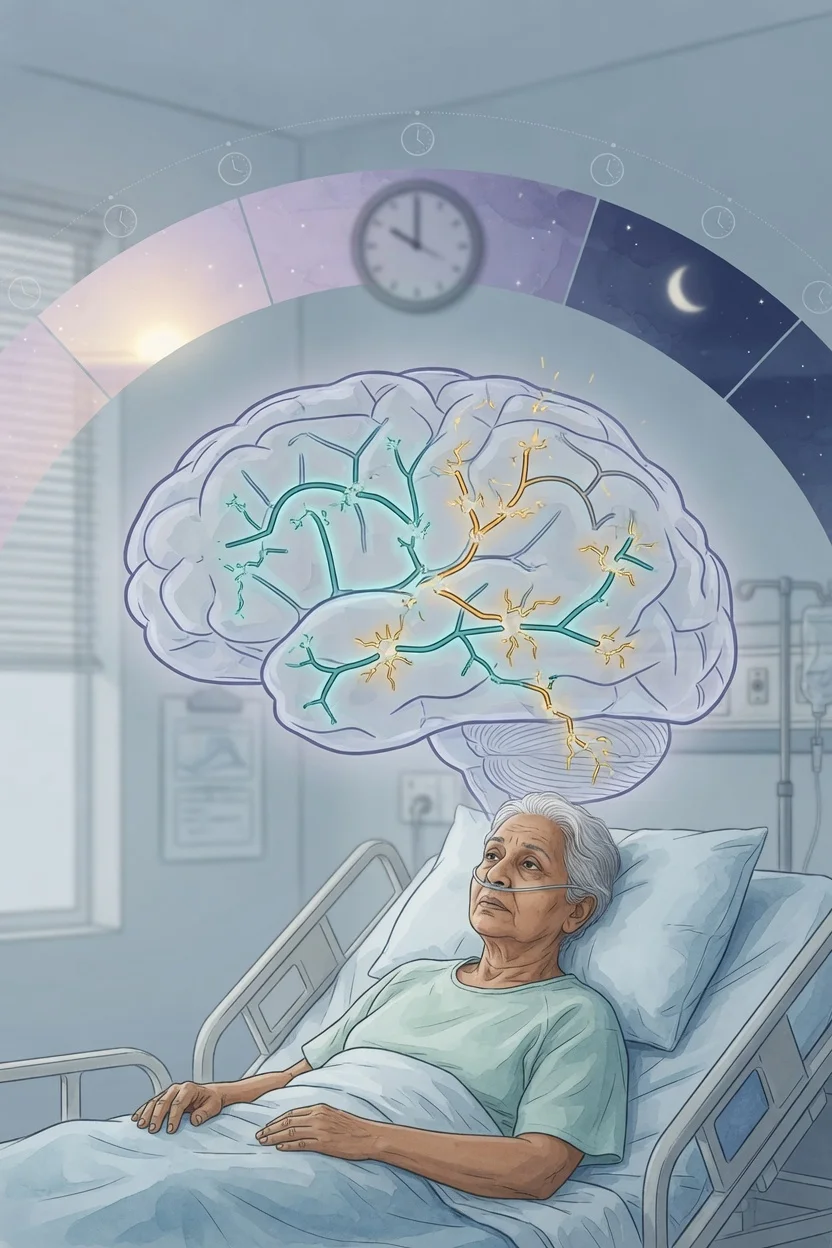
Delirium is the acute, fluctuating disturbance of attention and awareness that complicates the critical illness. It affects over half of the ICU patients, it is missed without the screening, and it is independently associated with the longer ventilation, the longer stay, the higher mortality, and the long-term cognitive impairment — the post-intensive care syndrome (the PICS).[2][3]
The screening: the CAM-ICU and the ICDSC
The CAM-ICU is the validated bedside screen performed each shift. It is positive when: the acute fluctuation (feature 1) AND the inattention (feature 2), together with either the altered level of consciousness (feature 3) or the disorganised thinking (feature 4). The sensitivity is about 80 per cent and the specificity about 95 per cent. The ICDSC (the Intensive Care Delirium Screening Checklist) is the alternative — the 8-item checklist with the higher sensitivity and the lower specificity.[3][4]
The CAM-ICU in detail — the four-feature algorithm
The Confusion Assessment Method for the ICU (CAM-ICU) is the most widely taught bedside screen because it needs no verbal response — it works in the intubated, sedated and aphasic patient. It is performed every shift (the PADIS mandate) and takes under two minutes. A positive CAM-ICU requires feature 1 AND feature 2 AND (feature 3 OR feature 4): [1]
CAM-ICU — the four features and how each is tested
| Feature | What it tests | How it is done at the bedside | Positive when |
|---|---|---|---|
| 1. Acute onset or fluctuating course | Is the change new and changing? | Richmond Agitation-Sedation Scale (RASS) + nurse/clinician judgement + review of prior 24 h | Any RASS other than 0 in the past 24 h, OR fluctuation seen |
| 2. Inattention | The CORE feature — without it the test cannot be positive | Letters test (ASE): patient squeezes hand on the letter "A" in the sequence SAVEAHAART; errors >2 = abnormal. Picture recognition in non-verbal patients | >2 errors (or fails to complete) |
| 3. Altered level of consciousness | RASS | RASS — anything other than alert (0) | RASS < 0 or > 0 (i.e. not "alert and calm") |
| 4. Disorganised thinking | Logic / coherence | Yes/no questions ("Will a stone float?"; "Are there fish in the sea?"; command: "Hold up this many fingers") | >1 error |
The CAM-ICU has a sensitivity of ~80 per cent and specificity of ~95 per cent for delirium against the DSM-IV reference standard.[3] Its weakness is the false negative in hypoactive delirium — a quietly withdrawn, slow patient scores "RASS -1" and may be wrongly labelled merely sedated rather than delirious. The ICDSC compensates for this.
The ICDSC — the 8-item checklist
The Intensive Care Delirium Screening Checklist (ICDSC) scores eight items over the shift; a score >= 4 of 8 is positive. It captures subsyndromal delirium (score 1-3) — a useful early warning that the CAM-ICU, being binary, misses. [1]
ICDSC — the eight items (score >= 4 = delirium)
- Altered level of consciousness — anything other than alert (deep sedation/ex coma = not assessable).
- Inattention — difficulty following conversation/instructions.
- Disorientation — to time, place or person.
- Hallucination or delusion — or the patient reporting them.
- Psychomotor agitation or retardation — the hypoactive end is included here.
- Inappropriate mood or speech — anxiety, dysphoria, anger, euphoria.
- Sleep/wake cycle disturbance — sleeping by day, awake at night.
- Fluctuation of symptom severity — coming and going across the shift.
Delirium motoric subtypes — hyperactive is the exception, not the rule
The single most common error is to equate "delirium" with "agitation." It is not. The motoric subtype determines the clinical picture, the prognosis, and — increasingly — the drug choice. [1]
Delirium motoric subtypes — frequency, features and prognosis
| Subtype | Frequency | Clinical picture | Who | Prognosis |
|---|---|---|---|---|
| Hyperactive | ~1-2 per cent (the minority) | Agitation, restlessness, pulling at lines, hallucinations, shouting — the "classic" delirium | Withdrawal (alcohol, benzodiazepines), drug intoxication | Best prognosis of the three (because it is seen and treated) |
| Hypoactive | ~40-50 per cent | Quiet, withdrawn, slow, lethargic, poorly responsive — looks "calm" or "over-sedated" | Sepsis, hepatic/uraemic encephalopathy, elderly, post-cardiotomy | Worst prognosis — missed, longer ventilation, highest mortality |
| Mixed | ~50 per cent (the majority) | Fluctuates between hyper- and hypoactive over hours-to-days | Most ICU delirium | Intermediate |
Risk factors — the predisposing and the precipitating
Delirium is the product of a vulnerable brain meeting an insult. The predisposing factors (the patient) and the precipitating factors (the ICU) combine — the more risk factors, the higher the probability. The modifiable ones are where the prevention bundle earns its money. [1]
Delirium risk factors — predisposing vs precipitating
| Predisposing (the patient) | Precipitating (the ICU / illness) |
|---|---|
| Older age (especially > 65) | Sepsis / systemic inflammation |
| Pre-existing dementia or cognitive impairment | Hypoxia / hypercapnia |
| Hypertension, prior stroke | Metabolic derangement (Na, glucose, renal, hepatic) |
| Depression, alcohol misuse | Surgery (especially cardiac and non-cardiac major) |
| Smoking, visual/hearing impairment | Benzodiazepines and opioids |
| Frailty, baseline dependence | Sleep deprivation and sensory deprivation |
| — | Pain, immobility, catheters/lines, restraints |
Risk factors — what the examiner wants named, grouped by modifiability
- NON-MODIFIABLE (predisposing): advancing age; pre-existing dementia or cognitive impairment; prior stroke; depression; alcohol and substance misuse; frailty; hypertension; severe baseline illness (APACHE).
- MODIFIABLE — sedation-related: benzodiazepines (the single strongest drug association — lorazepam and midazolam dose-dependently increase delirium); opioids (especially piperidine derivatives); deep or prolonged sedation; propofol in high dose.
- MODIFIABLE — metabolic/infective: sepsis and septic shock; hypoxaemia; metabolic encephalopathy (hyponatraemia, hyperglycaemia, uraemia, hepatic failure); withdrawal (alcohol, benzodiazepine).
- MODIFIABLE — environmental: sleep deprivation (ICU patients average < 2 hours of total sleep, almost none of it restorative REM/Stage 3-4); sensory deprivation or over-stimulation (noise, continuous light); immobility; restraints; catheter/line burden; absence of family.
- MODIFIABLE — procedural: surgery (cardiac bypass and high-risk non-cardiac); prolonged anaesthesia; re-intubation.
- The composite: the MORE risk factors present, the higher the risk — patients with >= 4 risk factors develop delirium in > 80 per cent of cases.[3][4]
Pathophysiology — why the acutely ill brain fails to attend
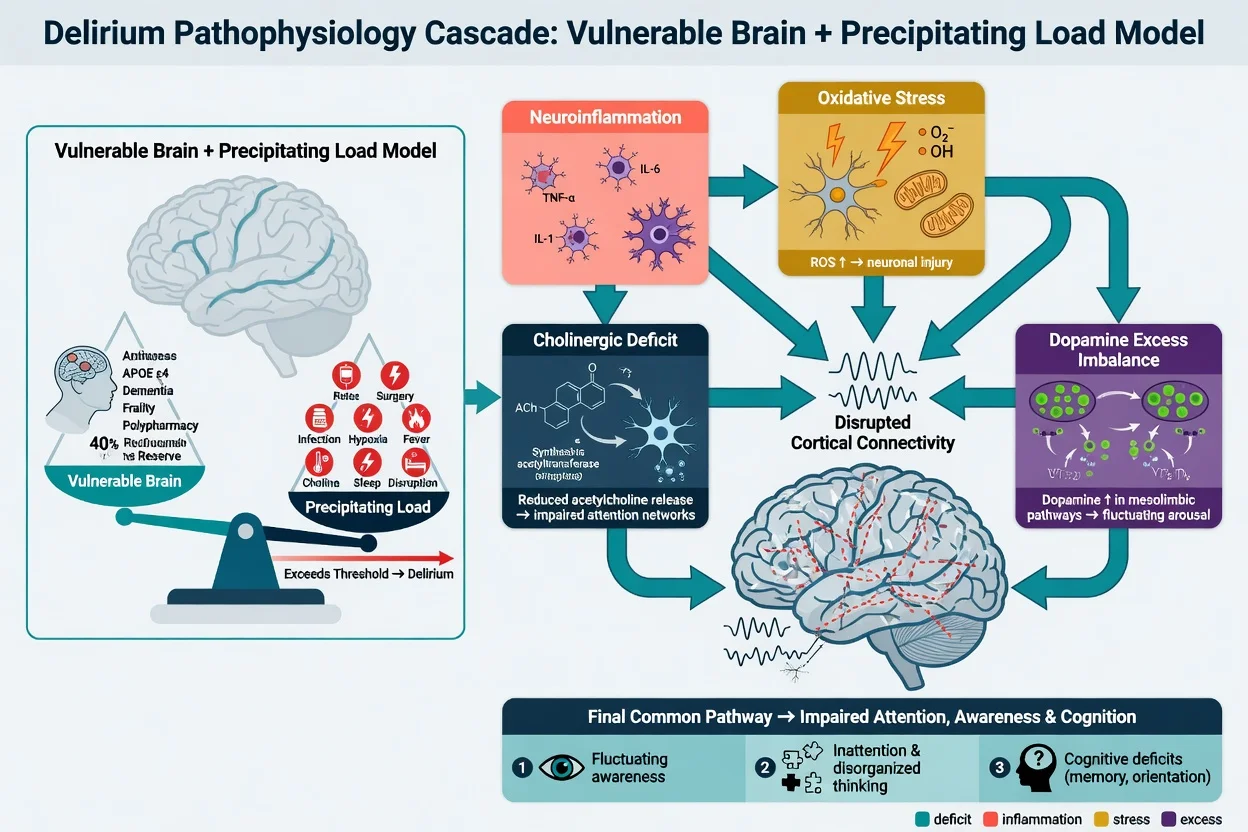
The mechanism is multifactorial and not fully resolved, which is why no single drug is curative. The leading, convergent pathways:[3]
- Neuroinflammation — systemic inflammation (sepsis, surgery) activates microglia and disrupts the blood-brain barrier; circulating cytokines (IL-1, IL-6, TNF) alter neurotransmission. This explains why sepsis is the dominant precipitant.
- Neurotransmitter imbalance — relative acetylcholine deficiency and dopamine excess (the classic "low ACh / high DA" model). Anticholinergic burden (many ICU drugs) and dopaminergic states (withdrawal, Parkinson's treatment) precipitate delirium. This is the rationale — now largely discredited — that underlies haloperidol (D2 blockade).
- Altered sleep architecture — critical illness and the ICU environment abolish slow-wave and REM sleep; without restorative sleep the brain cannot maintain attention. Dexmedetomidine uniquely preserves a sleep-like state.
- Reduced cerebral perfusion / microthrombosis — especially in shock and after cardiac arrest.
- Metabolic encephalopathy — substrate or electrolyte disturbance directly impairing neuronal function. [1]
The prevention: the bundle
The prevention is more effective than the treatment, and it is a bundle:[3]
- The light, the protocolised sedation — the analgesia-first, the RASS 0 to -2, the daily interruption, the benzodiazepine minimisation.
- The early mobilisation — the day-1 passive to active, the proven delirium-reduction intervention.
- The sleep and the day-night cycle — the clustered care, the lights-off, the earplugs, the eye masks; the minimisation of the nocturnal noise and the disruption.
- The reorientation, the hearing aids, the glasses, the family presence.
- The prompt treatment of the cause — the infection, the hypoxia, the metabolic, the pain, the withdrawal.[4]
The ABCDEF bundle — the operational form of prevention
The ABCDEF bundle is the Society of Critical Care Medicine (SCCM) operationalisation of the PADIS guideline. Each letter is an evidence-based element; the bundle is greater than the sum of its parts — sites that deliver all six elements report the largest reductions in delirium, coma, ventilation days and mortality. [1]
The ABCDEF bundle — every element, every day
- A — Assess, prevent and manage pain. Analgesia-first. Treat pain before adding sedatives — untreated pain is the commonest cause of agitation and a delirium driver. Tools: NRS if communicative, CPOT (Critical-Care Pain Observation Tool) > 2 or BPS (Behavioural Pain Scale) > 5 in the non-communicative.
- B — Both SAT and SBT. A daily Spontaneous Awakening Trial (stop sedation) paired with a Spontaneous Breathing Trial — the single most effective ventilator-weaning intervention; reduces ventilation days, delirium and mortality. Perform together; restart at half-dose if the patient fails.
- C — Choice of analgesia and sedation. Prefer dexmedetomidine or propofol; minimise benzodiazepines. Target light sedation (RASS -1 to 0) — deep sedation (RASS <= -3) in the first 48 h independently increases mortality.
- D — Delirium: assess, prevent, manage. CAM-ICU every shift; treat the cause; bundle the rest. Do NOT reach for an antipsychotic first.
- E — Early mobility and exercise. The single best-studied delirium-prevention intervention — begin passive range-of-movement on day 1, progress to active and out-of-bed as able. Reduces delirium days and ICU-acquired weakness.
- F — Family engagement and empowerment. Family at the bedside, reorientation cues, communication, and involvement in care — reduces anxiety and delirium, and underpins post-ICU recovery.
Non-pharmacological prevention — the interventions that actually work
Prevention is overwhelmingly non-pharmacological, and it is more effective than any drug. The hierarchy of benefit: [1]
Non-pharmacological delirium prevention — ranked by evidence
| Intervention | Mechanism / rationale | Strength of evidence |
|---|---|---|
| Early mobilisation (day 1) | Restores sensory input, cognition, sleep; reduces ICU-acquired weakness | Strongest — the headline intervention |
| Light, protocolised sedation (RASS -1 to 0) + SAT/SBT | Avoids deep sedation and over-sedation; benzodiazepine minimisation | Strong |
| Reorientation (clocks, calendars, verbal orientation, whiteboards) | Restores temporal and environmental anchoring | Moderate |
| Sleep hygiene / day-night cycle | Clustered night care, lights-off, earplugs, eye masks, reduce noise/alarms | Moderate — improves sleep; modest delirium effect |
| Family engagement and presence | Familiar faces, communication, reduced isolation | Moderate |
| Sensory restoration — hearing aids in, glasses on | Removes reversible perceptual impairment | Moderate (often overlooked) |
| Minimise night-time interventions | Protects the sleep window | Moderate |
| Prompt treatment of the cause (infection, hypoxia, metabolic, pain, withdrawal) | Removes the precipitant | Strong (self-evident) |
| Melatonin / ramelteon for refractory sleep disruption | Circadian restoration | Emerging — small trials positive |
Sleep in the ICU — what is lost and why it matters
ICU sleep is severely disrupted. Healthy adults cycle through N1-N2-N3 (slow wave) and REM roughly every 90 minutes; the ICU patient loses this architecture: [1]
- Total sleep is reduced to roughly 2 hours per 24 (from the normal 6-8), and is fragmented into brief epochs.
- Slow-wave (Stage 3-4) and REM sleep are almost abolished — precisely the stages that consolidate cognition and memory. What little sleep occurs is superficial N1-N2.
- Drivers: noise (alarms > 70 dB, conversations), light (continuous), patient-care interruptions (the average ICU patient is touched/woken hourly overnight), pain, anxiety, sedative drugs (benzodiazepines and opioids suppress REM), and the illness itself (inflammation disrupts sleep). [1]
The PADIS sleep-protection bundle — protecting the night
- Cluster night care — group nursing tasks (observations, medications, turning, blood tests) so the patient is woken once, not hourly. This is the highest-yield single sleep intervention.
- Lights-off at a set hour — darken the unit; maintain a visible day-night light cycle so the suprachiasmatic nucleus can entrain.
- Earplugs and eye masks — cheap, evidence-supported (RCTs show reduced delirium incidence with earplug use).
- Minimise noise and alarms — set alarms appropriately, silence non-actionable alerts, lower conversation volume.
- Protect the sleep window — designate protected quiet hours (e.g. 0000-0400) where non-urgent care is deferred.
- Pharmacology: prefer dexmedetomidine for nocturnal sedation (it produces a non-REM-like, arousable state and does not suppress REM). Melatonin or ramelteon for refractory circadian disruption. AVOID benzodiazepines (suppress REM) and z-drugs.
The management: the dexmedetomidine and the haloperidol
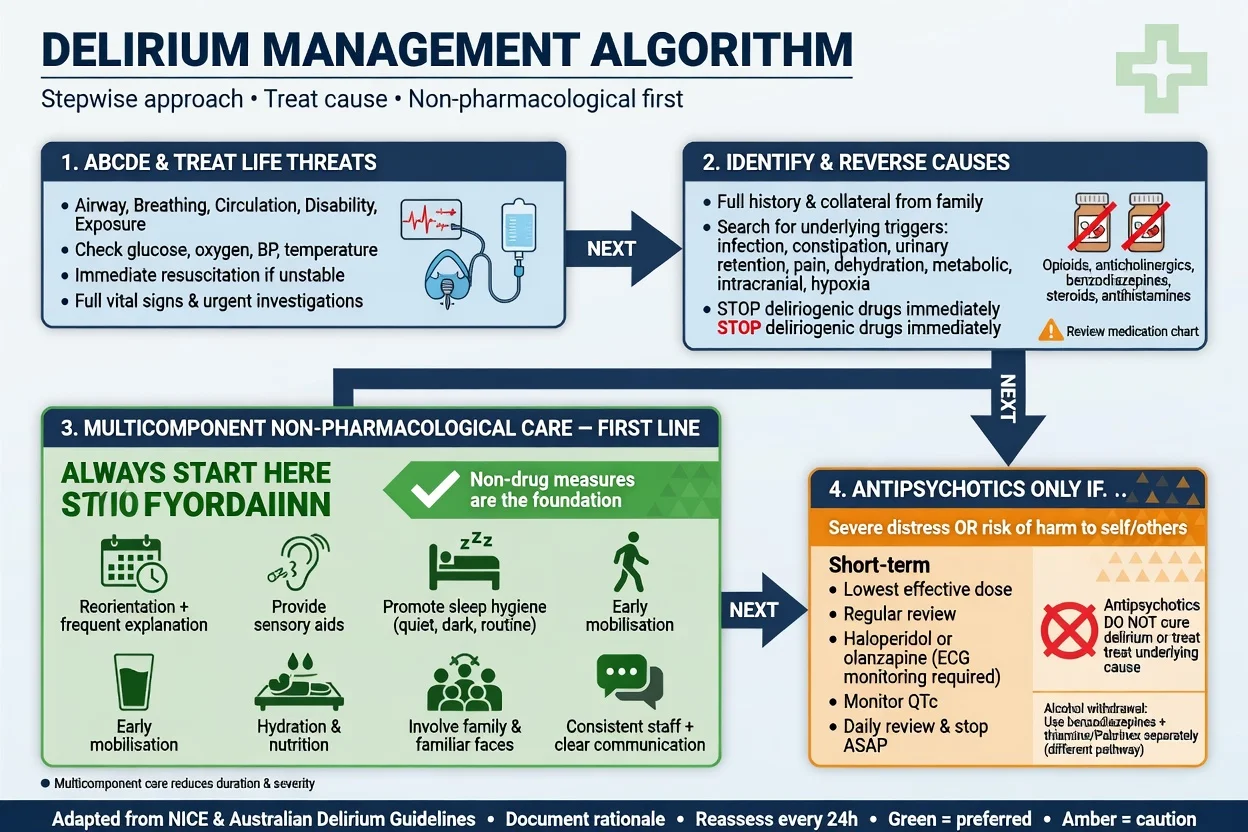
The dexmedetomidine is the preferred drug for the ICU delirium (the PADIS guideline) — the alpha-2 agonist reduces the delirium prevalence and duration (the SEDCOM trial, reused from the sedation domain) without the respiratory depression. It is the first-line for the delirious ICU patient.[3]
The haloperidol — the REDUCE trial (JAMA 2018) was a large study of the prophylactic haloperidol in the high-risk patients, and it showed no improvement in the 28-day survival (the primary outcome). The haloperidol is NOT routinely recommended for the delirium prophylaxis. It is reserved for the agitated delirium that endangers the patient or the lines (the QT monitored), as a bridge while the dexmedetomidine and the cause treatment take effect.[1]
Pharmacological management — what to use, and what to avoid
Drugs come AFTER the cause is treated and the bundle is delivered. The PADIS 2018 guideline (reaffirmed 2023) is explicit: there is no drug that should be given routinely for the prophylaxis or routine treatment of ICU delirium, because no antipsychotic improves outcomes and benzodiazepines worsen them. Drug therapy is reserved for the hyperactive/mixed patient in whom agitation endangers the patient, the staff or the lines. [1]
The pharmacological options for ICU delirium — evidence rank
| Drug | Class / mechanism | Role | Evidence | Key caution |
|---|---|---|---|---|
| Dexmedetomidine | Selective alpha-2A agonist — arousable sedation; analgesia-sparing; non-REM-like | First-line for the hyperactive/mixed delirious, ventilated patient | MENDS (more delirium-free days vs lorazepam); SEDCOM (delirium 54% vs 76.6% vs midazolam) | Bradycardia, hypotension (bolus avoided); costly |
| Quetiapine | Atypical antipsychotic (D2 + 5-HT2A) | Second-line / emerging for persistent delirium unresponsive to dexmedetomidine | Small RCTs suggest shorter delirium duration than placebo; evidence emerging, not definitive | Sedation, hypotension, QT prolongation, metabolic effects |
| Haloperidol | Typical antipsychotic (D2 blockade) | AVOID routinely. Reserve for dangerous agitation as a short bridge | HOPE-ICU, REDUCE, AID-ICU — NO benefit on delirium duration, survival or days alive/out of hospital | QT prolongation, torsades, extrapyramidal effects, neuroleptic malignant syndrome |
| Benzodiazepines (midazolam, lorazepam, diazepam) | GABA-A agonists | AVOID as sedation; use ONLY for withdrawal or seizures | Strongly deliriogenic — the strongest modifiable drug risk factor | Cause the very delirium they are wrongly used to treat |
| Propofol | GABA-A agonist (different kinetic profile) | Acceptable alternative sedative for the intubated patient | Less delirium signal than benzodiazepines | Hypotension; PRIS at high dose (> 4 mg/kg/h for > 48 h) |
| Melatonin / ramelteon | MT1/MT2 agonist — circadian restoration | Adjunct for refractory sleep disruption | Small RCTs positive for delirium prevention in elderly | Generally well tolerated |
Dexmedetomidine — the PADIS-preferred agent
Dexmedetomidine is the alpha-2A agonist that produces arousable, non-REM-like sedation with preserved respiratory drive and analgesia-sparing effect. Two landmark trials established its delirium advantage over benzodiazepines: [1]
- MENDS (Pandharipande, JAMA 2007) — dexmedetomidine vs lorazepam in medical/surgical ICU: more days alive without delirium or coma.[5]
- SEDCOM (Riker, JAMA 2009) — dexmedetomidine vs midazolam in 375 ventilated patients: delirium prevalence 54% vs 76.6%, and shorter time to extubation.[6]
It is the first-line drug for the hyperactive or mixed delirious, ventilated patient. Caveat: SPICE III (2019) showed no overall mortality benefit of dexmedetomidine vs usual care, and more bradycardia — so it is not a mandate for every patient, but it remains the preferred agent when a drug is needed for delirium. [1]
Quetiapine — emerging second-line for persistent delirium
For the patient whose delirium persists despite dexmedetomidine and maximal bundle therapy, quetiapine (an atypical antipsychotic) has the best of the emerging evidence: small RCTs (e.g. Devlin 2010) suggest it shortens delirium duration compared with placebo, with less extrapyramidal effect than haloperidol. The evidence is not definitive (small trials, surrogate outcomes) — the PADIS guideline offers only a weak, conditional suggestion. Use is by specialist preference, with baseline and repeat ECG (QTc) and metabolic monitoring. Haloperidol is not the default fallback. [1]
Haloperidol — the drug to avoid (the three negative trials)
The cumulative evidence from three large randomised trials is that haloperidol does not improve patient-centred outcomes in ICU delirium: [1]
REDUCE — van den Boogaard 2018, JAMA (PMID 29466591)
Study design
Multicentre, double-blind RCT — 1789 critically ill adults at high risk of delirium, randomised to prophylactic haloperidol 1 mg IV q8h, ziprasidone, or placebo
Intervention
Prophylactic haloperidol or ziprasidone vs placebo, started within 24 h of admission
Key finding
No difference in 28-day survival (primary outcome) or delirium-free days. No reduction in delirium incidence
Clinical bottom line
Prophylactic haloperidol does NOT improve survival or prevent delirium in high-risk ICU patients. Routine prophylaxis is NOT recommended
HOPE-ICU — Page 2013, Lancet Respir Med (PMID 24461612)
Study design
Randomised, double-blind, placebo-controlled trial — 142 mechanically ventilated adults with delirium, treated with haloperidol 2.5 mg IV q8h vs placebo
Intervention
Therapeutic (not prophylactic) haloperidol for established delirium
Key finding
No significant difference in delirium-free or coma-free days within 14 days (the primary outcome). No benefit on any secondary outcome
Clinical bottom line
Treating established delirium with haloperidol does NOT shorten delirium duration. The D2-blockade rationale does not translate into clinical benefit
AID-ICU — Dahl 2022, NEJM (PMID 36286254)
Study design
Multinational, randomised, double-blind, placebo-controlled trial — ~1000 acutely admitted ICU patients with delirium, haloperidol 5 mg/day (titratable) vs placebo
Intervention
Therapeutic haloperidol for acute ICU delirium
Key finding
No significant difference in days alive and out of hospital at 90 days (primary outcome). No benefit on mortality or delirium duration
Clinical bottom line
The largest and most definitive trial. Haloperidol does NOT improve outcomes in acute ICU delirium. Routine use should be abandoned; reserve for dangerous agitation only
SEDCOM — Riker 2009, JAMA (PMID 19188334)
Study design
Prospective, double-blind, multicentre RCT — 375 mechanically ventilated ICU patients, dexmedetomidine vs midazolam for sedation (target RASS -2 to +1)
Intervention
Dexmedetomidine vs midazolam infusion for sedation
Key finding
Delirium prevalence 54% (dexmedetomidine) vs 76.6% (midazolam), p<0.001. Median time to extubation 3.7 vs 5.6 days, p=0.01. Similar time in target sedation range
Clinical bottom line
Dexmedetomidine halves the delirium prevalence seen with midazolam and shortens ventilation — the cornerstone evidence for the PADIS preference for alpha-2 agonism over benzodiazepines
MENDS — Pandharipande 2007, JAMA (PMID 18073360)
Study design
Double-blind RCT — 106 medical/surgical ICU patients sedated with dexmedetomidine vs lorazepam for up to 5 days
Intervention
Dexmedetomidine vs lorazepam (benzodiazepine) infusion
Key finding
Dexmedetomidine gave more days alive without delirium or coma (median 7 vs 3, p=0.01) and a lower prevalence of coma
Clinical bottom line
First trial to show that avoiding a benzodiazepine in favour of dexmedetomidine reduces acute brain dysfunction in the ICU
Pandharipande BRAIN-ICU — NEJM 2013 (PMID 24088092)
Study design
Prospective cohort — 821 medical/surgical ICU patients, assessed for delirium and followed with cognitive testing at 3 and 12 months
Key finding
34% had deficits at 3 months resembling mild Alzheimer's, 24% at 12 months resembling moderate TBI. Longer delirium duration independently predicted worse cognition
Clinical bottom line
Delirium is not a transient ICU phenomenon — it causes lasting cognitive impairment in a quarter of survivors at one year. The case for prevention
Sleep and the day-night cycle
The ICU sleep is disrupted and fragmented — the frequent awakenings (the care, the alarms, the noise), the abnormal light exposure (the continuous light), the loss of the circadian rhythm, and the effects of the sedation and the illness. The sleep disruption contributes to the delirium and the impaired recovery.[3][4]
The PADIS sleep recommendations: the clustered care (the grouping of the nursing tasks to reduce the nocturnal interruptions), the lights-off (the darkening of the unit at night), the earplugs and the eye masks, the minimisation of the noise, and the melatonin or the ramelteon for the refractory insomnia. The dexmedetomidine (which mimics the natural non-REM sleep) is preferred for the nocturnal sedation.[3]
The post-intensive care syndrome
The PICS is the constellation of the cognitive, the psychological and the physical impairments that persist after the ICU discharge. The cognitive impairment (the Pandharipande BRAIN-ICU study, NEJM 2013 — the 40 per cent of the survivors had the deficits at 3 months, the 25 per cent at 12 months, similar to the mild Alzheimer's or the moderate TBI) is the most distinctive. The psychological (the PTSD, the depression, the anxiety) and the physical (the ICU-acquired weakness, the reduced function) are the other components.[2][3]
The prevention of the PICS is the delirium prevention, the light sedation, the early mobilisation, and the follow-up clinics (the post-ICU recovery).[2]
Outcomes — what delirium costs the patient
Delirium is independently associated with worse outcomes, and the relationship is dose-dependent: each additional day of delirium increases the risk of death and prolongs stay. The associations hold after adjustment for age, illness severity and comorbidity.[2][3]
Outcomes associated with ICU delirium
| Outcome | Magnitude / association | Note |
|---|---|---|
| Mortality | ~2-3x higher in-hospital and 6-month mortality | Independent predictor; persists after risk adjustment |
| Ventilation duration | Longer by days-to-weeks | Each delirium day adds ~1 day of ventilation |
| ICU length of stay | Markedly longer | Major cost driver |
| Hospital length of stay | Longer | Drives readmission risk |
| Long-term cognitive impairment | 26-34% at 12 months (BRAIN-ICU) | Resembles mild Alzheimer's / moderate TBI; the PICS cognitive domain |
| ICU-acquired weakness | More frequent | Shared immobility/inflammation pathway |
| PTSD / depression / anxiety | More frequent | The PICS psychological domain |
| Functional decline / QoL | Reduced at 6-12 months | Many never return to baseline independence |
The post-intensive care syndrome (PICS) — the long shadow
The PICS is the constellation of new or worsening cognitive, psychological and physical impairment that persists after critical illness and ICU discharge — present in the majority of long-stay survivors. It is the long-term face of delirium and critical illness, and the reason modern ICU care extends beyond discharge. [1]
PICS — the three domains
| Domain | Manifestations | Prevalence / timeline |
|---|---|---|
| Cognitive (most distinctive) | Impaired memory, attention, executive function, processing speed | 40% at 3 months, 25% at 12 months (BRAIN-ICU); resembles mild Alzheimer's / moderate TBI |
| Psychological | PTSD, depression, anxiety, panic | 20-40% report PTSD symptoms; depression common |
| Physical | ICU-acquired weakness (CIP/CIM), reduced exercise tolerance, ADL dependence, dysphagia, tracheostomy | Up to 50% of long-stay patients |
Preventing and managing PICS — the post-ICU agenda
- Prevent delirium (the dominant driver of the cognitive domain) — the ABCDEF bundle.
- Sedate lightly (RASS -1 to 0) and minimise benzodiazepines — deep sedation and benzodiazepines predict worse long-term cognition.
- Mobilise early — prevents ICU-acquired weakness and reduces cognitive decline.
- ICU diaries — a daily, lay-language record kept by staff/family that helps the patient reconstruct the lost period; reduces PTSD.
- Post-ICU follow-up clinics — cognitive and functional screening at 2-3 months; referral to rehabilitation, neuropsychology, and peer support.
- Family/PICS-F — relatives also suffer anxiety, depression, PTSD (PICS-Family); involve them and signpost support.[2][3]
Management: the integrated approach
- Screen each shift with the CAM-ICU.[3]
- Prevent with the bundle — the light sedation, the benzodiazepine minimisation, the early mobilisation, the sleep, the reorientation.[4]
- Treat the cause — the infection, the hypoxia, the metabolic, the pain, the withdrawal.[3]
- The dexmedetomidine for the drug management (the PADIS preferred).[3]
- The haloperidol only for the agitated delirium (REDUCE — no survival benefit).[1]
- The follow-up — the post-ICU clinic, the cognitive and the functional assessment.[2]
Monitoring
- The CAM-ICU each shift.
- The RASS and the CPOT for the sedation and the pain.
- The sleep — the observation (the periods of the rest), the clustered care documented.
- The long-term — the cognitive and the functional follow-up.[3][4]
Prognosis
The delirium independently predicts the longer stay, the higher mortality and the long-term cognitive impairment (the Pandharipande study). The PICS affects the majority of the long-stay ICU survivors, and the follow-up clinics and the rehabilitation are the modern additions to the ICU care.[2][3]
Exam practice
SAQ — Hypoactive delirium: recognition, screening, and the ABCDEF bundle
10 minutes · 10 marks
A 72-year-old man is on day 6 of an ICU admission for severe community-acquired pneumonia with septic shock. He has been extubated for 48 hours. The nursing staff report he is 'quiet and settled.' On examination he is lying still with his eyes closed, opens his eyes to voice but does not follow commands consistently, and his RASS is -2. He makes occasional errors when asked to squeeze his hand on the letter A in the sequence SAVEAHAART. His CAM-ICU is positive.
SAQ — Haloperidol vs dexmedetomidine: the pharmacological evidence for ICU delirium
10 minutes · 10 marks
A consultant asks you whether to prescribe haloperidol for the routine prophylaxis of delirium in a cohort of high-risk ICU patients. You are asked to review the evidence and recommend a pharmacological strategy.
Clinical pearls
[1]Exam pitfalls — the answers examiners are probing for
Red flags
Severity / context — how sick, and where this fits
Delirium severity and outcome — the dose-response framing
High
Delirium is among the most prevalent and most consequential complications of critical illness: present in over half of ICU patients, independently associated with a 2-3x mortality increase, longer ventilation and stay, and durable cognitive impairment in a quarter of survivors at one year. It is also among the most preventable — the ABCDEF bundle, early mobilisation, light sedation and benzodiazepine minimisation are high-yield, low-cost interventions. The examiner's framing: this is a diagnosis to be actively sought (screen every shift), prevented (the bundle) and managed (treat the cause; dexmedetomidine — not haloperidol).[2][3]
Hyperactive vs hypoactive delirium — the contrast the examiner wants
| Feature | Hyperactive | Hypoactive |
|---|---|---|
| Frequency | ~1-2% (the minority) | ~40-50% (the common, lethal form) |
| Motor activity | Agitated, restless, pulling at lines | Quiet, withdrawn, lethargic, slowed |
| Level of consciousness | RASS > +1 | RASS < 0 |
| Recognition | Seen immediately (noisy) | Missed ("looks settled") |
| Typical cause | Withdrawal, intoxication | Sepsis, metabolic, elderly, post-op |
| Prognosis | Best of the three | Worst — longest ventilation, highest mortality |
| Drug of choice | Dexmedetomidine; haloperidol only if dangerous | Treat the cause; dexmedetomidine; avoid over-sedation |
CAM-ICU vs ICDSC — side by side
| Feature | CAM-ICU | ICDSC |
|---|---|---|
| Type | Binary (positive/negative) | 8-item score (0-8) |
| Positive threshold | Algorithm (1 + 2 + [3 or 4]) | Score >= 4 of 8 |
| Time to perform | < 2 min | One shift of observation |
| Sensitivity | ~80% | Higher (also detects subsyndromal, 1-3) |
| Specificity | ~95% | Lower |
| Verbal response needed? | No (works intubated) | No |
| Best use | Every-shift bedside screen | Research; grading severity |
The drug classes — what to use and what to avoid
| Class | Example | Effect on delirium | PADIS position |
|---|---|---|---|
| Alpha-2 agonist | Dexmedetomidine | Reduces (MENDS, SEDCOM) | Preferred for sedation and delirium |
| Benzodiazepine | Midazolam, lorazepam | Worsens (deliriogenic) | Avoid; withdrawal/seizure only |
| Typical antipsychotic | Haloperidol | No benefit (REDUCE, HOPE-ICU, AID-ICU) | Not routine; dangerous agitation only |
| Atypical antipsychotic | Quetiapine | Possibly reduces (emerging) | Conditional second-line for persistent delirium |
| Melatonin agonist | Melatonin, ramelteon | Possibly prevents (small RCTs) | Adjunct for sleep disruption |
| Intravenous anaesthetic | Propofol | Less signal than benzodiazepines | Acceptable alternative sedative; beware PRIS |
Key trials and evidence — the five to know
The five trials every candidate must know — delirium & sleep
REDUCE (2018)
Prophylactic haloperidol in 1789 high-risk patients — NO survival benefit, NO delirium prevention
HOPE-ICU (2013)
Therapeutic haloperidol in 142 ventilated patients — NO reduction in delirium duration
AID-ICU (2022)
Therapeutic haloperidol in ~1000 patients — NO improvement in days alive/out of hospital at 90 days
MENDS (2007) + SEDCOM (2009)
Dexmedetomidine vs lorazepam/midazolam — more delirium-free days; delirium 54% vs 76.6%
BRAIN-ICU (2013)
Long-term cognition — 40% impaired at 3 months, 25% at 12 months; delirium duration predicts deficit
References
- [1]van den Boogaard M, Schoonhoven L, van der Hoeven JG, et al. Effect of Haloperidol on Survival Among Critically Ill Adults With a High Risk of Delirium: The REDUCE Randomized Clinical Trial JAMA, 2018.PMID 29466591
- [2]Pandharipande PP, Girard TD, Jackson JC, et al.; BRAIN-ICU Study Group. Long-term cognitive impairment after critical illness N Engl J Med, 2013.PMID 24088092
- [3]Ely EW, Margolin R, Francis J, et al. Evaluation of delirium in critically ill patients: validation of the Confusion Assessment Method for the Intensive Care Unit (CAM-ICU) Crit Care Med, 2001.PMID 11445689
- [4]Bergeron N, Dubois MJ, Dumont M, Dial S, Skrobik Y Intensive Care Delirium Screening Checklist: evaluation of a new screening tool Intensive Care Med, 2001.PMID 11430542
- [5]Pandharipande PP, Pun BT, Herr DL, et al. Effect of sedation with dexmedetomidine vs lorazepam on acute brain dysfunction in mechanically ventilated patients: the MENDS randomized controlled trial JAMA, 2007.PMID 18073360
- [6]Riker RR, Shehabi Y, Bokesch PM, et al.; SEDCOM (Safety and Efficacy of Dexmedetomidine Compared With Midazolam) Study Group. Dexmedetomidine vs midazolam for sedation of critically ill patients: a randomized trial JAMA, 2009.PMID 19188334
- [7]Page VJ, Ely EW, Gates S, et al. Effect of intravenous haloperidol on the duration of delirium and coma in critically ill patients (Hope-ICU): a randomised, double-blind, placebo-controlled trial Lancet Respir Med, 2013.PMID 24461612
- [8]Dahl M, Wøjcik C, Wihlborg AK, et al.; AID-ICU Trial Group. Haloperidol for the Treatment of Delirium in ICU Patients N Engl J Med, 2022.PMID 36286254