ICU · Sedation / procedural
Procedural Sedation in the ICU — Capnography, Agents & the Safety Bundle
Also known as Procedural sedation · Conscious sedation · Moderate sedation · Deep sedation · Capnography · End-tidal CO2 · Propofol · Ketamine · Midazolam · Fentanyl · Etomidate · Dexmedetomidine · Naloxone · Flumazenil · Sedation continuum
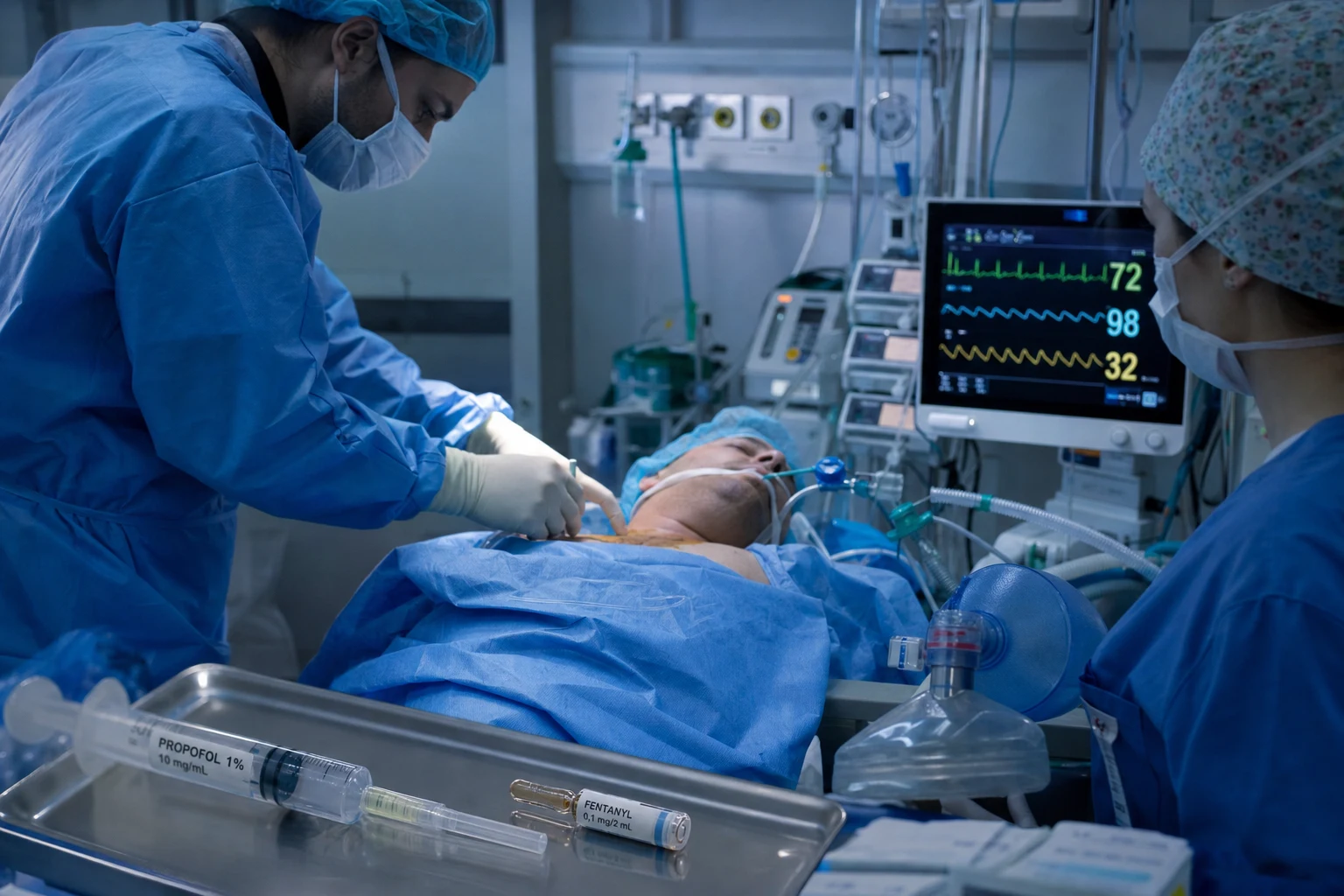
The procedural sedation is a drug-induced depression of the consciousness for a painful or an unpleasant procedure, maintaining the spontaneous ventilation and the airway reflexes (distinct from the general anaesthesia, where the airway is unprotected and the ventilation supported). The continuum runs from the minimal to the moderate, the deep, and the general anaesthesia — as the depth increases, the airway, the reflexes, the respiration, and the cardiovascular function are progressively compromised. The goal is the analgesia plus the anxiolysis plus the amnesia plus the immobility, with the cardiorespiratory stability and the rapid recovery. The safety bundle: the pre-procedure assessment (the fasting, the airway, the ASA status), the monitoring (the continuous ECG, the SpO2, the BP, and the CAPNOGRAPHY — the standard of care that detects the apnoea early), the dedicated observer (not the operator), and the rescue equipment plus the reversal agents. The agents: the propofol (the rapid and the deep, the hypotension and the respiratory depression), the ketamine (the preserved airway and the BP, the bronchodilation, the emergence reactions), the midazolam plus the fentanyl, the etomidate (the haemodynamically stable), and the dexmedetomidine (no respiratory depression). The reversal: the naloxone (the opioid) and the flumazenil (the benzodiazepine), with the re-sedation risk.
On this page & tools
Your progress
Saved locally on this device.
8 MCQs with explanations
Target exams
Overview & definition
The procedural sedation is a drug-induced depression of the consciousness for a painful or an unpleasant procedure, with the maintained spontaneous ventilation and the airway reflexes. It is distinct from the general anaesthesia, where the patient is unrousable, the airway is unprotected, and the ventilation is supported. The goal of the procedural sedation is the analgesia plus the anxiolysis plus the amnesia plus the immobility, with the cardiorespiratory stability and the rapid recovery.[1]
The ICU indications: the central venous catheterization, the arterial lines, the cardioversion, the chest tubes, the bronchoscopy, the endoscopy, the fracture and the joint reduction, the dressing changes, and the lumbar puncture.[1]
The continuum of the sedation
The sedation depth lies on a continuum (the ASA definition):[1]
| Depth | Responsiveness | Airway | Spontaneous ventilation | Cardiovascular |
|---|---|---|---|---|
| Minimal | The normal response to the verbal | Unaffected | Unaffected | Unaffected |
| Moderate (the "conscious sedation") | The purposeful response to the verbal or the light touch | No intervention needed | Adequate | Usually maintained |
| Deep | The purposeful response to the repeated or the painful stimulus | May need support | May be inadequate | Usually maintained |
| General anaesthesia | Unrousable, even to the pain | Often requires the support | Frequently inadequate | May be impaired |
As the depth increases, the airway, the reflexes, the respiration, and the cardiovascular function are progressively compromised — the operator must be prepared to rescue at the next deeper level.[1]
The safety bundle
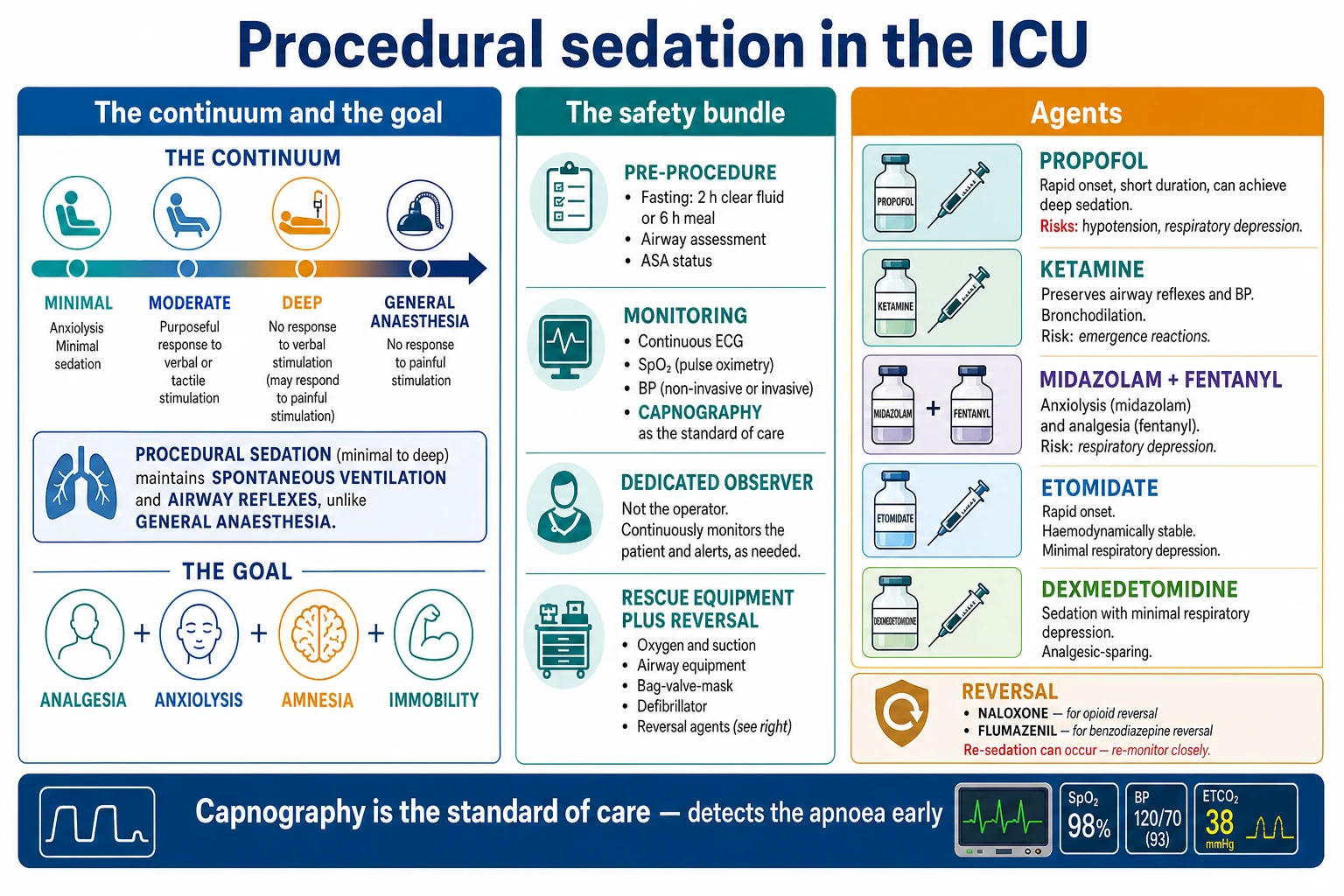
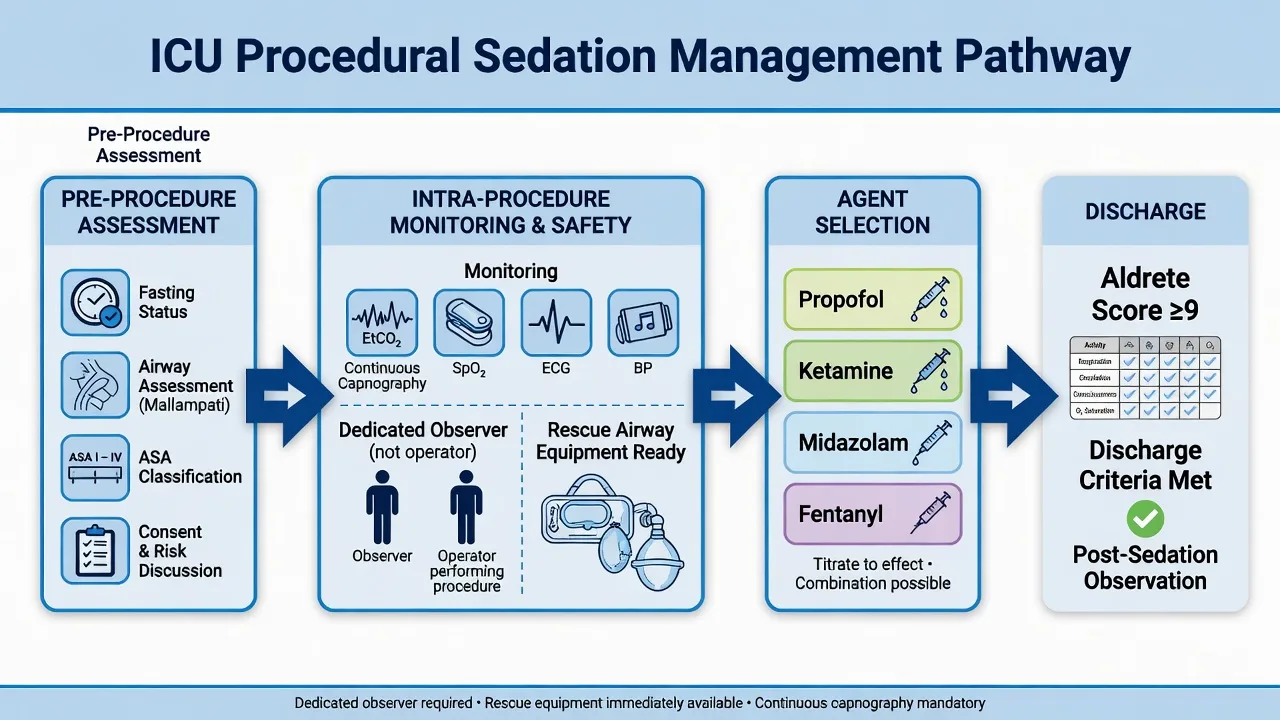
The pre-procedure assessment
- The history — the allergies, the medications, the OSA, the obesity, the difficult-airway predictors (the Mallampati, the neck mobility, the beard, the receding chin).[1]
- The fasting — the 2 hours for the clear fluids, the 6 hours for the light meal (the ASA guidance). In the ICU, the patient is often not fasted and is treated as the full stomach (the aspiration risk) — balance the urgency against the risk, and prefer the airway-protective techniques (the RSI) for the higher-risk sedation.[1]
- The ASA physical status — the stratification of the risk (the ASA 3 to 4 at the higher risk of the complications).[1]
- The informed consent, the IV access, the emergency equipment.[1]
The monitoring during the procedure
- The continuous ECG, the pulse oximetry, and the BP (every 3 to 5 minutes).[1]
- The capnography (the end-tidal CO2) — the standard of care. It detects the apnoea and the respiratory depression EARLIER than the pulse oximetry (the oximetry lags, especially on the supplemental oxygen).[1]
- The supplemental oxygen.[1]
- The level of the consciousness (the responsiveness) and the respiratory rate.[1]
The personnel
- The dedicated observer (the trained nurse) — NOT the operator. The observer monitors the patient and the airway; the operator performs the procedure.[1]
- The rescue equipment — the bag-valve-mask, the suction, the advanced airway, the resuscitation drugs.[1]
- The reversal agents at the bedside (the naloxone, the flumazenil).[1]
The agents
Propofol
The induction agent. The rapid onset and offset; the deep sedation; the titrated 0.5 to 1 mg/kg boluses. The hypotension and the respiratory depression (the apnoea) are the dose-dependent effects. The propofol infusion syndrome (PRIS) with the prolonged high-dose. The preferred agent for the rapid, the brief, the deep sedation.[1]
Ketamine
The dissociative anaesthesia. The maintained airway reflexes and the cardiovascular stability (the sympathetic stimulation); the analgesia and the anaesthesia; the bronchodilation (useful for the asthma). The emergence reactions (the hallucinations, the agitation) — reduced by the midazolam. The increased secretions (give the antisialogogue). The dose 0.5 to 1 mg/kg. The good agent for the haemodynamically unstable or the asthmatic patient.[1]
Midazolam and fentanyl
The classic combination. The midazolam (the benzodiazepine) gives the anxiolysis and the amnesia; the fentanyl (the opioid) gives the analgesia. The titrated, the incremental doses. The slower onset and offset than propofol; the respiratory depression; the paradoxical agitation in the elderly. The reliable, the moderate-sedation combination.[1]
Etomidate
The induction agent. The haemodynamically stable — the preferred for the RSI in the unstable or the shocked patient. The adrenal suppression (the single dose is controversial). The myoclonus and the nausea. For the intubation (the RSI), not the routine procedural sedation.[1]
Dexmedetomidine
The alpha-2 agonist. The sedation without the respiratory depression (the patient is arousable); the analgesia-sparing; the weaning and the procedural sedation. The bradycardia and the hypotension. The slower onset.[1]
Nitrous oxide (the entonox)
The inhaled 50 % nitrous oxide with the 50 % oxygen (the entonox), the self-administered via the demand-valve mask. The rapid onset and offset (1 to 2 minutes); the minimal cardiovascular and respiratory depression; the analgesia and the anxiolysis for the brief, the mildly painful procedures (the dressing changes, the wound care, the labour). The contraindications: the pneumothorax, the bowel obstruction, the middle-ear disease, the raised ICP (the expansion in the closed gas-filled spaces). The occupational hazard (the scavenging).[1]
The reversal agents
- The naloxone (the opioid reversal) — 40 to 100 µg titrated (avoid the full reversal that precipitates the pain and the pulmonary oedema). The shorter half-life than the opioid — the re-sedation risk (re-dose, the observation).[1]
- The flumazenil (the benzodiazepine reversal) — 0.2 mg titrated. The shorter half-life than the benzodiazepine — the re-sedation risk. The seizure risk in the chronic benzodiazepine users. The reserve for the over-sedation with the respiratory depression.[1]
The complications and the rescue
- The respiratory depression and the apnoea, the airway obstruction, the hypoxia, the hypotension, the aspiration. The management: the airway opening (the chin lift, the jaw thrust), the bag-valve-mask ventilation, the supplemental oxygen, the vasopressors, and the reversal if indicated. The early detection by the capnography prevents the deterioration.[1]
- The post-procedure recovery monitoring until the patient returns to the baseline (the RASS, the protective reflexes).[1]
Red flags
The agent pharmacology — the detailed comparison
The agent choice is matched to the patient, the procedure, and the desired depth. No single agent is "best"; the principle is the titration to the effect, the anticipation of the adverse effect, and the readiness to rescue.[1][2]
The procedural-sedation agents — onset, dose, advantages, pitfalls
| Agent | The class | The onset | The typical dose | The recovery | The strengths | The cautions |
|---|---|---|---|---|---|---|
| The propofol | The GABA-agonist | 30 to 60 s | 0.5 to 1 mg/kg boluses, titrate q1 to 2 min | 5 to 10 min | The rapid on and off; the deep, the titratable; the anti-emetic; the smooth recovery | The hypotension; the respiratory depression (the apnoea); the pain on the injection; the PRIS in the prolonged high-dose |
| The ketamine | The NMDA-antagonist | 1 to 2 min | 0.5 to 1.5 mg/kg IV (4 to 5 mg/kg IM) | 15 to 30 min | The preserved airway and BP; the bronchodilation; the profound analgesia; the dissociative state | The emergence reactions; the secretions; the sympathetic surge (avoid the IHD, the raised ICP); the emesis |
| The midazolam | The benzodiazepine | 2 to 5 min | 0.02 to 0.05 mg/kg, titrate | 30 to 60 min | The anxiolysis and the amnesia; the reversible; the slower, the forgiving | The cumulative sedation; the paradoxical agitation (the elderly); the hypotension; the duration exceeds the procedure |
| The fentanyl | The opioid | 1 to 2 min | 0.5 to 1 µg/kg, titrate | 20 to 40 min | The potent analgesia; the rapid; the haemodynamic stability | The respiratory depression (the chest-wall rigidity in the high bolus); the potentiation with the midazolam |
| The dexmedetomidine | The alpha-2 agonist | 5 to 10 min (the loading infusion) | 0.2 to 1 µg/kg/h infusion (± 0.5 to 1 µg/kg load) | 1 to 2 h | The cooperative, the arousable sedation; the no respiratory depression; the analgesia-sparing | The bradycardia; the hypotension; the slower onset; the cost |
| The etomidate | The GABA-agonist | 30 to 60 s | 0.1 to 0.3 mg/kg | 5 to 15 min | The haemodynamic stability (the shocked); the rapid | The adrenal suppression; the myoclonus; the nausea; the pain on the injection |
| The nitrous oxide | The inhaled NMDA-opioid | 1 to 2 min | The 50 % entonox, the self-administered | 1 to 5 min | The minimal depression; the rapid offset; the self-tiltration | The expansion in the closed spaces (the pneumothorax, the bowel); the megaloblastosis (the chronic); the teratogen (avoid the pregnancy) |
The propofol — the rapid and the deep
The propofol is the workhorse of the brief, the deep procedural sedation. The onset in the 30 to 60 seconds; the offset in the 5 to 10 minutes (the rapid redistribution). The titrated boluses (the 0.5 to 1 mg/kg, the repeat every 1 to 2 minutes) — never the single large bolus, which precipitates the apnoea and the hypotension. The dose-dependent cardiovascular and respiratory depression; the pain on the injection (the lidocaine, the larger vein).[3][4]
The propofol infusion syndrome (PRIS) — the rare but the lethal complication of the prolonged high-dose infusion (the > 4 mg/kg/h for the > 48 h, the high cumulative dose). The features: the metabolic acidosis, the rhabdomyolysis, the cardiac failure, the hepatomegaly, the hyperkalaemia, the renal failure. The risk factors: the high dose, the prolonged duration, the steroids, the catecholamines, the child, the neurologic injury. The management: the stop the propofol, the supportive care, the alternative agent (the dexmedetomidine, the benzodiazepine).[1]
The ketamine — the dissociative
The ketamine produces the dissociative anaesthesia — the cataleptic state with the preserved airway reflexes, the spontaneous ventilation, and the cardiovascular stability (the sympathetic surge raises the HR and the BP). The profound analgesia; the bronchodilation (the asthma); the maintained tone in the skeletal muscle. The dose 0.5 to 1.5 mg/kg IV (the 4 to 5 mg/kg IM for the IV access impossible).[6]
The adverse effects: the emergence reactions (the vivid hallucinations, the agitation on the recovery — reduced by the benzodiazepine, the quiet environment, the adult dose-adjustment; the more common in the adults than the children); the increased secretions (the antisialogogue — the glycopyrrolate); the emesis (the commonest in the children); the sympathetic surge (the relative contraindication in the ischaemic heart disease and the raised ICP, though the recent evidence questions the ICP significance).[6][7]
The Green meta-analyses (the 8,282 children): the high-dose age — the airway adverse events cluster in the very young (the < 2 years) and the high IM dose; the recovery agitation is predicted by the age (the older child) and the adjunctive medication.[6][7]
The midazolam and the fentanyl — the classic combination
The midazolam (the benzodiazepine) provides the anxiolysis, the amnesia, and the modest sedation; the fentanyl (the opioid) provides the analgesia. The titrated, the incremental doses (the 0.02 to 0.05 mg/kg of the midazolam; the 0.5 to 1 µg/kg of the fentanyl, the repeat every 2 to 3 minutes). The slower onset and offset than the propofol; the longer recovery (the 30 to 60 minutes); the cumulative effect (the re-dosing stacks the depression).[1]
The pitfalls: the synergy with the opioid (the profound respiratory depression — give the opioid first, the benzodiazepine second, the titrate slowly); the paradoxical agitation in the elderly and the hepatic impairment; the hypotension in the volume-depleted. The reversible (the flumazenil, the naloxone), but with the re-sedation risk.[1]
The fentanyl and the chest-wall rigidity
The fentanyl, in the high bolus dose or the rapid push, can precipitate the glottic and the chest-wall rigidity (the "wooden chest") — the sudden inability to ventilate from the skeletal-muscle and the vocal-cord tone. The management: the naloxone (the reversal), the neuromuscular blockade (the suxamethonium) if the naloxone alone fails, and the airway support (the bag-valve-mask, the intubation). The preventive principle: the titration (the slow, the small increments), never the rapid bolus.[1]
The dexmedetomidine — the cooperative sedation
The alpha-2 agonist produces the unique "cooperative" sedation — the patient is calm and the easily arousable, the interaction preserved, the respiratory drive maintained. The analgesia-sparing (the opioid-sparing up to the 50 %); the weaning-friendly (no the respiratory depression, the reduced delirium). The dose 0.2 to 1 µg/kg/h infusion, with or without the loading dose (the 0.5 to 1 µg/kg over the 10 minutes — the loading causes the bradycardia and the transient hypertension).[2]
The adverse effects: the bradycardia (the careful in the heart block, the beta-blocker); the hypotension (the volume-depleted); the slower onset (the 5 to 10 minutes — not for the immediate, the brief procedure); the dry mouth. The good agent for the longer, the awake, the weaning-context sedation (the bronchoscopy, the awake intubation, the weaning).[2]
The etomidate — the haemodynamically stable, the adrenal caveat
The etomidate is the haemodynamically neutral induction agent — the preferred for the RSI in the shocked, the head-injured, or the cardiac patient. The rapid onset (the 30 to 60 seconds); the brief duration (the 5 to 15 minutes). The adrenal suppression (the blockade of the 11-β-hydroxylase) — the single dose is the clinically relevant in the septic shock (the debate ongoing; the STAR trial suggests the harm in the septic shock); the prophylactic steroid is the practice in some units. The myoclonus; the nausea; the pain on the injection. The role: the intubation (the RSI), not the routine procedural sedation — the adrenal suppression makes it the second-line for the prolonged PSA.[1]
The ASA physical status classification
The ASA physical status stratifies the patient for the sedation risk — the higher the class, the higher the risk of the cardiorespiratory complication.[2]
The ASA physical status classification — the sedation-risk stratification
| The ASA class | The description | The sedation implication |
|---|---|---|
| ASA I | The normal, the healthy patient | The minimal risk; the suitable for the deep sedation |
| ASA II | The mild systemic disease (the controlled HTN, the controlled DM, the obesity without the OSA) | The low risk |
| ASA III | The severe systemic disease (the IHD, the COPD, the CKD, the morbid obesity, the OSA) | The moderate risk; the cautious titration; the capnography mandatory |
| ASA IV | The severe systemic disease, the constant threat to the life (the unstable angina, the severe heart failure, the septic shock) | The high risk; the sedation by the specialist; the airway-protection (the RSI) preferred |
| ASA V | The moribund, the not expected to survive without the operation | The extreme risk; the resuscitation before the sedation |
| ASA VI | The declared brain-dead, the organ donor | The transplant context |
| E (the suffix) | The emergency operation | The added risk; the appended to the class (the IIIE, the IVE) |
The ICU patient is rarely the ASA I or II — most are the ASA III to IV (the multi-organ disease, the shock, the full stomach). The capnography, the dedicated observer, and the rescue equipment are the standard for the ASA III and above. The ASA IV and above — consider the airway-protection (the RSI) rather than the procedural sedation, as the margin for the deeper-level rescue is the narrow.[2]
The sedation-depth assessment — the Ramsey and the RASS
The depth of the sedation must be the measured, not the assumed. The dedicated observer applies the scoring system continuously and the operator titrates to the target.[1]
The Ramsey sedation scale (the classic, the PSA)
| The score | The level | The description |
|---|---|---|
| 1 | The anxious, the agitated, the restless | The over-sedation? The undersedation. |
| 2 | The cooperative, the orientated, the tranquil | The target for the moderate sedation |
| 3 | The responsive to the commands only | The target for the moderate sedation |
| 4 | The brisk response to the light glabellar tap or the loud auditory stimulus | The deep sedation |
| 5 | The sluggish response to the light glabellar tap or the loud auditory stimulus | The deep sedation |
| 6 | The no response to the painful stimulus | The general anaesthesia |
The Richmond Agitation-Sedation Scale (the RASS, the ICU standard)
| The score | The term | The description |
|---|---|---|
| +4 | The combative | The overtly combative, the violent, the danger to the staff |
| +3 | The very agitated | The pulls the tubes, the catheter; the aggressive |
| +2 | The agitated | The frequent non-purposeful movement; the ventilator dyssynchrony |
| +1 | The restless | The anxious, the apprehensive, but not the aggressive |
| 0 | The alert and the calm | The target for the awake; the target for the procedural sedation recovery |
| −1 | The drowsy | The not fully alert, the sustained (>10 s) awakening to the voice |
| −2 | The light sedation | The briefly awakens to the voice with the eye contact (the >10 s) |
| −3 | The moderate sedation | The movement or the eye opening to the voice (but the no eye contact) |
| −4 | The deep sedation | The no response to the voice, but the movement to the physical stimulation |
| −5 | The unrousable | The no response to the voice or the physical stimulation |
The target for the procedural sedation recovery is the return to the baseline RASS (the typically the 0, or the pre-sedation score) and the protective reflexes. The discharge from the recovery requires the sustained RASS of the 0 or the baseline.[1]
The Observer's Assessment of Alertness/Sedation (the OAA/S)
The OAA/S is the composite (the responsiveness, the speech, the facial expression, the eyes), scored 5 (the alert) to 1 (the deep sedation). The moderate sedation is the OAA/S of the 3 (the responds to the commands spoken loudly and the repeatedly); the deep sedation is the OAA/S of the 2 or the less. The OAA/S is the validated for the procedural sedation and the favored by the anaesthesia societies.[2]
The monitoring — the capnography and the waveforms
The capnography is the standard of care for the procedural sedation — the ASA, the ACEP, and the ED guidelines converge. The Deitch RCT and the Burton observational study show the capnography detects the apnoea and the airway obstruction MINUTES before the oximetry, especially in the patient on the supplemental oxygen.[4][5]
The capnography — what the waveform tells
The normal waveform: the baseline (the CO2-free inspired gas), the ascending limb (the expiration), the alveolar plateau (the end-tidal CO2), the descending limb (the inspiration). The end-tidal CO2 (the EtCO2) is the peak — the 35 to 45 mmHg in the normal.[4]
The capnography waveform — the patterns and the causes
| The pattern | The EtCO2 | The finding | The action |
|---|---|---|---|
| The normal | The 35 to 45 mmHg | The regular, the square-wave plateau | The continue |
| The apnoea / the obstruction | The zero (the flat line) | The no ventilation — the airway obstruction or the apnoea | The airway manoeuvre, the bag, the reversal |
| The hypoventilation | The rising, the rising rate | The CO2 retention — the respiratory depression | The stimulate, the airway, the reduce the sedation |
| The hyperventilation | The falling | The over-breathing — the pain, the anxiety | The analgesia, the reassurance |
| The oesophageal intubation | The zero, the no plateau | The no alveolar gas | The re-intubate |
| The circuit disconnect | The zero | The leak | The reconnect |
| The malignant hyperpyrexia | The rapidly rising | The hypermetabolism (the rare, the anaesthesia) | The dantrolene, the cooling |
The principle: the capnography is the EARLIEST indicator of the respiratory compromise. The oximetry lags — on the supplemental oxygen, the SpO2 may remain in the 90s for the minutes after the apnoea. The Deitch trial: the supplemental oxygen DELAYED the detection of the hypoxia by the oximetry, but the capnography detected the apnoea at the onset. The conclusion: the capnography is the non-negotiable, and the routine supplemental oxygen does NOT substitute for the capnography (it may mask the deterioration).[3][4]
The monitoring — the full bundle
The monitoring for the procedural sedation — the standard bundle
- The pulse oximetry — the continuous, the audible tone; the detect the hypoxia (the lagging; the not the sole monitor).
- The capnography — the continuous end-tidal CO2; the standard of care; the earliest detector of the apnoea and the obstruction.
- The ECG — the continuous; the detect the arrhythmia, the ischaemia (the propofol, the etomidate).
- The non-invasive BP — the every 3 to 5 minutes; the detect the hypotension (the propofol, the midazolam).
- The depth of the sedation — the Ramsey or the RASS, the every 5 minutes; the titrate the agent to the target.
- The respiratory rate — the count; the hypoventilation.
- The level of the consciousness — the responsiveness to the verbal and the tactile stimulus.
The rescue airway equipment
The rescue equipment is at the bedside BEFORE the first dose. The operator must be able to manage the airway at one level deeper than the intended.[1][2]
The rescue airway equipment — the bedside checklist
- The oxygen source — the wall, the cylinder; the high-flow mask and the nasal specs.
- The bag-valve-mask — the PEEP valve, the reservoir; the tested.
- The suction — the Yankauer; the tested, the on.
- The oropharyngeal and the nasopharyngeal airways — the sized.
- The supraglottic airway (the LMA, the i-gel) — the rescue for the failed mask.
- The laryngoscope and the endotracheal tubes — the direct and the video laryngoscope; the cuffed tubes sized.
- The stylet, the bougie, the tube exchange — the difficult-airway adjuncts.
- The capnography (the confirm the intubation).
- The resuscitation drugs — the adrenaline, the vasopressors; the advanced-life-support.
- The reversal agents — the naloxone and the flumazenil; the drawn up.
- The difficult-airway trolley — the accessible (the surgical airway, the front-of-neck access for the cannot-intubate-cannot-oxygenate).
The discharge criteria — the Aldrete and the PDRE
The discharge from the recovery area requires the objective, the scored recovery — the patient returns to the baseline across the five domains. The Aldrete score (the modified post-anaesthesia recovery score) is the validated and the widely used.[10]
The modified Aldrete score — the recovery and the discharge
| The domain | The 0 points | The 1 point | The 2 points |
|---|---|---|---|
| The activity | The unable to lift the head or the move the limbs | The able to move the 2 limbs; the lifts the head briefly | The able to move the 4 limbs; the lifts the head |
| The respiration | The apnoeic; the ventilated | The dyspnoeic; the limited | The deep breath, the cough; the normal |
| The circulation | The BP ± 50 % of the baseline | The BP ± 20 to 49 % of the baseline | The BP ± 20 % of the baseline |
| The consciousness | The unresponsive | The arousable to the call | The fully awake |
| The oxygen saturation | The SpO2 < 90 % on the oxygen | The needs the oxygen to maintain the > 90 % | The maintains the > 92 % on the room air |
The discharge threshold: the score of the 9 to 10 (out of the 10), the sustained for the 20 to 30 minutes, and the return to the baseline. The ACEP adds the Post-Sedation Discharge Readiness criteria — the stable vitals, the normal mental status, the protective reflexes, the ambulation, the toleration of the oral intake, the no nausea, the responsible adult to accompany.[1][10]
The post-sedation discharge readiness criteria (the ACEP and the Aldrete)
- The vitals stable — the HR, the BP, the RR within the 20 % of the baseline for the 20 minutes.
- The mental status at the baseline — the RASS of the 0 or the pre-sedation score; the orientated.
- The protective reflexes intact — the gag, the cough, the swallow.
- The airway patent and the spontaneous ventilation — the no obstruction, the no stridor.
- The ambulation — the able to sit and the stand without the dizziness (if the baseline ambulatory).
- The pain controlled — the tolerable.
- The no nausea or the emesis.
- The dressing and the procedure site checked — the no bleeding.
- The responsible adult — the escort, the observation at home (the re-sedation risk in the first 12 h).
- The written discharge instructions — the activity, the diet, the warning signs, the contact.
The procedural sedation in the special populations
The obese and the OSA patient
The obese patient (the BMI > 30) and the OSA patient are the high-risk for the procedural sedation. The issues: the difficult airway (the Mallampati, the neck circumference, the OSA predicts the difficult mask and the difficult laryngoscopy); the rapid desaturation (the reduced functional residual capacity, the increased oxygen consumption, the atelectasis); the hypoventilation (the opioid and the benzodiazepine sensitivity); the dose adjustment (the lean body weight for the lipophilic agents — the propofol, the benzodiazepines — to avoid the overdose; the dosing on the total body weight over-sedates).[2]
The strategy: the dose on the lean body weight (the propofol 0.5 mg/kg of the LBW); the titrate the small increments; the capnography mandatory (the early apnoea detection); the prefer the agents with the rapid offset (the propofol, the dexmedetomidine) over the long-acting (the midazolam); the avoid the opioids where possible (the dexmedetomidine); the ramped position for the bag-mask and the intubation; the rescue airway and the difficult-airway equipment at the bedside; the consider the awake fiberoptic intubation for the predicted difficult airway.[2]
The elderly patient
The elderly (the > 65) are the increased sensitivity to the sedatives (the reduced clearance, the increased receptor sensitivity, the reduced volume) and the increased comorbidity. The pitfalls: the paradoxical agitation with the midazolam; the prolonged sedation with the midazolam and the benzodiazepine (the reduced hepatic clearance); the hypotension with the propofol (the reduced vascular tone, the diuretics, the beta-blocker); the delirium (the benzodiazepine is the strongest risk factor for the ICU delirium).[1]
The strategy: the reduce the dose by the 30 to 50 %; the titrate the small increments; the prefer the propofol (the rapid offset) and the dexmedetomidine (the delirium-sparing) over the midazolam; the avoid the benzodiazepine where possible (the delirium risk); the capnography (the hypoventilation); the consider the geriatric-friendly protocol (the ketamine for the analgesia, the propofol for the sedation).[1]
The pregnant patient
The procedural sedation in the pregnancy is the high-stakes — the two patients (the mother and the foetus), the aspiration risk (the reduced lower-oesophageal-sphincter tone, the increased intra-abdominal pressure, the delayed gastric emptying — the "full stomach" from the second trimester), the aortocaval compression (the supine — the left lateral tilt), the altered pharmacology (the increased volume, the reduced protein binding, the placental transfer).[1]
The agent selection: the propofol (the category B; the rapid offset; the preferred for the deep sedation); the ketamine (the category B; the bronchodilation; the preserved BP — good for the shocked obstetric patient; the increased uterine tone in the high dose); the fentanyl (the category B; the analgesia; the neonatal respiratory depression near the term — the close to the delivery, the avoid); the dexmedetomidine (the category C; the limited data). The avoid: the midazolam (the category D in the first trimester — the teratogenicity; the neonatal floppy-baby syndrome near the term); the nitrous oxide (the teratogen — the avoid in the first trimester; the megaloblastosis); the etomidate (the limited obstetric data).[1]
The strategy: the left lateral tilt (the aortocaval); the RSI for the deep sedation (the full stomach — the aspiration); the obstetric and the anaesthetic consult for the deep or the prolonged procedure; the foetal monitoring for the viable gestation; the senior operator and the airway-trained assistant.[1]
Exam practice
SAQ — Dexmedetomidine for ICU sedation
10 minutes · 10 marks
A 68-year-old man is day 3 in ICU, intubated for severe community-acquired pneumonia and septic shock. He is now off vasopressors (MAP 78, HR 58). Current sedation: propofol 2.5 mg/kg/h and fentanyl 100 mcg/h; RASS -3, CAM-ICU positive. Past history: COPD on home oxygen, atrial fibrillation with a slow ventricular response (baseline HR 55). The team wish to lighten sedation and accelerate weaning.
SAQ — Daily sedation interruption (spontaneous awakening trial)
10 minutes · 10 marks
A 72-year-old woman is day 5 in ICU, intubated for aspiration pneumonia complicating a recent ischaemic stroke with dysphagia. She is on midazolam 6 mg/h and fentanyl 150 mcg/h, RASS -3, on volume-control ventilation FiO2 0.45, PEEP 8, on weaning noradrenaline 0.05 mcg/kg/min. The registrar asks whether to perform a daily sedation interruption.
The clinical pearls
The trials and the evidence
ACEP 2014 Clinical Policy (Godwin, Ann Emerg Med)
PMID 24438649
The ED clinical policy — the procedural sedation and the analgesia
Population: The ED procedural sedation — the adults and the children
Key finding
The capnography, the dedicated observer, the rescue equipment, the discharge readiness — the standard of care. The propofol by the trained physician with the rescue; the ketamine safe in the children; the avoid the routine co-administration of the opioid and the benzodiazepine with the propofol.
Practice change
The ED-based authority on the procedural sedation — the foundational guideline on the safety bundle.
ASA 2018 Moderate Procedural Sedation Guidelines
PMID 29334501
The practice guidelines — the American Society of Anesthesiologists
Population: The adults and the children for the moderate procedural sedation
Key finding
The pre-procedure assessment (the airway, the ASA, the fasting), the capnography the standard, the dedicated observer, the rescue equipment, the scored recovery and the discharge readiness. The oxygen supplementation the routine.
Practice change
The anaesthesia-society guideline — the authoritative on the moderate sedation and the safety bundle.
Deitch 2008 — the supplemental-oxygen RCT (propofol PSA)
PMID 18294729
The randomized controlled trial — the ED propofol PSA
Population: The ED propofol procedural sedation
Key finding
The supplemental oxygen REDUCED the incidence of the hypoxia but DELAYED the detection by the oximetry — the SpO2 stayed normal longer in the apnoeic patient. The capnography detected the apnoea regardless.
Practice change
The pivotal trial on the oxygen-masking effect — the capnography the safety net, the oxygen the not the substitute.
Deitch 2010 — the capnography-propofol RCT
PMID 19783324
The randomized controlled trial — the ED propofol PSA
Population: The ED propofol procedural sedation
Key finding
The visible capnography did not significantly reduce the hypoxia incidence in this trial (the high baseline monitoring), but it detected the respiratory events earlier. The trial underpowered; the consensus and the Burton data support the routine capnography.
Practice change
The debated but the practice-changing — the capnography the standard of care.
Green 2009 — the ketamine airway meta-analysis (8,282 children)
PMID 19201064
The individual-patient data meta-analysis — the ED ketamine sedation
Population: The 8,282 children the ED ketamine sedation — the pooled individual-patient data
Key finding
The airway adverse events in the 1.4 %. The predictors: the very young age (under 2 years), the high IM dose, the co-administration of the anticholinergic or the benzodiazepine, the underlying airway or the respiratory disease.
Practice change
The definitive paediatric ketamine safety data — the ketamine is the safe in the children with the caveats.
Green 2009 — the ketamine recovery meta-analysis (8,282 children)
PMID 19501426
The individual-patient data meta-analysis — the ED ketamine sedation
Population: The 8,282 children the ED ketamine sedation — the pooled individual-patient data
Key finding
The recovery agitation in the 5.6 % (predicted by the older age, the adjunctive medication); the emesis in the 8.4 % (predicted by the older age, the long fasting, the high dose).
Practice change
The ketamine emergence and the emesis — the predictable and the mitigable.
The workflow — the procedural sedation from the decision to the discharge
The procedural sedation — the complete workflow
- The assess — the history, the airway, the ASA, the fasting, the consent; the indication and the depth required; the agent and the dose plan.
- The prepare — the IV access (the two cannulae), the monitoring (the ECG, the SpO2, the BP, the capnography), the rescue equipment (the bag-mask, the suction, the airway adjuncts, the supraglottic airway, the laryngoscope, the tubes), the reversal agents (the drawn up).
- The personnel — the dedicated observer (the trained nurse), the operator, the airway-rescuer (the available).
- The oxygen — the pre-oxygenation or the supplemental oxygen; the not the substitute for the capnography.
- The sedate — the titrate the agent to the target depth; the small increments; the patience; the wait the onset.
- The procedure — the begin at the target depth; the observer monitors the responsiveness, the airway, the capnography, the haemodynamics.
- The rescue — the deteriorate (the apnoea, the hypotension, the airway obstruction): the airway manoeuvre, the bag-mask, the reduce/stop the agent, the reversal, the vasopressor; the escalate to the advanced airway if the not resolved.
- The recover — the monitor the until the baseline (the Aldrete 9 to 10, the RASS the baseline, the protective reflexes).
- The discharge — the Aldrete 9 to 10, the stable vitals, the ambulation, the toleration of the oral intake, the no nausea, the responsible adult, the written instructions.
- The document — the agents and the doses, the depth, the monitoring, the complications, the recovery, the discharge criteria.
The rescue algorithm — the respiratory deterioration
- The recognise — the capnography the flat or the falling; the SpO2 the falling; the RR the slow; the no response.
- The call for the help — the airway-rescuer.
- The stop or the reduce the sedative — the agent.
- The airway manoeuvre — the chin lift, the jaw thrust; the open the airway.
- The bag-valve-mask — the high-flow oxygen; the two-person technique.
- The adjunct — the oropharyngeal or the nasopharyngeal airway; the supraglottic airway if the mask fails.
- The reversal — the naloxone 40 µg (the opioid) and/or the flumazenil 0.2 mg (the benzodiazepine); the titrate; the re-sedation risk.
- The escalate — the intubation (the RSI) if the not resolved; the difficult-airway pathway if the predicted.
- The treat the haemodynamics — the fluid, the vasopressor; the hypotension.
- The re-assess and the document — the cause, the response, the recovery.
The additional red flags
The exam high-yield — the one-line answers
- The capnography is the standard of care — the earliest detector of the apnoea, the earlier than the oximetry (the lags on the supplemental oxygen).[4][5]
- The dedicated observer, not the operator — the monitoring is the separate role.[1]
- The rescue at the one deeper level — the operator must be able to rescue the airway at the next deeper level than the intended.[2]
- The propofol — the rapid, the deep, the titrated 0.5 to 1 mg/kg; the hypotension, the apnoea; the PRIS in the prolonged high-dose.[1]
- The ketamine — the preserved airway and the BP, the bronchodilation, the emergence reactions, the secretions; the avoid the IHD and the raised ICP (the sympathetic surge).[6]
- The fentanyl — the analgesia, the chest-wall rigidity in the high bolus.[1]
- The dexmedetomidine — the cooperative sedation, the no respiratory depression, the bradycardia.[2]
- The etomidate — the haemodynamically stable, the adrenal suppression; the RSI, the not the routine PSA.[1]
- The nitrous oxide — the self-administered entonox; the contraindicated in the pneumothorax, the bowel obstruction, the raised ICP.[1]
- The naloxone (the opioid) and the flumazenil (the benzodiazepine) — the shorter half-life than the agonist; the re-sedation risk; the observe.[1]
- The obese — the dose on the lean body weight; the capnography mandatory; the dexmedetomidine preferred.[2]
- The elderly — the half the dose; the avoid the benzodiazepine (the delirium, the prolonged sedation); the propofol and the dexmedetomidine.[1]
- The pregnancy — the full stomach; the propofol and the ketamine (the category B); the avoid the midazolam (the category D) and the nitrous oxide (the teratogen).[1]
- The discharge — the Aldrete 9 to 10, the stable vitals, the protective reflexes, the responsible adult.[10]
- The ICU patient is the full stomach — the aspiration risk; the prefer the RSI for the deeper sedation.[1]
References
- [1]Godwin SA, Burton JH, Gerardo CJ, Haines RW, Smally CM. Clinical policy: procedural sedation and analgesia in the emergency department Ann Emerg Med, 2014.PMID 24438649
- [2]American Society of Anesthesiologists Task Force on Moderate Procedural Sedation and Analgesia. Practice Guidelines for Moderate Procedural Sedation and Analgesia 2018: A Report by the American Society of Anesthesiologists Task Force on Moderate Procedural Sedation and Analgesia, the American Association of Oral and Maxillofacial Surgeons, American College of Radiology, American Dental Association, American Society of Dentist Anesthesiologists, and Society of Interventional Radiology Anesthesiology, 2018.PMID 29334501
- [3]Deitch K, Chudnofsky CR, Dominici P, Latta B, Salamanca Y. The utility of supplemental oxygen during emergency department procedural sedation with propofol: a randomized, controlled trial Ann Emerg Med, 2008.PMID 18294729
- [4]Deitch K, Miner J, Chudnofsky CR, Dominici P, Latta B. Does end tidal CO2 monitoring during emergency department procedural sedation and analgesia with propofol decrease the incidence of hypoxic events? A randomized, controlled trial Ann Emerg Med, 2010.PMID 19783324
- [5]Burton JH, Harrah JD, Germann CA, Dillon DC. Does end-tidal carbon dioxide monitoring detect respiratory events prior to current sedation monitoring practices? Acad Emerg Med, 2006.PMID 16569750
- [6]Green SM, Roback MG, Krauss B, et al. Predictors of airway and respiratory adverse events with ketamine sedation in the emergency department: an individual-patient data meta-analysis of 8,282 children Ann Emerg Med, 2009.PMID 19201064
- [7]Green SM, Roback MG, Krauss B, et al. Predictors of emesis and recovery agitation with emergency department ketamine sedation: an individual-patient data meta-analysis of 8,282 children Ann Emerg Med, 2009.PMID 19501426
- [8]Vargo JJ. Safety in numbers: the case for endoscopist-directed propofol sedation Endosc Int Open, 2015.PMID 26528491
- [9]Miner JR, Gray RO, Buhumaid R, Patel R, McGill JW. Alfentanil for procedural sedation in the emergency department Ann Emerg Med, 2011.PMID 20947206
- [10]Aldrete JA. A postanesthetic recovery score Anesth Analg, 1970.PMID 5534693