ICU · Sedation & paralysis
Sedation, Analgesia and Paralysis in the ICU
Also known as Sedation · Analgesia · Daily sedation interruption · ICU delirium · Neuromuscular blockade · Dexmedetomidine · Train-of-four · Analgesia-first · Sugammadex · PRIS
Sedation and analgesia are universal in intensive care, and their quality shapes both the immediate course — tolerance of the endotracheal tube and the ventilator, the depth of sedation and its effect on delirium — and the long-term outcomes of critical illness. This topic builds the examiner's framework around the modern PADIS approach (analgesia-first, light sedation, delirium prevention, early mobility), the pharmacology of the sedatives and analgesics (propofol, midazolam, dexmedetomidine, ketamine; fentanyl, remifentanil, morphine), the evidence for daily sedation interruption and protocolised light sedation, the recognition and prevention of delirium, and the restricted, monitored role of neuromuscular blockade (rocuronium, suxamethonium, cisatracurium, vecuronium; reversal with sugammadex; train-of-four monitoring). It is anchored on the Kress daily-interruption and Kress psychological-outcome trials, the ABC SAT+SBT trial, the SEDCOM, MENDS, Jakob and SPICE III dexmedetomidine trials, the Schweickert early-mobility trial, the ACURASYS and ROSE neuromuscular-blockade trials in ARDS, the PADIS 2018 guideline and its 2025 focused update, the MIND-USA haloperidol trial, and the Reade and Eastwood review of sedation and delirium.
On this page & tools
Your progress
Saved locally on this device.
5 MCQs with explanations
Target exams
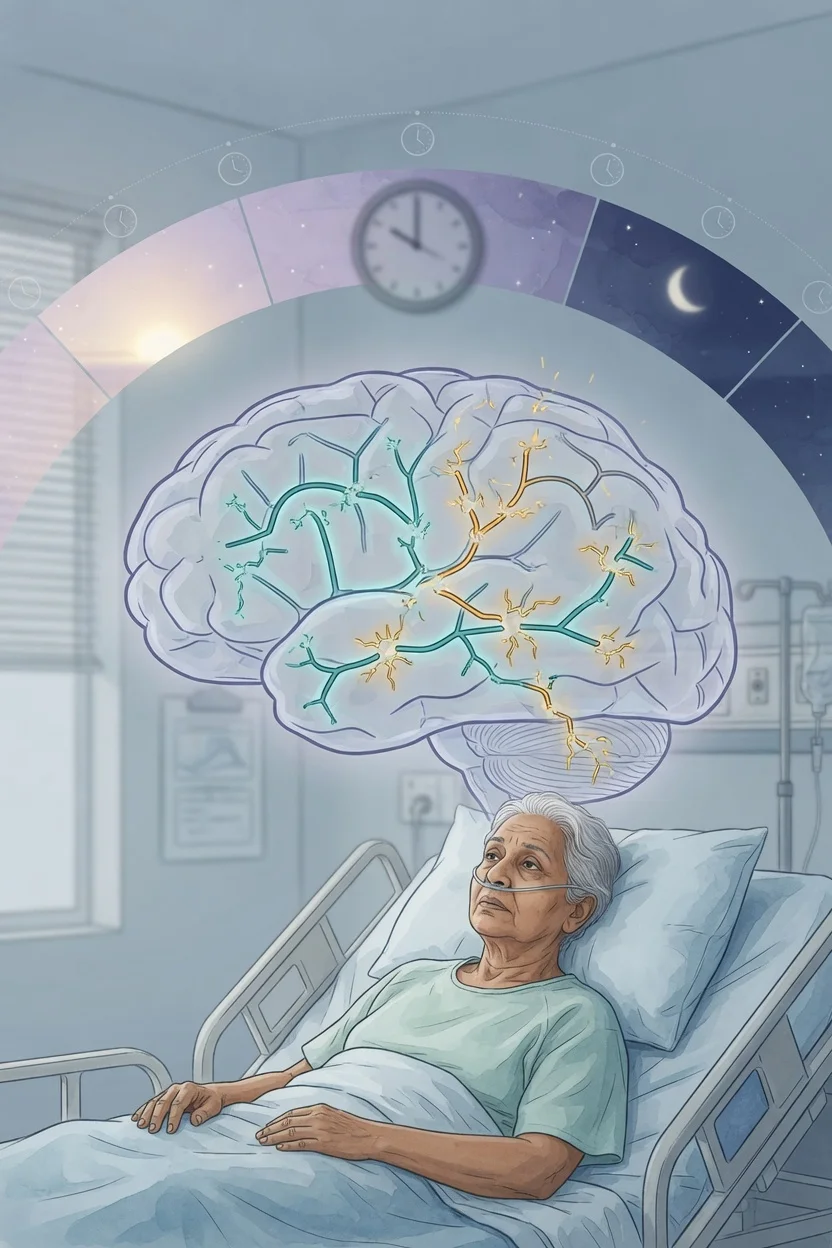
Overview & definition
Sedation and analgesia are given to nearly every critically ill patient who is mechanically ventilated, and their quality is a determinant of both the immediate tolerance of invasive support and the long-term cognitive and functional recovery. The modern framework, codified in the PADIS guideline (the Society of Critical Care Medicine's Pain, Agitation, Delirium, Immobility and Sleep guideline), reframes sedation as the management of five interlocking outcomes — pain, agitation/sedation, delirium, early mobility and sleep — each measured, each targeted, and each mutually dependent.[1][2]
The over-arching principle is analgesia-first, light sedation: pain is treated before and ahead of sedation, the sedation is kept as light as the patient can tolerate (a Richmond Agitation-Sedation Scale around 0 to −2 for most ventilated patients), benzodiazepines are minimised, and the patient is woken, assessed and mobilised early. Deep, prolonged sedation prolongs ventilation, drives delirium and contributes to the weakness and cognitive impairment that define post-intensive-care syndrome.[1][5]
Neuromuscular blockade (paralysis) is a separate, narrower tool: it abolishes the patient's own respiratory effort and movement, it provides no sedation or analgesia, and its use is confined to specific indications (the severe early ARDS patient, facilitation of ventilation, intra-operative) — always with adequate sedation and analgesia, and with the depth monitored.[6][7]
The PADIS framework
The PADIS guideline defines five targets, each with a validated tool, and the evidence favours a coordinated, protocolised approach across all five.[1][2]
- Pain — measured with a validated behavioural scale (the Critical-Care Pain Observation Tool, CPOT, or the Behavioural Pain Scale) in the patient who cannot self-report; treated with multimodal analgesia, opioids first for acute pain and paracetamol and regional techniques where possible.
- Agitation and sedation — measured with the Richmond Agitation-Sedation Scale (RASS), targeting light sedation (RASS 0 to −2) for most patients, with daily interruption or a protocol that wakes the patient.
- Delirium — screened with the Confusion Assessment Method for the ICU (CAM-ICU) or the Intensive Care Delirium Screening Checklist; prevented with a bundle and treated by addressing the cause and favouring dexmedetomidine.
- Immobility — early mobilisation and rehabilitation, which reduces weakness and delirium.
- Sleep — protection of sleep and the day–night cycle, with minimisation of nocturnal disruption. [1]
The 2025 focused update reaffirms analgesia-first, light-sedation, dexmedetomidine-preferred-for-delirium principles and refines the approach to anxiety and sleep.[2]
Sedation goals: the RASS target, daily interruption and analgesia-first
The goals of ICU sedation are explicit, and they are the same goals whatever the agent chosen: a patient who is comfortable (free of pain and dyspnoea), who tolerates the endotracheal tube and the ventilator without fighting, who is cooperative and rousable enough to participate in care and mobilisation, and in whom neurological examination remains possible. The PADIS guideline operationalises these into three measurable commitments.[1][2]
1. A defined sedation target — light, by default. For the great majority of ventilated patients the target is a RASS of 0 to −2 (alert and calm through to lightly sedated, briefly rousable with voice). Light sedation shortens ventilation, reduces delirium and permits early mobilisation; deep sedation (RASS −3 or deeper) in the first 48 hours of ventilation is independently associated with increased mortality and longer stay, and is reserved for deliberate, temporary indications — raised intracranial pressure, refractory hypoxaemia, severe ventilator dyssynchrony, proning, therapeutic hypothermia, and the paralysed patient.[1][5]
2. Daily sedation interruption (or a nurse-led protocol that does the same). Sedation is stopped (or reduced to the lightest level that keeps the patient safe) once each day until the patient is either awake enough to follow commands or becomes unsafe to wake further; it is then restarted at half the previous dose and titrated back to target. This exposes over-sedation, allows a neurological examination, and shortens ventilation. The safety screen before an interruption — no active high ventilator support, no active infusion of a vasopressor at high dose, no agitation dangerous to the patient, no raised intracranial pressure — is what makes it safe.[3]
3. Analgesia-first. Pain is treated before and independently of sedation, because untreated pain is the commonest cause of apparent agitation and because opioids alone, titrated to a CPOT target, often produce adequate sedation without any sedative at all. Sedatives are added only when comfort cannot be achieved with analgesia alone.[1][5]
The analgesia-first, light-sedation bundle at the bedside
Assess pain before sedation
Self-report (NRS 0-10) where possible; CPOT or Behavioural Pain Scale where not. A CPOT >2 or BPS >5 is pain — treat it before titrating a sedative. Reassess after each intervention.
Treat pain with multimodal analgesia
Scheduled paracetamol, an opioid titrated to the pain target (fentanyl infusion or morphine), and a regional technique or ketamine where appropriate. Add dexmedetomidine for its opioid-sparing, sedative effect rather than escalating the opioid.
Set and document a RASS target each shift
Default 0 to -2 (light). Deeper targets (-3 to -5) are deliberate and temporary: raised ICP, refractory hypoxaemia, proning, therapeutic hypothermia, or a paralysed patient. Reassess the target daily; the trajectory should be towards lighter.
Perform a daily sedation interruption (SAT)
Safety check first: FiO2 <= 0.6, PEEP <= 10, no high vasopressor, no active agitation, no raised ICP. Stop sedatives (keep opioids if pain present) until RASS 0 to -1, then restart at half the dose and titrate back. Pair with a spontaneous breathing trial (SBT) — the ABC trial showed pairing reduces ventilation days and mortality.
Screen for delirium and act on it
CAM-ICU or ICDSC each shift. If positive, find and treat the cause (infection, hypoxia, metabolic, urinary retention, constipation, sleep loss), convert benzodiazepines to dexmedetomidine or propofol, and mobilise.
Mobilise early, even while intubated
Passive range of motion on day 1, sit on the edge of the bed as soon as stable, stand and march when able. Early mobility (Schweickert, Lancet 2009) reduces delirium and ICU-acquired weakness and is the single most evidence-supported physical intervention.
Protect sleep and the day-night cycle
Cluster night care to minimise waking, lower lights and noise at night, open blinds and engage the patient during the day. Sedation is not a substitute for sleep.
Pathophysiology: sedation, delirium and the brain
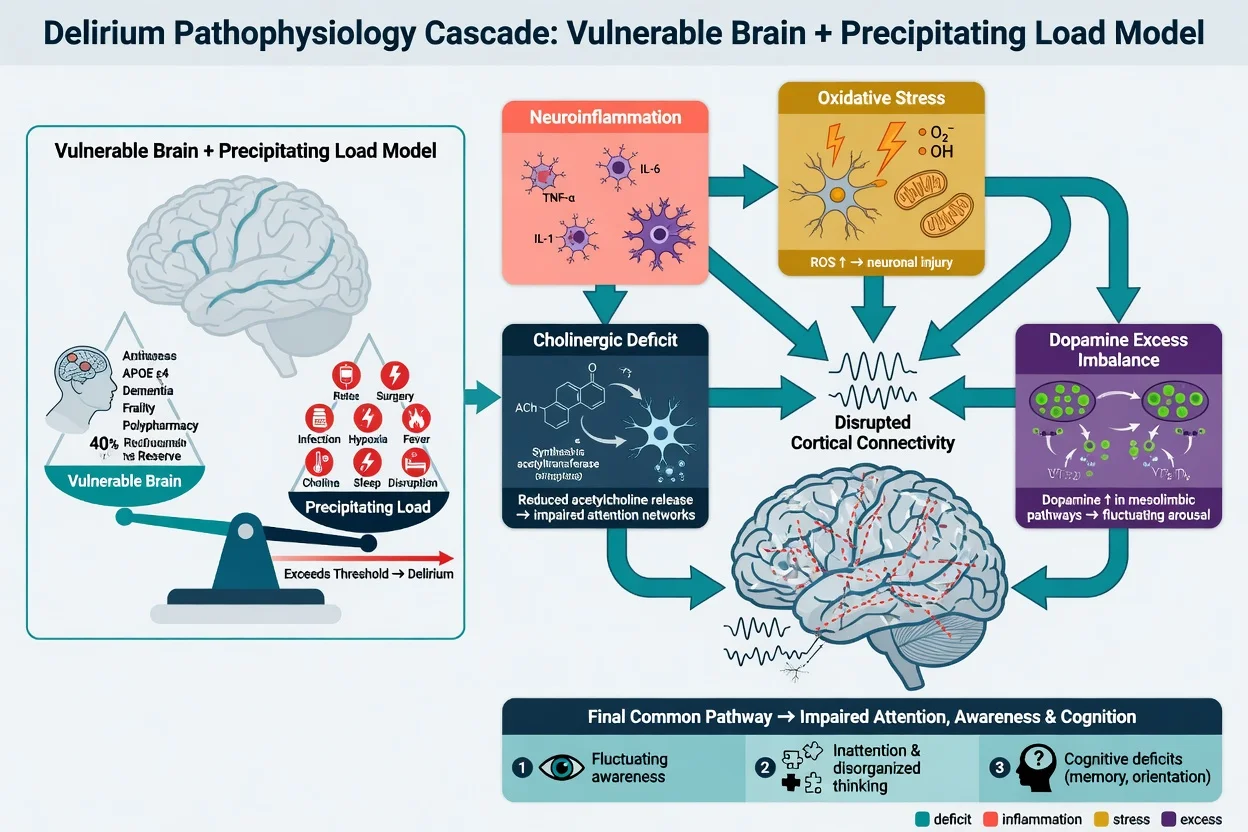
The sedatives act on different receptors, and their pharmacology explains both their use and their harms.[5][1]
- Propofol — a gamma-aminobutyric acid (GABA) agonist, fast-on and fast-off, ideal for short-term sedation and rapid neurological assessment, but it causes hypotension, respiratory depression and, at high or prolonged doses, the propofol infusion syndrome (metabolic acidosis, rhabdomyolysis, cardiac failure).
- Midazolam — a benzodiazepine (GABA agonist), with a longer context-sensitive half-time and active metabolites; it accumulates in renal and hepatic failure, and it is the sedative most strongly associated with delirium.
- Dexmedetomidine — a selective alpha-2 agonist that produces sedation and analgesia without respiratory depression, allowing the patient to be rousable and cooperative; it reduces delirium but causes bradycardia and hypotension.
- Ketamine — an NMDA antagonist providing analgesia and dissociative anaesthesia with preserved airway reflexes and haemodynamics; a useful adjunct and a bronchodilator in asthma. [1]
Delirium is an acute fluctuating disturbance of attention and cognition, and in the ICU it is driven by the illness, the sedation (especially benzodiazepines), the environment, sleep deprivation and the immobility. It is independently associated with longer ventilation, longer stay, higher mortality and long-term cognitive impairment — which is why its prevention (light sedation, early mobility, sleep, treating the cause) is more effective than its treatment.[5]
Sedative agents compared
Propofol
Short-term sedation, rapid wake-up
- Mechanism: GABA-A agonist
- Onset 1-2 min, offset 10-15 min (context-sensitive half-time stays short for up to ~48 h then lengthens)
- Dose: 0.5-3 (max 4) mg/kg/h; 1.1 kcal/mL as lipid emulsion
- Pros: titratable, rapid wake-up for neuro exam and extubation, anti-emetic, anti-convulsant
- Cons: hypotension, respiratory depression, pain on injection, raised triglycerides
- Cap at 4 mg/kg/h for 48 h — watch CK, lactate, triglycerides, pH for PRIS
Dexmedetomidine
Light, cooperative sedation
- Mechanism: selective alpha-2 adrenergic agonist
- Onset 5-10 min; offset 1-2 h (longer context-sensitive half-time than propofol)
- Dose: 0.2-1.5 mcg/kg/h infusion (no loading bolus for ICU sedation — risk of reflex bradycardia/hypotension)
- Pros: arousable, cooperative sedation; analgesic and opioid-sparing; NO respiratory depression; reduces delirium; SAT-friendly
- Cons: bradycardia, sinus pause, hypotension (sympatholysis); less effective for deep sedation
- Evidence: SEDCOM, MENDS, Jakob, SPICE III — less delirium, earlier extubation, no mortality benefit
Midazolam
Avoid — delirium and accumulation
- Mechanism: benzodiazepine (GABA-A); binds the benzodiazepine site
- Onset 2-5 min; offset 1-2 h initially but context-sensitive half-time lengthens markedly with sustained infusion; active metabolite (alpha-hydroxymidazolam) accumulates in renal failure
- Dose: 0.04-0.2 mg/kg/h
- Pros: reliable deep sedation, amnesia, anti-convulsant; cheap; the agent of choice for alcohol/benzodiazepine withdrawal
- Cons: the sedative MOST strongly associated with ICU delirium; prolonged wake-up; accumulation in organ failure
- Use ONLY when other agents are contraindicated, or for specific indications (withdrawal, status epilepticus)
Ketamine
Adjunct, bronchodilator, analgesic
- Mechanism: NMDA antagonist (also weak opioid-receptor and monoamine effects)
- Onset 1 min (bolus 0.5-1 mg/kg), offset 10-15 min; infusion 0.1-2 mg/kg/h
- Pros: profound analgesia, dissociative sedation, preserved airway reflexes and respiratory drive, bronchodilation (severe asthma), sympathetic stimulation — maintains BP in shocked patients
- Cons: emergence phenomena (hallucinations, vivid dreams), hypersalivation, tachycardia, theoretical rise in ICP (clinical significance over-stated)
- Role: co-induction for intubation in the shocked or asthmatic patient; opioid-sparing adjunct; refractory status epilepticus
Daily sedation interruption and protocolised light sedation
The single most influential concept in modern ICU sedation is that less is more: deep, uninterrupted sedation prolongs ventilation and causes delirium, and waking the patient daily exposes that. [1]
The Kress daily-interruption trial (NEJM 2000, 128 patients) randomised ventilated medical ICU patients to a daily interruption of sedative infusions until the patient was awake, versus clinician-discretionary interruption. The daily-interruption group had a shorter duration of mechanical ventilation (median 4.9 vs 7.3 days, P = 0.004) and a shorter ICU stay (6.4 vs 9.9 days, P = 0.02), with fewer diagnostic tests for altered mental status and no increase in complications such as self-extubation.[3]
The principle generalises into protocolised, target-directed, light sedation — a nurse-led protocol that titrates the sedative to a RASS target and wakes the patient daily — which the PADIS guideline endorses as standard. The exceptions are the patient who cannot tolerate light sedation (deep sedation for raised intracranial pressure, severe hypoxaemia, proning, or the paralysed patient), in whom deep sedation is intentional and temporary.[1][5]
The Awakening and Breathing Controlled (ABC) trial (Girard, Lancet 2008) took the logic one step further by pairing the daily spontaneous awakening trial (SAT) with a spontaneous breathing trial (SBT) as a linked safety-screened protocol. The paired approach increased days breathing without assistance, reduced the duration of mechanical ventilation and coma, and improved one-year survival — the strongest evidence that waking and weaning together change outcomes, not just process.[11]
The long-term dividend of waking the patient is shown by Kress's follow-up study (Am J Respir Crit Care Med 2003): patients randomised to daily interruption had lower rates of post-traumatic stress disorder and other psychological symptoms after discharge, dismantling the once-common fear that waking a critically ill patient is psychologically cruel — sustained deep sedation is the cruel and harmful course.[13]
ABC trial — Awakening and Breathing Controlled (Girard, Lancet 2008)
Multicentre RCT, 336 mechanically ventilated medical ICU patients
Population: Patients expected to need mechanical ventilation > 12 h; SAT- and SBT-eligible
Key finding
More days breathing without assistance (14.7 vs 12.0, P=0.02), shorter ICU stay, fewer coma days. 1-year mortality 44% vs 58% (P=0.01). No increase in self-extubation (the safety concern).
Practice change
Pairing daily SAT with SBT shortens ventilation and improves one-year survival. The 'wake and breathe' protocol is the operational core of the ABCDEF bundle.
Analgesia and the opioid agents
Because pain drives agitation, tachycardia, increased oxygen consumption and delirium, analgesia precedes and accompanies sedation in nearly every ICU patient. The PADIS guideline recommends a multimodal approach: a scheduled non-opioid baseline (paracetamol, and where appropriate a regional technique or ketamine), with an opioid titrated to a pain target (CPOT, BPS, or self-reported NRS) for dynamic and procedural pain.[1][5]
The three opioids that dominate ICU practice differ chiefly in onset, offset, and the metabolism that governs clearance in organ failure. [1]
Fentanyl
The ICU workhorse
- Mechanism: mu-opioid agonist; ~100x potency of morphine
- Onset 1-2 min, peak 3-5 min; highly lipophilic — large volume of distribution
- Dose: bolus 25-100 mcg; infusion 25-200 mcg/h (0.5-2 mcg/kg/h)
- Pros: rapid onset, haemodynamically neutral, no active metabolites, does not release histamine
- Cons: context-sensitive half-time lengthens markedly with sustained infusion (redistribution then tissue accumulation) — wake-up slows after days
- Role: first-line for the haemodynamically unstable or renally impaired ventilated patient
Remifentanil
Ultra-short, organ-independent
- Mechanism: mu-opioid agonist; ester structure cleaved by non-specific plasma and tissue esterases
- Onset 1 min, offset 3-10 min after stopping — context-sensitive half-time is ~3 min and is INDEPENDENT of infusion duration
- Dose: 0.025-0.15 mcg/kg/min infusion (no bolus typically; reduce in elderly)
- Pros: rapid titratability, predictable wake-up regardless of organ function, ideal for neuro exam and weaning
- Cons: cost, hyperalgesia/acute tolerance on withdrawal, bradycardia, chest-wall rigidity with bolus, no residual analgesia (transition to a longer opioid before stopping)
- Role: rapid-sequence and short-term analgesia, neuro-intensive care, intolerance-to-wake weaning
Morphine
Cheapest, but watch the metabolite
- Mechanism: mu-opioid agonist
- Onset 5-10 min; offset variable; hepatic glucuronidation to active metabolite M6G (analgesic, sedating) excreted renally
- Dose: 2-10 mg bolus; infusion 1-5 mg/h
- Pros: cheap, familiar, long duration, histamine release (vasodilator — can drop BP)
- Cons: M6G accumulates in renal failure → prolonged sedation and respiratory depression; histamine release unsuitable for unstable asthma or hypotension
- Role: stable patient with intact renal function; less suitable for rapid wake-up or renal impairment
Multimodal and opioid-sparing adjuncts
Reducing opioid exposure is itself a goal — it shortens wake-up, reduces delirium, and limits bowel and respiratory depression. The practical adjuncts are scheduled paracetamol (baseline analgesia, negligible risk), regional anaesthesia (fascial-plane blocks and epidural/paravertebral for thoracic and abdominal pathology — the most opioid-sparing single intervention), ketamine (an NMDA antagonist that is opioid-sparing, bronchodilator, and preserves haemodynamics), alpha-2 agonists dexmedetomidine and clonidine (analgesic and sedative, opioid-sparing), and gabapentinoids (neuropathic pain, with the caveat of accumulation and sedation in renal impairment). The PADIS bundle treats pain first, sedation second.[1][5]
Delirium: screening, prevention and management
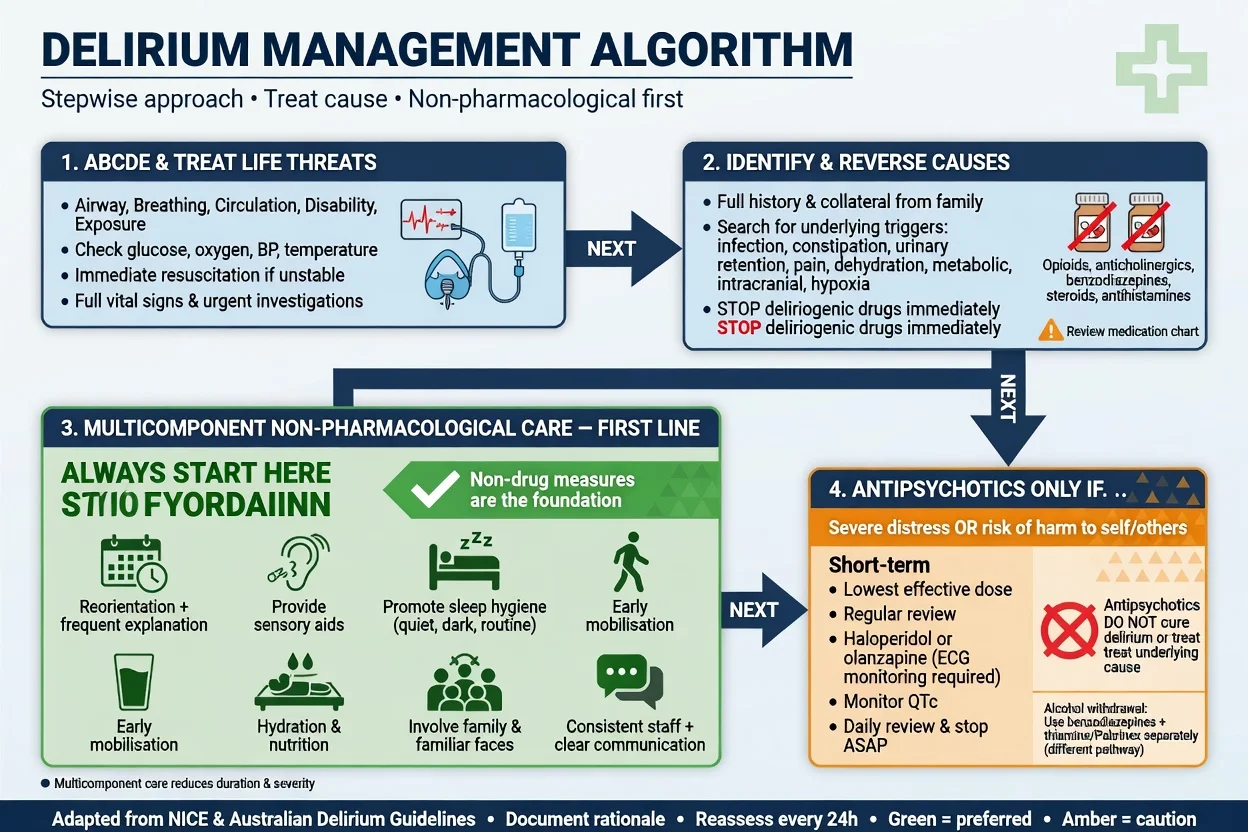
Delirium is common (it affects well over half of ventilated patients), it is missed without screening, and its prevention is the goal.[1][5]
Screening is with the CAM-ICU or the Intensive Care Delirium Screening Checklist (ICDSC), performed each shift. CAM-ICU scores four features — an acute change or fluctuation, inattention, altered level of consciousness, and disorganised thinking — and is positive when features 1 and 2, and either 3 or 4, are present. [1]
Prevention (more effective than treatment) is a bundle: light, protocolised sedation; minimisation of benzodiazepines; early mobilisation; protection of sleep and the day–night cycle; prompt removal of catheters; and treatment of the precipitants (infection, hypoxia, metabolic disturbance, pain). [1]
Management, once delirium is present, is first to find and treat the cause. If a drug is needed, the PADIS guideline prefers dexmedetomidine, which — in trials such as SEDCOM (JAMA 2009), where dexmedetomidine matched midazolam for time at target sedation (77 per cent versus 75 per cent) — reduced the prevalence and duration of delirium. Low-dose haloperidol is no longer recommended for prophylaxis; it is reserved for the agitated delirium that endangers the patient or the lines.[4]
Dexmedetomidine: the trial evidence
Four trials define the role of dexmedetomidine for ICU sedation. Together they establish that it achieves light, arousable sedation with less delirium and earlier extubation than benzodiazepines, but does not improve survival — so it is preferred for the delirium-prone, weaning or neurologically assessable patient, not as a universal replacement for propofol.[4][9][10][8]
- MENDS (Pandharipande, JAMA 2007) — dexmedetomidine versus lorazepam in medical and surgical ICU patients: more days alive without delirium or coma (median 7 vs 3), establishing the delirium-sparing effect.[9]
- SEDCOM (Riker, JAMA 2009) — dexmedetomidine versus midazolam: equivalent time at target sedation, and a lower prevalence and duration of delirium.[4]
- Jakob (JAMA 2012) — dexmedetomidine versus midazolam or propofol for prolonged ventilation: similar time at target, shorter time to extubation with dexmedetomidine, more bradycardia and hypotension.[10]
- SPICE III (Shehabi, NEJM 2019) — early dexmedetomidine versus usual care in 4000 ventilated patients: no difference in 90-day mortality (29.1% vs 29.1%), but less delirium and earlier extubation, at the cost of more bradycardia.[8]
SPICE III (Shehabi, NEJM 2019)
Multicentre, international RCT; 4000 mechanically ventilated adults expected to need sedation > 12 h
Population: Mixed medical/surgical ICU, within 12 h of starting sedation
Key finding
No difference in 90-day mortality (29.1% vs 29.1%; adjusted OR 0.98). Earlier extubation by ~1 day, less delirium, but more bradycardia (7.2% vs 1.6%) and hypotension.
Practice change
Dexmedetomidine is a safe and effective primary sedative that achieves light sedation, less delirium and earlier extubation — but it does NOT improve survival. The case for dexmedetomidine is delirium and wake-up, not mortality.
Haloperidol and antipsychotics do not improve outcomes
MIND-USA (Girard, NEJM 2018) randomised delirious ICU patients to low-dose haloperidol, ziprasidone, or placebo, and found no difference in days alive without delirium or coma, in duration of mechanical ventilation, or in mortality. Combined with the earlier HOPE-ICU and REDUCE meta-analytic evidence, this is why the PADIS guideline does not recommend routine antipsychotics for ICU delirium — they are reserved for severe agitation that endangers the patient or the lines, with QTc monitoring, and stopped when the agitation resolves.[15]
For the agitated, intubated delirious patient in whom sedation is genuinely difficult, Reade's trial (Crit Care 2009) showed that dexmedetomidine was more effective than haloperidol at achieving target sedation without undue harm — supporting dexmedetomidine as the pharmacological agent of choice for the management of established delirium.[14]
Neuromuscular blockade: agents, reversal and monitoring
Neuromuscular blocking agents (NMBAs) abolish skeletal-muscle activity, providing no sedation or analgesia, and they demand the two safeguards of adequate sedation and depth monitoring.[1][1]
- Non-depolarising agents — rocuronium and vecuronium (aminosteroids) and atracurium / cisatracurium (benzylisoquinolines, the latter undergoing Hoffman elimination, useful in organ failure). Rocuronium is the agent of choice for rapid-sequence intubation and for sustained paralysis.
- Reversal — sugammadex, a modified gamma-cyclodextrin that encapsulates rocuronium and vecuronium for rapid, reliable reversal (including the profound block after a intubating dose of rocuronium); neostigmine (with glycopyrrolate) reverses the residual block but is slower and less reliable for a deep block.
- Monitoring — the train-of-four (TOF): four supramaximal stimuli at 2 Hz, and the count of twitches (0 to 4) gauges the depth — a target of 1 to 2 twitches for deep paralysis, 2 to 4 for moderate; the post-tetanic count gauges the very deep block. [1]
The principle is that paralysis is never given without sedation and analgesia adequate for an aware patient, and the TOF is used to titrate to the least block that achieves the goal.[1]
The neuromuscular blocking agents compared
Rocuronium
Aminosteroid — RSI and sustained block
- Mechanism: non-depolarising, competitive nicotinic (N2) antagonist at the motor end-plate
- Intubating dose 1.0-1.2 mg/kg (onset 60-90 s); infusion 5-15 mcg/kg/min; reversed by sugammadex
- Pros: fastest onset of any non-depolariser (near-suxamethonium at 1.2 mg/kg); reliable, no histamine release; reversibility with sugammadex
- Cons: vagolytic (tachycardia); 5x cost of vecuronium; allergy (IgE, like all NMBAs — a leading cause of intra-operative anaphylaxis)
- Role: first-line for RSI when suxamethonium is contraindicated; sustained paralysis in ARDS (with TOF monitoring)
Suxamethonium
Depolariser — fastest onset, but many contraindications
- Mechanism: depolarising agonist at the nicotinic receptor (persistent depolarisation → phase I block)
- Dose 1-1.5 mg/kg; onset 30-60 s, offset 5-10 min (hydrolysed by plasma cholinesterase)
- Pros: unmatched onset and offset for RSI in a crash airway or full stomach
- Cons: hyperkalaemia (dangerous in burns >24 h, crush, renal failure, denervation, immobilisation); malignant hyperthermia trigger; bradycardia (repeat dose); succinylcholine apnoea (genetic cholinesterase deficiency); raised ICP/IOP/intragastric pressure; muscle pains
- Role: RSI when rapid offset matters and no contraindication; NEVER as an infusion
Cisatracurium
Benzylisoquinoline — organ-independent clearance
- Mechanism: non-depolarising, stereoisomer of atracurium; competitive nicotinic antagonist
- Intubating dose 0.15-0.2 mg/kg; infusion 1-3 mcg/kg/min
- Clearance: Hoffman elimination (pH- and temperature-dependent spontaneous degradation) AND ester hydrolysis — independent of liver and kidney; laudanosine is the metabolite (theoretical seizure risk at high doses)
- Pros: agent of choice in renal OR hepatic failure, and in ARDS (the ACURASYS trial used cisatracurium); no histamine release (unlike atracurium)
- Cons: not reversible by sugammadex (it is a benzylisoquinoline); slower onset than rocuronium
- Role: sustained paralysis in multi-organ failure and severe early ARDS
Vecuronium
Aminosteroid — intermediate, reversible by sugammadex
- Mechanism: non-depolarising aminosteroid; competitive nicotinic antagonist
- Intubating dose 0.1 mg/kg; infusion 0.8-1.2 mcg/kg/min
- Clearance: hepatic deacetylation and biliary/renal excretion — accumulates in organ failure; active metabolite (3-desacetylvecuronium)
- Pros: minimal cardiovascular effects; reversible by sugammadex; cheaper than rocuronium
- Cons: slower onset than rocuronium; accumulation in liver/renal failure; not a bronchodilator
- Role: maintenance paralysis where the cardiovascular profile matters and organ function is adequate
Indications for sustained paralysis
The indications for a sustained neuromuscular block in the ICU are narrow, and they are all situations where the patient's own effort — even against deep sedation — is itself harmful.[6][7][1]
- Severe early ARDS with refractory hypoxaemia or a high ventilator driving pressure that cannot be controlled by deep sedation alone (the ACURASYS/ROSE debate, below).
- Severe life-threatening asthma in which the patient is fighting the ventilator and generating dynamic hyperinflation (breath-stacking) that cannot be abolished by sedation — paralysis reduces the trigger burden and allows permissive hypercapnia and a long expiratory time.
- Refractory status epilepticus anaesthetic coma (a second-line/adjunct after a sedative agent has been loaded — paralysis stops the muscular manifestations and the lactate, acidosis and rhabdomyolysis of continuous convulsing; it does not stop the brain seizing, so continuous EEG is mandatory).
- Severe ventilator dyssynchrony, raised intrathoracic pressure interfering with venous return, or facilitation of prone positioning and invasive procedures (e.g. ECMO cannulation, tracheostomy), where deep sedation alone is insufficient.
- Intra-operative, for surgery or procedures. [1]
Train-of-four monitoring and the depth of block
The train-of-four applies four supramaximal 2 Hz stimuli (e.g. to the ulnar nerve at the adductor pollicis) and counts the visible twitches. The twitch count gauges the depth of receptor blockade and is used to titrate the infusion.[1][1]
- 4 twitches, no fade — < 70-75% receptor blockade; no meaningful paralysis; suitable for weaning.
- 3-4 twitches with fade (TOF ratio < 0.9) — moderate block (75-90%); target for most surgical relaxation.
- 2 twitches — ~80-90% blockade; the usual ICU target for sustained paralysis (deep enough to abolish dyssynchrony, light enough for some recovery).
- 1 twitch — > 90% blockade; deep block.
- 0 twitches — profound block (95%+); use a post-tetanic count (PTC) to gauge, and back off the infusion. [1]
For the critically ill, a TOF count of 2 (or, in the most severe ARDS, a post-tetanic count of 1-2) is the practical target — it is the least block that achieves ventilator synchrony, it minimises the duration and cumulative dose of the NMBA, and it limits ICU-acquired weakness. A TOF ratio (T4/T1) > 0.9 at reversal is the threshold for safe extubation; a ratio of 0.4-0.7 — historically accepted — leaves residual weakness and is unsafe. A supramaximal stimulus, a distal muscle (adductor pollicis, not the facial muscles which recover first), and consistent electrode placement are the technical preconditions.[1]
Reversal: sugammadex and the anticholinesterases
Sugammadex is a modified gamma-cyclodextrin that binds rocuronium (and, less avidly, vecuronium) in a tight 1:1 encapsulation complex, removing the free NMBA from the effect site and terminating the block within 1-3 minutes. It is effective at any depth of block — including the profound block (PTC 0) immediately after an intubating dose of rocuronium (1.2 mg/kg), where it is the only reliable reversal — and it acts without the muscarinic effects of an anticholinesterase. Dosing is by depth: 2 mg/kg for shallow (TOF ≥ 2), 4 mg/kg for deep, 16 mg/kg for immediate reversal of an intubating dose. The Cochrane review confirms that sugammadex substantially reduces residual curarisation compared with neostigmine.[16] The caveats are cost, a small but real risk of anaphylaxis (suspect it in cardiovascular collapse within minutes of administration), a rise in activated clotting time (not clinically meaningful for most patients), and that it is useless for the benzylisoquinolines (atracurium, cisatracurium) and for suxamethonium.
Neostigmine (with glycopyrrolate to block muscarinic effects) inhibits acetylcholinesterase, raising acetylcholine at the nicotinic receptor to out-compete the non-depolariser. It is effective only for a shallow block (TOF ≥ 4 with fade, or a TOF ratio 0.4-0.6) — using it for a deeper block produces bradycardia, secretions, and inadequate reversal, and is a recurrent cause of post-extubation respiratory failure. It reverses all non-depolarisers, including the benzylisoquinolines for which sugammadex is useless. It has no role in reversing a profound block.[1]
Neither agent reverses suxamethonium; phase I block is awaited or treated with fresh-frozen plasma in the rare case of genetic cholinesterase deficiency. [1]
The choice of NMB for rapid-sequence intubation
The Cochrane review of rocuronium versus succinylcholine for RSI (Perry, 2008) found that suxamethonium produces slightly superior intubating conditions, but with its catalogue of contraindications (hyperkalaemia, malignant hyperthermia, burns, denervation, cholinesterase deficiency). Rocuronium at 1.0-1.2 mg/kg achieves near-equivalent conditions and is the practical first-line for RSI when suxamethonium is contraindicated — and, since the availability of sugammadex, rocuronium followed by sugammadex reversal offers a "reversible suxamethonium" strategy.[17]
Paralysis in ARDS: the ACURASYS and ROSE trials
The clearest indication for sustained paralysis in the ICU is the early severe ARDS patient, and it is governed by two trials with opposite conclusions.[6][7]
ACURASYS (NEJM 2010) randomised patients with early, severe ARDS (PaO2/FiO2 below 150) to 48 hours of cisatracurium versus no routine paralysis. The paralysis group had a lower 90-day mortality (31.6 per cent versus 40.7 per cent, hazard ratio 0.68), more ventilator-free days and improved oxygenation, with less pneumothorax. It became the basis for a role for early, short, deep paralysis in the most severe ARDS.[6]
ROSE (NEJM 2019), a larger trial testing the same 48-hour strategy, found no mortality benefit (and no difference in ventilator-free days or barotrauma) and was stopped early at a prespecified interim analysis for futility. The two trials together mean that routine, early neuromuscular blockade is not beneficial in moderate-to-severe ARDS; paralysis is reserved for the individual patient with refractory hypoxaemia or a high ventilator-driving pressure that cannot be controlled by deep sedation alone.[7]
ACURASYS vs ROSE — cisatracurium in early severe ARDS
Two multicentre RCTs of early 48-hour cisatracurium vs placebo/no routine paralysis in severe (P/F < 150) ARDS
Population: ACURASYS: 340 patients, early severe ARDS (P/F < 150). ROSE: 1006 patients, P/F < 150 with a PEEP of >= 8 within 48 h.
Key finding
ACURASYS: 90-day mortality 31.6% vs 40.7% (HR 0.68), more ventilator-free days, less pneumothorax. ROSE: no difference in mortality (42.5% vs 42.8%), ventilator-free days or barotrauma — stopped for futility.
Practice change
Routine 48-hour cisatracurium does NOT improve mortality in moderate-severe ARDS (ROSE outweighs ACURASYS). Reserve sustained paralysis for the individual patient with refractory hypoxaemia or high driving pressure that deep sedation cannot control.
ICU-acquired weakness
Prolonged immobility, deep sedation, paralysis and the catabolic state of critical illness conspire to produce ICU-acquired weakness — a critical-illness polyneuromyopathy that delays weaning and rehabilitation and persists long after discharge.[5][1]
The prevention is the bundle that reduces its drivers: light sedation, the shortest possible duration of any paralysis, glycaemic control (avoiding both hyper- and hypoglycaemia), early mobilisation, and nutrition. Early mobilisation — even in the intubated patient — is the most evidence-supported single measure, and it pairs with delirium reduction. Schweickert's trial (Lancet 2009) randomised intubated patients to early protocolised physical and occupational therapy versus usual care and found more ventilator-free days, less delirium and better functional outcomes at discharge — the bedrock evidence for early mobility as a treatment, not a comfort.[12]
Management: the integrated plan
The management of sedation is the day-to-day execution of the PADIS bundle, individualised to the patient's phase of illness.[1][2]
- Assess and target — pain (CPOT), sedation (RASS), delirium (CAM-ICU) every shift, with an explicit target for each.
- Analgesia first — treat pain before adding sedation; use multimodal analgesia (opioid + paracetamol + regional where possible).
- Light, protocolised sedation — titrate to a RASS target (0 to −2 for most); minimise benzodiazepines; favour propofol for short-term and dexmedetomidine for the delirium-prone or weaning patient; interrupt daily.
- Prevent delirium — the bundle; favour dexmedetomidine if a drug is needed.
- Early mobilisation and sleep protection.
- Paralyse only when necessary — for refractory hypoxaemia or vent dyssynchrony unresponsive to deep sedation, for the shortest time, with TOF monitoring and assured sedation-analgesia. [1]
Monitoring depth of sedation and paralysis
Monitoring is the measurement that makes the targets actionable.[1][1]
- Depth of sedation — the RASS (−5 unarousable to +4 combative), done each shift and after each titration; for the deeply sedated or paralysed patient in whom the RASS is uninformative, a processed-EEG monitor (the bispectral index, BIS, or a similar device) gauges the depth, and it is the safeguard against awareness during paralysis.
- Pain — the CPOT or Behavioural Pain Scale in the patient who cannot report.
- Delirium — the CAM-ICU or ICDSC each shift.
- Paralysis — the train-of-four, titrating to the least block that achieves the goal (1 to 2 twitches for deep paralysis), and reassuring that the patient is adequately sedated (the paralysed patient cannot move to show pain or awareness).
- Adverse drug effects — bradycardia and hypotension with dexmedetomidine; hypotension and the propofol-infusion-syndrome risk with propofol; accumulation and delirium with benzodiazepines. [1]
The bispectral index (BIS) and processed EEG
For the deeply sedated, paralysed or anaesthetised patient the RASS collapses to −5 and is uninformative, and the safeguard against awareness-with-paralysis is a processed-EEG monitor — the bispectral index (BIS) being the prototype. BIS derives a dimensionless 0-100 score from a frontal EEG, with 40-60 corresponding to general anaesthesia/deep sedation and 60-85 to light sedation. A raw-EEG trend is preferred where available (a flat or suppressed trace, or burst-suppression, is more reliable than a single number, and is what is sought in a therapeutic anaesthetic coma). BIS is not a substitute for clinical assessment in the non-paralysed patient, it is distorted by facial muscle artefact and by ketamine and the opioids, and — used alone — it has not changed patient-important outcomes. Its justified role is narrow: the paralysed patient, to confirm that the patient is not aware, and the patient in an anaesthetic coma, where the depth itself is the target.[1][1]
Prognosis and long-term outcomes
The short-term outcomes of good sedation are a shorter duration of ventilation and a shorter ICU stay (as the Kress trial showed), and a lower incidence of delirium.[3][4] The long-term outcomes — the post-intensive-care syndrome of cognitive impairment, weakness and psychological symptoms — are shaped by the depth and duration of sedation and by delirium, which is why light sedation, delirium prevention and early mobilisation are now framed as long-term-outcome interventions, not merely comfort measures.[5] The Kress follow-up study extended this to psychological wellbeing: patients randomised to daily interruption had less PTSD and fewer psychological symptoms after discharge, dismantling the fear that waking critically ill patients is cruel.[13]
Exam practice
SAQ — Sedation, analgesia and paralysis in severe ARDS
10 minutes · 10 marks
A 58-year-old man is intubated for severe COVID-19 ARDS (PaO2/FiO2 95 on FiO2 0.9, PEEP 14). He is on propofol 5 mg/kg/h, fentanyl 150 mcg/h, and is fighting the ventilator with a measured driving pressure of 22 cmH2O. BP 88/50 (norepinephrine 0.4 mcg/kg/min), HR 110, CK 1200, lactate 3.2, pH 7.28, triglycerides 3.5 mmol/L. The registrar asks whether to add a muscle relaxant.
Clinical pearls
[1]Red flags
References
- [1]Devlin JW, Skrobik Y, Gélinas C, et al. Clinical Practice Guidelines for the Prevention and Management of Pain, Agitation/Sedation, Delirium, Immobility, and Sleep Disruption in Adult Patients in the ICU Crit Care Med, 2018.PMID 30113379
- [2]Devlin JW, Skrobik Y, Rochwerg B, et al. A Focused Update to the Clinical Practice Guidelines for the Prevention and Management of Pain, Anxiety, Agitation/Sedation, Delirium, Immobility, and Sleep Disruption in Adult Patients in the ICU Crit Care Med, 2025.PMID 39982143
- [3]Kress JP, Pohlman AS, O'Connor MF, Hall JB. Daily interruption of sedative infusions in critically ill patients undergoing mechanical ventilation N Engl J Med, 2000.PMID 10816184
- [4]Riker RR, Shehabi Y, Bokesch PM, et al.; SEDCOM Study Group. Dexmedetomidine vs midazolam for sedation of critically ill patients: a randomized trial JAMA, 2009.PMID 19188334
- [5]Reade MC, Eastwood GM. Sedation and delirium in the intensive care unit N Engl J Med, 2014.PMID 24476433
- [6]Papazian L, Forel JM, Gacouin A, et al.; ACURASYS Study Investigators. Neuromuscular blockers in early acute respiratory distress syndrome N Engl J Med, 2010.PMID 20843245
- [7]The National Heart, Lung, and Blood Institute PETAL Clinical Trials Network; Moss M, Huang DT, Brower RG, et al. Early Neuromuscular Blockade in the Acute Respiratory Distress Syndrome N Engl J Med, 2019.PMID 31112383
- [8]Shehabi Y, Howe BD, Bellomo R, et al.; ANZICS CTG; SPICE III Investigators. Early Sedation with Dexmedetomidine in Critically Ill Patients N Engl J Med, 2019.PMID 31112380
- [9]Pandharipande PP, Pun BT, Herr DL, et al. (MENDS). Effect of sedation with dexmedetomidine vs lorazepam on acute brain dysfunction in mechanically ventilated patients: the MENDS randomized controlled trial JAMA, 2007.PMID 18073360
- [10]Jakob SM, Ruokonen E, Grounds RM, et al. Dexmedetomidine vs midazolam or propofol for sedation during prolonged mechanical ventilation: two randomized controlled trials JAMA, 2012.PMID 22436955
- [11]Girard TD, Kress JP, Fuchs BD, et al. Efficacy and safety of a paired sedation and ventilator weaning protocol for mechanically ventilated patients in intensive care (Awakening and Breathing Controlled trial): a randomised controlled trial Lancet, 2008.PMID 18191684
- [12]Schweickert WD, Pohlman MC, Pohlman AS, et al. Early physical and occupational therapy in mechanically ventilated, critically ill patients: a randomised controlled trial Lancet, 2009.PMID 19446324
- [13]Kress JP, Gehlbach B, Lacy M, Pliskin N, Pohlman AS, Hall JB. The long-term psychological effects of daily sedative interruption on critically ill patients Am J Respir Crit Care Med, 2003.PMID 14525802
- [14]Reade MC, O'Sullivan K, Bates S, Goldsmith D, Ainslie WR, Bellomo R. Dexmedetomidine vs. haloperidol in delirious, agitated, intubated patients: a randomised open-label trial Crit Care, 2009.PMID 19454032
- [15]Girard TD, Exline MC, Carson SS, et al.; MIND-USA Investigators. Haloperidol and Ziprasidone for Treatment of Delirium in Critical Illness N Engl J Med, 2018.PMID 30346242
- [16]Abrishami A, Ho J, Wong J, Yin L, Chung F. Sugammadex, a selective reversal medication for preventing postoperative residual neuromuscular blockade Cochrane Database Syst Rev, 2009.PMID 19821409
- [17]Perry JJ, Lee JS, Sillberg VA, Wells GA. Rocuronium versus succinylcholine for rapid sequence induction intubation Cochrane Database Syst Rev, 2008.PMID 18425883