ICU · Neurocritical
Acute stroke in ICU: ischaemic, haemorrhagic, and neurocritical care
Also known as Ischaemic stroke · Haemorrhagic stroke · Intracerebral haemorrhage · Thrombolysis · Thrombectomy · Stroke ICU management
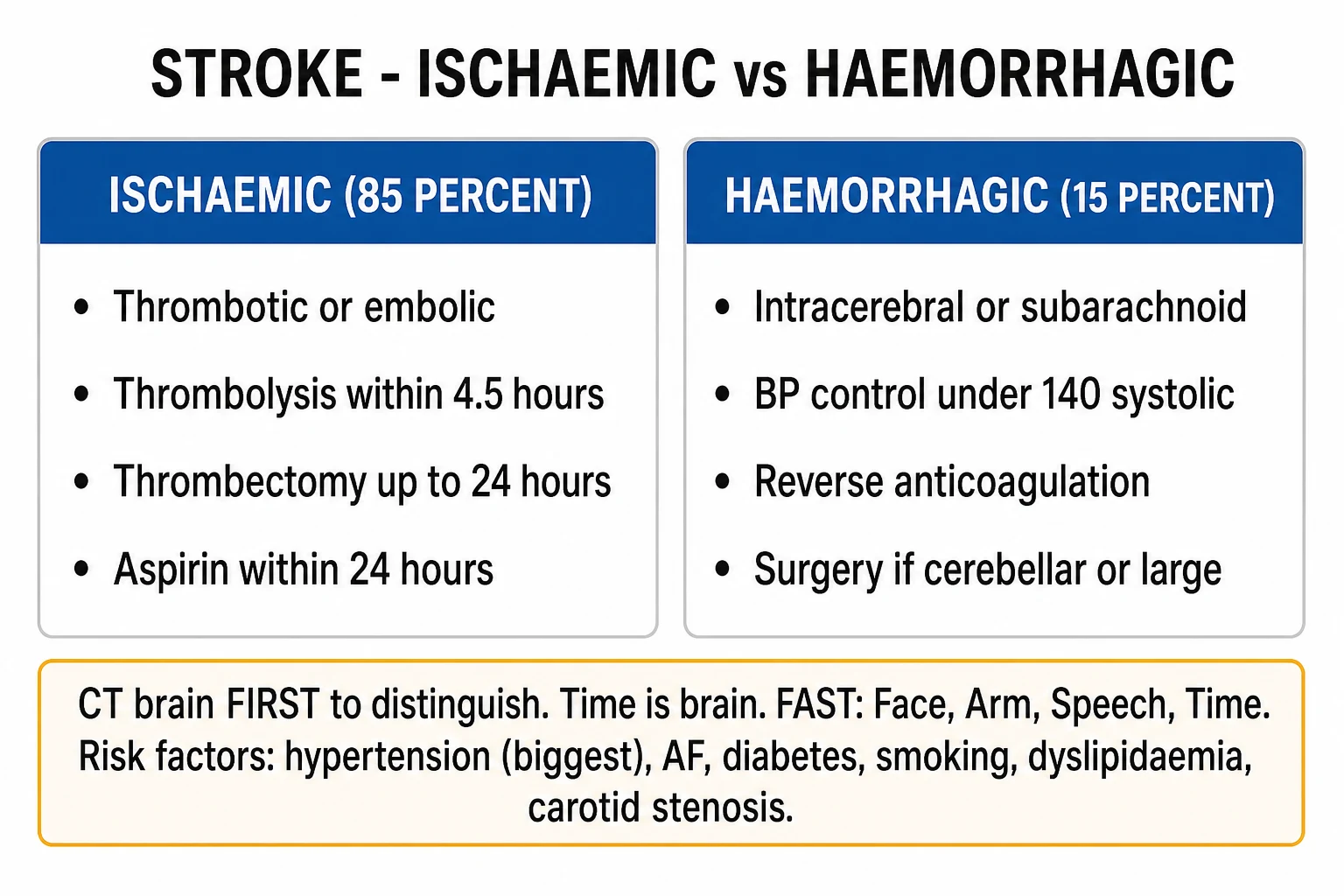
Acute stroke ICU management. ISCHAEMIC (80%): thrombolysis (alteplase within 4.5h — NINDS, ECASS III), thrombectomy (within 6-24h for large vessel occlusion — DAWN, DEFUSE-3), antiplatelet (aspirin within 24h), prevent complications. HAEMORRHAGIC (20%): blood pressure control (SBP <140 — INTERACT2), reverse coagulopathy, surgery (evacuation for cerebellar 3cm or lobar with deterioration), ICP management. ICU principles: airway, normoxia (SpO2 ≥94%), normocapnia (PaCO2 35-40), normoglycaemia (avoid hypo/hyperglycaemia), normothermia (treat fever), blood pressure management (permissive hypertension for ischaemic, controlled for haemorrhagic), DVT prophylaxis, swallowing assessment before oral intake.
On this page & tools
Your progress
Saved locally on this device.
Target exams
Red flags

Ischaemic vs haemorrhagic stroke ICU management
| Feature | Ischaemic (80%) | Haemorrhagic (20%) |
|---|---|---|
| CT | Hypodense (dark) area or normal early | Hyperdense (bright/white) area |
| BP target | PERMISSIVE hypertension (SBP ≤220 without lysis, ≤185 with lysis) | CONTROLLED (SBP 130-140 — INTERACT2) |
| Reversal of anticoagulants | Not needed (unless thrombolysing) | YES — reverse warfarin/DOAC immediately |
| Thrombolysis | Alteplase if ≤4.5h + no contraindication | CONTRAINDICATED (bleeding) |
| Thrombectomy | Large vessel occlusion (6-24h — DAWN/DEFUSE-3) | Not indicated |
| Antiplatelet | Aspirin 300mg within 24h (after lysis: after 24h) | NOT acutely (may worsen bleeding) |
| Surgery | Decompressive hemicraniectomy (malignant MCA) | Evacuation (cerebellar >3cm, lobar with deterioration) |
| ICP management | If malignant oedema | Often (haematoma mass effect) |
| Mortality | 10-20% (30-day) | 30-40% (30-day) |
Alteplase vs tenecteplase for ischaemic stroke
| Feature | Alteplase (rt-PA) | Tenecteplase (TNK) |
|---|---|---|
| Mechanism | Native tissue plasminogen activator | Genetically modified rt-PA (higher fibrin specificity, longer half-life) |
| Dose | 0.9 mg/kg (max 90 mg): 10% bolus + 90% over 60 min | 0.25 mg/kg (max 25 mg): single 5-second IV bolus |
| Administration | Bolus + 60-min infusion (pump, dedicated line) | Single bolus — ideal pre-hospital and during inter-hospital transfer |
| Regulatory status | Licensed for stroke 0-4.5h (NINDS, ECASS-III) | Off-label for stroke (approved for MI) — increasingly used first-line |
| Evidence | Gold standard (NINDS 1995, ECASS-III 2008) | EXTEND-IA TNK (2018): better reperfusion pre-thrombectomy; non-inferior outcomes |
| Fibrin specificity | Lower (more systemic fibrinolysis) | ~14-fold higher (less systemic bleeding, fewer remote bleeds) |
| Symptomatic ICH | 2-6% (per trial) | Similar or marginally lower |
| Practical advantage | Licensed, familiar, protocolised | Bolus — bridges seamlessly to thrombectomy ("drip-and-ship") |
Blood pressure targets after acute stroke
| Scenario | Systolic target | Diastolic target | Rationale / agent |
|---|---|---|---|
| Before alteplase (eligibility) | <185 mmHg | <110 mmHg | Lower sICH risk; use labetalol 10-20 mg IV or nicardipine 5-15 mg/h |
| After alteplase (24h) | <180 mmHg | <105 mmHg | Maintain 24h; each 10 mmHg above 180 ~doubles sICH risk |
| NOT thrombolysed (permissive HTN) | <220 mmHg | <120 mmHg | Preserve penumbral collateral perfusion pressure |
| Post-thrombectomy (reperfused) | <160-180 mmHg | <105 mmHg | Prevent hyperperfusion syndrome / haemorrhagic transformation |
| Spontaneous ICH | 130-140 mmHg | — | Limit haematoma expansion (INTERACT2); avoid <110 (ATACH-2 harm) |
| Cerebral venous sinus thrombosis | Normotension | — | Avoid hypotension (worsens venous-outflow ischaemia) |
ICU management of acute stroke
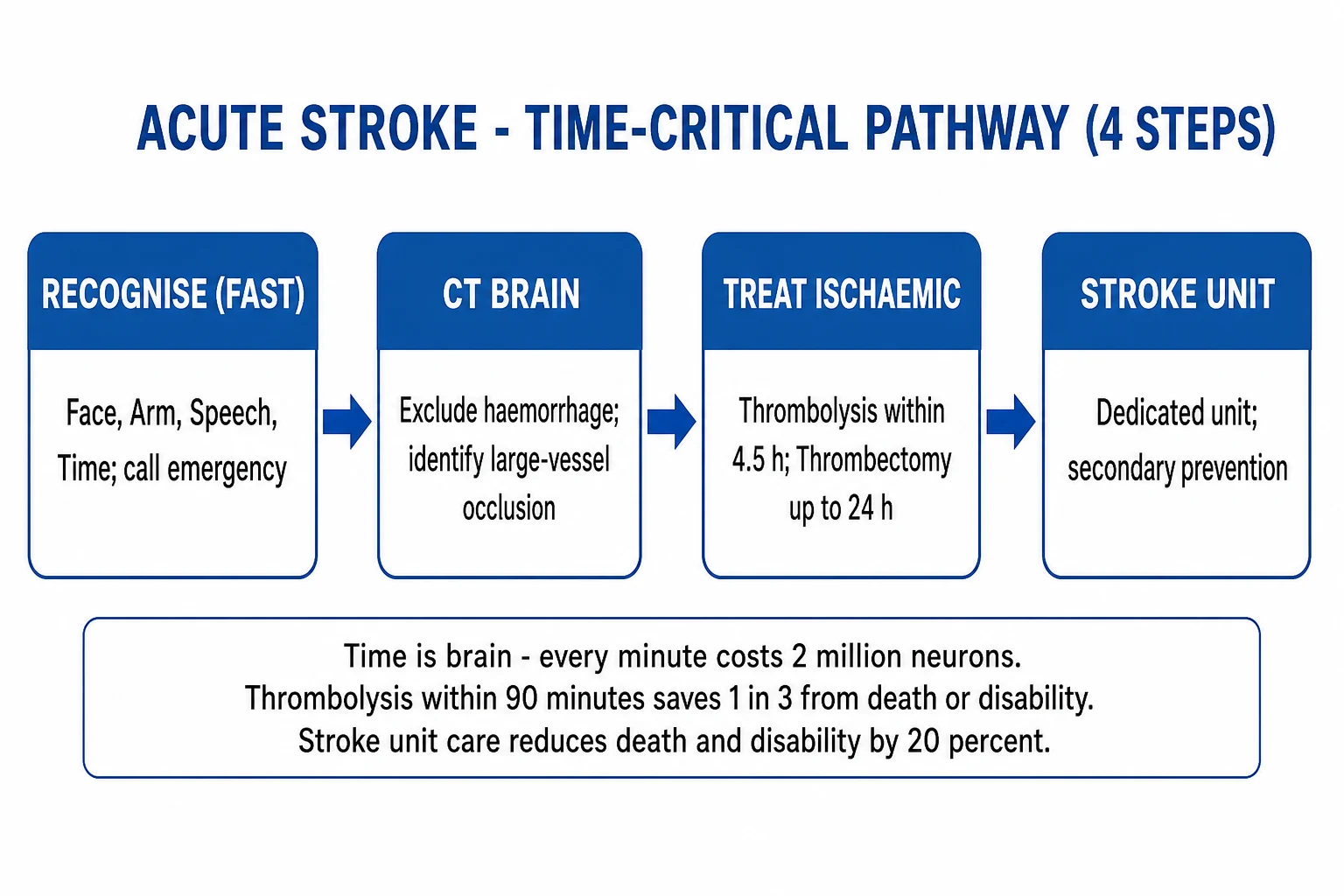
- Distinguish ischaemic vs haemorrhagic — CT head (non-contrast) immediately. Ischaemic: may be normal early, hypodense later. Haemorrhagic: bright (blood) immediately. This determines ENTIRE management
- ISCHAEMIC — time-critical interventions:
- Thrombolysis: alteplase 0.9 mg/kg (max 90 mg) if ≤4.5h, no contraindication. 10% bolus, 90% over 60 min
- Thrombectomy: large vessel occlusion (ICA, M1, basilar) + salvageable brain (CT perfusion/MRI mismatch) — up to 24h (DAWN, DEFUSE-3)
- Aspirin 300mg (after thrombolysis: wait 24h; without thrombolysis: within 24h)
- BP: permissive hypertension (SBP ≤185 for thrombolysis; ≤220 without)
- HAEMORRHAGIC — damage control:
- BP control: SBP 130-140 (INTERACT2 — labetalol/nicardipine IV). Avoid rapid reduction
- Reverse anticoagulants: vitamin K + PCC for warfarin; andexanet for DOAC; protamine for heparin
- Surgery: cerebellar haematoma >3cm or with hydrocephalus/deterioration → evacuation. Lobar with deterioration → consider evacuation
- ICP management: head elevation 30°, osmotherapy (mannitol/hypertonic saline) if raised ICP
- BOTH — general ICU care:
- Airway: intubate if GCS <8 or unable to protect airway
- Oxygen: SpO2 ≥94% (normoxia — avoid hyperoxia)
- Normocapnia: PaCO2 35-40 (avoid hypercapnia → vasodilation → raised ICP)
- Normoglycaemia: 6-10 mmol/L (avoid hypo/hyperglycaemia)
- Normothermia: treat fever (paracetamol, cooling — avoid hyperthermia)
- Swallow assessment: BEFORE oral intake (dysphagia → aspiration)
- DVT prophylaxis: LMWH (ischaemic: after 48h; haemorrhagic: after 24-48h stabilisation)
- Nutrition: early enteral (NG/PEG if dysphagic)
- Decompressive hemicraniectomy — for malignant MCA syndrome (ischaemic stroke with severe oedema → brain shift → herniation). Within 48h, age <60 (DESTINY, DECIMAL, HAMLET trials)
Haemorrhagic transformation of ischaemic stroke
- Recognise the entity. Haemorrhagic transformation (HT) = bleeding into an ischaemic infarct. Petechial HT occurs in up to 40% of untreated MCA infarcts (often asymptomatic); thrombolysis raises symptomatic ICH (sICH) to 2-6%
- Classify radiologically (ECASS definitions). HI-1/HI-2 = haemorrhagic infarct (petechiae along margins, usually asymptomatic, may signal successful reperfusion). PH-1/PH-2 = parenchymal haematoma (space-occupying, >30% infarct + mass effect). Only PH-2 reliably worsens outcome
- Identify risk factors. Large infarct volume, high NIHSS, delayed reperfusion, glucose >10 mmol/L, SBP >180 post-lysis, prior antiplatelet/anticoagulant use, cardioembolic aetiology
- Strict BP control post-lysis. SBP <180 / DBP <105 for 24h — check every 15 min for 2h, every 30 min for 6h, then hourly. Each 10-mmHg rise above 180 nearly doubles sICH risk
- If sICH develops. STOP alteplase infusion immediately; urgent non-contrast CT; give cryoprecipitate (10 units, replenish fibrinogen >1.5 g/L) ± tranexamic acid 1 g IV; reverse any antithrombotic; control BP aggressively; treat raised ICP (osmotherapy, head elevation 30°). Neurosurgical evacuation rarely helpful (deep bleeds) but discuss for large lobar clots
- Delay restart of antithrombotics. No antiplatelet/anticoagulant for 24h after lysis; re-image with CT before starting aspirin
Raised intracranial pressure in acute stroke
- Identify the cause. Malignant MCA oedema (ischaemic, peak 24-72h); large ICH with perilesional oedema and mass effect; hydrocephalus from intraventricular extension or posterior-fossa clot obstructing the fourth ventricle; cerebral venous sinus thrombosis
- Tier 1 — basics (apply to ALL). Head of bed 30°, neutral neck position (no venous jamming), normoxia (SpO2 ≥94%), normocapnia (PaCO2 35-40), normoglycaemia (6-10 mmol/L), normothermia (<37.5°C), maintain CPP >60 mmHg (avoid hypotension), adequate sedation/analgesia if intubated
- Tier 2 — osmotherapy. Mannitol 20% 0.5 g/kg bolus (osmolality target <320, hold if osmolar gap >18) OR hypertonic saline (3% infusion / 5% / 23.4% bolus; Na target 145-155 mmol/L). Sequential or alternating therapy for refractory rises; ensure euvolaemia
- Tier 3 — definitive surgical. DECOMPRESSIVE hemicraniectomy (malignant MCA, age <60, within 48h — DESTINY/DECIMAL/HAMLET); external ventricular drain (EVD) for hydrocephalus/intraventricular blood ± intraventricular rt-PA; suboccipital craniectomy + evacuation for cerebellar clot >3 cm with brainstem compression
- AVOID. Prophylactic hyperventilation (PaCO2 <30) — use only briefly for impending herniation; corticosteroids (ineffective in cytotoxic stroke oedema, may worsen outcome); aggressive fluid restriction; hypotonic fluids
- Monitor. Serial GCS/pupils every 15-30 min; routine CT at 24-72h for large territory strokes; invasive parenchymal ICP monitor if intubated and exam unreliable; continuous EEG if non-convulsive seizures suspected
Decompressive hemicraniectomy decision pathway (malignant MCA)
- Screen for malignancy risk early. Complete MCA territory infarct (NIHSS >15); >2/3 MCA hypodensity on initial CT; large CT-perfusion or DWI deficit; prior stroke, AF, heart failure, high glucose — these DESTINY/DECIMAL/HAMLET risk factors predict malignant course
- Time window. Within 48h of symptom onset (pooled DESTINY/DECIMAL/HAMLET analysis). Earlier surgery = better outcome; do not wait for herniation
- Age stratification. Age <60: clear benefit (absolute mortality reduction ~50%, NNT ~2 for survival with mRS ≤3). Age >60 (DESTINY-2): survival benefit but more survivors severely disabled (mRS 4) — decision individualised with goals-of-care discussion
- Dominant vs non-dominant hemisphere. Operate on BOTH sides — no evidence to withhold for dominant (left) hemisphere on grounds of aphasia; burden of aphasia is overstated relative to death from herniation
- Procedure. Large (>12 cm diameter) fronto-temporo-parietal craniectomy — too small a flap is ineffective and increases outward-bulging complications; durotomy/duroplasty; optional anterior temporal lobectomy
- Post-operative ICU care. Brain swells outward through bone defect (lowering ICP); manage swelling, control temperature/glucose/BP, plan cranioplasty at 6-12 weeks once atrophied and stable
SAQ — Malignant MCA infarction
10 minutes · 10 marks
A 54-year-old man presents 90 minutes after sudden onset of right-sided weakness and global aphasia. NIHSS 22. Non-contrast CT shows a hyperdense left MCA sign and hypodensity involving more than half the left MCA territory. He receives alteplase within the window. Eighteen hours later his GCS drops from 14 to 9 (E1V2M6) with a new right pupillary sluggishness, and repeat CT shows a large left MCA infarct with 7 mm midline shift.
SAQ — Blood pressure management after thrombolysis
10 minutes · 10 marks
A 68-year-old woman with an acute right MCA ischaemic stroke receives IV alteplase 2 hours after symptom onset after BP was confirmed at 158/86 mmHg. Ninety minutes into the infusion her blood pressure has risen to 195/105 mmHg. She remains asymptomatic with GCS 15 and a normal neurological examination unchanged from baseline.
SAQ — Acute stroke ICU management after thrombectomy
10 minutes · 10 marks
A 62-year-old man is admitted to ICU intubated and sedated after successful endovascular thrombectomy (TICI 3 reperfusion) for an acute left M1 occlusion. NIHSS was 18 before the procedure and is 8 as sedation weans. Pre-procedure CT perfusion showed a large penumbral mismatch. On arrival his BP is 168/92 mmHg, temperature 37.9°C and glucose 11.4 mmol/L.
SAQ — Malignant MCA syndrome in an older patient
10 minutes · 10 marks
A 71-year-old woman with known atrial fibrillation presents with sudden left-sided weakness and left hemineglect; NIHSS is 19. She was outside the thrombolysis window. At 36 hours her GCS has fallen from 13 (E3V4M6) to 10 (E2V3M5), her left pupil is 5 mm and sluggish, and CT shows a complete right MCA infarct with 8 mm midline shift at the pineal gland and effacement of the basal cisterns.
Clinical pearls
Red flags
Prognosis
DAWN trial (Nogueira 2018, NEJM) — thrombectomy 6-24h
RCT: 206 patients with anterior circulation large vessel occlusion, 6-24h from symptom onset, with CT perfusion mismatch (salvageable penumbra). Thrombectomy vs standard medical therapy.
- Primary outcome (functional independence at 90 days, mRS 0-2): thrombectomy 49% vs medical 13% (p<0.001)
- Mortality: thrombectomy 19% vs medical 18% (similar)
- CONCLUSION: Thrombectomy up to 24h (with perfusion imaging to identify salvageable brain) dramatically improves functional outcomes. EXTENDED the thrombectomy window from 6h to 24h. [1]
DEFUSE-3 (Albers 2018, NEJM): similar — thrombectomy 6-16h, functional independence 45% vs 17%. INTERACT2 (2013, NEJM): intensive BP lowering (SBP <140) in ICH — trend to better outcomes (OR 0.87, p=0.06). ATACH-2 (2016, NEJM): even more intensive (<110-140) — no additional benefit, more renal adverse events. Ischaemic stroke mortality: 10-20% (30-day). ICH mortality: 30-40% (30-day).
NINDS rt-PA Stroke Study (1995, NEJM) — the foundation of thrombolysis
RCT: 624 patients with ischaemic stroke. Alteplase within 3h vs placebo.
- Outcome: alteplase — minimal/no disability at 3 months significantly more common (OR 1.7)
- Symptomatic ICH: 6.4% alteplase vs 0.6% placebo
- CONCLUSION: first RCT proving thrombolysis benefit in acute ischaemic stroke. Established the 3h window and founded modern stroke reperfusion therapy.[7]
ECASS-III (Hacke 2008, NEJM) — extending the window to 4.5h
RCT: 821 patients; alteplase 3-4.5h after symptom onset vs placebo.
- Outcome: mRS 0-2 at 90 days — alteplase 52% vs placebo 45% (OR 1.34)
- Symptomatic ICH: 2.5% alteplase vs 0.3% placebo
- CONCLUSION: extended the thrombolysis window from 3h to 4.5h. The 4.5h ceiling remains the time-based threshold (imaging-based extension per WAKE-UP and EXTEND).[8]
EXTEND-IA TNK (Campbell 2018, NEJM) — tenecteplase before thrombectomy
RCT: 202 patients; tenecteplase 0.25 mg/kg bolus vs alteplase 0.9 mg/kg infusion, both before endovascular thrombectomy.
- Outcome: substantially better reperfusion before thrombectomy (22% vs 10%)
- Functional independence (mRS 0-2): similar between groups; non-inferiority met
- CONCLUSION: tenecteplase non-inferior to alteplase, with the bolus advantage favouring pre-hospital and "drip-and-ship" bridging therapy. Increasingly adopted as first-line thrombolytic.[22]
Pooled DESTINY/DECIMAL/HAMLET (Vahedi 2007, Lancet Neurol) — decompressive hemicraniectomy
Individual-patient meta-analysis of 93 patients, age <60, malignant MCA infarction, hemicraniectomy within 48h vs conservative.
- Mortality: hemicraniectomy 24% vs conservative 71% (NNT ~2 for survival)
- Favourable outcome (mRS ≤3): hemicraniectomy 43% vs conservative 21%
- CONCLUSION: decompressive hemicraniectomy within 48h in patients <60 halves mortality and triples the chance of favourable outcome. DESTINY-2 (Jüttler 2014) extended the evidence to patients >60: a survival benefit persists, but more survivors are left with mRS 4 — prompting goals-of-care discussion.[16][17]
WAKE-UP (Thomalla 2018, NEJM) — thrombolysis for unknown-onset stroke
RCT: 503 patients with wake-up stroke; MRI DWI-FLAIR mismatch used to estimate stroke onset <4.5h. Alteplase vs placebo.
- Outcome: mRS 0-1 — alteplase 53% vs placebo 42% (OR 1.61)
- Symptomatic ICH: 2.0% alteplase vs 0.4% placebo
- CONCLUSION: MRI-based tissue selection enables thrombolysis for wake-up / unknown-onset stroke — shifting the paradigm from the wall-clock to brain physiology.[14]
INTERACT3 (Ma 2023, Lancet) — combined care bundle in acute ICH
RCT: 7,036 patients with acute ICH. Combined early bundle (SBP <140 within 1h, glucose 6-10 mmol/L, temperature <37.5°C, anticoagulation reversal within 1h) vs usual care.
- Outcome: improved functional outcome (common OR 0.82); reduced death or dependency
- CONCLUSION: ICH outcome is a BUNDLE, not a single intervention. Neurocritical targets mirror ischaemic-stroke ICU targets (glucose, temperature) with reversed BP direction. Standardised early bundles save lives.[21]
References
- [1]Powers WJ, et al. Guidelines for the Early Management of Patients With Acute Ischemic Stroke: 2019 Update to the 2018 Guidelines for the Early Management of Acute Ischemic Stroke: A Guideline for Healthcare Professionals From the American Heart Association/American Stroke Association Stroke, 2019.PMID 31662037
- [2]Nogueira RG, et al. Thrombectomy 6 to 24 Hours after Stroke with a Mismatch between Deficit and Infarct N Engl J Med, 2018.PMID 29129157
- [3]Albers GW, et al. Thrombectomy for Stroke at 6 to 16 Hours with Selection by Perfusion Imaging N Engl J Med, 2018.PMID 29364767
- [4]Anderson CS, et al. Rapid blood-pressure lowering in patients with acute intracerebral hemorrhage N Engl J Med, 2013.PMID 23713578
- [5]Hemphill JC, et al. Guidelines for the Management of Spontaneous Intracerebral Hemorrhage: A Guideline for Healthcare Professionals From the American Heart Association/American Stroke Association Stroke, 2015.PMID 26022637
- [6]Qureshi AI, et al. Intensive Blood-Pressure Lowering in Patients with Acute Cerebral Hemorrhage N Engl J Med, 2016.PMID 27276234
- [7]NINDS rt-PA Stroke Study Group. Tissue plasminogen activator for acute ischemic stroke N Engl J Med, 1995.PMID 7477192
- [8]Hacke W, et al. Thrombolysis with alteplase 3 to 4.5 hours after acute ischemic stroke N Engl J Med, 2008.PMID 18815396
- [9]Berkhemer OA, et al. A randomized trial of intraarterial treatment for acute ischemic stroke N Engl J Med, 2015.PMID 25517348
- [10]Campbell BCV, et al. Endovascular therapy for ischemic stroke with perfusion-imaging selection N Engl J Med, 2015.PMID 25671797
- [11]Saver JL, et al. Stent-retriever thrombectomy after intravenous t-PA vs. t-PA alone in stroke N Engl J Med, 2015.PMID 25882376
- [12]Goyal M, et al. Randomized assessment of rapid endovascular treatment of ischemic stroke N Engl J Med, 2015.PMID 25671798
- [13]Jovin TG, et al. Thrombectomy within 8 hours after symptom onset in ischemic stroke N Engl J Med, 2015.PMID 25882510
- [14]Thomalla G, et al. MRI-Guided Thrombolysis for Stroke with Unknown Time of Onset N Engl J Med, 2018.PMID 29766770
- [15]Ma H, et al. Thrombolysis Guided by Perfusion Imaging up to 9 Hours after Onset of Stroke N Engl J Med, 2019.PMID 31067369
- [16]Vahedi K, et al. Early decompressive surgery in malignant infarction of the middle cerebral artery: a pooled analysis of three randomised controlled trials Lancet Neurol, 2007.PMID 17303527
- [17]Jüttler E, et al. Hemicraniectomy in older patients with extensive middle-cerebral-artery stroke N Engl J Med, 2014.PMID 24645942
- [18]Mendelow AD, et al. Early surgery versus initial conservative treatment in patients with spontaneous supratentorial lobar intracerebral haematomas (STICH II): a randomised trial Lancet, 2013.PMID 23726393
- [19]Baharoglu MI, et al. Platelet transfusion versus standard care after acute stroke due to spontaneous cerebral haemorrhage associated with antiplatelet therapy (PATCH): a randomised, open-label, phase 3 trial Lancet, 2016.PMID 27178479
- [20]Sherman DG, et al. Prevention of venous thromboembolism, recurrent stroke, and other vascular events after acute ischemic stroke: the role of low-molecular-weight heparin and antiplatelet therapy J Stroke Cerebrovasc Dis, 2006.PMID 17904084
- [21]Ma L, et al. The third Intensive Care Bundle with Blood Pressure Reduction in Acute Cerebral Haemorrhage Trial (INTERACT3): an international, stepped wedge cluster randomised controlled trial Lancet, 2023.PMID 37245517
- [22]Campbell BCV, et al. Tenecteplase versus Alteplase before Thrombectomy for Ischemic Stroke N Engl J Med, 2018.PMID 29694815
- [23]AVERT Trial Collaboration. Efficacy and safety of very early mobilisation within 24 h of stroke onset (AVERT): a randomised controlled trial Lancet, 2015.PMID 25892679
- [24]Langezaal LCM, et al. Endovascular Therapy for Stroke Due to Basilar-Artery Occlusion N Engl J Med, 2021.PMID 34010530
- [25]Amarenco P, et al. High-dose atorvastatin after stroke or transient ischemic attack N Engl J Med, 2006.PMID 16899775
- [26]EFFECTS Trial Collaboration. Safety and efficacy of fluoxetine on functional recovery after acute stroke (EFFECTS): a randomised, double-blind, placebo-controlled trial Lancet Neurol, 2020.PMID 32702335