ICU · Nutrition
ICU nutrition: enteral vs parenteral, timing, protein, and refeeding syndrome
Also known as ICU nutrition · Enteral nutrition · Parenteral nutrition · Early feeding · Refeeding syndrome · Protein targets ICU · Permissive underfeeding · Indirect calorimetry ICU · Trophic feeding · EPaNIC trial · PERMIT trial · Post-pyloric feeding
ICU nutrition: critically ill patients are hypercatabolic (muscle breakdown 2%/day). Early enteral nutrition (EN, within 24-48h) is STANDARD — maintains gut barrier, reduces infection, modulates immune response. PARENTERAL (PN): only if EN fails (7 days) or contraindicated (bowel obstruction, ischaemia). CALORIE TARGET: 70-80% of estimated energy expenditure (25-30 kcal/kg/day) by day 3-7. PROTEIN: 1.2-1.5 g/kg/day (higher than standard — counteract catabolism). Early EN (CALORIES, NUTRIREA-1, NUTRIREA-2 trials): starting EN early (within 24h) is SAFE and beneficial — don't wait. REFEEING SYNDROME: risk in malnourished patients — phosphate, magnesium, potassium drop when feeding starts — monitor, replace, start slow.
On this page & tools
Your progress
Saved locally on this device.
Target exams
Red flags
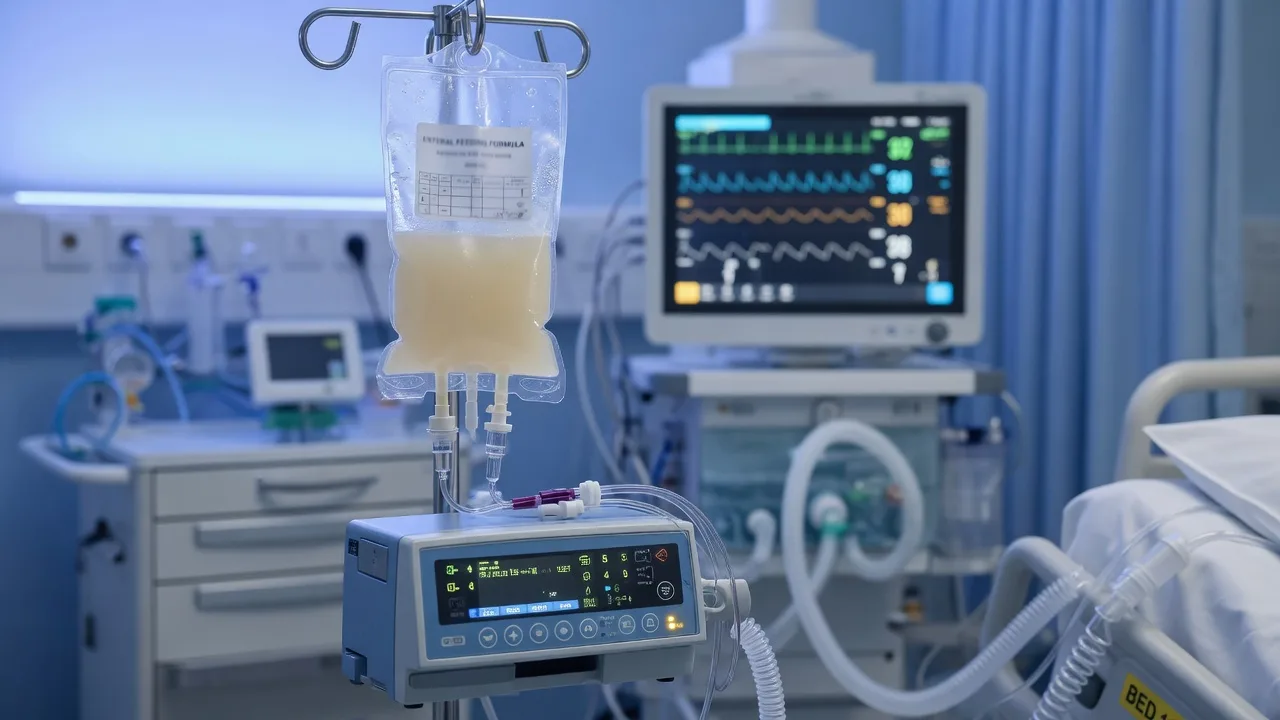
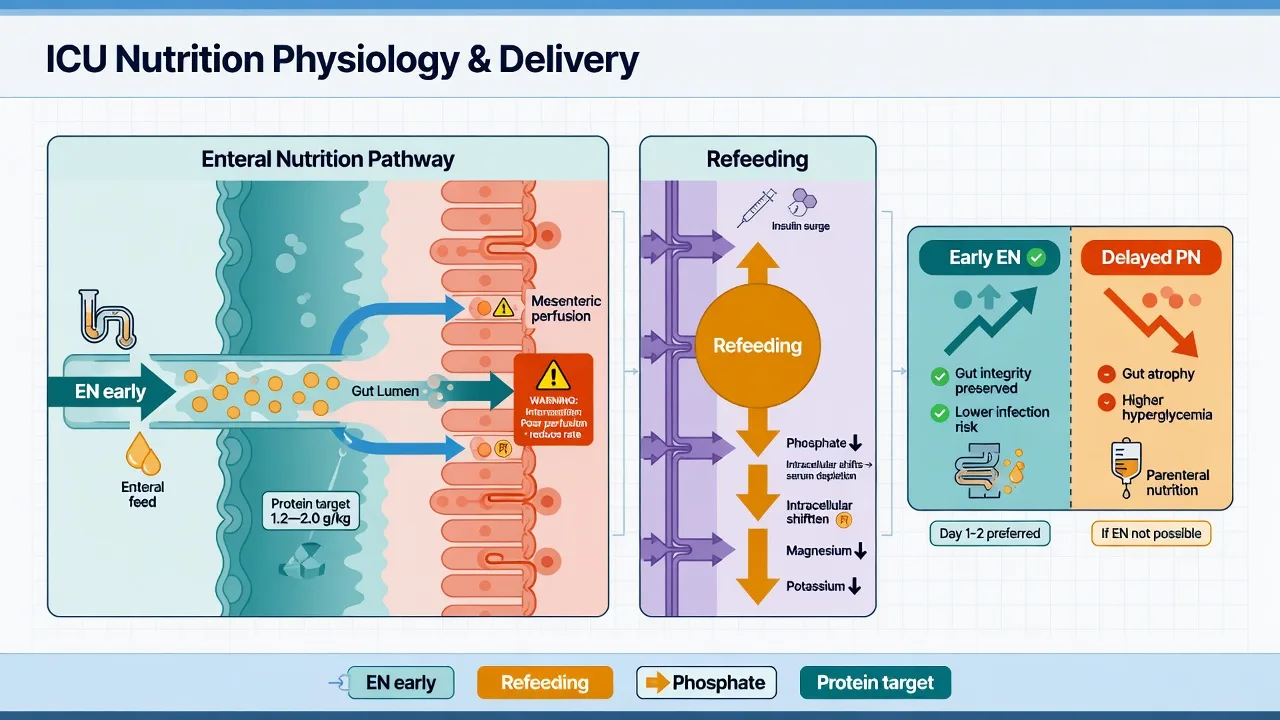
Enteral vs parenteral nutrition in ICU
| Feature | Enteral (EN) | Parenteral (PN) |
|---|---|---|
| Route | Gut (NG, NJ, PEG, oral) | IV (central line) |
| Gut barrier | MAINTAINED (trophic, mucosal integrity) | NOT maintained (gut atrophies) |
| Infection risk | LOWER (gut barrier intact → less translocation) | HIGHER (line infection, translocation) |
| Metabolic | More physiological (insulin response, gut hormones) | Hyperglycaemia, liver dysfunction |
| Cost | Cheaper | Expensive |
| Complications | Aspiration, diarrhoea, tube displacement | Line infection, hyperglycaemia, cholestasis |
| Timing | EARLY (within 24-48h) | Later (if EN fails >7d) |
| Preferred | YES (first-line) | NO (second-line — if EN fails/contraindicated) |
Nutrition management in ICU
- Assess nutritional status — weight, BMI, recent weight loss (>10% in 3 months = malnourished), SGA (Subjective Global Assessment), NUTRIC score (nutrition risk in critically ill). Identify high-risk patients (malnourished, elderly, chronic disease)
- Calculate energy target — estimated: 25-30 kcal/kg/day. Or measured: indirect calorimetry (gold standard — but not widely available). Target: reach 70-80% of target by day 3-7 (don't overfeed — hyperglycaemia, infection, liver dysfunction)
- Calculate protein target — 1.2-1.5 g/kg/day (HIGHER than standard — counteract catabolism). Some suggest 1.5-2.0 for severe burns, trauma, prolonged ICU
- START EARLY ENTERAL NUTRITION (within 24-48h) — (a) Route: NG tube first-line (NJ if aspiration risk — gastric ileus, severe reflux). (b) Start: low rate (20-40 mL/h), advance over 24-48h to target. (c) Formula: standard polymeric (most patients). Specialist if: renal (low electrolyte), hepatic (low protein/sodium), diabetic (low carbohydrate)
- Monitor tolerance — gastric residual volume (<500 mL acceptable — DON'T stop for GRV alone), abdominal distension, diarrhoea (common — treat cause), aspiration precautions (head elevation 30°)
- REFEEDING SYNDROME — prevent in malnourished — (a) Start SLOW (10-15 kcal/kg/day for first 5-7 days in high-risk). (b) Monitor: phosphate, magnesium, potassium, glucose daily for first week. (c) Replace: phosphate (sodium/potassium phosphate IV), magnesium, potassium, thiamine (200-300 mg before feeding). (d) Advance slowly as electrolytes stable
- PARENTERAL — only if EN fails (>7 days) or contraindicated — (a) Indications: bowel obstruction, mesenteric ischaemia, high-output fistula, severe shock with gut ischaemia. (b) Start: if EN not tolerated after 7 days. (c) May combine with EN (supplemental PN if EN insufficient)
Exam practice
SAQ — Early enteral nutrition timing in septic shock
10 minutes · 10 marks
A 68-year-old man is admitted to ICU with severe community-acquired pneumonia requiring invasive mechanical ventilation and noradrenaline 0.15 mcg/kg/min for septic shock (lactate 2.8 mmol/L, MAP 68 mmHg after resuscitation). He has been nil-by-mouth since arrival 6 hours ago. The nurse asks when and how to start feeding.
SAQ — Parenteral nutrition indications after mesenteric ischaemia
10 minutes · 10 marks
A 58-year-old woman undergoes emergency laparotomy for acute mesenteric ischaemia with extensive small-bowel resection; approximately 80 cm of jejunum remains in continuity with a high-output enterocutaneous fistula draining 1.5 L/day. On post-operative day 5 she has lost 8% body weight over the preceding month and NG feeding is delivering only 30% of target due to intolerance.
Clinical pearls
Red flags
Prognosis
Key ICU nutrition trials
CALORIES (Harvey 2014, NEJM): 2,400 ICU patients. Early EN vs early PN (within 36h). 30-day mortality: 29% vs 29% (NO difference). EN and PN similar when started early. NUTRIREA-1 (Reignier 2017, NEJM): 2,410 ventilated patients. Early EN vs early PN (within 24h). EN had FEWER infections (14.5% vs 26%), LESS ICU-acquired weakness, FEWER vomiting/aspiration. Mortality similar. CONCLUSION: EN preferred over PN early. NUTRIREA-2 (Reignier 2023, NEJM): Trophic (low calorie) vs target (full) EN in first week. Trophic NOT inferior (trend to better — less GIT complications). Don't rush to full calories in first week. EDEN (2012, JAMA): Omega-3 supplemented EN in ARDS — NO benefit. REDOXS (2013, NEJM): High-dose glutamine in critical illness — TREND TO HARM (don't use in shock/liver failure). [1]
CONSENSUS: Early EN (24-48h), protein 1.2-1.5 g/kg/day, target 70-80% of energy by day 7. PN only if EN fails. Monitor for refeeding.
Routes and access: gastric vs post-pyloric
Gastric (intragastric) vs post-pyloric (nasojejunal) feeding
| Feature | Gastric (NG/OG/PEG) | Post-pyloric (NJ/PEG-J) |
|---|---|---|
| Placement | Bedside, simple, blind | Endoscopy / fluoroscopy / Cortak electromagnetic — harder |
| Time to feeding | Immediate | Hours (delays feed start) |
| Aspiration risk | Marginally higher (theoretical) | Marginally lower (NOT clinically meaningful) |
| VAP reduction | Reference | No benefit over NG (NUTRIREA-2) |
| Cost | Cheap | Expensive |
| Failure / dislodgement | Lower | Higher (migration, blockage) |
| First-line | YES | NO — only for persistent aspiration, severe gastroparesis |
| When post-pyloric is justified | — | Persistent aspiration despite prokinetics; severe gastroparesis; gastric outlet obstruction; selected severe acute pancreatitis |
Energy targets: estimation vs measurement
Predictive equations vs indirect calorimetry for energy target
| Method | Detail | Accuracy |
|---|---|---|
| Indirect calorimetry | Measures VO2 + VCO2 → REE via Weir equation | GOLD STANDARD (±5%) |
| Penn State 2003 / 2010 | Best-performing predictive equation for ventilated ICU | Reasonable (±15%) |
| 25-30 kcal/kg/day rule | Simple weight-based | Acceptable when calorimetry unavailable |
| Harris-Benedict × stress factor | Tends to overestimate in critical illness | Poor (±30%) |
| Swinamer / Faisy / Ireton-Jones | Other ICU equations | Variable, less validated |
Timing of nutrition in ICU
Timing algorithm — when to start what
- Within 24 h (early EN) — Start EN in ALL critically ill patients who can be fed enterally, regardless of bowel sounds or flatus (CALORIES, NUTRIREA-1). Trophic rate 20–40 mL/h for the first 24–48 h.
- Day 2–3 (advance EN) — If tolerated, advance toward 60–80% of target by day 3–5. Permissive underfeeding (40–70%) in the first week is acceptable and possibly beneficial (PERMIT — no mortality difference vs full feeding).
- Day 4–7 — Aim for ≥80% of target calories and full protein (1.2–2.0 g/kg/day). If EN delivers <60% of target by day 4–7, consider SUPPLEMENTAL PN (TOP-UP / Heidegger — modest ICU-stay reduction; infection risk if overfed).
- Day 7+ (if EN still failing) — Switch to or add FULL PN. NEVER start PN early (within 48 h) in patients with a functioning gut — EPaNIC showed harm (more infection, longer ICU stay, weaker respiratory muscles).
- Special case — malnourished at admission — Start EN within 12–24 h but at TROPHIC rate with refeeding precautions; advance very slowly (see refeeding pathway).
- Special case — gut not usable from day 1 — Bowel obstruction, mesenteric ischaemia, high-output fistula: full PN from the outset (this is NOT "early PN" — it is indicated PN).
Permissive underfeeding vs full feeding
Permissive underfeeding vs full target feeding in the first week
| Feature | Permissive underfeeding | Full target feeding |
|---|---|---|
| Caloric delivery | 40–70% of target (first week) | 80–100% of target |
| PERMIT trial signal | Mortality identical to full | No outcome advantage |
| Refeeding risk | Lower | Higher |
| Hyperglycaemia / infection | Less | More (especially if pushed early) |
| GIT complications (vomiting, distension) | Fewer | More |
| Protein delivery | MUST still meet target (1.2–2.0 g/kg/day) — protein is NOT underfed | Full |
| When to advance | By day 7–10 → full target | From day 1 |
| Conclusion | SAFE in first week; beneficial in malnourished/high refeeding risk | Standard once stabilised |
PERMIT trial — permissive vs target feeding (Arabi 2015, NEJM)
PERMIT (Permissive Underfeeding vs Target Enteral Feeding): 894 critically ill, mechanically ventilated adults. Permissive underfeeding (40–60% of caloric target) vs standard (70–100%) for up to 14 days, with PROTEIN matched at ~1.2 g/kg/day in BOTH arms. 90-day mortality: 27.2% vs 29.1% — permissive was NON-INFERIOR. No difference in infections, ICU stay, ventilation days, or new-onset organ failure. KEY MESSAGE: in the first week you do NOT need to hit full calories; meet protein, deliver 40–70% of calories, advance later. Refeeding-prone patients benefit most. Caveat: protein was modest in both arms — PERMIT does NOT underfeed protein.[8]
Why early PN is harmful — EPaNIC
EPaNIC trial — early vs late parenteral nutrition (Casaer 2011, NEJM)
EPaNIC (Early Parenteral Nutrition Completing Enteral Nutrition in Adult Critically Ill Patients): 4,640 critically ill adults (mixed medical/surgical). Early PN (within 48 h, supplementing EN to reach full target) vs LATE PN (only if EN failed to deliver sufficient energy by day 8). OUTCOMES with EARLY PN: MORE infections (26.2% vs 22.8%), LONGER ICU stay (~4 vs ~3 days), LONGER mechanical ventilation, MORE cholestasis and hyperglycaemia, WEAKER respiratory muscles at ICU discharge (lower MRC sum score). Mortality similar. MECHANISM: early macronutrient load suppresses autophagy — impaired clearance of damaged mitochondria/proteins → cellular dysfunction and persistent inflammation. CONCLUSION: do NOT routinely supplement PN early; wait until day 7–8 if EN insufficient.[7]
Supplemental PN — when EN is insufficient
TOP-UP / Heidegger — supplemental PN after inadequate EN
Heidegger 2013 (Lancet / nested RCT): 305 ICU patients with EN delivering <60% of target by day 3 → randomised to add supplemental PN vs continue EN alone. Supplemental PN reduced nosocomial infections over 28 days (secondary outcome; primary was non-significant). TOP-UP (Davies 2024, AJRCCM meta-trial) — pooled data on supplemental PN after day 3–7 of inadequate EN: small reduction in ICU and hospital stay, no mortality difference, slight infection increase if overfed. CONSENSUS: consider supplemental PN after 3–7 days of inadequate EN; AVOID starting earlier (EPaNIC) and avoid overfeeding (hyperglycaemia, infection, liver dysfunction).[9] }
When to consider supplemental parenteral nutrition
| Timing / situation | Action | Evidence anchor |
|---|---|---|
| Day 1–2 | EN only (trophic) | CALORIES, NUTRIREA-1, EPaNIC |
| Day 3–7, EN <60% target | Consider supplemental PN | Heidegger 2013, TOP-UP |
| Day 7+, EN still failing | Full PN (or EN + PN) | ESPEN standard |
| EN contraindicated from start (obstruction, ischaemia, high-output fistula) | Full PN from day 1 | ESPEN — this is NOT "early PN" |
| Malnourished on admission | EN with refeeding precautions; supplemental PN earlier if needed | ESPEN |
Refeeding syndrome — prevention and management
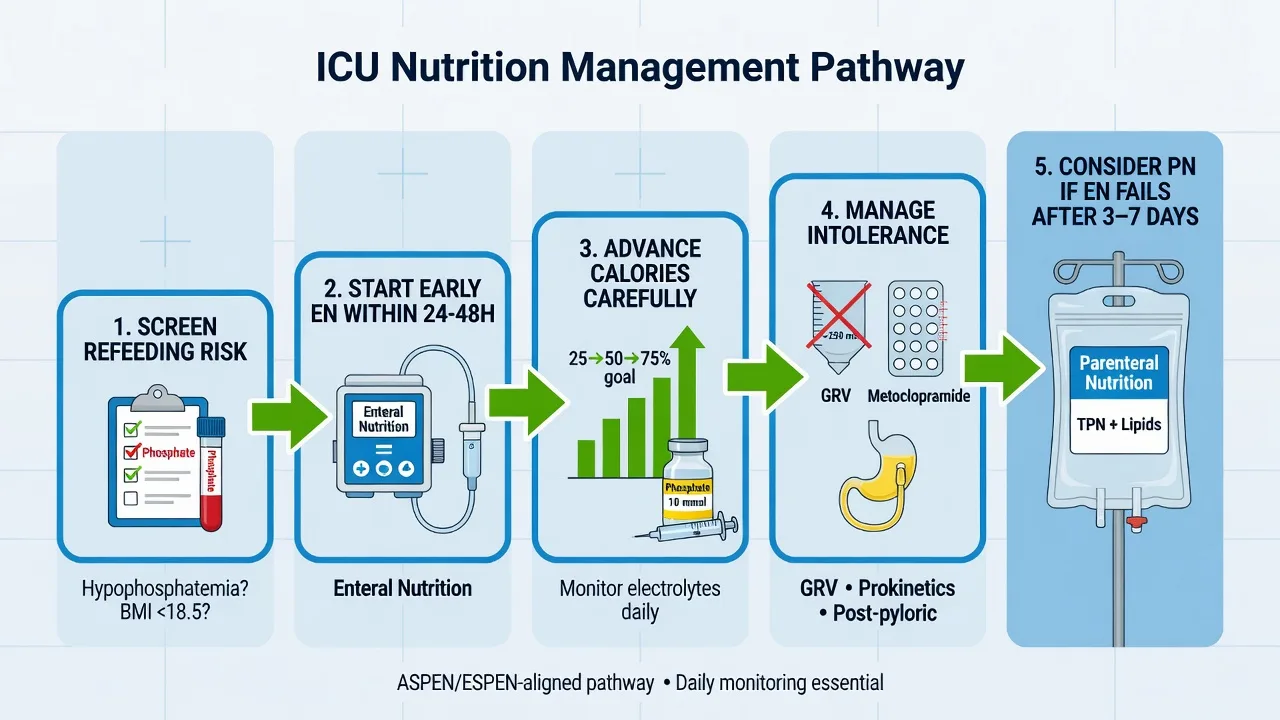
Refeeding syndrome prevention and management (NICE-based)
- Risk-stratify BEFORE feeding — High risk if ANY of: BMI <16, unintentional weight loss >15% in 3–6 months, little/no intake >10 days, hypokalaemia / hypomagnesaemia / hypophosphataemia at baseline, history of alcohol misuse, anorexia nervosa, chemotherapy, bariatric surgery. Medium risk: BMI 16–18.5, weight loss 5–10%, minimal intake 5–10 days.
- Correct baseline electrolytes BEFORE first feed — K+, Mg2+, PO4³⁻, Na+. Defer feeding until K+ >3.5, Mg2+ >0.65, PO4³⁻ >0.6 mmol/L.
- Give thiamine 200–300 mg IV/PO daily for 5–7 days STARTING BEFORE first feed — prevents Wernicke encephalopathy and lactic acidosis. Add vitamin B complex strong and continue daily multivitamin.
- Start at 5–15 kcal/kg/day (high-risk 5–10; medium-risk up to 15; up to 20 if low-risk but cautious). Protein 0.75–1.0 g/kg/day initially.
- Monitor daily for 5–7 days — K+, Mg2+, PO4³⁻, glucose (qid initially), fluid balance, ECG (QTc). Replace intracellular deficits: PO4³⁻ (K-Na phosphate IV), Mg2+ (MgSO4 IV), K+ (KCl IV).
- Advance slowly — increase by ~5 kcal/kg/day every 3–4 days ONLY if electrolytes stable. Reach full target (25–30 kcal/kg/day) and full protein by day 7–14.
- Treat overt refeeding hypophosphataemia <0.5 mmol/L — stop advancing, give 0.16–0.32 mmol/kg IV phosphate over 6 h, recheck, repeat as needed; ICU monitoring for arrhythmia if symptomatic.[14] }
Refeeding syndrome — NICE risk stratification
| Risk tier | Criteria | Initial feed | Monitoring |
|---|---|---|---|
| High | BMI <16; weight loss >15%; nil-by-mouth >10 d; baseline low K/Mg/PO4; EtOH; AN; chemo | 5–10 kcal/kg/day, ↑ over 7 days to full | K/Mg/PO4 daily × 7, glucose qid, ECG |
| Medium | BMI 16–18.5; weight loss 5–10%; minimal intake 5–10 d | 10–15 kcal/kg/day × 3 d, then ↑ | K/Mg/PO4 daily × 3 |
| Low | No risk factors | Standard EN | Routine |
Parenteral nutrition — setup and monitoring
Parenteral nutrition setup and monitoring
- Confirm indication — EN failing >7 days, OR EN contraindicated (bowel obstruction, mesenteric ischaemia, high-output fistula, severe unresuscitated shock with gut hypoperfusion), OR malnourished + cannot feed enterally.
- Choose access — Peripheral PN (osmolality <900 mOsm/L, <7 days, lower glucose concentration) or CENTRAL (standard — all-in-one bag with glucose, amino acids, lipid). Dedicated lumen.
- Calculate composition — Glucose 60–70% of non-protein calories; Lipid 30–40% (mixed MCT/LCT or fish-oil based where available; AVOID pure soybean → immunosuppression, hepatotoxicity). Protein 1.2–1.5 g/kg/day. Total calories 20–25 kcal/kg/day (LOWER than EN — PN overfeeding is more harmful per EPaNIC).
- Add electrolytes, trace elements, vitamins — individualise Na+, K+, Mg2+, PO4³⁻, Ca2+. Standard daily multivitamin and trace element. Selenium 350–1000 µg/day in ARDS/sepsis controversial.
- Start at low rate, advance over 24–48 h — avoid sudden hyperglycaemia. Insulin sliding scale if glucose >10 mmol/L.
- Monitor — Daily: glucose (qid), U&E, LFT, Mg, PO4, triglycerides (lipid clearance), CRP. Weekly: trace elements, fluid balance, weight.
- Prevent catheter-related bloodstream infection — dedicated lumen, full-barrier precautions at insertion, chlorhexidine dressing, daily review of necessity, remove promptly when EN resumed.
Protein dosing — beyond the basics
Protein targets across ICU populations
| Population | Protein target (g/kg/day) | Comment |
|---|---|---|
| General ICU | 1.2–1.5 | ESPEN / ASPEN baseline |
| Severe burns | 1.5–2.0 | Massive nitrogen loss |
| Polytrauma | 1.5–2.0 | Catabolic surge |
| Prolonged ICU (>7 d) | 1.5–2.0 | Counteract ICU-acquired weakness |
| AKI / CRRT | 1.5 (up to 2.5 on CRRT) | Higher loss across filter |
| Hepatic encephalopathy | 1.0–1.5 | DON'T restrict (old myth) |
| Septic shock (early) | 0.8–1.0 initially, ↑ when stable | Don't push in shock |
| Obesity (BMI >30) | 1.5–2.0 based on IDEAL body weight | Hypocaloric high-protein |
GRV monitoring — abandon it
Old vs new gastric residual volume thresholds
| Threshold / practice | Action | Evidence |
|---|---|---|
| Old: GRV >200 mL → hold | Stop feed | Reflexive; causes underfeeding |
| Old: GRV >500 mL → hold | Stop | Threshold from non-evidence sources |
| MODERN: do NOT routinely check GRV | Continue feed | NUTRIREA-2 GRV substudy (Reignier 2013, JAMA) — NO increase in VAP, vomiting, or mortality when GRV not monitored |
| If symptomatic (vomiting, distension) | Assess, prokinetic, ↓ rate | Symptom-driven, not number-driven |
Prokinetics and EN intolerance
Managing EN intolerance — practical approach
- Confirm intolerance — vomiting, abdominal distension, overt regurgitation. NOT a high GRV number alone.
- Exclude surgical pathology — abdominal exam, imaging to exclude obstruction, mesenteric ischaemia, ileus from intra-abdominal sepsis.
- Optimise nursing — head of bed 30–45°, verify feeding tube position, reduce opiate/sedation where possible.
- Add prokinetic — Metoclopramide 10 mg IV q6h OR Erythromycin 200 mg IV q12h. Combination is more effective than either alone. STOP if QTc prolonged or arrhythmia develops.
- Switch to post-pyloric only if prokinetics fail AND intolerance persists.
- Temporarily reduce rate — drop to 20 mL/h, reattempt advance next day. Do not abandon EN.
- Exclude C. difficile and other causes of diarrhoea if diarrhoea is the issue (separate from intolerance — see below).
Decision pathway at a glance
Nutrition decision pathway — EN vs supplemental PN vs full PN
- Can the gut be used? — If YES → EN. If NO (obstruction, ischaemia, high-output fistula) → full PN from day 1.
- Start EN within 24 h at trophic rate (20–40 mL/h). Don't wait for bowel sounds or flatus.
- By day 3–5: EN delivering ≥60% of target? — YES → continue, advance. NO → consider supplemental PN from day 4–7 (TOP-UP / Heidegger).
- By day 7: EN delivering ≥80% of target? — YES → continue EN alone. NO → add full PN.
- Malnourished on admission? → Start EN early but with refeeding precautions (5–15 kcal/kg/day, thiamine, daily K/Mg/PO4). Supplemental PN may be considered earlier in this subgroup only.
- Protein always targeted — 1.2–1.5 g/kg/day regardless of calorie strategy (higher in burns, trauma, CRRT, prolonged stay).
Quick reference — what the trials say
| Trial | Comparison | Result | Take-home |
|---|---|---|---|
| CALORIES (2014) | Early EN vs early PN (2400 pts) | No mortality difference | Either OK early if you must — but EN cheaper, safer |
| NUTRIREA-1 (2017) | Early EN vs early PN (2410 ventilated) | EN fewer infections / less weakness | EN preferred |
| EPaNIC (2011) | Early vs late PN (4640 pts) | Early PN more infection, longer stay | Don't supplement PN early |
| PERMIT (2015) | Permissive vs full calories (894 pts) | Mortality identical | Underfeed calories week 1 OK |
| NUTRIREA-2 (2019) | Gastric vs post-pyloric feeding | No difference in VAP / aspiration | Use NG |
| NUTRIREA-2 GRV (2013) | Routine vs no GRV monitoring | No difference in VAP | Abandon routine GRV |
| TOP-UP / Heidegger (2013) | Supplemental PN day 3–7 | Modest infection / stay reduction | Consider if EN inadequate |
| TARGET (2022) | Protein-enhanced EN vs standard | No outcome difference | Total protein > source |
| REDOXS (2013) | High-dose glutamine | Trend to harm | Avoid glutamine in shock / liver failure |
| EDEN (2012) | Omega-3 EN in ARDS | No benefit | Don't use omega-3 for ARDS outcome |
Special populations
References
- [1]Singer P, et al. Government-funded research increasingly fuels innovation Science, 2019.PMID 31221848
- [2]Harvey SE, et al. Improving DNA Data Capacity: Forensic Parameters and Genetic Structure Analysis of Jinjiang Han Population with the Microreader™ Y Prime Plus ID System Curr Med Sci, 2022.PMID 35403953
- [3]Reignier J, et al. Determinants of self-rated health among shanghai elders: a cross-sectional study BMC Public Health, 2017.PMID 29029627
- [4]Allingstrup MJ, et al. Can sand nourishment material affect dune vegetation through nutrient addition? Sci Total Environ, 2020.PMID 32278174
- [5]Friedli N, et al. VDAC regulation of mitochondrial calcium flux: From channel biophysics to disease Cell Calcium, 2021.PMID 33529977
- [6]McClave SA, et al. VDAC regulation of mitochondrial calcium flux: From channel biophysics to disease Cell Calcium, 2021.PMID 33529977
- [7]Casaer MP, et al. Urinary shedding of spirochaetes in a dog with acute leptospirosis despite treatment Vet Rec, 2011.PMID 21546405
- [8]Arabi YM, et al. Role of Vitamin D in Hospitalized Children With Lower Tract Acute Respiratory Infections J Pediatr Gastroenterol Nutr, 2016.PMID 26465790
- [9]Davies AR, et al. Worldwide Research Trends on Artemisinin: A Bibliometric Analysis From 2000 to 2021 Front Med (Lausanne), 2022.PMID 35602470
- [10]Reignier J, et al. DNA damage in liver cells of the tilapia fish Oreochromis mossambicus larva induced by the insecticide cyantraniliprole at sublethal doses during chronic exposure Chemosphere, 2020.PMID 31442775
- [11]Preiser JC, et al. Antiviral Essential Oils Incorporated in Nanocarriers: Strategy for Prevention from COVID-19 and Future Infectious Pandemics Pharm Nanotechnol, 2020.PMID 33069206
- [12]Reignier J, et al. A meta-analysis of genome-wide association studies identifies novel variants associated with osteoarthritis of the hip Ann Rheum Dis, 2014.PMID 23989986
- [13]Heyland DK, et al. [Myocardial structural changes in acute left ventricular overload in an experiment] Arkh Patol, 2011.PMID 21506339
- [14]Friedli N, et al. Effect of processing on nutritive values of milk protein Crit Rev Food Sci Nutr, 2017.PMID 27052328