ICU · oncology
Acute Severe Tumour Lysis Syndrome — Comprehensive ICU Management
Also known as Tumour lysis syndrome (TLS) · Acute tumour lysis syndrome (ATLS) · Tumor lysis syndrome · Hyperuricaemia of malignancy · Rasburicase · Cairo-Bishop classification · Laboratory tumour lysis syndrome · Clinical tumour lysis syndrome · Oncology metabolic emergency · Urate nephropathy
Acute severe tumour lysis syndrome (TLS) = a metabolic oncological emergency from rapid lysis of malignant cells releasing intracellular contents into the extracellular space: HYPERKALAEMIA (intracellular K+ dumped — most dangerous, causes fatal arrhythmia), HYPERPHOSPHATAEMIA (tumour cells carry ~4x normal phosphate), HYPOCALCAEMIA (secondary — Ca2+ precipitates with phosphate as calcium-phosphate crystals), and HYPERURICAEMIA (nucleic acid breakdown → purines → xanthine → uric acid via xanthine oxidase). Uric acid and calcium-phosphate precipitate in renal tubules → acute kidney injury (AKI), which then reduces K+ and phosphate excretion → a self-amplifying vicious cycle. Onset 12-72h after cytotoxic therapy (occasionally spontaneous before therapy in high-burden disease). Highest risk: Burkitt lymphoma, lymphoblastic lymphoma, acute lymphoblastic leukaemia (ALL, WBC high), high-grade non-Hodgkin lymphoma (bulky), AML with high WBC, and rapidly responding tumours treated with venetoclax/rituximab/steroids. Cairo-Bishop definition: laboratory TLS (≥2 abnormal values — urate ≥475 µmol/L/8 mg/dL, K+ ≥6.0 mmol/L, phosphate ≥1.45 mmol/L, Ca2+ ≤1.75 mmol/L or 25% change from baseline within 3 days before to 7 days after therapy) vs clinical TLS (LTLS PLUS AKI, arrhythmia/sudden death, or seizure). Prevention (cornerstone): aggressive IV hydration (3 L/m2/day or ~2-3 L/day, goal urine output 100 mL/m2/h) + urate-lowering therapy stratified by risk — rasburicase 0.15-0.2 mg/kg IV for HIGH risk (recombinant urate oxidase, converts EXISTING uric acid → soluble allantoin, acts within hours; CONTRAINDICATED in G6PD deficiency — haemolysis/methaemoglobinaemia), allopurinol 300 mg/day for INTERMEDIATE risk (xanthine oxidase inhibitor, prevents NEW uric acid only). Treatment of established TLS: aggressive hydration, rasburicase 0.15-0.2 mg/kg, treat hyperkalaemia per standard protocol (calcium gluconate for ECG changes → insulin/dextrose → salbutamol → potassium binders), do NOT routinely treat asymptomatic hypocalcaemia (calcium worsens Ca-P deposition), renal replacement therapy (CRRT preferred) for refractory hyperkalaemia/hyperphosphataemia or AKI. Alkalinisation of urine is NOT recommended (worsens calcium-phosphate precipitation).
On this page & tools
Your progress
Saved locally on this device.
Target exams
Red flags
Overview
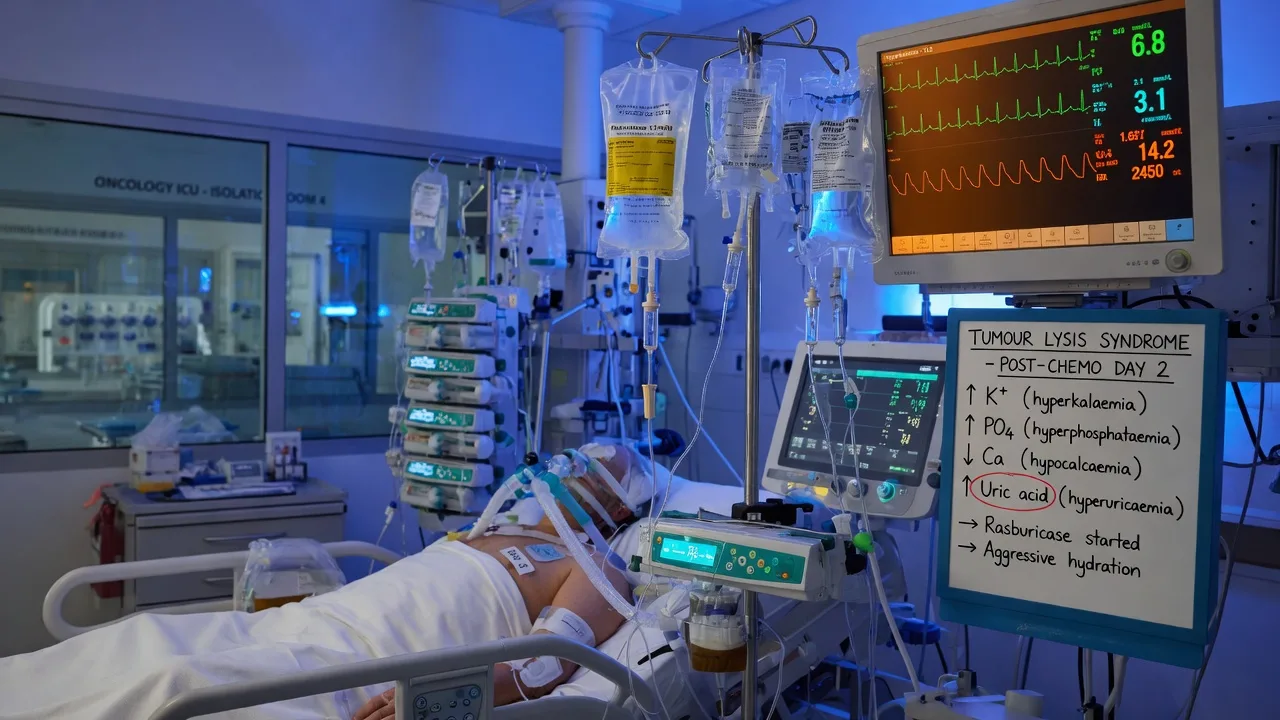
TLS is the metabolic emergency that crystallises everything dangerous about cell turnover: a tumour dying fast can kill the host just as effectively as one growing fast. The intensivist encounters TLS in two scenarios — (1) the patient admitted to ICU with established, severe TLS (hyperkalaemic arrhythmia, oliguric AKI, symptomatic hypocalcaemia) usually 12-72h after starting chemotherapy for a high-grade haematological malignancy, and (2) the high-risk patient on the haematology ward being actively monitored and prophylaxed for whom the ICU is called when potassium climbs or urine output falls. The key principles: hyperkalaemia kills first (membrane stabilise, then shift, then remove), rasburicase is dramatically superior to allopurinol for established hyperuricaemia (it destroys existing uric acid; allopurinol only prevents new formation), hypocalcaemia is usually left untreated (correcting it worsens the real problem — Ca-P deposition), and the kidney is both victim and amplifier of the syndrome (AKI reduces K+/phosphate clearance, accelerating the vicious cycle).[1][5]
Pathophysiology — why a dying tumour kills the host
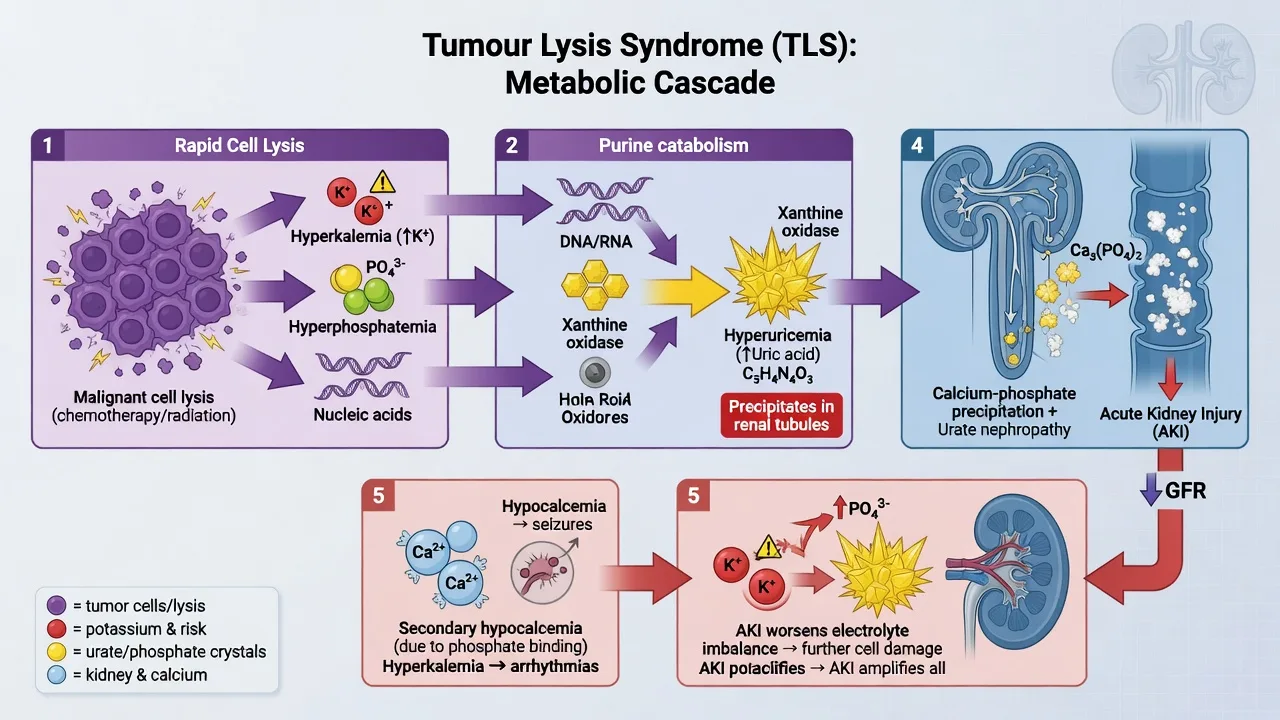
Rapid lysis of a large number of malignant cells overwhelms the body's homeostatic capacity. Each lysed cell empties its intracellular contents into the extracellular fluid. Four electrolyte/metabolic disturbances result, each with a defined mechanism and a defined consequence.[5]
The 4 metabolic disturbances of TLS — mechanism and consequence
| Disturbance | Mechanism (what the dying tumour cell releases) | Consequence |
|---|---|---|
| HYPERKALAEMIA (#1 danger) | Intracellular K+ is ~140 mmol/L (vs 4 mmol/L extracellular). Massive tumour lysis dumps K+ into ECF faster than the kidney (already injured) and Na+/K+-ATPase can compensate. | Fatal arrhythmia — peaked T waves → PR prolongation → QRS widening → sine wave → VF/asystole. THIS is the usual mode of death in TLS. |
| HYPERPHOSPHATAEMIA | Malignant cells carry ~4x the phosphate of normal cells (high nucleic acid and phosphometabolite content). Lysis releases this load acutely. | Drives hypocalcaemia (Ca-P precipitation) and direct calcium-phosphate nephropathy (nephrocalcinosis → AKI). |
| HYPOCALCAEMIA (secondary) | NOT a release phenomenon — Ca2+ precipitates as insoluble calcium-phosphate (and calcium-urate) crystals in the setting of hyperphosphataemia. Corrected calcium falls. | Symptomatic: tetany, carpopedal spasm, Chvostek/Trousseau signs, seizures, QT prolongation → torsades de pointes. |
| HYPERURICAEMIA | Massive nucleic acid (DNA/RNA) release → purine (guanine, adenine) breakdown → xanthine → uric acid (catalysed by xanthine oxidase). Uric acid is poorly soluble at urinary pH. | Urate nephropathy — uric acid precipitates as crystals in the distal renal tubules/collecting ducts → tubular obstruction → AKI. |
The kidney: victim and amplifier — the vicious cycle
The kidney is the central organ in TLS pathology. Acute kidney injury arises from four converging insults: (1) uric acid nephropathy — intratubular crystallisation of uric acid (most important early mechanism); (2) calcium-phosphate nephropathy — crystallisation and intrarenal deposition (nephrocalcinosis), which dominates later (after 48-72h as phosphate accumulates); (3) volume depletion — vomiting, poor oral intake, and obligate urinary solute losses reduce renal perfusion, and concentrated acidic urine favours further uric acid crystallisation (uric acid solubility is pH-dependent); and (4) cytokine-mediated renal vasoconstriction and inflammatory tubular injury. Once AKI develops, renal K+ and phosphate excretion fall, worsening the very hyperkalaemia and hyperphosphataemia that define TLS — a self-amplifying vicious cycle that is why established TLS is so dangerous and why dialysis is so often required.[5]
The arrhythmia mechanism — hyperkalaemia meets hypocalcaemia
Hyperkalaemia depolarises the cardiac myocyte resting membrane potential (makes it less negative) → inactivates sodium channels → slows phase-0 depolarisation and conduction → PR prolongation, QRS widening, conduction block, re-entrant ventricular arrhythmias (VF), and ultimately asystole. Hypocalcaemia compounds this by prolonging the action potential plateau and the QT interval → torsades de pointes. The two disturbances are synergistic: the hyperkalaemic heart with a long QT from hypocalcaemia is exquisitely arrhythmogenic. This is why ECG monitoring is mandatory and why calcium gluconate is given for ECG changes — it raises extracellular Ca2+, raising the threshold for depolarisation and transiently restoring membrane stability without lowering potassium.[1]
Clinical presentation — recognise the pattern
TLS presents as acute metabolic decompensation in a patient with a high-turnover malignancy, typically 12-72h after starting cytotoxic therapy (chemotherapy, radiotherapy, corticosteroids, or targeted/biological agents). A high-burden Burkitt lymphoma or T-cell ALL may present with spontaneous TLS before any therapy — these patients already have hyperuricaemia and AKI at diagnosis. The clinical features map directly to the four metabolic disturbances plus the AKI.[5]
TLS clinical features — by metabolic disturbance
| Disturbance | Clinical features | Severity marker |
|---|---|---|
| Hyperkalaemia | Often asymptomatic until ECG changes; muscle weakness, paraesthesia. ECG: peaked (tented) T waves → flattened/disappearing P waves → PR prolongation → QRS widening → sine wave → VF → asystole. | Sine wave / VF / asystole = peri-arrest. ECG changes = give calcium gluconate immediately. |
| Hyperphosphataemia | Largely asymptomatic itself — manifests through hypocalcaemia and AKI. | Rising phosphate drives worsening hypocalcaemia and Ca-P nephropathy. |
| Hypocalcaemia | Perioral/finger paraesthesia, muscle cramps, carpopedal spasm, Chvostek sign (facial nerve twitch), Trousseau sign (carpal spasm with BP cuff), laryngospasm, seizures. ECG: QT prolongation → torsades. | Seizure, laryngospasm, torsades = severe — treat with calcium gluconate. |
| Hyperuricaemia / AKI | Oliguria, anuria, fluid overload (pulmonary oedema), uraemic features (nausea, confusion, pericarditis), metabolic acidosis. | Oligoanuria + rising creatinine = dialysis likely. |
| Systemic | Lethargy, nausea, vomiting, reduced GCS (from uraemia, hyponatraemia if fluid overloaded, hypocalcaemia). | Hypotension from volume overload-induced or uraemia is late. |
Cairo-Bishop classification and grading — the exam-defining framework
The Cairo-Bishop system (2004, refined by Howard 2011 and the 2010 expert panel) defines and grades TLS. Every CICM/FFICM candidate must know it cold.[2][3][5]
Cairo-Bishop — Laboratory TLS (LTLS) vs Clinical TLS (CTLS)
| Laboratory TLS (LTLS) | Clinical TLS (CTLS) | |
|---|---|---|
| Timing window | Within 3 days BEFORE to 7 days AFTER cytotoxic therapy | Same window |
| Diagnostic criterion | ≥2 of the following four (present simultaneously): | LTLS (as left) PLUS ≥1 clinical complication: |
| • Uric acid ≥475 µmol/L (8.0 mg/dL) OR 25% rise from baseline | (a) Acute kidney injury — creatinine >1.5× the upper limit of normal (or 1.5× baseline in children) | |
| • Potassium ≥6.0 mmol/L OR 25% rise from baseline | (b) Cardiac arrhythmia or sudden death | |
| • Phosphate: adults ≥1.45 mmol/L (4.5 mg/dL); children ≥2.1 mmol/L (6.5 mg/dL) OR 25% rise from baseline | (c) Seizure | |
| • Corrected calcium ≤1.75 mmol/L (7.0 mg/dL) OR 25% fall from baseline | ||
| Note | Howard 2011 modification: the abnormal values must be present SIMULTANEOUSLY, and symptomatic hypocalcaemia alone qualifies even without the numerical threshold | A patient with CTLS by definition has LTLS |
Cairo-Bishop severity grading (0-5)
| Grade | Definition |
|---|---|
| 0 | No TLS |
| I/II/III | LTLS or CTLS with complications of mild / moderate / severe intensity (not life-threatening at grade I-II; grade III = severe/serious complication) |
| IV | Life-threatening complication (e.g., VF, status epilepticus, severe AKI requiring RRT) |
| V | Death attributable to TLS |
Practical point for the intensivist: the ICU patient with TLS almost always has CTLS (they are in ICU precisely because they have AKI, an arrhythmia, or a seizure). The role of the LTLS criteria at the bedside is to confirm the diagnosis and to quantify the metabolic load you must reverse. [1]
Risk factors and risk stratification — who gets prophylaxis with what
TLS risk is determined by tumour-related factors (type, bulk, proliferative rate, sensitivity to therapy), patient-related factors (baseline renal function, hydration, age), and treatment-related factors (potency and speed of the cytotoxic regimen). The 2010 international expert panel consensus stratifies patients into low, intermediate, and high risk, and the BCSH 2015 guidelines provide a practical decision framework.[3][6]
TLS risk factors
| Domain | High-risk features |
|---|---|
| Tumour type | Burkitt lymphoma / lymphoblastic lymphoma; ALL (especially WBC ≥100 ×10⁹/L in children, ≥25 ×10⁹/L in adults, or high tumour burden); AML with WBC ≥25-50 ×10⁹/L; bulky high-grade / aggressive NHL (especially with LDH >2× ULN); high-burden solid tumours (neuroblastoma, germ-cell tumours, small-cell lung cancer, advanced medulloblastoma) — solid tumour TLS is rarer but increasingly recognised with high-burden disease |
| Tumour burden / proliferation | Bulky disease (lymph node mass ≥10 cm, or ≥3 masses ≥3 cm); LDH elevated, particularly ≥2× upper limit of normal (a surrogate for tumour bulk and turnover); extensive marrow infiltration; high proliferative fraction (Ki-67); large abdominal mass (Burkitt — retroperitoneal/mediastinal) |
| Treatment sensitivity | Tumours expected to respond RAPIDLY to therapy (e.g., Burkitt to rituximab + chemo; CLL to venetoclax; ALL to steroids). A tumour that lyses fast releases contents faster than the kidney can clear them. |
| Baseline renal function | Pre-existing CKD/AKI, uraemia at diagnosis, oliguria, pre-existing hyperuricaemia — reduces clearance reserve |
| Patient factors | Dehydration / hypovolaemia (concentrated acidic urine favours uric acid crystallisation); acidic urine pH; concurrent nephrotoxins (NSAIDs, contrast, aminoglycosides); advanced age |
Risk-stratified prophylaxis — the BCSH / Coiffier framework
| Risk category | Hydration | Urate-lowering therapy | Monitoring |
|---|---|---|---|
| HIGH risk (Burkitt, lymphoblastic lymphoma, ALL high WBC, bulky high-grade NHL with LDH >2× ULN, AML high WBC, established/spontaneous TLS) | IV fluids 3 L/m2/day (or ~2-3 L/day adults), goal urine output >100 mL/m2/h (>2 mL/kg/h); start 24-48h before chemo | RASBURICASE 0.15-0.2 mg/kg IV (single dose, may repeat in 24h). Screen for G6PD deficiency first. Allopurinol is an ADD-ON or alternative only if rasburicase unavailable/contraindicated. | U&E, uric acid, phosphate, calcium, creatinine every 6-12h for 48-72h; continuous cardiac monitoring |
| INTERMEDIATE risk (intermediate-grade NHL, AML moderate WBC, multiple myeloma, low-burden ALL/CLL) | Same aggressive hydration | ALLOPURINOL 300 mg/day PO (start 24-48h before chemo). Rasburicase if uric acid rises or LTLS develops. | Same, every 12h |
| LOW risk (indolent lymphomas, low-burden solid tumours) | Maintain hydration; oral fluids | None routinely | U&E, urate, phosphate, calcium daily |
Prevention — the cornerstone
Prevention is far more effective than treatment. Most TLS is predictable and preventable with risk assessment, hydration, and the correct urate-lowering agent.[1][6]
TLS prevention protocol — before and during cytotoxic therapy
- RISK-STRATIFY every patient before therapy using tumour type, bulk (LDH, size, marrow involvement), proliferative rate, baseline renal function, and expected treatment sensitivity. Assign low / intermediate / high risk per the 2010 expert consensus. This single step determines everything that follows.[3]
- AGGRESSIVE IV HYDRATION — ALL at-risk patients, the single most important intervention. Normal saline 3 L/m2/day (≈2-3 L/day in adults), starting 24-48h before chemotherapy. Goal: urine output >100 mL/m2/h (>2 mL/kg/h). The rationale: high urinary flow dilutes uric acid and phosphate, reducing tubular crystallisation. Add a loop diuretic (furosemide) ONLY if urine output falls below target despite euvolaemia, or to manage volume overload — do not diurese a hypovolaemic patient. Do NOT alkalinise the urine — sodium bicarbonate increases urinary pH, promoting calcium-phosphate precipitation and worsening AKI; modern guidelines explicitly recommend against it.[1]
- RASBURICASE for HIGH risk — recombinant urate oxidase, 0.15-0.2 mg/kg IV (single dose, may repeat in 24h if uric acid remains high). It converts EXISTING uric acid to soluble allantoin (which is renally excreted), lowering uric acid within 4 hours. Screen for G6PD deficiency before giving (rasburicase is contraindicated — causes haemolysis and methaemoglobinaemia). When checking uric acid after rasburicase, transport the sample on ice and process immediately — rasburicase continues to degrade uric acid in the tube at room temperature, giving falsely low results.[4]
- ALLOPURINOL for INTERMEDIATE risk — xanthine oxidase inhibitor, 300 mg/day PO (100 mg/m2/day in children), starting 24-48h before chemo and continuing through the risk window. It prevents NEW uric acid formation but does NOT lower pre-existing uric acid (so it is ineffective for established hyperuricaemia / AKI). Reduce azathioprine or 6-mercaptopurine dose by 75% (both cleared by xanthine oxidase — allopurinol causes fatal myelosuppression if dose not adjusted). Febuxostat is an alternative, non-renally-cleared xanthine oxidase inhibitor.[6]
- MONITOR closely during the at-risk window (12-72h post-chemo) — U&E, uric acid, phosphate, calcium, creatinine every 6-12h for 48-72h; continuous cardiac monitoring for hyperkalaemia; hourly urine output. Escalate (rasburicase, hyperkalaemia treatment, ICU, RRT) the moment LTLS appears.[1]
- AVOID NEPHROTOXINS — stop NSAIDs, aminoglycosides, iodinated contrast, and ACE inhibitors/ARBs during the at-risk window to protect renal perfusion and tubular function.[5]
Treatment of established TLS — the ICU protocol
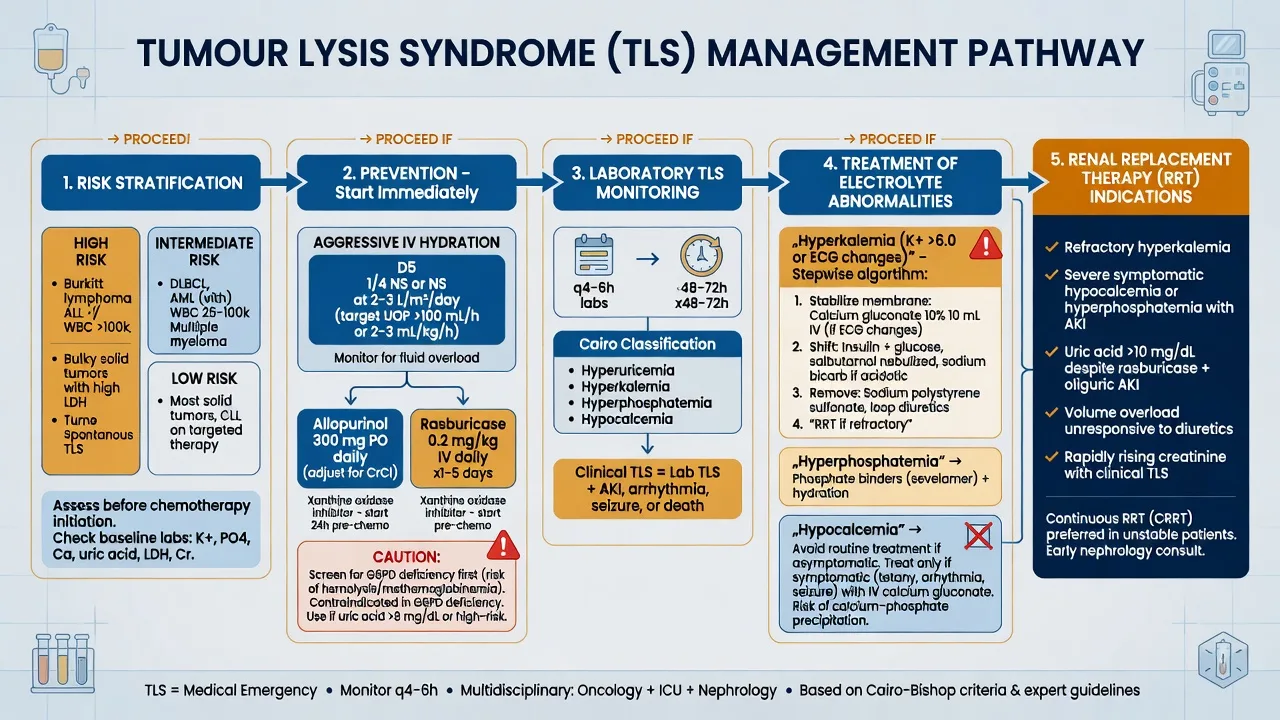
The patient with established (clinical) TLS in ICU needs simultaneous, aggressive management of all four metabolic disturbances, with hyperkalaemia taking immediate priority. The protocol below is the order in which the intensivist acts.[1][6]
Established TLS — ICU management protocol
- CONTINUOUS CARDIAC MONITORING + 12-LEAD ECG — look for hyperkalaemic changes (peaked T waves, PR prolongation, QRS widening, sine wave) and QT prolongation from hypocalcaemia. ECG changes = hyperkalaemic emergency.[5]
- TREAT HYPERKALAEMIA FIRST (it kills first) — staged protocol:
- CALCIUM GLUCONATE 10% 10 mL IV over 2-5 min (or calcium chloride via central line) if ANY ECG change. Stabilises the myocardial membrane by raising the threshold for depolarisation. Onset 1-3 min, lasts 30-60 min. It does NOT lower potassium — it buys time. Repeat if ECG changes recur.
- INSULIN/DEXTROSE — 10 units soluble insulin + 25-50 g glucose IV (e.g., 50 mL of 50% dextrose, or 100 mL 25% dextrose; reduce glucose and monitor closely in hyperglycaemic patients). Shifts K+ intracellular via Na+/K+-ATPase stimulation. Onset 15-30 min, lasts 4-6h. Monitor blood glucose.
- SALBUTAMOL 10-20 mg nebulised (or 0.5 mg IV) — beta-2 agonist, additive K+-lowering. Caution in tachyarrhythmia / ischaemia.
- POTASSIUM BINDERS — sodium zirconium cyclosilicate (SZC, fastest onset ~1-2h), patiromer, or calcium resonium / sodium polystyrene sulfonate (slower, hours-days). These actually REMOVE potassium (not just redistribute).
- RENAL REPLACEMENT THERAPY if refractory, or if AKI/oliguria means K+ will keep rising (see step 6).[5]
- RASBURICASE 0.15-0.2 mg/kg IV for hyperuricaemia — the definitive treatment for TLS-related hyperuricaemia (it destroys existing uric acid; allopurinol does not). Rapidly lowers uric acid (within 4h), which reduces urate nephropathy and helps the kidney recover, breaking the vicious cycle. Confirm G6PD status / haemolysis exclusion first. Sample handling on ice (see prevention).[4]
- AGGRESSIVE HYDRATION — continue IV fluids 3 L/m2/day, goal urine output >100 mL/m2/h. The kidney must be flushed to clear uric acid, phosphate, and potassium. Use loop diuretics to maintain urine output if euvolaemic/hypervolaemic. If oliguric despite volume → prepare for RRT.[1]
- HYPERPHOSPHATAEMIA — oral phosphate binders (sevelamer preferred; avoid calcium-based binders as they add calcium load and worsen Ca-P deposition). Aggressive hydration. RRT if refractory. The only definitive way to remove phosphate rapidly is dialysis.[6]
- HYPOCALCAEMIA — do NOT routinely treat. Hypocalcaemia is secondary to hyperphosphataemia (Ca-P precipitation). Giving calcium acutely worsens calcium-phosphate deposition in renal tubules and tissues (nephrocalcinosis, ectopic calcification) and worsens AKI. Treat hypocalcaemia ONLY if SYMPTOMATIC (tetany, carpopedal spasm, laryngospasm, seizure, or QT prolongation with arrhythmia/torsades): give calcium gluconate 10% 10-20 mL IV slowly, with ECG monitoring. Once phosphate is lowered (by binders/RRT) and AKI resolves, calcium will normalise.[1]
- RENAL REPLACEMENT THERAPY — indications: refractory hyperkalaemia; refractory hyperphosphataemia/hypocalcaemia; symptomatic volume overload/pulmonary oedema; AKI with uraemia/acidosis/oliguria. CRRT (continuous) is preferred in TLS — it provides smooth, continuous solute clearance without the rapid solute shifts (and rebound hyperkalaemia/phosphataemia) of intermittent haemodialysis, and is better tolerated haemodynamically. Intermittent haemodialysis is used if very rapid correction is needed (e.g., peri-arrest hyperkalaemia) or for logistical reasons, with a low-phosphate dialysate. The dialysate phosphate and calcium composition matter in TLS — use a low-calcium, phosphate-free/low-phosphate regimen guided by serum values.[5]
- CORRECT UNDERLYING FACTORS — treat acidosis (worsens hyperkalaemia and reduces calcium ionisation); ensure adequate analgesia and antiemetics; involve haematology/oncology to coordinate ongoing tumour-directed therapy; ensure Rasburicase/allopurinol continued through the crisis.[6]
Rasburicase vs allopurinol — head to head
| Feature | Rasburicase | Allopurinol |
|---|---|---|
| Mechanism | Recombinant urate oxidase → converts EXISTING uric acid → allantoin (soluble) | Xanthine oxidase inhibitor → prevents NEW uric acid formation |
| Effect on existing uric acid | YES — destroys it (the key difference) | NO — does not lower pre-existing uric acid |
| Onset | Hours (uric acid falls within 4h) | Days (no acute effect on existing load) |
| Role | HIGH-risk prophylaxis; TREATMENT of established TLS / hyperuricaemia | INTERMEDIATE-risk prophylaxis |
| Dose | 0.15-0.2 mg/kg IV (single dose, repeat in 24h if needed) | 300 mg/day PO (100 mg/m2/day children) |
| Key contraindication / caution | G6PD deficiency (haemolysis, methaemoglobinaemia) — screen first; pregnancy | Azathioprine / 6-mercaptopurine interaction (reduce dose 75%); warfarin potentiation; pregnancy |
| Cost | Very expensive | Cheap |
| Sample handling | Uric acid sample on ice, process immediately (rasburicase degrades uric acid in tube) | Routine |
Clinical pearls
Red flags
Prognosis
TLS outcomes and prognostic factors
| Factor | Outcome | Notes |
|---|---|---|
| Overall mortality (established TLS) | Up to 5-20% in severe cases | Death is usually from hyperkalaemic arrhythmia or complications of AKI; dramatically lower with effective prophylaxis |
| Pre-existing / baseline AKI | Worse outcomes | Reduced clearance reserve — more likely to need RRT and develop refractory electrolyte disturbance |
| Underlying tumour | Burkitt / high-grade NHL / ALL with high WBC = highest risk | Risk correlates with tumour bulk (LDH), proliferative rate, and treatment sensitivity |
| Need for RRT | 5-20% of high-risk patients | Usually temporary (days); renal function typically recovers as the tumour-lysis load clears, but some have residual CKD |
| Time to intervention | Early prophylaxis = excellent; late presentation with CTLS = high mortality | Prevention is far more effective than treatment — this is why risk stratification before therapy is paramount |
| Spontaneous TLS | Poorer prognosis | Presents late with established AKI and metabolic derangement before therapy even begins |
Key trials and evidence
Cairo & Bishop 2004 — TLS classification (Cairo-Bishop criteria) (PMID 15384972)
Source
British Journal of Haematology — the seminal classification paper
What it established
The Cairo-Bishop system: laboratory TLS (≥2 of uric acid ≥475 µmol/L/8 mg/dL, K+ ≥6.0 mmol/L, phosphate ≥1.45 mmol/L, calcium ≤1.75 mmol/L or 25% change within the at-risk window) vs clinical TLS (LTLS PLUS AKI / arrhythmia / sudden death / seizure)
Key contribution
Also reinforced aggressive hydration, rasburicase for treatment, allopurinol for prophylaxis, and that urine alkalinisation remains controversial
Clinical bottom line
The classification system every intensivist and haematologist uses to define and grade TLS — the exam framework
Cairo 2010 — International expert TLS panel consensus (PMID 20331465)
Source
British Journal of Haematology — international consensus of paediatric + adult oncology TLS experts
What it established
A formal medical-decision-tree risk model assigning LOW / INTERMEDIATE / HIGH TLS risk based on laboratory TLS, tumour proliferation/bulk/stage, and renal impairment/involveement — with matched prophylaxis recommendations
Key contribution
Standardised pre-therapy risk stratification that determines who gets hydration alone (low), hydration + allopurinol (intermediate), or hydration + rasburicase (high)
Clinical bottom line
The risk-stratification backbone that drives prophylaxis decisions — pair with BCSH 2015 for the practical algorithm
Cortes 2010 — Rasburicase Phase III trial in adults (PMID 20713865)
Source
Journal of Clinical Oncology — multicentre randomised Phase III trial, 275 adults with haematological malignancies at risk of TLS
Arms
Rasburicase 0.20 mg/kg/day d1-5 vs rasburicase d1-3 then allopurinol vs allopurinol alone d1-5
Key result
Uric acid control (≤7.5 mg/dL, days 3-7): 87% (rasburicase) vs 78% (rasburicase→allopurinol) vs 66% (allopurinol), p=0.001. Time to control in hyperuricaemic patients: 4h (rasburicase) vs 27h (allopurinol)
Clinical bottom line
Definitive adult evidence that rasburicase controls uric acid faster and more effectively than allopurinol — established rasburicase as first-line for high-risk prophylaxis and established TLS
Howard 2011 — NEJM TLS review (PMID 21561350)
Source
New England Journal of Medicine — the definitive narrative review
Key modifications
Howard refined Cairo-Bishop: laboratory TLS requires the abnormal values present SIMULTANEOUSLY (not just any two over the window), and symptomatic hypocalcaemia alone qualifies even without meeting the numerical threshold
Clinical guidance
Comprehensive pathophysiology, risk stratification, and management — hydration + rasburicase (high risk) / allopurinol (intermediate), no alkalinisation, RRT for refractory disturbance
Clinical bottom line
The single most-cited TLS reference — read it for the exam
Exam practice — SAQ
SAQ — Tumour lysis syndrome after lymphoma induction
10 minutes · 10 marks
A 29-year-old with bulky Burkitt lymphoma starts multi-agent chemotherapy. Six hours later: K+ 6.4, PO4 high, uric acid 0.72 mmol/L, creatinine rising, ECG peaked T waves.
Examiner densification notes
[1] [1]References
- [1]Coiffier B, Altman A, Pui CH, Younes A, Cairo MS. Guidelines for the management of pediatric and adult tumor lysis syndrome: an evidence-based review J Clin Oncol, 2008.PMID 18509186
- [2]Cairo MS, Bishop M. Tumour lysis syndrome: new therapeutic strategies and classification Br J Haematol, 2004.PMID 15384972
- [3]Cairo MS, Coiffier B, Reiter A, Younes A; TLS Expert Panel. Recommendations for the evaluation of risk and prophylaxis of tumour lysis syndrome (TLS) in adults and children with malignant diseases: an expert TLS panel consensus Br J Haematol, 2010.PMID 20331465
- [4]Cortes J, Moore JO, Maziarz RT, et al. Control of plasma uric acid in adults at risk for tumor Lysis syndrome: efficacy and safety of rasburicase alone and rasburicase followed by allopurinol compared with allopurinol alone--results of a multicenter phase III study J Clin Oncol, 2010.PMID 20713865
- [5]Howard SC, Jones DP, Pui CH. The tumor lysis syndrome N Engl J Med, 2011.PMID 21561350
- [6]Jones GL, Will A, Jackson GH, Webb NJ, Rule S; British Committee for Standards in Haematology. Guidelines for the management of tumour lysis syndrome in adults and children with haematological malignancies on behalf of the British Committee for Standards in Haematology Br J Haematol, 2015.PMID 25876990