ICU · Pharmacology
Anticoagulants & Antithrombotics — Pharmacology
Also known as Anticoagulants · Heparin pharmacology · Warfarin pharmacology · DOAC pharmacology · Antiplatelets · Protamine · Idarucizumab · Andexanet alfa · Unfractionated heparin · Low-molecular-weight heparin · Vitamin K antagonists · Direct oral anticoagulants · P2Y12 inhibitors · GPIIb/IIIa antagonists · Reversal agents
Anticoagulants and antithrombotics — by mechanism of action. The indirect (heparins via antithrombin III), the direct (DTI, FXa), the vitamin K antagonist (warfarin). The antiplatelets (COX, P2Y12, GPIIb/IIIa). The PK/PD and the reversal. UFH (potentiates antithrombin III → inactivates IIa + Xa; aPTT monitoring; protamine reversal; short t1/2 60-90 min; safe in renal failure). LMWH (enoxaparin 1 mg/kg BD; anti-Xa monitoring; renal clearance; partial protamine reversal ~60%). Warfarin (vitamin K epoxide reductase inhibitor; INR target 2-3; slow onset days; teratogenic; food/drug interactions; vitamin K + PCC/FFP reversal; protein C depletion → skin necrosis → overlap heparin). DOACs — dabigatran (direct thrombin inhibitor; idarucizumab reversal; 80% renal), rivaroxaban/apixaban (factor Xa inhibitors; andexanet alfa reversal). Antiplatelets — aspirin (irreversible COX-1), clopidogrel (P2Y12), GPIIb/IIIa (abciximab, tirofiban). Indications: VTE treatment/prophylaxis, AF (CHA2DS2-VASc), mechanical valve (warfarin only), ACS. Bleeding risk (HAS-BLED), major bleeding management (stop drug, activated charcoal if recent, reversal agents, blood products).
On this page & tools
Your progress
Saved locally on this device.
8 MCQs with explanations
Target exams
Red flags
Overview & definition
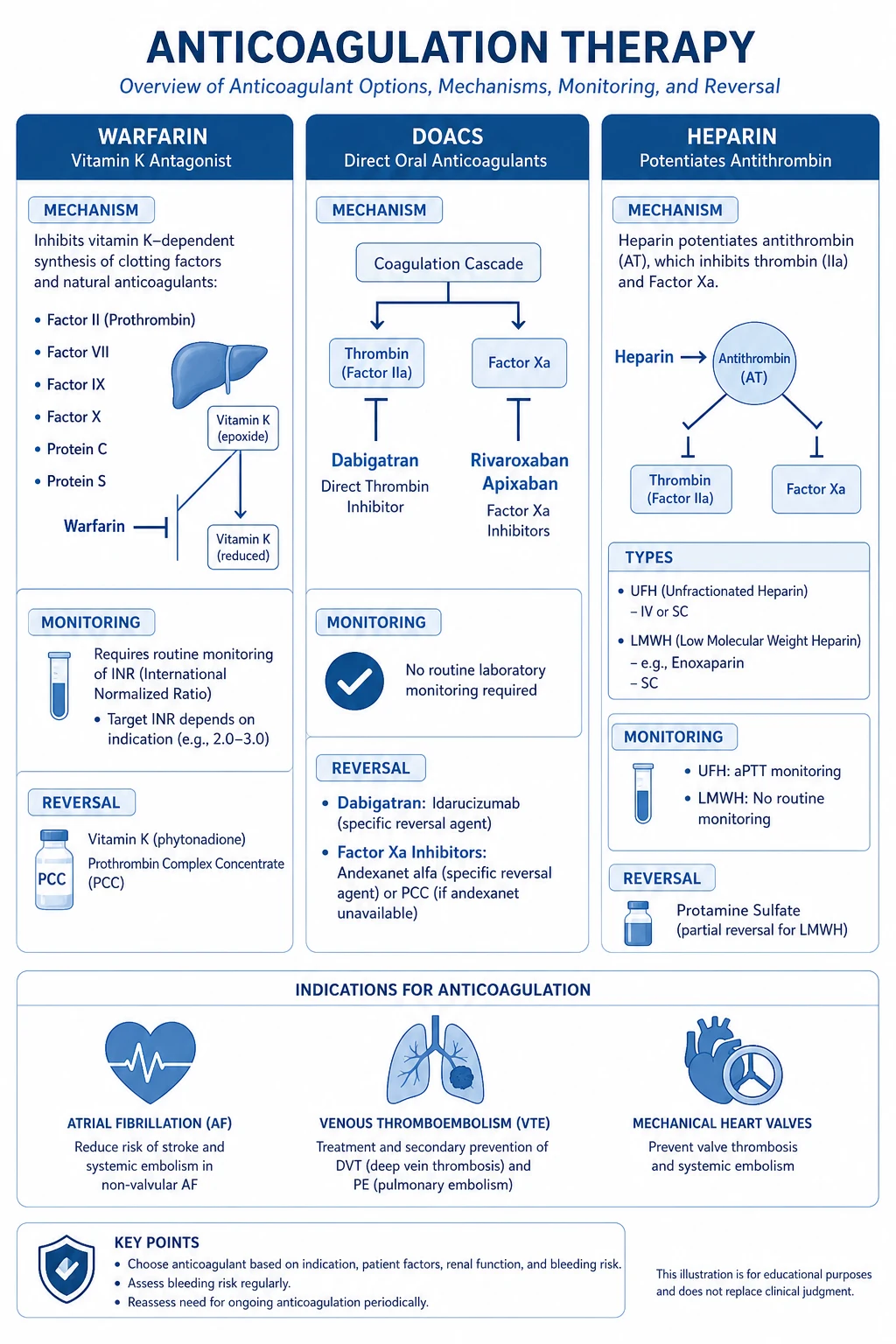
Anticoagulants and antithrombotics — by the mechanism of action. The indirect (heparins via antithrombin), the direct (DTI, FXa), the vitamin K antagonist (warfarin). The antiplatelets (COX, P2Y12, GPIIb/IIIa). The PK/PD and the reversal.[1]
The intensivist must master four therapeutic axes: (1) coagulation factor inhibition (parenteral heparins, oral warfarin/DOACs) for VTE, AF, and mechanical valves; (2) platelet inhibition (aspirin, P2Y12 inhibitors, GPIIb/IIIa) for ACS and stents; (3) the specific reversal agents (protamine, idarucizumab, andexanet alfa, vitamin K, PCC); and (4) the bleeding-risk framework (HAS-BLED) that governs drug choice. The unifying principle: match the drug to the indication, the patient's renal/hepatic function, and the realistic bleeding risk — then know precisely how to reverse each agent when bleeding occurs. [1]
By class
| Class | Mechanism | Monitoring | Reversal |
|---|---|---|---|
| UFH | Antithrombin → IIa + Xa | APTT / anti-Xa | Protamine |
| LMWH | Antithrombin → Xa | Anti-Xa (if needed) | Protamine (partial ~60%) |
| Fondaparinux | Antithrombin → Xa | Not routine | None (rFVIIa) |
| Dabigatran | Direct thrombin (IIa) | Thrombin time | Idarucizumab |
| Apixaban/rivaroxaban | Direct Xa | Anti-Xa (calibrated) | Andexanet alfa / PCC |
| Warfarin | Vit K epoxide reductase | INR | Vit K + PCC |
| Argatroban | Direct thrombin (IIa) | APTT | None (short t1/2) |
| Bivalirudin | Direct thrombin (IIa) | APTT | None (short t1/2) |
The anticoagulant landscape at a glance
Parenteral vs oral anticoagulants — the master comparison
| Drug | Mechanism | Onset | Half-life | Elimination | Monitoring | Reversal agent |
|---|---|---|---|---|---|---|
| UFH | Binds antithrombin III → inactivates IIa + Xa | Immediate (IV) / 20-30 min (SC) | 60-90 min (dose-dependent) | Reticuloendothelial (hepatic) + renal | aPTT (or anti-Xa) | Protamine 1 mg per 100 U heparin |
| LMWH (enoxaparin) | Antithrombin → preferential Xa inhibition | 3-5 h (SC) | 4-7 h | Renal (unchanged) | Anti-Xa (renal impairment, obesity, pregnancy) | Protamine PARTIAL (~60%) |
| Fondaparinux | Synthetic pentasaccharide → antithrombin → Xa only | 2-3 h (SC) | 17-21 h | Renal (unchanged) | None routine | None (rFVIIa, haemodialysis) |
| Warfarin | Vitamin K epoxide reductase inhibitor (↓II, VII, IX, X, protein C/S) | 3-5 days | 36-42 h | Hepatic (CYP2C9) | INR (target 2-3, or 2.5-3.5 mechanical mitral) | Vitamin K + 4F-PCC ± FFP |
| Dabigatran | Direct thrombin inhibitor (IIa) | 1-3 h | 12-17 h (prolonged in renal failure) | 80% renal | Thrombin time (TT), dTT, ECT | Idarucizumab (5 g IV) |
| Rivaroxaban | Direct factor Xa inhibitor | 2-4 h | 5-9 h (11-13 h elderly) | 33% renal, 66% hepatic/fecal | Anti-Xa (rivaroxaban-calibrated) | Andexanet alfa (high/low dose) ± PCC |
| Apixaban | Direct factor Xa inhibitor | 3-4 h | 12 h | 27% renal, 73% hepatic/fecal | Anti-Xa (apixaban-calibrated) | Andexanet alfa ± PCC |
| Argatroban | Direct thrombin inhibitor | Immediate (IV) | 39-51 min | Hepatic (bilirubin caution) | aPTT (target 1.5-3× baseline) | None — short t1/2 + haemodialysis |
| Bivalirudin | Direct thrombin inhibitor | Immediate (IV) | 25 min | Enzymatic (80%) + renal (20%) | aPTT / ACT | None — short t1/2 |
Heparin (UFH) — the workhorse parenteral anticoagulant
UFH dosing strategies in ICU practice
| Indication | Regimen | Target |
|---|---|---|
| DVT/PE treatment | 80 U/kg bolus → 18 U/kg/hr infusion | aPTT 1.5-2.5× control (or anti-Xa 0.3-0.7 IU/mL) |
| ACS | 60 U/kg bolus (max 4000 U) → 12 U/kg/hr (max 1000 U/hr) | aPTT 1.5-2.0× (60-85 s); usually with aspirin + P2Y12 |
| Atrial fibrillation (bridging) | No bolus → 18 U/kg/hr infusion | aPTT 1.5-2.5× |
| Mechanical valve (perioperative bridging) | SC 250 U/kg BD or infusion | aPTT 2-3× |
| Extracorporeal circuits (CRRT, ECMO) | 20-50 U/kg bolus → 5-20 U/kg/hr | Anti-Xa 0.25-0.35 IU/mL (CRRT) or ACT 180-220 s (ECMO) |
| VTE prophylaxis | 5000 U SC TDS | None (fixed dose) |
LMWH (enoxaparin) — predictable, no routine monitoring
UFH vs LMWH — when to choose which
| Feature | UFH | LMWH (enoxaparin) |
|---|---|---|
| Molecular weight | 3-30 kDa (heterogeneous) | 4-6 kDa (uniform) |
| Mechanism | Antithrombin → IIa + Xa equally | Antithrombin → Xa preferentially (3-4:1) |
| Half-life | 60-90 min (dose-dependent) | 4-7 h (fixed) |
| Clearance | Hepatic/reticuloendothelial + renal | Renal only |
| Bioavailability (SC) | Variable (~30-50%) | High (~90%, predictable) |
| Routine monitoring | Yes (aPTT) | No |
| HIT risk | 1-5% | ~0.2% (10× lower) |
| Osteoporosis risk | Higher (long-term) | Lower |
| Reversal | Protamine (complete) | Protamine PARTIAL (~60%) |
| Renal failure safety | SAFE | AVOID (CrCl <30) |
| Preferred when | AKI, need for rapid reversal/procedures, haemodynamic instability, CRRT/ECMO | Stable VTE treatment/prophylaxis, oncology (LMWH preferred in cancer — longer-term), outpatient |
Warfarin — the vitamin K antagonist
Warfarin reversal by clinical scenario — the bedside algorithm
| Clinical scenario | INR | Intervention | Speed of INR correction |
|---|---|---|---|
| INR supratherapeutic, NO bleeding | 5-9 | Hold warfarin; consider vitamin K 1-2.5 mg PO | 24-48 h |
| INR ≥10, NO bleeding | ≥10 | Hold warfarin; vitamin K 2.5-5 mg PO (IV if high bleeding risk) | 24-48 h |
| Minor bleeding | >3 | Hold; vitamin K 1-5 mg PO/IV | 12-24 h |
| Major bleeding | Any elevated | Hold + vitamin K 5-10 mg IV + 4F-PCC 25-50 IU/kg ± FFP | Immediate (within minutes — PCC) |
| Life-threatening bleed / ICH | Any elevated | Hold + vitamin K 10 mg IV + 4F-PCC 50 IU/kg + FFP 15 mL/kg | Immediate |
| Need for rapid pre-procedure reversal | Any | 4F-PCC + vitamin K 5 mg IV | Within 30-60 min |
Direct oral anticoagulants (DOACs) — the modern era
The four DOACs — mechanism, dose, reversal, and clearance
| Drug | Target | Standard dose (VTE/AF) | Renal clearance | Half-life | Reversal | Pregnancy |
|---|---|---|---|---|---|---|
| Dabigatran | Thrombin (IIa) | 150 mg BD | 80% | 12-17 h (prolonged in renal failure; up to 28 h) | Idarucizumab 5 g IV | Contraindicated |
| Rivaroxaban | Xa | 20 mg OD (15 mg OD if CrCl 15-50) | 33% | 5-9 h (11-13 h elderly) | Andexanet alfa ± PCC | Contraindicated |
| Apixaban | Xa | 5 mg BD (2.5 mg BD if ≥2 of: age ≥80, Cr ≥133, weight ≤60 kg) | 27% | 12 h | Andexanet alfa ± PCC | Contraindicated |
| Edoxaban | Xa | 60 mg OD (30 mg if CrCl 15-50, ≤60 kg, concomitant P-gp inhibitor) | 50% | 10-14 h | Andexanet alfa ± PCC | Contraindicated |
Specific reversal agents — the modern pharmacology
Anticoagulant reversal agents — dose, mechanism, and limitations
| Anticoagulant | Reversal agent | Dose | Mechanism | Time to effect | Limitations |
|---|---|---|---|---|---|
| UFH | Protamine sulfate | 1 mg per 100 U heparin (max 50 mg) | Cationic protein binds anionic heparin → inactive complex | <5 min (IV) | Anaphylaxis (1%); hypotension if rapid push; dosing uncertain after 2-3 h of heparin |
| LMWH | Protamine PARTIAL (~60%) | 1 mg per 1 mg enoxaparin (last 8 h) | Binds ~60% of LMWH | <5 min | Only PARTIAL reversal — longer LMWH t1/2 means residual anticoagulation |
| Fondaparinux | None (rFVIIa 90 mcg/kg) | rFVIIa if life-threatening | Off-label; bypasses inhibition | Variable | No reliable reversal; supportive care + waiting (t1/2 17-21 h) |
| Warfarin | Vitamin K + 4F-PCC | Vit K 5-10 mg IV + 4F-PCC 25-50 IU/kg | Vit K restores hepatic γ-carboxylation; PCC replaces factors | Vit K: 6-12 h; PCC: minutes | PCC has small thrombosis risk; FFP inferior (volume, thawing); INR rebound at 24 h if vit K omitted |
| Dabigatran | Idarucizumab | 5 g IV (2 × 2.5 g) | Monoclonal Fab → binds dabigatran 350× more avidly than thrombin | Minutes | Thrombotic risk if dabigatran re-initiated; expensive; rebound if ongoing absorption |
| Rivaroxaban/Apixaban | Andexanet alfa (HIGH: 800 mg bolus + 8 mg/min ×120 min; LOW: 400 mg + 4 mg/min ×120 min) | Weight + drug dose-dependent | Modified FXa decoy → sequesters Xa inhibitor | Minutes (bolus) | Short t1/2 → rebound; ~10% thrombotic risk; costly. Alternative: 4F-PCC 50 IU/kg |
| Edoxaban | Andexanet (off-label) / 4F-PCC | As for rivaroxaban | As above | Minutes | Limited evidence |
| Argatroban / Bivalirudin | None (short t1/2) | Supportive; wait | Short half-life = spontaneous reversal | 1-2 h off drug | Argatroban hepatic-safe but INR artefact; bivalirudin partial renal |
Antiplatelets — the ACS and stroke-prevention armamentarium
The P2Y12 inhibitors — clopidogrel vs prasugrel vs ticagrelor
| Feature | Clopidogrel | Prasugrel | Ticagrelor |
|---|---|---|---|
| Class | Thienopyridine (prodrug) | Thienopyridine (prodrug) | Cyclopentyl-triazolo-pyrimidine (direct) |
| Activation | Hepatic CYP2C19 (variable — ~30% poor metabolisers) | Rapid hepatic esterases (NOT CYP2C19-dependent) | None (active drug) |
| Onset | Slow (2-6 h after 600 mg load) | Fast (~30 min after 60 mg load) | Fast (~30 min after 180 mg load) |
| Potency | Moderate | High | High |
| Reversibility | Irreversible (lifespan of platelet, 7-10 d) | Irreversible (7-10 d) | Reversible (3-5 d) |
| Dose | 75 mg OD (600 mg load) | 10 mg OD (60 mg load) | 90 mg BD (180 mg load) — then 60 mg BD in long-term |
| Key trial | CURE (PCI/ACS) | TRITON-TIMI 38 | PLATO (mortality benefit) |
| Contraindications | CYP2C19 LOF + ACS/PCI | Prior stroke/TIA; caution >75 yr, <60 kg | Active bleeding; caution in bradyarrhythmia |
| Adverse effects | Rare thrombocytopenia | More major bleeding | Dyspnoea (10-15%), bradycardia/AV block, ↑uric acid/creatinine |
| Reversal | Platelet transfusion (wait 6-12 h after dose) | Platelet transfusion (no specific antidote) | Platelet transfusion less effective (reversible); bentalurase investigational |
The antiplatelets (continued)
- Aspirin — irreversible COX-1 (acetylation); platelet inhibition for lifespan (7-10 days).[1]
- Clopidogrel/prasugrel — irreversible P2Y12 (prodrugs; CYP2C19). Ticagrelor — reversible P2Y12.[1]
- GPIIb/IIIa (abciximab, tirofiban, eptifibatide) — block the final common pathway of platelet aggregation; the TARGET trial found abciximab superior to tirofiban for high-risk PCI.[1][23]
Key PK/PD
- UFH — short half-life (60-90 min); hepatic clearance; safe in renal failure. Dose-dependent half-life.[1]
- LMWH — renal excretion; avoid CrCl under 30. More predictable (no routine monitoring).[1]
- Warfarin — slow onset (days; the II/VII/IX/X + protein C/S); the narrow therapeutic window; the CYP2C9 metabolism; the drug interactions. The protein C depletion paradox (the early hypercoagulable → the warfarin skin necrosis → overlap with heparin for 5 days).[1]
- DOACs — oral; the predictable (no routine monitoring); the peak 1-4 h; the renal (dabigatran 80 per cent; apixaban/rivaroxaban 25-30 per cent).[1]
Indications — matching drug to disease
Anticoagulation indications by clinical scenario
| Indication | First-line anticoagulant | Rationale / comment |
|---|---|---|
| VTE treatment (DVT/PE) — first 5-10 days | LMWH OR UFH OR fondaparinux OR rivaroxaban/apixaban (oral from day 1) OR dabigatran (after 5-10 d parenteral — RE-COVER) | LMWH preferred initial; DOACs allow outpatient treatment without parenteral lead-in (rivaroxaban/apixaban); dabigatran requires parenteral lead-in[4] |
| VTE long-term (3-6 months) | DOAC (rivaroxaban, apixaban, dabigatran, edoxaban) preferred over warfarin | DOACs: non-inferior efficacy, less major bleeding, no monitoring; cancer → LMWH or edoxaban/rivaroxaban |
| VTE extended (cancer-associated) | LMWH (dalteparin) historically; now rivaroxaban/apixaban or edoxaban | Selected-DURATION: oral DOACs non-inferior to LMWH |
| Stroke prevention in non-valvular AF | DOAC (apixaban, rivaroxaban, dabigatran, edoxaban) preferred over warfarin | ARISTOTLE: apixaban superior (↓stroke + ↓bleeding + ↓mortality); AVERROES: apixaban superior to aspirin in AF unsuitable for warfarin; DOACs avoid dietary/drug interactions[2][29] |
| Mechanical heart valve | Warfarin ONLY — DOACs CONTRAINDICATED | RE-ALIGN: dabigatran more thrombosis/bleeding than warfarin in mechanical valves. INR target: mitral 2.5-3.5, aortic 2.0-3.0 |
| Atrial fibrillation (valvular — moderate-severe MS or rheumatic) | Warfarin (NOT DOAC) | DOACs not validated in valvular AF; warfarin remains standard |
| Antiphospholipid syndrome (triple positive) | Warfarin (NOT DOAC) | Triple-positive APS → DOACs inferior (RAPS trial) |
| Acute coronary syndrome (post-PCI) | Aspirin + P2Y12 (DAPT) — ticagrelor preferred; DOAC added only if AF (then triple → double therapy) | ATLAS-ACS: low-dose rivaroxaban (2.5 mg BD) reduced death; APPRAISE-2 apixaban STOPPED — excess bleeding/death |
| Chronic stable CAD/PAD | Aspirin ± low-dose rivaroxaban 2.5 mg BD (COMPASS) | COMPASS: reduced CV death/stroke/MI but ↑major bleeding |
| VTE prophylaxis (medical/surgical ICU) | LMWH 40 mg SC OD (enoxaparin) OR UFH 5000 U SC TDS | UFH if renal impairment; mechanical prophylaxis if contraindicated |
| Pregnancy (any indication) | LMWH ONLY (warfarin teratogenic; DOACs contraindicated) | Enoxaparin 1 mg/kg BD; switch to UFH near delivery (shorter t1/2); resume LMWH postpartum + warfarin for 6 weeks postpartum if needed |
| HIT | Argatroban (hepatic-safe) OR bivalirudin OR danaparoid | DO NOT use warfarin alone until platelets recover (warfarin potentiates protein C depletion → skin necrosis + venous limb gangrene) |
| Bridging around surgery (mechanical valve, AF) | Stop warfarin 5 days pre-op; LMWH bridging dose when INR <2; stop LMWH 24 h pre-op | PERIOP2: postoperative LMWH bridging did not reduce arterial thromboembolism |
Stroke and bleeding risk scores — CHA2DS2-VASc and HAS-BLED
Computing CHA2DS2-VASc and HAS-BLED — the AF risk stratification
- Compute CHA2DS2-VASc (stroke risk — each letter a point):
- C Congestive heart failure (1) — or LV dysfunction
- H Hypertension (1)
- A2 Age ≥75 (2) — note double points
- D Diabetes (1)
- S2 prior Stroke/TIA/thromboembolism (2) — double points
- V Vascular disease (prior MI, PAD, aortic plaque) (1)
- A Age 65-74 (1)
- Sc Sex category female (1)
- Apply the threshold for anticoagulation:
- Score 0 (male) or 1 (female) → no anticoagulation (truly low risk)
- Score ≥2 (male) or ≥3 (female) → oral anticoagulation recommended (DOAC preferred)
- Score 1 (male) / 2 (female) → consider anticoagulation (shared decision)
- Compute HAS-BLED (bleeding risk — each letter a point):
- H Hypertension (uncontrolled, SBP >160) (1)
- A Abnormal renal/liver function (1 each, max 2) — dialysis, transplant, cirrhosis, bilirubin >2×
- S Stroke (prior) (1)
- B Bleeding history/predisposition (1)
- L Labile INR (TTR <60%) (1)
- E Elderly (age >65) (1)
- D Drugs/alcohol concomitantly (antiplatelet/NSAID, ≥8 drinks/week) (1 each, max 2)
- Interpret HAS-BLED:
- Score ≥3 → "high risk" — review/correct modifiable risk factors (BP, NSAIDs, alcohol, labile INR) — NOT a reason to withhold anticoagulation (the stroke risk usually outweighs)
- A high HAS-BLED should trigger caution and modifiable-risk-factor correction, not denial of stroke prevention
- Choose the agent — DOAC preferred over warfarin for non-valvular AF (lower intracranial bleeding, comparable/better efficacy); warfarin for mechanical valves, severe MS, triple-positive APS
- Re-evaluate annually — recheck renal function (DOAC dose adjustment), bleeding risk, adherence, and new vascular disease[16][17]
Management pathways
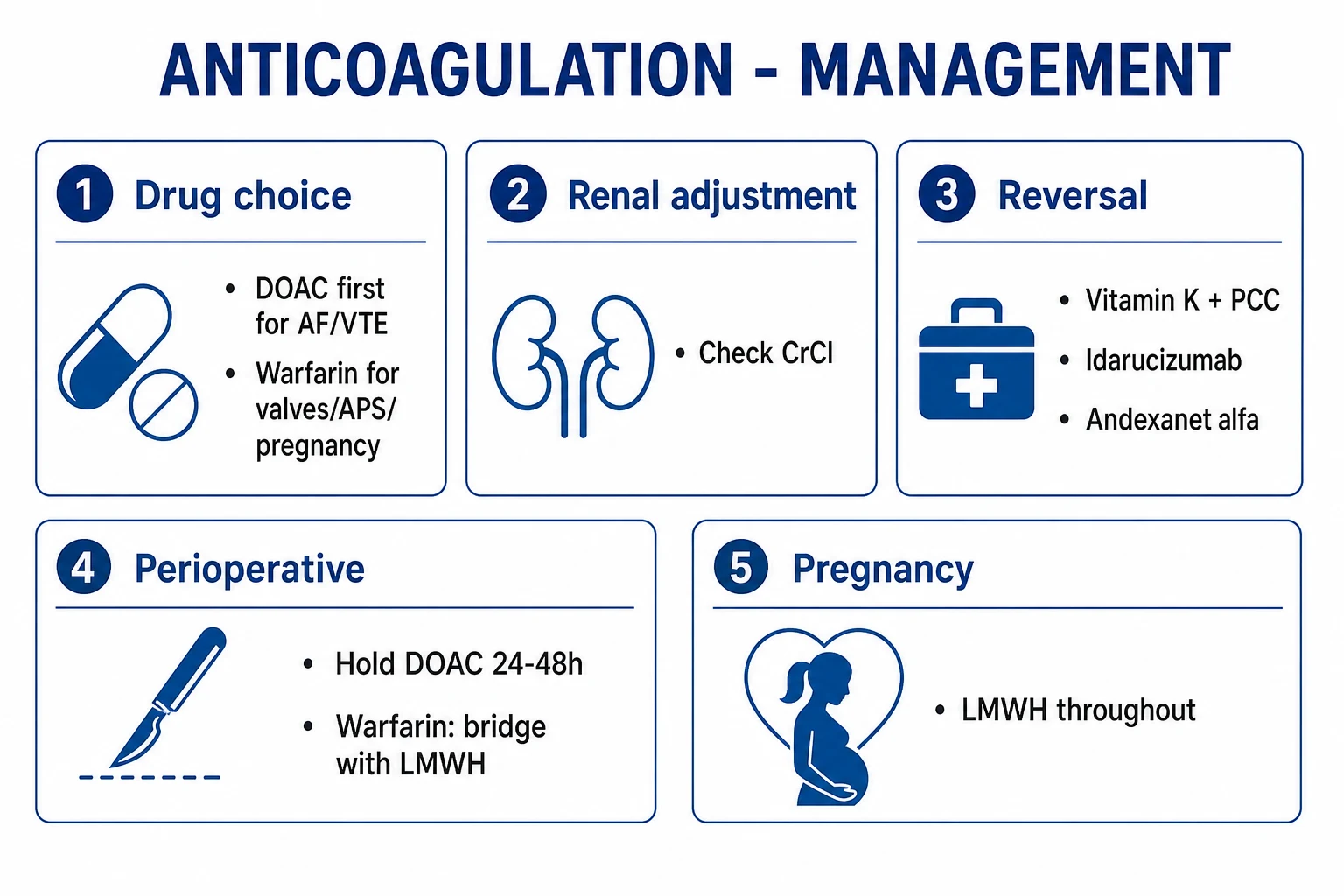
Major bleeding on an anticoagulant — the universal algorithm
- Recognise and resuscitate — ABC; two large-bore IV cannulae; cross-match; activate massive transfusion protocol if haemodynamically unstable; treat hypotension with crystalloid/blood products (1:1:1 PRBC:FFP:platelets in trauma)
- Identify the anticoagulant and time of last dose — drug, dose, time of last ingestion, renal function (CrCl/eGFR), and any co-administered antiplatelets/NSAIDs
- Stop the anticoagulant immediately (and all antiplatelets/NSAIDs)
- Give activated charcoal if recent ingestion — within 2-4 h for dabigatran/rivaroxaban/apixaban (the absorption window); useless if >4 h
- Apply local measures — endoscopic/surgical/radiological haemostasis for the bleed source (e.g., GI endoscopy, interventional radiology for retroperitoneal)
- Administer the specific reversal agent:
- Warfarin (INR elevated + major bleed) → vitamin K 5-10 mg IV + 4F-PCC 25-50 IU/kg (preferred over FFP — faster, smaller volume)
- Dabigatran → idarucizumab 5 g IV (2 × 2.5 g)
- Rivaroxaban/apixaban → andexanet alfa (HIGH or LOW dose by drug dose/timing); if unavailable → 4F-PCC 50 IU/kg or aPCC 50 IU/kg
- UFH → protamine 1 mg per 100 U heparin in last 2-3 h
- LMWH → protamine 1 mg per 1 mg enoxaparin (PARTIAL reversal ~60%)
- Fondaparinux, argatroban, bivalirudin → no specific agent; supportive (rFVIIa for fondaparinux; short t1/2 of DTIs = wait)
- Supportive blood products — PRBC to Hb >70 (or >80 if active/ongoing); platelets if <50 (or antiplatelet/anti-GPIIb/IIIa); fibrinogen (cryoprecipitate or fibrinogen concentrate) if <1.5; FFP if PT/aPTT >1.5×
- Adjuncts — tranexamic acid 1 g IV (CRASH-2: reduces mortality in trauma bleeding; role in non-trauma less clear); consider for refractory GI/surgical bleeding
- Do NOT delay reversal for confirmatory levels in life-threatening bleeds — give empirically based on history
- Re-assess at 1-2 h — if ongoing bleeding, repeat reversal (idarucizumab 5 g repeat in dabigatran rebound; PCC top-up); check anti-Xa/TT if available
- Decide on anticoagulation resumption — balance re-thrombosis vs re-bleeding; typically resume 7-14 days post-major GI bleed, sooner for mechanical valve/intracardiac thrombus
Perioperative management of anticoagulation — bridging
- Assess thromboembolic risk:
- HIGH — mechanical mitral valve, any valve + prior stroke/TIA, CHA2DS2-VASc ≥7, recent VTE (<3 months), severe thrombophilia → bridging usually indicated
- MODERATE — bileaflet aortic valve + ≥1 risk factor, CHA2DS2-VASc 5-6, VTE 3-12 months ago → individualise
- LOW — bileaflet aortic valve alone, simple AF CHA2DS2-VASc <5, VTE >12 months → no bridging
- Stop warfarin 5 days before surgery (INR falls to ~1.5 by day 4, normal by day 5)
- Start bridging LMWH (or UFH) 3 days before surgery — therapeutic dose enoxaparin 1 mg/kg BD when INR <2.0
- Stop LMWH 24 h before surgery (last dose morning of day -1); UFH if very high risk (stop 4-6 h pre-op)
- On day of surgery — check INR <1.5; neuraxial anaesthesia requires INR ≤1.4 and LMWH held ≥24 h
- Resume warfarin 12-24 h post-op (when haemostasis secured)
- Resume LMWH 48-72 h post-op (when surgical bleeding risk acceptable) — beware high bleed risk with early LMWH restart
- PERIOP2 finding — postoperative bridging (LMWH + warfarin) did NOT reduce arterial thromboembolism vs warfarin alone, and increased major bleeding → reserve for HIGHEST thrombotic risk patients
Heparin-induced thrombocytopenia (HIT) — recognise and switch
- Suspect HIT when platelets fall >50% OR to <100 ×10^9/L, 5-14 days after heparin exposure (or sooner if prior heparin in 30 days). The platelet fall is the hallmark — usually no bleeding, often THROMBOSIS (paradox: 30-50% develop new clot — DVT, limb ischaemia, stroke, MI)
- Apply the 4Ts score to estimate pre-test probability:
- Thrombocytopenia (fall pattern and nadir)
- Timing (day of onset — 5-14 d typical; <1 d if prior exposure)
- Thrombosis or other sequelae (skin necrosis, adrenal haemorrhage, acute systemic reaction)
- oTheR cause of thrombocytopenia excluded
- 4Ts 0-3 → unlikely (≈3%); 4-5 → intermediate (≈20%); 6-8 → high (≈60%). Meta-analysis: 4Ts score has good NPV, modest PPV
- Stop ALL heparin immediately — UFH, LMWH, heparin flushes, heparin-coated lines — switch to a non-heparin anticoagulant at therapeutic dose (HIT is pro-thrombotic)
- Switch to argatroban (hepatic clearance → preferred in renal failure; start 2 µg/kg/min, titrate aPTT 1.5-3× baseline) OR bivalirudin OR danaparoid OR fondaparinux (off-label)
- Send confirmatory testing — anti-PF4 antibody ELISA (sensitive, ±specific); serotonin release assay (SRA — gold standard but slow)
- Platelets usually recover in 4-14 days — do NOT start warfarin until platelets ≥150 (warfarin alone → catastrophic protein C depletion → venous limb gangrene)
- When platelets recovered and on argatroban, transition to warfarin (overlap ≥5 days, INR >2 for 24 h — note argatroban falsely elevates INR)
- Lifelong avoidance of heparin — document in chart; future anticoagulation with DOAC, fondaparinux, or argatroban. HIT antibodies fade in ~3 months — re-exposure rarely tested but generally avoided
DOAC-related intracranial haemorrhage — the time-critical reversal
- Confirm ICH (CT brain) and that the patient is on a DOAC — drug, dose, time of last ingestion
- Stop the DOAC and any antiplatelets immediately
- Activated charcoal if ingestion within 2-4 h (reduce absorption — especially dabigatran)
- For dabigatran — give idarucizumab 5 g IV (two consecutive 2.5 g boluses); if idarucizumab unavailable, consider haemodialysis (dabigatran is 35% unbound → dialysable) + aPCC 50 IU/kg
- For rivaroxaban/apixaban — give andexanet alfa (HIGH dose if last dose within 8 h or high dose ingested; LOW dose otherwise); if unavailable → 4F-PCC 50 IU/kg (or aPCC 50 IU/kg)
- Supportive care — BP control (SBP 140-160 mmHg), ICP management, reverse other coagulopathy (vit K if warfarin overlap, platelets if dual antiplatelet)
- Avoid platelet transfusion unless on antiplatelet + undergoing neurosurgery
- Neurosurgical evacuation — defer until anticoagulant effect reversed (anti-Xa or TT normal); then proceed as for non-anticoagulated ICH
- Do NOT routinely give PCC + andexanet together — additive thrombotic risk; choose one
- Plan anticoagulation resumption — balance haemorrhage expansion vs thrombotic indication; typically resume 7-10 days post-ICH if strong indication (mechanical valve sooner)
Red flags
Clinical pearls
Key trials and evidence
RE-LY — Dabigatran vs warfarin in AF (PMID 19717844)
Study design
Multicentre randomised open-label (PROBE) with blinded adjudication — 18,113 patients
Population
Non-valvular AF + ≥1 stroke risk factor (mean CHADS2 2.1)
Intervention
Dabigatran 110 mg BD OR 150 mg BD vs warfarin (INR 2-3)
Primary outcome
Stroke/systemic embolism: 150 mg 1.11% vs warfarin 1.69% (RR 0.66, p<0.001 for superiority); 110 mg non-inferior
Key secondary findings
Both doses reduced intracranial haemorrhage (~0.23% vs 0.74%); 150 mg increased GI bleeding; dyspepsia ~12% (main discontinuation cause)
Clinical bottom line
First DOAC to beat warfarin in AF — dabigatran 150 mg superior for stroke prevention with less ICH; launched the DOAC era
ARISTOTLE — Apixaban vs warfarin in AF (PMID 21870978)
Study design
Multicentre randomised double-blind — 18,201 patients
Population
Non-valvular AF + ≥1 stroke risk factor (mean CHADS2 2.1)
Intervention
Apixaban 5 mg BD vs warfarin (INR 2-3)
Primary outcome
Stroke/systemic embolism: 1.27% vs 1.60% (HR 0.79, p<0.001 superiority)
Key secondary findings
Major bleeding reduced (2.13% vs 3.09%, HR 0.69); haemorrhagic stroke reduced (0.24% vs 0.47%); all-cause mortality reduced (3.52% vs 3.94%, HR 0.89)
Clinical bottom line
Apixaban is the only DOAC to show simultaneous superiority for stroke prevention, reduced major bleeding, AND reduced mortality — preferred DOAC for AF
ROCKET AF — Rivaroxaban vs warfarin in AF (PMID 21830957)
Study design
Multicentre randomised double-blind double-dummy — 14,264 patients
Population
Non-valvular AF at HIGHER risk (mean CHADS2 3.5)
Intervention
Rivaroxaban 20 mg OD (15 mg if CrCl 30-49) vs warfarin (INR 2-3)
Primary outcome
Stroke/systemic embolism: 1.7% vs 2.2% (HR 0.88, non-inferior p<0.001; superiority not significant in ITT)
Key secondary findings
Critical-organ and fatal bleeding reduced; intracranial haemorrhage reduced (0.5% vs 0.7%); GI bleeding increased
Clinical bottom line
Once-daily rivaroxaban non-inferior to warfarin in higher-risk AF; less ICH, more GI bleed — convenient once-daily dosing
RE-VERSE AD — Idarucizumab for dabigatran reversal (PMIDs 26095746, 28693366)
Study design
Multicentre prospective open-label single-arm — 503 patients (full cohort)
Population
Patients on dabigatran with serious bleeding (Group A) OR requiring urgent procedure/surgery (Group B)
Intervention
Idarucizumab 5 g IV (2 × 2.5 g bolus)
Primary outcome
Maximum percentage reversal of dabigatran anticoagulant effect (by diluted TT): 88-98% at 24 h
Key secondary findings
Haemostasis good/excellent in ~93% in bleeding group; thrombotic events ~5% during follow-up (attributed to underlying disease + resumption)
Clinical bottom line
Idarucizumab provides immediate, complete, and safe reversal of dabigatran — the cleanest of the specific reversal agents (no procoagulant effect)
ANNEXA-4 — Andexanet alfa for Xa-inhibitor bleeding (PMIDs 27573206, 30730782)
Study design
Multicentre prospective open-label single-arm — 352 patients (full study)
Population
Patients on apixaban/rivaroxaban/edoxaban/enoxaparin with acute major bleeding
Intervention
Andexanet alfa — HIGH dose (800 mg bolus + 8 mg/min ×120 min) or LOW dose (400 mg + 4 mg/min ×120 min) by drug dose/timing
Primary outcome
Anti-Xa activity reduced 92% (apixaban) and 92% (rivaroxaban) at end of bolus; good/excellent haemostasis in 82% at 12 h
Key secondary findings
Rebound in anti-Xa at 4 h after infusion (short andexanet t1/2); thrombotic events ~10% within 30 days
Clinical bottom line
Andexanet reverses Xa-inhibitor anti-Xa activity rapidly with good clinical haemostasis; rebound and thrombosis are the main caveats — 4F-PCC 50 IU/kg is an alternative
EINSTEIN-PE/CHOICE — Rivaroxaban in VTE (PMIDs 22449293, 28316279)
Study design
EINSTEIN-PE: open-label non-inferiority RCT — 4,832 patients. EINSTEIN-CHOICE: double-blind RCT — 3,365 patients
Population
EINSTEIN-PE: acute symptomatic PE ± DVT. EINSTEIN-CHOICE: extended therapy after 6-12 months VTE treatment
Intervention
EINSTEIN-PE: rivaroxaban 15 mg BD ×21d → 20 mg OD vs enoxaparin/warfarin. EINSTEIN-CHOICE: rivaroxaban 20 mg OD OR 10 mg OD vs aspirin 100 mg OD
Primary outcome
EINSTEIN-PE: non-inferior (2.1% vs 1.8% symptomatic recurrent VTE; less major bleeding). EINSTEIN-CHOICE: rivaroxaban 20 mg (1.5%) and 10 mg (1.2%) both superior to aspirin (4.4%); similar bleeding
Clinical bottom line
Rivaroxaban allows oral-only VTE treatment without parenteral lead-in (15 mg BD loading then 20 mg OD); for extended therapy, rivaroxaban 10 or 20 mg OD is superior to aspirin with similar bleeding
PLATO — Ticagrelor vs clopidogrel in ACS (PMID 19717846)
Study design
Multicentre randomised double-blind — 18,624 patients
Population
Patients hospitalised for ACS (STEMI, NSTEMI, unstable angina) — intended invasive or non-invasive management
Intervention
Ticagrelor 180 mg load → 90 mg BD vs clopidogrel 300-600 mg load → 75 mg OD (both + aspirin)
Primary outcome
Composite CV death/MI/stroke at 12 months: 9.8% vs 11.7% (HR 0.84, p<0.001)
Key secondary findings
All-cause mortality reduced (4.5% vs 5.9%, p<0.001) — first P2Y12 with mortality benefit. Major bleeding similar overall but non-CABG bleeding higher; dyspnoea ~14%; bradyarrhythmias
Clinical bottom line
Ticagrelor preferred over clopidogrel in ACS — superior ischaemic outcomes AND reduced mortality. Benefit greatest with low-dose aspirin ≤100 mg
TRITON-TIMI 38 — Prasugrel vs clopidogrel in ACS (PMID 17982182)
Study design
Multicentre randomised double-blind — 13,608 patients
Population
Moderate-high-risk ACS undergoing PCI
Intervention
Prasugrel 60 mg load → 10 mg OD vs clopidogrel 300 mg load → 75 mg OD (both + aspirin)
Primary outcome
Composite CV death/MI/stroke: 9.9% vs 12.1% (HR 0.81, p<0.001)
Key secondary findings
Major bleeding increased (2.4% vs 1.8%); fatal ICH in patients with prior stroke/TIA (absolute contraindication); benefit greatest in STEMI + diabetes
Clinical bottom line
Prasugrel more potent/faster than clopidogrel — preferred in high-thrombotic-risk STEMI/diabetes WITHOUT prior stroke; contraindicated in prior TIA/stroke; reduce to 5 mg if >75 yr or <60 kg
HORIZONS-AMI — Bivalirudin in primary PCI (PMID 18499566)
Study design
Multicentre randomised open-label — 3,602 patients
Population
STEMI undergoing primary PCI
Intervention
Bivalirudin vs heparin + GPIIb/IIIa (abciximab)
Primary outcome
Major bleeding at 30 days: reduced (4.9% vs 8.3%); NACE composite reduced (10.1% vs 14.1%)
Key secondary findings
30-day mortality reduced (2.1% vs 3.1%); BUT acute stent thrombosis (<24 h) increased (1.3% vs 0.3%)
Clinical bottom line
Bivalirudin reduces bleeding and mortality in primary PCI — at the cost of early stent thrombosis (mitigated by adding P2Y12). Bivalirudin is the agent of choice in HIT patients needing PCI
CRASH-2 — Tranexamic acid in trauma (PMID 20554319)
Study design
Multicentre randomised placebo-controlled — 20,211 patients
Population
Trauma patients with significant bleeding OR systolic BP <90 OR HR >110 within 8 h of injury
Intervention
Tranexamic acid 1 g IV loading over 10 min → 1 g over 8 h vs placebo
Primary outcome
All-cause 28-day mortality: 14.5% vs 16.0% (RR 0.91, p=0.0035)
Key secondary findings
Bleeding death reduced (4.9% vs 5.7%); NO increase in vascular occlusive events, MI, stroke, PE, DVT. Benefit confined to treatment WITHIN 3 h of injury
Clinical bottom line
Early TXA (within 3 h) reduces mortality in trauma bleeding — a cheap, globally available life-saver. Late TXA (>3 h) trends toward harm
ATLAS ACS 2-TIMI 51 / APPRAISE-2 — DOACs in ACS (PMIDs 22077192, 21780946)
Study design
Both: multicentre randomised double-blind placebo-controlled. ATLAS: 15,526 patients. APPRAISE-2: 7,392 patients (stopped early)
Population
Recent ACS on DAPT (aspirin + clopidogrel)
Intervention
ATLAS: rivaroxaban 2.5 mg or 5 mg BD vs placebo. APPRAISE-2: apixaban 5 mg BD vs placebo
Primary outcome
ATLAS: reduced CV death/MI/stroke (8.9% vs 10.7%, HR 0.84); reduced all-cause/stent thrombosis. APPRAISE-2: STOPPED for excess major bleeding (1.3% vs 0.5%) and a trend toward more death
Key secondary findings
ATLAS: 2.5 mg reduced CV + all-cause mortality, with increased major/non-CABG bleeding but not fatal. APPRAISE-2: TIMI major bleeding and intracranial haemorrhage increased
Clinical bottom line
Only VERY LOW DOSE DOAC (rivaroxaban 2.5 mg BD) added to DAPT is tolerated in ACS; full-dose DOACs (apixaban 5 mg BD) cause excess bleeding with no benefit — defines the narrow therapeutic window
COMPASS — Rivaroxaban + aspirin in stable CVD (PMID 28844192)
Study design
Multicentre randomised double-blind — 27,395 patients (stopped early for benefit)
Population
Stable coronary artery disease and/or peripheral artery disease
Intervention
Rivaroxaban 2.5 mg BD + aspirin 100 mg OR rivaroxaban 5 mg BD alone OR aspirin 100 mg
Primary outcome
Composite CV death/stroke/MI: 4.1% vs 5.4% for rivaroxaban+ASA vs ASA (HR 0.76, p<0.001)
Key secondary findings
Major bleeding increased (3.4% vs 2.2%, HR 1.61) but no increase in fatal bleeding or intracranial haemorrhage; mortality reduced
Clinical bottom line
Dual pathway inhibition (low-dose rivaroxaban + aspirin) reduces CV events in stable CAD/PAD — at the cost of more (non-fatal) major bleeding
Prognosis and comparative outcomes
Anticoagulant outcomes by clinical scenario — what the evidence shows
| Scenario | Agent | Outcome vs comparator | Evidence |
|---|---|---|---|
| Non-valvular AF | Apixaban | Superior efficacy + reduced major bleeding + reduced mortality vs warfarin | ARISTOTLE (2011) |
| Non-valvular AF | Dabigatran 150 mg | Superior efficacy + reduced ICH vs warfarin | RE-LY (2009) |
| Non-valvular AF | Rivaroxaban | Non-inferior efficacy + reduced ICH vs warfarin | ROCKET AF (2011) |
| Acute VTE | Rivaroxaban/apixaban | Non-inferior to LMWH+warfarin; less major bleeding | EINSTEIN, AMPLIFY |
| Extended VTE | Rivaroxaban 10/20 mg, apixaban | Superior to aspirin for preventing recurrence | EINSTEIN-CHOICE (2017) |
| Dabigatran major bleeding reversal | Idarucizumab 5 g | Immediate complete reversal in 88-98%; ~93% haemostasis | RE-VERSE AD (2015/2017) |
| Xa-inhibitor major bleeding reversal | Andexanet alfa | 82-92% reduction in anti-Xa; ~82% haemostasis; ~10% thrombosis | ANNEXA-4 (2016/2019) |
| ACS post-PCI (DAPT) | Ticagrelor | Superior efficacy + reduced mortality vs clopidogrel | PLATO (2009) |
| ACS post-PCI (DAPT) | Prasugrel | Superior efficacy vs clopidogrel; more bleeding; CI in prior stroke | TRITON-TIMI 38 (2007) |
| Primary PCI STEMI | Bivalirudin | Reduced bleeding + mortality vs heparin+GPIIb/IIIa; more acute stent thrombosis | HORIZONS-AMI (2008) |
| Trauma bleeding | TXA within 3 h | Reduced all-cause mortality (14.5% vs 16.0%) | CRASH-2 (2010) |
| Stable CAD/PAD | Rivaroxaban 2.5 mg BD + aspirin | Reduced CV death/stroke/MI; more major bleeding | COMPASS (2017) |
| HIT | Argatroban | Reduced new thrombosis + composite endpoint (death/amputation/thrombosis) | ARG-911 (2001) |
| Major orthopaedic VTE prophylaxis | Fondaparinux | Superior VTE prophylaxis vs enoxaparin | Turpie 2002 |
Bleeding-risk and monitoring summary — the bedside reference
| Anticoagulant | Bleeding-risk factor | Laboratory monitor | Reversal agent | Specific note |
|---|---|---|---|---|
| UFH | High aPTT, renal impairment, weight extremes | aPTT 1.5-2.5×; anti-Xa 0.3-0.7 IU/mL | Protamine 1 mg/100 U (last 2-3 h) | HIT (5-14 d); osteoporosis; hyperkalaemia |
| LMWH | Renal impairment (CrCl <30), obesity, age | Anti-Xa 0.5-1.0 IU/mL BD (selective) | Protamine PARTIAL ~60% | Lower HIT risk (~0.2%); 4-7 h t1/2 |
| Fondaparinux | Renal impairment, low body weight | None routine | None (rFVIIa, dialysis) | Negligible HIT risk; 17-21 h t1/2 |
| Warfarin | Labile INR, age, drugs, diet, comorbidity | INR 2-3 (2.5-3.5 mech mitral) | Vit K + 4F-PCC ± FFP | Teratogenic; skin necrosis; CYP2C9 polymorphism |
| Dabigatran | CrCl <30, age >75, GI bleed history | TT/dTT (not PT/INR) | Idarucizumab 5 g IV ± dialysis | 80% renal; CRASH-2 not relevant |
| Rivaroxaban/apixaban | Renal impairment, age, low body weight | Anti-Xa (drug-calibrated) | Andexanet ± 4F-PCC 50 IU/kg | Not dialysable; rebound after andexanet |
| Argatroban | Hepatic impairment (dose-reduce) | aPTT 1.5-3× baseline | None (wait t1/2 ~45 min) | Falsely elevates INR; HIT choice |
| Bivalirudin | Renal impairment (mild t1/2 prolongation) | aPTT/ACT | None (wait t1/2 ~25 min) | PCI choice; HIT choice |
| Aspirin | History of GI bleed, age, NSAID combination | None (VerifyNow optional) | Platelet transfusion ± DDAVP | Irreversible COX-1 (7-10 d) |
| Clopidogrel | CYP2C19 LOF paradox (less effect + ?reactive bleeding) | None (genotyping optional) | Platelet transfusion | CYP2C19 polymorphism; wait 6-12 h post-dose |
| Ticagrelor | Age, prior bleeding | None | Platelet transfusion (limited) | Reversible; dyspnoea; bradyarrhythmia |
| GPIIb/IIIa | Renal impairment (eptifibatide, tirofiban), low weight | Platelet count (thrombocytopenia 1-5%) | Platelet transfusion | Acute profound thrombocytopenia possible |
The exam answer (consolidated)
Short-answer questions
SAQ — VTE prophylaxis strategy in a critically ill medical ICU patient
10 minutes · 10 marks
A 67-year-old man (110 kg, BMI 36) is admitted to ICU with septic shock from a urinary source, requiring noradrenaline 0.25 mcg/kg/min. He has stage 3 chronic kidney disease (baseline creatinine 170 µmol/L, current eGFR 32 mL/min), type 2 diabetes and a previous distal DVT three years ago. He is intubated and ventilated, has a right internal jugular central line and a femoral arterial line, and his platelet count on admission is 240 × 10⁹/L. There is no active bleeding. The nurse asks you to write up the VTE prophylaxis. Outline your assessment and management.
SAQ — DOAC versus LMWH for the treatment of acute VTE: choosing, dosing, reversing
10 minutes · 10 marks
A 59-year-old woman (72 kg) presents to the emergency department with acute dyspnoea and pleuritic chest pain. CT pulmonary angiography confirms a segmental pulmonary embolism with right ventricular strain on echo (RV/LV ratio 1.1) but she is haemodynamically stable (BP 124/78, HR 102). She has normal renal function (eGFR 88), no active bleeding, and no anticoagulant allergy. Her sister is asking whether she can be treated with one of the 'new blood thinners' rather than injections. Compare and contrast LMWH with a DOAC for her treatment.
References
- [1]Connolly SJ, Ezekowitz MD, Yusuf S, et al. Dabigatran versus warfarin in patients with atrial fibrillation N Engl J Med, 2009.PMID 19717844
- [2]Granger CB, Alexander JH, McMurray JJV, et al. Apixaban versus warfarin in patients with atrial fibrillation N Engl J Med, 2011.PMID 21870978
- [3]Patel MR, Mahaffey KW, Garg J, et al. Rivaroxaban versus warfarin in nonvalvular atrial fibrillation N Engl J Med, 2011.PMID 21830957
- [4]Schulman S, Kearon C, Kakkar AK, et al. Dabigatran versus warfarin in the treatment of acute venous thromboembolism N Engl J Med, 2009.PMID 19966341
- [5]Bauersachs R, Berkowitz SD, Brenner B, et al. (EINSTEIN Investigators) Oral rivaroxaban for symptomatic venous thromboembolism N Engl J Med, 2010.PMID 21128814
- [6]Büller HR, Prins MH, Lensin AW, et al. (EINSTEIN-PE Investigators) Oral rivaroxaban for the treatment of symptomatic pulmonary embolism N Engl J Med, 2012.PMID 22449293
- [7]Weitz JI, Lensing AWA, Prins MH, et al. Rivaroxaban or Aspirin for Extended Treatment of Venous Thromboembolism N Engl J Med, 2017.PMID 28316279
- [8]Pollack CV Jr, Reilly PA, Eikelboom J, et al. Idarucizumab for Dabigatran Reversal N Engl J Med, 2015.PMID 26095746
- [9]Pollack CV Jr, Reilly PA, van Ryn J, et al. Idarucizumab for Dabigatran Reversal - Full Cohort Analysis N Engl J Med, 2017.PMID 28693366
- [10]Connolly SJ, Milling TJ Jr, Eikelboom JW, et al. Andexanet Alfa for Acute Major Bleeding Associated with Factor Xa Inhibitors N Engl J Med, 2016.PMID 27573206
- [11]Siegal DM, Curnutte JT, Connolly SJ, et al. Andexanet Alfa for the Reversal of Factor Xa Inhibitor Activity N Engl J Med, 2015.PMID 26559317
- [12]Connolly SJ, Crowther M, Eikelboom JW, et al. Full Study Report of Andexanet Alfa for Bleeding Associated with Factor Xa Inhibitors N Engl J Med, 2019.PMID 30730782
- [13]Mega JL, Braunwald E, Wiviott SD, et al. (ATLAS ACS 2-TIMI 51) Rivaroxaban in patients with a recent acute coronary syndrome N Engl J Med, 2012.PMID 22077192
- [14]Alexander JH, Lopes RD, James S, et al. (APPRAISE-2) Apixaban with antiplatelet therapy after acute coronary syndrome N Engl J Med, 2011.PMID 21780946
- [15]Eikelboom JW, Connolly SJ, Bosch J, et al. (COMPASS) Rivaroxaban with or without Aspirin in Stable Cardiovascular Disease N Engl J Med, 2017.PMID 28844192
- [16]Pisters R, Lane DA, Nieuwlaat R, de Vos CB, Crijns HJGM, Lip GYH A novel user-friendly score (HAS-BLED) to assess 1-year risk of major bleeding in patients with atrial fibrillation: the Euro Heart Survey Chest, 2010.PMID 20299623
- [17]Lip GYH, Nieuwlaat R, Pisters R, Lane DA, Crijns HJGM Refining clinical risk stratification for predicting stroke and thromboembolism in atrial fibrillation using a novel risk factor-based approach: the euro heart survey on atrial fibrillation Chest, 2010.PMID 19762550
- [18]Yusuf S, Zhao F, Mehta SR, Chrolavicius S, Tognoni G, Fox KK (Clopidogrel in Unstable Angina to Prevent Recurrent Events Trial Investigators) Effects of clopidogrel in addition to aspirin in patients with acute coronary syndromes without ST-segment elevation N Engl J Med, 2001.PMID 11519503
- [19]Wallentin L, Becker RC, Budaj A, et al. (PLATO Investigators) Ticagrelor versus clopidogrel in patients with acute coronary syndromes N Engl J Med, 2009.PMID 19717846
- [20]Wiviott SD, Braunwald E, McCabe CH, et al. (TRITON-TIMI 38) Prasugrel versus clopidogrel in patients with acute coronary syndromes N Engl J Med, 2007.PMID 17982182
- [21]Mauri L, Kereiakes DJ, Yeh RW, et al. (DAPT Study Investigators) Twelve or 30 months of dual antiplatelet therapy after drug-eluting stents N Engl J Med, 2014.PMID 25399658
- [22]The EPIC Investigators Use of a monoclonal antibody directed against the platelet glycoprotein IIb/IIIa receptor in high-risk coronary angioplasty N Engl J Med, 1994.PMID 8121459
- [23]Topol EJ, Mark DB, Lincoff AM, et al. Comparison of two platelet glycoprotein IIb/IIIa inhibitors, tirofiban and abciximab, for the prevention of ischemic events with percutaneous coronary revascularization N Engl J Med, 2001.PMID 11419425
- [24]Stone GW, McLaurin BT, Cox DA, et al. (ACUITY Investigators) Bivalirudin for patients with acute coronary syndromes N Engl J Med, 2006.PMID 17124018
- [25]Stone GW, Witzenbichler B, Guagliumi G, et al. (HORIZONS-AMI Trial Investigators) Bivalirudin during primary PCI in acute myocardial infarction N Engl J Med, 2008.PMID 18499566
- [26]Lewis BE, Wallis DE, Berkowitz SD, et al. Argatroban anticoagulant therapy in patients with heparin-induced thrombocytopenia Circulation, 2001.PMID 11294800
- [27]Cuker A, Gimotty PA, Crowther MA, Warkentin TE Predictive value of the 4Ts scoring system for heparin-induced thrombocytopenia: a systematic review and meta-analysis Blood, 2012.PMID 22990018
- [28]CRASH-2 trial collaborators, Shakur H, Roberts I, et al. Effects of tranexamic acid on death, vascular occlusive events, and blood transfusion in trauma patients with significant haemorrhage (CRASH-2): a randomised, placebo-controlled trial Lancet, 2010.PMID 20554319
- [29]Connolly SJ, Eikelboom J, Joyner C, et al. (AVERROES Steering Committee and Investigators) Apixaban in patients with atrial fibrillation N Engl J Med, 2011.PMID 21309657
- [30]Turpie AGG, Bauer KA, Eriksson BI, Lassen MR Fondaparinux vs enoxaparin for the prevention of venous thromboembolism in major orthopedic surgery: a meta-analysis of 4 randomized double-blind studies Arch Intern Med, 2002.PMID 12196081