ICU · pharmacology
ICU Diuretics Pharmacology — Comprehensive (Loop, Thiazide, K-Sparing, Acetazolamide)
Also known as Loop diuretics · Furosemide · Bumetanide · Torasemide · Thiazide diuretics · Chlorthalidone · Metolazone · Spironolactone · Eplerenone · Amiloride · Acetazolamide · Sequential nephron blockade · Diuretic resistance · DOSE trial · RALES trial
ICU diuretics — comprehensive pharmacology organised by SITE OF ACTION in the nephron. The four classes map onto four sequential segments: PROXIMAL TUBULE → acetazolamide (carbonic anhydrase inhibitor — weak — HCO3 loss → metabolic acidosis); THICK ASCENDING LIMB of the loop of Henle → loop diuretics (furosemide/bumetanide/torasemide — block the Na-K-2Cl [NKCC2] cotransporter — the MOST POTENT class — inhibit 20-25% of filtered Na+ reabsorption); DISTAL CONVOLUTED TUBULE → thiazides (hydrochlorothiazide/chlorthalidone/metolazone — block the Na-Cl [NCC] cotransporter — 5-10% of Na+); CORTICAL COLLECTING DUCT → potassium-sparing diuretics (either aldosterone-receptor antagonists — spironolactone/eplerenone [RALES trial — 30% mortality reduction in severe HFrEF] — or the epithelial Na+ channel [ENaC] blockers — amiloride/triamterene). Clinical uses: loop (pulmonary oedema, heart failure decongestion, AKI fluid overload, hypercalcaemia adjunct); thiazide (hypertension, heart failure, nephrogenic DI, hypercalciuria); K-sparing (HFrEF with spironolactone, Conn syndrome, cirrhotic ascites, diuretic-induced hypokalaemia); acetazolamide (metabolic alkalosis correction, altitude sickness, glaucoma, CSF production). Adverse-effect signature by class: loop → HYPOkalaemia, hypomagnesaemia, HYPOcalcaemia, ototoxicity (high-dose IV push), hyperuricaemia, contraction alkalosis; thiazide → HYPOkalaemia, HYPOnatraemia, hyperuricaemia, HYPERcalcaemia (opposite to loop — classic exam contrast); K-sparing → HYPERkalaemia, metabolic acidosis, gynaecomastia (spironolactone — antiandrogen effect); acetazolamide → metabolic acidosis, hypokalaemia, renal stones. SEQUENTIAL NEPHRON BLOCKADE (loop + thiazide) is the key strategy for RESISTANT OEDEMA / diuretic resistance. The DOSE trial established that continuous infusion and intermittent bolus furosemide have equivalent efficacy and renal safety.
On this page & tools
Your progress
Saved locally on this device.
7 MCQs with explanations
Target exams
Red flags
Overview
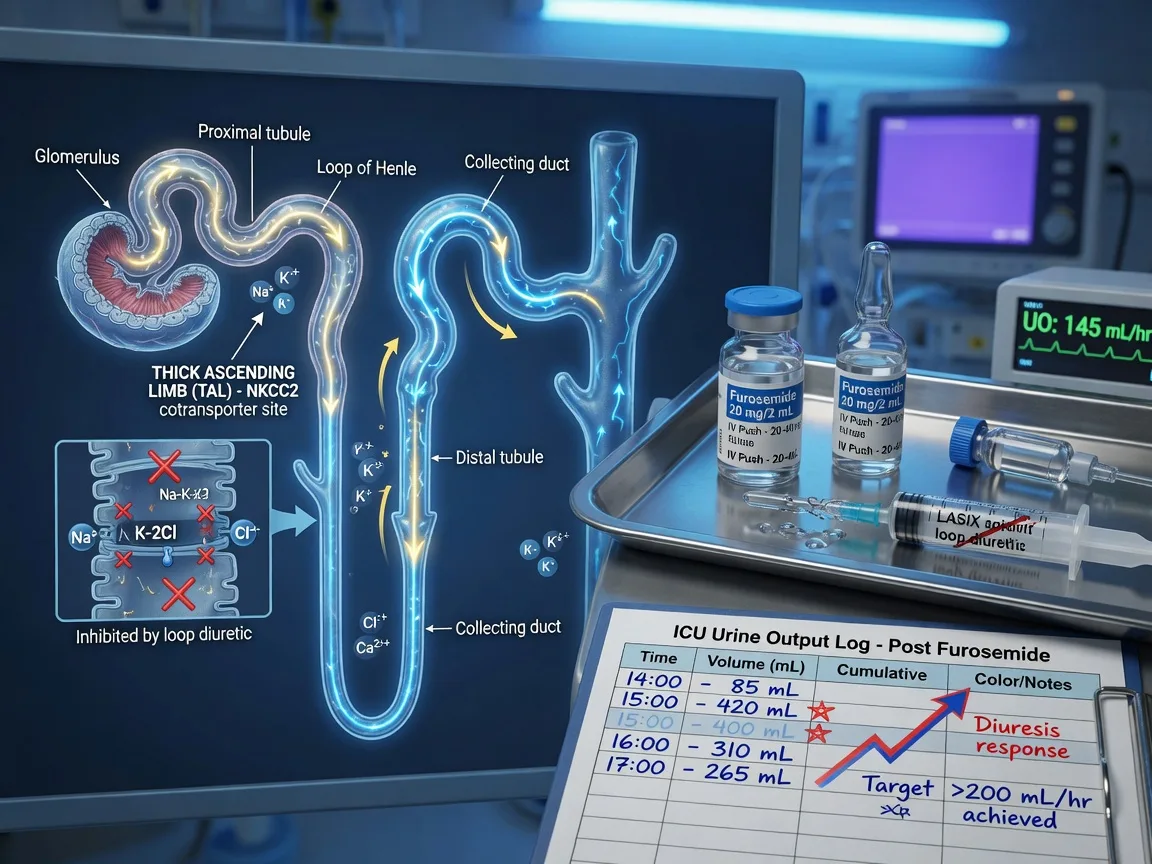
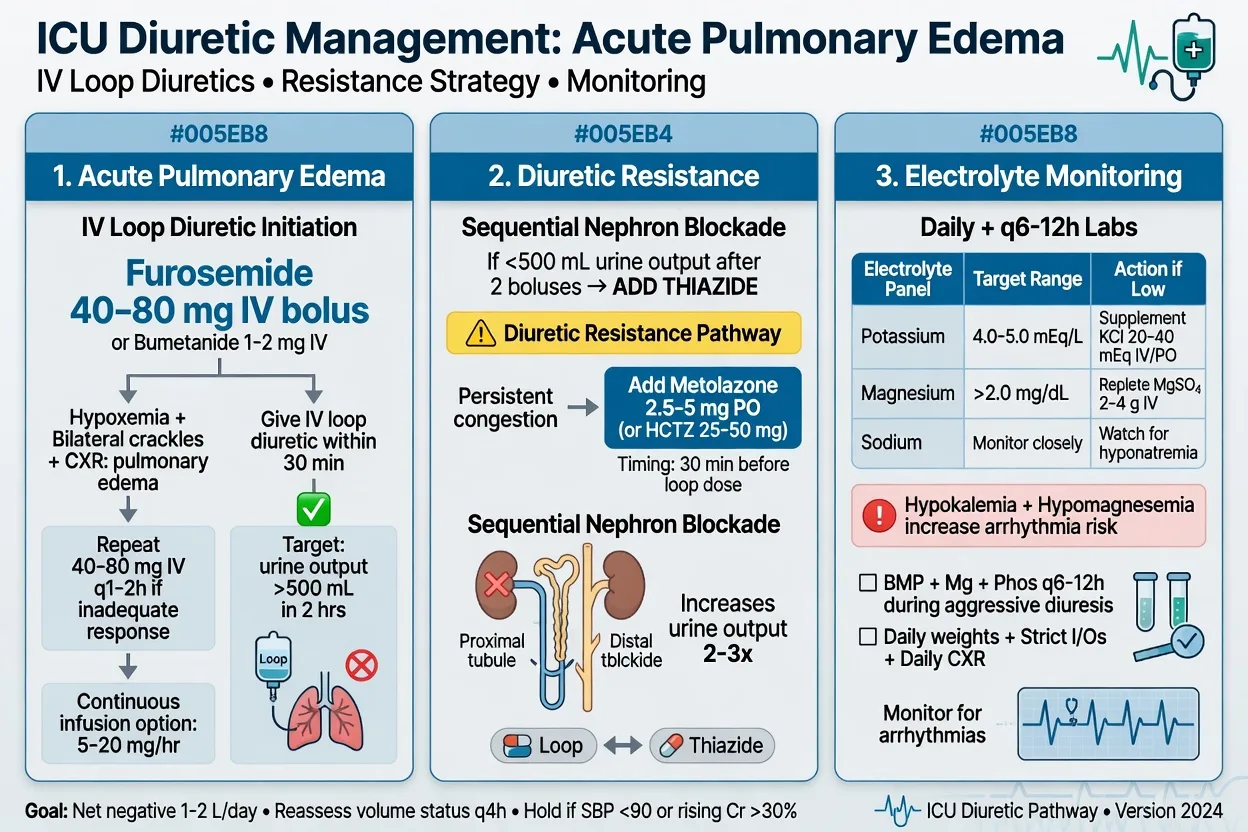
Diuretic classes — by nephron site of action [1]
The four diuretic classes — site, mechanism, potency and signature toxicity
| Class | Site of action | Molecular target | Potency (% filtered Na+ blocked) | Agents | Signature adverse effect |
|---|---|---|---|---|---|
| Carbonic anhydrase inhibitor | Proximal tubule | Carbonic anhydrase → ↓H+ → ↓HCO3/Na+ reabsorption | Weakest (1-3%) | Acetazolamide | Metabolic acidosis, hypokalaemia, renal stones |
| Loop | Thick ascending limb (TAL) | Na-K-2Cl (NKCC2) cotransporter | Most potent (20-25%) | Furosemide, bumetanide, torasemide | Hypokalaemia, hypomagnesaemia, HYPOcalcaemia, ototoxicity |
| Thiazide / thiazide-like | Distal convoluted tubule (DCT) | Na-Cl (NCC) cotransporter | Moderate (5-10%) | Hydrochlorothiazide, chlorthalidone, indapamide, metolazone | Hypokalaemia, HYPOnatraemia, hyperuricaemia, HYPERcalcaemia |
| Potassium-sparing | Cortical collecting duct (CCD) | Mineralocorticoid receptor (aldosterone antagonist) OR ENaC (epithelial Na+ channel blocker) | Weak (1-3%) | Spironolactone, eplerenone (MRA); amiloride, triamterene (ENaC) | HYPERkalaemia, metabolic acidosis, gynaecomastia (spironolactone) |
Loop diuretics — agent comparison (furosemide vs bumetanide vs torasemide)
| Property | Furosemide | Bumetanide | Torasemide (torasemide) |
|---|---|---|---|
| Oral bioavailability | Variable (10-100%, ~50% average) — unreliable oral absorption | ~80% (more reliable) | 80-100% (most reliable) |
| Relative potency | 40 mg IV = 20 mg PO (2:1 IV:PO) | 1 mg bumetanide ≈ 40 mg furosemide (40x more potent by mass) | 10-20 mg torasemide ≈ 40 mg furosemide |
| Onset (IV) | 5 min | 2-5 min | 10 min |
| Duration | 2-3 h (short) | 3-4 h | 4-6 h (longer) |
| Elimination | Renal (60%) + conjugation; metabolite glucuronide | Renal (50%) + hepatic metabolism | Hepatic (80%) — preferred in renal impairment |
| Ototoxicity risk | Highest (of the three) | Lower | Lowest |
| Half-life | Short (~1.5 h, longer in renal failure) | Short (~1 h) | Longer (~3.5 h) |
| Clinical bottom line | First-line, cheapest, but variable absorption and highest ototoxicity | Useful when reliable absorption needed or furosemide allergy | Longer-acting, hepatically cleared, less ototoxic — preferred in some units for stable HF |
The key practical points: furosemide has unpredictable oral bioavailability (so decompensated HF needs IV); IV:PO ratio is ~2:1 for furosemide (but 1:1 for bumetanide and torasemide); and all three loop diuretics are equally effective when given in equipotent doses — choice is driven by pharmacokinetics, ototoxicity and hepatic vs renal elimination.[3][4]
Adverse-effect signature — the classic contrasts (high-yield exam material)
| Adverse effect | Loop | Thiazide | K-sparing | Acetazolamide |
|---|---|---|---|---|
| Potassium | HYPOkalaemia | HYPOkalaemia | HYPERkalaemia | HYPOkalaemia |
| Calcium | HYPOcalcaemia (↑Ca excretion) | HYPERcalcaemia (↓Ca excretion) | No effect | No effect |
| Sodium | Hyponatraemia (uncommon) | HYPOnatraemia (commonest drug cause) | No effect | No effect |
| Magnesium | HYPOmagnesaemia (significant) | Mild hypomagnesaemia | No effect | Mild |
| Urate / uric acid | Hyperuricaemia | Hyperuricaemia (worse than loop) | No effect | No effect |
| Acid-base | Metabolic alkalosis (contraction + hypochloraemia) | Metabolic alkalosis | Metabolic acidosis | Metabolic acidosis |
| Glucose | Hyperglycaemia (mild) | Hyperglycaemia (more pronounced) | No effect | No effect |
| Class-specific | Ototoxicity (high-dose IV) | — | Gynaecomastia (spironolactone) | Renal stones (alkaline urine) |
The two contrasts worth memorising: (1) CALCIUM — loops cause HYPOcalcaemia, thiazides cause HYPERcalcaemia (so furosemide is a treatment for hypercalcaemia, while thiazides are contraindicated in it); (2) POTASSIUM/ACID-BASE — loops and thiazides cause hypokalaemic metabolic alkalosis, while K-sparing agents and acetazolamide cause hyperkalaemic (or normal-K) metabolic acidosis.[3]
Mechanism in depth — why each class works (and its toxicity)
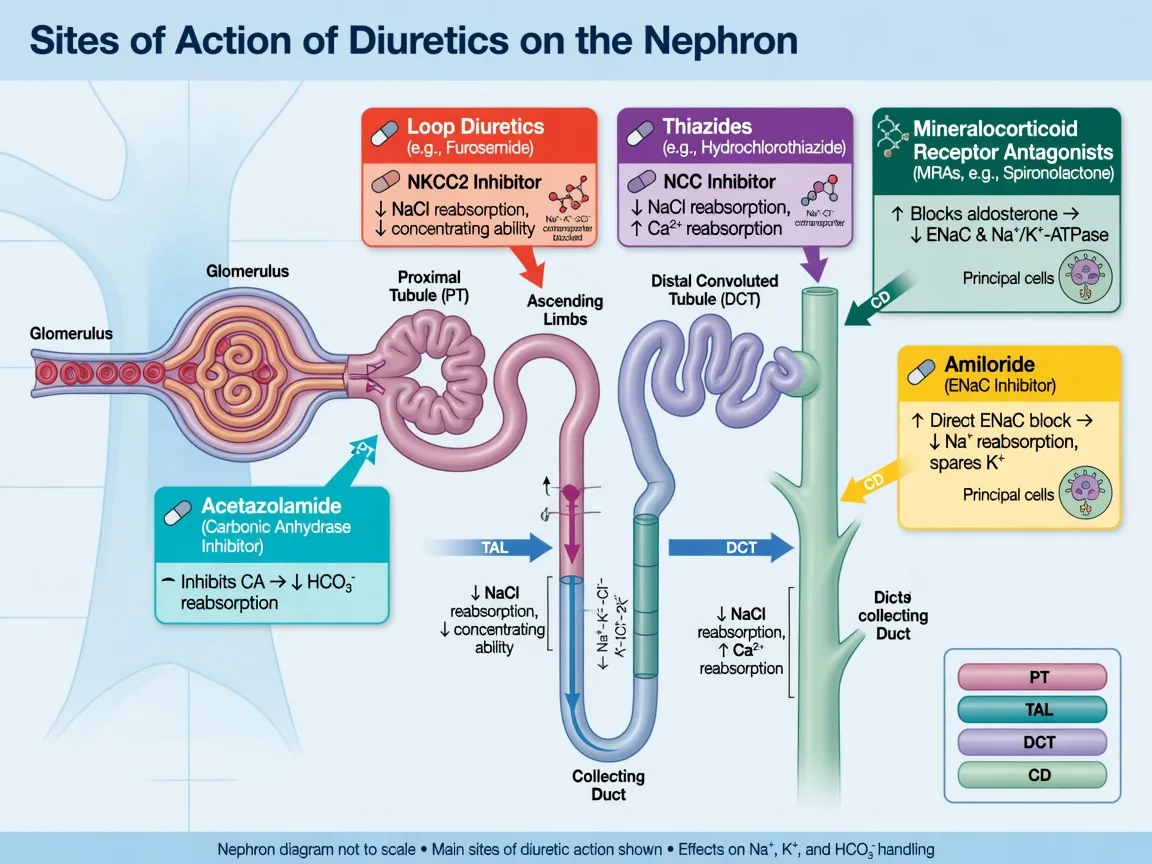
Nephron physiology — diuretic mechanism and electrolyte consequences
-
PROXIMAL TUBULE — acetazolamide (carbonic anhydrase inhibitor):
- Carbonic anhydrase (on the luminal brush border) catalyses CO2 + H2O → H2CO3 → H+ + HCO3-. The H+ is secreted into the lumen in exchange for Na+ (Na+/H+ exchanger).
- Acetazolamide inhibits carbonic anhydrase → less H+ available → less Na+/H+ exchange → Na+ and HCO3- are lost in the urine.
- Result: alkaline urine + metabolic acidosis (HCO3 loss). Weak diuresis because downstream segments (TAL, DCT) reabsorb most of the escaped Na+.
- Clinical: corrects metabolic alkalosis (e.g. chronic diuretic use, vomiting), altitude sickness (induces metabolic acidosis → stimulates ventilation → ↑oxygenation), glaucoma (↓CSF/aqueous humour production), altitude acclimatisation.
- Toxicity: metabolic acidosis (intended in alkalosis treatment), hypokalaemia (increased distal Na+ delivery → increased K+ secretion), renal stones (alkaline, calcium-rich urine), paraesthesia. [1]
-
THICK ASCENDING LIMB (TAL) — loop diuretics (the powerhouse):
- The TAL reabsorbs ~25% of filtered Na+ via the Na-K-2Cl (NKCC2) cotransporter on the luminal membrane. It is impermeable to water — the "diluting segment" — so it generates the corticomedullary osmotic gradient that drives water reabsorption in the collecting duct.
- The TAL also has a paracellular Ca2+ and Mg2+ reabsorption pathway (driven by the lumen-positive potential from K+ back-leak through ROMK).
- Loops block NKCC2 → (a) abolish the osmotic gradient → massive water loss; (b) lose the lumen-positive potential → increased Ca2+ and Mg2+ excretion → hypocalcaemia + hypomagnesaemia.
- This is why loops are the MOST POTENT diuretic (maximal natriuresis, up to 20-25% of filtered Na+) AND why they uniquely cause hypocalcaemia + hypomagnesaemia (the paracellular divalent cation loss).
- Result: powerful diuresis, Na+/K+/Cl-/Ca2+/Mg2+ loss, and (with volume contraction) hypochloraemic metabolic alkalosis. [1]
-
DISTAL CONVOLUTED TUBULE (DCT) — thiazides:
- The DCT reabsorbs ~5-10% of filtered Na+ via the Na-Cl (NCC) cotransporter (sensitive to thiazides). It is also the main site of active Ca2+ reabsorption (via the TRPV5 channel, driven by basolateral Na+/Ca2+ exchange and Ca-ATPase).
- Thiazides block NCC → more distal Na+ delivery → increased ENaC-mediated Na+ reabsorption in the collecting duct (and thus more K+ and H+ secretion → hypokalaemia + alkalosis).
- The calcium effect: thiazides increase Ca2+ reabsorption (the mechanism is complex — partly volume contraction increasing proximal Ca reabsorption, partly direct upregulation of DCT apical Ca channels) → HYPERcalcaemia / hypercalciuria reduction — opposite to loops. This is exploited to treat idiopathic hypercalciuria and calcium oxalate stones.
- Result: moderate diuresis, HYPERcalcaemia, and the classic thiazide triad: hypokalaemia + hyponatraemia + hyperuricaemia. [1]
-
CORTICAL COLLECTING DUCT (CCD) — potassium-sparing diuretics:
- The principal cell of the CCD reabsorbs Na+ via the epithelial Na+ channel (ENaC) on the luminal membrane; this creates a lumen-negative potential that drives K+ secretion (via ROMK) and H+ secretion (by intercalated cells). Aldosterone amplifies all of this (↑ENaC, ↑Na+/K+-ATPase, ↑ROMK).
- Two ways to block it: (a) aldosterone receptor antagonists (MRAs) — spironolactone, eplerenone — compete with aldosterone at the mineralocorticoid receptor → ↓ENaC activity → ↓K+ and H+ secretion → retain K+ (hyperkalaemia) and H+ (metabolic acidosis); (b) ENaC blockers — amiloride, triamterene — directly block the apical Na+ channel → same downstream effect.
- Weak diuresis (only 1-3% of Na+) — used NOT primarily for diuresis but to counteract loop/thiazide-induced hypokalaemia and for aldosterone-mediated disease (HFrEF, Conn syndrome, cirrhotic ascites).
- Result: HYPERkalaemia, metabolic acidosis, and (spironolactone only) gynaecomastia, impotence, menstrual irregularities (spironolactone binds androgen and progesterone receptors — eplerenone is more MRA-selective and avoids these).
Clinical uses by class
Clinical indications — which diuretic for which problem
| Indication | First-line class / agent | Rationale |
|---|---|---|
| Acute pulmonary oedema / cardiogenic | IV furosemide (loop) | Rapid venodilation (prostaglandin-mediated, within 5 min, before diuresis begins) + potent natriuresis → ↓preload. Start 1-2.5x the oral dose IV.[6] |
| Acute decompensated heart failure (decongestion) | IV loop (furosemide first-line); add thiazide if resistant | Loop is cornerstone of decongestion. DOSE trial: bolus = continuous infusion (equivalent).[1] |
| Chronic HFrEF (one of the four pillars) | Loop + spironolactone/eplerenone (MRA) | RALES: spironolactone 30% mortality reduction. MRA is a guideline pillar regardless of K+ status (monitor).[2] |
| Hypertension (uncomplicated) | Thiazide (chlorthalidone preferred — longer half-life, more outcome data) | ALLHAT: chlorthalidone superior to lisinopril/amlodipine for HF prevention. Once daily. |
| AKI with fluid overload | Loop (furosemide — high doses often needed; torasemide if hepatic) | Thiazides ineffective when GFR <30 (can't reach luminal site); loops remain effective down to low GFR. Not for prevention of AKI (no benefit). |
| Nephrogenic DI | Thiazide (hydrochlorothiazide) | Paradoxical — thiazides reduce polyuria by volume contraction → enhanced proximal Na+/water reabsorption → less distal delivery. |
| Idiopathic hypercalciuria / Ca-oxalate stones | Thiazide | Reduces urinary calcium excretion (the only class that does). |
| Hypercalcaemia (symptomatic) | IV furosemide + saline | Loop increases Ca excretion (after saline rehydration to prevent hypovolaemia). Do NOT use thiazide. |
| Conn syndrome (primary hyperaldosteronism) | Spironolactone / eplerenone | Blocks the excess aldosterone → corrects hypertension + hypokalaemia. |
| Cirrhotic ascites | Spironolactone ± furosemide (ratio 100:40 to maintain normokalaemia) | Spironolactone first-line (aldosterone high due to 2° hyperaldosteronism); add loop if insufficient. |
| Resistant oedema / diuretic resistance | Loop + thiazide (sequential nephron blockade — metolazone 2.5-5 mg) | Blocks hypertrophied downstream NCC → synergistic massive diuresis.[5] |
| Metabolic alkalosis (correction) | Acetazolamide | HCO3 loss in urine → corrects alkalosis; useful in post-hypercapnic alkalosis, loop-induced alkalosis. |
| Altitude sickness | Acetazolamide (prophylaxis) | Induces mild metabolic acidosis → stimulates ventilation → ↑oxygenation + acclimatisation. |
| Glaucoma (↑intra-ocular pressure) | Acetazolamide (systemic) | ↓Aqueous humour production (CA in ciliary body). |
ICU diuresis protocol — goal-directed decongestion
Goal-directed diuretic therapy in acute decompensated heart failure / fluid overload
-
ASSESS VOLUME STATUS AND PERFUSION FIRST (Stevenson phenotyping):
- Classify the patient as WET or DRY (congestion) and WARM or COLD (perfusion).
- Diuretics are for the WET patient. If WET + COLD (cardiogenic shock), you need inotropes/vasopressors FIRST, then diurese — diuretics alone in a cold, hypoperfused patient worsen AKI.
- Signs of congestion: raised JVP, pulmonary crackles/orthopnoea, peripheral oedema, ascites, lung ultrasound B-lines, IVC >2 cm with no collapse. [1]
-
CONVERT ORAL LOOP TO IV AND GIVE A STARTING DOSE:
- If the patient was on an oral loop, give 1-2.5x the total daily oral dose as IV (DOSE trial high-dose arm = 2.5x). IV:PO ratio for furosemide is ~2:1 (so 80 mg PO → ~40 mg IV equivalent, but in decompensation use at least the IV equivalent of the home dose, often more).
- Example: home furosemide 80 mg PO daily → start IV furosemide 40-80 mg bolus, assess 2-hour natriuresis/urine output. [1]
-
USE THE 6-HOUR URINE OUTPUT / SPOT SODIUM TO GUIDE TITRATION (the key to avoiding diuretic under-dosing):
- Measure urine output at 6 hours after the first dose and/or a spot urine sodium at 1-2 hours.
- Good response (urine output >100-150 mL/h at 6 h, or spot Na+ >50-70 mmol/L): continue current dose q12-24h.
- Poor response: DOUBLE the next dose (furosemide dose-response is logarithmic — small increments don't work). The DOSE trial used 2.5x.
- This stepwise doubling is critical — most diuretic "failure" is under-dosing. [1]
-
CHOOSE BOLUS OR CONTINUOUS INFUSION (DOSE trial — equivalent):
- The DOSE trial (2011) randomised to bolus vs continuous infusion → no difference in symptoms or renal function at 72 h. Either is acceptable.
- Continuous infusion is preferred by some for: very high doses (avoids peak-related ototoxicity), haemodynamically unstable patients (smoother), or when boluses cause large fluid shifts.
- Bolus is preferred for: ease, ability to assess dose-response (a bolus gives a discrete natriuretic response you can measure), lower nursing complexity.
- Rate limit for furosemide infusion: <4 mg/min (or dilute, infuse over ≥20 min for bolus doses >80 mg) to avoid ototoxicity.[1]
-
SET A DAILY NEGATIVE FLUID BALANCE TARGET:
- Target net negative balance per day depends on congestion severity (typically 1-3 L/day net negative).
- Avoid over-diuresis: if creatinine rises, re-assess — is it from over-diuresis (give a cautious fluid challenge, ease off diuretics) or from worsening congestion/cardiorenal (continue/intensify diuresis)? A small creatinine rise with effective decongestion is acceptable and often resolves. [1]
-
MONITOR ELECTROLYTES DAILY (or more often):
- Potassium (target 4.0-5.0 in HF — replete aggressively; hypokalaemia → arrhythmia and digoxin toxicity).
- Magnesium (loop-induced hypomagnesaemia worsens hypokalaemia and is often overlooked — replete to keep >0.8 mmol/L).
- Sodium, creatinine, urea.
- Replace K+ and Mg2+ ENTERALLY when possible (slow-release KCl, magnesium aspartate/glycerophosphate); IV only for severe deficits. [1]
-
IF RESISTANT — ESCALATE TO SEQUENTIAL NEPHRON BLOCKADE:
- Defined as failure to achieve adequate diuresis despite adequate loop doses (e.g. <100 mL/h after an adequate IV loop dose).
- Add a thiazide: metolazone 2.5-5 mg PO (preferred because it retains activity even at low GFR, unlike other thiazides) OR IV chlorothiazide 500-1000 mg.
- Give ~30 min before the loop dose. Expect a powerful synergistic diuresis. Monitor K+, Mg2+, Na+, creatinine every 6-12 h — the combination can cause profound electrolyte disturbance and AKI (volume depletion).[5]
- See the dedicated diuretic-resistance section below.
-
CONSIDER ADJUNCTS:
- Acetazolamide 250-500 mg if metabolic alkalosis has developed from loop therapy (corrects the alkalosis and may restore loop sensitivity).
- Hypertonic saline + high-dose furosemide (the 'sodium-loading' strategy) — emerging data (e.g. SMAC-HF) suggests improved diuresis, but not standard.
- Ultrafiltration — reserved for refractory cases; CARRESS-HF showed pharmacologic stepwise therapy was superior to ultrafiltration for cardiorenal syndrome with worsening renal function — ultrafiltration NOT first-line.
- Vasopressin V2 receptor antagonists (tolvaptan) — aquaretics, for dilutional hyponatraemia; limited role.
Diuretic resistance and sequential nephron blockade
Stepwise approach to the diuretic-resistant patient
-
Confirm it is TRUE resistance (not under-dosing):
- Check the dose is adequate. The loop dose-response curve is logarithmic — if response is poor, double the dose (e.g. 40 → 80 → 160 → 240 mg IV furosemide as bolus or split).
- Use the 6-hour urine output (>150 mL/h = good; <100 mL/h = poor) and spot urine sodium (>50-70 mmol/L = good) to quantify response.
- Ensure the drug is reaching the tubule: IV loop given to a patient with intestinal oedema and poor oral absorption will out-perform the same oral dose. [1]
-
Exclude CORRECTABLE causes of reduced loop efficacy:
- NSAIDs / COX-2 inhibitors — block prostaglandin-mediated afferent arteriole dilation, reducing renal blood flow and luminal furosemide delivery → resistance. STOP them.
- Hypoalbuminaemia (e.g. nephrotic, cirrhosis) — furosemide is highly protein-bound; low albumin means more free drug is metabolised/reaches non-target sites → give albumin + furosemide (evidence mixed but commonly used).
- Renal hypoperfusion (low cardiac output, sepsis) — the kidney is underperfused; the answer is inotropes/vasopressors/resuscitation, not more diuretic. Diuresing a 'cold/shock' kidney worsens AKI.
- Severe renal impairment — even loops lose efficacy at very low GFR (less luminal delivery); higher doses or combination needed. [1]
-
SWITCH or COMBINE loop agents:
- If oral absorption unreliable (intestinal oedema), switch to IV.
- Consider switching furosemide → torasemide/bumetanide (better bioavailability, longer half-life) — some patients respond better to one loop than another (no robust trial, but reasonable). [1]
-
ADD A THIAZIDE — sequential nephron blockade (the definitive step):
- Metolazone 2.5-5 mg PO (preferred — active even at GFR <30) OR chlorothiazide 500-1000 mg IV OR hydrochlorothiazide 25-50 mg PO (only if GFR reasonable).
- Give 30-60 min BEFORE the loop dose. The thiazide blocks the hypertrophied DCT (NCC) while the loop blocks the TAL (NKCC2) → synergistic natriuresis.
- Expected outcome: a dramatic diuretic response over 12-24 h (often several litres). Be ready for it. [1]
-
MONITOR INTENSIVELY (the dangerous part):
- Check K+, Mg2+, Na+, creatinine every 6-12 hours for the first 24-48 h.
- Anticipate and pre-empt: aggressive K+ and Mg2+ replacement; hold the combination if creatinine rises sharply or over-diuresis (hypotension, rising urea).
- Stop once euvolaemic (JVP normalised, B-lines resolved, weight stable). [1]
-
REFRACTORY CASES — consider:
- Hypertonic saline + high-dose loop (the 'sodium loading' / SMAC-HF approach) — emerging.
- Vasopressin V2 antagonist (tolvaptan) — aquaretic for dilutional hyponatraemia, modest decongestion.
- Ultrafiltration (veno-venous) — last resort; CARRESS-HF (2012) showed it was inferior to stepwise pharmacologic therapy for cardiorenal syndrome with worsening renal function (more adverse events, creatinine rose). Reserve for truly refractory fluid overload unresponsive to maximal pharmacologic therapy.
- Dopamine ("renal-dose") — NO benefit, do not use.
Fellowship SAQs — furosemide in AKI and acetazolamide
SAQ — Furosemide in oliguric AKI: dosing, resistance and the question of renal protection
10 minutes · 10 marks
A 68-year-old man in ICU following an emergency laparotomy for ischaemic bowel develops oliguric AKI (KDIGO stage 2). On day 3, urine output is 280 mL/24h, creatinine has risen from 90 to 310 micromol/L, K+ 5.8 mmol/L, and he is 4 L in positive fluid balance with pulmonary congestion on lung ultrasound (diffuse B-lines). He is normotensive on low-dose noradrenaline 0.05 mcg/kg/min (MAP 72, lactate 1.4). The team asks whether furosemide should be used, at what dose, and whether it might hasten renal recovery or reduce the need for renal replacement therapy.
SAQ — Acetazolamide for post-hypercapnic metabolic alkalosis complicating ventilator weaning
10 minutes · 10 marks
A 72-year-old woman with severe COPD is intubated for a pneumonia-triggered exacerbation. After 5 days she is ready to wean, but her blood gas shows pH 7.48, PaCO2 48 mmHg (6.4 kPa), HCO3 36 mmol/L, BE +12, PaO2 78 mmHg on pressure support. She has been on IV furosemide 80 mg/day for pulmonary congestion, has a mild AKI (creatinine 150 micromol/L), and K+ 3.1 mmol/L. The registrar asks whether acetazolamide would help and how to use it.
Clinical pearls
[1]Red flags
[1]Prognosis
Diuretic strategy outcomes — what the evidence shows
| Strategy / drug | Outcome impact | Evidence |
|---|---|---|
| Loop bolus vs continuous infusion | Equivalent efficacy and renal safety | DOSE trial (2011) — no difference in symptoms or creatinine; high-dose gave more diuresis but transient creatinine rise[1] |
| High-dose (2.5x) vs low-dose (1x) loop | High-dose: more diuresis + fluid loss; non-significant symptom trend; transient creatinine rise | DOSE trial[1] |
| Spironolactone in severe HFrEF | 30% reduction in all-cause mortality + fewer hospitalisations | RALES (1999) — stopped early for benefit; NNT ≈ 9 for mortality[2] |
| Eplerenone post-MI / HFrEF | Reduced mortality + CV hospitalisation | EMPHASIS-HF, EPHESUS; less gynaecomastia than spironolactone |
| Sequential nephron blockade (loop + thiazide) | Effective decongestion in resistant oedema; risk of AKI/electrolyte loss | Mechanistic + observational; standard of care for resistance[5] |
| Pharmacologic stepwise therapy vs ultrafiltration | Pharmacologic SUPERIOR (less creatinine rise, fewer adverse events) | CARRESS-HF (2012) — ultrafiltration not first-line for cardiorenal syndrome |
| Thiazide for hypertension | Reduced stroke, HF, CV events | ALLHAT — chlorthalidone superior to amlodipine/lisinopril for HF prevention |
Key trials and evidence
DOSE trial — Diuretic Optimization Strategies Evaluation (PMID 21366472)
Study design
Prospective, double-blind, randomised — 2×2 factorial — 308 patients
Population
Acute decompensated heart failure (ADHF)
Intervention
Bolus vs continuous infusion furosemide, AND low-dose (1× home oral dose) vs high-dose (2.5× home dose)
Co-primary outcomes
(a) Patient global symptom assessment (VAS AUC over 72 h); (b) change in serum creatinine from baseline to 72 h
Key finding
NO significant difference in either primary outcome for bolus vs infusion OR for low- vs high-dose. High-dose gave greater fluid loss/diuresis but transiently more creatinine rise and electrolyte disturbance.
Clinical bottom line
Bolus and continuous-infusion furosemide are EQUIVALENT — use either. High-dose (2.5×) is reasonable for marked congestion. This ended the belief that continuous infusion is superior.
RALES — Randomized Aldactone Evaluation Study (PMID 10471456)
Study design
Randomised, double-blind, placebo-controlled — 1663 patients across 195 centres
Population
Severe heart failure (NYHA III-IV, LVEF ≤35%) on standard therapy (ACE inhibitor + loop diuretic)
Intervention
Spironolactone 25 mg daily (titrated to 50 mg) vs placebo
Primary outcome
All-cause mortality
Key finding
30% REDUCTION in all-cause mortality (relative risk 0.70) — stopped EARLY after mean 24 months follow-up for benefit. Also significant reduction in hospitalisations and symptomatic improvement. Serious hyperkalaemia rare (~2%).
Clinical bottom line
Established aldosterone antagonism as a CORNERSTONE of HFrEF therapy (one of the four pillars). Monitor K+ but the mortality benefit is large and consistent.
CARRESS-HF — ultrafiltration vs pharmacologic therapy in cardiorenal syndrome (context for refractory fluid overload)
Study design
Randomised — 188 patients with cardiorenal syndrome (decompensated HF + worsening renal function + persistent congestion)
Intervention
Stepped pharmacologic therapy (loop ± thiazide ± dopamine/dobutamine) vs veno-venous ultrafiltration
Primary outcome
Change in weight (fluid loss) and creatinine at 96 h
Key finding
Equivalent weight loss, BUT ultrafiltration had SIGNIFICANTLY MORE adverse events (including worsening renal function requiring RRT). Trial stopped early.
Clinical bottom line
Pharmacologic stepwise diuretic therapy is SUPERIOR to ultrafiltration for cardiorenal syndrome. Reserve ultrafiltration for truly refractory cases unresponsive to maximal drug therapy.
Dosing quick-reference (ICU)
IV diuretic dosing in ICU — practical reference
| Drug | Typical IV dose | Onset (IV) | Duration | Notes |
|---|---|---|---|---|
| Furosemide | 20-80 mg bolus (up to 240 mg); infusion 5-40 mg/h (<4 mg/min) | 5 min | 2-3 h | IV:PO ~2:1. Watch ototoxicity at high doses/rates. |
| Bumetanide | 1-2 mg bolus (1 mg ≈ 40 mg furosemide) | 2-5 min | 3-4 h | Reliable absorption, IV:PO ~1:1, lower ototoxicity. |
| Torasemide | 10-20 mg (10 mg ≈ 40 mg furosemide) | 10 min | 4-6 h | Hepatically cleared (preferred in renal impairment), longest half-life. |
| Chlorothiazide (IV, for sequential blockade) | 500-1000 mg IV | 15-30 min | 6-12 h | Only IV thiazide; used with loop for resistant oedema. |
| Metolazone (PO, for sequential blockade) | 2.5-5 mg PO | 1 h | 12-24 h | Active at low GFR (GFR <30) — preferred thiazide for blockade. Give 30-60 min before loop. |
| Acetazolamide | 250-500 mg IV/PO | 1-2 h | 8-12 h | For metabolic alkalosis; causes metabolic acidosis. |
| Spironolactone | 12.5-50 mg PO daily | Days | — | Slow onset (days) — not for acute diuresis; for HFrEF/hyperaldosteronism. |
| Amiloride | 5-10 mg PO daily | 2 h | 24 h | ENaC blocker; K+-sparing adjunct. |
References
- [1]Felker GM, et al. Diuretic strategies in patients with acute decompensated heart failure N Engl J Med, 2011.PMID 21366472
- [2]Pitt B, et al. The effect of spironolactone on morbidity and mortality in patients with severe heart failure. Randomized Aldactone Evaluation Study Investigators N Engl J Med, 1999.PMID 10471456
- [3]Brater DC Pharmacology of diuretics Am J Med Sci, 2000.PMID 10653443
- [4]Sica DA, et al. Thiazide and loop diuretics J Clin Hypertens (Greenwich), 2011.PMID 21896142
- [5]Ellison DH Mechanistic Insights into Loop Diuretic Responsiveness in Heart Failure Clin J Am Soc Nephrol, 2019.PMID 31064772
- [6]Ellison DH, Felker GM Diuretic Treatment in Heart Failure N Engl J Med, 2017.PMID 29141174