ICU · Pharmacology
Insulin & Hypoglycaemics — Pharmacology
Also known as Insulin · Hypoglycaemics · Insulin types · Actrapid · Metformin · Sulfonylurea · GLP-1 · SGLT2 inhibitor · Variable-rate insulin infusion · Fixed-rate insulin infusion · NICE-SUGAR · Euglycaemic DKA · Metformin-associated lactic acidosis
ICU insulin and hypoglycaemics. INSULIN TYPES classified by onset/duration: RAPID analogues (lispro, aspart, glulisine — monomeric — onset 10-20 min, duration 3-5 h); SHORT/soluble (regular/Actrapid — forms hexamers — onset 30-60 min, duration 6-8 h — the IV preparation for ICU); INTERMEDIATE (isophane/NPH — protamine + zinc complex — cloudy — onset 1-2 h, duration 12-18 h); LONG (glargine — precipitates at neutral pH, flat peakless ~24 h; detemir — albumin-bound via myristic acid); ULTRA-LONG (degludec — multi-hexamers, 42+ h; icodec weekly). ICU INSULIN USE: DKA fixed-rate insulin infusion (FRII) 0.1 U/kg/h until ketones cleared; HHS lower dose 0.05 U/kg/h after aggressive fluid resuscitation; stress hyperglycaemia via variable-rate insulin infusion (VRII / sliding scale) targeting glucose 6-10 mmol/L per NICE-SUGAR (moderate control — tight control 4.4-6.1 increased mortality from hypoglycaemia, overturning the Leuven trial); insulin-dextrose for hyperkalaemia (intracellular K shift); GIK high-dose insulin for beta-blocker/calcium-channel-blocker toxicity. ORAL HYPOGLYCAEMICS: METFORMIN (biguanide — activates AMP kinase — suppresses hepatic gluconeogenesis — non-hypoglycaemic — UKPDS-34 mortality benefit in overweight T2DM — metformin-associated lactic acidosis (MALA) in renal failure/hypoxia/sepsis — removed by haemodialysis); SULFONYLUREAS (gliclazide, glibenclamide — close beta-cell K-ATP channel — stimulate insulin release — hypoglycaemia risk, especially glibenclamide/elderly/renal); DPP-4 inhibitors (sitagliptin — prolong incretins, glucose-dependent, weight-neutral, CV-safe per TECOS); SGLT2 inhibitors (dapagliflozin, empagliflozin — block Na-glucose cotransporter in proximal tubule — glycosuria — CV/renal benefit (EMPA-REG, CANVAS, CREDENCE) — euglycaemic DKA risk); GLP-1 agonists (exenatide, liraglutide, semaglutide — incretin mimetics — weight loss — CV benefit per LEADER/SUSTAIN-6). HYPOGLYCAEMIA MANAGEMENT: rule of 15 (15 g carbohydrate, recheck at 15 min); severe — 50% dextrose 25-50 mL IV (or 10% via central line) and glucagon 1 mg IM; octreotide 50-100 mcg SC for sulfonylurea-induced hypoglycaemia (inhibits insulin secretion).
On this page & tools
Your progress
Saved locally on this device.
8 MCQs with explanations
Target exams
Red flags
Overview & definition
Insulin physiology and molecular pharmacology
Insulin synthesis, secretion and receptor signalling — the molecular basis of every insulin preparation
-
SYNTHESIS in the pancreatic β-cell (proinsulin → insulin + C-peptide):
- Translated on ribosomes of the rough ER as preproinsulin (110 aa), the signal peptide cleaved to proinsulin (86 aa).
- In secretory granules, proinsulin is cleaved by prohormone convertases (PC1/3, PC2) at two basic-residue sites, releasing C-peptide (31 aa) and the mature insulin (51 aa = A-chain 21 aa + B-chain 30 aa, joined by two interchain disulphide bonds, with one intrachain disulphide on the A-chain).
- Stored as a hexamer (six insulin molecules + two zinc ions) in the granule — the hexamer is the storage form; all subcutaneous preparations must dissociate to monomers before absorption, which is the rate-limiting step that distinguishes rapid from short-acting insulins.
- Clinical correlate: C-peptide is co-secreted 1:1 with endogenous insulin and is measured to distinguish endogenous hyperinsulinaemia (e.g. insulinoma — high C-peptide) from exogenous insulin overdose (suppressed C-peptide). [1]
-
SECRETION — glucose-stimulated insulin secretion (GSIS):
- Glucose enters the β-cell via GLUT2 (low-affinity, high-capacity transporter that senses blood glucose).
- Glucose is phosphorylated by glucokinase (the rate-limiting glucose sensor), metabolised → ↑ATP:ADP ratio.
- ↑ATP closes the ATP-sensitive K+ channel (K-ATP) — composed of Kir6.2 pore + SUR1 regulatory subunit (the molecular target of sulfonylureas).
- K-ATP closure → β-cell depolarisation → opens voltage-gated Ca2+ channels → Ca2+ influx → insulin granule exocytosis.
- This K-ATP channel is exactly what sulfonylureas close directly (bypassing glucose) and what diazoxide opens (inhibiting insulin release — used for insulinoma and as an adjunct in sulfonylurea overdose). [1]
-
INSULIN RECEPTOR — a receptor tyrosine kinase:
- The insulin receptor is a heterotetramer (two extracellular α-subunits that bind insulin + two transmembrane β-subunits with intrinsic tyrosine-kinase domains).
- Insulin binding → β-subunit autophosphorylation → phosphorylates insulin receptor substrate (IRS) proteins.
- Two downstream cascades: (a) PI3K-Akt pathway → GLUT4 translocation to muscle/adipose membrane (glucose uptake), glycogen synthase activation (glycogen storage), mTOR (protein synthesis), anti-lipolysis — the metabolic arm; (b) Ras-MAPK pathway → gene transcription, cell growth, mitogenesis (the mechanism by which insulin is a growth factor).
- Clinical correlate: insulin resistance (type 2 diabetes, sepsis, critical illness, steroids) is a post-receptor defect (impaired IRS-1/PI3K signalling); the MAPK arm is relatively preserved, contributing to atherosclerosis. [1]
-
METABOLIC EFFECTS — net anabolic, storage-promoting:
- Liver: ↓glycogenolysis, ↓gluconeogenesis, ↓ketogenesis, ↑glycogen synthesis.
- Muscle: ↑glucose uptake (GLUT4), ↑glycogen synthesis, ↑protein anabolism (↓proteolysis).
- Adipose: ↑lipogenesis, ↓lipolysis (↓free fatty acids, ↓ketogenesis — the reason insulin is the cornerstone of DKA treatment).
- Electrolytes: drives K+, Mg2+, phosphate INTO cells (the basis of insulin-dextrose for hyperkalaemia, and the reason K+ falls during DKA treatment).
Insulin preparations — onset, peak, duration and formulation rationale
| Type | Onset (SC) | Peak | Duration | Examples | Why it behaves this way |
|---|---|---|---|---|---|
| Rapid-acting analogue | 10-20 min | 1-2 h | 3-5 h | Lispro (B28 Pro/B29 Lys inverted), aspart (B28 Pro→Asp), glulisine (B3 Asn→Gly, B29 Lys→Glu) | Single amino-acid substitutions prevent self-association → stays monomeric → absorbed immediately |
| Short-acting (soluble/regular) | 30-60 min | 2-4 h | 6-8 h | Regular human insulin (Actrapid, Humulin R) | Native insulin — self-associates into hexamers subcutaneously; must dissociate to dimers/monomers before absorption (rate-limiting). The only type given IV (no absorption step). |
| Intermediate | 1-2 h | 4-6 h | 12-18 h | Isophane / NPH (Neutral Protamine Hagedorn) | Complexed with protamine + zinc → cloudy suspension → slow dissolution/absorption. Resuspend before injecting (roll, don't shake). |
| Long-acting | 1-2 h | Peakless (flat) | 20-24 h | Glargine (A21 Asn→Gly + 2× Arg on B-chain → pH 4, precipitates at neutral SC pH); detemir (B30 Thr deleted + myristic-acid side-chain → binds albumin) | Either precipitates (glargine) or binds albumin (detemir) → slow, flat, peakless absorption (low nocturnal hypoglycaemia) |
| Ultra-long | 1-2 h | Peakless | 42+ h | Degludec (multi-hexamer formation); icodec (once-weekly) | Even slower release; degludec allows thrice-weekly dosing, icodec once weekly |
Exam anchor points: rapid analogues ~15 min onset (lispro/aspart/glulisine); short/regular 30-60 min onset and the ONLY type that can be given IV; NPH isophane is the cloudy intermediate (must resuspend); glargine is the flat, peakless long-acting (precipitation mechanism).[1]
ICU insulin use
Glycaemic control targets in critical illness
Approaches to glycaemic control in critical illness
| Strategy | Glucose target | Evidence | Current status |
|---|---|---|---|
| Tight glycaemic control (Leuven) | 4.4-6.1 mmol/L (80-110) | van den Berghe 2001 — mortality benefit in surgical ICU[2] | ABANDONED — superseded by NICE-SUGAR |
| Moderate control (NICE-SUGAR) | 6.1-8.3 mmol / 6-10 mmol/L | NICE-SUGAR 2009 — lower mortality vs tight[1] | STANDARD OF CARE in ICU |
| Conventional / permissive | <10-12 mmol/L | Historical comparator | Used if VRII resources limited |
| Sliding scale (historical) | Reactive boluses | Reactive, causes swings | Largely replaced by VRII |
Variable-rate insulin infusion (VRII) and sliding scale
Setting up and titrating a variable-rate insulin infusion (VRII) for stress hyperglycaemia
-
INDICATION: any critically ill patient with sustained glucose >10 mmol/L where the underlying illness (sepsis, steroids, pancreatitis, post-op, post-cardiac arrest) has caused insulin resistance and endogenous insulin cannot keep up. VRII provides smooth, titratable IV soluble insulin (Actrapid 50 U in 50 mL 0.9% saline = 1 U/mL). [1]
-
CHOOSE THE RIGHT FLUID: run a substrate (glucose-containing) fluid alongside the insulin to prevent hypoglycaemia and ketogenesis — typically 10% glucose at 50-100 mL/h, or glucose-saline; do NOT run insulin without substrate unless treating DKA (where endogenous substrate is the ketones). Add K+ to the substrate bag. [1]
-
USE A TRUSTED ALGORITHM: local sliding-scale tables prescribe the rate (U/h) by current glucose and rate of change. Most algorithms have three tiers — low-rate (insulin-naïve, low BMI, renal), standard, and high-rate (steroids, infection, high BMI). Start at the standard rate and re-check glucose hourly until stable. [1]
-
MONITOR AND TITRATE: check glucose hourly until stable (within target for 4 h), then every 2 h. Aim to keep glucose 6-10 mmol/L, avoiding excursions >10 and never below 4. Adjust by one tier if persistently above or below target. [1]
-
TRANSITION OFF safely: when the patient is eating / the acute insult has resolved and usual diabetes medication is appropriate, give the long-acting background insulin (e.g. glargine) and continue the VRII for at least 2-4 h overlap before stopping the IV insulin, to prevent rebound hyperglycaemia and ketogenesis. Never stop a VRII without background cover.
Diabetic ketoacidosis (DKA) — fixed-rate insulin infusion
DKA fixed-rate insulin infusion protocol — practical steps
-
FLUIDS FIRST (0.9% saline, 1 L stat then over 1 h, then titrated) — restore circulating volume before/at the same time as insulin; the profoundly volume-depleted DKA patient is at risk of cardiovascular collapse. [1]
-
START FIXED-RATE INSULIN 0.1 U/kg/h based on actual body weight (Actrapid 50 U in 50 mL 0.9% saline). This rate is NOT adjusted for glucose — the target is ketone suppression, which requires continuous tissue insulin levels. [1]
-
POTASSIUM REPLACEMENT — measure K+ at baseline (often normal/high from acidosis despite total-body deficit):
- If K+ >5.5 — omit K+, recheck in 2 h.
- If K+ 3.5-5.5 — add 40 mmol/L to each substrate bag (the most common scenario).
- If K+ <3.5 — defer insulin, give IV K+ (and cardiology input if <3.0) until K+ ≥3.5, then start insulin. [1]
-
ADD GLUCOSE SUBSTRATE when blood glucose <14 mmol/L — switch to 10% glucose at 125 mL/h (with K+) alongside the saline, to allow continuation of the full FRII without hypoglycaemia. Do NOT reduce the insulin rate while ketones persist. [1]
-
MONITOR — blood ketones (β-hydroxybutyrate), glucose, venous pH/bicarbonate and K+ every 1-2 h. Expected fall: glucose 3 mmol/L/h, ketones 0.5 mmol/L/h, bicarbonate ↑3 mmol/L/h. [1]
-
STOP CRITERIA — ketones <0.6 mmol/L, bicarbonate ≥15, pH ≥7.3. Then convert to subcutaneous regimen: ensure long-acting background insulin given and a meal then stop the FRII 30-60 min later. [1]
-
COMPLICATIONS — hypoglycaemia, hypokalaemia, cerebral oedema (mainly in children/young adults — avoid overly rapid correction; some units add phosphate only if <0.5), ARDS.
Hyperosmolar hyperglycaemic state (HHS)
DKA vs HHS — insulin strategy contrast
| Feature | DKA | HHS |
|---|---|---|
| Insulin dose | 0.1 U/kg/h fixed-rate | 0.05 U/kg/h (lower; fluids first) |
| Primary target of insulin | Switch off ketogenesis (β-hydroxybutyrate <0.6) | Lower glucose after rehydration |
| Ketosis | Present (marked) | Minimal/absent |
| Typical glucose | 15-30 mmol/L | Often >30 mmol/L |
| Fluid deficit | ~6 L | ~9-10 L (more profound) |
| pH / bicarbonate | pH <7.3, HCO3 <15 | pH >7.3, HCO3 >15 |
| Osmolality | Variable | >320 mOsm/kg (markedly raised) |
| Patient | Any age, type 1 more common | Older, type 2, comorbid |
| Key risk of over-treatment with insulin | Cerebral oedema (children), hypokalaemia | Osmotic shift, hypovolaemia, thromboembolism |
| Mortality | <5% (adults) | 10-20% |
Hyperkalaemia — insulin-dextrose
Insulin-dextrose for hyperkalaemia — mechanism and practical points
-
MECHANISM: insulin activates the Na+/H+ exchanger → ↑intracellular Na+ → drives the Na+/K+-ATPase → shifts K+ out of serum INTO cells. Onset within 15 min, peak effect at 30-60 min, duration 4-6 h (the effect is transient — K+ will leak back out — so a definitive removal strategy, i.e. potassium-binding resin or dialysis, is needed if hyperkalaemia is ongoing). [1]
-
REGIMEN: traditionally 10 units Actrapid + 25 g dextrose IV (25 mL of 50% or 125 mL of 20%); some units use 5 U + 25 g in dialysis-dependent renal patients to reduce hypoglycaemia. Give over 15-30 min. [1]
-
HYPOGLYCAEMIA is the commonest complication (up to 20-75%), occurring 1-6 h later — especially in renal failure, anuric patients, and those without diabetes. Monitor glucose every 30-60 min for 4-6 h; consider a prophylactic 10% glucose infusion or smaller insulin dose in high-risk patients. [1]
-
PRACTICAL: albuterol (salbutamol nebulised) has an additive K-lowering effect; combine for synergy. Insulin-dextrose does NOT remove K+ from the body — it only redistributes it. For total-body K+ removal use patiromer/sodium zirconium/potassium-binding resins or dialysis.
High-dose insulin / GIK for toxin-induced cardiogenic shock
Oral hypoglycaemics
The five classes of oral/injectable hypoglycaemic — mechanism, indication, signature toxicity
| Class | Agent(s) | Mechanism | Hypoglycaemia risk | Signature adverse effect | Outcome evidence |
|---|---|---|---|---|---|
| Biguanide | Metformin | Activates AMP kinase (AMPK) → ↓hepatic gluconeogenesis, ↓insulin resistance, ↑peripheral glucose uptake | None (does not stimulate insulin) | Lactic acidosis (MALA) in renal failure/hypoxia/sepsis; GI upset | UKPDS-34 — ↓mortality, ↓MI in overweight T2DM[3] |
| Sulfonylurea | Gliclazide, glibenclamide, glipizide, glimepiride | Close β-cell K-ATP channel → depolarisation → Ca2+ influx → insulin release (glucose-independent) | HIGH (especially glibenclamide, elderly, renal/hepatic) | Weight gain; SIADH (chlorpropamide); prolonged hypoglycaemia in overdose | Effective glucose lowering; no CV benefit |
| DPP-4 inhibitor (gliptin) | Sitagliptin, linagliptin, vildagliptin, saxagliptin | Inhibit DPP-4 → prolong endogenous GLP-1 / GIP incretins → glucose-dependent insulin release | Low (glucose-dependent) | Pancreatitis (rare); arthralgia; upper respiratory | TECOS — sitagliptin CV-neutral[9] |
| SGLT2 inhibitor (gliflozin) | Dapagliflozin, empagliflozin, canagliflozin, ertugliflozin | Block Na-glucose cotransporter in proximal tubule → glycosuria (~60-80 g glucose/day), osmotic diuresis | Low (insulin-independent) — but euglycaemic DKA | Genital mycotic infections, volume depletion, Fournier's gangrene, ↑fractures (canagliflozin) | EMPA-REG, CANVAS, CREDENCE — ↓CV death, ↓HF hospitalisation, ↓renal progression[4][5][6] |
| GLP-1 receptor agonist | Exenatide, liraglutide, semaglutide, dulaglutide, tirzepatide (injectable; oral semaglutide) | Incretin mimetic → ↑glucose-dependent insulin release, ↓glucagon, ↓gastric emptying, ↑satiety → weight loss | Low (glucose-dependent) | Nausea/vomiting; pancreatitis (rare); early retinopathy worsening (semaglutide) | LEADER / SUSTAIN-6 — ↓CV events, ↓mortality; ↓renal progression[7][8] |
Metformin (biguanide)
Metformin pharmacokinetics and the lactic-acidosis risk profile
| Property | Value |
|---|---|
| Mechanism | AMPK activation → ↓hepatic gluconeogenesis (dominant), ↑muscle glucose uptake |
| Hypoglycaemia | None (insulin-independent) |
| Weight effect | Weight-neutral / modest weight loss |
| Elimination | Renal (100%, unchanged) — accumulates in renal failure |
| Half-life | ~6 h |
| Standard dose | 500 mg BD up to 1 g TDS (max 2-3 g/day) |
| Contraindication | eGFR <30; hold perioperatively / around contrast / acute illness; avoid in severe hepatic failure, hypoxia |
| MALA incidence | ~3-6 / 100,000 patient-years (Cochrane)[11] |
| MALA treatment | Stop metformin; supportive; haemodialysis (clears metformin + lactate, corrects acidosis)[12] |
Sulfonylureas
Sulfonylurea agents — risk profile comparison
| Agent | Half-life | Elimination | Hypoglycaemia risk | Notes |
|---|---|---|---|---|
| Gliclazide | ~10-12 h | Hepatic (inactive metabolites) | Lowest of class | Preferred in elderly/renal; modified-release formulation |
| Glipizide | ~2-4 h (effect 12-24 h) | Hepatic | Moderate | Shorter half-life favours safety |
| Glimepiride | ~5-9 h | Hepatic + renal | Moderate | Once daily; some insulin-sensitising effect |
| Glibenclamide (glyburide) | ~10 h (active metabolites) | Renal (40%) + hepatic | HIGHEST — prolonged; avoid in elderly/renal | Classically implicated in severe overdose |
DPP-4 inhibitors (gliptins)
DPP-4 inhibitor pharmacology — the incretin axis
-
PHYSIOLOGY: after oral glucose, gut L- and K-cells release the incretin hormones GLP-1 and GIP, which amplify glucose-stimulated insulin secretion (the 'incretin effect' — oral glucose evokes more insulin than IV glucose). Native GLP-1/GIP are rapidly degraded (1-2 min) by the enzyme dipeptidyl peptidase-4 (DPP-4). [1]
-
MECHANISM of gliptins: sitagliptin, linagliptin, vildagliptin, saxagliptin competitively inhibit DPP-4, prolonging the half-life of endogenous incretins → enhanced glucose-dependent insulin secretion. Because the effect is glucose-dependent (only amplifies insulin release when glucose is high), hypoglycaemia is uncommon and the drugs are weight-neutral. [1]
-
SAFETY: the TECOS trial (2015) established that sitagliptin is cardiovascularly neutral in T2DM with established CV disease — no increase in CV events, heart failure or pancreatitis. (Saxagliptin and alogliptin showed a signal for heart-failure hospitalisation in their CVOTs, so are used with caution in HF.) [1]
-
ADVERSE EFFECTS: pancreatitis (rare but reported — stop and avoid if history), arthralgia, bullous pemphigoid, upper-respiratory symptoms. Dose-reduce in renal impairment (sitagliptin, saxagliptin); linagliptin is hepatically cleared and needs no renal dose adjustment. [1]
-
ICU CONTEXT: generally held in acute critical illness; low glycaemic volatility makes them attractive when restarting post-ICU.[9]
SGLT2 inhibitors (gliflozins)
Cardiovascular/renal outcome trials of SGLT2 inhibitors
| Trial | Drug | Population | Key result | Citation |
|---|---|---|---|---|
| EMPA-REG OUTCOME (2015) | Empagliflozin | T2DM + established CVD | 38% ↓ CV death; ↓HF hospitalisation; ↓all-cause mortality | Zinman[4] |
| CANVAS Program (2017) | Canagliflozin | T2DM + high CV risk | ↓composite CV events; ↓HF hospitalisation; renal protection; ↑amputation signal | Neal[5] |
| CREDENCE (2019) | Canagliflozin | T2DM + diabetic nephropathy | 30% ↓ kidney-failure composite (ESKD, doubling creatinine, renal/CV death) — stopped early for benefit | Perkovic[6] |
| DAPA-HF / EMPEROR | Dapagliflozin / empagliflozin | HFrEF (with or without diabetes) | ↓HF hospitalisation + mortality — class now an HFrEF pillar | — |
GLP-1 receptor agonists
Hypoglycaemia management
Hypoglycaemia treatments — agent, route, onset, caveat
| Treatment | Dose / route | Onset | When to use | Key caveat |
|---|---|---|---|---|
| Oral fast carbohydrate (rule of 15) | 15-20 g PO (glucose tablets, juice, gel) | 10-15 min | Conscious, can swallow | Recheck at 15 min; follow with long-acting carb |
| IV dextrose 10% | 100-250 mL IV | 5-10 min | ICU first-line — central line, safer | Large volume; preferred over 50% by many units |
| IV dextrose 50% | 25-50 mL IV | 5 min | Rapid correction, large vein/central | Extravasation → tissue necrosis; rebound in sulfonylurea |
| Glucagon | 1 mg IM/SC | 10-15 min | No IV access, out-of-hospital | Ineffective if glycogen-depleted (alcohol, starvation); causes vomiting (aspiration risk if unconscious) |
| Octreotide | 50-100 mcg SC q6-8h | 30-60 min | Sulfonylurea-induced refractory hypoglycaemia | Does not work instantly — bridge with dextrose; observe 24-48 h |
| Hydrocortisone / glucagon infusion | As indicated | Variable | Adrenal insufficiency; refractory | Not first-line |
Stepwise management of severe hypoglycaemia in the ICU
-
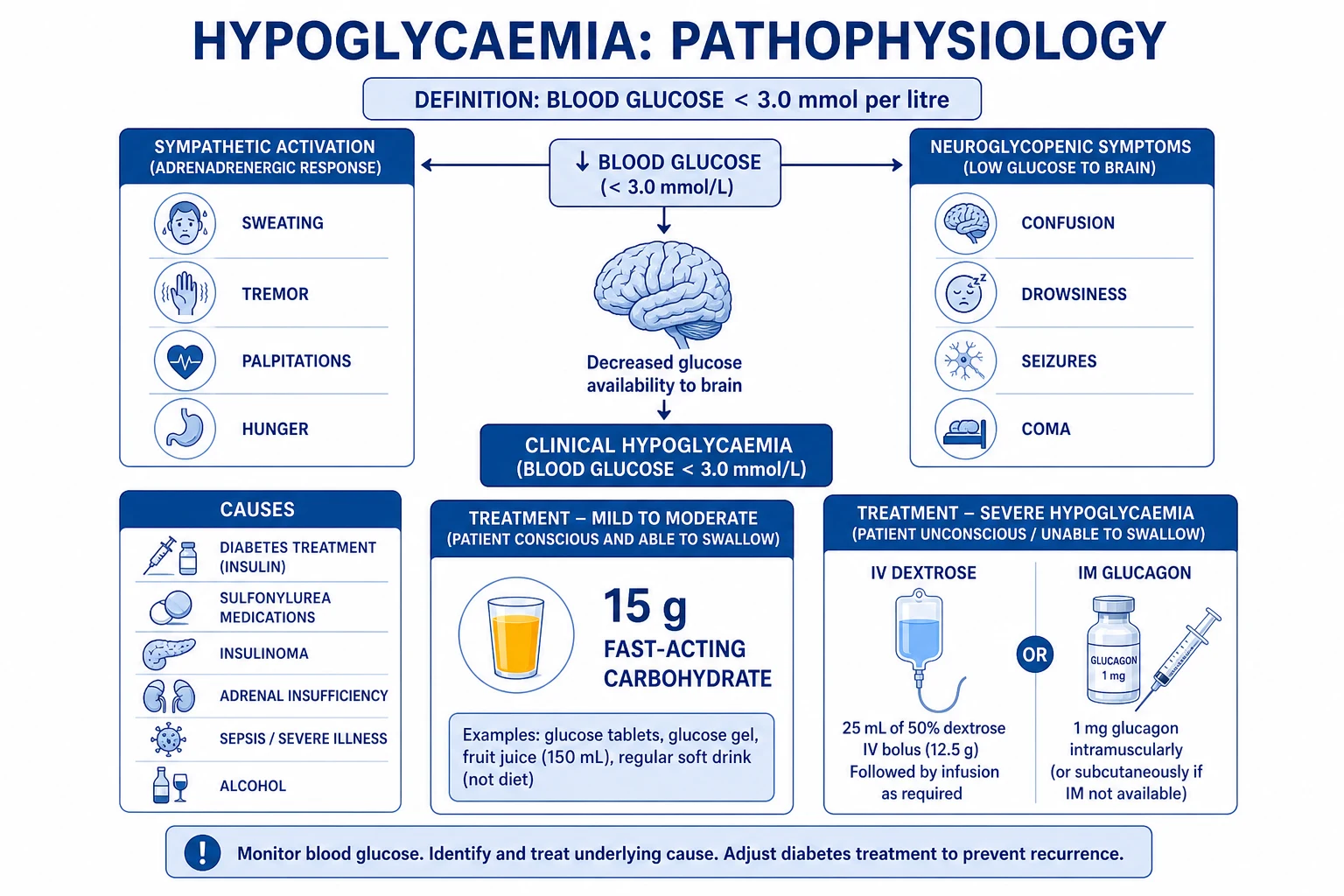
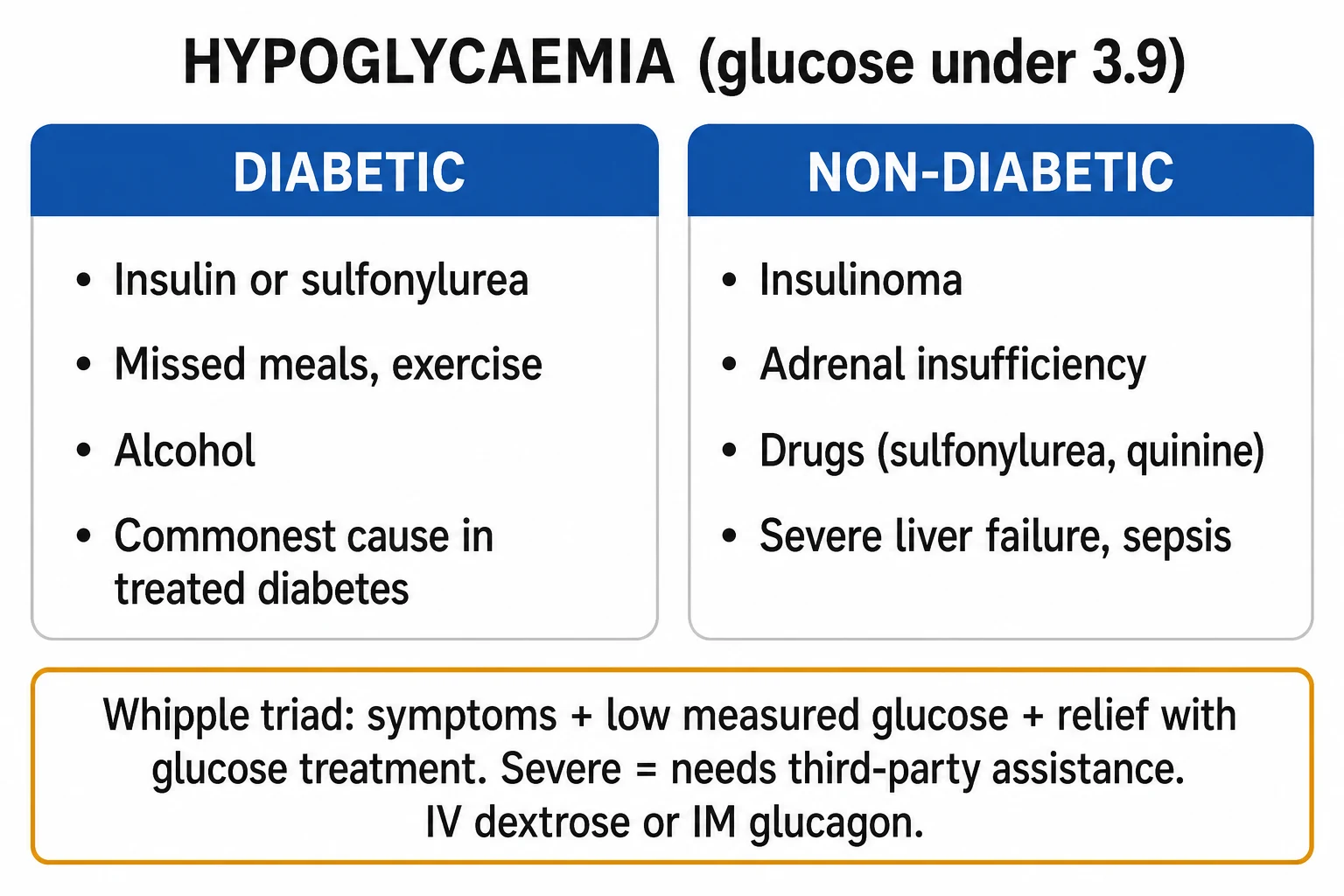
RECOGNISE — glucose <4.0 mmol/L (severe <2.8 or any level with impaired consciousness). Symptoms: autonomic (sweating, tremor, palpitations, hunger) and neuroglycopaenic (confusion, seizures, coma). In ICU, neuroglycopaenic signs may be the only clue in sedated patients. [1]
-
STOP any insulin infusion / oral hypoglycaemic and send a laboratory glucose to confirm. [1]
-
GIVE IV DEXTROSE — 50% 25-50 mL via large vein, or 10% 100-250 mL via central line (safer). Recheck glucose in 10-15 min and repeat until >6 mmol/L. [1]
-
IF NO IV ACCESS — glucagon 1 mg IM/SC (note: ineffective in alcohol or starved states). [1]
-
IDENTIFY AND REMOVE THE CAUSE — review all insulin/sulfonylurea; check renal function; consider sepsis/adrenal insufficiency/hepatic failure. If sulfonylurea is the cause → octreotide 50-100 mcg SC q6-8h + continuous dextrose infusion + 24-48 h observation. [1]
-
PREVENT RECURRENCE — once glucose stable >6, start a background glucose substrate infusion if on IV insulin; reduce the insulin dose; reassess the glycaemic-control target (was it too tight?). [1]
-
DOCUMENT and review — every severe hypoglycaemic event is a critical incident; tight control (NICE-SUGAR lesson) is dangerous.
SAQ — ICU insulin infusion protocol in a septic post-operative diabetic patient
10 minutes · 10 marks
A 68-year-old man with type 2 diabetes (HbA1c 78 mmol/mol on metformin and gliclazide) is admitted to ICU post-emergency laparotomy for perforated diverticulitis. He is in septic shock on noradrenaline 0.3 mcg/kg/min. His capillary glucose is 18 mmol/L. Outline your insulin infusion protocol, your glycaemic target, and how you will safely transition him to subcutaneous insulin for ward transfer.
SAQ — Sulfonylurea and metformin overdose: pharmacology and ICU management
10 minutes · 10 marks
A 24-year-old woman (60 kg) is brought to ED 4 hours after ingesting glibenclamide 70 mg (seventy 10-mg tablets) and an unknown quantity of metformin, with alcohol. She is drowsy (GCS 13), glucose 1.4 mmol/L, lactate 7.2 mmol/L, pH 7.18, and transiently responded to 25 g IV dextrose before recurring hypoglycaemia. The registrar asks for your ICU approach.
Clinical pearls
[1]Red flags
Key trials and evidence
NICE-SUGAR — Normoglycaemia in Intensive Care Evaluation and Survival Using Glucose Algorithm Regulation (PMID 19318384)
Study design
Multicentre (42 ICUs, international), randomised, controlled — 6104 mechanically-ventilated adults expected to stay ≥3 days
Population
Critically ill adults (mixed medical/surgical)
Intervention
Intensive glucose control (target 4.5-6.0 mmol/L; 81-108 mg/dL) vs conventional (target ≤10 mmol/L; ≤180 mg/dL)
Primary outcome
Death by 90 days
Key finding
INTENSIVE-control arm had SIGNIFICANTLY HIGHER 90-day mortality (27.5% vs 24.9%; OR 1.14) and dramatically more SEVERE HYPOGLYCAEMIA (6.8% vs 0.5%). Hypoglycaemia independently predicted death.
Clinical bottom line
OVERTURNED the Leuven 'tight control' era. ICU glucose target is MODERATE (6-10 mmol/L) — tight control is dangerous. The single most influential trial in ICU glucose management.
Leuven (van den Berghe) — Intensive Insulin Therapy in the Critically Ill (PMID 11794168)
Study design
Single-centre (Leuven surgical ICU), randomised, prospective — 1548 patients
Population
Surgical ICU patients (mostly post-cardiac surgery)
Intervention
Intensive insulin (target blood glucose 4.4-6.1 mmol/L, 80-110 mg/dL) vs conventional (target 10-11.1 mmol/L)
Primary outcome
ICU mortality
Key finding
Intensive insulin reduced ICU mortality (4.6% vs 8.0%) — greatest benefit in long-stay (>5 days) patients; also reduced bacteraemia, AKI needing dialysis, polyneuropathy.
Clinical bottom line
Pioneered 'tight glycaemic control' — but single-centre, protocol-driven, enteral-fed patients; could NOT be replicated elsewhere (NICE-SUGAR refuted it). Historical context only.
EMPA-REG OUTCOME — Empagliflozin, CV Outcomes and Mortality (PMID 26378978)
Study design
Randomised, double-blind, placebo-controlled — 7020 patients
Population
Type 2 diabetes + established cardiovascular disease
Intervention
Empagliflozin (SGLT2 inhibitor) 10 or 25 mg vs placebo, added to standard care
Primary outcome
Composite of major adverse CV events (CV death, non-fatal MI, non-fatal stroke)
Key finding
14% reduction in primary composite; striking **38% reduction in cardiovascular death** and 32% reduction in all-cause mortality; 35% reduction in HF hospitalisation.
Clinical bottom line
First SGLT2 CVOT to show CV/MORTALITY benefit — transformed SGLT2 inhibitors from glucose-lowering drugs into cardioprotective agents.
CREDENCE — Canagliflozin and Renal Outcomes in Type 2 Diabetes and Nephropathy (PMID 30990260)
Study design
Randomised, double-blind, placebo-controlled — 4401 patients; STOPPED EARLY for efficacy
Population
Type 2 diabetes + chronic kidney disease (eGFR 30-90) + albuminuria, on maximum-tolerated ACE/ARB
Intervention
Canagliflozin 100 mg vs placebo
Primary outcome
Composite of ESKD, doubling of serum creatinine, renal or CV death
Key finding
30% REDUCTION in the primary composite (HR 0.70); significant reduction in ESKD and CV outcomes — first dedicated trial of an SGLT2 inhibitor in diabetic kidney disease.
Clinical bottom line
Established SGLT2 inhibitors as renoprotective — now a foundation of diabetic kidney disease management regardless of glucose.
LEADER — Liraglutide and Cardiovascular Outcomes (PMID 27295427)
Study design
Randomised, double-blind, placebo-controlled — 9340 patients
Population
Type 2 diabetes + high cardiovascular risk
Intervention
Liraglutide (GLP-1 agonist) 1.8 mg SC daily vs placebo
Primary outcome
Composite of CV death, non-fatal MI, non-fatal stroke
Key finding
13% reduction in primary composite (HR 0.87); significant reduction in CV death (22%) and all-cause mortality (15%); reduced nephropathy progression.
Clinical bottom line
Established GLP-1 agonists as cardioprotective — liraglutide preferred in T2DM with established/at-risk CVD where weight loss and CV benefit are desired.
TECOS — Sitagliptin and Cardiovascular Outcomes (PMID 26052984)
Study design
Randomised, double-blind, placebo-controlled — 14,671 patients
Population
Type 2 diabetes + established cardiovascular disease
Intervention
Sitagliptin (DPP-4 inhibitor) vs placebo, added to existing therapy
Primary outcome
Composite of CV death, non-fatal MI, non-fatal stroke, unstable angina hospitalisation
Key finding
CV-NEUTRAL — no difference in primary composite, no increase in HF hospitalisation, no increase in pancreatitis. Sitagliptin safe in established CVD.
Clinical bottom line
Reassuring CV safety for DPP-4 inhibitors (sitagliptin specifically); unlike saxagliptin/alogliptin, no HF signal — sitagliptin preferred when a DPP-4 inhibitor is needed in CVD/HF.
Dosing quick-reference (ICU)
ICU insulin and hypoglycaemic dosing — practical reference
| Drug / scenario | Typical dose | Route | Onset / duration | Notes |
|---|---|---|---|---|
| Insulin — DKA (FRII) | 0.1 U/kg/h (titrate to 0.15 if glucose fall slow) | IV infusion (Actrapid 50 U/50 mL NS) | Onset min / effect while running | Continue until ketones <0.6; start glucose substrate when glucose <14[15] |
| Insulin — HHS | 0.05 U/kg/h (after fluids) | IV infusion | Min / while running | Half the DKA dose; fluids first[14] |
| Insulin — VRII / sliding scale | Per algorithm (0.5-6 U/h typical) | IV infusion | Min / while running | Target 6-10 mmol/L; substrate + K+ alongside |
| Insulin — hyperkalaemia | 10 U Actrapid + 25-50 g dextrose | IV over 15-30 min | 15 min / 4-6 h | Monitor glucose 4-6 h (late hypoglycaemia); consider 5 U in renal failure |
| Insulin — CCB/BB toxicity (HIET) | 1 U/kg bolus → 0.5-1 (up to 10) U/kg/h | IV + dextrose ± K+ | Min / while running | First-line antidotal therapy; titrate to haemodynamics |
| Glucagon — hypoglycaemia | 1 mg | IM/SC | 10-15 min / 1-2 h | Ineffective if glycogen-depleted; causes vomiting |
| IV dextrose — severe hypoglycaemia | 50% 25-50 mL OR 10% 100-250 mL | IV (large vein / central) | 5-10 min | 50% is VESICANT; 10% via central line safer |
| Octreotide — sulfonylurea hypoglycaemia | 50-100 mcg SC q6-8h | SC | 30-60 min / 6-8 h | Inhibits insulin release; observe 24-48 h[13] |
| Metformin (oral) | 500 mg BD → 1 g TDS | PO | Days | Hold periop / eGFR <30 / acute illness |
| Gliclazide (oral) | 40-80 mg OD → up to 320 mg | PO | Days | Preferred sulfonylurea (lowest hypoglycaemia) |
| Sitagliptin (oral) | 100 mg OD (50 mg if eGFR 30-45) | PO | Days | CV-safe (TECOS); no weight gain |
| Empagliflozin / Dapagliflozin (oral) | 10 mg OD (± up-titrate) | PO | Days | Stop pre-op / acute illness (euDKA risk) |
| Liraglutide / Semaglutide (SC) | Liraglutide 0.6→1.8 mg OD; semaglutide 0.25→1 mg weekly | SC | Days | Weight loss + CV benefit; titrate to limit GI effects |
References
- [1]NICE-SUGAR Study Investigators; Finfer S, Chittock DR, Su SY, et al. Intensive versus conventional glucose control in critically ill patients N Engl J Med, 2009.PMID 19318384
- [2]van den Berghe G, Wouters P, Weekers F, et al. Intensive insulin therapy in critically ill patients N Engl J Med, 2001.PMID 11794168
- [3]UK Prospective Diabetes Study (UKPDS) Group Effect of intensive blood-glucose control with metformin on complications in overweight patients with type 2 diabetes (UKPDS 34). UK Prospective Diabetes Study (UKPDS) Group Lancet, 1998.PMID 9742977
- [4]Zinman B, Wanner C, Lachin JM, et al. Empagliflozin, Cardiovascular Outcomes, and Mortality in Type 2 Diabetes N Engl J Med, 2015.PMID 26378978
- [5]Neal B, Perkovic V, Mahaffey KW, et al. Canagliflozin and Cardiovascular and Renal Events in Type 2 Diabetes N Engl J Med, 2017.PMID 28605608
- [6]Perkovic V, Jardine MJ, Neal B, et al. Canagliflozin and Renal Outcomes in Type 2 Diabetes and Nephropathy N Engl J Med, 2019.PMID 30990260
- [7]Marso SP, Daniels GH, Brown-Frandsen K, et al. Liraglutide and Cardiovascular Outcomes in Type 2 Diabetes N Engl J Med, 2016.PMID 27295427
- [8]Marso SP, Bain SC, Consoli A, et al. Semaglutide and Cardiovascular Outcomes in Patients with Type 2 Diabetes N Engl J Med, 2016.PMID 27633186
- [9]Green JB, Bethel MA, Armstrong PW, et al. Effect of Sitagliptin on Cardiovascular Outcomes in Type 2 Diabetes N Engl J Med, 2015.PMID 26052984
- [10]Bonora BM, Avogaro A, Fadini GP Euglycemic Ketoacidosis Curr Diab Rep, 2020.PMID 32424730
- [11]Salpeter SR, Greyber E, Pasternak GA, Salpeter EE Risk of fatal and nonfatal lactic acidosis with metformin use in type 2 diabetes mellitus Cochrane Database Syst Rev, 2010.PMID 20393934
- [12]Roberts DM, Ghannoum M Expanding the evidence for managing metformin poisoning to support decision-making Clin Toxicol (Phila), 2023.PMID 37129225
- [13]Glatstein M, Scolnik D, Bentur Y Octreotide for the treatment of sulfonylurea poisoning Clin Toxicol (Phila), 2012.PMID 23046209
- [14]Mustafa OG, Haq M, Dashora U, Dhatariya K, et al. Management of Hyperosmolar Hyperglycaemic State (HHS) in Adults: An updated guideline from the Joint British Diabetes Societies (JBDS) for Inpatient Care Group Diabet Med, 2023.PMID 36370077
- [15]Sharma A, Rengarajan L, Narendran P, Dhatariya K, et al. Guidelines for the management of diabetes-related ketoacidosis (DKA) have been poorly adopted and implemented, resulting in a lack of improvement in outcomes Diabet Med, 2025.PMID 39928758
- [16]Nyenwe EA, Kitabchi AE Evidence-based management of hyperglycemic emergencies in diabetes mellitus Diabetes Res Clin Pract, 2011.PMID 21978840