ICU · Rehabilitation
Acute severe community-acquired pneumonia: long-term outcomes and post-ICU cognitive impairment
Also known as Post-ICU cognitive impairment · Long-term outcomes after CAP · Critical illness neuropsychological impairment · Post-intensive care syndrome
Cognitive impairment after critical illness affects 30-80% of ICU survivors and may persist for years. Domains affected: memory (short-term and working), executive function (planning, decision-making, attention), processing speed, visuospatial ability. Mechanisms: hypoxia, inflammation (neuroinflammation), delirium, sedation, metabolic derangement, microvascular dysfunction. Severity ranges from subtle (noticeable only on testing) to severe (resembling mild-to-moderate Alzheimer's). Risk factors: duration of delirium (1 predictor), age, pre-existing cognitive impairment, sepsis severity, hypoglycaemia/hyperglycaemia. Prevention: minimise delirium (ABCDEF bundle), minimise sedation (dexmedetomidine), glycaemic control, early mobilisation, prevent hypoxia. Assessment: MoCA/MMSE at ICU follow-up. Management: cognitive rehabilitation, lifestyle modification, family education.
On this page & tools
Your progress
Saved locally on this device.
Target exams
Red flags
Clinical pearls
Red flags
Definition and scope
Epidemiology
Post-ICU cognitive impairment — the numbers
The headline figure to remember: up to 70-80% of ICU survivors have measurable cognitive impairment at hospital discharge, and 30-50% remain impaired at one year. The prevalence depends heavily on the population studied — it is highest after prolonged mechanical ventilation, sepsis, ARDS, and any admission complicated by delirium — and on the stringency of the testing and the definition of "impairment" (typically ≥1.5 or 2 standard deviations below age-matched norms). [1]
By population:
- General medical ICU survivors: ~30-40% cognitively impaired at 1 year.[3]
- ARDS survivors: impairment in ~50-80% at hospital discharge, ~30-55% at 1 year, ~20-25% at 2 years; ARDS is the most-studied and one of the highest-risk cohorts.[10][14]
- Septic shock survivors: cognitive deficits are common and correlate with the depth and duration of sepsis-associated encephalopathy.
- Post-COVID critical illness: an ARDS-like pattern of impairment, with depression/anxiety/PTSD prominently co-existing — a "PICS amplified" phenotype.[12]
Trajectory: recovery is fastest in the first 3-6 months, continues more slowly to ~12 months, and largely plateaus thereafter. A subgroup (~20%) has persistent deficits at 2-5 years that appear permanent — most often in executive function and processing speed. Older patients and those with longer delirium recover less.[10]
Post-intensive care syndrome (PICS) — the three-domain framework
Cognitive impairment never occurs in isolation. The Society of Critical Care Medicine (SCCM, 2010) defined post-intensive care syndrome (PICS) as new or worsening impairment across three interlocking domains: cognitive, psychological, and physical. The domains co-occur, compound one another, and share modifiable risk factors — which is why prevention is delivered as a bundle rather than piecemeal. [1]
PICS — the three interlocking domains (click each)
ICU-acquired weakness
CIM/CIP/CINM in 25-50% of patients ventilated >7 days; rapid muscle wasting (~2-3%/day early); respiratory and bulbar weakness; 6MWT ~50% of predicted at 6 months. Contributes to failed weaning, falls, delayed return to work.
Cognitive
Brain dysfunction
- Memory (declarative + working), attention, executive function, processing speed, visuospatial
- 30-80% impaired at discharge; 30-50% still impaired at 1 year
- Pattern resembles moderate TBI / mild-to-moderate Alzheimer disease
- DELIRIUM duration = single strongest predictor (BRAIN-ICU)
- Recovery plateaus ~12 months; a residuum is often permanent
Psychological
PTSD / depression / anxiety
- PTSD ~20%, depression ~30%, anxiety ~40% of survivors
- Driven by delusional ICU recall (factual memories via diaries are protective)
- Interferes with return to work, relationships, quality of life
- The MOST MODIFIABLE domain — trauma-focussed CBT, SSRIs, diaries, peer support
Physical
ICU-acquired weakness
- CIM/CIP/CINM in 25-50% ventilated >7 days
- Deconditioning, dyspnoea, post-extubation dysphagia
- 6MWT ~50% of predicted at 6 months; ~30-40% still weak at 1 year
- Compounds cognitive impairment via deconditioning, immobility, sleep loss
The interaction between domains is the key insight: a patient who is physically weak cannot exercise, which worsens mood and sleep, which worsens cognition, which reduces adherence to rehabilitation — a vicious cycle. Conversely, treating one domain (e.g. exercise for depression, CBT for PTSD) often helps the others. [1]
Cognitive domains affected
Cognitive domains impaired in post-ICU cognitive impairment
| Domain | What is impaired | Clinical manifestation |
|---|---|---|
| Executive function | Planning, set-shifting, inhibition, judgement, multitasking, decision-making | Cannot manage medications/finances, plan complex tasks, or make decisions; poor judgement |
| Memory | Declarative (new learning), working memory, retrieval | Forgets conversations/appointments; repeats questions; loses train of thought |
| Attention | Sustained, selective, divided attention | Easily distracted; cannot follow multi-step instructions; "fog" |
| Processing speed | Slowed cognition and reaction | Tasks take longer; loses conversational threads; slow reading |
| Visuospatial ability | Spatial orientation, construction, navigation | Gets lost; difficulty with maps, driving, drawing, assembling |
Executive function and processing speed are the most commonly and most severely affected domains, and the slowest to recover — this is why the pattern is said to resemble traumatic brain injury (TBI) rather than a typical cortical dementia (which preferentially affects episodic memory early). Memory is also commonly impaired but tends to recover more than executive function over the first year.[3]
Mechanisms — why the brain is injured in critical illness
No single mechanism explains post-ICU cognitive impairment — it is multifactorial. The major mechanisms act in concert during the acute illness and the ICU stay, and several are directly modifiable, which is the whole basis of prevention. [1]
Mechanisms of ICU-acquired brain injury
| Mechanism | How it injures the brain | Modifiable? |
|---|---|---|
| Delirium | Acute brain dysfunction; neuroinflammation, synaptic disruption, neurotransmitter imbalance (cholinergic deficit). Each day of delirium independently worsens long-term cognition | YES — #1 target (ABCDEF) |
| Neuroinflammation | Systemic cytokines (IL-1, IL-6, TNF-α) cross the blood-brain barrier → microglial activation → neuronal/synaptic dysfunction ("sickness behaviour" prolonged into chronic impairment) | Partly (treat sepsis, minimise inflammation) |
| Hypoxia / hypoperfusion | Neuronal injury from hypoxaemia, hypotension, microvascular dysfunction; watershed-sensitive regions (hippocampus, frontal cortex) | YES (oxygenation, perfusion, avoid hypotension) |
| Sedative neurotoxicity | Benzodiazepines (GABA-ergic) strongly associated with delirium and cognitive decline; propofol, opioids also implicated. Prolonged deep sedation | YES (minimise, prefer dexmedetomidine) |
| Metabolic / glucose | Both hypoglycaemia (direct neuronal injury) and hyperglycaemia (neurotoxicity, oxidative stress) damage the brain | YES (moderate glucose control 8-10 mmol/L) |
| Sleep disruption | Loss of sleep architecture, circadian disruption (light, noise, care), abolishes restorative slow-wave/REM sleep → impairs memory consolidation, worsens delirium | YES (sleep promotion, cluster care) |
Neuroinflammation in depth. The leading unifying hypothesis is that systemic inflammation (from sepsis, tissue injury, surgery) drives microglial activation within the central nervous system. Activated microglia release reactive oxygen species and pro-inflammatory cytokines, impair synaptic plasticity, and disrupt the blood-brain barrier. In most patients this resolves; in a subset it persists, producing chronic low-grade neuroinflammation that manifests as executive dysfunction and slowed processing speed — a profile reminiscent of the "chemo brain" seen after systemic cancer therapy. Hypoxia and hypoperfusion compound this by injuring metabolically demanding hippocampal and frontal neurons.[12]
Why delirium is the master variable. Delirium is simultaneously a marker of these upstream injuries and a driver in its own right — prolonged delirium state itself appears neurotoxic. The BRAIN-ICU study showed that each additional day of delirium independently predicted worse global cognition and executive function at 3 and 12 months, even after adjusting for age, sedation, severity of illness, and pre-existing function. This dose-response relationship is the single most important reason delirium prevention is the cornerstone of cognitive-impairment prevention.[3][8]
Risk factors
Risk factors for post-ICU cognitive impairment
Risk factors — modifiable vs non-modifiable
| Category | Risk factor | Why it matters |
|---|---|---|
| Modifiable (ICU) | Delirium (duration + severity) | #1 predictor; each day worsens long-term cognition |
| Modifiable (ICU) | Prolonged deep sedation / benzodiazepines | Neurotoxicity → delirium → cognitive decline |
| Modifiable (ICU) | Hypoxaemia / hypotension / hypoperfusion | Direct neuronal injury (hippocampus, frontal cortex) |
| Modifiable (ICU) | Hyperglycaemia / hypoglycaemia | Both neurotoxic; moderate control is best |
| Modifiable (ICU) | Immobility | Worsens delirium, sleep, deconditioning |
| Modifiable (ICU) | Sleep disruption (noise, light, care) | Impairs memory consolidation; worsens delirium |
| Modifiable (ICU) | Prolonged ventilation (>7 days) | Drives delirium, weakness, deconditioning |
| Non-modifiable | Older age | Reduced cognitive reserve |
| Non-modifiable | Pre-existing cognitive impairment | Lower baseline; more vulnerable |
| Non-modifiable | Low educational attainment / frailty | Reduced cognitive reserve |
| Non-modifiable | Severity of illness (sepsis, ARDS, MODS) | Greater neuroinflammatory load |
The dominant exam message: most of the strongest risk factors are modifiable during the ICU stay — which is why bundle-based prevention (ABCDEF) is effective at reducing cognitive impairment, not just delirium. [1]
Prevention — the ABCDEF bundle
Prevention is the most effective strategy, because once neuronal injury is established there is no specific pharmacological rescue. The ABCDEF bundle (SCCM ICU Liberation) is the single best-evidenced, multidisciplinary prevention strategy — every component targets a modifiable risk factor identified above. In the ICU Liberation Collaborative (>15,000 patients), better bundle performance was associated with more delirium-free, coma-free, and ventilator-free days and lower mortality.[5]
ABCDEF bundle — preventing delirium and cognitive impairment
A — Assess and manage pain
Use validated tools (CPOT for communicative, BPS for non-communicative). Treat pain adequately — untreated pain drives delirium and PTSD. Analgesia-first approach reduces sedative requirement.
B — Both SAT and SBT daily
Daily spontaneous awakening trial (SAT) + spontaneous breathing trial (SBT). Shortens ventilation → less delirium, less ICU-acquired weakness. Performed as a coordinated safety-checked pair.
C — Choice of sedation
Prefer dexmedetomidine or propofol over benzodiazepines. Benzodiazepines (GABA-ergic) are strongly associated with delirium and long-term cognitive decline. Target light sedation (RASS -1 to 0); avoid deep sedation unless indicated.
D — Delirium: assess, prevent, manage
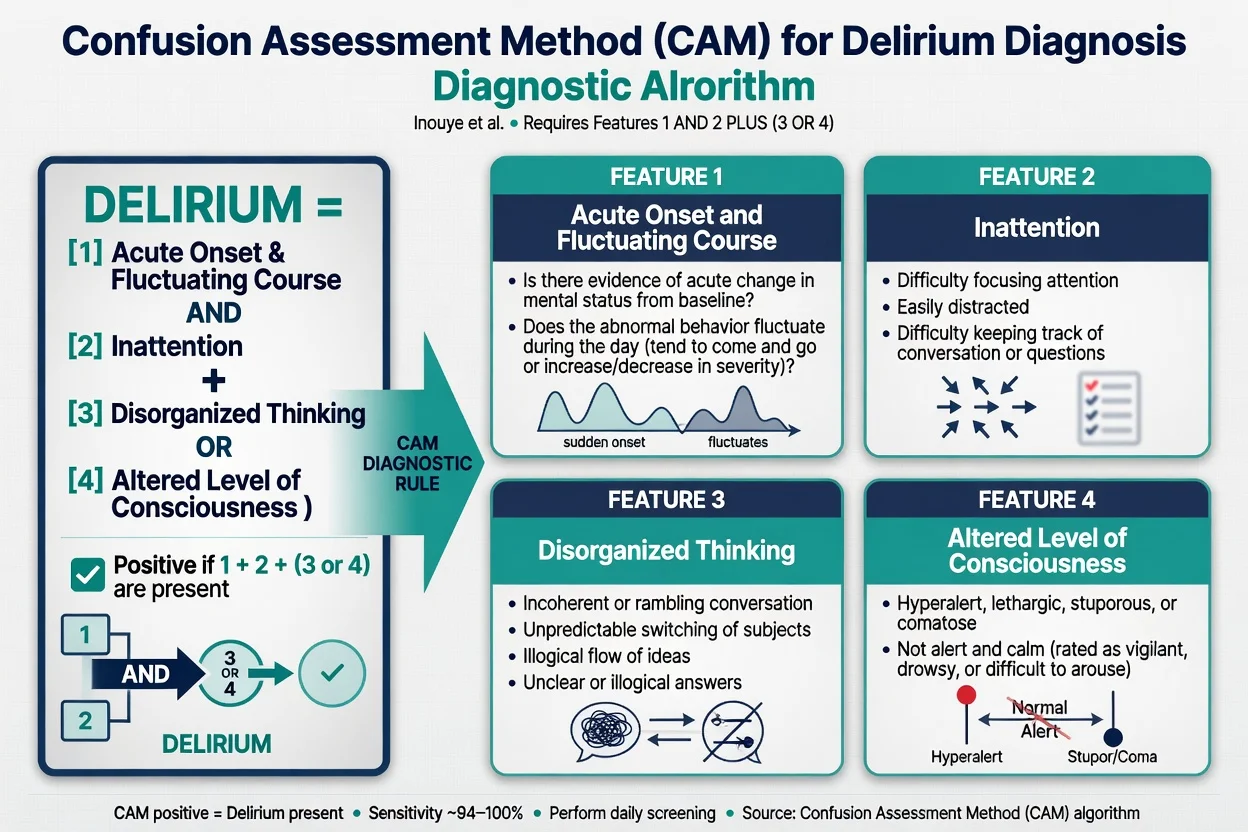
Monitor with CAM-ICU or ICDSC at least once per shift. Prevent: treat pain, minimise sedatives, promote sleep, mobilise, orientation cues, hearing/vision aids. The #1 modifiable predictor of long-term cognition — preventing delirium is preventing cognitive impairment.
E — Early mobility
Passive range of motion from day 1 → sit → stand → walk, even while ventilated. Reduces ICU-acquired weakness, delirium duration, and ICU stay (Schweickert 2009). Requires coordinated nursing + physiotherapy + minimal sedation.
F — Family engagement and empowerment
Flexible visiting, family presence at rounds, family participation in care. Reduces anxiety and PICS-Family morbidity. ICU diaries aid factual memory reconstruction and reduce PTSD.
Prevention by domain — what actually works
| Target | Effective intervention | Mechanism / evidence |
|---|---|---|
| Delirium / cognition | ABCDEF bundle; minimise benzodiazepines; treat pain; promote sleep | Reduces delirium duration → reduces long-term cognitive impairment |
| Brain perfusion / oxygenation | Avoid hypoxaemia and hypotension; monitor depth | Prevents direct neuronal injury to hippocampus, frontal cortex |
| Glucose control | Moderate control (NICE-SUGAR, target ~8-10 mmol/L) | Avoids hypoglycaemia (brain) and severe hyperglycaemia (neurotoxicity) |
| ICU-acquired weakness | Early mobilisation (day 1-5); minimise sedation + NMBA; avoid steroids if possible | Reduces weakness → enables exercise → supports cognition |
| Sleep | Lights-off at night, cluster care, earplugs/eyemasks, minimise nocturnal disruption | Restores memory consolidation; reduces delirium |
| PTSD / anxiety | ICU diaries (factual memories); minimise sedation; benzodiazepine avoidance | Reduces frightening delusional recall; aids memory reconstruction |
| Family (PICS-F) | Structured communication, family meetings, flexible visiting, bereavement support | Reduces family anxiety, depression, PTSD, complicated grief |
Assessment at follow-up
Cognitive impairment is often unrecognised by patients and families — the deficits are subtle enough to be attributed to "tiredness" or "age" but severe enough to derail medication adherence, finances, driving, and return to work. Structured screening at an ICU recovery/follow-up clinic (typically 2-3 months post-discharge) is essential. [1]
Validated tools for assessing post-ICU cognitive (and related) impairment
| Domain | Tool | What it measures | Interpretation |
|---|---|---|---|
| Global cognition | Montreal Cognitive Assessment (MoCA) | 30-point screening — memory, executive, attention, language, visuospatial | <26 = impairment; <18 = moderate-severe; ideal bedside screen |
| Global cognition | MMSE | 30-point — older, less sensitive to executive dysfunction | Largely superseded by MoCA for this population |
| Executive / attention | Trail-Making Test A/B | Processing speed (A), set-shifting/executive (B) | Slowed times reflect impairment; sensitive to ICU deficits |
| Executive | Digit Symbol Substitution, verbal fluency | Processing speed, executive function | Commonly impaired in ICU survivors |
| Memory | RBANS / Hopkins Verbal Learning | Declarative memory, broad cognition | Used in research (BRAIN-ICU used RBANS) |
| Pre-morbid (informant) | IQCODE (family-rated) | Pre-existing decline | Distinguishes new ICU-acquired decline from prior |
| Functional impact | ADL (Barthel), IADL | Independence in daily tasks | Tracks real-world impact, rehab goals |
| Mental health | HADS, PHQ-9, GAD-7, IES-R / PCL-5 | Anxiety, depression, PTSD | Always co-screen — domains compound |
| Quality of life | SF-36 / EQ-5D | Generic health-related quality of life | Compare to population norms; track recovery |
Approach. Screen every ICU survivor (especially those ventilated >48 h or with delirium) at 2-3 months with a MoCA + Trail-Making Test + a mental-health screen (HADS, IES-R). Re-assess at 6 and 12 months to chart trajectory. Reserve comprehensive formal neuropsychological testing for selected patients (those returning to cognitively demanding work, or with discordant/disabling deficits). Use an informant-rated tool (IQCODE) to separate new ICU-acquired decline from pre-existing impairment.[3]
Cognitive rehabilitation
Unlike delirium prevention — which has strong evidence — cognitive rehabilitation after critical illness has a more modest and evolving evidence base, but is now a recommended component of post-ICU recovery programmes. The principles borrow from the traumatic brain injury and stroke rehabilitation literature. [1]
Cognitive rehabilitation after ICU — a structured approach
1. Baseline assessment & goal-setting
Formal neuropsychological assessment of affected domains (memory, executive, attention, processing speed). Set patient-centred SMART goals tied to function (e.g. "manage own medications", "return to part-time work").
2. Restorative (drill) techniques
Repeated practice of impaired cognitive domains via structured (paper-based or computerised) exercises — e.g. attention processing training, memory drills. Aimed at restoring the underlying capacity. Evidence: modest gains in trained domains; generalisation to daily function is limited.
3. Compensatory strategies
Teach strategies to work around the deficit: external memory aids (smartphones, calendars, pillboxes, alarms), structured routines, single-task focus, written checklists, mnemonics. These have the highest real-world yield for daily function.
4. Metacognitive / strategy training
Train self-monitoring and self-regulation — pause-plan-check, pacing, learning to anticipate errors in executive tasks. Particularly useful for frontal/executive deficits.
5. Functional / vocational rehabilitation
Integrate cognitive strategies into real tasks — medication management, finance handling, simulated work tasks. Plan graded return to work with the employer; consider modified duties. Formal driving assessment if indicated.
6. Lifestyle & maintenance
Aerobic exercise (promotes BDNF and neuroplasticity), adequate sleep, Mediterranean-style diet, social and cognitive engagement, avoidance of sedating/anticholinergic drugs (deprescribe). These support recovery and protect against further decline.
Family education is part of rehabilitation. Explain that cognitive changes are expected after ICU, are not dementia, will not necessarily progress, and often improve over months — but that some residual deficit is common. Practical advice: keep a consistent routine, do one task at a time, use reminders/notes, reduce distractions, allow extra time, and avoid major financial or life decisions during the early recovery period.[3]
Recovery trajectory
Recovery trajectory of post-ICU cognitive impairment (click each)
Continued gains
Memory and attention recover substantially. Executive function and processing speed lag. Depression/anxiety/PTSD often peak as the reality of residual disability sets in.
Functional consequences — ADLs, driving, return to work
Key trials and evidence
Pandharipande 2013 — BRAIN-ICU (long-term cognitive impairment) (PMID 24088092)
Study design
Prospective cohort — 821 adults with respiratory failure or shock at medical/surgical ICUs
Assessment
Cognition (RBANS, Trail-Making, executive tests) at 3 and 12 months after discharge
Key result
At 3 months, 40% had global cognition scores like moderate TBI; at 12 months, 26% were like moderate TBI and a further group scored like mild Alzheimer disease — including young, previously well patients
Risk factor
Longer DELIRIUM duration independently predicted worse global cognition and executive function at 3 and 12 months — a dose-response effect
Clinical bottom line
Post-ICU cognitive impairment is common, persistent, resembles TBI, and is driven by delirium — preventing delirium is the most important intervention
Schweickert 2009 — Early mobilisation (PMID 19446324)
Study design
Randomised controlled trial — 104 mechanically ventilated patients
Population
Patients ventilated <72 h, expected to ventilate >72 h more
Intervention
Early physical + occupational therapy (day 1-5) during daily sedation interruption vs usual care
Primary outcome
Return to independent functional status at hospital discharge: 59% (early) vs 35% (usual care) — significant
Key finding
Early mobilisation → more ventilator-free days, better functional outcomes, and shorter delirium duration
Clinical bottom line
Early mobilisation (day 1-5, even while ventilated) is the most effective physical-domain PICS prevention and also reduces delirium
Pun 2019 — ICU Liberation ABCDEF Bundle, >15,000 patients (PMID 30339549)
Study design
Multicentre quality-improvement cohort — 15,000+ adults across 68 ICUs (ICU Liberation Collaborative)
Intervention
Performance of the ABCDEF bundle (Assess pain, Both SAT+SBT, Choice of sedation, Delirium, Early mobility, Family)
Key result
Better (more complete) bundle performance was associated with more delirium-free, coma-free, and ventilator-free days, lower ICU mortality, and more days alive without coma/delirium
Clinical bottom line
The ABCDEF bundle is the best-evidenced multidisciplinary PICS-prevention strategy — every component targets a modifiable risk factor and the bundle is greater than the sum of its parts
Salluh 2015 — Delirium outcomes meta-analysis (PMID 26041151)
Study design
Systematic review and meta-analysis of 42 studies, ~16,500 ICU patients
Key result
Delirium associated with higher mortality (OR ~2), longer ICU and hospital stay, and more long-term cognitive impairment
Clinical bottom line
Delirium is independently associated with worse outcomes across every domain — confirming it as the central modifiable driver of post-ICU cognitive impairment
NICE-SUGAR 2009 — Glucose control in ICU (PMID 19318384)
Study design
Multinational RCT — 6,104 critically ill adults; intensive (4.5-6.0 mmol/L) vs conventional (≤10 mmol/L) glucose control
Key result
Intensive control INCREASED mortality and severe hypoglycaemia vs conventional control
Clinical bottom line
Moderate glucose control (target ~8-10 mmol/L, avoiding hypoglycaemia) is optimal — hypoglycaemia is directly neurotoxic and worsens cognitive outcomes
Nielsen 2020 — DRIP-study, family-authored ICU diaries (PMID 30795978)
Study design
Randomised controlled trial — family-authored ICU diaries vs control
Population
ICU patients and their close relatives
Intervention
Diary written by relatives (with staff support), given to patient at 1 and 3 months
Outcome
PTSD, anxiety, depression in patients and relatives
Clinical bottom line
ICU diaries are low-cost, low-risk, and help patients/families reconstruct factual memories — reducing delusional recall and psychological morbidity (the most treatable PICS domain)
Herridge 2016 — ARDS long-term recovery (PMID 27025938)
Study design
Prospective cohort — ARDS survivors followed to 5 years (Toronto ARDS cohort)
Key result
Cognitive and psychological impairment persisted years after the acute illness; exercise capacity recovered slowly but plateaued; most patients never returned to predicted function
Clinical bottom line
Recovery from critical illness is measured in years, not weeks — survivors need prolonged, structured follow-up; a residuum of cognitive impairment is common
Distinguishing features and differential
Post-ICU cognitive impairment vs other cognitive syndromes
| Feature | Post-ICU cognitive impairment | Alzheimer dementia | Vascular dementia | TBI |
|---|---|---|---|---|
| Onset | After critical illness | Insidious, progressive | Stepwise / gradual | At injury |
| Course | Improves over 6-12 mo, then plateaus | Relentlessly progressive | Stepwise decline | Static then improves |
| Dominant domain | Executive + processing speed | Episodic memory early | Executive, stepwise | Variable, frontal |
| Reversibility | Partial — often improves | No | No | Partial |
| Key driver | Delirium, neuroinflammation, sedation | Amyloid/tau | Vascular disease | Mechanical injury |
The TBI-like pattern (executive and processing-speed predominant) and the improving course over the first year are the two features that most reliably distinguish post-ICU cognitive impairment from a neurodegenerative dementia. An informant history (IQCODE) is invaluable for separating new ICU-acquired decline from pre-existing impairment.[3]
Exam practice
SAQ — Post-ICU cognitive impairment
10 minutes · 10 marks
A 62-year-old previously independent warehouse manager was admitted to ICU 10 weeks ago with severe community-acquired pneumonia, septic shock, and ARDS. He required vasopressors, 11 days of mechanical ventilation, and developed delirium lasting 7 days. He is now at home. His wife reports he forgets conversations, cannot manage his own medications, gets lost driving to familiar places, and has not returned to work. He scores 23/30 on the MoCA at the ICU recovery clinic.
Clinical pearls — extended
Red flags — extended
References
- [1]Pandharipande PP, et al. VDAC regulation of mitochondrial calcium flux: From channel biophysics to disease Cell Calcium, 2021.PMID 33529977
- [2]Salluh JI, et al. Notum palmitoleoyl-protein carboxylesterase regulates Fas cell surface death receptor-mediated apoptosis via the Wnt signaling pathway in colon adenocarcinoma Bioengineered, 2021.PMID 34402722
- [3]Pandharipande PP, Girard TD, Jackson JC, et al. Long-term cognitive impairment after critical illness N Engl J Med, 2013.PMID 24088092
- [4]Schweickert WD, Pohlman MC, Pohlman AS, et al. Early physical and occupational therapy in mechanically ventilated, critically ill patients: a randomised controlled trial Lancet, 2009.PMID 19446324
- [5]Pun BT, Balas MC, Barnes-Daly MA, et al. Caring for Critically Ill Patients with the ABCDEF Bundle: Results of the ICU Liberation Collaborative in Over 15,000 Adults Crit Care Med, 2019.PMID 30339549
- [6]Marra A, Ely EW, Pandharipande PP, Patel MB. The ABCDEF Bundle in Critical Care Crit Care Clin, 2017.PMID 28284292
- [7]Nielsen AH, Angel S, Egerod I, et al. The effect of family-authored diaries on posttraumatic stress disorder in intensive care unit patients and their relatives: A randomised controlled trial (DRIP-study) Aust Crit Care, 2020.PMID 30795978
- [8]Salluh JIF, Wang H, Schneider EB, et al. Outcome of delirium in critically ill patients: systematic review and meta-analysis BMJ, 2015.PMID 26041151
- [9]Ely EW, Shintani A, Truman B, et al. Delirium as a predictor of mortality in mechanically ventilated patients in the intensive care unit JAMA, 2004.PMID 15082703
- [10]Herridge MS, Tansey CM, Matte A, et al. Recovery and outcomes after the acute respiratory distress syndrome (ARDS) in patients and their family caregivers Intensive Care Med, 2016.PMID 27025938
- [11]NICE-SUGAR Study Investigators. Intensive versus conventional glucose control in critically ill patients N Engl J Med, 2009.PMID 19318384
- [12]Pandharipande PP, Girard TD, Cotton BA, et al. Mitigating neurological, cognitive, and psychiatric sequelae of COVID-19-related critical illness Lancet Respir Med, 2023.PMID 37475124
- [13]Devlin JW, Skrobik Y, Gelinas C, et al. Pain and Delirium in Critical Illness: An Exploration of Key 2018 SCCM PADIS Guideline Evidence Gaps Semin Respir Crit Care Med, 2019.PMID 31826261
- [14]Herridge MS, Cheung AM, Tansey CM, et al. Two-year outcomes, health care use, and costs of survivors of acute respiratory distress syndrome Am J Respir Crit Care Med, 2006.PMID 16763220