ICU · Rehabilitation
Post-intensive care syndrome (PICS)
Also known as Post-intensive care syndrome (PICS) · ICU-acquired weakness · Post-ICU cognitive impairment · Post-ICU psychological morbidity · ICU follow-up clinics · Post-intensive care syndrome-family (PICS-F) · ICU recovery clinic · ICU diary
PICS describes new or worsening impairments in physical, cognitive, or mental health after critical illness and ICU stay. Affects 30-50% of ICU survivors. Physical: ICU-acquired weakness (CIM/CIP), fatigue, dyspnoea. Cognitive: impaired memory, executive dysfunction, attention deficits (resembles mild Alzheimer's). Mental health: PTSD, depression, anxiety. Risk factors: prolonged ventilation, sepsis, delirium, hypoglycaemia/hyperglycaemia, older age, pre-existing cognitive impairment. Prevention: minimise sedation (ABCDEF bundle), early mobilisation, glycaemic control, delirium prevention, sleep promotion. Follow-up: ICU follow-up clinics, rehabilitation, psychological support. Family members also affected (PICS-Family).
On this page & tools
Your progress
Saved locally on this device.
Target exams
Red flags
Definition — what PICS is
[1]Post-intensive care syndrome (PICS) was defined by the Society of Critical Care Medicine (SCCM) in 2010 as new or worsening impairment in physical, cognitive, or mental health arising after critical illness and persisting beyond the acute hospital stay. It reframes ICU outcomes: survival is necessary but not sufficient — the modern goal is functional recovery (return to independent living, work, relationships, quality of life). [1]
Three core points define the concept: [1]
- The deficits are acquired — they are new, or represent a worsening of pre-morbid function, attributable to the critical illness episode (not present beforehand).
- The deficits are persistent — they last weeks to months; many persist for years and a substantial fraction never fully resolve.
- The deficits are multi-domain — physical, cognitive, and mental health problems frequently coexist in the same patient and compound one another (e.g., weakness reduces rehabilitation tolerance → worsens cognition and mood; depression reduces engagement with rehabilitation → worsens weakness).[1][2]
Why it matters: as ICU mortality has fallen, the population of survivors with disability has grown. PICS is the most common and most modifiable long-term consequence of an ICU admission, and it is now a recognised exam and quality-of-care topic in its own right. [1]
The three domains of PICS
PICS — the three interlocking domains (click each)
Psychological morbidity
PTSD ~20%, depression ~30%, anxiety ~40% of survivors. Driven by frightening ICU memories, delusional recall, loss of autonomy, sedation, and pain. Reduces quality of life and return to work; the most treatable domain.
Physical
Weakness and debility
- ICU-acquired weakness (CIM/CIP) — affects 25-50% of ventilated patients
- Muscle wasting, reduced exercise tolerance, fatigue
- Dyspnoea on exertion (reduced respiratory muscle strength)
- Swallowing difficulties (post-extubation dysphagia)
- May persist for months-years; incomplete recovery in ~50%
Cognitive
Brain dysfunction
- Impaired memory, attention, executive function, visuospatial ability
- Severity ranges from mild to resembling mild-to-moderate Alzheimer disease
- Affects 30-80% of ICU survivors at hospital discharge
- DELIRIUM during ICU stay is the strongest predictor
- May persist for 12+ months; some recovery but often incomplete
Mental health
Psychological morbidity
- PTSD: ~20% of ICU survivors (flashbacks, nightmares, avoidance)
- Depression: ~30%
- Anxiety: ~40%
- Risk factors: memory of frightening ICU experiences, prolonged sedation, lack of diaries
- May interfere with return to work, relationships, quality of life
The physical domain in depth
Physical domain — the numbers
The cognitive domain in depth
Cognitive subdomains affected in PICS
| Domain | What is impaired | Clinical manifestation |
|---|---|---|
| Executive function | Planning, set-shifting, inhibition, judgement, multitasking | Cannot manage medications, finances, or complex tasks; poor decision-making |
| Memory | Declarative (new learning), working memory | Forgets conversations, appointments; repeats questions |
| Attention | Sustained, selective, divided attention | Easily distracted; cannot follow long instructions |
| Processing speed | Slowed cognition | Takes longer to complete tasks; loses threads of conversation |
| Visuospatial ability | Spatial orientation, construction | Gets lost; difficulty with maps, driving, drawing |
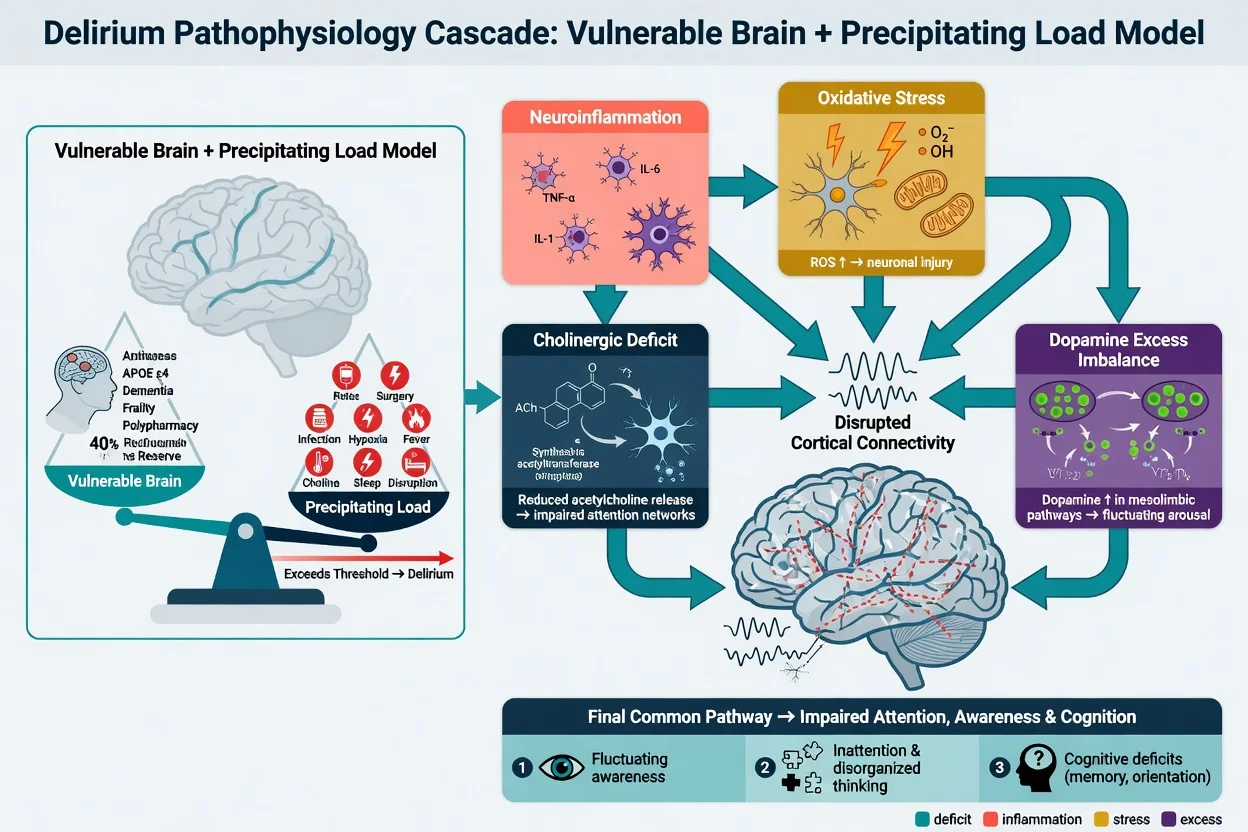
Mechanisms of ICU-related brain injury: delirium (neuroinflammation, synaptic dysfunction), hypoxaemia, hypotension/hypoperfusion, glucose excursions (both hypo- and hyperglycaemia), metabolic encephalopathy, sedative neurotoxicity (benzodiazepines), sleep disruption, and sepsis-associated encephalopathy. Delirium duration is the single strongest, independent predictor of long-term cognitive impairment — each additional day of delirium measurably worsens 12-month cognition.[3]
The mental health domain in depth
[1]Drivers of post-ICU psychological morbidity:
- Frightening / delusional ICU memories — hallucinations, paranoid delusions, memories of pain, restraint, and loss of control (often from delirium). Factual memories (written diaries) help; delusional memories (without a factual anchor) drive PTSD.
- Lack of memory continuity — a gap in memory of the ICU stay forces the patient to reconstruct events, and they fill the gap with frightening delusional content.
- Prolonged sedation (especially benzodiazepines) — associated with more delusional memories and worse psychological outcomes.
- Pain, restraint, and immobility — sensations of helplessness.
- Pre-existing psychiatric morbidity, younger age, female sex, lower education — higher risk.
- Outcome disconnect — the patient is "lucky to be alive" but feels disabled, isolated, and unable to return to work or family roles. [1]
This is the most modifiable domain: ICU diaries, factual memory reconstruction, trauma-focussed CBT, pharmacotherapy, peer support, and graduated exposure all help. Early psychological screening at follow-up is essential.[5]
Risk factors
PICS risk factors
Risk factors for PICS — modifiable vs non-modifiable
| Category | Risk factor | Why it matters |
|---|---|---|
| Modifiable (ICU) | Delirium (duration + severity) | #1 predictor of cognitive impairment; each day worsens outcome |
| Modifiable (ICU) | Prolonged deep sedation / benzodiazepines | Immobility → weakness; neurotoxicity → delirium and cognitive decline |
| Modifiable (ICU) | Immobility | Causes ICUAW, contractures, deconditioning |
| Modifiable (ICU) | Hyperglycaemia / hypoglycaemia | Both worsen nerve damage and cognition |
| Modifiable (ICU) | Prolonged ventilation (>7 days) | Drives ICUAW, delirium, and deconditioning |
| Modifiable (ICU) | Sleep disruption / noise / light | Worsens delirium and psychological recovery |
| Modifiable (ICU) | Hypoxaemia, hypotension, hypoperfusion | Direct brain injury |
| Modifiable (ICU) | Steroids + NMBA | Highest risk of critical illness myopathy |
| Modifiable (ICU) | Inadequate nutrition / refeeding | Catabolism, sarcopenia |
| Non-modifiable | Older age | Reduced cognitive and physical reserve |
| Non-modifiable | Pre-existing cognitive impairment | Lower baseline; more vulnerable to decline |
| Non-modifiable | Pre-existing psychiatric morbidity | Higher PTSD/depression/anxiety risk |
| Non-modifiable | Severity of illness (sepsis, MODS, ARDS) | Greater systemic inflammation |
| Non-modifiable | Frailty, low educational attainment, low health literacy | Worse functional recovery |
The dominant message: most of the strongest risk factors are modifiable during the ICU stay, which is why bundle-based prevention (below) works. [1]
Prevention — the ABCDEF bundle
PICS prevention — the ABCDEF bundle
A — Assess and manage pain
Use CPOT/BPS for pain. Treat pain adequately. Analgesia-first approach (reduce sedative use). Untreated pain drives delirium and PTSD.
B — Both SAT and SBT
Daily sedation awakening trial + spontaneous breathing trial. Reduces ventilation days and delirium. Shorter ventilation = less ICUAW and less delirium.
C — Choice of sedation
Prefer dexmedetomidine or propofol over benzodiazepines. Benzodiazepines increase delirium and cognitive impairment. Minimise sedation depth (RASS -1 to 0).
D — Delirium assessment and management
Monitor delirium (CAM-ICU) at least once per shift. Prevent: treat pain, minimise sedatives, promote sleep, mobilise. Delirium is the #1 predictor of long-term cognitive impairment — preventing it is the most important PICS prevention measure.
E — Early mobility
Passive ROM from day 1 → sit → stand → walk. Reduces ICUAW, delirium, and ICU stay. Requires coordinated nursing + physiotherapy. Schweickert 2009: early therapy in ventilated patients improved functional outcomes.
F — Family engagement
Family presence in ICU. Flexible visiting. Family participation in care. Reduces anxiety and PICS-F (family morbidity). ICU diaries help patients understand their ICU experience.
Prevention by domain — what actually works
| Target | Effective intervention | Mechanism / evidence |
|---|---|---|
| Delirium & cognition | ABCDEF bundle; minimise benzodiazepines; treat pain; promote sleep | Reduces delirium duration → reduces long-term cognitive impairment (Pandharipande) |
| ICUAW / weakness | Early mobilisation (day 1-5); minimise sedation + NMBA; avoid steroids if possible | Schweickert 2009: more ventilator-free days + better function; reduces ICUAW ~50% |
| Glucose control | Moderate control (NICE-SUGAR, 8-10 mmol/L) | Avoids hypoglycaemia (worsens brain) and hyperglycaemia (nerve/muscle damage) |
| Nutrition | Early enteral feeding; high protein (1.2-1.5 g/kg/day); refeeding precautions | Counters catabolic muscle loss; supports recovery |
| Sleep | Lights-off at night, cluster care, earplugs/eyemasks, minimise nocturnal disruption | Reduces delirium and improves psychological outcomes |
| PTSD / anxiety | ICU diaries (factual memories); minimise sedation; benzodiazepine avoidance | Reduces frightening delusional recall; aids memory reconstruction |
| Family (PICS-F) | Structured communication, family meetings, flexible visiting, bereavement support | Reduces family anxiety, depression, PTSD, complicated grief |
Assessment instruments at follow-up
Validated tools for assessing each PICS domain in the ICU recovery clinic
| Domain | Tool | What it measures | Interpretation |
|---|---|---|---|
| Physical | MRC sum score | 6 muscle groups × 2 sides, 0-5; total 0-60 | <48 = ICU-acquired weakness |
| Physical | Hand grip dynamometry | Global muscle strength | <11 kg (female) / <27 kg (male) = weakness |
| Physical | 6-minute walk test (6MWT) | Exercise capacity / endurance | Markedly reduced at 6 months; track recovery |
| Physical | Barthel Index / FIM | Activities of daily living | Dependency level; guides rehab goals |
| Cognitive | Montreal Cognitive Assessment (MoCA) | Global cognition (30-point) | <26 = impairment; <18 = moderate-severe |
| Cognitive | Trail-Making Test A/B | Attention, processing speed, executive function | Slowed times reflect impairment |
| Cognitive | IQCODE (informant) | Pre-morbid cognitive decline (family-rated) | Distinguishes new vs prior decline |
| Mental | HADS (Hospital Anxiety & Depression Scale) | Anxiety + depression | Each subscale ≥8 = probable disorder |
| Mental | IES / IES-R (Impact of Event Scale) | PTSD symptoms | High scores prompt trauma-focussed CBT |
| Mental | PHQ-9 / GAD-7 | Depression / anxiety screening | Standard thresholds |
| Quality of life | SF-36 / EQ-5D | Generic health-related quality of life | Compares to population norms |
| Fatigue | Functional Assessment of Chronic Illness Therapy-Fatigue (FACIT-F) | Post-ICU fatigue | Common, disabling, under-recognised |
The recovery clinic visit (see below) should screen all three domains — physical, cognitive, and psychological — because impairment in one domain predicts impairment in the others and they compound to determine overall function. [1]
PICS-Family (PICS-F)
Follow-up and rehabilitation
The ICU recovery clinic
Post-ICU follow-up — the structured recovery clinic
Timing & invitation
Offer ALL ICU survivors (especially those ventilated >48 h or with prolonged stay) a review at the dedicated ICU follow-up / recovery clinic at 2-3 months after ICU or hospital discharge. Earlier review (4-6 weeks) for those with marked disability.
Multidisciplinary assessment
Assess all three domains: (1) Physical — MRC score, grip strength, 6MWT, ADLs (Barthel), swallowing; (2) Cognitive — MoCA, Trail-Making, informant IQCODE; (3) Psychological — HADS, IES-R, PHQ-9. Also screen sleep, fatigue, pain, and quality of life (SF-36).
Identify & triage problems
Common findings: ICUAW and deconditioning, dysphagia, cognitive impairment, PTSD/depression/anxiety, new physical diagnoses missed during acute illness (e.g., incidental cancer, neuropathy). Triage to the right service.
Rehabilitation programme
Physiotherapy: progressive exercise to rebuild strength and endurance. Occupational therapy: ADLs, aids, return to work. Speech & language therapy: post-extubation dysphagia, communication. Dietitian: nutritional rehabilitation.
Psychological support
Counselling / trauma-focussed CBT for PTSD, depression, anxiety. Provide and review the ICU diary. Peer support groups (ICU survivors). Refer to mental health services when severe.
Cognitive rehabilitation
For cognitive impairment: compensatory strategies (notes, reminders, structuring tasks), cognitive rehabilitation therapy, and signposting to community neuro-rehab where available.
Return to work & social role
Only 50-70% return to work within 1 year. Plan modified duties, phased return, vocational rehabilitation. Address driving safety (cognition, seizures, weakness).
Re-review & long-term follow-up
Review at 6 and 12 months. Recovery continues for 12-24 months — some patients need prolonged support. Provide a single point of contact.
Rehabilitation programmes
Components of post-ICU rehabilitation
| Component | Focus | Typical interventions |
|---|---|---|
| Physiotherapy | Strength, endurance, balance, mobility | Progressive resistance + aerobic exercise; gait re-education; falls prevention |
| Occupational therapy | Independence, ADLs, home, work | Energy conservation; home assessment + aids; graded return to work |
| Speech & language | Swallowing, voice, communication | Dysphagia rehabilitation; vocal cord dysfunction post-intubation |
| Dietetics | Nutritional rehabilitation | High-protein refeeding; weight restoration; refeeding syndrome precautions |
| Psychology / psychiatry | PTSD, depression, anxiety | Trauma-focussed CBT; EMDR; pharmacotherapy (SSRI); peer support |
| Cognitive rehab | Memory, executive function | Compensatory strategies; structured tasks; community neuro-rehab |
| Pharmacy | Medication review | Deprescribe; reconcile; minimise sedatives/anticholinergics |
| Social work / vocational | Social role, finances, work | Benefits, employer liaison, return-to-work plan |
Recovery trajectory — how the domains recover over time (click each)
Plateau beginning
6MWT still ~50% of predicted. PTSD/depression/anxiety often peak here as reality of residual disability sets in. Return-to-work attempts begin.
Key trials and evidence
Pandharipande 2013 — BRAIN-ICU (long-term cognitive impairment) (PMID 24088092)
Study design
Prospective cohort — 821 adults with respiratory failure or shock at medical/surgical ICUs
Assessment
Cognition (RBANS, executive tests) at 3 and 12 months after discharge
Key result
26% had impairment at 12 months comparable to MODERATE TBI; a further group scored like MILD ALZHEIMER disease — including young, previously well patients
Risk factor
Longer DELIRIUM duration independently predicted worse global cognition and executive function at 3 and 12 months
Clinical bottom line
Cognitive impairment is common, persistent, and driven by delirium — preventing delirium is the most important PICS intervention
Schweickert 2009 — Early mobilisation (PMID 19446324)
Study design
Randomised controlled trial — 104 mechanically ventilated patients
Population
Patients ventilated <72 h, expected to ventilate >72 h more
Intervention
Early physical + occupational therapy (day 1-5) during daily sedation interruption vs usual care
Primary outcome
Return to independent functional status at hospital discharge: 59% (early) vs 35% (usual care) — significant
Key finding
Early mobilisation → more ventilator-free days, better functional outcomes, shorter delirium duration
Clinical bottom line
Early mobilisation (day 1-5, even in ventilated patients) is the most effective physical-domain PICS prevention
Svenningsen 2019 — DRIP-study, ICU diaries (PMID 30795978)
Study design
Randomised controlled trial — family-authored ICU diaries vs control
Population
ICU patients and their close relatives
Intervention
Diary written by relatives (with staff support) during admission, given to patient at 1 and 3 months
Outcome
PTSD, anxiety, depression symptoms in patients and relatives
Key finding
Diaries aid factual memory reconstruction; meta-analytic evidence shows benefit on depression and quality of life, with mixed effects on PTSD — benefit greatest when delusional memories are present
Clinical bottom line
ICU diaries are a low-cost, low-risk intervention that helps patients and families make sense of the ICU stay and reduce psychological morbidity
Marra 2017 — The ABCDEF bundle in critical care (PMID 28284292)
Article type
Authoritative review of the SCCM ICU Liberation ABCDEF bundle
Components
A pain, B SAT+SBT, C choice of sedation, D delirium, E early mobility, F family engagement
Evidence base
Bundle performance in >15,000 patients (ICU Liberation Collaborative) linked to more ventilator-/coma-/delirium-free days and lower mortality
Clinical bottom line
The ABCDEF bundle is the single best-evidenced, multidisciplinary PICS-prevention strategy — every component targets a modifiable risk factor
Exam practice
SAQ — Post-intensive care syndrome
10 minutes · 10 marks
A 58-year-old previously independent woman was admitted to ICU 10 weeks ago with severe community-acquired pneumonia and septic shock requiring vasopressors, 9 days of mechanical ventilation, and continuous renal replacement therapy. She developed delirium for 6 days. She is now at home but reports she cannot walk to the shops, forgets conversations, feels tearful and anxious, and has not returned to her office job. She is attending the ICU recovery clinic.
Clinical pearls
Red flags
References
- [1]Needham DM, et al. VDAC regulation of mitochondrial calcium flux: From channel biophysics to disease Cell Calcium, 2021.PMID 33529977
- [2]Rawal G, Yadav S, Kumar R. Notum palmitoleoyl-protein carboxylesterase regulates Fas cell surface death receptor-mediated apoptosis via the Wnt signaling pathway in colon adenocarcinoma Bioengineered, 2021.PMID 34402722
- [3]Pandharipande PP, Girard TD, Jackson JC, et al. Long-term cognitive impairment after critical illness N Engl J Med, 2013.PMID 24088092
- [4]Schweickert WD, Pohlman MC, Pohlman AS, et al. Early physical and occupational therapy in mechanically ventilated, critically ill patients: a randomised controlled trial Lancet, 2009.PMID 19446324
- [5]Svenningsen H, Tonnesen EK, Lykkestegaard Egerod I, et al. The effect of family-authored diaries on posttraumatic stress disorder in intensive care unit patients and their relatives: A randomised controlled trial (DRIP-study) Aust Crit Care, 2020.PMID 30795978
- [6]Marra A, Ely EW, Pandharipande PP, Patel MB. The ABCDEF Bundle in Critical Care Crit Care Clin, 2017.PMID 28284292