ICU · Renal / RRT
Sustained Low-Efficiency Dialysis (SLED) — The Hybrid Modality
Also known as Sustained low-efficiency dialysis · SLED · Extended daily dialysis · EDD · Hybrid dialysis · Slow low-efficiency dialysis · SLED-f
The sustained low-efficiency dialysis (SLED) is a hybrid renal replacement therapy that combines the features of the intermittent haemodialysis (IHD) and the continuous renal replacement therapy (CRRT). A standard haemodialysis machine is run slowly — the low blood flow (150 to 200 mL/min) and the low dialysate flow (100 to 300 mL/min) over the extended 6 to 8 hours (up to 12 hours) session, the daily. The primarily diffusion-based clearance. The advantages: vs the IHD the better haemodynamic tolerance (the slower fluid removal, the less hypotension and the less dialysis disequilibrium); vs the CRRT the uses the standard IHD machine (the cheaper, the more available), the less anticoagulation, the allows the down-time (the procedures and the mobility), the less staff-intensive. The indications: the AKI in the haemodynamically marginal patient, the bridge from the CRRT to the IHD, and the resource-limited setting (the CRRT machines scarce). The outcomes are comparable to the CRRT (Schwenger RCT 2012; Dalbhi meta-analysis 2021).
On this page & tools
Your progress
Saved locally on this device.
8 MCQs with explanations
Target exams
Overview & definition
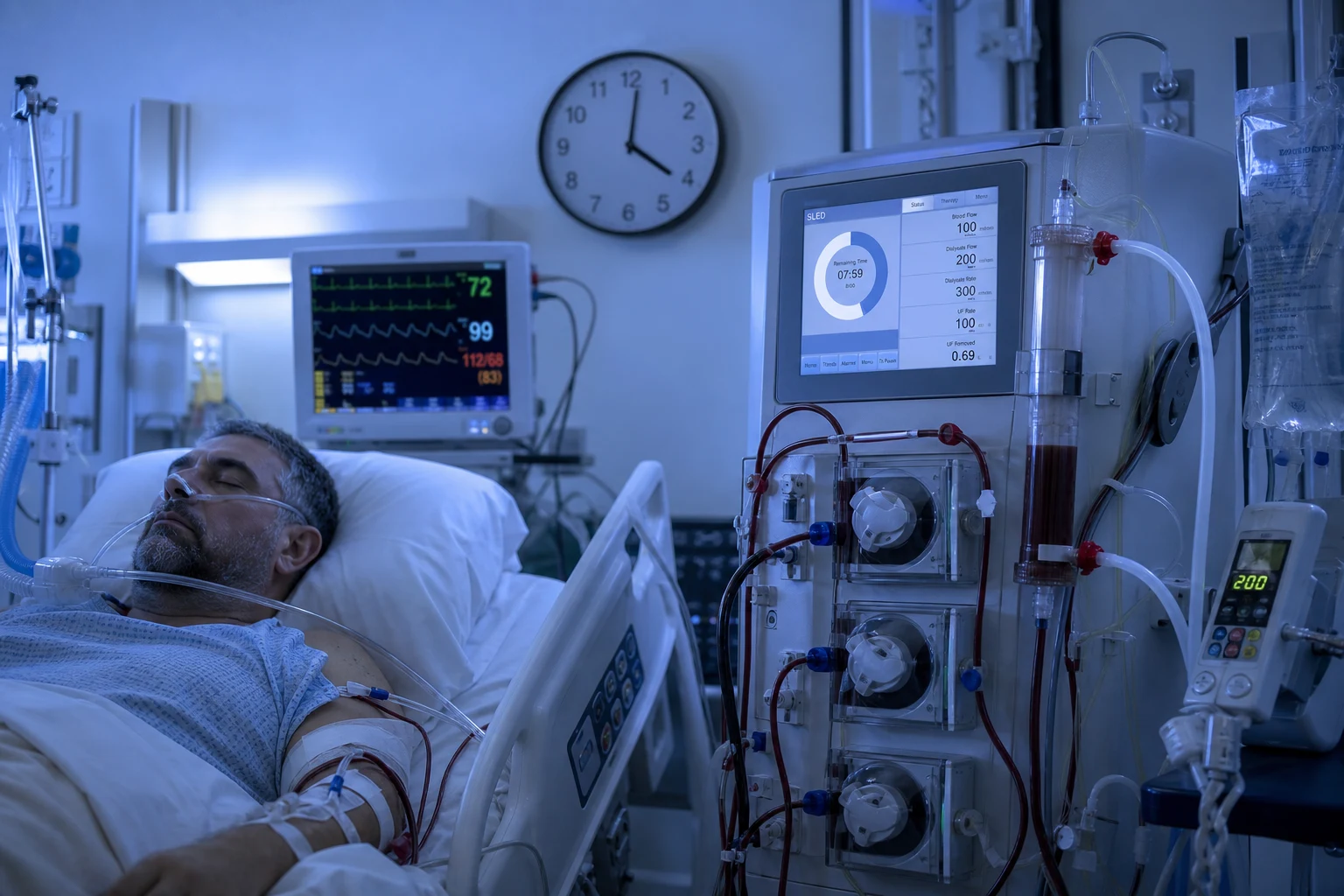
The sustained low-efficiency dialysis (SLED) — also called the extended daily dialysis (EDD) — is a hybrid renal replacement therapy that combines the features of the intermittent haemodialysis (IHD) and the continuous renal replacement therapy (CRRT). A standard haemodialysis machine is run slowly: the low blood and the dialysate flow rates over the extended duration, the daily. The result is the gentle, the efficient clearance with the better haemodynamic tolerance than the IHD, but the less intensive and the cheaper than the CRRT.[1][4]
The prescription
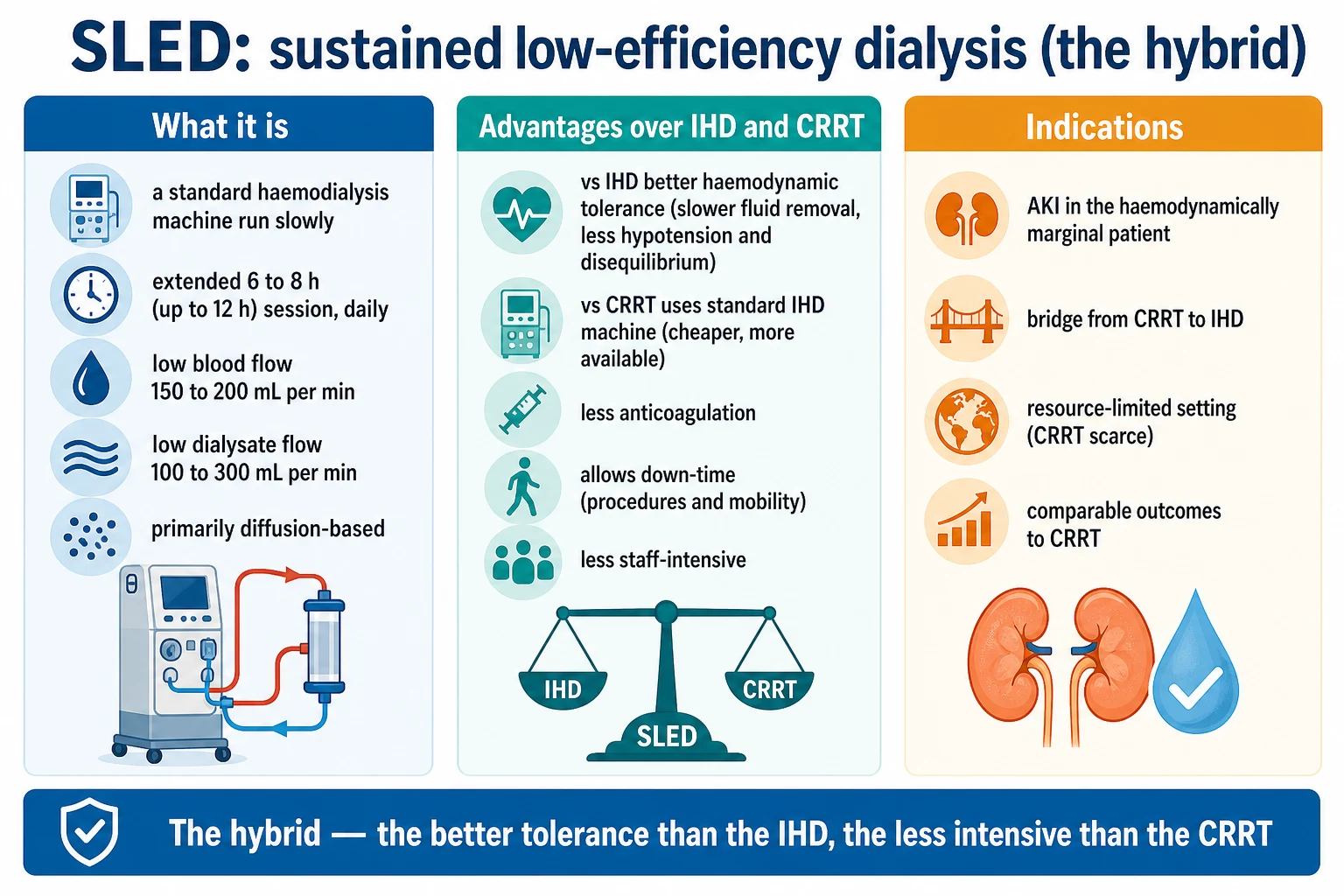
- The blood flow — the 150 to 200 mL/min (the lower than the standard IHD).[1]
- The dialysate flow — the 100 to 300 mL/min (the lower than the standard IHD).[1]
- The duration — the 6 to 8 hours (up to 12 hours), the daily (or the alternate days).[1]
- The mechanism — the primarily diffusion-based (like the IHD), but the slow and the extended → the gentle clearance.[1]
- The anticoagulation — the less than the CRRT (the shorter session); the heparin, the regional citrate, or none.[1]
- The fluid removal — the slow, the titrated to the haemodynamic tolerance.[1]
The advantages
Vs the IHD
- The better haemodynamic tolerance — the slower, the extended fluid and solute removal causes the less hypotension (the risk for the haemodynamically marginal patient).[1][2]
- The less dialysis disequilibrium — the slower solute shifts reduce the cerebral-oedema risk.[1]
- The better solute clearance per session — the longer session improves the clearance over the standard IHD.[1]
Vs the CRRT
- The uses the standard IHD machine — the cheaper, the more available (the CRRT machines are the scarce in the resource-limited settings).[1][3]
- The less anticoagulation — the shorter session reduces the anticoagulation exposure and the bleeding risk.[1]
- The allows the down-time — the intermittent sessions let the patient mobilise, the attend the procedures, and the imaging (the continuous CRRT limits the mobility).[1]
- The less staff-intensive — the standard machine, the less circuit troubleshooting.[1]
- The less hypothermia and the nutrient loss than the CRRT (the shorter circuit time).[1]
The disadvantages
- The intermittent — not the truly continuous; the solute and the fluid accumulate between the sessions (the gentler than the IHD but the less steady than the CRRT).[1]
- The less middle-molecule clearance than the CVVH (the diffusion-based, not the convective).[1]
- The may need the anticoagulation (the heparin), with the bleeding risk (the less than the CRRT).[1]
The indications
- The AKI in the haemodynamically marginal patient — the better tolerated than the IHD, the less intensive than the CRRT. The ideal middle-ground for the moderately unstable patient.[1]
- The bridge from the CRRT to the IHD — the transitional modality as the patient stabilises and the renal function recovers.[1]
- The resource-limited setting — the CRRT machines scarce; the SLED uses the standard IHD machine.[1][3]
- The patient who needs the down-time — the procedures, the imaging, the mobilisation, the rehabilitation (the intermittent sessions allow this).[1]
The outcomes
The SLED provides the comparable solute control and the haemodynamic stability to the CRRT in the most studies, with the no clear mortality difference. The choice between the SLED, the CRRT, and the IHD depends on the haemodynamic stability, the resources, the anticoagulation needs, and the patient factors (the mobility, the procedures).[1][1][11]
[1]Red flags
SLED principles — why the hybrid works
The SLED is not merely a dialysis prescription; it is a deliberate physiological compromise engineered to occupy the favourable middle ground between IHD and CRRT. To justify every prescription parameter in a viva, you must understand the physics that links flow rates, duration, and clearance to the clinical effects of haemodynamic stability and adequate solute removal.[4]
The clearance equation — diffusion and the role of Qd/Qb
Diffusive clearance in a haemodialyser obeys the mass-transfer relationship $K = K_0 A \times f(Q_b, Q_d)$, where $K_0 A$ is the membrane mass-transfer-area coefficient (a property of the dialyser — surface area and permeability), and $f(Q_b, Q_d)$ is a function that saturates as the smaller of blood flow and dialysate flow is reached. In standard IHD, $Q_b$ is 300–400 mL/min and $Q_d$ is 500–800 mL/min, so clearance of small solutes (urea) is flow-limited and high — a 4-hour session clears the urea pool efficiently but violently. [1]
In SLED, both flows are deliberately throttled: $Q_b$ 150–200 mL/min, $Q_d$ 100–300 mL/min. Because $Q_d$ is now much lower than $Q_b$, clearance becomes dialysate-limited (the dialysate leaving the filter is nearly fully saturated with urea), and the instantaneous clearance is modest (roughly the dialysate flow rate, 100–300 mL/min). The trick is to run this modest clearance for a long time (6–12 h): total solute removed = clearance × time, so the long session restores the total clearance lost by throttling the flows. The patient gets the same delivered Kt/V as IHD but delivered gently.[3][4]
Why slow = haemodynamically stable
The haemodynamic instability of standard IHD has three roots, all of which SLED mitigates by running slowly:[2]
- Rate of volume removal (ultrafiltration). To remove 3 L of fluid over a 4-hour IHD session requires ~750 mL/h net ultrafiltration. At this rate, plasma refilling from the interstitium cannot keep up → intravascular volume depletion → hypotension. SLED removes the same 3 L over 8–12 h (250–375 mL/h), well within plasma-refilling capacity. The hypotension rate in the Fliser RCT was significantly lower with extended dialysis than with IHD.
- Osmotic solute shifts. Rapid urea clearance in IHD lowers plasma osmolality faster than urea can equilibrate out of the brain and tissues → a falling serum osmolality → water shifts into the brain → cerebral oedema and the dialysis disequilibrium syndrome (headache, nausea, seizures, raised ICP). SLED's slow urea clearance preserves a near-constant osmolal gradient → no disequilibrium. This is why SLED (and CRRT) is preferred over IHD in traumatic brain injury, fulminant liver failure, and any patient with raised ICP.
- Acetate/bicarbonate flux and vasoactive mediator release. The rapid solute and buffer flux of IHD transiently impairs vascular tone and releases vasoactive cytokines; the slower flux of SLED avoids this. [1]
The single-pass batch (Genius) system
A distinctive feature of much of the European SLED literature (including the Schwenger RCT) is the single-pass batch dialysis system (e.g., the Genius, a Fresenius machine).[1][4] A fixed volume of dialysate (typically 75–90 L) is prepared in a single tank, and blood and dialysate are circulated through a high-flux dialyser until the dialysate is spent (which coincides with the 6–8 h session). Because the dialysate is pre-prepared as one batch, there is no continuous dialysate proportioning pump — the machine is mechanically simpler and cheaper to operate. The Genius uses a gravity-driven dialysate circuit (density-based separation of fresh from spent dialysate in a single tank), which further reduces complexity. Most modern ICUs, however, perform SLED on a standard haemodialysis machine (e.g., Fresenius 5008, Nikkiso) in an "extended" programme, which is functionally equivalent.
SLED-f — adding convective clearance
SLED-f (SLED with filtration) is a variant that adds convective clearance (haemofiltration) on top of the diffusive clearance of standard SLED. By pulling extra ultrafiltrate across the membrane and replacing it with substitution fluid, SLED-f gains middle-molecule clearance (β2-microglobulin, vancomycin, some cytokines) that pure diffusive SLED lacks — analogous to the difference between CVVHD and CVVHDF.[3]
Standard SLED vs SLED-f
| Feature | SLED (pure diffusive) | SLED-f (diffusive + convective) |
|---|---|---|
| Clearance mechanism | Diffusion only (concentration gradient) | Diffusion + convection (solvent drag) |
| Small-molecule clearance (urea, creatinine) | Good | Good |
| Middle-molecule clearance (β2-microglobulin, vancomycin) | Poor | Better (comparable to CVVHDF per hour) |
| Replacement fluid needed | No | Yes (post- or pre-dilution) |
| Anticoagulation need | Low–moderate | Moderate (higher filtration fraction → more clotting) |
| Cost/complexity | Lower (standard setup) | Higher (needs substitution fluid) |
| Indication | Routine AKI, volume control | Sepsis with inflammatory mediators; need for middle-molecule clearance |
Clinically, SLED-f is used selectively. The Schwenger RCT compared standard SLED (single-pass batch, largely diffusive) against CVVHDF and found equivalent outcomes; the incremental benefit of adding convection to SLED (i.e., SLED-f) over plain SLED has not been demonstrated in a large outcome trial, so it remains a clinician-preference or niche indication.[1][5]
SLED vs CRRT vs IHD — the comprehensive comparison
This is the central exam table. Memorise it: the examiner wants to see that you can defend a modality choice against all three axes — haemodynamics, clearance, and logistics.[1][12][13]
SLED vs CRRT vs IHD — the complete comparison
| Domain | IHD (intermittent) | SLED (hybrid) | CRRT (continuous) |
|---|---|---|---|
| Machine | Standard haemodialysis machine | Standard haemodialysis machine (extended programme) | Dedicated CRRT machine (Prismaflex, multiFiltrate) |
| Blood flow (Qb) | 300–400 mL/min | 150–200 mL/min | 150–200 mL/min |
| Dialysate flow (Qd) | 500–800 mL/min | 100–300 mL/min | 25–35 mL/kg/hr effluent (~30–50 mL/min equivalent) |
| Session duration | 3–4 h, 3×/week | 6–12 h, daily or alternate-day | Continuous, 24 h/day |
| Clearance mechanism | Diffusion | Diffusion (SLED); diffusion + convection (SLED-f) | Convection (CVVH), diffusion (CVVHD), or both (CVVHDF) |
| Solute clearance per hour | Highest (but violent) | Intermediate | Lowest per hour (but sustained 24 h) |
| Total daily clearance | High (if 3×/week) | High (daily) | High (cumulative over 24 h) |
| Haemodynamic stability | Poorest — rapid fluid/solute shifts | Good — slow, gentle | Best — continuous, no swings |
| Anticoagulation | Heparin boluses; short exposure | Heparin, regional citrate, or none — moderate exposure | Regional citrate (preferred) or heparin — highest exposure (longest circuit time) |
| Bleeding risk | Low (short session) | Low–moderate | Highest (continuous anticoagulation) |
| Middle-molecule clearance | Poor | Poor (SLED) / moderate (SLED-f) | Good (CVVH/CVVHDF) |
| Fluid removal precision | Coarse — large hourly UF | Good — titratable over long session | Best — precise continuous UF |
| Cost per session | Lowest | Low (uses standard machine, less anticoag) | Highest (dedicated machine, fluids, citrate, staff) |
| Staff intensity | Low | Low–moderate | Highest (circuit troubleshooting, frequent changes) |
| Patient mobility / down-time | Good (off between sessions) | Good (off 12–18 h/day) | Poor — tethered 24 h/day |
| Drug dosing | Conventional dialysis dosing | Between IHD and CRRT; need TDM | Highest clearance — most underdosing (DALI: 75%) |
| Electrolyte loss (K, Mg, PO₄) | Moderate, intermittent | Moderate, intermittent | Greatest, continuous — need daily replacement |
| Hypothermia | Minimal | Minimal (short circuit time vs CRRT) | Common — needs fluid warmer |
| Solute control smoothness | Saw-tooth (peaks and troughs) | Gentle waves | Flat, steady-state |
| Indication sweet-spot | Stable patient, chronic dialysis, dialysable toxin (rapid clearance) | Haemodynamically marginal patient; CRRT→IHD bridge; resource-limited | Vasopressor-dependent shock, raised ICP, hepatic failure |
Choosing a modality by clinical context
The comparison only matters insofar as it drives a choice. The decision tree below is examiner-favoured.[1][13]
Modality selection by scenario
| Scenario | Preferred modality | Rationale |
|---|---|---|
| Vasopressor-dependent shock, max vasopressors | CRRT | No solute/UF swings → haemodynamic stability paramount |
| Raised ICP (TBI, SAH, fulminant liver failure) | CRRT or SLED | IHD causes osmotic shift → ICP spike; SLED and CRRT avoid this |
| Moderately unstable (single low-dose vasopressor) | SLED | Better tolerated than IHD, cheaper than CRRT, allows down-time |
| Severe hyperkalaemia (K⁺ >7) needing immediate clearance | IHD | Fastest diffusive K⁺ clearance, then switch |
| Dialysable toxin (salicylate, lithium, metformin) | IHD | Rapid diffusive clearance of toxin |
| Bridge from CRRT to IHD as patient recovers | SLED | Intermediate intensity — natural transitional step |
| Resource-limited (no CRRT machine) | SLED | Standard IHD machine run slowly |
| Need for down-time (procedures, rehab, mobilisation) | SLED or IHD | Intermittent — patient free 12–18 h |
| Brain-injured / hepatic failure with marginal stability | SLED | Gentler than IHD on ICP; cheaper/less anticoag than CRRT |
The SLED prescription in detail
A defensible SLED prescription sets four parameters: blood flow, dialysate flow, session duration, and net ultrafiltration (fluid removal) target. The anticoagulation and dialysate composition complete the order.[1][3]
Writing and setting up a SLED prescription
- SET BLOOD FLOW (Qb). Start at 150–200 mL/min for a haemodynamically stable adult. If marginal (single vasopressor), start 150 mL/min and titrate up to 200 as tolerated. Below 150 mL/min the risk of circuit clotting rises and clearance falls; above 200 the haemodynamic benefit of slowing is lost.
- SET DIALYSATE FLOW (Qd). 100–300 mL/min. Lower (100) for the most haemodynamically fragile; higher (300) when stronger clearance is needed (e.g., severe uraemia, hyperkalaemia). Because clearance becomes dialysate-limited, Qd is the master lever for per-hour solute removal.
- SET DURATION. 6–8 h routinely; extend to 10–12 h for large fluid removal targets or severe uraemia. Daily is standard; alternate-day is acceptable for stable, recovering patients. The product Qd × duration sets the delivered Kt/V.
- SET NET ULTRAFILTRATION. Calculate the required fluid removal (input minus desired output over the session) and divide by the session length to set hourly UF. Cap hourly UF at ~300–400 mL/h for haemodynamic safety; if the target cannot be met within the session, extend the session rather than increase the UF rate.
- CHOOSE ANTICOAGULATION. Unfractionated heparin (bolus then infusion, targeting APTT 1.5–2× baseline) is standard. Regional citrate is an option for high-bleeding-risk patients. No-anticoagulation protocols (high Qb, pre-dilution saline flushes) are used in active bleeding but shorten circuit life.
- CHOOSE DIALYSATE COMPOSITION. Bicarbonate-buffered (preferred — corrects acidosis); potassium 2–4 mmol/L based on serum K⁺; calcium 1.25–1.5 mmol/L (calcium-free only if using citrate); sodium 138–140.
- SET MONITORING. Hourly BP, MAP, HR, circuit pressures (venous, arterial, transmembrane). Bloods (Na, K, bicarbonate, urea, creatinine, phosphate, Mg, iCa if citrate) at baseline, mid-session, and end of session for the first few runs, then daily.
- CALCULATE DELIVERED DOSE (Kt/V). Aim for single-pool Kt/V ≈ 1.2–1.4 per session (equivalent to the IHD adequacy standard), or a sustained equivalent renal clearance (EKR) of ~20 mL/min when averaged over 24 h. The ATN trial's intensive arm used SLED 6×/week at Kt/V ~1.2–1.4 with no outcome advantage over 3×/week, confirming that more is not better.[9]
Dose adequacy — Kt/V, EKR, and the "per day" concept
SLED blurs the IHD adequacy metric (Kt/V per session) and the CRRT metric (mL/kg/hr per day). Two frameworks reconcile them:[4][8]
- Per-session Kt/V: target 1.2–1.4 (the standard IHD adequacy). A 70 kg patient with a urea volume ~40 L needs Kt ≈ 48–56 L, achieved by clearance 200 mL/min × 4–5 h or clearance 150 mL/min × 6–7 h.
- Equivalent renal clearance (EKR): averages the intermittently-delivered clearance over 24 h. Daily SLED delivering Kt/V 1.2 typically yields EKR ~20 mL/min — matching the KDIGO CRRT dose (25 mL/kg/hr ≈ 20–25 mL/min EKR for a 70–80 kg patient). This is the physiological justification for saying SLED delivers "CRRT-equivalent" daily clearance. [1]
The RENAL and ATN trials together established that pushing delivered dose above this standard (CRRT 40 mL/kg/hr; IHD/SLED 6×/week) does not improve survival — so the aim is adequacy, not maximalism.[8][9]
Anticoagulation for SLED
SLED needs less anticoagulation than CRRT because the circuit runs for hours rather than days, but it still requires a strategy — a bare dialyser in contact with non-anticoagulated blood will clot within 1–3 h.[1][3]
Anticoagulation options for SLED
| Strategy | Regimen | Indication | Pitfalls |
|---|---|---|---|
| Unfractionated heparin (standard) | Bolus 30–50 U/kg, then infusion 500–1000 U/h targeting APTT 1.5–2× baseline | Default — most patients | Bleeding risk; HIT (rare but catastrophic) |
| Regional citrate | Citrate pre-filter, calcium post-filter return; target circuit iCa <0.35, systemic iCa 1.1–1.3, total/iCa ratio <2.5 | High bleeding risk; active bleed; HIT | Citrate accumulation in liver failure; needs calcium + monitoring; more complex for a 6–12 h setup |
| Low-molecular-weight heparin | Single bolus (e.g., enoxaparin 0.5 mg/kg) per session | Moderate bleeding risk; simpler than UFH infusion | Less reversibility; renal accumulation; not easily monitored |
| No anticoagulation (saline flushes) | Pre-dilution saline 250 mL bolus q30min; high Qb 200 mL/min | Active bleeding, recent surgery, severe coagulopathy | Frequent circuit clotting; reduced delivered dose; higher blood loss in clotted circuits |
| Prostacyclin (epoprostenol) | 2–5 ng/kg/min infusion | Heparin contraindicated; citrate unavailable | Hypotension from vasodilation |
Practical pearl: for the routine haemodynamically marginal patient with no active bleed, unfractionated heparin is the workhorse. For the bleeding patient, regional citrate (if the centre has the protocol) or a no-heparin strategy with high Qb is used. Because the SLED session is short, citrate accumulation is much less of a concern than in continuous CRRT — but it still requires the standard calcium monitoring. [1]
Vascular access for SLED
SLED uses the same vascular access as IHD and CRRT: a temporary dual-lumen haemodialysis catheter (12–14 Fr) inserted into a central vein.[1]
SLED catheter site selection
| Site | Advantages | Disadvantages | Role |
|---|---|---|---|
| Right IJV | Straight path to RA, best flow, lowest recirculation, ultrasound-guided | Pneumothorax (<1%), line infection | PREFERRED |
| Femoral | Safe insertion (no pneumothorax), compressible | Highest infection risk, DVT, patient immobility, higher recirculation if short | Second line; obesity, coagulopathy |
| Subclavian | Comfortable, lower infection | Stenosis — destroys future AV fistula; pneumothorax; incompressible | Avoid if long-term dialysis possible |
| Left IJV | Available if right IJV thrombosed | Tortuous path → kinking → poor flow → clotting | Avoid if possible |
Tip confirmation (right IJV tip at cavo-atrial junction on CXR; femoral tip in IVC) is mandatory before the first session. A malpositioned or kinked catheter produces low blood flow, repeated pressure alarms, access recirculation, and early circuit clotting — the single most fixable cause of a "difficult" SLED run. [1]
Drug dosing on SLED
SLED clears water-soluble drugs by diffusion — but the intermittent, lower-flow nature means the dosing strategy sits between IHD and CRRT. The key principles:[1][10]
- Small water-soluble drugs ARE cleared (vancomycin, beta-lactams, aminoglycosides, levetiracetam, digoxin, water-soluble vitamins) — sieving coefficient ≈ 1.0.
- Protein-bound drugs are NOT significantly cleared (ceftriaxone 90% bound, warfarin) — only the free fraction crosses.
- Clearance occurs mainly during the session (6–12 h/day); off-SLED, the patient has near-zero extracorporeal clearance (only residual renal function). Dosing must account for this on/off pattern.
- The DALI study confirmed that beta-lactam clearance on extended dialysis is substantial and that underdosing is common — therapeutic drug monitoring (TDM) is recommended for critical antibiotics.[10]
Antibiotic dosing on SLED — common ICU agents
| Drug | Clearance on SLED | Dosing principle | Monitoring |
|---|---|---|---|
| Vancomycin | Substantial | Loading 25–30 mg/kg; re-dose guided by trough (often q24–48h) | Trough 15–20 mg/L; TDM essential |
| Piperacillin-tazobactam | Substantial | 4.5 g q6–8h or extended infusion | Beta-lactam level if available |
| Meropenem | Substantial | 1 g q8–12h; extended infusion | Beta-lactam level |
| Cefepime / ceftazidime | Substantial | 2 g q8–12h | Beta-lactam level; neurotoxicity if accumulation |
| Aminoglycosides | Substantial | Extended-interval; check level post-SLED | Trough before next dose |
| Linezolid | Partly cleared | Standard 600 mg q12h | CBC (thrombocytopenia) |
| Levetiracetam | Substantial | Increased frequency (e.g., q12h) | Anti-epileptic level |
| Ceftriaxone | Minimal (highly protein-bound) | Standard dosing | — |
Pearl: time drug administration relative to the SLED session. For beta-lactams, an extended or continuous infusion during the session maximises time above MIC. Re-dose vancomycin after each SLED session if levels fall. Re-evaluate dosing after every circuit or prescription change. [1]
Complications of SLED
SLED shares the complications of all extracorporeal circuits but at a lower rate than CRRT for the continuous-exposure problems.[1][3]
SLED complications and management
| Complication | Mechanism | Frequency vs CRRT | Management |
|---|---|---|---|
| Hypotension | Volume removal exceeding plasma refill | Less than IHD; slightly more than CRRT | Reduce UF rate; extend session; assess volume status |
| Circuit clotting | Inadequate anticoagulation; low Qb; kinked line | Less than CRRT (shorter run) | Increase heparin; raise Qb; check access |
| Bleeding | Systemic heparin | Less than CRRT | Switch to citrate or no-heparin protocol |
| Hypothermia | Heat loss to circuit/fluids | Much less than CRRT (short run) | Fluid warmer if session >8 h |
| Hypophosphataemia | Phosphate lost in dialysate | Less than CRRT (intermittent) | Check phosphate daily; replace (glycerophosphate) |
| Hypokalaemia / hypomagnesaemia | Lost in dialysate | Intermittent | Use K⁺-containing dialysate; supplement Mg |
| Hypocalcaemia | Citrate chelation (if citrate used) | Less than CRRT | Calcium return infusion; monitor iCa |
| Air embolism | Circuit disconnect; air detector failure | Rare | Air detector mandatory; Trendelenburg L lateral |
| Access complications | Catheter infection, thrombosis, pneumothorax | Same as CRRT | Aseptic insertion; site care |
| Disequilibrium | Osmotic shift (rare at SLED flows) | Much less than IHD | — (SLED is protective) |
| Dialysis disequilibrium in at-risk brain | Rapid urea fall | Rare with SLED | Use SLED/CRRT in raised ICP rather than IHD |
FlowSteps — SLED session setup and the daily cycle
Setting up and running a SLED session
- CONFIRM INDICATION AND PRESCRIPTION. Confirm the AKI indication (refractory hyperkalaemia/acidosis, overload, uraemia) is still present — re-check before every session. Verify the prescription: Qb, Qd, duration, net UF target, anticoagulation, dialysate composition.
- CHECK VASCULAR ACCESS. Confirm catheter patency (free aspiration from both lumina), tip position, and no signs of line infection. A poorly flowing line will cause alarms and clotting all session.
- PRIME THE CIRCUIT with heparinised or plain saline per machine protocol; confirm no air in the lines and the air detector is functional.
- CONNECT AND START. Connect to the catheter, start blood flow at 100 mL/min, confirm haemodynamic stability, then titrate to target Qb (150–200 mL/min). Set Qd and the net UF target.
- START ANTICOAGULATION. Heparin bolus then infusion (or citrate/calcium per protocol). Document the regimen and the monitoring plan.
- HOURLY MONITORING. Hourly BP, MAP, HR, circuit pressures (arterial, venous, transmembrane), net UF progress, and machine alarms. Adjust UF rate to haemodynamic response — if MAP drops, slow the UF, do not stop the session (extend it instead).
- MID-SESSION BLOODS. At the midpoint, check Na, K, bicarbonate, glucose, and (if citrate) iCa and total calcium, to detect and correct developing electrolyte shifts before they become symptomatic.
- END OF SESSION. Reduce UF to zero, blood-back the circuit, disconnect. Send end-of-session bloods (urea for Kt/V, electrolytes). Calculate delivered Kt/V and document.
- OFF-SLED PERIOD. Plan the down-time: procedures, imaging, mobilisation, rehabilitation, and feeds. Re-check bloods before the next session to detect inter-session accumulation (rising K⁺, urea, fluid).
FlowSteps — the CRRT → SLED → IHD transition pathway
SLED's natural place is as the transitional modality as a patient recovers from shock toward stability.[1]
Stepping down the RRT ladder — CRRT → SLED → IHD → stop
- RECOGNISE RECOVERY. Off vasopressors (or minimal single agent) >24 h, MAP >65 without boluses, rising spontaneous urine output (>500 mL/day without diuretics), falling/stable creatinine, normalising K⁺ and bicarbonate.
- CRRT → SLED (first step down). Stop CRRT, start daily SLED (Qb 150–200, Qd 200, 8 h). SLED's gentler profile and down-time make it the natural intermediate — the patient is not yet ready for full IHD intensity.
- MONITOR THE GAP. If between-SLED biochemistry (K⁺, bicarbonate, urea) and fluid remain controlled over 24–48 h, the patient tolerates the intermittent modality → proceed.
- SLED → IHD (or reduce frequency). Once fully stable, convert to standard IHD (Qb 300, 4 h) or reduce SLED to alternate-day. The first IHD session after CRRT/SLED should use lower Qb to avoid disequilibrium.
- STOP RRT. When urine output is sustained (>1 L/day), creatinine stable/falling, no ongoing indication — stop and observe for 48–72 h with daily bloods. If biochemistry deteriorates, restart (recovery was incomplete).
- COUNSEL ON DIALYSIS DEPENDENCE. Risk factors: age, baseline CKD, severity/duration of AKI, sepsis, multi-organ failure. STARRT-AKI showed accelerated-start patients had more residual dialysis dependence — recovery is never guaranteed.[7]
Exam practice — SAQs
SAQ — Writing a SLED prescription for the haemodynamically marginal septic patient
10 minutes · 10 marks
A 68-year-old woman (70 kg) with septic shock from pyelonephritis, on a single low-dose noradrenaline (0.08 mcg/kg/min), has developed KDIGO stage 3 AKI. K+ 6.1 mmol/L (refractory to medical therapy), pH 7.20 (HCO3 16), she is 4 L positively balanced, creatinine 320 micromol/L. The ICU has both a dedicated CRRT machine and standard haemodialysis machines available. You decide to start sustained low-efficiency dialysis (SLED).
SAQ — SLED as the step-down modality from CRRT: rationale, setup and complications
10 minutes · 10 marks
A 58-year-old man (85 kg) has been on CRRT (CVVHDF with regional citrate anticoagulation) for 6 days for septic shock from perforated diverticulitis. He is now off vasopressors for 36 h (MAP 72 on no agents), lactate 1.4 mmol/L, and his urine output has risen to 600 mL/day, but his K+ is 5.9 mmol/L, urea 32 mmol/L and he remains 3 L positively balanced. The consultant asks you to transition him to sustained low-efficiency dialysis (SLED) as a step-down.
Clinical pearls
Key trials and evidence
Schwenger RCT — SLED vs CVVHDF (the REnal Replacement Treatment Study, PMID 22839577)
Study design
Multicentre randomised trial — 232 critically ill patients with dialysis-dependent AKI in 9 German ICUs
Intervention
SLED (single-pass batch system, Qb 200, Qd 200–350, 6–8 h daily) vs CVVHDF (effluent 20–35 mL/kg/hr) with regional heparin anticoagulation
Primary outcome
No difference in mortality, renal recovery, or dialysis dependence at day 28 and day 90
Key finding
SLED achieved comparable dose delivery with less anticoagulation and lower cost — non-inferior to CRRT
Clinical bottom line
SLED is a legitimate alternative to CRRT in the haemodynamically marginal ICU patient — not merely a resource-limited compromise
Fliser RCT — Extended dialysis vs IHD cardiovascular tolerability (PMID 14750100)
Study design
Randomised controlled study — critically ill patients with AKI and cardiovascular instability
Intervention
Extended (slow low-efficiency) dialysis vs standard intermittent haemodialysis
Primary outcome
Significantly fewer intradialytic hypotensive episodes and less need for vasopressor escalation with extended dialysis
Key finding
The slower ultrafiltration rate and gentler solute flux of extended dialysis preserve haemodynamic stability
Clinical bottom line
Provides the haemodynamic rationale for SLED over IHD in the marginal patient
AKIKI trial — Early vs delayed RRT (PMID 27181456)
Study design
Multicentre RCT — 620 patients with severe AKI (KDIGO stage 3) in 31 French ICUs
Intervention
Early RRT (immediately upon randomisation) vs delayed (only if urgent indication: K⁺ >6, pH <7.15, overload, BUN >90)
Primary outcome
60-day mortality: 48% (early) vs 50% (delayed) — NO significant difference
Key finding
50% of the delayed group NEVER needed RRT — spontaneous recovery
Clinical bottom line
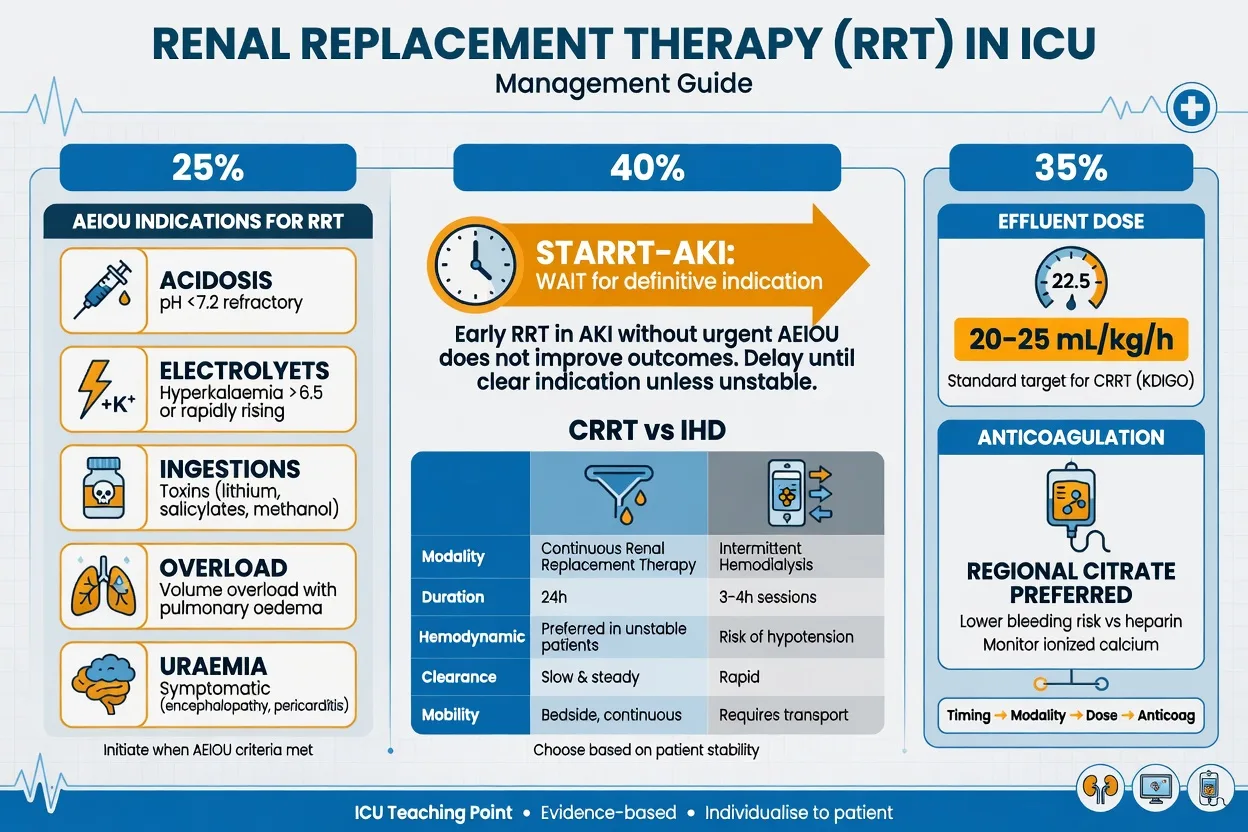
Do NOT start RRT (any modality) early for rising creatinine alone — wait for an urgent indication
STARRT-AKI trial — Accelerated vs standard RRT (PMID 32668114)
Study design
Multicentre RCT — 3,019 patients with AKI KDIGO stage 2–3 in 168 ICUs worldwide
Intervention
Accelerated RRT (within 12 h of stage 2–3) vs standard (only if urgent indication or persistent AKI >72 h)
Primary outcome
90-day mortality: 43.9% (accelerated) vs 43.7% (standard) — NO benefit
Adverse events
Accelerated group had MORE adverse events (catheter infection, bleeding) and MORE remained dialysis-dependent at 90 days
Clinical bottom line
Accelerated RRT may be HARMFUL — wait for an urgent indication before starting RRT
RENAL trial — CRRT dose 25 vs 40 mL/kg/hr (PMID 19846848)
Study design
Multicentre RCT — 1,508 critically ill adults with AKI needing RRT (Australia/NZ)
Intervention
Post-dilution CVVHDF at 25 mL/kg/hr (standard) vs 40 mL/kg/hr (higher intensity)
Primary outcome
90-day mortality: 44.7% in both arms — NO difference
Adverse events
Higher-intensity arm had significantly more hypophosphataemia (65% vs 54%)
Clinical bottom line
Delivered dose above ~25 mL/kg/hr (EKR ~20 mL/min) does NOT improve survival but increases phosphate loss — defines the adequacy standard applied to SLED too
ATN trial (VA/NIH) — Intensity of renal support (PMID 18492867)
Study design
Multicentre RCT — 1,124 critically ill patients with AKI + ≥1 non-renal organ failure
Intervention
Intensive (IHD/SLED 6×/week; CVVHDF 35 mL/kg/hr) vs less-intensive (IHD/SLED 3×/week; CVVHDF 20 mL/kg/hr)
Primary outcome
60-day mortality: 53.6% (intensive) vs 51.5% (less-intensive) — NO difference
Key finding
No difference in duration of RRT, renal recovery, or non-renal organ recovery. SLED was an explicit modality in both arms.
Clinical bottom line
More intensive SLED does NOT improve outcomes — together with RENAL, sets the SLED frequency (daily, not 6×/week if stable)
Meta-analyses — SLED vs CRRT and modality comparison
Dalbhi 2021 meta-analysis — SLED non-inferior to CRRT (PMID 34941056)
Study design
Comparative meta-analysis of RCTs and observational studies — SLED vs CRRT in critically ill AKI
Primary outcome
No significant difference in mortality between SLED and CRRT
Secondary outcomes
Comparable renal recovery and dialysis dependence; SLED with lower cost and less anticoagulation
Clinical bottom line
SLED is non-inferior to CRRT for survival and renal recovery, at lower cost
Russo 2022 systematic review — Haemodynamic instability by modality (PMID 35124346)
Study design
Systematic review and meta-analysis comparing haemodynamic instability among continuous (CRRT), intermittent (IHD), and hybrid (SLED) RRT in AKI
Key finding
Hybrid RRT (SLED) associated with less haemodynamic instability than IHD, and comparable to CRRT
Clinical bottom line
Supports SLED as the modality of choice for the haemodynamically marginal patient — IHD's instability without CRRT's cost
Zhou 2021 network meta-analysis — RRT modality (PMID 33836397)
Study design
Bayesian network meta-analysis of RCTs comparing RRT modalities (IHD, SLED, CRRT) in critically ill AKI
Key finding
No modality demonstrated a clear mortality advantage; SLED ranked favourably on haemodynamic tolerance and cost
Clinical bottom line
Modality choice should be driven by haemodynamic stability, resources, and patient factors — not by a presumed survival benefit
Zhao 2020 meta-analysis — RRT modality and renal recovery (PMID 32149415)
Study design
PRISMA-compliant systematic review and meta-analysis — effect of RRT modalities on renal recovery and mortality
Key finding
No significant difference in mortality or renal recovery between intermittent/hybrid (SLED) and continuous modalities
Clinical bottom line
Evidence does not support one modality over another for hard outcomes — choice is logistic and haemodynamic
Additional red flags
Sample exam question — worked answer
[1]Worked explanation
Step 1 — Confirm the indication. This patient has an urgent, indisputable indication for RRT: refractory hyperkalaemia (K⁺ 6.1 unresponsive to medical therapy), metabolic acidosis (pH 7.20), and volume overload (4 L positive). The AKIKI and STARRT-AKI trials remind us to wait for an urgent indication before starting RRT — here, the indication is met, so RRT should start now, in whichever modality best matches her physiology.[6][7]
Step 2 — Assess haemodynamic stability and choose the modality. The decision rests on the three-axis comparison: haemodynamics, clearance, and logistics. She is on a single, low-dose vasopressor — she is not in refractory shock on max vasopressors, but she is not fully stable either. This is the textbook haemodynamically marginal patient for whom SLED is the ideal middle ground: better tolerated than standard IHD (Fliser RCT — fewer hypotensive episodes), yet cheaper, less anticoagulation, and with down-time compared to CRRT.[2][12] If she were on escalating high-dose multiple vasopressors with refractory shock, CRRT would be the choice. If she were fully off vasopressors, IHD would suffice. She sits in the SLED sweet-spot.
Step 3 — Defend SLED against CRRT. A common viva challenge: "Why not CRRT, which is the most stable?" The defence is multilayered. First, the evidence shows no mortality or renal-recovery difference between SLED and CRRT (Schwenger RCT 2012; Dalbhi meta-analysis 2021; Zhou network meta-analysis 2021) — CRRT is not superior in outcomes, only marginally smoother haemodynamically.[1][11][13] Second, SLED uses the standard IHD machine and less anticoagulation, so it is cheaper and carries a lower bleeding risk (Berbece cost analysis).[3] Third, the down-time allows the procedures, imaging, and mobilisation that matter for her recovery and prevent ICU-acquired weakness. Fourth, in a centre with only one CRRT machine, choosing SLED reserves the CRRT machine for a patient who truly needs it (max vasopressors). For this marginal patient, the marginal haemodynamic gain of CRRT is not worth the cost and tether.
Step 4 — Defend SLED against IHD. "Why not just haemodialyse her?" Because standard IHD's rapid ultrafiltration and osmotic shifts would precipitate hypotension in a patient already vasopressor-dependent, worsening the AKI and the shock. The Fliser RCT established extended/slow dialysis as haemodynamically superior to IHD.[2] Additionally, her severe acidosis and uraemia make dialysis disequilibrium a concern with high-flux IHD; SLED's slow clearance avoids the osmotic shift.
Step 5 — Set the prescription. Following the prescription protocol:[1][3]
- Blood flow (Qb): 150 mL/min (start low for the vasopressor-dependent patient; titrate to 200 as tolerated).
- Dialysate flow (Qd): 300 mL/min (higher end — she needs aggressive clearance for the K⁺ 6.1 and acidosis; clearance is dialysate-limited, so Qd is the lever).
- Duration: 8 h (long enough for the fluid removal and solute clearance; extend to 10–12 h if fluid removal at a safe UF rate demands it).
- Net ultrafiltration: she is 4 L positive — remove over 8 h at ~400 mL/h (within safe plasma-refill capacity). Do NOT push to 750 mL/h to "finish in 4 h" — that is the IHD mistake.
- Anticoagulation: unfractionated heparin (bolus 30 U/kg then infusion 500–1000 U/h targeting APTT 1.5–2× baseline), unless she has active bleeding — then regional citrate or no-heparin with high Qb.
- Dialysate: bicarbonate-buffered (corrects her acidosis), potassium 2 mmol/L (she is hyperkalaemic but do not use zero-K⁺ — risk of overshoot hypokalaemia), calcium 1.5 mmol/L.
- Dose target: single-pool Kt/V ≈ 1.2–1.4, or EKR ~20 mL/min averaged over 24 h — the adequacy standard set by RENAL and ATN.[8][9]
Step 6 — Monitoring. Hourly BP, MAP, HR, and circuit pressures (arterial, venous, transmembrane) — titrate UF rate down if MAP drops, and extend the session rather than push the UF. Mid-session and end-of-session bloods (Na, K, bicarbonate, glucose, urea, creatinine, phosphate, Mg) — check K⁺ at midpoint because she started hyperkalaemic and you must confirm it is falling without overshoot. Phosphate before the next session (repeated sessions deplete it). Delivered Kt/V at session end (urea reduction ratio). Vancomycin/beta-lactam levels if she is on antibiotics — SLED clears them (DALI), and underdosing causes treatment failure.[10]
Step 7 — Plan the off-period and the transition. Use the 12–18 h down-time for her antibiotic dosing, feeds, physiotherapy, and any imaging. As her shock resolves (vasopressor off, urine output rising, creatinine falling), step down the ladder: CRRT → SLED (current) → IHD → stop. The first IHD session after SLED should use reduced Qb to avoid disequilibrium. Counsel that dialysis dependence is possible (age, sepsis, AKI severity are risk factors; STARRT-AKI showed accelerated-start patients had more residual dependence).[7]
Bottom line for the exam: SLED is the modality of choice for the haemodynamically marginal patient — better tolerated than IHD, cheaper and less anticoagulation than CRRT, with comparable outcomes. Set Qb 150–200, Qd 100–300 (raise Qd for aggressive clearance), duration 6–12 h with the UF rate capped for haemodynamic safety, and standard heparin anticoagulation. Monitor hourly haemodynamics, mid-session electrolytes, delivered Kt/V, and antibiotic levels. The prescription is justified by the Schwenger non-inferiority RCT, the Fliser haemodynamic RCT, and the dose ceiling from RENAL/ATN. [1][2][8][9]
Prognosis and outcomes summary
SLED outcomes — what the evidence shows
| Outcome | Finding | Source |
|---|---|---|
| Mortality (SLED vs CRRT) | No significant difference | Schwenger RCT 2012; Dalbhi meta-analysis 2021; Zhou network meta-analysis 2021 |
| Renal recovery | No significant difference vs CRRT | Zhao meta-analysis 2020; Dalbhi 2021 |
| Haemodynamic stability | Better than IHD; comparable to CRRT | Fliser RCT 2004; Russo systematic review 2022 |
| Cost per treatment day | Substantially lower than CRRT | Berbece cost analysis 2006 |
| Anticoagulation exposure | Lower than CRRT | Schwenger 2012; Berbece 2006 |
| Dose intensity (more vs less) | No benefit above standard (daily, Kt/V 1.2–1.4) | ATN trial 2008 |
| Timing of initiation | No benefit of early start; possible harm | AKIKI 2016; STARRT-AKI 2020 |
The overarching message: SLED is a fully evidence-supported modality, not a compromise. Where the haemodynamic profile, resources, or need for down-time favour it, SLED delivers CRRT-equivalent outcomes at lower cost and complexity. The choice between SLED, CRRT, and IHD should be individualised to the patient's haemodynamic stability, the centre's resources, and the practical need for mobility and procedures — guided by the comparison table and the evidence above.[1][1][11]
References
- [1]Schwenger V, Weigand MA, Hoffmann O, et al. Sustained low efficiency dialysis using a single-pass batch system in acute kidney injury - a randomized interventional trial: the REnal Replacement Therapy Study in Intensive Care Unit PatiEnts Crit Care, 2012.PMID 22839577
- [2]Fliser JT, Kielstein JT Efficacy and cardiovascular tolerability of extended dialysis in critically ill patients: a randomized controlled study Am J Kidney Dis, 2004.PMID 14750100
- [3]Berbece AN, Richardson RMA Sustained low-efficiency dialysis in the ICU: cost, anticoagulation, and solute removal Kidney Int, 2006.PMID 16850023
- [4]Kielstein JT, Schiffer M, Hafer C Technology Insight: treatment of renal failure in the intensive care unit with extended dialysis Nat Clin Pract Nephrol, 2006.PMID 16932387
- [5]Schneider AG, Bellomo R, Bagshaw SM, et al. Good-bye CRRT, here comes SLED? ... not so fast! Crit Care, 2012.PMID 23148709
- [6]Gaudry S, Hajage D, Schortgen F, et al. (AKIKI trial) Initiation Strategies for Renal-Replacement Therapy in the Intensive Care Unit N Engl J Med, 2016.PMID 27181456
- [7]STARRT-AKI Investigators, Canadian Critical Care Trials Group, ANZICS Clinical Trials Group Timing of Initiation of Renal-Replacement Therapy in Acute Kidney Injury N Engl J Med, 2020.PMID 32668114
- [8]Bellomo R, Cass A, Cole L, et al. (RENAL Replacement Therapy Study Investigators) Intensity of continuous renal-replacement therapy in critically ill patients N Engl J Med, 2009.PMID 19846848
- [9]Palevsky PM, Zhang JH, O'Connor TZ, et al. (VA/NIH Acute Renal Failure Trial Network) Intensity of renal support in critically ill patients with acute kidney injury N Engl J Med, 2008.PMID 18492867
- [10]Roberts JA, Udy AA, Jarrett P, et al. (DALI study) DALI: defining antibiotic levels in intensive care unit patients: are current β-lactam antibiotic doses sufficient for critically ill patients? Clin Infect Dis, 2014.PMID 24429437
- [11]Dalbhi SA, Alorf R, Alotaibi M, et al. Sustained low efficiency dialysis is non-inferior to continuous renal replacement therapy in critically ill patients with acute kidney injury: A comparative meta-analysis Medicine (Baltimore), 2021.PMID 34941056
- [12]Russo DS, Eugenio CS, Balestrin IG, et al. Comparison of hemodynamic instability among continuous, intermittent and hybrid renal replacement therapy in acute kidney injury: A systematic review of randomized clinical trials J Crit Care, 2022.PMID 35124346
- [13]Zhou X, Dong P, Pan J, et al. Renal replacement therapy modality in critically ill patients with acute kidney injury - A network meta-analysis of randomized controlled trials J Crit Care, 2021.PMID 33836397
- [14]Zhao Y, Chen Y Effect of renal replacement therapy modalities on renal recovery and mortality for acute kidney injury: A PRISMA-compliant systematic review and meta-analysis Semin Dial, 2020.PMID 32149415