ICU · Respiratory
ARDS and lung-protective ventilation
Also known as Acute respiratory distress syndrome (ARDS) · Lung-protective ventilation · Non-cardiogenic pulmonary oedema · Berlin definition · Low tidal volume ventilation · Prone positioning
ARDS is a syndrome of acute, diffuse, inflammatory lung injury causing increased pulmonary vascular permeability and loss of aerated lung tissue, presenting as refractory hypoxaemia and bilateral opacities not explained by cardiac failure. The ARDSNet trial (2000) established lung-protective ventilation (Vt 6 mL/kg PBW, plateau pressure <30, driving pressure <15) as the standard of care, reducing mortality from 40% to 31%. Adjunctive therapies include prone positioning (PROSEVA: 28-day mortality 16% vs 33%, NNT 6), early dexamethasone (DEXA-ARDS: 28-day mortality 21% vs 36%), neuromuscular blockade (ROSE: no benefit), and VV-ECMO for refractory cases (EOLIA: no significant benefit but high crossover). Two biologic subphenotypes exist (Calfee 2014): hyperinflammatory (~65%, mortality ~44%) and hypoinflammatory (~35%, mortality ~23%) — the basis of precision-medicine approaches.
On this page & tools
Your progress
Saved locally on this device.
Target exams
Red flags
Definition and diagnosis
Berlin definition (2012)
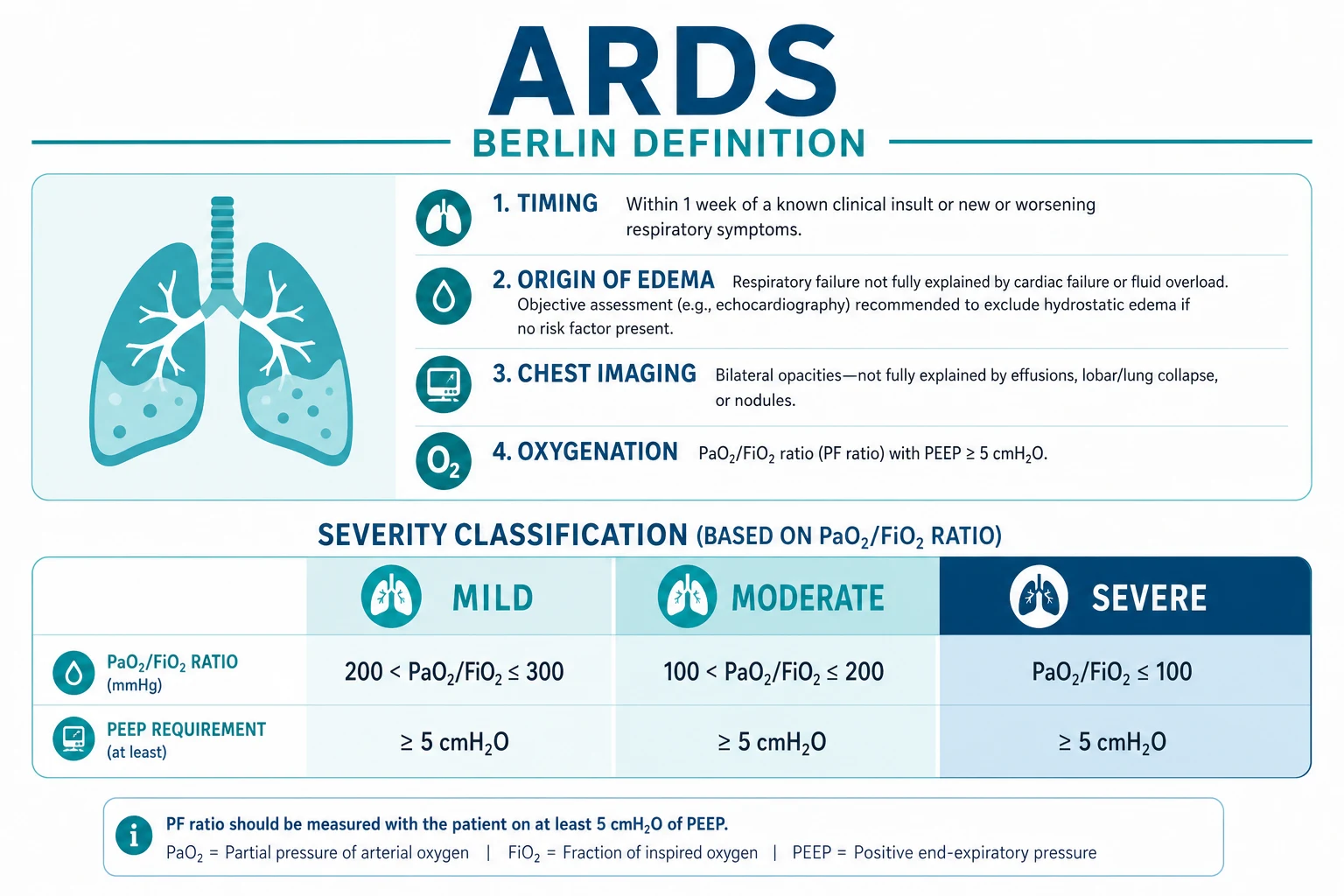
The Berlin definition requires ALL of the following within 1 week of a known clinical insult:[3][2]
- Timing: within 7 days of a precipitating insult (pneumonia, sepsis, aspiration, trauma, pancreatitis)
- Chest imaging: bilateral opacities — not fully explained by effusions, lobar/lung collapse, or nodules (on CXR or CT)
- Origin of oedema: respiratory failure not fully explained by cardiac failure or fluid overload (echo to exclude hydrostatic oedema if no clear risk factor)
- Oxygenation (with PEEP ≥5 cmH2O or CPAP ≥5): [1]
Berlin severity by PaO2/FiO2 ratio (click each)
PaO2/FiO2 <100
Severe ARDS. P/F ratio <100. Mandatory proning (>=16 hours/day). Consider VV-ECMO referral if refractory despite optimised ventilation and proning.
New global definition (2024)
The 2024 update (Kigali modification expanded):[4]
- PaO2/FiO2 measured with any FiO2 (not just PEEP ≥5) — includes patients on high-flow nasal cannula
- SpO2/FiO2 ratio <315 as a non-invasive alternative (for resource-limited settings)
- Bilateral opacities on lung ultrasound accepted (not just CXR/CT)
- Onset within 7 days retained
Causes
Direct lung injury
Pulmonary ARDS
- Pneumonia (most common — viral, bacterial, fungal)
- Aspiration of gastric contents
- Pulmonary contusion
- Fat embolism
- Inhalation injury (smoke, chemical)
- Near-drowning
- Reperfusion pulmonary oedema
Indirect lung injury
Extrapulmonary ARDS
- Sepsis (most common indirect cause)
- Severe major trauma (multiple fractures)
- Acute pancreatitis
- Massive transfusion / TRALI
- Cardiopulmonary bypass
- Drug overdose
- Burns (>30% TBSA)
Pathophysiology
The pathogenesis of ARDS involves three overlapping phases:[1][2]
1. Exudative phase (days 0-7):
- Alveolar-capillary membrane disruption (endothelial and epithelial injury)
- Increased permeability → protein-rich oedema fluid floods alveoli (non-cardiogenic pulmonary oedema)
- Surfactant dysfunction (inactivation and reduced production) → atelectasis
- Hyaline membranes form (proteinaceous debris + dead cells)
- Neutrophil influx → release of proteases, reactive oxygen species, cytokines
- Result: refractory hypoxaemia (V/Q mismatch, shunt) + reduced compliance (stiff lungs) [1]
2. Proliferative phase (days 7-21):
- Type II pneumocyte proliferation → attempts to repair the epithelium
- Fibroblast proliferation → early fibrosis
- Resolution of pulmonary oedema if the insult is controlled
- Some patients recover; others progress to fibrosis [1]
3. Fibrotic phase (weeks-months):
- Pulmonary fibrosis → irreversible loss of lung compliance
- Pulmonary hypertension (vascular remodelling)
- Poor prognosis; prolonged ventilation [1]
Lung-protective ventilation
The ARDSNet protocol (2000)
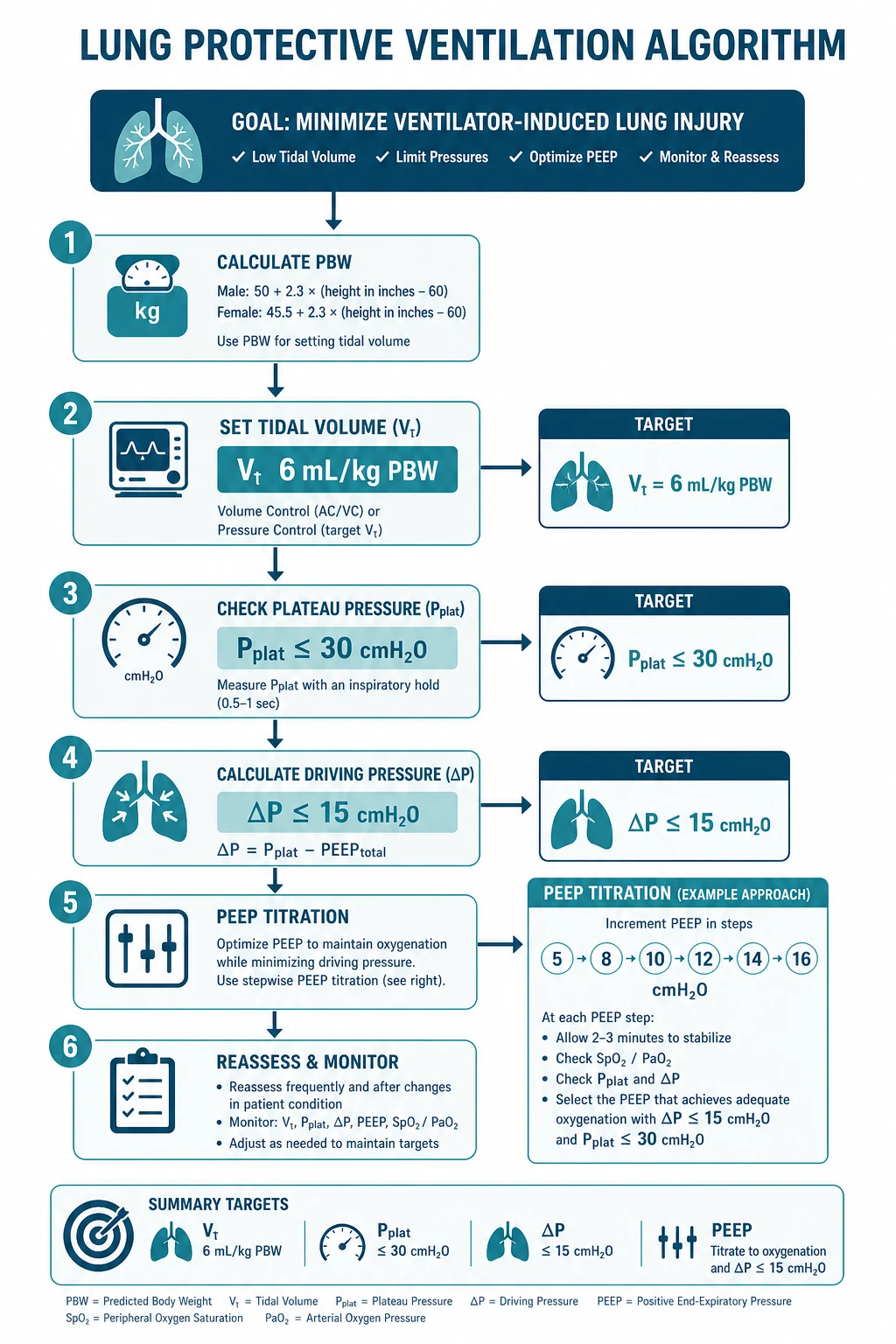
The landmark ARDSNet trial (NEJM 2000) randomised 861 patients with ALI/ARDS to low Vt (6 mL/kg PBW) vs traditional Vt (12 mL/kg PBW). The trial was stopped early for benefit.[5]
ARDSNet trial results
Ventilator settings
Lung-protective ventilation setup
Calculate predicted body weight (PBW)
Male: 50 + 0.91 x (height cm - 152.4). Female: 45.5 + 0.91 x (height cm - 152.4). Use PBW, NOT actual body weight — Vt is based on lung size, which correlates with height.
Set initial Vt = 8 mL/kg PBW
Then reduce by 1 mL/kg every 2-4 hours until Vt = 6 mL/kg PBW. Do not reduce below 4 mL/kg unless per specialist protocol.
Set respiratory rate = 18-35 bpm
Adjust to target pH 7.30-7.45. Permissive hypercapnia is acceptable (respiratory acidosis is tolerated to protect the lung). PaCO2 may rise to 60-80 mmHg if pH >7.20.
Titrate PEEP/FiO2
Use the ARDSNet PEEP/FiO2 ladder (lower or higher PEEP strategy). Higher PEEP strategy preferred for moderate-severe ARDS. Target SpO2 88-95% or PaO2 55-80 mmHg.
Monitor plateau pressure
Measure with 0.5-second inspiratory hold. Target Pplat <30 cmH2O. If >30, reduce Vt by 1 mL/kg steps (minimum 4 mL/kg).
Monitor driving pressure
Driving pressure = Pplat - PEEP. Target <15 cmH2O. Driving pressure >15 is independently associated with increased mortality.
PEEP titration strategies
| Strategy | Method | Pros | Cons |
|---|---|---|---|
| ARDSNet lower PEEP/FiO2 | Table-based PEEP 5-24 based on FiO2 | Simple, validated in ARDSNet trial | May under-treat severe ARDS |
| ARDSNet higher PEEP/FiO2 | Higher PEEP for same FiO2 | Better for moderate-severe ARDS | Risk of barotrauma/hypotension |
| Best PEEP / best compliance | Incremental PEEP trial; choose PEEP with best static compliance | Individualised | Time-consuming; needs paralysis |
| Driving pressure-guided | Titrate PEEP to minimise driving pressure (Pplat - PEEP) | Strongest association with survival | Requires plateau pressure measurement |
| Oesophageal pressure-guided (EPVent) | Use oesophageal balloon to estimate transpulmonary pressure | Accounts for chest wall compliance | PREVENT trial (2019): no mortality benefit; invasive[12] |
The ARDSNet PEEP/FiO2 ladders
The two original ARDSNet protocol tables. Titrate downward as oxygenation improves; never reduce PEEP below 5. [1]
| FiO2 | 0.30 | 0.40 | 0.40 | 0.50 | 0.50 | 0.60 | 0.70 | 0.70 | 0.70 | 0.80 | 0.90 | 0.90 | 0.90 | 1.0 |
|---|---|---|---|---|---|---|---|---|---|---|---|---|---|---|
| Lower PEEP (cmH2O) | 5 | 5 | 8 | 8 | 10 | 10 | 10 | 12 | 14 | 14 | 14 | 16 | 18 | 18-24 |
| Higher PEEP (cmH2O) | 5 | 5 | 10 | 10 | 12 | 14 | 14 | 14 | 16 | 16 | 18 | 20 | 20 | 22-24 |
Choosing between strategies: The 2010 Briel meta-analysis (individual patient data from 3 ALVEOLI/Express/LOVS trials) showed higher PEEP reduces mortality in moderate-severe ARDS (P/F <200) but offers no benefit — and possible harm — in mild ARDS (P/F >200).[20] The LOVS trial (Meade 2008) used the high-PEEP ladder with recruitment manoeuvres and showed no overall mortality benefit but reduced barotrauma.[19]
Driving pressure (ΔP)
Driving pressure = plateau pressure − PEEP. It is the dynamic strain delivered to the aerated lung with each breath — the variable most tightly coupled to the 'baby lung' that is actually being ventilated. [1]
The Amato et al. (NEJM 2015) analysis pooled 3,562 patients from 9 RCTs.[17] In multivariable analysis adjusting for P/F, PEEP and Vt:
- Driving pressure >15 cmH2O was the ventilation variable most strongly associated with mortality — a stronger predictor than Vt, plateau pressure, or PEEP alone.
- Reducing Vt only mattered if it also reduced ΔP; raising PEEP only helped if it reduced ΔP.
- Implication: Target ΔP <15 cmH2O. If ΔP is >15, reduce Vt first (1 mL/kg steps to 4 mL/kg); if still high, PEEP may be on the flat/derecruiting portion of the curve — a trial of higher PEEP that reduces ΔP suggests recruitable lung. [1]
Permissive hypercapnia
Lung-protective ventilation may result in hypoventilation (low Vt + high dead space). This causes respiratory acidosis (elevated PaCO2). This is accepted (permissive hypercapnia) because protecting the lung is more important than normalising PaCO2.[2]
- Acceptable: PaCO2 up to 60-80 mmHg IF pH ≥7.20
- If pH <7.20: increase RR (up to 35-40); consider bicarbonate infusion (controversial); do NOT increase Vt above 6 mL/kg
- Contraindications to permissive hypercapnia: raised ICP (intracranial hypertension), severe pulmonary hypertension [1]
Adjunctive therapies
Prone positioning
Mechanism: Improves V/Q matching by:
- Recruiting dorsal (previously collapsed) lung regions
- Reducing shunt
- More uniform ventilation distribution
- Facilitates drainage of secretions
- Reduces ventilator-induced lung injury (more homogeneous transpulmonary pressure)[6]
The PROSEVA trial (NEJM 2013): randomised 466 patients with severe ARDS (PaO2/FiO2 <150, FiO2 ≥60%, PEEP ≥5) to prone positioning for ≥16 hours vs supine.[6]
PROSEVA trial results
Indications: PaO2/FiO2 <150 despite optimised ventilation (after at least 4 hours of optimisation).[13]
Contraindications: spinal instability, unstable pelvic fractures, severe burns, pregnancy (relative), recent abdominal surgery (relative), raised ICP. [1]
Complications: facial pressure sores (most common), nerve compression, corneal abrasions, tube/line dislodvement (ETT, CVC, arterial line), haemodynamic instability during turning, cardiac arrest (rare). [1]
Neuromuscular blockade
ACURASYS trial (NEJM 2010): 340 patients with early severe ARDS, cisatracurium for 48 hours. Reduced 90-day mortality (31% vs 41%, p=0.05) and adjusted hazard ratio 0.68.[9]
ROSE trial (NEJM 2019): 1006 patients with moderate-severe ARDS (P/F <150), cisatracurium for 48 hours. NO mortality benefit (42.5% vs 42.8%, p=0.95). Higher rates of myocarditis/rhabdomyolysis with NMB.[10]
Current recommendation: Do NOT routinely use NMB in ARDS. Consider short (24-48 hour) infusion of cisatracurium for severe oxygenation failure (P/F <150) where ventilator dyssynchrony is problematic or profound hypoxaemia persists despite proning.[13]
[1]VV-ECMO for refractory ARDS
Indications: Severe ARDS (PaO2/FiO2 <80) despite optimised lung-protective ventilation, proning, and PEEP titration for >6-12 hours. Consider referral to an ECMO centre early.[7][11]
Key trials:
- CESAR (Lancet 2009): referral to ECMO centre improved 6-month survival without severe disability (63% vs 47%, p=0.03). BUT: only 75% of the ECMO group actually received ECMO.[8]
- EOLIA (NEJM 2018): early VV-ECMO vs conventional ventilation. No significant 60-day mortality benefit (35% vs 46%, p=0.09). BUT: 28% crossover from control to ECMO; Bayesian re-analysis suggests 85-96% probability of benefit.[7]
- Meta-analysis (2020): individual patient data from EOLIA + 3 other trials suggests mortality benefit with VV-ECMO in severe ARDS.[11]
Corticosteroids (DEXA-ARDS)
The role of corticosteroids in ARDS has been debated for two decades. Current evidence supports early, moderate-dose dexamethasone in moderate-severe ARDS but NOT routine use in mild ARDS or late-phase unresolving ARDS. [1]
The DEXA-ARDS trial (Villar et al, Lancet Respir Med 2020): 277 patients with moderate-severe ARDS (P/F 200-280 within 24 hours of onset) given dexamethasone 20 mg/day x 5 days then 10 mg/day x 5 days vs placebo.[15]
DEXA-ARDS results
- Increased ventilator-free days (15 vs 7.5) and oxygenation-free days.
- No signal of increased infection, gastroduodenal bleeding, or hyperglycaemia requiring intervention.
- Caveat: enrolled only early (<24h), moderate-severe ARDS; benefit may not extend to late fibroproliferative disease. [1]
How steroids fit in practice: Consider dexamethasone 20 mg/day x 5 days (then taper) in moderate-severe ARDS within 72 hours of onset. Avoid in mild ARDS, in active untreated infection without septic shock, and in late (>14 day) unresolving ARDS (LAEDS/SSC 2012 trials showed harm when started late). Methylprednisolone 1 mg/kg/day for persistent ARDS is an older, weaker alternative. [1]
Higher PEEP and recruitment manoeuvres
Higher vs lower PEEP: The Briel individual-patient-data meta-analysis (2010, ALVEOLI/EXPRESS/LOVS) confirmed that higher PEEP improves survival only in moderate-severe ARDS (P/F <200) and is neutral/harmful in mild ARDS.[20] The LOVS trial (Meade 2008, n=983) combined the high-PEEP ladder with recruitment manoeuvres — no mortality benefit, but reassuringly less barotrauma with lung-protective Vt.[19]
Recruitment manoeuvres (RMs): NOT recommended routinely. The ART trial (Cavalcanti 2017, n=1,010) tested a stepwise incremental PEEP recruitment strategy + titrated PEEP vs a low-PEEP control in moderate-severe ARDS.[18]
- Result: 28-day mortality 29.3% (recruitment) vs 24.6% (control), adjusted RR 1.20 (95% CI 1.01-1.42) — increased mortality with recruitment.
- More barotrauma (pneumothorax requiring drainage), hypotension, and need for vasoactive drugs.
- Conclusion: Aggressive staircase recruitment with high PEEP is harmful. Brief (40-second, 40 cmH2O) sustained-inflation RMs may be used selectively before proning or to assess recruitability, but not as routine therapy. [1]
ARDS subphenotypes (precision medicine)
ARDS is pathophysiologically and biologically heterogeneous. Latent class analysis of plasma biomarkers (Calfee et al, 2014) identified two reproducible subphenotypes that are biologically distinct and have markedly different outcomes.[16]
Hyperinflammatory (Type 1)
~65% of ARDS
- Higher IL-6, IL-8, sTNFR-1, surfactant protein D
- Lower PaO2/FiO2, more organ failures
- Higher vasopressor requirement and longer ventilation
- Mortality ~44% — clearly worse prognosis
- More likely to benefit from higher PEEP, simvastatin, and anaemia-correcting strategies
Hypoinflammatory (Type 2)
~35% of ARDS
- Lower inflammatory biomarker profile
- Less severe oxygenation impairment
- Fewer non-pulmonary organ failures
- Mortality ~23%
- May be harmed by aggressive therapies that benefit Type 1 (e.g. higher PEEP, simvastatin)
Why this matters: Trial-level treatment effects differ by subphenotype. In secondary analyses, higher PEEP and simvastatin (HARP-2) trended toward benefit in the hyperinflammatory phenotype and harm in the hypoinflammatory phenotype. The 2020 Calfee parsimonious classifier (3-4 variables: IL-8, sTNFR-1, bicarbonate, platelets) allowed bedside identification without the full biomarker panel.[22]
[1]Evidence and landmark trials
ARDSNet
NEJM 2000
861 pts with ALI/ARDS — Vt 6 vs 12 mL/kg PBW
Key finding
Mortality: 31% low Vt vs 40% traditional (p=0.007). Stopped early for benefit.
Practice change
Lung-protective ventilation (6 mL/kg PBW, Pplat <30) became the standard of care
PROSEVA
NEJM 2013
466 pts with severe ARDS (P/F <150) — prone >=16h vs supine
Key finding
28-day mortality: 16% prone vs 33% supine (p<0.001). 90-day mortality: 23% vs 41% (p<0.001)
Practice change
Prone positioning for >=16 hours became standard for severe ARDS
ROSE
NEJM 2019
1006 pts with moderate-severe ARDS — cisatracurium 48h vs no routine NMB
Key finding
90-day mortality: 42.5% vs 42.8% (no difference, p=0.95). More cardiovascular events with NMB
Practice change
Routine NMB no longer recommended for ARDS
EOLIA
NEJM 2018
249 pts with very severe ARDS (P/F <50) — VV-ECMO vs conventional ventilation
Key finding
60-day mortality: 35% ECMO vs 46% control (NOT significant, p=0.09). 28% crossover to ECMO
Practice change
VV-ECMO should be used selectively for refractory cases, not routinely
PREVENT
JAMA 2019
ESC oesophageal pressure-guided PEEP vs high PEEP/FiO2 empiric
Key finding
No significant difference in death or ventilator-free days
Practice change
Oesophageal pressure-guided PEEP not superior to empiric strategy
DEXA-ARDS
Lancet RM 2020
277 pts with moderate-severe ARDS (P/F <280) — dexamethasone 20mg x5d then 10mg x5d vs placebo
Key finding
28-day mortality: 21% dexa vs 36% placebo (p=0.0048). More ventilator-free days (15 vs 7.5)
Practice change
Early dexamethasone (within 24h) for moderate-severe ARDS
ART
JAMA 2017
1010 pts with moderate-severe ARDS — staircase recruitment + titrated PEEP vs low PEEP
Key finding
28-day mortality: 29.3% recruitment vs 24.6% control (RR 1.20, 95% CI 1.01-1.42) — HARM. More barotrauma and hypotension
Practice change
Aggressive staircase recruitment manoeuvres should NOT be used routinely
LOVS
JAMA 2008
983 pts with ALI/ARDS — high PEEP ladder + recruitment vs low PEEP
Key finding
No difference in hospital mortality (~36% both groups). Trend to fewer barotrauma deaths with lung-protective Vt
Practice change
High PEEP + recruitment not superior to low PEEP strategy overall
Amato et al.
NEJM 2015
Pooled 3562 pts from 9 RCTs — driving pressure vs mortality
Key finding
Driving pressure >15 cmH2O was the ventilation variable most strongly associated with death — stronger than Vt, PEEP, or plateau pressure alone
Practice change
Driving pressure <15 cmH2O added to lung-protective targets
Management algorithm summary
Complete ARDS management pathway
Recognise and diagnose
Berlin criteria within 7 days of insult. Bilateral opacities, P/F <300 with PEEP >=5, exclude cardiac failure (echo).
Start lung-protective ventilation
Vt 6 mL/kg PBW. RR 18-35 for pH 7.30-7.45. Pplat <30. Driving pressure <15. Permissive hypercapnia accepted if pH >=7.20.
Titrate PEEP and FiO2
Use higher PEEP/FiO2 table for moderate-severe. Target SpO2 88-95%. Consider best-compliance or driving-pressure-guided PEEP.
Prone positioning (if P/F <150)
Continuous prone for >=16 hours per session. Minimum 3-4 sessions. Reduce if P/F improves to >150 for 4 hours in supine.
Early dexamethasone (DEXA-ARDS)
For moderate-severe ARDS within 24-72 h of onset: dexamethasone 20 mg/day x5 days, then 10 mg/day x5 days. Reduced 28-day mortality (21% vs 36%) and increased ventilator-free days. Avoid in late (>14 day) unresolving ARDS.
Consider adjuncts
Short NMB only for severe dyssynchrony. Inhaled pulmonary vasodilators (NO/prostacyclin) as bridge. Recruitment manoeuvres — controversial, not routine.
VV-ECMO referral (if P/F <80 despite above)
Refer early to ECMO centre. Indications: P/F <80 for >6h, or P/F <50 for >3h, or pH <7.25 with RR maxed. Must be at a centre with capability.
Treat the cause
Antibiotics for pneumonia. Source control for sepsis. Stop causative drugs. Treat pancreatitis. This is the most important step for recovery.
Conservative fluid strategy
FACTT trial: conservative fluid strategy (target even-to-negative fluid balance after resuscitation) improves oxygenation and ventilator-free days without increasing renal failure.
Driving pressure check
Measure ΔP = Pplat - PEEP on every check. Target <15 cmH2O. If ΔP >15, reduce Vt (1 mL/kg to 4 mL/kg) or trial higher PEEP that *reduces* ΔP (indicates recruitable lung). Amato 2015: ΔP is the strongest ventilation predictor of survival.
Weaning
Daily sedation breaks + SBT when P/F >200, FiO2 <40%, PEEP <8, stable for 30 min. Follow weaning protocol.
Prognosis
ARDS outcomes
- Prognostic factors: age, comorbidities, severity (P/F ratio), driving pressure, cause (direct vs indirect — direct may have better prognosis)[1]
- Long-term sequelae: cognitive impairment (~30%), PTSD (~25%), depression (~40%), physical weakness, pulmonary fibrosis in survivors[2]
Exam practice
SAQ — Severe ARDS management
10 minutes · 10 marks
A 55-year-old man is admitted to ICU with severe community-acquired pneumonia. He is intubated and ventilated. Settings: Vt 450 mL, RR 24, PEEP 12, FiO2 0.9. ABG: pH 7.28, PaCO2 52, PaO2 63, HCO3 24. CXR shows bilateral diffuse alveolar infiltrates. Height 178 cm. Echo: normal LV function, no valve lesion.
SAQ — Moderate ARDS and prone positioning (PROSEVA)
10 minutes · 10 marks
A 62-year-old woman (height 165 cm) is intubated for severe pneumococcal pneumonia. Day 2 of ventilation: Vt 380 mL, RR 26, PEEP 12, FiO2 0.70. ABG: pH 7.31, PaCO2 50, PaO2 75, HCO3 24. Plateau pressure 27 cmH2O, driving pressure 15 cmH2O. CXR shows bilateral alveolar infiltrates. Despite 4 hours of optimised lung-protective ventilation and a conservative fluid strategy, oxygenation has not improved.
SAQ — Severe refractory ARDS and VV-ECMO (EOLIA criteria)
10 minutes · 10 marks
A 45-year-old man (height 180 cm) on ICU day 3 of severe H1N1 influenza ARDS. Settings: Vt 360 mL (5 mL/kg PBW), RR 32, PEEP 18, FiO2 1.0. He has been proned for 36 hours across three sessions. ABG: pH 7.21, PaCO2 64, PaO2 54, HCO3 24. Plateau pressure 30 cmH2O, driving pressure 12 cmH2O. Noradrenaline 0.3 mcg/kg/min for septic shock. CXR shows bilateral white-out. Echo: normal LV, mildly dilated RV with moderate tricuspid regurgitation.
Clinical pearls
Red flags
References
- [1]Matthay MA, Zemans RL, Zimmerman GA, et al. Acute respiratory distress syndrome in adults: diagnosis, outcomes, long-term sequelae, and management Lancet, 2022.PMID 36070788
- [2]Fan E, Brodie D, Slutsky AS. Acute Respiratory Distress Syndrome: Advances in Diagnosis and Treatment JAMA, 2018.PMID 29466596
- [3]ARDS Definition Task Force. Acute respiratory distress syndrome: the Berlin Definition JAMA, 2012.PMID 22797452
- [4]Matthay MA, Hughes G, Liu KD, et al. A New Global Definition of Acute Respiratory Distress Syndrome Am J Respir Crit Care Med, 2024.PMID 37487152
- [5]The Acute Respiratory Distress Syndrome Network. Ventilation with lower tidal volumes as compared with traditional tidal volumes for acute lung injury and the acute respiratory distress syndrome N Engl J Med, 2000.PMID 10793162
- [6]Guérin C, Reignier J, Richard JC, et al. Prone positioning in severe acute respiratory distress syndrome N Engl J Med, 2013.PMID 23688302
- [7]Combes A, Hajage D, Capellier G, et al. Extracorporeal Membrane Oxygenation for Severe Acute Respiratory Distress Syndrome N Engl J Med, 2018.PMID 29791822
- [8]Peek GJ, Mugford M, Tiruvoipati R, et al. Efficacy and economic assessment of conventional ventilatory support versus extracorporeal membrane oxygenation for severe adult respiratory failure (CESAR): a multicentre randomised controlled trial Lancet, 2009.PMID 19762075
- [9]Papazian L, Forel JM, Gacouin A, et al. Neuromuscular blockers in early acute respiratory distress syndrome N Engl J Med, 2010.PMID 20843245
- [10]Moss M, Huang DT, Brower RG, et al. Early Neuromuscular Blockade in the Acute Respiratory Distress Syndrome N Engl J Med, 2019.PMID 31112383
- [11]Munshi L, Walkey A, Goligher E, et al. ECMO for severe ARDS: systematic review and individual patient data meta-analysis Intensive Care Med, 2020.PMID 33021684
- [12]Writing Group for the PREVENT Trial Investigators. Effect of Titrating Positive End-Expiratory Pressure (PEEP) With an Esophageal Pressure-Guided Strategy vs an Empirical High PEEP-Fio2 Strategy on Death and Days Free From Mechanical Ventilation Among Patients With Acute Respiratory Distress Syndrome: A Randomized Clinical Trial JAMA, 2019.PMID 30776290
- [13]Fan E, Del Sorbo L, Goligher EC, et al. Treatment of ARDS With Prone Positioning Chest, 2017.PMID 27400909
- [14]Cochran A, Batac D, Ramanujan V, et al. Diagnosis and Epidemiology of Acute Respiratory Failure Crit Care Clin, 2024.PMID 38432693
- [15]Villar J, Ferrando C, Martínez D, et al. Dexamethasone treatment for the acute respiratory distress syndrome: a multicentre, randomised controlled trial Lancet Respir Med, 2020.PMID 32043986
- [16]Calfee CS, Delucchi KL, Sinha P, et al. Subphenotypes in acute respiratory distress syndrome: latent class analysis of data from two randomised controlled trials Lancet Respir Med, 2014.PMID 24853585
- [17]Amato MBP, Meade MO, Slutsky AS, et al. Driving pressure and survival in the acute respiratory distress syndrome N Engl J Med, 2015.PMID 25693014
- [18]Cavalcanti AB, Suzumura ÉA, Laranjeira LN, et al. Effect of Lung Recruitment and Titrated Positive End-Expiratory Pressure (PEEP) vs Low PEEP on Mortality in Patients With Acute Respiratory Distress Syndrome: A Randomized Clinical Trial JAMA, 2017.PMID 28973363
- [19]Meade MO, Cook DJ, Guyatt GH, et al. Ventilation strategy using low tidal volumes, recruitment maneuvers, and high positive end-expiratory pressure for acute lung injury and acute respiratory distress syndrome: a randomized controlled trial JAMA, 2008.PMID 18270352
- [20]Briel M, Meade M, Mercat A, et al. Higher vs lower positive end-expiratory pressure in patients with acute lung injury and acute respiratory distress syndrome: systematic review and meta-analysis JAMA, 2010.PMID 20197533
- [21]Wiedemann HP, Wheeler AP, Bernard GR, et al. Comparison of two fluid-management strategies in acute lung injury N Engl J Med, 2006.PMID 16714767
- [22]Calfee CS, Delucchi K, Parsons PE, et al. Development and validation of parsimonious algorithms to classify acute respiratory distress syndrome phenotypes: a secondary analysis of randomised controlled trials Lancet Respir Med, 2020.PMID 31948926