ICU · respiratory
Acute Respiratory Distress Syndrome (ARDS) — Berlin Definition, Lung-Protective Ventilation, Proning, ECMO, and Phenotyping
Also known as ARDS · Acute respiratory distress syndrome · Berlin definition ARDS · Non-cardiogenic pulmonary oedema · Diffuse alveolar damage · Lung-protective ventilation · Prone ventilation · VV-ECMO · ARDS subphenotypes · PROSEVA · Baby lung
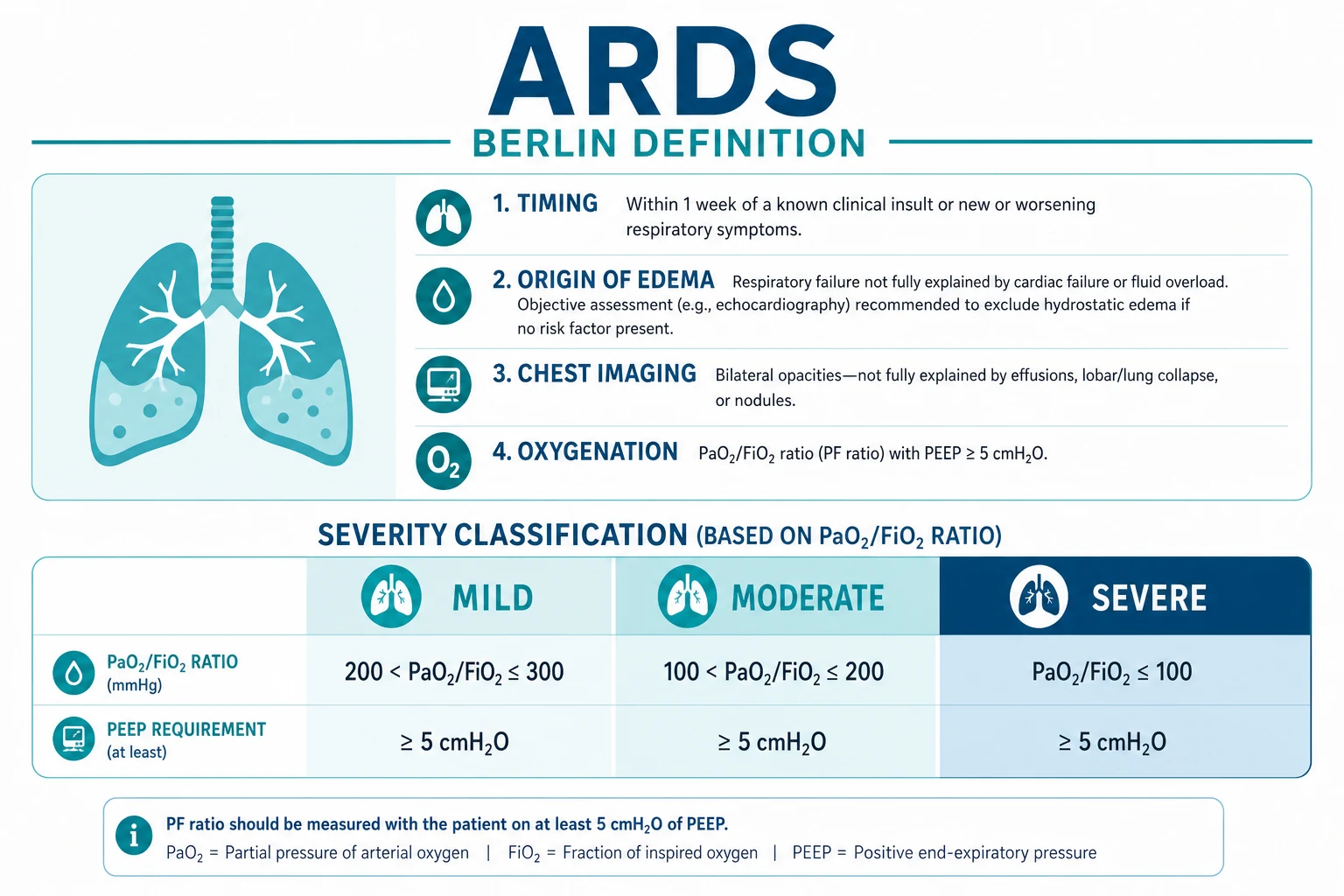
Acute respiratory distress syndrome (ARDS) — a syndrome of acute, diffuse, inflammatory lung injury causing increased pulmonary vascular permeability, loss of aerated lung, and severe hypoxaemia. The 2012 Berlin Definition replaces AECC: (1) Timing — within 1 week of a known clinical insult or new/worsening respiratory symptoms; (2) Chest imaging — bilateral opacities not fully explained by effusions, lobar/lung collapse, or nodules (CT or CXR); (3) Origin of oedema — respiratory failure NOT fully explained by cardiac failure or fluid overload (objective assessment — echo — required if no clear risk factor); (4) Oxygenation — PaO2/FiO2 ratio measured with PEEP/CPAP >=5 cmH2O: MILD 200-300 (inclusive), MODERATE 100-200, SEVERE <100. Causes are DIRECT/pulmonary (pneumonia — most common, aspiration of gastric contents, pulmonary contusion, inhalation injury, near-drowning) or INDIRECT/extrapulmonary (sepsis — most common indirect, severe trauma/shock, acute pancreatitis, massive transfusion/TRALI, severe burns, drug overdose). Pathophysiology — diffuse alveolar damage: exudative phase (type I pneumocyte + capillary endothelial injury → protein-rich alveolar oedema → hyaline membranes), proliferative phase (type II pneumocyte proliferation, fibroblast infiltration), fibrotic phase. The 'baby lung' concept (Gattinoni) — the aerated lung in ARDS is small, not stiff; high tidal volumes overdistend the small healthy portion → volutrauma. Management PILLARS: (1) Treat the cause (antibiotics, source control). (2) Lung-protective ventilation (ARDSNet — Vt 6 mL/kg PREDICTED body weight, plateau pressure <30 cmH2O, driving pressure <15 cmH2O, permissive hypercapnia pH >7.20). (3) PEEP optimisation (PEEP/FiO2 table, best compliance, oesophageal pressure). (4) Prone positioning (PROSEVA — >=16 h/day for moderate-severe ARDS P/F <150, ~50% relative mortality reduction). (5) Conservative fluid strategy (FACTT). (6) Corticosteroids (DEXA-ARDS — dexamethasone improves moderate-severe ARDS). (7) VV-ECMO for severe refractory ARDS (EOLIA). Neuromuscular blockade is NOT routine (ROSE). ARDS subphenotypes (Calfee 2014) — hyperinflammatory vs hypoinflammatory — differ in mortality and treatment response. Mortality ~35% overall (severe ~45%).
On this page & tools
Your progress
Saved locally on this device.
Target exams
Red flags
Overview
ARDS is one of the most common and lethal syndromes in critical care — ~10% of ICU admissions and ~25% of ventilated patients — with overall mortality around 35% (severe ARDS ~45%). Despite decades of research, only a handful of interventions have proven to reduce mortality, and the cornerstone remains the deceptively simple act of ventilating gently. Understanding the Berlin definition, the evidence ladder of management, and the concept of the 'baby lung' is essential for every fellowship candidate and every patient on a ventilator. [1]
The Berlin Definition (2012)
The 2012 Berlin Definition replaced the 1994 American-European Consensus Conference (AECC) definition, resolving several ambiguities (notably the ALI/ARDS terminology confusion and the acute lung injury misnomer). It is a syndromic definition — four criteria, all required.[6]
The four Berlin criteria — what each means
| Criterion | Requirement | Common errors / pearls |
|---|---|---|
| Timing | Within 1 week of a known clinical insult OR new/worsening respiratory symptoms | Chronic fibrotic lung disease or subacute processes (>1 week) are NOT ARDS. Note the onset — ARDS from a known trigger (e.g., sepsis, trauma) is usually within 24-72 h |
| Imaging | Bilateral opacities — on chest X-ray OR CT — NOT fully explained by effusions, lobar/lung collapse, or pulmonary nodules | Bilateral is key. Unilateral (e.g., severe unilateral pneumonia) is NOT Berlin ARDS. CT is more sensitive than CXR. Beware atelectasis mimicking oedema |
| Origin of oedema | Respiratory failure NOT fully explained by cardiac failure or fluid overload. An objective assessment (e.g., echocardiography) is required if no obvious ARDS risk factor | The clause that separates ARDS from cardiogenic pulmonary oedema. If a cardiac cause is plausible, do an echo — but cardiac failure and ARDS can COEXIST (e.g., sepsis with cardiomyopathy). PAOP >18 is no longer required (Berlin dropped the Swan requirement) |
| Oxygenation | PaO2/FiO2 (P/F) ratio measured on PEEP/CPAP >=5 cmH2O: Mild 200-300 • Moderate 100-200 • Severe <100 | P/F MUST be interpreted with the PEEP — a P/F of 250 on PEEP 5 is mild ARDS, but the same P/F on PEEP 15 represents a much sicker lung. Always quote P/F WITH the PEEP and FiO2 |
Diagnosing ARDS at the bedside — the four-step check
- CONFIRM TIMING — Is there a recognised trigger (pneumonia, sepsis, trauma, aspiration, pancreatitis, transfusion, burns) within the last 7 days with acute onset respiratory failure?
- CONFIRM IMAGING — Bilateral opacities on CXR or CT, not explained by effusion/collapse/nodules. If unilateral or chronic, it is NOT Berlin ARDS
- EXCLUDE HYDROSTATIC OEDEMA — Is the oedema non-cardiogenic? If any cardiac component is plausible, perform echocardiography. Cardiac failure and ARDS can coexist; the question is whether oedema is FULLY explained by the heart
- GRADE SEVERITY — PaO2/FiO2 on PEEP >=5: mild 200-300, moderate 100-200, severe <100. Document the PEEP and FiO2 alongside the ratio. Severity drives the escalation ladder (proning, ECMO, steroids)
Causes — direct vs indirect
ARDS risk factors are classified by whether the insult strikes the lung directly (epithelial injury first) or indirectly (endothelial injury from a systemic inflammatory process). The distinction has pathophysiological and sometimes prognostic relevance, though both converge on diffuse alveolar damage. [1]
Direct (pulmonary) vs indirect (extrapulmonary) ARDS causes
| Category | Common causes | Notes |
|---|---|---|
| DIRECT (pulmonary) | Pneumonia (bacterial, viral — including influenza, COVID-19 — fungal; the SINGLE MOST COMMON cause of ARDS worldwide), aspiration of gastric contents, pulmonary contusion, inhalation injury (smoke, chemical), near-drowning, fat/pulmonary embolism with infarction, reperfusion pulmonary oedema (post-lung-transplant, post-PEA) | Epithelial injury predominates; consolidation pattern on imaging; often more focal/recruitable. Direct causes (especially pneumonia) carry slightly higher mortality than indirect |
| INDIRECT (extrapulmonary) | Sepsis (the commonest indirect cause and the commonest single predisposing condition overall), severe non-thoracic trauma with shock, acute pancreatitis, massive transfusion / TRALI, severe burns (>30% TBSA), cardiopulmonary bypass, drug overdose (heroin, salicylates, paraquat), anaphylaxis, amniotic fluid embolism, DIC | Endothelial injury predominates; more homogeneous ground-glass/interstitial pattern; often more recruitable oedema. Sepsis + pneumonia together is the classic combination |
Pathophysiology — diffuse alveolar damage and the 'baby lung'
ARDS is the clinical manifestation of diffuse alveolar damage (DAD). Injury to the alveolar-capillary membrane (epithelium and endothelium) increases permeability, flooding the alveoli with protein-rich oedema fluid, inactivating surfactant, and collapsing dependent lung units. [1]
The process has three overlapping phases:
- Exudative phase (days 0-7): type I pneumocyte and capillary endothelial injury → protein-rich alveolar oedema → hyaline membranes (composed of fibrin and necrotic epithelial cells) → surfactant dysfunction → atelectasis and shunt. This is the phase of worst oxygenation.
- Proliferative phase (days 7-14): type II pneumocyte proliferation to repopulate the epithelium, fibroblast migration, early organisation. Oxygenation may improve but compliance often remains poor.
- Fibrotic phase (after ~14 days): variable interstitial fibrosis in survivors; the basis of long-term lung function impairment. [1]
The 'baby lung' concept (Gattinoni) is the central insight of ARDS ventilation: the ARDS lung is not uniformly stiff — it is small. Disease is heterogeneously distributed (dense consolidation in dependent regions, near-normal aeration in non-dependent regions). The small aerated portion behaves like the lung of a child. A "normal" 500 mL tidal volume is delivered almost entirely to this small aerated baby lung, overdistending it → volutrauma. This is why low tidal volume ventilation works: it matches the size of the functional lung, not the size of the patient. [1]
Management — the evidence ladder
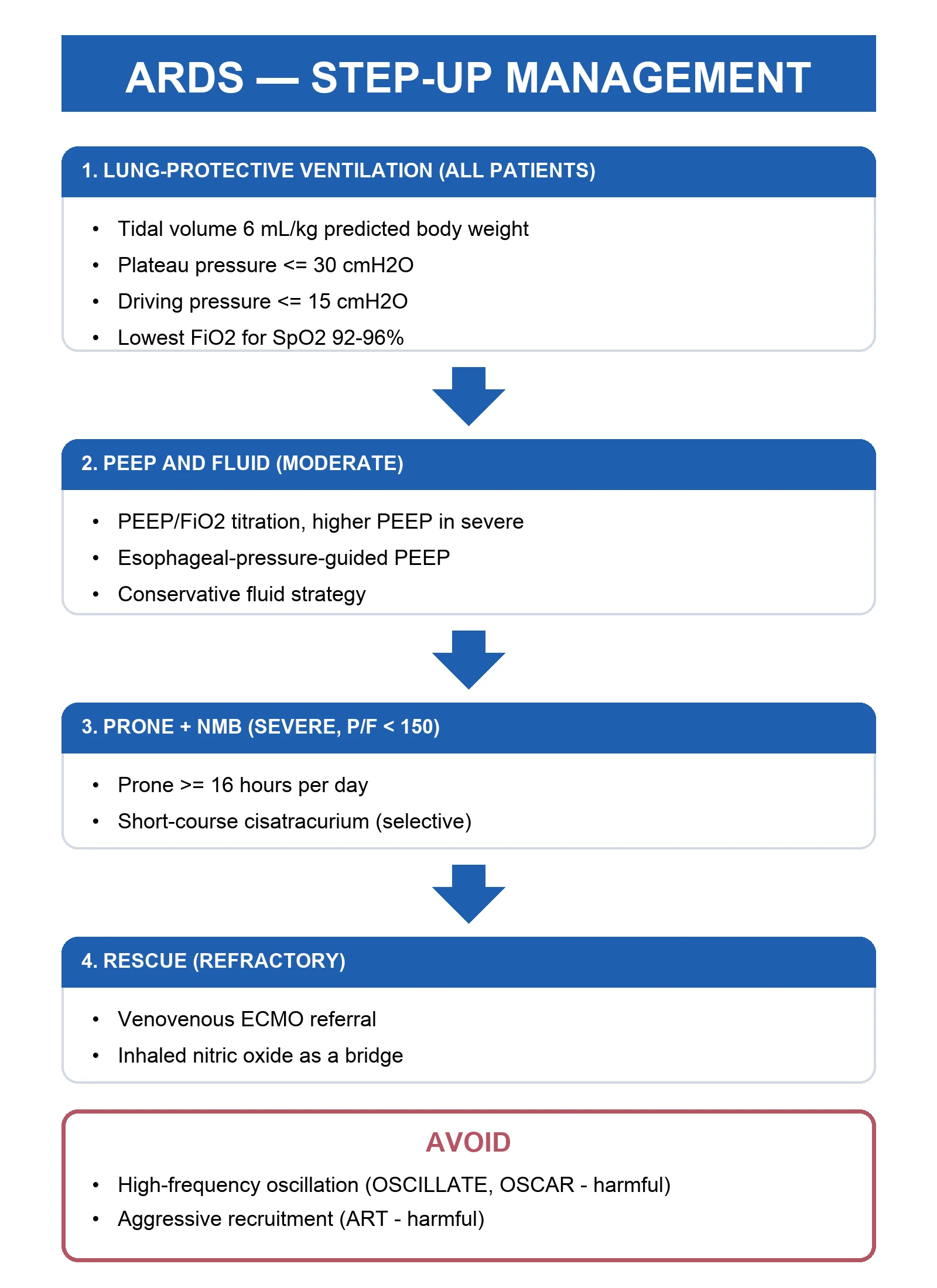
ARDS management is a stepwise escalation determined by severity. The foundational layer applies to every ARDS patient; higher layers are reserved for moderate-severe and refractory disease. Master the order: it is one of the most frequently examined sequences in critical care. [1]
The ARDS management ladder — escalate by severity
- TREAT THE CAUSE — antibiotics for pneumonia/sepsis, source control (drain infected collections, stop offending transfusion), treat pancreatitis, etc. ARDS is a consequence; without treating the trigger, nothing else works
- LUNG-PROTECTIVE VENTILATION (all ARDS) — Vt 6 mL/kg PREDICTED body weight, plateau pressure <30 cmH2O, driving pressure <15 cmH2O, permissive hypercapnia (pH >7.20), FiO2 titrated to SpO2 88-95% (ARDSNet protocol)[1]
- PEEP OPTIMISATION — use the PEEP/FiO2 table; in moderate-severe ARDS, titrate to best compliance / lowest driving pressure (consider higher PEEP strategies, oesophageal pressure guidance in selected patients)
- CONSERVATIVE FLUID STRATEGY (all/moderate-severe) — once the patient is out of shock, target a negative/neutral fluid balance (FACTT) — improves lung function and more ventilator-free days
- PRONE POSITIONING (moderate-severe, P/F <150) — >=16 h/day, early (within 36-48 h), in centres with expertise (PROSEVA — the biggest mortality win after low Vt)[2]
- CORTICOSTEROIDS (moderate-severe) — dexamethasone 20 mg/day x5, then 10 mg/day x5, then 5 mg/day x2 (DEXA-ARDS) — start within 24 h of moderate-severe ARDS onset[5]
- VV-ECMO (severe, refractory) — referral to an ECMO centre for P/F <80 despite optimisation, or P/F <150 with >=3 high-risk features; consider after prone ventilation fails (EOLIA)[4]
- NOT ROUTINE — neuromuscular blockade (ROSE — not routine; reserve for asynchrony or dangerous ventilation), inhaled pulmonary vasodilators (no mortality benefit), high-frequency oscillation (HARMO/OSCILLATE — increased mortality, AVOID)
Lung-protective ventilation — the ARDSNet protocol
The ARDSNet trial (2000) is the most influential trial in the history of critical care. It established that simply lowering tidal volume from 12 to 6 mL/kg predicted body weight reduced mortality from 40% to 31% (22% relative reduction, NNT 11).[1]
ARDSNet 2000 — Low tidal volume ventilation (PMID 10793162)
Design
Multicentre randomised controlled trial, 861 patients with ALI/ARDS (P/F <300)
Intervention
Vt 6 mL/kg PBW + Pplat <=30 cmH2O vs Vt 12 mL/kg PBW + Pplat <=50 cmH2O
Stopped early
Yes — at planned interim analysis for clear mortality benefit
Primary outcome
Mortality before discharge home and breathing unassisted: 31.0% (low Vt) vs 39.8% (traditional), p=0.007
Secondary
More ventilator-free days (12 vs 10, p=0.007); fewer non-pulmonary organ failures
Key physiology
Mean Vt achieved 6.2 vs 11.8 mL/kg PBW; mean Pplat 25 vs 33 cmH2O. Permissive hypercapnia (PaCO2 ~48, pH ~7.30) was tolerated without harm
Bottom line
Vt 6 mL/kg PBW + Pplat <30 is the STANDARD OF CARE for ALL patients with ARDS. The single most evidence-supported ARDS intervention. Using ACTUAL (not predicted) body weight is the commonest error
The protocol is more than just "6 mL/kg" — it is a coordinated bundle of targets that minimise ventilator-induced lung injury (volutrauma, atelectrauma, barotrauma, biotrauma). [1]
ARDSNet lung-protective ventilation targets
| Parameter | Target | Why it matters / how to adjust |
|---|---|---|
| Tidal volume (Vt) | Start 6 mL/kg PBW; reduce to 4 mL/kg if Pplat >30 or delta P >15 | PBW (NOT actual weight): male = 50 + 0.91 × (height cm - 152.4); female = 45.5 + 0.91 × (height cm - 152.4). The commonest error is using actual weight in obesity |
| Plateau pressure (Pplat) | <30 cmH2O (measured by 0.5 s inspiratory hold) | Surrogate for alveolar overdistension. In a stiff chest wall (obesity, abdominal compartment, kyphoscoliosis), a higher Pplat may be acceptable because transpulmonary pressure is not elevated |
| Driving pressure (delta P) | <15 cmH2O (delta P = Pplat - PEEP) | The strongest single ventilatory predictor of survival (Amato 2015). Each 1 cmH2O above 15 ≈ 5% mortality increase. Delta P = Vt / compliance — the actual strain on the baby lung |
| Respiratory rate | Set to keep pH >7.20; max ~35 (watch for auto-PEEP) | Permissive hypercapnia is the trade for low Vt. Do NOT increase Vt to normalise PaCO2 |
| FiO2 | Lowest that keeps SpO2 88-95% / PaO2 55-80 mmHg | Permissive hypoxaemia is acceptable to limit oxygen toxicity and high FiO2 |
| PEEP | Per PEEP/FiO2 table; optimise to best compliance / lowest delta P | Too low → atelectrauma; too high → volutrauma + haemodynamic compromise |
Setting up lung-protective ventilation — step by step
- CALCULATE PBW from height and sex (NOT actual weight). Male = 50 + 0.91 × (cm - 152.4); Female = 45.5 + 0.91 × (cm - 152.4)
- SET Vt = 6 mL/kg PBW. If Pplat >30 or delta P >15 on this Vt, reduce to 4 mL/kg PBW
- SET PEEP/FiO2 per the ARDSNet table (e.g., start PEEP 5, FiO2 0.3-0.4 for mild; PEEP 10-14, FiO2 0.7-1.0 for severe)
- SET RESPIRATORY RATE 20-35 to keep pH >7.20 (permissive hypercapnia). Check for auto-PEEP in obstructive disease
- CHECK PLATEAU PRESSURE (0.5 s inspiratory hold) — target <30 cmH2O
- CHECK DRIVING PRESSURE (Pplat - PEEP) — target <15 cmH2O
- TITRATE FiO2 down to the lowest maintaining SpO2 88-95%
- ACCEPT PERMISSIVE HYPERCAPNIA (pH >7.20) — do NOT increase Vt to chase normocapnia
- RE-CHECK Pplat and delta P after EVERY ventilator change
PEEP optimisation
Positive end-expiratory pressure (PEEP) keeps alveoli open at end-expiration, preventing cyclic collapse/reopening (atelectrauma) and improving oxygenation by reducing shunt. But there is no single universal optimal PEEP — too little causes atelectrauma, too much causes volutrauma (overdistension) and haemodynamic compromise (reduced venous return, right ventricular afterload). The goal is the PEEP that gives the best oxygenation at the best compliance with the lowest driving pressure. [1]
PEEP optimisation strategies — from simple to advanced
| Strategy | Method | When to use | Limitations |
|---|---|---|---|
| PEEP/FiO2 table (ARDSNet) | Standardised pairs of PEEP and FiO2 (lower and higher PEEP versions). Simplest, default approach | All ARDS — the starting point | Population-based; does not individualise. Higher-PEEP table benefits moderate-severe but not mild ARDS (LOVS/LIVES meta-analysis) |
| Best compliance / decremental PEEP | Incrementally increase PEEP, measure static compliance at each step; choose the PEEP giving best compliance (or do a PEEP decremental trial after a recruitment manoeuvre) | Moderate-severe ARDS | Requires measuring plateau pressure at each step; recruitment manoeuvres themselves are not routinely recommended |
| Driving pressure-guided | Titrate PEEP to the lowest delta P (= Vt / compliance) — the point where adding PEEP no longer reduces delta P means further PEEP only overdistends | A pragmatic bedside target integrated into routine ventilation | Needs reliable plateau pressure measurement |
| Oesophageal pressure (oesophageal balloon manometry) | Estimate pleural pressure; set PEEP so end-expiratory transpulmonary pressure is slightly positive (alveoli held open across the respiratory cycle) | Obese patients, severe asymmetrical disease, refractory hypoxaemia where standard tables fail (Talmor 2008) | Specialised catheter, operator-dependent; not routine |
| Electrical impedance tomography (EIT) | Regional, real-time assessment of lung aeration — titrate PEEP to maximise dependent aeration without overdistending non-dependent regions | Research/selected centres | Equipment, expertise not universally available |
Prone positioning — PROSEVA
Prone positioning improves oxygenation by recruiting dependent (dorsal) lung regions, making perfusion more uniform, reducing shunt, and — crucially — unloading the right ventricle and reducing dorsal heart compression. Earlier prone trials showed oxygenation improvement without survival benefit; the breakthrough was PROSEVA (2013), which used prolonged (>=16 h/day) prone sessions in severe ARDS and demonstrated a dramatic survival benefit.[2]
PROSEVA 2013 — Prone positioning in severe ARDS (PMID 23688302)
Design
Multicentre RCT, 466 patients with SEVERE ARDS (P/F <150 on FiO2 >=0.6, PEEP >=5, Vt ~6 mL/kg PBW)
Intervention
Prone positioning >=16 h/day vs supine, started EARLY, continued for as long as P/F <150
Primary outcome
28-day mortality: 16.0% (prone) vs 32.8% (supine), p<0.001 — a 51% relative reduction
90-day mortality
23.6% (prone) vs 41.0% (supine); hazard ratio 0.44 (95% CI 0.29-0.67), p<0.001
Safety
No increase in complications (including accidental extubation, pressure sores, kinked tubes). Cardiac arrests were MORE common in the SUPINE group
Why it worked (vs earlier trials)
Patient selection (severe only), prolonged sessions (>16 h), and protective ventilation throughout — earlier trials used shorter sessions and non-protective ventilation
Bottom line
In severe ARDS (P/F <150 on FiO2 >=0.6, PEEP >=5) already on lung-protective ventilation, early prolonged prone positioning >=16 h/day halves mortality. The single largest ARDS mortality benefit after low Vt. NNT ~6
Who, when, and how to prone:
- Who: moderate-severe ARDS (P/F <150 on FiO2 >=0.6 and PEEP >=5). Some guidelines extend to P/F <200 with FiO2 >=0.6.
- When: EARLY — ideally within 36-48 h of meeting criteria. Continue daily as long as criteria persist; stop when the patient improves (e.g., P/F >150 on turning supine for >=4 h on FiO2 <=0.6).
- How long: at least 16 continuous hours per day (PROSEVA used ~17 h). Brief sessions are ineffective.
- Cautions/relative contraindications: unstable spinal injury, recent sternotomy/hepatic surgery, massive haemorrhage, severe raised intracranial pressure, uncontrolled arrhythmia/shock, pregnancy with fetus at risk, open abdomen. These are relative — weigh risk individually.
- Complications: pressure sores, facial/periorbital oedema, nerve compression, tube/line dislodgement, corneal injury. With trained teams, serious events are uncommon. [1]
Prone positioning protocol — practical steps
- CONFIRM INDICATION — moderate-severe ARDS (P/F <150, FiO2 >=0.6, PEEP >=5) on lung-protective ventilation, within 7 days of onset
- CHECK CONTRAINDICATIONS — unstable spine, recent major abdominal/sternal surgery, refractory shock, uncontrolled ICP. Optimise haemodynamics and sedation first
- PREPARE — secure all tubes/lines (endotracheal, CVC, arterial, drains, urinary), empty gastric/bowel, pre-oxygenase with FiO2 1.0. Have suction and replacement tubes ready. Use a dedicated, trained turning team
- MONITOR — continuous SpO2, ECG, arterial line; check tube position immediately after turning. Expect a transient PaO2 dip then improvement
- MAINTAIN >=16 h/day — typical schedule ~16-18 h prone, 6-8 h supine (for nursing care, line checks, dialysis). Do NOT interrupt for routine care
- PROTECT SKIN/NERVES — dedicated pressure-area care, eye protection, padded supports; reposition arms/head periodically
- REASSESS DAILY — continue until P/F >150 sustained on supine turning trial with FiO2 <=0.6 for >=4 h
Neuromuscular blockade — ROSE (NOT routine)
Deep sedation with continuous neuromuscular blocking agents (NMBAs) had been suggested (ACURASYS 2010 — cisatracurium for 48 h showed a mortality benefit in severe ARDS) to improve ventilator synchrony, reduce oxygen consumption, and allow lung-protective ventilation. The larger, more definitive ROSE trial (2019) overturned routine use. [1]
ROSE 2019 — Early neuromuscular blockade in ARDS (PMID 31112383)
Design
Multicentre RCT (PETAL Network), 1006 patients with moderate-severe ARDS (P/F <150 on PEEP >=5, FiO2 >=0.5)
Intervention
Continuous cisatracurium + deep sedation for 48 h vs usual care WITHOUT routine NMBA (lighter sedation, NMBA only if asynchrony)
Primary outcome
90-day mortality: 42.5% (NMBA) vs 42.8% (control) — NO difference. Trial stopped for futility at interim analysis
Secondary
NMBA group had FEWER days alive and free of mechanical ventilation (more heavy sedation, more cardiovascular events)
Bottom line
Routine continuous NMBA does NOT improve mortality in moderate-severe ARDS and is NOT recommended. RESERVE NMBAs for severe patient-ventilator asynchrony, dangerous transpulmonary pressures, profound hypoxaemia, or to facilitate lung-protective ventilation/proning. Prefer lighter sedation
Corticosteroids — DEXA-ARDS
Steroid use in ARDS has been contentious for decades (methylprednisolone, the Meduri fibroproliferative-era approach). The contemporary, best-evidence answer comes from DEXA-ARDS (2020): dexamethasone, given early in moderate-severe ARDS, improves outcomes.[5]
DEXA-ARDS 2020 — Dexamethasone in moderate-severe ARDS (PMID 32043986)
Design
Multicentre RCT, 277 patients with MODERATE-SEVERE ARDS (P/F <200 on PEEP >=5, FiO2 >=0.5) within 72 h of onset
Intervention
Dexamethasone 20 mg/day IV x5 days, then 10 mg/day x5 days, then 5 mg/day x2 days (total 12 days) vs standard care
Primary outcome
Ventilator-free days at 28 days: significantly more in dexamethasone group (median +4.8 days)
Mortality
Lower with dexamethasone (21% relative reduction in 60-day mortality; 28% vs 36% unadjusted)
Safety
No increase in infections; trend to fewer nosocomial pneumonias. Reassuring on hyperglycaemia (manage with insulin)
Bottom line
Dexamethasone (20/10/5 mg tapering over 12 days) started EARLY (<72 h) in moderate-severe ARDS increases ventilator-free days and reduces mortality. Now a standard adjunct for moderate-severe ARDS, alongside protective ventilation
Steroid principles in ARDS:
- Use early (within 24-72 h of moderate-severe ARDS onset) — DEXA-ARDS used within 72 h; the earlier the better. The old "late rescue for fibroproliferative ARDS" approach is less supported.
- Drug and dose: dexamethasone 20 mg/day × 5, then 10 mg/day × 5, then 5 mg/day × 2 (the DEXA-ARDS regimen). Methylprednisolone and hydrocortisone are alternatives used in some guidelines (e.g., for sepsis-associated ARDS).
- Contraindications/cautions: active uncontrolled infection (without antimicrobial cover), recent GI bleed, strong relative concerns about immunosuppression. Manage hyperglycaemia with insulin.
- COVID-19 ARDS: dexamethasone 6 mg/day up to 10 days (RECOVERY) is standard for oxygen-requiring COVID-19 — a related but distinct evidence base. [1]
Fluid management — FACTT (conservative strategy)
Once the patient is resuscitated and out of shock, a conservative (negative/neutral) fluid strategy improves lung function without harming other organs. The evidence is the FACTT trial (2006), the fluid-management arm of ARDSNet.[1]
FACTT 2006 — Conservative vs liberal fluid strategy in ALI/ARDS (PMID 16714767)
Design
Multicentre RCT (ARDSNet), 1000 patients with ALI/ARDS within 48 h of ICU admission
Intervention
Conservative strategy (target central venous pressure <4 or PAOP <8, driven by furosemide/fluid restriction) vs liberal strategy (CVP 10-14 / PAOP 14-18)
Primary outcome
No difference in 60-day mortality (25.5% vs 28.4%, p=0.30)
Key benefits
Conservative strategy improved LUNG FUNCTION (more ventilator-free days, more ICU-free days, lower FiO2/PEEP) WITHOUT increasing renal failure or need for dialysis
Net fluid balance
Conservative group ≈ -136 mL over 7 days vs +6992 mL in the liberal group
Bottom line
Once the patient is out of shock, pursue a conservative fluid strategy (avoid positive balance, use diuretics) — improves oxygenation and ventilator-free days. Do NOT apply during the resuscitative phase of shock
VV-ECMO for severe refractory ARDS
Veno-venous ECMO (VV-ECMO) provides extracorporeal gas exchange, allowing the injured lung to 'rest' on very protective settings while the underlying cause is treated. The definitive RCT is EOLIA (2018), supported by the earlier CESAR trial and the extensive COVID-19 experience. [1]
EOLIA 2018 — VV-ECMO for severe ARDS (PMID 29791822)
Design
Multicentre RCT (international), 429 patients with VERY SEVERE ARDS (P/F <50 for >3 h, <80 for >6 h, or pH <7.25 with PaCO2 >=60 for >6 h), despite optimisation
Intervention
Immediate transfer to ECMO centre + VV-ECMO vs continued conventional lung-protective ventilation (proning allowed)
Primary outcome
Mortality at 60 days: 35% (ECMO) vs 46% (control), p=0.09 — NOT statistically significant
Nuance
Trial stopped EARLY for futility; a Bayesian reanalysis and the as-treated analysis suggest a high probability of benefit. Crossover (28% of controls received ECMO as rescue) diluted the effect
Bottom line
EOLIA was borderline positive — a strong trend favouring ECMO that did not reach conventional significance due to early stopping and crossover. VV-ECMO is a reasonable, often life-saving option for severe refractory ARDS in expert centres. Earlier referral is critical
Indications and timing for VV-ECMO referral:
- Severe refractory hypoxaemia: P/F <80 for >6 h (or <50 for >3 h) despite optimisation including prone ventilation.
- Dangerous hypercapnia/acidosis: pH <7.25 with PaCO2 >=60 despite protective ventilation that cannot be safely increased.
- High mortality predicted: consider when P/F <150 with >=3 high-risk features (e.g., high driving pressure, low compliance, immunocompromise, advanced age).
- Refer EARLY — outcomes are best when ECMO is initiated before irreversible end-organ failure. Refer to a regional ECMO centre; do not wait until the patient is pre-arrest. [1]
Contraindications: irreversible comorbidity/poor baseline, advanced age with multi-organ failure, anticoagulation contraindication with active bleeding, very prolonged (>7-10 days) uncontrolled high-pressure ventilation, terminal malignancy, futility. [1]
VV-ECMO — when and how to escalate
- OPTIMISE EVERYTHING FIRST — lung-protective ventilation, PEEP optimisation, prone positioning, conservative fluids, treat the cause. ECMO is a rescue AFTER the standard ladder fails
- CHECK CRITERIA — P/F <80 for >6 h (or <50 for >3 h), or pH <7.25 with PaCO2 >=60 for >6 h, despite optimisation
- REFER EARLY to a regional ECMO centre (often retrieval of the patient on ECMO — mobile ECMO team). Early referral before multi-organ failure improves survival
- EXCLUDE FUTILITY — irreversible comorbidity, uncontrolled bleeding, very prolonged high-pressure ventilation (>7 days), terminal prognosis
- ON ECMO — continue to rest the lung (very low Vt, low PEEP, low rate), anticoagulate (heparin, monitor), treat the cause, manage complications (bleeding, thrombosis, infection, haemolysis, limb ischaemia)
- WEAN — as the lung recovers (improving compliance, oxygenation on increasing ventilator settings), trial reduced ECMO flows/sweep; decannulate when stable
ARDS subphenotypes — precision medicine
Not all ARDS is the same. Using latent class analysis of data from two ARDSNet trials, Calfee and colleagues (2014) identified two reproducible subphenotypes that differ markedly in biology, outcomes, and treatment response.[6]
Calfee 2014 — ARDS subphenotypes (PMID 24853585)
Design
Latent class analysis of individual patient data from two ARDSNet RCTs (n = ~1000)
Finding
TWO reproducible subphenotypes — hyperinflammatory and hypoinflammatory — identified across independent cohorts
Hyperinflammatory (class 2)
Higher inflammatory markers (IL-6, IL-8, sTNFr1), lower protein C, higher bicarbonate, vasopressor use; MUCH HIGHER mortality
Hypoinflammatory (class 1)
Lower inflammatory markers; LOWER mortality
Treatment interaction
In a secondary analysis of higher-PEEP trials, the hyperinflammatory subphenotype benefited from higher PEEP while the hypoinflammatory subphenotype was potentially HARMED by it — a treatment-by-subphenotype interaction
Bottom line
ARDS is biologically heterogeneous. Two subphenotypes (hyper- vs hypoinflammatory) have different outcomes and may respond differently to PEEP, fluids, and steroids. This is the foundation of ARDS precision medicine — moving from 'one size fits all'
Hyperinflammatory vs hypoinflammatory ARDS subphenotypes
| Feature | Hyperinflammatory (class 2) | Hypoinflammatory (class 1) |
|---|---|---|
| Inflammatory markers | High IL-6, IL-8, sTNFr1; low protein C | Lower/normal inflammatory markers |
| Other features | More vasopressor use, lower PaO2/FiO2, higher bicarbonate | Less organ dysfunction |
| Mortality | Significantly higher (approaching 40-50%) | Lower (around 15-25%) |
| Response to higher PEEP | May BENEFIT | May be HARMED (overdistension) |
| Response to conservative fluids | Greater benefit | Less benefit |
| Implication | A candidate for aggressive lung-protective bundle + steroids + consider higher PEEP | Standard bundle; avoid iatrogenic overdistension |
| Clinical use | Surrogate markers at the bedside (surfactant protein D, IL-6, etc.) are not yet routine, but trials of phenotype-directed therapy are ongoing | " — " |
Exam practice — SAQ
ARDS Berlin definition and management SAQ
10 minutes · 10 marks
A 55-year-old with severe community-acquired pneumonia is intubated. Day 1 ABG on FiO2 0.8, PEEP 12: PaO2 58 mmHg. CXR bilateral infiltrates. Echo normal LV. Outline diagnosis, severity, and your stepwise ICU management with trial evidence.
Clinical pearls [1]
[1]Red flags
Prognosis
ARDS outcomes — by severity and intervention
| Scenario | Mortality | Key evidence / comment |
|---|---|---|
| Overall ARDS | ~35% | Has improved over time with protective ventilation and bundles |
| Mild ARDS (P/F 200-300) | ~27-34% | Best outcomes; protective ventilation still mandatory |
| Moderate ARDS (P/F 100-200) | ~32-40% | Prone positioning and steroids if persistent moderate-severe |
| Severe ARDS (P/F <100) | ~40-45% | Full bundle: low Vt + prone + steroids + consider ECMO |
| Severe ARDS + prone (PROSEVA) | ~16-24% (28-90 d) | ~50% relative reduction vs supine |
| Severe ARDS + ECMO (EOLIA) | ~35% (60 d) | In selected, refractory cases in expert centres |
| Hyperinflammatory subphenotype | ~40-50% | Higher mortality; may respond better to aggressive bundle |
| Hypoinflammatory subphenotype | ~15-25% | Lower mortality; avoid overdistension |
Survivors of ARDS often face a prolonged recovery: physical (ICU-acquired weakness, critical-illness myopathy/neuropathy, deconditioning), cognitive (memory, attention, executive deficits — 'post-intensive care syndrome'), and psychological (depression, anxiety, PTSD). Most lung function recovers within 6-12 months, though mild impairments (DLCO, exercise capacity) can persist. Pulmonary rehabilitation, ICU follow-up clinics, and structured recovery programmes improve long-term outcomes. [1]
Key trials summary
The landmark ARDS trials — what they changed
| Trial (year) | Intervention | Key result | What it changed |
|---|---|---|---|
| ARDSNet (2000) | Vt 6 vs 12 mL/kg PBW | Mortality 31% vs 40% (p=0.007) | Lung-protective ventilation = standard of care for ALL ARDS |
| PROSEVA (2013) | Prone >=16 h/day vs supine, severe ARDS | 28-d mortality 16% vs 33% (p<0.001) | Early prolonged proning for P/F <150 — biggest benefit after low Vt |
| ROSE (2019) | Routine cisatracurium 48 h vs usual care | 90-d mortality 42.5% vs 42.8% (NS) | Stopped routine NMBA — reserve for asynchrony/dangerous ventilation |
| EOLIA (2018) | VV-ECMO vs conventional, very severe ARDS | 60-d mortality 35% vs 46% (p=0.09, borderline) | ECMO is a reasonable rescue for severe refractory ARDS; refer early |
| DEXA-ARDS (2020) | Dexamethasone vs placebo, moderate-severe ARDS | More ventilator-free days; lower mortality | Dexamethasone early (<72 h) for moderate-severe ARDS |
| FACTT (2006) | Conservative vs liberal fluid strategy | More ventilator/ICU-free days; no mortality difference | Conservative fluids once out of shock |
| Calfee (2014) | Latent class analysis of ARDSNet data | Two subphenotypes (hyper/hypoinflammatory) | Foundation of ARDS precision medicine |
| Berlin Definition (2012) | Consensus definition | Four criteria; severity by P/F on PEEP >=5 | Replaced AECC; unified the syndrome definition |
Bottom line
ARDS is defined by the Berlin criteria and managed by a severity-based ladder: (1) treat the cause; (2) lung-protective ventilation (Vt 6 mL/kg PBW, Pplat <30, delta P <15, permissive hypercapnia) for everyone; (3) PEEP optimisation; (4) conservative fluids once out of shock; (5) prone positioning >=16 h/day for moderate-severe ARDS (PROSEVA); (6) dexamethasone early for moderate-severe ARDS (DEXA-ARDS); (7) VV-ECMO for severe refractory disease (EOLIA). Do NOT routinely paralyse (ROSE), do NOT use HFOV, and recognise that ARDS is heterogeneous (hyper- vs hypoinflammatory subphenotypes). The two interventions with proven mortality benefit are low tidal volume ventilation and prolonged prone positioning — master these first. [1]
References
- [1]Acute Respiratory Distress Syndrome Network (Brower RG, et al.) Ventilation with lower tidal volumes as compared with traditional tidal volumes for acute lung injury and the acute respiratory distress syndrome N Engl J Med, 2000.PMID 10793162
- [2]Guerin C, Reignier J, Richard JC, et al. (PROSEVA Study Group) Prone positioning in severe acute respiratory distress syndrome N Engl J Med, 2013.PMID 23688302
- [3]Moss M, Huang DT, Brower RG, et al. (ROSE Trial / PETAL Network) Early Neuromuscular Blockade in the Acute Respiratory Distress Syndrome N Engl J Med, 2019.PMID 31112383
- [4]Combes A, Hajage D, Capellier G, et al. (EOLIA Trial) Extracorporeal Membrane Oxygenation for Severe Acute Respiratory Distress Syndrome N Engl J Med, 2018.PMID 29791822
- [5]Villar J, Ferrando C, Martinez D, et al. (DEXA-ARDS Network) Dexamethasone treatment for the acute respiratory distress syndrome: a multicentre, randomised controlled trial Lancet Respir Med, 2020.PMID 32043986
- [6]Calfee CS, Delucchi K, Parsons PE, et al. Subphenotypes in acute respiratory distress syndrome: latent class analysis of data from two randomised controlled trials Lancet Respir Med, 2014.PMID 24853585