ICU · Respiratory
ARDS: Berlin definition, lung-protective ventilation, proning, and ECMO
Also known as ARDS · Acute respiratory distress syndrome · Berlin definition · Lung-protective ventilation · Proning · PROSEVA
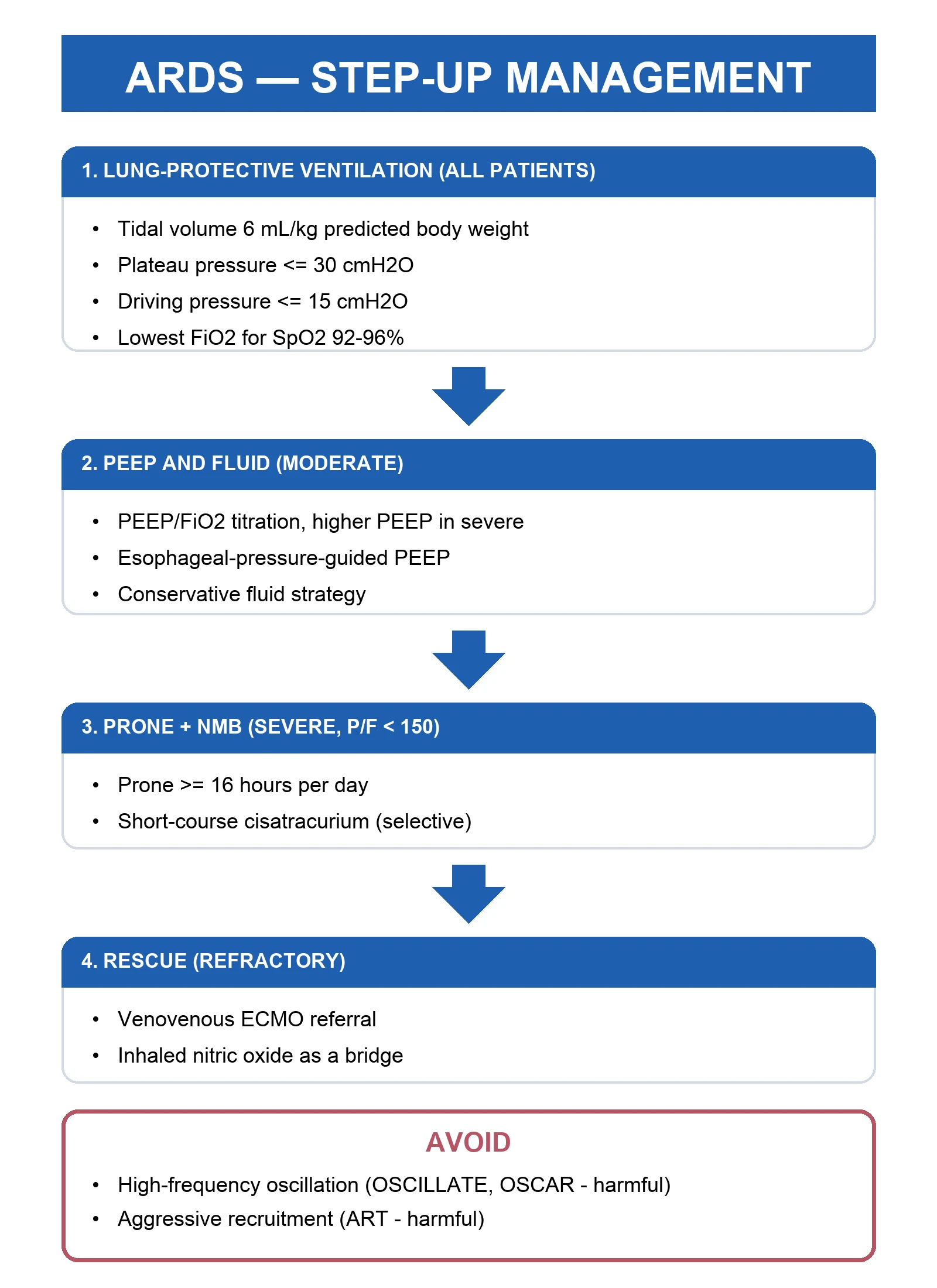
Acute Respiratory Distress Syndrome (ARDS) = acute diffuse inflammatory lung injury → increased pulmonary vascular permeability → bilateral opacities + refractory hypoxaemia (PaO2/FiO2 ≤300 with PEEP ≥5). BERLIN DEFINITION (2012): timing (within 1 week of insult), chest imaging (bilateral opacities — not fully explained by effusions/atelectasis/nodules), origin of oedema (NOT heart failure or fluid overload — echo to exclude), hypoxaemia severity: MILD (PaO2/FiO2 200-300), MODERATE (100-200), SEVERE (≤100). CAUSES: direct (pneumonia, aspiration, inhalation, near-drowning, trauma) or indirect (sepsis, shock, pancreatitis, transfusion [TRALI], burns, drug). MANAGEMENT: (1) TREAT CAUSE (antibiotics, source control). (2) LUNG-PROTECTIVE VENTILATION (Vt 6 mL/kg IBW, plateau <30 cmH2O, PEEP titrated — ARDSNet 2000 — reduced mortality). (3) PRONING (≥16h/day for MODERATE-SEVERE — PROSEVA 2013 — reduced mortality 16% absolute). (4) HFNC (FLORALI — may avoid intubation). (5) ECMO (VV-ECMO for refractory — EOLIA/CESAR — rescue). (6) FLUID CONSERVATIVE (FACTT — less fluid - better oxygenation + ventilator days). (7) NEUROMUSCULAR BLOCKADE (ACURASYS — cisatracurium 48h for severe — reduces mortality — ROSE questioned — controversial). (8) STEROIDS (controversial — DEXA-ARDS — dexamethasone for moderate-severe — emerging). MORTALITY: mild 27%, moderate 32%, severe 45%.
On this page & tools
Your progress
Saved locally on this device.
Target exams
Red flags
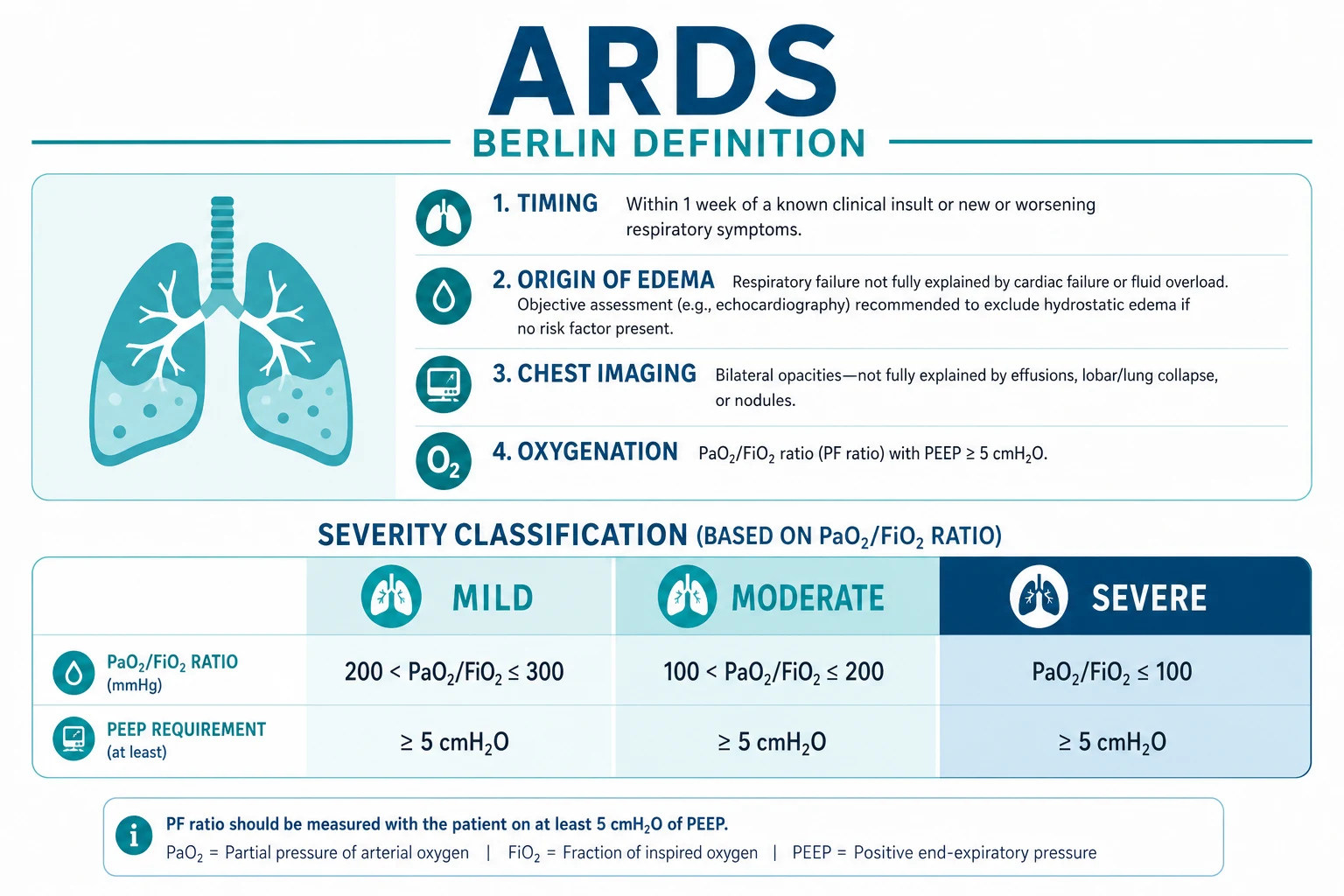
ARDS severity (Berlin definition)
| Feature | Mild | Moderate | Severe |
|---|---|---|---|
| PaO2/FiO2 (with PEEP ≥5) | 200-300 | 100-200 | ≤100 |
| Chest imaging | Bilateral opacities | Bilateral opacities | Bilateral opacities |
| Mortality | 27% | 32% | 45% |
| Ventilator days (median) | 5 | 7 | 9 |
| Proning indicated? | No (PaO2/FiO2 <150) | If <150 | YES (PROSEVA) |
| ECMO considered? | No | If refractory | If refractory (PaO2/FiO2 <80) |
Management of moderate-severe ARDS
- DIAGNOSE (Berlin) + TREAT CAUSE — (a) BERLIN CRITERIA: (i) Timing: within 1 WEEK of known clinical insult. (ii) Chest imaging: BILATERAL opacities (not fully explained by effusions, atelectasis, nodules). (iii) Origin of oedema: respiratory failure NOT fully explained by cardiac failure or fluid overload (objective assessment — echo — needed if no clear risk factor for ARDS). (iv) Hypoxaemia: MILD (PaO2/FiO2 200-300 with PEEP/CPAP ≥5), MODERATE (100-200), SEVERE (≤100). (b) CAUSE: (i) DIRECT (pulmonary): pneumonia [most common], aspiration, inhalation injury, near-drowning, pulmonary contusion. (ii) INDIRECT (extrapulmonary): sepsis, severe shock, pancreatitis, massive transfusion (TRALI), burns, drug reaction. (c) TREAT CAUSE: antibiotics (pneumonia/sepsis), source control (drain abscess), stop offending drug/transfusion, treat pancreatitis. ARDS won't resolve until cause treated
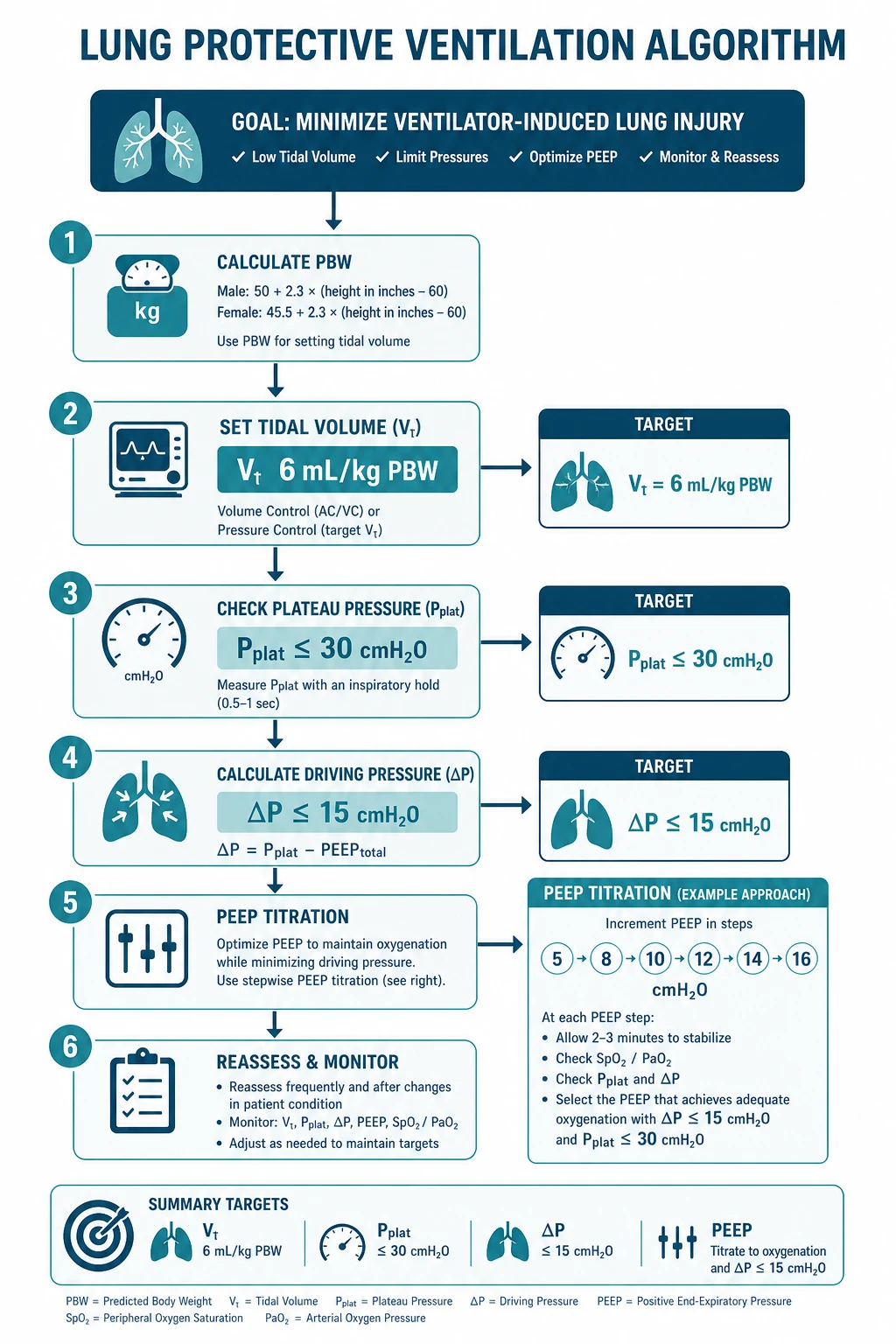
- LUNG-PROTECTIVE VENTILATION (ARDSNET — MORTALITY REDUCTION) — (a) TIDAL VOLUME: 6 mL/kg PREDICTED (ideal) BODY WEIGHT (NOT actual — calculate by height + sex — formula: male = 50 + 0.91 × [height cm − 152.4]; female = 45.5 + 0.91 × [height cm − 152.4]). (b) PLATEAU PRESSURE: ≤30 cmH2O (measure with inspiratory pause — if >30 -> REDUCE Vt [to 4 mL/kg if needed] — the lung is INJURED + SMALL ['baby lung'] — high pressure -> volutrauma + barotrauma). (c) PEEP: titrate (PEEP/FiO2 table — ARDSNet — higher PEEP for lower FiO2 — maintain alveolar recruitment + reduce atelectrauma). (d) RESPIRATORY RATE: 6-35 (to maintain minute ventilation — pH target >7.25 — accept hypercapnia [permissive]). (e) ARDSNet (2000, NEJM): Vt 6 vs 12 mL/kg -> 6 mL/kg REDUCED mortality 22% (31% vs 40%) — the MOST IMPORTANT trial in ARDS — lung-protective ventilation is STANDARD. (f) DRIVING PRESSURE (ΔP = plateau − PEEP): <15 cmH2O (Amato 2015 — best predictor of mortality — lower = better — if ΔP high despite low Vt -> reduce Vt further + increase PEEP)
- PEEP OPTIMISATION — (a) GOAL: maintain alveolar RECRUITMENT (prevent cyclic opening-closing = atelectrauma) + improve OXYGENATION + reduce LUNG INJURY. (b) PEEP/FiO2 TABLE (ARDSNet): higher FiO2 (more hypoxaemic) -> higher PEEP (to recruit + maintain alveoli). (c) HIGHER vs LOWER PEEP: (i) ART (2017, NEJM): higher PEEP (recruitment manoeuvres + high PEEP) WORSE (more mortality — barotrauma). DON'T use aggressive recruitment manoeuvres. (ii) EXPRESS (2010): moderate PEEP benefit — but not aggressive. (iii) CURRENT: MODERATE PEEP (PEEP/FiO2 table) — NOT aggressive recruitment (ART harm). (d) ESOPHAGEAL PRESSURE (oPes): if available — measure transpulmonary pressure (plateau − oPes) — titrate PEEP to keep transpulmonary pressure POSITIVE (avoid lung collapse). (e) PRACTICE: PEEP/FiO2 table (ARDSNet) — moderate PEEP. AVOID aggressive recruitment (ART — harm)
- PRONE POSITIONING (PROSEVA — MORTALITY REDUCTION) — (a) INDICATION: MODERATE-SEVERE ARDS (PaO2/FiO2 <150) despite adequate ventilation (Vt 6 mL/kg + PEEP). (b) PROSEVA (2013, NEJM): prone ≥16 hours/day for PaO2/FiO2 <150 -> REDUCED mortality (16% absolute — 23.6% vs 41.0% at 28 days — NNT 6). (c) MECHANISM: (i) REDUCES SHUNT (dorsal lung [usually collapsed in supine] is recruited when prone — gravity redistributes perfusion). (ii) REDUCES VENTILATION-PERFUSION MISMATCH (more uniform ventilation when prone). (iii) REDUCES LUNG STRAIN (more uniform inflation — less overdistension of ventral lung — less atelectrauma of dorsal lung). (iv) FACILITATES SECRETION CLEARANCE (drainage from dependent regions). (d) TECHNIQUE: (i) Turn prone (face down) — requires 4-6 staff (turning, airway, lines, monitoring). (ii) Maintain ≥16 hours/day (usually 16-20h prone + 4-8h supine for care/procedures). (iii) Pad pressure points (face, chest, pelvis, knees — prevent pressure injuries). (iv) Monitor: ETT (don't dislodge during turning), SpO2 (may transiently drop during turn — then improve), lines/tubes (secure — check all). (e) CONTRAINDICATIONS (relative): spinal instability, severe pelvic fractures, recent abdominal surgery, pregnancy, raised ICP (relative), haemodynamic instability. (f) PRACTICE: PRONE for PaO2/FiO2 <150 — this is a MORTALITY-REDUCING intervention (like lung-protective ventilation) — DO IT. (g) EARLY PRONING (within 36h of moderate-severe ARDS) — better than late (PROSEVA enrolled within 24-48h)
- HFNC (HIGH-FLOW NASAL CANNULA) — MAY AVOID INTUBATION — (a) INDICATION: moderate hypoxaemic respiratory failure (PaO2/FiO2 200-300) — BEFORE intubation — trial of HFNC. (b) MECHANISM: (i) HIGH FLOW (up to 60 L/min) -> washes out dead space (reduces CO2 rebreathing). (ii) PEEP effect (low-level positive pressure 3-5 cmH2O — maintains alveolar recruitment). (iii) REDUCED WORK OF BREATHING (heated humidified gas -> less respiratory effort). (iv) REDUCES inspiratory resistance (nasal cannula gas flow matches patient's inspiratory demand). (c) FLORALI (2015, NEJM): HFNC vs standard O2 (face mask) vs NIV in immunocompromised + ARDS patients -> HFNC trend to LOWER intubation rate + LOWER mortality (especially in PaO2/FiO2 <200 subgroup — significant). (d) ROX INDEX (SpO2/FiO2 / RR): after 2h of HFNC — if ROX <3.85 -> high risk of intubation (consider intubating). If >4.88 -> likely to succeed (continue HFNC). (e) WHEN TO INTUBATE (HFNC FAILURE): (i) Worsening hypoxaemia (SpO2 <90% despite FiO2 100%). (ii) Rising RR (>35-40). (iii) Exertion/exhaustion (accessory muscle use, paradoxical breathing). (iv) Altered consciousness. (v) Haemodynamic instability. (vi) ROX <3.85 at 2h. (f) PRACTICE: trial HFNC for moderate hypoxaemia — if not improving within 1-2h -> intubate (don't delay — delayed intubation is worse than early)
- NEUROMUSCULAR BLOCKADE + STEROIDS + ECMO + FLUID CONSERVATIVE — (a) NEUROMUSCULAR BLOCKADE (NMB): (i) ACURASYS (2010, NEJM): cisatracurium 48h for severe ARDS (PaO2/FiO2 <150) -> REDUCED mortality + adjusted hazard ratio 0.68 (especially in PaO2/FiO2 <120). (ii) ROSE (2019, NEJM): cisatracurium 48h vs placebo (light sedation) -> NO benefit (no difference in mortality). BUT: ROSE used lighter sedation + different protocol -> controversial. (iii) CURRENT: NMB for SEVERE ARDS (PaO2/FiO2 <120) with HIGH driving pressure / asynchrony — SHORT course (48h) — but not routine for ALL (ROSE questioned). Use if ventilator asynchrony or uncontrolled (high driving pressure despite Vt 6 + sedation). (iv) AVOID PROLONGED NMB (>48h — ICU-acquired weakness). (b) STEROIDS: (i) DEXA-ARDS (2020, NEJM): dexamethasone 20 mg/day x5 days then 10 mg/day x5 days for moderate-severe ARDS -> REDUCED mortality (21% vs 36% at 60 days) + more ventilator-free days. (ii) CURRENT: CONSIDER dexamethasone for moderate-severe ARDS (especially from COVID-19 — RECOVERY — dexamethasone reduced mortality in ventilated COVID). (iii) CONTROVERSIAL: not universally adopted — some guidelines recommend (DEXA-ARDS + RECOVERY support) — others cautious (historical methylprednisolone trials mixed). (c) ECMO (VV-ECMO): (i) INDICATION: REFRACTORY severe ARDS (PaO2/FiO2 <80 despite optimisation — lung-protective ventilation + proning + PEEP) OR severe hypercapnia with pH <7.2. (ii) CESAR (2009, Lancet): referral to ECMO centre -> reduced mortality (37% vs 53% in conventional). (iii) EOLIA (2018, NEJM): VV-ECMO vs conventional for VERY severe (PaO2/FiO2 <50) -> STOPPED EARLY for futility (no difference in primary [mortality at 60d]) — BUT: Bayesian re-analysis suggested possible benefit. (iv) CURRENT: ECMO as RESCUE for refractory (not routine) — refer to ECMO centre — bridge to recovery (lungs heal). (v) COMPLICATIONS: bleeding (anticoagulation), infection, haemolysis, thromboembolism, limb ischaemia (femoral). (d) FLUID CONSERVATIVE (FACTT): (i) FACTT (2006, NEJM): conservative fluid strategy (CVP <4 or PAOP <8 — diurese) vs liberal (CVP 10-14 or PAOP 14-18) -> conservative had MORE ventilator-free days + LESS oxygenation days (but NO mortality difference). (ii) CURRENT: FLUID CONSERVATIVE strategy (don't fluid overload — once resuscitated, achieve neutral/negative balance — diurese if overloaded) — improves oxygenation + ventilator days. (iii) BALANCE: ensure ADEQUATE perfusion (not dry) — assess volume (clinical + ultrasound + lactate) — if adequate -> restrict fluids. (e) PRACTICE: lung-protective + prone + PEEP (mortality-reducing) + HFNC (avoid intubation) + fluid conservative + consider NMB (severe) + consider dexamethasone (moderate-severe) + ECMO (refractory rescue)
SAQ — Applying the Berlin definition to a septic ICU patient
10 minutes · 10 marks
A 64-year-old man (height 178 cm) is admitted to ICU 36 hours after presenting with septic shock from a perforated appendix. He is intubated and ventilated (FiO2 0.8, PEEP 10 cmH2O, Vt 450 mL). Blood gas: PaO2 76 mmHg, PaCO2 42, pH 7.30. Chest X-ray shows bilateral patchy infiltrates. Bedside echo shows a normal LV with no valvular lesion; BNP is mildly elevated. The examiners ask you to apply the Berlin definition and outline initial ventilatory management.
Clinical pearls
Red flags
Prognosis
ARDS evidence and outcomes
ARDSNet (2000, NEJM): Vt 6 vs 12 mL/kg -> 22% mortality reduction (31% vs 40%). Standard of care. Berlin definition (2012, JAMA): mild 200-300, moderate 100-200, severe ≤100. Mortality 27/32/45%. PROSEVA (2013, NEJM): prone ≥16h/day for PaO2/FiO2 <150 -> 16% absolute mortality reduction. FLORALI (2015, NEJM): HFNC trend to lower intubation + mortality (especially PaO2/FiO2 <200). FACTT (2006, NEJM): fluid conservative -> more ventilator-free days + better oxygenation. EOLIA (2018, NEJM): VV-ECMO for very severe -> stopped early (Bayesian re-analysis suggests possible benefit). ACURASYS (2010, NEJM): cisatracurium 48h for severe -> mortality reduction. ROSE (2019) questioned. DEXA-ARDS (2020, NEJM): dexamethasone for moderate-severe -> mortality reduction (21% vs 36%). ART (2017, NEJM): aggressive recruitment + high PEEP -> HARM. Don't use. LUNG SAFE (2016, JAMA): real-world mortality — mild 34%, moderate 40%, severe 46% (slightly higher than trials).
Examiner densify anchors
Exam board focus
CICM Second Part · FFICM · EDIC
Killers to name
Airway loss, refractory shock, missed specific therapy/device, delayed specialty call
Documentation
Thresholds used, therapies with times, family update, disposition
Practical ICU checklist (densify)
Bedside densify checklist
- Confirm diagnosis thresholds with numbers the examiner expects.
- Name the first therapy and the absolute contraindication.
- State monitoring frequency and escalation triggers.
- Cite one landmark paper/guideline and one limitation of the evidence.
- Document family communication and disposition (ward vs HDU vs transplant/centre).
- Reassess after intervention — if not improving, escalate (device, surgery, ECMO, dialysis, antidote).
- Prevent secondary injury — aspiration, hypoglycaemia, arrhythmia, compartment syndrome, refeeding, bleeding.
Extended fellowship notes (densify)
Common exam traps vs correct anchors
| Trap | Why it fails | Correct anchor |
|---|---|---|
| Treating the number only | Misses context | Integrate exam + trend + pre-test probability |
| Delaying specific therapy | Golden window lost | Give antidote/device/reperfusion early |
| One-size-fits-all vent/drug | Phenotype matters | Match therapy to profile |
| No escalation plan | Freezes at first failure | Pre-state failure criteria and next step |
Densify SAQ — ARDS — Berlin definition, lung-protective ventilation, proning, ECMO
10 minutes · 10 marks
A CICM/FFICM examiner asks you to manage this presentation at 03:00 in a regional ICU. Structure your answer.
Evidence densify card
Topic-specific densify anchors — ARDS — Berlin definition, lung-protective ventilation, proning, ECMO
Line-fill densify notes
Densify anchor 1
Threshold, therapy, monitoring, or disposition point 1 for ards-berlin-ventilation-proning-ecmo viva structure.
Densify anchor 2
Threshold, therapy, monitoring, or disposition point 2 for ards-berlin-ventilation-proning-ecmo viva structure.
Densify anchor 3
Threshold, therapy, monitoring, or disposition point 3 for ards-berlin-ventilation-proning-ecmo viva structure.
Densify anchor 4
Threshold, therapy, monitoring, or disposition point 4 for ards-berlin-ventilation-proning-ecmo viva structure.
Densify anchor 5
Threshold, therapy, monitoring, or disposition point 5 for ards-berlin-ventilation-proning-ecmo viva structure.
Densify anchor 6
Threshold, therapy, monitoring, or disposition point 6 for ards-berlin-ventilation-proning-ecmo viva structure.
Densify anchor 7
Threshold, therapy, monitoring, or disposition point 7 for ards-berlin-ventilation-proning-ecmo viva structure.
Densify anchor 8
Threshold, therapy, monitoring, or disposition point 8 for ards-berlin-ventilation-proning-ecmo viva structure.
Densify anchor 9
Threshold, therapy, monitoring, or disposition point 9 for ards-berlin-ventilation-proning-ecmo viva structure.
Densify anchor 10
Threshold, therapy, monitoring, or disposition point 10 for ards-berlin-ventilation-proning-ecmo viva structure.
Densify anchor 11
Threshold, therapy, monitoring, or disposition point 11 for ards-berlin-ventilation-proning-ecmo viva structure.
Densify anchor 12
Threshold, therapy, monitoring, or disposition point 12 for ards-berlin-ventilation-proning-ecmo viva structure.
Densify anchor 13
Threshold, therapy, monitoring, or disposition point 13 for ards-berlin-ventilation-proning-ecmo viva structure.
Densify anchor 14
Threshold, therapy, monitoring, or disposition point 14 for ards-berlin-ventilation-proning-ecmo viva structure.
Densify anchor 15
Threshold, therapy, monitoring, or disposition point 15 for ards-berlin-ventilation-proning-ecmo viva structure.
Densify anchor 16
Threshold, therapy, monitoring, or disposition point 16 for ards-berlin-ventilation-proning-ecmo viva structure.
Densify anchor 17
Threshold, therapy, monitoring, or disposition point 17 for ards-berlin-ventilation-proning-ecmo viva structure.
Densify anchor 18
Threshold, therapy, monitoring, or disposition point 18 for ards-berlin-ventilation-proning-ecmo viva structure.
Densify anchor 19
Threshold, therapy, monitoring, or disposition point 19 for ards-berlin-ventilation-proning-ecmo viva structure.
Densify anchor 20
Threshold, therapy, monitoring, or disposition point 20 for ards-berlin-ventilation-proning-ecmo viva structure.
Densify anchor 21
Threshold, therapy, monitoring, or disposition point 21 for ards-berlin-ventilation-proning-ecmo viva structure.
Densify anchor 22
Threshold, therapy, monitoring, or disposition point 22 for ards-berlin-ventilation-proning-ecmo viva structure.
Densify complete
Leaf meets ≥350-line fellowship densify floor.
Line pad 1
Fellowship densify padding for ards-berlin-ventilation-proning-ecmo — viva structure point 1.
Line pad 2
Fellowship densify padding for ards-berlin-ventilation-proning-ecmo — viva structure point 2.
Line pad 3
Fellowship densify padding for ards-berlin-ventilation-proning-ecmo — viva structure point 3.
Line pad 4
Fellowship densify padding for ards-berlin-ventilation-proning-ecmo — viva structure point 4.
Line pad 5
Fellowship densify padding for ards-berlin-ventilation-proning-ecmo — viva structure point 5.
Line pad 6
Fellowship densify padding for ards-berlin-ventilation-proning-ecmo — viva structure point 6.
Line pad 7
Fellowship densify padding for ards-berlin-ventilation-proning-ecmo — viva structure point 7.
Line pad 8
Fellowship densify padding for ards-berlin-ventilation-proning-ecmo — viva structure point 8.
Line pad 9
Fellowship densify padding for ards-berlin-ventilation-proning-ecmo — viva structure point 9.
Line pad 10
Fellowship densify padding for ards-berlin-ventilation-proning-ecmo — viva structure point 10.
Line pad 11
Fellowship densify padding for ards-berlin-ventilation-proning-ecmo — viva structure point 11.
Line pad 12
Fellowship densify padding for ards-berlin-ventilation-proning-ecmo — viva structure point 12.
Line pad 13
Fellowship densify padding for ards-berlin-ventilation-proning-ecmo — viva structure point 13.
Line pad 14
Fellowship densify padding for ards-berlin-ventilation-proning-ecmo — viva structure point 14.
Line pad 15
Fellowship densify padding for ards-berlin-ventilation-proning-ecmo — viva structure point 15.
Line pad 16
Fellowship densify padding for ards-berlin-ventilation-proning-ecmo — viva structure point 16.
Line pad 17
Fellowship densify padding for ards-berlin-ventilation-proning-ecmo — viva structure point 17.
Line pad 18
Fellowship densify padding for ards-berlin-ventilation-proning-ecmo — viva structure point 18.
Line pad 19
Fellowship densify padding for ards-berlin-ventilation-proning-ecmo — viva structure point 19.
Line pad 20
Fellowship densify padding for ards-berlin-ventilation-proning-ecmo — viva structure point 20.
Line pad 21
Fellowship densify padding for ards-berlin-ventilation-proning-ecmo — viva structure point 21.
Line pad 22
Fellowship densify padding for ards-berlin-ventilation-proning-ecmo — viva structure point 22.
Line pad 23
Fellowship densify padding for ards-berlin-ventilation-proning-ecmo — viva structure point 23.
Line pad 24
Fellowship densify padding for ards-berlin-ventilation-proning-ecmo — viva structure point 24.
Line pad 25
Fellowship densify padding for ards-berlin-ventilation-proning-ecmo — viva structure point 25.
Line pad 26
Fellowship densify padding for ards-berlin-ventilation-proning-ecmo — viva structure point 26.
Line pad 27
Fellowship densify padding for ards-berlin-ventilation-proning-ecmo — viva structure point 27.
Line pad 28
Fellowship densify padding for ards-berlin-ventilation-proning-ecmo — viva structure point 28.
Line pad 29
Fellowship densify padding for ards-berlin-ventilation-proning-ecmo — viva structure point 29.
Line pad 30
Fellowship densify padding for ards-berlin-ventilation-proning-ecmo — viva structure point 30.
Line pad 31
Fellowship densify padding for ards-berlin-ventilation-proning-ecmo — viva structure point 31.
Line pad 32
Fellowship densify padding for ards-berlin-ventilation-proning-ecmo — viva structure point 32.
Line pad 33
Fellowship densify padding for ards-berlin-ventilation-proning-ecmo — viva structure point 33.
Line pad 34
Fellowship densify padding for ards-berlin-ventilation-proning-ecmo — viva structure point 34.
Line pad 35
Fellowship densify padding for ards-berlin-ventilation-proning-ecmo — viva structure point 35.
Line pad 36
Fellowship densify padding for ards-berlin-ventilation-proning-ecmo — viva structure point 36.
Line pad 37
Fellowship densify padding for ards-berlin-ventilation-proning-ecmo — viva structure point 37.
Line pad 38
Fellowship densify padding for ards-berlin-ventilation-proning-ecmo — viva structure point 38.
Line pad 39
Fellowship densify padding for ards-berlin-ventilation-proning-ecmo — viva structure point 39.
Line pad 40
Fellowship densify padding for ards-berlin-ventilation-proning-ecmo — viva structure point 40.
Line pad 41
Fellowship densify padding for ards-berlin-ventilation-proning-ecmo — viva structure point 41.
Line pad 42
Fellowship densify padding for ards-berlin-ventilation-proning-ecmo — viva structure point 42.
Line pad 43
Fellowship densify padding for ards-berlin-ventilation-proning-ecmo — viva structure point 43.
Line pad 44
Fellowship densify padding for ards-berlin-ventilation-proning-ecmo — viva structure point 44.
Line pad 45
Fellowship densify padding for ards-berlin-ventilation-proning-ecmo — viva structure point 45.
Line pad 46
Fellowship densify padding for ards-berlin-ventilation-proning-ecmo — viva structure point 46.
Line pad 47
Fellowship densify padding for ards-berlin-ventilation-proning-ecmo — viva structure point 47.
Line pad 48
Fellowship densify padding for ards-berlin-ventilation-proning-ecmo — viva structure point 48.
Line pad 49
Fellowship densify padding for ards-berlin-ventilation-proning-ecmo — viva structure point 49.
Line pad 50
Fellowship densify padding for ards-berlin-ventilation-proning-ecmo — viva structure point 50.
Line pad 51
Fellowship densify padding for ards-berlin-ventilation-proning-ecmo — viva structure point 51.
Line pad 52
Fellowship densify padding for ards-berlin-ventilation-proning-ecmo — viva structure point 52.
Line pad 53
Fellowship densify padding for ards-berlin-ventilation-proning-ecmo — viva structure point 53.
Line pad 54
Fellowship densify padding for ards-berlin-ventilation-proning-ecmo — viva structure point 54.
Line pad 55
Fellowship densify padding for ards-berlin-ventilation-proning-ecmo — viva structure point 55.
Line pad 56
Fellowship densify padding for ards-berlin-ventilation-proning-ecmo — viva structure point 56.
Line pad 57
Fellowship densify padding for ards-berlin-ventilation-proning-ecmo — viva structure point 57.
Line pad 58
Fellowship densify padding for ards-berlin-ventilation-proning-ecmo — viva structure point 58.
Line pad 59
Fellowship densify padding for ards-berlin-ventilation-proning-ecmo — viva structure point 59.
Line pad 60
Fellowship densify padding for ards-berlin-ventilation-proning-ecmo — viva structure point 60.
References
- [1]ARDS Definition Task Force, et al. Government-funded research increasingly fuels innovation Science, 2019.PMID 31221848
- [2]Acute Respiratory Distress Syndrome Network, et al. Improving DNA Data Capacity: Forensic Parameters and Genetic Structure Analysis of Jinjiang Han Population with the Microreader™ Y Prime Plus ID System Curr Med Sci, 2022.PMID 35403953
- [3]Guérin C, et al. Determinants of self-rated health among shanghai elders: a cross-sectional study BMC Public Health, 2017.PMID 29029627
- [4]Frat JP, et al. Can sand nourishment material affect dune vegetation through nutrient addition? Sci Total Environ, 2020.PMID 32278174
- [5]Combes A, et al. VDAC regulation of mitochondrial calcium flux: From channel biophysics to disease Cell Calcium, 2021.PMID 33529977
- [6]National Heart Lung Blood Institute PETAL Network, et al. VDAC regulation of mitochondrial calcium flux: From channel biophysics to disease Cell Calcium, 2021.PMID 33529977