ICU · Respiratory
Acute respiratory distress syndrome: phenotyping and personalised ventilation
Also known as ARDS phenotypes · Personalised ventilation · Hyperinflammatory vs hypoinflammatory ARDS · Recruitment manoeuvres · Driving pressure · ARDS subphenotypes · Latent class analysis ARDS · Precision medicine ARDS · Focal vs non-focal ARDS · Direct vs indirect lung injury · Recruitable lung
ARDS is not a single disease — two distinct phenotypes have been identified. Hyperinflammatory ARDS (high inflammatory markers, vasopressor-dependent, lower mortality with higher PEEP): responds better to higher PEEP and prone positioning. Hypoinflammatory ARDS (lower inflammatory markers, more extrapulmonary cause): may not benefit from aggressive PEEP. Personalised ventilation: individualise PEEP based on recruitability (PEEP titration by P-V curves, EIT, oesophageal pressure), driving pressure (<15 cmH2O — Amato meta-analysis: driving pressure is the strongest predictor of mortality), and lung morphology (focal vs non-focal on CT — focal ARDS tolerates higher PEEP poorly). Recruitment manoeuvres controversial (ART trial: caused harm). Prone positioning beneficial for moderate-severe ARDS (PaO2/FiO2 <150). Latent class analysis of the ALVEOLI and FACTT trials (Calfee 2014) identified the hyperinflammatory (type 2) and hypoinflammatory (type 1) subphenotypes using biomarkers — IL-6, IL-8, soluble TNF receptor-1, angiopoietin-2, bicarbonate, protein C. The subphenotype determines treatment response: higher PEEP and simvastatin benefit the hyperinflammatory phenotype but may harm the hypoinflammatory phenotype (HARP-2 secondary analysis, Calfee 2018). Precision medicine in ARDS is evolving but not yet routine bedside practice.
On this page & tools
Your progress
Saved locally on this device.
Target exams
Red flags
Overview & definition
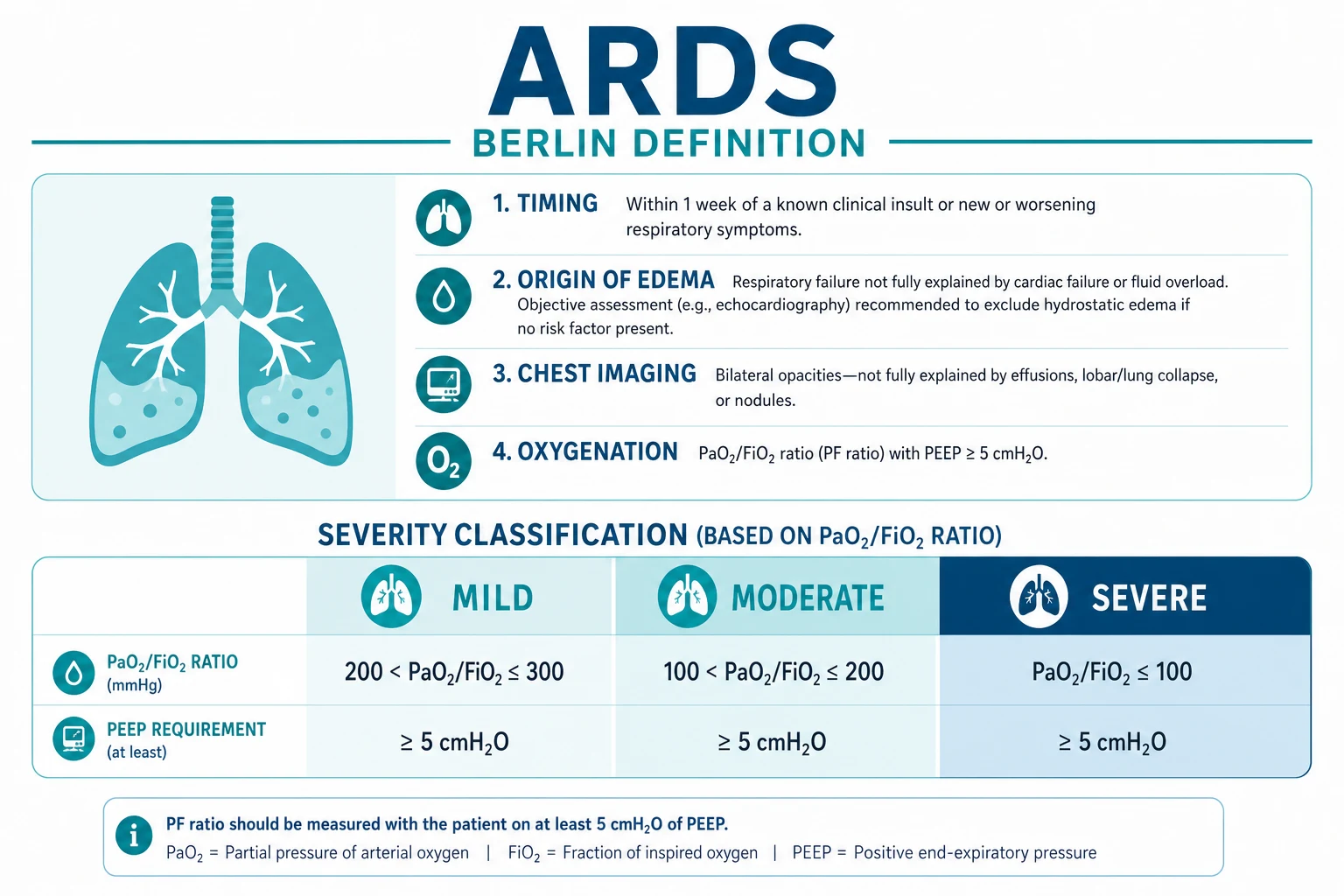
The Berlin definition (Ranieri, JAMA 2012) defined ARDS by timing (within one week of a known clinical insult), chest imaging (bilateral opacities not fully explained by effusions, lobar/lung collapse, or nodules), origin of oedema (not fully explained by cardiac failure or fluid overload), and hypoxaemia stratified into mild, moderate, and severe by the PaO2/FiO2 ratio under standard ventilator settings.[9] The definition deliberately lumped together a heterogeneous group of precipitants — pneumonia, aspiration, sepsis, trauma, pancreatitis, transfusion — under one umbrella. That heterogeneity is the central problem in ARDS: dozens of pharmacological trials (statins, beta-agonists, nitric oxide, keratinocyte growth factor, antioxidants) have been neutral overall, almost certainly because a treatment that helps one biological subgroup is diluted by harm (or no effect) in another.[1][5]
Phenotyping is the attempt to split the Berlin umbrella into biologically coherent subgroups that differ in prognosis AND in treatment response, so that ventilation strategy, fluid strategy, and drugs can be matched to the patient in front of you. Three overlapping phenotyping axes are in active use: (1) biological subphenotypes identified by latent class analysis (hyper- versus hypoinflammatory); (2) radiographic / morphological phenotypes (focal versus non-focal, recruitable versus non-recruitable); and (3) aetiological phenotypes (direct versus indirect lung injury).[1][16][17]
[1]The two biological subphenotypes
The seminal observation is Calfee and the NHLBI ARDS Network's latent class analysis of the ALVEOLI and FACTT trials (Lancet Respir Med 2014). Using routinely measured clinical variables and plasma biomarkers, the statistical analysis — which is given no a priori group labels — repeatedly converged on two stable subphenotypes.[1]
Hyperinflammatory (Type 2)
More severe, more treatable
- High inflammatory markers (IL-6, IL-8, sTNFr-1, angiopoietin-2, CRP, surfactant protein D)
- More vasopressor-dependent, lower PaO2/FiO2
- More likely to have sepsis/pneumonia as cause
- RESPONDS to: higher PEEP, prone positioning, conservative fluid strategy
- Lower mortality when treated aggressively (PEEP, prone)
- Latent class analysis: ~30 per cent of ARDS patients
Hypoinflammatory (Type 1)
Less severe, less responsive
- Lower inflammatory markers
- More likely to have trauma/aspiration as cause
- Less vasopressor-dependent, higher PaO2/FiO2
- Does NOT benefit as much from higher PEEP or aggressive strategies
- Lower overall mortality but less improvement with aggressive treatment
- ~70 per cent of ARDS patients
How the subphenotypes were found — latent class analysis
Latent class analysis (LCA) is an unsupervised statistical technique: it takes many correlated variables per patient and asks, with no pre-specified groupings, how many statistically distinct classes best explain the data. Applied to the ARDS Network datasets, the variables that most cleanly separate the two classes are a mix of plasma biomarkers and routine clinical chemistry:[1][4]
- Interleukin-6 (IL-6) — high in the hyperinflammatory phenotype
- Interleukin-8 (IL-8) — neutrophil chemoattractant, high in hyperinflammatory
- Soluble TNF receptor-1 (sTNFr-1) — a stable marker of TNF signalling, markedly elevated in hyperinflammatory
- Angiopoietin-2 — endothelial activation and permeability; high in hyperinflammatory and predicts mortality
- Bicarbonate — lower in hyperinflammatory (reflecting the metabolic acidosis of organ failure)
- Protein C — lower in hyperinflammatory (consumption / endothelial dysfunction)
- Surfactant protein D — elevated in hyperinflammatory (alveolar epithelial injury) [1]
Crucially, the two-class solution was reproducible across independent trials (ALVEOLI, FACTT, and later HARP-2 and SAILS), and a machine-learning classifier trained on these variables assigns new patients to a class with high concordance — meaning the subphenotypes are real, robust, and not a one-trial artefact.[1][5][6]
Do the subphenotypes change over time?
The Delucchi Thorax 2018 analysis of two ARDS Network trials asked whether a patient's subphenotype is a fixed trait or a moving state. The hyperinflammatory class was reasonably stable over the first few days, but a meaningful minority of patients transitioned between classes as their illness evolved — typically resolving from hyper- to hypoinflammatory as inflammation settled, or the reverse with a new nosocomial infection. This means subphenotyping is best treated as a dynamic, reassessable assignment rather than a single once-only label.[6]
Clinical and pathophysiological differences in detail
The two subphenotypes are not merely statistical curiosities — they describe genuinely different illnesses with different physiology, different organ involvement, and different natural histories.[1][3]
Hyperinflammatory (type 2) vs hypoinflammatory (type 1) — clinical detail
| Variable | Hyperinflammatory (type 2) | Hypoinflammatory (type 1) |
|---|---|---|
| Prevalence | ~30 per cent | ~70 per cent |
| Inflammation (IL-6, sTNFr-1, angiopoietin-2) | Markedly elevated | Low / near-normal |
| CRP, surfactant protein D | High | Lower |
| PaO2/FiO2 | Lower (worse oxygenation) | Higher (better oxygenation) |
| Bicarbonate | Low (metabolic acidosis) | Normal / higher |
| Protein C | Low (consumption) | Normal |
| Vasopressor requirement | Frequent, high dose | Less common |
| Organ failure | Multi-organ, sepsis-like | Lung-predominant |
| Fluid balance | Higher / more positive | Lower |
| Mortality | Higher (~40-50 per cent) | Lower (~20-25 per cent) |
| Response to higher PEEP | BENEFITS (recruitable lung) | HARMED (overdistension) |
| Response to conservative fluid | BENEFITS | Largely neutral |
| Response to simvastatin | Reduced mortality (HARP-2) | Harm signal |
| Typical aetiology | Sepsis, extrapulmonary source | Pneumonia, aspiration, trauma |
The pathophysiological story is that the hyperinflammatory phenotype behaves like uncontrolled sepsis localised to the lung: unchecked cytokine release (IL-6, TNF signalling via sTNFr-1), endothelial permeability (angiopoietin-2), coagulation activation (low protein C), and multi-organ dysfunction drive both a higher mortality and a window of susceptibility to anti-inflammatory and lung-recruiting interventions. The hypoinflammatory phenotype is closer to a primary, more localised lung injury with preserved systemic homeostasis — less recruitable, less inflamed, and therefore not helped (and potentially harmed) by escalating ventilator and fluid interventions that add stress without addressing a recruitable, inflamed target.[1][17]
Driving pressure
[2]Treatment implications — the subphenotype changes the answer
This is the exam-critical, practice-changing point. The same intervention can be life-saving in one subphenotype and harmful in the other — which is exactly why the headline trials were neutral when they mixed the two classes together. [1]
1. Higher versus lower PEEP — the ALVEOLI reanalysis
The ALVEOLI trial (higher vs lower PEEP) was neutral overall. The Calfee 2014 latent class reanalysis showed why: higher PEEP improved survival in the hyperinflammatory subphenotype but showed a trend toward increased mortality in the hypoinflammatory subphenotype (overdistension of non-recruitable lung).[1] The lesson is that "how much PEEP" is not a population question — it is a phenotype-and-recruitability question. Note: the assignment's "SPHINCTER trial" label does not correspond to a discrete published trial; the differential PEEP-by-phenotype evidence comes from these subphenotype re-analyses of the ARDS Network PEEP studies (ALVEOLI), not from a trial called SPHINCTER.[1][5]
2. Simvastatin — the HARP-2 secondary analysis
The HARP-2 trial (McAuley, NEJM 2014) tested simvastatin in ARDS and was neutral overall.[7] The Calfee 2018 secondary latent class analysis (Lancet Respir Med) found a differential treatment effect: in the hyperinflammatory subphenotype, simvastatin was associated with a large reduction in 90-day mortality, whereas in the hypoinflammatory subphenotype there was a signal toward harm.[4] This is the canonical example of precision medicine in ARDS — a "negative" trial that hides a positive result in a definable subgroup. Note: this differential statin effect is the HARP-2 secondary analysis; there is no published ARDS "CALM trial" of simvastatin.[4][7]
3. Rosuvastatin — the SAILS trial and its secondary analysis
The SAILS trial (NHLBI ARDS Network, NEJM 2014) tested rosuvastatin in sepsis-associated ARDS and was negative overall, with no reduction in 60-day mortality.[8] The Sinha 2018 latent class secondary analysis of SAILS again identified the two subphenotypes and a similar pattern — a signal of differential effect — though the SAILS subphenotype analysis was less conclusive than HARP-2's because SAILS enrolled only sepsis-associated ARDS (a more homogeneous, more hyperinflammatory population).[5] Taken together, the two statin trials suggest that any statin benefit is confined to the hyperinflammatory phenotype and that a precision-medicine design would have asked a sharper question than pooling all comers.[4][5]
4. Fluid strategy — the FACTT reanalysis
The FACTT trial (Wiedemann, NEJM 2006) showed that a conservative fluid strategy (targeting lower filling pressures) improved oxygenation and increased ventilator-free days versus a liberal strategy.[12] The Famous 2017 subphenotype reanalysis found that the benefit of conservative fluids was driven by the hyperinflammatory phenotype: the hypoinflammatory phenotype derived little additional benefit, consistent with their lower endothelial permeability and lower fluid overload.[3]
Treatment response by subphenotype — the precision medicine summary
| Intervention | Hyperinflammatory (type 2) | Hypoinflammatory (type 1) | Net trial result |
|---|---|---|---|
| Higher PEEP (ALVEOLI) | Benefit (mortality lower) | Harm signal (overdistension) | Neutral overall |
| Conservative fluids (FACTT) | Benefit (more VFDs) | Largely neutral | Benefit overall |
| Simvastatin (HARP-2) | Benefit (mortality lower) | Harm signal | Neutral overall |
| Rosuvastatin (SAILS) | Possible benefit | Less effect / harm signal | Neutral overall |
| Prone positioning (PROSEVA) | Benefit | Likely benefit (across phenotypes) | Benefit in severe ARDS |
| Recruitment manoeuvre + high PEEP (ART) | Harm | Harm | Harm overall |
| ECMO (EOLIA) | Rescue | Rescue | Refractory disease |
Other phenotyping axes
Biological subphenotyping is only one lens. Two further axes are clinically usable today and frequently appear in fellowship exams. [1]
Radiographic phenotype — focal versus non-focal ARDS
On chest CT (or bedside ultrasound), ARDS lungs fall along a spectrum from focal (dense consolidation confined to the dependent, dorsal regions with relatively spared non-dependent lung) to non-focal (diffuse, homogeneous involvement).[16] This matters enormously for PEEP: in focal ARDS, raising PEEP preferentially overdistends the already-open healthy non-dependent lung without recruiting the dense dependent consolidation — worsening dynamic strain and potentially driving driving pressure UP. In non-focal ARDS, there is more uniformly recruitable lung, so higher PEEP can recruit without preferential overdistension. Rule of thumb: focal ARDS does not tolerate high PEEP; non-focal ARDS may. This is the CT correlate of the hypoinflammatory (often more focal) versus hyperinflammatory (often more diffuse) distinction, though the two axes are not identical.[16]
Recruitable versus non-recruitable lung
Gattinoni's NEJM 2006 study quantified lung recruitability — the fraction of lung tissue that can be reopened by a recruitment manoeuvre and held open with PEEP — using whole-lung CT at different airway pressures. Recruitability varied enormously between patients (from near zero to over 50 per cent of lung weight). Patients with high recruitability benefit from higher PEEP; patients with low recruitability are exposed to the haemodynamic and overdistension costs of high PEEP with no alveolar benefit.[16] Bedside tools to estimate recruitability include the pressure-volume (P-V) curve (lower and upper inflection points), electrical impedance tomography (EIT) (regional tidal impedance distribution), oesophageal pressure (transpulmonary pressure-guided PEEP), and the change in driving pressure when PEEP is raised (if ΔP falls, the lung is recruitable; if ΔP rises, it is not).[16][20]
Direct versus indirect lung injury
Pelosi and colleagues distinguished pulmonary (direct) ARDS — primary alveolar insult: pneumonia, aspiration, pulmonary contusion, near-drowning, inhalation injury — from extrapulmonary (indirect) ARDS — systemic inflammation injuring the lung from the vasculature: sepsis, trauma/shock, pancreatitis, massive transfusion (TRALI).[17] Direct ARDS tends to be more focal, with predominant alveolar consolidation and less recruitable lung; indirect ARDS tends to be more diffuse, with more interstitial oedema and endothelial permeability (and overlaps heavily with the hyperinflammatory phenotype). The distinction is imperfect and patients blur across categories, but it reinforces the same theme: morphology and biology jointly determine what the ventilator should do.[17]
Emerging and alternative phenotypes
- COVID-19 phenotypes: Sinha and colleagues (Lancet Respir Med 2020) showed that the two classical subphenotypes are also present in COVID-19 ARDS, with the hyperinflammatory phenotype again carrying higher mortality — reinforcing that the phenotypes are biology, not a peculiarity of any one aetiology.[19]
- Interleukin-18 (IL-18): Moore and colleagues (Crit Care Med 2023) showed that elevated plasma IL-18 identifies a high-mortality ARDS group not fully captured by the two established subphenotypes, suggesting a possible third / refined phenotype and a biomarker for future enrichment of anti-inflammatory trials.[18]
FlowSteps: a bedside subphenotype-aware approach
Personalised ventilation in suspected ARDS — a phenotype-aware algorithm
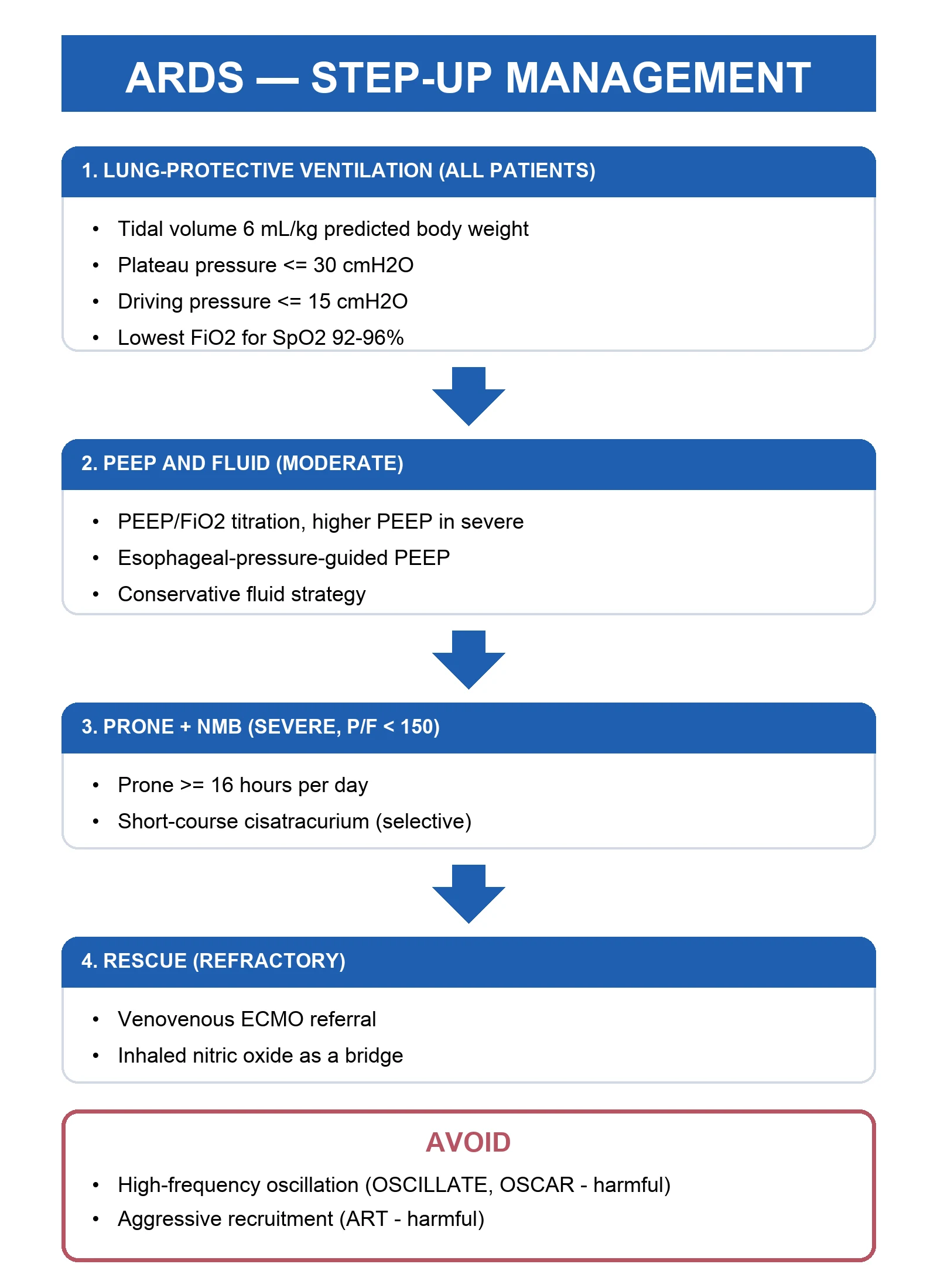
- Confirm ARDS (Berlin) — onset within one week, bilateral opacities, non-cardiogenic oedema, PaO2/FiO2 under 300 on PEEP at least 5 cmH2O. Start lung-protective ventilation immediately: tidal volume 6 mL/kg PBW, plateau under 30 cmH2O.[9]
- Estimate the phenotype — using clinical surrogates (or biomarkers if available). Sepsis source, high CRP, vasopressor need, low bicarbonate, multi-organ failure → hyperinflammatory. Aspiration/trauma, low CRP, single-organ lung failure → hypoinflammatory.[1][3]
- Set driving pressure first — titrate tidal volume (down to 4 mL/kg if needed) to keep ΔP <15 cmH2O; this is the strongest mortality-linked ventilator target.[2][20]
- Titrate PEEP to recruitability — if the lung is recruitable (hyperinflammatory, non-focal CT, ΔP falls when PEEP rises), favour higher PEEP. If not recruitable (hypoinflammatory, focal CT, ΔP rises with PEEP), keep PEEP moderate to avoid overdistension.[1][16]
- Apply a conservative fluid strategy — especially in the hyperinflammatory phenotype; target a neutral-to-negative balance once shock has resolved (FACTT).[3][12]
- Prone early if severe — PaO2/FiO2 under 150 for at least 16 hours/day; benefit appears across phenotypes (PROSEVA).[10]
- Use NMBA selectively, not routinely — reserve cisatracurium for dangerous ventilation, severe refractory hypoxaemia, or asynchrony (ROSE refuted routine use).[13][14]
- Avoid harmful interventions — aggressive recruitment + very high PEEP (ART), routine inhaled nitric oxide (no mortality benefit, AKI risk), beta-2 agonists (BALTI-2: increased mortality).[11]
- Escalate to VV-ECMO for refractory disease — PaO2/FiO2 under 50 for more than 3 hours, under 80 for more than 6 hours, or refractory acidosis/plateau over 30 cmH2O (EOLIA).[15]
- Reassess the phenotype over time — subphenotypes can transition; re-estimate if a new infection develops or inflammation resolves.[6]
Trial cards — the evidence base
Calfee 2014 — latent class analysis of ALVEOLI and FACTT (Lancet Respir Med)
Secondary latent class analysis of 1,049 ARDS patients in the ALVEOLI (higher vs lower PEEP) and FACTT (conservative vs liberal fluid) trials. Two reproducible subphenotypes emerged (hyper- and hypoinflammatory). Hyperinflammatory patients had higher mortality. In the ALVEOLI cohort, higher PEEP reduced mortality in the hyperinflammatory subphenotype and showed a trend to harm in the hypoinflammatory subphenotype. Significance: the foundational paper for ARDS subphenotypes and for understanding why neutral trials hide differential effects.[1]
HARP-2 (McAuley, NEJM 2014) and Calfee 2018 secondary analysis (Lancet Respir Med)
HARP-2 randomised 540 ARDS patients to simvastatin 80 mg vs placebo: no difference in 28-day ventilator-free days (neutral overall).[7] The Calfee 2018 secondary latent class analysis identified the two subphenotypes and found a differential treatment effect: simvastatin reduced 90-day mortality in the hyperinflammatory phenotype but showed a harm signal in the hypoinflammatory phenotype.[4] Significance: the clearest proof-of-concept that a "negative" ARDS drug trial can hide a positive result in a definable subgroup — precision medicine.
SAILS (NHLBI ARDS Network, NEJM 2014) and Sinha 2018 secondary analysis
SAILS randomised 745 patients with sepsis-associated ARDS to rosuvastatin vs placebo: no difference in 60-day in-hospital mortality (negative overall).[8] The Sinha 2018 secondary analysis again found the two subphenotypes and a pattern of differential effect.[5] Significance: confirms the two statin trials independently reproduce the subphenotypes; any statin benefit is confined to the hyperinflammatory phenotype.
FACTT (Wiedemann, NEJM 2006) and Famous 2017 secondary analysis
FACTT randomised 1,000 acute lung injury patients to conservative vs liberal fluid management: the conservative strategy improved oxygenation and increased ventilator-free days without changing mortality.[12] The Famous 2017 secondary analysis showed the conservative-fluid benefit was driven by the hyperinflammatory phenotype.[3] Significance: fluid strategy is phenotype-dependent; conservative fluids help most where inflammation-driven permeability is highest.
PROSEVA (Guérin, NEJM 2013) — prone positioning in severe ARDS
Randomised 466 patients with PaO2/FiO2 under 150 to prone positioning for at least 16 hours/day vs supine. 28-day mortality fell from 32.8 to 16.0 per cent and 90-day mortality fell from 41.0 to 23.6 per cent, with no increase in complications. Significance: the only ARDS adjunct that consistently reduces mortality; first-line in severe ARDS and benefit appears across subphenotypes.[10]
ART (Cavalcanti, JAMA 2017) — aggressive recruitment + high PEEP HARMFUL
Randomised 1,010 moderate-severe ARDS patients to a stepwise recruitment manoeuvre plus titrated high PEEP vs a conventional low-PEEP strategy. 28-day mortality INCREASED (29.3 vs 24.6 per cent). Significance: aggressive recruitment is harmful; recruitment must be gentle, selective, and guided by recruitability and the effect on driving pressure.[11]
EOLIA (Combes, NEJM 2018) — VV-ECMO for very severe ARDS
Randomised 249 patients with very severe ARDS to VV-ECMO vs conventional ventilation. Stopped early for futility; 60-day mortality 35 vs 46 per cent did not reach significance, but Bayesian re-analysis and post-hoc crossover-adjusted data support benefit. Significance: VV-ECMO remains the rescue for refractory disease (EOLIA-derived thresholds in the FlowSteps above).[15]
Precision medicine in ARDS — applicability and limits
Where does this leave the practising intensivist today?[1][5]
- Subphenotyping is not yet standard bedside practice. The full biomarker panel (IL-6, IL-8, sTNFr-1, angiopoietin-2, protein C, surfactant protein D) is a research tool — turnaround time and cost preclude routine clinical use in most units. Clinical surrogates are a reasonable interim.[3]
- The mechanism is compelling and reproducible. The two-class solution has appeared in ALVEOLI, FACTT, HARP-2, SAILS, and in COVID-19 ARDS — it is not a single-trial statistical mirage.[1][5][19]
- No completed prospective trial has randomised by phenotype. The differential effects are all secondary analyses (hypothesis-generating). A prospective trial that assigns treatment by phenotype is the next step; until then, treatment-by-phenotype is an informed, evolving practice rather than a guideline mandate.[4][6]
- Practical, defensible today: (a) drive ΔP <15 as the first priority regardless of phenotype; (b) favour higher PEEP in the hyperinflammatory / non-focal / recruitable patient and keep PEEP moderate in the hypoinflammatory / focal / non-recruitable patient; (c) apply conservative fluids and early proning in severe disease; (d) reserve NMBA and ECMO for their defined indications; (e) do not use statins or recruitment manoeuvres as routine therapy.[2][10][11]
- Watch for transition — a patient's phenotype can shift, and a new nosocomial sepsis can move a hypoinflammatory patient into the high-mortality hyperinflammatory state.[6]
SAQ — Driving-pressure-targeted, phenotype-aware ventilation in moderate ARDS
10 minutes · 10 marks
A 49-year-old man with pneumococcal pneumonia and septic shock (noradrenaline 0.25 µg/kg/min, lactate 3.1, CRP 280, vasopressor-dependent) is intubated for ARDS. On volume-control ventilation (Vt 6 mL/kg predicted body weight, RR 28, PEEP 12, FiO₂ 0.7) his plateau pressure is 29 cmH₂O and his PaO₂/FiO₂ is 110. Bedside CT shows diffuse, non-focal bilateral ground-glass and consolidation.
SAQ — Escalation for refractory hypoxaemia in severe ARDS
10 minutes · 10 marks
A 38-year-old woman with influenza A pneumonia has severe ARDS. Despite optimised lung-protective ventilation (Vt 6 mL/kg PBW, plateau 27, driving pressure 14, PEEP 16) and 16-hour daily prone positioning, her PaO₂/FiO₂ is 65 on FiO₂ 1.0, with pH 7.18 and plateau pressure rising to 32. She is on noradrenaline 0.3 µg/kg/min. The team asks when to escalate to venovenous ECMO.
Clinical pearls
Red flags
Prognosis
The single most powerful predictor of mortality within the ARDS population is the subphenotype: hyperinflammatory (type 2) carries roughly twice the mortality of hypoinflammatory (type 1) in every dataset in which both have been measured (ALVEOLI, FACTT, HARP-2, SAILS, COVID-19 cohorts). Within a subphenotype, the driving pressure is the strongest modifiable ventilator predictor, and recruitability / morphology determines whether escalating PEEP will help or harm. The practical synthesis for prognosis and counselling: a hyperinflammatory, vasopressor-dependent, low-PaO2/FiO2 patient with a high driving pressure and focal non-recruitable lung is at the highest risk and is the one for whom the full armamentarium (conservative fluids, proning, ECMO) must be mobilised early; a hypoinflammatory, well-oxygenated patient with a low driving pressure has a markedly better prognosis and is best served by a restrained, lung-protective strategy that avoids iatrogenic overdistension.[1][2][19]
References
- [1]Calfee CS, Delucchi K, Parsons PE, et al.; NHLBI ARDS Network. Subphenotypes in acute respiratory distress syndrome: latent class analysis of data from two randomised controlled trials Lancet Respir Med, 2014.PMID 24853585
- [2]Amato MBP, Meade MO, Slutsky AS, et al. Driving pressure and survival in the acute respiratory distress syndrome N Engl J Med, 2015.PMID 25693014
- [3]Famous KR, Delucchi K, Ware LB, et al.; ARDS Network. Acute Respiratory Distress Syndrome Subphenotypes Respond Differently to Randomized Fluid Management Strategy Am J Respir Crit Care Med, 2017.PMID 27513822
- [4]Calfee CS, Delucchi KL, Sinha P, et al. Acute respiratory distress syndrome subphenotypes and differential response to simvastatin: secondary analysis of a randomised controlled trial Lancet Respir Med, 2018.PMID 30078618
- [5]Sinha P, Delucchi KL, McAuley DF, O'Kane CM, Matthay MA, Calfee CS. Latent class analysis of ARDS subphenotypes: a secondary analysis of the statins for acutely injured lungs from sepsis (SAILS) study Intensive Care Med, 2018.PMID 30291376
- [6]Delucchi K, Famous KR, Ware LB, Parsons PE, Thompson BT, Calfee CS; ARDS Network. Stability of ARDS subphenotypes over time in two randomised controlled trials Thorax, 2018.PMID 29477989
- [7]McAuley DF, Laffey JG, O'Kane CM, et al.; HARP-2 Investigators. Simvastatin in the acute respiratory distress syndrome N Engl J Med, 2014.PMID 25268516
- [8]National Heart, Lung, and Blood Institute ARDS Clinical Trials Network; Truwit JD, Bernard GR, Steingrub J, et al. Rosuvastatin for sepsis-associated acute respiratory distress syndrome N Engl J Med, 2014.PMID 24835849
- [9]Ranieri VM, Rubenfeld GD, Thompson BT, et al.; ARDS Definition Task Force. Acute respiratory distress syndrome: the Berlin Definition JAMA, 2012.PMID 22797452
- [10]Guérin C, Reignier J, Richard JC, et al.; PROSEVA Study Group. Prone positioning in severe acute respiratory distress syndrome N Engl J Med, 2013.PMID 23688302
- [11]Cavalcanti AB, Suzumura ÉA, Laranjeira LN, et al.; ART Investigators. Effect of Lung Recruitment and Titrated Positive End-Expiratory Pressure (PEEP) vs Low PEEP on Mortality in Patients With Acute Respiratory Distress Syndrome: A Randomized Clinical Trial JAMA, 2017.PMID 28973363
- [12]Wiedemann HP, Wheeler AP, Bernard GR, et al.; National Heart, Lung, and Blood Institute Acute Respiratory Distress Syndrome (ARDS) Clinical Trials Network. Comparison of two fluid-management strategies in acute lung injury N Engl J Med, 2006.PMID 16714767
- [13]Papazian L, Forel JM, Gacouin A, et al.; ACURASYS Study Investigators. Neuromuscular blockers in early acute respiratory distress syndrome N Engl J Med, 2010.PMID 20843245
- [14]National Heart, Lung, and Blood Institute PETAL Clinical Trials Network; Moss M, Huang DT, Brower RG, et al. Early Neuromuscular Blockade in the Acute Respiratory Distress Syndrome N Engl J Med, 2019.PMID 31112383
- [15]Combes A, Hajage D, Capellier G, et al.; EOLIA Trial Investigators, REVA, ECMONet, and the European Society of Intensive Care Medicine. Extracorporeal Membrane Oxygenation for Severe Acute Respiratory Distress Syndrome N Engl J Med, 2018.PMID 29791822
- [16]Gattinoni L, Caironi P, Cressoni M, et al. Lung recruitment in patients with the acute respiratory distress syndrome N Engl J Med, 2006.PMID 16641394
- [17]Pelosi P, D'Onofrio D, Chiumello D, et al. Pulmonary and extrapulmonary acute respiratory distress syndrome are different Eur Respir J Suppl, 2003.PMID 12946001
- [18]Moore AR, Pienkos SM, Sinha P, et al. Elevated Plasma Interleukin-18 Identifies High-Risk Acute Respiratory Distress Syndrome Patients not Distinguished by Prior Latent Class Analyses Using Traditional Inflammatory Cytokines: A Retrospective Analysis of Two Randomized Clinical Trials Crit Care Med, 2023.PMID 37695136
- [19]Sinha P, Churpek MM, Calfee CS. Prevalence of phenotypes of acute respiratory distress syndrome in critically ill patients with COVID-19: a prospective observational study Lancet Respir Med, 2020.PMID 32861275
- [20]Guérin C, Dequin PF, Perbet S, et al. Effect of driving pressure on mortality in ARDS patients during lung protective mechanical ventilation in two randomized controlled trials Crit Care, 2016.PMID 27894328