ICU · Respiratory / ventilation
Inhaled Pulmonary Vasodilators — Nitric Oxide & Inhaled Prostacyclin
Also known as Inhaled nitric oxide · iNO · Inhaled prostacyclin · Inhaled epoprostenol · Inhaled iloprost · Selective pulmonary vasodilator · Pulmonary hypertension · Acute cor pulmonale · Persistent pulmonary hypertension of the newborn · PPHN · Methaemoglobinaemia
Inhaled pulmonary vasodilators (inhaled nitric oxide and inhaled prostacyclin/epoprostenol) selectively vasodilate the vasculature of well-ventilated alveoli, improving V/Q matching (oxygenation by reducing shunt) and reducing pulmonary vascular resistance (RV afterload), with minimal systemic vasodilation because they are inactivated on entering the blood. Inhaled nitric oxide (5-40 ppm) risks methaemoglobinaemia, rebound on withdrawal, and nitrogen-dioxide toxicity; inhaled prostacyclin (nebulised) is cheaper and avoids methaemoglobinaemia. They are used for refractory hypoxaemia (a transient oxygenation benefit with no mortality gain in ARDS), pulmonary hypertension and right-ventricular failure, and persistent pulmonary hypertension of the newborn. They must be tapered to avoid rebound.
On this page & tools
Your progress
Saved locally on this device.
Target exams
Overview & definition
Inhaled pulmonary vasodilators — inhaled nitric oxide (iNO) and inhaled prostacyclin (epoprostenol), with iloprost for selected chronic use — are delivered into the inspired gas, so they reach only well-ventilated alveoli and dilate the vessels supplying them. The result is two effects: improved ventilation-perfusion matching (blood is redirected from non-ventilated shunt units to ventilated ones, improving oxygenation) and a fall in pulmonary vascular resistance (reducing right-ventricular afterload). Because they are inactivated as they enter the blood (nitric oxide binds haemoglobin; prostacyclin is rapidly metabolised), they have minimal systemic vasodilation, unlike intravenous vasodilators.[1][1]
The mechanism
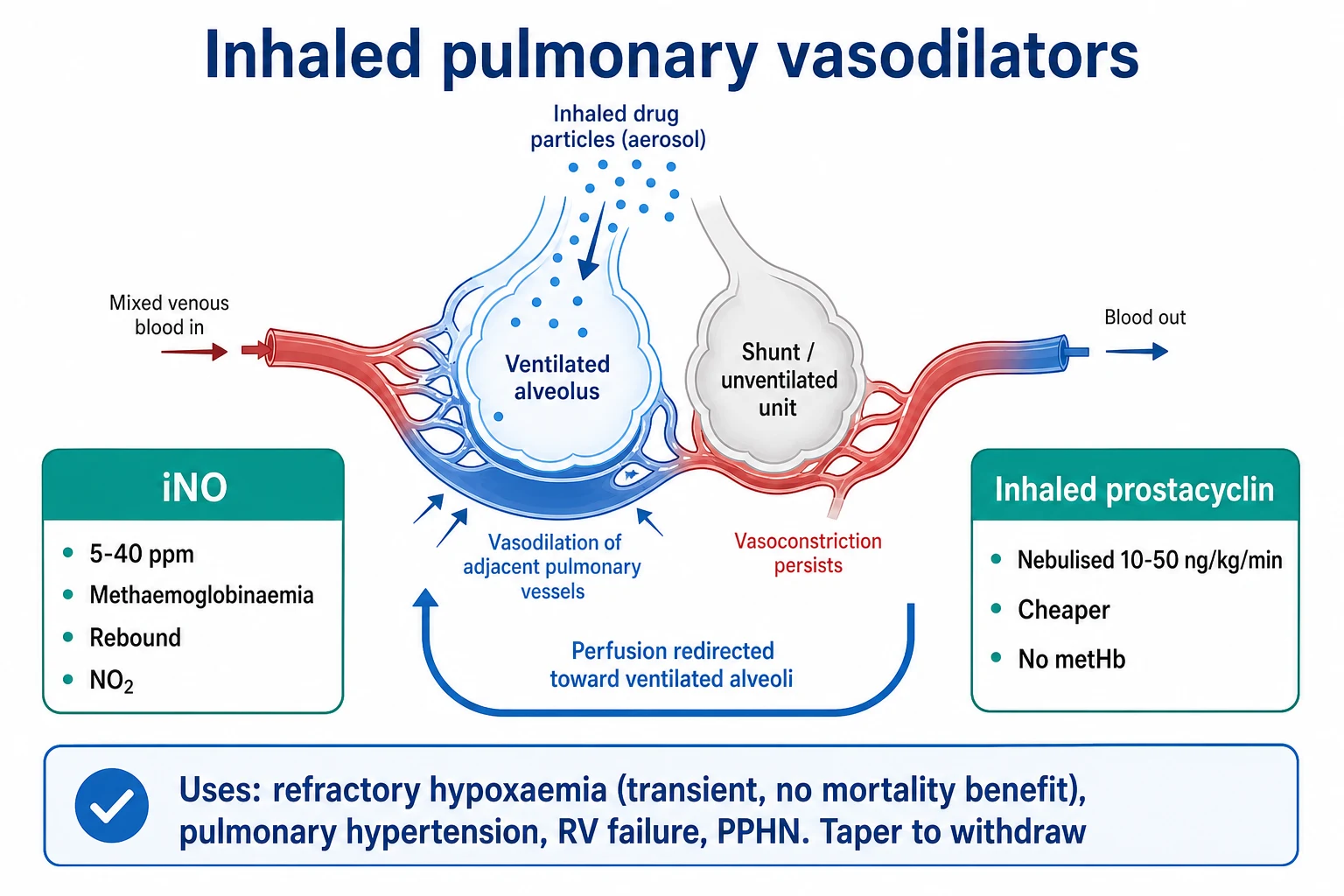
- Improved oxygenation — the drug reaches only ventilated alveoli, vasodilating their capillaries and so redirecting blood away from non-ventilated (shunt) units; the shunt fraction falls and the PaO2 rises.
- Reduced pulmonary vascular resistance — the pulmonary vasculature of the ventilated units dilates, lowering the PVR and the right-ventricular afterload (helping acute cor pulmonale and pulmonary hypertension).
- Minimal systemic vasodilation — the agent is inactivated as it binds haemoglobin (nitric oxide) or is metabolised (prostacyclin), so it does not reach the systemic circulation in active form; systemic blood pressure is largely spared.[1][1]
Inhaled nitric oxide (iNO)
- Dose: 5-40 ppm (start low, about 5-10 ppm, and titrate to the oxygenation response).
- Mechanism: nitric oxide activates guanylate cyclase, raising cGMP and relaxing vascular smooth muscle. It is inactivated by binding haemoglobin, hence the minimal systemic effect.
- Adverse effects: methaemoglobinaemia (monitor the methaemoglobin level — keep it under about 5 per cent), rebound pulmonary hypertension and hypoxaemia on withdrawal (it must be tapered), nitrogen-dioxide (NO2) toxicity (monitor NO2), and, per meta-analyses, an increased risk of acute kidney injury.[1]
Inhaled prostacyclin (epoprostenol)
- Dose: nebulised, about 10-50 ng/kg/min, titrated.
- Mechanism: prostacyclin (PGI2) raises cAMP, relaxing smooth muscle and inhibiting platelets; it is rapidly metabolised.
- Advantages over iNO: cheaper, requires only a standard nebuliser (no dedicated delivery and monitoring system), and avoids methaemoglobinaemia and NO2 toxicity; the efficacy is comparable.[1]
- Adverse effects: systemic vasodilation and hypotension if the dose is too high or spills over, and platelet inhibition (a bleeding tendency).[1]
Iloprost is a stable inhaled prostacyclin analogue (longer-acting), used mainly in chronic pulmonary hypertension; it has a smaller acute-ICU role.[1]
Uses
- Refractory hypoxaemia in ARDS — an inhaled vasodilator produces a transient improvement in oxygenation but does not improve mortality (and the meta-analyses suggest a kidney-injury risk), so it is a rescue or bridge, not routine therapy.[1][1]
- Acute pulmonary hypertension and right-ventricular failure (acute cor pulmonale from a massive PE, ARDS, or post-cardiotomy) — it selectively lowers the PVR and the RV afterload without dropping the systemic blood pressure, often combined with an inotrope (dobutamine, milrinone) for the failing RV.[1]
- Persistent pulmonary hypertension of the newborn (PPHN) — iNO is a proven, first-line therapy.[1]
- Peri-operative pulmonary hypertension (cardiac surgery, transplantation).[1]
Withdrawal
Both agents must be tapered rather than stopped abruptly, to avoid rebound pulmonary hypertension and hypoxaemia (which can be severe).[1]
Monitoring
- The oxygenation response (ABG, SpO2).
- The pulmonary artery pressure (if a PA catheter is in place) and the right-heart function (echocardiography).
- The systemic blood pressure (for spillover with prostacyclin).
- For iNO: the methaemoglobin (keep under about 5 per cent) and the NO2 level.[1]
Red flags
Cellular pharmacology — cGMP versus cAMP
Inhaled nitric oxide (iNO)
soluble guanylate cyclase → cGMP
- A free-radical gas that diffuses across the alveolo-capillary membrane into pulmonary vascular smooth muscle
- Binds the haem moiety of SOLUBLE GUANYLATE CYCLASE, raising intracellular cGMP more than 100-fold
- cGMP activates protein kinase G, which dephosphorylates myosin light chain → smooth-muscle relaxation and vasodilation
- Signalling is terminated by phosphodiesterase-5 (PDE5) — the basis for synergism with sildenafil, a PDE5 inhibitor
- On entering blood, NO binds oxyhaemoglobin and is oxidised to methaemoglobin and nitrate — near-instantaneous scavenging that prevents systemic spillover
Inhaled epoprostenol (PGI2)
IP receptor → Gs → cAMP
- Prostacyclin (PGI2) binds the IP G-protein-coupled receptor on vascular smooth muscle
- Gs coupling activates adenylate cyclase, raising intracellular cAMP
- cAMP activates protein kinase A, which phosphorylates and inhibits myosin light-chain kinase → vasodilation
- Also a potent platelet anti-aggregant — relevant at high systemic dose
- Rapidly metabolised by endothelial prostacyclin dehydrogenase (plasma half-life about 3-6 minutes)
Why selective? (both agents)
Delivery plus scavenging
- Both drugs are carried ONLY to ventilated alveoli by the inspired gas — collapsed or consolidated units receive none
- So they dilate the vessels of ventilated units and redirect flow away from shunt units (improved V/Q matching)
- Inactivation on entering blood (haemoglobin for NO, enzymatic for PGI2) prevents active drug reaching systemic arterioles
- Net effect: a fall in pulmonary vascular resistance WITHOUT a fall in systemic vascular resistance
Inhaled nitric oxide — dosing and practical delivery
- Test dose: a 10-20 minute trial at 1-5 ppm identifies responders (a >20 per cent rise in PaO2 or a fall in pulmonary artery pressure). Non-responders gain little from higher doses.[5]
- Therapeutic dose: 5-40 ppm, most often titrated in the 10-20 ppm band. The oxygenation response plateaus by about 20 ppm, and doses above 40 ppm add toxicity (methaemoglobinaemia, NO2) without benefit.[2][5]
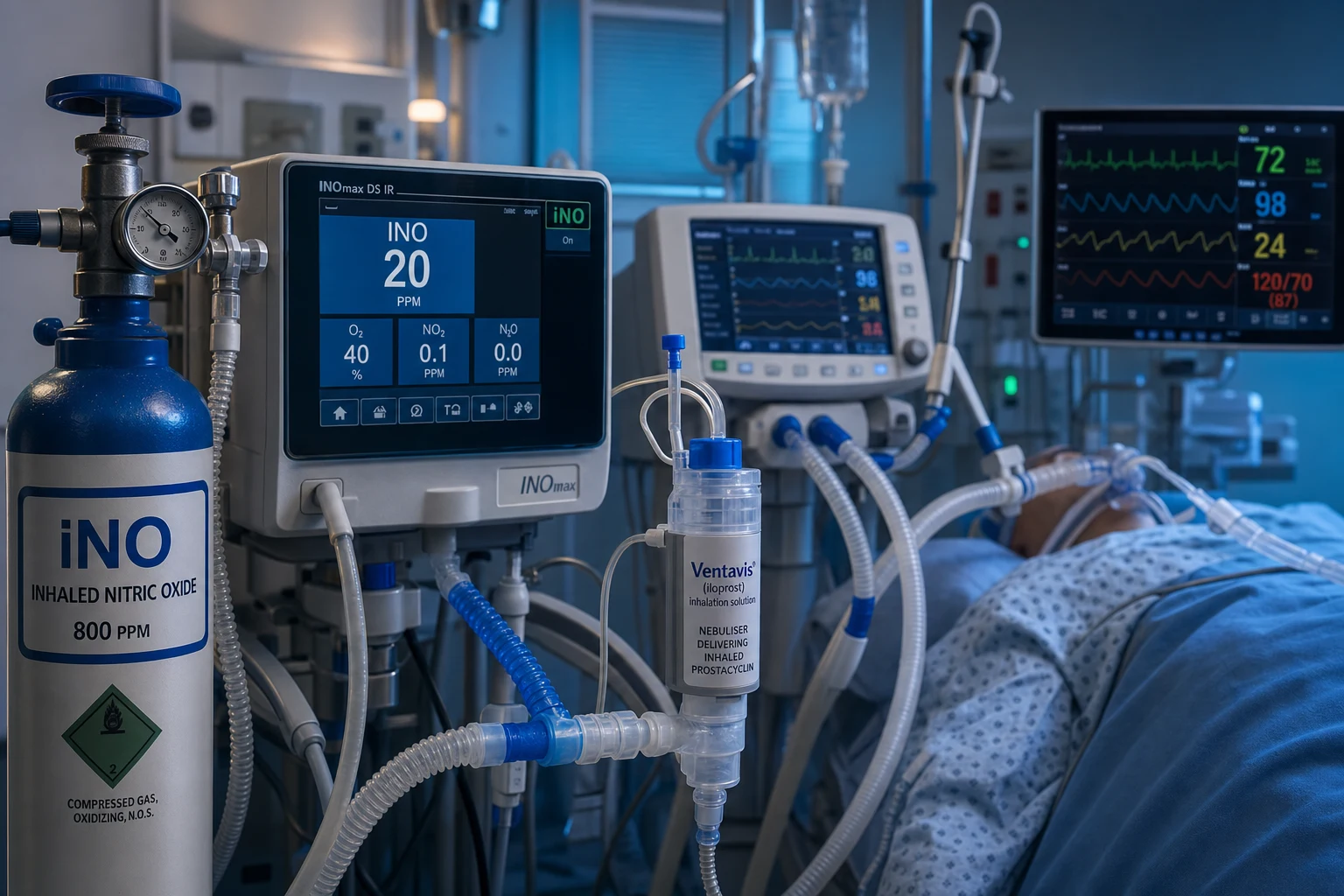
- Delivery: NO is supplied as a certified medical gas (typically 100-800 ppm in nitrogen) bled into the inspiratory limb, synchronised to inspiration to limit NO2 formation. A dedicated injector and electrochemical analyser continuously display delivered NO and inspired NO2.[1]
- Onset and offset: both within seconds — the oxygenation and pulmonary-haemodynamic effect is immediate on starting and on stopping, which is precisely why the rebound is so abrupt.
Inhaled nitric oxide — adverse effects in depth
[1]Inhaled prostacyclin — dosing and the stable analogues
- Epoprostenol (PGI2): nebulised at 10-50 ng/kg/min (start near 10, titrate by 10 every 15-30 min to the oxygenation or pulmonary-pressure response). The vial (0.5-2 mg) is reconstituted in glycine diluent and run through a vibrating-mesh or jet nebuliser into the inspiratory limb.[1]
- Iloprost: a stable PGI2 analogue, inhaled 2.5-5 microgram per dose, 6-9 times daily. Used mainly in chronic group 1 pulmonary arterial hypertension; in the ICU it occasionally helps during weaning from iNO.[1]
- Treprostinil: another stable analogue, inhaled (3 breaths four times daily, titrated), with the same cAMP mechanism.
- Advantages over iNO: cheaper, needs only a standard nebuliser (no certified gas, injector or NO/NO2 analyser), and avoids methaemoglobinaemia and NO2 toxicity. Oxygenation and pulmonary-haemodynamic effects are comparable to iNO in published series.[1]
- Disadvantages: dose-dependent systemic hypotension if excess drug aerosolises and spills over; platelet inhibition (a bleeding tendency, relevant peri-operatively); and a nebuliser that can fail silently, causing an unannounced oxygenation crash if flow is interrupted.
The indications, reconsidered
Where inhaled pulmonary vasodilators actually earn their place
Severe ARDS with refractory hypoxaemia — a bridge, not a treatment
Use when PaO2/FiO2 remains critically low despite optimised lung-protective ventilation and prone positioning, while ECMO cannulation is arranged or the lung recovers. iNO reliably raises PaO2/FiO2 over the first 24-72 hours (a responder shows >20% improvement) but the Cochrane (Afshari 2016) and Adhikari meta-analyses show NO mortality benefit and a possible AKI signal. Treat it as a temporising oxygenation bridge — never as routine ARDS therapy.<Cite id="2" /><Cite id="3" /><Cite id="4" />
Right-ventricular failure and acute cor pulmonale — the best-supported adult use
In acute pulmonary hypertension with RV failure (massive PE, ARDS with RV strain, post-cardiotomy, decompensated group 1-4 pulmonary hypertension), an inhaled vasodilator lowers PVR and RV afterload WITHOUT systemic hypotension — an advantage over intravenous vasodilators (nitroprusside, GTN, milrinone), which drop SVR and the RV coronary perfusion pressure. Combine with an inotrope (dobutamine 2.5-5, milrinone) for the failing RV; echo guides the response.<Cite id="1" /><Cite id="1" />
Peri-operative pulmonary hypertension — cardiac surgery and transplantation
iNO is well established after mitral valve surgery, cardiac transplantation and lung transplantation, where a transient pulmonary hypertensive crisis can be catastrophic; it is started prophylactically or at the first echo sign of RV dysfunction and tapered over 24-72 hours.
Persistent pulmonary hypertension of the newborn (PPHN) — proven for iNO
iNO is first-line and evidence-based in term and near-term neonates with PPHN and hypoxic respiratory failure: the Cochrane (Barrington and Finer) confirms it reduces the need for ECMO and improves oxygenation without excess mortality or severe disability. Inhaled prostacyclin analogues are an emerging alternative.<Cite id="7" /><Cite id="8" />
Pre-ECMO optimisation and during lung-recruitment manoeuvres
A short course of inhaled vasodilator can maintain acceptable PaO2 during transport, cannulation or a stepwise recruitment manoeuvre in the sickest patients; stop it cleanly (tapered) once definitive support is established.
iNO in PPHN
Proven, first-line
- Cochrane (Barrington and Finer 2017): reduces ECMO use and improves oxygenation in term/near-term PPHN
- Dose 5-20 ppm; start at 5 ppm, wean to 1 ppm then stop
- No excess death or severe neurodevelopmental disability
iNO in adult ARDS
No mortality benefit
- Cochrane (Afshari 2016) plus Adhikari (2007, 2014): no mortality benefit; transient oxygenation gain only
- Signal toward increased AKI and renal-replacement therapy
- Rescue or bridge only — never routine therapy
iNO or PGI2 in RV failure
Physiologically rational
- Lowers PVR and RV afterload without systemic hypotension
- Combine with an inotrope (dobutamine or milrinone) for the failing RV
- Echo-guided; watch for rebound on withdrawal
The evidence — trial cards
Afshari 2016 — Cochrane review: inhaled nitric oxide for ARDS and ALI in children and adults (CD002787.pub3)
Design
Cochrane systematic review and meta-analysis, updated from 2010 — the definitive synthesis
Population
Adults and children with ARDS or acute lung injury across multiple randomised trials
Key result
iNO produced a transient rise in oxygenation in the first 24 hours but did NOT reduce overall mortality (relative risk around 1.05-1.10, not significant). A signal toward increased renal dysfunction and renal-replacement therapy
Bottom line
The benchmark review. iNO improves oxygenation transiently but does not save lives and may harm the kidneys — a rescue or bridge, never routine ARDS therapy.
Adhikari 2007 (BMJ) — effect of nitric oxide on oxygenation and mortality in acute lung injury
Design
Systematic review and meta-analysis of 12 randomised trials, more than 1000 patients
Key result
No reduction in mortality (RR 1.10, 95% CI 0.94-1.30). A transient improvement in oxygenation at 24 hours that was not sustained. A non-significant trend toward increased renal failure
Bottom line
First rigorous meta-analysis to show the oxygenation-mortality disconnect — the oxygenation benefit does not translate into survival.
Adhikari 2014 (Crit Care Med) — iNO does not reduce mortality regardless of ARDS severity
Design
Updated systematic review and meta-analysis, stratified by ARDS severity
Key result
No mortality benefit in any severity stratum (mild, moderate or severe). A statistically significant increase in renal-replacement therapy in iNO-treated patients
Bottom line
Closed the door on the idea that the sickest patients benefit — even severe ARDS derives no survival benefit, with a concrete renal harm.
Taylor 2004 (JAMA) — low-dose inhaled nitric oxide in acute lung injury
Design
Multicentre randomised controlled trial; 385 adults with ALI or ARDS
Intervention
iNO 5 ppm versus placebo, for up to 28 days
Key result
No difference in mortality (iNO 23% vs 26% control, NS) or ventilator-free days. A small, transient rise in PaO2/FiO2; more renal dysfunction in the iNO arm
Bottom line
The largest single adult RCT — confirmed the oxygenation-only, no-mortality-benefit signal that the meta-analyses later consolidated.
Lundin 1999 (Intensive Care Med) — European multicentre iNO in acute lung injury
Design
Multicentre randomised controlled trial; 268 adults with severe ALI or ARDS
Intervention
iNO 2-40 ppm (lowest effective) versus no iNO
Key result
No difference in 30-day mortality (iNO 40% vs 44% control). A transient oxygenation improvement that waned by 1-4 days
Bottom line
The pivotal European trial — together with Taylor 2004, established that iNO does not improve survival in adult ALI/ARDS.
Barrington and Finer 2017 — Cochrane: nitric oxide for respiratory failure in term and near-term infants (CD000399.pub3)
Design
Cochrane systematic review and meta-analysis of neonatal randomised trials
Population
Term and near-term infants with hypoxic respiratory failure, including PPHN
Key result
iNO reduced the combined outcome of death or need for ECMO and improved oxygenation, without an increase in death or severe disability
Bottom line
Established iNO as first-line therapy in PPHN — the one setting where inhaled NO has proven outcome benefit, unlike adult ARDS.
Shivanna 2019 — Cochrane: prostanoids for pulmonary hypertension in neonates (CD012963.pub2)
Design
Cochrane systematic review of inhaled and infused prostanoids in neonatal pulmonary hypertension
Key result
Low-certainty evidence that inhaled prostanoids improve oxygenation in PPHN; insufficient evidence of an effect on mortality or ECMO use
Bottom line
An emerging alternative to iNO in PPHN, particularly where iNO is unavailable or causes methaemoglobinaemia; the evidence base is still maturing.
Afshari 2011 (Anesth Analg) — iNO for ARDS/ALI: meta-analysis with trial sequential analysis
Design
Systematic review with meta-analysis AND trial sequential analysis (TSA)
Key result
Trial sequential analysis confirmed the meta-analysis was robust — no mortality benefit, and the data were sufficient to refute a clinically important effect
Bottom line
The TSA closed off the critique that the negative meta-analyses were underpowered — iNO does not reduce mortality in ARDS/ALI.
The headline numbers — inhaled nitric oxide in adult ARDS
A practical protocol — starting, titrating and stopping
Starting inhaled nitric oxide in the adult ICU
Confirm the indication and exclude cheaper reversible causes
Have a defined goal: bridge to ECMO, RV-failure support, peri-operative pulmonary hypertension, or PPHN. Confirm lung-protective ventilation and prone positioning are already optimised — iNO is not a substitute for them. Check the bleeding risk if prostacyclin is to be used instead.
Set up the delivery and monitoring system
Certified NO in nitrogen gas cylinder, synchronised injector in the inspiratory limb, and the electrochemical analyser displaying delivered NO and inspired NO2. Note that NO in the inspiratory limb slightly increases the effective FiO2.
Start and titrate
Begin at 5-10 ppm (or a 1-5 ppm test). Check an ABG and, if available, pulmonary artery pressure or echo at 15-30 min. Titrate up in 5-ppm steps to the lowest dose that achieves the oxygenation or RV goal, up to 20-40 ppm. There is no benefit above about 40 ppm.<Cite id="2" />
Define and document a responder
A meaningful response is a >20 per cent rise in PaO2/FiO2 or a clear fall in pulmonary artery pressure or improvement in RV function on echo. A non-responder gains nothing from prolonged use — discontinue, tapered.
Monitor continuously
Continuous SpO2; co-oximetry metHb every 6-12 h (keep <5%); inspired NO2 (keep <2-3 ppm); systemic blood pressure; and echocardiographic RV function. Reassess the indication daily — the default is to wean, not to continue.
Tapering and stopping — the same principles for iNO and prostacyclin
Wait for a stable reason to wean
Improving oxygenation (P/F rising on lower FiO2/PEEP), recovering RV function, or establishment of definitive therapy (ECMO running, source controlled). Do not wean during instability.
Halve the dose stepwise
Reduce in roughly halving steps (e.g. 20 → 10 → 5 → 1 ppm), holding each step for 4-12 hours while watching the oxygenation and, for RV failure, the echo. The final step to zero is from 1 ppm.
Bridge the rebound pharmacologically if needed
If rebound pulmonary hypertension or hypoxaemia occurs, restart the previous dose and wean more slowly; oral sildenafil 10-20 mg can bridge by sustaining cGMP signalling as iNO is withdrawn.<Cite id="1" />
Watch for the rebound window
Rebound occurs within minutes to hours of cessation; keep close monitoring for 12-24 hours after the final dose, and have an inhaled vasodilator drawn up to restart if needed.
Inhaled nitric oxide
cGMP pathway
- Dose 5-40 ppm (plateau around 20 ppm)
- Onset seconds; scavenged by haemoglobin
- Methaemoglobinaemia, NO2 toxicity, rebound, AKI signal
- Costly; dedicated gas plus injector plus analyser
- Proven in PPHN; no mortality benefit in adult ARDS
Inhaled epoprostenol
cAMP pathway
- Dose 10-50 ng/kg/min nebulised
- Onset minutes; metabolised by endothelium (half-life ~3-6 min)
- No metHb, no NO2; spillover hypotension, platelet inhibition
- Cheap; standard nebuliser only
- Comparable oxygenation effect; observational evidence base
Inhaled iloprost or treprostinil
stable PGI2 analogues
- Iloprost 2.5-5 mcg inhaled 6-9 times daily; treprostinil 3 breaths QID
- Longer-acting; mainly chronic group 1 PAH
- Same cAMP mechanism, same rebound on withdrawal
- Occasional ICU role in weaning off iNO
IV vasodilators (contrast)
non-selective
- Nitroprusside, GTN, milrinone dilate systemic AND pulmonary beds
- Drop systemic vascular resistance → hypotension → RV ischaemia
- Worsen V/Q matching (dilate vessels of non-ventilated units too)
- This is the problem inhaled agents are designed to avoid
Oral sildenafil (adjunct)
PDE5 inhibitor
- Blocks cGMP breakdown → selectively potentiates the iNO pathway
- Useful to bridge rebound during iNO withdrawal
- Causes systemic hypotension at full dose; not a primary ICU pulmonary vasodilator
Severity of methaemoglobinaemia (metHb per cent) from iNO
metHb >30%
Tissue hypoxia, confusion, lactic acidosis, arrhythmia, seizures. Stop iNO, give methylene blue 1-2 mg/kg IV (avoid in G6PD deficiency), switch to prostacyclin, and support oxygenation.
Red flags (additional)
[1] [1] [1] [1]SAQ — Severe ARDS, refractory hypoxaemia and right ventricular failure
10 minutes · 10 marks
A 48-year-old man (180 cm, 80 kg) is on day 4 of severe H1N1 influenza ARDS. He is ventilated with Vt 360 mL, RR 28, PEEP 18, FiO2 1.0 and has been proned for 18 hours. ABG: pH 7.24, PaCO2 58, PaO2 65, HCO3 24. Echo shows a dilated right ventricle with septal flattening, estimated RVSP 55 mmHg and TAPSE 1.2 cm. The team proposes starting inhaled nitric oxide.
SAQ — Switching from iNO to inhaled prostacyclin in pulmonary hypertension crisis
10 minutes · 10 marks
A 35-year-old post-partum woman with known idiopathic pulmonary arterial hypertension is intubated for low-output cardiac failure. She is on iNO 40 ppm, with a fall in estimated RVSP from 90 to 65 mmHg, but her methaemoglobin has risen to 4.5 per cent at 48 hours and the cost of ongoing iNO is being flagged. You plan to switch to inhaled epoprostenol.
Clinical pearls
[1]References
- [1]Ware LR, Kim CS, et al. A Narrative Review on the Administration of Inhaled Prostaglandins in Critically Ill Adult Patients With Acute Respiratory Distress Syndrome Ann Pharmacother, 2024.PMID 37589097
- [2]Afshari A, Brok J, Møller AM, Wetterslev J Inhaled nitric oxide for acute respiratory distress syndrome (ARDS) in children and adults Cochrane Database Syst Rev, 2016.PMID 27347773
- [3]Adhikari NK, Burns KE, Friedrich JO, Granton JT, Cook DJ, Meade MO Effect of nitric oxide on oxygenation and mortality in acute lung injury: systematic review and meta-analysis BMJ, 2007.PMID 17383982
- [4]Adhikari NK, Dellinger RP, Lundin S, et al. Inhaled nitric oxide does not reduce mortality in patients with acute respiratory distress syndrome regardless of severity: systematic review and meta-analysis Crit Care Med, 2014.PMID 24132038
- [5]Taylor RW, Zimmerman JL, Dellinger RP, et al.; Inhaled Nitric Oxide in ARDS Study Group Low-dose inhaled nitric oxide in patients with acute lung injury: a randomized controlled trial JAMA, 2004.PMID 15069048
- [6]Lundin S, Mang H, Smithies M, Stenqvist O, Frostell C; European Study Group of Inhaled Nitric Oxide Inhalation of nitric oxide in acute lung injury: results of a European multicentre study. The European Study Group of Inhaled Nitric Oxide Intensive Care Med, 1999.PMID 10501745
- [7]Barrington KJ, Finer N, Pennaforte T, Altit G Nitric oxide for respiratory failure in infants born at or near term Cochrane Database Syst Rev, 2017.PMID 28056166
- [8]Shivanna B, Gowda S, Welty SE, Barrington KJ, Pammi M Prostanoids and their analogues for the treatment of pulmonary hypertension in neonates Cochrane Database Syst Rev, 2019.PMID 31573068
- [9]Afshari A, Brok J, Møller AM, Wetterslev J Inhaled nitric oxide for acute respiratory distress syndrome and acute lung injury in adults and children: a systematic review with meta-analysis and trial sequential analysis Anesth Analg, 2011.PMID 21372277