ICU · Respiratory
Non-invasive ventilation (NIV) in the ICU
Also known as NIV · BiPAP (bilevel positive airway pressure) · CPAP (continuous positive airway pressure) · Non-invasive positive pressure ventilation (NIPPV) · Pressure support via mask · Helmet CPAP
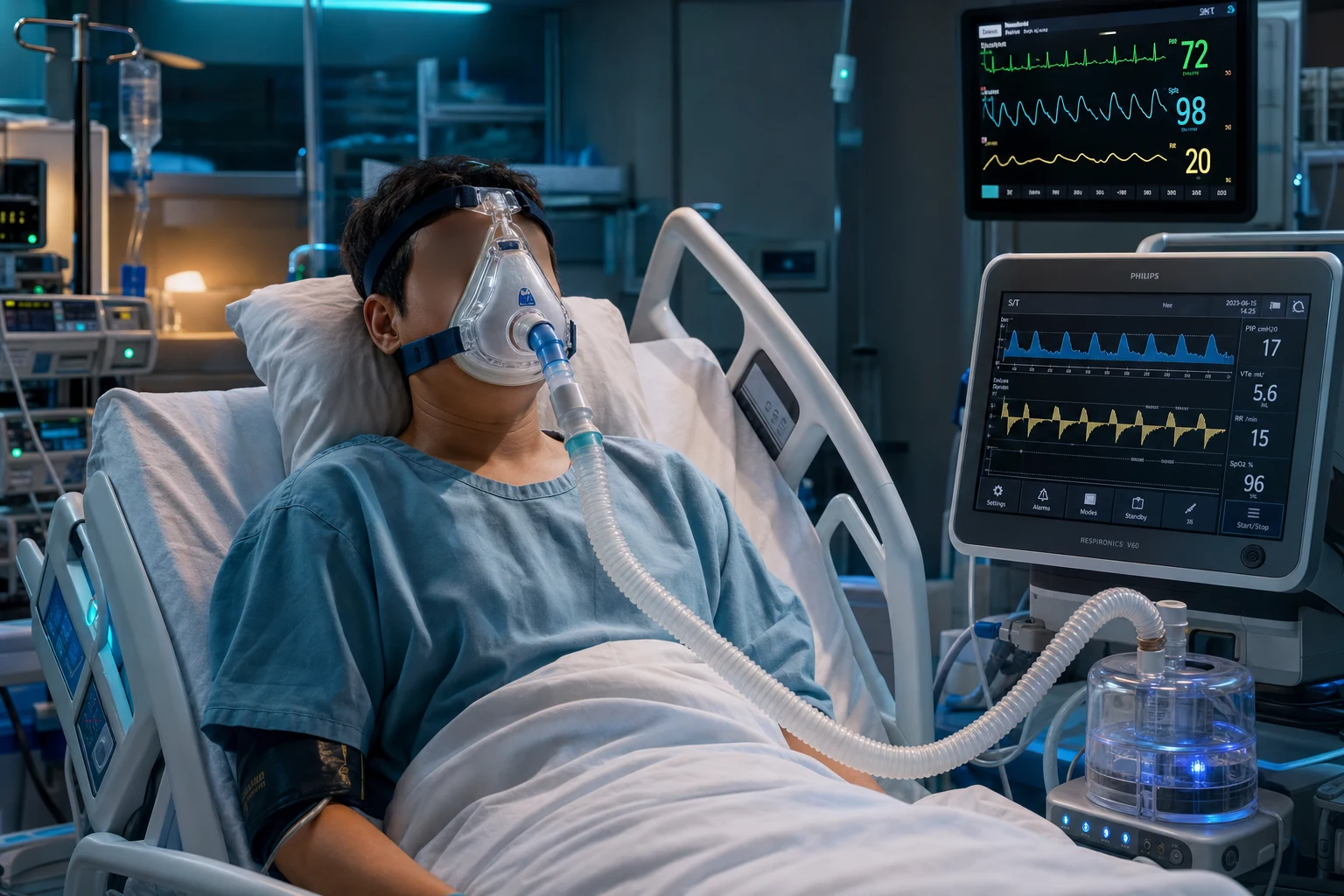
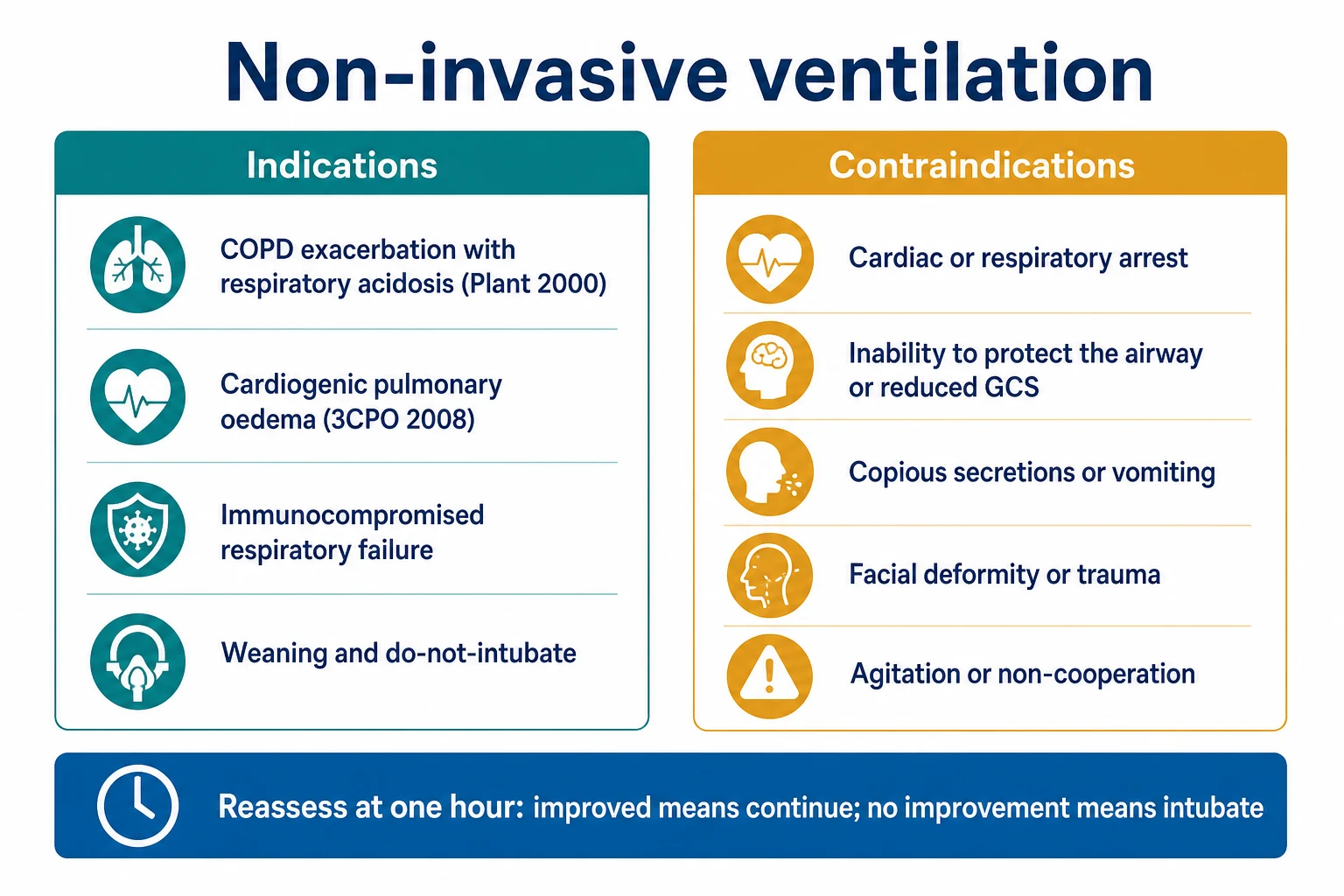
NIV delivers positive pressure ventilation via a face mask (or nasal mask/helmet) without endotracheal intubation. Reduces intubation rates, ventilator-associated pneumonia, and mortality in selected patients. CPAP: continuous positive pressure throughout respiratory cycle — splints alveoli open, reduces work of breathing, and in cardiogenic oedema reduces preload and LV afterload. BiPAP: IPAP (inspiratory positive airway pressure — pressure support) + EPAP (extrinsic PEEP). Best evidence: COPD exacerbation with type 2 respiratory failure (pH 7.25-7.35) — Plant trial 2000; cardiogenic pulmonary oedema — 3CPO 2008; immunocompromised patients with pneumonia — Hilbert 2001; and prophylactic post-extubation NIV in high-risk patients — Nava 2005. Contraindications: facial trauma, inability to protect airway (GCS <8), copious secretions, vomiting, agitation, cardiac arrest. The single most important principle: reassess at one hour — if no improvement, intubate. NIV is a time-limited trial, not an open-ended commitment.
On this page & tools
Your progress
Saved locally on this device.
Target exams
Red flags
How NIV works — the physiology
NIV delivers positive pressure to the airway through a leak-tight interface, doing mechanical work the fatiguing patient can no longer do. Two pressure domains matter. [1]
EPAP / PEEP / CPAP (extrinsic, set pressure during exhalation):
- Recruits collapsed alveoli and splints them open throughout the respiratory cycle, increasing functional residual capacity and lung compliance — less work per breath.
- Overcomes intrinsic PEEP (auto-PEEP) in obstructed patients: by raising extrinsic pressure toward intrinsic PEEP, it lowers the pressure gradient the diaphragm must generate to trigger a breath. This is the principal mechanism by which BiPAP unloads the COPD patient — set external EPAP at ~80% of measured intrinsic PEEP.
- Reduces preload (decreased venous return) and LV afterload (decreased transmural LV pressure) — the haemodynamic mechanism in cardiogenic pulmonary oedema.
- Redistributes alveolar oedema out of the alveolar space (cardiogenic oedema). [1]
IPAP / pressure support (the inspiratory boost):
- Augments every patient-triggered breath, increasing tidal volume and minute ventilation, washing out CO2.
- The IPAP-EPAP gradient IS the pressure support: IPAP 15 / EPAP 5 = 10 cmH2O of pressure support. To increase ventilation, raise IPAP; to increase oxygenation/recruitment, raise EPAP — but raising EPAP also raises IPAP and shortens expiration, so watch for dynamic hyperinflation in COPD. [1]
Clinical translation. A COPD patient tiring against their intrinsic PEEP needs EPAP to lower the trigger threshold and IPAP to boost tidal volume and blow off CO2. A pulmonary-oedema patient needs the continuous pressure (CPAP is sufficient) to preload- and afterload-reduce and recruit. An immunocompromised patient needs the mask pressure to bridge while the underlying insult is treated, avoiding the infectious morbidity of a tube. [1]
Indications by condition
COPD exacerbation
Strongest evidence
- Type 2 respiratory failure: pH 7.25-7.35, PaCO2 elevated
- NIV reduces mortality, intubation rates, and length of stay (Plant 2000; Lightowler 2003 Cochrane)
- Settings: IPAP 10-15 (titrate up to 20), EPAP 4-5, FiO2 to SpO2 88-92%
- If pH <7.25 after 1-2h NIV: intubate (NIV failure)
- NIV is standard of care — should be tried BEFORE intubation in most COPD patients
Cardiogenic pulmonary oedema
Strong evidence
- CPAP 5-10 cmH2O reduces intubation rates and mortality
- Mechanism: reduces preload (venous return) and afterload (LV afterload)
- Improves oxygenation rapidly
- Can use CPAP or BiPAP — 3CPO (2008) showed equivalence and NO mortality difference vs standard O2
- Start early — do NOT wait for intubation criteria
Immunocompromised
Pneumonia
- NIV preferred over intubation in immunocompromised patients with pneumonia (Hilbert 2001)
- Avoids VAP (ventilator-associated pneumonia) — devastating in immunocompromised
- Reduces mortality and complications compared to invasive ventilation
- Monitor closely — intubate if no improvement
Post-extubation
Prophylactic only
- PROPHYLACTIC NIV immediately after extubation in high-risk patients reduces reintubation (Nava 2005; Ferrer 2006)
- High-risk: COPD, hypercapnia, obesity, cardiac failure, older age, weak cough
- NIV-as-RESCUE after overt extubation failure INCREASES mortality (Esteban 2004) — intubate instead
- HFNC is an alternative bridge, preferred when not hypercapnic
Asthma (controversial)
Selected
- Evidence weaker than COPD — small trials, no robust mortality signal
- May reduce intubation in carefully selected, cooperative patients with persistent hypercapnia
- High risk of dynamic hyperinflation and delayed intubation — low threshold to abandon
- Heliox-driven BiPAP is occasionally used but not standard
ARDS / de novo hypoxaemic
High failure rate
- NIV failure rate 30-50% in de novo hypoxaemic respiratory failure (pneumonia/ARDS)
- Helmet CPAP markedly outperformed face-mask NIV in the MALLED trial (Patel 2016) — intubation 18% vs 62%
- Use cautiously; intubate early at the first sign of failure
The pH drives the support in COPD
AECOPD — escalation pathway by arterial pH (click each)
pH <7.25
Severe acidosis. NIV may still work but MUST be in a monitored setting (HDU/ICU) with a low threshold to intubate. Co-existing obtundation, agitation, or haemodynamic instability favours immediate intubation. A trial is reasonable ONLY if the patient is cooperative and the airway is safe.
COPD exacerbation — the prototype NIV patient
The COPD patient is the textbook indication because the pathophysiology maps exactly onto the mechanisms above: dynamic hyperinflation raises intrinsic PEEP, the diaphragm fatigues against it, and CO2 accumulates. BiPAP lowers the trigger threshold (EPAP) and unloads ventilation (IPAP). [1]
COPD NIV bundle — start to decision
Controlled oxygen FIRST
Venturi 24-28 per cent to SpO2 88-92 per cent. High-concentration oxygen worsens hypercapnia via the HALDANE effect (oxygenated haemoglobin releases bound CO2) and relief of hypoxic pulmonary vasoconstriction (worsened V/Q matching, more dead space). Never give high-flow oxygen to a COPD patient "to be safe". Drive the pre-NIV nebuliser with AIR, not oxygen.
Confirm the indication
ABG: pH 7.25-7.35 with PaCO2 elevated (typically >6.5 kPa / 45 mmHg). This is the Plant-trial population. pH >7.35 = standard therapy. pH <7.25 = monitored NIV trial or intubate. Ensure no contraindication (GCS, vomiting, facial trauma, agitation).
Set up BiPAP
Full-face (oronasal) mask, correctly sized. Mode: spontaneous/timed (S/T). IPAP 10-12 cmH2O, EPAP 4-5 cmH2O, backup rate 12-14/min (backup only — patient should trigger). Rise time moderate. FiO2 to SpO2 88-92 per cent. Heated humidifier.
Titrate up over 15-30 min
Increase IPAP by 2 cmH2O every 10-15 min toward 20 cmH2O until tidal volume rises (target 6-8 mL/kg), respiratory rate falls (toward <25), and the patient looks comfortable. Keep EPAP at 4-6 — raise only if oxygenation is the problem (each cmH2O EPAP adds to IPAP and risks dynamic hyperinflation).
Recheck ABG at 1 hour
Success: pH rising toward normal, PaCO2 falling, respiratory rate falling, patient comfortable. Continue NIV and treat the exacerbation (steroids, antibiotics, bronchodilators). Failure: pH <7.25 and not rising, rising PaCO2, worsening distress, falling GCS — INTUBATE. Do not persist with failing NIV.
Wean once treated
When pH normal and patient clinically improved: reduce IPAP by 2 cmH2O at a time, then introduce progressive off-periods (1 h off, then 2 h, then 4 h) with ABG checks during the off periods. Transition to oxygen alone when stable for >4-8 h off NIV.
Cardiogenic pulmonary oedema — CPAP is the workhorse
Positive pressure recruits oedematous alveoli, increases functional residual capacity and arterial oxygenation within minutes, and — critically — improves cardiac performance by reducing LV afterload (the transmural pressure the LV ejects against falls as intrathoracic pressure rises) and reducing venous return (preload) in the overfilled circulation. [1]
Cardiogenic pulmonary oedema — NIV in the bundle
Recognise the syndrome
Acute breathlessness, frothy pink sputum, bilateral crackles, gallop, hypertension usually present, bilateral interstitial/alveolar oedema on CXR. SpO2 low, respiratory rate high. The patient is drowning in their own pulmonary oedema.
Start CPAP early — with the medical bundle
CPAP 5-10 cmH2O (start at 5, titrate toward 10). FiO2 to SpO2 >92 per cent. Simultaneously give IV furosemide, sublingual/IV nitrate (if systolic >110), opiate in small doses (debated — avoid if hypotensive), and treat the trigger (ischaemia, arrhythmia, sepsis).
CPAP or BiPAP?
Either works. 3CPO (Gray 2008, NEJM) — 1069 patients — found CPAP and BiPAP EQUIVALENT, and neither improved 7- or 30-day mortality versus standard oxygen, though both accelerated physiological and symptom improvement. CPAP is simpler. Use BiPAP if the patient is also hypercapnic (CO2-retaining from respiratory muscle fatigue).
Titrate and reassess
Most patients improve within 30-60 min (oxygenation up, work of breathing down, BP often falls as afterload drops — watch). Wean CPAP down by 1-2 cmH2O as oedema resolves with diuresis. Transition to standard oxygen when stable.
When to intubate
Cardiogenic shock, refractory hypoxia on CPAP 10 + high FiO2, altered mental state, vomiting, respiratory arrest. NIV is contraindicated in cardiogenic shock (the pressure may worsen hypotension) unless used cautiously with vasopressors.
Immunocompromised — avoid the tube
In the immunocompromised patient (neutropenic sepsis, haematology, transplant, chemotherapy), invasive ventilation carries a notoriously high mortality — partly because the endotracheal tube is a superhighway for nosocomial infection in a patient with no immune reserve. Hilbert (2001, NEJM) randomised immunosuppressed patients with pulmonary infiltrates, fever, and respiratory failure to early NIV vs standard oxygen: NIV reduced intubation, serious complications, and ICU and hospital mortality. [1]
Immunocompromised respiratory failure — the approach
Recognise the high stakes
Immunocompromised + pulmonary infiltrates + respiratory failure. Intubation carries very high mortality (30-50%+). NIV (or HFNC) is the preferred first support, applied early and intensively, while the underlying cause is investigated (BAL, galactomannan, viral PCRs, imaging).
Choose interface and mode
BiPAP for hypercapnic or fatiguing patients; CPAP/helmet for pure hypoxaemia. Full-face mask. Early heated humidification. Aggressive secretion clearance (the patient is often neutropenic and cannot clear).
Treat the cause in parallel
Antimicrobial spectrum must cover the opportunistic differential: Pneumocystis (co-trimoxazole + steroid if hypoxic), CMV (ganciclovir), invasive fungal (amphotericin/voriconazole), bacterial, and consider non-infective causes (oedema, DAH, drug toxicity, relapse).
Define failure early
NIV failure predictors here are the same as elsewhere: severity of hypoxaemia at baseline (low PaO2/FiO2), no improvement at 1 hour, tachypnoea persisting, haemodynamic instability, multi-organ failure. Set a time limit. If failing — intubate promptly; prolonged failing NIV is worse than timely intubation.
Post-extubation — prophylactic yes, rescue no
This distinction is exam-critical and frequently examined. NIV has opposite effects depending on WHEN it is applied after extubation. [1]
PROPHYLACTIC NIV (good)
Applied immediately at/after extubation in high-risk patients
- Nava 2005 (CCM): prophylactic NIV in high-risk extubated patients reduced reintubation and ICU mortality
- Ferrer 2006 (AJRCCM): NIV to prevent post-extubation failure in high-risk patients reduced reintubation and mortality
- High-risk phenotype: age >65, COPD, hypercapnia (PaCO2 >45 at extubation), obesity-hypoventilation, cardiac failure, weak cough, multiple failed SBTs, obesity
- Apply BiPAP immediately (within 1 hour of extubation), not after the patient has decompensated
RESCUE NIV (harmful)
Applied AFTER overt respiratory failure post-extubation
- Esteban 2004 (NEJM): NIV used as rescue after extubation failure INCREASED ICU mortality (25% vs 14%)
- Harm mechanism: delays definitive re-intubation, prolongs the period of unrecognised respiratory distress, aspiration risk
- The lesson: if a patient fails extubation and develops overt respiratory failure, RE-INTUBATE — do not reach for the mask
- Post-extubation respiratory distress = the exception to "try NIV first"
Interface selection — full-face, nasal, helmet
Full-face (oronasal) mask
First-line in the acute setting
- Best seal, least mouth leak — the default for acute respiratory failure
- Required for high inspiratory pressure (mouth breathing blows off the pressure through a nasal mask)
- Risk: claustrophobia, aspiration if vomiting (no protection), nasal bridge pressure ulcers
- Size it correctly — too large leaks, too small causes sores. Measure nose-bridge to chin crease
Nasal mask
Chronic/long-term and weaning
- Less claustrophobic, allows speech, eating, expectoration
- Better tolerated for long-term/chronic NIV (neuromuscular, obesity-hypoventilation)
- Mouth leak limits effectiveness in acute hypercapnia — add a chin strap if used acutely
Helmet CPAP
Hypoxaemic failure, intolerance, ARDS
- No nasal bridge pressure, no facial skin breakdown, less leak, better tolerated, allows communication
- MALLED trial (Patel 2016, JAMA): helmet CPAP vs face-mask NIV in ARDS — intubation 18% vs 62%, mortality lower
- Helmet is the interface of choice in de novo hypoxaemic failure (ARDS/pneumonia) where NIV is being attempted
- Generates continuous flow CPAP; less suited to delivering pressure-support ventilation
Total face mask / mouthpiece
Special situations
- Total face mask (covers whole face): useful when nasal bridge ulceration develops
- Mouthpiece (lipseal): neuromuscular patients, intermittent daytime support
BiPAP vs CPAP — choosing the mode
CPAP
One continuous pressure
- Single positive pressure throughout the respiratory cycle — no pressure support
- Recruits alveoli, splints open lung, reduces preload/afterload
- Does NOT augment tidal volume or lower PaCO2 (no pressure support)
- Best for: cardiogenic pulmonary oedema, pure hypoxaemic failure (with helmet), OSA
- Set 5-10 cmH2O
BiPAP (bilevel)
IPAP + EPAP = pressure support
- Two pressures: IPAP on inspiration, EPAP on exhalation. The gradient IS the pressure support
- Augments tidal volume, washes out CO2, lowers PaCO2, raises pH
- Best for: COPD exacerbation (hypercapnic), any hypercapnic respiratory failure, fatiguing patient
- Set IPAP 10-15 (up to 20), EPAP 4-5, backup rate 12-14. IPAP-EPAP gap = pressure support (e.g., 15/5 = 10 cmH2O PS)
Settings
NIV setup and titration
Choose interface
Full face mask (oronasal): first choice — best seal, least leak. Nasal mask: less claustrophobic but mouth leak. Helmet (total face): for claustrophobic patients, facial injuries, or hypoxaemic/ARDS failure (Patel 2016). Ensure correct size — measure face.
Initial settings — COPD
Mode: BiPAP (spontaneous/timed). IPAP 10-12 cmH2O (titrate up to 20). EPAP 4-5 cmH2O. FiO2 to achieve SpO2 88-92% (avoid hyperoxia — worsens hypercapnia in COPD via Haldane effect). Backup rate 12-15/min (backup only — patient should trigger spontaneously). Rise time: moderate.
Initial settings — pulmonary oedema
Mode: CPAP or BiPAP. CPAP 5-10 cmH2O (start at 5, titrate up). FiO2 to achieve SpO2 >92%. If BiPAP: IPAP 10, EPAP 5.
Titrate based on response
Check ABG at 1-2 hours. COPD: if pH rising and PaCO2 falling → continue. If no improvement or worsening → intubate. Increase IPAP by 2 cmH2O every 15 min to maximum 20 if PaCO2 not falling. Increase EPAP if oxygenation inadequate (but may worsen hyperinflation in COPD).
Weaning
Once underlying condition treated and patient improving: reduce IPAP gradually (2 cmH2O at a time). Increase off periods (1h off, then 2h, then 4h). Monitor ABG and clinical status during off periods. Transition to oxygen only when stable for >4h off NIV.
Monitoring — success and failure at the bedside
Bedside monitoring during NIV
Continuous clinical observation
Comfort, accessory-muscle use, respiratory rate (target fall to <25), thoracoabdominal synchrony (asynchrony = trouble), level of consciousness (improving or deteriorating?), ability to cough and clear secretions, peripheral warmth/colour. A patient who looks and sounds better within 30-60 min is responding.
Continuous SpO2 and ECG
SpO2 in target range (88-92% COPD, 92-96% others). Heart rate and rhythm — NIV in cardiogenic oedema may drop BP as afterload falls. Watch for hypotension requiring vasopressor support.
Arterial blood gas at 1 hour
The pivotal measurement. Compare with baseline: is pH rising toward 7.35? Is PaCO2 falling? Is PaO2 adequate? A pH that has not improved by 1 hour (or has fallen) predicts failure — set up for intubation.
Check the mask and circuit every 15-30 min
Leaks (reseat mask, adjust straps — but do not overtighten, which causes ulcers and more leak), humidifier water level, Rainout in the circuit, patient-ventilator synchrony (count triggering efforts vs delivered breaths). Intentional leak port must be patent.
Nutrition, fluids, and DVT prophylaxis
NIV is not a reason to starve the patient — small oral sips if alert with intact swallow, or NG feed if prolonged. Maintain hydration. DVT prophylaxis. Pressure-area care. The NIV patient is an ICU patient, not a "leave them on the mask" patient.
Predicting NIV failure — the one-hour rule
The single best-validated principle in acute NIV: the response at one hour discriminates success from failure far better than baseline variables alone. [1]
Baseline (pre-NIV) predictors of failure:
- Severity of acidosis at baseline (pH <7.25 — Plant data show higher failure)
- Severity of hypoxaemia (low PaO2/FiO2 in de novo failure)
- Impaired consciousness (GCS <8 is a contraindication; even GCS 8-12 raises failure)
- Older age, nursing-home residence, comorbidity burden
- Acute Physiology and Chronic Health Evaluation (APACHE) / high severity scores
- Chest X-ray consolidation (pneumonia/ARDS — higher failure than oedema/COPD)
- Copious secretions, agitation, asynchrony [1]
One-hour response predictors of failure (the decisive ones):
- pH not improved or worsened (the cardinal sign)
- PaCO2 not fallen or risen
- Respiratory rate not fallen (persistently >30)
- Worsening distress, falling consciousness, rising accessory-muscle use
- Inability to tolerate the interface / remove mask repeatedly [1]
HACOR score — quantifying NIV failure in hypoxaemic failure
[1]Contraindications
[1]Complications of NIV
Interface-related
Most common
- Nasal bridge pressure ulcers (most common — prevent with dressings, alternating masks, break periods)
- Air leak (reseat mask; some intentional leak is normal through the port)
- Claustrophobia, agitation
- Dry eyes (mask leaks upward into eyes — reseat)
- Aerophagia / gastric insufflation (usually mild; NG tube if severe)
Pressure-related
Less common
- Barotrauma / pneumothorax (rare but reported — especially in asthma/ARDS with high pressures)
- Hypotension (reduced venous return — especially in hypovolaemia/cardiogenic oedema)
- Reduced cardiac output in preload-dependent patients
Humidification/aspiration
Important
- Mucosal drying, secretion inspissation (use heated humidifier — HMEs are ineffective in NIV)
- Aspiration pneumonia (vomiting, impaired swallow, reduced consciousness) — the rationale for the GCS/vomiting contraindication
Weaning protocol
Structured NIV weaning
Confirm readiness
Underlying cause treated and reversing (e.g., COPD exacerbation resolving on steroids/antibiotics; pulmonary oedema diuresed). pH normal (7.35-7.45), PaCO2 near baseline for the patient, SpO2 in target on minimal FiO2, respiratory rate <25, patient comfortable, cough effective, secretions manageable. Neurologically awake and cooperative.
Reduce pressure support
Lower IPAP by 2 cmH2O at each step (e.g., 20 → 18 → 16). Watch the respiratory rate and ABG at each step. If PaCO2 climbs or pH falls, you have stepped too fast — return to previous setting and treat more before retrying.
Introduce progressive off-periods
Once at low pressures (IPAP 10-12, EPAP 4), begin structured off-time: 1 hour off NIV with oxygen, check ABG at the end. If stable, extend to 2 h, then 4 h, then daytime off. Many COPD patients benefit from nocturnal NIV during weaning.
Transition to oxygen
When stable for >4-8 hours off NIV with acceptable ABG, transition to controlled oxygen (Venturi) and monitor. Have the mask at the bedside — some patients need to restart overnight.
Identify long-term candidates
A subset — especially COPD with chronic hypercapnia (PaCO2 >52 mmHg / 7 kPa) and long-term oxygen therapy, or obesity-hypoventilation, or neuromuscular disease — should be referred for long-term home NIV.
The landmark trials
PLANT (Plant 2000)
Lancet 2000
236 pts, AECOPD pH 7.25-7.35 on general respiratory wards — early NIV vs standard therapy
Key finding
Intubation 15% NIV vs 27% control; in-hospital mortality lower; fewer complications; shorter stay
Practice change
Early bilevel NIV became first-line for the acidotic AECOPD, even on the ward
Lightowler (Cochrane)
BMJ 2003
8 RCTs meta-analysis — NPPV + usual care vs usual care for hypercapnic AECOPD
Key finding
Reduced mortality (RR 0.41), intubation (RR 0.42), treatment failure (RR 0.51), and hospital stay (-3.24 days); rapid improvement in pH, PaCO2, RR at 1 hour
Practice change
NIV confirmed as first-line coupled with usual medical care in all suitable AECOPD patients
3CPO (Gray 2008)
NEJM 2008
1069 pts acute cardiogenic pulmonary oedema — CPAP vs BiPAP vs standard oxygen
Key finding
No difference in 7-day or 30-day mortality or intubation overall; CPAP and BiPAP equivalent; NIV gave faster symptom and physiological improvement at 1 hour
Practice change
NIV used early for symptom/physiological benefit in pulmonary oedema, but is not a mortality intervention — diurese and treat the cause
Brochard 1995
NEJM 1995
85 pts AECOPD — face-mask pressure-support NIV vs standard therapy
Key finding
Fewer complications, shorter stay, fewer intubations, trend to lower mortality
Practice change
Confirmed NIV superiority to standard therapy in moderate-severe AECOPD
Confalonieri 1999
AJRCCM 1999
56 pts severe CAP — NIV vs standard oxygen
Key finding
Reduced intubation (21% vs 50%) and mortality; benefit confined to COPD subgroup; trend to fewer complications
Practice change
NIV reasonable in severe CAP, especially with underlying COPD
Hilbert 2001
NEJM 2001
52 immunosuppressed pts with pulmonary infiltrates, fever, ARF — early NIV vs standard oxygen
Key finding
Reduced intubation, serious complications, and ICU/hospital mortality (50% vs 38% ICU mortality; lower complications)
Practice change
Early NIV preferred in immunocompromised respiratory failure to avoid invasive-ventilation morbidity
Nava 2005 (prophylactic)
CCM 2005
97 high-risk extubated pts — prophylactic NIV vs standard oxygen immediately after extubation
Key finding
Lower reintubation, fewer ventilator days, lower ICU mortality
Practice change
Prophylactic NIV after extubation in high-risk patients is standard of care
Esteban 2004 (rescue)
NEJM 2004
221 pts developing respiratory failure within 48h of extubation — NIV vs standard oxygen
Key finding
NIV INCREASED ICU mortality (25% vs 14%); no reduction in reintubation; delayed re-intubation
Practice change
NIV is contraindicated as RESCUE therapy after overt extubation failure — re-intubate
Patel (MALLED helmet)
JAMA 2016
83 pts ARDS (PaO2/FiO2 <300) — helmet CPAP vs face-mask NIV
Key finding
Helmet reduced intubation (18% vs 62%, p<0.001) and was stopped early for benefit
Practice change
Helmet CPAP preferred interface for NIV in ARDS/hypoxaemic failure
FLORALI (Frat 2015)
NEJM 2015
310 pts hypoxaemic RF (PaO2/FiO2 <300, PaCO2 <45) — HFNC vs standard O2 vs BiPAP NIV
Key finding
HFNC lowest intubation (38% vs 47% vs 50%); in severe (P/F <200), HFNC 35% vs standard 53% (significant); 90-day mortality lowest with HFNC
Practice change
HFNC is a strong first-line alternative to NIV in de novo hypoxaemic failure; NIV less effective in pure hypoxaemia without hypercapnia
RECOVERY-RS (Perkins 2022)
JAMA 2022
1273 pts acute hypoxaemic RF incl. COVID-19 — CPAP vs HFNC vs conventional oxygen (3-arm, factorial)
Key finding
Trial stopped early: CPAP reduced the composite of intubation or death vs conventional oxygen; HFNC did not reach significance
Practice change
CPAP (often helmet) is preferred over HFNC as first-line non-invasive support in COVID-19 / hypoxaemic respiratory failure
NIV vs HFNC — when to choose which
Choose NIV (BiPAP/CPAP)
Hypercapnia, oedema, helmet-eligible
- Hypercapnic respiratory failure (COPD, obesity-hypoventilation) — pressure support washes out CO2
- Cardiogenic pulmonary oedema — preload/afterload reduction
- Post-extubation prophylaxis in high-risk (hypercapnic) patients
- ARDS/hypoxaemia where helmet CPAP is available (MALLED, RECOVERY-RS)
Choose HFNC
Hypoxaemia, comfort, communication
- De novo hypoxaemic respiratory failure without hypercapnia (pneumonia, COVID, ARDS) — FLORALI
- Post-extubation prophylaxis in non-hypercapnic high-risk patients
- Better tolerated — communication, eating, less claustrophobia
- Provides low-level PEEP (3-5 cmH2O) and dead-space washout
SAQ — NIV for COPD exacerbation with hypercapnic respiratory failure
10 minutes · 10 marks
A 68-year-old man with severe COPD (FEV1 35 per cent predicted) presents with a 3-day exacerbation. He is drowsy (GCS 13), using accessory muscles, respiratory rate 32, SpO2 86 per cent on room air. Initial ABG on 2 L/min nasal spec: pH 7.24, PaCO2 84, PaO2 56, HCO3 36, base excess +10. CXR shows hyperinflation only. Heart rate 112, BP 144/88, alert but fatiguing.
SAQ — NIV failure in de novo hypoxaemic respiratory failure
10 minutes · 10 marks
A 56-year-old woman with severe bilateral community-acquired pneumonia (P/F 110 on FiO2 0.85) is started on BiPAP for hypoxaemic failure. CXR shows bilateral alveolar infiltrates. After 1 hour on IPAP 12/EPAP 8, FiO2 0.9, she is more tachypnoeic (RR 36), SpO2 88 per cent, and her HACOR score is 14. She has no hypercapnia and no COPD history.
Clinical pearls
Red flags
Prognosis
Outcome depends on the indication and the one-hour response
COPD exacerbation (the best NIV indication): with early NIV, intubation falls from ~27% to ~15% and in-hospital mortality drops (Plant 2000; Lightowler 2003 Cochrane mortality RR 0.41). The one-hour response is decisive — a rising pH predicts success; a static or falling pH predicts failure and the need to intubate. [1]
Cardiogenic pulmonary oedema: NIV improves symptoms and physiology faster than standard oxygen but does not change 7-day or 30-day mortality (3CPO 2008). Prognosis tracks the cardiac cause (ischaemia, valve disease, arrhythmia). [1]
Immunocompromised respiratory failure: early NIV reduces intubation, complications, and mortality versus standard oxygen and invasive ventilation (Hilbert 2001), but prognosis is dominated by the underlying malignancy/transplant and the infecting organism. [1]
De novo hypoxaemic / ARDS: NIV via face mask fails in 30-50%; helmet CPAP markedly improves success (Patel 2016). HFNC is a strong alternative (FLORALI). The lesson in pure hypoxaemic failure: pick the interface and support carefully, define a time limit, and intubate early at the first sign of failure. [1]
Post-extubation: prophylactic NIV in high-risk patients reduces reintubation and mortality (Nava 2005); rescue NIV after overt failure increases mortality (Esteban 2004). Timing is everything.
References
- [1]British Thoracic Society. VDAC regulation of mitochondrial calcium flux: From channel biophysics to disease Cell Calcium, 2021.PMID 33529977
- [2]Osadnik CR, et al. Notum palmitoleoyl-protein carboxylesterase regulates Fas cell surface death receptor-mediated apoptosis via the Wnt signaling pathway in colon adenocarcinoma Bioengineered, 2021.PMID 34402722
- [3]Lightowler JV, Wedzicha JA, Elliott MW, Ram FSF. Forecasting the nursing home population Med Care, 2003.PMID 12544538
- [4]Brochard L, Mancebo J, Wysocki M, et al. Geodesic surfactant structures Nature, 1995.PMID 7477279
- [5]Gray A, Goodacre S, Newby DE, Masson M, Sampson F, Nicholl J (3CPO trial). MDA-MB-231 produces ATP-mediated ICAM-1-dependent facilitation of the attachment of carcinoma cells to human lymphatic endothelial cells Am J Physiol Cell Physiol, 2008.PMID 18768924
- [6]Confalonieri M, Potena A, Carbone G, et al. Time to treatment of acute myocardial infarction revisited Curr Opin Cardiol, 1998.PMID 10091021
- [7]Hilbert G, Gruson D, Vargas F, et al. Direct quantification of human cytomegalovirus immediate-early and late mRNA levels in blood of lung transplant recipients by competitive nucleic acid sequence-based amplification J Clin Microbiol, 2001.PMID 11136779
- [8]Nava S, Gregoretti C, Fanfulla F, et al. Cystic fibrosis, disease severity, and a macrophage migration inhibitory factor polymorphism Am J Respir Crit Care Med, 2005.PMID 16179637
- [9]Esteban A, Frutos-Vivar F, Ferguson ND, et al. Toxicity of PCBs (Aroclor-1221, 1254) to embryos and larvae of Xenopus laevis Bull Environ Contam Toxicol, 2004.PMID 15386055
- [10]Patel BK, Wolfe KS, Pohlman AS, Hall JB, Kress JP. Clinical Management of Opioid Use Disorder JAMA, 2016.PMID 27434445
- [11]Frat JP, Thille AW, Mercat A, et al (FLORALI). Less-tight versus tight control of hypertension in pregnancy N Engl J Med, 2015.PMID 25629739
- [12]Perkins GD, Ji C, Connolly BA, et al (RECOVERY-RS). Nirmatrelvir Plus Ritonavir: First Approval Drugs, 2022.PMID 35305258