ICU · Respiratory / oxygen therapy
Oxygen Therapy Devices — Escalating FiO2
Also known as Oxygen therapy · Oxygen delivery devices · Nasal cannula · Simple face mask · Non-rebreather mask · Venturi mask · High-flow nasal cannula · HFNC · Escalating FiO2 · Oxygen target
Oxygen delivery devices escalate from low-flow variable-performance devices (nasal cannula 24-44 per cent, simple mask 35-60 per cent, non-rebreather reservoir mask 60-90 per cent) through fixed-performance Venturi masks (precise 24-60 per cent) to high-flow nasal cannula (up to 100 per cent, humidified, with low-level PEEP) and then non-invasive or invasive ventilation. The British Thoracic Society targets a SpO2 of 94-98 per cent for most acutely ill adults (88-92 per cent in COPD or hypercapnia risk). The FLORALI trial (NEJM 2015) supports high-flow nasal cannula in acute hypoxaemic respiratory failure, with reduced intubation in the pneumonia subgroup. Oxygen is a drug — give the lowest FiO2 that meets the target.
On this page & tools
Your progress
Saved locally on this device.
Target exams
Overview & definition
Oxygen is a drug with a dose (the FiO2), an indication, and adverse effects. The delivery devices form an escalating ladder of FiO2, from the low-flow variable-performance devices (nasal cannula, simple and reservoir masks), through the fixed-performance Venturi mask, to high-flow nasal cannula and then non-invasive or invasive ventilation. The British Thoracic Society guideline targets a SpO2 of 94-98 per cent for most acutely ill adults, and 88-92 per cent in patients at risk of hypercapnia (COPD).[1][1]
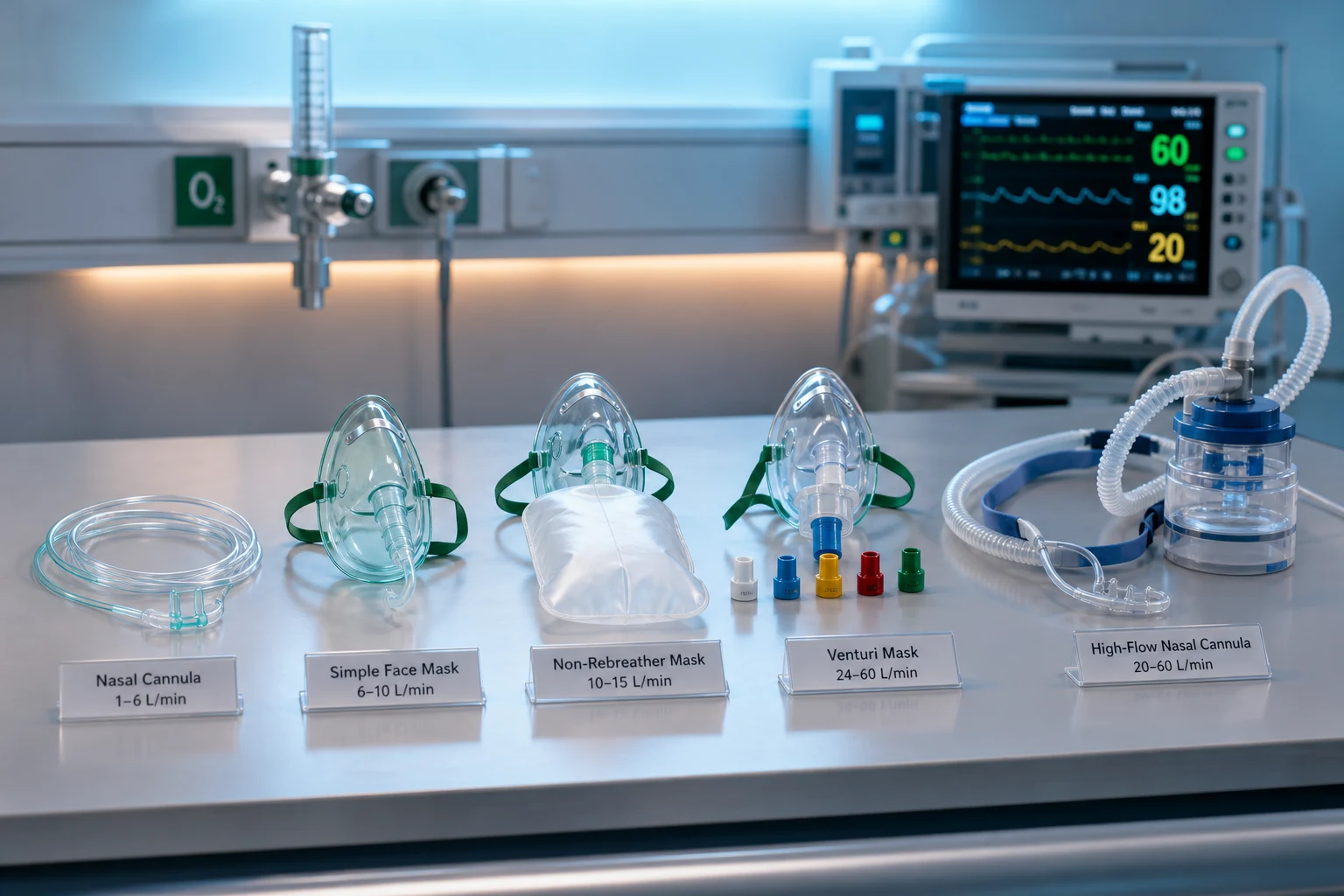
Low-flow, variable-performance devices
The FiO2 these deliver varies with the patient's inspiratory flow (a high peak inspiratory flow entrains more room air and dilutes the FiO2).[1]
- Nasal cannula — 1-6 L/min delivers about 24-44 per cent FiO2 (roughly each 1 L/min adds about 4 per cent above room air). Comfortable, allows eating and talking; dries the nose above 4 L/min (humidify).
- Simple face mask — 5-10 L/min delivers about 35-60 per cent FiO2. Run it at at least 5 L/min to wash out exhaled CO2 and avoid rebreathing.
- Non-rebreather (reservoir) mask — 10-15 L/min with a reservoir bag and one-way valves delivers 60-90 per cent FiO2, the highest FiO2 of the low-flow devices. The first choice for the rapidly desaturating, critically ill patient (give the highest FiO2 first, then wean).[1]
The physics of variable-performance devices — why FiO2 falls as inspiratory flow rises
A low-flow device supplies gas at a fixed flow (say 6 L/min), but the patient's minute and peak inspiratory flow varies enormously in respiratory distress (peak inspiratory flow can exceed 100 L/min). The oxygen delivered mixes with entrained room air in the anatomic reservoir (the nose, nasopharynx, and the mask itself). The delivered FiO2 is therefore a function of the ratio of the device flow to the patient's peak inspiratory flow, not of the dial setting alone. This is the single most important principle to explain in the viva: a "6 L/min nasal cannula" does not deliver 44 per cent FiO2 to a patient panting at a peak inspiratory flow of 120 L/min — it delivers far less, because most of each breath is room air.[1]
The arithmetic (a useful viva approximation): for a sinusoidal inspiratory pattern the mean inspiratory flow is roughly pi/2 (about 1.5) times the minute-ventilation-derived mean. At a minute ventilation of 10 L/min with an I:E ratio of 1:2, the mean inspiratory flow is about 30 L/min. A nasal cannula at 4 L/min therefore contributes only a small fraction of each breath — most is entrained room air. This is precisely why a tachypnoeic, distressed patient saturates poorly on a nasal cannula and needs a fixed-performance device (Venturi) or a high-flow device (HFNC) that can match or exceed the inspiratory flow.[1]
Nasal cannula in depth — the workhorse
The nasal cannula is the most-used oxygen device in the hospital and the most comfortable. Flow is set 1-6 L/min. The classical rule of thumb — each 1 L/min adds about 4 per cent FiO2 above 21 per cent (so 2 L/min ≈ 28 per cent, 4 L/min ≈ 36 per cent, 6 L/min ≈ 44 per cent) — holds only for a calm patient breathing quietly through the nose; it is a rough guide, not a measured FiO2. Two under-appreciated points: [1]
- The cannula delivers gas to the nasopharyngeal anatomic reservoir, which holds about 50 mL. Between breaths this reservoir fills with oxygen, so even though the continuous flow is only a few L/min, the first part of each inspiration draws oxygen-rich gas. This is why the cannula works at all at low flow, and why mouth-breathing reduces its efficiency (the reservoir is bypassed).[1]
- Above about 4 L/min the unhumidified gas dries the nasal mucosa (epistaxis, discomfort, crusting) and causes mucociliary dysfunction within hours. Humidify (bubbler or, better, heated humidification) for any cannula above 4 L/min and for any patient on oxygen for more than a few hours.[1]
Simple face mask in depth — the rebreathing trap
The simple (Hudson) face mask covers the nose and mouth and delivers 5-10 L/min, achieving about 35-60 per cent FiO2. The mask itself is a 100-200 mL reservoir — useful, but also the trap: at flows under 5 L/min the exhaled gas (CO2-rich) is not flushed from the mask and is rebreathed, causing a rising PaCO2. The minimum-flow rule (never under 5 L/min) exists for this reason. If the patient needs a FiO2 below what a 5 L/min mask gives, downgrade to a nasal cannula, not a slower mask. The mask is less comfortable than the cannula, interferes with eating and talking, and is inferior to HFNC for almost every ICU use — its main role is as a stopgap when a cannula is insufficient and HFNC is not yet set up.[1]
The non-rebreather (reservoir) mask — the highest-FiO2 low-flow device
The non-rebreather mask adds a one-litre reservoir bag and a series of one-way valves: a one-way inspiratory valve between bag and mask (so the patient inhales from the bag, not the room) and one-way exhalation ports on the mask (so exhaled gas leaves and is not rebreathed). At 10-15 L/min it delivers 60-90 per cent FiO2 — the highest of any low-flow device. It is the device of choice for the rapidly desaturating, critically ill patient, on the principle of giving the highest FiO2 first, then weaning to a target (you can always turn oxygen down).[1]
Two exam points on the reservoir mask: (1) the FiO2 never reaches 100 per cent because the mask-to-face seal is never perfect and room air is entrained around the edges, particularly in a distressed patient; (2) the reservoir bag must remain at least two-thirds inflated throughout the respiratory cycle — if it collapses on inspiration the oxygen flow is inadequate (turn it up) and the mask is functioning as a simple mask. A common error is to run a non-rebreather at 6-8 L/min; this collapses the bag and the patient rebreathes. Minimum 10 L/min, ideally 15 L/min.[1]
Low-flow oxygen devices — flow, FiO2, and the rule you must not break
| Device | Flow (L/min) | Approximate FiO2 | Minimum flow / rule | Best use |
|---|---|---|---|---|
| Nasal cannula | 1-6 | 24-44% | Humidify above 4 L/min | Stable hypoxaemia, comfort, allows eating/talking; mild COPD |
| Simple face mask | 5-10 | 35-60% | Never below 5 L/min (rebreathing) | Stopgap; mostly superseded by HFNC in ICU |
| Non-rebreather (reservoir) | 10-15 | 60-90% | Reservoir bag must stay ⅔ inflated | The crashing/desaturating patient — highest FiO2 first |
Choosing and setting up the right low-flow device at the bedside
Assess the work of breathing and the likely FiO2 need
A calm, mildly hypoxaemic patient (e.g. post-operative SpO2 92%) needs only a nasal cannula at 2-4 L/min. A distressed, rapidly desaturating patient needs the highest FiO2 you have — a non-rebreather at 15 L/min — while you prepare definitive support. Do not "creep up" through devices in the crashing patient.
Connect to oxygen and set the flow
Nasal cannula 1-6 L/min; simple mask 5-10 L/min (never less); non-rebreather 10-15 L/min (aim for 15). Check the wall flowmeter is delivering — a flat or empty cylinder or a kinked tube is the commonest reason a device "fails".
Check the reservoir bag (non-rebreather)
The bag must remain at least two-thirds inflated throughout the cycle. If it collapses on inspiration, increase the flow. A collapsed bag means the patient is breathing against a closed inspiratory valve and effectively rebreathing.
Add humidification above 4 L/min
For a cannula above 4 L/min, or any patient on oxygen more than a few hours, add heated humidification (HFNC does this intrinsically). Dry gas impairs mucociliary clearance and promotes secretion retention and atelectasis.
Set the SpO2 target and titrate down
Target SpO2 94-98% for most adults (88-92% in COPD/hypercapnia risk). Once the target is met, wean the flow — the principle is the lowest FiO2 that meets the target, not the highest the patient tolerates.
The fixed-performance Venturi mask
The Venturi mask entrains a fixed ratio of air to oxygen through colour-coded valves, delivering a precise, known FiO2 (24, 28, 31, 35, 40, 50, 60 per cent), independent of the patient's inspiratory flow. It is the device of choice when a known, controlled FiO2 matters — above all in COPD, where a controlled FiO2 (start at 24-28 per cent) avoids oxygen-induced hypercapnia.[1][1]
The Venturi principle — entrainment ratio and the colour codes
The Venturi (High Airflow Oxygen Entrainment) mask works by passing a narrow jet of 100 per cent oxygen through a fixed orifice; the high-velocity stream entrains room air through side ports in a precisely engineered ratio. The resulting total gas flow is high (often 40-80 L/min depending on the valve), which exceeds the patient's peak inspiratory flow, and so the delivered FiO2 is fixed and independent of the patient's breathing pattern. This is the definition of a fixed-performance device.[1]
The key physics: the entrainment ratio (oxygen : entrained air) sets the FiO2, and the size of the orifice sets the ratio. A larger entrainment port entrains more air → a lower FiO2 but a higher total flow. The trade-off is fundamental — the lower the FiO2 setting, the higher the delivered total flow, which is why the 24% valve delivers the most total flow (~80 L/min) and the 60% valve delivers the least. The colour-coded valves deliver: [1]
Venturi mask colour codes — FiO2, oxygen flow to drive, and total delivered flow
| Colour | Delivered FiO2 | Recommended oxygen flow (L/min) | Approximate total delivered flow (L/min) | Use |
|---|---|---|---|---|
| Blue | 24% | 2-4 | ~80 | COPD — start here |
| White | 28% | 4-6 | ~68 | COPD with rising PaCO2 |
| Orange | 31% | 6-8 | ~56 | COPD / precise titration |
| Yellow | 35% | 8-10 | ~45 | Moderate hypoxaemia, control needed |
| Red | 40% | 10-12 | ~36 | Higher controlled FiO2 |
| Green | 50% | 12-15 | ~24 | Severe hypoxaemia, short term |
| Grey/pink | 60% | 12-15 | ~18 | Highest fixed FiO2 (low total flow — caution in high inspiratory flow) |
Two clinical traps with the Venturi. First, the oxygen flowmeter must be set to the value marked on the valve (e.g. 2-4 L/min for the 24% blue valve) — turning the flowmeter up does not raise the FiO2, it merely over-drives the jet and the entrainment ratio (hence FiO2) is unchanged; conversely, setting the flow too low under-drives the jet and the FiO2 falls. Second, the high-FiO2 valves (50%, 60%) deliver a low total flow (~24, ~18 L/min), which a patient in distress (peak inspiratory flow over 60 L/min) will exceed, entraining room air around the mask and dropping the true FiO2 below the set value. For a controlled high FiO2 in a distressed patient, HFNC is the fixed-performance device of choice because it delivers up to 60 L/min at any FiO2.[1]
Venturi in COPD — the controlled-oxygen rationale
In a COPD exacerbation with hypercapnia, the goal is a known, modest FiO2 that corrects hypoxaemia without worsening CO2. Start with the 24% (blue) valve, check an arterial blood gas at 30-60 minutes, and titrate up (to 28%, rarely 31%) to keep PaO2 above 60 mmHg (SpO2 ~88-92%). The Venturi is preferred over a nasal cannula here because its FiO2 is predictable and stable regardless of the variable breathing pattern of the distressed COPD patient. If the PaCO2 continues to rise and the pH falls despite controlled oxygen, the patient has ventilatory failure needing NIV (BiPAP), not more oxygen.[1][1]
High-flow nasal cannula (HFNC)
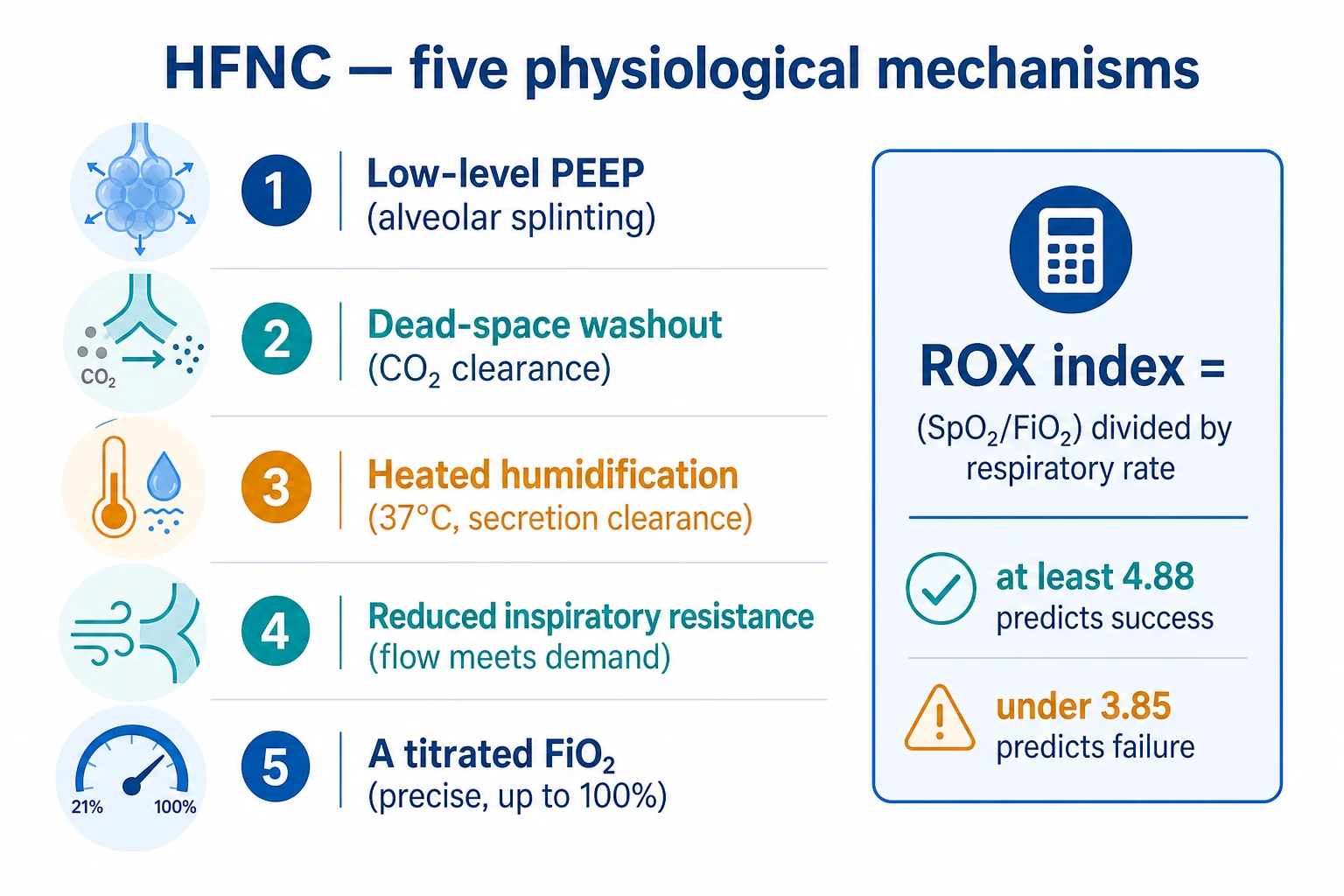
HFNC delivers up to 60 L/min of heated, humidified gas with a titrated FiO2 (up to 100 per cent). Its advantages over standard oxygen:[2][1]
- A low-level PEEP (about 3-5 cmH2O) that splints open alveoli.
- Dead-space washout (clearing CO2 from the upper airway with each breath).
- Heated humidification, which improves comfort, secretion clearance, and ciliary function.
- Reduced work of breathing and a high, known FiO2.
The FLORALI trial (Frat, NEJM 2015) compared HFNC with standard oxygen and non-invasive ventilation in acute hypoxaemic respiratory failure. Overall 28-day intubation rates were not significantly different, but HFNC reduced intubation in the pneumonia subgroup and in patients with a PaO2/FiO2 under 150, and was well tolerated. The ROX index (SpO2/FiO2 divided by respiratory rate) helps predict which patients will succeed on HFNC and which need intubation.[2]
HFNC physiology — the four mechanisms (a viva staple)
HFNC is not "just oxygen" — it is a distinct respiratory support with four overlapping mechanisms, and you should be able to recite all four:[2][1]
- A high, known, fraction of inspired oxygen (up to 100%), set independently of flow. Unlike a Venturi (where high FiO2 means low total flow) or a cannula (where flow sets FiO2), HFNC decouples the two: the oxygen is blended with air to a set FiO2 and delivered at high flow. The FiO2 is therefore stable regardless of the patient's inspiratory effort.
- A low level of positive pressure (PEEP) generated by the high flow against the fixed nasal prongs — typically 1-5 cmH2O, proportional to flow and inversely related to mouth opening. It splints open collapsed alveoli, redistributes oedema fluid, and reduces work of breathing by unloading inspiratory muscles. Measured with a closed mouth, peak airway pressure approaches 5-7 cmH2O at 60 L/min.
- Washout of anatomical dead space — the high flow flushes CO2-rich gas from the nasopharynx and upper airway before each inspiration, so each breath contains a higher fraction of fresh gas. This reduces the physiological dead space and improves ventilatory efficiency (a lower minute ventilation achieves the same PaCO2), which is why HFNC helps even mild hypercapnia (it is not a substitute for NIV in true type-2 failure).
- Heated, humidified gas at 37°C and near-100% relative humidity — the single biggest comfort and physiology advantage. Fully humidified, warmed gas preserves mucociliary function, prevents heat and water loss, thins secretions, and allows sustained tolerance. Standard dry oxygen at over 4 L/min impairs cilia within hours; HFNC supports them. [1]
The ROX index — predicting HFNC success
The ROX index (Roca 2019) = (SpO2 / FiO2) / respiratory rate, where SpO2 is in per cent, FiO2 is a fraction (0-1), and RR in breaths/min. Measured at 2, 6, and 12 hours after starting HFNC, it predicts the likelihood of avoiding intubation:[5]
- ROX ≥ 4.88 — likely to succeed; continue HFNC.
- ROX 3.85-4.87 — intermediate; monitor closely and repeat.
- ROX < 3.85 — high risk of failure; prepare for intubation. [1]
The trend matters as much as the absolute value: a falling ROX over successive measurements is an early warning to intubate, while a rising ROX reassures. The ROX index is best validated in pneumonia; apply it cautiously in other pathologies.[5]
Setting up and titrating HFNC at the bedside
Start at a high flow and a high FiO2, then titrate
Begin at 40-50 L/min flow and FiO2 0.9-1.0 for the hypoxaemic patient; let the patient acclimatise (HFNC feels odd at first). Most adults tolerate 50-60 L/min; reduce to 30-40 L/min in cardiogenic pulmonary oedema or if poorly tolerated.
Set the humidifier to 37 C and confirm misting
Heated humidification at 34-37 C is integral — it is not optional. Confirm condensation in the circuit. Dry HFNC is not HFNC.
Titrate the FiO2 down to the SpO2 target
Once SpO2 is in target (92-96% for most, 88-92% for COPD), wean FiO2 in steps of 0.1. Aim for FiO2 under 0.4 before weaning flow.
Calculate the ROX index at 2, 6, and 12 hours
ROX = (SpO2/FiO2)/RR. A value at or above 4.88 supports continuing; below 3.85 is a warning to prepare for intubation. Watch the trend — a falling ROX over time is an intubation trigger.
Wean flow last, only after FiO2 is low
Reduce flow in 5-10 L/min steps to 20-30 L/min, then step down to a nasal cannula. Do not wean flow before FiO2 — the PEEP and dead-space washout are load-reducing.
Intubate early for failure — do not chase a falling ROX
Rising RR, falling SpO2, rising work of breathing, exhaustion, or a ROX under 3.85 mandate intubation. Delayed intubation from a failing HFNC trial increases mortality.
HFNC for preoxygenation before intubation
HFNC has a second, increasingly important ICU role: preoxygenation and apnoeic oxygenation during tracheal intubation. In the critically ill patient (desaturating fast, reduced functional residual capacity, shunt), the standard bag-mask or non-rebreather preoxygenation often fails to denitrogenate the lungs, and desaturation during the apnoeic period of rapid sequence intubation is common and dangerous. HFNC at 60 L/min during preoxygenation, continued through the apnoeic period (the so-called apnoeic oxygenation technique), extends the safe apnoea time by delivering oxygen into the pharynx that diffuses down the trachea even without ventilation. Miguel-Montanes (2015) and Guitton (2019) showed HFNC reduced desaturation during intubation of moderately hypoxaemic patients.[6][7]
Indications and contraindications for HFNC
HFNC — when it helps and when it does not
| Indicated (good evidence) | Uncertain / second-line | Contraindicated / likely to fail |
|---|---|---|
| Acute hypoxaemic respiratory failure without hypercapnia (pneumonia — the strongest FLORALI signal) | Cardiogenic pulmonary oedema (HFNC is acceptable; CPAP/NIV better proven for work-of-breathing) | Severe type-2 (hypercapnic) failure with acidosis — needs NIV, not HFNC |
| PaO2/FiO2 100-300 (moderate hypoxaemia) | Immunocompromised respiratory failure (HFNC increasingly first-line, often before NIV) | Cardiopulmonary arrest / apnoea / coma — needs immediate intubation |
| Post-extubation / preventive in high-risk extubation (HIGH-WEAN, FLORALI-2 ongoing) | Do-not-intubate symptom relief (dyspnoea, comfort) | Facial/airway trauma, basal skull fracture (nasal prongs), complete nasal obstruction |
| Mild hypercapnia (pH normal) as a ceiling of care | Palliative dyspnoea in advanced disease | Inability to protect airway, copious secretions needing suction, agitated/uncooperative |
Non-invasive and invasive ventilation
- Non-invasive ventilation (NIV) — bilevel (BiPAP) or CPAP with titrated oxygen, for type-2 failure (the COPD exacerbation), cardiogenic pulmonary oedema (CPAP), and immunocompromised respiratory failure. It provides positive pressure that standard oxygen cannot.
- Invasive mechanical ventilation — the definitive support, delivering up to 100 per cent FiO2, for the failing, tiring, or obtunded patient.[1]
The escalation ladder and the SpO2 target
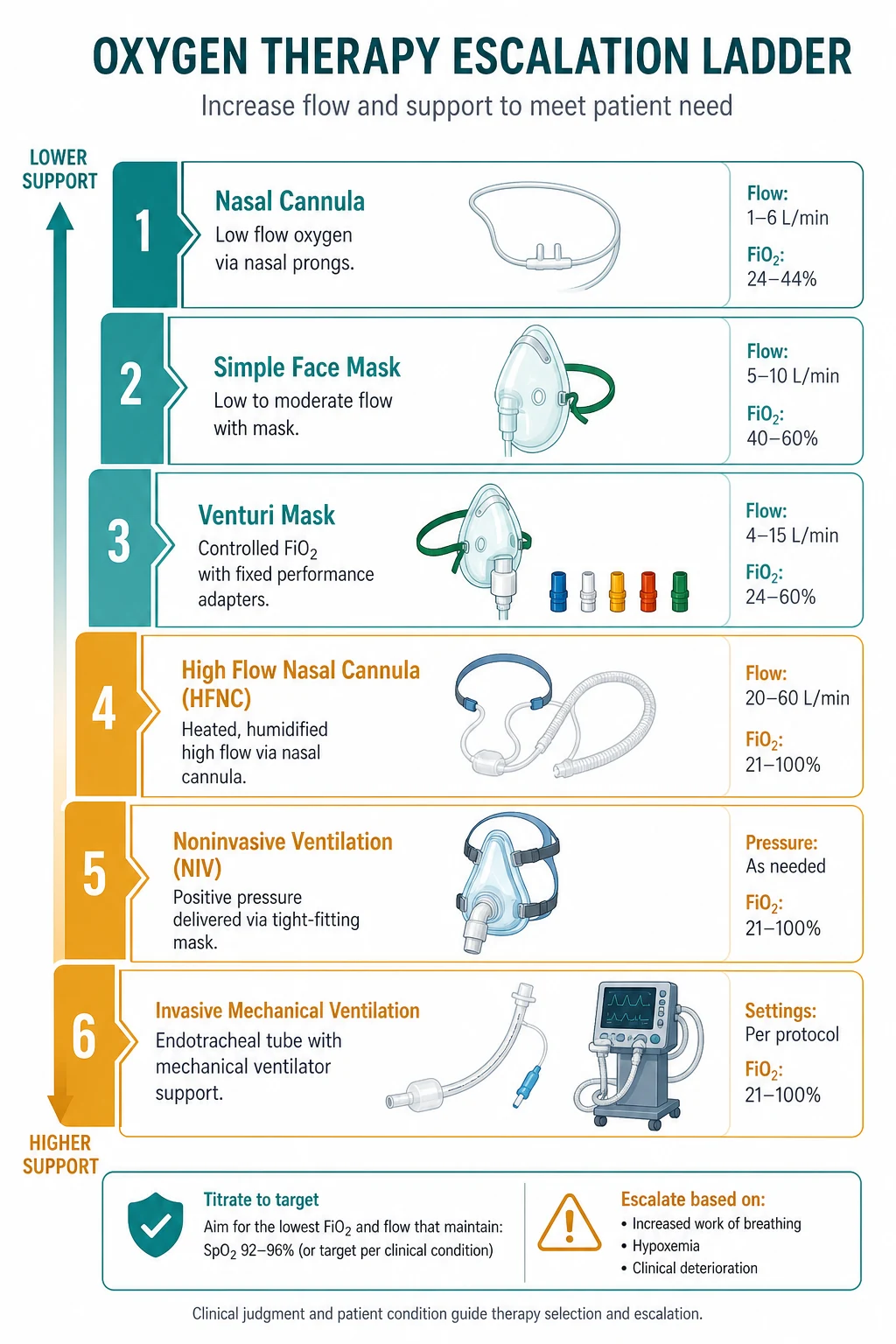
Escalate FiO2 from the nasal cannula through masks to HFNC and ventilation, but give the lowest FiO2 that meets the target SpO2, because hyperoxia is harmful:[1][1]
- Nasal cannula → simple mask → non-rebreather → Venturi (for precision, especially COPD) → HFNC → NIV → invasive ventilation.
- Target SpO2 94-98 per cent for most acutely ill adults (and 92-96 per cent for the critically ill).[1]
- Target SpO2 88-92 per cent in patients at risk of hypercapnia (COPD, neuromuscular weakness, obesity-hypoventilation, an overdose).[1]
The oxygen dissociation curve and the CO2 retainer
The oxygen-haemoglobin dissociation curve is sigmoid, and its shape dictates much of oxygen therapy. Three regions matter clinically:[1]
- The flat plateau (PaO2 60-100 mmHg, SpO2 90-100%) — above PaO2 60 mmHg the curve is nearly horizontal, so increasing PaO2 from 80 to 100 mmHg adds only a trivial amount of oxygen to haemoglobin (saturation rises from ~94% to ~98%, a gain of <1 mL O2/dL of blood). Chasing a supra-normal SpO2 gives no meaningful benefit and exposes the patient to hyperoxia. This is the physiological basis of the conservative-oxygen strategy.
- The P50 (PaO2 ~26-27 mmHg at SpO2 50%) — the point that defines the curve's affinity. A right shift (lower affinity, easier unloading to tissues) is caused by ↑H+ (acid), ↑CO2 (Bohr), ↑2,3-DPG, ↑temperature; a left shift (higher affinity, harder unloading) by the opposites. Stored blood and alkalosis left-shift the curve and impair tissue oxygen unloading.
- The steep lower limb (PaO2 20-60 mmHg) — here small falls in PaO2 cause large falls in saturation. This is why a COPD patient at SpO2 88% is on the safe knee but one who slips to SpO2 80% (PaO2 ~44 mmHg) is in real trouble. Targeting 88-92% in the COPD/CO2 retainer sits right at the knee — enough oxygenation, minimal hyperoxic CO2 penalty, and away from the cliff of the steep limb. [1]
Why does oxygen worsen CO2 in the COPD patient? — the two mechanisms
This is one of the most asked oxygen-viva questions. The traditional answer ("oxygen removes the hypoxic ventilatory drive") is incomplete and partly wrong. Two mechanisms contribute, and the second is the larger:[1][1]
- The Haldane effect (the dominant mechanism). Deoxyhaemoglobin carries CO2 more readily than oxyhaemoglobin (it binds H+, facilitating CO2 transport as bicarbonate). When you give a high FiO2 and fully saturate haemoglobin, the blood's capacity to carry CO2 as bicarbonate falls, and CO2 is released into the tissues but retained in the lungs where V/Q is low. In the COPD lung, where many areas are poorly ventilated (low V/Q), the retained CO2 cannot be blown off, and the PaCO2 rises. This accounts for the majority of the oxygen-induced hypercapnia.
- Worsened V/Q mismatch (release of hypoxic pulmonary vasoconstriction). In chronic COPD, poorly ventilated alveolae are matched by hypoxic pulmonary vasoconstriction (HPV) — blood is diverted away from the worst-ventilated units. A high FiO2 relieves HPV, perfusing these low-V/Q units ("V/Q scatter"), increasing shunt-like dead space, and so the CO2 load on the remaining well-ventilated lung rises.
- Reduced ventilatory drive (a smaller, real contributor). Some chronic CO2 retainers rely partly on hypoxic drive; a high PaO2 reduces this. But this is a minor contributor compared with the Haldane effect and V/Q mismatch — which is why even patients who maintain their ventilation can still develop a rising PaCO2 on oxygen. [1]
The clinical consequence: control the FiO2 (Venturi 24-28%), check an ABG, and if the PaCO2 rises with acidosis move to NIV — do not simply remove the oxygen, because a hypoxaemic COPD patient still dies of hypoxia. Target SpO2 88-92%, accepting a PaO2 of ~60 mmHg.[1][1]
Oxygen toxicity and the conservative-oxygen principle
Oxygen is not benign:[1]
- Absorption atelectasis — nitrogen washout removes the gas (nitrogen, poorly soluble) that holds alveoli open. With a high FiO2 the alveolus fills with absorbable oxygen; when the oxygen is taken up faster than fresh gas enters, the alveolus collapses. This is worst in dependent, poorly ventilated lung (a key mechanism of worsening in ARDS, atelectrauma).
- Pulmonary oxygen toxicity (the Lorrain-Smith effect) — sustained high FiO2 (classically above 0.6 for over 24-48 hours, though the threshold is debated) generates reactive oxygen species (superoxide, hydrogen peroxide, hydroxyl radical) that overwhelm the lung's antioxidant defences (catalase, superoxide dismutase, glutathione). The histological sequence is tracheobronchitis → capillary leak → interstitial oedema → fibroproliferation, histologically indistinguishable from ARDS. The ARDSnet low-tidal-volume trial's mortality benefit is partly attributable to its lower FiO2 / higher PEEP strategy, which minimises both volutrauma and oxygen toxicity.
- Hypercapnia in COPD — the Haldane effect and worsened V/Q mismatch (above). The dose-related, predictable harm in the CO2 retainer.
- Systemic effects — peripheral vasoconstriction (reduced cardiac output modestly), coronary and cerebral vasoconstriction, absorption of nitrogen from body cavities (middle ear, sinus, gut), and (in the premature neonate) retinopathy of prematurity and bronchopulmonary dysplasia.
- Recent large trials support a conservative strategy — target a near-normal, not supra-normal, SpO2:[1][3][4]
- ICU-ROX (Mackle 2020, NEJM): conservative oxygenation (SpO2 91-96%) vs usual care in mechanically ventilated ICU patients — no difference in the primary outcome of ventilator-free days, and no signal of harm from the conservative approach.[3]
- HOT-ICU (Nielsen 2024, JAMA): lower (SpO2 target 93-95%) vs higher (97-98%) oxygenation target in 1850 critically ill patients — no difference in days alive without life support at 90 days; no benefit from targeting hyperoxia, reinforcing that a conservative target is safe and appropriate.[4]
- LOFT and SUPRA-O2 and the Cochrane meta-analyses collectively show that a higher (liberal/hyperoxia) target does not improve survival and may increase mortality, while a conservative target is safe. The net message: avoid both hypoxaemia and hyperoxia.
Clinical decision points
- Type-1 (hypoxaemic) failure — escalate FiO2; HFNC for moderate hypoxaemia (FLORALI supports it, especially in pneumonia); CPAP/NIV for cardiogenic pulmonary oedema; intubate if severe or failing (a rising respiratory rate, exhaustion, a falling SpO2 on HFNC).
- Type-2 (hypercapnic) failure — controlled oxygen (a Venturi at 24-28 per cent) plus NIV; avoid a high FiO2.[1]
- The rapidly desaturating patient — start with the highest FiO2 (the non-rebreather), then wean to the target.[1]
SAQ — Choosing the oxygen device and the CO2 retainer
10 minutes · 10 marks
A 70-year-old man with severe COPD (FEV1 30 per cent predicted, long-term oxygen therapy at home) presents with a 2-day exacerbation. On arrival he is on 6 L/min via a simple face mask; SpO2 96 per cent, RR 26, GCS 14. Initial ABG: pH 7.28, PaCO2 76, PaO2 78, HCO3 34. The ED team plans to switch to a non-rebreather to keep SpO2 above 95 per cent.
SAQ — HFNC in hypoxaemic respiratory failure and the ROX index
10 minutes · 10 marks
A 48-year-old man with bilateral community-acquired pneumonia is hypoxaemic (SpO2 90 per cent on a non-rebreather at 15 L/min, RR 32, P/F 130). You start high-flow nasal cannula at 50 L/min, FiO2 0.6. After 30 minutes he is more comfortable (RR 26, SpO2 94 per cent). The team asks how long to trial HFNC before deciding on intubation.
Red flags
Oxygen blenders — precise FiO2 in the ventilated patient
An oxygen blender (air-oxygen blender) mixes compressed air and oxygen to deliver a precise, adjustable FiO2 (21-100%) at high total flow, independent of the patient's inspiratory pattern. It is the fixed-performance source behind every modern ventilator, HFNC circuit, anaesthetic machine, and neonatal CPAP device. The principle is the same as the Venturi — mix two gas sources in a known ratio — but the blender uses calibrated needle valves and a pressure-balancing chamber rather than a fixed entrainment jet, and it delivers high flow at any FiO2.[1]
Blenders exist because a wall oxygen flowmeter alone cannot deliver a known FiO2 at high flow: it delivers 100% oxygen at whatever flow is set, and the patient entrains room air to make up the deficit (the same variable-performance problem as the nasal cannula). The blender solves this by mixing the air and oxygen before delivery. Two ICU applications: [1]
- Mechanical ventilators have an integral blender; the FiO2 is set on the ventilator and delivered precisely in every breath. This is the only way to guarantee a known FiO2 in the intubated patient.
- HFNC and CPAP circuits use an external blender (or an integral turbine-blender in modern devices) to set FiO2 independently of flow — the FiO2 dial and the flow dial are separate, which is why HFNC can deliver 60 L/min at 40% FiO2 (impossible with a simple Venturi).[1]
Inhaled pulmonary vasodilators — oxygen delivery to the refractory hypoxaemic lung
When the problem is intrapulmonary shunt (blood perfusing non-ventilated alveolae, e.g. in severe ARDS or pneumonia), raising FiO2 saturates ventilated units but cannot reach the shunted blood — the hypoxaemia is refractory to oxygen. The two rescue manoeuvres are prone positioning (redistributes perfusion to dorsal, previously atelectatic lung) and inhaled pulmonary vasodilators, which deliver vasodilator only to ventilated alveolae, selectively increasing their perfusion and reducing shunt.[1]
Inhaled nitric oxide (iNO) and inhaled prostacyclin (epoprostenol)
- Inhaled nitric oxide (iNO) — a selective pulmonary vasodilator delivered into the inspiratory limb of the ventilator circuit (typically 5-20 ppm, up to 40 ppm). Because iNO is a gas it reaches only ventilated alveolae, vasodilating their adjacent pulmonary arterioles and redirecting blood from shunt regions to ventilated regions, reducing shunt fraction and raising PaO2 (often a 10-20% rise in PaO2/FiO2). It is rapidly bound by haemoglobin (forming methaemoglobin and nitrates), so it has no systemic vasodilator effect — the selectivity that makes it useful. Monitor methaemoglobin (keep under 2-3%) and nitrogen dioxide (NO2) (a toxic by-product, keep under 2 ppm). iNO reduces pulmonary pressures in pulmonary hypertension and acutely improves oxygenation in neonatal PPHN (its only proven mortality benefit), but in adult ARDS it does not improve survival — it is a rescue/bridge therapy.[1]
- Inhaled epoprostenol (prostacyclin, PGI2) — an alternative inhaled vasodilator (50 ng/kg/min nebulised into the circuit), cheaper and with no methaemoglobin or NO2 risk; effect on oxygenation is comparable to iNO. Both iNO and inhaled epoprostenol are not tied to the oxygen device ladder but are added on top of a high FiO2 on the ventilator when standard oxygen is exhausted.[1]
Inhaled pulmonary vasodilators in refractory hypoxaemia
| Feature | Inhaled nitric oxide (iNO) | Inhaled epoprostenol (PGI2) |
|---|---|---|
| Dose | 5-20 ppm (up to 40) into inspiratory limb | ~50 ng/kg/min nebulised |
| Mechanism | ↑ cGMP in pulmonary vascular smooth muscle | ↑ cAMP in pulmonary vascular smooth muscle |
| Selectivity | Reaches ventilated alveolae only → redirects flow from shunt | Same — ventilated-alveolae selective |
| Systemic effect | None (rapidly bound by Hb) | Minimal (rapidly metabolised) |
| Monitoring | Methaemoglobin (keep <2-3%); NO2 (keep <2 ppm) | Systemic BP (hypotension if circuit leak) |
| Effect on oxygenation | Often 10-20% rise in PaO2/FiO2 | Comparable |
| Effect on survival (adult ARDS) | No proven mortality benefit — rescue/bridge | No proven mortality benefit — rescue/bridge |
| Cost | Very expensive | Cheap |
| Proven mortality benefit | Neonatal PPHN only | Neonatal PPHN |
ICU-specific considerations in oxygen therapy
Pulmonary hypertension and the right ventricle
In pulmonary hypertension and acute right ventricular failure, hypoxaemia and acidosis are potent pulmonary vasoconstrictors that worsen RV afterload and can precipitate a lethal downward spiral. These patients need a higher target (SpO2 94-96%, avoiding any hypoxaemia) — the small CO2-retainer concession does not apply. Correction of hypoxaemia is itself a pulmonary vasodilator, and in severe RV failure an inhaled pulmonary vasodilator (iNO) is added to reduce RV afterload. Conversely, hyperoxia can worsen atelectasis without helping, so do not chase 100% either.[1]
Carbon monoxide poisoning — use 100% oxygen
In carbon monoxide (CO) poisoning, CO binds haemoglobin with ~240 times the affinity of oxygen, forming carboxyhaemoglobin and shifting the dissociation curve far left. The treatment is 100% oxygen (non-rebreather at 15 L/min, or FiO2 1.0 on a ventilator) to displace CO from haemoglobin (the half-life of COHb falls from ~320 min on room air to ~80 min on 100% oxygen, and to ~20 min on hyperbaric oxygen). This is one situation where hyperoxia is mandatory — the dissociation-curve logic does not apply, because the problem is CO displacement, not oxygen delivery.[1]
The shunted / refractory patient — oxygen has limits
Oxygen corrects hypoxaemia from low V/Q and low inspired oxygen, but it cannot overcome true shunt (perfusion of non-ventilated lung). In shunt, raising FiO2 from 0.6 to 1.0 adds almost nothing to arterial oxygenation because the shunted blood bypasses the ventilated alveolae entirely. The shunt fraction can be estimated: PaO2/FiO2 under 200 implies a significant shunt. The solutions for shunt are not more FiO2 but recruitment (PEEP, prone), reducing shunt (draining effusion, treating pneumonia), and in the limit, ECMO. Knowing when oxygen has "failed" — the refractory hypoxaemia despite FiO2 1.0 — is the trigger to escalate beyond FiO2.[1]
Oxygen in metabolic acidosis and shock
In shock and severe metabolic acidosis, oxygen delivery (DO2) is the issue, not FiO2. Maximise oxygen content (haemoglobin, saturation) and cardiac output. Hyperoxia does not correct lactic acidosis from shock — restoring perfusion does. The conservative-oxygen target still applies, but never let a shocked patient sit hypoxaemic.[1]
The escalating-FiO2 ladder applied — three archetype patients
The COPD exacerbation with rising PaCO2 (type-2 failure)
Start with a Venturi 24% (blue) at 2-4 L/min; check ABG at 30-60 min; target SpO2 88-92%, PaO2 ~60 mmHg. If PaCO2 rises with pH under 7.35, escalate to NIV (BiPAP) with controlled oxygen — not to a higher FiO2. Controlled, known FiO2 is the whole point; the Venturi is the device.
Acute hypoxaemic respiratory failure from pneumonia (type-1, no hypercapnia)
Escalate: nasal cannula → simple/non-rebreather → HFNC at 50-60 L/min and FiO2 1.0, then wean FiO2 to target 92-96%. Calculate ROX at 2/6/12 h. If ROX is under 3.85 or the patient is tiring, intubate — do not let a failing HFNC run. FLORALI supports HFNC, especially in pneumonia (PaO2/FiO2 under 150).
The crashing/desaturating patient (e.g. massive PE, aspiration, arrest)
Non-rebreather at 15 L/min (or bag-valve-mask with an oxygen reservoir at 15 L/min for the apnoeic patient) — give the highest FiO2 first. Proceed to intubation with HFNC preoxygenation/apnoeic oxygenation if time permits. Do not "creep up" the ladder in the crashing patient.
Key trials and evidence
FLORALI — High-flow oxygen through nasal cannula in acute hypoxaemic respiratory failure (Frat 2015, NEJM)
Study design
Multicentre, randomised, open-label trial — 310 patients with acute hypoxaemic respiratory failure (PaO2/FiO2 ≤300) without hypercapnia, across 23 ICUs in France and Belgium
Intervention
HFNC vs standard oxygen (non-rebreather) vs non-invasive ventilation (NIV), delivered for at least 2 hours
Primary outcome
Intubation rate at day 28 — HFNC 38%, standard O2 47%, NIV 50% (not significant overall)
Key subgroup finding
HFNC significantly reduced intubation in pneumonia (P = 0.0098 for interaction) and in patients with PaO2/FiO2 ≤150 (HR 0.46, 95% CI 0.25-0.84). 90-day mortality was lower with HFNC.
Clinical bottom line
HFNC is a valid first-line therapy in acute hypoxaemic respiratory failure; the strongest signal is in pneumonia and moderate hypoxaemia. Established HFNC as a standard of care.
ICU-ROX — Conservative oxygen therapy during mechanical ventilation (Mackle 2020, NEJM)
Study design
Multicentre, randomised, blinded-outcome-assessor trial — 965 mechanically ventilated ICU patients across Australia/New Zealand
Intervention
Conservative oxygen therapy (SpO2 target 91-96%, aiming ~88-92%) vs usual care (liberal, clinician-set)
Primary outcome
Ventilator-free days at 28 days — no significant difference (conservative 21.3 days vs usual care 22.1 days; absolute difference -0.3)
Key finding
No difference in mortality, new organ failures, or adverse events. The conservative approach was safe; it neither helped nor harmed in the broader ICU population.
Clinical bottom line
A conservative (lower-SpO2) oxygen strategy is safe in mechanically ventilated patients — there is no mandate to target hyperoxia, and no harm from a near-normal target. Supports weaning FiO2 to the lowest that meets target.
HOT-ICU — Lower vs higher oxygenation target (Nielsen 2024, JAMA)
Study design
Multicentre, randomised clinical trial — 1850 critically ill ICU patients across 32 Danish ICUs
Intervention
Lower target (PaO2 8 kPa / SpO2 93-95%) vs higher target (PaO2 12 kPa / SpO2 97-98%)
Primary outcome
Days alive without life support at 90 days — no significant difference (lower target 76.4 vs higher target 76.7 days)
Key finding
No difference in 90-day or 1-year mortality, organ support, or serious adverse events. Targeting hyperoxia (higher PaO2) conferred no benefit over a conservative target.
Clinical bottom line
In the general ICU population, a conservative oxygen target is as good as a liberal one and avoids hyperoxia. Reinforces the conservative-oxygen principle across ICU-ROX and HOT-ICU.
ROX index — predicting HFNC outcome (Roca 2019, AJRCCM)
Study design
Prospective cohort and pooled analysis — 191 patients with pneumonia treated with HFNC, combined with prior cohorts (n = 458)
Index
ROX = (SpO2/FiO2) ÷ respiratory rate, measured at 2, 6, and 12 hours of HFNC
Key finding
ROX ≥4.88 predicted HFNC success; ROX <3.85 predicted need for intubation; 3.85-4.88 is intermediate. The index improved on PaO2/FiO2 alone.
Clinical bottom line
The ROX index is a validated bedside tool to decide who can continue on HFNC and who needs intubation. Best validated in pneumonia; trend over time is as informative as the absolute value.
HFNC preoxygenation for intubation (Miguel-Montanes 2015, CCM; Guitton 2019, ICM)
Study design
Two randomised trials comparing HFNC preoxygenation with non-rebreather/bag-mask before intubation of critically ill patients with mild-to-moderate hypoxaemia
Intervention
HFNC at 60 L/min during preoxygenation, continued through apnoea (apnoeic oxygenation) vs standard preoxygenation
Key finding
HFNC reduced the incidence and severity of desaturation during intubation; the benefit was clearest in patients with baseline SpO2 90-95%
Clinical bottom line
HFNC is a useful preoxygenation and apnoeic-oxygenation strategy for the critically ill, particularly the moderately hypoxaemic — it extends the safe apnoea time, though it does not substitute for bag-mask ventilation in the severely hypoxaemic or apnoeic.
Mnemonic
The oxygen ladder — 'N.S.V.H.N.I' (Nasal, Simple, Venturi, High-flow, NIV, Invasive)
ICU pearls — the oxygen device and physiology viva
Additional red flags
References
- [1]O'Driscoll BR, Howard LS, Earis J, Mak V; British Thoracic Society Emergency Oxygen Guideline Group. BTS guideline for oxygen use in adults in healthcare and emergency settings Thorax, 2017.PMID 28507176
- [2]Frat JP, Thille AW, Mercat A, et al.; FLORALI Study Group; REVA Network. High-flow oxygen through nasal cannula in acute hypoxemic respiratory failure N Engl J Med, 2015.PMID 25981908
- [3]Mackle DM, Bailey MJ, Beasley RW, et al.; ICU-ROX Investigators and the Australian and New Zealand Intensive Care Society Clinical Trials Group. Conservative Oxygen Therapy during Mechanical Ventilation in the ICU N Engl J Med, 2020.PMID 31613432
- [4]Nielsen FM, Klitgaard TL, Siegel H, et al.; HOT-ICU Investigators. Lower vs Higher Oxygenation Target and Days Alive Without Life Support in COVID-19: The HOT-COVID Randomized Clinical Trial JAMA, 2024.PMID 38501214
- [5]Roca O, Caralt B, Messika J, et al. An Index Combining Respiratory Rate and Oxygenation to Predict Outcome of Nasal High-Flow Therapy Am J Respir Crit Care Med, 2019.PMID 30576221
- [6]Miguel-Montanes R, Hajage D, Messika J, et al. Use of high-flow nasal cannula oxygen therapy to prevent desaturation during tracheal intubation of intensive care patients with mild-to-moderate hypoxemia Crit Care Med, 2015.PMID 25479117
- [7]Guitton C, Ehrmann S, Volteau C, et al.; HIGH-WEAN Trial Investigators and the Clinical Research in Intensive Care and Sepsis (CRICS-TRIGGERSEP) network. Nasal high-flow preoxygenation for endotracheal intubation in the critically ill patient: a randomized clinical trial Intensive Care Med, 2019.PMID 30666367
- [8]Frat JP, Coudroy R, Ragot S, et al.; REVA Network. Effect of high-flow nasal cannula oxygen versus standard oxygen on mortality in patients with acute hypoxaemic respiratory failure: protocol for a multicentre, randomised controlled trial (SOHO) BMJ Open, 2024.PMID 39448217