ICU · Respiratory
Oxygen therapy and high-flow nasal cannula in acute respiratory failure
Also known as Oxygen therapy · High-flow nasal cannula · HFNC · Optiflow · Airvo · FLORALI · Nasal high flow
Oxygen therapy in acute respiratory failure: escalating from low-flow (nasal cannula, simple mask) to HIGH-FLOW NASAL CANNULA (HFNC) to non-invasive ventilation (NIV) to invasive mechanical ventilation. HFNC: heated, humidified oxygen at HIGH flow (30-60 L/min) via nasal cannula. Benefits: (1) FiO2 precisely controlled (21-100%). (2) LOW-LEVEL PEEP (3-5 cmH2O — washout dead space, alveolar recruitment). (3) Heated/humidified (better mucociliary clearance, comfort). (4) Reduced work of breathing. FLORALI trial: HFNC reduced intubation vs NIV/standard in hypoxic respiratory failure (PaO2/FiO2 <300). Indications: pneumonia, COVID-19, cardiogenic pulmonary oedema, post-extubation, immunocompromised. Failures → intubate (don't delay).
On this page & tools
Your progress
Saved locally on this device.
Target exams
Red flags
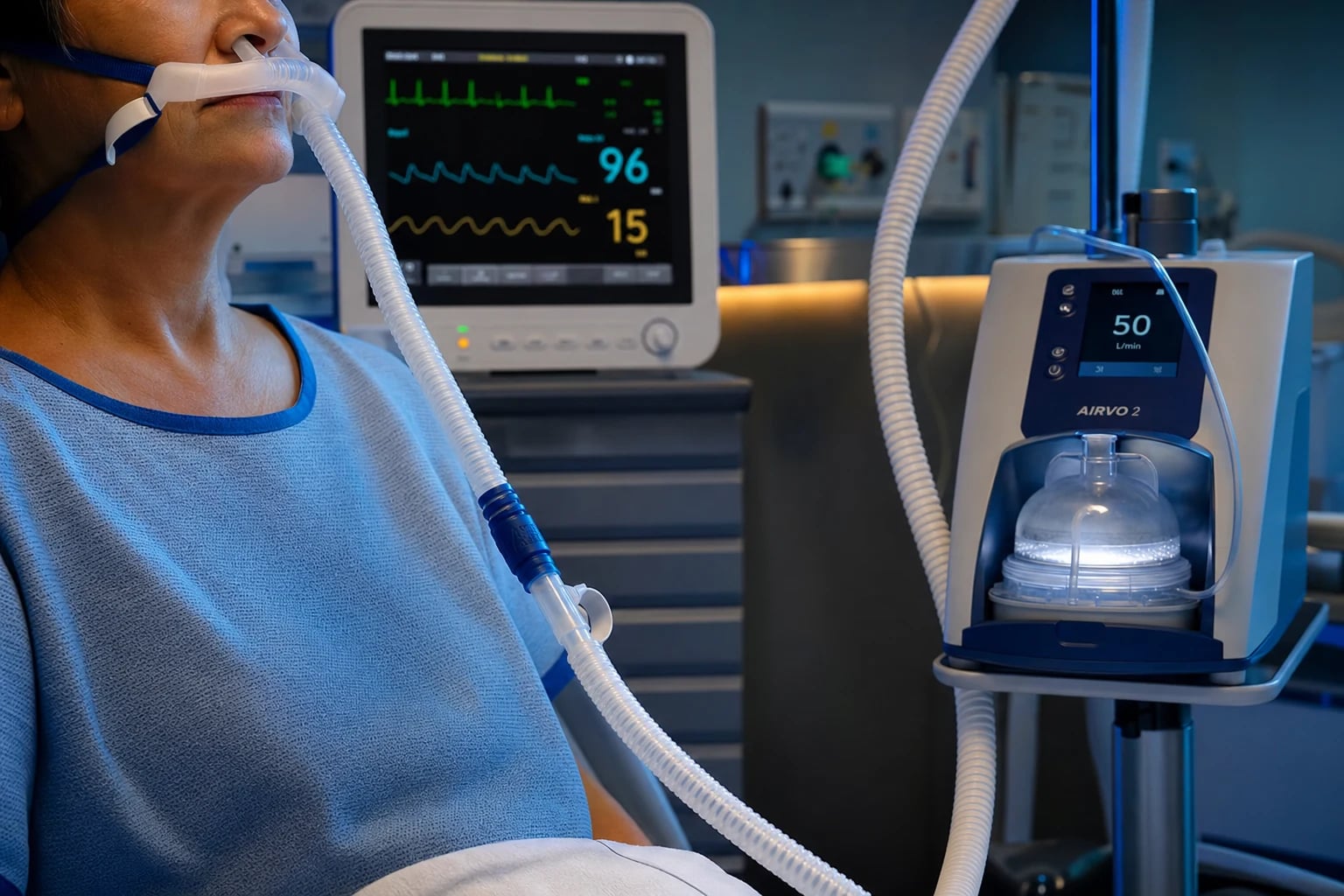
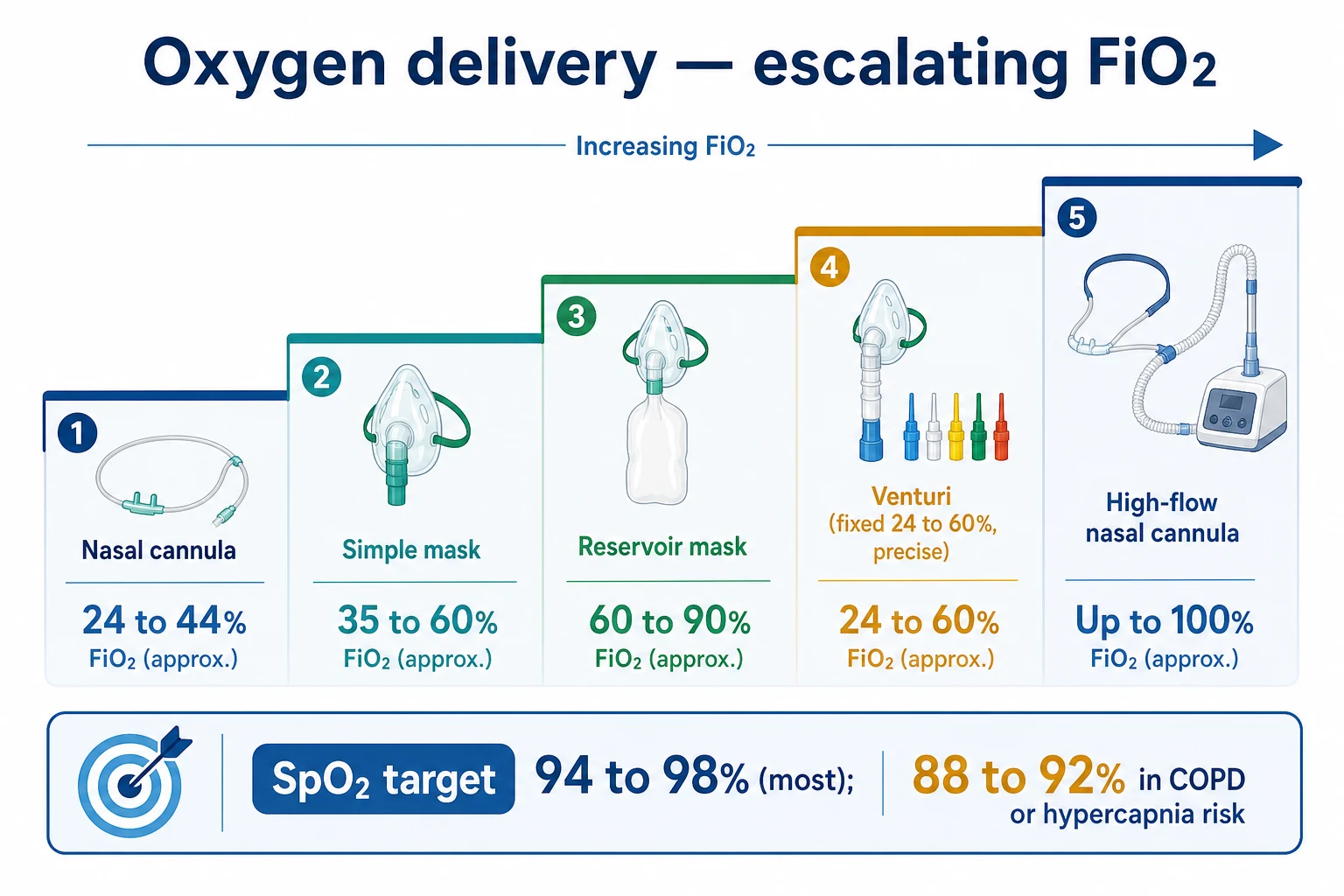
Physiology — the five mechanisms of HFNC
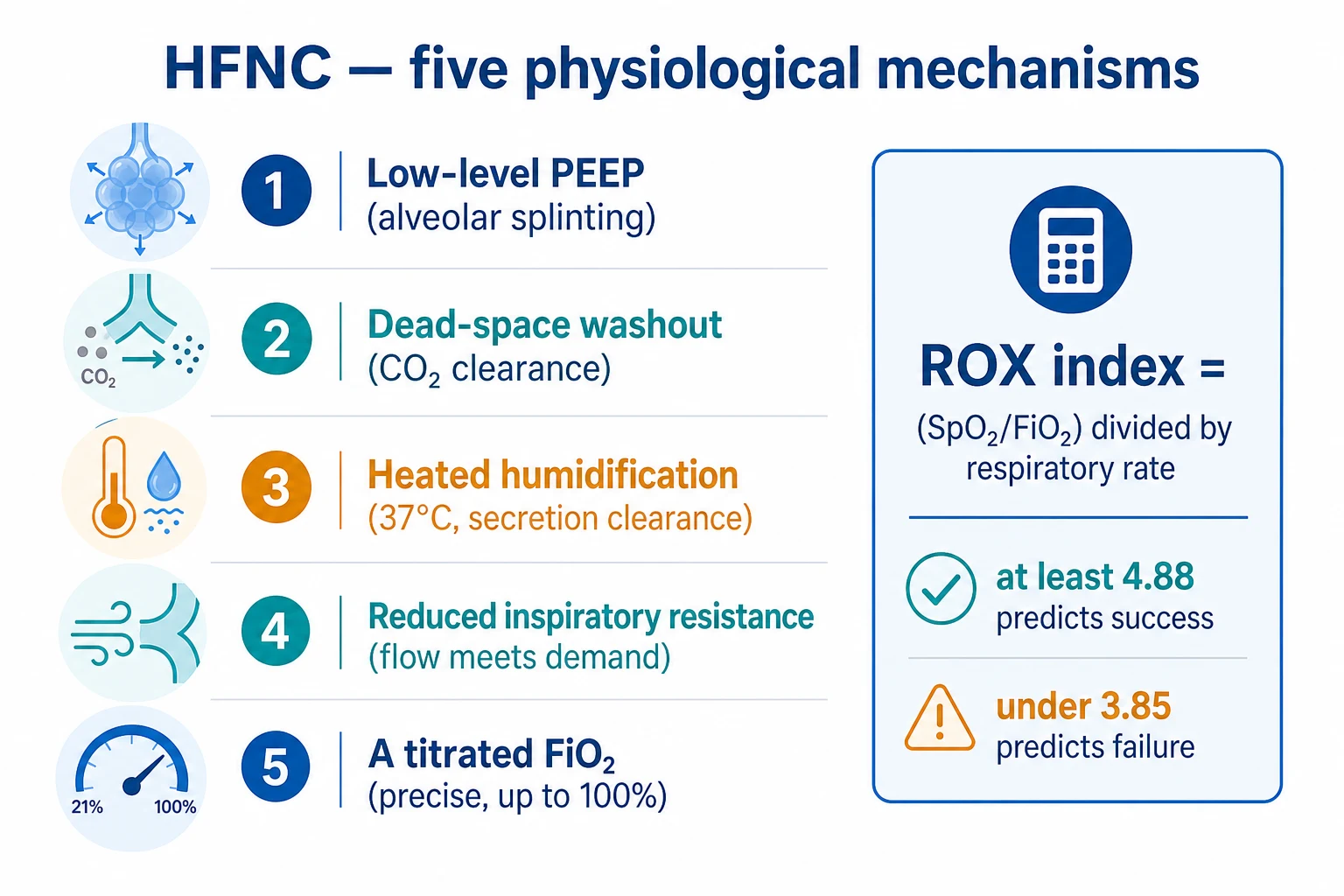
High-flow nasal cannula (HFNC) is not simply "oxygen at high flow." It is a multimodal respiratory support device that works through five distinct, measurable physiological mechanisms: (1) a precise titrated FiO2; (2) low-level positive end-expiratory pressure (PEEP); (3) anatomical dead-space washout; (4) heated humidification; and (5) reduced inspiratory resistance with unloading of the respiratory muscles. Each effect is flow-dependent, and together they explain why a patient who fails a non-rebreather mask can improve within minutes on HFNC without any ventilatory pressure being applied.[11]
1. A precise, titrated FiO2 (21-100%)
Standard oxygen devices deliver a variable FiO2 because room air is entrained around the mask or through the nose during peak inspiration — a non-rebreather mask set to 15 L/min may deliver an effective FiO2 of only 0.6-0.7 in a dyspnoeic patient with a high inspiratory flow. HFNC delivers gas at 30-60 L/min, which exceeds the peak inspiratory flow of most distressed patients, so no room air is entrained and the delivered FiO2 equals the set value. This is the precondition for an accurate P/F ratio, a meaningful ROX index, and a true lung-protective low-FiO2 strategy.[2]
2. Low-level PEEP (3-5 cmH2O)
The high gas flow generates a continuous positive pressure throughout the nasopharynx that is transmitted to the alveoli. Measured pharyngeal pressure rises by approximately 0.5-1 cmH2O for every 10 L/min of flow, giving roughly 3-5 cmH2O at 30-60 L/min with the mouth closed. With the mouth open, much of the pressure is vented and only ~1-2 cmH2O reaches the alveoli. This low-level PEEP splints open alveoli, raises end-expiratory lung volume (recruitment), reduces atelectrauma, and improves V/Q matching — demonstrable on electrical impedance tomography within minutes.[11]
3. Dead-space washout
Each tidal breath normally begins by re-inhaling CO2-laden gas from the anatomical dead space (nasopharynx, oropharynx, trachea, bronchi — ~150 mL in the adult). The high flow of HFNC flushes this CO2-rich gas out of the upper airway before the next breath, so each inspiration delivers fresh gas. Effective dead space falls by 25-50% at 30-60 L/min, meaning higher alveolar ventilation for the same minute volume. PaCO2 typically falls by 2-5 mmHg even without any pressure support — enough to correct mild-moderate hypercapnia but not enough for established type-2 failure.[11]
4. Heated, humidified gas (warmed to 37 degrees, saturated)
Dry wall oxygen delivers <10 mg H2O/L and rapidly desiccates the mucosa, paralysing cilia, inspissating secretions, and impairing mucociliary clearance. HFNC delivers gas conditioned to 31-37 degrees C and fully saturated (33-44 mg H2O/L), preserving ciliary beat frequency, keeping secretions thin, and reducing the metabolic cost the body otherwise spends warming and humidifying inspired gas. The benefit is largest in pneumonia, bronchiectasis, and any patient with copious or thick secretions. Warmed, humidified gas is the mechanism patients feel first — comfort and tolerance are consistently higher than a tight NIV mask.[2]
5. Reduced inspiratory resistance and unloaded muscles
By meeting or exceeding the patient's peak inspiratory demand, HFNC bypasses the resistance of the nasopharynx so the inspiratory muscles no longer have to "pull" gas through the nose. Work of breathing and respiratory rate fall, often within the first 15-30 minutes — a falling respiratory rate is one of the earliest signs that HFNC is working.[11]
Oxygen delivery devices
| Device | FiO2 range | Flow | PEEP | Indication |
|---|---|---|---|---|
| Nasal cannula | 24-44% | 1-6 L/min | None | Mild hypoxaemia |
| Simple face mask | 40-60% | 5-10 L/min | None | Moderate hypoxaemia |
| Non-rebreather mask | 60-90% | 10-15 L/min | None | Severe hypoxaemia (bridge) |
| HFNC | 21-100% (precise) | 30-60 L/min | 3-5 cmH2O | Moderate-severe hypoxaemia (FLORALI) |
| NIV (CPAP/BiPAP) | 21-100% | High (machine) | 5-15 cmH2O | Hypercapnic + hypoxaemic, cardiogenic oedema |
| Invasive ventilation | 21-100% | Variable | Variable | Severe/respiratory failure, failed HFNC/NIV |
The five HFNC mechanisms — measurable effects at the bedside
| Mechanism | Measurable effect | Magnitude / what changes it | Clinical consequence |
|---|---|---|---|
| Precise FiO2 | Delivered FiO2 = set FiO2 | Above ~30 L/min there is little room-air entrainment | Allows true titration and a valid P/F and ROX |
| Low-level PEEP | Pharyngeal pressure (oesophageal manometry) | ~0.5-1 cmH2O per 10 L/min; ~3-5 cmH2O at 30-60 L/min. Mouth closed roughly doubles alveolar pressure | Recruitment, raised EELV, reduced atelectrauma |
| Dead-space washout | Reduction in anatomic dead space | Falls ~25-50% at 30-60 L/min | Higher alveolar ventilation; PaCO2 drops 2-5 mmHg |
| Heated humidification | Absolute humidity at the airway | ~33-44 mg H2O/L at 31-37 degrees (saturated). Dry O2 delivers <10 mg H2O/L | Preserved mucociliary clearance, thin secretions, comfort |
| Unloaded muscles | Inspiratory resistance bypassed; flow meets demand | Delivered 30-60 L/min exceeds peak inspiratory demand | RR and work of breathing fall within minutes |
What HFNC does to the failing lung — the four measurable wins
- RAISES END-EXPIRATORY LUNG VOLUME — low-level PEEP splints alveoli, increasing functional residual capacity and V/Q matching (demonstrated on EIT within minutes).[11]
- REDUCES RESPIRATORY RATE — dead-space washout plus muscle unloading slow the patient. A falling RR over the first hour is the earliest sign HFNC is working.
- REDUCES PaCO2 — improved alveolar ventilation without pressure support drops PaCO2 by 2-5 mmHg. Enough for mild-moderate hypercapnia, NOT for established type-2 failure.
- IMPROVES OXYGENATION AND COMFORT — accurate FiO2, recruitment, and humidification combine. Comfort is consistently higher than a tight NIV mask.[2]
Technique and bedside setup
The physiological benefit of HFNC is flow-dependent. Running the device at 20-25 L/min delivers "warm humidified oxygen," not high-flow therapy, and gives a misleading impression of whether the patient will respond. A real HFNC trial requires 30 L/min minimum (typically 40-60 L/min).[2]
Starting HFNC at the bedside — the first hour
- CHOOSE THE INTERFACE — select the correct nasal cannula size (prongs should fill about half the nares; too small wastes flow as leak). Connect a blended, humidified HFNC system (Optiflow, Airvo/myAIRVO, Vapotherm).[2]
- SET FLOW FIRST, THEN FiO2 — begin at 30-40 L/min (25-30 in older/frail, then titrate up). Set FiO2 to 1.0 to preoxygenate, then wean to the lowest FiO2 that holds SpO2 92-96% (88-92% in COPD / CO2-retainers).[4]
- SET TEMPERATURE 34-37 degrees — 37 for maximal humidification (thick secretions); 31-34 if the patient finds high flow claustrophobic (cooler gas feels less oppressive).
- REASSESS AT 15-30 MINUTES — RR, accessory-muscle use, SpO2, comfort. A falling RR and relaxed accessory muscles within 30 minutes is an early sign of response.
- COMPUTE THE ROX INDEX at 1-2 h, then 6 and 12 h. Plot the trend (see below). A rising/stable ROX >= 4.88 supports continuation; a falling ROX or any value < 3.85 triggers the intubation conversation.[10]
- TREAT THE CAUSE IN PARALLEL — antibiotics for pneumonia, diuretics for cardiogenic oedema, bronchodilators for COPD/asthma. HFNC is support, not therapy.
- DECLARE THE ESCALATION THRESHOLD before you walk away — define which deterioration triggers intubation (ROX < 3.85, sustained RR > 35, SpO2 < 90% on FiO2 >= 0.9, exhaustion, altered mentation).[1]
HFNC for preoxygenation before intubation
Intubating the hypoxaemic patient is dangerous — desaturation during the apnoeic period is rapid and is associated with cardiac arrest. HFNC is the best preoxygenation device available because the continuing high flow provides apnoeic oxygenation throughout laryngoscopy, extending safe apnoea time. Set HFNC at 50-60 L/min, FiO2 1.0, for at least 3-5 minutes of tidal-volume preoxygenation, and leave the nasal cannula running through the apnoeic period of laryngoscopy. Severe shunt physiology will still desaturate despite apnoeic oxygenation — intubate efficiently.[2]
Escalating oxygen therapy in acute respiratory failure
- Assess severity — SpO2, respiratory rate, work of breathing, ABG (PaO2, PaCO2, pH), mental state
- Start with HFNC (for moderate-severe hypoxaemia — PaO2/FiO2 <300) — flow 30-60 L/min, FiO2 100% then titrate to SpO2 92-96%
- Monitor response — every 15-30 min: SpO2, RR, work of breathing, comfort. Assess ROX score (predicts HFNC success/failure)
- If improving — titrate FiO2 down (lowest to maintain SpO2 92-96%), reduce flow as tolerated
- If not improving or worsening — consider NIV (if hypercapnic or cardiogenic), or INTUBATE (if exhaustion, rising PaCO2, altered mental state)
- If HFNC fails — DON'T delay intubation (delayed intubation has worse outcomes than early). Criteria: RR >40, PaCO2 rising, pH <7.3, SpO2 <90% on 100% FiO2, exhaustion, altered mental state
The ROX index in detail (Roca, J Crit Care 2016; updated 2019)
The ROX index was derived and validated in pneumonia with hypoxaemic respiratory failure and predicts HFNC success:[10]
> ROX = (SpO2 / FiO2) divided by respiratory rate (SpO2 in %, FiO2 as a fraction, RR in breaths/min) [1]
A refined version incorporating the ROX trend and updated time-specific thresholds was published by Roca in 2019.[15]
ROX index thresholds by time on HFNC (Roca 2016; updated 2019)
| Time after starting HFNC | ROX predicting SUCCESS (low intubation risk) | ROX predicting FAILURE (intubate) | Action if in the grey zone |
|---|---|---|---|
| 2 hours | >= 4.88 | < 2.73-2.88 | Continue HFNC, monitor closely, repeat ROX |
| 6 hours | >= 4.88 | < 3.15-3.47 | Continue, but a low and falling value = prepare for intubation |
| 12 hours | >= 4.88 | < 3.85 | Low or falling ROX = intubate; do not delay |
| Trend | Stable or rising over time | Falling over time | A falling trend is the strongest warning — act on the direction |
> Worked examples (ROX = (SpO2 % / FiO2 fraction) / RR). > - Likely success: SpO2 95%, FiO2 0.5, RR 25 → (95/0.5) = 190; 190/25 = 7.6 — well above 4.88. > - Likely failure: SpO2 92%, FiO2 0.9, RR 32 → (92/0.9) = 102; 102/32 = 3.2 — below the 12-hour failure cut-off. [1]
Scores and signs predicting HFNC failure
| Tool | What it measures | Cut-off / interpretation | Comment |
|---|---|---|---|
| ROX index | (SpO2/FiO2) / RR | >= 4.88 success; < 3.85 failure (time-dependent) | Best validated; derived in pneumonia[10] |
| HACOR | Heart rate, Acidosis (pH), Consciousness, Oxygenation, RR | > 5 at 1 h predicts failure | Designed for NIV; extrapolated to HFNC[13] |
| Clinical trend | RR, accessory muscles, mental status, SpO2, lactate | Rising RR, exhaustion, falling SpO2 = failing | The most universally applicable |
| Serial ABG/VBG | pH, PaCO2, PaO2, lactate | Falling pH, rising PaCO2/lactate = failing | Essential in hypercapnic or mixed failure |
Indications
- Acute hypoxaemic (type-1) respiratory failure — pneumonia (the strongest evidence base), mild-moderate ARDS, aspiration pneumonitis, COVID-19 / viral pneumonitis. First-line per FLORALI, especially when PaO2/FiO2 < 200.[1]
- Post-extubation prophylaxis — HFNC for 24 h after extubation halves reintubation in low-risk / older patients (Hernández 2016).[8]
- Post-operative hypoxaemia — non-inferior to NIV and better tolerated after cardiothoracic surgery (Stéphan FLAIR 2015).[7]
- Immunocompromised respiratory failure — a trial of HFNC is reasonable first-line to avoid intubation; FLORALI-2 informs this population.[14]
- Preoxygenation for intubation — best available device; leave running through apnoea.[2]
- Do-not-intubate (DNI) / palliative symptom relief — humidified high-flow oxygen without a mask keeps the patient comfortable and able to communicate.
- Bridge in COPD with mild hypercapnia — only if NIV not tolerated and PaCO2 only mildly raised; monitor CO2 closely.[6]
Contraindications
These are mostly relative and must be individualised:[6]
- Absolute: respiratory arrest / apnoea; an unprotected airway (GCS < 8, copious secretions the patient cannot clear); absent respiratory drive; facial/nasal trauma or surgery preventing cannula fit; severe nasal obstruction.
- Strong relative: pneumothorax untreated (drain first, then HFNC acceptable); haemodynamic instability / shock (intubate); status asthmaticus with exhaustion; significant hypercapnia / type-2 failure (use bilevel NIV); altered mental state with aspiration risk.
- Caution: known inability to tolerate nasal flow; very agitated patient; risk of delayed intubation if the team "waits and sees" too long. [1]
HFNC in specific clinical contexts — what the evidence supports
| Context | Role of HFNC | Evidence / comment |
|---|---|---|
| Pneumonia (CAP/HAP) | First-line for hypoxaemic failure | FLORALI subgroup reduced intubation; ROX validated here. Strongest single indication.[1][10] |
| Mild-moderate ARDS | Alternative to NIV; bridge to intubation/ECMO | Avoid in SEVERE ARDS (P/F < 150 with high WOB) — these need intubation for lung-protective ventilation |
| COVID-19 / viral pneumonitis | Widely first-line; reassess at 1 h | High flow aerosolises — airborne precautions. ROX applies. Awake proning complements HFNC.[5] |
| Cardiogenic pulmonary oedema | Adjunct if CPAP/NIV not tolerated | CPAP/NIV has stronger evidence (3CPO). HFNC reasonable if mask refused |
| COPD with mild hypercapnia | Use with close CO2 monitoring | Significant hypercapnia (pH < 7.30) → NIV first-line |
| Immunocompromised | Reasonable first-line to avoid intubation | FLORALI-2 (2020) — outcomes comparable to standard O2; HFNC acceptable[14] |
| Do-not-intubate / palliative | Excellent for symptom relief | Humidified, mask-free, patient can talk and eat |
| Post-extubation (low-risk/older) | First-line preventive support | Hernández 2016 — halved reintubation vs conventional O2[8] |
| Post-cardiothoracic surgery | First-line; non-inferior to NIV | Stéphan FLAIR 2015; better tolerance[7] |
| Preoxygenation before intubation | Best device; leave running through apnoea | Severe shunt will still desaturate |
Weaning and stepping down
HFNC is a bridge; step down to standard oxygen once the underlying process improves. The dead-space washout and PEEP effects are lost the instant flow falls, so rebound hypoxaemia is common in the first hour after the switch.[2]
Stepping down from HFNC to standard oxygen
- CONFIRM RECOVERY — RR < 25, no accessory-muscle use, comfortable, cause treated, haemodynamically stable.
- TITRATE FiO2 DOWN FIRST to 0.3-0.4 while keeping flow up; SpO2 must stay 92-96%. A falling FiO2 requirement is the most reliable sign of recovery.
- REDUCE FLOW IN STEPS — 60 → 50 → 40 → 30 L/min over hours-to-a-day, reassessing at each step. A rise in RR > 5/minute after a step-down = hold or go back up.
- CONVERT TO STANDARD OXYGEN (NRB or nasal specs at an equivalent FiO2) once 30 L/min tolerated with FiO2 <= 0.35-0.4 and a stable RR.
- MONITOR FOR 1-2 HOURS after the switch for rebound work of breathing or desaturation. If the RR climbs, return to HFNC.[2]
Pitfalls and adverse effects
HFNC is generally safe and well tolerated, but:[2]
- Skin injury — nare pressure ulcer from prongs; protect with a hydrocolloid dressing; size correctly.
- Dry mucosa/epistaxis — ensure humidifier chamber filled and heated circuit used.
- Rebound hypoxaemia on stepping down — monitor 1-2 h after switching.
- Masking deterioration — SpO2 stays acceptable while work of breathing climbs silently. Watch RR, accessory muscles, ROX trend, not just SpO2.[1]
- Aerosol generation — high flow aerosolises secretions; use airborne/contact precautions (especially COVID-19).[5]
- Misuse in type-2 failure — using HFNC for a CO2-retainer can look fine on SpO2 while PaCO2 climbs and the patient becomes obtunded.
SAQ — HFNC physiology, the FLORALI evidence and the ROX index
10 minutes · 10 marks
A 58-year-old woman with bilateral pneumococcal pneumonia presents with hypoxaemic respiratory failure. On a non-rebreather at 15 L/min she has SpO2 89 per cent, RR 32, accessory muscle use and P/F 124 (FiO2 ~0.85). She has no COPD and no hypercapnia. You start HFNC at 50 L/min, FiO2 0.6, and the team asks how long to trial it before deciding on intubation.
SAQ — HFNC in cardiogenic pulmonary oedema and the post-extubation patient
10 minutes · 10 marks
A 75-year-old man with severe aortic stenosis and acute decompensated heart failure is admitted with cardiogenic pulmonary oedema. Initial CPAP has improved his work of breathing but he cannot tolerate the mask. He has SpO2 92 per cent on HFNC at 40 L/min, FiO2 0.5. Separately, a 60-year-old woman who was extubated 30 minutes ago after 4 days of ventilation for pneumonia is now at risk of reintubation (age, cardiac failure, COPD).
Clinical pearls
More clinical pearls
Red flags
Prognosis
FLORALI trial (Frat 2015, NEJM) — HFNC vs standard oxygen vs NIV
RCT: 310 patients with hypoxaemic respiratory failure (PaO2/FiO2 <300, PaCO2 ≤45). HFNC vs standard oxygen (non-rebreather mask) vs NIV (BiPAP).
- Intubation rate: HFNC 38% vs standard 47% vs NIV 50% (HFNC lowest, not statistically significant overall)
- Severe subgroup (PaO2/FiO2 <200): HFNC 35% vs standard 53% (p=0.02 — significant benefit)
- 90-day mortality: HFNC 12% vs standard 23% vs NIV 24% (HFNC lowest, p=0.05)
- CONCLUSION: HFNC reduces intubation (especially in severe hypoxaemia) and may improve mortality. Now first-line for moderate-severe hypoxaemic respiratory failure. [1]
OXY-CPU (Chu 2018, Lancet): liberal oxygen (SpO2 96-100%) vs conservative (90-96%). Liberal INCREASED mortality (RR 1.21). Target SpO2 92-96%.
FLORALI — the detail (Frat 2015, NEJM; PMID 25981908)
Design
Multicentre, unblinded RCT; 23 French ICUs; 310 patients with acute hypoxaemic respiratory failure (PaO2/FiO2 <=300 on standard O2 for >=15 min, PaCO2 <=45)
Three arms
HFNC (n=106) vs standard oxygen / non-rebreather (n=102) vs NIV — pressure support up to 10 cmH2O + PEEP 5-10, intermittent 1-h sessions (n=102)
Primary outcome
28-day intubation rate
Intubation (overall)
HFNC 38% vs standard 47% vs NIV 50% — NOT significant overall (p=0.18)
Subgroup signal
In pneumonia and PaO2/FiO2 < 150, HFNC significantly REDUCED intubation vs standard oxygen — the clinically important finding
90-day mortality
HFNC 12% vs standard 23% vs NIV 28% — HR 0.42 favouring HFNC over the two controls (p=0.046)
Bottom line
HFNC is a legitimate FIRST-LINE therapy in moderate AHRF, especially pneumonia and P/F < 150 — reduces intubation and may reduce 90-day mortality. Does NOT replace intubation for severe/worsening failure.[1]
Stéphan FLAIR 2015 (JAMA) — HFNC vs NIV after cardiothoracic surgery
Design
Multicentre randomised non-inferiority trial; 820 patients with AHRF (PaO2/FiO2 <=300) within 7 days of cardiothoracic surgery
Intervention
HFNC vs NIV (bilevel, face mask, intermittent sessions)
Primary outcome
Treatment failure (reintubation, switch, or premature discontinuation) by day 7 — non-inferiority MET: 22% HFNC vs 22% NIV
Secondary
Better tolerance with HFNC; fewer skin-breakdown events; ~40% could not tolerate the 15-min NIV sessions
Bottom line
Post-cardiothoracic AHRF: HFNC non-inferior to NIV and better tolerated — a reasonable first line.[7]
Hernández 2016 — post-extubation HFNC in LOW-risk patients (JAMA; PMID 26975498)
Design
Multicentre RCT; 527 mechanically ventilated patients at LOW risk for reintubation (>= 65 yr OR cardiac/respiratory cause)
Intervention
HFNC 30 L/min for 24 h after extubation vs conventional O2
Primary outcome
Reintubation within 7 days: 4.9% (HFNC) vs 12.2% (conventional), p=0.004 — a ~60% relative reduction
Bottom line
In low-risk/older patients, prophylactic HFNC after extubation halves reintubation vs conventional O2 — the post-extubation support of choice.[8]
Hernández 2016 — post-extubation HFNC in HIGH-risk patients (JAMA; PMID 27706464)
Design
Multicentre RCT; 604 patients at HIGH risk for reintubation (>= 65 yr with cardiac/respiratory cause, obesity-hypoventilation, COPD, prolonged ventilation, multiple failed weaning)
Intervention
HFNC for 24 h vs prophylactic NIV (intermittent) after extubation
Primary outcome
Reintubation within 7 days: 22.8% (HFNC) vs 19.1% (NIV) — non-inferiority of HFNC NOT met
Secondary — ICU mortality
LOWER with HFNC: 1.6% vs 6.8% (p=0.01)
Bottom line
In high-risk patients NIV remains the default post-extubation support (HFNC failed non-inferiority for reintubation). HFNC reduced ICU mortality and is reasonable where NIV is refused/not tolerated.[9]
FLORALI-2 2020 (JAMA) — immunocompromised AHRF
Design
Multicentre RCT; immunocompromised patients (haematological malignancy, solid-organ transplant, neutropenia) with AHRF
Comparison
HFNC vs standard oxygen (with NIV used as rescue/adjunct in both arms)
Outcome
No significant difference in 28-day intubation or mortality between HFNC and standard oxygen in this population
Bottom line
In the immunocompromised, HFNC did not clearly beat standard oxygen for hard outcomes — but it remains a reasonable, well-tolerated first trial. Avoidance of intubation remains a central goal given the high mortality of intubation in this group.[14]
The landmark HFNC trials — what each changed
Key HFNC trials — design, result, and what it changed in practice
| Trial (year) | Population | Comparison | Key result | What it changed |
|---|---|---|---|---|
| FLORALI (2015)[1] | AHRF P/F <=300, n=310 | HFNC vs standard O2 vs NIV (intermittent) | 28-day intubation negative overall; subgroup-positive in pneumonia and P/F < 150; 90-day mortality lower | HFNC = first-line for moderate AHRF, especially pneumonia |
| Stéphan FLAIR (2015)[7] | Post-cardiothoracic AHRF, n=820 | HFNC vs NIV (intermittent) | Non-inferior for treatment failure; better tolerance | HFNC first-line post-cardiothoracic AHRF |
| Hernández low-risk (2016)[8] | Low-risk post-extubation, n=527 | HFNC vs conventional O2 | Reintubation 4.9% vs 12.2% | Prophylactic HFNC after extubation in older/low-risk |
| Hernández high-risk (2016)[9] | High-risk post-extubation, n=604 | HFNC vs NIV (prophylactic) | HFNC failed non-inferiority for reintubation; ICU mortality lower | NIV first in high-risk; HFNC if NIV not tolerated |
| Roca ROX (2016, updated 2019)[10][15] | Pneumonia on HFNC, n=191 | Derivation of ROX index | ROX >= 4.88 success; < 3.85 failure (time-dependent) | The bedside prediction score for HFNC success |
| Mauri physiology (2017)[11] | AHRF on HFNC | Measured pressures, EELV, WOB | Demonstrated measurable PEEP, recruitment, reduced RR/WOB | Quantified the five mechanisms |
| Ou meta-analysis (2017)[12] | Adults with AHRF, pooled RCTs | HFNC vs standard O2 vs NIV | HFNC reduced intubation vs standard O2; non-inferior to NIV | Confirmed FLORALI signal across RCTs |
| FLORALI-2 (2020)[14] | Immunocompromised AHRF | HFNC vs standard O2 | No difference in intubation/mortality | HFNC reasonable in immunocompromised; not clearly superior |
HFNC vs NIV vs standard oxygen — choosing the device
The choice depends on the type of respiratory failure (hypoxaemic vs hypercapnic), the expected trajectory, the need for pressure support, and tolerance. No device is universally superior — match the device to the pathophysiology.[6]
HFNC vs NIV vs standard oxygen — head-to-head
| Feature | Standard oxygen (NRB mask, nasal specs) | HFNC | NIV (bilevel/CPAP) |
|---|---|---|---|
| Max flow | ~15 L/min (NRB) | 30-60 L/min | High (driven by turbine) |
| FiO2 delivered | Variable (room-air entrainment) — 0.4-0.9 in practice | Accurate, 0.21-1.0 | Accurate, 0.21-1.0 |
| Pressure support | None | Low-level PEEP ~1-5 cmH2O (flow/mouth dependent) | True IPAP/EPAP, typically 8-20/5-10 cmH2O |
| Dead-space washout | Minimal | Significant — reduces effective dead space 25-50% | Moderate (mask adds dead space; pressure does the work) |
| Humidification | Poor (dry) | Excellent (37 degrees, fully humidified) | Variable (depends on circuit humidifier) |
| Best for | Mild hypoxaemia, stable patients | Acute hypoxaemic (type-1) failure — pneumonia, mild-moderate ARDS; preoxygenation; post-extubation | Hypercapnic (type-2) failure — COPD, neuromuscular; cardiogenic pulmonary oedema (CPAP) |
| Worst for | Anything more than mild hypoxaemia | Significant hypercapnia (use NIV) | Ventilatory failure where patient cannot protect airway; claustrophobic/asynchronic patients |
| Tolerance | Best | Excellent (no mask, patient can talk, eat) | Often poor — mask discomfort, skin breakdown, claustrophobia, asynchrony |
| Evidence (type-1 failure) | Standard-of-care comparator | FLORALI — reduced intubation in pneumonia subgroup | Mixed; intermittent NIV in type-1 failure did not beat HFNC in FLORALI |
| Can eat/talk | Yes | Yes | Difficult (mask) |
Bottom line
High-flow nasal cannula is a five-mechanism respiratory support device — a precise titrated FiO2, low-level PEEP, dead-space washout, heated humidification, and muscle unloading — that sits between standard oxygen and NIV. FLORALI (NEJM 2015) established it as first-line for moderate acute hypoxaemic respiratory failure, especially pneumonia and PaO2/FiO2 < 150.[1] The ROX index (Roca 2016, updated 2019) — (SpO2/FiO2)/RR, time-specific (>= 4.88 success, < 3.85 failure) — predicts success and guides intubation.[10][15] For type-2 (hypercapnic) failure, NIV is first-line; HFNC is the device of choice for post-extubation support in low-risk/older patients (Hernández 2016)[8] and is non-inferior to NIV after cardiothoracic surgery (Stéphan 2015).[7] The cardinal principle: HFNC is a bridge, not a destination — it can mask deterioration by holding the SpO2 high while the work of breathing climbs silently. Watch the RR, the accessory-muscle use, the ROX trend, and the trajectory; intubate the failing patient early.
References
- [1]Frat JP, et al. Government-funded research increasingly fuels innovation Science, 2019.PMID 31221848
- [2]Mellnes AR, et al. Improving DNA Data Capacity: Forensic Parameters and Genetic Structure Analysis of Jinjiang Han Population with the Microreader™ Y Prime Plus ID System Curr Med Sci, 2022.PMID 35403953
- [3]Ospina-Tascón GA, et al. Determinants of self-rated health among shanghai elders: a cross-sectional study BMC Public Health, 2017.PMID 29029627
- [4] Chu DK, et al. Can sand nourishment material affect dune vegetation through nutrient addition? Sci Total Environ, 2020.PMID 32278174
- [5]Stephen J, et al. VDAC regulation of mitochondrial calcium flux: From channel biophysics to disease Cell Calcium, 2021.PMID 33529977
- [6]Rochwerg B, et al. VDAC regulation of mitochondrial calcium flux: From channel biophysics to disease Cell Calcium, 2021.PMID 33529977
- [7]Stéphan F, Barrucand B, Petit P, et al. High-Flow Nasal Oxygen vs Noninvasive Positive Airway Pressure in Hypoxemic Patients After Cardiothoracic Surgery: A Randomized Clinical Trial JAMA, 2015.PMID 25980660
- [8]Hernández G, Vaquero C, González P, et al. Effect of Postextubation High-Flow Nasal Cannula vs Conventional Oxygen Therapy on Reintubation in Low-Risk Patients: A Randomized Clinical Trial JAMA, 2016.PMID 26975498
- [9]Hernández G, Vaquero C, Colinas L, et al. Effect of Postextubation High-Flow Nasal Cannula vs Noninvasive Ventilation on Reintubation and Postextubation Respiratory Failure in High-Risk Patients: A Randomized Clinical Trial JAMA, 2016.PMID 27706464
- [10]Roca O, Messika J, Caralt B, et al. Predicting success of high-flow nasal cannula in pneumonia patients with hypoxemic respiratory failure: The utility of the ROX index J Crit Care, 2016.PMID 27481760
- [11]Mauri T, Turrini C, Eronia N, et al. Physiologic Effects of High-Flow Nasal Cannula in Acute Hypoxemic Respiratory Failure Am J Respir Crit Care Med, 2017.PMID 27997805
- [12]Ou X, Hua Y, Liu J, Gong C, Zhao W. Effect of high-flow nasal cannula oxygen therapy in adults with acute hypoxemic respiratory failure: a meta-analysis of randomized controlled trials CMAJ, 2017.PMID 28246239
- [13]Duan J, Han X, Bai S, et al. The Treatment of Primary Orthostatic Hypotension Ann Pharmacother, 2017.PMID 28092986
- [14]Frat JP, Ragot S, Girault C, et al.; FLORALI-2 Network. Hypoxia-inducible factor 2α drives hepatosteatosis through the fatty acid translocase CD36 Liver Int, 2020.PMID 32432822
- [15]Roca O, Caralt B, Messika J, et al. Delayed dosing intervals for quadrivalent human papillomavirus vaccine do not reduce antibody avidity Hum Vaccin Immunother, 2020.PMID 31967933
- [16]Ni YN, Luo J, Yu H, et al. Hamster Weight Patterns Predict the Intensity and Course of Schistosoma haematobium Infection J Parasitol, 2015.PMID 26186584