ICU · Respiratory / monitoring
Patient–Ventilator Asynchrony
Also known as Patient-ventilator asynchrony · Asynchrony · Ineffective triggering · Double triggering · Breath stacking · Auto-triggering · Flow starvation · Reverse triggering · Fighting the ventilator · Asynchrony index
Patient-ventilator asynchrony is a mismatch between the patient's neural respiratory drive and the ventilator's delivered breaths, detectable on the waveforms. It is common and associated with longer ventilation and higher mortality. The types fall by the phase of the breath: trigger asynchrony (ineffective triggering, auto-triggering, double triggering/breath stacking), flow asynchrony (starvation, excess), and cycle asynchrony (premature or delayed cycling). An asynchrony index over 10 per cent is significant. Management is to read the waveforms, identify the type, and fix the cause — sedation, the trigger sensitivity, the flow and inspiratory time, and a cycling-off criterion — with NAVA or PAV for refractory cases.
On this page & tools
Your progress
Saved locally on this device.
Target exams
Overview & definition
Patient-ventilator asynchrony is a mismatch between the patient's neural respiratory drive and the breath the ventilator delivers. It is common — over a quarter of ventilated patients have significant asynchrony — and it matters: it lengthens ventilation, worsens comfort and delirium, and is associated with higher mortality. It is diagnosed at the bedside by reading the waveforms (pressure, flow, volume) and quantified by the asynchrony index.[1][1]
The asynchrony index is the number of asynchrony events divided by the total number of patient trigger attempts, expressed as a percentage; over 10 per cent is significant.[1]
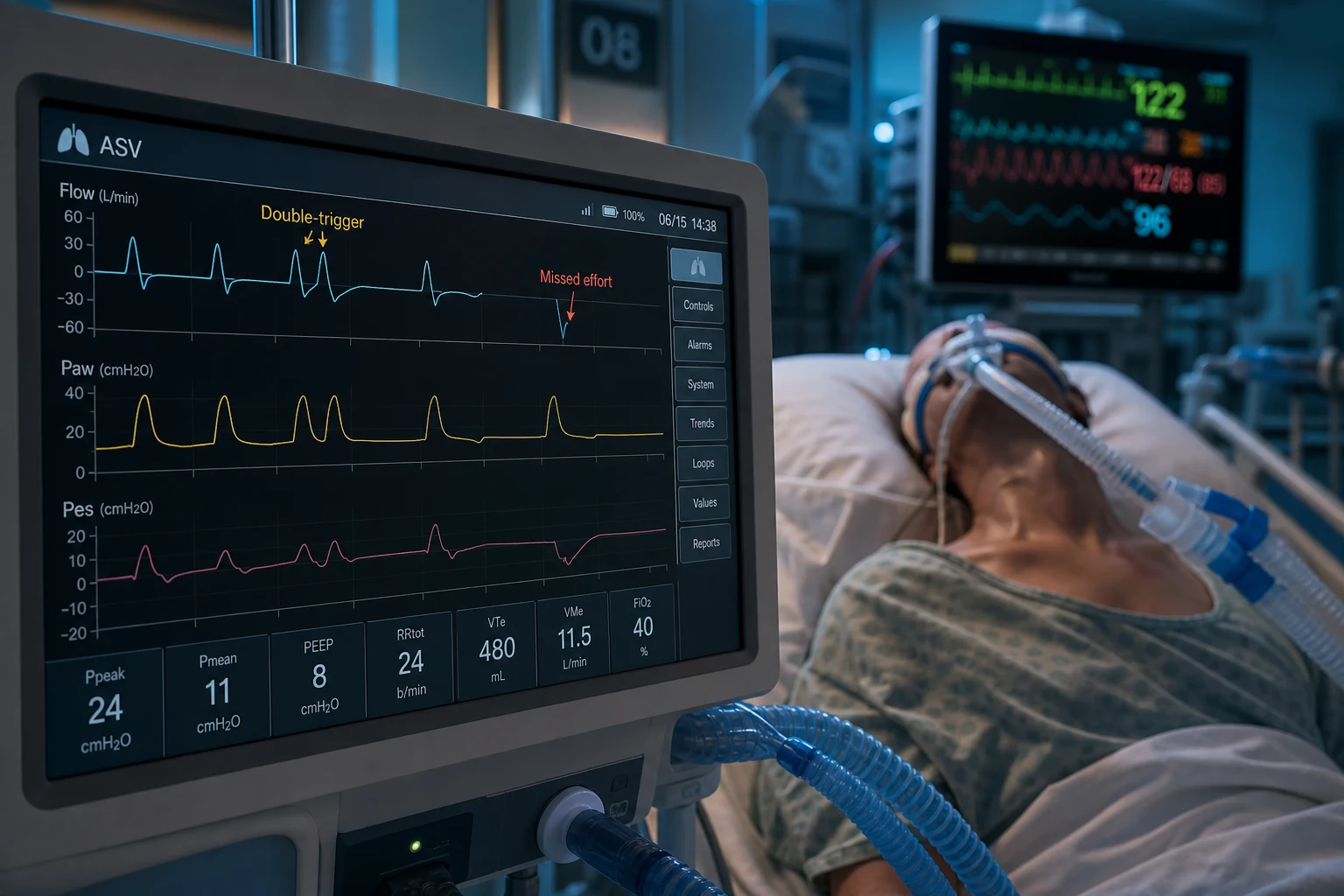

The types — by phase of the breath

Trigger asynchrony
- Ineffective triggering (a missed effort) — the commonest. The patient makes an inspiratory effort that does not trigger a breath. The usual cause is auto-PEEP (the patient must overcome the auto-PEEP threshold load before triggering, especially in COPD); other causes are a weak effort, an insensitive trigger setting, and over-sedation. On the waveform, a deflection appears in the pressure/flow trace (the effort) with no ventilator breath following.
- Auto-triggering — the ventilator triggers a breath without patient effort, from a too-sensitive trigger, a circuit leak, water in the circuit, or cardiac oscillations. The waveform shows regular "breaths" with no patient effort.
- Double triggering (breath stacking) — two breaths triggered close together, the second stacking on the first (a large effective tidal volume), when the ventilator's inspiratory time is shorter than the patient's neural inspiratory time (the patient is still inhaling when the ventilator cycles off, triggering a second breath).[1][1]
Flow asynchrony
- Flow starvation (insufficient flow) — in volume control with a fixed flow less than the patient's demand, the patient "sucks" against the ventilator. On the waveform the pressure trace dips or becomes concave during inspiration (the patient effort pulls the pressure down). The fix is to raise the flow, switch to a decelerating flow or pressure control, or use a demand-flow mode.
- Excess flow — too much flow over-distends or terminates the breath prematurely.[1]
Cycle asynchrony
- Premature cycling — the ventilator ends inspiration before the patient's neural inspiration ends, which can cause double triggering.
- Delayed (prolonged) cycling — the ventilator continues into the patient's neural expiration, so the patient actively exhales against the inspiratory flow ("fighting the ventilator"). On the waveform, the pressure rises at end-inspiration (the patient exhaling against flow).[1]
Mode asynchrony
- Reverse triggering — the ventilator's mechanical breath itself triggers diaphragmatic contraction (the reverse of normal triggering), seen in deeply sedated or paralysed patients; it can cause breath-stacking and patient-ventilator injury.[1]
Management — read the waveform, fix the cause
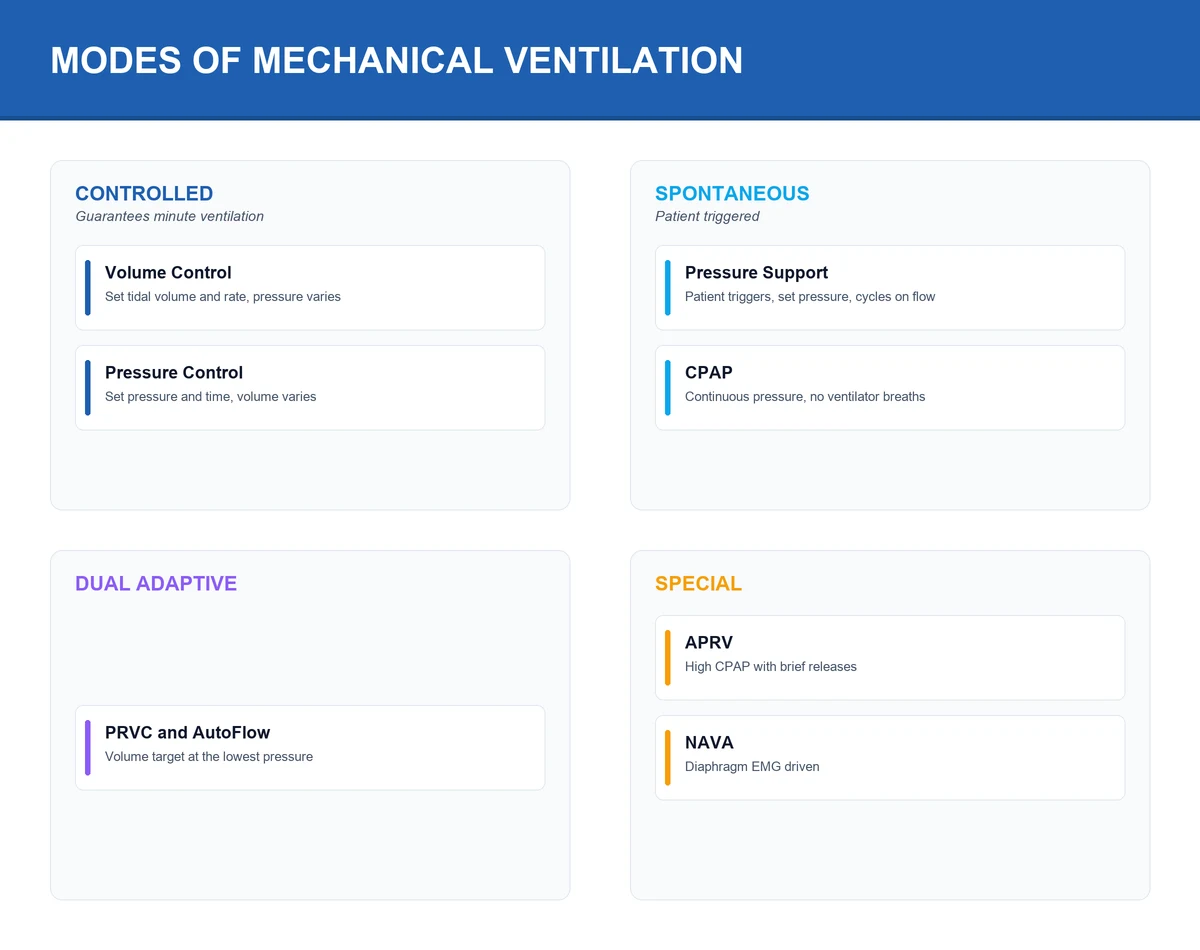
Each type has a specific fix:[1][1]
- Ineffective triggering — reduce the auto-PEEP (bronchodilation, a lower respiratory rate, external PEEP at about 75-80 per cent of the auto-PEEP), make the trigger more sensitive, reduce sedation, and increase the pressure support.
- Auto-triggering — make the trigger less sensitive and fix the leak or drain the water from the circuit.
- Double triggering — lengthen the inspiratory time to match the patient's neural inspiratory time, increase the flow, or switch to a mode that lets the patient set the inspiratory time (pressure support).
- Flow starvation — increase the inspiratory flow, switch to a decelerating flow or a pressure-control mode, or use a demand-flow mode.
- Cycle mismatch — adjust the cycling-off criterion (in pressure support, the percentage of the peak flow at which inspiration cycles off).
- Optimise sedation — both over-sedation (no drive) and under-sedation (excess drive) worsen asynchrony.
- Change the mode — neurally adjusted ventilatory assist (NAVA) (which triggers and cycles off the diaphragm's electrical activity) and proportional assist ventilation (PAV) (which amplifies the patient's own effort) reduce asynchrony by matching the ventilator to the patient's demand.[1]
Red flags
Epidemiology — how common, and why it matters
Asynchrony is the rule rather than the exception during assisted ventilation. In Thille's landmark study, around one quarter of assisted breaths showed some form of asynchrony, and 10–15 per cent of all trigger attempts were ineffective.[2] Blanch's multicentre cohort of fifty intensive care units showed that a high asynchrony index (over 10 per cent) is independently associated with increased ICU mortality, longer ventilation, and more tracheostomy.[3] de Wit showed that ineffective triggering alone predicts a longer duration of mechanical ventilation, independent of disease severity.[4]
It is therefore a quality marker: an ICU with persistent asynchrony is an ICU ventilating badly, and the asynchrony index is a tractable, modifiable target. The catch is that it is invisible without the waveforms — a single set of numbers on the screen (rate, tidal volume, oxygenation) cannot detect it, and bedside staff systematically under-recognise it. [1]
The phases of a breath — where asynchrony arises
Every mechanical breath has four phases, and asynchrony is classified by the phase that fails:[1][1]
The four phases of a ventilator breath and the asynchrony each can generate
1. Trigger (onset)
The ventilator detects the start of inspiration. Failure = TRIGGER asynchrony: ineffective triggering (effort with no breath — commonest), auto-triggering (breath with no effort), double triggering (two stacked breaths).
2. Inspiratory flow delivery
The ventilator delivers flow/pressure during inspiration. Failure = FLOW asynchrony: starvation (concave pressure trace, demand exceeds set flow) or excess (too much flow).
3. Cycling to expiration
The ventilator ends inspiration and opens the expiratory valve. Failure = CYCLE asynchrony: premature cycling (double triggering) or delayed cycling (patient exhales against flow, pressure rises at end-inspiration).
4. Expiratory phase / mode-level mismatch
A higher-order mismatch: reverse triggering (the ventilator breath entrains diaphragmatic contraction) and mode asynchrony (the wrong mode for the patient — e.g. volume control for a high, variable drive).
Detection — waveform analysis (the bedside skill)
Asynchrony is diagnosed by reading the pressure, flow, and volume scalars displayed as time curves. Use curve loops, not numbers; review at least one minute of breathing and look at both flow–time and pressure–time traces simultaneously. Esophageal pressure (or diaphragm electrical activity, EAdi) adds the patient-effort signal that the ventilator traces lack, and is the reference standard for subtle asynchrony.[1]
Trigger asynchrony on the waveform
- Ineffective triggering — a downward deflection appears in the pressure trace and a simultaneous deflection in the flow trace during expiration, but no ventilator breath follows. The deflection is the patient's inspiratory effort; it fails to trigger because it cannot overcome the trigger threshold (most often auto-PEEP in COPD, or an insensitive flow/pressure trigger). Look at the expiratory portion of the flow curve — a notch of reverse (inspiratory) flow in expiration is the patient effort.
- Auto-triggering — the ventilator delivers a regular breath pattern with no preceding deflection (no patient effort). Suspect it when the displayed respiratory rate is higher than the patient's actual effort, or when the rate is suspiciously regular in a patient who should be variable. Causes: trigger set too sensitive, a circuit leak (especially around the tube or humidifier), water condensation sloshing in the circuit, or cardiac oscillations transmitted to the flow sensor (the "cardiac trigger").
- Double triggering (breath stacking) — two breaths within one patient effort: the first breath cycles off while the patient is still inhaling, the continuing demand immediately re-triggers a second breath, and the two tidal volumes sum. On the waveform there is no expiratory flow between the two breaths — the defining feature — and the combined delivered volume is large.[1][2]
Flow asynchrony on the waveform
- Flow starvation — the hallmark is a concave, dipping pressure trace during inspiration in volume control. In volume control the flow is fixed, so when the patient's demand exceeds it the patient "pulls" against the set flow and the airway pressure drops below the set value. In pressure control, flow starvation shows as a persistently high, flat inspiratory flow that does not decelerate (the patient is still demanding), or as a rising EAdi throughout inspiration.
- Excess flow — the pressure trace overshoots or the breath terminates early; the patient may actively exhale against the inspiratory flow early in the breath (a small pressure spike at the start). [1]
Cycle asynchrony on the waveform
- Premature cycling — the ventilator ends inspiration while the patient's neural inspiration continues; the demand then re-triggers a second breath, so premature cycling presents as double triggering. The clue is that the two breaths share a single patient effort (one EAdi deflection).
- Delayed (prolonged) cycling — the ventilator continues delivering inspiratory flow into the patient's neural expiration, so the patient actively exhales against the inspiratory flow. The waveform shows a pressure rise at end-inspiration (the patient's expiratory effort pressurises the circuit against the closing valve). In pressure support this is fixed by raising the cycling-off flow threshold; in volume control by shortening the inspiratory time. [1]
Mode asynchrony — reverse triggering
Reverse triggering is a physiologically distinct entity: the ventilator's mechanical breath itself entrains rhythmic diaphragmatic contractions at a 1:1, 2:1, or 3:1 ratio with the ventilator rate.[6] It is invisible on standard scalars (the effort is entrained, not spontaneous) and was only recognised once EAdi and oesophageal pressure monitoring became routine in research. It occurs in deeply sedated or paralysed patients on controlled ventilation, and matters because it can generate breath-stacking (a second, entrained effort stacks a second tidal volume) and is associated with diaphragm injury and patient–ventilator dyssynchrony that conventional monitoring misses.[6][10]
Trigger
Onset of breath
- Ineffective triggering — effort with no breath (commonest; usually auto-PEEP)
- Auto-triggering — breath with no effort (leak, water, cardiac, too-sensitive)
- Double triggering — two stacked breaths, no expiratory flow between them
Flow
During inspiration
- Starvation — concave/dipping pressure in volume control; demand exceeds set flow
- Excess flow — overshoot, premature termination, early active exhalation
Cycle
End of inspiration
- Premature cycling — presents as double triggering (one effort, two breaths)
- Delayed cycling — pressure rises at end-inspiration (exhales against flow)
Mode
Higher-order mismatch
- Reverse triggering — ventilator breath entrains diaphragm contraction (deeply sedated)
- Mode mismatch — wrong mode for the patient's drive pattern
The asynchrony index
The asynchrony index (AI) quantifies the burden: the number of asynchrony events divided by the total number of trigger attempts (patient efforts plus ventilator triggers), expressed as a percentage. An AI over 10 per cent is the conventional threshold for significant, harmful asynchrony and the threshold at which mortality rises in observational data.[3] It should be assessed over a representative window (at least 15–30 minutes of assisted ventilation, excluding suctioning and procedures), and re-measured after any ventilator change. Automated waveform analysis (as used in research, e.g. for reverse triggering detection) improves reliability over visual estimation.[11]
Diaphragm electrical activity (EAdi) and NAVA monitoring
The diaphragm electrical activity (EAdi) signal, captured by a dedicated nasogastric tube with electrode array, gives the patient's neural respiratory drive directly — the signal the ventilator is trying to follow. It serves two purposes:[1]
- Diagnostic — EAdi reveals asynchrony that scalars hide, especially reverse triggering (entrained EAdi bursts), ineffective efforts hidden within expiration, and the timing mismatch between neural and mechanical inspiration. It is the reference standard for asynchrony research.
- Therapeutic (NAVA) — neurally adjusted ventilatory assist (NAVA) uses EAdi both to trigger the breath and to proportionally deliver pressure in proportion to the diaphragm's electrical output, so the patient's own neural drive sets the rate, the timing, and the size of every breath. Because trigger and cycling follow the neural signal rather than a flow/pressure threshold, NAVA markedly reduces trigger and cycle asynchrony in patients with a preserved drive.[1]
EAdi requires an intact diaphragm and neural output — it is unsuitable for high spinal cord injury, phrenic nerve disruption, or profound neuromuscular weakness, and it adds the cost and placement of a specialised tube. [1]
Consequences — why asynchrony must be treated
Persistent asynchrony is not merely uncomfortable; it is harmful through several mechanisms:[3][4]
- Increased work of breathing — in ineffective triggering the patient performs inspiratory work that produces no ventilator support (wasted effort); in flow starvation the patient pulls against a fixed flow, doubling the load; in delayed cycling the patient actively exhales against inspiratory flow. Each unwasted effort is muscle work the fatiguing respiratory pump must still perform.
- Patient discomfort and agitation — the mismatch between demand and delivery is sensed as air hunger, driving agitation and the "fighting the ventilator" appearance that is then (wrongly) treated with more sedation, deepening the cycle.
- Prolonged mechanical ventilation — ineffective triggering independently predicts longer ventilation, in part because the wasted effort delays weaning and reflects a patient whose drive, load, and ventilator settings are mismatched.[4]
- Sleep disruption — asynchrony is markedly worse at night, when the sleep state destabilises the respiratory pattern; auto-triggering and ineffective efforts fragment sleep, contributing to ICU delirium and fatigue.
- Ventilator-induced injury — double triggering and reverse triggering can deliver stacked, excessive tidal volumes (volutrauma) and high transpulmonary pressures, generating the very lung injury ventilation is meant to avoid; reverse triggering is also linked to diaphragm contractile injury (load-induced myotrauma).
- Increased mortality — after adjustment for severity, an asynchrony index over 10 per cent is independently associated with higher ICU mortality.[3]
Management — a structured, cause-specific approach
The principle is read the waveform, classify the type, and fix the cause — not to deepen sedation reflexively. The general steps, then the type-specific fixes.[1][1]
General approach to the patient with asynchrony
1. Recognise it
Look at the scalars, not the numbers. Review at least 1 minute of flow and pressure curves. Calculate the asynchrony index; an AI over 10 per cent is significant. Do not assume agitation equals under-sedation.
2. Classify by phase
Trigger (ineffective, auto-, double), flow (starvation, excess), cycle (premature, delayed), or mode (reverse triggering). The phase determines the fix.
3. Fix the cause first
Treat auto-PEEP (bronchodilation, low rate, external PEEP), correct circuit leaks, drain water, treat pain/agitation appropriately, check tube patency and circuit integrity. Ventilator adjustment comes after the reversible causes.
4. Adjust the ventilator
Trigger sensitivity, flow setting/pattern, inspiratory time, cycling-off criterion — each matched to the type (see below). Make one change at a time and reassess the waveforms.
5. Consider an adaptive mode
For refractory asynchrony with preserved respiratory drive, switch to NAVA, PAV+, or ASV so the ventilator follows the patient. Re-evaluate sedation; deep sedation is itself a cause.
6. Re-measure
Reassess the asynchrony index after every change. Asynchrony is dynamic — what works at noon may fail by evening. Continuous waveform vigilance is the standard of care.
Type-specific fixes
- Ineffective triggering — the cause is almost always auto-PEEP. Reduce the auto-PEEP with bronchodilation, a lower respiratory rate (longer expiratory time), and external PEEP set at about 75–80 per cent of the measured auto-PEEP (this counteracts the inspiratory threshold load without adding to hyperinflation). Make the trigger more sensitive, reduce excessive sedation, and increase pressure support if the effort is weak.[1][1]
- Auto-triggering — make the trigger less sensitive (raise the flow trigger threshold or lower the pressure trigger sensitivity), inspect and fix the circuit leak, drain condensate from the circuit, and reposition the patient if cardiac oscillations are the source.
- Double triggering — the ventilator's inspiratory time is shorter than the patient's neural inspiratory time. Lengthen the inspiratory time (or increase the flow in volume control, which shortens the time to deliver the volume and paradoxically can worsen — so prefer lengthening Ti), or switch to a patient-cycled mode (pressure support) where the patient sets the inspiratory time.[1]
- Flow starvation — increase the set inspiratory flow, change to a decelerating flow pattern, or switch from volume to pressure control/pressure support (which delivers the flow the patient demands). The most effective single move is usually to abandon fixed-flow volume control.
- Delayed cycling — in pressure support, raise the cycling-off flow threshold (e.g. from 25 per cent to 40–50 per cent of peak inspiratory flow) so the ventilator cycles earlier; in volume control, shorten the set inspiratory time. The goal is for the ventilator to end inspiration as the patient's neural inspiration ends.
- Premature cycling — it presents as double triggering; lower the cycling-off threshold (pressure support) or lengthen the inspiratory time so the breath does not end before neural inspiration.
- Reverse triggering — reduce the depth of sedation (allow the patient's own drive to resume and entrain normally), reduce the controlled respiratory rate if the patient has a drive, and consider a mode that allows patient triggering (pressure support, PAV+, NAVA). Do not ignore it as a benign deep-sedation phenomenon.[6][10]
Adaptive modes — when standard adjustments fail
When trigger, flow, and cycle adjustments do not resolve asynchrony in a patient with preserved respiratory drive, an adaptive mode that lets the ventilator follow the patient is the next step.[1][7][8]
Proportional Assist (PAV+)
Load-adjustable gain
- Delivers pressure proportional to patient effort (measures elastance/resistance breath-by-breath and amplifies)
- The patient sets the rate, Vt, and Ti — the ventilator amplifies their own output
- Reduces flow and trigger asynchrony; gives a "gain" (per cent assist) the clinician sets
- Needs a measurable spontaneous effort; not for fully controlled ventilation
Neurally Adjusted (NAVA)
EAdi-driven
- Triggers and cycles off the diaphragm electrical activity (EAdi) via a nasogastric electrode tube
- Pressure delivered proportional to EAdi — true neural synchrony
- Markedly reduces trigger and cycle asynchrony; intrinsic safety limit (cannot over-pressurise)
- Needs intact phrenic nerve and diaphragm; specialised tube and monitor required
Adaptive Support (ASV)
Closed-loop target
- Operator sets a target minute ventilation; the ventilator auto-titrates rate, Vt, and I:E to minimise work of breathing
- Targets the "least work" breathing pattern using the Otis equation
- Reduces asynchrony by matching pattern to mechanics; transitions controlled-to-spontaneous automatically
- Less patient-specific than NAVA/PAV+ (does not read the neural signal)
PAV+ has been shown to reduce asynchrony and improve synchrony compared with pressure support in critically ill adults.[7] The Bosma pilot randomised trial compared weaning on PAV versus pressure support and found PAV feasible, with favourable synchrony, though definitive outcome trials are still awaited.[8] NAVA is particularly effective for double triggering and reverse triggering, because the breath is timed to the neural signal rather than to a flow threshold. ASV provides a closed-loop safety net that adapts the pattern to changing mechanics and drive.
Sedation and the patient–ventilator interface
Sedation is both a cause and a treatment of asynchrony, and the relationship is U-shaped: both extremes worsen synchrony.[5]
- Over-sedation abolishes or attenuates the respiratory drive, causing ineffective triggering (the effort is too weak to trigger) and, in deeply sedated or paralysed patients on controlled ventilation, reverse triggering (the ventilator breath entrains the suppressed diaphragm). It also prolongs ventilation and delirium.
- Under-sedation (or unrelieved pain/agitation) generates an excessive, disordered drive that the set pattern cannot follow — double triggering, flow starvation, and auto-triggering from movement and leaks.
- The right depth is the lightest sedation compatible with comfort and synchrony, with analgesia prioritised over hypnotics (analgesia-first, daily sedation interruption, avoidance of benzodiazepines where possible), and regular reassessment against a target (e.g. RASS 0 to −1 once the patient is triggering).
- Treat pain before adjusting the ventilator or the sedation — an intubated patient in pain breathes badly, and the asynchrony resolves only when the pain does. [1]
The interface matters too: an obstructed or kinked endotracheal tube, a cuff leak, or excessive circuit dead-space all generate asynchrony that no ventilator setting will fix. Check the tube and circuit before chasing the waveform. [1]
Asynchrony during non-invasive ventilation
Asynchrony is even more common during non-invasive ventilation (NIV) than during invasive ventilation, because the interface (mask, helmet) introduces leaks and a large dead-space, and the patient is often awake with a high, variable drive. Carteaux's bench-and-clinical study showed that leaks drive auto-triggering and delayed cycling, and that the choice of interface and the cycling-off setting strongly influence synchrony.[9] Practical fixes for NIV asynchrony: use the ventilator's leak-compensation mode, set a higher cycling-off threshold to overcome leak-induced delayed cycling, choose the least-leaky interface that the patient tolerates (oronasal mask generally better than total-face mask for synchrony), and consider NAVA-NIV (which triggers off EAdi and is largely leak-proof) for refractory cases.
Landmark trials and evidence
Thille 2006
Intensive Care Med
Prospective observational, 62 pts on assisted ventilation, waveform + oesophageal pressure
Key finding
24% of assisted breaths showed asynchrony; ineffective triggering the commonest type, frequently missed on standard monitoring.
Practice change
Established asynchrony as a frequent, waveform-diagnosed phenomenon and defined its classification
Blanch 2015
Intensive Care Med
Multicentre prospective, 50 ICUs, 500 pts, continuous waveform monitoring
Key finding
Asynchrony index >10% independently associated with higher ICU mortality, longer ventilation, and more tracheostomy.
Practice change
AI over 10% became the threshold defining harmful, clinically significant asynchrony
de Wit 2009
Crit Care Med
Prospective observational, 60 pts, ineffective triggering quantified over ventilation course
Key finding
Ineffective triggering independently predicted increased duration of mechanical ventilation.
Practice change
Ineffective triggering reframed as a marker (and contributor) to prolonged ventilation, not a harmless finding
Akoumianaki 2013
Chest
Observational physiology study of deeply sedated/paralysed ventilated pts with EAdi
Key finding
Described reverse triggering — ventilator-induced, entrained diaphragm contraction — as an unrecognised asynchrony.
Practice change
Added a new class of asynchrony; prompted EAdi-based detection
Xirouchaki/Kondili 2008
Intensive Care Med
Crossover physiological study, PAV+ (load-adjustable gain) vs pressure support
Key finding
PAV+ improved patient-ventilator synchrony and reduced asynchrony compared with pressure support.
Practice change
Supported proportional modes as a synchrony strategy when standard modes fail
Bosma 2016
Crit Care Med
Pilot RCT, weaning on PAV vs pressure support
Key finding
PAV weaning feasible with favourable synchrony; pilot data only (definitive outcome trials awaited).
Practice change
Justified further trials of proportional-assist weaning; not yet a standard-of-care change
SAQ — Ineffective triggering in a COPD patient on pressure support
10 minutes · 10 marks
A 68-year-old man with COPD is ventilated on pressure support ventilation (PSV) — PS 12, PEEP 5, trigger −2 cmH2O, FiO2 0.35. The nurse reports that the ventilator rate is 18 but he is making respiratory efforts at 28-32 per minute. The flow scalar shows multiple small inspiratory deflections in the expiratory limb that do not trigger a breath. He is uncomfortable and his work of breathing appears elevated.
SAQ — Reverse triggering and double triggering in a deeply sedated ARDS patient
10 minutes · 10 marks
A 50-year-old man with severe ARDS is on day 3 of ventilation with volume-controlled mode (Vt 360 mL, RR 24, PEEP 14, FiO2 0.8). He is on continuous infusion of fentanyl and rocuronium for ventilation synchrony. The flow scalar shows a periodic notch during expiration with a small rise in intrathoracic pressure suggestive of diaphragmatic activity, and on some breaths there is double triggering with breath-stacking.
Clinical pearls — high-yield for the exam
Additional red flags
One-line summary
Patient-ventilator asynchrony is a mismatch between neural drive and the delivered breath, common (a quarter of ventilated patients), harmful (longer ventilation, higher mortality at an asynchrony index over 10 per cent), and diagnosed only on the waveforms. Classify by phase — trigger (ineffective triggering from auto-PEEP is the commonest; auto-triggering; double triggering), flow (starvation — a concave pressure trace), cycle (delayed cycling — pressure rises at end-inspiration), and mode (reverse triggering in the deeply sedated) — and fix the cause: reduce auto-PEEP, adjust the trigger/flow/inspiratory time/cycling-off criterion, optimise sedation (U-shaped; treat pain first), and switch to NAVA, PAV+, or ASV for refractory cases with preserved drive. [1]
References
- [1]Hodzic-Santor B, Telias I, et al. Asynchrony: Clinical Relevance, Detection, and Resolution Respir Care, 2025.PMID 40971310
- [2]Thille AW, Rodriguez P, Cabello B, et al. Patient-ventilator asynchrony during assisted mechanical ventilation Intensive Care Med, 2006.PMID 16896854
- [3]Blanch L, Villagra A, Sales B, et al. Asynchronies during mechanical ventilation are associated with mortality Intensive Care Med, 2015.PMID 25693449
- [4]de Wit M, Miller KB, Green DA, et al. Ineffective triggering predicts increased duration of mechanical ventilation Crit Care Med, 2009.PMID 19886000
- [5]de Wit M, Pedram S, Best AM, et al. Observational study of patient-ventilator asynchrony and relationship to sedation level J Crit Care, 2009.PMID 19272542
- [6]Akoumianaki E, Lyazidi A, Rey N, et al. Mechanical ventilation-induced reverse-triggered breaths: a frequently unrecognized form of neuromechanical coupling Chest, 2013.PMID 23187649
- [7]Xirouchaki N, Kondili E, Vaporidi K, et al. Proportional assist ventilation with load-adjustable gain factors in critically ill patients: comparison with pressure support Intensive Care Med, 2008.PMID 18607562
- [8]Bosma KJ, Read BA, Bahrgard Nikoo MJ, et al. A Pilot Randomized Trial Comparing Weaning From Mechanical Ventilation on Pressure Support Versus Proportional Assist Ventilation Crit Care Med, 2016.PMID 26807682
- [9]Carteaux G, Lyazidi A, Cordoba-Izquierdo A, et al. Patient-ventilator asynchrony during noninvasive ventilation: a bench and clinical study Chest, 2012.PMID 22406958
- [10]Mellado Artigas R, Damiani LF, Piraino T, et al. Reverse Triggering Dyssynchrony 24 h after Initiation of Mechanical Ventilation Anesthesiology, 2021.PMID 33662121
- [11]Pham T, Montanya J, Telias I, et al. Automated detection and quantification of reverse triggering effort under mechanical ventilation Crit Care, 2021.PMID 33588912