ICU · Respiratory / ventilation
Prone Ventilation — Technique & Physiology
Also known as Prone ventilation · Prone positioning · Proning · PROSEVA · Proning technique · Proning team · Proning physiology · Awake proning
Prone ventilation reduces mortality in severe ARDS (PROSEVA, NEJM 2013) by recruiting the dorsal lung, improving ventilation-perfusion matching, and reducing ventilator-induced lung injury through more uniform lung stress and strain — a benefit beyond oxygenation. Physiologically, proning places the heart on the sternum (not the lung) and flattens the pleural-pressure gradient, so the dorsal lung (the larger, healthier region) recruits and the ventral lung is less overdistended. The technique is a coordinated team procedure (5 to 6 trained staff), preceded by a checklist (a secured airway, lines managed, eye and pressure-area protection, gastric decompression, adequate sedation), with the patient kept prone for at least 16 hours. The complications — accidental extubation, line loss, and pressure injury — are minimised by a trained team.
On this page & tools
Your progress
Saved locally on this device.
Target exams
Overview & definition
Prone ventilation is the placement of a mechanically ventilated patient face-down (prone) to improve gas exchange and reduce mortality in severe ARDS. The PROSEVA trial (NEJM 2013) showed that prone positioning for at least 16 hours a day in patients with a PaO2/FiO2 under 150 reduced 28-day mortality from 32.8 to 16.0 per cent.[1] Proning is not merely an oxygenation manoeuvre: its survival benefit comes from reducing ventilator-induced lung injury, and it is now first-line in severe ARDS, not a last resort.[1][1]
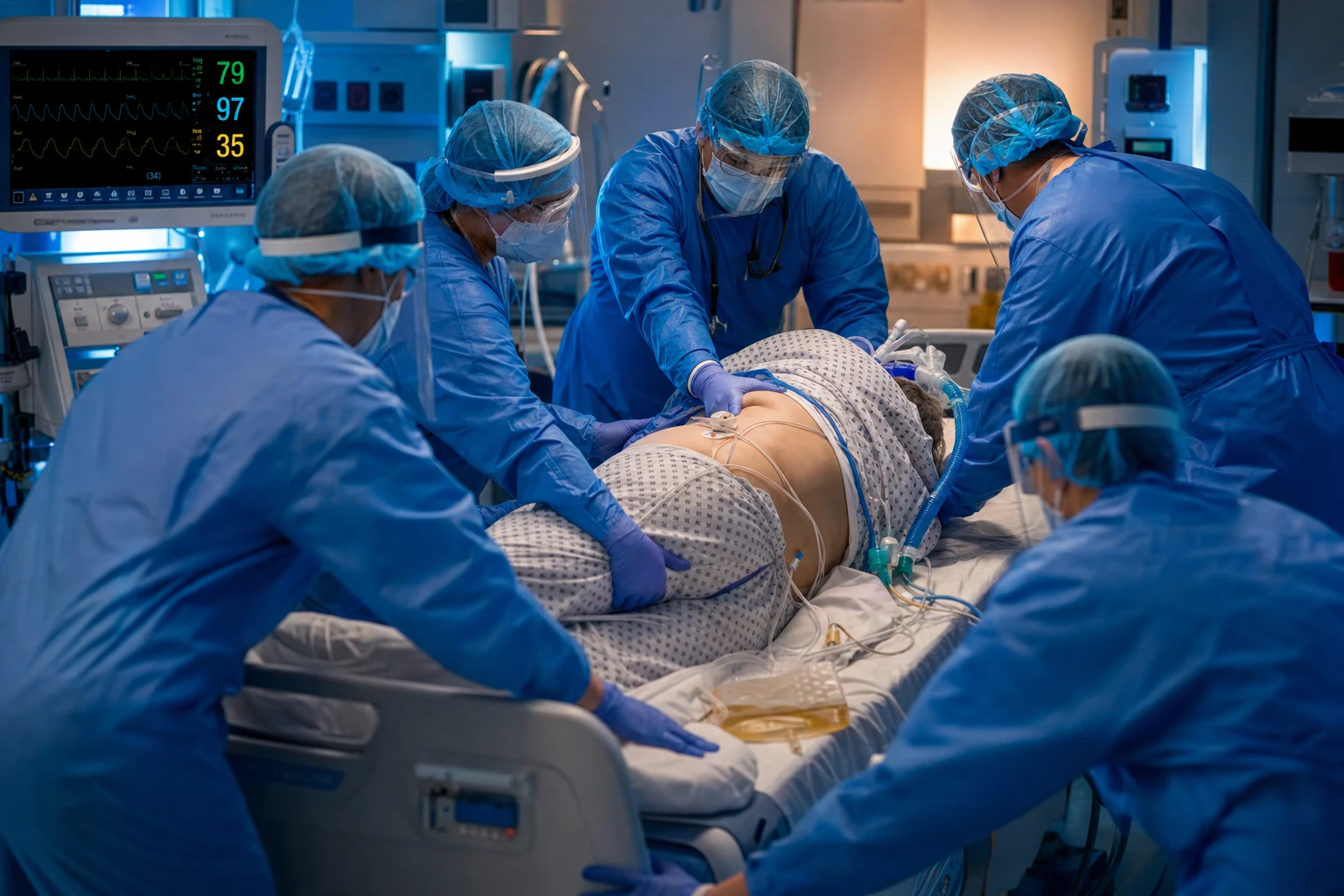
The physiology — why proning works
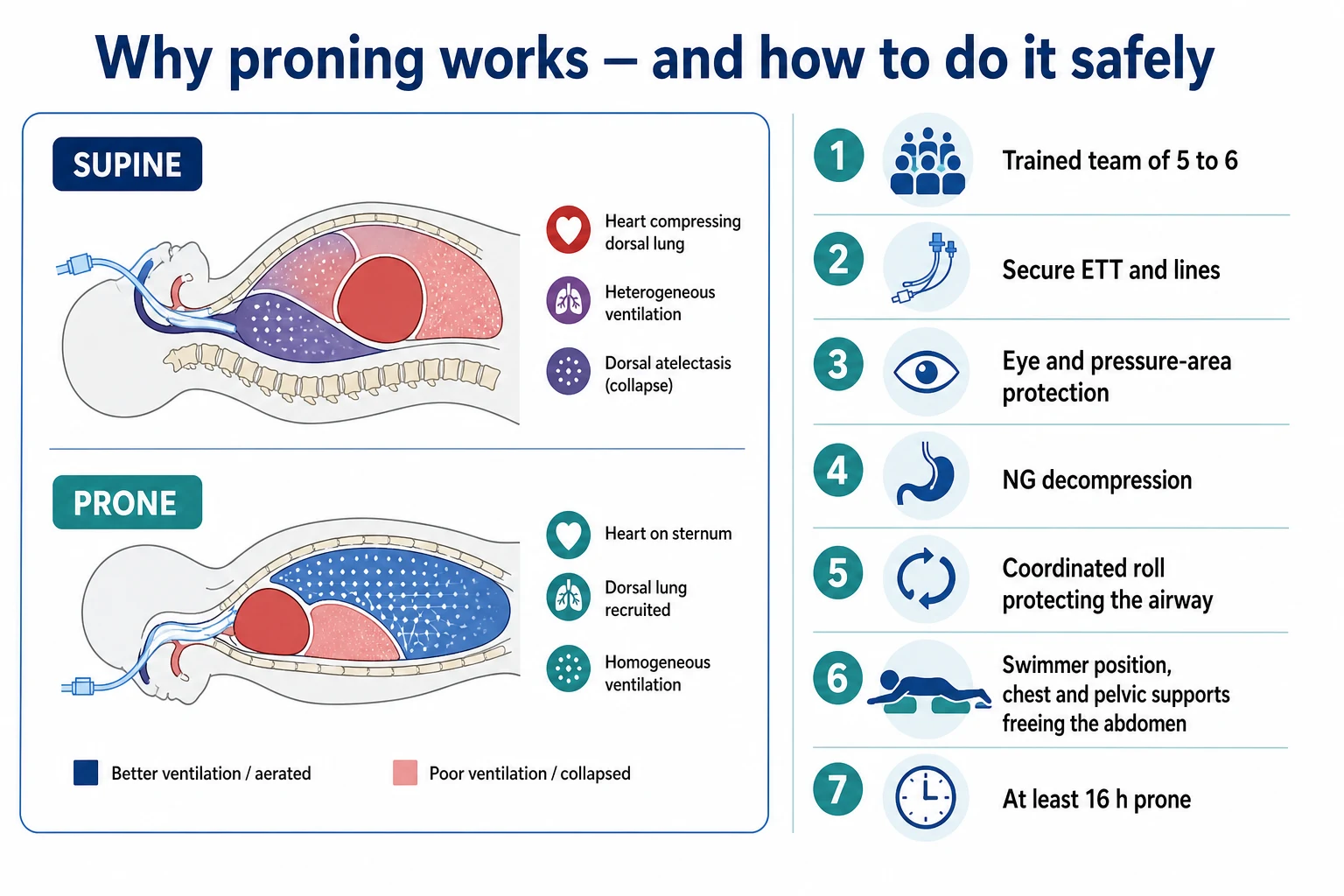
In the supine position the lung is heterogeneous: the heart (heavy) and the abdominal contents compress the dependent (dorsal) lung, while the non-dependent (ventral) lung is relatively over-distended. The pleural-pressure gradient from top to bottom of the lung is steep, so the dorsal lung is collapsed (atelectatic, shunt) and the ventral lung is overstretched (overdistension, volutrauma).[1]
- The heart rests on the sternum, not the lung.
- The pleural-pressure gradient flattens, so the transpulmonary pressure is more uniform.
- The dorsal lung — the larger, healthier region — recruits, reducing shunt and improving oxygenation.
- The ventral lung is less overdistended.
- Dorsal perfusion is preserved (or improves), so V/Q matching improves.
- The net effect is more homogeneous ventilation and less lung stress and strain, which is the mechanism of the mortality benefit (beyond oxygenation).[1]
Indications and contraindications
- Indication (PROSEVA): a PaO2/FiO2 under 150 with a FiO2 at least 60 per cent and PEEP at least 5 cmH2O in severe ARDS.[1]
- Contraindications: spinal instability, a recent sternotomy, unstable fractures, raised intracranial pressure, and (relative) pregnancy and severe haemodynamic instability.[1][1]
The technique — a coordinated team procedure
Before the turn (the checklist).[1]
- Assemble a trained team of 5-6 (a team leader controlling the airway, two staff on each side, and a person dedicated to the lines and the urinary catheter).
- Secure the airway — check the endotracheal-tube securement (the airway is the most dangerous thing to lose); have a backup airway plan.
- Manage the lines and tubes — central venous and arterial lines, drains, and the urinary catheter are gathered, secured, and given enough slack to turn.
- Eye protection (eyes closed and padded), pressure-area protection (face, chest, pelvis, knees, feet), and gastric decompression (a nasogastric tube on free drainage).
- Ensure adequate sedation and analgesia (often deepened for the turn), and consider a short-acting neuromuscular blocker for a difficult turn.
- Pre-oxygenase with a high FiO2; ensure the monitor and the arterial line are working (the blood pressure often dips transiently on the turn).
The turn.[1]
- A coordinated log-roll (or the "swimmer" technique) on the leader's count, protecting the airway throughout (the most dangerous moment of proning).
- Support the lines, the urinary catheter, and the ventilator circuit as the patient turns.
After the turn (positioning).[1]
- The head rests on a prone pillow or head-rest, turned to one side (alternated); the eyes are checked at each turn.
- The arms are in a swimmer's position (one arm up, one down), alternated, to prevent brachial-plexus injury.
- Chest and pelvic supports lift the trunk and free the abdomen (reducing intra-abdominal pressure and improving ventilation); the abdomen hangs free.
- The knees and feet are off the bed, padded.
- Re-check the endotracheal tube, every line, and the circuit; re-check the blood pressure and the gas; confirm ventilation.
Duration and cycles
Keep the patient prone for at least 16 hours a day (PROSEVA), with supine sessions of about 8 hours for nursing care, imaging, and procedures. The cycles continue until the ARDS improves (a rising PaO2/FiO2 in the supine position on reasonable ventilator settings).[1]
The non-responder
About 10-15 per cent of patients do not improve their oxygenation in the prone position ("non-responders"). They should still be proned for the mortality benefit, which comes from reducing ventilator-induced lung injury, not from the oxygenation alone.[1][1]
Complications
- Accidental extubation or airway loss — the most dangerous complication; prevented by meticulous airway securement and a trained airway leader.
- Loss of vascular access — central-line or arterial-line dislodgement; prevented by gathering and supporting the lines.
- Pressure injury — the commonest morbidity, over the face, ears, shoulders, chest, iliac crests, knees, and feet; prevented by padding and alternating position.
- Facial and cervical oedema, and nerve injuries (facial, optic, brachial plexus).
- Transient hypotension and desaturation on turning (preload and derecruitment effects); usually recover within minutes.
- Cardiac arrest on turning (rare); the team must be able to return the patient supine emergently.
- Eye injury (corneal abrasion, retinal ischaemia) — eye care at every turn.[1]
Awake proning (the non-intubated patient)
In selected hypoxaemic, non-intubated patients (notably COVID-19 pneumonia), awake self-proning improves oxygenation and may reduce intubation. It is a different technique — the cooperative patient turns themselves, monitored for fatigue, and it does not have the invasive-ventilation mortality evidence of PROSEVA.[1]
[1]SAQ — Severe ARDS and the decision to prone (PROSEVA)
10 minutes · 10 marks
A 52-year-old woman (height 165 cm, weight 70 kg) is intubated and ventilated for severe influenza A pneumonia with ARDS. She is on volume-control ventilation: Vt 420 mL (6 mL/kg predicted body weight), RR 28, PEEP 14 cmH2O, FiO2 0.85. Arterial blood gas: pH 7.30, PaO2 56 mmHg, PaCO2 52 mmHg, SpO2 89 per cent. Plateau pressure 32 cmH2O, driving pressure 18 cmH2O. Chest X-ray shows bilateral dense alveolar infiltrates. Noradrenaline 0.12 mcg/kg/min for MAP 65. The registrar asks whether to start prone ventilation.
SAQ — Cardiac arrest during prone ventilation and the emergency supine roll
10 minutes · 10 marks
A 64-year-old man in severe ARDS (P/F 92) is 6 hours into his second prone session for influenza A pneumonia. He is sedated, paralysed with cisatracurium, on noradrenaline 0.3 mcg/kg/min. The nurse calls you urgently: the monitor shows pulseless electrical activity at 32 bpm, the SpO2 trace is flat at 72 per cent, and there is no end-tidal CO2 trace. The patient is prone with an 8.0 mm oral endotracheal tube secured at 23 cm at the teeth, a right internal jugular triple-lumen catheter, a right radial arterial line, and a urinary catheter.
Red flags
The physiology deepened — six mechanisms beyond "the heart on the sternum"
The single-sentence explanation (the heart sits on the sternum, the dorsal lung opens) is true but incomplete. Proning improves survival through six distinct, additive mechanisms, only some of which relate to oxygenation. The mortality benefit is driven by the lung-protection mechanisms (homogenisation of transpulmonary pressure and drainage of secretions), not by the oxygenation gain — which is why a "non-responder" still benefits.[1][1]
| Mechanism | What changes | Bedside effect | Drives mortality benefit? |
|---|
| Mechanism | What changes | Bedside effect | Drives mortality benefit? |
|---|---|---|---|
| 1. Heart repositioning | The heart rests on the sternum, freeing the deep lower lobe it compressed in supine (the heart is heavy and the left lower lobe lies behind it) | Recruits left lower lobe; CT shows dorsal aeration gain within minutes | Partially (less atelectrauma) |
| 2. Homogenised transpulmonary pressure | The pleural-pressure gradient flattens; transpulmonary pressure becomes uniform ventral-to-dorsal | Less overdistension ventrally, less cyclic collapse dorsally — the stress-and-strain reduction | Yes — the central mortality mechanism |
| 3. Dorsal alveolar recruitment | The larger, better-perfused dorsal lung re-expands | Shunt falls; oxygenation rises (the visible benefit, seen in ~85%) | Indirectly (allows lower FiO2/PEEP) |
| 4. Reduced shunt / improved V/Q matching | Perfusion favours the dorsal lung (gravity-independent); recruiting it matches ventilation to perfusion | PaO2 rises with no change in dead space; the classic responder | No (oxygenation only) |
| 5. Drainage of secretions | Dependent airways in supine become uppermost in prone; gravity and ciliary clearance improve | Less plugging, lower VAP risk, easier suctioning | Yes (fewer infections, less VILI) |
| 6. Lymphatic/venous drainage; reduced compression | The freed abdomen lowers intra-abdominal pressure; the dorsal chest wall moves more freely | Better lung and chest-wall compliance, higher compliance, less renal congestion | Indirectly |
The take-home: oxygenation is what you can measure at the bedside, but the stress–strain homogenisation (mechanism 2) and the secretion drainage (mechanism 5) are what change survival. This single insight explains every counter-intuitive feature of prone ventilation — why a non-responder still lives, why early long proning works, and why you cannot judge the therapy by the PaO2 alone.[1][1]
The evidence ladder — four generations of prone trials
The survival benefit was hard-won: three "negative" trials preceded the one positive landmark (PROSEVA). Understanding why the early trials failed and PROSEVA succeeded is itself the exam answer.[1][2][3][4][5]
The four generations of prone-ventilation trials — from physiology to survival
Generation 1 — proof of physiology (Gattinoni, NEJM 2001)
304 patients with acute respiratory failure (ALI/ARDS), proned for about 7 h/day. **No mortality benefit** (28-day mortality ~21% prone vs ~25% supine, NS). But it established that proning improves oxygenation reliably and is feasible. The failure: too-short proning, mixed severity, and the oxygenation benefit does not equal a survival benefit.<Cite id="2" />
Generation 2 — longer proning, mixed results (Mancebo 2006, Taccone 2009)
Mancebo (136 patients, ~17 h/day) showed a **non-significant trend** to lower mortality (~50% prone vs ~62% supine), underpowered. Taccone (342 patients, ~20 h/day) was **negative overall** but showed a survival signal in the most severe subgroup (P/F under 100). The lesson crystallising: long proning in **severe** ARDS is where the signal lives.<Cite id="3" /><Cite id="4" />
Generation 3 — the meta-analytic confirmation (Sud 2010, Abroug 2011, Munshi 2017)
Sud 2010 (ICM) pooled trials and found prone ventilation **reduced mortality in severe hypoxaemia** (P/F under 100) but not in mild-moderate. Munshi 2017 confirmed: mortality benefit confined to severe ARDS with prolonged (over 12 h) proning. These metas told the designers of PROSEVA exactly who to enrol and how long to prone.<Cite id="5" /><Cite id="6" /><Cite id="10" />
Generation 4 — PROSEVA (Guérin, NEJM 2013): the landmark
466 patients, **severe ARDS only (P/F under 150)**, proned at least **16 h/day**, started early. 28-day mortality **16% prone vs 32.8% supine** (NNT 6); 90-day mortality 23.6% vs 41.0%. The trial that changed practice: severe ARDS + long proning = survival. It is now first-line, not salvage.<Cite id="1" />
| Trial (year) | n | Severity | Hours prone/day | Mortality effect | Why it did/didn't work |
|---|
| Trial (year) | n | Severity | Hours prone/day | Mortality effect | Why it did/didn't work |
|---|---|---|---|---|---|
| Gattinoni 2001 (NEJM) | 304 | Mixed (P/F ~150-200) | ~7 h | None (NS) | Too short; mild-moderate ARDS dominate; oxygenation ≠ survival |
| Mancebo 2006 (AJRCCM) | 136 | Severe (P/F under 200) | ~17 h | Trend to benefit (NS) | Right duration, right severity — but underpowered |
| Taccone 2009 (JAMA) | 342 | Moderate-severe | ~20 h | Negative overall; signal in P/F under 100 | Too few ultra-severe patients; duration right |
| PROSEVA 2013 (NEJM) | 466 | Severe (P/F under 150) | at least 16 h | 16% vs 32.8% (NNT 6) | Right patients, right duration, lung-protective ventilation, early |
The recurring lesson across all four: the benefit is severity-dependent and duration-dependent. Short proning of mild ARDS does nothing; long proning of severe ARDS saves lives.[1][5]
PROSEVA (Guérin 2013)
NEJM 2013
466 pts, severe ARDS (P/F <150 on FiO2 ≥0.6, PEEP ≥5, Vt ~6 mL/kg PBW) — prone ≥16 h/day vs supine
Key finding
28-day mortality 16.0% vs 32.8% (NNT 6, p<0.001). 90-day mortality 23.6% vs 41.0%. No increase in complications (extubation, line loss) with trained teams.
Practice change
Prone ≥16 h/day is FIRST-LINE for severe ARDS (P/F <150) — not salvage
Gattinoni 2001
NEJM 2001
304 pts with acute respiratory failure (ALI/ARDS) — prone ~7 h/day vs supine
Key finding
No mortality difference (28-day mortality ~21% vs ~25%). Proning improved oxygenation reliably but did not improve survival.
Practice change
Established proning as feasible and oxygenation-improving, but showed oxygenation ≠ survival benefit; longer proning in severe ARDS needed
Sud 2010 meta-analysis
Intensive Care Med 2010
Pooled RCTs of prone vs supine ventilation in acute respiratory failure; severe-hypoxaemia subgroup analysis
Key finding
Prone ventilation REDUCED mortality in severe hypoxaemia (P/F under 100) but NOT in milder disease. The first clear subgroup signal that guided PROSEVA.
Practice change
Defined the target population — benefit confined to severe ARDS
Munshi 2017 meta-analysis
Ann Am Thorac Soc 2017
Systematic review and meta-analysis of prone ventilation in ARDS
Key finding
Mortality benefit confined to severe ARDS with PROLONGED (over 12 h) proning; no benefit with short or intermittent proning or in non-severe disease.
Practice change
Confirmed duration + severity as the two determinants of benefit; reinforced the 16-h PROSEVA standard
Indications refined — who, when, and the 12-24 h window
The PROSEVA indication is precise, and the timing matters as much as the threshold.[1]
Applying the PROSEVA indication at the bedside — a 4-step decision
1. Confirm severe ARDS (Berlin + P/F criterion)
Bilateral opacities not fully explained by cardiac failure, within 7 days of a known trigger, AND a PaO2/FiO2 **under 150** with FiO2 at least 0.60 and PEEP at least 5 cmH2O. (PEEP must be at least 5 — a P/F of 100 on zero PEEP is atelectasis, not ARDS, and will not behave like PROSEVA ARDS.)<Cite id="1" />
2. Optimise lung-protective ventilation first
Vt 6 mL/kg predicted body weight, plateau under 30 cmH2O, driving pressure under 15, PEEP per the high-PEEP/FiO2 table. Confirm adequate sedation (and paralysis if dyssynchronous). Proning is an ADJUNCT to lung-protective ventilation, never a substitute for it.<Cite id="1" /><Cite id="1" />
3. Time the first proning at 12-24 h
Reassess the P/F at **12-24 h** of optimised ventilation. If it remains under 150, the patient meets criteria — prone EARLY (within ~12-36 h of ARDS onset). PROSEVA enrolled within ~36 h; early proning is part of the benefit. Do not wait days to "see if it improves".<Cite id="1" />
4. Commit to at least 16 h/day until recovery
Plan continuous cycles of at least 16 h prone with ~8 h supine for care, repeating daily until the P/F rises (in the supine position) above ~150-200 on reasonable settings. Stopping too early forfeits the benefit.<Cite id="1" />
| Criterion | PROSEVA threshold | Practical note |
|---|
| Criterion | PROSEVA threshold | Practical note |
|---|---|---|
| PaO2/FiO2 | under 150 | Severe ARDS band (Berlin: under 100 is "very severe") |
| FiO2 | at least 0.60 (60%) | Confirms the hypoxaemia is real, not a low-FiO2 artefact |
| PEEP | at least 5 cmH2O | Excludes unrecruited atelectatic lung masquerading as ARDS |
| Tidal volume | ~6 mL/kg PBW | Lung protection must already be in place |
| Timing of first proning | 12-24 h after optimising ventilation | Early proning (within ~36 h of onset) is part of the protocol |
| Duration per cycle | at least 16 h continuous | Supine window ~8 h for care, then re-prone |
Contraindications — absolute vs relative
Most "contraindications" are relative and centre-specific; only a few are absolute. The decision is a risk-benefit judgement by the proning team.[1][1]
| Condition | Type | Reason | Approach |
|---|
| Condition | Type | Reason | Approach |
|---|---|---|---|
| Unstable spinal injury / spinal instability (recent trauma, surgical fixation not yet stable) | Absolute | Log-roll risks cord damage; the turn is non-negotiable for proning | Do not prone; treat ARDS with lung-protective ventilation, consider ECMO |
| Unstable fractures (pelvis, long bones, flail chest not stabilised) | Absolute (until fixed) | Movement and prone loading cause pain, displacement, respiratory compromise | Stabilise first; prone once fixed |
| Open abdomen / recent laparotomy with open abdomen | Absolute (relative) | Pressure on exposed viscera; loss of abdominal domain | Relative if closed and stable — team judgement |
| Raised intracranial pressure (uncontrolled) | Relative | Venous drainage from the head may be impaired; the turn can transiently raise ICP | ICP monitoring; prone only if ICP controlled and turn tolerated |
| Pregnancy (late) | Relative | Aortocaval compression in prone; fetal monitoring difficult | Multidisciplinary decision; left lateral tilt, frequent maternal/fetal checks; benefits may still outweigh in severe ARDS |
| Severe haemodynamic instability / refractory shock | Relative | The turn can cause transient hypotension; resuscitate first | Stabilise with fluids/vasopressors; prone once MAP stable |
| Recent sternotomy / chest trauma | Relative | Pressure on healing sternum | Pad carefully; usually possible with supports |
| Massive haemoptysis / uncontrolled airway bleed | Relative | Drainage dynamics change; airway-loss risk | Secure and control the bleed first |
The most common practical barrier is not an absolute contraindication but haemodynamic instability on the turn — which is why pre-oxygenation, vasopressor optimisation, and a team ready to abort and re-supine are non-negotiable.[1]
The manual proning protocol — the full choreography
Proning is a procedure, not a manoeuvre. A poorly executed proning causes the complications (extubation, line loss, arrest) that the trials proved are avoidable with a trained team.[1][1]
The 5-phase proning protocol — what each team member does
Phase 1 — Pre-turn checklist and preparation (10-15 min)
Team of 5-6 assembled: airway leader at the head, two staff each side, one dedicated to lines/catheter/ventilator circuit. Checklist: ETT securement checked and tube position confirmed on CXR; all lines (CVC, arterial, drains) given slack and centralised; NG tube on free drainage (decompress the stomach); eyes closed and padded; pressure areas (face, chest, iliac crests, knees, feet, genitals) padded; sedation deepened, consider a short-acting NMBA; pre-oxygenate FiO2 1.0; confirm arterial line and monitor working; have the emergency supine plan ready.<Cite id="1" />
Phase 2 — The turn (the highest-risk 60 seconds)
Patient supine, arms across chest. On the leader count, a coordinated log-roll toward the ventilator: the patient is moved to the edge of the bed, then turned laterally, then prone onto the new surface (or a slide board / proning sheet). The airway leader controls the ETT at the lips throughout — never let go. Lines, catheter and circuit are supported and moved with the patient. The leader calls "turn" and "stop" — no one moves without the call.<Cite id="1" />
Phase 3 — Positioning (the swimmer position)
Head on a prone pillow, turned to one side (alternate every 2-4 h). Eyes checked and free of pressure. Arms in the swimmer position (one arm flexed up by the head, one down by the side — alternate). Chest and pelvic supports (foam or gel) lift the trunk and free the abdomen — the abdomen must hang free to lower intra-abdominal pressure. Knees and feet off the bed, padded. Genitals and breasts free of pressure.<Cite id="1" />
Phase 4 — Post-turn verification (immediate)
Re-check ETT position and depth (bilateral air entry, capnography), every line (patent, no kink), the ventilator circuit (no disconnection), blood pressure (expect a transient dip — recover within 5 min), and an arterial blood gas at 15-30 min. Confirm chest rise and SpO2. Document position, time, and any event.<Cite id="1" />
Phase 5 — Prone nursing care (continuous, 16 h)
Reposition the head and arms every 2 h (alternate side); perform eye care (lubrication, lid closure) each time; skin inspection of all pressure areas each reposition; suction via a closed-suction catheter; keep the abdomen free; monitor for and treat any desaturation/hypotension. Plan the supine turn (back) at ~16 h for care, imaging and procedures, then re-prone.<Cite id="1" />
Complications — what the trials actually showed
PROSEVA and modern cohorts proved that with a trained team, prone ventilation is safe — the feared complications (extubation, line loss, arrest) are rare, and pressure injury is the commonest morbidity.[1]
| Complication | Frequency (PROSEVA-era) | Mechanism | Prevention |
|---|
| Complication | Frequency (PROSEVA-era) | Mechanism | Prevention |
|---|---|---|---|
| Pressure injury (any stage) | ~25-30% (commonest morbidity) | Sustained pressure over face, ears, shoulders, iliac crests, knees, feet, chest, genitals | Meticulous padding; reposition head/limbs every 2 h; silicone dressings; skin inspection each turn |
| Facial and periorbital oedema | ~30-50% (usually mild) | Dependent oedema, gravity; venous/lymphatic congestion | Elevate head of bed slightly; expected, resolves on return supine |
| Corneal abrasion / eye injury | ~3-7% | Direct pressure on the globe, lagophthalmos | Eyes closed and padded/lubricated; check every turn; ophthalmology if chemosis or exposure keratopathy |
| Nerve injury (facial, optic, brachial plexus, ulnar) | ~2-5% | Compression or stretch; arm malposition | Swimmer position with arm alternation; pad pressure points; avoid hyperabduction |
| Endotracheal tube dislodgement / accidental extubation | ~1-2% (rare with trained teams) | Pull on the tube during the turn | Dedicated airway leader; secure tube; pre-check depth; emergency supine plan |
| Vascular access loss (CVC/arterial line) | ~1-2% | Line caught/pulled during turn | Centralise and give slack; dedicated line person; secure with stay-sutures |
| Transient hypotension / desaturation on turning | ~5-10% (usually self-limited) | Preload fall, derecruitment, vasodilation | Pre-oxygenate, optimise vasopressors/volume, expect recovery in under 5 min |
| Cardiac arrest on turning | under 1% (rare) | Severe preload drop, hypoxaemia, vagal response | Team trained to emergently return supine; full monitoring; abort if unstable |
| Vomiting / aspiration | uncommon | Full stomach, NG displacement | NG decompression pre-turn; verify NG position |
| Retinal ischaemia / vision loss | rare but catastrophic | Raised intraocular pressure, direct globe pressure | Avoid direct orbital pressure; eye checks every turn |
Note: in the pre-PROSEVA era, complications were reported as a barrier to proning; PROSEVA showed no excess of extubation, line loss or unplanned extubation in the prone group — the trained-team, checklist-driven protocol is what made proning safe, and is part of why the trial was positive.[1]
Awake proning — the COVID-era evidence base
Awake (non-intubated) proning expanded rapidly during the COVID-19 pandemic as a way to improve oxygenation in hypoxaemic patients on HFNC/NIV and potentially avoid intubation. It is physiologically the same idea (recruit dorsal lung, improve V/Q) but the evidence base is fundamentally different from PROSEVA — it is about oxygenation and intubation avoidance, not a proven mortality benefit in the invasively ventilated patient.[7][8][9]
| Feature | Intubated proning (PROSEVA) | Awake proning (COVID-era) |
|---|
| Feature | Intubated proning (PROSEVA) | Awake proning (COVID-era) |
|---|---|---|
| Patient | Intubated, sedated, severe ARDS (P/F under 150) | Non-intubated, hypoxaemic on HFNC/NIV (often COVID-19) |
| Evidence | Mortality benefit (28-day 16% vs 32.8%, NNT 6) | Oxygenation improves; intubation benefit uncertain; mortality signal in metas |
| Technique | 5-6 person coordinated log-roll; 16 h cycles | Patient self-positions prone, encouraged to spend as long as tolerated |
| Duration | At least 16 h continuous | As tolerated; sessions of 2-4 h, cumulative 8-16 h, with breaks |
| Key trial | PROSEVA (NEJM 2013) | Ehrmann multinational meta-trial (Lancet Respir Med 2021) |
| Outcome focus | Survival | Intubation rate, oxygenation, comfort |
| Failure signal | A non-responder still benefits (keep proning) | Failure = rising effort, falling ROX, falling SpO2 — intubate, do not persist |
The landmark awake trial: Ehrmann multinational meta-trial
The largest body of awake-proning evidence is the multinational, randomised, open-label meta-trial (Ehrmann et al., Lancet Respiratory Medicine 2021 — six coordinated national RCTs in non-intubated adults with COVID-19 hypoxaemic respiratory failure on HFNC). The headline finding: awake proning did not significantly reduce the primary composite of intubation or death at 28 days in the overall analysis, but it improved oxygenation and was safe. Subsequent individual-patient-data meta-analyses refined this: benefit is most plausible in patients who tolerate prolonged (over 8 h) prone sessions and who show an oxygenation response.[7]
Later meta-analyses and RCTs have refined the picture further: a 2022 systematic review (Li et al., Lancet Respir Med) and a 2022 meta-analysis (Beran et al., Respir Care) found consistent oxygenation improvement and signals toward reduced intubation; a 2026 meta-analysis (Alsarayreh et al., BMC Anesthesiology) reported reductions in mortality, intubation, and hospital stay; and a 2024 multicentre RCT (Liu et al., Chi-ARDS Net, ICM) showed prolonged protocols were feasible and improved oxygenation further than shorter ones. The net message: awake proning is safe, improves oxygenation, may reduce intubation in selected motivated patients who sustain the position — but is a bridge, not a barrier, to intubation.[8][9][11][12]
Ehrmann awake-proning meta-trial
Lancet Respir Med 2021
6 coordinated national RCTs, non-intubated COVID-19 adults with acute hypoxaemic respiratory failure on HFNC — awake prone vs standard care
Key finding
No significant reduction in the primary composite of intubation or death at 28 days; improved oxygenation; safe and feasible. Subgroups tolerating prolonged proning trended toward benefit.
Practice change
Awake proning is reasonable and safe to reduce the intubation burden; benefit not established as mortality-improving; use to support, not to delay, definitive airway when failing
Li 2022 awake-proning SR
Lancet Respir Med 2022
Systematic review of awake prone positioning in non-intubated COVID-19 acute hypoxaemic respiratory failure
Key finding
Awake proning improved oxygenation consistently; signals toward reduced intubation in patients sustaining the position; no consistent mortality signal across heterogeneous studies.
Practice change
Awake proning a reasonable adjunct; select motivated patients who tolerate prolonged sessions; intubate promptly for failure
Beran 2022 meta-analysis
Respir Care 2022
Meta-analysis of prone positioning in non-intubated COVID-19 subjects
Key finding
Improved SpO2/FiO2 and reduced intubation rate; trends toward reduced mortality not reaching significance.
Practice change
Supports awake proning as an intubation-sparing adjunct in COVID-19 hypoxaemia
Liu 2024 prolonged vs shorter awake prone RCT
Intensive Care Med 2024
Multicentre RCT (Chi-ARDS Net), COVID-19 acute respiratory failure — prolonged vs shorter awake prone protocols
Key finding
Prolonged protocols were feasible, better tolerated than expected, and gave greater oxygenation improvement; no clear harm.
Practice change
Encourage prolonged (over 8 h/day) awake prone sessions where tolerated
Practical awake-proning protocol — selecting, supervising, and spotting failure
1. Select the right patient
Hypoxaemic (SpO2 under 92% on HFNC at least 30-40 L/min, FiO2 at least 0.4), cooperative and able to self-turn, no contraindication (recent abdominal surgery, severe obesity preventing proning, late pregnancy, agitation). Explain the rationale; the motivated patient tolerates it better.<Cite id="7" />
2. Set up monitoring and targets
Continuous SpO2, ROX index (SpO2/FiO2 ÷ RR) trended, HFNC titrated. Target prone as long as tolerated — at least 8-12 h/day in sessions of 2-4 h, with breaks for meals, toileting, and physiotherapy. Pillows under chest and pelvis, abdomen free; head turned, arms in the swimmer position.<Cite id="7" />
3. Reassess tolerance and oxygenation
An oxygenation responder (SpO2 rises) is encouraged to continue. Non-responders still tolerate the position; the goal is to support while the lung heals, not to delay intubation. Watch for fatigue, rising RR, falling ROX index, patient distress.<Cite id="8" />
4. Define and act on failure — intubate, do not persist
Failure signs: ROX index under 2.75-3.0 at 1-2 h of HFNC, rising work of breathing, increasing RR, persistent SpO2 under 90% on FiO2 1.0, altered mentation, haemodynamic instability. Awake proning is a BRIDGE, not a barrier, to intubation — when failing, intubate. Persisting to avoid intubation causes delayed, higher-risk intubation.<Cite id="7" />
Stopping criteria — when to come out of prone
Proning continues until the ARDS improves. The decision to stop is made by reassessing the patient in the supine position.[1][1]
Stopping prone ventilation — a stepwise check
1. Test recovery in the supine position
Return the patient supine for the routine care window. After ~1 h supine on stable ventilator settings, recheck the PaO2/FiO2. If it is above ~150-200 with FiO2 under 0.6 and PEEP under ~10, the ARDS has improved enough to trial staying supine.<Cite id="1" />
2. Confirm sustained improvement
A single good gas is not enough — confirm the P/F holds over ~4-12 h supine, with improving compliance and falling FiO2/PEEP requirement. Premature cessation leads to re-deterioration and the need to re-prone.<Cite id="1" />
3. Stop proning, keep lung-protective ventilation
Discontinue prone cycles; continue lung-protective ventilation and wean as the lung recovers. Most patients are proned for ~4-10 days; very severe ARDS may need longer.<Cite id="1" />
4. Watch for re-deterioration
If the P/F falls again below ~150 supine after stopping, resume proning — there is no penalty for re-proning. The lungs tell you when they are ready.
High-yield clinical pearls — proning for the CICM/FFICM/EDIC exam
More red flags
The exam viva — questions an examiner will ask about proning
| Question | The answer an examiner wants |
|---|
| Question | The answer an examiner wants |
|---|---|
| What is the indication for proning? | Severe ARDS: PaO2/FiO2 under 150 with FiO2 at least 0.60 and PEEP at least 5, on lung-protective ventilation, reassessed at 12-24 h (PROSEVA).[1] |
| How long do you prone for? | At least 16 h/day, continuous, in cycles, until the ARDS improves (P/F above ~150-200 supine).[1] |
| Why does proning reduce mortality if it is not about oxygenation? | It homogenises transpulmonary pressure (less stress/strain, less VILI) and drains secretions — the oxygenation gain is a marker, not the mechanism. Non-responders still benefit.[1][1] |
| Why did the early trials fail and PROSEVA succeed? | Early trials proned too briefly (~7 h) and included mild-moderate ARDS. PROSEVA enrolled only severe ARDS (P/F under 150), proned at least 16 h, early, with lung-protective ventilation and trained teams.[1][5] |
| What are the contraindications? | Absolute: unstable spinal injury, unstable fractures, open abdomen. Relative: raised ICP, late pregnancy, severe shock, recent sternotomy — risk-benefit with the team.[1] |
| How do you do it safely? | Trained team of 5-6; checklist (airway, lines, eyes, pressure areas, NG, sedation); coordinated log-roll with a dedicated airway leader; swimmer position with the abdomen free; at least 16 h; emergency supine plan rehearsed.[1] |
Prone ventilation — the numbers to know
References
- [1]Guérin C, Reignier J, Richard JC, et al.; PROSEVA Study Group. Prone positioning in severe acute respiratory distress syndrome N Engl J Med, 2013.PMID 23688302
- [2]Gattinoni L, Tognoni G, Pesenti A, et al.; Prone-Supine Study Group. Effect of prone positioning on the survival of patients with acute respiratory failure N Engl J Med, 2001.PMID 11529210
- [3]Mancebo J, Fernández R, Blanch L, et al. A multicenter trial of prolonged prone ventilation in severe acute respiratory distress syndrome Am J Respir Crit Care Med, 2006.PMID 16556697
- [4]Taccone P, Pesenti A, Latini R, et al.; Prone-Supine II Study Group. Prone positioning in patients with moderate and severe acute respiratory distress syndrome: a randomized controlled trial JAMA, 2009.PMID 19903918
- [5]Sud S, Friedrich JO, Taccone P, et al. Prone ventilation reduces mortality in patients with acute respiratory failure and severe hypoxemia: systematic review and meta-analysis Intensive Care Med, 2010.PMID 20130832
- [6]Munshi L, Del Sorbo L, Adhikari NKJ, et al. Prone Position for Acute Respiratory Distress Syndrome. A Systematic Review and Meta-Analysis Ann Am Thorac Soc, 2017.PMID 29068269
- [7]Ehrmann S, Li J, Ibarra-Estrada M, et al.; Awake Prone Positioning Meta-Trial Group. Awake prone positioning for COVID-19 acute hypoxaemic respiratory failure: a randomised, controlled, multinational, open-label meta-trial Lancet Respir Med, 2021.PMID 34425070
- [8]Li J, Luo J, Pavlov I, et al.; Awake Prone Positioning Meta-Analysis Group. Awake prone positioning for non-intubated patients with COVID-19-related acute hypoxaemic respiratory failure: a systematic review and meta-analysis Lancet Respir Med, 2022.PMID 35305308
- [9]Beran A, Mhanna M, Srour O, et al. Effect of Prone Positioning on Clinical Outcomes of Non-Intubated Subjects With COVID-19 Respir Care, 2022.PMID 34753813
- [10]Abroug F, Ouanes-Besbes L, Dachraoui F, et al. An updated study-level meta-analysis of randomised controlled trials on proning in ARDS and acute lung injury Crit Care, 2011.PMID 21211010
- [11]Alsarayreh M, Moawad MHED, Barham H, et al. Awake prone positioning reduces mortality, intubation, and hospital stay in acute hypoxemic respiratory failure: a systematic review and meta-analysis of 6,164 patients BMC Anesthesiol, 2026.PMID 42210098
- [12]Liu L, Sun Q, Zhao H, et al.; Chi-ARDS Net (Chinese ARDS Research Network). Prolonged vs shorter awake prone positioning for COVID-19 patients with acute respiratory failure: a multicenter, randomised controlled trial Intensive Care Med, 2024.PMID 39088076