ICU · Respiratory
Pulmonary vasculitis and diffuse alveolar haemorrhage in ICU
Also known as ANCA-associated vasculitis · Granulomatosis with polyangiitis · GPA · Microscopic polyangiitis · MPA · Diffuse alveolar haemorrhage · DAH · Pulmonary renal syndrome
Pulmonary vasculitis with diffuse alveolar haemorrhage (DAH): ANCA-associated vasculitides (GPA — Wegener's, MPA, EGPA — Churg-Strauss) cause capillaritis → alveolar bleeding. Pulmonary-renal syndrome: DAH + rapidly progressive glomerulonephritis. Clinical: haemoptysis, dyspnoea, hypoxia, falling Hb, diffuse infiltrates on imaging + AKI, haematuria, proteinuria. Diagnosis: ANCA (PR3/c-MPO), renal biopsy (pauci-immune crescentic GN), bronchoalveolar lavage (progressively bloodier aliquots). Treatment: high-dose corticosteroids (methylprednisolone 1g/day × 3), cyclophosphamide OR rituximab, plasma exchange (severe DAH, RPGN). Other DAH causes: anti-GBM (Goodpasture), SLE, coagulopathy, drug-induced, idiopathic pulmonary haemosiderosis.
On this page & tools
Your progress
Saved locally on this device.
Target exams
Red flags
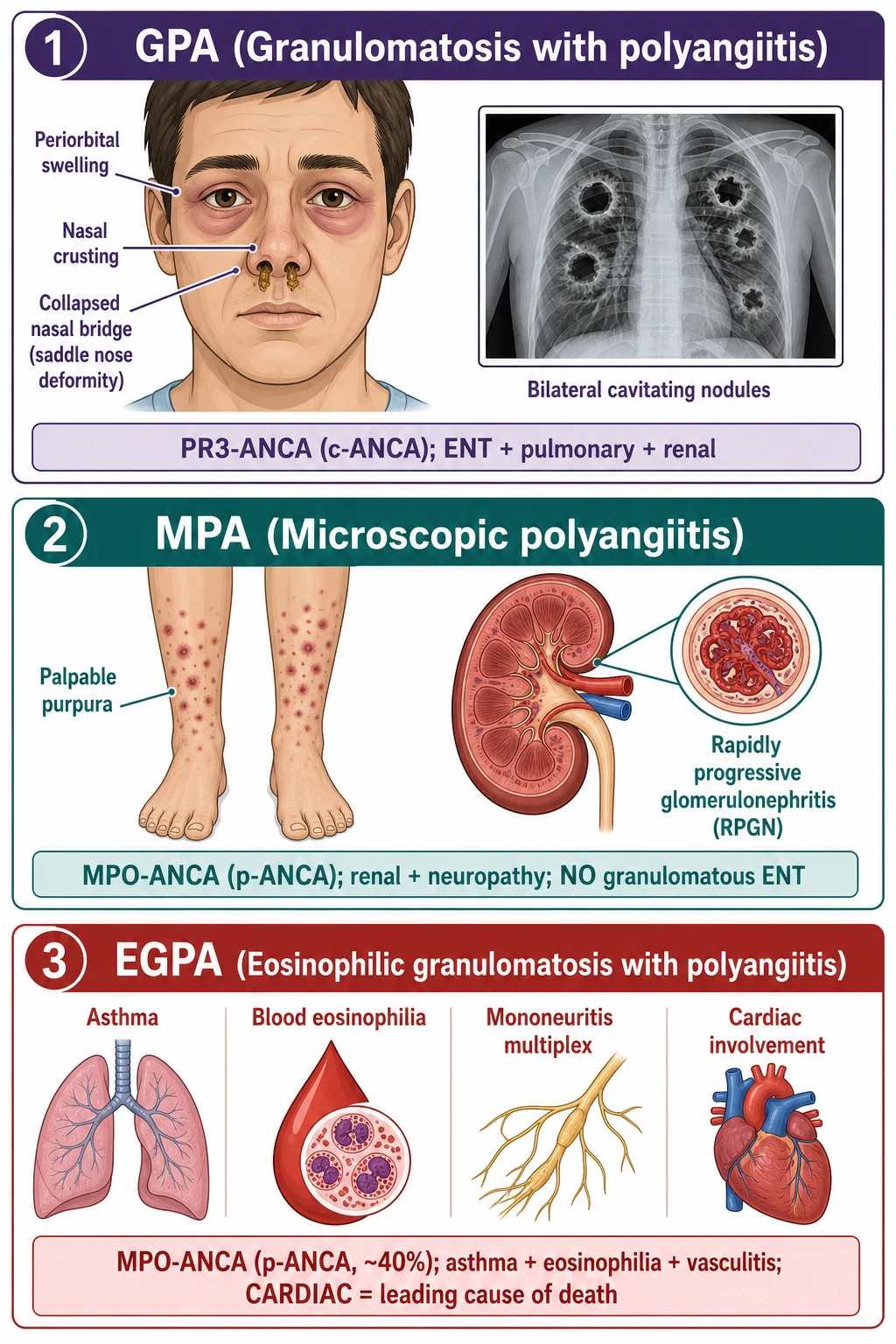
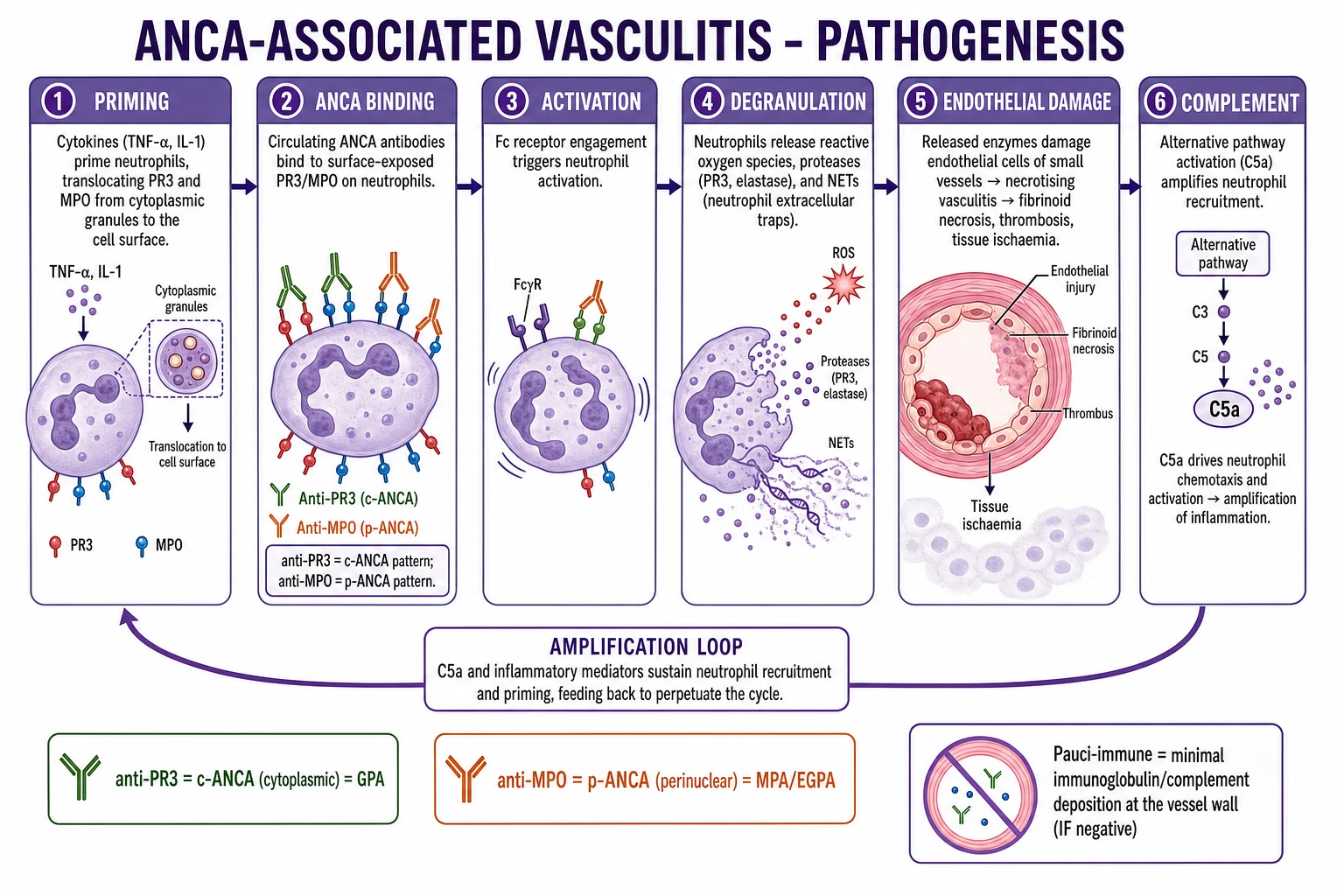
Management of suspected pulmonary vasculitis with DAH
- Recognise — haemoptysis + dyspnoea + falling Hb + diffuse infiltrates + AKI (pulmonary-renal syndrome). Hypoxia may be severe
- Resuscitate — ABC. Oxygen (may need intubation/ventilation for hypoxia). Transfusion for anaemia. Avoid excessive fluids (worsen pulmonary oedema)
- Investigations — (a) ANCA (PR3/c-MPO), anti-GBM, ANA, complement, ANA. (b) Renal: U&E, creatinine, urinalysis (RBC casts), urine PCR. (c) Bronchoscopy + BAL (progressively bloodier aliquots = DAH). (d) CT chest (diffuse ground-glass, consolidation). (e) Renal biopsy (pauci-immune crescentic GN)
- IMMUNOSUPPRESSION — start before biopsy if unstable: (1) Methylprednisolone 1g IV daily × 3 days. (2) Cyclophosphamide 15 mg/kg IV OR rituximab 375 mg/m² weekly × 4. (3) Plasma exchange if severe DAH/RPGN/anti-GBM overlap
- Plasma exchange — for severe DAH (hypoxia, massive bleeding), rapidly progressive GN (creatinine rising, dialysis-dependent), anti-GBM positive. MEPEX trial: improved renal recovery
- Supportive ICU — ventilation (protective, PEEP), renal replacement therapy, transfusion, infection prophylaxis (PJP, fungal)
- Maintenance — after induction: rituximab or azathioprine/methotrexate for 18-24 months (prevent relapse)
SAQ — ANCA-associated vasculitis with pulmonary-renal syndrome
10 minutes · 10 marks
A 58-year-old man presents to the emergency department with a 3-week history of malaise, low-grade fever, arthralgia, and two episodes of small-volume haemoptysis, now with worsening dyspnoea. Over the past 4 days he has noticed his urine is dark and frothy. On examination: T 37.9 degrees C, RR 28, SpO2 90 per cent on room air, BP 168/96, HR 102, coarse bilateral inspiratory crackles. No rash, no synovitis. Investigations: haemoglobin 78 g/L (was 132 four months ago), WCC 14.2, platelets 280, creatinine 386 micromol/L (baseline 90), urea 28, CRP 142, INR 1.0, APTT 32. Urinalysis shows blood 3+, protein 2+, and microscopy reveals red cell casts. Chest X-ray shows bilateral diffuse perihilar airspace opacities. PR3-ANCA strongly positive (high titre); MPO-ANCA negative; anti-GBM antibody negative. Bronchoscopy returns progressively bloodier lavage aliquots from the right middle lobe. CT chest shows bilateral ground-glass and consolidative change, sparing the periphery.
SAQ — Goodpasture syndrome (anti-GBM disease) with massive haemoptysis
10 minutes · 10 marks
A 24-year-old previously well man presents with a 10-day history of progressive dyspnoea and a 2-day history of frank haemoptysis (around 200 mL over 12 hours), now requiring intubation for severe hypoxaemia (PaO2/FiO2 90). On examination he is pale, tachycardic (HR 128) and hypotensive (BP 96/58). Haemoglobin 64 g/L, creatinine 410 micromol/L (baseline 80), urea 32, potassium 6.0 mmol/L. Urinalysis: blood 3+, protein 2+, red cell casts on microscopy. Chest X-ray shows bilateral diffuse alveolar infiltrates. Anti-GBM antibody strongly positive (44 EU/mL; normal less than 20). PR3-ANCA and MPO-ANCA negative. Renal biopsy shows linear IgG deposition along the glomerular basement membrane with crescent formation in 80 per cent of glomeruli.
Clinical pearls
Red flags
Prognosis
RAVE trial (Stone 2010, NEJM) — rituximab vs cyclophosphamide
RCT: 197 patients with severe AAV. Rituximab (375 mg/m² weekly × 4) vs cyclophosphamide (followed by azathioprine maintenance).
- Complete remission at 6 months: rituximab 64% vs cyclophosphamide 53% (non-inferior, rituximab non-inferior)
- Relapsing disease: rituximab 67% vs cyclophosphamide 42% (rituximab SUPERIOR for relapse)
- Adverse events: similar (infection ~30% both)
- CONCLUSION: Rituximab non-inferior to cyclophosphamide for induction. Preferred for relapsing disease. Less long-term toxicity (no cumulative dose limit, less infertility, less malignancy). [1]
MEPEX trial (Jayne 2007): plasma exchange improved renal recovery at 3 months (more off dialysis) for severe AAV with renal failure. No long-term mortality benefit. PLEX reserved for dialysis-dependent RPGN or severe DAH. Mortality: AAV 1-year mortality 5-15% (higher with DAH, older age, severe renal failure). 5-year survival 70-80% with treatment.
AAV subtypes in detail
ANCA-associated vasculitis is a clinicopathological spectrum of three overlapping disorders unified by necrotising small-vessel vasculitis and a pauci-immune pattern on biopsy. All three share the same pathogenesis — circulating ANCA activates primed neutrophils at the vessel wall, degranulation releases proteases and reactive oxygen species, and capillaritis follows. They diverge in clinical phenotype, dominant autoantigen and prognosis.[1] }
| Feature | GPA (Wegener's) | MPA | EGPA (Churg-Strauss) |
|---|---|---|---|
| ANCA positive | ~90% (PR3) | ~70% (MPO) | ~40% (MPO) |
| IF pattern | c-ANCA (cytoplasmic) | p-ANCA (perinuclear) | p-ANCA |
| Antigen | PR3 (proteinase 3) | MPO (myeloperoxidase) | MPO (when positive) |
| Upper airway | Saddle nose, sinusitis, subglottic stenosis, otitis | Rare | Allergic rhinitis, nasal polyps |
| Pulmonary | Cavitating nodules, DAH, fixed infiltrates | DAH (most common cause), interstitial fibrosis | Eosinophilic asthma, fleeting infiltrates |
| Renal | Pauci-immune crescentic GN | Pauci-immune crescentic GN (often severe) | Less common, milder |
| Nerve | Cranial / mononeuritis multiplex | Mononeuritis multiplex | Mononeuritis multiplex |
| Asthma / eosinophilia | Absent | Absent | Hallmark — late-onset asthma, eos >10% / >1.5×10⁹/L |
| Cardiac | Rare | Rare | Common — eosinophilic myocarditis (leading cause of death) |
| Granulomas | Present (necrotising) | Absent | Present (eosinophilic) |
| Typical age | 40–55 | 55–65 | 35–50 |
| Relapse risk | HIGH (PR3 relapses most) | Lower | Moderate |
Causes of diffuse alveolar haemorrhage
DAH is a syndrome, not a diagnosis. It is bleeding from the pulmonary microvasculature into the alveolar space and is produced by three histological patterns: capillaritis (inflammatory, immune-mediated — AAV/anti-GBM/SLE), bland haemorrhage (no inflammation — coagulopathy, mitral stenosis, drug toxicity), and diffuse alveolar damage (DAD — the bleeding is incidental to ARDS). Capillaritis is the time-critical ICU diagnosis because it mandates immediate immunosuppression.[2] }
| Category | Mechanism | Examples | Treatment pivot |
|---|---|---|---|
| Immune capillaritis | Small-vessel vasculitis of alveolar capillaries | AAV (GPA, MPA, EGPA), anti-GBM, SLE, cryoglobulinaemia, IgA vasculitis, rheumatoid vasculitis | Immunosuppression + PLEX (if anti-GBM or severe) |
| Bland haemorrhage | Bleeding without inflammation | Coagulopathy (INR >2, DIC), thrombocytopenia, anticoagulants, mitral stenosis, drug toxicity (propylthiouracil, amiodarone) | Correct coagulopathy / remove cause |
| Pulmonary veno-occlusive / post-capillary | Raised pulmonary venous pressure | Severe mitral stenosis, left atrial hypertension | Treat the cardiac cause |
| Infection-related | Direct endothelial injury | Invasive aspergillosis, H1N1, leptospirosis, dengue, malaria | Antimicrobials, supportive |
| Idiopathic | Pulmonary haemosiderosis | Rare, recurrent DAH in children/young adults | Steroids, azathioprine |
| Malignancy | Vascular invasion / angioinvasive | Angioinvasive aspergillosis, leukaemia, Kaposi sarcoma | Treat underlying |
| Feature | DAH | ARDS |
|---|---|---|
| Pathology | Capillaritis (inflammation) or bland bleeding | Diffuse alveolar damage |
| Imaging | Bilateral ground-glass ± consolidation, often central/perihilar, spares costophrenic angles | Bilateral opacities, diffuse, dependent |
| Anaemia | Drop in Hb 1–3 g/dL over 24–48 h (falling Hb is the clue) | May be anaemic but not rapidly falling from lung bleeding |
| Bronchoscopy | Progressively bloodier sequential aliquots | Clear / purulent (infection) — not bloody |
| Trigger | ANCA, anti-GBM, SLE, drugs | Sepsis, pneumonia, aspiration, trauma, pancreatitis |
| Response to steroids/PLEX | Often dramatic | No response |
| ANA / ANCA / anti-GBM | Positive (immune DAH) | Negative |
Diagnostic workup
Diagnostic workup of suspected DAH in ICU — the 5-question algorithm
- Is it DAH? — Falling Hb (>1–2 g/dL/24 h) + diffuse infiltrates + hypoxaemia, with or without haemoptysis. Haemoptysis is absent in up to one-third because bleeding is distal and the patient may be intubated. Do not wait for haemoptysis to make the diagnosis.[2] }
- Is it capillaritis or bland? — Send ANCA (PR3 + MPO ELISA), anti-GBM, ANA, anti-dsDNA, complement C3/C4, cryoglobulins, urinalysis. If ANCA/anti-GBM positive → immune capillaritis → treat aggressively. If coagulopathy alone → bland bleeding → correct coagulopathy.
- Is there a pulmonary-renal syndrome? — Urinalysis for dysmorphic RBCs/casts, urine ACR/PCR, creatinine. DAH + nephritic sediment = pulmonary-renal syndrome until proven otherwise. Always catheterise for urine in DAH.[5] }
- Confirm with bronchoscopy — Sequential BAL aliquots become progressively bloodier (the "haemorrhagic BAL" sign). Also rules out infection (the great mimic). Hemosiderin-laden macrophages appear after 48–72 h and date the bleed. BAL is safe even in hypoxic/intubated patients.[2] }
- Tissue diagnosis — biopsy is often deferred in ICU. Renal biopsy shows pauci-immune necrotising crescentic GN (AAV) or linear IgG deposition (anti-GBM). Lung biopsy is rarely needed and is high-risk in hypoxic DAH. Treat empirically before biopsy if the patient is unstable — delays for tissue kill patients.[6] }
Induction therapy — choosing the agent
| Feature | Cyclophosphamide | Rituximab |
|---|---|---|
| Mechanism | DNA cross-linking alkylator | Anti-CD20 → B-cell depletion |
| Dose (induction) | 15 mg/kg IV q2–3w (pulse) OR 2 mg/kg/day PO × 3–6 months | 375 mg/m² weekly × 4 OR 1 g × 2 (days 1 + 15) |
| Evidence | Standard for 40 years | RAVE 2010: non-inferior[3]; RITUXVAS 2010: non-inferior[7] |
| Best for | Limited access, low cost | Relapsing disease, women of childbearing potential, PR3-ANCA |
| Avoid in | Young (infertility, malignancy), cytopenic | Hypogammaglobulinaemia, chronic HBV (reactivation) |
| Time to effect | Weeks | Weeks (B-cells deplete within 1–2 weeks) |
| Cumulative toxicity | Dose-dependent (leukaemia, bladder, infertility) | No cumulative limit |
| PJP prophylaxis | Required | Required (during steroid phase) |
Plasma exchange — when and how
Plasma exchange for severe AAV / DAH — practical protocol
- Indications — (a) Anti-GBM positive (mandatory), (b) creatinine >5.7 mg/dL (500 µmol/L) or dialysis-dependent RPGN, (c) severe DAH with hypoxaemia, (d) double-positive ANCA + anti-GBM. MEPEX supported PLEX for renal recovery; PEXIVAS challenged the mortality benefit.[4] }[8] }
- Prescription — Exchange 1 plasma volume (~60 mL/kg) per session, daily or alternate days, 7–14 sessions over 2–3 weeks. Replacement: 5% albumin ± fresh-frozen plasma (FFP preferred in active bleeding / pre-procedure). Anticoagulate carefully — DAH patients bleed.
- Vascular access — Central venous catheter (jugular preferred). Insert early; do not delay PLEX for line placement in anti-GBM.
- Monitor — Anti-GBM titre (aim undetectable before stopping), renal function, respiratory status, fibrinogen, ionised calcium (citrate chelation), bleeding. Re-biopsy not required.
- Stop — When anti-GBM titre negative (usually 9–12 sessions) OR clinical stability achieved. Transition to maintenance rituximab/azathioprine. PLEX does not replace immunosuppression.
- Risks — Bleeding (especially if FFP not co-administered), line infection, hypocalcaemia, hypotension, allergy (FFP), hepatitis B reactivation, venous access complications. Co-administer PJP prophylaxis and vaccination planning for rituximab.[4] }
| Feature | Anti-GBM (Goodpasture) | AAV (GPA / MPA / EGPA) |
|---|---|---|
| Antibody | Anti-α3(IV) collagen (anti-GBM) | ANCA (PR3 or MPO) |
| Biopsy IF | Linear IgG along GBM | Pauci-immune (scant/no Ig) |
| DAH frequency | ~40–60% | Variable (MPA > GPA) |
| Plasma exchange | STANDARD for all | Selective (severe/dialysis only) |
| Relapse | Rare (after titre clearance) | Common (50% in 5 y) |
| Maintenance | Usually short (stop when Ab negative) | 18–24 months minimum |
| Double-positive | Behaves as AAV — needs maintenance | — |
Landmark trials
RITUXVAS (Jones 2010, NEJM) — rituximab in renal AAV
RCT: 76 patients with newly diagnosed renal AAV. Rituximab (375 mg/m² weekly × 4) + 2 cyclophosphamide pulses vs cyclophosphamide continuation (then azathioprine). Both arms received steroids.
- Sustained remission at 12 months: rituximab 76% vs cyclophosphamide 82% (non-inferior)
- Severe adverse events: similar (~42%)
- CONCLUSION: Rituximab is non-inferior to cyclophosphamide for renal AAV induction. With RAVE, this established rituximab as standard first-line induction. RITUXVAS used concomitant low-dose cyclophosphamide (a pragmatic design) whereas RAVE was rituximab monotherapy.
PEXIVAS (Walsh 2020, NEJM) — plasma exchange in severe AAV
RCT: 704 patients with severe AAV (eGFR <50 or DAH). Plasma exchange + standard immunosuppression vs standard immunosuppression alone. Largest AAV trial ever.
- Primary endpoint — death or ESRD at 12 months: PLEX 28% vs control 26% (no significant difference, HR 1.06)
- DAH-specific outcome: no clear reduction in DAH-related death
- Severe infection: higher with PLEX (≈36% vs 30%)
- CONCLUSION: Routine PLEX does NOT reduce death or ESRD in severe AAV. This challenged MEPEX (which had shown renal recovery benefit). PEXIVAS still supports selective PLEX for anti-GBM overlap and dialysis-dependent renal vasculitis, but routine PLEX for all severe AAV is no longer justified. Controversy persists regarding PLEX for life-threatening DAH with refractory hypoxaemia.[8] }
Practice implication: PLEX is still indicated for (1) anti-GBM disease (PEXIVAS excluded anti-GBM), (2) dialysis-dependent AAV at presentation with crescentic biopsy, (3) double-positive ANCA + anti-GBM. No longer routine for moderate AAV or isolated DAH without severe renal failure.
ADVOCATE (Jayne 2021, NEJM) — avacopan, a C5a-receptor blocker
RCT: 331 patients with newly diagnosed or relapsing AAV. Avacopan 30 mg PO bd (glucocorticoid-sparing) vs prednisone taper, both on rituximab or cyclophosphamide induction.
- Sustained remission at 52 weeks: avacopan 72% vs prednisone 70% — non-inferior AND superior for sustained remission
- Glucocorticoid toxicity: significantly lower with avacopan (less weight gain, less diabetes, less infection)
- Renal function: better eGFR recovery with avacopan
- CONCLUSION: Avacopan (C5a-R inhibitor) enables steroid sparing in AAV induction without losing efficacy. Mechanistically attractive — AAV is driven by complement C5a-mediated neutrophil priming. Now FDA-approved for AAV. In ICU: useful for severe AAV where steroid toxicity is undesirable, but high-dose steroids still used for life-threatening DAH.[9] }
MIRACLE (Wechsler 2017, NEJM) — mepolizumab for EGPA
RCT: 136 patients with relapsing/refractory EGPA. Mepolizumab 300 mg SC monthly (anti-IL-5) vs placebo.
- Remission at 36 weeks (≥24 weeks accrued): mepolizumab 28% vs placebo 3% (p<0.001)
- Steroid-sparing: more patients tapered prednisone ≤4 mg/day (44% vs 7%)
- Relapse: lower with mepolizumab
- CONCLUSION: Mepolizumab (anti-IL-5) is effective for relapsing/refractory EGPA, enabling steroid taper. MANDARA (NEJM 2024) showed benralizumab was non-inferior to mepolizumab for EGPA, giving two IL-5-pathway options. Note: EGPA with severe DAH or cardiac/gut involvement still needs cyclophosphamide/rituximab — biologics are for eosinophilic/asthmatic phenotype.[10] }[11] }
EGPA-specific considerations
GPA upper-airway disease
ICU supportive care and pitfalls
Differential diagnosis in the ICU
Prognosis and outcomes
MEPEX (Jayne 2007, JASN) — plasma exchange in renal AAV
RCT: 137 patients with severe renal AAV (creatinine >5.7 mg/dL / 500 µmol/L). Plasma exchange vs methylprednisolone pulses, both with oral cyclophosphamide.
- Death or ESRD at 3 months: PLEX 36% vs methylpred 69% (PLEX better for renal recovery)
- Patients off dialysis at 3 months: 69% (PLEX) vs 49% (methylpred)
- Mortality at 1 year: no difference
- CONCLUSION: PLEX improved short-term renal recovery in severe AAV. This drove routine PLEX use for 13 years — until PEXIVAS (2020) showed no mortality/ESRD benefit at scale. Current practice: selective PLEX for dialysis-dependent presentation or anti-GBM overlap.[4] }
Overall AAV prognosis: 1-year mortality 5–15% (higher with DAH, age >65, ESRD at presentation, FFS ≥2, cardiac involvement in EGPA). 5-year survival 70–80% with modern therapy. DAH alone is not an independent mortality predictor but signals severe disease. EGPA cardiac involvement is the single biggest excess-mortality driver across AAV.[1] }
Maintenance and relapse
| Step | Action | Time-critical? |
|---|---|---|
| 1. Recognise | Falling Hb + diffuse infiltrates ± haemoptysis ± AKI | Yes |
| 2. Resuscitate | O₂ (intubate if hypoxaemic), transfuse, lung-protective ventilation | Yes |
| 3. Bloods | ANCA (PR3+MPO ELISA), anti-GBM, ANA, complements, cryoglobulins, U&E, urine MC&S | Yes (within 1 h) |
| 4. Bronchoscopy | Sequential BAL — progressively bloodier = DAH; send for infection | Within 6 h |
| 5. CT chest | Ground-glass ± consolidation, central/perihilar; CTPA if PE possible | Within 6 h |
| 6. Biopsy (renal) | Pauci-immune crescentic GN (AAV) or linear IgG (anti-GBM); defer if unstable | Within 24–48 h |
| 7. Treat empirically | Methylprednisolone 1 g IV × 3 → if unstable, treat before biopsy | Yes |
| 8. Add induction agent | Cyclophosphamide 15 mg/kg IV OR rituximab 375 mg/m² weekly × 4 | Within 24 h |
| 9. Plasma exchange | If anti-GBM positive, dialysis-dependent, or severe DAH | If anti-GBM: yes |
| 10. Supportive | RRT, transfusion, PJP prophylaxis, infection surveillance | Ongoing |
| 11. Plan maintenance | Rituximab q6 months OR azathioprine for 18–24 months | After remission |
References
- [1]Lyons PA, Peters JE, Alberici F, et al. Genetically distinct subsets within ANCA-associated vasculitis N Engl J Med, 2012.PMID 22808956
- [2]Lauque D, Cadranel J, Lazor R, et al. Microscopic polyangiitis with alveolar hemorrhage. A study of 29 cases and review of the literature. Groupe d'Etudes et de Recherche sur les Maladies Orphelines Pulmonaires (GERMOP) Medicine (Baltimore), 2000.PMID 10941351
- [3]Stone JH, Merkel PA, Spiera R, et al. Rituximab versus cyclophosphamide for ANCA-associated vasculitis N Engl J Med, 2010.PMID 20647199
- [4]Jayne DR, Gaskin G, Rasmussen N, et al. Randomized trial of plasma exchange or high-dosage methylprednisolone as adjunctive therapy for severe renal vasculitis J Am Soc Nephrol, 2007.PMID 17582159
- [5]Greco A, Rizzo MI, De Virgilio A, et al. Goodpasture's syndrome: a clinical update Autoimmun Rev, 2015.PMID 25462583
- [6]Audemard-Verrier A, De Boysson H, Cottin V, et al. Alveolar hemorrhage in anti-basement membrane antibody disease: a series of 28 cases Medicine (Baltimore), 2007.PMID 17505257
- [7]Jones RB, Tervaert JW, Hauser T, et al. Rituximab versus cyclophosphamide in ANCA-associated renal vasculitis N Engl J Med, 2010.PMID 20647198
- [8]Walsh M, Merkel PA, Peh CA, et al. Plasma Exchange and Glucocorticoids in Severe ANCA-Associated Vasculitis N Engl J Med, 2020.PMID 32053298
- [9]Jayne DRW, Merkel PA, Schall TJ, et al. Avacopan for the Treatment of ANCA-Associated Vasculitis N Engl J Med, 2021.PMID 33596356
- [10]Wechsler ME, Akuthota P, Jayne D, et al. Mepolizumab or Placebo for Eosinophilic Granulomatosis with Polyangiitis N Engl J Med, 2017.PMID 28514601
- [11]Wechsler ME, Pesci A, Pelaia G, et al. Benralizumab versus Mepolizumab for Eosinophilic Granulomatosis with Polyangiitis N Engl J Med, 2024.PMID 38393328