ICU · Respiratory
Refractory hypoxaemia and rescue therapies for severe ARDS
Also known as Refractory hypoxaemia · Difficult-to-ventilate ARDS · Rescue therapies for severe ARDS · ECMO for refractory respiratory failure · Prone positioning · Inhaled pulmonary vasodilators · Recruitment manoeuvres · ECCO2R
Refractory hypoxaemia describes persistent, life-threatening hypoxaemia (PaO2/FiO2 <100) despite optimised conventional lung-protective ventilation — PEEP ≥10 cmH2O, FiO2 1.0, Vt 6 mL/kg PBW with plateau pressure <30 and driving pressure <15. It demands stepwise, protocolised escalation through rescue therapies: (1) re-optimise ventilation and treat reversible causes; (2) prone positioning for ≥16 hours/day (PROSEVA — halved 28-day mortality); (3) neuromuscular blockade for severe dyssynchrony (ACURASYS benefit vs ROSE no benefit); (4) inhaled pulmonary vasodilators (nitric oxide 10-40 ppm or inhaled epoprostenol) as a transient bridge; (5) recruitment manoeuvres and higher-PEEP strategy (Briel meta-analysis — benefit in moderate-severe ARDS, harm in mild); (6) permissive hypercapnia (accept PaCO2 60-80 if pH ≥7.20); (7) ECCO2R to enable ultra-protective ventilation; (8) veno-venous ECMO (CESAR, EOLIA) as a bridge to recovery or decision. The cardinal rule: do NOT persist with a failing strategy — each step has a time window measured in hours, not days.
On this page & tools
Your progress
Saved locally on this device.
Target exams
Red flags
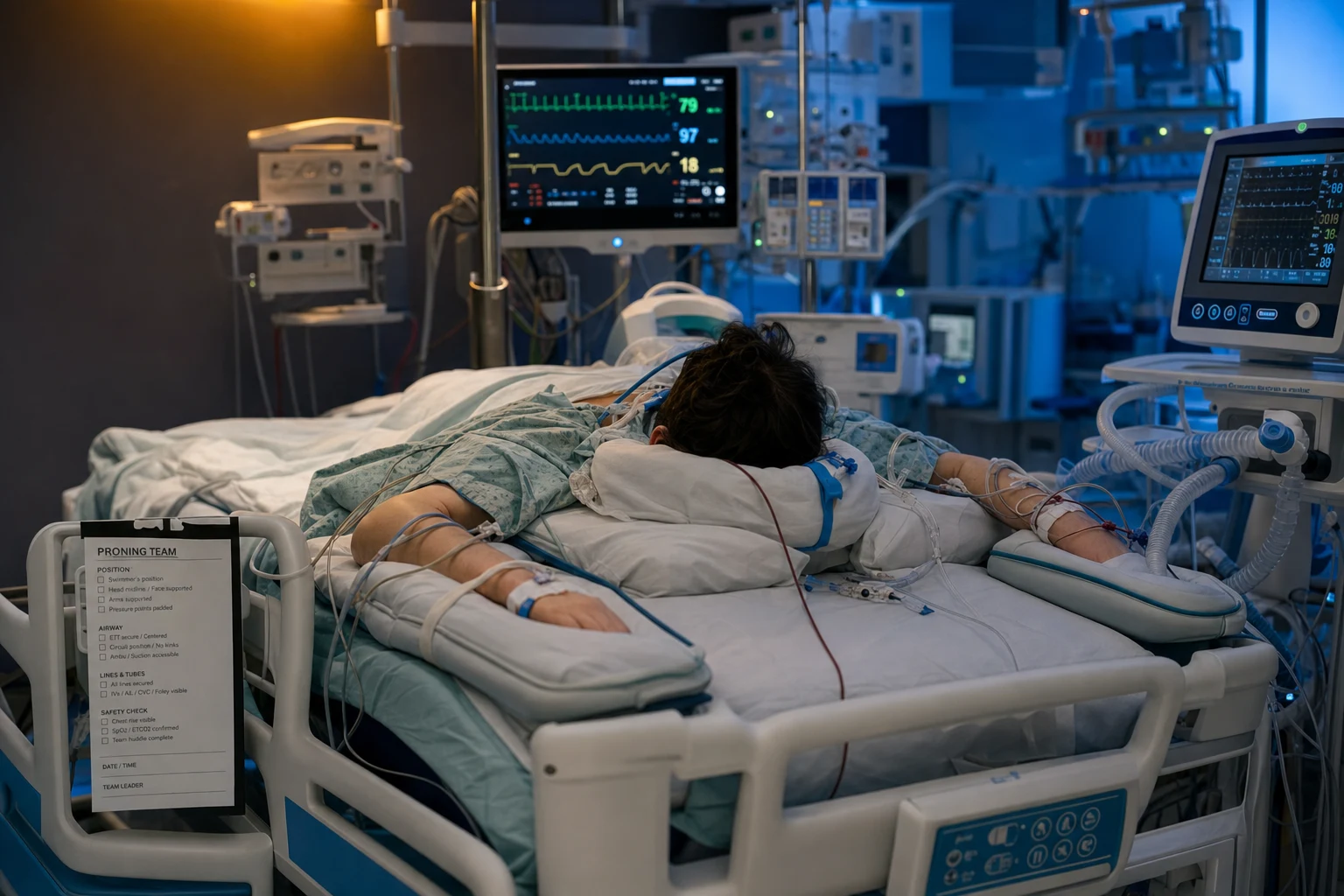
Definition
Refractory hypoxaemia is persistent, life-threatening arterial hypoxaemia (classically PaO2/FiO2 <100, and often <80) that persists despite optimised conventional lung-protective mechanical ventilation.[14][15] The term is reserved for the patient in whom the baseline therapy has been correctly applied and exhausted, signalling the need for rescue (salvage) therapies. It is a problem-oriented descriptor rather than a distinct disease — the underlying pathology is almost always severe ARDS (most commonly from pneumonia, aspiration, sepsis, or trauma), occasionally compounded by pulmonary vascular shunting, severe atelectasis, or unrecognised concurrent processes (pneumothorax, pleural effusion, mucus plugging).[1]
Diagnostic threshold and prerequisite checklist
The label should only be applied once all of the following have been confirmed:[15]
| Domain | Requirement before declaring "refractory" |
|---|---|
| Tidal volume | Vt 6 mL/kg predicted body weight (down-titrated to 4 mL/kg if Pplat high) |
| Plateau pressure | <30 cmH2O (measured by 0.5 s inspiratory hold) |
| Driving pressure (ΔP) | <15 cmH2O — the ventilation variable most strongly associated with survival[8] |
| PEEP | ≥10 cmH2O (adequately titrated, not just set) |
| FiO2 | 1.0 (100%) — to reveal the true severity of shunt |
| Reversible causes | Excluded: endotracheal tube obstruction/mucus plug, pneumothorax, pleural effusion, aspiration, ventilator dyssynchrony, untreated sepsis, deep sedation/analgesia adequate |
| Haemodynamics | Adequate cardiac output and haemoglobin (a low mixed-venous oxygen from shock worsens PaO2) |
Severity strata in refractory hypoxaemia (click each)
PaO2/FiO2 <80 on FiO2 1.0 + PEEP ≥10
Refractory hypoxaemia despite optimised ventilation. Indication for VV-ECMO evaluation. Time window for escalation is hours, not days.
Pathophysiology of refractory hypoxaemia
Refractory hypoxaemia arises from a combination of mechanisms, the dominant one being intrapulmonary shunt through non-ventilated but perfused alveoli (consolidated, atelectatic, or oedema-filled). Because shunted blood bypasses ventilated alveoli, supplemental oxygen alone cannot correct it — the only way to reduce shunt is to recruit collapsed alveoli (PEEP, prone, recruitment) or to redirect perfusion away from shunted units (inhaled vasodilators, prone).[14]
Intrapulmonary shunt
Dominant mechanism
- Perfusion of non-ventilated alveoli — refractory to supplemental O2
- Caused by alveolar flooding (oedema), consolidation (pneumonia), atelectasis
- Target: RECRUIT alveoli (PEEP, prone, recruitment manoeuvres)
Low V/Q + dead space
Contributes to hypoxaemia + hypercapnia
- Heterogeneous injury — some units underventilated, others overventilated
- High dead-space fraction drives hypercapnia and ventilator dyssynchrony
- Target: optimise Vt/PEEP; ECCO2R removes CO2 when Vt must fall
Pulmonary vascular dysregulation
Target of inhaled vasodilators
- Hypoxic pulmonary vasoconstriction is lost/blunted in injured regions
- Blood is maldistributed toward shunted (injured) lung
- Target: inhaled NO/epoprostenol vasodilates ONLY ventilated units → diverts flow
Impaired oxygen delivery
Systemic — worsens measured hypoxaemia
- Low cardiac output or anaemia lowers mixed-venous O2 → PaO2 falls
- Shock must be treated concurrently; do not chase PaO2 alone
- Target: restore DO2 (haemoglobin, inotropes, source control)
Stepwise escalation algorithm
The cardinal principle of managing refractory hypoxaemia is protocolised, stepwise escalation with hard time checkpoints. Persisting with a failing strategy — or escalating without a defined endpoint — is a common and fatal error. Each intervention has a window measured in hours: if there is no physiological improvement (rising PaO2/FiO2, falling ΔP, improving compliance) within the expected window, move to the next step.[14][15]
Escalation pathway for refractory hypoxaemia
Confirm optimisation & exclude reversible causes
Vt 6 mL/kg PBW (down to 4 if Pplat high), Pplat <30, ΔP <15, PEEP ≥10 titrated, FiO2 1.0. Exclude: ETT obstruction/mucus plug (suction + bronchoscopy), pneumothorax (US/CXR), large pleural effusion (drain), aspiration, ventilator dyssynchrony, untreated sepsis. Ensure deep sedation; check haemoglobin and cardiac output.
Prone positioning (≥16 hours/day)
FIRST-LINE rescue for PaO2/FiO2 <150. PROSEVA: continuous prone ≥16 h/day reduced 28-day mortality 16% vs 33%. Continue until P/F >150 for >4 h in supine. Not a bridge to ECMO — it IS the definitive therapy in responders.
Neuromuscular blockade (if dyssynchronous)
Cisatracurium infusion 37.5 mg/h for 48 h, deep sedation first (RASS -5). ACURASYS: benefit in early severe ARDS (P/F <150); ROSE: no routine benefit. Use SELECTIVELY for severe dyssynchrony or profound hypoxaemia unresponsive to proning — NOT routine.
Inhaled pulmonary vasodilator (bridge)
Inhaled nitric oxide 10-40 ppm OR inhaled epoprostenol (prostacyclin) 10-50 ng/kg/min. Reduces pulmonary vascular resistance and improves V/Q matching — typically transient oxygenation benefit (days). Use as a BRIDGE to ECMO or recovery, not as definitive therapy. Cochrane: no mortality benefit.
Higher-PEEP strategy / recruitment
Apply higher PEEP/FiO2 ladder (Briel meta: benefit in moderate-severe ARDS, harm in mild). Avoid aggressive stepwise recruitment (ART 2017 — halted for harm). Brief sustained inflation (40 cmH2O × 40 s) only if clearly recruitable on static compliance.
Permissive hypercapnia + ECCO2R
Accept PaCO2 60-80 mmHg if pH ≥7.20. If pH <7.20 with injurious ventilation, ECCO2R enables ultra-protective ventilation (Vt 3-4 mL/kg) by removing CO2 extracorporeally. Contraindicated in raised ICP.
VV-ECMO referral (bridge to recovery/decision)
For PaO2/FiO2 <80 despite steps 1-6 for >6-12 h, or P/F <50 for >3 h, or pH <7.25 with RR maxed. CESAR: transfer to ECMO centre improved survival. EOLIA: trend to benefit, high crossover. Refer EARLY — before fibrotic phase (>7-10 days high-pressure ventilation).
Treat the cause + plan the exit
Antibiotics for pneumonia, source control for sepsis, withdraw causative drugs. ECMO is a BRIDGE — define the destination daily: recovery, transplant, or withdrawal of life-sustaining therapy. Conservative fluid strategy (FACTT) throughout.
Prone positioning
Prone positioning is the single most evidence-supported rescue therapy for moderate-severe ARDS and should be first-line for any patient with PaO2/FiO2 <150.[3][15]
Mechanism
Prone positioning improves oxygenation and survival through several synergistic mechanisms: [1]
- Recruitment of dependent (dorsal) lung: the dorsal lung is better perfused and, in the supine position, consolidated/atelectatic. Proning recruits it, increasing functional lung size.
- More homogeneous transpulmonary pressure: reduces regional overdistension of non-dependent (ventral) alveoli → less volutrauma.
- Reduced shunt: improved V/Q matching by reallocating perfusion to now-ventilated dorsal units.
- Reduced right ventricular afterload: by lowering hypoxic pulmonary vasoconstriction and improving pulmonary vascular resistance.
- Improved drainage of secretions and reduced cardiac compression of the left lower lobe. [1]
PROSEVA trial (NEJM 2013) — Guérin et al.
Practical conduct
Performing a safe prone turn
Screen for contraindications
Absolute: spinal instability, unstable pelvic/facial fractures, unsecured intracranial mass effect. Relative: recent abdominal surgery, severe burns, pregnancy, raised ICP, haemodynamic instability, freshly placed pacemaker.
Assemble the team (4-6 people)
Minimum: intensivist or senior registrar at the head (controls ETT), respiratory therapist, 2-3 nurses/assistants. Pre-oxygenase with FiO2 1.0 for 10 min. Check all lines/tubes secured, eyes protected, ECG leads moved to back.
Execute the turn
Coordinate on count of three — log-roll to lateral then prone. One person dedicated to the ETT throughout. Reposition arms (swimmer posture), pad pressure points (face, chest, iliac crests, knees, dorsum of feet), re-check tube/line positions immediately.
Maintain ≥16 hours per session
PROSEVA used 16-h continuous sessions. Typical: prone 16 h, supine 8 h (for nursing care, dialysis, procedures). Continue daily sessions until P/F >150 sustained for >4 h supine.
Monitor and anticipate complications
Facial pressure sores (most common — prophylactic dressing), corneal abrasion (eye lubrication + taping), nerve compression, tube/line dislodgement (rare but catastrophic — ETT), haemodynamic swings during turning, cardiac arrest (rare). Have emergency return-to-supine plan for ETT obstruction or cardiac arrest.
Inhaled pulmonary vasodilators
Inhaled pulmonary vasodilators (inhaled nitric oxide [iNO] and inhaled epoprostenol [prostacyclin]) selectively vasodilate the pulmonary vasculature of ventilated alveoli, redistributing pulmonary blood flow away from shunted units toward ventilated units — improving V/Q matching without the systemic hypotension seen with intravenous vasodilators.[11]
Inhaled nitric oxide (iNO)
Selective pulmonary vasodilator
- Dose 10-40 ppm (start 20 ppm, titrate down to lowest effective)
- Onset seconds; rapidly binds haemoglobin → methaemoglobinaemia risk
- Requires specialised delivery system + NO/NO2 monitoring
- Rebound pulmonary hypertension if abruptly withdrawn — wean slowly
- Expensive; methaemoglobin must be monitored
Inhaled epoprostenol (prostacyclin)
Alternative vasodilator
- Dose 10-50 ng/kg/min nebulised (prostacyclin/Flolan)
- No methaemoglobinaemia; cheaper; no NO2 generation
- Mild systemic vasodilatation may cause systemic hypotension
- Continuous nebuliser required; aerosol exposure to staff
- Comparable oxygenation efficacy to iNO
What the evidence shows
Trial findings
- Cochrane (2016): NO mortality benefit for iNO in ARDS
- Transient oxygenation improvement (first 24-72 h) only
- Possible increased renal dysfunction with prolonged use
- Use as a BRIDGE — to ECMO cannulation or recovery
Neuromuscular blockade
The role of neuromuscular blockade (NMB) in severe ARDS has been the most contested of all rescue therapies, with two large trials reaching apparently conflicting conclusions.[4][5]
ACURASYS (NEJM 2010)
Papazian — suggested benefit
- 340 pts, EARLY severe ARDS (P/F <150, PEEP ≥5)
- Cisatracurium 48 h (deep NMB) vs placebo
- 90-day mortality 31% vs 41% (adjusted HR 0.68)
- More ventilator-free days, less barotrauma
- Smaller trial; no routine proning in control arm
ROSE (NEJM 2019)
PETAL Network — no benefit
- 1006 pts, moderate-severe ARDS (P/F <150, FiO2 ≥60%)
- Cisatracurium 48 h vs light sedation + no routine NMB
- 90-day mortality 42.5% vs 42.8% (no difference)
- More cardiovascular events (myocarditis, rhabdomyolysis)
- Higher PEEP in controls; earlier proning in controls
Current recommendation (ATS/ESICM/SCCM 2017, updated post-ROSE): Do NOT routinely use NMB in ARDS.[15] Consider a short (24-48 hour) infusion of cisatracurium in the specific subset with severe oxygenation failure (P/F <150) and overt ventilator dyssynchrony, or profound hypoxaemia unresponsive to proning — used selectively, with deep sedation first and cardiac monitoring for the rare myocarditis/rhabdomyolysis signal.
High-PEEP strategy and recruitment manoeuvres
Higher PEEP recruits collapsed alveoli, increases functional lung size, and reduces shunt — but at the cost of potential haemodynamic compromise, fluid overload from reduced venous return, and regional overdistension. The net benefit depends on recruitability of the lung.[10]
Higher vs lower PEEP — the Briel meta-analysis
The Briel meta-analysis (JAMA 2010) pooled individual patient data from three RCTs and found that a higher-PEEP strategy benefited patients with moderate-severe ARDS while harming those with mild ARDS.[10]
Higher-PEEP strategy — who benefits
Recruitment manoeuvres — ART halted for harm
Aggressive stepwise incremental PEEP recruitment (the ART protocol — 2-min steps to PEEP 45 cmH2O then decremental titration) was studied in the ART trial (JAMA 2017) and halted for harm: 28-day mortality 55% in recruitment vs 49% in control.[7]
APRV / BiLevel (open-lung approach)
Airway Pressure Release Ventilation (APRV), also marketed as BiLevel, is an alternative mode that applies a continuous high continuous positive airway pressure (P-high) with brief, time-cycled releases to a lower pressure (P-low), allowing spontaneous breathing throughout. It is conceptually an open-lung approach: sustained high mean airway pressure keeps alveoli recruited while the brief release vents CO2.[15]
APRV advantages
Open-lung physiology
- High mean airway pressure maintains alveolar recruitment
- Spontaneous breathing preserves diaphragm activity → improved V/Q
- Reduced need for deep sedation/NMB in some patients
- May improve oxygenation in refractory cases
APRV disadvantages
Why it is not routine
- No high-quality RCT showing mortality benefit vs lung-protective VCV
- Risk of overdistension/autotriggering; high P-high can be injurious
- Requires expertise to set P-high, P-low, T-high, T-low
- Spontaneous effort can cause patient-ventilator asynchrony
- Not a substitute for low Vt — watch tidal volumes on release
Permissive hypercapnia
Lung-protective ventilation (low Vt) deliberately accepts hypoventilation, producing a respiratory acidosis. This is accepted because protecting the lung is more important than normalising PaCO2.[15]
[1]Extracorporeal CO2 removal (ECCO2R)
ECCO2R removes carbon dioxide via a low-flow veno-venous circuit (membrane lung), allowing the clinician to reduce minute ventilation to ultra-protective levels (Vt 3-4 mL/kg PBW) while maintaining acceptable PaCO2 and pH. It is conceptually distinct from VV-ECMO, which provides both oxygenation and CO2 removal at high blood flow.[13]
ECCO2R
CO2 removal — low flow
- Low blood flow (~0.5-1.5 L/min) via single double-lumen cannula
- Removes CO2 efficiently; minimal oxygenation contribution
- Enables ultra-protective ventilation (Vt 3-4 mL/kg) for permissive hypercapnia
- Indication: refractory hypercapnia/acidosis with injurious ventilation
- Smaller cannulae, less anticoagulation than full VV-ECMO
VV-ECMO
Full respiratory support — high flow
- High blood flow (3-6 L/min) via femoral + IJ (or bicaval dual-lumen)
- Provides oxygenation AND CO2 removal
- Indication: refractory hypoxaemia (P/F <80) OR refractory hypercapnia
- Larger cannulae, systemic anticoagulation, higher complication burden
A systematic review of ECCO2R for moderate-severe ARDS showed feasibility and physiological benefit (enabling ultra-protective ventilation) but insufficient high-quality evidence of mortality benefit — it remains an adjunct for the specific problem of refractory hypercapnia/acidosis when lung protection would otherwise be sacrificed.[13]
Veno-venous ECMO
Veno-venous (VV) ECMO provides full extracorporeal gas exchange for isolated respiratory failure (as distinct from VA-ECMO for cardiac failure). It is the definitive rescue therapy for refractory hypoxaemia — a bridge to recovery (lung healing), bridge to decision (neurological prognosis, transplant candidacy), or bridge to transplant.[2]
Indications and timing
When to refer for VV-ECMO
Confirm refractoriness
PaO2/FiO2 <80 despite optimised lung-protective ventilation + PEEP titration + proning for >6-12 h. OR PaO2/FiO2 <50 for >3 h. OR pH <7.25 with RR maxed (permissive hypercapnia exceeded).
Assess contraindications
Absolute: irreversible brain injury, terminal malignancy, severe chronic organ failure, non-lung transplant candidate with irreversible lung disease. Relative: ventilation >7-10 days high pressure (fibrosis), age >70, immunosuppression, anticoagulation contraindication. No "futile" prolonged runs without a defined exit.
Refer EARLY to an ECMO centre
Mortality rises with delay. CESAR: transfer to an ECMO centre improved 6-month survival. Mobilise retrieval/transfer before the patient is too unstable to move. Define the daily goal: recovery, transplant, or withdrawal.
Continue optimal ventilation on ECMO
Once on VV-ECMO, set "rest" lung settings: Vt 4-6 mL/kg, RR 10-12, PEEP 10-15, FiO2 0.3-0.5. The goal is to let the lung HEAL, not to chase oxygenation (the circuit provides that).
Manage complications & wean
Bleeding (anticoagulation), thrombosis, haemolysis, infection, limb ischaemia (more with VA). Wean as underlying lung recovers: reduce sweep gas flow, increase ventilator support, trial off.
Landmark trials
CESAR (Lancet 2009)
Peek — positive
- 180 pts severe reversible resp failure — transfer to ECMO centre vs conventional
- 6-month survival without severe disability: 63% vs 47% (p=0.03)
- BUT only 75% of ECMO group actually received ECMO
- Criticised: "transfer to a centre" rather than ECMO itself
- Practice change: established ECMO as a referral pathway
EOLIA (NEJM 2018)
Combes — non-significant
- 249 pts very severe ARDS (P/F <50) — VV-ECMO vs conventional
- 60-day mortality 35% ECMO vs 46% control (p=0.09 — NOT significant)
- Stopped early for futility; 28% crossed over from control to ECMO
- Post-hoc Bayesian reanalysis suggests plausible benefit
- Practice: use SELECTIVELY for refractory cases, not routine
EOLIA trial — key numbers
Evidence and landmark trials
PROSEVA
NEJM 2013
466 pts severe ARDS (P/F <150) — prone ≥16 h vs supine
Key finding
28-day mortality 16% prone vs 33% supine (p<0.001); 90-day 23% vs 41%
Practice change
Prone ≥16 h is standard for severe ARDS — first-line rescue therapy
ACURASYS
NEJM 2010
340 pts early severe ARDS (P/F <150) — cisatracurium 48 h vs placebo
Key finding
90-day mortality 31% vs 41% (adjusted HR 0.68); more ventilator-free days
Practice change
Suggested selective NMB in severe ARDS — later challenged by ROSE
ROSE
NEJM 2019
1006 pts moderate-severe ARDS — cisatracurium 48 h vs light sedation no routine NMB
Key finding
90-day mortality 42.5% vs 42.8% (no difference); more cardiovascular events
Practice change
Routine NMB no longer recommended; use selectively for dyssynchrony
CESAR
Lancet 2009
180 pts severe reversible resp failure — transfer to ECMO centre vs conventional
Key finding
6-month survival without disability 63% vs 47% (p=0.03); 75% of ECMO group received ECMO
Practice change
Established ECMO referral pathway for severe reversible respiratory failure
EOLIA
NEJM 2018
249 pts very severe ARDS (P/F <50) — VV-ECMO vs conventional ventilation
Key finding
60-day mortality 35% vs 46% (p=0.09, NS); 28% crossover to ECMO
Practice change
Use VV-ECMO selectively for refractory cases; refer early
ART
JAMA 2017
1010 pts moderate-severe ARDS — stepwise recruitment + titrated PEEP vs low PEEP
Key finding
28-day mortality 55% recruitment vs 49% control (p=0.041) — halted for harm
Practice change
Aggressive stepwise recruitment NOT recommended; routine recruitment abandoned
Briel meta-analysis
JAMA 2010
IPD meta-analysis of 3 RCTs (2299 pts) — higher vs lower PEEP in ALI/ARDS
Key finding
Higher PEEP reduced mortality in moderate-severe ARDS; increased mortality in mild
Practice change
Use higher-PEEP strategy for moderate-severe ARDS only
FACTT (NHLBI)
NEJM 2006
1000 pts ALI — conservative vs liberal fluid strategy for 7 days
Key finding
More ventilator-free and ICU-free days with conservative strategy; no renal harm
Practice change
Conservative fluid strategy is standard in established ARDS
Adjunctive and supportive measures
Supportive care that is NOT optional
Conservative fluid strategy (FACTT)
After initial resuscitation, target even-to-negative fluid balance. FACTT (2006): improved oxygenation, ventilator-free and ICU-free days, without increasing renal failure.<Cite id="9" />
Treat the underlying cause
Antibiotics for pneumonia, source control for sepsis, withdrawal of causative drugs, treat pancreatitis. Recovery depends on resolving the insult — ECMO buys time but does not treat the cause.
Adequate sedation & analgesia
Ensure RASS -4 to -5 before proning or NMB. Pain and agitation drive dyssynchrony and oxygen consumption. Avoid deep sedation where not required (delirium risk).
Nutrition and glucose control
Early enteral nutrition. Avoid both hyperglycaemia and hypoglycaemia. Visceral protein support recovery.
Venous thromboembolism prophylaxis
Pharmacological prophylaxis unless contraindicated (active bleeding, recent surgery) — augment with mechanical prophylaxis. ARDS and immobility are high VTE risk.
Stress ulcer prophylaxis
PPI or H2RA for mechanically ventilated patients with coagulopathy or prolonged ventilation.
Daily awakening & readiness
When P/F >200, FiO2 <40%, PEEP <8, stable — daily SBT. Early mobility where feasible.
Define the exit daily
Each day on rescue therapy or ECMO, explicitly state the goal: recovery, transplant, or withdrawal. Avoid indefinite escalation without a plan.
Clinical pearls
Red flags
Exam practice
SAQ — Refractory hypoxaemia escalation
10 minutes · 10 marks
A 62-year-old woman with severe community-acquired pneumonia is intubated and ventilated. Current settings: Vt 360 mL (PBW 60 kg), RR 30, PEEP 14, FiO2 1.0. ABG: pH 7.21, PaCO2 64, PaO2 71, HCO3 24. Pplat 29 cmH2O. CXR: bilateral dense alveolar infiltrates. Echo: normal LV, no valve lesion. She has been on these settings for 8 hours with no improvement.
SAQ — Reconciling ACURASYS and ROSE
8 minutes · 8 marks
A colleague asks why your unit does not routinely use cisatracurium in all patients with moderate-severe ARDS, given that a major trial showed a mortality benefit.
Prognosis and key numbers
Outcomes in refractory hypoxaemia / severe ARDS
- Prognostic factors: age, comorbidities, severity (P/F), driving pressure, cause (direct vs indirect), time to lung-protective ventilation, time to proning, fluid balance.[14]
- Predictors of mortality: persistent high driving pressure, multi-organ failure, prolonged (>14 day) ECMO run without recovery, refractory acidosis.
- Long-term survivors: ~30-40% have cognitive impairment, depression, PTSD, and reduced physical function at one year.
Key concepts summary
[1]References
- [1]Niederman MS, Cilloniz C, Mendoza M, Torres A. Severe community-acquired pneumonia Eur Respir Rev, 2022.PMID 36517046
- [2]Combes A, Hajage D, Capellier G, et al. Extracorporeal Membrane Oxygenation for Severe Acute Respiratory Distress Syndrome N Engl J Med, 2018.PMID 29791822
- [3]Guérin C, Reignier J, Richard JC, et al. Prone positioning in severe acute respiratory distress syndrome N Engl J Med, 2013.PMID 23688302
- [4]Papazian L, Forel JM, Gacouin A, et al. Neuromuscular blockers in early acute respiratory distress syndrome N Engl J Med, 2010.PMID 20843245
- [5]National Heart, Lung, and Blood Institute PETAL Clinical Trials Network, Moss M, Huang DT, Brower RG, et al. Early Neuromuscular Blockade in the Acute Respiratory Distress Syndrome N Engl J Med, 2019.PMID 31112383
- [6]Peek GJ, Mugford M, Tiruvoipati R, et al. Efficacy and economic assessment of conventional ventilatory support versus extracorporeal membrane oxygenation for severe adult respiratory failure (CESAR): a multicentre randomised controlled trial Lancet, 2009.PMID 19762075
- [7]Writing Group for the Alveolar Recruitment for Acute Respiratory Distress Syndrome Trial (ART) Investigators, Cavalcanti AB, Suzumura ÉA, et al. Effect of Lung Recruitment and Titrated Positive End-Expiratory Pressure (PEEP) vs Low PEEP on Mortality in Patients With Acute Respiratory Distress Syndrome: A Randomized Clinical Trial JAMA, 2017.PMID 28973363
- [8]Amato MBP, Meade MO, Slutsky AS, et al. Driving pressure and survival in the acute respiratory distress syndrome N Engl J Med, 2015.PMID 25693014
- [9]National Heart, Lung, and Blood Institute Acute Respiratory Distress Syndrome (ARDS) Clinical Trials Network, Wiedemann HP, Wheeler AP, et al. Comparison of two fluid-management strategies in acute lung injury N Engl J Med, 2006.PMID 16714767
- [10]Briel M, Meade M, Mercat A, et al. Higher vs lower positive end-expiratory pressure in patients with acute lung injury and acute respiratory distress syndrome: systematic review and meta-analysis JAMA, 2010.PMID 20197533
- [11]Gebistorf F, Karam O, Wetterslev J, Afshari A. Inhaled nitric oxide for acute respiratory distress syndrome (ARDS) in children and adults Cochrane Database Syst Rev, 2016.PMID 27347773
- [12]Villar J, Añón JM, Ferrando C, et al. Dexamethasone treatment for the acute respiratory distress syndrome: a multicentre, randomised controlled trial Lancet Respir Med, 2020.PMID 32043986
- [13]Worku E, Girma T, Tola A, et al. Venovenous extracorporeal CO(2) removal to support ultraprotective ventilation in moderate-severe acute respiratory distress syndrome: A systematic review and meta-analysis of the literature Perfusion, 2023.PMID 35656595
- [14]Matthay MA, Zemans RL, Zimmerman GA, et al. Acute respiratory distress syndrome in adults: diagnosis, outcomes, long-term sequelae, and management Lancet, 2022.PMID 36070788
- [15]Fan E, Del Sorbo L, Goligher EC, et al. Treatment of ARDS With Prone Positioning Chest, 2017.PMID 27400909