ICU · Respiratory / ventilation
Refractory Hypoxaemia Adjuncts — Proning, iNO, Recruitment, NMBA, ECMO
Also known as Refractory hypoxaemia · Prone positioning · Prone ventilation · PROSEVA · Inhaled nitric oxide · iNO · Recruitment manoeuvre · Neuromuscular blockade · NMBA · ACURASYS · ROSE trial · VV-ECMO · EOLIA · CESAR · ART trial · ECCO2R · Apnoeic oxygenation · Driving pressure
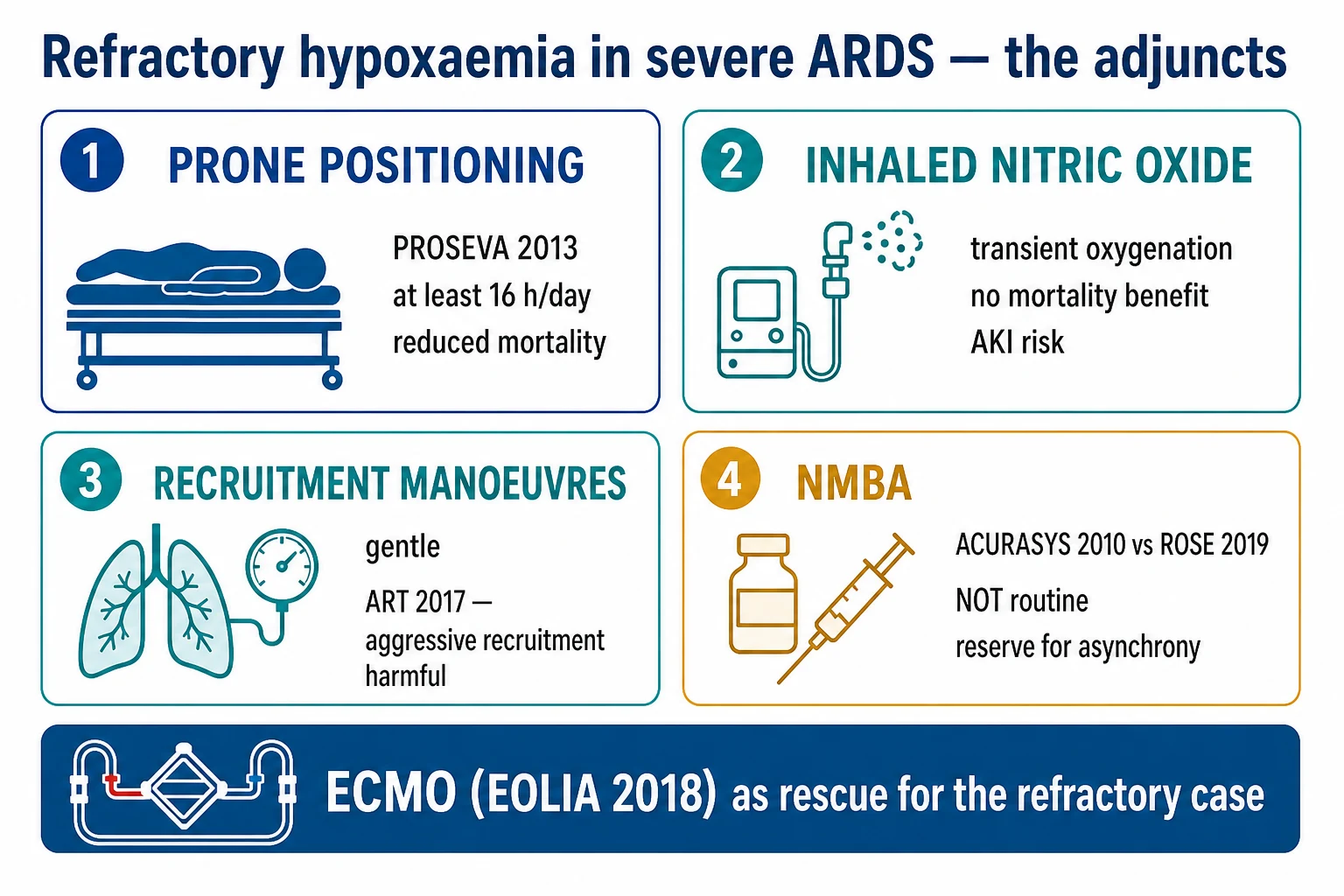
Refractory hypoxaemia in severe ARDS is defined as a PaO2/FiO2 under 100 despite optimised lung-protective ventilation (Vt 6 mL/kg PBW, Pplat under 30 cmH2O, optimised PEEP, FiO2 1.0). A staged set of adjuncts is deployed: optimise ventilation (driving-pressure-guided PEEP, permissive hypercapnia), then PRONE POSITIONING (PROSEVA, NEJM 2013 — at least 16 h/day in PaO2/FiO2 under 150) which is the ONLY adjunct that reduces mortality, then transient oxygenation therapies (inhaled nitric oxide or inhaled epoprostenol — no survival benefit, AKI/rebound risk), then short neuromuscular blockade for asynchrony (ACURASYS 2010 benefit refuted by ROSE 2019 — NOT routine), then VV-ECMO (EOLIA 2018, CESAR 2009) for the refractory case, with ECCO2R as a partial support. Aggressive recruitment plus very high PEEP is harmful (ART 2017).
On this page & tools
Your progress
Saved locally on this device.
Target exams
Overview & definition
When severe ARDS remains hypoxaemic despite optimised lung-protective ventilation (low tidal volume, adequate PEEP, plateau under 30 cmH2O), four adjuncts are considered — proning, inhaled nitric oxide, recruitment manoeuvres, and neuromuscular blockade — with VV-ECMO as the rescue for the refractory case. Of these, proning is the only one that consistently reduces mortality; the others are temporising or selective.[1][1]
Definition, severity thresholds and oxygenation indices
Refractory hypoxaemia in the ICU is conventionally defined as a PaO2/FiO2 ratio under 100 despite optimised lung-protective ventilation — Vt 6 mL/kg predicted body weight, plateau pressure under 30 cmH2O, PEEP titrated (FiO2 1.0 if needed), and permissive hypercapnia tolerated. When PaO2/FiO2 falls below 50 for over 3 hours (or below 80 for over 6 hours, or a pH under 7.25 with PaCO2 60 mmHg or more refractory to optimised ventilation), the patient meets VV-ECMO rescue criteria (EOLIA thresholds).[4][1]
Berlin severity grading of ARDS (PEEP/CPAP at least 5 cmH2O)
| Severity | PaO2/FiO2 (mmHg) | Hospital mortality | Adjunct role |
|---|---|---|---|
| Mild | 200-300 | 27 per cent | Lung-protective ventilation only |
| Moderate | 100-200 | 32 per cent | Consider proning if under 150 |
| Severe | under 100 | 45 per cent | Proning FIRST-LINE; consider iNO, NMBA, ECMO |
Oxygenation indices — beyond PaO2/FiO2
- Oxygenation Index (OI) = (mean airway pressure × FiO2 × 100) / PaO2. An OI over 40 in paediatric ARDS is an ECMO criterion; an OI above 25 predicts severe disease and warrants escalation planning.
- Oxygenation Saturation Index (OSI) = (mean airway pressure × FiO2 × 100) / SpO2 — useful when an arterial line is unavailable.
- Driving pressure (ΔP) = plateau pressure minus PEEP. An analysis of pooled ARDSNet data (Amato 2015, NEJM) found that driving pressure is the ventilatory variable that best stratifies risk: a ΔP over 14-15 cmH2O is independently associated with mortality, even after adjusting for Vt and Pplat.[13]
- P/F-to-F ratio trend is more informative than a single value — a falling PaO2/FiO2 over hours despite rising PEEP and FiO2 signals failure of conventional strategy.
Refractory hypoxaemia is not a single diagnosis
Always exclude reversible causes before declaring a patient "refractory": untreated pneumothorax, tube malposition/obstruction, endobronchial intubation, mucous plugging, untreated sepsis with high metabolic demand, right-heart failure or massive pulmonary embolism, undiagnosed shunt (e.g., patent foramen ovale), or unrecognised alveolar flooding from fluid overload. A falling SpO2 in the absence of a worsening P/F should prompt echocardiography rather than an escalation of ventilator settings.[1][22]
Mechanisms — why the lung stays hypoxaemic
Three overlapping mechanisms dominate in established severe ARDS:[1][22]
- Intrapulmonary shunt — perfusion of non-ventilated, consolidated or atelectatic lung. Unlike V/Q mismatch, shunt is refractory to added FiO2: PaO2 barely rises as FiO2 climbs. This is the dominant lesion in severe ARDS.
- Low V/Q units — flooded or obstructed alveoli that ventilate poorly; partially responsive to FiO2 and PEEP.
- Diffusion impairment and dead space — late-stage fibrosis and microvascular obliteration raise dead space; VD/VT rises and CO2 clearance worsens. [1]
The "baby lung" concept (Gattinoni): in ARDS, aerated lung volume is reduced to roughly 20-30 per cent of normal — the lung is small, not stiff. Ventilating 6 mL/kg into this small compartment generates injurious stress and strain. All adjuncts act by either recruiting lung (proning, recruitment, PEEP), improving V/Q matching in already ventilated lung (iNO, inhaled epoprostenol), reducing injurious strain (NMBA, proning), or bypassing the lung entirely (VV-ECMO, ECCO2R).[1]
Refractory hypoxaemia escalation algorithm (the staged pathway)
Staged escalation for refractory hypoxaemia in severe ARDS
- STEP 0 — VERIFY the basics — (a) Confirm endotracheal tube position and patency (pass suction catheter; auscultate; CXR). (b) Exclude pneumothorax (bedside ultrasound, CXR). (c) Optimise haemoglobin (target 70-90 g/L, higher if ischaemia), cardiac output (echo, target CI over 2.5), temperature (avoid fever; target 36-37 degrees), and metabolic demand (sedation, analgesia). (d) Treat the cause (antibiotics, source control).
- STEP 1 — OPTIMISE lung-protective ventilation — (a) Vt 6 mL/kg predicted body weight (drop to 4 mL/kg if Pplat over 30). (b) Plateau pressure under 30 cmH2O. (c) Driving pressure (ΔP) under 14-15 cmH2O — the most powerful predictor of survival (Amato 2015, NEJM). (d) PEEP titrated by the ARDSNet PEEP/FiO2 higher table, or by oesophageal pressure / best-compliance if available. (e) Permissive hypercapnia (pH above 7.20). (f) FiO2 1.0 as needed. Allow 1-2 hours to equilibrate before declaring failure.[13]
- STEP 2 — PRONE POSITIONING (the mortality-reducing adjunct) — Indicated for PaO2/FiO2 under 150 despite Step 1. PROSEVA (NEJM 2013): proning at least 16 h/day reduced 28-day mortality from 32.8 to 16.0 per cent. First-line; do not wait for the patient to be moribund. Continue daily until PaO2/FiO2 over 150 with FiO2 0.6 and PEEP 10 in the supine turnaround for at least 4 hours.[1]
- STEP 3 — INHALED PULMONARY VASODILATOR (transient oxygenation bridge) — iNO 1-20 ppm OR inhaled epoprostenol 0.02-0.05 mcg/kg/min. Use ONLY as a bridge (e.g., while organising ECMO) or for RV failure/pulmonary hypertension, NOT routinely. Watch for methaemoglobinaemia (iNO), AKI, and rebound hypoxaemia on withdrawal. A response (rise in PaO2/FiO2 over 20 per cent) is seen in only ~60 per cent.[14][16]
- STEP 4 — SHORT NEUROMUSCULAR BLOCKADE (selective) — Continuous cisatracurium for 24-48 hours ONLY for patient-ventilator asynchrony, dangerous ventilation (Pplat over 30 despite Vt 4 mL/kg), or severe refractory hypoxaemia. Not routine (ROSE 2019). Adequate deep sedation first; monitor with train-of-four (target 1-2 of 4 twitches).[2][3]
- STEP 5 — VV-ECMO (the rescue) — Referral and cannulation when EOLIA thresholds met: PaO2/FiO2 under 50 for over 3 h, or under 80 for over 6 h, or pH under 7.25 with PaCO2 at least 60 mmHg for over 6 h despite Step 1-4, or Pplat over 30 refractory. Refer EARLY — the patient should not be multi-organ-failing at the time of cannulation.[4][21]
- CONSIDER ADJUNCTIVELY — ECCO2R for CO2-only failure (avoidance of injurious ventilation, allowing ultra-protective Vt), awake proning in non-intubated patients (COVID data, Ehrmann meta-trial), inhaled epoprostenol if iNO unavailable.[18][23]
Prone positioning — the first-line, mortality-reducing adjunct
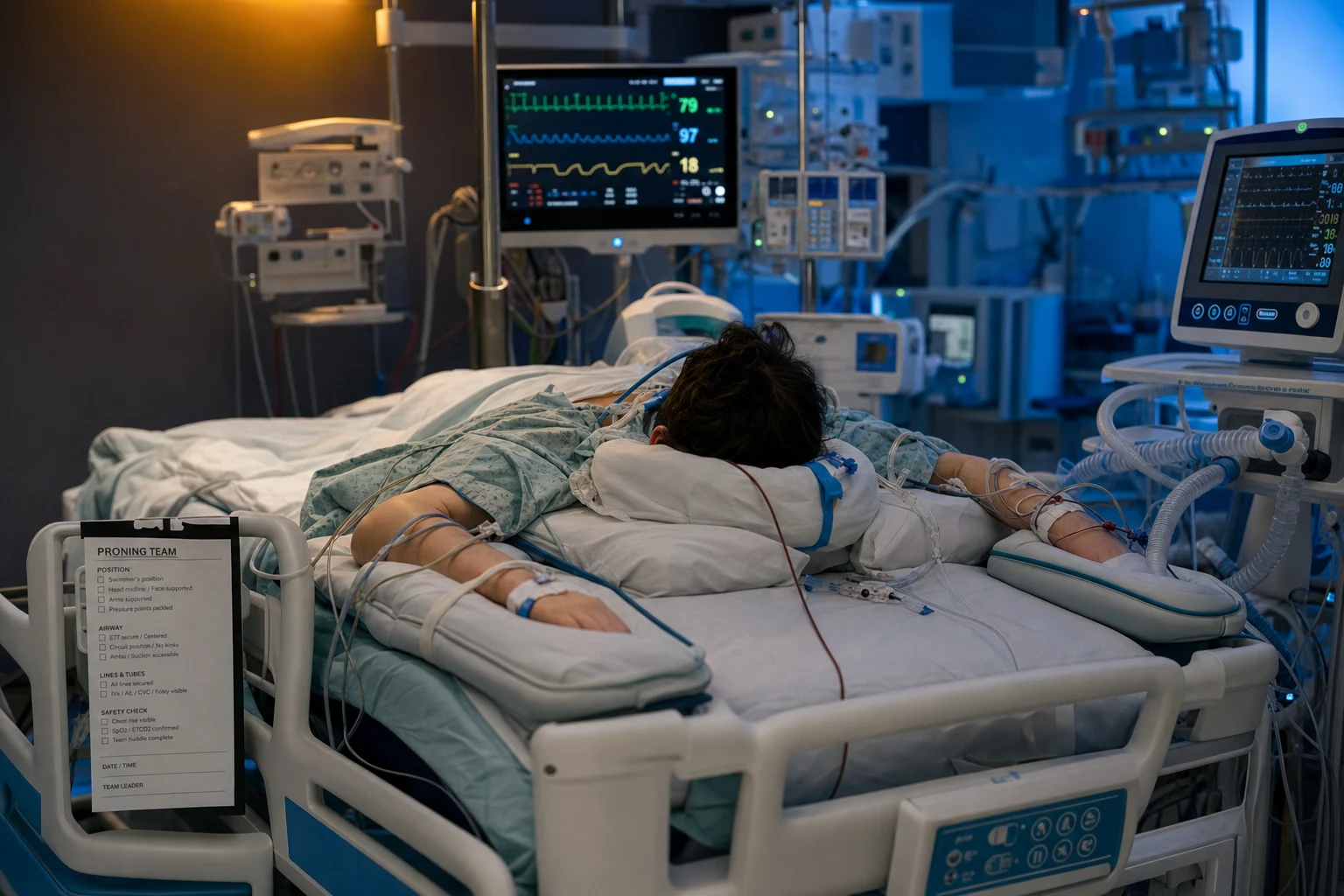
The PROSEVA trial (NEJM 2013) randomised patients with severe ARDS (PaO2/FiO2 under 150) to prone positioning for at least 16 hours a day versus continued supine ventilation. Proning reduced 28-day mortality from 32.8 to 16.0 per cent and 90-day mortality, with no increase in complications (the main serious risk, accidental extubation or line dislodgement, was manageable with a trained team).[1]
Mechanisms: proning improves oxygenation by recruiting the dependent (dorsal) lung, reducing shunt and improving ventilation-perfusion matching; but its survival benefit is beyond oxygenation alone — it reduces ventilator-induced lung injury by more uniform lung stress and strain, and it facilitates lung-protective ventilation.[1][1]
Indication: a PaO2/FiO2 under 150 with FiO2 at least 60 per cent and PEEP at least 5 cmH2O.[1]
Contraindications: spinal instability, a recent sternotomy, unstable fractures, raised intracranial pressure, and (relative) pregnancy and severe haemodynamic instability.[1][1]
Practical points: proning is a team procedure (trained staff, careful line and airway management, pressure-area protection); keep the patient prone for at least 16 hours; about 10-15 per cent of patients do not improve oxygenation in the prone position ("non-responders") but proning should still continue for its mortality benefit.[1]
Proning physiology — four reasons it works
- Reduced shunt — the dependent dorsal lung (which has the greatest perfusion and is most atelectatic when supine) is placed uppermost in the prone position; the dorsal alveoli are recruited by the now-favourable vertical pleural pressure gradient, and shunt falls.
- More uniform transpulmonary pressure — in the supine position the heart compresses the dependent lung and the vertical gradient of pleural pressure is steep; in the prone position the gradient flattens, ventilation is more homogenous, and regional overdistension and atelectrauma both fall.
- Reduced lung strain — for the same Vt, regional strain is lower because the aerated lung is larger; VILI is reduced independent of oxygenation, which is why non-responders still benefit.
- Improved secretion clearance and lymphatic drainage, and reduced right-ventricular afterload in patients with RV dysfunction by reducing PVR through better oxygenation and less hypoxic vasoconstriction. [1]
Proning technique — the turn itself
- Pre-turn: pause enteral feeds (aspiration risk), check tube/line security, suction airway, preoxygenate with FiO2 1.0, ensure at least 5 trained staff plus a team leader, eye protection, ECG on the front.
- The turn: a coordinated 180-degree lateral roll (or log-roll), maintaining head/neck/ETT in alignment. The "swimmer's position" — one arm up, one arm down, head turned — minimises brachial plexus injury.
- Post-turn: new CXR to confirm ETT/CVC and exclude pneumothorax; check pressure areas (forehead, cheeks, chin, shoulders, iliac crests, knees, dorsa of feet) every 2 hours with repositioning; protect eyes (corneal abrasions, ischaemic optic neuropathy are recognised complications).
- Continuous monitoring: SpO2, end-tidal CO2, arterial line trace (often dampens transiently), cardiac rhythm. Anticipate a brief desaturation during the turn itself; this usually resolves within 15-30 minutes. [1]
Proning complications
- Pressure injury to face, chest, anterior iliac crests, knees (most common; protocolised pressure-area care reduces severity).
- Facial and airway oedema — proning raises venous pressure in the head and neck; extubation may be delayed until oedema settles.
- Nerve injuries — brachial plexus, ulnar, common peroneal.
- Eye injury — corneal abrasions, ischaemic optic neuropathy, retinal ischaemia.
- Catheter, line, chest tube or ETT dislodgement — the main serious risk; managed with a trained proning team.
- Cardiovascular instability during the turn (transient hypotension from reduced venous return). [1]
Proning in the awake / non-intubated patient (COVID-era data)
Awake proning of patients on high-flow nasal cannula became widespread during COVID-19. The Ehrmann meta-trial (Lancet Respir Med 2021, six RCTs, n = 1125) found that awake proning did not reduce the need for intubation overall, but improved SpO2; subgroup data suggested a possible benefit in the most hypoxaemic patients.[18] A subsequent individual-patient-data systematic review and meta-analysis (Li, Lancet Respir Med 2022) confirmed a modest oxygenation benefit but a high heterogeneity and no robust mortality signal.[24] Awake proning is reasonable to trial in cooperative patients on HFNC but should NOT delay intubation when indicated.
Inhaled nitric oxide (iNO)
Inhaled nitric oxide is a selective pulmonary vasodilator: it reaches only ventilated alveoli, vasodilating their capillaries and so improving V/Q matching and oxygenation.[1]
- It produces a transient improvement in oxygenation, but does not improve mortality, and meta-analyses suggest it increases the risk of acute kidney injury.[1]
- Its current role is as a rescue or bridge (for example, profound hypoxaemia while arranging ECMO, or right-heart failure from pulmonary hypertension), not routine therapy.[1]
Dosing, monitoring and weaning of iNO
- Dose: start at 1-5 ppm (low dose, less toxicity) and titrate up to a maximum of 20 ppm (higher doses are not more effective and increase methaemoglobinaemia and NO2 generation).
- Monitor: continuous SpO2 and haemodynamics; methaemoglobin every 24 h (keep below 2-3 per cent); inspired NO2 (kept under 3 ppm — use a NO2 scavenger if needed).
- Wean slowly — abrupt cessation causes rebound pulmonary vasoconstriction and rebound hypoxaemia that can be worse than baseline. Halve the dose every few hours and do not stop abruptly.
- Response criterion: a rise in PaO2/FiO2 of at least 20 per cent within 30-60 minutes defines a responder. Only ~60 per cent respond. A non-responder should have iNO withdrawn and a different strategy pursued. [1]
Inhaled epoprostenol (prostacyclin) — the practical alternative
Inhaled epoprostenol (Flolan) aerosolised at 0.02-0.05 mcg/kg/min is as effective as iNO for oxygenation, is cheap and rapidly available, and avoids methaemoglobinaemia and NO2 toxicity. Its main drawback is systemic vasodilatation with hypotension if the aerosol leaks into the systemic circuit (mitigated by using a vibrating-mesh nebuliser in the inspiratory limb), and a short half-life requiring a continuous infusion that cannot be interrupted. Many units now use inhaled epoprostenol as first-line inhaled pulmonary vasodilator, reserving iNO for RV failure with pulmonary hypertension. [1]
Compare: iNO versus inhaled epoprostenol
| Feature | iNO | Inhaled epoprostenol |
|---|---|---|
| Onset / offset | Seconds | Minutes |
| Cost | Very expensive | Cheap |
| Availability | Cylinder, special delivery | Pharmacy compounding |
| Methaemoglobinaemia | Yes (monitor) | No |
| NO2 toxicity | Yes (monitor) | No |
| Systemic hypotension | Rare | Yes (if systemic leak) |
| Rebound on withdrawal | Yes (severe) | Yes (mild, short half-life) |
| Reverses RV failure / pulmonary HTN | Yes | Yes |
| Reduces mortality in ARDS | No | No |
Recruitment manoeuvres
A recruitment manoeuvre — a brief, deliberate increase in transpulmonary pressure to reopen collapsed alveoli — can improve oxygenation in selected patients, often followed by a higher PEEP to keep the lung open.[1]
- The ART trial (JAMA 2017) found that an aggressive recruitment manoeuvre plus very high PEEP increased 28-day mortality compared with a standard lung-protective strategy. Recruitment is therefore gentle and selective, not an aggressive blanket strategy.[1][6]
Types of recruitment manoeuvre — from gentle to aggressive
- Sustained inflation — CPAP at 30-40 cmH2O for 30-40 seconds. Simple but associated with haemodynamic compromise and barotrauma; now rarely used in adults.
- Staircase / incremental PEEP — PEEP increased in 5 cmH2O steps every 2-3 minutes while watching oxygenation, compliance, and haemodynamics, until a plateau (best compliance) is found; PEEP is then decremented to the value 2 cmH2O above the point of best compliance ("open-lung" PEEP).
- Prolonged sigh — periodic (every 30-60 seconds) 1-3 breath at PEEP 15-20 above baseline with low driving pressure. Lower risk; used by some as a recruitment-maintenance strategy.
- Extended sigh (PHARLAP-style staircase) — combined prolonged sigh and decremental PEEP; promising but requires close monitoring.
- PEEP titration guided by oesophageal pressure — set PEEP so that transpulmonary end-expiratory pressure is positive (0-5 cmH2O) — used by EPVent and EPVent-2.[11][12]
Trials informing recruitment practice
- LOVS (Meade, JAMA 2008): open-lung ventilation with recruitment plus high PEEP — no overall mortality benefit, but a trend in the most severe subgroup.[9]
- EXPRESS (Mercat, JAMA 2008): PEEP titrated to maximal alveolar recruitment versus minimal PEEP — improved oxygenation and ventilator-free days but no mortality benefit and more barotrauma.[8]
- ALVEOLI (Brower, NEJM 2004): higher versus lower PEEP/FiO2 — no benefit.[7]
- Briel meta-analysis (JAMA 2010): pooled ALVEOLI/EXPRESS/LOVS — a small survival benefit with higher PEEP in the subgroup with manifest ARDS (PaO2/FiO2 under 200), and possible harm in patients whose lungs were not recruitable.[15]
- ART (Cavalcanti, JAMA 2017): stepwise recruitment plus titrated high PEEP in moderate-severe ARDS — increased 28-day mortality (55 vs 49 per cent) and barotrauma. Aggressive recruitment is harmful.[6]
- PHARLAP (Hodgson, AJRCCM 2019): phase II maximal recruitment open-lung approach — improved oxygenation without raising mortality; phase III stopped for futility.[17]
- EPVent (Talmor, NEJM 2008): oesophageal-pressure-guided PEEP — improved oxygenation and a trend to survival.[11]
- EPVent-2 (Beitler, JAMA 2019): larger multicentre RCT — oesophageal-pressure-guided PEEP was NOT superior to a high PEEP/FiO2 empirical strategy.[12]
Practical take-home: who, when, how
- Trial a gentle recruitment (staircase PEEP, NOT sustained inflation) in patients with a recruitable lung (young, primary pulmonary ARDS, high chest-wall compliance, falling SpO2) when oxygenation is refractory.
- Always do it under continuous haemodynamic and SpO2 monitoring with vasopressors running and the team ready to abort.
- Watch the right heart — abrupt rises in intrathoracic pressure reduce RV preload and raise RV afterload; acute cor pulmonale on echocardiography is an indication to stop.
- Do NOT perform aggressive (ART-style) recruitment — it kills patients.[6]
High PEEP strategies — what the evidence supports
Higher PEEP keeps recruited alveoli open and reduces atelectrauma, but in patients with poorly recruitable lungs it causes overdistension, barotrauma, and haemodynamic compromise. The synthesis of the evidence:[7][8][9][15]
| Strategy | Trial | Outcome | Take-home |
|---|---|---|---|
| Higher PEEP/FiO2 (empirical) | ALVEOLI 2004 | No mortality benefit | Use higher PEEP/FiO2 table in moderate-severe ARDS |
| PEEP to maximal recruitment | EXPRESS 2008 | Better O2, no survival, more barotrauma | Reasonable if recruitable; watch for harm |
| Open-lung + recruitment | LOVS 2008 | No overall benefit; trend in severe | Combined strategy acceptable |
| Pooled higher PEEP | Briel 2010 meta | Small survival benefit IF P/F under 200 | Reserve high PEEP for moderate-severe ARDS |
| Stepwise RM + high PEEP | ART 2017 | HARMFUL (increased mortality) | NEVER use aggressive recruitment |
| Oesophageal-pressure-guided PEEP | EPVent 2008 / EPVent-2 2019 | Trend (2008); no benefit (2019) | Not superior; investigational |
Current practice: titrate PEEP by the higher ARDSNet PEEP/FiO2 table for moderate-severe ARDS, then personalise — use best respiratory-system compliance, best PaO2/FiO2, driving pressure, or oesophageal/transpulmonary pressure to refine. A PEEP that reduces the driving pressure at the same Vt is generally beneficial; a PEEP that raises the driving pressure is overdistending.[13]
Neuromuscular blockade — not routine
The role of neuromuscular blocking agents in severe ARDS has been redefined by two duelling trials:[2][3]
- ACURASYS (NEJM 2010) found that early cisatracurium for 48 hours in severe ARDS improved the adjusted 90-day outcome and reduced barotrauma and patient-ventilator asynchrony, which established a role for paralysis.[2]
- ROSE (NEJM 2019, the PETAL Network) found that routine early continuous cisatracurium did not improve 90-day mortality and was associated with more adverse events (including cardiovascular) than a light-sedation strategy.[3]
Current practice: neuromuscular blockade is not routine; reserve it for patient-ventilator asynchrony, dangerous or injurious ventilation (a high plateau pressure), severe refractory hypoxaemia, or transport, and use it for the shortest time with adequate sedation and monitoring for critical-illness myopathy.[3][1]
Why the trials disagreed
ACURASYS used deep sedation in both arms and a high dose of cisatracurium (37.5 mg/h); ROSE used light sedation as the comparator (a strategy that itself may be beneficial), and allowed crossover. ROSE also enrolled less severely hypoxaemic patients. The totality of evidence suggests NMBA helps only when it eliminates dangerous asynchrony in the sickest patients; used routinely it adds ICU-acquired weakness, prolonged ventilation, and cardiovascular events without offsetting benefit. [1]
Practical NMBA use
- Indication: persistent double-triggering, breath-stacking, or reverse triggering despite deep sedation; a plateau pressure over 30 cmH2O that cannot be controlled by Vt reduction; severe refractory hypoxaemia as a bridge to proning or ECMO; transport of an unstable ventilated patient.
- Choice and dose: cisatracurium 0.2 mg/kg bolus then 1-3 mcg/kg/min infusion, or rocuronium for rapid sequence. Cisatracurium is preferred (Hofmann elimination, organ-independent clearance).
- Monitoring: deep sedation first (RASS -5); train-of-four to 1-2 of 4 twitches; daily pause to reassess and allow interaction; physiotherapy; early mobilisation when stopped.
- Complications: ICU-acquired weakness (combined with corticosteroids the risk is highest), corneal injury (eye care), venous thromboembolism (chemoprophylaxis), prolonged ventilation. [1]
VV-ECMO — the rescue
Veno-venous ECMO is the rescue for the patient with refractory hypoxaemia or hypercapnia unresponsive to optimised conventional ventilation and the adjuncts above. The EOLIA trial (NEJM 2018) of VV-ECMO in very severe ARDS did not reach its primary mortality endpoint at 60 days (35 vs 46 per cent, stopped early for futility), but a Bayesian re-analysis and the post-hoc data support a benefit, and ECMO remains standard rescue for refractory disease.[4][20]
Indications (EOLIA-derived): a PaO2/FiO2 under 50 for more than 3 hours, or under 80 for more than 6 hours, or a pH under 7.25 with a PaCO2 of 60 mmHg or more for more than 6 hours, despite optimised ventilation; or a plateau pressure over 30 cmH2O refractory to adjustment.[4][1]
CESAR — the trial that came before
The CESAR trial (Lancet 2009) randomised adults with severe but potentially reversible respiratory failure to "transfer to a centre capable of ECMO" versus conventional ventilation. The composite primary endpoint (death or severe disability at 6 months) favoured ECMO referral (37 vs 53 per cent).[5] CESAR has important methodological limitations (single ECMO centre, no protocolised conventional ventilation in the control arm, composite outcome), but combined with EOLIA and the Bayesian re-analysis it supports centralised ECMO referral for the most severe cases.[5][20][21]
VV- versus VA-ECMO — the right circuit for the right failure
| Feature | VV-ECMO | VA-ECMO |
|---|---|---|
| Indication | Isolated respiratory failure | Cardiac (± respiratory) failure |
| Cannulation | Femoral vein to IJ (or dual-lumen Avalon) | Femoral vein to femoral artery |
| Provides | Oxygenation + CO2 removal | Oxygenation + circulatory support |
| Cardiac support | None | Yes (bypasses RV and LV) |
| Complication signature | Recirculation, haemolysis | Distal limb ischaemia, LV afterload raised, differential hypoxaemia |
| Use in refractory hypoxaemia | First-line (isolated ARDS) | Only if concomitant shock or RV failure |
Predicting survival — the RESP score
The RESP score (Respiratory ECMO Survival Prediction) is the most widely used pre-cannulation mortality model. High-scoring predictors: younger age, viral pneumonia, low comorbidity, longer time from intubation, low PEEP at referral, normal CO2, non-respiratory/chronic comorbidity absent. Best outcomes when ECMO is initiated within 7 days of intubation in a patient with single-organ failure and a reversible cause. [1]
ECMO complications (what to watch for on rounds)
- Bleeding (cannulation sites, intracranial — the most feared) and thrombosis — anticoagulation with heparin, target ACT/aPTT per local protocol; some centres run "no anticoagulation" in high-bleeding-risk patients.
- Haemolysis (rising free haemoglobin, falling haemoglobin, dark urine) — pump or oxygenator thrombosis.
- Acute kidney injury (~50 per cent of ECMO patients) — often requiring continuous renal replacement therapy on circuit.
- Infection — line, cannula site, ventilator-associated.
- Recirculation (VV-ECMO) — SpO2 fails to rise despite high flows; reposition cannula.
- Differential hypoxaemia (VA-ECMO with femoral cannulation) — upper body is perfused by the failing heart with poorly oxygenated blood; address by adding an arterial return to the IJ (V-AV configuration). [1]
Weaning and decannulation
Wean VV-ECMO by reducing sweep gas flow (CO2 first) then blood flow (oxygenation), watching SpO2 and PaO2/FiO2 on rising ventilator support. A trial of increased ventilator settings with reduced ECMO flow (the "SET" — Spontaneous breathing trial, ECMO flow reduction trial) is performed daily once the lung recovers. Decannulation when the patient maintains SpO2 above 90 per cent on FiO2 0.5 with lung-protective ventilation. [1]
Apnoeic oxygenation, tracheal gas insufflation, and ECCO2R — niche adjuncts
Apnoeic oxygenation / TRANSLARYNGEAL gas insufflation
Apnoeic oxygenation exploits the fact that oxygen continues to diffuse down the alveolar-capillary gradient even without bulk gas flow. Trans-laryngeal (tracheal) gas insufflation (TGI/TRIO) — low-flow oxygen (1-15 L/min) delivered via a catheter at or below the carina — maintains oxygenation for prolonged apnoea, used historically during airway procedures (rigid bronchoscopy, difficult intubation) and increasingly during preoxygenation for intubation (THRIVE — Transnasal Humidified Rapid-Insufflation Ventilatory Exchange, high-flow nasal cannula at 70 L/min). Apnoeic oxygenation does not clear CO2 — PaCO2 rises at ~3-4 mmHg/min in the apnoeic patient, so it is a bridge only for oxygenation while a definitive airway or oxygenation strategy is established. [1]
Extracorporeal CO2 removal (ECCO2R)
ECCO2R uses lower blood flows (200-500 mL/min) than VV-ECMO to remove CO2 via a membrane lung, permitting ultra-protective ventilation (Vt 3-4 mL/kg) in patients whose CO2 cannot otherwise be cleared without injurious ventilation. It does NOT meaningfully oxygenate. Current roles:[23]
- COPD exacerbation failing non-invasive ventilation (where the problem is CO2, not oxygenation).
- ARDS with injurious ventilation to allow ultra-protective Vt reduction.
- Bridge to recovery in less severe respiratory failure than VV-ECMO. [1]
The evidence base is small (no definitive large RCT showing survival benefit); ECCO2R remains investigational for ARDS but is established for selected COPD use. The main complications are bleeding and vascular injury (large-bore cannulation), haemolysis, and circuit thrombosis.[23]
Adjuncts that do NOT work in adult ARDS
- High-frequency oscillatory ventilation (HFOV) — OSCILLATE (NEJM 2013) showed increased mortality; OSCAR (NEJM 2013) showed no benefit. Do not use.
- Beta-2 agonists (salbutamol) — ALTA (NEJM 2012) showed increased mortality. Do not use.
- Statins (simvastatin) — HARP-2 (NEJM 2014) and SAILS (NEJM 2014) showed no benefit. Do not use.
- Inhaled surfactant — no mortality benefit in adults.
- Omega-3 fatty acids / ARDS-targeted enteral feeds — no consistent benefit. [1]
Trial cards — the landmark RCTs at a glance
PROSEVA
NEJM 2013
466 pts with severe ARDS (PaO2/FiO2 <150, FiO2 at least 0.6, PEEP at least 5) — prone at least 16 h/day vs continued supine
Key finding
28-day mortality 16.0% (prone) vs 32.8% (supine), NNT 6; 90-day mortality 23.6 vs 41.0%. No increase in complications.
Practice change
Proning for at least 16 h/day is FIRST-LINE in severe ARDS (P/F under 150)
ACURASYS
NEJM 2010
340 pts with severe ARDS (P/F under 150) within 48 h — cisatracurium 48 h vs placebo, deep sedation both arms
Key finding
Adjusted 90-day mortality HR 0.68 favouring cisatracurium; reduced barotrauma and asynchrony
Practice change
Established a role for early cisatracurium in severe ARDS (later refuted by ROSE)
ROSE (PETAL)
NEJM 2019
1006 pts with moderate-severe ARDS (P/F under 150) — cisatracurium 48 h vs no routine NMBA, LIGHT sedation comparator
Key finding
90-day mortality 42.5% vs 42.8% (no difference); more cardiovascular events with NMBA
Practice change
Routine early NMBA is NOT recommended — reserve for asynchrony or dangerous ventilation
EOLIA
NEJM 2018
249 pts with very severe ARDS (P/F <50 for >3 h, <80 for >6 h, or pH <7.25 with PaCO2 at least 60) — VV-ECMO vs conventional
Key finding
60-day mortality 35% vs 46% (NOT significant, p=0.09); trial stopped early for futility; 28% crossover to ECMO
Practice change
VV-ECMO remains the rescue for refractory very severe ARDS; Bayesian re-analysis supports benefit
CESAR
Lancet 2009
180 adults with severe but potentially reversible respiratory failure — transfer to ECMO centre vs conventional ventilation
Key finding
Death or severe disability at 6 months 37% (ECMO referral) vs 53% (control)
Practice change
Supported centralised ECMO referral for severe reversible respiratory failure
ART
JAMA 2017
1010 pts with moderate-severe ARDS — stepwise recruitment manoeuvre + titrated high PEEP vs low (standard) PEEP
Key finding
28-day mortality INCREASED: 55% vs 49%; more barotrauma
Practice change
Aggressive recruitment + very high PEEP is HARMFUL — abandoned
EPVent-2
JAMA 2019
200 pts with moderate-severe ARDS — oesophageal-pressure-guided PEEP vs empirical high PEEP/FiO2
Key finding
No significant difference in death or ventilator-free days
Practice change
Oesophageal-pressure-guided PEEP is not superior to empirical high-PEEP strategy
Amato driving pressure
NEJM 2015
Individual-patient-data pooled analysis of 3562 patients across 9 RCTs
Key finding
Driving pressure (Pplat - PEEP) was the ventilatory variable that best stratified risk; ΔP >14-15 associated with mortality
Practice change
Driving pressure is the key variable to minimise — set PEEP and Vt to minimise ΔP
RECOVERY-RS
JAMA 2022
1273 adults with COVID-19 acute hypoxaemic respiratory failure — CPAP vs HFNC vs conventional O2 (3-arm partial factorial)
Key finding
No significant reduction in intubation or death with CPAP or HFNC vs conventional O2
Practice change
Initial CPAP/HFNC trial reasonable; do not delay intubation
Ehrmann awake prone meta-trial
Lancet Respir Med 2021
6 RCTs, 1125 non-intubated patients with COVID-19 hypoxaemia — awake proning vs standard care
Key finding
No reduction in intubation overall; improved SpO2; possible benefit in most hypoxaemic subgroup
Practice change
Awake proning is reasonable in cooperative HFNC patients but should not delay intubation
Head-to-head comparison of the adjuncts
| Adjunct | Improves O2 | Reduces mortality | Cost / complexity | Risks | Role |
|---|---|---|---|---|---|
| Proning | Yes (transient) | YES (PROSEVA) | Low — staff intensive | Pressure injury, nerve, facial oedema, ETT/line dislodgement | First-line |
| iNO | Yes (transient, ~60%) | No | Very high | AKI, methaemoglobinaemia, rebound hypoxaemia | Bridge / RV failure |
| Inhaled epoprostenol | Yes (transient) | No | Low | Systemic hypotension (if leak) | Alternative to iNO |
| Recruitment (gentle) | Yes (selected) | No | Low | Barotrauma, haemodynamic instability | Selective |
| Recruitment (aggressive, ART) | — | HARMFUL | — | Death, barotrauma | Do NOT use |
| High PEEP (moderate-severe) | Yes | Marginal (Briel meta) | Low | Barotrauma, hypotension | Standard |
| NMBA (cisatracurium) | Indirect | No (ROSE) | Low | ICU-AW, cardiovascular, prolonged vent | Selective (asynchrony) |
| VV-ECMO | Yes | Probable (EOLIA/Bayesian) | Very high — specialised centre | Bleeding, AKI, infection, thrombosis | Rescue |
| ECCO2R | No (CO2 only) | Investigational | High | Bleeding, vascular injury, haemolysis | Selected CO2 failure |
SAQ — Staged escalation of severe ARDS to the VV-ECMO threshold
10 minutes · 10 marks
A 48-year-old woman (height 168 cm, weight 75 kg) with severe influenza A pneumonia is intubated and ventilated for ARDS. She is 6 hours into lung-protective ventilation: Vt 6 mL/kg predicted body weight (420 mL), RR 28, PEEP 14 cmH2O, FiO2 0.9, with deep sedation (propofol and fentanyl infusions). Arterial blood gas: pH 7.24, PaO2 56 mmHg, PaCO2 58 mmHg, bicarbonate 22, base excess minus 6. Plateau pressure 32 cmH2O, driving pressure 18 cmH2O. CXR shows bilateral dense alveolar infiltrates. Bedside echocardiography shows a normal LV, no RV dilatation, no pericardial effusion. She is on noradrenaline 0.18 mcg/kg/min for MAP 68, lactate 2.4. The registrar asks what the next step is.
SAQ — VV-ECMO referral, cannulation and anticoagulation
10 minutes · 10 marks
A 35-year-old previously well man is intubated and ventilated for severe COVID-19 pneumonia with ARDS. On day 4 of lung-protective ventilation (Vt 6 mL/kg PBW, plateau 30, PEEP 14, FiO2 1.0), with prone ventilation (16 hours per day) and inhaled epoprostenol 0.05 mcg/kg/min, his arterial blood gas shows pH 7.18, PaO2 52 mmHg, PaCO2 72 mmHg. He is on noradrenaline 0.25 mcg/kg/min for MAP 68, with lactate 3.2 and a normal echocardiogram. Platelets 165, INR 1.4, APTT 38, fibrinogen 5.2 g/L. The team is considering VV-ECMO.
Clinical pearls
Red flags
References
- [1]Guérin C, Reignier J, Richard JC, et al.; PROSEVA Study Group. Prone positioning in severe acute respiratory distress syndrome N Engl J Med, 2013.PMID 23688302
- [2]Papazian L, Forel JM, Gacouin A, et al.; ACURASYS Study Investigators. Neuromuscular blockers in early acute respiratory distress syndrome N Engl J Med, 2010.PMID 20843245
- [3]National Heart, Lung, and Blood Institute PETAL Clinical Trials Network; Moss M, Huang DT, et al. (ROSE trial). Early Neuromuscular Blockade in the Acute Respiratory Distress Syndrome N Engl J Med, 2019.PMID 31112383
- [4]Combes A, Hajage D, Capellier G, et al.; EOLIA Trial Investigators, REVA, ECMONet, and the European Society of Intensive Care Medicine. Extracorporeal Membrane Oxygenation for Severe Acute Respiratory Distress Syndrome N Engl J Med, 2018.PMID 29791822
- [5]Peek GJ, Mugford M, Tiruvoipati R, et al.; CESAR trial collaboration. Efficacy and economic assessment of conventional ventilatory support versus extracorporeal membrane oxygenation for severe adult respiratory failure (CESAR): a multicentre randomised controlled trial Lancet, 2009.PMID 19762075
- [6]Cavalcanti AB, Suzumura ÉA, Laranjeira LN, et al.; Writing Group for the Alveolar Recruitment for Acute Respiratory Distress Syndrome Trial (ART) Investigators. Effect of Lung Recruitment and Titrated Positive End-Expiratory Pressure (PEEP) vs Low PEEP on Mortality in Patients With Acute Respiratory Distress Syndrome: A Randomized Clinical Trial JAMA, 2017.PMID 28973363
- [7]Brower RG, Lanken PN, MacIntyre N, et al.; National Heart, Lung, and Blood Institute ARDS Clinical Trials Network. Higher versus lower positive end-expiratory pressures in patients with the acute respiratory distress syndrome N Engl J Med, 2004.PMID 15269312
- [8]Mercat A, Richard JC, Vielle B, et al.; Expiratory Pressure (Express) Study Group. Positive end-expiratory pressure setting in adults with acute lung injury and acute respiratory distress syndrome: a randomized controlled trial JAMA, 2008.PMID 18270353
- [9]Meade MO, Cook DJ, Guyatt GH, et al.; Lung Open Ventilation Study Investigators. Ventilation strategy using low tidal volumes, recruitment maneuvers, and high positive end-expiratory pressure for acute lung injury and acute respiratory distress syndrome: a randomized controlled trial JAMA, 2008.PMID 18270352
- [10]Frat JP, Thille AW, Mercat A, et al.; FLORALI Study Group; REVA Network. High-flow oxygen through nasal cannula in acute hypoxemic respiratory failure N Engl J Med, 2015.PMID 25981908
- [11]Talmor D, Sarge T, Malhotra A, et al. Mechanical ventilation guided by esophageal pressure in acute lung injury N Engl J Med, 2008.PMID 19001507
- [12]Beitler JR, Sarge T, Banner-Goodspeed VM, et al.; EPVent-2 Study Group. Effect of Titrating Positive End-Expiratory Pressure (PEEP) With an Esophageal Pressure-Guided Strategy vs an Empirical High PEEP-Fio2 Strategy on Death and Days Free From Mechanical Ventilation Among Patients With Acute Respiratory Distress Syndrome: A Randomized Clinical Trial JAMA, 2019.PMID 30776290
- [13]Amato MBP, Meade MO, Slutsky AS, et al. Driving pressure and survival in the acute respiratory distress syndrome N Engl J Med, 2015.PMID 25693014
- [14]Dellinger RP, Zimmerman JL, Taylor RW, et al.; Inhaled Nitric Oxide in ARDS Study Group. Effects of inhaled nitric oxide in patients with acute respiratory distress syndrome: results of a randomized phase II trial. Inhaled Nitric Oxide in ARDS Study Group Crit Care Med, 1998.PMID 9428538
- [15]Briel M, Meade M, Mercat A, et al. Higher vs lower positive end-expiratory pressure in patients with acute lung injury and acute respiratory distress syndrome: systematic review and meta-analysis JAMA, 2010.PMID 20197533
- [16]Adhikari NKJ, Burns KEA, Friedrich JO, et al. Effect of nitric oxide on oxygenation and mortality in acute lung injury: systematic review and meta-analysis BMJ, 2007.PMID 17383982
- [17]Hodgson CL, Cooper DJ, Arabi Y, et al. Maximal Recruitment Open Lung Ventilation in Acute Respiratory Distress Syndrome (PHARLAP). A Phase II, Multicenter Randomized Controlled Clinical Trial Am J Respir Crit Care Med, 2019.PMID 31356105
- [18]Ehrmann S, Li J, Ibarra-Estrada M, et al. Awake prone positioning for COVID-19 acute hypoxaemic respiratory failure: a randomised, controlled, multinational, open-label meta-trial Lancet Respir Med, 2021.PMID 34425070
- [19]Perkins GD, Ji C, Connolly BA, et al. Effect of Noninvasive Respiratory Strategies on Intubation or Mortality Among Patients With Acute Hypoxemic Respiratory Failure and COVID-19: The RECOVERY-RS Randomized Clinical Trial JAMA, 2022.PMID 35072713
- [20]Goligher EC, Tomlinson G, Hajage D, et al. Extracorporeal Membrane Oxygenation for Severe Acute Respiratory Distress Syndrome and Posterior Probability of Mortality Benefit in a Post Hoc Bayesian Analysis of a Randomized Clinical Trial JAMA, 2018.PMID 30347031
- [21]Combes A, Peek GJ, Hajage D, et al. ECMO for severe ARDS: systematic review and individual patient data meta-analysis Intensive Care Med, 2020.PMID 33021684
- [22]Fan E, Brodie D, Slutsky AS. Extracorporeal CO2 Removal-A Solution in Search of a Problem? Crit Care Med, 2019.PMID 30557243
- [23]Karagiannidis C, Brodie D, Strassmann S, et al. Physiological and Technical Considerations of Extracorporeal CO(2) Removal Crit Care, 2019.PMID 30849995
- [24]Li J, Luo J, Pavlov I, et al. Awake prone positioning for non-intubated patients with COVID-19-related acute hypoxaemic respiratory failure: a systematic review and meta-analysis Lancet Respir Med, 2022.PMID 35305308