ICU · Respiratory / ventilation
Severe & Near-Fatal Asthma in the ICU
Also known as Severe asthma · Near-fatal asthma · Status asthmaticus · Acute severe asthma · Life-threatening asthma · Critical asthma syndrome · Magnesium sulphate in asthma · Ketamine for asthma · Permissive hypercapnia in asthma · Volatile anaesthetics in asthma · Heliox · VV-ECMO for asthma
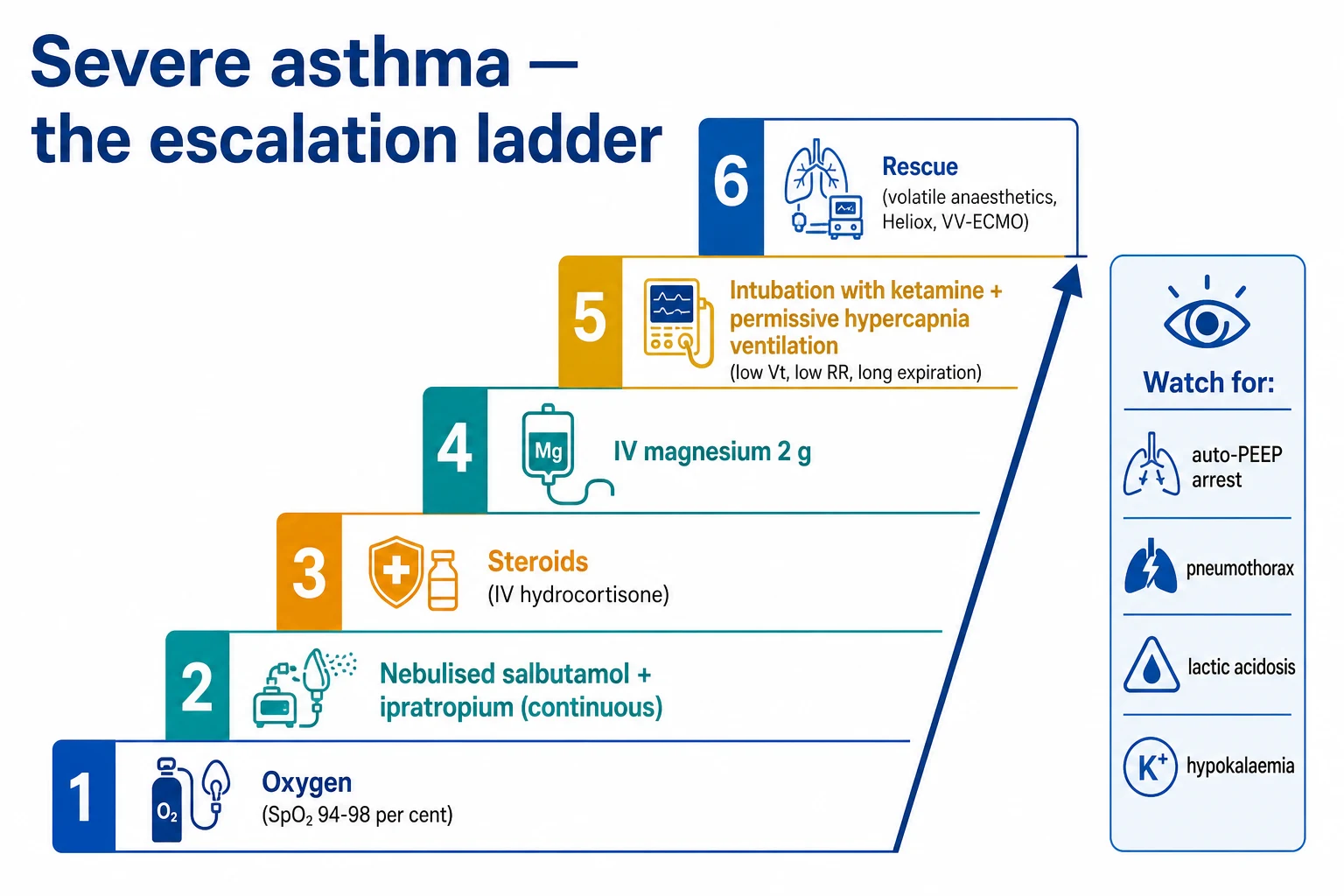
Severe or near-fatal asthma (status asthmaticus) is graded by the British Thoracic Society as acute severe, life-threatening, or near-fatal. The escalation ladder is oxygen (SpO2 94-98 per cent), repeated or continuous nebulised salbutamol 5 mg with ipratropium 0.5 mg, systemic corticosteroids (prednisolone 40-50 mg or IV hydrocortisone 100 mg), intravenous magnesium sulphate 2 g over 20 minutes, and second-line aminophylline or IV salbutamol. If the patient tires or the PaCO2 rises, intubate with ketamine and ventilate for permissive hypercapnia (low tidal volume, low rate, long expiration, plateau under 30). Refractory bronchospasm is treated with inhalational volatile anaesthetics (sevoflurane), Heliox, or VV-ECMO. Watch for the auto-PEEP arrest, tension pneumothorax, lactic acidosis, and hypokalaemia.
On this page & tools
Your progress
Saved locally on this device.
Target exams
Red flags
Definition and classification
Status asthmaticus (also called near-fatal asthma or critical asthma syndrome) is acute severe asthma that does not respond to standard bronchodilator therapy and progresses toward life-threatening respiratory failure. The ICU manages the refractory cases — those needing escalation to intravenous bronchodilators, intubation and ventilation, or rescue therapy (volatile anaesthetics, Heliox, VV-ECMO).[7][6]
The British Thoracic Society / SIGN severity grading drives the escalation — every asthmatic in the resus bay must be formally graded:[5][8]
BTS severity grading (click each)
Near-fatal asthma
A RISING PaCO2 with altered consciousness, or requiring mechanical ventilation. Imminent respiratory arrest. Intubate with ketamine immediately; do not wait for the arrest.
Pathophysiology
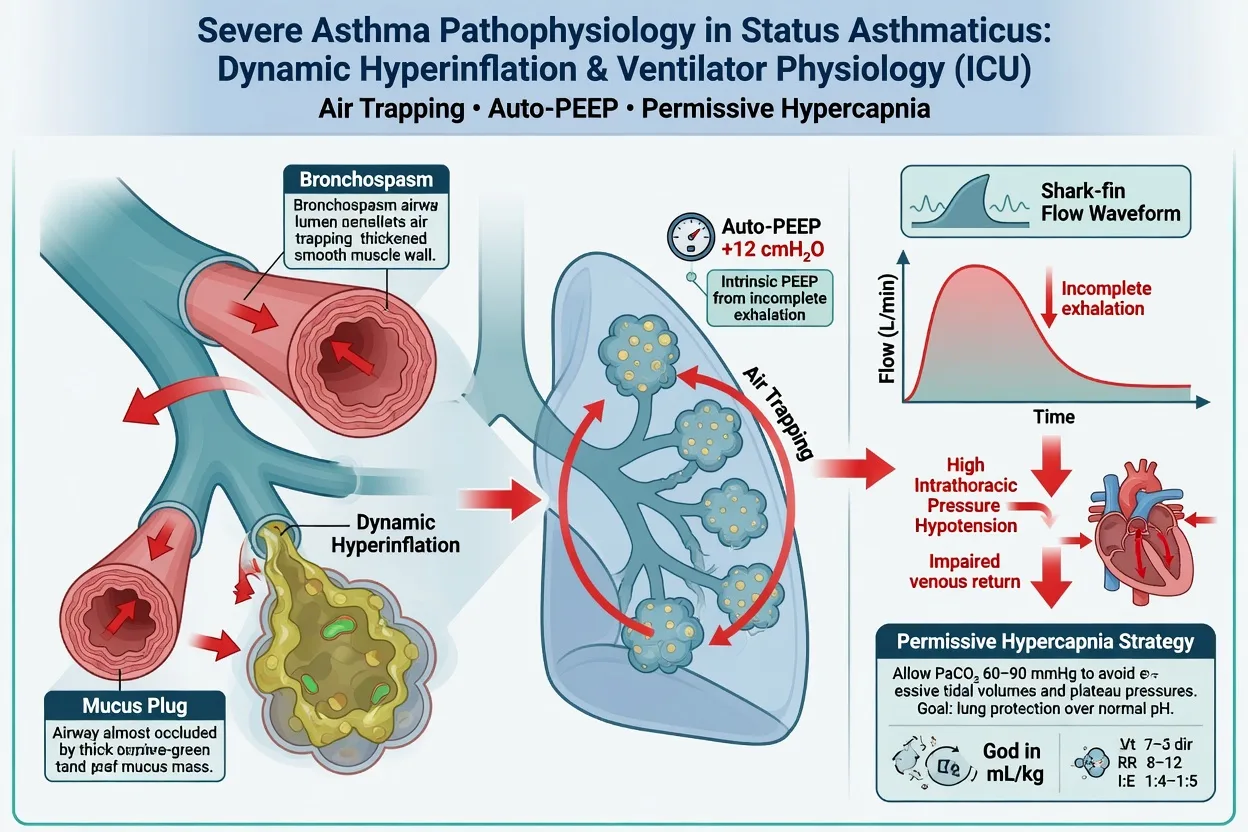
Status asthmaticus is the extreme of the asthmatic triad — bronchospasm, airway inflammation with mucosal oedema, and mucus plugging — producing critical airflow obstruction that is expiratory-predominant and heterogeneous. Three consequences drive the physiology:[6][1]
- Airflow obstruction → hyperinflation. Expiration is prolonged and incomplete. Each breath stacks gas onto the lung (dynamic hyperinflation), so end-expiratory lung volume rises above functional residual capacity. This generates intrinsic (auto-) PEEP.
- Dynamic hyperinflation → haemodynamic compromise. The hyperinflated lung compresses the intra-thoracic vessels; intrathoracic pressure rises, venous return falls, and right ventricular afterload increases (acute cor pulmonale). With positive-pressure ventilation this is amplified — the auto-PEEP arrest.
- Heterogeneous obstruction → V/Q mismatch and the silent chest. Some lung units are completely occluded (mucus plugs), others are perfused but underventilated — hypoxaemia. As obstruction becomes near-total, wheeze disappears (no airflow to generate sound) — the silent chest is a sign of pre-arrest, not improvement. [1]
Clinical presentation and initial assessment
A targeted 60-second assessment drives the grade and the escalation:[5][2]
- Ability to speak — phrases, sentences, or unable to speak (a surrogate for severity).
- Vital signs — SpO2 on room air, RR, HR, BP (hypotension or an arrhythmia is life-threatening), temperature (infection trigger).
- Examination — use of accessory muscles, silent chest (no breath sounds = pre-arrest), cyanosis, altered consciousness, the pulsus paradoxus (an exaggerated fall in systolic BP on inspiration, reflecting the high negative intrathoracic pressure).
- PEF — if the patient can perform it; compare to best or predicted. Under 33 per cent = life-threatening.
- ABG — mandatory if severe or life-threatening. Look at the PaCO2 (a normal or rising value is ominous), the PaO2, and the pH.
- Chest X-ray — to exclude a pneumothorax, pneumomediastinum, or pneumonia; not to diagnose asthma.
- ECG — arrhythmia (from hypoxia, beta-agonists, hypokalaemia); right heart strain.
- Potassium, lactate, glucose — hypokalaemia and lactic acidosis from beta-agonists. [1]
Management — the escalation ladder
The severe asthma escalation ladder
1. Oxygen — target SpO2 94-98 per cent
High-flow oxygen via a mask (15 L/min non-rebreather or high-flow nasal cannula). Unlike COPD, asthmatics are not chronic CO2 retainers — do not restrict oxygen. Hypoxaemia kills before hypercapnia.
2. Nebulised salbutamol 5 mg + ipratropium 0.5 mg
Driven by oxygen. Salbutamol 5 mg (NOT the 2.5 mg reliever dose) repeated every 15-20 minutes or given as a continuous neb (e.g. 10-20 mg/h). Add ipratropium 0.5 mg every 4-6 hours — a different mechanism (antimuscarinic) that is additive in severe attacks. Continue through the ventilator circuit via an in-line nebuliser.
3. Systemic corticosteroids — early
Prednisolone 40-50 mg orally (or hydrocortisone 100 mg IV if unable to swallow or very severe). Give within the first hour — they take 4-6 hours to work. Continue for 5 days (no need to taper for short courses). They reduce airway inflammation, mucus, recurrence, and mortality.
4. IV magnesium sulphate 2 g over 20 minutes
For acute severe asthma not responding to steps 1-3. A smooth-muscle relaxant (inhibits calcium influx). Single dose 2 g IV over 20 min. Monitor for hypotension, flushing, and areflexia. The 3Mg trial (Lancet Respir Med 2013) did not change overall practice, but magnesium is still recommended for the severe case.
5. Second-line IV bronchodilators
IV salbutamol (250 mcg slow loading bolus, then an infusion 3-20 mcg/min) OR IV aminophylline (5 mg/kg loading over 20 min, then 0.5 mg/kg/h infusion — monitor levels). Both are controversial and carry arrhythmia risk. Use ONE, not both, and only if standard therapy is failing.
6. Intubation with ketamine + permissive-hypercapnia ventilation
For exhaustion, a falling GCS, a rising PaCO2, a respiratory arrest, or failure to respond. Induce with KETAMINE (a bronchodilator), pre-oxygenase, use a large ETT (8.0+) to lower resistance, and ventilate for permissive hypercapnia. Have a vasopressor ready — intubation of the hyperinflated asthmatic often causes hypotension.
7. Rescue therapy for refractory bronchospasm
Inhalational volatile anaesthetics (sevoflurane or isoflurane via an anaesthetic ventilator), Heliox (helium-oxygen mix to reduce work of breathing), or VV-ECMO for refractory hypercapnia or hypoxaemia. These are salvage therapies for the patient who cannot be ventilated or oxygenated by conventional means.
Bronchodilator drug options
Nebulised salbutamol
First-line beta-2 agonist
- Dose: 5 mg neb (driven by O2), repeated q15-20 min or continuous 10-20 mg/h
- Onset within minutes; peak at 30 min; the workhorse of acute asthma
- Side-effects: tachycardia, tremor, **lactic acidosis** (beta-2-driven glycolysis), **hypokalaemia** (beta-2 drives K+ into cells)
- In-line nebs through the ventilator circuit for the intubated patient
Ipratropium bromide
Antimuscarinic — additive
- Dose: 0.5 mg neb q4-6h, mixed WITH salbutamol (different receptor)
- Additive bronchodilation in the severe attack (greater than salbutamol alone)
- Less tachycardia than salbutamol; the mainstay alongside salbutamol
- Duoneb = salbutamol 2.5 mg + ipratropium 0.5 mg; the severe asthmatic needs the full 5 mg salbutamol dose
IV salbutamol
Second-line
- For severe or refractory cases unresponsive to nebs
- Load: 250 mcg slow IV bolus (over 1-2 min); infusion 3-20 mcg/min titrated
- SAME side-effects as neb but worse: tachyarrhythmia, lactic acidosis, hypokalaemia
- Controversial — some guidelines do NOT recommend routine use; cardiac monitoring essential
Aminophylline
Second-line methylxanthine
- Load: 5 mg/kg IV over 20 min, then 0.5 mg/kg/h infusion
- Narrow therapeutic window — check serum levels; toxicity = arrhythmia, seizures
- Cochrane: no clear benefit over standard therapy; use only if failing
- Drug interactions: ciprofloxacin, erythromycin, cimetidine raise levels; phenytoin and smoking lower them
IV magnesium sulphate
Smooth-muscle relaxant
- Dose: 2 g IV over 20 minutes (single dose; may repeat once after careful review)
- Inhibits calcium influx into bronchial smooth muscle; also anti-inflammatory
- Side-effects: flushing, hypotension, areflexia; rare respiratory depression
- 3Mg trial (Lancet Respir Med 2013): no overall benefit in the broad cohort — but selectively useful in the most severe
Corticosteroids
Treat the inflammation + mucus
- Prednisolone 40-50 mg PO OR hydrocortisone 100 mg IV (if cannot take PO or very severe)
- Give within 1 hour; onset 4-6 hours; continue 5 days (no taper for short course)
- Reduces recurrence, inflammation, mucus, and mortality
- IV hydrocortisone 100 mg q6h is standard in the intubated patient
Ketamine
Induction agent + bronchodilator
- Induction dose 1-2 mg/kg IV (use lower end if hypotensive)
- The ONLY induction agent that bronchodilates — increases catecholamine release
- Sympathomimetic: supports BP (unlike propofol/thiopentone which cause hypotension and can worsen bronchospasm)
- Can be continued as an infusion (0.1-1 mg/kg/h) for sedation with ongoing bronchodilation
Investigations
The investigation bundle in severe asthma is narrow and targeted — do not delay treatment for tests:[5][6]
- ABG — the single most important investigation. Assess the PaCO2 (low = expected; normal or rising = life-threatening), the PaO2 (response to oxygen), and the pH.
- Chest X-ray — to exclude a pneumothorax, pneumomediastinum, pneumonia, or lobar collapse (mucus plugging). Not diagnostic of asthma.
- ECG — arrhythmia (hypoxia, beta-agonists, hypokalaemia); right-heart strain pattern (S1Q3T3, right axis) in severe hyperinflation.
- Bloods — FBC (infection, eosinophilia), electrolytes (hypokalaemia from beta-agonists), lactate (beta-2 effect, not necessarily shock), glucose (steroids), CRP (infection trigger).
- Theophylline level — if the patient takes oral theophylline (avoid loading aminophylline in these patients — toxicity risk).
- Point-of-care lung ultrasound — to identify a pneumothorax (absent lung sliding, lung point) and assess for consolidation; can detect pneumomediastinum indirectly. [1]
Mechanical ventilation in asthma
Intubation is the most dangerous moment in severe asthma. The goals of mechanical ventilation are to deliver enough gas exchange to keep the patient alive while minimising dynamic hyperinflation — the proximate cause of the auto-PEEP arrest.[1][2]
Indications for intubation
The decision is clinical, driven by deterioration rather than a single number:[2][5]
- A respiratory or cardiac arrest (the absolute indication).
- A reduced or falling conscious level (CO2 narcosis or exhaustion).
- Exhaustion — falling respiratory rate, shallow breathing, poor effort despite maximal medical therapy.
- A rising PaCO2 that is refractory to bronchodilators (the patient is tiring).
- Refractory hypoxaemia despite high-flow oxygen.
- Haemodynamic instability from the workload of breathing. [1]
The RSI — induction with ketamine
Rapid sequence intubation in the severe asthmatic
1. Pre-oxygenase with 100 per cent oxygen
Use a well-fitting mask + nasal cannula; the asthmatic has reduced functional residual capacity and desaturates fast. Apply apnoeic oxygenation with HFNC at 15 L/min.
2. Induction: ketamine 1-2 mg/kg IV
Ketamine is the bronchodilator induction agent — it increases catecholamine release and directly relaxes bronchial smooth muscle. Use the LOWER end (1 mg/kg) if hypotensive. Avoid propofol and thiopentone — they cause hypotension and can worsen bronchospasm.
3. Paralysis: rocuronium 1.2 mg/kg or suxamethonium 1.5 mg/kg
Rocuronium preferred (no histamine release; vecuronium and atracurium can release histamine and worsen bronchospasm). Suxamethonium if a difficult airway is anticipated or the potassium is normal.
4. Use a LARGE ETT (8.0 mm or larger)
A larger ETT lowers resistance and allows passage of a bronchoscope for mucus clearance and for an in-line nebuliser. Use a video laryngoscope for the best first-pass success.
5. Have a vasopressor drawn up
Intubation and positive-pressure ventilation in the hyperinflated asthmatic frequently cause hypotension (loss of venous return to auto-PEEP, vasodilation from induction). Have metaraminol or noradrenaline ready; give a bolus at the first sign of a falling BP.
6. If the BP collapses on connecting to the ventilator — DISCONNECT
This is the auto-PEEP arrest. Disconnect the circuit, let the lung deflate fully (you will hear a long exhale), then reconnect at a lower rate and tidal volume. The differential is a tension pneumothorax — ultrasound will distinguish them.
The ventilator settings — permissive hypercapnia
The strategy is low and slow: a low tidal volume, a low respiratory rate, and a long expiratory time, accepting a high PaCO2 to protect the lung and the circulation.[1][2]
Ventilator settings for severe asthma (permissive hypercapnia)
Mode: volume-controlled (or pressure-regulated)
Volume control gives a guaranteed tidal volume and a predictable I:E; pressure control can be used if plateau pressure is the limiting factor. Either is acceptable — the GOALS matter, not the mode.
Tidal volume: 6-8 mL/kg predicted body weight
Low Vt reduces hyperinflation and plateau pressure. Use PBW (height-based), NOT actual weight. Reduce further if plateau pressure exceeds target.
Respiratory rate: 10-12 breaths/min
A LOW rate gives a long expiratory time. The single most effective lever against auto-PEEP is a slower rate. Do not be afraid of an RR of 8.
I:E ratio: 1:3 to 1:4 (long expiration)
Use a HIGH inspiratory flow (60-100 L/min) to shorten inspiration and lengthen expiration. Inspiratory time 0.8-1.0 s; expiratory time 4-6 s.
External PEEP: minimal (0-5 cmH2O)
Set external PEEP at about 75-80 per cent of the measured auto-PEEP, or just low (3-5 cmH2O). High external PEEP stacks onto auto-PEEP and worsens hyperinflation. Watch the expiratory flow waveform — if it does not return to baseline, gas is still trapped.
Plateau pressure target: under 30 cmH2O
Measure with a 0.5-s inspiratory hold. If plateau exceeds 30, reduce the Vt or the rate first. A plateau over 30 predicts the auto-PEEP arrest.
Permissive hypercapnia: accept PaCO2 60-80 mmHg if pH at least 7.15
Tolerate the high CO2 — it is the price of protecting the lung and circulation. Do NOT increase the rate to normalise the CO2 (this worsens hyperinflation). Bicarbonate can be given if pH falls below 7.15-7.20. CONTRAINDICATED in raised intracranial pressure.
Sedation, analgesia, and paralysis
Deep sedation is essential in the ventilated asthmatic — patient-ventilator asynchrony and coughing worsen bronchospasm and air-trapping.[1][11]
- Ketamine infusion (0.1-1 mg/kg/h) — provides both sedation and ongoing bronchodilation; the agent of choice.
- Fentanyl or morphine for analgesia; avoid pethidine (histamine release).
- Midazolam can be added for amnesia.
- Avoid propofol as a maintenance infusion in severe asthma — it can cause bronchospasm and profound hypotension in the hyperinflated patient.
- Neuromuscular blockade — if asynchrony persists despite deep sedation. Use rocuronium or vecuronium (avoid atracurium/mivacurium — histamine release). Use for the shortest possible time and review daily. Combining NMBAs with corticosteroids causes critical-illness myopathy — a devastating complication. [1]
Rescue therapy for refractory bronchospasm
When the patient cannot be ventilated or oxygenated despite the above, escalate to the rescue ladder:[10][12]
Inhalational volatile anaesthetics
Sevoflurane or isoflurane
- Potent bronchodilators (direct smooth-muscle relaxation + reduction of airway reactivity)
- Delivered via an anaesthetic ventilator (or an AnaConDa / Mirus device on a standard ICU ventilator)
- A 2024 systematic review confirms efficacy in refractory status asthmaticus in adults
- Watch for: hypotension (vasodilation), arrhythmia, nephrotoxicity (compound A with desiccated soda lime), carbon monoxide from dry absorbents
Heliox
Helium-oxygen mixture
- A lower-density gas (helium 70-80 per cent with oxygen 20-30 per cent) — reduces turbulent flow and the work of breathing through narrowed airways
- Most useful in the NON-intubated tiring patient to buy time; limited role once intubated (the ETT dominates resistance)
- Reduces PaCO2 and dyspnoea in some studies; no clear mortality benefit
- Requires a high FiHe — limits usefulness if the patient needs more than 30-40 per cent oxygen
VV-ECMO
Lung rest for refractory cases
- Rescue for refractory hypercapnia, acidosis, or hypoxaemia despite maximal conventional ventilation
- Allows the ventilator to be turned down to "lung rest" settings while the bronchospasm resolves over hours to days
- Near-fatal asthma has an EXCELLENT prognosis on ECMO (survival over 80-90 per cent in case series) — refer EARLY
- Requires a high-volume ECMO centre; the practical delay is cannulation and transfer, not the indication
Complications
Complications of severe asthma and its ventilation
The complications fall into three groups:[1][6]
1. Mechanical (from the disease and the ventilation)
- The auto-PEEP arrest — the most feared peri-intubation complication. Aggressive ventilation of a hyperinflated, obstructed lung raises intrathoracic pressure, drops venous return, and produces hypotension progressing to pulseless electrical activity (PEA). Management: disconnect the circuit, let the lung deflate, then reduce the rate and tidal volume.
- Tension pneumothorax (barotrauma) — the other sudden cause of deterioration in the ventilated asthmatic. Unilateral examination, tracheal deviation, hypoxaemia, hypotension. Ultrasound (absent lung sliding) and immediate needle/finger decompression, then an intercostal drain.
- Pneumomediastinum and subcutaneous emphysema — alveolar rupture tracks air along the bronchovascular bundles into the mediastinum (Macklin effect) and the soft tissues. Usually self-limiting; manage conservatively unless tamponade (rare).
- Hypotension at intubation — from the combination of induction agents, the loss of sympathetic tone, and the sudden positive intrathoracic pressure on a hyperinflated lung. Anticipate it; have vasopressors ready. [1]
2. Metabolic and drug-related
- Lactic acidosis — from high-dose beta-2 agonists (salbutamol drives aerobic glycolysis in skeletal muscle). Usually resolves as the bronchospasm resolves; do NOT confuse it with a shock lactic acidosis. Stop or reduce the salbutamol if the lactate is very high or the pH is falling.
- Hypokalaemia — beta-2 agonists drive potassium into cells. Monitor every 2-4 hours and replace (asthma can drop the K by 0.5-1.0 mmol/L).
- Tachyarrhythmia — from hypoxia, beta-agonists, theophylline, and electrolyte disturbance. Treat the cause; rate-control with a beta-blocker is relatively contraindicated in bronchospasm.
- Theophylline toxicity — if aminophylline is used. Nausea, vomiting, tremor, then seizures and arrhythmia. Check levels; stop the infusion. [1]
3. Neuromuscular
- Critical-illness myopathy and polyneuropathy — the devastating combination of corticosteroids + neuromuscular blockade in the ventilated asthmatic. Presents as prolonged weakness, failure to wean. Prevention: use NMBAs for the shortest possible time, prefer steroid-sparing sedation (ketamine), and review daily.
- Acute cor pulmonale — right-heart strain from the hyperinflated lung (raised pulmonary vascular resistance). Echocardiography shows a dilated, hypokinetic RV with septal bowing. Improves as hyperinflation is relieved. [1]
Evidence and landmark trials
3Mg trial
Lancet Respir Med 2013
1109 adults with acute severe asthma — IV Mg 2g OR nebulised Mg (3 x 500mg) vs placebo, in addition to standard therapy
Key finding
No significant effect on the primary outcome (breathlessness QoL at 2.5 days) or hospital admission. Subgroup with the most severe asthma may benefit.
Practice change
IV magnesium remains recommended (BTS) for acute severe asthma not responding to standard therapy, but the broad trial did not support routine use in all
Cochrane IV Mg (adults)
Cochrane Database Syst Rev 2014
Systematic review of IV magnesium sulfate vs placebo in adults with acute asthma in the ED
Key finding
IV Mg reduced hospital admission (OR ~0.5) in the severe subgroup (FEV1 under 25% predicted); no improvement in lung function in the broader cohort.
Practice change
IV Mg 2g is a reasonable second-line agent in the most severe attacks not responding to standard therapy
Sevoflurane systematic review
Critical Care 2024
Systematic review of sevoflurane in adults with status asthmaticus refractory to conventional therapy
Key finding
Case series and reports consistently show rapid reductions in airway pressures, PaCO2, and dynamic hyperinflation; no RCTs exist.
Practice change
Sevoflurane is a recognised rescue therapy for refractory status asthmaticus in adults when conventional ventilation fails
ECMO in near-fatal asthma
Respir Med 2023
Comprehensive review of VV-ECMO and related techniques for near-fatal asthma
Key finding
Case series and registries report survival to discharge of over 80-90% in asthmatics cannulated for refractory status asthmaticus.
Practice change
Early ECMO referral is appropriate for refractory near-fatal asthma — the disease is reversible and the outcomes are excellent
Ketamine narrative review
Br J Anaesth 2025
Narrative review of the diverse pharmacology of ketamine, including bronchodilation
Key finding
Ketamine is the preferred induction agent in status asthmaticus — bronchodilation via catecholamine release and direct smooth-muscle effects; also valuable as a sedative infusion.
Practice change
Ketamine (not propofol) should be the default induction agent in the severe asthmatic needing intubation
Critical asthma syndromes
Clin Rev Allergy Immunol 2015
Expert review defining critical asthma syndromes and the near-fatal asthma phenotype
Key finding
Standardised the language of acute, life-threatening, and near-fatal asthma and the risk factors for recurrence and death.
Practice change
Provided the framework for severity grading now embedded in BTS/SIGN and international guidelines
Prognosis
Outcomes in severe and near-fatal asthma
Prognostic points for the exam:[6][12]
- Most deaths are preventable — the cause is usually a delay in escalation (not recognising the life-threatening grade, or lingering on a failing therapy).
- Risk factors for near-fatal asthma (the high-risk phenotype): a previous near-fatal attack (the strongest predictor), prior ICU admission or intubation, heavy beta-agonist use (over one canister per month), poor perception of dyspnoea, non-adherence with inhaled corticosteroids, comorbid anxiety/depression, food allergy, and current smoking.
- Mortality rises sharply after a pre-hospital cardiac arrest — the worst outcomes are in patients who arrest before reaching ICU.
- VV-ECMO outcomes are excellent — survival over 80 per cent — because the disease is reversible.
- Long-term — review the phenotype, optimise maintenance therapy (ICS + LABA ± biologic for severe eosinophilic or allergic asthma), and address adherence and triggers. [1]
Exam practice
SAQ — Near-fatal asthma in the ICU
10 minutes · 10 marks
A 28-year-old woman with a history of severe asthma (two prior ICU admissions, one near-fatal) presents to the ED with 6 hours of worsening wheeze and breathlessness unresponsive to her salbutamol inhaler. On arrival: RR 32, SpO2 90 per cent on room air, HR 132, BP 104/64, cannot complete sentences, loud bilateral wheeze. She has received 15 L/min oxygen, back-to-back nebulised salbutamol 5 mg + ipratropium 0.5 mg, and oral prednisolone 50 mg. The ABG (on oxygen) shows pH 7.28, PaCO2 48 mmHg, PaO2 68 mmHg, HCO3 22, lactate 4.2 mmol/L, K+ 3.1 mmol/L.
Clinical pearls
Red flags
References
- [1]Laher AE, Buchanan SK. Mechanically Ventilating the Severe Asthmatic J Intensive Care Med, 2018.PMID 29105540
- [2]Brenner B, Corbridge T, Kazzi A. Intubation and mechanical ventilation of the asthmatic patient in respiratory failure J Emerg Med, 2009.PMID 19683662
- [3]Goodacre S, Cohen J, Bradburn M, Gray A, Benger J, Coats T, et al. Intravenous or nebulised magnesium sulphate versus standard therapy for severe acute asthma (3Mg trial): a double-blind, randomised controlled trial Lancet Respir Med, 2013.PMID 24429154
- [4]Kew KM, Kirtchuk L, Michell CI. Intravenous magnesium sulfate for treating adults with acute asthma in the emergency department Cochrane Database Syst Rev, 2014.PMID 24865567
- [5]Long B, Lentz S, Koyfman A, Gottlieb M. Evaluation and management of the critically ill adult asthmatic in the emergency department setting Am J Emerg Med, 2021.PMID 32222313
- [6]Kostakou E, Kaniaris E, Filiou E, Vasileiadis I, Katsaounou P, Tzortzaki E, et al. Acute Severe Asthma in Adolescent and Adult Patients: Current Perspectives on Assessment and Management J Clin Med, 2019.PMID 31443563
- [7]Kenyon N, Zeki AA, Albertson TE, Louie S. Definition of critical asthma syndromes Clin Rev Allergy Immunol, 2015.PMID 24213844
- [8]Garner O, Ramey JS, Hanania NA. Management of Life-Threatening Asthma: Severe Asthma Series Chest, 2022.PMID 35218742
- [9]Sellers WF. Inhaled and intravenous treatment in acute severe and life-threatening asthma Br J Anaesth, 2013.PMID 23234642
- [10]Ho GWK, Thaarun T, Ee NJ, Boon TC, Ning KZ, Cove ME, et al. A systematic review on the use of sevoflurane in the management of status asthmaticus in adults Crit Care, 2024.PMID 39402635
- [11]Richards ND, Howell SJ, Bellamy MC, Beck J. The diverse effects of ketamine, jack-of-all-trades: a narrative review Br J Anaesth, 2025.PMID 39753406
- [12]Lozano-Espinosa M, Antolín-Amérigo D, Riera J, Gordo Vidal F, Quirce S, Álvarez Rodríguez J. Extracorporeal membrane oxygenation (ECMO) and beyond in near fatal asthma: A comprehensive review Respir Med, 2023.PMID 37245648