ICU · Antimicrobial therapy
Antimicrobial Therapy and Stewardship in the ICU
Also known as Antibiotic stewardship · Antimicrobial therapy · PK PD dosing · De-escalation · Antibiogram · Therapeutic drug monitoring · Antibiotic resistance
Antimicrobial stewardship is the systematic, the evidence-based, the measured use of the antibiotics to maximise the patient outcome, minimise the resistance, and reduce the toxicity. This topic builds the examiner's framework on the PK/PD dosing principles (the beta-lactam prolonged infusion, the aminoglycoside once-daily, the vancomycin AUC), the empirical therapy guided by the local antibiogram, the de-escalation when the culture returns, the duration of therapy (the shortest effective course), the beta-lactam allergy, the therapeutic drug monitoring, and the resistance mechanisms (the ESBL, the CRE, the MRSA, the VRE).
On this page & tools
Your progress
Saved locally on this device.
Target exams
Overview & definition
Antimicrobial stewardship is the systematic, the evidence-based, the measured use of the antibiotics to maximise the patient outcome, minimise the resistance, and reduce the toxicity. The over-use (the wrong drug, the wrong dose, the wrong duration) drives the resistance; the under-use (the delayed, the inadequate) worsens the infection. The stewardship is the balance.[1][1]
The PK/PD dosing principles
The antibiotic dosing in the ICU is governed by the pharmacokinetics (the absorption, the distribution, the metabolism, the excretion) and the pharmacodynamics (the relationship between the drug concentration and the bacterial killing).[1]
- The concentration-dependent killing (the aminoglycoside, the fluoroquinolone, the daptomycin) — the higher the peak concentration, the greater the killing. The once-daily dosing (the high peak, the low trough — the reduced toxicity) is the principle. The aminoglycoside: the 7 mg/kg gentamicin once daily, the trough monitored.[1]
- The time-dependent killing (the beta-lactam — the penicillin, the cephalosporin, the carbapenem) — the longer the concentration is above the MIC, the greater the killing. The prolonged or the continuous infusion (the beta-lactam infused over 4 hours or the 24-hour continuous, to maintain the time above the MIC) is the principle. The piperacillin-tazobactam: the 4 g loading then the 16 g/24h continuous infusion.[1][1]
- The AUC/MIC (the vancomycin) — the total exposure (the area under the curve) relative to the MIC. The vancomycin: the AUC/MIC of 400 to 600 (the Bayesian dosing or the trough of 15 to 20 as the surrogate).[1]
The empirical therapy and the antibiogram
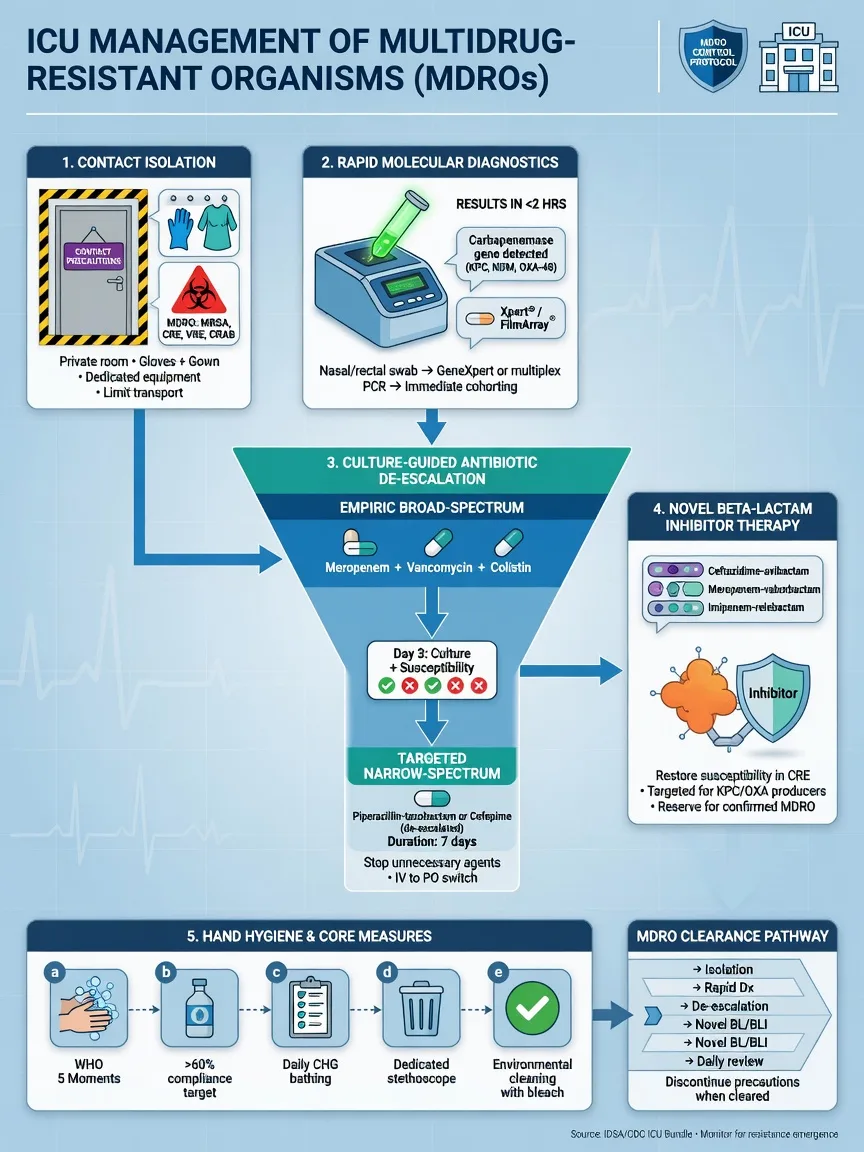
The empirical antibiotic is started BEFORE the culture returns, guided by:[1]
- The suspected source (the pneumonia — the community or the hospital; the intra-abdominal; the line; the urine; the CNS).
- The local antibiogram — the ICU-specific susceptibility pattern that guides the empirical choice.
- The patient's risk factors — the prior MDR colonisation, the recent antibiotics, the immunocompromise, the healthcare exposure.
- The severity — the septic shock demands the broad cover (the anti-pseudomonal + the MRSA); the less severe may narrow. [1]
The principle: the early, the appropriate, the adequate dose — then the de-escalation.[1][1]
The de-escalation
The de-escalation is the narrowing of the antibiotic once the culture and the sensitivities return (48 to 72 hours). The broad-spectrum empirical cover is NARROWED to the targeted, the narrowest, the most effective agent based on the culture. The de-escalation reduces the resistance, the C. difficile, and the toxicity, without worsening the outcome. The stop — the discontinuation when the infection is EXCLUDED (the alternative diagnosis found, the cultures negative, the inflammatory markers resolved) — is the other key stewardship step.[1]
The duration of therapy
The principle is the shortest effective course. The evidence has shortened many durations:[1]
- The VAP: 7 to 8 days (most).
- The intra-abdominal: 4 to 5 days after the source control.
- The pyelonephritis: 7 days (the fluoroquinolone) or 10 to 14 days (the beta-lactam).
- The cellulitis: 5 to 6 days.
- The S. aureus bacteraemia: 14 days minimum (the uncomplicated, the echo-negative, the removable focus); 6 weeks for the endocarditis or the metastatic.[1]
The beta-lactam allergy
The reported penicillin allergy is common (10 per cent of the patients) but the true allergy is rare (under 5 per cent of the reported, the skin-test confirmed). The cross-reactivity between the penicillin and the cephalosporin is under 1 per cent for the modern cephalosporins (the dissimilar side chains). The principle: assess the allergy (the history — the timing, the reaction, the severity), use the cephalosporin with the dissimilar side chain if the non-severe history, and refer for the testing if the uncertain. The unnecessary avoidance of the beta-lactam (the use of the vancomycin or the fluoroquinolone instead) worsens the outcome and the resistance.[1][1]
The therapeutic drug monitoring (TDM)
The TDM is the measurement of the drug level to guide the dosing, used for the antibiotics with the narrow therapeutic window (the vancomycin — the AUC or the trough; the aminoglycoside — the peak and the trough; the beta-lactam — the increasingly recommended for the critically ill with the altered PK). The ICU patient has the augmented renal clearance (the young, the septic, the high cardiac output — the subtherapeutic levels) or the renal impairment (the toxic accumulation) — both demand the TDM.[1]
The resistance mechanisms
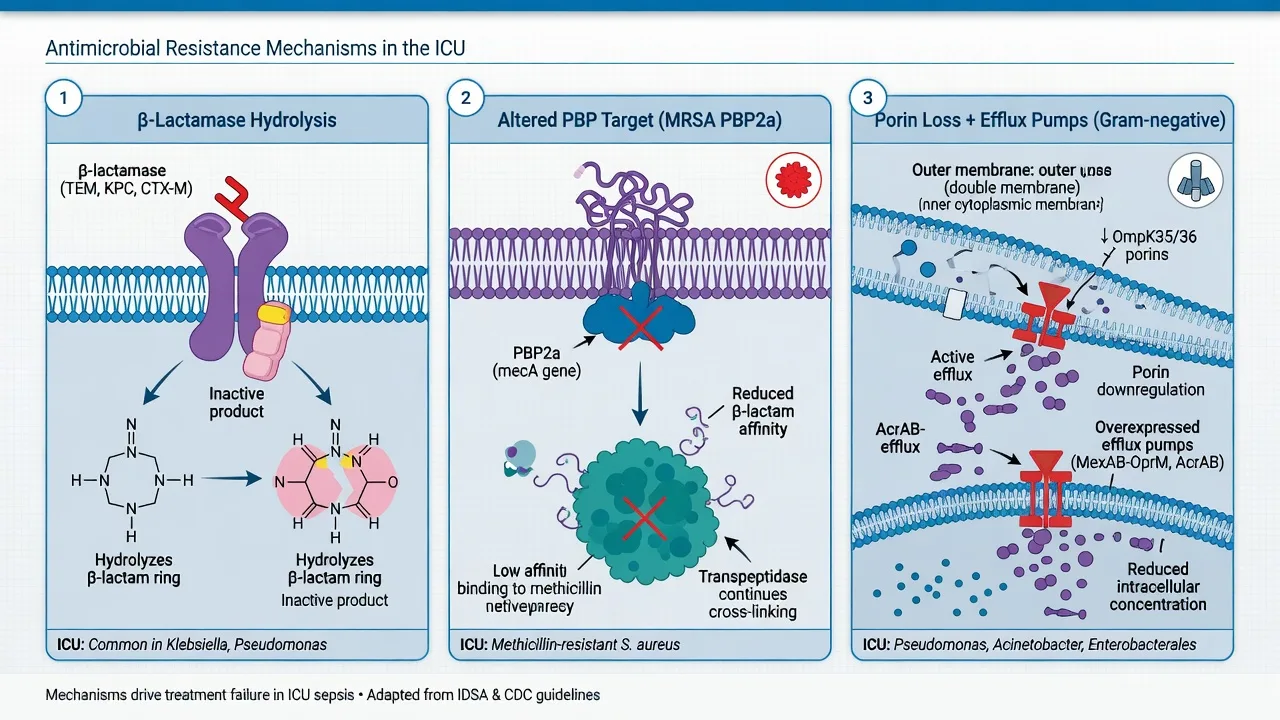
The key resistance mechanisms in the ICU:[1]
- The ESBL (the extended-spectrum beta-lactamase) — the Enterobacteriaceae (the E. coli, the Klebsiella) resistant to the penicillins and the cephalosporins. Treated with the carbapenem.
- The CRE (the carbapenem-resistant Enterobacteriaceae) — the Klebsiella, the Enterobacter resistant to the carbapenems. Treated with the colistin or the ceftazidime-avibactam.
- The MRSA — the Staphylococcus aureus resistant to the methicillin. Treated with the vancomycin or the linezolid.
- The VRE (the vancomycin-resistant Enterococcus) — treated with the linezolid or the daptomycin.
- The MDR Pseudomonas/Acinetobacter — the non-fermenters with the multiple resistances; treated with the colistin, the combination therapy.[1][1]
Management: the integrated stewardship approach
- The empirical — guided by the source, the antibiogram, the risk, the severity; the adequate dose (the PK/PD).[1]
- The de-escalation — at 48 to 72 hours, narrow to the culture.[1]
- The duration — the shortest effective course.[1]
- The TDM — for the vancomycin, the aminoglycoside, and increasingly the beta-lactam.[1]
- The stop — when the infection is excluded.[1]
Monitoring
- The cultures — the pre-antibiotic, the follow-up.
- The TDM levels — the vancomycin trough or AUC, the aminoglycoside.
- The renal function — for the nephrotoxic agents (the aminoglycoside, the vancomycin, the colistin).
- The antibiogram — the annual ICU-specific report.[1]
Prognosis
The appropriate antibiotic (the right drug, the right dose, the right duration) improves the survival of the sepsis and the ICU-acquired infection. The inappropriate (the delayed, the inadequate, the excessive) worsens the outcome and drives the resistance. The stewardship is the patient-level AND the population-level intervention.[1][1]
Red flags
The "Start Smart Then Focus" framework
The Start Smart Then Focus framework is the operational backbone of the UK (the Public Health England, now the UKHSA) and the Australian (the ACSQHC) antimicrobial stewardship programs. It translates the abstract principle — the right drug, the right dose, the right duration — into the two-step bedside behaviour. The "Start Smart" is the front-loaded, the appropriate, the adequate-dose empirical therapy within the ONE HOUR of the suspected severe infection (the sepsis, the septic shock). The "Then Focus" is the systematic review at the 48 to the 72 hours — the narrowing to the culture (the de-escalation), the switch to the oral (the IV-to-PO), the consideration of the stop (the infection excluded), and the DEFINED duration.[1][7]
Start Smart Then Focus — the bedside sequence
- START SMART (within the 1 hour) — the empirical cover. The blood cultures (the two sets) BEFORE the antibiotic if possible (but never delay the antibiotic for the cultures in the septic shock). The empirical choice guided by the source (the pneumonia, the intra-abdominal, the line, the urine, the CNS, the skin), the local antibiogram, the patient's risk factors (the prior MDR colonisation, the recent antibiotic, the immunocompromise, the healthcare exposure), and the severity (the septic shock demands the broad — the anti-pseudomonal + the MRSA cover). The LOADING DOSE (the doubled first dose) for the time-dependent beta-lactam (the piperacillin-tazobactam 4 g, the meropenem 2 g) — the large volume of distribution and the augmented renal clearance of the septic patient demand the front-loaded dose.[9]
- REVIEW AT THE 48 TO 72 HOURS — the "Focus". The culture and the sensitivity are reviewed. The clinical response (the fever, the white cell count, the inflammatory markers — the CRP, the procalcitonin, the SOFA score) is assessed. The four questions: the (a) is the infection CONFIRMED (the culture positive) or EXCLUDED (the alternative diagnosis, the negative cultures, the resolving inflammation)? the (b) is the antibiotic the right one (the narrow to the culture)? the (c) what is the duration and the stop-day? the (d) can the patient switch to the oral (the IV-to-PO)?[16]
- THE DE-ESCALATION — the narrow to the culture. The broad-spectrum empirical cover (the meropenem + the vancomycin) is NARROWED to the narrowest effective agent (the amoxicillin, the cefuroxime, the ceftriaxone) based on the culture and the sensitivity. The de-escalation is the safe (no increase in the mortality — the individual-patient-data meta-analysis of the Gutiérrez-Pizarraya 2017) and the effective (the reduced resistance, the C. difficile, the cost).[16]
- THE STOP — the infection excluded. The discontinuation of the antibiotic when the infection is EXCLUDED (the alternative non-infective diagnosis — the drug fever, the PE, the pancreatitis, the adrenal insufficiency; the cultures negative; the inflammatory markers resolved). The continued antibiotic "to be safe" in the patient without the infection is the NOT safe — it drives the resistance, the C. difficile, and the toxicity.[1]
- THE DEFINED DURATION — the stop-day written on the chart. The shortest effective course is the evidence-based for the every infection (the 7 days for the VAP, the 7 days for the CAP, the 4 days for the intra-abdominal, the 14 days for the S. aureus bacteraemia). The automatic STOP on the stop-day, with the clinical review.[4][7]
- THE DOCUMENTATION — the indication, the drug, the dose, the route, the duration, the review date, the stop date. The written antibiotic plan is the most-overlooked stewardship intervention; the antibiotic without the documented plan is the one most likely to be continued for too long.[1]
The daily antibiotic review (the "antibiotic time-out")
The daily antibiotic review — the "antibiotic time-out" or the "antibiotic stop" — is the bedside stewardship ritual performed at the EVERY morning round on the EVERY patient on the antibiotic. It is the single most cost-effective stewardship intervention (the zero cost, the few seconds, the large effect on the duration and the resistance). The seven questions (the mnemonic: "Does This Patient Really Need This Antibiotic Today?"):[1]
The daily antibiotic time-out — the seven questions
- Does this patient have an infection? (The stop if the indication has resolved — the fever was the non-infective: the drug fever, the PE, the post-operative inflammatory response, the pancreatitis, the adrenal insufficiency, the alcohol withdrawal.)
- Have I got the right cultures? (The blood, the urine, the sputum, the wound, the line — taken BEFORE the antibiotic if possible; the follow-up cultures to confirm the clearance.)
- Is the antibiotic the right one? (The narrow to the culture and the sensitivity; the right drug for the site and the organism.)
- Is the dose right? (The renal and the hepatic function; the augmented renal clearance in the young and the septic; the TDM for the vancomycin, the aminoglycoside, and increasingly the beta-lactam.)
- How long? (The defined stop-day for the infection; the days remaining.)
- Can I switch to the oral? (The IV-to-PO — the criteria below.)
- Can I stop? (The infection excluded — the stop.)
The IV-to-oral (IV-to-PO) switch
The IV-to-PO switch is the conversion from the intravenous to the oral antibiotic once the patient meets the clinical criteria. It is the safe (the equivalent efficacy), the cost-saving, and the line-sparing (the earlier removal of the IV access reduces the CRBSI risk). The early switch SHORTENS the length of stay (by the 1 to the 3 days) without the increase in the mortality or the treatment failure. The switch is feasible for the MOST ICU infections by the day 2 to the 4.[1][6]
The IV-to-PO switch — the criteria and the bioavailability
| The criterion | The detail |
|---|---|
| The haemodynamic stability | The off the vasopressors (or the weaning), the stable blood pressure, the stable heart rate. |
| The improving clinical signs | The resolving fever (the afebrile or the trend down for the 24 to 48 hours), the improving white cell count, the improving inflammatory markers. |
| The improving mental status | The oriented, the able to swallow safely (the no aspiration risk), the no feeding tube dependence (or the functioning NG/PEG). |
| The functional gastrointestinal tract | The no ileus, the no vomiting, the no malabsorption, the able to absorb the oral medication. |
| The improving oxygenation | The off the high-flow oxygen (or the low-flow), the no escalating respiratory support. |
| The oral antibiotic available with the good bioavailability | The fluoroquinolone, the linezolid, the fluconazole, the metronidazole, the doxycycline, the clindamycin, the trimethoprim-sulfamethoxazole, the voriconazole (the near 100 per cent bioavailability — the oral is the equivalent of the IV). |
The antibiotics WITHOUT the reliable oral bioavailability (the do NOT switch): the beta-lactam (the piperacillin-tazobactam, the meropenem, the ceftazidime, the cefepime — the oral bioavailability under 1 per cent for the acylureidopenicillins and the carbapenems), the aminoglycoside (the gentamicin, the tobramycin, the amikacin — the near-zero oral bioavailability), the vancomycin (the negligible oral absorption — the oral vancomycin is the non-absorbed, the gut-active form for the C. difficile). For these, the IV is continued, OR the switch is to a DIFFERENT oral agent (the step-down to the oral ciprofloxacin for the Gram-negative; the oral linezolid for the MRSA; the oral fluconazole for the Candida).[1]
The procalcitonin-guided antibiotic stopping (the PRORATA and the Cochrane evidence)
The procalcitonin (the PCT) is the calcitonin precursor released by the extra-thyroidal tissues (the liver, the kidney, the lung, the monocytes) in the response to the BACTERIAL endotoxin and the inflammatory cytokines (the IL-1, the TNF, the IL-6). The PCT is the BETTER discriminator of the bacterial from the non-bacterial inflammation than the CRP and the white cell count (the RISES within the 6 to the 12 hours of the bacterial infection; the PEAKS at the 24 hours; the HALF-LIFE of the 24 hours — the kinetic tracking of the response; the STAYS LOW in the viral infection, the sterile inflammation, the auto-immune, the adrenal insufficiency, the drug fever). The serial PCT is the kinetic marker of the response — the FALLING PCT confirms the response; the RISING or the plateau PCT prompts the reassessment (the wrong antibiotic, the wrong source, the wrong diagnosis, the complication — the abscess, the empyema, the line infection).[3][13]
The PCT guides the STOP, NEVER the START. The empiric antibiotic is ALWAYS started in the sick patient with the suspected bacterial infection (the septic shock, the severe CAP, the VAP) — the PCT at the presentation is the LAGGING marker (the low in the first 6 to the 12 hours), and the falsely low PCT in the early sepsis is the well-described pitfall. The PCT guides the STOP at the 48 to the 72 hours: the STOP when the PCT has FALLEN by the 80 per cent from the peak OR the under the 0.5 ng/mL. The STOP is the SAFE (the non-inferiority for the mortality and the treatment failure) and the EFFECTIVE (the reduced antibiotic exposure).[1][2]
Bouadma 2010 (PRORATA) — the procalcitonin-guided antibiotic stopping (PMID 20097417)
Study design
Multicentre, open-label, cluster-randomised — the 6 French ICUs, the 31 patients per cluster
Population
The 621 adults with the suspected bacterial infection (the first episode)
Intervention
The serial serum procalcitonin (the PCT) measured at the day 1, 2, 3, 5, 7, 10 — the STOP the antibiotic when the PCT fell by the 80 per cent of the peak OR the under the 0.5 ng/mL; the DURATION defined by the algorithm; the clinician could over-ride
Primary outcome
The mean number of the days WITHOUT the antibiotic at the day 28: 14.3 (the PCT) vs 11.6 (the control) — the 2.7-day reduction
The mortality and the safety
The 28-day and the 60-day mortality: NON-INFERIOR (the slightly lower in the PCT group). The relapse and the superinfection: non-inferior.
Clinical bottom line
The procalcitonin-guided STOP reduced the antibiotic exposure by the 2.7 days in the ICU — safely, without the increase in the mortality or the relapse. The foundational trial of the PCT-guided stopping.
Schuetz 2017 (Cochrane) — the procalcitonin for the acute respiratory infections (PMID 29025194)
Study design
The individual-patient-data systematic review and meta-analysis — the 26 RCTs, the 6,708 patients
Population
The adults with the acute respiratory infection across the primary care, the ED, and the ICU (the CAP, the exacerbation of the COPD, the bronchitis, the VAP, the sepsis)
Intervention
The procalcitonin-guided initiation and the discontinuation of the antibiotic vs the routine care (the PCT algorithm — the START, the STOP, the duration)
Primary outcome
The 30-day all-cause mortality: 8.6 per cent (the PCT) vs 10.0 per cent (the routine) — the PCT-guided was the NON-INFERIOR, with the trend to the SUPERIOR (the adjusted)
The antibiotic exposure
The 2.4-day reduction in the total antibiotic exposure; the lower rate of the antibiotic prescription; the shorter treatment duration
Clinical bottom line
The procalcitonin-guided antibiotic is the SAFE (the non-inferior, even the trend to the lower mortality) and the EFFECTIVE (the 2.4 fewer antibiotic days). The largest and the most authoritative evidence. The PCT guides the STOP — NEVER the START.
The pitfalls of the procalcitonin
The PCT is the LOW in the: the early sepsis (the lag of the 6 to the 12 hours — the negative PCT at the presentation does NOT exclude the bacterial infection); the localised infection (the empyema, the abscess, the meningitis — the organism contained, the low systemic release); the immunosuppressed (the blunted response); the liver failure (the impaired synthesis); and the patients on the beta-blocker (the blunted cytokine). The PCT is the FALSELY HIGH in the: the trauma, the surgery, the cardiogenic shock (the sterile inflammation — the PCT rises from the tissue injury); the pancreatitis (the 24 to the 48 hours of the sterile rise, then the falling if the no superinfection); the burns (the first 24 hours); the acute kidney injury (the impaired clearance — the PCT accumulates); and the medullary carcinoma of the thyroid (the rare). The clinical judgement is the ALWAYS the final arbiter.[3][13]
The duration optimisation — the evidence for the shorter course
The principle is the SHORTEST effective course. The evidence has systematically shortened the recommended durations over the two decades — the longer course does NOT improve the outcome and the DOES increase the resistance, the C. difficile, the cost, and the toxicity. The shortest-duration evidence is summarised below.[1][6][7]
The evidence-based antibiotic durations — the ICU-relevant infections
| The infection | The duration | The key evidence |
|---|---|---|
| The VAP | The 7 days (the 7 to the 8 for the most) | The Chastre 2003 (the PneumA, the JAMA): the 8-day = the 15-day course for the mortality and the recurrence. The Daghmouri 2023 (the EClinicalMedicine meta-analysis): the short course (the 7 to 8 days) = the long course for the mortality, with the fewer antibiotic days. The EXCEPTION: the non-fermenting Gram-negative (the Pseudomonas, the Acinetobacter, the Stenotrophomonas) — the higher recurrence at the 8 days; consider the longer (the 10 to the 14 days). The Kalil 2016 IDSA/ATS: the 7-day course for the most VAP.[4][7][17] |
| The severe CAP | The 5 to the 7 days (the minimum 5; the longer if the slow response, the S. aureus, the Pseudomonas, the Legionella) | The Metlay 2019 ATS/IDSA: the 5-day MINIMUM for the CAP, the extended for the slow responder (the febrile over the 72 hours, the unstable). The CORB-65 and the CURB-65 are the severity, NOT the duration. The PCT can guide the stop.[6] |
| The hospital-acquired pneumonia (the HAP) | The 7 days | The Kalil 2016 IDSA/ATS: the 7-day course for the most HAP, with the extension for the slow response and the MDR organism.[7] |
| The intra-abdominal infection (the complicated, after the source control) | The 4 days (the 24 hours after the source control) | The Sawyer 2015 (the STOP-IT, the NEJM): the ~4-day course = the ~8-day course for the complicated intra-abdominal infection after the adequate source control — the half the antibiotic exposure with the SAME outcome (the surgical-site infection, the recurrent IAI, the mortality).[5] |
| The pyelonephritis (the complicated) | The 7 days (the fluoroquinolone) or the 10 to 14 days (the beta-lactam) | The shorter fluoroquinolone course is the adequate; the beta-lactam is the longer (the oral step-down). |
| The cellulitis (the non-purulent) | The 5 to the 6 days (the 6 for the severe) | The shorter is the adequate for the mild to the moderate; the severe (the necrotising, the diabetic foot) is the longer. |
| The S. aureus bacteraemia | The 14 days MINIMUM (the uncomplicated: the echo-negative, the removable focus, the prompt response) — the 6 WEEKS for the endocarditis, the metastatic, the deep focus | The IDSA 2011 MRSA guideline: the 4 to 6 weeks for the complicated; the 14 days minimum for the truly uncomplicated. The do NOT shorten for the S. aureus — the metastatic focus and the endocarditis are the silent killers.[14] |
| The CNS infection (the meningitis) | The pathogen-specific: the 7 days for the meningococcus; the 10 to the 14 for the pneumococcus; the 21 for the Listeria; the 14 to 21 for the Gram-negative | The duration is the pathogen-dependent; the do NOT shorten reflexively. |
| The candidemia | The 14 days after the FIRST negative culture AND the resolution of the symptoms (and the removal of the source — the line, the ophthalmology review for the endophthalmitis) | The IDSA candidiasis guideline; the do NOT shorten — the relapse and the metastatic eye infection are the risks. |
The rapid diagnostics for the earlier de-escalation
The rapid diagnostics (the molecular, the antigen-based) ACCELERATE the pathogen and the resistance identification — from the DAYS (the conventional culture) to the HOURS. The earlier identification enables the EARLIER de-escalation (the narrowing to the known pathogen), the EARLIER stop (the negative result excludes the organism), and the EARLIER targeted therapy (the right drug, the right dose, the right duration). The reduction in the broad-spectrum days is the direct stewardship benefit.[1]
The rapid diagnostics — the tool, the target, and the turnaround
| The test | The method | The target | The turnaround | The stewardship role |
|---|---|---|---|---|
| The BioFire FilmArray (the multiplex PCR panel) | The multiplex PCR (the respiratory, the blood culture identification, the GI) | The respiratory panel: the influenza A/B, the RSV, the SARS-CoV-2, the adenovirus, the rhinovirus, the M. pneumoniae, the C. pneumoniae, the L. pneumophila. The BCID panel: the Gram-positive, the Gram-negative, the Candida, and the resistance genes (the mecA, the vanA/B, the blaCTX-M, the blaKPC, the blaNDM, the blaOXA-48). | The 1 hour (the respiratory panel); the 1 hour from the positive blood culture (the BCID). | The EARLY narrowing: the mecA negative → the stop the vancomycin; the vanA positive → the switch to the linezolid or the daptomycin; the blaKPC positive → the ceftazidime-avibactam; the influenza positive → the oseltamivir, the stop the antibiotic if the pure viral. |
| The MALDI-TOF (the matrix-assisted laser desorption/ionisation time-of-flight) | The mass spectrometry of the colony | The species-level identification of the grown colony (the Gram-positive, the Gram-negative, the yeast) | The 5 to 10 minutes from the colony (the same day as the growth) | The EARLIER species identification (the E. coli vs the Klebsiella vs the Enterobacter — the ESBL-risk differentiation; the coagulase-negative staph vs the S. aureus — the pathogen vs the contaminant); the earlier targeted therapy and the de-escalation. |
| The PCT (the procalcitonin) | The immunoassay (the point-of-care or the lab) | The systemic bacterial infection | The 20 to 60 minutes | The START (the high PCT supports the bacterial) and the STOP (the falling PCT guides the discontinuation). The PCT NEVER overrides the clinical judgement. |
| The urinary pneumococcal and the Legionella antigen | The immunochromatographic | The S. pneumoniae and the L. pneumophila serogroup 1 | The 15 minutes | The rapid pathogen confirmation in the CAP — the targeted therapy (the ceftriaxone or the amoxicillin for the pneumococcus; the macrolide or the fluoroquinolone for the Legionella) and the duration. |
| The urinary legionella antigen | The immunochromatographic | The L. pneumophila serogroup 1 (the 70 to the 80 per cent of the clinical cases) | The 15 minutes | The rapid confirmation; the do NOT narrow on the negative (the other serogroups and the species are the missed). |
| The C. difficile toxin EIA and the NAAT | The toxin EIA + the nucleic acid amplification (the two-step or the three-step algorithm) | The toxigenic C. difficile | The 1 to 4 hours | The diagnosis of the C. difficile (the toxin EIA positive = the disease; the NAAT positive + the toxin EIA negative = the colonisation, the do NOT treat unless the symptomatic). The stewardship: the AVOID the test on the formed stool (the not the diarrhoea); the AVOID the test in the asymptomatic; the treat the disease, NOT the carrier. |
| The rapid phenotypic susceptibility (the disk diffusion, the automated — the VITEK, the Phoenix) | The phenotypic (the growth-based) | The MIC and the susceptibility | The 12 to 24 hours from the colony | The EARLIER susceptibility (the de-escalation from the broad to the narrow, the targeted therapy). The LAG of the 1 to 2 days from the colony growth. |
| The PCR for the MDR colonisation (the rectal swab for the CRE, the VRE, the ESBL) | The multiplex PCR | The carbapenemase genes (the KPC, the NDM, the OXA-48, the VIM, the IMP); the vanA/B (the VRE) | The 1 to 2 hours | The RISK STRATIFICATION — the patient with the known MDR colonisation receives the targeted empirical cover (the patient with the prior CRE → the empirical ceftazidime-avibactam or the colistin; the prior MRSA → the empirical vancomycin). |
The rapid molecular panels have the important LIMITATIONS. The PCR DETECTS the DNA (the live OR the dead) — the positive PCR does NOT mean the active infection (the DNA from the prior colonisation, the recent antibiotic). The PCR does NOT provide the susceptibility (the mecA → the MRSA, the vanA → the VRE — but the MIC and the susceptibility are the phenotypic, the next day). The contamination (the sample-to-sample, the reagent) is the false positive. The cost is the significant (the BioFire panel is the several hundred dollars per the test) — the targeted use (the suspected sepsis, the positive blood culture, the severe CAP) is the principle. The clinical judgement and the conventional culture REMAIN the gold standard for the confirmation.[1]
The expanded TDM — the vancomycin AUC and the beta-lactam
The therapeutic drug monitoring (the TDM) is the measurement of the drug level to guide the dosing, used for the antibiotics with the NARROW therapeutic window OR the UNPREDICTABLE PK in the critically ill. The ICU patient is the pharmacokinetically unpredictable — the augmented renal clearance (the young, the septic, the high-cardiac-output), the renal impairment (the AKI, the CKD, the CRRT), the altered volume of distribution (the sepsis, the oedema, the burns, the ascites), the hypoalbuminaemia (the altered free fraction of the highly-bound drugs — the ceftriaxone, the teicoplanin), and the extracorporeal circuits (the CRRT, the ECMO — the sequestration of the drug in the circuit).[1]
The TDM targets — the vancomycin, the aminoglycoside, and the beta-lactam
| The antibiotic | The PK/PD index | The target | The TDM approach | The toxicity |
|---|---|---|---|---|
| The vancomycin | The AUC/MIC | The AUC/MIC of the 400 to the 600 (the Bayesian dosing or the two-level estimation); the TROUGH of the 15 to the 20 mg/L is the SURROGATE (the less preferred — the 2020 ASHP/IDSA guideline moved to the AUC) | The Bayesian dosing (the 2-level AUC at the 24 to 48 hours, then the weekly) OR the trough (the 4th dose before the next dose) | The nephrotoxicity (the AUC over the 600); the infusion reaction (the histamine release — the red man, the rate-related); the ototoxicity (the rare, the high level) |
| The aminoglycoside | The Cmax/MIC (the peak) | The Cmax/MIC of the 8 to the 10 (the gentamicin: the Cmax of the 16 to the 24 mg/L for the Gram-negative; the higher for the synergy — the enterococcal endocarditis, the listeria) | The once-daily: the peak (the 30 minutes post) and the trough (the before the next dose — the under 1 mg/L); the Hartford nomogram or the Bayesian. The extended-interval for the renally-cleared. | The nephrotoxicity (the proximal tubule — the cumulative, the 7 to 10 days); the ototoxicity (the cochlear and the vestibular — the IRREVERSIBLE, the cumulative); the neuromuscular blockade (the rare, the high dose + the magnesium + the paralytic) |
| The beta-lactam (the piperacillin-tazobactam, the meropenem, the ceftazidime, the cefepime, the flucloxacillin) | The fT over the MIC (the time above) | The fT over the MIC of the 100 per cent (the 4 × MIC as the conservative target for the severe and the immunocompromised) | The INCREASINGLY recommended for the critically ill (the Roberts DOLCIS, the TAAT). The trough (the before the next dose — the 4 × MIC for the severe) OR the Bayesian. The CONVENTIONAL target: the fT over the MIC of the 50 to the 70 per cent (the conservative 100 per cent for the severe). | The neurotoxicity (the cefepime — the encephalopathy, the myoclonus, the non-convulsive status; the meropenem — the seizures at the high level; the penicillin — the same); the electrolytes (the sodium load — the ticarcillin; the hypokalaemia); theinterstitial nephritis (the rare). |
| The colistin / the polymyxin B | The fAUC/MIC | The fAUC (the steady-state); the trough of the 2 to the 4 mg/L (the colistin) | The TDM recommended (the narrow therapeutic window, the variable PK) | The nephrotoxicity (the dose-dependent, the 20 to the 60 per cent); the neurotoxicity (the paresthesia, the ataxia, the muscle weakness — the rare). |
| The teicoplanin | The fAUC/MIC | The trough of the 15 to the 30 mg/L for the deep infection (the endocarditis, the osteomyelitis, the pneumonia) — the LOADING dose (the 6 mg/kg q12h × 3, then the 6 mg/kg daily) essential | The trough (the before the 4th dose, then the weekly) | The nephrotoxicity (the LESS than the vancomycin — the advantage); the hypersensitivity. |
| The linezolid | The fAUC/MIC (the trough) | The trough of the 2 to the 7 mg/L (the 12 to the 20 for the serious MRSA) | The TDM for the prolonged course (the over the 14 days), the renal impairment, the extremes | The thrombocytopenia (the 7 to the 14 days, the cumulative, the reversible); the lactic acidosis (the mitochondrial toxicity); the serotonin syndrome (the MAOI interaction — the serotonin reuptake inhibitors, the linezolid is the reversible MAOI); the peripheral and the optic neuropathy (the prolonged course). |
| The flucloxacillin / the dicloxacillin / the nafcillin | The fT over the MIC | The fT over the MIC of the 100 per cent (the conservative); the trough of the 5 to the 10 × MIC | The TDM for the severe S. aureus (the endocarditis, the bacteraemia), the high dose | The interstitial nephritis (the flucloxacillin — the idiosyncratic); the cholestatic hepatitis (the flucloxacillin — the 1 to 6 weeks post); the neurotoxicity (the high dose). |
The vancomycin AUC — the 2020 ASHP/IDSA guideline
The 2020 ASHP/IDSA consensus guideline (the Rybak) moved the vancomycin monitoring from the TROUGH to the AUC — the trough over-estimates the exposure in the obese and the older, the under-estimates in the augmented clearance, and the poor surrogate for the AUC/MIC of the 400 to the 600. The AUC-guided dosing REDUCED the nephrotoxicity (the 5 to the 15 per cent at the AUC of the 600+). The Bayesian dosing (the two levels at the 24 to the 48 hours, then the weekly) is the recommended — the software (the Bayesian — the InsightRX, the DoseMe, the PrecisePK) estimates the individual PK from the population and the measured levels. The loading dose (the 20 to the 35 mg/kg, the max 3 g) and the maintenance (the 15 to the 20 mg/kg q8-12h) for the serious MRSA. The MIC of the S. aureus over the 1.5 mg/L — the vancomycin is the unlikely to achieve the AUC/MIC of the 400; the SWITCH to the alternative (the linezolid, the daptomycin for the bacteraemia — note the daptomycin is the inactivated by the lung surfactant, the do NOT use for the pneumonia).[8]
The beta-lactam TDM — the Roberts DOLCIS / TAAT
The beta-lactam TDM is the INCREASINGLY recommended for the critically ill — the augmented clearance and the altered PK produce the subtherapeutic levels in the 20 to the 40 per cent of the ICU patients (the BLING II nested cohort: the augmented clearance was the associated with the subtherapeutic piperacillin-tazobactam). The subtherapeutic beta-lactam is the treatment FAILURE (the mortality, the resistance selection — the "the mutant selection window"). The TDM with the dose adjustment (the increased frequency, the continuous infusion, the higher dose) achieves the target in the most. The DOLCIS (the Defining Antibiotic Levels in Intensive Care) and the TAAT (the Target Achievement in Antibiotic Therapy) are the programmes. The continuous infusion (the BLING I and the BLING II: the 100 per cent fT over the MIC for the piperacillin-tazobactam, the ticarcillin-clavulanate, the meropenem — the trend to the more days alive and free of the organ dysfunction) is the underpinning.[9][10][11][12]
The de-escalation — the evidence and the pitfalls
The de-escalation is the narrowing (or the discontinuation) of the antibiotic once the culture and the sensitivity return. The de-escalation is the SAFE — the individual-patient-data meta-analysis of the Gutiérrez-Pizarraya 2017 (the 8 prospective studies, the non-immunosuppressed ICU sepsis): the de-escalation was the NOT associated with the increased mortality (the trend to the lower), and the associated with the shorter duration and the fewer broad-spectrum days. The de-escalation is the EFFECTIVE — the reduced resistance, the C. difficile, the cost, and the toxicity. The de-escalation is the UNDER-USED — the barrier is the clinician's fear of the "missing something" and the lack of the structured review.[16]
The de-escalation — the patterns and the safety
| The pattern | The action | The safety |
|---|---|---|
| The culture positive, the sensitivity returned | The narrow to the narrowest effective agent (the amoxicillin for the MSSA sensitive to the penicillin; the cefuroxime for the E. coli ESBL-negative; the ceftriaxone for the pneumococcus) | The safe — the narrowest effective. |
| The culture negative, the clinical syndrome resolved | The STOP — the infection excluded | The safe — the no organism, the resolved syndrome. |
| The culture negative, the clinical syndrome persists | The reassess — the wrong diagnosis, the wrong antibiotic, the wrong source, the wrong sample. The consider the occult (the abscess, the endocarditis, the fungal, the viral). The continue the narrow empirical OR the broaden if the new information. | The case-by-case; the reassessment, NOT the reflexive continuation. |
| The polymicrobial (the intra-abdominal, the wound) | The narrow to the most relevant pathogens (the Enterobacteriaceae and the anaerobes for the intra-abdominal — the ceftriaxone + the metronidazole, or the amoxicillin-clavulanate) | The safe; the broad-cover is the over-treatment after the source control. |
| The MDR colonisation but the sensitive organism cultured | The narrow to the CULTURED organism (the do NOT treat the colonisation) | The safe — the colonisation is the not the infection; the over-treatment drives the resistance. |
| The non-fermenting Gram-negative (the Pseudomonas, the Acinetobacter) | The CONSIDER the longer course (the 10 to 14 days); the dual therapy for the severe; the source control | The exception to the 7-day rule; the higher recurrence at the 8 days (the Chastre 2003 — the non-fermenting subgroup).[4] |
The combination vs the monotherapy — when and why
The combination therapy (the two active agents) is the USED for the: the MDR Gram-negative (the Pseudomonas, the Acinetobacter, the CRE — the broader cover, the synergy, the reduced resistance emergence); the severe sepsis / the septic shock (the empiric — the anti-pseudomonal + the anti-MRSA); the enterococcal endocarditis (the ampicillin + the aminoglycoside or the ceftriaxone — the synergy); the polymicrobial infection (the intra-abdominal, the wound). The combination therapy is the NOT used for the: the non-severe infection (the monotherapy is the adequate — the ceftriaxone for the pneumococcal pneumonia); the ESBL-negative Enterobacteriaceae (the carbapenem monotherapy); the MRSA (the vancomycin monotherapy — the IDSA 2011 — the combination with the rifampicin or the aminoglycoside is the NOT recommended for the routine; the no mortality benefit and the increased toxicity).[14]
The antifungal stewardship
The antifungal stewardship is the under-recognised but the important. The over-use of the echinocandin and the azole drives the resistance (the C. glabrata azole-resistance, the C. auris multidrug-resistance), the cost (the echinocandin is the expensive), and the toxicity (the hepatotoxicity, the QTc — the fluconazole, the voriconazole). The principles: the EMPIRIC antifungal for the suspected invasive candidiasis (the septic shock with the broad-spectrum antibiotic, the TPN, the central line, the pancreatitis, the prolonged ICU); the DE-ESCALATION at the day 3 to 5 if the CANDIDA is NOT cultured (the STOP); the STEP-DOWN from the echinocandin to the oral fluconazole once the patient is stable AND the C. albicans (the azole-susceptible) is identified; the DURATION of the 14 days after the FIRST negative culture for the candidemia; and the SOURCE CONTROL (the line removal). The beta-D-glucan and the Candida score are the adjuncts (the negative beta-D-glucan argues against the invasive candidiasis; the sensitivity and the specificity are the imperfect).[1]
The antibiotic-related adverse events
The antibiotic-related adverse events — the common and the severe
| The antibiotic | The common | The severe |
|---|---|---|
| The beta-lactam | The diarrhoea, the rash, the C. difficile | The anaphylaxis (the IgE — the penicillin); the interstitial nephritis (the methicillin, the flucloxacillin, the nafcillin — the idiosyncratic); the cefepime encephalopathy (the non-convulsive status — the elderly, the renal impairment); the biliary sludging (the ceftriaxone); the Coombs-positive haemolysis (the high-dose); the hepatitis (the flucloxacillin, the amoxicillin-clavulanate — the cholestatic). |
| The vancomycin | The infusion reaction (the red man — the histamine, the rate-related, the NOT IgE); the phlebitis | The nephrotoxicity (the AUC-related, the synergistic with the piperacillin-tazobactam and the aminoglycoside — the controversial); the ototoxicity (the high level, the rare); the neutropenia (the prolonged, the 7 to 14 days); the DRESS (the delayed, the 2 to 8 weeks). |
| The aminoglycoside | The nephrotoxicity (the early sign: the rising creatinine at the 7 to 10 days, the reversible if the stopped; the proximal tubule — the beta-2 microglobulin, the magnesium wasting); the ototoxicity (the IRREVERSIBLE — the cochlear and the vestibular; the cumulative, the monitoring) | The neuromuscular blockade (the rare, the high dose + the paralytic + the magnesium + the myasthenia); the electrolyte (the hypomagnesaemia, the hypokalaemia, the hypocalcaemia). |
| The fluoroquinolone | The GI (the nausea, the diarrhoea, the C. difficile); the tendinopathy (the Achilles — the 1 to 2 per cent, the rupture, the elderly, the corticosteroid); the QTc prolongation; the CNS (the headache, the insomnia, the dizziness, the confusion) | The aortic aneurysm and the dissection (the FDA black box — the collagen effect); the retinal detachment; the peripheral neuropathy (the FDA warning); the myasthenia exacerbation (the FDA warning — the CONTRAINDICATED); the DRESS; the SJS/TEN (the rare). |
| The linezolid | The thrombocytopenia (the 7 to 14 days, the cumulative, the reversible on the stop); the GI | The lactic acidosis (the mitochondrial toxicity — the late, the 4 to 12 weeks); the serotonin syndrome (the MAOI — the SSRI, the tramadol, the pethidine); the peripheral and the optic neuropathy (the prolonged, the over the 28 days); the myelosuppression (the late). |
| The macrolide (the azithromycin, the clarithromycin) | The GI (the nausea, the diarrhoea); the QTc prolongation (the clarithromycin — the higher; the azithromycin — the lower but the FDA warning); the CYP3A4 inhibition (the clarithromycin — the statin, the warfarin, the tacrolimus) | The SJS/TEN (the rare); the ototoxicity (the high dose, the prolonged — the reversible); the pyloric stenosis (the neonate — the erythromycin, the azithromycin). |
| The colistin / the polymyxin B | The nephrotoxicity (the 20 to 60 per cent, the dose-dependent, the proximal tubule, the reversible on the stop); the neurotoxicity (the paresthesia, the ataxia, the muscle weakness — the rare) | The apnoea (the neuromuscular blockade — the rare, the high dose); the hyperpigmentation (the polymyxin B). |
| The trimethoprim-sulfamethoxazole | The GI; the rash (the sulfonamide); the photosensitivity | The SJS/TEN (the sulfonamide — the highest-risk antibiotic); the hyperkalaemia (the trimethoprim — the amiloride-like, the elderly, the ACE-inhibitor, the renal impairment); the megaloblastic anaemia (the folate antagonism — the trimethoprim); the methaemoglobinaemia (the rare); the AIN (the interstitial nephritis). |
The MDR definitions — the standardised terminology
The Magiorakos 2012 (the international expert proposal) standardised the definitions for the acquired resistance — the MDR (the multidrug-resistant), the XDR (the extensively drug-resistant), and the PDR (the pandrug-resistant). The MDR is the acquired non-susceptibility to the at least ONE agent in the THREE OR MORE antimicrobial categories. The XDR is the non-susceptibility to the at least ONE agent in ALL BUT TWO OR FEWER antimicrobial categories (i.e., the susceptible to only one or two categories). The PDR is the non-susceptibility to ALL agents in ALL antimicrobial categories (i.e., the no active agent — the truly untreatable by the conventional antibiotic; the salvage therapy — the colistin, the ceftazidime-avibactam, the newer combinations).[15]
Management — the integrated stewardship (expanded)
The integrated ICU antimicrobial stewardship — the practical sequence
- THE PRE-ANTIBIOTIC — the cultures (the blood × 2 sets, the urine, the sputum, the wound, the line) BEFORE the antibiotic if possible (but the NEVER delay the antibiotic in the septic shock). The inflammatory markers (the CRP, the procalcitonin, the lactate). The rapid diagnostics (the BioFire if the available, the urinary antigens for the CAP).
- THE START SMART (within the 1 hour) — the empirical broad cover guided by the source, the local antibiogram, the risk factors, and the severity. The loading dose. The documented indication, the drug, the dose, the route, the duration, the review date.
- THE FOCUS (at the 48 to 72 hours) — the culture review, the de-escalation to the narrowest effective agent, the consideration of the stop (the excluded infection), the IV-to-PO switch if the criteria met. The PCT-guided stop.
- THE DAILY REVIEW — the seven-question antibiotic time-out. The TDM. The renal and the hepatic function.
- THE DEFINED DURATION — the stop-day written on the chart. The shortest effective course.
- THE SOURCE CONTROL — the drainage of the abscess, the debridement of the necrotic tissue, the removal of the infected line, the repair of the perforation. The source control is the ESSENTIAL for the intra-abdominal, the line, the necrotising, and the deep-seated infection; the antibiotic without the source control is the futile.
- THE STOP — the discontinuation on the stop-day OR the excluded infection. The documented rationale. The follow-up cultures if the indicated.
The antipseudomonal and the anti-MRSA agents — the comparative
| The agent | The class | The PD/PK | The role | The cautions |
|---|---|---|---|---|
| The piperacillin-tazobactam | The acylureidopenicillin + the beta-lactamase inhibitor | The fT over the MIC (the prolonged or the continuous infusion) | The broad — the Gram-negative (the Pseudomonas), the anaerobes, the ENTEROCOCCUS (the susceptible). The empirical for the intra-abdominal, the HAP/VAP, the complicated. | The nephrotoxicity synergy with the vancomycin (the controversial); the FALSELY elevated the INR (the interference with the assay). |
| The meropenem | The carbapenem | The fT over the MIC | The broad — the Gram-negative (the ESBL, the AmpC, the SOME Pseudomonas), the anaerobes, the Gram-positive (the NOT the MRSA, the NOT the Enterococcus faecium). The empirical for the severe sepsis, the neutropenic fever, the ESBL. | The seizures (the high dose, the renal impairment, the meningitis — the rare but the WATCH); the C. difficile; the carbapenem-resistance selection. |
| The ceftazidime | The 3rd-gen cephalosporin (the anti-pseudomonal) | The fT over the MIC | The Pseudomonas, the Gram-negative — the NOT the ESBL (the susceptible to the hydrolysis). The empirical for the Pseudomonas; the NOT the empiric for the ESBL-risk. | The narrow Gram-positive cover; the ESBL hydrolysis. |
| The cefepime | The 4th-gen cephalosporin | The fT over the MIC | The broad — the Gram-negative (the Pseudomonas), the Gram-positive (the MSSA, the pneumococcus). The empirical for the febrile neutropenia, the HAP. | The encephalopathy (the non-convulsive status — the elderly, the renal impairment — the WATCH); the stronger Gram-positive than the ceftazidime. |
| The aztreonam | The monobactam | The fT over the MIC | The Gram-negative only (the Pseudomonas); the NO cross-reactivity with the penicillin (the safe in the severe beta-lactam allergy — the side chain dissimilar). | The NO Gram-positive, the NO anaerobes; the combine with the vancomycin + the metronidazole for the broad empirical. |
| The vancomycin | The glycopeptide | The AUC/MIC | The MRSA, the MRSE, the ampicillin-resistant Enterococcus; the oral for the C. difficile. | The nephrotoxicity (the AUC); the infusion reaction; the ototoxicity; the MIC creep. |
| The linezolid | The oxazolidinone | The fAUC/MIC | The MRSA, the VRE (the E. faecium), the pneumonia (the lung penetration — the good); the oral bioavailability 100 per cent. | The thrombocytopenia; the lactic acidosis; the serotonin syndrome (the MAOI); the neuropathy (the prolonged). |
| The daptomycin | The lipopeptide | The Cmax/MIC (the concentration-dependent) | The MRSA bacteraemia, the VRE, the skin/soft tissue — the NOT the pneumonia (the inactivated by the lung surfactant). | The myopathy (the weekly CK); the eosinophilic pneumonia (the rare). |
| The colistin / the polymyxin B | The polymyxin | The fAUC/MIC | The MDR Gram-negative (the CRE, the MDR Pseudomonas, the MDR Acinetobacter) — the last-line. | The nephrotoxicity (the 20 to 60 per cent); the neurotoxicity; the do NOT use as the monotherapy (the high resistance emergence). |
| The ceftazidime-avibactam | The 3rd-gen cephalosporin + the novel beta-lactamase inhibitor (the KPC, the OXA-48, the ESBL, the AmpC — the NOT the MBL) | The fT over the MIC | The CRE (the KPC, the OXA-48), the MDR Pseudomonas; the salvage for the carbapenem-resistant. | The MBL (the NDM, the VIM, the IMP) — the NOT inhibited; the combine with the aztreonam for the MBL (the avibactam protects the aztreonam from the ESBL co-hydrolysis — the salvages the last active agent for the MBL). |
Key trials and evidence
Chastre 2003 (PneumA) — 8 vs 15 days for the VAP (PMID 14625336)
Study design
Randomised, multicentre — the 401 patients
Population
The adults with the microbiologically proven VAP
Intervention
The 8-day vs the 15-day antibiotic course
Primary outcome
The 28-day mortality: 18.8 per cent (the 8 days) vs 17.2 per cent (the 15 days) — NO significant difference
The recurrence
No overall difference — BUT the non-fermenting Gram-negative (the Pseudomonas, the Acinetobacter, the Stenotrophomonas) had the HIGHER recurrence at the 8 days (the 40.6 vs the 25.4 per cent), though NOT the higher mortality
Clinical bottom line
The 8-day VAP course = the 15-day course for the mortality and the recurrence. The exception: the non-fermenting Gram-negative — consider the longer course. This underpins the 7-day standard of the Kalil 2016 IDSA/ATS.
Sawyer 2015 (STOP-IT) — 4 days for the intra-abdominal (PMID 25992746)
Study design
Randomised, multicentre — the 518 patients, the non-inferiority
Population
The adults with the complicated intra-abdominal infection AND the adequate source control (the operation, the drainage)
Intervention
The ~4-day fixed course (the stop at the 4 days) vs the ~8-day course (the stop at the 8 days, or the clinical)
Primary outcome
The composite of the surgical-site infection, the recurrent intra-abdominal infection, the death — the 21.8 per cent (the 4 days) vs the 22.3 per cent (the 8 days) — the NON-INFERIOR
The antibiotic exposure
The mean 4.0 days (the short) vs the 8.0 days (the long) — the half the antibiotic days
Clinical bottom line
The 4-day course = the 8-day course for the complicated intra-abdominal infection AFTER the adequate source control. The source control is the PREREQUISITE. The shorter course reduces the resistance, the C. difficile, and the cost.
Dulhunty 2015 (BLING II) — the continuous beta-lactam infusion (PMID 26200166)
Study design
Multicentre, double-blind, randomised, placebo-controlled — the 25 ICUs, the 432 patients
Population
The adults with the severe sepsis (the ACT) receiving the piperacillin-tazobactam, the ticarcillin-clavulanate, or the meropenem
Intervention
The continuous infusion (the loading + the 24-hour continuous) vs the intermittent (the 30-minute q6h)
Primary outcome
The 14-day 'alive and free of organ dysfunction': NO significant difference (the 71.2 per cent the continuous vs the 70.4 per cent the intermittent — the trend to the benefit)
The PK/PD
The continuous infusion ACHIEVED the higher fT over the MIC (the 100 per cent vs the 50 to 70 per cent). The nested cohort: the augmented clearance subgroup had the more subtherapeutic with the intermittent.
Clinical bottom line
The continuous beta-lactam infusion did NOT improve the clinical outcome in the unselected severe sepsis — but the PK benefit is the real. The continuous infusion is the REASONABLE for the severe infection, the high-MIC organism, the augmented clearance, and the immunocompromised — the targeted, NOT the universal.
Daghmouri 2023 — the short vs long VAP course meta-analysis (PMID 36911269)
Study design
Systematic review and meta-analysis of the randomised controlled trials
Population
The adults with the microbiologically confirmed VAP
Intervention
The short-course (the 7 to 8 days) vs the long-course (the 10 to 15 days) antibiotic therapy
Primary outcome
The all-cause mortality: NO significant difference between the short and the long course
The secondary
The recurrence, the relapse, the superinfection, the MDR acquisition — the NO significant difference, EXCEPT the trend to the higher recurrence in the non-fermenting Gram-negative (the Pseudomonas, the Acinetobacter) at the short course
Clinical bottom line
The short-course VAP therapy (the 7 to 8 days) is the SAFE and the EFFECTIVE for the most VAP. The exception: the non-fermenting Gram-negative — consider the longer course. The confirmation of the Chastre 2003 and the Kalil 2016 guideline.
SAQ — Empirical antibiotic therapy in septic shock and the 1-hour bundle
10 minutes · 10 marks
A 68-year-old nursing-home resident is admitted to ICU with septic shock (MAP 55 on noradrenaline 0.3 mcg/kg/min, lactate 4.2) and severe community-acquired pneumonia. Chest X-ray shows right lower lobe consolidation. She has chronic kidney disease (eGFR 30) and was treated with amoxicillin-clavulanate for a urinary tract infection 2 weeks ago. She is allergic to penicillin (rash as a child). Blood cultures are drawn.
SAQ — De-escalation, MRSA bacteraemia, and the duration of therapy
10 minutes · 10 marks
A 55-year-old man is in ICU on day 3 of empirical piperacillin-tazobactam and vancomycin for severe hospital-acquired pneumonia. He is improving (afebrile for 24 hours, MAP 75 off vasopressors, white cell count falling). Blood cultures drawn on admission have grown MRSA sensitive to vancomycin and linezolid; sputum has grown Pseudomonas aeruginosa sensitive to piperacillin-tazobactam, ceftazidime, and meropenem. He has normal renal function.
The high-yield clinical pearls
The examiner's favourites — the predicted questions
The predicted CICM / FFICM / EDIC questions — and the one-paragraph answers
| The question | The answer |
|---|---|
| The principle of the antimicrobial stewardship | The right drug, the right dose, the right duration, the right de-escalation, the right stop. The patient-level AND the population-level intervention. |
| The PK/PD dosing — the three principles | The concentration-dependent (the aminoglycoside, the fluoroquinolone, the daptomycin — the high peak, the once-daily); the time-dependent (the beta-lactam — the fT over the MIC, the prolonged or the continuous infusion); the AUC/MIC (the vancomycin — the AUC/MIC of the 400 to the 600). |
| The "Start Smart Then Focus" | The broad appropriate empirical within the 1 hour (the loading dose); the systematic review at the 48 to the 72 hours (the de-escalation, the IV-to-PO, the consider the stop, the defined duration). |
| The procalcitonin — the role and the pitfall | The guides the STOP (the 80 per cent fall or the under 0.5 ng/mL); the NEVER the START (the lag in the early sepsis). The falsely low in the early sepsis, the localised infection, the immunosuppressed; the falsely high in the trauma, the surgery, the pancreatitis, the AKI. |
| The IV-to-PO switch — the criteria | The haemodynamically stable, the afebrile for the 24 to 48 hours, the improving, the functional gut, the oral antibiotic with the good bioavailability (the linezolid, the fluoroquinolone, the fluconazole, the metronidazole). The do NOT switch the piperacillin-tazobactam, the meropenem, the aminoglycoside, the vancomycin. |
| The VAP duration | The 7 days (the 7 to the 8 for the most). The Chastre 2003 (the 8 = the 15 days); the Daghmouri 2023 meta-analysis (the confirmation). The exception: the non-fermenting Gram-negative (the Pseudomonas, the Acinetobacter) — the longer course. The Kalil 2016 IDSA/ATS. |
| The CAP duration | The 5 to 7 days (the minimum 5). The Metlay 2019 ATS/IDSA. The extended for the slow responder, the S. aureus, the Pseudomonas, the Legionella. The PCT can guide the stop. |
| The intra-abdominal duration | The 4 days after the adequate source control. The Sawyer 2015 STOP-IT. The source control is the PREREQUISITE. |
| The vancomycin monitoring — the 2020 guideline | The AUC-guided (the AUC/MIC of the 400 to the 600), the NOT the trough. The Bayesian dosing. The MIC over the 1.5 mg/L — the SWITCH. The daptomycin for the bacteraemia (the NOT for the pneumonia — the surfactant inactivation). |
| The beta-lactam TDM | The INCREASINGLY recommended for the critically ill — the augmented clearance, the subtherapeutic in the 20 to 40 per cent. The BLING II: the continuous infusion achieves the higher fT over the MIC (the 100 per cent). |
| The MDR — the definitions and the management | The MDR (the non-susceptible to the ≥ 1 in the ≥ 3 categories); the XDR (the susceptible to the ≤ 2 categories); the PDR (the no active agent). The CRE — the ceftazidime-avibactam (the KPC, the OXA-48); the MBL (the NDM, the VIM, the IMP) — the ceftazidime-avibactam + the aztreonam. |
| The C. difficile — the management | The fidaxomicin (the preferred — the lower recurrence) or the oral vancomycin 125 mg QID for the 10 days; the severe — the oral vancomycin + the bezlotoxumab for the high-recurrence-risk. The STOP the inciting antibiotic, the SOURCE (the line), the AVOID the metronidazole for the severe. |
Additional red flags
Prognosis (expanded)
The appropriate antibiotic — the right drug, the right dose, the right duration, the right de-escalation, the right stop — improves the survival of the sepsis and the ICU-acquired infection (the Kumar 2006: the each hour of the delay in the septic shock increases the mortality by the 7.6 per cent). The inappropriate — the delayed (the mortality), the inadequate (the treatment failure, the resistance selection), the excessive (the C. difficile, the resistance, the toxicity, the cost) — worsens the outcome. The stewardship is the patient-level intervention (the right antibiotic for the THIS patient) AND the population-level intervention (the preservation of the antibiotic effectiveness for the FUTURE patient). The resistance is the IRREVERSIBLE on the population scale (the resistance genes do not disappear — they persist; the reduced-use reduces the SELECTION PRESSURE but does not eliminate the resistance). The stewardship is the SHARED RESPONSIBILITY — the intensivist, the microbiologist, the pharmacist, the infection-control, and the patient.[1][1]
References
- [1]Bouadma L, Luyt CE, Tubach F, et al. (PRORATA Study Group) Use of procalcitonin to reduce patients' exposure to antibiotics in intensive care units (PRORATA trial): a multicentre randomised controlled trial Lancet, 2010.PMID 20097417
- [2]Schuetz P, Wirz Y, Sager R, et al. Procalcitonin to initiate or discontinue antibiotics in acute respiratory tract infections Cochrane Database Syst Rev, 2017.PMID 29025194
- [3]Schuetz P, Bolliger R, Merker M, Christ-Crain M Procalcitonin-guided antibiotic therapy algorithms for different types of acute respiratory infections based on previous trials Expert Rev Anti Infect Ther, 2018.PMID 29969320
- [4]Chastre J, Wolff M, Fagon JY, et al. (PneumA Trial Group) Comparison of 8 vs 15 days of antibiotic therapy for ventilator-associated pneumonia in adults: a randomized trial JAMA, 2003.PMID 14625336
- [5]Sawyer RG, Claridge JA, Nathens AB, et al. (STOP-IT Trial Group) Trial of short-course antimicrobial therapy for intraabdominal infection N Engl J Med, 2015.PMID 25992746
- [6]Metlay JP, Waterer GW, Long AC, Anzueto A, et al. (ATS/IDSA) Diagnosis and Treatment of Adults with Community-acquired Pneumonia. An Official Clinical Practice Guideline of the American Thoracic Society and Infectious Diseases Society of America Am J Respir Crit Care Med, 2019.PMID 31573350
- [7]Kalil AC, Metersky ML, Klompas M, et al. (IDSA/ATS) Management of Adults With Hospital-acquired and Ventilator-associated Pneumonia: 2016 Clinical Practice Guidelines by the Infectious Diseases Society of America and the American Thoracic Society Clin Infect Dis, 2016.PMID 27418577
- [8]Rybak MJ, Le J, Lodise TP, et al. (ASHP/IDSA/PIDS/SIDP) Therapeutic Monitoring of Vancomycin for Serious Methicillin-resistant Staphylococcus aureus Infections: A Revised Consensus Guideline and Review by the American Society of Health-system Pharmacists, the Infectious Diseases Society of America, the Pediatric Infectious Diseases Society, and the Society of Infectious Diseases Pharmacists Clin Infect Dis, 2020.PMID 32658968
- [9]Dulhunty JM, Roberts JA, Davis JS, et al. (BLING II) A Multicenter Randomized Trial of Continuous versus Intermittent β-Lactam Infusion in Severe Sepsis Am J Respir Crit Care Med, 2015.PMID 26200166
- [10]Dulhunty JM, Roberts JA, Davis JS, et al. (BLING I) Continuous infusion of beta-lactam antibiotics in severe sepsis: a multicenter double-blind, randomized controlled trial Clin Infect Dis, 2013.PMID 23074313
- [11]Udy AA, Dulhunty JM, Roberts JA, et al. Association between augmented renal clearance and clinical outcomes in patients receiving β-lactam antibiotic therapy by continuous or intermittent infusion: a nested cohort study of the BLING-II randomised, placebo-controlled, clinical trial Int J Antimicrob Agents, 2017.PMID 28286115
- [12]Kasiakou SK, Sermaides GJ, Michalopoulos A, et al. Continuous versus intermittent intravenous administration of antibiotics: a meta-analysis of randomised controlled trials Lancet Infect Dis, 2005.PMID 16122681
- [13]Boussekey N, Leroy O, Alfandari S, et al. Procalcitonin kinetics in the prognosis of severe community-acquired pneumonia Intensive Care Med, 2006.PMID 16477418
- [14]Liu C, Bayer A, Cosgrove SE, et al. (IDSA) Clinical practice guidelines by the infectious diseases society of america for the treatment of methicillin-resistant Staphylococcus aureus infections in adults and children: executive summary Clin Infect Dis, 2011.PMID 21217178
- [15]Magiorakos AP, Srinivasan A, Carey RB, et al. Multidrug-resistant, extensively drug-resistant and pandrug-resistant bacteria: an international expert proposal for interim standard definitions for acquired resistance Clin Microbiol Infect, 2012.PMID 21793988
- [16]Gutierrez-Pizarraya A, Leone M, Garnacho-Montero G, et al. Collaborative approach of individual participant data of prospective studies of de-escalation in non-immunosuppressed critically ill patients with sepsis Expert Rev Clin Pharmacol, 2017.PMID 28266901
- [17]Daghmouri MA, Dudoignon E, Chaouch MA, et al. Comparison of a short versus long-course antibiotic therapy for ventilator-associated pneumonia: a systematic review and meta-analysis of randomized controlled trials EClinicalMedicine, 2023.PMID 36911269