ICU · Resuscitation
Acute severe community-acquired pneumonia: special populations — elderly
Also known as CAP in the elderly · Pneumonia in older ICU patients · Atypical presentation of pneumonia in elderly · Geriatric ICU
CAP in the elderly (65 years) presents differently and has worse outcomes than in younger adults. Atypical presentation: may NOT have fever (30-50% afebrile), confusion/altered mental status may be the ONLY presenting symptom (delirium from hypoxaemia or infection), falls, functional decline, anorexia, incontinence. Higher mortality (20-30% vs 5-10% in young). Worse outcomes due to: reduced physiological reserve, comorbidities (COPD, heart failure, CKD, diabetes), immunosenescence, malnutrition, polypharmacy, aspiration risk (swallowing impairment), delayed presentation. Management: lower threshold for ICU, early antibiotics, comprehensive geriatric assessment, address polypharmacy, prevent delirium, early mobilisation, assess advance care planning.
On this page & tools
Your progress
Saved locally on this device.
Target exams
Red flags
Clinical pearls
Red flags
Why the elderly are different: atypical presentation
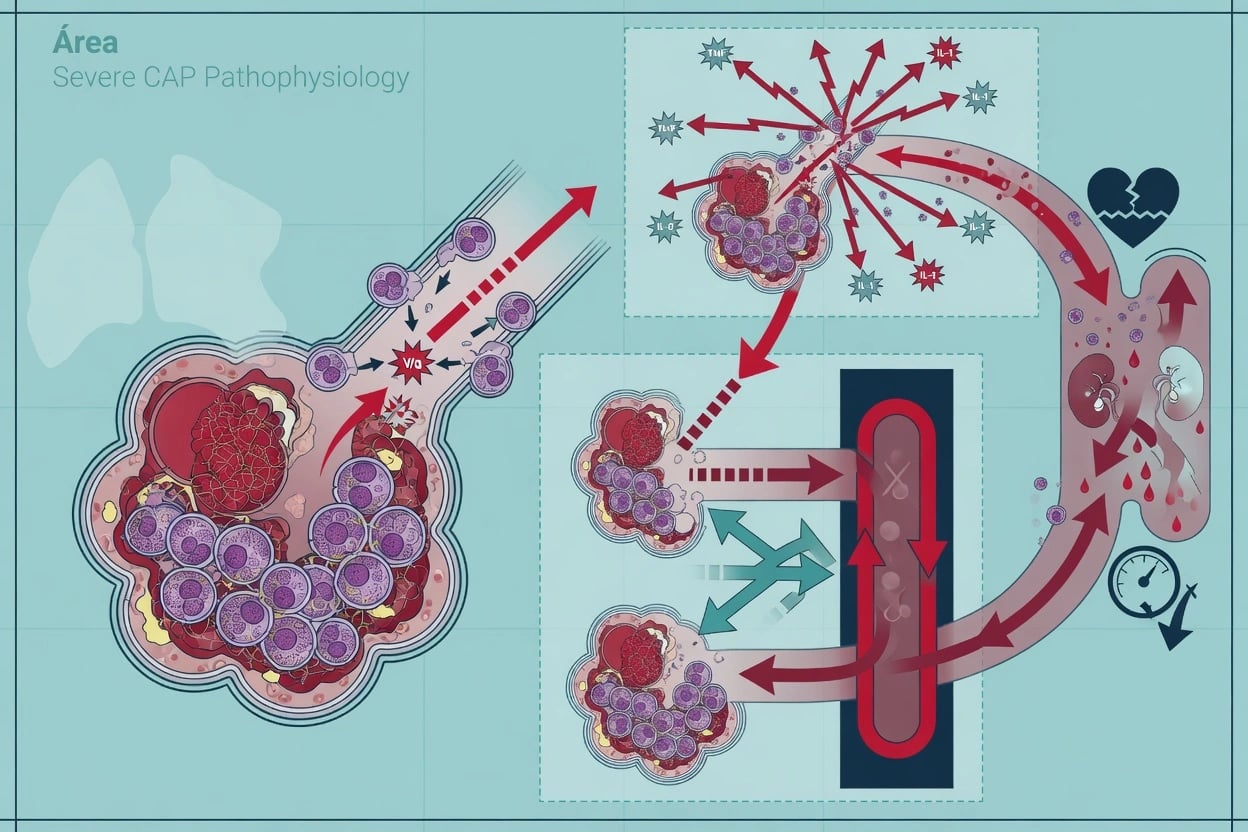
The single most important concept in geriatric CAP is that the presentation is atypical. The classic pneumonia triad of fever, purulent productive cough, and pleuritic chest pain is the exception rather than the rule after the age of 65. Relying on fever or a clear chest-history to "rule out" pneumonia in an older patient is a dangerous diagnostic habit and a frequent source of delayed antibiotics and excess mortality.[2]
Atypical features that should prompt active exclusion of pneumonia in any older patient include: [1]
- New confusion, delirium, or a fall — frequently the ONLY manifestation. Delirium in this setting reflects cerebral hypoxaemia, cytokine-mediated encephalopathy, and/or unrecognised sepsis.
- Functional decline — new inability to perform activities of daily living, reduced mobility, or new incontinence.
- Anorexia, nausea, or generalised weakness — vague constitutional symptoms that are easy to dismiss.
- Subtle tachypnoea — often the earliest and most reliable vital sign abnormality; a respiratory rate >=22 in an older patient is never normal.
- Failure to thrive / decreased oral intake — particularly in residential care. [1]
Blunted febrile and inflammatory responses mean that 30-50% of elderly patients with bacteriologically confirmed CAP are afebrile at presentation, and a subset have hypothermia, which itself carries a worse prognosis.[2]
Classic presentation (younger adults)
- Fever (usually >38C), rigors
- Purulent productive cough, pleuritic chest pain
- Dyspnoea, tachypnoea
- Focal chest signs: crackles, bronchial breathing
- Systemic upset but preserved baseline cognition
Atypical presentation (elderly)
- Afebrile in 30-50%; may be hypothermic
- Cough may be absent or weak (impaired cough reflex)
- Confusion, delirium, or reduced GCS — often the only sign
- Falls, functional decline, new incontinence, anorexia
- Tachypnoea (often the earliest reliable sign); abdominal pain may dominate
Increased susceptibility: why the elderly get sicker
Several overlapping physiological changes make older patients both more likely to develop pneumonia and more likely to deteriorate once they have it. These are favourite First-Part/physiology material because they explain almost every clinical feature that follows.[2]
1. Immunosenescence. Aging produces a progressive decline in both cell-mediated (T-cell repertoire contraction, thymic involution) and humoral (reduced B-cell diversity and affinity maturation) immunity. The clinical consequences are higher infection risk, impaired pathogen clearance, blunted fever and inflammatory responses, and reduced vaccine immunogenicity. This is why a normal WCC and absence of fever are unreliable in the elderly. [1]
2. Reduced cough reflex and mucociliary clearance. Reduced cough force, impaired laryngeal sensation, blunted chemoreflex sensitivity, and diminished mucociliary escalation impair clearance of aspirated or inhaled organisms. This is the physiological basis of aspiration pneumonia and of pneumonia in those with reduced level of consciousness. [1]
3. Aspiration risk (see dedicated section below). Dysphagia from stroke, dementia, Parkinson disease, neuromuscular disease, or simply age-related deconditioning, compounded by sedating medications, makes silent aspiration common. [1]
4. Comorbidities. COPD, heart failure, chronic kidney disease, diabetes, chronic liver disease, and immunosuppression all reduce physiological reserve and increase susceptibility. Each comorbidity independently worsens CAP prognosis; the cumulative burden (captured by the Charlson Comorbidity Index) is strongly predictive of mortality. [1]
5. Polypharmacy. Average elderly ICU patients take 5-10 regular medications. Several classes directly increase pneumonia risk or worsen its course: PPIs (increased CAP and C. difficile risk), sedatives (aspiration), antipsychotics (aspiration and delirium), and immunosuppressants. [1]
6. Malnutrition and sarcopenia. Protein-energy malnutrition impairs immune function and respiratory muscle strength, reduces cough force, and delays recovery. Sarcopenia compounds ICU-acquired weakness. [1]
Host defence impaired by age
- Cough reflex and laryngeal sensation: reduced
- Mucociliary clearance: impaired
- Cellular immunity: impaired (immunosenescence)
- Humoral immunity: reduced vaccine response
- Respiratory muscle strength: reduced (sarcopenia)
Clinical consequence
- Silent aspiration → Gram-negative and anaerobic pneumonia
- Blunted fever / normal WCC → delayed diagnosis
- Poor vaccine response → recurrent infection
- Rapid progression to respiratory failure (low reserve)
- Delayed recovery, prolonged weaning, ICU-acquired weakness
CURB-65 and severity scores: the age trap in the elderly
Severity scoring behaves differently in older patients because age is embedded in every commonly used score. This has practical and exam-relevant consequences that are frequently tested.[2]
CURB-65 awards 1 point automatically for age >=65 — so every elderly patient starts from a score of 1 regardless of physiology. A CURB-65 of 2 in an older patient (which triggers inpatient care) may therefore reflect age alone plus a single abnormality; conversely, a CURB-65 of 1 is essentially unattainable in patients over 65, meaning the score's outpatient "0-1" band is largely irrelevant in this population.[2]
The practical implication is that CURB-65 over-stratifies by age and under-detects severity in fit older patients while paradoxically being unable to identify a true "low-risk" elderly patient. For this reason: [1]
- CRB-65 (the blood-test-free variant) is widely recommended for older patients in primary care and the ED: Confusion, RR >=30, BP (systolic <90 or diastolic <=60), age >=65. Any ONE criterion positive = severe — hospitalise. It is simpler and does not depend on a urea result.[2]
- PSI / PORT weights age even more heavily (age in years is added directly), plus comorbidities. This makes PSI the most accurate mortality predictor but it can under-predict severity in fit older patients with physiological derangement (a 75-year-old with a PaO2 of 50 can still score as "low risk" if the rest is normal).[4]
- SMART-COP and the IDSA/ATS severe CAP criteria are preferable for the ICU-support decision because they weight oxygenation, pH, and organ dysfunction rather than age.[3]
CURB-65
- Age >=65 = 1 point (automatic)
- Cannot score 0 in any patient >=65 → outpatient band largely irrelevant
- Ignores oxygenation and comorbidity
- Underestimates severity in fit older hypoxaemic patients
PSI / PORT
- Age in years added directly; comorbidities heavily weighted
- Best mortality predictor but age-driven → can score low risk in a hypoxic 75-year-old
- Cumbersome; 20+ variables
CRB-65
- No blood test; Confusion, RR >=30, BP <90 / diastolic <=60, age >=65
- Any ONE positive = severe = hospitalise
- Ideal for primary-care/ED triage of the elderly
IDSA/ATS + SMART-COP
- Weight oxygenation, pH, organ-support needs — not age
- Best for the ICU-support decision in older patients
- IDSA/ATS: 1 major OR >=3 of 9 minor = severe = ICU
CURB-65 and severity scoring — elderly angles
Aspiration risk and swallow assessment
Aspiration is the dominant mechanism of pneumonia in the elderly and reframes the microbiology (more Gram-negatives and anaerobes) and the prevention strategy. Aspiration pneumonia is distinct from aspiration pneumonitis (acute chemical lung injury after a large-volume aspiration of sterile acidic gastric contents), which is managed differently.[2]
Who is at risk
Neurological
- Stroke (especially brainstem, cortical, bilateral) — the commonest cause
- Dementia and cognitive impairment
- Parkinson disease and atypical parkinsonism
- Neuromuscular disease (myasthenia, motor neuron disease, myopathy)
- Reduced level of consciousness from any cause (sedation, sepsis, post-ictal)
Mechanical / structural
- Reduced laryngeal sensation and cough reflex with age
- Poor dentition and dry mouth (reduced salivary bacterial clearance)
- Nasogastric tubes and gastrostomy (do NOT abolish aspiration)
- Oesophageal dysmotility / stricture / reflux
- Prolonged intubation and post-extubation dysphagia
Medication-related
- Sedatives: benzodiazepines, opioids, antipsychotics
- Anticholinergics (dry mouth, cognitive effects)
- Skeletal muscle relaxants
- PPIs (gastric pH rises → bacterial overgrowth)
Swallow assessment and prevention
Every elderly ICU patient should be assumed to have impaired swallow until proven otherwise. Do not give oral intake until swallow has been assessed, especially post-extubation. [1]
Aspiration risk assessment and prevention in the elderly ICU patient
Screen every patient on admission and after extubation
A simple bedside screen (e.g. a 30 mL water swallow test, or a validated tool such as the Volume-Viscosity Swallow Test / GUSS) flags patients needing formal assessment. Red flags: wet or gurgly voice, coughing or throat-clearing during the swallow, pocketing of food, prolonged meal times, recurrent chest infections.
Refer to speech and language therapy (SLT)
SLT performs a formal bedside clinical swallow evaluation and, where indicated, instrumental assessment (fibre-optic endoscopic evaluation of swallowing, FEES; or videofluoroscopy). They grade the swallow, identify safe fluid consistencies and diet textures (IDDSI framework), and recommend strategies (chin-tuck, postural changes, supervised feeding).
Modify intake and feeding strategy
Thickened fluids and texture-modified diets per IDDSI as prescribed. Sit upright (>=30 degrees) for meals and for 30 minutes afterwards. Avoid sedating medications before meals. Ensure good oral and denture hygiene. Small frequent meals; supervised feeding for cognitively impaired patients.
Optimise oral hygiene
Mechanical tooth brushing, chlorhexidine mouthcare, and professional dental care reduce oropharyngeal bacterial load and are evidence-based for reducing ventilator-associated and aspiration pneumonia. Do not neglect the edentulous patient — denture hygiene and oral mucosa care matter.
Review and de-prescribe deliriogenic / sedating drugs
Reduce or stop benzodiazepines, opioids where possible, chronically used antipsychotics, and anticholinergics (Beers criteria). These blunt laryngeal sensation and cough and are the most modifiable aspiration risk factor.
Consider enteral access if swallow unsafe
If swallow is unsafe and unlikely to recover within days, establish nasogastric feeding (short term) or a gastrostomy (long term, with a goals-of-care discussion — gastrostomy does NOT eliminate aspiration of oropharyngeal secretions). Feeding route should follow anticipated prognosis and patient / surrogate preference.
Pharmacology and drug dosing in the elderly
Age-related changes in drug handling and the near-universal presence of comorbidity and polypharmacy make pharmacotherapy in elderly CAP a balancing act between undertreatment and toxicity.[1]
Renal dosing
Renal function declines with age even with a "normal" creatinine, because muscle mass falls in parallel with GFR. Never dose renal drugs on serum creatinine alone in the elderly. Calculate creatinine clearance (Cockcroft-Gault) or eGFR (CKD-EPI) and adjust. In critical illness, augmented renal clearance (early sepsis, young-old patients) can under-expose beta-lactams, while established AKI over-exposes them — consider therapeutic drug monitoring (TDM) of beta-lactams in critically ill elderly. [1]
High-risk drug classes
Beta-lactams
- Renally cleared — adjust to CrCl / eGFR
- Accumulation in AKI → neurotoxicity: encephalopathy, myoclonus, seizures (cefepime, ceftaroline, piperacillin-tazobactam especially)
- Augmented clearance in early sepsis → under-dosing → use beta-lactam TDM in severe CAP
Macrolides & fluoroquinolones
- QT prolongation → torsades; risk additive with other QT drugs and electrolyte disturbance
- Fluoroquinolones: tendinopathy / rupture, aortic dissection risk, delirium, hypoglycaemia — avoid in elderly if alternatives exist (FDA warnings)
- Macrolides inhibit CYP3A4 → interact with statins (rhabdomyolysis), warfarin (INR rise), digoxin
Vancomycin & aminoglycosides
- Nephrotoxicity — avoid aminoglycosides in the elderly where possible
- Vancomycin: monitor trough / AUC, watch with concomitant nephrotoxins (NSAIDs, contrast, ACEi)
- Ototoxicity additive — caution with pre-existing hearing loss and diuretics
NSAIDs
- AKI, fluid retention, gastroprotection failure, hypertension, heart-failure exacerbation
- Generally AVOID in elderly CAP — use paracetamol first-line for fever and pleuritic pain
Polypharmacy, PPIs and the Beers criteria
[1]The Beers criteria (American Geriatrics Society) list drugs considered potentially inappropriate in older adults; the highest-yield deliriogenic classes in the ICU are benzodiazepines, anticholinergics (oxybutynin, diphenhydramine — use non-sedating antihistamines), first-generation antihistamines, and certain opioids (morphine metabolites accumulate in CKD — prefer fentanyl / oxycodone with care). Sedation, aspiration, falls, and delirium all flow from these drugs. [1]
Elderly pharmacology — key principles
Prognosis and outcomes: elderly CAP is 2-3x more lethal
Community-acquired pneumonia is substantially more dangerous in the elderly. In-hospital and 30-day mortality rise steeply with age, and ICU mortality for severe CAP in patients over 65 is roughly 2-3 times that of younger adults (commonly cited as 20-30% versus 5-10%).[1][2]
The excess mortality is multifactorial and reflects more than the infection itself: [1]
- Reduced physiological reserve → earlier and more profound organ failure.
- Comorbidity burden → each comorbidity independently worsens outcome (Charlson index predicts mortality).
- Delayed presentation and diagnosis → atypical symptoms are misattributed to old age or dementia; blunted fever and WCC responses lower diagnostic suspicion.
- Delayed antibiotics → each hour of delay to antibiotics in septic shock increases mortality, and this effect is amplified in the elderly.
- Frailty → independently predicts mortality, functional decline, and failure to return to baseline — often more strongly than age itself.
- Immunosenescence → impaired clearance, more severe infection, recurrent episodes. [1]
Equally important is functional outcome: many elderly CAP survivors never return to their pre-admission baseline. ICU-acquired weakness, deconditioning (1-2% muscle loss per bed-day), new cognitive impairment, and depression drive loss of independence and institutionalisation.[1]
Corticosteroids in elderly community-acquired pneumonia
Multicentre randomised placebo-controlled trials and individual-patient-data meta-analyses
Population: Adults (predominantly older) hospitalised with CAP
Key finding
Corticosteroids modestly shorten time to clinical stability and may reduce mortality in severe CAP, with the greatest signal in older, more inflamed patients — at the cost of more hyperglycaemia and (in some studies) delayed viral clearance. Guidelines do NOT recommend routine steroids for all CAP; consider in severe CAP with high inflammatory burden, and avoid in uncontrolled influenza.
Practice change
Do not default to steroids in every elderly CAP patient. Reserve short-course steroids for severe CAP with persistent shock or high inflammatory burden, and weigh against hyperglycaemia (common in the elderly) and active viral infection.
Prognosis — elderly CAP at a glance
Microbiology in elderly CAP
Streptococcus pneumoniae remains the commonest pathogen across all age groups, including the elderly, but the spectrum broadens with age, comorbidity, and aspiration risk.[2]
Still commonest
- Streptococcus pneumoniae — #1 in all age groups including elderly
- Haemophilus influenzae (especially in COPD)
- Respiratory viruses — influenza, RSV, SARS-CoV-2; RSV increasingly recognised in older adults
More frequent with age / aspiration
- Enteric Gram-negative bacilli (E. coli, Klebsiella, Enterobacter)
- Anaerobes and oral flora in aspiration pneumonia
- Staphylococcus aureus (including MRSA) — post-viral and in nursing-home / residential patients
- Pseudomonas aeruginosa in structural lung disease (bronchiectasis, severe COPD)
Atypicals — relatively less common
- Legionella and Mycoplasma are less common in the very old than in younger adults
- But still occur — Legionella carries high mortality in the elderly; do not miss the urinary antigen
- Chlamydia pneumoniae occurs in older adults
The empiric antibiotic strategy is the same as for younger adults — beta-lactam + macrolide (or a respiratory fluoroquinolone) for inpatient CAP — but with three elderly-specific nuances: (1) broader Gram-negative cover if aspiration or nursing-home risk (consider amoxicillin-clavulanate or piperacillin-tazobactam rather than a simple beta-lactam); (2) renal dose adjustment from the first dose; (3) review for MRSA / Pseudomonas risk factors (prior respiratory isolation, recent hospitalisation or IV antibiotics, structural lung disease) and add cover accordingly per ATS/IDSA 2019.[3]
Management pathway: elderly-specific priorities
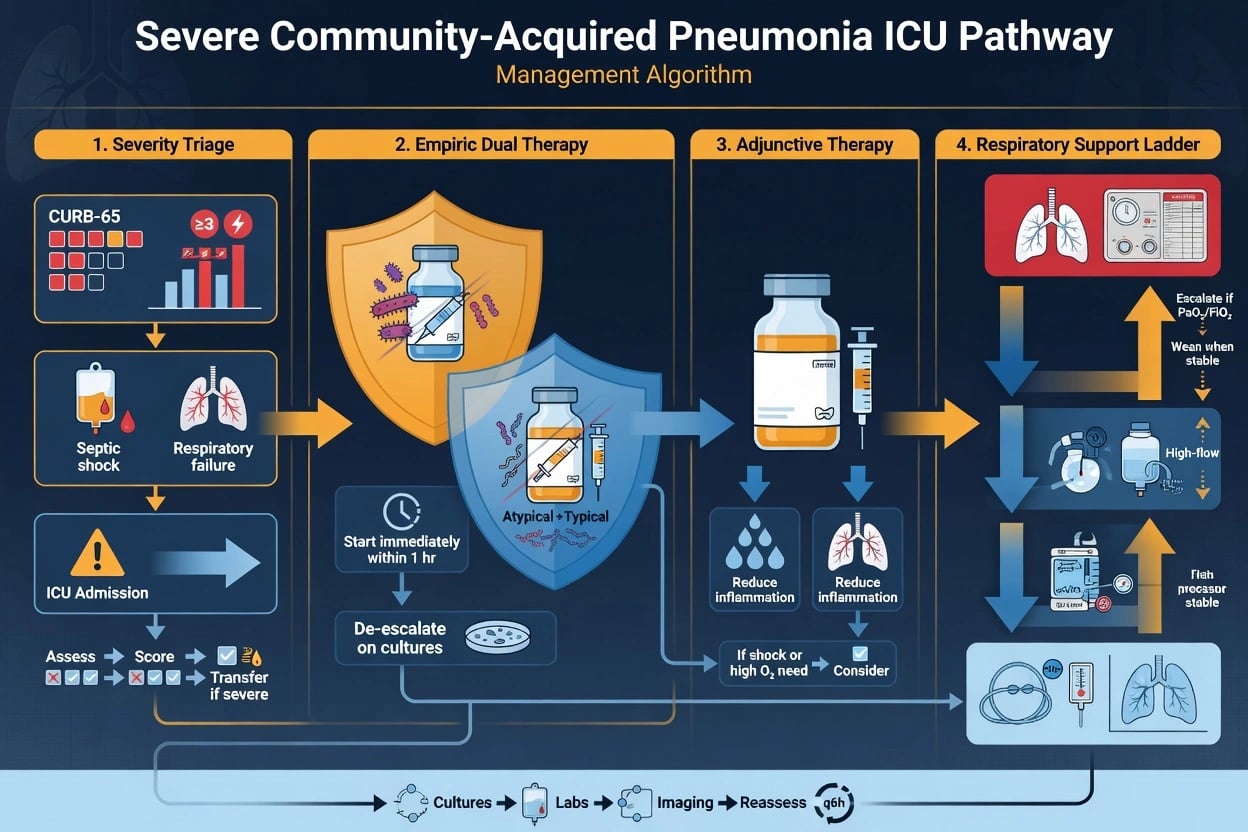
The general CAP pathway (early oxygen, cultures, antibiotics within 1 hour of sepsis, source control, lung-protective ventilation if needed) applies unchanged, but the elderly require additional, parallel geriatric priorities from the first hour. [1]
Elderly CAP management pathway — from ED to ICU
Recognise atypical presentation and lower the threshold to act
Confusion, a fall, or functional decline in an older patient is sepsis until excluded. Do not be falsely reassured by a normal temperature or WCC. Tachypnoea (RR >=22) is the single most sensitive vital sign.
ABCDE plus early oxygen and cultures
Target SpO2 92-96% (88-92% in COPD / CO2 retainers — avoid uncontrolled high-flow O2). Send blood cultures, sputum, urinary pneumococcal and Legionella antigens, and respiratory viral PCR (influenza / RSV / COVID) before antibiotics where feasible.
Antibiotics within 1 hour (sepsis) — renally dosed
Beta-lactam + macrolide for inpatient CAP; widen cover for aspiration or MRSA / Pseudomonas risk. Adjust ALL renally cleared drugs to Cockcroft-Gault / CKD-EPI from the first dose.
Assess swallow BEFORE any oral intake
Bedside swallow screen in every older patient, and especially post-extubation. Refer SLT for formal assessment if the screen fails. Start oral hygiene and head-up positioning immediately.
Prevent delirium — apply the ABCDEF bundle
Assess/manage pain, Both spontaneous awakening and breathing trials, Choice of sedation (avoid benzodiazepines), Delirium monitoring, Early mobilisation, Family engagement. Minimise deliriogenic drugs; orient the patient; preserve the sleep-wake cycle.
Review and de-prescribe (medication reconciliation)
Stop PPIs without indication, NSAIDs, benzodiazepines, anticholinergics; adjust anticoagulants / antiplatelets to the bleeding-infection balance; check for drug interactions (macrolide-statin, macrolide-warfarin, QT-prolonging combinations).
Nutrition, mobilisation, and rehabilitation
Early enteral nutrition if nil-by-mouth; assess malnutrition (MUST); physiotherapy and mobilisation from day 1 to limit deconditioning. Plan early for rehabilitation needs.
Frailty assessment, goals of care and advance care planning
Score frailty (Clinical Frailty Scale). Discuss resuscitation status, ceiling of treatment, and overall goals with the patient and family EARLY — ideally before crisis. Document decisions.
Plan discharge, vaccination, and secondary prevention
Begin discharge planning on admission. Ensure pneumococcal, influenza, COVID, and (where indicated) RSV vaccination before or soon after discharge; smoking cessation; swallow and dental follow-up; ICU follow-up clinic to screen for post-intensive care syndrome.
Residential care and nursing-home CAP
The old "healthcare-associated pneumonia" (HCAP) category was abandoned in the ATS/IDSA 2019 guideline because it poorly predicted multidrug-resistant pathogens and drove unnecessary broad-spectrum antibiotic use.[3] However, residence in a nursing home is still a marker of risk — for severity, frailty, and aspiration — even if it is no longer a trigger for empiric MRSA / Pseudomonas cover on its own.
Empiric MRSA or Pseudomonas cover should be added only when validated local risk factors are present: prior respiratory isolation of these organisms, recent hospitalisation with parenteral antibiotics (especially within 90 days), or structural lung disease (bronchiectasis, severe COPD).[3]
Nursing-home CAP — what is true
- Higher severity, more comorbidity, more aspiration, higher frailty and mortality
- Higher rate of Gram-negatives and S. aureus (including MRSA)
- Earlier and more explicit goals-of-care conversations are usually warranted
Nursing-home CAP — what is NOT true
- Residence alone does NOT mandate empiric MRSA / Pseudomonas cover (HCAP concept abandoned)
- Does NOT automatically mean ICU admission is futile — decide on physiological reserve and goals, not postcode
Vaccination and secondary prevention in the elderly
Vaccination is the most effective single secondary-prevention measure, but immunosenescence blunts the response — elderly patients mount lower antibody titres that wane faster. Strategies that partially overcome this include:[2]
- Influenza: annual vaccination; high-dose and adjuvanted formulations are preferred for older adults where available.
- Pneumococcal: PCV15 / PCV20, or PCV13 followed by PPSV23, per national immunisation schedule — give before or at discharge after a CAP episode.
- COVID-19: keep up to date per current guidance.
- RSV: a single dose of RSV vaccine is now recommended for older adults in many countries.
- Herpes zoster (recombinant zoster vaccine) and tetanus boosting — general geriatric immunisation, not pneumonia-specific but high-yield at discharge. [1]
Address modifiable risk factors before discharge: smoking cessation, optimisation of COPD and heart failure, swallow and dental review, and de-prescribing of high-risk drugs.[2]
Frailty, advance care planning and ceiling of care
Frailty — measured simply at the bedside with the Clinical Frailty Scale (CFS, 1-9) — often predicts mortality, functional decline, and discharge destination in elderly CAP better than age or individual comorbidities. A CFS >=5 (mildly frail or worse) should trigger an explicit goals-of-care conversation.[1]
Goals-of-care and ceiling-of-treatment discussion in elderly CAP
Assess frailty and baseline function
Use the Clinical Frailty Scale and ask the family about the patient baseline 2 weeks ago (ADLs, mobility, cognition, living situation). Baseline function frames what a successful recovery would even look like.
Estimate prognosis honestly
Combine severity scores, comorbidity, frailty, and trajectory. Be honest about uncertainty. Most families want realistic information, not false reassurance or unsupported pessimism.
Hold a structured family meeting early
Within 24-72 hours of ICU admission (sooner if unstable). Use a validated structure (e.g. SPIKES or the serious-illness conversation guide). Ask what the patient would value; identify a surrogate decision-maker.
Agree and document a ceiling of treatment
Clarify whether escalation to intubation, vasopressors, CPR, and readmission to ICU align with the patient values — and document it. A ceiling is about what we will do, not what we will withhold without discussion.
Reassess daily and on any change
Goals of care are reversible decisions, made once and revisited. If recovery is slower than hoped or a new complication arises, reconvene. Transition to comfort-focused care when ICU treatments are failing or disproportionate to goals.
Delirium prevention: the ABCDEF bundle
Delirium affects up to 80% of mechanically ventilated elderly ICU patients and is independently associated with longer stay, higher mortality, and long-term cognitive impairment (a core component of post-intensive care syndrome). The ABCDEF bundle is the evidence-based mitigation:[1]
- Assess, prevent, and manage pain.
- Both spontaneous awakening trials and spontaneous breathing trials.
- Choice of analgesia and sedation — favour propofol / dexmedetomidine over benzodiazepines.
- Delirium — assess, prevent, and manage (CAM-ICU / ICDSC); treat underlying causes first; antipsychotics are NOT prophylaxis.
- Early mobility and exercise.
- Family engagement and empowerment. [1]
Red flags (elderly-specific)
Exam practice
SAQ — Atypical CAP in an elderly patient
10 minutes · 10 marks
An 82-year-old woman with dementia and a previous stroke is brought from her nursing home after being found on the floor. She is unable to give a history. Observations: T 36.1C, RR 28, SpO2 88% on room air, BP 96/58, HR 112, GCS 13 (confused; baseline GCS 14). Her family say she has been off her food for 2 days and less mobile than usual. CXR shows right lower lobe consolidation. WCC 9.2, CRP 64, lactate 2.4, urea 9.5, Na 131. Urine pneumococcal antigen positive.
Clinical pearls (expanded)
Red flags (expanded)
References
- [1]Martin-Loeches I, Torres A. Severe community-acquired pneumonia Eur Respir Rev, 2022.PMID 36517046
- [2]Feldman C. Notum palmitoleoyl-protein carboxylesterase regulates Fas cell surface death receptor-mediated apoptosis via the Wnt signaling pathway in colon adenocarcinoma Bioengineered, 2021.PMID 34402722
- [3]Metlay JP, Waterer GW, Long AC, et al. Using Simulation to Evaluate Clinical Performance and Reasoning in Adult-Geriatric Acute Care Nurse Practitioner Students J Nurs Educ, 2019.PMID 31573650
- [4]Fine MJ, Auble TE, Yealy DM, et al. Evidence for regulation of transcription and replication of the human neurotropic virus JCV genome by the human S(mu)bp-2 protein in glial cells Gene, 1997.PMID 9034313