ICU · Ethics, EOL & communication
Ethics, End-of-Life, Communication & Aeromedical Retrieval
Also known as Ethics and EOL · Four principles of bioethics · Capacity and consent · Limitation of treatment · Withholding and withdrawing · Breaking bad news · SPIKES · Family meeting · Brain death and organ donation · Aeromedical retrieval
The professional and the CanMEDS domain of the ICU — the four principles of the bioethics (the autonomy, the beneficence, the non-maleficence, the justice), the capacity and the informed consent (the components, the emergency exception, the substituted decision-maker, the advance directive), the end-of-life care and the limitation of the treatment (the withholding vs the withdrawing — the ethical equivalence, the futility, the goals-of-care), the breaking of the bad news (the SPIKES — the Setting, the Perception, the Invitation, the Knowledge, the Emotions, the Strategy), the shared decision-making and the family meeting, the specific ethics (the Jehovah's Witness, the brain death and the organ donation, the do-not-resuscitate), the medico-legal (the documentation, the open disclosure, the coroner), and the aeromedical retrieval (the scoop-and-run vs the stay-and-play, the time-critical, the team, the platform, the physiological stressors of the altitude, the temperature, the noise, the vibration and the gas expansion).
On this page & tools
Your progress
Saved locally on this device.
8 MCQs with explanations
Target exams

Overview & definition
The ethics, the end-of-life care, the communication and the retrieval is the professional and the CanMEDS domain of the ICU — the human, the ethical and the logistic dimensions that surround the technical care. The intensivist who masters the bioethics, the capacity, the limitation of the treatment, the breaking of the bad news, and the retrieval brings the expertise AND the humanity.[1][1]
The framework rests on five pillars: the bioethics (the four principles), the capacity and the consent, the end-of-life care and the limitation of the treatment, the communication (the SPIKES, the family meeting), and the aeromedical retrieval.[1]
The four principles of bioethics
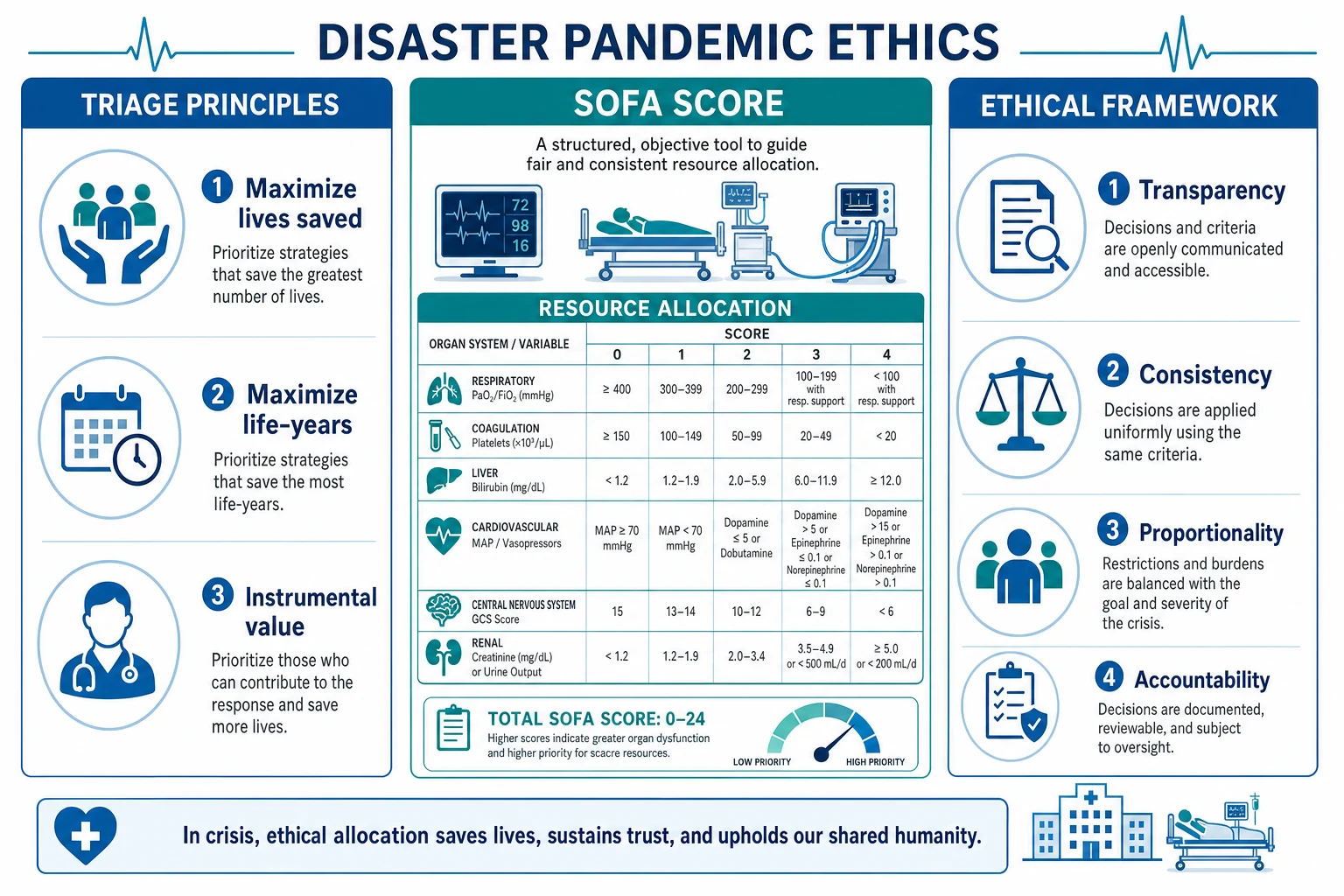
The Beauchamp-and-Childress framework is the bedrock of the medical ethics.[1]
- The autonomy — the respect for the patient's right to the self-determination, the informed choice. The competent patient may accept or refuse any treatment, even the life-saving. The informed consent and the advance directive.
- The beneficence — the duty to act in the best interest, to provide the benefit. The basis of the treatment.
- The non-maleficence — the duty to do no harm (the primum non nocere). The weighing of the burden against the benefit.
- The justice — the fair distribution of the resources (the equity), the equal treatment. The triage, the allocation of the scarce resource (the organ, the ICU bed, the ventilator).[1][1]
The principles may conflict — the autonomy (the refusal) vs the beneficence (the life-saving); the justice (the triage) vs the autonomy. The ethical reasoning weighs the principles in the context.[1]
Ethical frameworks beyond the four principles — the engine-room reasoning
The four principles are a framework for listing the moral considerations; they do not tell the clinician how to weigh them when they conflict. Two deeper engines of moral reasoning are tested at Fellowship level and frame almost every ICU dilemma.[1][1]
Deontological (duty-based) ethics. The rightness of an act is judged by whether it conforms to a moral rule or duty, irrespective of the consequences — Kant's categorical imperative: act only on that maxim that you can will to become a universal law; treat humanity always as an end and never merely as a means. Duties include truth-telling, keeping promises, respect for persons, and the prohibition on killing the innocent. In the ICU the deontological stance underwrites the absolute prohibition on active euthanasia even when the patient requests it, the requirement for honest prognosis, and the obligation to obtain valid consent. The weakness is rigidity: a duty that yields a catastrophic outcome can be hard to defend.[1][1]
Consequentialist (utilitarian) ethics. The rightness of an act is judged by its outcomes — the action that produces the greatest balance of benefit over harm (for act-utilitarianism) or the rule that, if generally followed, produces the best consequences (rule-utilitarianism). Consequentialism underwrites triage (maximise the good across a population), cost-effectiveness analysis, and the withdrawal of futile treatment. Its weakness is the risk of sacrificing the individual for the aggregate — the textbook trap of "harvesting one patient's organs to save five."[1][1]
Virtue ethics, care ethics, casuistry. Virtue ethics (Aristotle, MacIntyre) asks "what would the good clinician do?" — character and phronesis (practical wisdom) over rules. Care ethics (Gilligan, Noddings) centres relational responsibility and responsiveness to vulnerability — a strong fit with nursing ethics. Casuistry resolves case-by-case from paradigm cases rather than from abstract principles. A modern intensivist draws on all three: principlism to enumerate the considerations, deontology and consequentialism to reason through the conflict, and virtue/care ethics to situate the decision in the relationship with this patient and family.[1][1]
| Feature | Deontological (duty-based) | Consequentialist (utilitarian) |
|---|
| Feature | Deontological (duty-based) | Consequentialist (utilitarian) |
|---|---|---|
| Source of moral authority | The rule, the duty, the right itself | The outcome, the aggregate good |
| Core question | "Is there a duty to do / not do this?" | "Which act produces the most good?" |
| Canonical thinker | Immanuel Kant (categorical imperative) | Bentham and Mill (greatest good for the greatest number) |
| In the ICU | Truth-telling, valid consent, the prohibition on killing, no use of persons as mere means | Triage, resource allocation, withdrawal of futile therapy, cost-effectiveness |
| Strength | Protects the individual; respect for persons; non-negotiable floor | Maximises benefit across a population; flexible; fits pandemic triage |
| Weakness / trap | Rigid — even catastrophic outcomes may be required | Can sacrifice the individual for the aggregate; the "transplant surgeon" reductio |
| Typical exam anchor | "You may not kill one to save five" | "Allocate the ventilator to the most likely to benefit" |
| Conflicts with | Consequentialism when a duty yields a worse outcome | Deontology when the best outcome violates a duty |
The capacity and the informed consent
The informed consent is the autonomous authorisation of the treatment. The components: the capacity, the disclosure (the diagnosis, the proposed treatment, the alternatives, the risks, the benefits), the comprehension, the voluntariness.[1]
The capacity is the patient's ability to understand the information, to appreciate the consequences, to reason, and to communicate the choice. The capacity is the decision-specific (the patient may have the capacity for the blood transfusion but the not for the complex surgery), the time-specific (the delirious patient lacks the capacity; the recovered patient may regain it), and the presumed until the evidence otherwise. The capacity assessment is the structured (the comprehension, the appreciation, the reasoning, the choice).[1]
The emergency exception — the treatment without the consent is the permissible in the emergency (the life-threatening, the incapable patient, the no available surrogate, the treatment to preserve the life).[1]
The substitute decision-maker (the SDM) — for the incapable patient, the SDM (the legally-appointed, the next-of-kin) decides in the patient's best interest OR the known wishes (the substituted judgement).[1][1]
The advance directive (the advance care plan) — the patient's prior written wishes (the refusal of the treatment, the values). The legally-binding in the many jurisdictions; the guides the care when the patient is the incapable.[1]
The end-of-life care and the limitation of the treatment
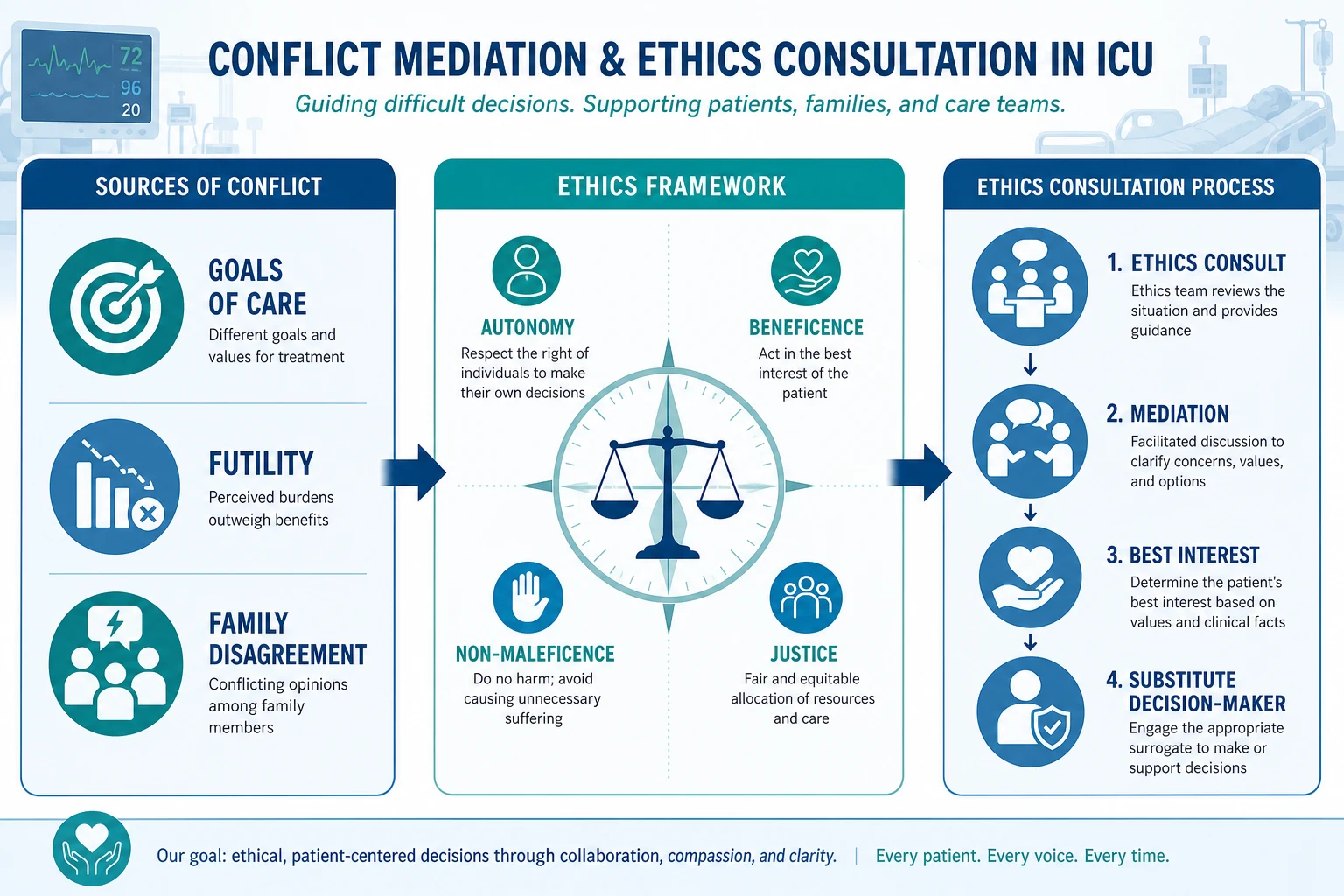
The most of the ICU deaths follow the limitation of the treatment (the withholding or the withdrawing), the not the failed resuscitation. The good end-of-life care is the core ICU skill.[3][1]
The withholding vs the withdrawing. The withholding is the not starting a treatment; the withdrawing is the stopping a treatment already started. The ethical and the legal equivalence — there is the no obligation to continue a treatment that the patient (or the SDM) declines. The withdrawing may feel harder, but the distinction is the ethically arbitrary.[4][1]
The futility — the treatment that cannot achieve its goal (the physiological futility — the treatment cannot work; the qualitative futility — the treatment may work but the outcome is the unacceptable, the profound disability). The unilateral withholding of the futile treatment is the permissible in the some jurisdictions (the medical-futility policies).[4][5]
The goals-of-care discussion. The framing of the care in the patient-centred goals (the cure, the life-prolongation, the comfort), the honest prognosis, the alignment of the treatment with the goals. The trajectory (the declining, the terminal).[3][1]
The withdrawal process. The structured: the family meeting (the consensus, the plan), the sedation and the analgesia (the prevention of the distress — the opioid, the benzodiazepine; the proportional, the not the euthanasia), the removal of the treatment (the extubation, the stopping the vasopressor), the comfort and the dignity, the family support, the bereavement.[3][4]
The prevalence of limitation of treatment — the ETHICUS data
The ETHICUS study across 37 European intensive care units documented that roughly 73 per cent of ICU deaths followed an active limitation of treatment (withholding or withdrawing), with marked regional variation — northern Europe withdraws more often and earlier, southern Europe more often withholds and later, reflecting cultural, legal and religious differences rather than differences in patient case-mix.[12] The implication for practice: the decision to limit life-sustaining treatment is the single most common end-of-life act an intensivist performs, and the skill of doing it well — prognostication, communication, family support, withdrawal technique, and bereavement — is a core competency, not an optional adjunct.[9][12]
Types of futility — physiological, qualitative, and the modern "potentially inappropriate" framing
The original Schneiderman and Jecker formulation divided futility into physiological futility (the intervention simply cannot achieve its physiological aim — chest compressions that cannot generate a blood pressure in a transected aorta) and qualitative futility (the intervention may achieve its aim but the resulting quality of life is below a minimum threshold acceptable to the patient).[14] The modern ATS/AACN/ACCP/ESICM/SCCM consensus moved away from the unilateral language of "futility" toward the more honest framing of "potentially inappropriate treatment" — treatment that has at least some chance of doing what the patient (or surrogate) hopes, but that the clinician judges not to be in the patient's best interest; and "medically ineffective" treatment — treatment that cannot achieve its physiological aim.[11] The distinction matters because the two call for different processes: a medically ineffective treatment may be withheld unilaterally with documentation and a fair-process appeal; a potentially inappropriate treatment demands a structured conflict-resolution pathway (second opinion, ethics committee, and — only as a last resort — a unilateral withdrawal with a defined notice period and offer of transfer).[11]
| Feature | Withholding | Withdrawing |
|---|
| Feature | Withholding | Withdrawing |
|---|---|---|
| Definition | Not starting a treatment | Stopping a treatment already begun |
| Ethical status | Permissible when treatment fails the test of benefit-over-burden | Ethically and legally equivalent to withholding — no obligation to continue a treatment that the patient/SDM declines or that fails benefit-over-burden |
| Psychological difficulty | Often feels easier (passive) | Often feels harder (active) — but the distinction is ethically arbitrary |
| Common ICU examples | Not starting a fourth vasopressor, not intubating for a peri-arrest arrest, not starting RRT in a dying patient | Stopping a vasopressor, extubating, stopping RRT, deactivating an ICD |
| Documentation required | Goals-of-care discussion, reasoning, family/SDM involvement, review date | As above, plus the withdrawal plan: agents, doses, who is present, what is removed and in what order |
| Comfort care | Started concurrently | Started before and during withdrawal — analgesia and sedation given proportionally to distress |
| Medico-legal exposure | Same as withdrawing | Same as withholding — no separate liability for a well-conducted withdrawal |
| Type of futility | Meaning | Typical example | Process |
|---|
| Type of futility | Meaning | Typical example | Process |
|---|---|---|---|
| Physiological (medical ineffectiveness) | The intervention cannot achieve its physiological aim | CPR in a transected aorta; the third course of chemotherapy for a chemo-refractory leukaemia | May be withheld unilaterally; document the rationale; offer a fair-process appeal; no ethical obligation to provide |
| Qualitative | The intervention may succeed but the resulting quality of life falls below a threshold the patient would accept | A tracheostomy and long-term ventilation for a patient in persistent vegetative state | Engage SDM; apply substituted judgement / best interest; usually requires consensus, not unilateral action |
| Quantitative (probabilistic) | The intervention has an exceedingly low probability of success (e.g. <1%) | CPR in an out-of-hospital arrest with downtime >30 min in an asystolic patient | Discuss with team and SDM; a DNACPR is the usual outcome |
| "Potentially inappropriate" (modern framing) | Some chance of benefit, but clinician judges overall not in the patient's interest; family request conflicts with clinical judgement | Family request for full escalation in a dying patient with multi-organ failure | Structured conflict resolution: deliberation, second opinion, ethics committee review, defined notice period, offer of transfer, then unilateral limitation if no consensus |
A structured withdrawal of life-sustaining treatment — the practical sequence
Confirm the decision is sound and shared
A goals-of-care discussion has established that continued life-sustaining treatment fails the benefit-over-burden test, agreed by the treating team and the patient/SDM, documented in the chart with the reasoning and the time of the decision. The decision is for *withdrawal*, not for *euthanasia* — the intent is to allow the underlying disease to take its course while preventing and treating suffering.
Plan the withdrawal with the family
Hold a focused family meeting: explain what will be withdrawn (vasopressors, ventilation, RRT, antibiotics, the ICD shock function), what will be *kept* (analgesia, sedation, airway comfort, mouth care, family presence), the expected trajectory (minutes to days), and where the patient will be (ICU, ward, home if a retrieval-based palliative pathway exists). Invite questions; allow the family to be present if they wish.
Prepare the medication
Draw up an opioid (morphine 2-10 mg boluses, or an infusion 50% of the analgesic dose per hour) and a sedative (midazolam 2-5 mg boluses, or a propofol/midazolam infusion) BEFORE any line or tube is removed. The principle is *proportionality*: dose to the observed signs of distress (dyspnoea, agitation, pain, secretion-related grimacing), never a fixed "withdrawal cocktail". The dose that controls symptoms is, by definition, the correct dose — even if large; the intent (comfort) distinguishes this from euthanasia.
Deactivate the ICD and pause non-comfort interventions
Deactivate defibrillation and anti-tachycardia therapies to prevent a shock from a device the patient no longer wishes to fire; stop routine bloods, antibiotics, RRT, and vasopressors unless they are providing comfort.
Perform the extubation (or terminal wean)
Two acceptable approaches: (a) extubation — remove the tube, suction the airway, provide humidified oxygen or air by face mask; (b) terminal wean — progressively reduce FiO2 and ventilator support while observing comfort, then extubate. Extubation is preferred where the family wishes to be present, hear the patient speak, and have a natural death; terminal wean is preferred when there is concern about airway compromise (upper-airway oedema, copious secretions). Suction as needed; reposition for comfort.
Support the family and observe
Stay with the patient; do not abandon the bedside. Encourage the family to be present and to touch, speak, and grieve. Reassess analgesia/sedation every few minutes and titrate. Acknowledge the moment of death with respect. Offer bereavement information and follow-up.
Document and notify
Record the time of death, the withdrawal sequence, the medications given and the indication (observed distress), who was present, and whether consent/coroner criteria apply. Notify the GP, the organ-donation service (if eligibility exists and the timing allows — see the donation-timing section), and arrange a bereavement follow-up.
The breaking of the bad news — the SPIKES
The SPIKES protocol (Baile, the Oncologist 2000) is the structured approach to the delivering of the bad news.[2]
- S — the Setting. The private, the quiet, the seated, the no interruptions; the sufficient time; the key family present.
- P — the Perception. The "what is your understanding of the situation?" — the assess the patient's frame before the sharing.
- I — the Invitation. The "how much would you like to know?" — the permission to share, the pace.
- K — the Knowledge. The giving of the information — the warning shot ("I am afraid I have the difficult news"), the plain language, the small chunks, the avoid the jargon.
- E — the Emotions. The acknowledgement of the emotion — the silence, the empathy ("I can see this is the very hard"), the respond to the affect.
- S — the Strategy and the Summary. The plan, the next steps, the follow-up, the check the understanding.[2][1]
The goals-of-care conversation — the upstream of every EOL decision
The goals-of-care conversation is the structured dialogue that precedes the limitation-of-treatment decision. It is the bridge between the prognosis (what is medically likely) and the plan (what is to be done), and it anchors every downstream decision — escalation, de-escalation, limitation, withdrawal, or full active treatment. The Ariadne Labs Serious Illness Conversation Guide is the most widely taught structured tool, with a randomised trial demonstrating that a structured conversation template improves patient-clinician concordance, reduces anxiety and depression in surviving family members, and is welcomed rather than feared by patients.[18][20]
The Guide asks seven questions in a fixed order: (1) Set up the conversation (frame, permission, time); (2) Assess understanding and preferences for information ("How much do you want to know about what is likely ahead?"); (3) Share prognosis (a calibrated range, framed with "I hope... and I worry that..."); (4) Explore goals ("What is most important to you?"); (5) Explore fears and worries ("What are you most worried about?"); (6) Explore sources of strength ("What gives you strength?"); (7) Make a recommendation aligned with the patient's stated values. The ICU variant is shorter and incorporates the substituted-judgement step when the patient lacks capacity.[18][20]
| Frame | Patient's stated priority | Typical plan | What is limited/withdrawn |
|---|
| Frame | Patient's stated priority | Typical plan | What is limited/withdrawn |
|---|---|---|---|
| Life-prolongation (cure) | "Do everything to extend my life, even if I am unconscious or in pain" | Full active treatment; ICU escalation; CPR if arrest | Nothing — all measures appropriate |
| Life-prolongation with a quality floor | "Extend life, but not if I will be permanently unconscious, ventilator-dependent, or in severe pain" | Trial of ICU; defined review point; ceilings (no tracheostomy, no RRT) defined in advance | Below-floor treatments withdrawn / withheld when ceiling reached |
| Comfort (quality of life) | "I value comfort and dignity above all; I do not want to die attached to machines" | Ward-based or ICU-based palliative pathway; symptom control; no CPR, no intubation | ICU support withheld; current support withdrawn if it adds burden without benefit |
The shared decision-making and the family meeting
The shared decision-making is the collaborative process — the clinician brings the expertise (the prognosis, the options), the patient and the family bring the values (the goals, the preferences), and the decision is the shared.[3][1]
The family meeting structure. The preparation (the review the record, the align the team), the introductions, the ask the family's understanding, the give the prognosis (the honest, the calibrated), the discuss the goals and the options, the plan, the document, the follow-up. The empathic, the no jargon, the allow the silence and the emotion.[1][1]
The ICU family meeting — a structured approach that works in 30 minutes
Pre-meeting preparation (5 min)
Review the chart, the trajectory, the prognosis, and the prior conversations; align the treating team (consultant, registrar, bedside nurse, allied health) on the message before the family enters — *never disagree in front of the family*. Identify the legal decision-maker and the family spokesperson. Choose a quiet, private room; silence the bleeps; sit down.
Introductions and agenda (2 min)
Name everyone, state your role, and set the frame: "We have 30 minutes; I want to understand what Mum would want, share what we are seeing, and agree on a plan. Please stop me if anything is unclear or if you disagree."
Ask — family understanding and values (5-8 min)
Listen more than you speak. "Tell me what you understand about your mother's illness. What was she like before this? What gave her life meaning? What has she said — ever — about being in intensive care, about being on machines, about the end of her life?" Capture the patient as a person — this is substituted-judgement material.
Tell — prognosis in plain language (5 min)
Use a calibrated forecast: "I hope she will recover enough to go home. I am worried that, with this illness, the chance of her leaving hospital alive is below one in ten, and that even if she does survive she is unlikely to return to independent life." Avoid jargon, false certainty, and false hope. Pause. Allow silence.
Respond to emotion (NURSE)
Name, Understand, Respect, Support, Explore — "This is terrifying news (name). I can see how much she means to you (understand). The way your family has rallied around her shows enormous love (respect). We will not abandon you, whatever the plan (support). Tell me what you are feeling right now (explore)." Do not jump to the plan until the emotion is acknowledged.
Make a recommendation aligned with values (3-5 min)
A recommendation is not a demand: "Given what you have told me about your mother — that she would never want to be permanently ventilator-dependent — and given the medical reality we are seeing, I recommend we shift our focus from extending life to ensuring her comfort and dignity. We would stop the antibiotics and the dialysis, keep her free of pain and breathlessness, and let the family be with her." A value-aligned recommendation relieves the family of the unbearable weight of "deciding to let go".
Agree a plan, document, and follow up (3-5 min)
Summarise the agreed plan back to the family; check understanding; write it in the chart verbatim; set a defined review time (the next morning, or sooner if the family requests). Tell them they can change their mind, ask more questions, and seek a second opinion. Provide written information and the contact for the social worker and the bereavement service.
When consensus fails — the conflict-resolution pathway
Most family-clinician conflict over limitation of treatment is resolvable with time, repeated meetings, and the engagement of allied health, chaplaincy, and the ethics service. Where consensus genuinely fails, the multi-society consensus endorses a fair, transparent structured process rather than a unilateral act: (1) deliberate with the team about whether the requested treatment is medically ineffective or merely potentially inappropriate; (2) obtain a second medical opinion from an independent intensivist; (3) involve the clinical ethics committee; (4) offer the family the option of transfer to another institution willing to provide the treatment; (5) if no transfer is possible and the treatment remains inappropriate, give the family a defined notice period (typically 5-10 days) before the limitation takes effect, and document every step.[11] Litigation is rare and usually avoidable; where it is threatened, the engagement of hospital legal counsel and the medical-defence organisation is essential. Half of family members of ICU patients in the FAMIREA study did not wish to share in the decision — a finding that should reduce, not increase, the pressure on families: clinicians carry the responsibility for a value-aligned recommendation; the family contributes the patient's voice, not the technical judgement.[19]
The specific ethics
The Jehovah's Witness and the blood transfusion. The competent adult may refuse the blood (the autonomy). The refusal is the binding even if the death follows. The child (the incapable) — the court may override the refusal (the best interest, the justice). The management: the blood-conservation (the cell salvage, the erythropoietin, the iron), the minimisation of the phlebotomy, the early the haemostasis, the referral to the bloodless-medicine service.[1]
The brain death and the organ donation. The brain death is the legal death (the irreversible cessation of the brain function — the clinical testing: the coma, the absent brainstem reflexes, the apnoea, the排除 the confounders). The organ donation (the consent, the SDM, the timing — the before or the after the cardiac death). The intensivist's role (the identification, the referral to the donation service, the family discussion, the maintenance for the donation).[1][1]
The do-not-resuscitate (the DNR) / the not-for-resuscitation (the NFR). The order that the CPR is the not attempted in the arrest. The decision based on the futility, the patient's wishes, the prognosis. The documented, the discussed, the reviewed.[1]
The medico-legal
The documentation is the medico-legal record — the contemporaneous, the accurate, the objective; the capacity, the consent, the goals-of-care, the family discussions. The open disclosure is the honest, the timely disclosure of the adverse event — the apology, the explanation, the prevention (the root-cause analysis).[6][1]
The coroner's cases — the reportable deaths (the unexpected, the violent, the unnatural, the in custody, the procedure-related). The preservation of the evidence.[1]
The aeromedical retrieval
The aeromedical retrieval is the transport of the critically ill patient by the air (the fixed-wing, the rotor-wing) — the ANZ geography demands the expertise.[7][1]
The principle. The retrieval delivers the right patient to the right place in the right time with the right care. The decision: the does the patient need the retrieval (the time-critical — the trauma, the STEM, the stroke; the time-sensitive — the sepsis; the does-the-benefit-outweigh-the-risk). The scoop-and-run (the rapid, the minimal-on-scene — the trauma, the time-critical) vs the stay-and-play (the stabilise on the scene — the medical, the time-sensitive).[7][1]
The team. The retrieval physician (the critical-care trained), the nurse, the paramedic; the scope of the practice (the intubation, the lines, the vasopressors, the blood).[7]
The platform. The fixed-wing (the long-range, the pressurised, the high-altitude), the rotor-wing (the helicopter — the short-range, the unpressurised, the hover), the road (the short-distance, the accessible). The choice by the distance, the urgency, the weather, the patient.[7][8]
The physiological stressors of the flight.[7][1]
- The altitude and the gas expansion. The cabin altitude (the pressurised to the 1500 to 2400 m, the unpressurised much higher); the Boyle law — the gas volume expands (the 30 per cent at the 2400 m). The pneumothorax, the pneumocephalus, the bowel obstruction, the air-embolism, the ET-cuff, the intra-aortic balloon — the risk. The decompression of the gas-filled spaces (the chest tube, the aspiration of the gastric air, the cuff-pressure monitoring).
- The oxygen. The Dalton and the Henry — the lowered partial pressure at the altitude (the hypoxia); the increased FiO2 for the marginal patients.
- The temperature. The cold cabin (the hypothermia, esp. the child, the burned).
- The noise and the vibration. The impaired examination and the monitoring (the auscultation impossible, the alarms hard to hear); the sedation; the patient comfort.
- The acceleration and the deceleration. The hemodynamic swings.
- The confined space. The limited access (the airway, the lines), the limited equipment.[1]
The preparation and the in-flight. The stabilise before the transport (the airway secured, the lines, the controlled — the "the no surprises in the air"); the monitoring (the ECG, the pulse oximetry, the capnography, the invasive pressure); the continuous reassessment; the communication (the referral centre, the accepting team).[7][1]
ICU triage, resource allocation and mass-casualty ethics
The principle of justice becomes operational when the demand for a scarce critical-care resource exceeds the supply — a ventilator, an ICU bed, an ECMO circuit, an organ, or, in a pandemic, all three simultaneously. The ethical object is no longer "what is best for this patient" but "what produces the most good across the population of patients who need this resource" — the transition from a deontological to a consequentialist frame, bounded by procedural justice (a fair, transparent, consistent rule applied to all).[17]
The core allocation principles
Emanuel and colleagues, in the most-cited pandemic-triage framework, specify six substantive principles: (1) maximise benefit — save the most lives and the most life-years; (2) prioritise health workers — both as reciprocity for the risk they take and as instrumental value (their return to work saves further lives); (3) do not allocate on a first-come-first-served basis (it discriminates against those who present later or with less access); (4) apply evidence-based instrumental value (prioritise those whose survival leads to others' survival — e.g. a ventilated nurse); (5) apply the principle of equal moral worth — once chosen, every patient receives the same standard of care; (6) promote, reward and instrumentalise reciprocity for those who bear disproportionate risk.[17] Allocation rules should be applied consistently across sites, transparent (published), non-discriminatory (no allocation by race, sex, religion, wealth, social worth in the discriminatory sense, or disability per se), and subject to appeal. Decisions should be made by a dedicated triage officer or committee, NOT by the treating clinician at the bedside — to remove the moral injury of the conflict of interest.[16][17]
Mass-casualty and disaster triage — the CHEST consensus
The CHEST Task Force on mass casualty and pandemic triage distinguishes three disaster contexts — mass critical care (needs exceed resources, ongoing), pandemic critical care (a defined infectious surge), and disaster critical care (a sudden physical event such as earthquake or blast). It frames triage as a dynamic, iterative process with re-triage at defined intervals, and uses a multi-domain score (SOFA-based prognosis + major comorbidity + resource availability) to assign patients to one of four colour-coded bands: red (highest priority — high benefit, treat), yellow (intermediate — observe/reassess), green (low acuity — defer), and black (expectant — comfort care only because critical care cannot alter the outcome at current resource levels).[16] The "black" or expectant category is the ethically hardest but the most important — it converts an unmanageable demand into a survivable one, and it allocates to those expectant patients the resources they most need: analgesia, sedation, dignity, and family presence. Re-triage (every 24-48 hours and on any change in resource availability) is mandatory; an "expectant" patient who improves must be moved to "red", and conversely.[16]
Inter-hospital retrieval — when to move the patient, when to wait
The retrieval decision under resource pressure is an ethical act: moving a critically ill patient incurs risk, but staying may deny a downstream patient a bed, or deny the retrieval patient a capability (ECMO, neurosurgery, interventional radiology) only the receiving centre can provide.[7][8]
| Question | What you are weighing | The default decision |
|---|
| Question | What you are weighing | The default decision |
|---|---|---|
| Is the receiving centre's capability required? | Time-critical intervention (STEMI, stroke, neurosurgical lesion, major trauma, ECMO, paediatric ICU) that the referring centre cannot provide | Yes — transfer. Time is the determinant ("scoop-and-run"); stabilise the airway and lines but do not delay for full resuscitation if the window is closing. |
| Is the patient's physiological state survivable for the transport time? | A patient in refractory shock on three vasopressors, an unsecured difficult airway, an unstable pneumothorax, an unprotected aneurysm | "Stay-and-play": stabilise (intubate, drain, central access, transfuse, achieve some haemodynamic control) before movement. Transport physiologically stresses every system; the un-stabilised patient is the one who arrests in the helicopter. |
| Does the weather/platform permit a safe flight? | Cloud base, icing, wind, the rotor vs fixed-wing trade-off, the road alternative | If the flight is not safe, send the team to the patient (a "rendezvous" or "stay-and-treat" model), or use road transfer; never fly a marginal-weather mission for a marginal-benefit retrieval. |
| Who should accompany the patient? | The acuity and the predicted interventions en route | A retrieval-trained physician for the unstable or intervention-likely patient; a critical-care nurse or paramedic team for the stabilised patient. The team carries its own kit; the referring centre's drugs do not fly. |
Retrieval risk — the "no surprises in the Air" doctrine
The cardinal rule of aeromedical retrieval is that the patient who is borderline on the ground will be substantially worse in the air — the partial pressure of oxygen falls (Dalton), gas in closed spaces expands (Boyle, up to 30 per cent at a 2400 m cabin altitude), the temperature drops, the noise makes auscultation and monitoring-alarms unreliable, and access to the patient and the equipment is severely limited.[7][1] The pre-flight checklist is therefore aggressive: intubate the borderline airway; insert a chest tube for any pneumothorax or any rib fracture at risk of one; aspirate gastric air; replace air in IV lines with saline and monitor the ET-cuff pressure; secure every line; have a back-up plan (an alternative airway, a back-up vasopressor, an extra unit of blood) for every tube, line, and drug that cannot easily be re-sited en route. The dictum is to stabilise before transport and to re-stabilise at every waypoint, not to defer intervention until arrival.[7][1]
Organ donation — the timing of the conversation
The donation conversation is one of the most delicate acts in intensive care. Done well, it provides meaning to a family in the worst moment of their lives; done poorly, it can compound grief, breach trust, and derail the next family's decision. The cardinal rules are (1) decouple the death conversation from the donation conversation — the family must understand and accept the death (or, for donation after circulatory death, the decision to withdraw) before donation is raised; (2) use a trained requester — usually a donation specialist coordinator, not the treating intensivist, who has time, training, and an arms-length position from the withdrawal decision; (3) normalise donation as a routine option, not a request — frame it as "what would the patient have wanted?" and as a public good, not as a favour to the hospital.[11][13]
Donation after brain death (DBD) vs donation after circulatory death (DCD)
In DBD, brain death has been diagnosed by the standard clinical criteria (coma, absent brainstem reflexes, the apnoea test, with confounders excluded — the AAN evidence-based guideline is the operational standard), and organ retrieval occurs with the heart still beating under general anaesthesia, before the warm-ischaemic interval compromises the organs.[13] The conversation is timed after the second clinical test confirming brain death and after the family has accepted the death. The intensivist's role is to maintain the donor's physiology (normotension, normoxia, normocapnia, normothermia, euglycaemia, hormonal resuscitation with vasopressin, insulin and methylprednisolone) until organ retrieval, to avoid the loss of otherwise usable organs.
In DCD, the patient is not brain-dead but has sustained a catastrophic brain injury and the family has decided to withdraw life-sustaining treatment; donation occurs after the heart has stopped, following a defined no-touch observation period (2-5 minutes in most jurisdictions, 5 minutes in the UK, to ensure permanence and exclude auto-resuscitation). The conversation is timed after the withdrawal decision but before the withdrawal is enacted, and the withdrawal itself is conducted in theatre or an adjacent location to minimise warm-ischaemic time. DCD is now the dominant strategy to expand the donor pool in many countries; the Maastricht III "controlled DCD" pathway (planned withdrawal in a controlled setting) is the model with the best graft outcomes.[11]
| Feature | DBD | DCD (controlled / Maastricht III) |
|---|
| Feature | DBD | DCD (controlled / Maastricht III) |
|---|---|---|
| The death | Brain death (irreversible cessation of all brain function) | Circulatory death (irreversible cessation of circulation and respiration) |
| Diagnosis of death | Clinical brainstem testing (apnoea test, absent reflexes) with confounders excluded | Defined no-touch observation period (2-5 min) after asystole confirms permanence |
| The pre-condition | A catastrophic brain injury meeting brain-death criteria | A decision to withdraw life-sustaining treatment in a patient with a non-recoverable catastrophic brain injury |
| Warm ischaemic time | None — the heart continues to perfuse the organs | Present — the interval from asystole to cold perfusion, kept as short as possible |
| Organs recoverable | All — kidneys, liver, heart, lungs, pancreas, intestine | Kidneys, liver, lungs, pancreas; the heart is recoverable in selected centres with ex-vivo perfusion |
| Timing of the donation conversation | After the second brain-death test and after the family accept the death | After the withdrawal decision and before the withdrawal is enacted |
| Setting of the death | ICU, then theatre for retrieval | Theatre or theatre-adjacent area, with retrieval team present |
| Family presence at death | Less often possible (donor maintained in ICU until retrieval) | Often possible, with the family present at the moment of withdrawal |
Cultural and religious considerations at the end of life
The ICU cares for a whole community; the end-of-life conversation is conducted across differences of language, faith, family structure, and concept of the person and of death. The general principle is cultural humility: ask, do not assume; the patient and family are the experts on their own tradition, and there is wide variation within every faith and culture. The clinician's task is to elicit what matters to this patient, not to apply a checklist stereotype.[1][1]
A small number of high-frequency considerations recur in the ANZ and UK ICU:[1]
-
Jehovah's Witnesses and blood — a competent adult's refusal of whole blood, packed cells, platelets and plasma is binding, even if fatal. Many Witnesses will accept cell salvage (in a continuous circuit), acute normovolaemic haemodilution, factor concentrates, and albumin; the position on individual fractions varies and must be elicited and documented. A child or an incapable adult is protected by the courts — apply for a declaration that transfusion is in the best interest. A bloodless-medicine pathway (early haemostasis, minimised phlebotomy, erythropoietin, IV iron) is the foundation of management.[1]
-
Islam — the obligation to preserve life is strong, but the withdrawal of futile treatment is accepted by most scholars. Decisions are often made collectively by the family and the imam; the family may wish to face Mecca, and the dying patient should be turned onto the right side if possible. After death, the body is washed and shrouded by the family of the same sex; burial occurs as soon as possible (ideally within 24 hours); autopsy is generally disliked unless required by law. Organ donation is accepted by many but not all Islamic authorities — elicit the family's position.[1]
-
Hinduism and Sikhism — the family is central to decision-making; the eldest son often carries the responsibility. Cows are sacred and beef is forbidden — relevant to diet and to drug formulation (some capsules contain bovine gelatin). After death, the family may wish to perform rituals at the bedside, and cremation is the rule, ideally within 24 hours. Organ donation is generally accepted.[1]
-
Buddhism — consciousness at the moment of death is believed to influence rebirth, so sedation to unconsciousness at the end of life may be declined; a calm environment and the presence of a monk or nun matter. Organ donation is generally accepted as an act of compassion.[1]
-
Judaism — the definition of death (brain death vs circulatory) is contested between Orthodox and other traditions; Orthodox practice may decline both brain-death certification and organ donation, requiring a circulatory definition. The Sabbath (Friday sunset to Saturday sunset) and holy days constrain movement and decisions; a rabbi is consulted. Burial is rapid, in a plain wooden coffin; autopsy is generally forbidden unless a court orders it.[1]
-
Aboriginal and Torres Strait Islander peoples — the western ICU's individual-autonomy model often conflicts with a kinship-based decision-making structure in which the family — including Elders who may be distant geographically — collectively decide. The patient may not be the appropriate decision-maker in isolation; allow time for family to gather, including from remote communities; use an Aboriginal liaison officer; be aware that the deceased's name and image may be culturally restricted after death. Discharge to country may be a legitimate palliative goal.[1]
-
Atheists, agnostics, and "none" — the fastest-growing category in many ANZ and UK communities; do not assume a faith framework. Dignity, autonomy, relationships, and leaving a legacy are the anchors of the conversation.[1]
The clinician's anchor in every case is the same: elicit what matters to this patient as a unique person, supported by their family and their tradition; translate the prognosis and the plan into language the family can use; and ensure that the limitations of the system (dietary rules, the timing of rituals, the disposition of the body) are not the things the family remembers as having been mishandled.[1][1]
The CanMEDS and the non-technical skills
The CanMEDS framework (the Medical Expert, the Communicator, the Collaborator, the Leader, the Health Advocate, the Scholar, the Professional) defines the roles beyond the technical. The non-technical skills (the teamwork, the leadership, the situational awareness, the decision-making, the communication) are the examinable and the clinically-vital. The crisis-resource-management (the CRM — the role allocation, the communication, the workload, the situational awareness).[1][1]
Prognosis
The ethics, the communication and the retrieval are the domains that distinguish the expert intensivist. The patient and the family remember the compassion, the honesty and the dignity of the end-of-life care long after the technical details are forgotten. The retrieval extends the ICU to the patient wherever they are. The mastery is the technical AND the human.[2][3][7][1]
Red flags
Trial cards
Truog 2001 — Recommendations for end-of-life care in the ICU (SCCM Ethics Committee)
Critical Care Medicine
PMID 11801837
Consensus statement of the Society of Critical Care Medicine Ethics Committee
Population: Adult and paediatric ICU patients at the end of life
Key finding
Codified the ethical equivalence of withholding and withdrawing; the principle of proportionality for analgesia and sedation at withdrawal (the intent is comfort, the dose is whatever that requires, even if large); and the obligation to deliver competent palliative care in the ICU. The single most-cited ICU EOL document of the early 2000s.
Truog 2008 — Multisociety consensus statement on EOL care in the ICU
Critical Care Medicine
PMID 18431285
Consensus statement — ACCM, ATS, SCCM, AACN, ASAPS, ESICM
Population: Adult ICU patients at the end of life and their families
Key finding
Moved the field toward a structured 'fair process' for the resolution of conflict over potentially inappropriate treatment; emphasised the integration of palliative care from ICU admission rather than only at the end of life; and laid the groundwork for the 2015 Bosslet policy.
Bosslet 2015 — ATS/AACN/ACCP/ESICM/SCCM policy on potentially inappropriate treatments
American Journal of Respiratory and Critical Care Medicine
PMID 25978438
Multi-society policy statement (the modern successor to the 2008 Truog consensus)
Population: ICU patients and families where the family requests treatment the clinician judges inappropriate
Key finding
Retired the unilateral, ambiguous language of 'futility' in favour of the operational categories of 'medically ineffective' and 'potentially inappropriate'; codified the seven-step conflict-resolution pathway; and recommended that no patient be provided a medically ineffective treatment even on request. The contemporary exam answer for any 'family wants everything' question.
Sprung 2008 — ETHICUS study of end-of-life decisions in 37 European ICUs
Intensive Care Medicine
PMID 17992508
Prospective observational cohort across 37 European intensive care units
Population: Consecutive ICU deaths during the study period
Key finding
Approximately 73 per cent of ICU deaths followed a limitation of treatment (withholding or withdrawing), with a striking north-south gradient: Northern European units withdrew more often and earlier (median 4 days before death); Southern European units more often withheld and later (median 1 day). The variation reflects cultural, legal and religious differences, not case-mix — the most-cited empirical evidence that EOL practice is a cultural act as much as a medical one.
Schneiderman 1990 — Medical futility: its meaning and ethical implications
Annals of Internal Medicine
PMID 2187394
Conceptual / ethical analysis
Population: Conceptual — the moral basis for unilateral withholding
Key finding
Defined the two senses of futility — physiological (the treatment cannot work) and qualitative (the treatment may work but the outcome falls below a threshold of acceptable quality). The foundational paper for the language of futility that was later refined — and partially retired — by the 2015 Bosslet policy. Examinable as the original formulation.
Kon 2016 — Multisociety policy statement on shared decision-making in the ICU
American Journal of Respiratory and Critical Care Medicine
PMID 27097019
Joint ACCM / ATS policy statement
Population: ICU patients and families for whom decisions about life-sustaining treatment must be made
Key finding
Codified three legitimate decision-making models (clinician decides after family input; shared; family decides with clinician input) and the time-limited trial as the structured answer to prognostic uncertainty — 'let us try for 5 days and then reassess'. The contemporary exam answer for any 'how should we decide' question.
Emanuel 2020 — Fair allocation of scarce medical resources in the time of Covid-19
New England Journal of Medicine
PMID 32202722
Multi-author ethical framework (the most-cited pandemic-triage paper)
Population: Patients competing for a scarce resource (ventilators, ICU beds) during a pandemic
Key finding
The reference framework for the Covid-19 ventilator-allocation debate. Examinable as the structured answer to any 'how do you allocate the last ICU bed' question: maximise benefit across the population, prioritise key workers, apply a consistent rule through a triage officer, do not discriminate, and provide an appeal mechanism.
Christian 2014 — CHEST consensus statement on triage in mass casualty and pandemic
Chest
PMID 25144591
CHEST Task Force consensus statement
Population: Critically ill and injured patients during pandemics and mass-casualty events
Key finding
Codified the 'expectant' (black) category — the ethically hardest but most important allocation in a surge — as a means of converting an unmanageable demand into a survivable one, and mandated re-triage at defined intervals. The exam answer for 'how do you triage when the ICU is full'.
Wijdicks 2010 — AAN evidence-based guideline for determining brain death in adults
Neurology
PMID 20530327
American Academy of Neurology evidence-based guideline update
Population: Adults with suspected brain death
Key finding
Confirmed that the diagnosis of brain death rests on (1) the irreversible and known cause of coma, (2) the exclusion of confounders (core temperature >36 C, no CNS-depressant drug, no severe metabolic/endocrine derangement, normotension), and (3) the absence of brainstem reflexes and apnoea. The reference for any brain-death examination question, and the operational standard for DBD organ donation.
Bernacki 2015 — Development of the Serious Illness Care Program
BMJ Open
PMID 26443662
Protocol for a randomised controlled trial of the Serious Illness Conversation Guide
Population: Patients with serious or life-limiting illness and their clinicians
Key finding
Established the protocol for the trial that demonstrated the Serious Illness Conversation Guide improves patient-clinician concordance on goals, increases the documentation of advance directives, and reduces anxiety and depression in bereaved family members. The most widely taught structured goals-of-care tool in critical care and palliative medicine.
Scheunemann 2019 — Randomised trial of the Serious Illness Care Program in the ICU
JAMA Internal Medicine
PMID 30933293
Randomised trial of the Serious Illness Conversation Guide in ICU patients and family members
Population: Critically ill ICU patients and their surrogate decision-makers
Key finding
The intervention was acceptable to clinicians and families and did not increase depression or anxiety (a feared harm of more open prognostic communication). The trial reinforced that patients and families want, and benefit from, earlier and more structured goals-of-care conversations, and that the feared harm of 'taking away hope' is not realised in practice.
Azoulay 2004 — FAMIREA: half of ICU families do not wish to share in the decision
Critical Care Medicine
PMID 15343009
Multicentre prospective survey across 78 French ICUs
Population: Family members of ICU patients
Key finding
Approximately half of family members did not wish to share in the limitation-of-treatment decision; a substantial minority wished to delegate the decision to the clinician. The clinical implication is that clinicians should *ask* the family about their preferred role (autonomous, shared, or delegated) rather than impose a 'shared decision-making' model on families who would rather be guided. Codified the spectrum of legitimate decision-making roles later formalised in the 2016 Kon policy.
SAQ — Inter-hospital transfer of a ventilated patient with severe ARDS
10 minutes · 10 marks
A 48-year-old, 80 kg man is ventilated in a regional ICU for severe influenza A pneumonia with ARDS (P/F 75 on Vt 6 mL/kg PBW, PEEP 14, FiO₂ 1.0, plateau 32 cmH₂O). He is on noradrenaline 0.2 mcg/kg/min for MAP 70, lactate 2.1, and proned for 16 h/day. The tertiary ECMO centre accepts him for VV-ECMO assessment and dispatches a retrieval team. Discuss the principles of preparing and executing a safe inter-hospital transfer of this ventilated patient.
SAQ — Aeromedical transfer: platform selection and flight physiology
10 minutes · 10 marks
A retrieval team based in a tertiary centre is tasked with collecting a 35-year-old woman with community-acquired septic shock and Guillain-Barré syndrome (FVC 18 mL/kg, falling) from a hospital 600 km away. She is intubated and on a single vasopressor. The referring centre has both a regional airstrip and a helipad. Discuss the aeromedical considerations for this retrieval.
Clinical pearls
Additional red flags
References
- [1]Saroop S, et al. Fundamental Principles of Bioethics and Their Implementation in the Paediatric Intensive Care Unit: Clinical Complexities and the Imperative for Structured Ethics Education Cureus, 2026.PMID 42272598
- [2]Baile WF, Buckman R, Lenzi R, et al. SPIKES-A six-step protocol for delivering bad news: application to the patient with cancer Oncologist, 2000.PMID 10964998
- [3]Latronico N, et al. End-of-life care in the intensive care unit Anaesthesia, 2023.PMID 36633479
- [4]Winkler EC, et al. End-of-life Care in the Intensive Care Unit and Ethics of Withholding/Withdrawal of Life-sustaining Treatments Anesthesiol Clin, 2024.PMID 39054016
- [5]Vergano M, et al. Sliding doors at the bedside: conditional outcomes and moral judgments in end-of-life care Crit Care, 2026.PMID 41965692
- [6]De Brun A, et al. Understanding what shapes patient and family experience of the open disclosure process in the Irish healthcare context: a qualitative study BMC Med Ethics, 2026.PMID 41814246
- [7]Gunnarsson B, et al. Aeromedical retrieval services characteristics globally: a scoping review Scand J Trauma Resusc Emerg Med, 2022.PMID 36510297
- [8]Taylor C, et al. Overcoming distance: an exploration of current practices of government and charity-funded critical care transport and retrieval organizations Scand J Trauma Resusc Emerg Med, 2023.PMID 37789319
- [9]Truog RD, Cist AF, Brackett SE, et al. Recommendations for end-of-life care in the intensive care unit: The Ethics Committee of the Society of Critical Care Medicine Crit Care Med, 2001.PMID 11801837
- [10]Truog RD, Campbell ML, Curtis JR, et al. Recommendations for end-of-life care in the intensive care unit: a consensus statement by the American College [corrected] of Critical Care Medicine Crit Care Med, 2008.PMID 18431285
- [11]Bosslet GT, Pope TM, Rubenfeld GD, et al. An Official ATS/AACN/ACCP/ESICM/SCCM Policy Statement: Responding to Requests for Potentially Inappropriate Treatments in Intensive Care Units Am J Respir Crit Care Med, 2015.PMID 25978438
- [12]Sprung CL, Woodcock T, Cohen J, et al. Reasons, considerations, difficulties and documentation of end-of-life decisions in European intensive care units: the ETHICUS Study Intensive Care Med, 2008.PMID 17992508
- [13]Wijdicks EFM, Varelas PN, Gronseth GS, Greer DM, et al. Evidence-based guideline update: determining brain death in adults: report of the Quality Standards Subcommittee of the American Academy of Neurology Neurology, 2010.PMID 20530327
- [14]Schneiderman LJ, Jecker NS, Jonsen AR. Medical futility: its meaning and ethical implications Ann Intern Med, 1990.PMID 2187394
- [15]Kon AA, Davidson JE, Morrison W, Danis M, White DB, et al. Shared Decision-Making in Intensive Care Units. Executive Summary of the American College of Critical Care Medicine and American Thoracic Society Policy Statement Am J Respir Crit Care Med, 2016.PMID 27097019
- [16]Christian MD, Sprung CL, King MA, et al. Triage: care of the critically ill and injured during pandemics and disasters: CHEST consensus statement Chest, 2014.PMID 25144591
- [17]Emanuel EJ, Persad G, Upshur R, et al. Fair Allocation of Scarce Medical Resources in the Time of Covid-19 N Engl J Med, 2020.PMID 32202722
- [18]Bernacki R, Hutchings M, Vick J, et al. Development of the Serious Illness Care Program: a randomised controlled trial of a palliative care communication intervention BMJ Open, 2015.PMID 26443662
- [19]Azoulay E, Pochard F, Chevret S, et al. (FAMIREA study group). Half the family members of intensive care unit patients do not want to share in the decision-making process: a study in 78 French intensive care units Crit Care Med, 2004.PMID 15343009
- [20]Scheunemann LP, McDevitt M, Carson SS, Hanson LC, et al. Clinician-Family Communication About Patients' Values and Preferences in Intensive Care Units JAMA Intern Med, 2019.PMID 30933293