ICU · ICU-acquired infection
ICU-Acquired Infection — VAP, CRBSI and CLABSI
Also known as Ventilator-associated pneumonia · VAP · Catheter-related bloodstream infection · CRBSI · Central line infection · Nosocomial infection · Catheter-associated UTI
The ICU-acquired infections are the complications of the critical care itself — the ventilator-associated pneumonia (the VAP), the catheter-related bloodstream infection (the CRBSI), the catheter-associated UTI, and the Clostridioides difficile. Each increases the mortality, the length of stay, and the cost, and each is largely PREVENTABLE through the bundles. This topic builds the examiner's framework on the VAP (the diagnosis, the prevention bundle, the short-course antibiotics), the CRBSI (the prevention, the diagnosis, the catheter removal), and the general principles of the infection prevention in the ICU.
On this page & tools
Your progress
Saved locally on this device.
8 MCQs with explanations
Target exams
Overview & definition
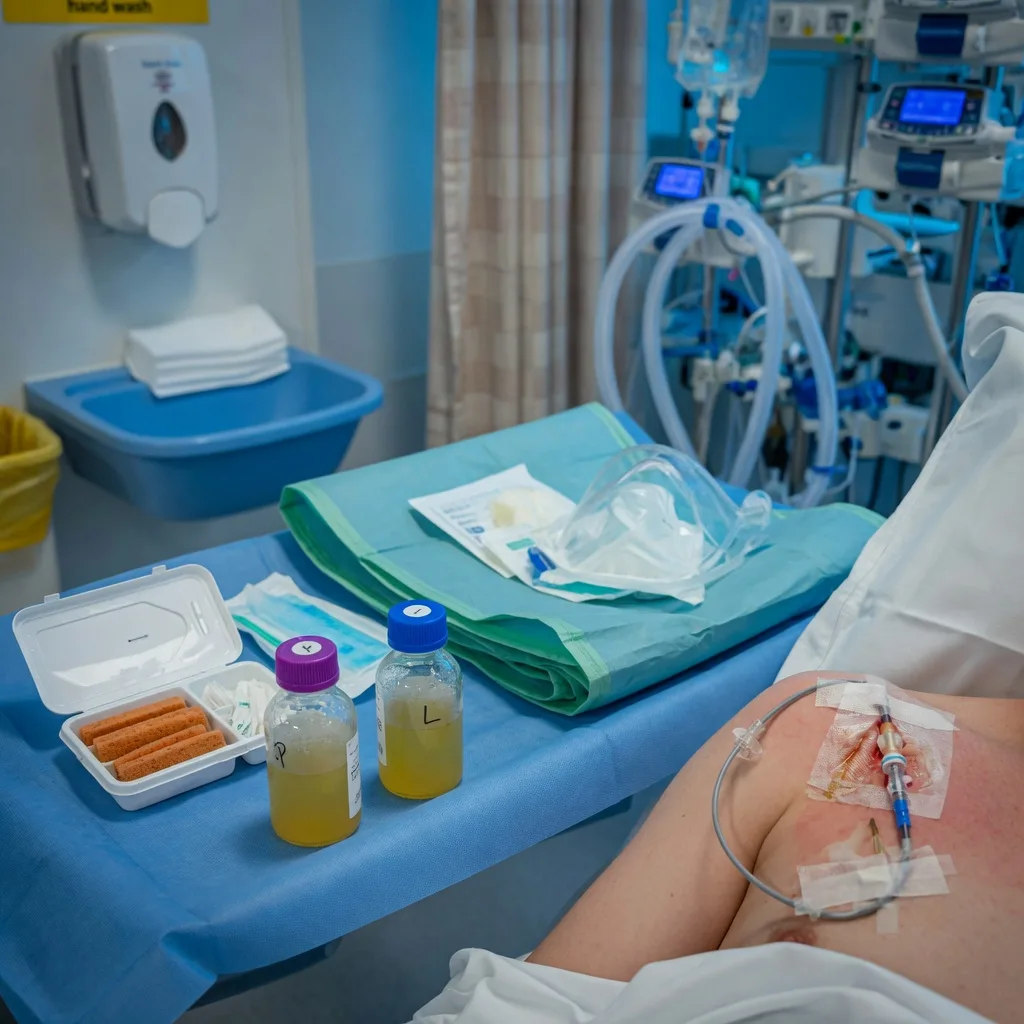
The ICU-acquired infections are the infections that develop 48 hours or more after the ICU admission — they are the complications of the critical care itself. The four commonest are the ventilator-associated pneumonia (the VAP), the catheter-related bloodstream infection (the CRBSI, the CLABSI), the catheter-associated urinary tract infection (the CAUTI), and the Clostridioides difficile colitis. Each increases the mortality (by 5 to 15 per cent per infection), the length of stay (by 4 to 10 days per infection), and the cost, and each is largely PREVENTABLE through the evidence-based bundles.[1][1]
The VAP: definition and diagnosis
The VAP is the pneumonia that develops 48 hours or more after the intubation. It presents with the new or the progressive infiltrate on the chest X-ray, plus the fever, the leukocytosis, and the purulent secretions.[1]
The diagnosis is the clinical (the CPIS — the Clinical Pulmonary Infection Score, semi-quantitative) or the microbiological (the bronchoalveolar lavage — the BAL, the quantitative culture at the 10,000 CFU/mL threshold; or the mini-BAL). The microbiological diagnosis reduces the unnecessary antibiotics (the over-treatment of the colonised patient) and the resistance.[1][1]
The VAP: the prevention bundle
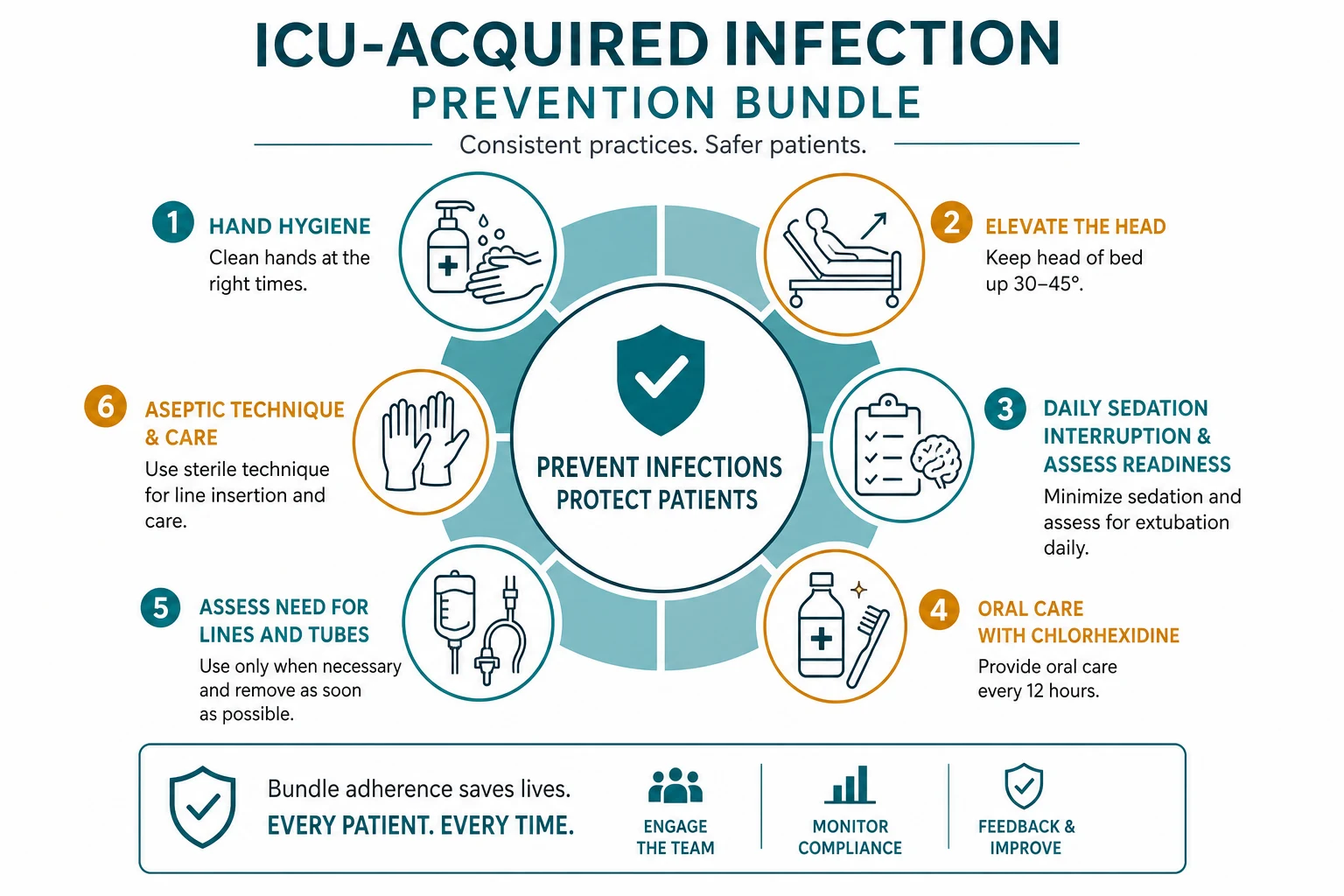
The VAP prevention is the "ventilator bundle" — the set of the evidence-based interventions that reduce the VAP rate:[1]
- The head of the bed elevated 30 to 45 degrees — the gravity reduces the aspiration of the oropharyngeal secretions.
- The daily sedation interruption — the earlier awakening, the earlier weaning, the reduced duration of the intubation.
- The oral care with chlorhexidine (or the tooth-brushing) — the reduction of the oropharyngeal bacterial load.
- The peptic ulcer prophylaxis — the stress ulcer bleeding prevention (the selective use).
- The DVT prophylaxis — the standard for the ventilated patient.
- The subglottic secretion drainage — for the prolonged ventilation (reduces the pooling above the cuff). [1]
The VAP: the management

The early, the appropriate, the short-course antibiotics. The empirical antibiotic is guided by the local antibiogram and the patient's risk factors (the late-onset VAP — over 5 days — and the prior antibiotics increase the risk of the MDR organisms — the Pseudomonas, the Acinetobacter, the MRSA). The de-escalation once the culture returns. The short course — 7 to 8 days for most VAPs (the evidence shows no benefit of the longer course except for the non-fermenting Gram-negatives like the Pseudomonas).[1][1]
The CRBSI: the prevention and the diagnosis
The CRBSI is the bloodstream infection from the central venous catheter. The prevention is the "central line bundle":[1]
- The full-barrier precautions at the insertion (the cap, the mask, the sterile gown, the gloves, the large drape).
- The chlorhexidine skin preparation (the 2 per cent alcoholic, the allowed drying).
- The subclavian vein preferred over the femoral (the lower infection rate) and the jugular (the intermediate).
- The daily review of the line necessity — the prompt removal when no longer needed.
- The chlorhexidine-impregnated sponge or the dressing for the prolonged use.[1][1]
The diagnosis — the paired blood cultures (the peripheral AND the catheter-drawn, with the differential time to positivity — the catheter culture positive more than 2 hours before the peripheral suggests the CRBSI). The management: the catheter removal (and the culture of the tip — the semi-quantitative roll-plate, the 15 CFU threshold), and the targeted antibiotics (the vancomycin for the Gram-positive, the Gram-negative cover guided by the local pattern).[1]
The CAUTI and the C. difficile
The CAUTI — the catheter-associated UTI is prevented by the minimisation of the catheter duration (the daily review, the alternative collection), the aseptic insertion, and the closed drainage. The treatment is the targeted antibiotic and the catheter change.[1]
The C. difficile colitis — the antibiotic-associated diarrhoea, from the disruption of the gut flora. The risk factors: the broad-spectrum antibiotics (the clindamycin, the cephalosporin, the fluoroquinolone), the PPI, the age, the prolonged stay. The diagnosis: the stool toxin assay. The treatment: the stop the offending antibiotic (if possible), the oral vancomycin (125 mg QID) or the fidaxomicin (the preferred, the lower recurrence rate), and the severe case (the megacolon, the perforation) — the surgery.[1][1]
The five major ICU-acquired infections — the comparative framework
The intensivist must distinguish the five device- and the procedure-related ICU infections, for each has its own pathogenesis, its own diagnostic standard, and its own prevention bundle. The common principle is the same — the organism reaches the sterile site along the device or the wound, and the DURATION of the device (or the wound) is the dominant risk factor for each.[1][1]
The five major ICU-acquired infections — the comparative framework
| The infection | The device / the portal | The typical organism | The diagnostic gold standard | The dominant prevention |
|---|---|---|---|---|
| The VAP | The endotracheal tube (the micro-aspiration around the cuff) | The polymicrobial — the Pseudomonas, the Acinetobacter, the MRSA, the Enterobacteriaceae | The quantitative BAL / the mini-BAL (the 10,000 CFU/mL threshold) | The ventilator bundle (the head-up 30 to 45, the SAT, the subglottic suction) |
| The CRBSI / the CLABSI | The central venous catheter (the biofilm on the luminal or the external surface) | The coagulase-negative staphylococcus, the Staphylococcus aureus, the enterococcus, the Candida, the Gram-negative | The paired blood cultures (the differential time to positivity over 2 hours) | The central line bundle (the full-barrier, the CHG prep, the subclavian, the daily review) |
| The CAUTI | The urinary catheter (the ascending colonisation) | The E. coli, the Klebsiella, the Enterococcus, the Candida, the Pseudomonas | The urine culture over 100,000 CFU/mL plus the symptoms | The avoidance (the daily review, the aseptic insertion, the closed drainage) |
| The C. difficile | The gut-flora disruption (the antibiotic, the PPI) | The toxigenic C. difficile (the toxin A, the toxin B) | The stool toxin assay (the NAAT plus the toxin EIA) | The stewardship, the contact isolation, the environmental cleaning with the bleach |
| The SSI | The surgical wound (the inoculation at the operation) | The S. aureus, the streptococcus, the Gram-negative (the wound-dependent) | The clinical (the purulence, the dehiscence) plus the wound culture | The perioperative bundle (the timing of the prophylaxis, the normothermia, the glycaemic control) |
The surgical site infection (the SSI) — the fifth ICU-acquired infection
The SSI is the infection of the surgical wound — the incisional (the superficial or the deep) or the organ-space. It is the only ICU-acquired infection that begins OUTSIDE the ICU (at the operation) but declares itself IN the ICU on the post-operative days 2 to 7. The CDC grades the SSI into the superficial incisional (the skin and the subcutaneous tissue), the deep incisional (the fascia and the muscle), and the organ-space (any part opened or manipulated).[1][9]
The risk factors — the wound class (the dirty and the contaminated wounds carry the 10 to 27 per cent risk), the long operative duration, the poor glycaemic control (the perioperative glucose over 11 mmol/L), the hypothermia, the hypoxaemia, the shaving (the razor — the clipper is preferred), the failure of the prophylactic antibiotic, the smoking, and the obesity. [1]
The prevention — the perioperative bundle (the CDC 2017 SSI guideline):[9]
- The prophylactic antibiotic within the 60 minutes before the incision (the vancomycin and the fluoroquinolone may start the 120 minutes before — the longer infusion). The re-dose during the long operation (every two half-lives — the cefazolin every 4 hours, or at the blood loss over the 1.5 L).
- The skin preparation with the alcohol-based chlorhexidine (the allowed air-dry — the alcohol is the rapid killer, the chlorhexidine the persistent).
- The normothermia (the core over the 36C — the hypothermia impairs the neutrophil function and the wound oxygenation).
- The perioperative glycaemic control (the glucose under the 11 mmol/L — the hyperglycaemia impairs the neutrophil function).
- The normoxia with the high FiO2 (the supplemental oxygen 80 per cent in the recovery — the oxygen kills the anaerobes and supports the oxidative killing of the neutrophil).
- The hair clipping (not the shaving — the razor creates the abrasions that harbour the bacteria).
- The preoperative bathing with the chlorhexidine (the night before and the morning of the operation). [1]
The diagnosis and the management — the clinical (the erythema, the purulence, the pain, the dehiscence, the fever on the days 3 to 7), the wound culture (the superficial swab is poor — the deep tissue or the aspiration is preferred), and the imaging (the CT for the organ-space, the dehiscence of the fascia). The management: the open the wound, the debride the necrotic tissue, the targeted antibiotic (the narrow-spectrum for the superficial, the broad for the deep and the organ-space). The fascial dehiscence (the burst abdomen) is the surgical emergency. [1]
The expanded ventilator bundle — the full VAP prevention
The VAP is prevented not by one intervention but by the BUNDLE — the simultaneous application of the several evidence-based measures, each modest on its own but powerful together. The modern bundle (the IHI 100,000 Lives Campaign, the SHEA/IDSA 2014 and the 2022 update) extends beyond the original five.[3]
The ventilator bundle — the full VAP prevention
- THE HEAD OF THE BED ELEVATED 30 TO 45 DEGREES — the gravity reduces the pooling and the micro-aspiration of the oropharyngeal secretions above the cuff. This is the single best-studied element. The compliance is audited at the bedside — the angle-indicator on the bed. The exception is the active haemorrhage, the spinal precaution, and the profound hypotension (the flat for the resuscitation, then the head-up).
- THE DAILY SEDATION INTERRUPTION (THE SAT — THE SPONTANEOUS AWAKENING TRIAL) paired with the daily spontaneous breathing trial (the SBT) — the earlier awakening, the earlier weaning, the reduced duration of the intubation (and every day off the ventilator is a day the VAP cannot occur). The SAT and the SBT together are the "wake up and breathe." The contraindications: the active seizure, the untreated agitation, the high airway pressure, the escalating vasopressors, the paralytic infusion.
- THE ORAL CARE WITH THE CHLORHEXIDINE (the 0.12 per cent or the 2 per cent) and the tooth-brushing — the reduction of the oropharyngeal bacterial load, the reservoir for the VAP pathogens. NOTE the controversy: the 2014 SHEA/IDSA update and the 2022 update recommend AGAINST the routine oral chlorhexidine for the patient WITHOUT the oropharyngeal risk (the possible mortality signal, the resistance) — the MECHANICAL tooth-brushing is the BETTER-evidenced and the safer intervention. The consensus: the chlorhexidine for the high-risk (the post-cardiac-surgery, the immunosuppressed), the tooth-brushing for the rest.
- THE PEPTIC ULCER PROPHYLAXIS (THE STRESS ULCER) — the SELECTIVE use (the ventilated over the 48 hours, the coagulopathy, the shock, the prior GI bleed, the major burn). The PPI or the H2-blocker. NOTE the trade-off: the PPI raises the C. difficile risk (the gastric alkalinisation allows the spore germination) — the SELECTIVE use minimises this.
- THE DEEP VEIN THROMBOSIS PROPHYLAXIS — the LMWH (the enoxaparin 40 mg SC daily) for the medical and the surgical patient, with the mechanical (the IPC) when the anticoagulation is contraindicated. The DVT prophylaxis does not prevent the VAP directly but is the part of the original IHI bundle (it reduces the mortality of the ventilated patient).
- THE SUBGLOTTIC SECRETION DRAINAGE — for the patient expected to be intubated over the 48 to 72 hours, the specialised endotracheal tube with the subglottic suction port evacuates the pooled secretions above the cuff (the bacterial soup that otherwise trickles past). Reduces the early-onset VAP.
- THE CUFF PRESSURE MAINTAINED 20 TO 30 cmH2O — the cuff is the seal; the low cuff allows the micro-aspiration, the high cuff causes the mucosal ischaemia and the stricture. The cuff pressure is checked and the set daily (the manual manometer, NOT the subjective "pilot balloon feel" — which over-estimates the pressure).
- THE EARLY MOBILISATION — the sitting, the standing, the walking of the ventilated patient. Reduces the duration of the ventilation, the atelectasis, and the ICU-acquired weakness.
- THE MINIMISATION OF THE SEDATION AND THE AVOIDANCE OF THE PARALYTIC — the protocolised sedation (the light target, the RASS 0 to the -1), the daily review. The paralytic is the last resort and requires the depth-of-sedation and the depth-of-paralysis monitoring.
The expanded CRBSI bundle — the central line "checklist"
The Pronovost Keystone study (the NEJM 2006) is the most famous quality-improvement trial in medicine: a five-element checklist, implemented in the 103 ICUs in Michigan, REDUCED the median CRBSI rate from the 2.7 to the 0 per the 1,000 catheter-days at three months, and the effect SUSTAINED at the 18 months (the mean 1.4). The lesson: the simple bundle, done every time, beats the clever antibiotic.[1]
The central line insertion bundle — the Pronovost checklist
- THE HAND HYGIENE before and after the palpation and the insertion (the alcohol-based rub or the soap-and-water — see the WHO Five Moments below).
- THE FULL MAXIMAL STERILE BARRIER PRECAUTIONS — the cap, the mask (covering the mouth AND the nose), the sterile gown, the sterile gloves, AND the FULL-BODY sterile drape (the large drape, not the small fenestrated one). The operator AND the assistant. This is the element most often skipped — and the one with the largest single effect.
- THE CHLORHEXIDINE SKIN PREPARATION (the over the 2 per cent chlorhexidine in the 70 per cent alcohol, the allowed AIR-DRY — the alcohol needs the contact time, the chlorhexidine the persistence; do NOT fan or blot).
- THE OPTIMAL SITE SELECTION — the subclavian vein PREFERRED over the jugular (the intermediate) and the femoral (the AVOIDED — the highest infection rate AND the highest thrombosis). The trade-off: the subclavian carries the pneumothorax and the cannot-be-compressed bleeding; the femoral is the compressible but the infective; the jugular is the compromise. The ultrasound guidance for the safety (the fewer attempts), the site for the infection.
- THE DAILY REVIEW OF THE LINE NECESSITY — the question every morning, "Does this patient need this line today?" and the prompt removal when the answer is no. The duration of the catheterisation is the STRONGEST risk factor for the CRBSI.
The additional central-line MAINTENANCE measures:[2]
- The chlorhexidine-impregnated sponge dressing (the Biopatch) at the exit site — for the central line expected to remain over the 5 days. Reduces the catheter-colonisation and the CRBSI.
- The chlorhexidine-impregnated transparent dressing (the Tegaderm CHG) — the alternative, with the continuous release of the chlorhexidine into the skin interface.
- The "scrub the hub" — the 15-second alcohol or the chlorhexidine wipe of EVERY access port before and after the use. The hub is the most common portal for the luminal CRBSI.
- The replacement of the administration sets at the 96-hour interval (the 24-hour if the propofol or the blood product — the lipid-rich growth medium).
- The AVOID the routine guidewire exchange — the guidewire exchange of the suspected-infected line INCREASES the infection. The removal and the new site (the guidewire exchange ONLY for the mechanical failure, NOT for the infection). [1]
The WHO Five Moments of Hand Hygiene
The hand hygiene is the SINGLE most effective infection-prevention measure in the ICU, yet the compliance (without the active program) hovers at the 40 per cent. The WHO 2009 framework operationalises the hand hygiene into the FIVE moments — the five points at which the hands of the healthcare worker must be decontaminated (the alcohol-based rub as the default, the soap-and-water when the visible soiling or the spore-former — the C. difficile).[1]
The WHO Five Moments for Hand Hygiene
- MOMENT 1 — BEFORE TOUCHING A PATIENT. Protects the patient from the flora on the healthcare worker's hands (the hand-to-skin, the hand-to-mucous-membrane transmission). The examples: the taking the pulse, the blood pressure, the turning, the bathing.
- MOMENT 2 — BEFORE A CLEAN / ASEPTIC TASK. Protects the patient from the entry of the healthcare worker's flora into the sterile field. The examples: the dressing change, the line insertion, the suction, the medication preparation.
- MOMENT 3 — AFTER THE BODY FLUID EXPOSURE RISK. Protects the healthcare worker and the environment from the patient's organisms. The examples: the blood draw, the line access, the catheter care, the suction, the handling of the waste.
- MOMENT 4 — AFTER TOUCHING A PATIENT. Protects the healthcare worker and the immediate environment. The examples: the taking the pulse, the examination, the turning.
- MOMENT 5 — AFTER TOUCHING THE PATIENT'S SURROUNDINGS. Protects the healthcare worker and the next patient from the contamination of the environment. The examples: the bedrails, the monitor, the IV pump, the charts, the bedside table.
- The alcohol-based rub is NOT effective against the C. difficile spores (nor the Norovirus). The SOAP-AND-WATER is required after the care of the C. difficile patient (the spores are physically washed off).
- The glove is NOT a substitute for the hand hygiene — the hands become contaminated during the glove removal, and the same Moment-1-to-5 rules apply to the gloved AND the ungloved hand.
- The hand hygiene BEFORE the glove (the Moment 1 and the Moment 2) is the most-missed — the false sense of security from the glove. [1]
The chlorhexidine bathing
The daily bathing of the ICU patient with the 2 per cent chlorhexidine-impregnated washcloths (the CHG bathing) reduces the colonisation and the infection. The Climo 2013 NEJM trial (the multicentre, the cluster-randomised, the crossover): the daily CHG bathing REDUCED the hospital-acquired bloodstream infection by the 28 per cent and the acquisition of the multidrug-resistant organism by the 23 per cent — with NO serious skin reactions.[7]
The indications — the highest benefit in the ICU with the high baseline rate of the MDR organism and the CRBSI. The patient with the central line, the surgical wound, the drain, the prolonged stay. The caveats — the chlorhexidine is INEFFECTIVE against the C. difficile (the spore — use the soap-and-water), the rare skin reaction (the contact dermatitis, the rare anaphylaxis), and the concern for the resistance (the low-level, the long-term surveillance ongoing). The patient with the open wound or the burn — the chlorhexidine into the wound is avoided (the cytotoxic to the fibroblast). [1]
The surveillance and the feedback
The measurement of the infection rate is the PREREQUISITE for the improvement — the "what gets measured gets done." The ICU-acquired infection rates are tracked, expressed per the 1,000 device-days (the VAP per the 1,000 ventilator-days, the CLABSI per the 1,000 line-days, the CAUTI per the 1,000 catheter-days), and FED BACK to the clinicians.[1][1]
The components of the effective surveillance: [1]
- The standardised definition (the CDC NHSN — the National Healthcare Safety Network — for the CLABSI, the CAUTI, the SSI; the VAP is harder — the CDC moved to the ventilator-associated event, the VAE, the OBJECTIVE surveillance definition, because the clinical VAP is the unreliable across the observers).
- The denominator — the device-days — the daily count of the patients with the device (the ventilator, the central line, the urinary catheter), so the rate is the comparable across the units and the time.
- The risk-adjusted comparison — the unit-to-unit, the hospital-to-hospital benchmark.
- The feedback to the front line — the rate displayed in the open, the unit-level dashboard, the monthly review at the staff meeting. The Pronovost Keystone success was as much the FEEDBACK (and the culture change, the empowering the nurse to stop the unsafe line) as the checklist itself.
- The root-cause analysis of the each CLABSI — the "what went wrong, what could we change." [1]
The antimicrobial stewardship — the over-arching principle
The antibiotic is the double-edged sword — it cures the infection AND it selects the resistance, the C. difficile, and the colonisation by the MDR organism. The stewardship is the systematic effort to optimise the antibiotic use — the RIGHT drug, the RIGHT dose, the RIGHT route, the RIGHT duration, and the STOP when the infection is excluded.[1][1]
The four pillars of the ICU stewardship: [1]
The four pillars of the ICU antimicrobial stewardship
| The pillar | The intervention | The evidence |
|---|---|---|
| The procalcitonin-guided (the PCT) decision | The serial serum procalcitonin — the START the antibiotic when the PCT is the high (over the 0.5 ng/mL, or the rising); the STOP when the PCT falls by the 80 per cent or the under the 0.5 ng/mL | The Schuetz 2017 Cochrane (the individual-patient-data, the 26 RCTs, the 6,708 patients): the PCT-guided therapy REDUCED the antibiotic exposure by the 2.4 days AND the mortality (8.6 vs the 10.0 per cent). The caveat: the PCT NEVER overrides the clinical judgement — the empiric antibiotic is started in the sick patient, the PCT guides the STOP.[8] |
| The de-escalation | The narrowing of the antibiotic once the culture and the sensitivity return — from the broad (the meropenem + the vancomycin) to the narrow (the amoxicillin, the cefuroxime) | The early appropriate antibiotic saves the life (the septic shock); the continued broad antibiotic selects the resistance. The de-escalation is the safe and the standard once the pathogen and the sensitivity are the known. |
| The intravenous-to-oral (the IV-to-PO) conversion | The switch to the oral when the patient is the haemodynamically stable, the afebrile for the 24 to 48 hours, the improving, and the functional gut (the oral antibiotic with the good bioavailability — the fluoroquinolone, the linezolid, the fluconazole, the metronidazole) | The early switch saves the line (and the CRBSI risk), the cost, and the hospital day. The bioavailability of the linezolid and the fluoroquinolone is the near 100 per cent — the oral is the equivalent of the IV. |
| The duration and the stop | The defined duration for the every infection (the 7 days for the VAP, the 7 days for the intra-abdominal, the 5 days for the CAP) and the automatic STOP on the day | The Chastre 2003 JAMA: the 8 days = the 15 days for the VAP (the exception of the non-fermenting Gram-negative — the Pseudomonas — where the longer course reduces the recurrence).[5] The Kalil 2016 IDSA/ATS: the 7-day course for the most VAP.[4] |
The stewardship at the bedside — the daily "antibiotic time-out": [1]
- Does this patient have an infection? (The stop if the fever was the non-infective — the drug fever, the PE, the adrenal insufficiency, the withdrawal.)
- Have I got the cultures? (The blood, the urine, the sputum, the wound — BEFORE the antibiotic if possible.)
- Is the antibiotic the right one? (The narrow to the culture, the right dose for the renal and the hepatic function.)
- How long? (The defined stop-day.)
- Can I switch to the oral? (The IV-to-PO.) [1]
The 2016 IDSA/ATS HAP/VAP guideline FURTHER streamlined the VAP: the REMOVAL of the HCAP category (the "healthcare-associated pneumonia" — the over-broad, the over-treated), the preference for the NON-invasive sampling (the endotracheal aspirate over the bronchoscopy), the 7-day duration for the most, and the strong recommendation for the LOCAL ANTIBIOGRAM.[4]
Management: the integrated infection-prevention approach
- The bundles — the ventilator bundle for the VAP, the central line bundle for the CRBSI, the catheter care for the CAUTI.[1]
- The antibiotic stewardship — the right drug, the right dose, the right duration, the de-escalation, the stop when the infection is excluded.[1][1]
- The hand hygiene — the most effective single infection-prevention measure.[1]
- The surveillance — the ICU-acquired infection rates tracked, fed back, and acted upon.[1]
Monitoring
- The temperature, the white count, the inflammatory markers — for the early detection.
- The chest X-ray, the secretions — for the VAP.
- The line sites, the blood cultures — for the CRBSI.
- The stool chart, the toxin assay — for the C. difficile. [1]
Prognosis
Each ICU-acquired infection increases the mortality (by 5 to 15 per cent), the stay (by 4 to 10 days), and the cost. The prevention (the bundles, the stewardship, the hand hygiene) is more effective than the treatment, and the zero-VAP, the zero-CLABSI targets are the modern standard.[1][1]
SAQ — Diagnosis and management of ventilator-associated pneumonia
10 minutes · 10 marks
A 65-year-old man has been intubated for 6 days for severe ARDS. He develops new fever (38.9°C), purulent respiratory secretions, rising FiO2 requirement, and a new infiltrate in the right lower lobe. His white cell count is 16 ×10^9/L. The team asks for the diagnosis and management.
SAQ — Central-line-related bloodstream infection (CRBSI)
10 minutes · 10 marks
A 50-year-old woman with a triple-lumen central line for inotropic support develops fever and rigors 30 minutes after the line is accessed. Blood cultures drawn from the line and peripherally both grow coagulase-negative Staphylococcus. Outline the diagnosis, management, and prevention.
Red flags
Clinical pearls
Key trials and evidence
Pronovost 2006 (Keystone) — the central-line checklist (PMID 17192537)
Study design
Prospective, collaborative, cohort — the 103 ICUs in Michigan, the before-and-after
Population
The adult ICUs (the medical, the surgical, the cardiac)
Intervention
The five-element central-line bundle (the hand hygiene, the full maximal barrier, the chlorhexidine prep, the avoid the femoral, the remove the unnecessary) + the checklist + the central-line cart + the feedback + the empower the nurse
Primary outcome
The median CRBSI per the 1,000 catheter-days: the 2.7 (baseline) to the 0 (at the 3 months) — the large, SUSTAINED reduction
The 18-month follow-up
The mean CRBSI the 7.7 (baseline) to the 1.4 per the 1,000 catheter-days — the effect persisted (and improved) over the time
Clinical bottom line
The simple bundle, done every time, with the culture and the feedback, ELIMINATES the CRBSI in most ICUs. The most-cited quality-improvement trial in medicine. The lesson: the SYSTEM, not the individual clinician, is the driver of the infection.
Chastre 2003 (PneumA) — 8 vs 15 days for the VAP (PMID 14625336)
Study design
Randomised, multicentre — the 401 patients
Population
The adults with the microbiologically proven VAP
Intervention
The 8-day vs the 15-day antibiotic course
Primary outcome
The 28-day mortality: 18.8 per cent (the 8 days) vs 17.2 per cent (the 15 days) — NO significant difference
The recurrence
No overall difference — BUT the non-fermenting Gram-negative (the Pseudomonas, the Acinetobacter) had the HIGHER recurrence at the 8 days (40.6 vs the 25.4 per cent), though NOT the higher mortality
Clinical bottom line
The 8-day VAP course = the 15-day course for the mortality and the recurrence. The exception: the non-fermenting Gram-negative — consider the longer course. This underpins the 7-day standard (the Kalil 2016 guideline).
Climo 2013 — the daily chlorhexidine bathing (PMID 23387823)
Study design
Multicentre, cluster-randomised, crossover — the 9 ICUs and the bone-marrow-transplant units
Population
The 7,727 patients over the 74,000 patient-days
Intervention
The daily bathing with the 2 per cent chlorhexidine-impregnated washcloths vs the non-antimicrobial washcloths
Primary outcome
The primary bloodstream infection: 28 per cent LOWER with the chlorhexidine (4.78 vs the 6.60 per the 1,000 patient-days)
The secondary
The acquisition of the multidrug-resistant organism: 23 per cent lower. No serious skin reactions.
Clinical bottom line
The daily CHG bathing reduces the CRBSI and the MDR acquisition in the ICU — the cheap, the effective, the safe. The standard in the high-risk ICU. The CAVEAT: the chlorhexidine does NOT kill the C. difficile spore.
Schuetz 2017 (Cochrane) — the procalcitonin-guided antibiotic (PMID 29023707)
Study design
The systematic review and the individual-patient-data meta-analysis — the 26 RCTs, the 6,708 patients
Population
The adults with the acute respiratory infection (the pneumonia, the exacerbation of the COPD, the bronchitis) across the primary care, the ED, and the ICU
Intervention
The procalcitonin-guided initiation and the discontinuation of the antibiotic vs the routine care
Primary outcome
The 30-day all-cause mortality: 8.6 per cent (the PCT) vs the 10.0 per cent (the routine) — the PCT-guided was the NON-INFERIOR (and the trend to the superior)
The antibiotic exposure
The 2.4-day reduction in the total antibiotic days, and the lower rate of the antibiotic prescription
Clinical bottom line
The procalcitonin-guided antibiotic is the SAFE (no increase in the mortality or the treatment failure) and the EFFECTIVE (the less antibiotic). The caveat: the PCT guides the STOP, NEVER the START — the empiric antibiotic is started in the sick patient.
Prognosis (expanded)
Each ICU-acquired infection increases the mortality (by the 5 to the 15 per cent), the stay (by the 4 to the 10 days), and the cost. The prevention (the bundles, the stewardship, the hand hygiene) is more effective than the treatment, and the zero-VAP, the zero-CLABSI targets are the modern standard. The prognosis is the worst for the patient with the MDR organism (the Pseudomonas, the Acinetobacter, the VRE, the ESBL, the CRE) — the limited antibiotic options, the higher mortality, the longer stay. The prognosis is the best for the unit with the high bundle compliance, the active surveillance, the stewardship, and the culture of the safety. The ICU-acquired infection is the MEASURE of the QUALITY of the critical care — and the preventable infection is the NEVER-EVENT.[1][1][1]
References
- [1]Pronovost P, Needham D, Berenholtz S, et al. An intervention to decrease catheter-related bloodstream infections in the ICU N Engl J Med, 2006.PMID 17192537
- [2]O'Grady NP, Alexander M, Burns LA, et al. (CDC/HICPAC) Guidelines for the prevention of intravascular catheter-related infections Clin Infect Dis, 2011.PMID 21460264
- [3]Klompas M, Branson R, Eichenwald EC, et al. (SHEA/IDSA) Strategies to prevent ventilator-associated pneumonia in acute care hospitals: 2014 update Infect Control Hosp Epidemiol, 2014.PMID 25026607
- [4]Kalil AC, Metersky ML, Klompas M, et al. (IDSA/ATS) Management of Adults With Hospital-acquired and Ventilator-associated Pneumonia: 2016 Clinical Practice Guidelines by the Infectious Diseases Society of America and the American Thoracic Society Clin Infect Dis, 2016.PMID 27418577
- [5]Chastre J, Wolff M, Fagon JY, et al. (PneumA Trial Group) Comparison of 8 vs 15 days of antibiotic therapy for ventilator-associated pneumonia in adults: a randomized trial JAMA, 2003.PMID 14625336
- [6]McDonald LC, Gerding DN, Johnson S, et al. (IDSA/SHEA) Protein-mediated looping of DNA under tension requires supercoiling Nucleic Acids Res, 2018.PMID 29365152
- [7]Climo MW, Yokoe DS, Warren DK, et al. Efficacy of combined antiviral therapy with lamivudine and tenofovir in a liver transplanted girl with de novo hepatitis B virus infection Transpl Infect Dis, 2013.PMID 23387823
- [8]Schuetz P, Wirz Y, Sager R, et al. Guidelines for the use of flow cytometry and cell sorting in immunological studies Eur J Immunol, 2017.PMID 29023707
- [9]Berrios-Torres SI, Umscheid CA, Bratzler DW, et al. (CDC/HICPAC) Centers for Disease Control and Prevention Guideline for the Prevention of Surgical Site Infection, 2017 JAMA Surg, 2017.PMID 28467526