ICU · Resuscitation & shock
Anaphylaxis & Anaphylactic Shock
Also known as Anaphylaxis · Anaphylactic shock · Anaphylactoid reaction · IM adrenaline · Tryptase · EpiPen
Anaphylaxis — the severe, life-threatening systemic hypersensitivity reaction. The rapid onset (the skin/mucosal + the respiratory + the cardiovascular + the GI). The IgE-mediated (most) or the non-IgE (the anaphylactoid). The IM adrenaline 0.5 mg FIRST; the 100% O2; the IV fluid; the positioning. The IV adrenaline infusion for the refractory. The tryptase for the diagnosis. The observation 6-24 h (the biphasic).
On this page & tools
Your progress
Saved locally on this device.
Target exams
Overview & definition
Anaphylaxis — the severe, the life-threatening, the systemic hypersensitivity reaction. The rapid onset (minutes to hours). The multiple systems: the skin/mucosal, the respiratory, the cardiovascular, the GI. The leading cause of death: the airway obstruction (the laryngeal oedema) and the circulatory collapse (the vasodilation + the myocardial depression). The IM adrenaline 0.5 mg is the first-line treatment.[1][1]
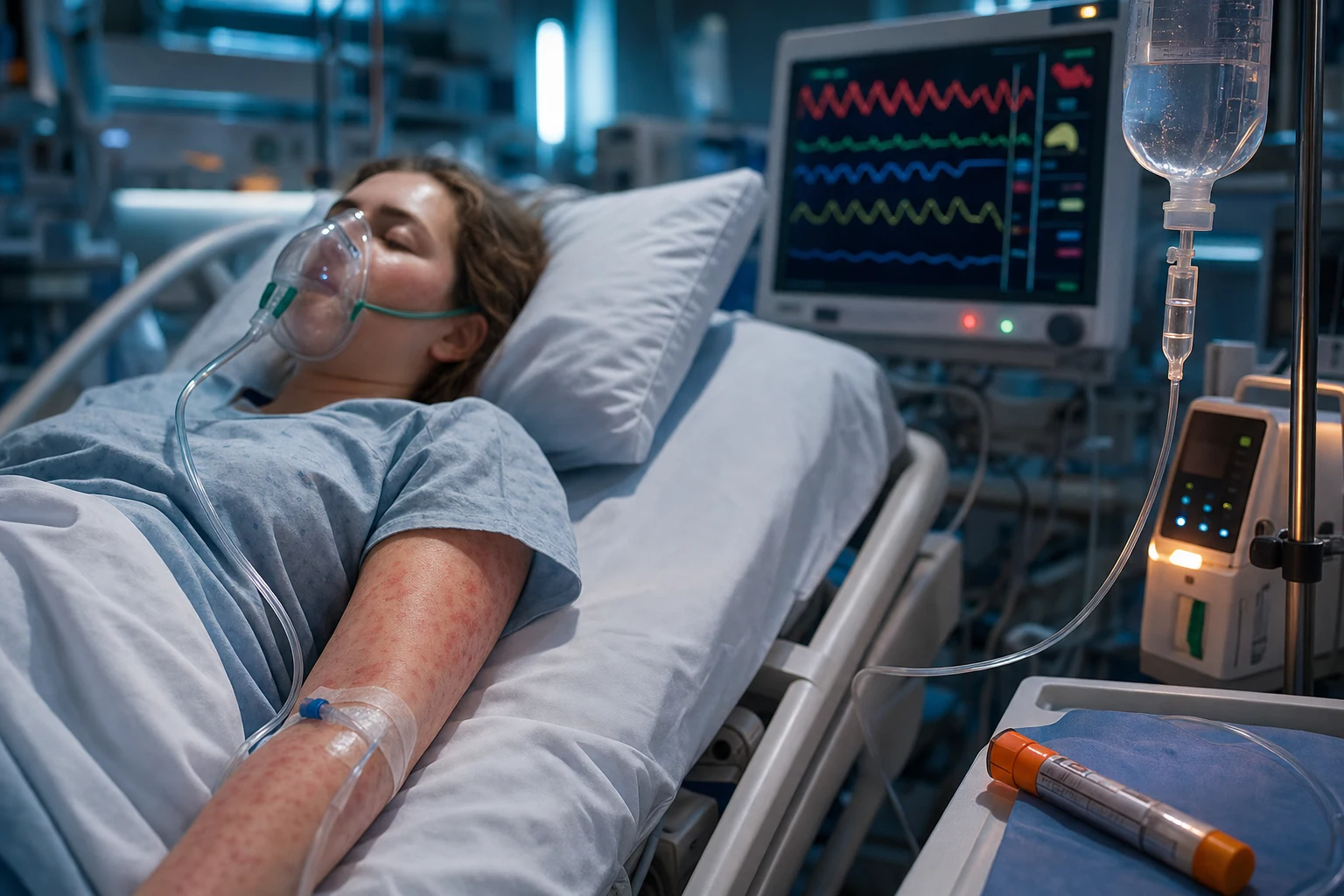
The clinical — the WAO criteria
The WAO 2020 criteria for the diagnosis of the anaphylaxis (any ONE of the three):[1]
- The acute onset (minutes-hours) of the skin/mucosal (the urticaria, the angioedema, the flushed) + at least ONE of: the respiratory (the wheeze, the stridor, the dyspnoea), the cardiovascular (the hypotension, the collapse), the end-organ (the GI, the dizziness).[1]
- The TWO OR MORE of the following after the exposure to a likely allergen: the skin/mucosal, the respiratory, the cardiovascular, the GI (the vomiting, the diarrhoea, the cramping).[1]
- The hypotension after the exposure to a known allergen (the adult SBP below 90 or the 30% drop from the baseline).[1]
The NIAID/FAAN diagnostic criteria — the foundational 2006 consensus
The NIAID/FAAN (the National Institute of Allergy and Infectious Diseases / the Food Allergy and Anaphylaxis Network) second symposium 2006 criteria — the diagnostic framework later adopted and refined by the WAO. The anaphylaxis is highly likely when ANY ONE of the three criteria is fulfilled:[3][4]
Criterion 1. The acute onset (the minutes to the several hours) of an illness with the involvement of the skin and/or the mucosal tissue (the generalised urticaria, the pruritus or the flush, the swollen lips-tongue-uvula) AND at least ONE of the following:
- The respiratory compromise (the dyspnoea, the wheeze, the stridor, the hypoxaemia, the reduced PEF).
- The reduced BP or the associated symptoms of the end-organ dysfunction (the collapse, the syncope, the incontinence).
- The severe GI symptoms (the crampy abdominal pain, the repetitive vomiting), especially after a food allergen. [1]
Criterion 2. The TWO OR MORE of the following that occur rapidly AFTER the exposure to a LIKELY allergen for that patient (a food, a drug, an insect sting, a contrast agent, a latex, an exercise):
- The skin/mucosal (the urticaria, the flush, the angioedema, the pruritus).
- The respiratory compromise (the wheeze, the stridor, the hypoxaemia).
- The reduced BP or the associated symptoms (the collapse, the syncope, the dizziness).
- The persistent GI symptoms (the vomiting, the cramping, the diarrhoea). [1]
Criterion 3. The reduced BP after the exposure to a KNOWN allergen for that patient:
- The adults — SBP below 90 mmHg (or the 30 per cent drop from the baseline).
- The infants and the children — SBP below 70 mmHg (1 month-1 yr), below 70 + (2 × age) (1-10 yr), below 90 (11-17 yr).[3]
The NIAID/FAAN criteria — the sensitivity around 95 per cent, the specificity the high. The limitation: the 5 per cent missed (the cardiovascular collapse alone WITHOUT the skin; the perioperative — the skin hidden under the drapes; the food anaphylaxis with the normal tryptase).[4]
The NIAID/FAAN 2006 vs the WAO 2020 — the diagnostic criteria
| Feature | The NIAID/FAAN 2006 | The WAO 2020 |
|---|---|---|
| Criterion 1 | Skin/mucosa + (respiratory OR reduced BP/end-organ OR severe GI) | Skin/mucosa + (respiratory OR cardiovascular OR end-organ/GI) |
| Criterion 2 | 2+ systems after a LIKELY allergen | 2+ systems after a LIKELY allergen |
| Criterion 3 | Reduced BP after a KNOWN allergen | Reduced BP after a KNOWN allergen |
| The GI | Criterion 1 (severe) + Criterion 2 | A standalone system |
| The paediatric BP | Explicit age-based thresholds | Adult thresholds adapted |
| The clinical use | The foundational criteria — still widely cited | The current international standard |
The severity grading — the Brown 3-grade system
The Brown SGA 2004 three-grade severity grading — the practical bedside and the research tool.[6]
- Grade 1 (mild): the skin and the subcutaneous tissue only (the urticaria, the flush, the angioedema) — WITHOUT the respiratory, the cardiovascular, or the severe GI.
- Grade 2 (moderate): the grade 1 features PLUS the mild-to-moderate respiratory (the wheeze, the dyspnoea), the cardiovascular (the tachycardia, the mild hypotension), OR the GI.
- Grade 3 (severe): the hypoxaemia (the cyanosis, the SpO2 below 92 per cent), the hypotension (the collapse, the syncope), and/or the neurological compromise (the confusion, the collapse, the incontinence). The highest risk of the biphasic and the death.[6]
The grade 3 reaction → the longer the observation (the 12-24 h); the grade 1 may be observed the 6 h if the rapid response. The grade predicts the biphasic and the adrenaline requirement. [1]
The pathophysiology
The IgE-mediated (most) — the allergen binds the IgE on the mast cells and the basophils → the degranulation → the release of the histamine, the tryptase, the leukotrienes, the prostaglandins, the platelet-activating factor. The non-IgE (the anaphylactoid) — the direct mast cell activation (the contrast media, the opioids, the vancomycin, the NSAIDs).[1][1]
The mediators → the vasodilation (the hypotension), the capillary leak (the oedema), the bronchoconstriction (the wheeze), the increased mucus secretion, the increased gut motility, the myocardial depression (the histamine — the direct the negative the inotropy).[1]
The triggers — the allergens and the agents
The anaphylaxis triggers — the IgE-mediated (the true allergy — the drugs, the foods, the venoms, the latex) and the non-IgE (the direct mast cell activation — the radiocontrast, the opioids, the vancomycin, the NSAIDs, the exercise, the cold). The idiopathic — the 20 per cent (the no trigger found despite the work-up).[5][14]
The common anaphylaxis triggers — the community vs the perioperative
| Trigger | The mechanism | The community (the ED) | The perioperative (the theatre/ICU) | The notes |
|---|---|---|---|---|
| The drugs — beta-lactams (penicillins, cephalosporins) | IgE | The #1 drug trigger | 15-20 per cent of perioperative | The penicillin-cephalosporin cross-reactivity the low (1-2 per cent with the modern side chains) |
| The drugs — NMBAs (rocuronium, suxamethonium, vecuronium) | IgE to the quaternary ammonium | Rare | The #1 perioperative trigger (60-70 per cent) | The cross-reactivity between the NMBAs the 60-70 per cent. The sugammadex reverses the NMBA — NOT the anaphylaxis |
| The drugs — NSAIDs (aspirin, ibuprofen, diclofenac) | Non-IgE (the COX-1 inhibition → the leukotriene) | Common | — | The class effect within the strong COX-1 inhibitors; the COX-2 selective (the celecoxib) usually tolerated |
| The drugs — radiocontrast media (the iodinated) | Non-IgE (the direct mast cell activation) | Common (the radiology) | — | The "iodine allergy" is the myth — the reaction is to the contrast molecule, NOT the iodine. The premedication (the steroid + the antihistamine) for the prior reactors |
| The drugs — vancomycin | Non-IgE (the direct degranulation — the Red Man Syndrome) | — | Common | The rate-dependent — slow the infusion (the NOT the anaphylaxis if the infusion slowed resolves it) |
| The foods (the peanut, the tree nut, the shellfish, the milk, the egg, the sesame) | IgE | The #1 cause in the children | — | The peanut and the tree nut — the most likely to be the severe and the fatal |
| The insect stings (the bee, the wasp, the hornet, the fire ant) | IgE to the venom | Common (the adults) | — | The beekeeper and the prior large local reaction — the higher risk |
| The latex | IgE (the Hevea proteins) | Decreasing (the healthcare workers, the spina bifida) | The decreasing — the latex-free theatre | The type I (anaphylaxis); NOT the type IV (the contact dermatitis) |
| The chlorhexidine | IgE | Under-recognised | 5-8 per cent perioperative (the skin prep, the central line, the urinary catheter lubricant) | The ubiquitous — the test if the unexplained perioperative reaction |
| The Patent Blue / the dyes | IgE | Rare | 2-4 per cent (the lymph node mapping — the breast, the melanoma) | The falsely low SpO2 for 1-2 min |
| The exercise / the cold / the co-factors | Non-IgE / the cofactor-augmented | The exercise-induced (the food + the exercise), the cold-induced | — | The cofactors (the NSAID, the alcohol, the exercise, the menstruation, the intercurrent infection) lower the threshold |
| The idiopathic | Unknown | 20 per cent | 5-10 per cent | The work-up (the tryptase, the skin testing, the component testing) — the referral to the allergy clinic |
The differential diagnosis — the mimics of the anaphylaxis
The anaphylaxis — the commonly over-diagnosed AND the under-diagnosed. The mimics — the vasovagal, the anxiety, the asthma, the carcinoid, the mastocytosis, the scombroid, the hereditary angioedema.[5][9]
The anaphylaxis vs the mimics — the distinguishing features
| Condition | The key distinguishing features | The trap |
|---|---|---|
| The vasovagal syncope | The pallor (NOT the flush/urticaria), the bradycardia (NOT the tachycardia), the nausea, the rapid resolution on the supine, the precipitant (the pain, the sight of blood). The NO urticaria, the NO bronchospasm, the normal tryptase | The over-diagnosis of the vasovagal in the young — the bradycardia can occur in the anaphylaxis too (the Bezold-Jarisch reflex from the empty ventricle) |
| The anxiety / the panic attack | The dyspnoea WITHOUT the wheeze/hypoxaemia, the tingling fingers (the hyperventilation → the respiratory alkalosis), the NO urticaria, the NO hypotension, the normal tryptase | The genuine anaphylaxis dismissed as the panic — the fatal error |
| The asthma | The isolated bronchospasm — the NO urticaria, the NO hypotension, the NO GI, the history of the asthma | The anaphylaxis may present as the isolated bronchospasm. The severe asthma after a food/drug → the anaphylaxis until proven otherwise |
| The carcinoid syndrome | The flush (NOT the urticaria), the diarrhoea, the right-heart valvular disease, the wheeze — the elevated 24-h urinary 5-HIAA, the NOT the tryptase | The flush in the carcinoid is the prolonged and the patchy — the anaphylaxis flush is the acute and the generalised |
| The systemic mastocytosis | The recurrent unexplained anaphylaxis, the urticaria pigmentosa, the Darier sign, the baseline tryptase elevated (above 20 mcg/L), the KIT D816V mutation | The trigger may be trivial (the wasp sting, the temperature change). The baseline tryptase above 20 → the mastocytosis |
| The scombroid poisoning | The histamine from the spoiled fish (the tuna, the mahi-mahi) — the flush, the urticaria, the diarrhoea, the wheeze, the minutes after the ingestion. The NOT IgE — the histamine intoxication. The response to the antihistamine (the adrenaline NOT the first-line unless the severe) | The multiple diners affected — the clue |
| The hereditary angioedema (the C1-inhibitor deficiency) | The angioedema WITHOUT the urticaria (the bradykinin — NOT the histamine), the family history, the low C4, the NOT the bronchospasm, the NOT the hypotension. The NOT the response to the adrenaline — the C1-inhibitor concentrate or the icatibant | The laryngeal angioedema → the intubation. The bradykinin-mediated |
| The shock from the other cause (the septic, the cardiogenic, the hypovolaemic) | The NO urticaria, the NO bronchospasm, the appropriate history | The anaphylaxis can be the isolated shock (the Criterion 3) — the skin may be absent |
The practical rule: the acute unexplained bronchospasm + the hypotension within the minutes of a drug/food/sting → the anaphylaxis until proven otherwise.[9]
The management — the ABCDE
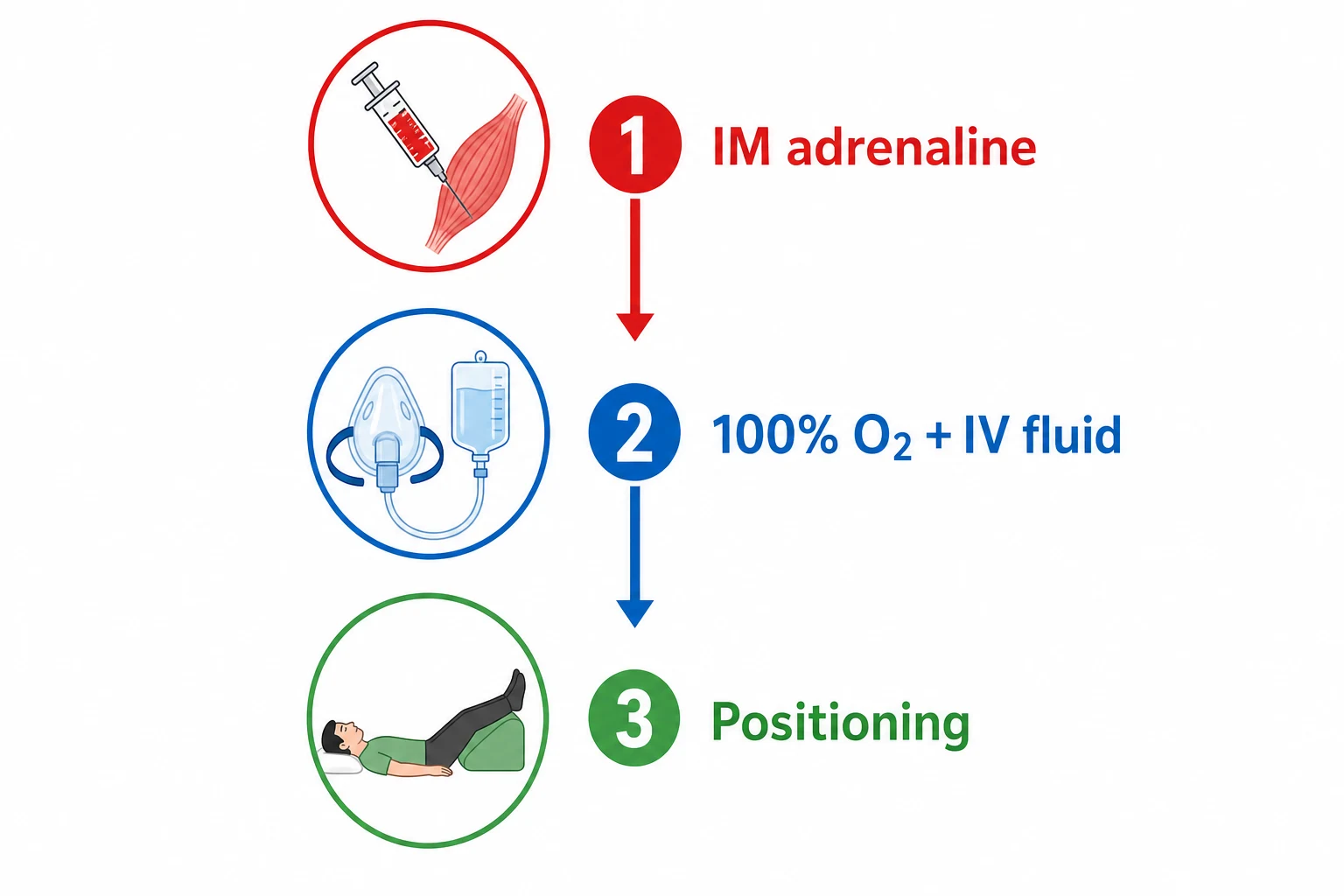
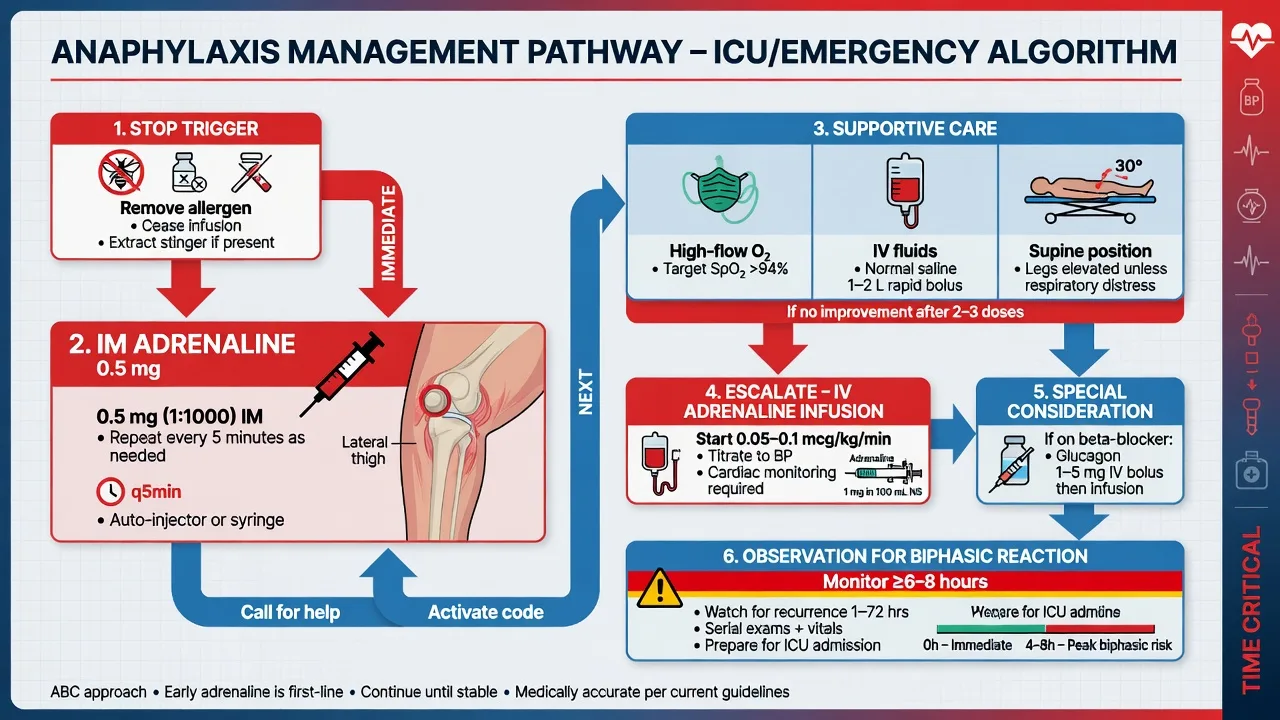
1. The IM adrenaline 0.5 mg (the FIRST-LINE).[1][2]
- The 0.5 mg (0.5 mL of the 1:1000) IM in the anterolateral thigh. The repeat every 5 minutes if no response (up to 2 doses before the IV).[1]
- The alpha-1 (the vasoconstriction — the BP, the oedema reduction), the beta-1 (the increased the inotropy and the chronotropy), the beta-2 (the bronchodilation).[1]
2. The airway + the breathing.[1][1]
- The 100% O2 (the high-flow, the non-rebreather). The early intubation if the airway oedema (the laryngeal — the rapidly progressive; the intubate before the impossible).[1]
- The nebulised adrenaline (5 mg) for the upper airway oedema (the laryngeal).[1]
- The IV fluid (the 20 mL/kg crystalloid rapidly — the vasodilation + the capillary leak → the relative the hypovolaemia).[2]
- The vasopressor (the noradrenaline) if the refractory. The IV adrenaline infusion (the 0.05-0.1 mcg/kg/min — for the refractory to the IM).[1]
- The antihistamine (the chlorphenamine 10 mg IV — the H1; the H2 — the famotidine; the secondary — NOT the first-line).[1]
- The corticosteroid (the hydrocortisone 200 mg IV — the prevent the biphasic; the delayed onset 4-6 h).[1]
- The bronchodilator (the salbutamol nebulised — the bronchospasm refractory to the adrenaline).[1]
- The glucagon (1-2 mg IV) for the beta-blocked patient (the adrenaline ineffective; the glucagon bypasses the receptor).[1]
5. The positioning.[1]
- The supine + the legs raised (the cardiovascular collapse — the venous return).[1]
- The sitting up (the respiratory distress — the easier the breathing).[1]
- The left lateral (the pregnant — the vena cava).[1]
The diagnosis — the tryptase
The serum tryptase — the mast cell degranulation marker. The peak 1-2 h; the return to the baseline 4-6 h. The sampling: the acute (as soon as possible), the 1-2 h, and the baseline (at least 24 h later). The rise above 1.2 x the baseline + 2 mcg/L → the anaphylaxis (the sensitivity not perfect — the food anaphylaxis may have a normal tryptase).[1]
The biphasic reaction
The biphasic — the recurrence of the symptoms 4-24 h after the initial resolution (without the re-exposure). The incidence 5-20 per cent. The risk factors: the delayed the adrenaline, the severe the initial reaction, the multiple the doses the adrenaline, the biphasic the history. The observation 6-24 h (the severe → the longer). The corticosteroid + the antihistamine (the prevention — the evidence weak).[1]
Refractory anaphylaxis — the escalation beyond the standard therapy
The refractory anaphylaxis — the no improvement despite the 2 doses of the IM adrenaline + the IV fluids + the IV adrenaline infusion. The incidence the 3-5 per cent. The pathophysiology: the profound NO-mediated vasoplegia (the refractory to the alpha-agonists), the extremely high circulating mediators (the histamine, the PAF, the NO), the beta-blocker therapy blocking the adrenaline's beta-effects.[7][11]
The refractory anaphylaxis — the rescue agents
| Agent | The dose | The mechanism | The indication |
|---|---|---|---|
| The IV adrenaline infusion | 0.05-0.5 mcg/kg/min, the titrate to the MAP above 65 | The alpha-1 + the beta-1 + the beta-2 | The first escalation after the 2 doses IM + the fluids |
| The IV noradrenaline | 0.05-0.5 mcg/kg/min | The alpha-1 predominant (the vasoconstriction) | The vasoplegia refractory to the adrenaline |
| The vasopressin | 0.01-0.04 U/min | The V1 receptor — the independent pathway (NOT the alpha) | The second vasopressor — the catecholamine-resistant vasoplegia |
| The methylene blue | 1-2 mg/kg IV over 20 min (the repeat in 30-60 min if the partial response) | The inhibits the soluble guanylate cyclase → the blocks the NO-cGMP-mediated vasoplegia | The NO-mediated refractory vasoplegia (the case reports and the series). The caution: the SSRI interaction (the serotonin syndrome), the MAOI. The NOT in the G6PD deficiency (the haemolysis). The interferes with the pulse oximetry (the falsely low SpO2)[11] |
| The glucagon | 1-5 mg IV over 5 min, then the 5-15 mcg/min infusion | The activates the adenylate cyclase via the glucagon receptor (the bypasses the beta-receptor) → the cAMP → the positive inotropy + the chronotropy | The beta-blocked patient (the adrenaline ineffective). The emesis is the common (the have the antiemetic and the airway protected)[7] |
| The atropine | 0.5-1 mg IV | The muscarinic antagonist | The severe bradycardia from the Bezold-Jarisch reflex (the profound vasodilation + the empty ventricle → the vagal reflex) |
| The VA-ECMO | — | The mechanical circulatory support | The last resort — the refractory cardiovascular collapse or the cardiac arrest (the bridge to the recovery) |
The refractory anaphylaxis — the escalation protocol
- The ASSESS at 5 minutes after the second IM adrenaline + the 20 mL/kg fluid — the BP, the wheeze, the skin, the mental state. The refractory = the persistent hypotension/wheeze.
- The IV adrenaline infusion — the 1 mg in the 100 mL 0.9 per cent saline (the 10 mcg/mL), the start the 0.05 mcg/kg/min, the titrate the every 2-5 min to the MAP above 65. The NOT the IV bolus (the risk of the VF, the intracranial haemorrhage) unless the cardiac arrest.
- The second vasopressor (the noradrenaline) if the adrenaline infusion inadequate — the central access when the safe.
- The methylene blue 1-2 mg/kg IV over 20 min — the NO-mediated vasoplegia. The monitor the SpO2 (the falsely low — the co-oximetry if the available).
- The glucagon 1-5 mg IV over 5 min then the infusion — the beta-blocked (the check the medication history the early).
- The vasopressin 0.01-0.04 U/min — the catecholamine-resistant.
- The VA-ECMO — the refractory collapse. The call the early.
The tryptase — the mast cell degranulation marker (the expanded)
The serum tryptase — the enzyme released from the mast cell granules (NOT from the basophils — the basophils contain the little). The peak at the 1-2 hours; the half-life the 2 hours; the return to the baseline by the 6-8 hours. The diagnostic sampling — the THREE samples:[12][13]
- The acute sample — the ASAP (the within 30 min, the ideally before the adrenaline — but the NOT the delay the treatment).
- The 1-2 hour sample — the peak.
- The baseline sample — the at least 24 hours after the resolution (the serial tryptase — the most informative).
The diagnostic threshold: the peak tryptase above (1.2 × the baseline + 2 mcg/L) → the anaphylaxis (the 92 per cent specificity). The absolute peak above 11.4 mcg/L → the supportive (the not the diagnostic alone).[13]
The limitations:
- The sensitivity the 60-90 per cent — the food anaphylaxis may have the NORMAL tryptase (the mast cell burden lower; the food triggers the less tryptase than the drug/venom). The negative tryptase does NOT exclude the anaphylaxis.[13]
- The elevated baseline (above 20 mcg/L) → the systemic mastocytosis — the refer for the KIT D816V mutation and the bone marrow biopsy.
- The tryptase also elevated in the trauma, the cardiac arrest, the AMI — the NOT the specific to the anaphylaxis.
The observation period — the biphasic risk stratification
The observation — the 6-12 hours for the low-risk; the 12-24 hours for the high-risk. The decision — the balanced (the biphasic risk vs the bed-occupancy).[7][14]
The biphasic reaction — the risk stratification for the observation
| The low-risk (the observe 6 h, the may discharge with the action plan) | The high-risk (the observe 12-24 h, the admit to the HDU/ICU) |
|---|---|
| The grade 1 (the skin only) | The grade 3 (the hypoxia/hypotension/neuro) |
| The single dose of the adrenaline with the rapid response | The 2+ doses of the adrenaline |
| The beta-agonist NOT required | The refractory (the IV adrenaline infusion) |
| The no prior biphasic history | The prior biphasic history |
| The no beta-blocker | The beta-blocker therapy |
| The no comorbidity (the asthma, the cardiovascular) | The asthma, the cardiovascular disease, the mastocytosis |
| The reaction the over 1 hour ago, the stable | The slow onset, the prolonged reaction |
| The access to the auto-injector + the carer | The social isolation, the no access to the care |
The corticosteroid + the antihistamine — the prevention of the biphasic — the evidence the weak (the largest cohort study the negative). The still the standard (the hydrocortisone 200 mg IV + the chlorphenamine 10 mg IV). The NOT a substitute for the observation.[7]
The perioperative anaphylaxis — the unique ICU/theatre challenge
The perioperative anaphylaxis — the unique: (a) the patient anaesthetised (the NO skin signs visible under the drapes — the hypotension + the bronchospasm may be the ONLY signs), (b) the multiple drugs simultaneously (the trigger the difficult), (c) the patient intubated (the bronchospasm = the high airway pressures + the hypoxia), (d) the vasoplegia attributed to the anaesthetic agents (the delayed recognition).[8][9]
The triad of the perioperative anaphylaxis: the sudden hypotension + the high airway pressures (the bronchospasm) + the tachycardia (or the paradoxical bradycardia from the Bezold-Jarisch reflex). The skin signs — the often absent (the under the drapes; the check the exposed skin, the ask the surgeon). The #1 trigger — the NMBAs (the 60-70 per cent; the rocuronium the most common).[8]
The perioperative anaphylaxis — the theatre protocol
- The SUSPECT — the sudden hypotension + the high airway pressures + the tachycardia/bradycardia within the minutes of a drug (the induction, the antibiotic, the skin prep, the dye). The ask the surgeon to check the skin.
- The STOP all the potential triggers — the most recently administered agent (the NMBA, the antibiotic, the contrast, the dye, the chlorhexidine). The NOT give more.
- The CALL FOR HELP — the senior anaesthetist, the ICU team, the stop the surgery if possible.
- The POSITION — the supine with the legs elevated (the Trendelenburg).
- The IM adrenaline 0.5-1 mg (the 1:1000) — the IM even in the anaesthetised (the anterolateral thigh).
- The IV fluids — the 20-50 mL/kg crystalloid rapidly (the massive capillary leak; the consider the colloid cautiously — the colloid itself can be the trigger).
- The IV adrenaline infusion if the refractory. The vasopressin/methylene blue/glucagon as the above.
- The SAMPLES — the tryptase the acute, the 1-2 h, the 24 h. The send the saved serum (the drug-specific IgE later). The refer to the allergy clinic at the 4-6 weeks for the skin testing (the NOT the earlier — the false negative in the first 4 weeks).[8]
Prognosis
The mortality the low (1-3 per cent) if the prompt the IM adrenaline. The death from the airway (the laryngeal oedema) or the circulatory collapse (the myocardial depression). The delayed the adrenaline → the worse the outcome.[1][2][1]
SAQ — Refractory anaphylaxis and the beta-blocked patient
10 minutes · 10 marks
A 60-year-old man on metoprolol for ischaemic heart disease develops anaphylaxis after a CT contrast injection. He has widespread urticaria, stridor, and hypotension (BP 70/40) despite two doses of IM adrenaline (0.5 mg) and 1 L of crystalloid. The registrar asks what to do next.
SAQ — Perioperative anaphylaxis and neuromuscular blocking agents
10 minutes · 10 marks
A 45-year-old woman undergoing induction for elective caesarean section receives thiopentone, suxamethonium, and prophylactic co-amoxiclav. Within 2 minutes she develops profound hypotension (BP 50/30), bronchospasm with peak airway pressures rising to 50 cmH2O, and widespread flushing. Outline the immediate management and the subsequent investigation.
Red flags
Clinical pearls
The key facts
Additional red flags
The landmark trials and the guidelines
Sampson 2006 — the NIAID/FAAN second symposium: the diagnostic criteria (PMID 16461139)
Source
Journal of Allergy and Clinical Immunology — the consensus report
The criteria
The three criteria: (1) skin/mucosa + respiratory/reduced-BP/severe-GI; (2) 2+ systems after a likely allergen; (3) reduced BP after a known allergen
The significance
The foundational diagnostic framework — the universally cited; the basis for the WAO 2020 update
The clinical bottom line
The anaphylaxis is the CLINICAL diagnosis — the treat on the criteria; the NOT the wait for the lab
Brown 2004 — the clinical features and the severity grading (PMID 15316518)
Source
Journal of Allergy and Clinical Immunology — the prospective cohort
The grading
The 3-grade system: grade 1 (mild — skin only), grade 2 (moderate — +resp/CV/GI), grade 3 (severe — hypoxia/hypotension/neuro)
The key finding
The grade predicts the adrenaline requirement, the biphasic, and the death. The grade 3 → the highest risk
The clinical bottom line
The severity grade → the observation duration (the grade 3 the 12-24 h; the grade 1 the 6 h)
Cardona 2020 — the World Allergy Organization anaphylaxis guidance (PMID 33204386)
Source
World Allergy Organization Journal — the international consensus
The scope
The diagnosis, the triggers, the management, the observation, the long-term care
The key points
The IM adrenaline the first-line; the positioning the supine + the legs raised; the tryptase the serial; the observation the risk-stratified
The clinical bottom line
The current international standard for the anaphylaxis — the replaces the 2015 update
Garvey 2019 — the perioperative anaphylaxis international overview (PMID 31130272)
Source
British Journal of Anaesthesia — the international consensus
The triggers
The NMBAs the #1 (the 60-70 per cent; the rocuronium the most common), the antibiotics (the 15-20 per cent), the chlorhexidine (the 5-8 per cent), the dyes (the 2-4 per cent), the latex (the decreasing)
The work-up
The tryptase the serial; the skin testing at the 4-6 weeks (the NOT the earlier — the false negative); the specific IgE; the basophil activation test
The clinical bottom line
The perioperative anaphylaxis — the NMBA the #1; the triad the hypotension + the high pressures + the tachy/brady; the refer the allergy clinic at the 4-6 weeks
Dribin 2020 — the persistent, refractory, and biphasic anaphylaxis consensus (PMID 32853640)
Source
Journal of Allergy and Clinical Immunology in Practice — the multidisciplinary consensus
The definitions
The refractory — the no response despite the 2 doses IM + the fluids + the IV infusion; the persistent — the lasts the over 2 h; the biphasic — the recurrence the 4-24 h without the re-exposure
The risk factors
The grade 3, the 2+ adrenaline doses, the beta-blocker, the mastocytosis, the prior biphasic, the delayed adrenaline
The clinical bottom line
The standardised definitions for the research and the practice; the refractory the 3-5 per cent; the escalation the IV infusion → the methylene blue/glucagon/vasopressin
The quick-reference — the management at a glance
The anaphylaxis — the first 30 minutes (the rapid reference)
- The RECOGNISE — the NIAID/FAAN criteria (the skin + the respiratory/reduced-BP/GI; the 2+ systems after the allergen; the reduced BP after the known allergen).
- The CALL FOR HELP — the senior, the ICU, the anaesthetist.
- The IM ADRENALINE 0.5 mg (the 1:1000) in the anterolateral thigh — the FIRST, the EARLY, the ENOUGH. The repeat every 5 min.
- The POSITION — the supine + the legs elevated (the NEVER the sit/stand). The pregnant — the left lateral. The vomiting — the recovery. The respiratory distress — the upright with the caution.
- The OXYGEN 15 L/min via the non-rebreather. The target the SpO2 above 92 per cent.
- The IV FLUIDS 20 mL/kg crystalloid rapidly. The repeat if the hypotension. The massive capillary leak → the 2-3 L in the first hour.
- The ASSESS at the 5 min — the improving → the observe; the refractory → the IV adrenaline infusion 0.05 mcg/kg/min, the titrate.
- The ADJUNCTS — the H1 (the chlorphenamine 10 mg IV), the H2 (the famotidine), the hydrocortisone 200 mg IV (the adjuncts — the NOT the first-line).
- The BETA-BLOCKED — the glucagon 1-5 mg IV then the infusion.
- The SAMPLES — the tryptase the acute + the 1-2 h + the 24 h. The save the serum.
- The OBSERVE — the 6-12 h (the low-risk) the 12-24 h (the high-risk). The biphasic the 5-20 per cent.
- The DISCHARGE — the 2 adrenaline auto-injectors + the action plan + the referral to the allergy clinic.
The summary
The anaphylaxis — the severe, the life-threatening, the systemic hypersensitivity. The clinical diagnosis (the NIAID/FAAN: the skin + the respiratory/reduced-BP/GI; the 2+ systems after the allergen; the reduced BP after the known allergen). The management the ABCDE: the IM adrenaline 0.5 mg (the FIRST-LINE), the 100 per cent O2, the IV fluids (the 20 mL/kg), the positioning (the supine + the legs elevated — the NEVER the sit/stand). The IV adrenaline infusion for the refractory (the 0.05 mcg/kg/min). The glucagon for the beta-blocked. The methylene blue for the NO-mediated refractory vasoplegia. The antihistamine + the corticosteroid — the adjuncts ONLY. The tryptase — the serial (the acute + the 1-2 h + the 24 h); the negative does NOT exclude. The observation — the 6-12 h (the low-risk) the 12-24 h (the high-risk); the biphasic the 5-20 per cent. The differential — the vasovagal, the anxiety, the asthma, the carcinoid, the mastocytosis, the scombroid, the hereditary angioedema. The outcome — the prompt the IM adrenaline → the low mortality; the delayed → the death.[3][5][9][14]
References
- [1]Cardona V, et al. World Allergy Organization (WAO) Diagnosis and Rationale for Action against Cow's Milk Allergy (DRACMA) Guidelines update - IV - A quality appraisal with the AGREE II instrument World Allergy Organ J, 2022.PMID 36091188
- [2]Turner PJ, et al. Prevalence of anaphylaxis among adults admitted to critical care for severe asthma exacerbation Emerg Med J, 2018.PMID 30093380
- [3]Sampson HA, Munoz-Furlong A, Campbell RL, et al. Second symposium on the definition and management of anaphylaxis: summary report--Second National Institute of Allergy and Infectious Disease/Food Allergy and Anaphylaxis Network symposium J Allergy Clin Immunol, 2006.PMID 16461139
- [4]Campbell RL, Li JT, Nicklas RA, et al. Evaluation of national institute of allergy and infectious diseases/food allergy and anaphylaxis network criteria for the diagnosis of anaphylaxis in emergency department patients J Allergy Clin Immunol, 2012.PMID 22051698
- [5]Cardona V, Ansotegui IJ, Ebisawa M, et al. World allergy organization anaphylaxis guidance 2020 World Allergy Organ J, 2020.PMID 33204386
- [6]Brown SGA. Clinical features and severity grading of anaphylaxis J Allergy Clin Immunol, 2004.PMID 15316518
- [7]Dribin TE, Camargo CA, Fritea L, et al. Persistent, refractory, and biphasic anaphylaxis: A multidisciplinary Delphi study J Allergy Clin Immunol, 2020.PMID 32853640
- [8]Garvey LH, Dewachter P, Hepner DL, et al. Management of suspected immediate perioperative allergic reactions: an international overview and consensus recommendations Br J Anaesth, 2019.PMID 31130272
- [9]Soar J, Pumphrey R, Cant A, et al. Emergency treatment of anaphylactic reactions--guidelines for healthcare providers Resuscitation, 2008.PMID 18358585
- [10]Soar J. Emergency treatment of anaphylaxis in adults: concise guidance Clin Med (Lond), 2009.PMID 19435130
- [11]Da Silva PS, Waisman DR. Methylene Blue to Treat Refractory Latex-Induced Anaphylactic Shock: A Case Report A A Pract, 2018.PMID 28937421
- [12]Stone SF, Bosco A, Brown SGA. Mediators released during human anaphylaxis Curr Allergy Asthma Rep, 2012.PMID 22086296
- [13]Francis A, Fatovich DM, Doshi R, et al. Serum mast cell tryptase measurements: Sensitivity and specificity for a diagnosis of anaphylaxis in emergency department patients with shock or hypoxaemia Emerg Med Australas, 2018.PMID 29094472
- [14]Wang J, Scurlock AM, Young MC, et al. Anaphylaxis in Practice: A Guide to the 2023 Practice Parameter Update J Allergy Clin Immunol Pract, 2024.PMID 38944199
- [15]Simons FE, Ardusso LR, Bilo MB, et al. 2015 update of the evidence base: World Allergy Organization anaphylaxis guidelines World Allergy Organ J, 2015.PMID 26525001