ICU · Resuscitation & shock
Fluid Resuscitation — Crystalloid vs Colloid, Balanced vs Saline, SOSD/ROSE & Fluid Overload
Also known as Intravenous fluids · Crystalloid vs colloid · Balanced vs saline · SMART trial · SAFE trial · Lactated Ringer's · Hartmann's solution · Hyperchloraemic metabolic acidosis · Fluid compartments · ROSE model · SOSD · Permissive hypotension · Fluid overload · De-resuscitation · Strong ion difference
Fluid resuscitation turns on four evidence-based questions. (1) Crystalloid vs colloid — crystalloid is first-line; albumin shows no mortality benefit per SAFE; hydroxyethyl starch is harmful per CHEST and 6S; CRISTAL showed no colloid advantage. (2) Balanced vs saline — balanced is preferred per SMART (lower mortality and AKI) and confirmed hospital-wide by FLUID; SPLIT was the neutral precursor. Saline causes hyperchloraemic metabolic acidosis (high chloride, low strong ion difference) → renal vasoconstriction → AKI. (3) How much — titrate to endpoints and to fluid responsiveness (PLR, SVV/PPV, fluid challenge, IVC), not a formula; only ~50 per cent of patients are responders. (4) When to stop — the SOSD/ROSE model (Salvage/Optimisation/Stabilisation/De-escalation): restrictive strategies are safe per CLASSIC, CLOVERS and FACTT, and cumulative overload kills. Plan de-resuscitation. Permissive hypotension is appropriate in bleeding trauma (Bickell).
On this page & tools
Your progress
Saved locally on this device.
Target exams
Red flags
Overview & definition
Fluid resuscitation comes down to four evidence-based questions: (1) crystalloid vs colloid (crystalloid is first-line), (2) balanced vs saline (balanced is preferred — the SMART trial), (3) how much (titrate to endpoints and to fluid responsiveness, not to a formula), and (4) when to stop (the SOSD/ROSE model — restrictive strategies are safe, and overload kills). The key compositional concern is the chloride load, which drives hyperchloraemic metabolic acidosis via a reduced strong ion difference. Titrate to clinical endpoints, test responsiveness before each bolus, and plan for de-resuscitation of overload.[1][1]

Fluid compartments and distribution — where the fluid goes
The fate of any resuscitation fluid is governed by body-water physiology. Total body water (TBW) is approximately 60 per cent of body weight in a young man (50 per cent in women, lower again in the elderly, ~75 per cent in neonates). TBW is divided into two main compartments:[1]
- Intracellular fluid (ICF) — about two-thirds of TBW (≈ 40 per cent of body weight).
- Extracellular fluid (ECF) — about one-third of TBW (≈ 20 per cent of body weight). The ECF is further split into interstitial fluid (three-quarters of the ECF, ≈ 15 per cent of body weight) and intravascular plasma (one-quarter of the ECF, ≈ 5 per cent of body weight). A small transcellular compartment (CSF, synovial, GIT secretions) completes the picture. [1]
The clinically decisive consequence is the distribution ratio: an isotonic crystalloid given intravenously leaves the vasculature rapidly. Roughly only one-quarter to one-third of a crystalloid bolus remains intravascular after 30-60 minutes; the rest distributes throughout the ECF (interstitium). This is why a "500 mL bolus" is not 500 mL of circulating volume for long, and why repeated boluses accumulate oedema long before they accumulate circulating volume.[1]
TBW
60% body weight
- Total body water — ~42 L in a 70 kg male
- ICF two-thirds (~28 L); ECF one-third (~14 L)
- Falls with age and female sex; rises in neonates
ICF
Intracellular — 2/3
- Two-thirds of TBW — the potassium-rich cell interior
- The osmotic "set point" — Na⁺/K⁺-ATPase keeps it there
- Not directly reached by a crystalloid bolus
ECF
Extracellular — 1/3
- One-third of TBW — sodium-rich
- Interstitial 3/4 of ECF; plasma 1/4 of ECF
- Crystalloid distributes throughout the whole ECF
Plasma
Intravascular — 1/4 of ECF
- Only ~3 L — the volume that actually perfuses
- Only 25-30% of a crystalloid bolus stays here after 1 hour
- Colloids are designed to stay here (the theoretical advantage)
The revised Starling model — why crystalloid leaks
Classical Starling taught that fluid flux across the capillary depends on a balance of hydrostatic and oncotic pressures, with albumin holding fluid in. The revised (glycocalyx) Starling model is now the accepted physiology and it changes practice:[1]
- The endothelial glycocalyx layer (EGL) is a fragile carbohydrate-protein mesh on the vascular lumen. The relevant oncotic force opposing filtration is the colloid osmotic pressure difference between plasma and the sub-glycocalyx space, not between plasma and the interstitium.
- Under normal conditions the sub-glycocalyx oncotic pressure is low, so plasma albumin does oppose filtration — but once the EGL is shed (sepsis, trauma, major surgery, hyperglycaemia, ischaemia-reperfusion), albumin escapes and the colloid advantage largely disappears. This is the mechanistic reason colloids failed to outperform crystalloids in critical illness: the sick endothelium leaks everything.
- Filtration is therefore governed largely by hydrostatic pressure and capillary integrity — which is why reducing preload/venous pressure (de-resuscitation) removes oedema, and why a damaged glycocalyx turns any fluid into interstitial oedema. [1]
Practical upshot: in the inflamed/leaky patient, no colloid is "volume-sparing" enough to justify its cost and risk; crystalloid, given in measured aliquots guided by responsiveness, is the rational default.[1]
Crystalloid vs colloid
Crystalloids are first-line — cheaper, safer, and evidence-based.[1]
Colloids:[1]
- Albumin — the SAFE trial (6,997 patients; 4 per cent albumin vs saline showed no mortality difference). May benefit the sepsis subgroup and patients with severe hypoalbuminaemia.[3]
- Hydroxyethyl starch (HES) — HARMFUL. The CHEST trial showed increased AKI and RRT, and the 6S trial showed increased mortality in sepsis. Withdrawn or restricted.[4][5]
- Gelatin — less evidence; a possible AKI concern.[1]
The definitive head-to-head between the two classes is CRISTAL: a multicentre trial of 2,857 patients with hypovolaemic shock randomised to colloids vs crystalloids found no difference in 28-day mortality, confirming that the more expensive colloids buy no outcome advantage.[7]
Crystalloid
First-line
- Cheap, available, no anaphylaxis risk
- Distributes throughout ECF — only ~25-30% stays intravascular
- Balanced (Hartmann / Plasma-Lyte) preferred — SMART, FLUID
- Safe in all populations; no excess bleeding or AKI
Colloid
Reserve / do-not-use
- Theoretically volume-sparing (stays intravascular)
- Albumin (SAFE) — no mortality benefit; possible sepsis subgroup benefit
- HES — HARMFUL: CHEST (AKI/RRT), 6S (death in sepsis). Withdrawn
- Gelatin — weaker evidence, possible AKI
- CRISTAL: no mortality advantage for colloids overall
Balanced vs saline — the chloride question
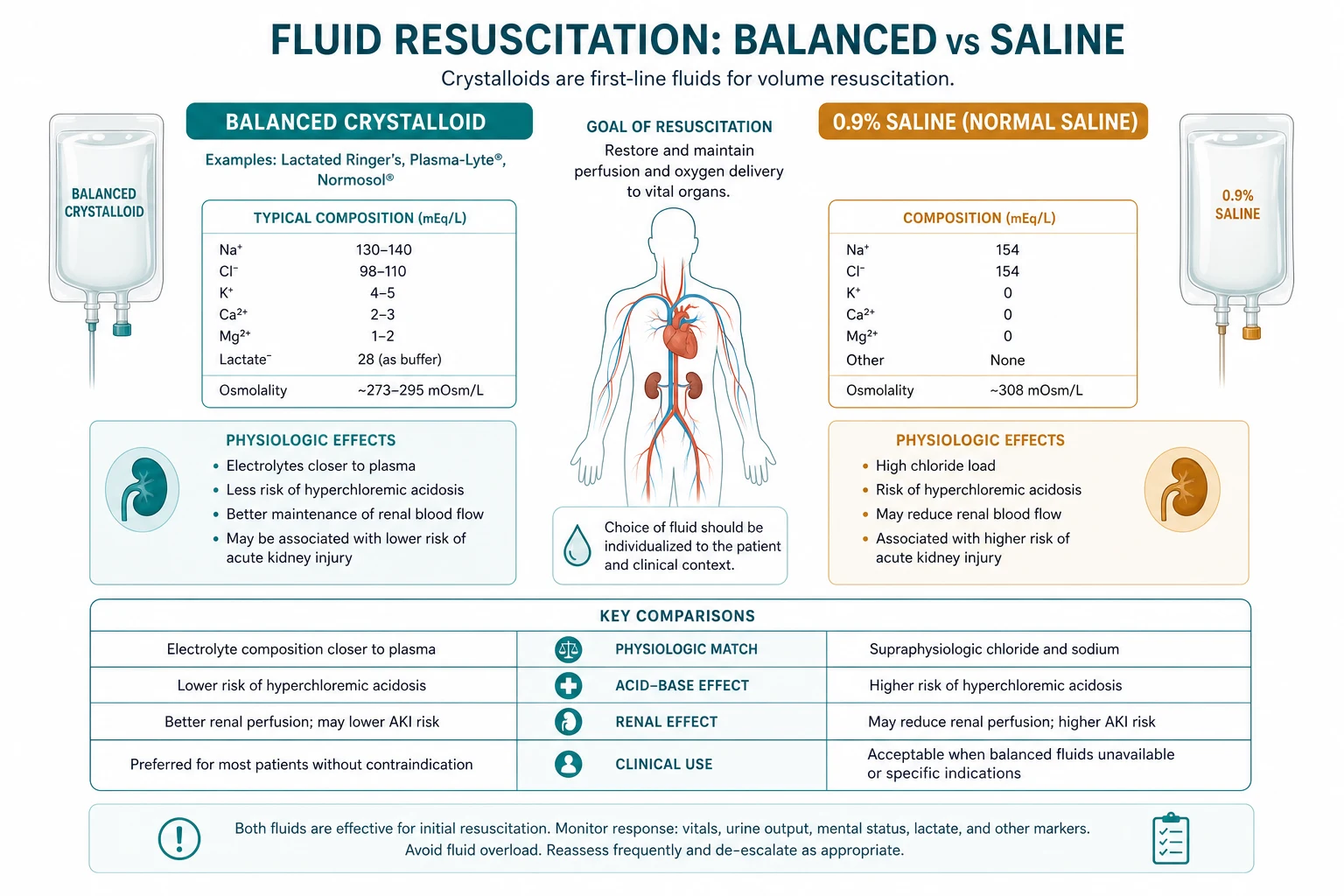
The SMART trial (Semler, NEJM 2018) — 15,752 ICU patients; balanced crystalloids (lactated Ringer's, Plasma-Lyte) vs saline.[1]
- The balanced group had lower all-cause mortality (10.3 vs 11.1 per cent), less AKI, and less need for RRT.[1]
- The mechanism: saline has a high chloride (154 mmol/L), which causes hyperchloraemic metabolic acidosis → renal afferent arteriole vasoconstriction → AKI.[1]
SMART-DKA — balanced fluids give faster DKA resolution (a quicker bicarbonate rise and a shorter insulin infusion).[2]
Strong ion difference (SID) — the mechanism in one line
The acid-base effect of a fluid is governed by its strong ion difference (SID) — the difference between the sum of fully-dissociated cations and anions. Plasma SID is normally ~40 mEq/L. A fluid with a SID well below 40 (saline, SID = 0 because Na = Cl = 154) causes hyperchloraemic metabolic acidosis by diluting the plasma bicarbonate and adding a chloride load; a fluid with a SID near 40 (Plasma-Lyte ~50, Hartmann ~28) is acid-base neutral.[1]
This is why "balanced" matters: it is a chloride/SID property, not a "lactate is good" property. The lactate and acetate buffers in balanced fluids are metabolised to bicarbonate, restoring SID, and the lower chloride prevents the renal vasoconstriction that drives saline-associated AKI. [1]
Composition
| Fluid | Na | Cl | K | Other | Osmolality | SID |
|---|---|---|---|---|---|---|
| 0.9% saline | 154 | 154 | - | - | 308 | 0 |
| Lactated Ringer's (Hartmann's) | 131 | 111 | 5 | Ca 2, lactate 29 | 279 | 28 |
| Plasma-Lyte 148 | 140 | 98 | 5 | Mg 1.5, acetate 27, gluconate 23 | 294 | ~50 |
| 4% albumin | 140 | 128 | - | albumin 40 g/L | 250 | - |
| 3% saline (hypertonic) | 513 | 513 | - | - | 1027 | 0 |
| 5% dextrose | - | - | - | dextrose 50 g/L | 278 (then free water) | - |
The key variable is chloride: saline 154 (high), lactated Ringer's 111, Plasma-Lyte 98 (near-physiological). Lactated Ringer's is slightly hypotonic (Na 131), so use caution in TBI (cerebral oedema — controversial).[1]
Tonicity vs osmolality — a common exam trap: 5% dextrose is isotonic in the bag (osmolality 278) but hypotonic in vivo, because the dextrose is metabolised leaving free water — it is effectively a free-water load and unsuitable for resuscitation. Hartmann's is slightly hypotonic (osmolality 279) but a near-physiological resuscitation fluid. [1]
Balanced crystalloid types
- Compound Sodium Lactate (Hartmann's / lactated Ringer's) — the workhorse; near-physiological chloride, calcium-containing (incompatible with citrated blood in the same line), slightly hypotonic.
- Plasma-Lyte 148 / Plasma-Lyte-A — the most physiological: chloride 98, magnesium-containing, buffered with acetate and gluconate (not lactate, so no Ca incompatibility — runs with blood); the most "balanced" but more expensive.
- Ringer's acetate — the Scandinavian analogue (acetate buffer instead of lactate); used in CHEST and 6S. [1]
Crystalloid-type trial evidence
SMART
NEJM 2018
Multicentre cluster-crossover RCT (single centre) — 15,752 ICU adults; balanced crystalloid vs saline
Key finding
Balanced crystalloids reduced all-cause mortality (10.3% vs 11.1%), AKI and need for RRT. Largest effect in sepsis and DKA subgroups.
Practice change
Balanced crystalloids are the default resuscitation fluid in the ICU
SPLIT
JAMA 2015
Multicentre double-blind RCT (ANZ) — 2,278 ICU adults; buffered crystalloid (Plasma-Lyte 148) vs saline
Key finding
No significant difference in AKI or RRT. A neutral precursor to SMART — underpowered and enriched with lower-risk patients.
Practice change
Did not change practice on its own; foreshadowed the chloride question
FLUID
NEJM 2025
Hospital-wide cluster-crossover pragmatic trial — all adults receiving IV fluid across entire hospitals; lactated Ringer’s vs saline
Key finding
Confirmed the SMART signal at a hospital level: balanced crystalloids are the preferred default across the whole hospital, not just the ICU.
Practice change
Extends the balanced-first principle beyond the ICU to the entire hospital
SMART-DKA
JAMA Netw Open 2020
Pre-specified subgroup analysis of SMART — DKA patients
Key finding
Balanced crystalloids gave a faster bicarbonate rise and shorter time to DKA resolution and shorter insulin infusion.
Practice change
Balanced crystalloid is preferred in DKA
Crystalloid vs colloid trial evidence
SAFE
NEJM 2004
Multicentre RCT (ANZ) — 6,997 ICU patients; 4% albumin vs saline for resuscitation
Key finding
No difference in 28-day or overall mortality. A post-hoc signal of benefit in severe sepsis and harm in TBI.
Practice change
Killed routine albumin use; albumin is a discretionary second-line fluid, not a default
CHEST
NEJM 2012
Multicentre RCT (ANZ) — 7,000 ICU patients; 6% HES (130/0.4) vs saline
Key finding
No mortality difference overall, but significantly more need for RRT and more AKI with HES.
Practice change
HES should not be used for resuscitation in the ICU
6S
NEJM 2012
Multicentre RCT (Scandinavia) — 804 severe-sepsis patients; HES 130/0.42 vs Ringer’s acetate
Key finding
Significantly INCREASED mortality (51% vs 43%) and more RRT with HES at 90 days.
Practice change
HES is harmful in sepsis; contributed to its regulatory withdrawal
CRISTAL
JAMA 2013
Multicentre RCT — 2,857 hypovolaemic shock patients; colloids vs crystalloids (clinician choice within each arm)
Key finding
No difference in 28-day mortality (the primary outcome); a secondary signal of fewer deaths at 90 days with colloids, but not the primary endpoint and not enough to change practice.
Practice change
No mortality advantage for colloids — crystalloid remains first-line
Principles
1. What type. Balanced crystalloid is first-line (lactated Ringer's / Hartmann's, Plasma-Lyte).[1][1]
2. How much. Titrate to clinical endpoints (MAP 65, lactate, urine output) — not to a formula (the 30 mL/kg bolus is only a starting point in sepsis).[1]
3. When to stop. If fluid responsive (PLR, SVV, echo), give fluid; if not responsive, use a vasopressor rather than more fluid. De-resuscitate (diuresis or RRT) for fluid overload.[1]
4. Complications of overload. Pulmonary oedema, abdominal compartment syndrome, and tissue oedema (impaired wound healing, gut oedema).[1]
5. Re-test before every bolus. Fluid responsiveness changes hour to hour — yesterday's responder is today's overloaded patient. A bolus is a test, not a resuscitation target.[1]
The SOSD / ROSE model — when to give and when to remove fluid
The ROSE model (Resuscitation, Optimisation, Stabilisation, De-resuscitation — sometimes SOSD, Salvage/Optimisation/Stabilisation/De-escalation) frames intravenous fluid as a drug with a therapeutic window and a toxicity profile. Fluid is actively given in the first two phases, merely maintained in the third, and actively removed in the fourth.[1]
The SOSD/ROSE phases of fluid therapy
Salvage (S1) — life-saving, time-critical
Profound shock with a threatened circulation. Give fluid rapidly (boluses of 250-500 mL balanced crystalloid, repeated to a MAP > 65 or evidence of perfusion). Goal is to prevent cardiovascular collapse. This is the only phase where a large volume is justified empirically, and even here a vasopressor is started early in septic shock (CLOVERS).
Optimisation (S2) — titrated, responsiveness-guided
Shock is resolving but the patient may still be preload-dependent. Give fluid ONLY if fluid-responsive (PLR, SVV/PPV, fluid challenge, echo). Each bolus is a measured test of the Frank-Starling curve. Start vasopressors and move to a conservative strategy as soon as the patient stops responding.
Stabilisation (S3) — maintenance only
Shock has resolved. Aim for a zero or negative fluid balance. Replace only ongoing losses and provide maintenance fluid (typically ~25-30 mL/kg/day, ideally balanced, with the enteral route preferred). Avoid the reflex of continuing resuscitation-rate fluid.
De-escalation / Evacuation (S4) — active removal (de-resuscitation)
The patient is now fluid-overloaded (positive cumulative balance, oedema, may have a rising creatinine from venous congestion). Remove fluid actively with diuretics (furosemide) and, if that fails or the kidneys are failing, with renal replacement therapy. Target a negative balance and back to dry weight.
The model reframes the question from "how much fluid does the patient need?" to "which phase is the patient in?" — and the phase determines whether fluid should be added, maintained, or removed.[1]
Assessing fluid responsiveness — give fluid only to responders
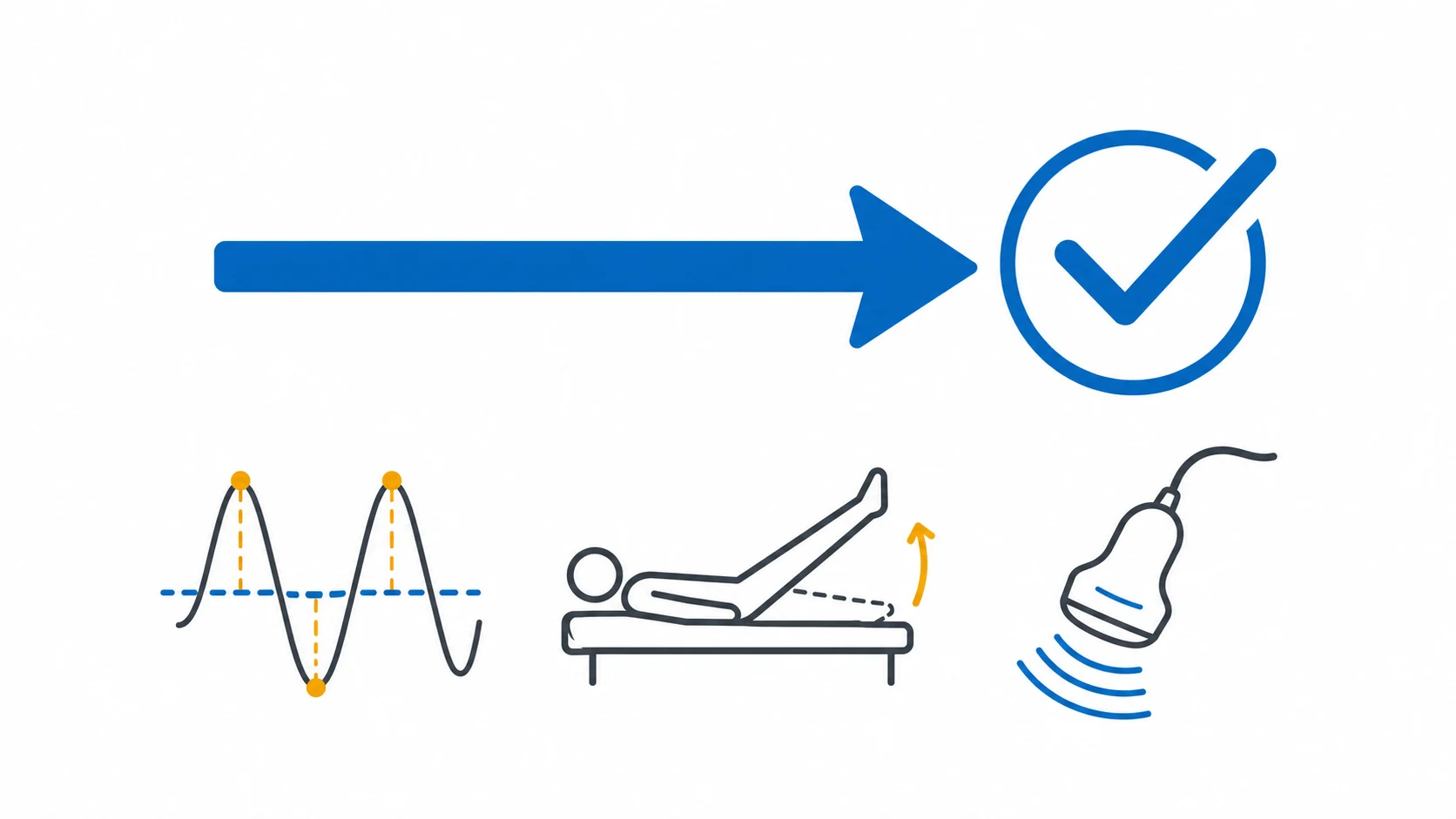
Only about half of ICU patients are fluid responsive (a rise in stroke volume ≥ 10 per cent to a bolus). Static markers (CVP, PAOP) do not predict it — the curve is flat. Dynamic tests do. (See the dedicated fluid responsiveness topic for full technique.)[1]
Passive leg raise (PLR)
Gold standard
- Reversible self-transfusion of ~300 mL
- Works in spontaneous breathing AND atrial fibrillation
- Start semi-recumbent 45°, legs up 45° for 60-90 s
- Requires real-time CO/SV/LVOT VTI measurement
- Positive: rise in CO/SV/VTI ≥ 10%
Fluid challenge
The definitive test
- 250-500 mL balanced crystalloid over 5-10 min
- Measure response (CO/SV/VTI, MAP, lactate) in real time
- Define the target BEFORE giving the fluid (FENICE)
- A bolus is a TEST, not a resuscitation target
SVV / PPV
Arterial waveform
- SVV > 12%, PPV > 13% predict responsiveness
- Requires controlled ventilation, Vt > 8 mL/kg, regular rhythm
- Invalid in low tidal-volume ARDS ventilation, AF, spontaneous breathing
- Needs a closed chest/abdomen and an arterial line
IVC ultrasound
Simplest
- Spontaneous breathing: IVC collapsibility > 40-50% suggests responsive
- Mechanical ventilation: IVC distensibility > 18% suggests responsive
- Simple but least reliable; confounded by high PEEP and raised intra-abdominal pressure
CVP / PAOP
Static — do NOT use
- Flat CVP-responsiveness curve (Marik, AUC 0.55)
- A low CVP does not guarantee, a high CVP does not exclude responsiveness
- Do not use CVP to decide whether to give a bolus
Permissive hypotension — when less fluid is more
In active haemorrhage, aggressive crystalloid resuscitation before bleeding control can be harmful: it dilutes clotting factors, displaces clots (pops them off), lowers blood viscosity, and propagates the lethal triad (acidosis, hypothermia, coagulopathy). The classic evidence is Bickell (NEJM 1994): in 598 patients with penetrating torso trauma and hypotension, delaying fluid resuscitation until operative control of haemorrhage reduced mortality and shortened hospital stay.[12]
Modern interpretation — reinforced by damage-control resuscitation and a 2018 systematic review:[14]
- Maintain a permissive (low-normal) blood pressure (systolic ~80-90 mmHg, MAP ~65) until haemorrhage is controlled, using minimal crystalloid and prioritising blood products (massive transfusion, balanced ratios) and early vasopressors.
- The aim is perfusion without disruption of fresh clot, not normotension.
- Contraindications: traumatic brain injury (a low MAP causes secondary brain injury — keep CPP > 60), and any condition in whom cerebral or coronary hypoperfusion is the dominant threat.
Fluid overload — the dangers of cumulative positive balance
A cumulative positive fluid balance is an independent predictor of mortality in critical illness. The harms are mechanical, biochemical, and organ-specific:[8][9]
- Pulmonary — pulmonary oedema, worsened oxygenation, prolonged ventilation (the defining harm in ARDS).
- Tissue/gut — interstitial oedema impairs wound healing, mitochondrial function and gut motility; raises intra-abdominal pressure.
- Renal (paradoxical) — renal venous congestion and abdominal compartment syndrome cause AKI — the very organ resuscitation was meant to protect.
- Haemodilution — falls in haematocrit and albumin; worsens oxygen delivery and oncotic pressure. [1]
Restrictive-strategy trial evidence
CLASSIC
NEJM 2022
Multicentre RCT (Scandinavia) — 1,554 ICU septic-shock patients; restrictive vs standard IV fluid after initial resuscitation
Key finding
A restrictive strategy (median 1.2 L vs 3.0 L after randomisation) was safe — no increase in death, AKI or ischaemic events. Less fluid did not harm and trended toward benefit.
Practice change
Supports a restrictive fluid strategy after the initial resuscitation phase in septic shock
FACTT
NEJM 2006
Multicentre RCT (ARDSNet) — 1,000 ALI/ARDS patients; conservative vs liberal fluid for 7 days
Key finding
Conservative fluid management (lower cumulative fluid, lower CVP/PAOP targets) gave MORE ventilator-free days and fewer ICU days, with no increase in shock or renal failure.
Practice change
Conservative fluid management is the standard in ARDS
CLOVERS
NEJM 2023
Multicentre RCT (PETAL) — 1,563 sepsis-induced hypotension; early restrictive vs liberal fluid before/with vasopressors
Key finding
An early restrictive strategy (earlier vasopressors, less fluid) was non-inferior to a liberal strategy for 90-day mortality, with no excess harm.
Practice change
Earlier vasopressors and less early fluid is an acceptable early-sepsis strategy
Fluid therapy — the numbers examiners expect
Specific conditions
- DKA: balanced fluids (SMART-DKA — faster resolution).[2]
- Sepsis: a 30 mL/kg bolus then reassess; balanced preferred; move to a restrictive strategy and early vasopressors once the initial resuscitation is complete (CLOVERS, CLASSIC).[1][9][10]
- Trauma / burns: lactated Ringer's (ATLS, military practice); permissive hypotension in active haemorrhage until bleeding control; hypertonic saline offers no outcome benefit over isotonic in trauma/TBI (the ROC/TRUST subgroup) and is not recommended.[12][13][14]
- TBI: saline (lactated Ringer's is slightly hypotonic → cerebral-oedema risk — controversial; the current Brain Trauma Foundation guideline favours saline).[1]
- ARDS: conservative fluid strategy (FACTT) — more ventilator-free days.[8]
- Severe hypoalbuminaemia: albumin is a reasonable adjunct in the rare patient with profound, symptomatic hypoalbuminaemia (oncotic support) — not for routine resuscitation (SAFE).[3]
- Hepatic failure / cirrhosis: balanced crystalloid cautious of potassium load; albumin is first-line for spontaneous bacterial peritonitis (SBP) and hepatorenal syndrome, and for large-volume paracentesis — a specific role distinct from general resuscitation.[1]
- Cardiac failure / cardiogenic shock: give fluid only after demonstrating responsiveness (these patients are frequently preload-independent and easily pushed into pulmonary oedema); a cautious 250 mL challenge with echo is the safest approach.[1]
Prognosis
Balanced crystalloids reduce mortality and AKI (SMART; confirmed hospital-wide by FLUID). Fluid overload increases mortality (pulmonary oedema, abdominal compartment, wound breakdown, renal venous congestion). Restrictive strategies are safe (CLASSIC, FACTT, CLOVERS), and active de-resuscitation improves outcomes. The prognosis of the underlying condition dominates; the fluid strategy's contribution is to avoid iatrogenic harm from both the wrong fluid (saline, starches) and too much fluid.[1][2][8][9][10]
[1]SAQ practice
SAQ — Fluid choice and overload in septic shock
10 minutes · 10 marks
A 66-year-old woman is admitted to the ICU with urosepsis and septic shock. She has received 30 mL/kg of 0.9% saline in the emergency department (3 L). On examination: HR 118, BP 82/48 (MAP 59), warm peripheries, lactate 3.6 mmol/L, urine output 0.2 mL/kg/h, SpO2 94% on FiO2 0.4. She is intubated and on volume-controlled ventilation (Vt 6 mL/kg PBW, PEEP 10), in sinus rhythm. A central and arterial line are in situ. She has marked peripheral and sacral oedema; cumulative fluid balance is +5.2 L. Her chloride is 114 mmol/L with a pH of 7.28 and bicarbonate 17.
Clinical pearls
Red flags
References
- [1]Semler MW, Self WH, Wanderer JP, et al.; SMART Trial and PETAL Network Investigators. Balanced Crystalloids versus Saline in Critically Ill Adults N Engl J Med, 2018.PMID 29768150
- [2]Self WH, Evans M, Semler MW, et al. Clinical Effects of Balanced Crystalloids vs Saline in Adults With Diabetic Ketoacidosis: A Subgroup Analysis of Cluster Randomized Clinical Trials JAMA Netw Open, 2020.PMID 33196806
- [3]Finfer S, Bellomo R, Boyce N, French J, Myburgh J, Norton R; SAFE Study Investigators. A comparison of albumin and saline for fluid resuscitation in the intensive care unit N Engl J Med, 2004.PMID 15163774
- [4]Myburgh JA, Finfer S, Bellomo R, et al.; CHEST Investigators; Australian and New Zealand Intensive Care Society Clinical Trials Group. Hydroxyethyl starch or saline for fluid resuscitation in intensive care N Engl J Med, 2012.PMID 23075127
- [5]Perner A, Haase N, Guttormsen AB, et al.; 6S Trial Group; Scandinavian Critical Care Trials Group. Hydroxyethyl starch 130/0.42 versus Ringer's acetate in severe sepsis N Engl J Med, 2012.PMID 22738085
- [6]Young P, Bailey M, Beasley R, et al.; SPLIT Investigators; ANZICS Clinical Trials Group. Effect of a Buffered Crystalloid Solution vs Saline on Acute Kidney Injury Among Patients in the Intensive Care Unit: The SPLIT Randomized Clinical Trial JAMA, 2015.PMID 26444692
- [7]Annane D, Siami S, Jaber S, et al.; CRISTAL Investigators. Effects of fluid resuscitation with colloids vs crystalloids on mortality in critically ill patients presenting with hypovolemic shock: the CRISTAL randomized trial JAMA, 2013.PMID 24108515
- [8]National Heart, Lung, and Blood Institute ARDS Clinical Trials Network; Wiedemann HP, Wheeler AP, et al. Comparison of two fluid-management strategies in acute lung injury N Engl J Med, 2006.PMID 16714767
- [9]Meyhoff TS, Hjortrup PB, Wetterslev J, et al. Restriction of Intravenous Fluid in ICU Patients with Septic Shock N Engl J Med, 2022.PMID 35709019
- [10]National Heart, Lung, and Blood Institute PETAL Network; Shapiro NI, Douglas IS, et al. Early Restrictive or Liberal Fluid Management for Sepsis-Induced Hypotension N Engl J Med, 2023.PMID 36688507
- [11]Semler MW, Bravata DM, Gershengorn HB, et al.; FLUID Investigators. A Crossover Trial of Hospital-Wide Lactated Ringer's Solution versus Normal Saline N Engl J Med, 2025.PMID 40503714
- [12]Bickell WH, Wall MJ Jr, Pepe PE, et al. Immediate versus delayed fluid resuscitation for hypotensive patients with penetrating torso injuries N Engl J Med, 1994.PMID 7935634
- [13]Bulger EM, May S, Kerby JD, et al.; ROC Investigators. Out-of-hospital hypertonic resuscitation following severe traumatic brain injury: a randomized controlled trial JAMA, 2010.PMID 20924011
- [14]Hashmi ZG, Schneider EB, Kugler NW, et al. Permissive hypotension versus conventional resuscitation strategies in adult trauma patients with hemorrhagic shock: A systematic review and meta-analysis of randomized controlled trials J Trauma Acute Care Surg, 2018.PMID 29370058