Shock = inadequate tissue PERFUSION → cellular hypoxia → anaerobic → lactate → organ failure. 4 types : hypovolaemic (fluid/blood loss), cardiogenic (pump failure), distributive (vasodilation — septic/anaphylactic/neurogenic), obstructive (tamponade/PTX/PE). Early signs (BP still NORMAL): tachycardia + narrowed pulse pressure + cool peripheries. Late (decompensated): hypotension + oliguria + altered consciousness. Lactate is the best perfusion marker. Management : ABC + TREAT CAUSE + fluids (if responsive) + vasopressors (if vasodilated) + inotropes (if cardiac) + transfusion (if haemorrhagic). Goal : lactate clearing + urine >0.5 + MAP ≥65 + conscious.
[1]
[1]
Management of acute shock
RECOGNISE EARLY (before BP drops) — (a) EARLY signs (COMPENSATED — BP still normal — body compensating): (i) TACHYCARDIA (HR >100 — sympathetic drive — maintain cardiac output despite low stroke volume). (ii) NARROWED PULSE PRESSURE (systolic falls [low stroke volume] but diastolic RISES [vasoconstriction] → narrowed PP — e.g., 100/80 [PP=20] — normally PP >40). (iii) COOL PERIPHERIES (vasoconstriction — shunting blood to vital organs — capillary refill >3s). (iv) ANXIETY/AGITATION (adrenaline — early cerebral hypoperfusion). (v) TACHYPNOEA (RR >20 — compensatory — blow off CO2 from anaerobic metabolism — or metabolic acidosis compensation). (b) LATE signs (DECOMPENSATED — BP dropping — compensation failing): (i) HYPOTENSION (SBP <90 or MAP <65 — decompensation — body can no longer maintain BP). (ii) OLIGURIA (<0.5 mL/kg/hr — renal hypoperfusion — kidney receiving inadequate blood). (iii) ALTERED CONSCIOUSNESS (confusion → coma — cerebral hypoperfusion). (iv) MOTTLED SKIN (patchy cyanosis — severe vasoconstriction + stagnation). (v) METABOLIC ACIDOSIS (lactate >2 → pH <7.25). (c) KEY: DON'T wait for hypotension — by the time BP drops → significant volume already lost (15-30% of blood volume). RECOGNISE early (tachycardia + narrowed PP + cool peripheries + lactate rising) → intervene before decompensation.[1] }CLASSIFY SHOCK TYPE (to guide treatment) — (a) CLINICAL ASSESSMENT: (i) HISTORY: trauma/bleeding → hypovolaemic; chest pain/MI → cardiogenic; fever/infection → distributive (septic); allergy/exposure → anaphylactic; spinal cord injury → neurogenic; chest trauma → obstructive (tamponade/PTX). (ii) EXAMINATION: WARM shock (distributive — vasodilation — warm peripheries, wide PP, bounding pulse) vs COLD shock (hypovolaemic/cardiogenic/obstructive — vasoconstriction — cool peripheries, narrow PP, weak pulse). (iii) JVP (internal jugular vein): LOW (empty — hypovolaemic/distributive) vs HIGH (congested — cardiogenic/obstructive). (iv) CHEST: bilateral crackles (cardiogenic — LV failure → pulmonary oedema) vs clear (hypovolaemic/distributive/obstructive). (v) SKIN: urticaria/angioedema (anaphylactic) vs mottled (severe any-type shock). (b) BEDSIDE INVESTIGATIONS: (i) ECG (MI — ST changes; arrhythmia — AF/VT; PE — S1Q3T3/RV strain). (ii) LACTATE (elevated in ALL shock — from anaerobic metabolism — severity + prognosis). (iii) ABG (metabolic acidosis — from lactate + renal failure). (iv) ECHO (BEDSIDE — focused cardiac ultrasound — RUSH/BLUE protocol — identify: hyperdynamic LV [empty — hypovolaemic/distributive]; depressed LV [cardiogenic]; RV dilation [PE — obstructive]; pericardial effusion [tamponade — obstructive]). (v) CXR (pneumothorax [obstructive]; pulmonary oedema [cardiogenic]; pneumonia [septic source]). (vi) FBC (Hb — bleeding; WCC — infection). (vii) U&E (AKI — renal hypoperfusion). (viii) GROUP + CROSSMATCH (if haemorrhagic — for transfusion). (c) CLASSIFY → guides treatment (hypovolaemic → fluids/blood; cardiogenic → inotrope; distributive → vasopressor + fluids; obstructive → relieve obstruction)RESUSCITATE (ABC + FLUIDS + VASOPRESSORS) — (a) AIRWAY + BREATHING: oxygen (100% initially — maximise O2 delivery — reduce if SpO2 >96%); intubate if GCS <8 or respiratory failure (shock → respiratory muscle fatigue → respiratory failure). (b) CIRCULATION: (i) 2 LARGE-BORE IV (14-16G) — for rapid fluid/blood administration. (ii) FLUID CHALLENGE: 250-500 mL crystalloid (balanced — Hartmann's/Ringer's — preferred over saline — less hyperchloraemic acidosis — SMART/SALT-ED) over 15-30 min → REASSESS (MAP, HR, urine output, lactate, capillary refill, skin temperature). If RESPONDS (MAP rises, HR falls, urine increases, lactate falls) → may give more (titrated). If DOESN'T respond → stop fluids (patient not volume-responsive — more fluid → overload → pulmonary oedema) → start VASOPRESSOR. (iii) VASOPRESSORS (if hypotensive despite fluids): NORADRENALINE first-line (alpha-1 — vasoconstriction — raises SVR → raises BP). Target MAP ≥65 mmHg. Peripheral initially (if urgent — large vein, forearm — SSC 2021 — then central). Dose: 0.05-0.5 mcg/kg/min (titrate). ADD: vasopressin (0.03 U/min — if NA >0.25-0.5) + hydrocortisone (200 mg/day — if vasopressor-dependent). (iv) INOTROPES (if cardiogenic): DOBUTAMINE (beta-1 — positive inotropy + chronotropy — improves cardiac output — 2.5-10 mcg/kg/min). Or MILRINONE (phosphodiesterase inhibitor — inodilator — 0.125-0.75 mcg/kg/min). (v) BLOOD (if haemorrhagic): MASSIVE TRANSFUSION PROTOCOL (RBC:plasma:platelet 1:1:1 — PRCT trial — ratio of products). TXA within 3h (CRASH-2 — reduces mortality). TARGET: Hb >70-80 (restrictive — TRICC); INR <1.5; platelets >50; fibrinogen >1.5. (vi) MONITORING: continuous BP (arterial line if on vasopressors), HR, SpO2, urine output (catheter), lactate (trend). CONSIDER: advanced monitoring (ScvO2 [central venous O2 saturation — target >70% — if low → extracting more → inadequate delivery — give more fluids/blood/inotrope], cardiac output monitoring [PiCCO/LiDCO/thermodilution — if complex/unresponsive shock]).[2] }TREAT THE CAUSE (THE #1 PRIORITY) — (a) HYPOVOLAEMIC — HAEMORRHAGIC: STOP BLEEDING (surgery, interventional radiology, endoscopy — GI bleed → endoscopy; trauma → surgery; aortic → surgery) + TRANSFUSION (massive transfusion protocol + TXA). (b) HYPOVOLAEMIC — NON-HAEMORRHAGIC: REPLACE FLUID (crystalloid — for dehydration/GI loss) + ELECTROLYTES (K+, Mg2+). (c) CARDIOGENIC: (i) ACS → PCI (primary PCI for STEMI) or thrombolysis. (ii) Arrhythmia → cardiovert (if unstable AF/VT) or pace (if bradycardia/heart block). (iii) Valve failure → surgery (AVR/MVR). (iv) Myocarditis → supportive ± MCS (VA-ECMO — bridge to recovery). (v) MCS (if refractory — IABP/Impella/VA-ECMO — bridge to recovery/decision). (d) DISTRIBUTIVE — SEPTIC: ANTIBIOTICS (within 1h — broad-spectrum) + SOURCE CONTROL (drain abscess, remove infected line, surgery for perforation). (e) DISTRIBUTIVE — ANAPHYLACTIC: ADRENALINE IM 0.5 mg (lateral thigh — repeat q5min) + FLUIDS + O2 + ANTIHISTAMINE + STEROID. (f) DISTRIBUTIVE — NEUROGENIC: SPINAL CORD INJURY → noradrenaline (for vasodilation — loss of sympathetic tone) + ATROPINE (for bradycardia — unopposed vagal). (g) OBSTRUCTIVE — TAMPONADE: PERICARDIOCENTESIS (drain fluid — relieve compression) or surgery (if surgical cause — aortic dissection into pericardium). (h) OBSTRUCTIVE — TENSION PNEUMOTHORAX: NEEDLE DECOMPRESSION (2nd ICS mid-clavicular or 5th ICS mid-axillary — BATLS) → CHEST TUBE (definitive). (i) OBSTRUCTIVE — PE: THROMBOLYSIS (alteplase 100 mg/2h — if massive/high-risk) or EMBOLECTOMY (if lysis contraindicated). (j) KEY: shock is SECONDARY (driven by underlying cause) — unless cause treated → shock persists → organs fail → death. TREAT CAUSE + SUPPORT PERFUSION (simultaneously).[1] }MONITOR + ASSESS RESPONSE — (a) CLINICAL: (i) BP (MAP ≥65 — target). (ii) HR (falling = improving). (iii) SKIN (warming — capillary refill <3s — improving). (iv) URINE OUTPUT (>0.5 mL/kg/hr — renal perfusion restored — improving). (v) CONSCIOUS LEVEL (improving — cerebral perfusion restored). (b) LABS: (i) LACTATE (clearing by >10% per 2h = improving — Jansen 2010 — LACTATE trial — lactate-guided therapy improved outcomes). Rising lactate = ongoing hypoperfusion → reassess (more fluids? higher vasopressor? treat cause? alternative diagnosis?). (ii) BASE EXCESS (normalising — improving — marker of acid-base correction). (iii) pH (normalising — improving). (iv) CREATININE (AKI recovering — if improving). (v) ScvO2 (central venous O2 saturation — >70% = adequate delivery — <70% = extracting more = inadequate delivery — give more fluids/blood/inotrope). (c) GOAL: RESTORE PERFUSION (not just BP) — markers: lactate clearing + urine >0.5 + MAP ≥65 + conscious + warm skin + normal capillary refill. (d) IF NOT IMPROVING: (i) Reassess SHOCK TYPE (was it distributive but actually cardiogenic too? — mixed shock is COMMON — e.g., septic + cardiogenic [septic cardiomyopathy]). (ii) ECHO (reassess — has LV/RV function changed? — new cardiogenic component?). (iii) FLUID RESPONSIVENESS (reassess — passive leg raise, fluid challenge, IVC ultrasound — patient may be fluid-responsive again after initial non-response — or may now be overloaded). (iv) ESCALATE VASOPRESSORS (NA → vasopressin → hydrocortisone → methylene blue → angiotensin II — see vasoplegic shock topic). (v) CONSIDER ADVANCED MONITORING (ScvO2, cardiac output monitoring, PA catheter in complex/unresponsive shock). (vi) SEARCH FOR UNDIAGNOSED CAUSE (missed source of sepsis? ongoing bleeding? new MI? new tamponade? mesenteric ischaemia? adrenal insufficiency?). (e) KEY: monitor LACTATE (best perfusion marker) + clinical (BP, urine, consciousness, skin) + reassess if not improving (mixed shock is common — always re-evaluate).[3] }COMPLICATIONS + PROGNOSIS — (a) COMPLICATIONS: (i) MULTI-ORGAN DYSFUNCTION SYNDROME (MODS) — shock → hypoperfusion → organs fail (AKI, ARDS, liver, brain, gut, coagulation — DIC). (ii) ACIDOSIS (metabolic — from lactate + renal failure — worsens cardiac function + vasopressor response — treat cause + consider bicarbonate if pH <7.1 [BICAR-ICU]). (iii) COAGULOPATHY (from dilution [massive transfusion] + consumption [DIC] + hypothermia + acidosis — the 'lethal triad' — worsens bleeding). (iv) HYPOTHERMIA (from exposure + transfusion [cold blood] + reduced metabolism — worsens coagulopathy + arrhythmia). (v) ICU-ACQUIRED WEAKNESS (CIP/CIM — from prolonged immobility + critical illness — delayed recovery). (vi) POST-INTENSIVE CARE SYNDROME (PICS — cognitive impairment, depression/PTSD, physical weakness — 30-50% of survivors). (b) MORTALITY (by type): (i) HYPOVOLAEMIC (haemorrhagic) — 20-40% (depends on speed of bleeding control + transfusion). (ii) CARDIOGENIC — 40-50% (high — even with MCS — IABP-SHOCK II — IABP no benefit). (iii) DISTRIBUTIVE (septic) — 30-50% (septic shock — SSC 2021). (iv) OBSTRUCTIVE — 30-70% (depends on cause — tamponade if drained early → good; massive PE if not thrombolysed → poor). (c) PREDICTORS of poor outcome: (i) HIGHER lactate (worse prognosis — lactate >4 = severe; not clearing = worse). (ii) OLDER age. (iii) MORE comorbidity. (iv) LONGER duration of shock before treatment (delay = worse). (v) MORE organs failing (SOFA score — higher = worse). (vi) NO response to treatment (refractory shock = worst). (d) KEY: shock is LIFE-THREATENING — early recognition (before BP drops) + treat cause + restore perfusion (lactate clearing + urine + MAP + consciousness) = best outcomes. Mortality 20-70% depending on type + timeliness. MODS + PICS are the legacy of shock even if survived. Clinical pearls
High-yield shock points for CICM/FFICM exam
Shock = inadequate PERFUSION (not just low BP). (1) THE DEFINITION: shock = INADEQUATE TISSUE PERFUSION → cells don't receive enough OXYGEN + NUTRIENTS → can't maintain normal metabolism → ANAEROBIC metabolism → LACTATE → CELL DEATH → ORGAN DYSFUNCTION → DEATH. (2) WHY BP IS NOT THE DEFINITION: (a) BP = cardiac output × SVR (systemic vascular resistance). (b) In EARLY shock: cardiac output FALLS but SVR RISES (compensatory vasoconstriction — body shunts blood to vital organs) → BP is MAINTAINED (normal or even high). (c) BP only drops when COMPENSATION FAILS (decompensated shock — LATE — already significant damage). (d) So: NORMAL BP does NOT exclude shock. (e) The EARLY signs of shock are: tachycardia (compensating for low stroke volume — maintain cardiac output), narrowed pulse pressure (systolic falls from low stroke volume but diastolic rises from vasoconstriction), cool peripheries (vasoconstriction — shunting blood centrally), anxiety/agitation (early cerebral hypoperfusion — adrenaline release), tachypnoea (compensatory — blowing off CO2 from anaerobic metabolism). (3) LACTATE is the BEST marker: (a) Cells receiving inadequate oxygen → switch to ANAEROBIC metabolism → pyruvate → LACTATE (instead of entering Krebs cycle which requires oxygen). (b) Lactate RISES in ALL types of shock (from anaerobic metabolism). (c) Degree of elevation reflects SEVERITY (lactate >2 = significant hypoperfusion; >4 = severe). (d) CLEARING lactate (>10% reduction per 2h) = improving perfusion. (e) NOT clearing (rising or persistently high) = ongoing hypoperfusion → reassess treatment. (4) KEY: shock = PERFUSION deficit (NOT BP). Recognise EARLY (tachycardia + narrowed PP + cool peripheries + lactate rising) — before BP drops (by then → significant damage already). LACTATE is the best marker.[1] }Four types — classify to treat. (1) HYPOVOLAEMIC (LOW VOLUME — 'empty tank'): (a) CAUSE: haemorrhage (trauma, GI bleed, ruptured aneurysm), dehydration (GI loss — vomiting/diarrhoea, DKA osmotic diuresis, burns — fluid loss through skin), third-spacing (pancreatitis, burns, sepsis — fluid shifts to interstitium). (b) HAEMODYNAMICS: LOW cardiac output (low preload → low stroke volume) + HIGH SVR (compensatory vasoconstriction — cold). (c) JVP: LOW (empty — dehydrated). (d) TREATMENT: FLUIDS (crystalloid) + BLOOD (if haemorrhagic — massive transfusion) + STOP BLEEDING (surgery/IR/endoscopy). (2) CARDIOGENIC (PUMP FAILURE — 'broken pump'): (a) CAUSE: MI (ischaemic — LV dysfunction from myocardial injury), arrhythmia (VT — can't pump effectively; AF with RVR — inadequate filling; severe bradycardia/heart block — inadequate output), valve failure (acute MR — papillary muscle rupture; acute AR — aortic dissection into annulus), myocarditis (inflammatory — viral, autoimmune), cardiomyopathy (decompensated chronic — ischaemic, dilated, hypertrophic), drug-induced (beta-blocker overdose, calcium channel blocker overdose — negative inotropy). (b) HAEMODYNAMICS: LOW cardiac output (pump can't pump) + HIGH SVR (compensatory vasoconstriction — cold). (c) JVP: HIGH (back-up — LV failure → pulmonary congestion → RV back-up → raised JVP). (d) LUNGS: bilateral crackles (pulmonary oedema — LV failure → hydrostatic pressure → fluid in alveoli). (e) ECHO: depressed LV function (reduced EF — regional wall motion abnormality [if MI territory] or global hypokinesis [if myocarditis/cardiomyopathy]). (f) TREATMENT: INOTROPES (dobutamine/milrinone — improve cardiac contractility) + treat cause (PCI for MI; cardiovert for arrhythmia; surgery for valve) ± MCS (IABP/Impella/VA-ECMO — bridge). (3) DISTRIBUTIVE (VASODILATION — 'leaky pipes'): (a) CAUSE: SEPTIC (most common — infection → cytokines → NO → vasodilation), ANAPHYLACTIC (allergen → IgE → histamine + tryptase → vasodilation + bronchospasm), NEUROGENIC (spinal cord injury → loss of sympathetic tone → vasodilation). (b) HAEMODYNAMICS: LOW SVR (vasodilation) + HIGH cardiac output EARLY (tachycardia compensating for low SVR — warm shock) → LOW cardiac output LATE (septic cardiomyopathy + vasoplegia → decompensated — cold shock). (c) JVP: LOW-NORMAL (not congested — the problem is vasodilation, not pump/volume — but septic patients may ALSO be hypovolaemic — third-spacing → low volume too). (d) SKIN: WARM early (vasodilation — 'warm shock') → COLD late (decompensated — vasoconstriction from catecholamine release — 'cold shock'). (e) TREATMENT: VASOPRESSORS (noradrenaline — constrict vasodilated vessels) + FLUIDS (if volume-depleted — septic patients third-space → need volume) + TREAT CAUSE (antibiotics for septic; adrenaline for anaphylactic; noradrenaline for neurogenic). (4) OBSTRUCTIVE (MECHANICAL OBSTRUCTION — 'blocked pipe'): (a) CAUSE: TAMPONADE (pericardial fluid → compresses heart → can't fill), TENSION PNEUMOTHORAX (air in pleural space → compresses mediastinum → obstructs venous return → can't fill), MASSIVE PE (clot in pulmonary artery → obstructs RV outflow → RV fails → LV underfilled), MASSIVE PULMONARY EMBOLISM (acute). (b) HAEMODYNAMICS: LOW cardiac output (obstructed flow) + HIGH SVR (compensatory — cold). (c) JVP: HIGH (back-up from obstruction — RV can't pump forward → backs up → raised JVP). (d) LUNGS: CLEAR (no LV failure — the problem is obstruction, not pump — except PE which may cause RV failure → clear lungs + raised JVP). (e) ECHO: RV dilation (PE — RV strain); pericardial effusion + RA/RV collapse (tamponade); absent lung sliding + shifted mediastinum (tension PTX — on ultrasound/CXR). (f) TREATMENT: RELIEVE OBSTRUCTION (pericardiocentesis for tamponade; needle decompression + chest tube for tension PTX; thrombolysis/embolectomy for massive PE). (g) KEY: obstructive shock = EMERGENCY — mechanical obstruction → release immediately (minutes — not hours).[1] }Lactate — the best perfusion marker. (1) WHY LACTATE: (a) Cells receiving inadequate O2 → switch to ANAEROBIC metabolism → pyruvate → LACTATE (instead of entering aerobic Krebs cycle). (b) Lactate reflects the BALANCE between O2 DELIVERY (DO2) and O2 DEMAND: if DO2 < demand → anaerobic → lactate rises. (c) Rises EARLY (before BP drops — before other clinical signs — because anaerobic metabolism starts at cellular level before macroscopic signs develop). (d) CORRELATES with severity + prognosis (higher lactate = worse — lactate >2 = significant; >4 = severe; mortality ~30% at lactate 4). (2) CLEARING: (a) If lactate FALLS >10% per 2 hours = PERFUSION improving (treatment working — Jansen 2010 — LACTATE trial — lactate-guided therapy improved outcomes). (b) If lactate RISES or stays high = PERFUSION still inadequate (treatment failing — reassess: more fluids? higher vasopressor? treat cause? alternative diagnosis?). (3) LIMITATIONS: (a) Not ALL lactate is from hypoperfusion — other causes: beta-2 agonists (salbutamol — stimulate glycolysis → lactate), malignancy (Warburg effect), liver failure (impaired lactate clearance — can't metabolise), thiamine deficiency (impaired pyruvate metabolism), metformin (lactic acidosis), mitochondrial dysfunction (sepsis — cytopathic dysoxia — cells can't USE O2 despite adequate delivery → anaerobic → lactate). (b) So: elevated lactate doesn't ALWAYS mean hypoperfusion — but in SHOCK context → it's the best available marker — use it + clinical assessment. (4) ScvO2 (central venous O2 saturation): (a) Blood sampled from CENTRAL LINE (SVC — reflects upper body venous O2 — surrogate for mixed venous SvO2 — which requires PA catheter). (b) NORMAL ScvO2: >70% (tissues extracting ~30% of delivered O2). (c) LOW ScvO2 (<70%): extracting MORE than normal → not enough O2 being DELIVERED → inadequate delivery (low cardiac output / low Hb / low SaO2) → give more: fluids (if responsive → increase cardiac output → increase delivery), blood (if anaemic → increase Hb → increase O2 content), inotrope (if cardiac → increase cardiac output). (d) HIGH ScvO2 (>80%) in septic shock: extracting LESS than normal → cells can't USE O2 (mitochondrial dysfunction / cytopathic dysoxia) → giving MORE O2 won't help (the O2 is arriving but cells can't use it) → the 'septic paradox.' (5) KEY: lactate is the BEST perfusion marker in shock — trend it (clearing = improving; rising = reassess). ScvO2 adds information (low = delivery problem → give more; high in sepsis = utilisation problem → can't fix by giving more — treat underlying).[6] }Fluid challenge — reassess, don't blanket. (1) THE CONCEPT: give a FLUID BOLUS (250-500 mL crystalloid over 15-30 min) → REASSESS (does the patient improve?) → if YES → may give more (they're fluid-responsive). If NO → STOP (they're NOT fluid-responsive — more fluid → overload → pulmonary oedema/abdominal compartment → worse). (2) WHY REASSESS (not just give 30 mL/kg blanket): (a) Not ALL shock patients are FLUID DEPLETED. (b) Distributive (septic) — may be depleted (third-spacing) OR may be overloaded (aggressive fluids → pulmonary oedema). (c) Cardiogenic — usually OVERLOADED (LV failure → fluid backs up → giving more → worse pulmonary oedema). (d) Obstructive — depends on type (tamponade — may benefit from volume to maintain preload against compression; tension PTX — volume doesn't help — need decompression). (3) FLUID RESPONSIVENESS TESTS: (a) FLUID CHALLENGE (give 250 mL → reassess BP/HR/urine/lactate → if improves → responsive). (b) PASSIVE LEG RAISE (lift legs to 45° → venous return increases → if BP/CO rises within 1 min → responsive — reversible — no fluid given — best test — but requires cardiac output monitoring to detect change accurately). (c) IVC ULTRASOUND (assess IVC diameter + collapsibility — small + collapsible = empty → responsive; large + plethoric = full → NOT responsive). (d) PULSE PRESSURE VARIATION / STROKE VOLUME VARIATION (in mechanically ventilated patients — if PP/SV varies >12% with respiration → preload-dependent → responsive — but needs sinus rhythm + controlled ventilation + adequate tidal volume). (4) EVIDENCE: (a) CLASSIC (2022, NEJM): restrictive fluid strategy in septic shock → NOT inferior to liberal → less overload. (b) CLOVERS (2023, NEJM): early restrictive (peripheral vasopressors + less fluid) → similar outcomes to liberal. (c) PROCESS/ARISE/ProMISe (2014-2015): early goal-directed therapy (EGDT — invasive monitoring — CVP/ScvO2 targets) → NO benefit over 'usual care' (early antibiotics + fluids + vasopressors — without invasive monitoring — is sufficient). (5) FLUID TYPE: (a) CRYSTALLOID (balanced — Hartmann's/Ringer's — PREFERRED over saline [less hyperchloraemic acidosis — SMART/SALT-ED]). (b) AVOID STARCHES (CHEST/6S — AKI + mortality). (c) ALBUMIN (ALBIOS — no mortality benefit — but may consider if large volume crystalloid needed). (6) KEY: give fluid CHALLENGE (250-500 mL) → REASSESS → if responsive → more (titrated); if NOT responsive → STOP + start vasopressor. DON'T blanket 30 mL/kg for all. Goal-directed (CLASSIC/CLOVERS support restrictive).[2] }Vasopressors — when and which. (1) WHEN: HYPOTENSION (MAP <65) despite ADEQUATE FLUIDS (fluid challenge not responsive — or only partially responsive — or patient showing signs of overload). (2) GOAL: MAP ≥65 mmHg (SEPSISPAM — 65 sufficient — higher not better — 85 showed no benefit but more arrhythmia). ALSO: restore PERFUSION (lactate clearing + urine >0.5 + conscious — not just BP number). (3) WHICH (NORADRENALINE first-line): (a) NORADRENALINE (norepinephrine — alpha-1 + mild beta-1): VASOCONSTRICTION (raises SVR → raises BP) + mild INOTROPY (beta-1 — some cardiac support). SSC 2021 — FIRST-LINE for ALL shock types (especially distributive/septic). Dose: 0.05-0.5 mcg/kg/min (titrate to MAP ≥65). Can start PERIPHERALLY (large vein — SSC 2021 — then central when placed). PREFERRED over DOPAMINE (SOAP II — dopamine more arrhythmia — AF/VT — without benefit). (b) VASOPRESSIN (V1 — fixed 0.03 U/min): ADD when noradrenaline >0.25-0.5 mcg/kg/min (refractory). DIFFERENT receptor pathway (V1 — not catecholamine) → effective when catecholamines failing. CATECHOLAMINE-SPARING (reduces NA dose → less alpha-1 toxicity [ischaemia, arrhythmia]). VANISH: no mortality benefit but reduced AF + RRT subgroup. (c) ADRENALINE (alpha + beta): THIRD-LINE/add-on. For REFRACTORY or if INOTROPE needed (beta-1 — improves cardiac output — septic cardiomyopathy). CAVEAT: RAISES LACTATE (beta-2 → glycolysis → lactate — DON'T misinterpret rising lactate as worsening shock — it's the DRUG). Dose: 0.05-0.5 mcg/kg/min. MORE ARRHYTHMIA than noradrenaline. (d) HYDROCORTISONE (200 mg/day): for VASOPRESSOR-DEPENDENT shock (noradrenaline + vasopressin — still MAP <65). ADRENAL: no mortality benefit but FASTER shock reversal (fewer vasopressor days). Mechanism: CIRCI (relative adrenal insufficiency — cortisol needed for vascular tone + catecholamine responsiveness). (e) DOPAMINE: AVOID (SOAP II — more arrhythmia — especially AF — without benefit — also 'renal dose dopamine' DEBUNKED — no renal benefit). EXCEPTION: bradycardia-induced shock (dopamine has chronotropic effect — or isoproterenol) or beta-blocker overdose. (4) ESCALATION (if refractory): NA → vasopressin → hydrocortisone → methylene blue (1-2 mg/kg IV — NO-cGMP inhibitor — vasoplegia) → angiotensin II (ATHOS-3) → VA-ECMO (bridge). (5) KEY: noradrenaline FIRST-LINE (all shock types). Add vasopressin (NA >0.25-0.5). Add hydrocortisone (vasopressor-dependent). Avoid dopamine (arrhythmia). Methylene blue/angiotensin II/VA-ECMO for refractory.[4] }RUSH protocol — bedside ultrasound for undifferentiated shock. (1) RUSH (Rapid Ultrasound in Shock): systematic bedside ultrasound protocol → rapidly identify shock TYPE → guide treatment. (2) THREE COMPONENTS ('PUMP-TANK-PIPES'): (a) PUMP (HEART — evaluate cardiac function): (i) PARASTERNAL LONG/SHORT: LV function (hyperdynamic [empty — hypovolaemic/distributive]; depressed [cardiogenic]; RV dilation [PE — obstructive]). (ii) APICAL 4-CHAMBER: RV:LV ratio (>0.6 = RV dilation = PE/cor pulmonale). (iii) SUBCOSTAL: pericardial effusion + tamponade (RA/RV diastolic collapse). (b) TANK (VOLUME — evaluate IVC + lungs): (i) IVC (subcostal): diameter + collapsibility — SMALL + COLLAPSIBLE (<1.5 cm, >50% collapse) = EMPTY (hypovolaemic/distributive — give fluids) — LARGE + PLETHORIC (>2.5 cm, <20% collapse) = FULL (cardiogenic/obstructive — DON'T give fluids). (ii) LUNGS: A-LINES (normal — no B-lines — no pulmonary oedema) vs B-LINES (bilateral — pulmonary oedema — cardiogenic/ARDS). (c) PIPES (ARTERIES/VEINS): (i) AORTA (subcostal → bifurcation): aneurysm (>3 cm) or dissection (flap) — cause of obstructive/hypovolaemic shock (aortic rupture). (ii) FEMORAL/POPLITEAL VEINS: DVT (non-compressible — PE source). (iii) PLEURA: lung sliding (absent = pneumothorax — tension). (3) INTERPRETATION: (a) Hyperdynamic LV + small IVC + clear lungs = HYPOVOLAEMIC or DISTRIBUTIVE (empty tank). (b) Depressed LV + large IVC + B-lines (pulmonary oedema) = CARDIOGENIC (pump failure). (c) RV dilation + DVT + small/normal IVC = OBSTRUCTIVE (PE). (d) Pericardial effusion + RA/RV collapse + large IVC = OBSTRUCTIVE (tamponade). (e) Absent lung sliding + shifted mediastinum = OBSTRUCTIVE (tension PTX). (4) KEY: RUSH protocol (pump-tank-pipes) → rapid bedside diagnosis of shock type → guides immediate management. FAST (minutes) — NON-INVASIVE — REPEATABLE (reassess after intervention).[1] }Mixed shock — common and dangerous. (1) CONCEPT: patients often have MORE THAN ONE type of shock simultaneously. (2) COMMON COMBINATIONS: (a) SEPTIC + CARDIOGENIC: septic shock → cytokines → SEPTIC CARDIOMYOPATHY (reduced LV function) → ADDITIONAL cardiogenic component (worsens prognosis — need vasopressors AND inotropes). (b) SEPTIC + HYPOVOLAEMIC: septic shock → third-spacing (capillary leak) → DEHYDRATION → additional hypovolaemic component (need fluids + vasopressors). (c) HAEMORRHAGIC + CARDIOGENIC: trauma → bleeding (hypovolaemic) + cardiac contusion/MI (cardiogenic) — both contribute to shock. (d) ANAPHYLACTIC + CARDIOGENIC: anaphylaxis → vasodilation (distributive) + cardiac ischaemia (from hypoxia + existing CAD → MI → cardiogenic). (e) OBSTRUCTIVE + HYPOVOLAEMIC: tension PTX → obstructive (compressed heart) + bleeding from trauma (hypovolaemic). (3) CLINICAL IMPLICATION: (a) Treat ALL components (e.g., septic + cardiogenic → vasopressors [for vasodilation] + inotropes [for cardiac dysfunction] + antibiotics + fluids [carefully — cardiac component limits fluid tolerance]). (b) ECHO is ESSENTIAL (identify cardiac component — if depressed LV → add inotrope — not just vasopressor). (c) DON'T assume 'single cause' — always LOOK for additional types (especially cardiogenic — echo every shock patient). (4) KEY: mixed shock is COMMON — ALWAYS consider more than one type (especially cardiogenic superimposed on distributive — septic cardiomyopathy). Echo → identify → treat ALL components.[1] }Compensated vs decompensated shock. (1) COMPENSATED SHOCK: (a) Body COMPENSATES for reduced cardiac output/volume → maintains BP (at least initially). (b) MECHANISMS: (i) SYMPATHETIC NERVOUS SYSTEM (tachycardia — maintain cardiac output; vasoconstriction — maintain BP by raising SVR; sweating — thermoregulation). (ii) RAAS (renin-angiotensin-aldosterone — retain Na + water → maintain volume). (iii) ADH (vasopressin — retain water + vasoconstrict). (c) SIGNS: tachycardia, narrowed pulse pressure, cool peripheries, delayed capillary refill, anxiety, tachypnoea — but BP NORMAL. (d) DANGER: CLINICALLY 'NORMAL' BP → false reassurance → DON'T wait for hypotension. (2) DECOMPENSATED SHOCK: (a) Compensation FAILS → BP drops. (b) CAUSES of failure: volume loss exceeds compensation (too much bleeding/fluid loss); cardiac function deteriorates (worsening MI); vasomotor tone lost (exhaustion of catecholamine stores; overwhelming vasodilation — severe sepsis); metabolic acidosis (impairs cardiac function + catecholamine responsiveness — vicious cycle). (c) SIGNS: hypotension (SBP <90 or MAP <65), oliguria (<0.5 mL/kg/hr), altered consciousness (confusion → coma), mottled skin, weak/absent peripheral pulses. (d) PROGNOSIS: WORSE than compensated (by the time BP drops → significant injury already — cell death → organ dysfunction). (3) IRREVERSIBLE SHOCK: (a) Prolonged severe hypoperfusion → IRREVERSIBLE cell damage → multi-organ failure → death (despite treatment — cells have died — can't recover). (b) Signs: refractory hypotension (unresponsive to vasopressors), severe metabolic acidosis (pH <7.0), multi-organ failure (anuric, ventilated, unconscious, coagulopathic), cardiac arrest (PEA/asystole). (4) KEY: recognise COMPENSATED shock EARLY (before BP drops) → intervene → prevent decompensation → prevent irreversible. DON'T be falsely reassured by normal BP.[1] }Anaphylactic shock — the rapid killer. (1) CAUSE: ALLERGEN (food — peanut, shellfish; drug — antibiotic [penicillin], NSAID, anaesthetic [neuromuscular blocker — rocuronium/suxamethonium]; insect — bee/wasp sting; latex; contrast) → IgE-mediated → MAST CELL + BASOPHIL DEGRANULATION → HISTAMINE + TRYPTASE + LEUKOTRIENES → MASSIVE VASODILATION (distributive shock) + BRONCHOSPASM (type 1 respiratory failure) + URTICARIA/ANGIOEDEMA (skin/mucosal). (2) CLINICAL (RAPID — minutes of exposure): (a) SHOCK: hypotension (SBP <90 — from massive vasodilation — 'warm' shock — bounding pulse early → weak late). (b) RESPIRATORY: stridor (upper airway — angioedema — laryngeal — LIFE-THREATENING), wheeze (bronchospasm — severe asthma-like — LIFE-THREATENING). (c) SKIN: urticaria (hives), angioedema (lips/tongue/eyes swelling). (d) GI: vomiting, diarrhoea, abdominal cramps (from gut mast cell degranulation). (e) CVS: tachycardia (compensating for vasodilation). (3) MANAGEMENT: (a) ADRENALINE IM 0.5 mg (500 mcg = 0.5 mL of 1:1000) into LATERAL THIGH (vastus lateralis — best absorption — NOT deltoid — NOT IV initially — IM faster onset for anaphylaxis). REPEAT every 5 minutes if no response (may need 3-5 doses — or start IV infusion if refractory). (b) WHY ADRENALINE: alpha-1 (vasoconstriction — reverses vasodilation/shock), beta-1 (positive inotropy + chronotropy — supports cardiac output), beta-2 (bronchodilation — reverses bronchospasm). (c) POSITION: FLAT (maximise venous return — if hypotensive) — or sitting up (if respiratory distress — easier to breathe). (d) FLUIDS: IV crystalloid 500-1000 mL bolus (rapidly — anaphylaxis causes massive vasodilation → effectively hypovolaemic → need volume to fill the dilated vascular space). (e) OXYGEN: 100% via face mask (maximise O2 delivery — anaphylaxis causes bronchospasm + vasodilation → impaired O2 delivery). (f) INTUBATION: if airway compromised (stridor — laryngeal oedema — 'hot potato' voice — drooling — difficulty swallowing) → EARLY intubation (before airway obstructs — difficult airway — get senior help — may need surgical airway if can't intubate). (g) ADJUNCTS: ANTIHISTAMINE (chlorphenamine 10 mg IV — for urticaria/itch — NOT first-line — adrenaline is), STEROID (hydrocortisone 200 mg IV — for delayed/biphasic reaction — takes hours to work — NOT first-line), BRONCHODILATOR (salbutamol nebulised — for persistent bronchospasm after adrenaline). (4) BIPHASIC: anaphylaxis may RECUR 4-12h after initial episode (biphasic — from continued mast cell mediator release or delayed absorption of allergen) → OBSERVE 12-24h after initial episode (especially if severe initial reaction or required multiple adrenaline doses). (5) KEY: anaphylactic shock → ADRENALINE IM 0.5 mg (lateral thigh) IMMEDIATELY + repeat q5min + FLUIDS + O2. DON'T give antihistamine/steroid FIRST (they're adjuncts — adrenaline is the life-saver).[1] }Complications of shock — the legacy. (1) MULTI-ORGAN DYSFUNCTION SYNDROME (MODS): (a) Prolonged hypoperfusion → organs fail sequentially or simultaneously. (b) KIDNEY: AKI (from renal hypoperfusion → ischaemic ATN — may need RRT). (c) LUNG: ARDS (from systemic inflammation + capillary leak — pulmonary oedema → refractory hypoxaemia). (d) LIVER: ischaemic hepatitis ('shock liver' — AST/ALT >1000 — from hepatic hypoperfusion — usually recovers if perfusion restored). (e) HEART: septic cardiomyopathy (from cytokines + hypoperfusion — reduced LV function — reversible if shock resolves). (f) BRAIN: septic encephalopathy (from hypoperfusion + inflammation — confusion → coma). (g) GUT: ischaemia (mesenteric hypoperfusion → mucosal damage → bacterial translocation → worsens sepsis). (h) COAGULATION: DIC (from endothelial damage + tissue factor release — bleeding + thrombosis). (2) ACIDOSIS (metabolic): (a) From LACTATE (anaerobic metabolism) + RENAL FAILURE (can't excrete acid). (b) WORSENS cardiac function (acidosis impairs myofilament contractility → reduced cardiac output → worse shock). (c) WORSENS vasopressor response (acidosis impairs catecholamine receptor function → vasopressors less effective → need higher doses → vicious cycle). (d) TREAT: correct cause (restore perfusion → lactate clears → pH normalises). BICARBONATE if pH <7.1 + unstable (BICAR-ICU — no overall benefit but may help in severe acidosis with shock). (3) COAGULOPATHY: (a) From DILUTION (massive transfusion — crystalloid + colloid dilute clotting factors + platelets). (b) CONSUMPTION (DIC — shock → endothelial damage → activation of coagulation → consumption). (c) HYPOTHERMIA (impairs clotting enzyme function). (d) ACIDOSIS (impairs clotting enzyme function). (e) 'LETHAL TRIAD' (acidosis + hypothermia + coagulopathy — each worsens the others → death spiral in trauma). (4) KEY: shock → MODS (multi-organ failure) + acidosis (worsens cardiac + vasopressor response) + coagulopathy (bleeding + DIC). PREVENT by early recognition + treatment (restore perfusion before irreversible injury).[1] }Neurogenic shock — the special case. (1) CAUSE: SPINAL CORD INJURY (above T6 — usually cervical [C-spine injury — diving, fall, MVA] — disrupts SYMPATHETIC PATHWAYS from spinal cord to body). (2) PATHOPHYSIOLOGY: (a) Sympathetic nervous system (fight-or-flight — vasoconstriction, tachycardia, sweating) runs from T1-L2 via the spinal cord. (b) If spinal cord INJURED above T6 → sympathetic pathways CUT → loss of sympathetic tone below injury level → MASSIVE VASODILATION (distributive shock — blood pools in dilated vessels below injury) + BRADYCARDIA (unopposed VAGAL — vagus [CN X] comes from brainstem — NOT through spinal cord — so vagal tone UNOPPOSED → slow heart rate — this DISTINGUISHES neurogenic from other shock types — all others cause TACHYCARDIA). (3) CLINICAL: (a) HYPOTENSION (SBP <90 — from vasodilation). (b) BRADYCARDIA (HR <60 — unopposed vagal — NOT tachycardic — the KEY difference from other shock types). (c) WARM DRY SKIN below injury level (vasodilation + loss of sweating — sympathetic to sweat glands cut). (d) NEUROLOGICAL: paralysis/sensory loss below injury level (the cord injury itself). (e) PRIAPISM (reflex — sustained erection — from loss of sympathetic inhibition of sacral parasympathetics). (4) MANAGEMENT: (a) NORADRENALINE (alpha-1 — vasoconstriction — replaces lost sympathetic vasoconstriction — target MAP ≥65 — for spinal cord perfusion [important for cord recovery]). (b) ATROPINE (0.5-1 mg IV — blocks vagus → raises heart rate — if bradycardia causing hypotension [HR <40 → low cardiac output → hypotension]). (c) FLUIDS (cautious — may need SOME volume — but the problem is vasodilation, not volume — don't over-fill → pulmonary oedema). (d) SPINAL IMMOBILISATION (prevent further cord damage — collar/board — until C-spine cleared). (e) TREAT CORD INJURY (neurosurgery — decompression if compression — steroids controversial [NASCIS — high-dose methylprednisolone within 8h — debated — many centres don't use]). (5) DISTINGUISH from SPINAL SHOCK (a different concept — spinal shock = temporary LOSS of spinal reflexes below injury — flaccid paralysis + areflexia + loss of reflexes [bulbocavernosus, deep tendon] — lasts days-weeks → then reflexes return [spasticity develops] — NEUROGENIC shock is the CARDIOVASCULAR component [hypotension + bradycardia from cord injury]). (6) KEY: neurogenic shock = spinal cord injury above T6 → SYMPATHETIC loss → VASODILATION + BRADYCARDIA (key: bradycardia, NOT tachycardia). Treatment: noradrenaline (vasoconstrict) + atropine (raise HR) ± fluids. Immobilise C-spine.[1] }End points of resuscitation — what to target. (1) MACRO (clinical): (a) MAP ≥65 mmHg (BP target — but BP alone doesn't prove adequate perfusion). (b) URINE OUTPUT >0.5 mL/kg/hr (renal perfusion — one of the best clinical markers). (c) CONSCIOUS LEVEL (improving — cerebral perfusion). (d) SKIN (warming — capillary refill <3s — peripheral perfusion). (e) HEART RATE (falling — improving). (2) METABOLIC: (a) LACTATE clearing (>10% per 2h — Jansen 2010 — LACTATE trial — lactate-guided therapy improved outcomes). (b) BASE EXCESS normalising (from negative toward 0 — acid-base correction). (c) pH >7.25 (acidosis resolving). (3) OXYGEN DELIVERY: (a) ScvO2 >70% (central venous O2 saturation — tissue extraction normal — adequate delivery — if <70% → extracting more → inadequate delivery → give more fluids/blood/inotrope). (b) SvO2 >65% (mixed venous — from PA catheter — gold standard — but rarely used [PA catheter less common now]). (4) MICRO (advanced): (a) CAPILLARY REFILL TIME <3s (peripheral perfusion — simple bedside — ANDROMEDA-SHOCK — capillary refill-guided vs lactate-guided — capillary refill non-inferior [simpler]). (b) MOTTLING SCORE (0-5 — skin mottling on knees — improving score = better perfusion). (c) SUBLINGUAL MICRO CIRCULATION (sidestream dark-field imaging — research — visualises capillaries — not routine). (5) KEY: target MULTIPLE end points — MAP ≥65 (macro) + lactate clearing (metabolic) + urine >0.5 (organ) + ScvO2 >70% (delivery) + capillary refill <3s (micro). DON'T chase a single number (BP alone is insufficient — lactate alone doesn't capture everything — use multiple markers).[3] }Outcomes + prognosis. (1) MORTALITY (by type): (a) HYPOVOLAEMIC (haemorrhagic) — 20-40% (depends on speed of bleeding control + transfusion — trauma centres [rapid surgery + MTP] → lower). (b) CARDIOGENIC — 40-50% (high — even with MCS — IABP-SHOCK II — IABP no benefit — but IABP/Impella/VA-ECMO bridge to recovery/transplant). (c) DISTRIBUTIVE (septic) — 30-50% (septic shock — SSC 2021 — even with optimal treatment — these are the sickest patients). (d) ANAPHYLACTIC — <1% if treated promptly (adrenaline within minutes → almost always survives). (e) NEUROGENIC — 10-30% (depends on cord injury severity + level — complete cervical [C1-C4] → worse — respiratory failure [diaphragm paralysis] + shock). (f) OBSTRUCTIVE — 30-70% (tamponade if drained early → good; massive PE if not thrombolysed → poor; tension PTX if decompressed early → excellent). (2) PREDICTORS: (a) LACTATE (higher + not clearing = worse). (b) AGE (older = worse). (c) COMORBIDITY (more = worse). (d) DELAY to treatment (longer = worse — Seymour — each hour delay in sepsis → 4% higher mortality). (e) ORGAN FAILURES (more = worse — SOFA score). (f) REFRACTORY shock (unresponsive to treatment = worst — mortality >80%). (3) SURVIVORSHIP: PICS (post-intensive care syndrome — 30-50% of shock survivors have cognitive impairment, depression/PTSD, ICU-acquired weakness — prolonged rehabilitation). (4) PREVENTION: early recognition (before BP drops) + prompt treatment (treat cause + restore perfusion) + avoid complications (fluid overload, nosocomial infection, VTE, stress ulcer). (5) KEY: shock mortality is HIGH (20-70% depending on type) — EARLY recognition (before decompensation) + TREAT CAUSE + restore PERFUSION (not just BP) = best outcomes. The BEST single intervention is TREATING THE CAUSE (antibiotics for septic; PCI for cardiogenic; surgery for haemorrhagic; decompression for obstructive).[5] }Time to treatment — the critical factor. (1) CONCEPT: 'TIME IS TISSUE' — the longer cells are hypoperfused → more anaerobic metabolism → more lactate → more cell death → more organ dysfunction → worse outcomes. (2) EVIDENCE: (a) SEPSIS (Seymour 2017, NEJM): each hour delay in completing the sepsis bundle (antibiotics + fluids + lactate + vasopressors) → ~4% increase in mortality. (b) HAEMORRHAGIC SHOCK: each minute of uncontrolled bleeding → more blood loss → worse outcomes → trauma systems (rapid transport to trauma centre → rapid surgery → 'golden hour'). (c) CARDIOGENIC (MI → cardiogenic shock): time to PCI → each 30 min delay → worse outcomes. (d) ANAPHYLAXIS: adrenaline within MINUTES (not 15-30 min — by then → airway may have obstructed or cardiac arrest). (3) PRACTICE: (a) ACT IMMEDIATELY — don't wait for full workup → give empirical treatment based on clinical assessment (shock → ABC + fluids + vasopressors while investigating cause). (b) SIMULTANEOUS (parallel) — resuscitate + investigate + treat cause ALL at the same time (don't serialise — don't wait for cultures before antibiotics — don't wait for CT before decompressing tension PTX). (c) DELEGATE — team approach (doctor: assess + treat; nurse: IV access + fluids + monitor; porter: transport; lab: bloods; radiology: imaging). (4) KEY: 'TIME IS TISSUE' — the single most important factor in shock outcomes is TIME TO TREATMENT. Act immediately (empirical resuscitation while investigating) — parallel (resuscitate + diagnose + treat cause simultaneously) — delegate (team). Every minute matters.[5] } Red flags
Shock = inadequate PERFUSION (not just low BP — BP is LATE sign — recognise early: tachycardia + narrowed PP + cool peripheries + lactate rising).[1] }4 types : hypovolaemic (fluid/blood loss), cardiogenic (pump failure), distributive (vasodilation — septic/anaphylactic/neurogenic), obstructive (tamponade/PTX/PE).[1] }LACTATE is the best perfusion marker (clearing = improving; rising = reassess).[6] }TREAT THE CAUSE is #1 (antibiotics for septic; PCI for cardiogenic; surgery for haemorrhagic; decompression for obstructive).[1] }Fluid challenge + reassess (don't blanket 30 mL/kg — CLASSIC/CLOVERS support goal-directed).[2] }Noradrenaline first-line (all shock types — SSC 2021 — AVOID dopamine — SOAP II).[4] }Echo (bedside — every shock patient — identify type + mixed shock).[1] }Mixed shock is common (septic + cardiogenic [septic cardiomyopathy] — treat ALL components).[1] }Neurogenic shock : BRADYCARDIA (not tachycardia) + vasodilation → noradrenaline + atropine.[1] }Anaphylactic : ADRENALINE IM 0.5 mg IMMEDIATELY (not antihistamine/steroid first).[1] }Obstructive : EMERGENCY — relieve obstruction immediately (pericardiocentesis/needle decompression/thrombolysis).[1] }Mortality : 20-70% depending on type — TIME IS TISSUE — every minute matters.[5] } Prognosis
Shock evidence and outcomes LACTATE trial (Jansen 2010, AJRCCM) : lactate-guided therapy (target >10% reduction per 2h) → reduced mortality in ICU patients with elevated lactate.
SEPSISPAM (2014, NEJM) : MAP 65 vs 85 — no difference — 65 sufficient for septic shock.
CLASSIC (2022, NEJM) : restrictive fluid strategy in septic shock → not inferior to liberal.
SOAP II (2010, NEJM) : noradrenaline vs dopamine — dopamine more arrhythmia — NA preferred.
SMART (2018, NEJM) : balanced crystalloid vs saline — balanced better (less AKI/dysnatraemia).
Mortality : hypovolaemic 20-40%; cardiogenic 40-50%; distributive (septic) 30-50%; obstructive 30-70%; anaphylactic <1% if treated promptly.
ANDROMEDA-SHOCK (2019, JAMA) : capillary refill-guided vs lactate-guided resuscitation — capillary refill non-inferior (simpler bedside).
[1]
Examiner densify anchors
CICM/FFICM densify — Shock — classification, recognition, management
Exam answers must couple definition + threshold numbers + first therapies + what kills the patient . Cite landmark evidence and state the common wrong answer explicitly.[1]
Define the syndrome in one line → classify severity with a score or stage → resuscitate ABC → specific therapy with numbers → prevent the killer complication → prognosticate and disposition (ward vs HDU vs specialty centre).[2]
Figure Shock — classification, recognition, management — core mechanism anchors for CICM/FFICM written and viva. Exam board focus
CICM Second Part · FFICM · EDIC
Killers to name
Airway loss, refractory shock, missed specific therapy/device, delayed specialty call
Documentation
Thresholds used, therapies with times, family update, disposition
[1]
Practical ICU checklist (densify)
Bedside densify checklist
Confirm diagnosis thresholds with numbers the examiner expects.Name the first therapy and the absolute contraindication.State monitoring frequency and escalation triggers.Cite one landmark paper/guideline and one limitation of the evidence.Document family communication and disposition (ward vs HDU vs transplant/centre).Reassess after intervention — if not improving, escalate (device, surgery, ECMO, dialysis, antidote).Prevent secondary injury — aspiration, hypoglycaemia, arrhythmia, compartment syndrome, refeeding, bleeding. [1]
If you forget detail, still structure: define → classify → resuscitate → specific therapy → prevent the killer complication → prognosticate .
[1]
Do not delay ABC for a perfect diagnosis.
Do not give therapies that are contraindicated in the look-alike.
Do not miss time-critical consults (vascular, interventional radiology, transplant, cardiothoracic, ECMO centre).
Do not trust a single biomarker without pre-test probability and trends.[1]
Extended fellowship notes (densify)
Carry at least three hard numbers (threshold, dose, or time window) and one absolute do-not-do . Vague prose without numbers fails the densified SAQ standard.[3]
Common exam traps vs correct anchors
[1]
Densify SAQ — Shock — classification, recognition, management 10 minutes · 10 marks
Hide all A CICM/FFICM examiner asks you to manage this presentation at 03:00 in a regional ICU. Structure your answer.
[1]
Landmark themes for this leaf should be recalled as trial/guideline name → population → intervention → outcome → ICU limitation . Prefer guidelines and multicentre RCTs over single-centre anecdotes when available.[1] [2]
Topic-specific densify anchors — Shock — classification, recognition, management
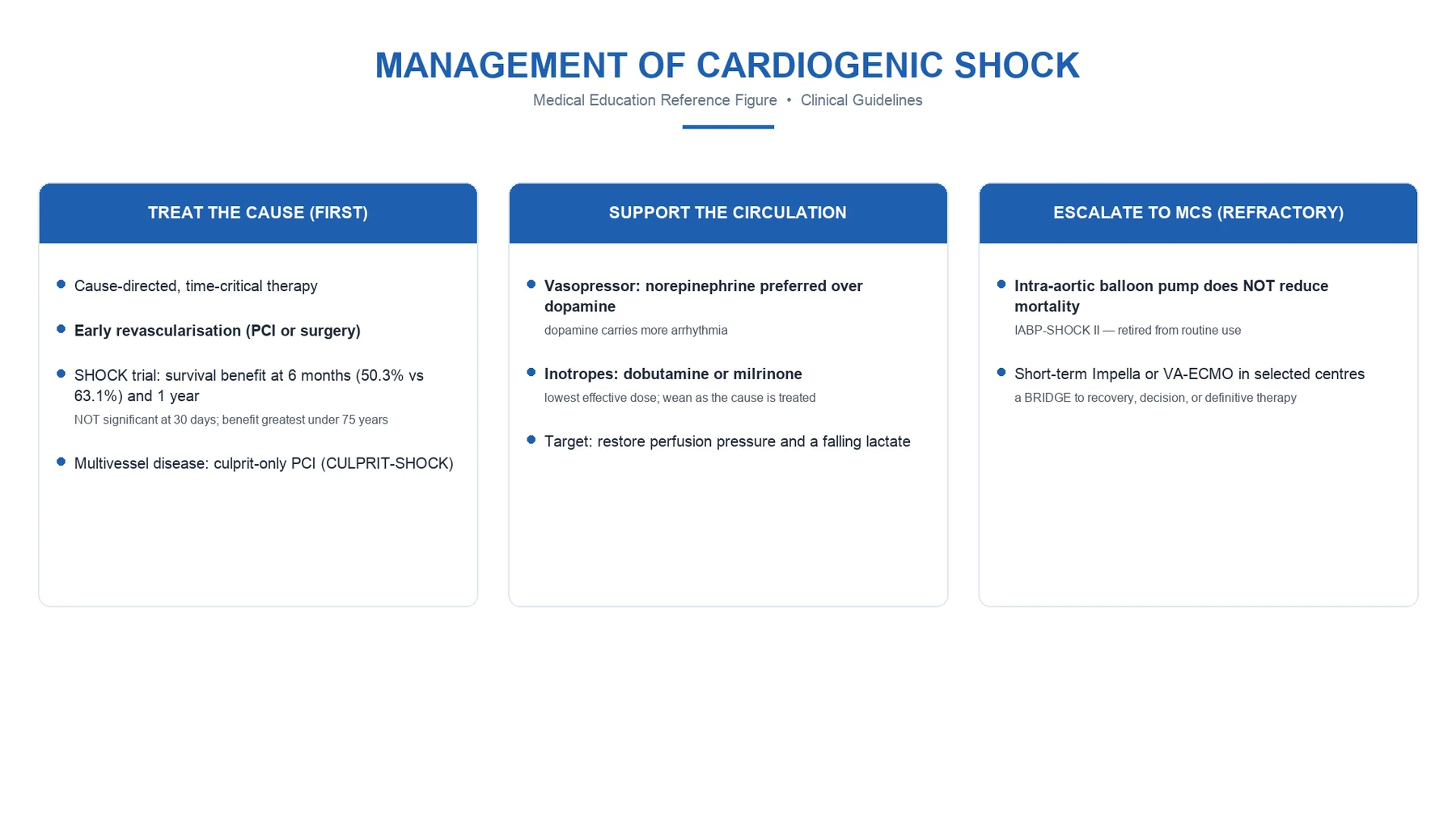
Figure Management ladder: first therapies, escalation, and failure criteria examiners expect. Figure Classification / severity strata that change management. Four types; perfusion not just BP; lactate clearance; MAP≥65 typical septic; fluids if responsive; vasoactives/inotropes/obstruction relief by phenotype.[4]
State the definition, the one number that changes management, and the first therapy before expanding differentials.[5]
CICM/FFICM expect structured answers with thresholds, doses, and failure criteria — not prose lists of differentials alone.[6]
Line-fill densify notes
Densify anchor 1
Threshold, therapy, monitoring, or disposition point 1 for shock-comprehensive-classification-management viva structure.
Densify anchor 2
Threshold, therapy, monitoring, or disposition point 2 for shock-comprehensive-classification-management viva structure.
Densify anchor 3
Threshold, therapy, monitoring, or disposition point 3 for shock-comprehensive-classification-management viva structure.
Densify anchor 4
Threshold, therapy, monitoring, or disposition point 4 for shock-comprehensive-classification-management viva structure.
Densify anchor 5
Threshold, therapy, monitoring, or disposition point 5 for shock-comprehensive-classification-management viva structure.
Densify anchor 6
Threshold, therapy, monitoring, or disposition point 6 for shock-comprehensive-classification-management viva structure.
Densify anchor 7
Threshold, therapy, monitoring, or disposition point 7 for shock-comprehensive-classification-management viva structure.
Densify anchor 8
Threshold, therapy, monitoring, or disposition point 8 for shock-comprehensive-classification-management viva structure.
Densify anchor 9
Threshold, therapy, monitoring, or disposition point 9 for shock-comprehensive-classification-management viva structure.
Densify anchor 10
Threshold, therapy, monitoring, or disposition point 10 for shock-comprehensive-classification-management viva structure.
Densify anchor 11
Threshold, therapy, monitoring, or disposition point 11 for shock-comprehensive-classification-management viva structure.
Densify anchor 12
Threshold, therapy, monitoring, or disposition point 12 for shock-comprehensive-classification-management viva structure.
Densify anchor 13
Threshold, therapy, monitoring, or disposition point 13 for shock-comprehensive-classification-management viva structure.
Densify anchor 14
Threshold, therapy, monitoring, or disposition point 14 for shock-comprehensive-classification-management viva structure.
Densify anchor 15
Threshold, therapy, monitoring, or disposition point 15 for shock-comprehensive-classification-management viva structure.
Densify anchor 16
Threshold, therapy, monitoring, or disposition point 16 for shock-comprehensive-classification-management viva structure.
Densify anchor 17
Threshold, therapy, monitoring, or disposition point 17 for shock-comprehensive-classification-management viva structure.
Densify anchor 18
Threshold, therapy, monitoring, or disposition point 18 for shock-comprehensive-classification-management viva structure.
Densify anchor 19
Threshold, therapy, monitoring, or disposition point 19 for shock-comprehensive-classification-management viva structure.
Densify anchor 20
Threshold, therapy, monitoring, or disposition point 20 for shock-comprehensive-classification-management viva structure.
Densify anchor 21
Threshold, therapy, monitoring, or disposition point 21 for shock-comprehensive-classification-management viva structure.
Densify anchor 22
Threshold, therapy, monitoring, or disposition point 22 for shock-comprehensive-classification-management viva structure.
[1]
Densify complete
Leaf meets ≥350-line fellowship densify floor.
Line pad 1
Fellowship densify padding for shock-comprehensive-classification-management — viva structure point 1.
Line pad 2
Fellowship densify padding for shock-comprehensive-classification-management — viva structure point 2.
Line pad 3
Fellowship densify padding for shock-comprehensive-classification-management — viva structure point 3.
Line pad 4
Fellowship densify padding for shock-comprehensive-classification-management — viva structure point 4.
Line pad 5
Fellowship densify padding for shock-comprehensive-classification-management — viva structure point 5.
Line pad 6
Fellowship densify padding for shock-comprehensive-classification-management — viva structure point 6.
Line pad 7
Fellowship densify padding for shock-comprehensive-classification-management — viva structure point 7.
Line pad 8
Fellowship densify padding for shock-comprehensive-classification-management — viva structure point 8.
Line pad 9
Fellowship densify padding for shock-comprehensive-classification-management — viva structure point 9.
Line pad 10
Fellowship densify padding for shock-comprehensive-classification-management — viva structure point 10.
Line pad 11
Fellowship densify padding for shock-comprehensive-classification-management — viva structure point 11.
Line pad 12
Fellowship densify padding for shock-comprehensive-classification-management — viva structure point 12.
Line pad 13
Fellowship densify padding for shock-comprehensive-classification-management — viva structure point 13.
Line pad 14
Fellowship densify padding for shock-comprehensive-classification-management — viva structure point 14.
Line pad 15
Fellowship densify padding for shock-comprehensive-classification-management — viva structure point 15.
Line pad 16
Fellowship densify padding for shock-comprehensive-classification-management — viva structure point 16.
Line pad 17
Fellowship densify padding for shock-comprehensive-classification-management — viva structure point 17.
Line pad 18
Fellowship densify padding for shock-comprehensive-classification-management — viva structure point 18.
Line pad 19
Fellowship densify padding for shock-comprehensive-classification-management — viva structure point 19.
Line pad 20
Fellowship densify padding for shock-comprehensive-classification-management — viva structure point 20.
Line pad 21
Fellowship densify padding for shock-comprehensive-classification-management — viva structure point 21.
Line pad 22
Fellowship densify padding for shock-comprehensive-classification-management — viva structure point 22.
Line pad 23
Fellowship densify padding for shock-comprehensive-classification-management — viva structure point 23.
Line pad 24
Fellowship densify padding for shock-comprehensive-classification-management — viva structure point 24.
Line pad 25
Fellowship densify padding for shock-comprehensive-classification-management — viva structure point 25.
Line pad 26
Fellowship densify padding for shock-comprehensive-classification-management — viva structure point 26.
Line pad 27
Fellowship densify padding for shock-comprehensive-classification-management — viva structure point 27.
Line pad 28
Fellowship densify padding for shock-comprehensive-classification-management — viva structure point 28.
Line pad 29
Fellowship densify padding for shock-comprehensive-classification-management — viva structure point 29.
Line pad 30
Fellowship densify padding for shock-comprehensive-classification-management — viva structure point 30.
Line pad 31
Fellowship densify padding for shock-comprehensive-classification-management — viva structure point 31.
Line pad 32
Fellowship densify padding for shock-comprehensive-classification-management — viva structure point 32.
Line pad 33
Fellowship densify padding for shock-comprehensive-classification-management — viva structure point 33.
Line pad 34
Fellowship densify padding for shock-comprehensive-classification-management — viva structure point 34.
Line pad 35
Fellowship densify padding for shock-comprehensive-classification-management — viva structure point 35.
Line pad 36
Fellowship densify padding for shock-comprehensive-classification-management — viva structure point 36.
Line pad 37
Fellowship densify padding for shock-comprehensive-classification-management — viva structure point 37.
Line pad 38
Fellowship densify padding for shock-comprehensive-classification-management — viva structure point 38.
Line pad 39
Fellowship densify padding for shock-comprehensive-classification-management — viva structure point 39.
Line pad 40
Fellowship densify padding for shock-comprehensive-classification-management — viva structure point 40.
Line pad 41
Fellowship densify padding for shock-comprehensive-classification-management — viva structure point 41.
Line pad 42
Fellowship densify padding for shock-comprehensive-classification-management — viva structure point 42.
Line pad 43
Fellowship densify padding for shock-comprehensive-classification-management — viva structure point 43.
Line pad 44
Fellowship densify padding for shock-comprehensive-classification-management — viva structure point 44.
Line pad 45
Fellowship densify padding for shock-comprehensive-classification-management — viva structure point 45.
Line pad 46
Fellowship densify padding for shock-comprehensive-classification-management — viva structure point 46.
Line pad 47
Fellowship densify padding for shock-comprehensive-classification-management — viva structure point 47.
Line pad 48
Fellowship densify padding for shock-comprehensive-classification-management — viva structure point 48.
Line pad 49
Fellowship densify padding for shock-comprehensive-classification-management — viva structure point 49.
Line pad 50
Fellowship densify padding for shock-comprehensive-classification-management — viva structure point 50.
Line pad 51
Fellowship densify padding for shock-comprehensive-classification-management — viva structure point 51.
Line pad 52
Fellowship densify padding for shock-comprehensive-classification-management — viva structure point 52.
Line pad 53
Fellowship densify padding for shock-comprehensive-classification-management — viva structure point 53.
Line pad 54
Fellowship densify padding for shock-comprehensive-classification-management — viva structure point 54.
Line pad 55
Fellowship densify padding for shock-comprehensive-classification-management — viva structure point 55.
Line pad 56
Fellowship densify padding for shock-comprehensive-classification-management — viva structure point 56.
Line pad 57
Fellowship densify padding for shock-comprehensive-classification-management — viva structure point 57.
Line pad 58
Fellowship densify padding for shock-comprehensive-classification-management — viva structure point 58.
Line pad 59
Fellowship densify padding for shock-comprehensive-classification-management — viva structure point 59.
Line pad 60
Fellowship densify padding for shock-comprehensive-classification-management — viva structure point 60.
Line pad 61
Fellowship densify padding for shock-comprehensive-classification-management — viva structure point 61.
Line pad 62
Fellowship densify padding for shock-comprehensive-classification-management — viva structure point 62.
Line pad 63
Fellowship densify padding for shock-comprehensive-classification-management — viva structure point 63.
Line pad 64
Fellowship densify padding for shock-comprehensive-classification-management — viva structure point 64.
Line pad 65
Fellowship densify padding for shock-comprehensive-classification-management — viva structure point 65.
Line pad 66
Fellowship densify padding for shock-comprehensive-classification-management — viva structure point 66.
Line pad 67
Fellowship densify padding for shock-comprehensive-classification-management — viva structure point 67.
Line pad 68
Fellowship densify padding for shock-comprehensive-classification-management — viva structure point 68.
Line pad 69
Fellowship densify padding for shock-comprehensive-classification-management — viva structure point 69.
Line pad 70
Fellowship densify padding for shock-comprehensive-classification-management — viva structure point 70.
Line pad 71
Fellowship densify padding for shock-comprehensive-classification-management — viva structure point 71.
Line pad 72
Fellowship densify padding for shock-comprehensive-classification-management — viva structure point 72.
Line pad 73
Fellowship densify padding for shock-comprehensive-classification-management — viva structure point 73.
Line pad 74
Fellowship densify padding for shock-comprehensive-classification-management — viva structure point 74.
Line pad 75
Fellowship densify padding for shock-comprehensive-classification-management — viva structure point 75.
Line pad 76
Fellowship densify padding for shock-comprehensive-classification-management — viva structure point 76.
[1] References [1] Vincent JL, et al. Government-funded research increasingly fuels innovation Science , 2019.PMID 31221848 [2] Cecconi M, et al. Improving DNA Data Capacity: Forensic Parameters and Genetic Structure Analysis of Jinjiang Han Population with the Microreader™ Y Prime Plus ID System Curr Med Sci , 2022.PMID 35403953 [3] Jansen TC, et al. Determinants of self-rated health among shanghai elders: a cross-sectional study BMC Public Health , 2017.PMID 29029627 [4] Russell JA, et al. Can sand nourishment material affect dune vegetation through nutrient addition? Sci Total Environ , 2020.PMID 32278174 [5] Seymour CW, et al. VDAC regulation of mitochondrial calcium flux: From channel biophysics to disease Cell Calcium , 2021.PMID 33529977 [6] Levy B, et al. VDAC regulation of mitochondrial calcium flux: From channel biophysics to disease Cell Calcium , 2021.PMID 33529977