ICU · Trauma & burns
Trauma, Burns and Mass-Casualty Resuscitation
Also known as Trauma · Major trauma · Burns · Parkland formula · Damage-control surgery · Mass casualty · START triage · Injury Severity Score
Trauma is the time-critical failure of mechanical integrity — of the circulation, the airway, the brain and the skeleton — and its management is the parallel, prioritised, damage-control resuscitation of the ATLS primary survey. This topic builds the examiner's framework on the primary and the secondary survey (the ABCDE), the lethal triad of acidosis-hypothermia-coagulopathy that drives the bleeding to death, the damage-control resuscitation with tranexamic acid and the 1:1:1 transfusion ratio, the burns resuscitation (the Parkland formula and the inhalation injury), the cervical-spine clearance (the Canadian C-spine rule), the traumatic-brain-injury corticosteroid harm (the CRASH trial), the mass-casualty triage (START) and the injury scoring (the ISS and the RTS), and the evidence base — CRASH-2 for tranexamic acid and the Canadian C-spine rule for the clearance of the alert, stable patient.
On this page & tools
Your progress
Saved locally on this device.
5 MCQs with explanations
Target exams
Overview & definition
Trauma is the time-critical failure of the body's mechanical integrity — the circulation haemorrhaging, the airway obstructed, the brain injured, the skeleton unstable — and its management is the parallel, prioritised, damage-control resuscitation of the ATLS (Advanced Trauma Life Support) primary survey. The single over-riding principle is that the immediately life-threatening injuries are found and treated in a fixed order, before the full diagnosis, because the patient who is bleeding or obstructed dies of the bleeding or the obstruction, not of the fracture that is most apparent.[1][1]
The framework is the primary survey (the ABCDE), the resuscitation that runs in parallel with it, and the secondary survey once the immediately life-threatening problems are controlled. The trauma patient who reaches the intensive care unit has, in the main, been stabilised by the primary survey, and the ICU task is the ongoing damage-control resuscitation, the definitive repair, and the prevention of the second hit.[1]
Pathophysiology: the lethal triad and the second hit
The trauma patient who bleeds dies of the lethal triad that the bleeding generates — acidosis, hypothermia and coagulopathy, each worsening the bleeding and the other two in a spiral to death. The acidosis (from the hypoperfusion) and the hypothermia (from the exposure and the transfusion) impair the coagulation cascade, the coagulopathy worsens the bleeding, and the resuscitation that dilutes the clotting factors with crystalloid worsens all three.[1]
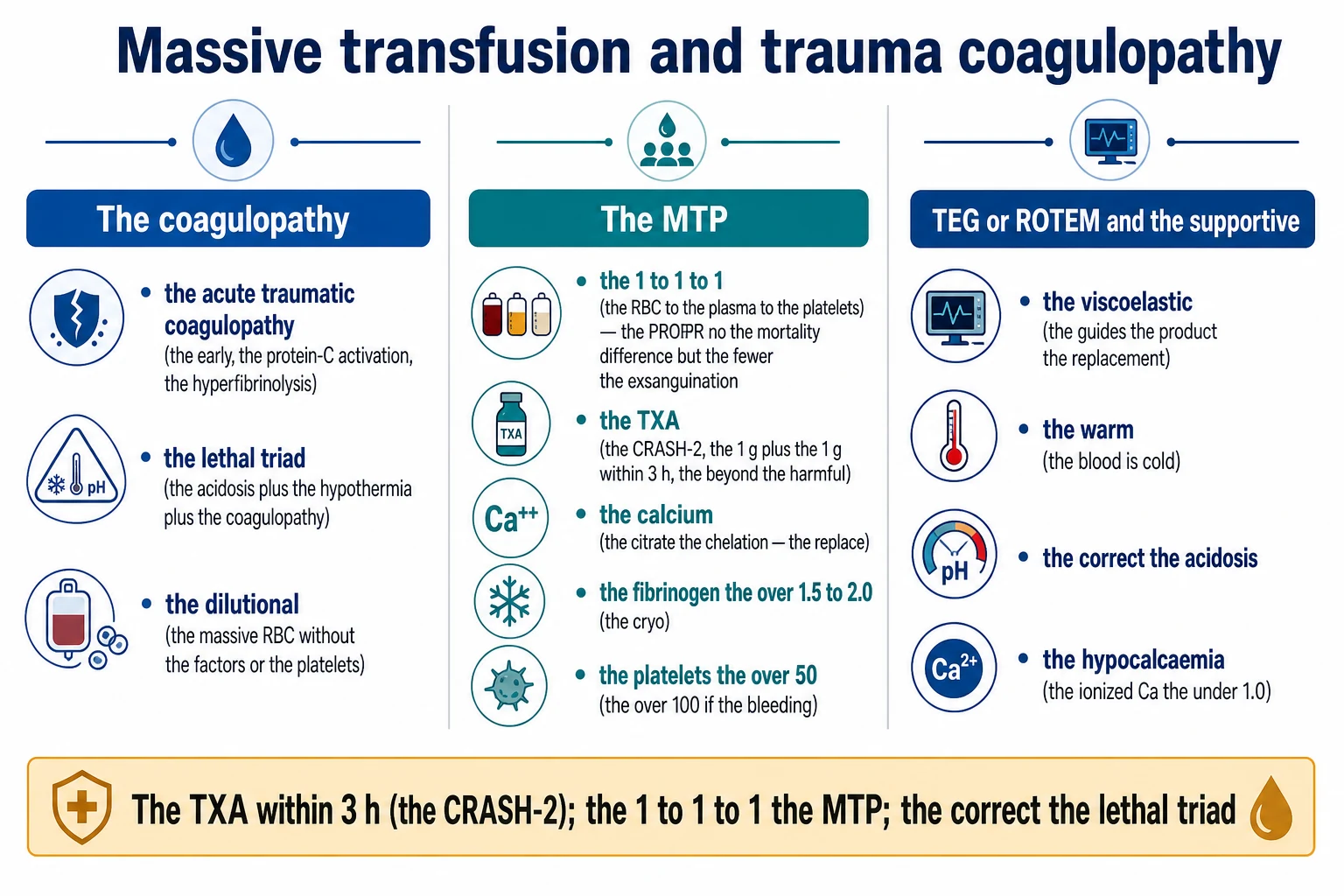
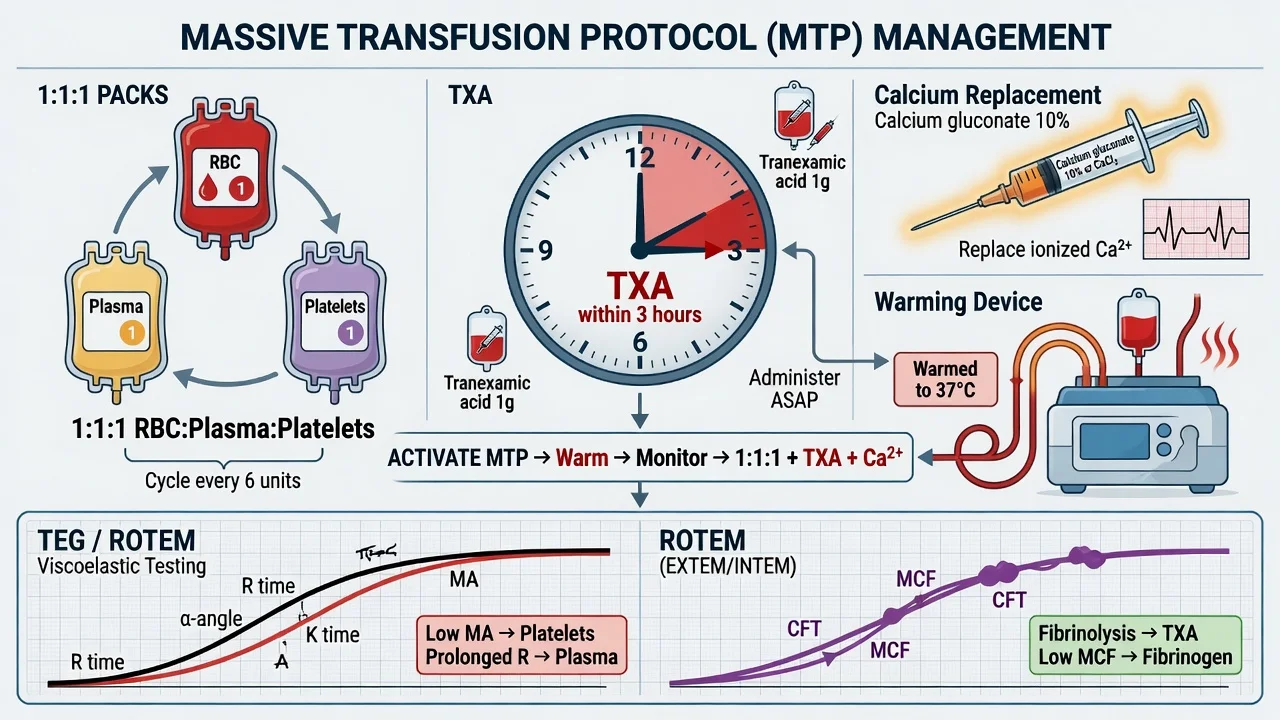
The damage-control principle is the prevention and the reversal of this triad: the surgical control of the bleeding before the physiology is irretrievable, the resuscitation with blood products rather than crystalloid (to avoid the dilutional coagulopathy), the tranexamic acid to inhibit the fibrinolysis, the warming of the patient, and the correction of the acidosis by the restoration of the perfusion. The "second hit" — the inflammatory and the ischaemic-reperfusion injury of the uncontrolled resuscitation — is the later problem that the disciplined, damage-control approach is designed to minimise.[1]
The primary survey: the ABCDE
The primary survey is the fixed-order search for the immediately life-threatening injuries, with the resuscitation running in parallel at each step.[1]
- A — Airway, with cervical-spine control. The airway is secured (the jaw thrust, the suction, the intubation for the unprotected or the obstructed), with the cervical spine immobilised throughout (in-line manual stabilisation, a collar, sandbags and tape) until it is cleared.
- B — Breathing and ventilation. The life-threatening chest injuries (the tension pneumothorax, the massive haemothorax, the flail segment, the open pneumothorax) are found and treated — the needle decompression, the chest drain, the intubation and the ventilation for the failing gas exchange.
- C — Circulation, with haemorrhage control. The source and the rate of the bleeding are identified (the external, compressible; the chest, the abdomen, the pelvis, the long-bone), the bleeding is controlled (the direct pressure, the tourniquet, the pelvic binder), and the resuscitation with the blood products and the tranexamic acid is begun.
- D — Disability, the neurological status. The Glasgow Coma Scale, the pupils, the lateralising signs — the traumatic brain injury is identified, the airway and the perfusion (the determinants of the secondary brain injury) are defended, and the intubation for the GCS of 8 or below is performed.
- E — Exposure and environmental control. The patient is fully exposed for the examination, then covered and warmed to prevent the hypothermia of the lethal triad. [1]
The secondary survey and the adjuncts
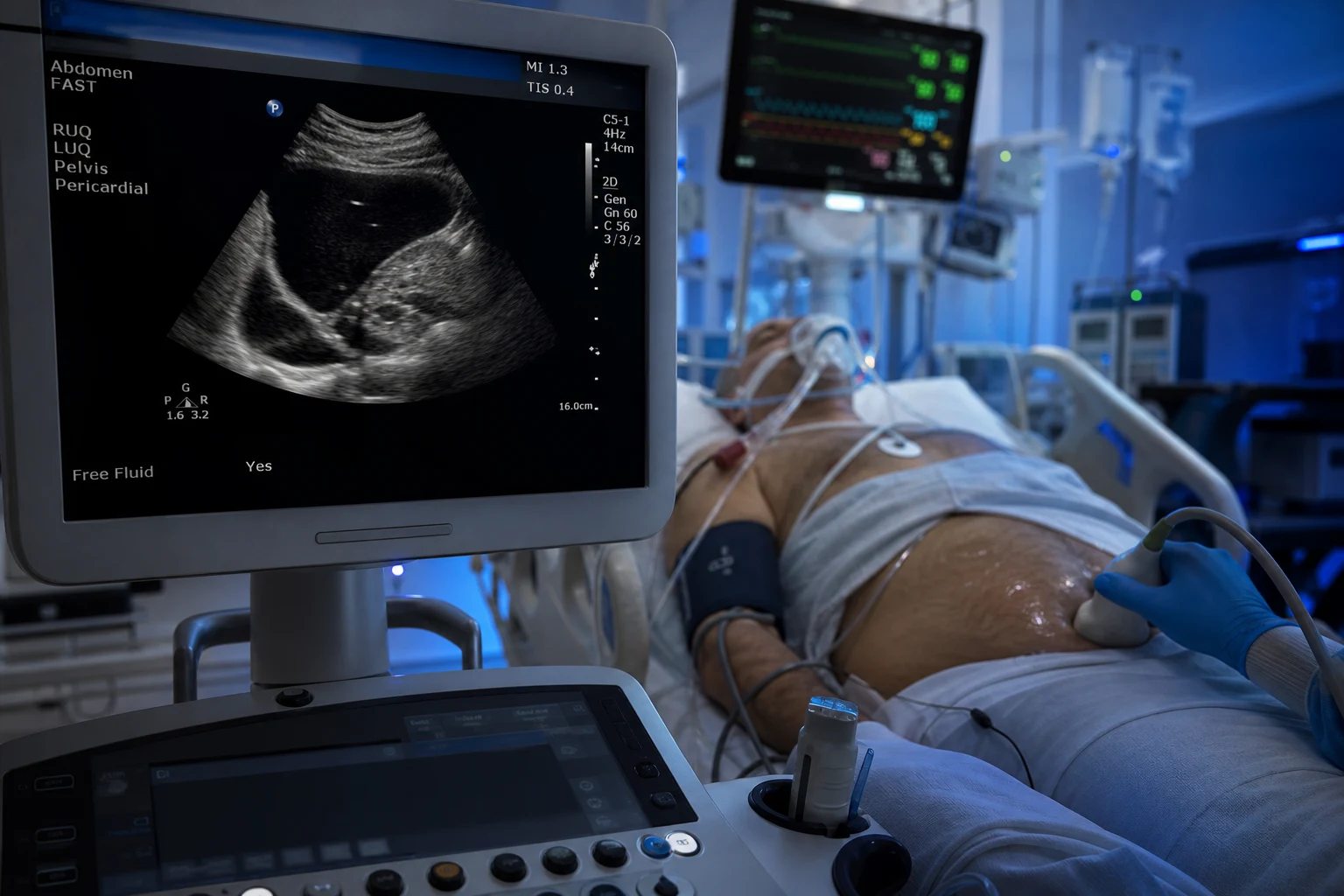
Once the immediately life-threatening problems of the primary survey are controlled, the secondary survey is the head-to-toe examination that finds the remaining, non-immediately-life-threatening injuries — the missed fractures, the concealed intra-abdominal injury, the ocular and the neurological injuries — aided by the adjuncts of the trauma series (the chest and the pelvic films), the focused abdominal sonography in trauma (FAST), and the whole-body computed tomography in the stable patient.[1][1]
The principle is that the secondary survey is not done until the primary survey is complete and the resuscitation is under way, and that it is repeated — the missed injury is the commonest error of trauma care, and the second look finds it. [1]
Traumatic brain injury and the cervical-spine clearance
The traumatic brain injury is the dominant determinant of the trauma outcome, and the intensivist's primary contribution is the prevention of the secondary injury — the hypoxia and the hypotension that each roughly double the mortality — by the airway, the oxygenation, the normocapnia and the normotension, with the specific TBI management (the ICP control, the avoidance of the harmful corticosteroids confirmed by the CRASH trial) addressed in its own domain.[3]
The cervical spine is cleared by the Canadian C-spine rule in the alert, stable, evaluable trauma patient: a radiograph is NOT required for the patient who is alert and stable, who has no high-risk factor (the age over 65, the dangerous mechanism, the paraesthesia), and who can rotate the neck 45 degrees to either side. The application of the rule reduces the unnecessary imaging and the radiation, with no missed injury.[2]
Haemorrhage and damage-control resuscitation
The resuscitation of the haemorrhage is the damage-control approach, the principles of which are detailed in the resuscitation topic: the blood products in a 1:1:1 ratio (the plasma-to-red-cell-to-platelet), the permissive hypotension until the bleeding is controlled, the avoidance of the crystalloid dilution that worsens the coagulopathy, and the tranexamic acid.[4][1]
Tranexamic acid — the CRASH-2 trial (Lancet 2010) showed that it reduced the mortality of the bleeding trauma patient when given early (within three hours of the injury), with the greatest benefit in the first hour and a signal of harm if given after three. It is given to every bleeding trauma patient as early as possible.[1]
The restrictive transfusion threshold applies once the bleeding is controlled (TRICC, a haemoglobin of 70 g/L), and the resuscitation switches from the ratio-driven to the physiological, with the perfusion (the lactate clearance, the base deficit) the endpoint.[4]
Burns: depth, surface area and the Parkland formula
The burns resuscitation is governed by the depth (the superficial, the partial- and the full-thickness), the surface area (the per-cent of the total body surface area, estimated by the rule of nines or the Lund-Browder chart), and the fluid formula. The Parkland formula (4 mL of a crystalloid per kilogram per-cent body surface area in the first 24 hours, half in the first 8) is the standard starting point for the resuscitation of the partial- and full-thickness burns above about 15 to 20 per cent in the adult, titrated to the urine output (0.5 mL/kg/h) rather than given slavishly.[1]
The inhalation injury — the supraglottic oedema, the lower-airway thermal and chemical damage, the carbon-monoxide and the cyanide poisoning — is the immediately life-threatening complication that demands the early intubation (the oedema progresses rapidly), the high-flow oxygen (and the hyperbaric oxygen for the severe carbon-monoxide poisoning), and the bronchoscopy for the assessment. The escharotomy relieves the compartment syndrome of the circumferential full-thickness chest or limb burn.[1]
Mass-casualty triage: START and the principles
In the mass-casualty incident, the demand exceeds the resources, and the triage is the discipline of doing the greatest good for the greatest number — the inversion of the routine care, in which the most resources go to the most salvageable. The START (Simple Triage and Rapid Treatment) algorithm sorts the casualties by the ability to walk (the "green", the minor), the breathing (the "black", the expectant, after the airway-opening manoeuvre), the perfusion (the "red", the immediate) and the consciousness (the "yellow", the delayed).[1]
The principle is that the most salvageable (the immediate, the red — the haemorrhaging, the obstructed) are treated first, the least salvageable (the expectant, the black — the unsalvageable in the available time) are given comfort, and the delayed (the yellow, the stable) wait — a hard but necessary discipline that maximises the survivors. The triage is dynamic and repeated as the resources and the casualties change.[1]
Major incident management — the CSCATT and the MIMMS framework
The Major Incident Medical Management and Support (MIMMS) course, run by the Advanced Life Support Group (ALSG — the same body that runs ALS and APLS), is the gold-standard civilian major-incident curriculum in the UK, Australasia and much of Europe; its hospital-level extension is HMIMMS (Hospital MIMMS) and the military CBRN-focused variant is the Major Joint Medical Disaster Support (MJMDS) course.[1] All three teach a single command framework — the CSCATT mnemonic — that fixes the order in which a major incident is run, and it is this order that the exam tests.[1]
The CSCATT order is Command, Safety, Communication, Assessment, Triage, Treatment, Transport — and the order matters as much as the content. The single most common error at a major incident is to start triaging and treating before command and safety are established, with the result that the responders become the next casualties. The intensivist who is called to the hospital major incident or who deploys to the scene is a member of a structured command hierarchy (the JESIP joint-services interoperability model in the UK; gold–silver–bronze in older terminology; the AIIMS structure of incident controller, operations, plans and logistics in Australasia), and operates within it.[1]
- Command — a single incident commander with the medical commander (the most senior clinician on scene, distinct from the ambulance operational commander) and a defined command location. The clinical team leader must NOT also be the triage officer or the resuscitation room doctor — these roles are separated to preserve oversight.
- Safety — scene safety first (the secondary device, the live electricity, the chemical vapour cloud, the unstable structure); the minimum protective equipment (PPE); the inner cordon, the outer cordon and the warm zone for decontamination. The standing order is "do not become a casualty".
- Communication — a declared major incident declared using the standard message structure — the METHANE mnemonic (Major incident, Exact location, Type, Hazards, Access, Number of casualties, Emergency services). The METHANE message and its acknowledgement is the act of activation.[1]
- Assessment — a rapid scene reconnaissance, the estimate of the casualty numbers, and the resource-to-casualty ratio (the determinant of whether the incident is compensated or decompensated — the latter triggers the full triage discipline and the expectant category).
- Triage — the sieve at the point of contact, the sort at the casualty clearing station.
- Treatment — at the casualty clearing station, by priority, with the interventions restricted to the immediately life-saving (the airway opening, the needle decompression, the tourniquet, the antidote autoinjector).
- Transport — the prioritised evacuation to the right hospital (matching the casualty to the facility with the capacity and the specialty, not the nearest hospital).
The triage sieve and the triage sort
The MIMMS framework divides triage into two sequential physiological assessments — the sieve and the sort.[1]
The triage sieve is the rapid (under 30 seconds per casualty) initial physiological sort performed at the point of contact by the first responder, that places each casualty into one of the four (or five) priority categories. It uses only three variables — mobility, breathing and the pulse/capillary refill — and is designed to be performed without equipment and in poor conditions. [1]
The triage sort is the more detailed secondary physiological sort performed at the casualty clearing station (CCS), which refines the sieve using the components of the Triage Revised Trauma Score (TRTS) — the respiratory rate, the systolic blood pressure and the Glasgow Coma Scale — each scored 0–4 and summed. The TRTS is the operational form of the Revised Trauma Score; the higher the score the better the prognosis, and the boundary values map directly onto the triage categories.[1][1]
The triage sieve — the MIMMS algorithm
- MOBILITY — casualties who can walk to a designated point are classified P3 (T3, minimal). They are directed to a safe area, reassessed later, and used as a self-help reserve. Beware the false-negative: the spinal-injured and the paediatric walker.
- AIRWAY / BREATHING — for those who cannot walk: open the airway with a jaw thrust or a head-tilt-chin-lift. If the casualty does not breathe after the airway-opening manoeuvre (and after one repositioning), they are classified DEAD (expectant on the sieve). No further intervention at this stage; reassess at the sort.
- RESPIRATORY RATE — for those who breathe: count for 15 s and multiply by four. RR less than 10 or greater than 30 per minute → P1 (immediate, T1).
- PERFUSION — if the RR is 10–30: assess the capillary refill (or the radial pulse in low light). Capillary refill > 4 s, or absent radial pulse → P1 (immediate).
- OTHERWISE → P2 (delayed, T2).
- LABEL — apply a SMART tag (or a coloured ribbon: red T1, yellow T2, green T3, black dead) and re-triage every 15–30 min as the casualty's physiology evolves.[1]
The sieve is intentionally crude — it over-triages (assigns too many to P1) by design, because the consequence of under-triage at this stage is the preventable death. The sort corrects the over-triage. The categories are: [1]
| Category | Priority | Colour | Definition | Treatment / transport |
|---|
| Category | Priority | Colour | Definition | Treatment / transport |
|---|---|---|---|---|
| T1 / P1 — Immediate | 1 | Red | Life-threatening but salvageable injury; ABC compromise; needs intervention within 60 min | Treat first at the CCS; transport first to a major trauma centre with ICU |
| T2 / P2 — Delayed | 2 | Yellow | Stable serious injury; can wait hours without deterioration (most isolated long-bone fractures, stable penetrating wounds) | Treat second; transport second to a surgical hospital |
| T3 / P3 — Minimal | 3 | Green | Walking wounded; minor injuries; self-evacuating | Self-help and first-aid post; transport last, possibly by non-ambulance means |
| T4 / Expectant | 4 | Black | Unsalvageable in the available time (e.g. > 90% full-thickness burns, severe head injury with agonal breathing) | Palliation and comfort; re-classified up only if resources unexpectedly expand |
The expectant category (T4) is the hardest discipline of mass-casualty medicine and the one the routine ICU clinician finds most counter-intuitive. It is invoked only when the resource-to-casualty ratio is so deranged that the time spent on an unsalvageable casualty would cost several salvageable lives. In a compensated incident (resources exceed demand) the category is not used and every casualty gets best care. The decision to declare a casualty expectant is made by the senior triage officer, documented, and revisited if the resource picture changes (the second team arrives, the helicopter lands, the night shift comes on).[1]
START, SALT, CareFlight and JumpSTART — the algorithms compared
| Algorithm | Origin / setting | Walking test | Key physiological step | Pitfall |
|---|
| Algorithm | Origin / setting | Walking test | Key physiological step | Pitfall |
|---|---|---|---|---|
| START | US (Hoover, Newport Beach FD, 1983); the world default | Walk → Green | RR > 30; cap refill > 2 s; cannot follow commands → Red | Over-triage of children < 8 yr (use JumpSTART); cap refill unreliable in cold |
| MIMMS sieve | UK ALSG; the ANZ default | Walk → T3 | RR < 10 or > 30; cap refill > 4 s → T1 | Less granular than START; needs the sort at the CCS |
| SALT | US CDC, 2008; the modern evidence-based algorithm | Global sort: wave / walk / wave | Life-saving interventions (needle decompression, tourniquet, autoinjector) BEFORE category | More complex; requires more training |
| CareFlight | Australia (Kenji); used by RFDS and NSW Ambulance | Walk → Green | Obvious life threat → Red; then RR, SBP, obeys commands | Similar to START; tested once |
| JumpSTART | US (Romig 2002); the paediatric START for ages 1–8 | Modified for developmental age | RR < 15 or > 45 → Red; if apnoeic, give 5 rescue breaths before declaring dead | Children < 1 yr need a separate chart |
The SALT (Sort, Assess, Life-saving interventions, Treatment/Transport) algorithm is the most thoroughly studied and is increasingly the standard for paramedic training in North America; it differs from START in two important ways — it permits a small set of life-saving interventions (the needle thoracostomy, the tourniquet, the autoinjector, the airway opening, the pressure dressing) before the priority is assigned, and it explicitly assigns an expectant category.[5]
START in detail — the algorithm the exam expects
START triage — the full algorithm, every step
- ACTION 1 — WALK — Instruct all casualties to walk to a designated safe area. Those who walk are GREEN (minor). They are removed from the immediate area, sit down, and are re-triaged later.
- ACTION 2 — BREATHING — For those remaining (non-walking): open the airway. If still not breathing after one repositioning → BLACK (expectant/dead). Move on; do not perform CPR in a mass casualty.
- ACTION 3 — RESPIRATORY RATE — If breathing: count for 15 s and multiply by four. RR > 30/min → RED (immediate).
- ACTION 4 — PERFUSION — If RR ≤ 30: check the radial pulse or the capillary refill. No radial pulse, or cap refill > 2 s → RED (immediate). Apply a tourniquet to any external compressible haemorrhage — the single life-saving intervention permitted within START.
- ACTION 5 — MENTAL STATUS — If perfusion is adequate: assess the ability to follow simple commands. Cannot follow commands → RED.
- ACTION 6 — DEFAULT — All others → YELLOW (delayed).
- REPEAT — Re-triage every 15–30 min. The dynamic re-assessment is the safeguard against the deteriorating casualty mis-triaged to yellow.[1]
Paediatric mass-casualty triage — JumpSTART and the paediatric sieve
Children behave differently from adults in three ways that defeat the standard START: a young child cannot follow the "walk" command (developmentally, not because of injury); the respiratory-rate cut-offs are age-specific; and the paediatric patient with hypovolaemia preserves the blood pressure until very late — a normal blood pressure is not reassuring. The JumpSTART algorithm (Romig, 2002) was developed to address these and is the standard paediatric triage tool for children between 1 and 8 years.[1]
JumpSTART triage — children 1–8 years
- ALL WALKERS (any child who walks, regardless of developmental command-following) → GREEN. Children < 1 year or non-ambulant (developmentally) → assess individually.
- BREATHING — For non-walkers: open the airway. If not breathing → give 5 rescue breaths. If still apnoeic after the 5 rescue breaths → BLACK. (The 5 rescue breaths is the single most important paediatric modification — many injured children are apnoeic from a reversible cause, not from unsurvivable injury.)
- RESPIRATORY RATE — If breathing spontaneously: RR < 15 or > 45 → RED.
- PERFUSION — If RR 15–45: palpate the central pulse. No central pulse → RED. Capillary refill > 2 s → RED.
- MENTAL STATUS — Appropriate response to pain (AVPU: alert / voice / pain / unresponsive). Inappropriate response or posturing → RED.
- DEFAULT — All others → YELLOW.[1]
Explosive, blast and burn mass-casualty triage
Explosive events produce the mixed picture of blast lung injury, penetrating fragment wounds, blunt crush injury and burn, often in the same casualty, and in numbers that overwhelm within minutes (the 2005 London bombings, the 2017 Manchester Arena bombing, the 2017 Barcelona attacks). The triage is START/MIMMS, but two blast-specific principles override.[1]
Explosive mass casualty — the blast-specific priorities
- SCENE SAFETY — secondary device — The single most dangerous assumption at a bombing is that the worst is over. The secondary device deliberately targets the responders. Maintain the cordon, no radio transmission near a suspect device, and the minimum responders in the hot zone.
- TYMPANIC MEMBRANE = blast-exposure marker — A ruptured tympanic membrane is a marker of significant primary blast exposure and predicts blast lung injury. Examine the ears early; if the casualty is dyspnoeic and the TM is ruptured, assume blast lung.
- BLAST LUNG LAGS — Blast lung injury (pulmonary contusion and alveolar rupture) often worsens over 24–48 h; the casualty triaged GREEN at the scene may be intubated by morning. Re-triage aggressively.
- PENETRATING FRAGMENT WOUNDS — Apply tourniquets liberally for limb haemorrhage; do not remove the embedded fragment in the field.
- AIR EMBOLISM — Suspect in any casualty with neurological signs after blast; keep head-down, left-lateral position during transport.
- CRUSH SYNDROME — The casualty extricated after prolonged crushing: pre-release fluid loading (warm saline + bicarbonate), monitor for hyperkalaemia and arrhythmia, expect rhabdomyolysis-induced AKI.
For burn mass casualties (the nightclub fire, the bushfire, the industrial flash fire), the standard Parkland formula breaks down — there is not the fluid, the staff, or the beds. The triage is by %TBSA and the airway, with the expectant threshold set by the resource position. A working framework in a decompensated burn MCI is: > 80% TBSA in an adult, or > 50% with inhalation injury, or > 95% in any casualty, is expectant.[1]
| TBSA + airway | Category | Action |
|---|
| TBSA + airway | Category | Action |
|---|---|---|
| < 20% TBSA, no inhalation injury | T3 (Green) — or T2 if face/hands/perineum | Dressings, oral fluids, outpatient or delayed transfer |
| 20–60% TBSA, no inhalation injury | T2 (Yellow, delayed) | Parkland initiation, transfer to a burn unit within 6–8 h |
| Any TBSA + airway obstruction, or 60–80% TBSA | T1 (Red, immediate) | Early intubation, Parkland, transfer to burn ICU |
| > 80% TBSA, or > 50% with inhalation injury, or > 95% (any) | T4 (Expectant) | Palliation, comfort; re-classify only if resources expand |
Chemical, biological, radiological and nuclear (CBRN) mass casualty
The CBRN event inverts several standard rules. The casualty is contaminated — the responder who touches the casualty without PPE becomes the next casualty, and the hospital that accepts an un-decontaminated casualty closes itself. The triage is performed through PPE (gloves, suit, respirator), the life-saving interventions are restricted (no mouth-to-mouth, no needle decompression through a suit — use autoinjectors), and the casualty is decontaminated before they enter the clean zone of the hospital.[1]
CBRN — strip and decontaminate before any clinical care
- HOT ZONE / WARM ZONE / COLD ZONE — Set up the three zones before accepting casualties. The hot zone is the contaminated scene; the warm zone is the decontamination corridor; the cold zone is the clean clinical area. No casualty crosses hot→cold without decontamination.
- STRIP — Clothing removal eliminates 80–90% of contamination. This is the single most effective intervention and is performed before any rinse.
- RINSE-WIPE-RINSE — Copious warm water (hypothermia in cold-water decontamination is a real killer), then soap, then rinse again. Ambulant casualties self-decontaminate; the non-ambulant go through the decontamination tent.
- ANTIDOTE EARLY — Nerve agent: atropine + oxime autoinjectors (the NATO combo-pen / DuoDote); cyanide: hydroxocobalamin; organophosphate: benzodiazepine for seizures. The clinical sign drives the antidote, not the assay — the cholinergic toxidrome (miosis, salivation, lacrimation, fasciculations) is diagnostic.
- HOSPITAL LOCKDOWN — The hospital activates its CBRN plan, locks the doors, sets up the decontamination structure outside the ED, and accepts casualties only through the decontamination corridor. A contaminated casualty who breaches the ED closes the hospital.
- REVERSE TRIAGE for the agent — For nerve agents the most cyanotic / bradypnoeic casualty is the most reversible (the antidote works in minutes). The standard "expectant" may rapidly become "immediate" with atropine.
Hospital major incident plan — activation and the cascade
The hospital major incident plan (the Major Incident Plan, the Disaster Plan, Code Brown in Australasia) is the standing document that pre-allocates roles, locations and the chain of activation. It is activated by a defined trigger (the METHANE message, the standing-order activation criteria, or the explicit declaration by the senior emergency physician or the on-call executive), and the activation is the declaration — not the assessment. The plan assumes the staff on duty will not know their roles; the document does.[1]
Hospital major incident — the activation cascade
- DECLARATION — The senior ED consultant or on-call executive declares the major incident using the trigger criteria (any incident where the demand exceeds the available resources). The declaration activates the plan; it does not wait for confirmation.
- METHANE MESSAGE — The standard structured message to all receiving agencies: Major incident declared, Exact location, Type (chemical / explosive / mass casualty), Hazards, Access (in/out routes), Number of casualties (estimated), Emergency services required.
- CASCADE ACTIVATION — Switchboard triggers the cascade — the major incident team (incident commander, medical commander, matron, portering, security, theatre coordinator, ICU consultant, radiology, laboratory, mortuary, communications).
- ICU ALERT — ICU consultant on site within 30–60 min; ICU bed state reviewed; surge capacity activated.
- CREATE CAPACITY — The ED creates trolley space: ambulant casualties to the front hall; stable admitted patients to the wards; elective theatres converted to emergency; the day-case unit to a holding ward.
- ESTABLISH THE TRIAGE POINT — A single triage officer at the ED door, re-sorting casualties as they arrive (they will arrive before the official notification — the "self-presenters" arrive by private car, often the most urgent).
- COMMUNICATIONS CELL — A single point for media, family enquiries and inter-hospital coordination. No clinical staff talks to media; all enquiries routed to the cell.
- STAND-DOWN — When the casualty flow is contained and the inpatients are placed, the incident commander stands the plan down. A hot debrief is held within 24 h.[1]
ICU surge capacity — the three tiers and the reverse-triage ladder
The ICU is the rate-limiting step in any major incident — the ED can absorb a surge by discharging and doubling up, the theatre can run extra lists, but the ICU cannot create trained nurses. The surge capacity is conventionally defined in three tiers — conventional, contingent and crisis capacity — corresponding to the staff, space and supplies available at each level.[6]
| Tier | Staffing model | Space | Indication |
|---|
| Tier | Staffing model | Space | Indication |
|---|---|---|---|
| Conventional | Usual ICU nurse-to-patient ratio (1:1 for the ventilated) | Usual ICU beds | Routine surge — seasonal, predictable |
| Contingent | Modified ratios (1:2 or 1:3 for the stable ventilated; supervised non-ICU nurses) | Post-anaesthetic care unit (PACU), HDU, theatre recovery opened as surge ICU | Moderate incident; cancel electives; transfer out where possible |
| Crisis | Crisis standards — any trained staff (operating department practitioners, redeployed ward nurses under ICU supervision); 1:4 or worse | Any monitored bed; the operating theatre becomes ICU overflow; cohorting of casualties | Mass casualty or pandemic overwhelm — reverse triage in force |
ICU surge — the capacity-creation ladder (in order)
- CANCEL ELECTIVE WORK — The fastest single intervention: cancel elective surgery, elective admissions and outpatient work; the staff and the PACU/recovery space become available within hours.
- EXPEDITE DISCHARGE — Every patient reviewed for step-down to HDU or ward; palliative / withdrawal decisions expedited where appropriate.
- OPEN THE PACU AND THEATRE RECOVERY as ICU overflow — monitored spaces with anaesthetic-trained staff; ideal for the stabilised trauma casualty.
- DOUBLE-BED / SINGLE-ROOM CONVERSION — Convert single rooms to double occupancy; cohort casualties by mechanism where contamination is a concern.
- REDEPLOY STAFF — Recovered theatre staff, ward nurses, retired staff recalled. Operate to a crisis staffing model with clear scope-of-practice and supervision.
- MUTUAL AID — INTRA-NETWORK TRANSFER — Move the stable ICU patients out to a non-receiving hospital; the receiving hospital keeps the unstable. Done by air where distance requires.
- EXTERNAL MUTUAL AID — Activate the regional mutual-aid agreement; military medical teams, the disaster medical assistance team (DMAT), the international response (where scale requires).
- REVERSE TRIAGE — The last-resort, crisis-standard decision: the allocation of the last ICU bed to the casualty with the highest probability of benefit (not necessarily the most unwell). A documented, ethical, multidisciplinary decision, using a published triage tool, revisable as capacity changes.[6]
The reverse-triage ladder is the ethical and operational framework for the crisis tier — the explicit acknowledgement that, when the trained ICU nurse-to-patient ratio cannot be maintained, the ICU is no longer delivering the standard of care and the allocation decisions are made on greatest good for the greatest number, with the priority given to the casualty most likely to survive with the shortest ICU stay (the "first come, first served" is suspended). The decisions are documented, made by a triage committee (not the bedside clinician, who has a conflict), and revisited every shift as the capacity changes. [1]
Mutual aid — the formal networks
Mutual aid is the standing agreement between hospitals, regions, and (where applicable) the military and international response, that pre-arranges the transfer of staff, supplies and patients in a major incident. It is formalised before the incident — the response is rehearsed, the contacts are maintained, the legal and the indemnity questions are settled. The intensivist on call should know the local mutual-aid structure: the regional trauma network, the state disaster medical plan, the national health emergency operations centre, and (for the mass casualty or the CBRN) the military and federal assets available.[1]
- Intra-network transfer — the regional trauma / burn / paediatric network; the principle is that the right patient goes to the right hospital (the burn casualty to the burn centre, the paediatric casualty to the paediatric trauma centre, the neurosurgical casualty to the neurosurgical centre), and that the stable casualty is moved out of the receiving hospital to clear capacity.
- External / military — the military field hospital, the DMAT (Disaster Medical Assistance Team), the urban search-and-rescue team, the international medical-surgical response team (IMSURT) or the WHO Emergency Medical Teams (EMTs).
- Logistics — the regional blood bank, the pharmaceutical cache, the oxygen and ventilator cache, the body-handling and mortuary capacity. [1]
Debriefing — hot, warm and cold
The debrief after a major incident is not optional; it is part of the response. It serves three purposes — the operational review (what worked, what did not, what to fix), the support of the responders (the psychological aftermath of a major incident is substantial and predictable), and the institutional learning that feeds back into the major incident plan.[1]
The post-incident debrief schedule
- HOT DEBRIEF — within 24 h (ideally within 4 h of stand-down) — A short, immediate, on-the-spot debrief held by the team that just stood down. Three questions: what went well; what did not; what do we do differently next time. Attendance is the team that worked the incident; the tone is supportive, not blame-finding. The aim is to acknowledge the work, surface the immediate concerns, and identify any casualty or responder needing urgent follow-up.
- WARM DEBRIEF — within 1 week — A departmental debrief; the senior team reviews the chronology, the resource use, the casualties; the gaps in the plan are identified and assigned to a named owner for action.
- COLD DEBRIEF — within 1–2 months — The formal, structured organisational review; every discipline contributes; the lessons are formally documented and incorporated into the next iteration of the major incident plan. A formal root-cause-analysis structure may be used where a serious adverse event occurred.
- PSYCHOLOGICAL FOLLOW-UP — Every responder is offered structured psychological follow-up; the symptoms of acute stress disorder and PTSD appear in 20–40% of responders in the weeks after a major incident. The offer is active (not "see occupational health if you need it") and the at-risk responders (the first-on-scene, those who cared for a casualty who died, those with a personal trigger) are contacted individually.
Psychological first aid for responders
Psychological first aid (PFA) is the structured, evidence-informed early support for the responder exposed to a traumatic event — modelled on the WHO and Inter-Agency Standing Committee (IASC) framework, and built on the principles of safety, calm, connectedness, self-efficacy and hope. It is not "counselling" and it is explicitly not critical incident stress debriefing (CISD — the older single-session debrief, which has been shown to be ineffective or harmful in some populations).[1]
The practical bedside skill is the L-A-S-T framework (Look, Assess/Approach, Stabilise, Triage/Treat) or the WHO R-U-P-A — recognise the acute stress response, understand that it is normal, protect from further exposure, access support. The intervention is brief, practical and respectful: provide a quiet space, hydration and food, a structured break, contact with family, and the explicit acknowledgement that the response to an abnormal event is normal. The indications for escalation to mental-health follow-up are the persistent intrusive symptoms (the flashbacks, the nightmares), the avoidance, the hypervigilance, the dissociation, and the functional impairment (the inability to return to work). [1]
Trauma scoring: the ISS and the RTS
The trauma scores quantify the severity and predict the outcome. The Glasgow Coma Scale is the neurological component; the Injury Severity Score (ISS) sums the squares of the three most-severely-injured body regions (the Abbreviated Injury Scale of each), with an ISS above 15 defining the major trauma; and the Revised Trauma Score (RTS) combines the GCS, the systolic blood pressure and the respiratory rate into a physiologic score. The scores guide the triage to the trauma centre and the audit of the care.[1]
Management: the time-critical, parallel, damage-control approach
The trauma management is the parallel execution of the primary survey and the resuscitation, the time-critical control of the bleeding and the airway, and the damage-control discipline that reverses the lethal triad.[1][1]
- The primary survey (ABCDE) with the resuscitation in parallel — the airway with the C-spine control, the breathing, the circulation with the haemorrhage control, the disability, the exposure and the warming.
- The damage-control resuscitation of the haemorrhage — the blood in a 1:1:1 ratio, the tranexamic acid early, the permissive hypotension, the warming.[1]
- The cervical-spine and the TBI management — the clearance by the Canadian C-spine rule; the prevention of the secondary brain injury; the corticosteroids avoided (CRASH).[2][3]
- The damage-control surgery for the physiology that is failing — the abbreviated operation to control the bleeding and the contamination, with the definitive repair staged when the patient is stable.[1]
- The secondary survey and the repeated examination to find the missed injury.
Monitoring the trauma patient
Monitoring divides into the perfusion, the bleeding, the brain and the injuries.[1][1]
- The perfusion — the lactate and the base deficit (the markers of the under-resuscitation and the occult bleeding), the urine output, the capillary refill.
- The bleeding and the coagulopathy — the haemoglobin, the coagulation, the ionised calcium (the citrate chelation), the temperature (the hypothermia of the triad).
- The brain — the GCS, the pupils, the ICP (if monitored), the sedation.
- The injuries — the repeated FAST, the chest film, the compartment pressures (the abdominal, the limb), the whole-body CT in the stable patient. [1]
Prognosis and the determinants of outcome
The trauma outcome is the outcome of the brain injury (the dominant determinant of the long-term), the haemorrhage (the dominant determinant of the early death), and the age and the comorbidity. The preventable death in trauma is, overwhelmingly, the failure to control the haemorrhage and the airway early — the discipline of the primary survey and the damage-control resuscitation — and the survivors are left with the disability of the brain injury and the limb, the psychological trauma, and the long recovery.[1][1]
SAQ — Major incident command: CSCATT, METHANE and triage at a bombing
10 minutes · 10 marks
You are the on-call ICU consultant called to the ED at 14:30 following reports of an explosion at a city-centre concert venue. The ambulance service has declared a major incident with an estimated 60 casualties, 12 of whom are expected to arrive at your hospital within 20 minutes. Describe your role within the CSCATT command framework, the METHANE declaration, and how you would perform triage using the START algorithm.
SAQ — Blast injury: primary, secondary, tertiary and quaternary mechanisms
10 minutes · 10 marks
A 24-year-old man is brought to the ED 30 minutes after a bomb detonation at a train station. He was 5 metres from the blast. He is dyspnoeic (RR 36, SpO2 88% on 15 L), has a ruptured right tympanic membrane, bilateral patchy infiltrates on chest X-ray, a bleeding left thigh laceration, and is confused. BP 100/70, HR 130. Outline the pathophysiology of blast injury, the immediate management priorities, and the ICU considerations over the next 48 hours.
Red flags
Lerner 2008 — the SALT mass-casualty triage guideline (CDC expert panel)
Design: A structured expert-panel review (the CDC-sponsored Mass Casualty Triage Working Group) of the published evidence on mass-casualty triage algorithms (START, CareFlight, Sacco, MIMMS sieve), convened to draft a proposed national (US) guideline. Key findings: No algorithm had a strong evidence base; most relied on expert consensus. The panel synthesised a new algorithm — SALT (Sort, Assess, Life-saving interventions, Treatment/Transport) — that combined the strengths of the existing systems, added an explicit expectant category, and permitted a small set of life-saving interventions (tourniquet, needle thoracostomy, autoinjector, airway opening, pressure dressing) before category assignment. Relevance: SALT is now the most widely endorsed triage algorithm in North American prehospital practice; it is the algorithm most likely to appear in the exam alongside START. The paper is the citation for the modern consensus on triage.[5]
Christian 2014 — Chest consensus on crisis standards of care (surge capacity)
Design: A Task Force on Mass Critical Care (CHEST / SCCM) consensus statement on definitive care for the critically ill during a disaster — defining the conventional → contingent → crisis surge tiers. Key findings: Defined the three tiers of surge capacity and the staffing models for each; articulated that crisis standards of care are a system-level declaration (not a bedside one), and that the transition between tiers is a documented, jurisdictional decision. Set out the framework for the allocation (reverse-triage) decisions that govern the last ICU bed. Relevance: The conceptual framework for ICU surge capacity in mass casualty and pandemic — the conventional/contingent/crisis taxonomy and the triage-committee governance model that the exam expects.[6]
Clinical pearls — mass-casualty and disaster triage
Key points — the one-minute exam revision on mass casualty
In a mass-casualty incident the demand exceeds the resources, and the discipline of triage — doing the greatest good for the greatest number — inverts the routine care. The MIMMS framework (the CSCATT order — Command, Safety, Communication, Assessment, Triage, Treatment, Transport) fixes the operational sequence; the METHANE message is the activation; the sieve (the rapid physiological sort at the point of contact) is followed by the sort (the TRTS-based re-triage at the casualty clearing station). The START algorithm sorts by walking, breathing, RR > 30, perfusion and mental status into the four categories — immediate (red), delayed (yellow), minimal (green) and expectant (black) — and the triage is dynamic and repeated. The hospital major incident plan is activated by the METHANE message; the ICU surge is built in three tiers (conventional, contingent, crisis); the reverse-triage ladder is the crisis-standard tool for the allocation of the last ICU bed; the mutual aid network, the structured debrief (hot within 24 h, cold within 1–2 months), and the psychological first aid for responders complete the response.[1][1]
References
- [1]The CRASH-2 Collaborators. Effects of tranexamic acid on death, vascular occlusive events, and blood transfusion in trauma patients with significant haemorrhage (CRASH-2): a randomised, placebo-controlled trial Lancet, 2010.PMID 20554319
- [2]Stiell IG, Wells GA, Vandemheen KL, et al. The Canadian C-spine rule for radiography in alert and stable trauma patients JAMA, 2001.PMID 11597285
- [3]Edwards P, Arango M, Balica L, et al.; CRASH trial collaborators. Effect of intravenous corticosteroids on death within 14 days in 10008 adults with clinically significant head injury (MRC CRASH trial): randomised placebo-controlled trial Lancet, 2004.PMID 15474134
- [4]Hébert PC, Wells G, Blajchman MA, et al. A multicenter, randomized, controlled clinical trial of transfusion requirements in critical care. Transfusion Requirements in Critical Care Investigators, Canadian Critical Care Trials Group N Engl J Med, 1999.PMID 9971864
- [5]Lerner EB, Schwartz RB, Coule PL, et al. Public health disaster research: surveying the field, defining its future Disaster Med Public Health Prep, 2007.PMID 18388605
- [6]Christian MD, Devereaux AV, Dichter JR, Geiling JA, Rubinson L. Comparison of Positive Inotropic Agents in the Management of Acute Decompensated Heart Failure J Cardiovasc Pharmacol, 2020.PMID 32091426