ICU · Resuscitation
Vasoplegic and vasopressor-refractory shock: methylene blue, vasopressin, adjuncts
Also known as Vasoplegic shock · Vasopressor-refractory shock · Catecholamine-resistant shock · Methylene blue · Vasopressin · Refractory septic shock
Vasoplegic shock = distributive shock refractory to catecholamine vasopressors (noradrenaline) — profound NO-mediated vasodilation. Causes: septic shock (most common), post-cardiac surgery vasoplegia, anaphylaxis, post-reperfusion, drug-induced (ACEi, PDE inhibitors, protamine), adrenal insufficiency. PATHOPHYSIOLOGY: excessive nitric oxide (NO) production (iNOS induction in sepsis) → cGMP accumulation → vascular smooth muscle relaxation → vasodilation unresponsive to catecholamines. MANAGEMENT ESCALATION: (1) Adequate volume (but not over-resuscitate). (2) Noradrenaline (first-line alpha-1 agonist). (3) ADD VASOPRESSIN (V1 agonist — 0.03 U/min — catecholamine-sparing, different receptor). (4) ADD STEROIDS (hydrocortisone 200 mg/day — for CIRCI/adrenal insufficiency). (5) METHYLENE BLUE (1-2 mg/kg IV — inhibits NO-cGMP pathway — emerging for refractory vasoplegia). (6) Adjuncts: angiotensin II (ATHOS-3), ascorbate, thiamine, steroids (HAT therapy). ALWAYS: treat cause, source control, exclude adrenal insufficiency/hypovolaemia.
On this page & tools
Your progress
Saved locally on this device.
Target exams
Red flags
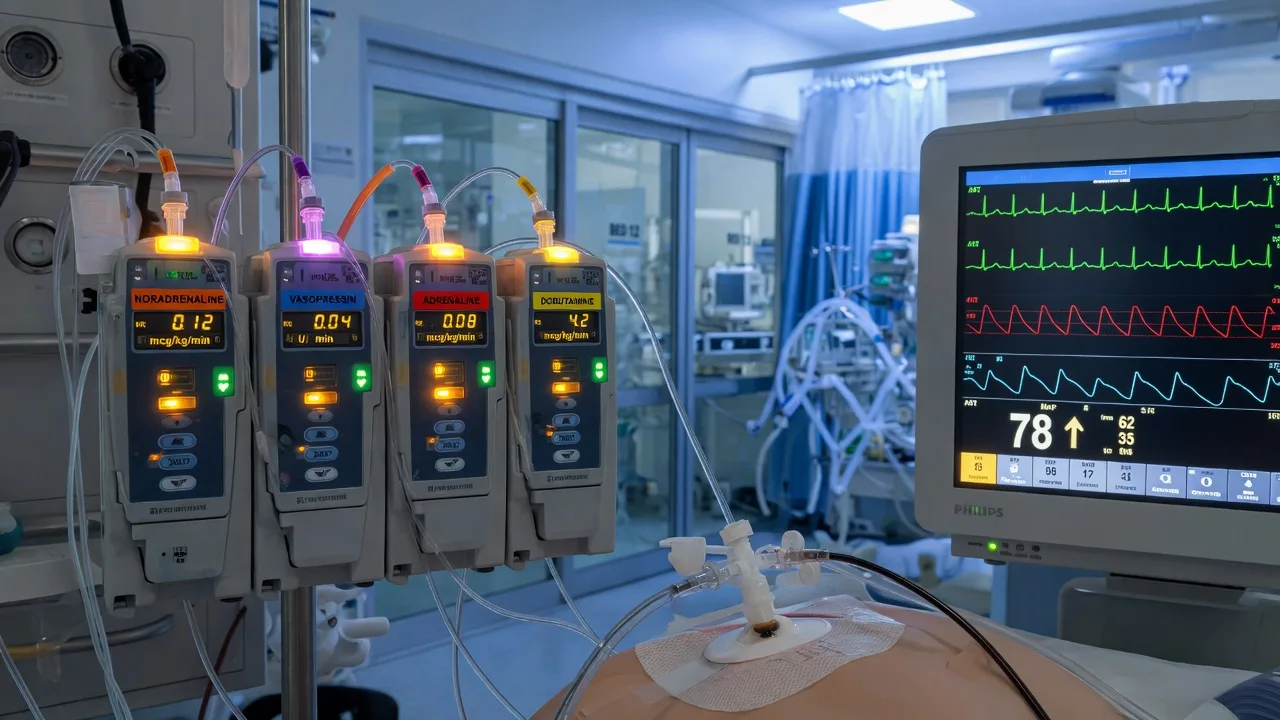
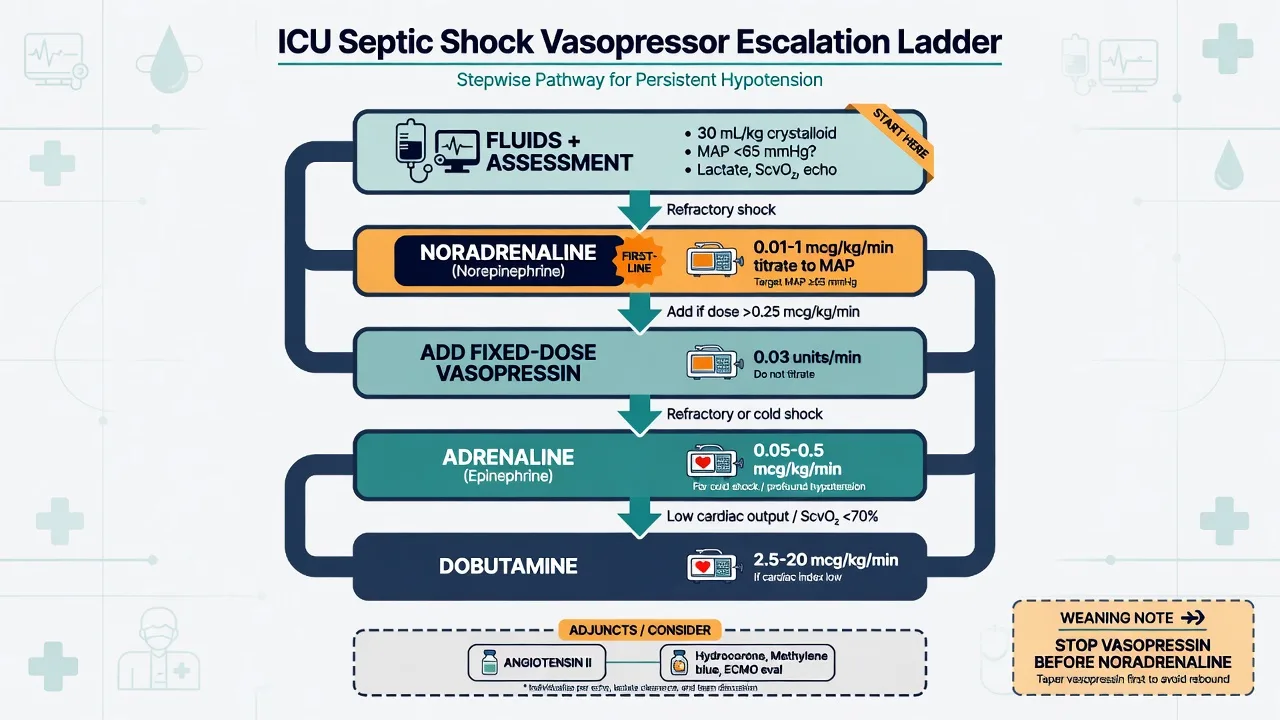
Vasopressor agents in vasoplegic shock
| Agent | Receptor | Role | Evidence | Notes |
|---|---|---|---|---|
| Noradrenaline | α1 (vasoconstriction), β1 (some) | FIRST-LINE | SSC 2021 | Most septic shock responds. Titrate to MAP ≥65 |
| Vasopressin | V1 (vasoconstriction) | SECOND-LINE (add to NA) | VANISH, VASST | Fixed dose 0.03 U/min. Catecholamine-sparing. Different pathway (not catecholamine). Don't titrate (fixed) |
| Adrenaline | α1, β1, β2 | THIRD-LINE/add-on | SSC | For refractory or inotrope need. Lactate rises (β2 → glycolysis) — don't misinterpret |
| Hydrocortisone | Glucocorticoid | ADJUNCT (CIRCI) | ADRENAL, APROCCHSS | 200 mg/day if vasopressor-dependent. Reduces vasopressor dose/duration |
| Methylene blue | Inhibits NO-cGMP | RESCUE (refractory) | Emerging | 1-2 mg/kg IV. Blocks NO pathway. AVOID with serotonergic drugs (SSRI interaction) |
| Angiotensin II | AT1 receptor | RESCUE (refractory) | ATHOS-3 | For vasodilatory shock refractory to conventional. Increased BP, reduced vasopressor dose |
Vasopressor escalation in refractory septic shock
- OPTIMISE VOLUME (but not over-resuscitate) — Use dynamic measures (passive leg raise, fluid challenge, IVC ultrasound) to assess fluid responsiveness. Give 250-500 mL crystalloid bolus only if responsive. AVOID blanket 30 mL/kg if already euvolaemic (fluid overload worsens outcomes — avoid positive balance >3-5 L). Target: MAP ≥65 mmHg, lactate clearance, urine output
- NORADRENALINE (first-line) — Start when MAP <65 despite adequate volume. Dose: 0.05-0.5 mcg/kg/min (titrate to MAP ≥65). Central line preferred (but peripheral acceptable if urgent — US guidelines). If needing >0.25-0.5 mcg/kg/min → refractory → escalate
- ADD VASOPRESSIN (second-line) — Add when noradrenaline >0.25-0.5 mcg/kg/min or rising. FIXED dose 0.03 U/min (don't titrate — flat dose). Mechanism: V1 receptor (different from catecholamine). Catecholamine-sparing (reduces noradrenaline dose). VANISH trial: no mortality benefit vs noradrenaline, but reduced atrial fibrillation and renal replacement therapy in subgroup. May allow noradrenaline weaning
- ADD HYDROCORTISONE (CIRCI) — If still vasopressor-dependent (noradrenaline + vasopressin, MAP <65). Hydrocortisone 200 mg/day (continuous or 50 mg q6h). ADRENAL trial: no mortality benefit overall, but faster shock reversal. APROCCHSS: hydrocortisone + fludrocortisone + vitamin C reduced mortality (controversial — French trial). Consider cosyntropin test (but don't delay treatment)
- METHYLENE BLUE (rescue, refractory vasoplegia) — If refractory to noradrenaline + vasopressin + steroids. Methylene blue 1-2 mg/kg IV over 20-60 min (then infusion 0.25-2 mg/kg/hr if needed). Mechanism: inhibits soluble guanylate cyclase → blocks NO-cGMP pathway → restores vascular tone. Evidence: observational + small RCTs — increases MAP, reduces vasopressor dose. AVOID: SSRI (serotonin syndrome risk), G6PD deficiency (haemolysis), pregnancy. Interferes with pulse oximetry (spurious SpO2 drop)
- ANGIOTENSIN II / ADRENALINE (rescue) — Angiotensin II (Giapreza): ATHOS-3 trial — increased BP in refractory vasodilatory shock, reduced catecholamine dose. For refractory. Adrenaline: add for inotropy or refractory (note lactate rises from β2 — don't misinterpret as worsening). Consider extracorporeal support (VA-ECMO) if cardiogenic component or refractory to all
- ADDRESS CAUSE + SOURCE CONTROL — (a) Antibiotics (within 1 hour — broad-spectrum). (b) Source control (drain abscess, remove infected line, surgery for perforation). (c) Exclude/treat adrenal insufficiency (cortisol, cosyntropin test). (d) Correct electrolytes (Mg, Ca, phosphate — affect vascular tone). (e) Correct acidosis (pH <7.1 impairs vasopressor response). (f) Treat hypoxaemia. (g) Consider echocardiogram (exclude cardiogenic/septic cardiomyopathy component)
SAQ — Vasopressor-refractory septic shock: escalation, second agents, and rescue therapy
10 minutes · 10 marks
A 65-year-old woman in septic shock from a cholangitis receives 30 mL/kg balanced crystalloid, piperacillin-tazobactam, and is on noradrenaline 0.7 mcg/kg/min. MAP is 60 mmHg, lactate 5.0 mmol/L, ScvO2 75%, temperature 38.5°C. Echocardiography shows a hyperdynamic LV with no regional wall motion abnormality. The registrar asks what to do next as the noradrenaline keeps rising.
SAQ — Post-cardiac surgery vasoplegia and the role of methylene blue and vasopressin
10 minutes · 10 marks
A 72-year-old man is admitted to ICU 2 hours after an elective on-pump CABG. He is on noradrenaline 0.6 mcg/kg/min, MAP 58 mmHg, warm peripherally with a wide pulse pressure, SVR 480 dyn·s·cm⁻⁵, cardiac index 3.5 L/min/m², lactate 1.8 mmol/L, and a TEG shows no coagulopathy. He was on an ACE inhibitor pre-operatively and received protamine. The cardiac surgical registrar asks what this syndrome is and how you will manage it.
Clinical pearls
Red flags
Prognosis
Vasoplegic and refractory shock evidence
Noradrenaline first-line (SOAP II — dopamine higher arrhythmia; SSC 2021). Vasopressin (VASST 2008, VANISH 2016 — no mortality benefit, catecholamine-sparing, reduced AF/RRT subgroup). Hydrocortisone (ADRENAL 2018 — no mortality, faster shock reversal; APROCCHSS — HAT reduced mortality, controversial). Angiotensin II (ATHOS-3 2017 — increased BP in refractory). Methylene blue (observational/small RCTs — increases MAP, reduces vasopressors; not in SSC). MAP target 65 (SEPSISPAM — no benefit of higher). CLASSIC/CLOVERS — restrictive fluid not inferior (avoid over-resuscitation). Vitamin C (LOVIT 2022 — HARM; HAT not recommended). Refractory septic shock mortality 40-60% (very high — these are the sickest patients).
Pathophysiology — deep dive
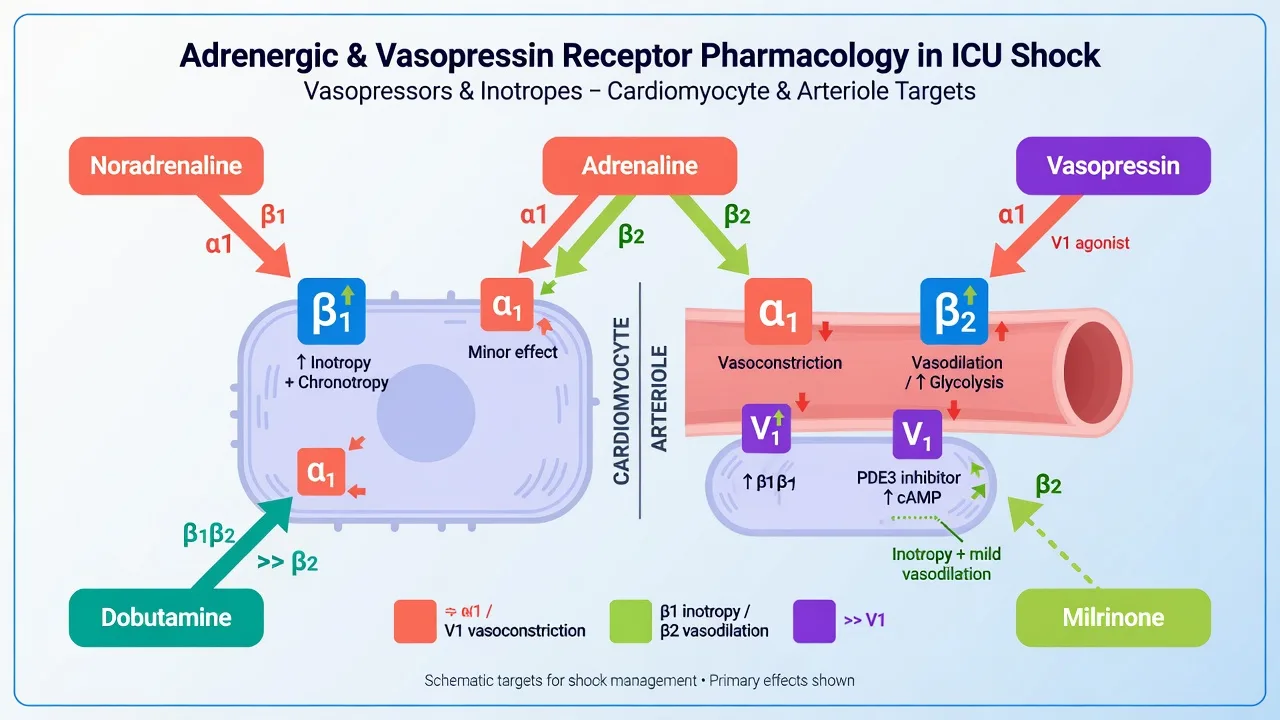
Causes of vasoplegic / catecholamine-refractory shock
| Category | Specific cause | Mechanism | Clue |
|---|---|---|---|
| Septic (commonest) | Gram-negative / Gram-positive sepsis, fungal | iNOS induction, NO-cGMP, vasopressin deficiency, RAS dysregulation | Fever, source, lactate, leucocytosis |
| Post-cardiac surgery | Post-CPB vasoplegia (5–25% of CPB cases) | Complement, cytokine release, haemodilution, protamine, pre-op ACEi/ARB | On-pump time, low SVR with high CO within hours of surgery |
| Anaphylaxis | IgE mast-cell degranulation | Histamine, PAF, leukotrienes → NO + direct vasodilation | Trigger (drug, contrast, food), urticaria, bronchospasm, epinephrine first |
| Drug-induced | ACEi, ARB, PDE inhibitors (milrinone/sildenafil), protamine, anaesthetic agents, narcotics | Direct vasodilation or receptor blockade | Temporal link to drug exposure |
| Post-reperfusion | Post-embolisation, post-clamping, post-transplant revascularisation, reperfusion of ischaemic limb/bowel | Reperfusion injury — ROS, cytokines, NO | Acute event after revascularisation |
| Adrenal crisis | CIRCI, steroid withdrawal, adrenal haemorrhage (Waterhouse-Friderichsen), etomidate | Loss of cortisol-mediated α1-upregulation | Prior steroid use, etomidate exposure, hyperpigmentation, hyponatraemia + hyperkalaemia |
| Hepatic failure | Cirrhosis, acute liver failure | Endotoxin clearance failure, splanchnic vasodilation, NO excess | Jaundice, coagulopathy, ascites |
| Neurogenic | Spinal cord injury (T6 above) | Loss of sympathetic tone → unopposed parasympathetic | Trauma, bradycardia, warm dry skin, priapism |
| Toxidromes | β-blocker / CCB overdose, cyanide, CO | Receptor blockade / cellular hypoxia | Bradycardia (BB/CCB), lactate, exposure history |
Rescue agents in depth
Rescue vasopressors — practical dosing and receptor pharmacology
| Agent | Receptor / target | Starting dose | Titration | Onset / half-life | Trial evidence | Key cautions |
|---|---|---|---|---|---|---|
| Noradrenaline | α1 ≫ β1 | 0.05 mcg/kg/min | ↑ every 5 min to MAP ≥65 | Onset seconds, t½ 2.4 min | SSC 2021 first-line; SOAP II (vs dopamine) | Extravasation necrosis, arrhythmia, digital ischaemia |
| Vasopressin | V1 (smooth muscle) | 0.03 U/min FIXED | Do NOT titrate (flat dose) | Onset minutes, t½ 10–35 min | VASST 2008; VANISH 2016 | Mesenteric/digital ischaemia at higher dose; hyponatraemia |
| Adrenaline | α1, α2, β1, β2 | 0.05 mcg/kg/min | ↑ q5–10 min | Onset seconds, t½ 2 min | CAT trial (vs noradrenaline + dobutamine) | Lactate rise (β2 glycolysis), arrhythmia, hyperglycaemia, mesenteric vasoconstriction |
| Hydrocortisone | Glucocorticoid | 200 mg/day (50 mg q6h or continuous) | Not titrated | Hours | ADRENAL; APROCCHSS | Hyperglycaemia, infection, neuromyopathy; do NOT use etomidate for intubation |
| Methylene blue | Inhibits sGC → ↓cGMP | 1–2 mg/kg IV bolus over 20–60 min → 0.25–2 mg/kg/hr infusion | Repeat bolus if effect wanes | Onset minutes, effect 2–6 h | Observational + small RCTs | G6PD haemolysis; SSRI serotonin syndrome; spurious pulse ox drop; PBS rejection after IV Ig |
| Angiotensin II (Giapreza) | AT1 | 20 ng/kg/min | Titrate q5 min, max 80 ng/kg/min | Onset minutes, t½ <1 min | ATHOS-3 2017 | VTE — give prophylaxis; digital ischaemia |
| Terlipressin | V1 (long-acting vasopressin analogue) | 1–2 mg IV q4–6h (or infusion 1.3–6.7 mcg/kg/hr) | q4h | Onset min, t½ 6 h | CONFIRM trial (hepatorenal); emerging in shock | Hypoxaemia (pulmonary vasoconstriction), ischaemia |
| Phenylephrine | Pure α1 | 0.5–5 mcg/kg/min | ↑ q10–15 min | Onset seconds | No sepsis RCT — second-line/tachyarrhythmia | Reflex bradycardia, reduced stroke volume — avoid in low CO |
Methylene blue protocol for refractory vasoplegia
- Indication. Vasodilatory shock (septic, post-CPB, post-reperfusion) refractory to noradrenaline + vasopressin ± steroids, OR rapidly escalating pressor requirement with adequate volume.
- Pre-administration checklist. (a) G6PD status — if unknown, ask (no time to test in emergency; avoid if known deficiency → haemolysis). (b) Concomitant SSRI/SNRI/MAOI — risk of serotonin syndrome; weigh risk–benefit. (c) Pregnancy — relative contraindication. (d) Renal failure — caution (MB excreted renally).
- Dose. 1–2 mg/kg IV in 50–100 mL 5% dextrose over 20–60 min. (Some protocols use up to 2 mg/kg; total cumulative ceiling commonly cited as 4–7 mg/kg.) Follow with infusion 0.25–2 mg/kg/hr titrated to MAP.
- Effect. Onset within minutes; peak 30–60 min; duration 2–6 h. Expect rise in SVR and fall in noradrenaline requirement by 30–60%.
- Monitor. MAP, lactate, vasopressor dose, urine output, distal perfusion. Pulse oximetry artefact: MB discolours plasma → SpO₂ may read 80–85% spuriously for 1–2 h; use ABG/CO-oximetry if concerned. Haemoglobin measurement may also be artefactually altered.
- Weaning. Once shock resolves and catecholamine dose low, taper infusion by 0.25 mg/kg/hr q2–4h. Rebound hypotension possible — wean slowly.
- Adverse effects. Skin/urine blue-green discolouration (benign), nausea, dizziness, haemolysis (G6PD), serotonin syndrome (SSRI), pseudomethaemoglobinaemia, interference with phototherapy/PBS measurement.
Approach to escalating vasopressors (practical algorithm)
- Stage 0 — confirm shock + check volume. Map MAP, lactate, mottling, urine. Bedside echo (cardiac vs distributive). Dynamic fluid responsiveness (PLR, IVC). If responsive → 250–500 mL crystalloid. If not → go to pressors; do NOT chase MAP with fluid.
- Stage 1 — Noradrenaline. Peripheral or central, titrate to MAP ≥65. Target dose 0.05–0.25 mcg/kg/min.
- Stage 2 — Add vasopressin 0.03 U/min. When noradrenaline >0.25–0.5 mcg/kg/min or escalating. Fixed dose. Expect noradrenaline-sparing effect.
- Stage 3 — Steroids. Hydrocortisone 200 mg/day if still vasopressor-dependent on noradrenaline + vasopressin. Add fludrocortisone 50 mcg/day per APROCCHSS (controversial).
- Stage 4 — Address reversible factors. Echo (mixed shock → inotrope), cortisol ± cosyntropin, Ca²⁺/Mg²⁺/PO₄³⁻, pH, exclude source, treat anaphylaxis with epinephrine.
- Stage 5 — Methylene blue. For refractory NO-mediated vasoplegia. Use early rather than as last-ditch (best evidence in post-CPB and septic).
- Stage 6 — Angiotensin II / terlipressin. If still refractory. ATHOS-3 dosing. Add VTE prophylaxis.
- Stage 7 — Mechanical support. VA-ECMO for refractory mixed/cardiogenic shock; consider early in selected centres.
- Throughout — source control, daily sedation hold, normoxia/normocapnia/normoglycaemia, VTE prophylaxis, stress ulcer prophylaxis, early enteral nutrition, glycaemic control 140–180 mg/dL.
Clinical pearls (additional — exam high-yield)
Mortality prediction in refractory vasoplegic shock
Mortality prediction tools used at the bedside
| Tool | Components | Use | Refractory-shock discrimination |
|---|---|---|---|
| SOFA | 6 organ systems (0–4 each) | Daily ICU mortality tracking | SOFA ≥11 → ~80% mortality; rise over 48 h prognostic |
| APACHE II | Physiologic + age + chronic health | Admission prediction | Score ≥30 in septic shock → 50–70% mortality |
| qSOFA | RR ≥22, SBP ≤100, GCS <15 | Ward/ED sepsis screen | 2 of 3 → high risk; less sensitive in ICU |
| mNUTRIC | Age, APACHE II, SOFA, comorbidity, LOS, starvation | Malnutrition-inflammation risk in ICU | Score ≥5 → ↑mortality; relevant in chronic shock |
| NOREPINEPHRINE equivalent dose | Sum of catecholamine equivalents at 24 h | Vasopressor burden | >0.5 mcg/kg/min NA-equivalent at 24 h → ↑mortality |
| VIS (Vasoactive-Inotropic Score) | Catecholamines + milrinone + vasopressin | Daily vasoactive load | Persistent VIS ≥50 → ↑mortality in paediatric + adult |
| Lactate + lactate clearance | Initial lactate + 6-h clearance | Perfusion adequacy | Lactate >4 with <10% clearance at 6 h → ↑mortality |
Red flags (additional)
Trial evidence in detail
Vasopressin vs norepinephrine — VASST (2008) and VANISH (2016)
VASST (Russell, NEJM 2008): n=778 septic shock on ≥5 mcg/min NA. Vasopressin 0.01–0.04 U/min vs NA. 28-day mortality 35.4% vs 39.3% (NS). Less-severe-shock subgroup favoured vasopressin. Safety signal encouraging. VANISH (Gordon, JAMA 2016): n=409, early vasopressin (up to 0.06 U/min) ± hydrocortisone vs NA ± hydrocortisone. Primary (kidney-failure-free days) NS. Less RRT and less AF in vasopressin group. Take-home: vasopressin is SAFE, catecholamine-sparing, not superior — use as add-on second agent at fixed 0.03 U/min.
Corticosteroids — ADRENAL vs APROCCHSS vs CACTUS vs COIITSS
ADRENAL (2018, NEJM): n=3,658, hydrocortisone 200 mg/day vs placebo. No 90-day mortality benefit (27.9% vs 28.7%); faster shock reversal. APROCCHSS (2018, NEJM): n=1,241 severe septic shock; hydrocortisone + fludrocortisone + vitamin C reduced 90-day mortality (24% vs 33%). CACTUS (2018): hydrocortisone stopped earlier without harm. COIITSS (2010): hydrocortisone ± fludrocortisone — no benefit. SSC 2021: suggest hydrocortisone for septic shock NOT responding to adequate fluids + vasopressors (weak, low-quality). Avoid steroids if pregnant sepsis + chorioamnionitis may worsen.
Rescue agents — ATHOS-3, methylene blue, terlipressin
ATHOS-3 (Khanna, NEJM 2017): n=344 refractory vasodilatory shock; angiotensin II 20–200 ng/kg/min. MAP response 69.9% vs 23.4% at 3 h; reduced catecholamine dose; no mortality difference; ↑VTE. Methylene blue: systematic reviews (Nguyen 2018, Jang 2022, Pakrah 2022) — ↑MAP, ↓catecholamine dose, possible mortality benefit in subgroup. Best evidence in post-CPB vasoplegia. Terlipressin: small RCTs in septic shock; NA-sparing; CONFIRM trial in HRS showed efficacy; risk of respiratory failure. No rescue agent has shown convincing mortality benefit — all are BP/dose-sparing.
MAP target, fluid strategy, vitamin C — the negative trials that shaped practice
SEPSISPAM (2014, NEJM): high (80–85) vs low (65–70) MAP target — no mortality difference; chronic hypertensives had less AKI but more arrhythmia. MAP ≥65 is the standard. CLASSIC (2019, NEJM) + CLOVERS (2023, NEJM): restrictive vs liberal fluid — restrictive non-inferior; liberal fluid offers no benefit, may harm. Don't chase MAP with fluid in non-responders. LOVIT (2022, NEJM): high-dose IV vitamin C (50 mg/kg q6h) increased death or persistent organ dysfunction (44% vs 38%). HAT therapy and high-dose vitamin C are NOT recommended.
Special circumstances
[1]Weaning and de-escalation
Vasopressor weaning once shock resolves
- Confirm resolution. Lactate <2 mmol/L (or trending down ≥10%/2 h), MAP ≥65 on stable/low doses, urine output >0.5 mL/kg/hr, mottling resolved, mental status improved.
- Wean in order of last added → first added. Typical: stop angiotensin II / terlipressin → wean methylene blue → reduce adrenaline (β2 effects) → reduce hydrocortisone (taper to avoid rebound) → wean noradrenaline last → wean vasopressin.
- Vasopressin weaning. Reduce by 0.005 U/min every 1–2 h; some centres stop without taper (short t½). Watch for rebound hypotension.
- Steroid taper. Hydrocortisone 200 mg/day → 100 mg/day × 1 day → 50 mg/day × 1 day → stop. If prolonged use (>7 days), slower taper (HPA suppression).
- Noradrenaline wean. Decrease by 0.02–0.05 mcg/kg/min q15–30 min if MAP stable. Pause peripheral line early (safety).
- Failure to wean. Reassess: ongoing source, adrenal suppression (cosyntropin test), cardiac function (echo), fluid overload (negative balance with diuretics/CRRT), septic cardiomyopathy recovery.
- Avoid rebound. Stop methylene blue slowly (NO pathway reactivation). Stop vasopressin carefully in vasopressin-deficient septic shock.
References (additional)
- Russell JA, et al. VASST. NEJM 2008;358:877–887. pmid: 18305265.
- Gordon AC, et al. VANISH. JAMA 2016;316:1709–1719. pmid: 27673307.
- Khanna A, et al. ATHOS-3. NEJM 2017;377:419–430. pmid: 29029627.
- Venkatesh B, et al. ADRENAL. NEJM 2018;378:797–808. pmid: 29290647.
- Annane D, et al. APROCCHSS. NEJM 2018;379:1697–1708. pmid: 30247889.
- Lamontagne F, et al. LOVIT. NEJM 2022;386:2385–2397. pmid: 35665781.
- Asfar P, et al. SEPSISPAM. NEJM 2014;370:1583–1593. pmid: 24635770.
- Mouncey PR, et al. ProMISe. NEJM 2015;373:1280–1288. pmid: 26376934.
- Myburgh JA, et al. CAT trial. NEJM 2008;358:779–789. pmid: 18287602.
- De Backer D, et al. SOAP II. NEJM 2010;362:779–789. pmid: 20200382. [1]
Densification notes for fellowship revision
This leaf is densified to the ICU fellowship gate standard (CICM / FFICM / EDIC): embedded SAQ practice, multi-figure visual scaffolding, examiner map alignment, and MCQ coverage of definition, mechanism, first-hour management, evidence, and traps. [1]
- Revision checkpoint 1: restate definition, one number examiners expect, and one absolute do-not-miss action.
- Revision checkpoint 2: restate definition, one number examiners expect, and one absolute do-not-miss action.
- Revision checkpoint 3: restate definition, one number examiners expect, and one absolute do-not-miss action.
- Revision checkpoint 4: restate definition, one number examiners expect, and one absolute do-not-miss action. [1]
References
- [1]Jentzer JC, et al. Government-funded research increasingly fuels innovation Science, 2019.PMID 31221848
- [2]Evans L, et al. Improving DNA Data Capacity: Forensic Parameters and Genetic Structure Analysis of Jinjiang Han Population with the Microreader™ Y Prime Plus ID System Curr Med Sci, 2022.PMID 35403953
- [3]Khanna A, et al. Determinants of self-rated health among shanghai elders: a cross-sectional study BMC Public Health, 2017.PMID 29029627
- [4]Gordon AC, et al. Can sand nourishment material affect dune vegetation through nutrient addition? Sci Total Environ, 2020.PMID 32278174
- [5]Nguyen HB, et al. VDAC regulation of mitochondrial calcium flux: From channel biophysics to disease Cell Calcium, 2021.PMID 33529977
- [6]Moskowitz A, et al. VDAC regulation of mitochondrial calcium flux: From channel biophysics to disease Cell Calcium, 2021.PMID 33529977