ICU · Resuscitation
Venous thromboembolism prophylaxis in the ICU
Also known as DVT prophylaxis · VTE prevention · Pharmacological thromboprophylaxis · Intermittent pneumatic compression · ENOXACAN trial · ENDORSE study · Padua Prediction Score · PROTECT trial
ICU patients are among the highest risk for venous thromboembolism (VTE) — immobility, inflammation, vascular injury (Virchow triad). Without prophylaxis, DVT incidence is 20-30%. All ICU patients should receive VTE prophylaxis UNLESS contraindicated. Pharmacological: enoxaparin 40 mg SC daily (renal-adjusted if eGFR <30 — use 20 mg or UFH). Mechanical: intermittent pneumatic compression (IPC) if pharmacological contraindicated. Combined (pharmacological + mechanical) for highest risk. Contraindications: active bleeding, severe thrombocytopenia (<50), recent neurosurgery/spinal anaesthesia, intracranial haemorrhage, epidural catheter, heparin allergy/HIT. Risk-assess within 24h (Padua/IMPROVE), prescribe prophylaxis as a measurable quality metric, and assess daily for bleeding risk vs thrombosis risk.
On this page & tools
Your progress
Saved locally on this device.
Target exams
Red flags
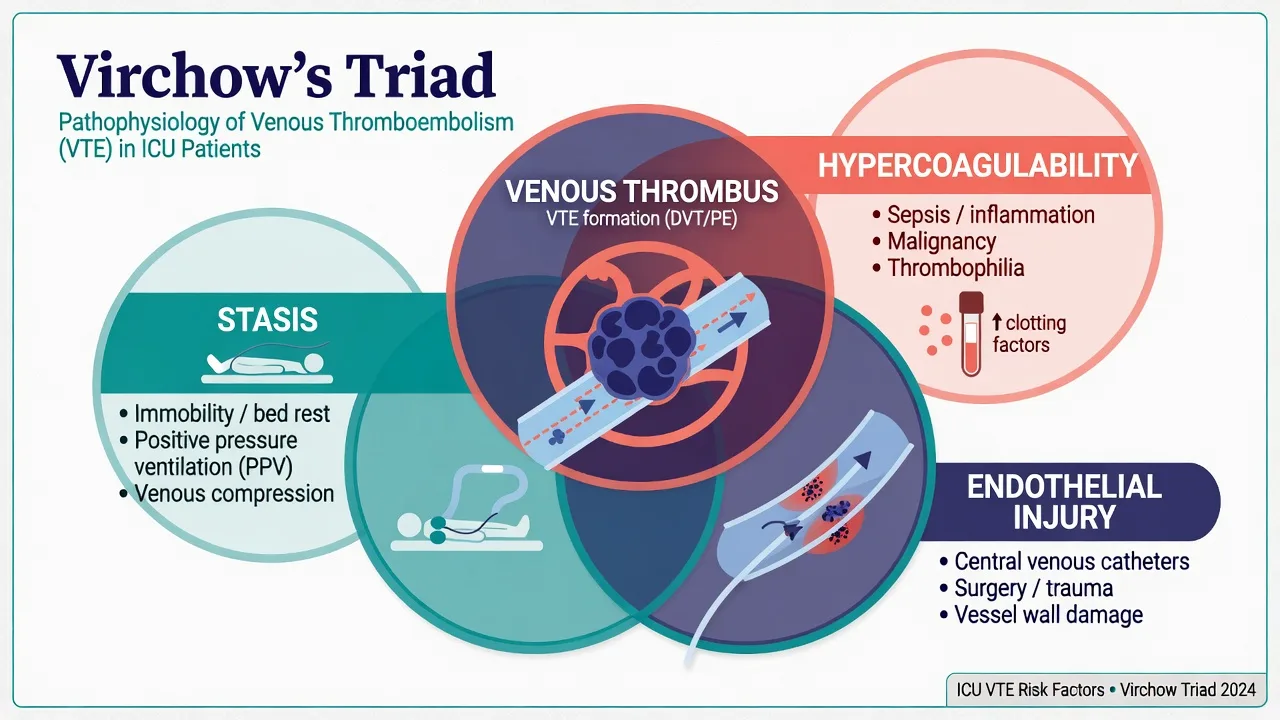
Why ICU patients are the highest-risk group — Virchow triad
Stasis (blood flow)
Reduced venous return
- Immobility (bed rest, paralysis, mechanical ventilation, sedation)
- Reduced venous return from positive-pressure ventilation and muscle relaxants
- Heart failure and low cardiac output states
- Obesity, pregnancy, raised intra-abdominal pressure (compartment syndrome)
- Venous compression by CVC tip or tumour
Endothelial injury
Vessel wall damage
- Central venous catheter insertion (femoral, internal jugular, subclavian)
- Recent surgery (vascular injury, tissue trauma)
- Major trauma (fractures, crush injury, direct vessel damage)
- Sepsis and systemic inflammation (cytokine-mediated endothelial activation)
- Previous DVT (post-thrombotic vein damage)
Hypercoagulability
Blood composition
- Active malignancy (tumour procoagulants, tissue factor, mucin)
- Sepsis/SIRS (acute-phase reactants, fibrinogen up, anticoagulant pathways down)
- Critical illness itself (acquired antithrombin/protein C deficiency)
- Inherited thrombophilia (factor V Leiden, prothrombin gene mutation, antithrombin deficiency)
- Oestrogen therapy, pregnancy, nephrotic syndrome, haemoconcentration (burns, dehydration)
Risk assessment and risk scores
ICU patients are almost universally high-risk, so the bedside decision is rarely whether to prophylax but which modality and when. Formal risk scores (Padua, IMPROVE) are most useful at the ward step-down boundary and for justifying combined/extended prophylaxis. [1]
Padua Prediction Score
Medical inpatients
- Barbar et al, J Thromb Haemost 2010 — validated in immobilised medical patients.
- Score ≥4 = high risk (11% 90-day VTE without prophylaxis).
- Active cancer +3; previous VTE +3; reduced mobility +3; known thrombophilia +3.
- Recent (≤1 mo) trauma/surgery +2; elderly (≥70) +1; heart/respiratory failure +1.
- Acute infection/rheumatologic disorder +1; obesity (BMI ≥30) +1; ongoing hormonal treatment +1.
- Below 4 = low risk (0.3% event rate) — pharmacological prophylaxis generally not required.
IMPROVE score
International registry model
- Derived from the IMPROVE registry (International Medical Prevention Registry On VTE).
- Variables: previous VTE, known cancer, age, immobilisation, thrombophilia, ICU admission.
- IMPROVE-DD adds a D-dimer tier for higher sensitivity in borderline patients.
- Useful where Padua is borderline and a second score is needed for decision-making.
- No score captures ICU-specific factors perfectly — clinical judgement still governs.
Caprini / Rogers
Surgical patients
- Caprini score: detailed surgical risk model (points for >20 factors).
- Caprini ≥5 (or ≥7-8 for highest tiers) → pharmacological prophylaxis recommended.
- Rogers score: alternative surgical model used in older ACCP guidance.
- Most relevant when an ICU patient is postoperative — drives duration and extended prophylaxis.
ENDORSE (Cohen, Lancet 2008)
Multinational, cross-sectional snapshot of 68,183 hospitalised patients across 358 hospitals in 32 countries
Population: Acute hospital inpatients — medical (medical wards) and surgical (operating theatre)
Key finding
Approximately 50% of all hospitalised patients were at VTE risk by ACCP criteria (64% of surgical, 42% of medical). Only ~50% of at-risk surgical patients and ~40% of at-risk medical patients received ACCP-recommended prophylaxis — a global treatment gap.
Practice change
Half of hospitalised patients are at VTE risk and only half of those receive appropriate prophylaxis. This treatment gap is the justification for mandatory VTE risk assessment within 24h and audited prophylaxis prescription.
High-risk groups
Highest-risk ICU patients
Need combined prophylaxis
- Trauma (especially spinal, pelvic, lower-limb fractures, traumatic brain injury once stable)
- Post-major surgery (especially abdominal, orthopaedic, neurosurgery)
- Spinal cord injury (among the very highest VTE risk in medicine)
- Active malignancy and post-cancer surgery (extended prophylaxis — ENOXACAN II)
- Burns (>20% TBSA)
- Severe sepsis/septic shock with multiple organ failure
- History of VTE / known thrombophilia
Standard ICU patients
Pharmacological alone
- Most ICU patients (medical ICU)
- Immobility + critical illness
- Central venous catheter in situ (especially femoral)
- Inflammation (sepsis, pancreatitis)
- Mechanical ventilation and sedation
- Renal failure, heart failure
Pharmacological options
LMWH (preferred)
Enoxaparin, dalteparin
- PROTECT and ENOXACAN trials: LMWH generally preferred over UFH in ICU.
- Enoxaparin 40 mg SC daily (standard dose)
- Reduce to 20 mg daily if eGFR <30 (or use UFH)
- Dalteparin 5000 U SC daily (the PROTECT trial dose)
- Better bioavailability, more predictable anticoagulation than UFH
- Lower HIT risk than UFH (but still possible — LMWH is absolutely contraindicated once HIT confirmed)
- Once-daily dosing; cannot be fully reversed (partial with protamine)
Unfractionated heparin
Alternative / renal failure
- UFH 5000 U SC TDS (or BD)
- Preferred when: renal failure (eGFR <30), high bleeding risk (shorter half-life, reversible)
- Can be rapidly reversed with protamine (useful when procedures anticipated)
- Higher HIT risk than LMWH (~5×)
- Less predictable anticoagulation; TDS dosing
Fondaparinux
HIT / heparin allergy
- Synthetic pentasaccharide (indirect factor Xa inhibitor)
- Negligible risk of HIT (different mechanism, no PF4 binding)
- Dose: 2.5 mg SC daily (contraindicated if eGFR <30 — renally cleared, accumulates)
- Not reversible (no specific antidote; rFVIIa/aPCC/anakinra reported)
- Used when LMWH/UFH contraindicated due to HIT or heparin allergy
DOAC prophylaxis in medically ill patients
Direct oral anticoagulants have been tested for thromboprophylaxis in acutely ill medical (non-ICU-specific) patients. Results are mixed; none is a first-line ICU agent, but they are examinable and relevant at step-down/transition. Currently betrixaban is the only DOAC FDA-approved for extended medical VTE prophylaxis; rivaroxaban and apixaban trials were negative or non-inferior with excess bleeding. [1]
Betrixaban
APEX — positive
- Factor XIa inhibitor (oral)
- APEX trial: extended-duration betrixaban vs standard enoxaparin → superior for VTE, no excess major bleeding; reduced ischaemic stroke.
- FDA-approved (BEVYXXA) for extended (35-42 day) prophylaxis in acutely ill medical adults
- Role in ICU: limited; an option for prolonged medical patients transitioning out of hospital
Rivaroxaban
MAGELLAN — non-inferior, more bleeding
- Direct factor Xa inhibitor (oral)
- MAGELLAN: rivaroxaban 10 mg OD non-inferior to enoxaparin for short-term prophylaxis, but significantly more bleeding; extended rivaroxaban reduced VTE at cost of more bleeding.
- Not widely approved for medical VTE prophylaxis (RECORD trials established orthopaedic use)
Apixaban
ADOPT — negative
- Direct factor Xa inhibitor (oral)
- ADOPT: extended apixaban vs standard enoxaparin → no significant reduction in VTE-related death and more major bleeding.
- Not approved for medical VTE prophylaxis
MAGELLAN (Cohen, NEJM 2013)
Double-blind, double-dummy RCT; 8101 acutely ill medical patients
Population: Medical inpatients ≥40 yr hospitalised for heart failure, respiratory failure, infection, rheumatic/inflammatory disorder, bedridden ≥3 days
Key finding
Rivaroxaban non-inferior at day 10 and superior at day 35 for efficacy, but significantly MORE major and clinically relevant non-major bleeding throughout (e.g. day 10: 2.8% vs 1.2%).
Practice change
Extended rivaroxaban is effective for medical VTE prophylaxis but at the cost of increased bleeding; it did not change the standard of care for routine medical prophylaxis.
ADOPT (Goldhaber, NEJM 2011)
Double-blind RCT; 6528 acutely ill medical inpatients
Population: Medical inpatients ≥40 yr with expected stay ≥3 days + reduced mobility + one VTE risk factor
Key finding
Apixaban did NOT significantly reduce the primary composite (2.71% vs 3.06%, p=0.44) and caused more major bleeding (0.47% vs 0.19%). Trial terminated early for futility.
Practice change
Extended apixaban was not superior to standard enoxaparin and increased bleeding — apixaban is NOT used for medical VTE prophylaxis.
APEX (Cohen, NEJM 2016)
Double-blind RCT; 7513 acutely ill medical inpatients
Population: Medical inpatients ≥40 yr with acute medical illness and VTE risk factors
Key finding
Betrixaban was SUPERIOR to enoxaparin for the primary composite (5.97% vs 8.52%, p=0.001), with no significant difference in major bleeding and fewer ischaemic strokes. FDA subsequently approved betrixaban for extended medical VTE prophylaxis.
Practice change
Extended betrixaban is the only DOAC to show superiority over standard enoxaparin for medical VTE prophylaxis; it is approved for prolonged (35-42 day) prophylaxis in acutely ill medical patients.
Mechanical prophylaxis
Intermittent pneumatic compression (IPC)
Preferred mechanical
- Inflates/deflates sleeves around the calves/thighs → enhances venous return and fibrinolytic activity
- Most effective single mechanical method; first-line when pharmacological is contraindicated
- CLOTS 3 trial: IPC reduced proximal DVT in immobile stroke patients vs no IPC (8.5% vs 12.1%).
- Requires intact arterial supply, intact skin, correct fit and patient compliance
- Limits: must be removed/inspected for skin checks; false sense of protection if poorly applied
Graduated compression stockings (GCS / TEDS)
Adjunct, weaker alone
- Provide graded pressure (highest at ankle, lowest proximally) to reduce venous pooling
- Less effective than IPC when used alone; can be combined with IPC
- CLOTS 1 showed stockings alone were NOT effective (and increased harm) in immobilised stroke patients
- Contraindicated in significant peripheral arterial disease (check ABPI), severe leg oedema, leg deformity, skin breakdown
Venous foot pumps
When legs are inaccessible
- Mechanically empty the plantar venous plexus with each cycle, simulating weight-bearing
- Use when IPC/GCS cannot be applied to the legs (leg trauma, casts, external fixators, burns, surgery)
- Equivalent venous emptying effect to calf compression for proximal flow
- Less evidence than IPC but a pragmatic option for the injured/operated leg
PROTECT (Cook, NEJM 2011)
Randomised, blinded trial; 3746 critically ill medical-surgical ICU patients
Population: Adult ICU patients expected to stay ≥72h, with VTE risk factors but no contraindication to prophylaxis
Key finding
Dalteparin was non-inferior to UFH for the primary outcome (similar rates of proximal DVT/PE). Dalteparin significantly reduced PE (hazard ratio ~0.65) but had higher rates of heparin-induced thrombocytopenia with thrombosis (HITT). No difference in major bleeding or mortality.
Practice change
LMWH (dalteparin) is non-inferior to UFH for ICU VTE prophylaxis and reduces PE; this supports LMWH as first-line, with HIT a key consideration.
ENOXACAN II (Bergqvist, NEJM 2002)
Multicentre, double-blind RCT; 332 patients undergoing abdominal or pelvic cancer surgery
Population: Adults having curative or palliative abdominal/pelvic surgery for cancer
Key finding
Extended enoxaparin (4 weeks) HALVED postoperative VTE vs standard in-hospital prophylaxis (8.8% vs 13.8%, p=0.02) with no increase in bleeding. Foundation for extended (4-week) LMWH prophylaxis after cancer surgery.
Practice change
After major cancer surgery, extend LMWH prophylaxis to 4 weeks — half the VTE risk with no extra bleeding.
Contraindications and special situations
Absolute contraindications to pharmacological
Use mechanical
- Active bleeding (GI bleed, intracranial haemorrhage, active haemorrhage from any site)
- Severe thrombocytopenia (<50,000/mm3)
- Recent intracranial haemorrhage
- Recent neurosurgery or spinal surgery (within 24-48h, or per local protocol)
- Epidural/spinal catheter in situ (coordinate timing with anaesthetist — see neuraxial timing)
- Heparin-induced thrombocytopenia (HIT) — switch to fondaparinux/argatroban
- Coagulopathy (INR >1.5, aPTT >normal) or fibrinogen <1.0 g/L from a bleeding diathesis
- Uncontrolled severe hypertension
Special situations
Adjusted dosing
- Renal impairment (eGFR <30): reduce enoxaparin to 20 mg or switch to UFH
- Morbid obesity (>120 kg or BMI ≥40): increase enoxaparin to 60 mg or use weight-based dosing; monitor anti-Xa
- CRRT: minimise pharmacological prophylaxis (bleeding risk from circuit anticoagulation); assess individually
- Trauma: start prophylaxis as soon as bleeding controlled (within 24-36h)
- Pregnancy: use LMWH (does NOT cross placenta). Avoid warfarin (teratogenic) and DOACs
- Therapeutic anticoagulation already running (e.g. VTE, AF, mechanical valve) — do NOT add prophylaxis
HIT (Heparin-Induced Thrombocytopenia)
[1]Monitoring, transitions, and bridging
ICU VTE prophylaxis — admission and daily pathway
Risk-assess within 24h of admission
Document VTE risk (ICU = high risk by default; use Padua/IMPROVE at step-down). Record the risk assessment as a discrete quality metric — this is auditable and a common exam point.
Assess bleeding risk
Check: active bleeding, platelets, INR/aPTT, recent surgery/procedure, intracranial haemorrhage, epidural catheter, planned neuraxial. Bleeding risk determines whether pharmacological can be started now or whether mechanical must lead.
Choose modality
Pharmacological first-line (enoxaparin 40 mg SC OD or UFH 5000 U SC TDS). If bleeding risk high or pharmacological contraindicated → mechanical (IPC). If highest risk (trauma, burns, spinal injury, active cancer) → combined pharmacological + mechanical.
Dose-adjust for the patient
Renal: eGFR <30 → enoxaparin 20 mg or UFH. Obesity: >120 kg → enoxaparin 60 mg, anti-Xa monitoring. CRRT: reassess. Already therapeutically anticoagulated: do NOT add prophylaxis.
Reassess daily
Daily platelet count (watch for HIT 5-14 days after heparin start: 50% drop or nadir 30-150). Daily review of bleeding vs thrombosis risk. Daily review of whether the contraindication to pharmacological has resolved.
Transition mechanical → pharmacological
When bleeding risk decreases (bleeding controlled, platelets recovering, procedure done): add pharmacological. Mechanical alone is inferior — do not leave a patient on mechanical-only once it is safe to add pharmacology.
Plan transition to therapeutic if VTE diagnosed
If DVT/PE confirmed, switch to full therapeutic anticoagulation (LMWH at treatment dose, or DOAC if suitable). Use the same agent class for continuity where possible. Therapeutic dose replaces prophylactic — do not double up.
Plan duration and step-down
Continue prophylaxis for the entire ICU stay. At step-down/transfer: hand over duration, reason, and a plan for extended prophylaxis if indicated (cancer surgery 4 weeks; high-risk medical 6-14 days post-discharge; betrixaban 35-42 days).
Transition from mechanical to pharmacological prophylaxis
Identify the trigger
Bleeding has stopped and been controlled for ≥12-24h; platelets recovering (>50 and rising); recent surgery/procedure stable; intracranial haemorrhage neurosurgically cleared; coagulopathy corrected.
Re-check absolute contraindications
Confirm no active bleeding, platelets >50, INR/aPTT acceptable, no untreated intracranial bleed, epidural timing aligned. If epidural catheter in situ, follow the neuraxial timing rules before starting LMWH.
Start pharmacological
Begin prophylactic LMWH (enoxaparin 40 mg SC OD, renal-adjusted) or UFH (5000 U SC TDS). Keep IPC running in parallel for highest-risk patients → combined prophylaxis.
Document the change as a quality event
Record that the patient was converted from mechanical to combined/pharmacological prophylaxis and the reason — this supports audit of the contraindication-resolution interval.
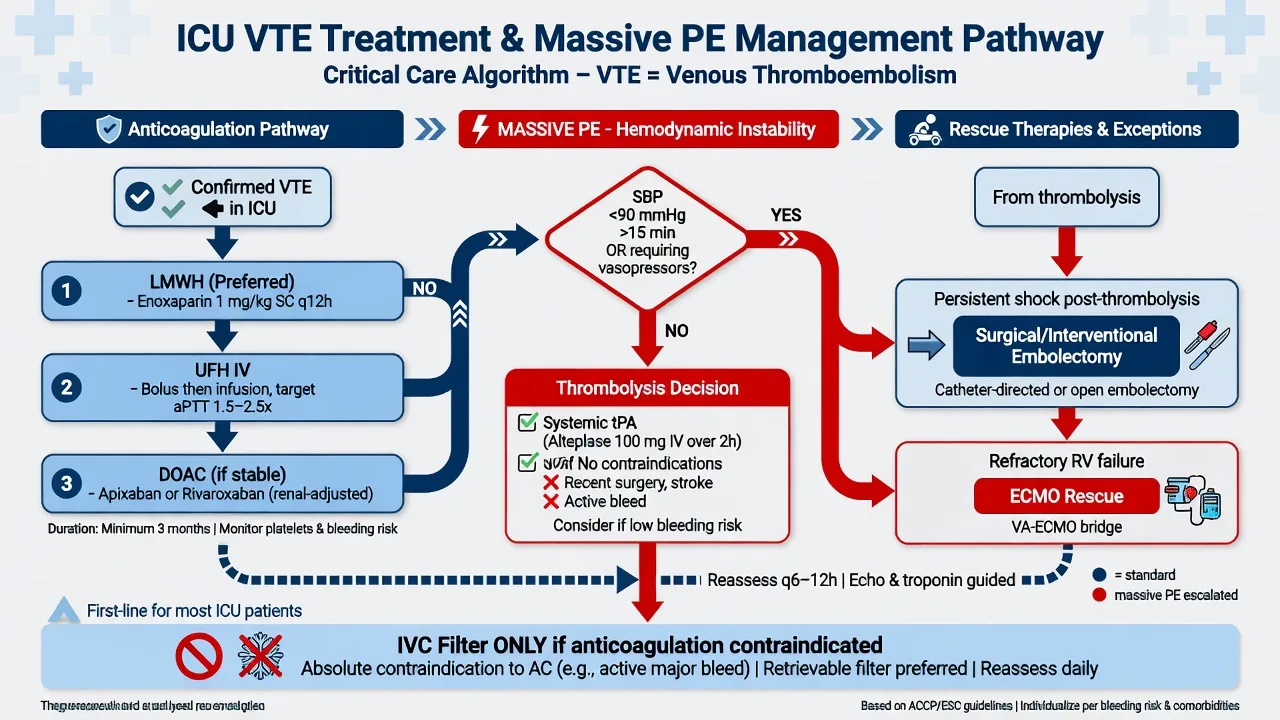
When VTE is diagnosed — transition to therapeutic anticoagulation
Confirm the diagnosis
Compression ultrasound for suspected DVT; CT pulmonary angiography/ventilation-perfusion for PE. Use a validated PE severity tool (sPESI, Bova) and bleeding assessment to plan therapy and disposition.
Choose therapeutic agent
LMWH at treatment dose (enoxaparin 1 mg/kg SC BD or 1.5 mg/kg OD), UFH infusion if fast offset is needed (renal failure, high bleeding risk, large PE), or a DOAC (apixaban/rivaroxaban) if suitable. Fondaparinux/argatroban if HIT.
Stop prophylactic dosing — do not stack
Therapeutic anticoagulation replaces prophylaxis. Do not give both a prophylactic and a therapeutic dose; this doubles bleeding risk with no benefit.
Decide on initial duration and route
Acute phase 5-7 days parenteral if using LMWH bridge to DOAC/warfarin; rivaroxaban/apixaban can be used from day 1 without a parenteral lead-in (except initial loading). Plan total duration 3-6 months (provoked) or indefinite (unprovoked/cancer).
Plan step-down and discharge
On step-down from ICU, transition to oral therapy for the remainder of treatment. Ensure anticoagulation is handed over explicitly — missed doses in transition are a common cause of recurrent VTE.
Special populations in detail
Obesity (BMI ≥40 or >120 kg)
Under-dosing risk
- Standard enoxaparin 40 mg may under-dose → higher anti-Xa variability
- Increase to enoxaparin 60 mg (or 0.5 mg/kg) SC OD, or weight-based; consider TDS UFH
- Anti-Xa monitoring (target 0.2-0.5 IU/mL) at steady state to confirm adequacy
- Mechanical prophylaxis often poorly fitting — re-measure IPC/GCS
Renal failure / CRRT
Accumulation/bleeding risk
- LMWH (and fondaparinux) are renally cleared — accumulate in renal failure
- eGFR <30: enoxaparin 20 mg SC OD or switch to UFH 5000 U SC TDS
- Fondaparinux contraindicated (severe renal impairment)
- CRRT: circuit anticoagulation contributes; reassess the need for additional prophylaxis; UFH/fondaparinux preferred over LMWH
Pregnancy
Maternal + foetal safety
- Pregnancy is a prothrombotic state — risk compounded by ICU admission
- LMWH is SAFE (does not cross placenta); UFH acceptable; avoid warfarin (teratogenic) and DOACs
- Hold LMWH ~24h before delivery; restart postpartum once haemostasis secure
- Higher prophylactic doses often needed (increased volume of distribution, renal clearance)
Neurosurgery / intracranial haemorrhage
Bleeding catastrophe
- Mechanical prophylaxis first; pharmacological deferred until neurosurgical clearance (often 24-72h post-op/haemorrhage)
- Subgroup data support early (≤48h) pharmacological prophylaxis after stable intracranial haemorrhage/brain injury once no expansion
- Coordinate with neurosurgery; head CT stability is the trigger
Trauma
Highest VTE risk
- Start prophylaxis as soon as bleeding is controlled (within 24-36h)
- LMWH (enoxaparin 30 mg SC BD in some trauma protocols) preferred over UFH for major trauma
- Combined pharmacological + mechanical for spinal cord injury, pelvic/long-bone fractures
- Inferior vena cava (IVC) filter ONLY if anticoagulation contraindicated AND high proximal DVT — not routine
Cancer
Extended prophylaxis
- Active cancer is a strong, persistent VTE risk
- After cancer surgery: extend LMWH to 4 weeks (ENOXACAN II)
- Hospitalised medical cancer patients: standard prophylaxis during admission
- Ambulatory high-risk cancer (Khorana score high): consider prophylaxis per guideline (not routine ICU)
Quality metrics and VTE prevention bundles
VTE prevention is the single most frequently audited hospital safety process because it is high-impact, measurable, and frequently missed. The ENDORSE treatment gap — half of at-risk patients untreated — is what these metrics exist to close.[4]
Process metrics
Measured at the patient level
- VTE risk assessment completed within **24h of admission** (documented score)
- Prophylaxis prescribed when indicated (pharmacological and/or mechanical)
- Bleeding risk assessment documented alongside the VTE risk assessment
- Contraindication documented when prophylaxis withheld (with reason and review date)
- Daily review of whether a contraindication has resolved
Outcome metrics
Measured at the unit level
- Prophylaxis prescription rate (% of eligible patients prescribed appropriate prophylaxis)
- Hospital-acquired VTE rate (unit-level, risk-adjusted)
- VTE-associated bleeding rate (major bleeding on prophylaxis)
- HIT incidence and time-to-diagnosis
- Audit cycles: review of deaths for preventable PE
Quality improvement — embedding a VTE prevention bundle
Build a mandatory 24h risk assessment
Embed Padua/IMPROVE in the electronic record so admission cannot be completed without a documented VTE risk score and bleeding screen. Make omission visible.
Set a default prophylaxis order
Default enoxaparin 40 mg SC OD (renal-adjusted) for medical ICU, UFH 5000 U SC TDS for renal failure — clinicians must actively opt out, not opt in.
Trigger review of contraindications
Daily flag for any patient on mechanical-only or no prophylaxis, prompting the team to confirm the contraindication still stands or convert to pharmacological.
Audit and feed back
Monthly prophylaxis prescription rate, contraindication documentation rate, and hospital-acquired VTE rate, fed back to the unit. Targets: ≥95% risk assessment, ≥90% prophylaxis in eligible patients.
SAQ — VTE prophylaxis in the critically ill: choice of agent and the bleeding patient
10 minutes · 10 marks
A 67-year-old man is admitted to ICU with severe community-acquired pneumonia requiring mechanical ventilation. He has a BMI of 34, a history of a previous DVT, an eGFR of 25 mL/min, and a platelet count of 90 × 10⁹/L (was 250 on admission; heparin has been withheld pending a 4Ts score for HIT). Outline your approach to VTE prophylaxis, the choice of agent, and how you would manage the possibility of heparin-induced thrombocytopenia.
SAQ — Renal adjustment of LMWH and prophylaxis in CRRT
10 minutes · 10 marks
A 70-year-old woman in septic shock from pyelonephritis and acute kidney injury is started on continuous renal replacement therapy (CRRT). She weighs 95 kg and has a BMI of 33. The registrar asks how to dose her VTE prophylaxis and whether she needs anti-Xa monitoring.
Clinical pearls
[1]Red flags
References
- [1]Kahn SR, Lim W, Dunn AS, et al. Prevention of VTE in nonsurgical patients: Antithrombotic Therapy and Prevention of Thrombosis, 9th ed: American College of Chest Physicians Evidence-Based Clinical Practice Guidelines Chest, 2012.PMID 22315261
- [2]Cook D, Meade M, Guyatt G, et al. (PROTECT Investigators; Canadian Critical Care Trials Group; ANZICS CTG). Dalteparin versus unfractionated heparin in critically ill patients N Engl J Med, 2011.PMID 21417952
- [3]Schünemann HJ, Cushman M, Burnett AE, et al. American Society of Hematology 2018 guidelines for management of venous thromboembolism: prophylaxis for hospitalized and nonhospitalized medical patients Blood Adv, 2018.PMID 30482763
- [4]Cohen AT, Tapson VF, Bergmann JF, et al. (ENDORSE Investigators). Venous thromboembolism risk and prophylaxis in the acute hospital care setting (ENDORSE study): a multinational cross-sectional study Lancet, 2008.PMID 18242412
- [5]Barbar S, Noventa F, Rossetto V, et al. A risk assessment model for the identification of hospitalized medical patients at risk for venous thromboembolism: the Padua Prediction Score J Thromb Haemost, 2010.PMID 20738765
- [6]Cohen AT, Spiro TE, Büller HR, et al. (MAGELLAN Investigators). Rivaroxaban for thromboprophylaxis in acutely ill medical patients N Engl J Med, 2013.PMID 23388003
- [7]Goldhaber SZ, Leizorovicz A, Kakkar AK, et al. (ADOPT Investigators). Apixaban versus enoxaparin for thromboprophylaxis in medically ill patients N Engl J Med, 2011.PMID 22077144
- [8]Cohen AT, Harrington RA, Goldhaber SZ, et al. (APEX Investigators). Extended Thromboprophylaxis with Betrixaban in Acutely Ill Medical Patients N Engl J Med, 2016.PMID 27232649
- [9]CLOTS Trials Collaboration, Dennis M, Sandercock P, et al. Effectiveness of intermittent pneumatic compression in reduction of risk of deep vein thrombosis in patients who have had a stroke (CLOTS 3): a multicentre randomised controlled trial Lancet, 2013.PMID 23727163
- [10]Bergqvist D, Agnelli G, Cohen AT, et al. (ENOXACAN II). Duration of prophylaxis against venous thromboembolism with enoxaparin after surgery for cancer N Engl J Med, 2002.PMID 11919306
- [11]Darzi AJ, Repp AB, Kahale LA, et al. Risk-assessment models for VTE and bleeding in hospitalized medical patients: an overview of systematic reviews Blood Adv, 2020.PMID 33049056