ICU · Toxicology
Alcohol withdrawal and delirium tremens
Also known as Alcohol withdrawal syndrome (AWS) · Delirium tremens (DTs) · Wernicke encephalopathy · CIWA-Ar scoring · Symptom-triggered therapy · PAWSS (Prediction of Alcohol Withdrawal Severity Scale) · Kindling phenomenon
Alcohol withdrawal occurs 6-48h after cessation/reduction of alcohol intake. Stages: minor withdrawal (6-12h: tremor, anxiety, insomnia), seizures (12-48h: generalised tonic-clonic), hallucinosis (12-48h: visual/auditory hallucinations with clear sensorium), delirium tremens (48-96h: confusion, agitation, autonomic hyperactivity — hypertension, tachycardia, fever — mortality 5-15%). Pathophysiology: chronic ethanol potentiates GABA-A and antagonises NMDA; abrupt cessation unmasks an unopposed glutamatergic (hyper-excitable) state — the basis of seizures, hallucinosis and DTs, and of the kindling phenomenon (each episode worsens the next). Management: benzodiazepines (chlordiazepoxide or diazepam) — symptom-triggered (CIWA-Ar guided) is superior to fixed-schedule. Thiamine 100 mg IV BEFORE glucose (prevent Wernicke). Phenobarbital for refractory DTs. Wernicke encephalopathy: confusion, ataxia, ophthalmoplegia — give thiamine 500 mg IV TDS x 3 days.
On this page & tools
Your progress
Saved locally on this device.
Target exams
Red flags
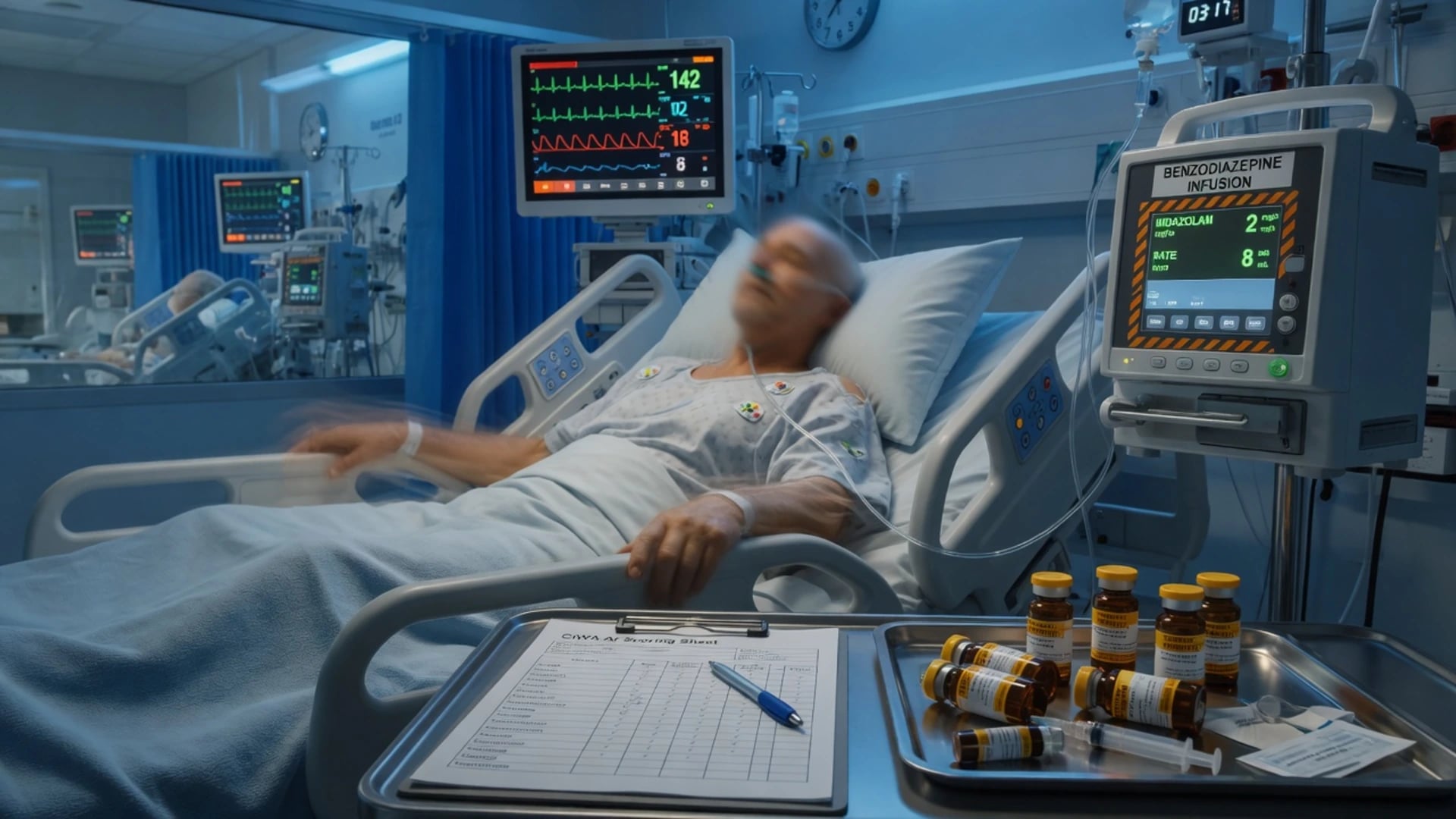
Timeline and stages
Alcohol withdrawal timeline (click each)
Seizures
Generalised tonic-clonic seizures (1-6 in a cluster), typically 24-48 h after cessation. Usually self-limiting (<5 min) and rarely status. Treatment: IV lorazepam or diazepam. Do NOT routinely give phenytoin — benzodiazepines are treatment of choice.
The four stages of alcohol withdrawal — side by side
| Stage | Onset (after last drink) | Hallmark | Sensorium | CIWA-Ar | Disposition |
|---|---|---|---|---|---|
| Minor withdrawal | 6-12 h (tremor from ~6-8 h) | Coarse tremor, anxiety, insomnia, nausea, mild autonomic | CLEAR | <10 | Ward; oral chlordiazepoxide |
| Withdrawal seizures | 12-48 h (peak 24 h) | Generalised tonic-clonic, 1-6 in cluster, brief; rarely status | Brief post-ictal only | n/a (inter-ictal) | Observe; IV lorazepam if active |
| Alcoholic hallucinosis | 12-48 h (peak ~24 h) | Visual > auditory hallucinations | CLEAR — patient oriented | 10-15 | Ward/HDU; benzodiazepine |
| Delirium tremens (DTs) | 48-96 h (peak ~72 h) | Confusion + agitation + autonomic storm (HR >120, BP >180, T >38.5) + hallucinations | ALTERED — disoriented | >20 | ICU — high-dose IV benzodiazepine ± intubation |
Pathophysiology — the unifying neurobiology
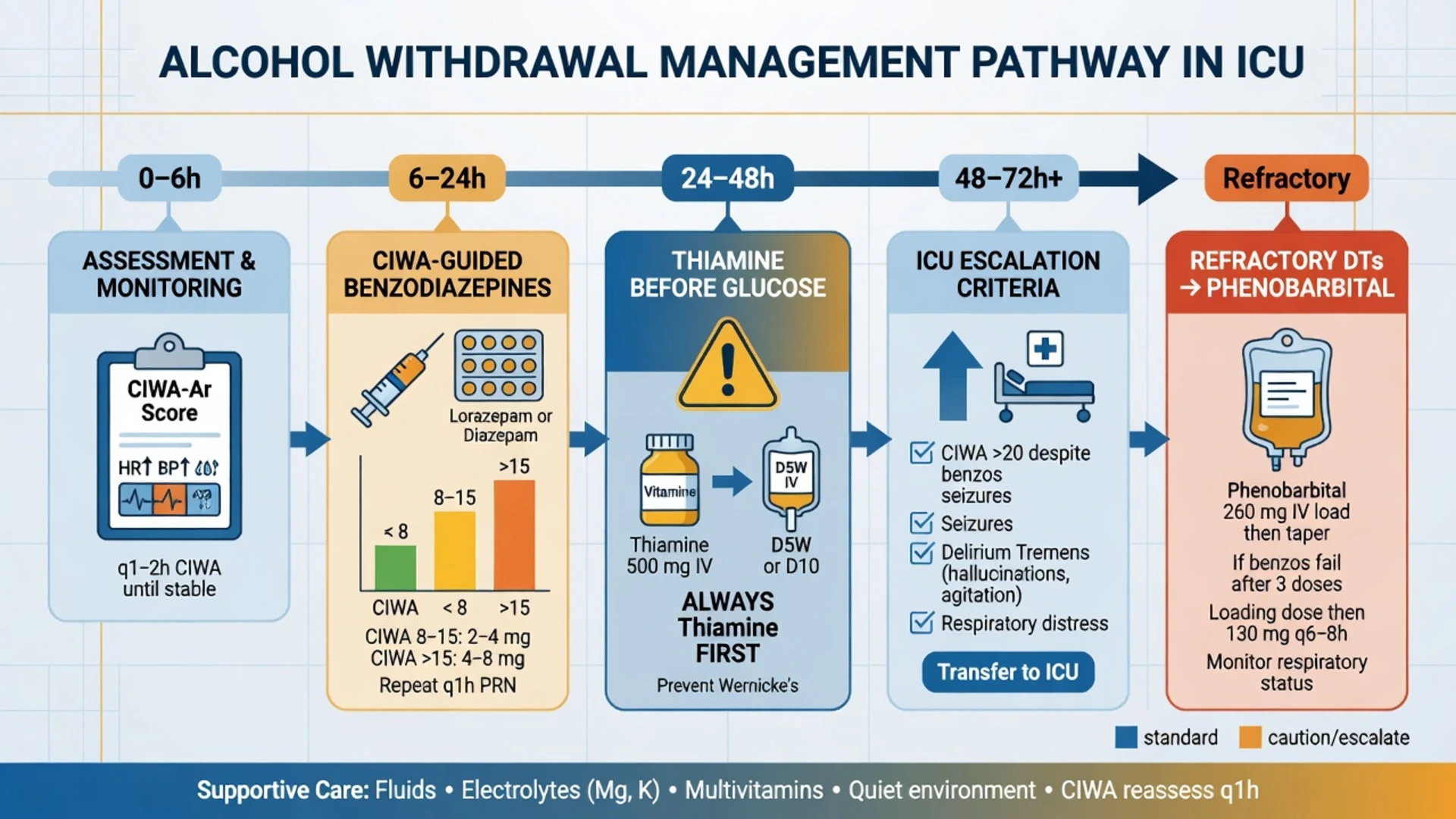
The two receptors that explain everything in alcohol withdrawal
| Receptor | Effect of chronic ethanol | Effect of abrupt cessation | Clinical correlate |
|---|---|---|---|
| GABA-A (inhibitory) | Chronic ethanol binds and potentiates GABA-A → brain DOWN-REGULATES GABA-A receptors to maintain homeostasis (tolerance) | Sudden loss of ethanol + already-reduced GABA-A receptors → loss of inhibition | Anxiety, tremor, insomnia, seizures, DTs — the excitability of withdrawal |
| NMDA (excitatory, glutamate) | Chronic ethanol antagonises NMDA → brain UP-REGULATES NMDA receptors to compensate | Sudden loss of antagonism + increased NMDA receptors → unopposed excitation | Hyper-excitability, seizures, hallucinations; explains why GABA-agonists (benzodiazepines) and NMDA-antagonists (ketamine infusion in refractory DTs) both work |
| Voltage-gated Ca channels | Up-regulated by chronic ethanol | Abrupt cessation → Ca influx → neuronal hyper-excitability | Rationale for ** gabapentin** and ** carbamazepine** (Ca-channel modulators) as adjuncts |
| Dopamine / noradrenaline | Chronic ethanol suppresses locus coeruleus firing | Rebound noradrenergic storm | Autonomic hyperactivity of DTs — rationale for alpha-2 agonists (clonidine, dexmedetomidine) as adjuncts[9] |
CIWA-Ar scoring
CIWA-Ar pitfalls — where it goes wrong
| Pitfall | What happens | What to do instead |
|---|---|---|
| Patient intubated / sedated | Cannot score — items need a conversational, oriented patient | Do NOT use CIWA-Ar. Switch to symptom-triggered protocol on sedation interruption or use the RASS-adjusted AWS protocol (e.g. Minnesota / SCCM ICU-AW approach). |
| Concomitant sedative/opioid use | Falsely low CIWA-Ar despite severe withdrawal | Treat based on autonomic signs (HR, BP, tremor) + history; PAWSS predicts severity better. |
| DTs already established | Sensorium clouded → orientation item invalid; CIWA grossly under-reads severity | Treat the patient, not the score — DTs = high-dose IV benzodiazepine regardless of CIWA-Ar |
| Sensory impairment / dementia / non-English | Items poorly assessable | Use PAWSS to risk-stratify, treat empirically |
| Score only once | Severity fluctuates hour-to-hour; under-treatment → escalation | Score every 1 h when severe, every 4 h when moderate |
Risk stratification — PAWSS
Management protocol — the first hour
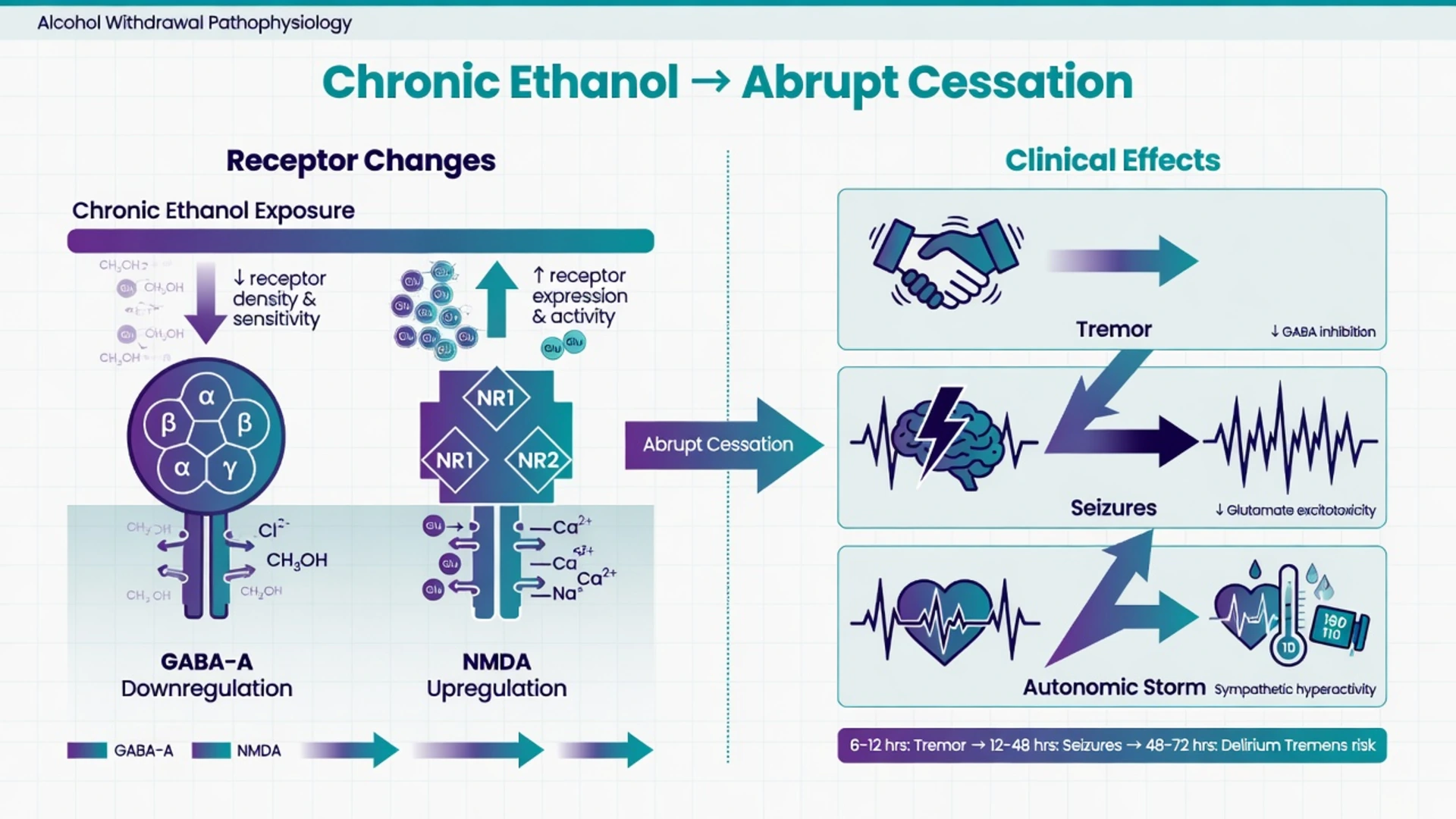
Alcohol withdrawal management — the first 24 hours
Assess severity & risk (CIWA-Ar + PAWSS)
Score CIWA-Ar every 1-4 hours depending on severity. Calculate PAWSS at admission to predict who will progress. CIWA <8: observe. CIWA 8-15: oral chlordiazepoxide 25-50 mg as needed (symptom-triggered). CIWA >15: IV benzodiazepine (diazepam 10-20 mg or lorazepam 2-4 mg every 1-2h). CIWA >20: ICU, continuous infusion.
Give THIAMINE before glucose
Thiamine 100 mg IV (or 500 mg IV TDS if Wernicke suspected) BEFORE any glucose-containing fluid. Glucose metabolism consumes thiamine — giving glucose first precipitates Wernicke encephalopathy. Also give folate, multivitamins, magnesium (commonly deficient in alcoholics).
Correct electrolytes — Mg before K
Hypomagnesaemia (common in alcoholics — contributes to seizures, arrhythmias, and refractory hypokalaemia). Hypokalaemia. CORRECT Mg BEFORE K (refractory hypokalaemia without Mg correction). Phosphate (refeeding risk when nutrition started).
Benzodiazepine — the cornerstone
Chlordiazepoxide (oral, long half-life — preferred for mild-moderate). Diazepam (IV for moderate-severe — long half-life, active metabolites). Lorazepam (IV — preferred if hepatic impairment, shorter half-life, more predictable). Symptom-triggered (CIWA-guided) is superior to fixed-schedule dosing.
Phenobarbital for refractory
If benzodiazepines insufficient (high doses, persistent symptoms), add phenobarbital. Loading dose: 10-15 mg/kg IV. Advantages: long half-life, less respiratory depression than high-dose benzodiazepines, smooth control. Increasingly used as first-line in some ED protocols.<Cite id="2" /><Cite id="7" />
Manage delirium tremens
ICU admission. Continuous cardiac monitoring. High-dose IV benzodiazepines (diazepam infusion or lorazepam infusion). May need intubation for airway protection. Treat autonomic hyperactivity: beta-blockers (caution — may mask withdrawal severity), clonidine/dexmedetomidine for sympathetic overactivity. Treat fever (cooling, paracetamol). Fluid resuscitation (large insensible losses from sweating).
Do NOT routinely give phenytoin
Alcohol withdrawal seizures are self-limiting and do NOT require phenytoin. Treatment: benzodiazepines (lorazepam 2-4 mg IV or diazepam 10 mg IV). Only consider phenytoin/levetiracetam if: recurrent seizures, structural brain lesion, or seizure after 48h of abstinence (unlikely to be withdrawal).
Plan for refeeding & long-term prevention
Start nutrition SLOWLY (refeeding risk: phosphate, magnesium, potassium all plummet as insulin rises — recheck q6-12h for the first 72 h). Continue thiamine 100 mg oral daily for at least 1-2 weeks. Liaise with addiction medicine BEFORE discharge — long-term naltrexone/acamprosate/thiamine reduce readmission.
Benzodiazepine pharmacology — choosing the right agent
The four benzodiazepines used in alcohol withdrawal
| Agent | Route | Onset | Half-life (parent + metabolites) | Hepatic metabolism | Best use |
|---|---|---|---|---|---|
| Chlordiazepoxide | Oral | 1-4 h | Long (~24-48 h, with active metabolites → effective t½ up to ~100 h, including nordiazepam) | Extensive hepatic oxidation | First-line for mild-moderate outpatient or ward withdrawal — long t½ gives smooth self-tapering |
| Diazepam | Oral, IV, PR | Oral 15-30 min; IV 1-3 min | Long (~20-50 h, active metabolites → effective t½ up to ~100 h) | Hepatic oxidation to nordiazepam, temazepam, oxazepam | First-line IV for moderate-severe — rapid onset + long t½ gives smooth control; AVOID in hepatic failure/elderly (accumulation) |
| Lorazepam | Oral, IV, IM | IV 5-10 min | Intermediate (~10-20 h, NO active metabolites) | Glucuronidation only (preserved in liver/renal disease) | Preferred if hepatic impairment, elderly, or renal failure — predictable, no active metabolites; IM absorption reliable |
| Oxazepam | Oral | Slow (30-60 min) | Short-intermediate (~4-15 h, no active metabolites) | Glucuronidation only | Mild withdrawal in hepatic impairment; slow onset limits use in severe withdrawal |
Lorazepam vs diazepam in severe withdrawal — when each wins
| Question | Answer |
|---|---|
| Which has faster onset IV? | Diazepam (1-3 min vs lorazepam 5-10 min) — diazepam is highly lipid-soluble, crosses blood-brain barrier faster |
| Which accumulates less in cirrhosis? | Lorazepam — glucuronidation is preserved even in severe hepatic disease; diazepam's active metabolites accumulate and cause prolonged sedation |
| Which is preferred in the elderly? | Lorazepam — shorter t½, no active metabolites, lower risk of delirium and falls |
| Which gives smoother taper? | Diazepam — long t½ + active metabolites self-taper, reducing rebound withdrawal |
| Which is preferred for ICU infusion? | Lorazepam — though diazepam is acceptable; midazolam for very short-term control only |
| Why avoid midazolam for withdrawal? | Rapid onset but VERY short t½ → frequent bolusing or high infusion rates → tachyphylaxis and unpredictable accumulation in renal failure (active metabolite) |
Symptom-triggered vs fixed-schedule — the evidence
Symptom-triggered vs fixed-schedule benzodiazepine dosing
| Parameter | Symptom-triggered (CIWA-guided) | Fixed-schedule (e.g. chlordiazepoxide 50 mg QID x 4 d then taper) |
|---|---|---|
| Principle | Give a benzodiazepine ONLY when CIWA-Ar > threshold (usually 8); reassess hourly | Give a fixed benzodiazepine dose on a schedule regardless of symptoms; PRN top-ups as needed |
| Total benzodiazepine dose | LOWER (typically ~50-70% less) | Higher — risk of oversedation |
| Treatment duration | SHORTER | Longer |
| Complication rate | LOWER (oversedation, falls, prolonged admission) | Higher |
| Best for | Most inpatient withdrawal (mild-moderate); patients who can reliably be scored | Patients who CANNOT be scored (intubated, severe dementia); very high-risk (PAWSS high) as a baseline |
| Requires | Trained nursing staff to score CIWA every 1-4 h | Less intensive monitoring |
Mayo-Smith 1997 — ASAM meta-analysis of pharmacological management of alcohol withdrawal (JAMA, PMID 9214531)
Design
Meta-analysis of 65 controlled trials of pharmacotherapy for alcohol withdrawal, used to derive the American Society of Addiction Medicine (ASAM) evidence-based guideline
Key finding 1
Benzodiazepines are the treatment of choice — superior to placebo for seizures (RR ~0.16 for withdrawal seizures) and for delirium/hallucinosis
Key finding 2
Symptom-triggered regimens (CIWA-guided) reduced total benzodiazepine dose, treatment duration, and complication rates compared with fixed-schedule
Key finding 3
No agent was clearly superior, but long-half-life agents (diazepam, chlordiazepoxide) were associated with smoother control
Clinical bottom line
The single most influential guideline in alcohol withdrawal — established benzodiazepines + symptom-triggered dosing as the standard of care; frames every modern protocol
Amato 2010 — Cochrane: benzodiazepines for alcohol withdrawal (PMID 20238336)
Design
Cochrane systematic review and meta-analysis of 64 RCTs (n = 4309) comparing benzodiazepines with placebo or other drugs for alcohol withdrawal
Key finding 1
Benzodiazepines were more effective than placebo in preventing withdrawal seizures (RR 0.16, 95% CI 0.04-0.69)
Key finding 2
Benzodiazepines were more effective than placebo in preventing delirium (RR 0.21, 95% CI 0.08-0.53)
Key finding 3
Benzodiazepines were superior to antipsychotics in efficacy and adverse effects; no single benzodiazepine was clearly superior
Clinical bottom line
Confirms benzodiazepines as first-line for alcohol withdrawal; antipsychotics should NOT be used as monotherapy — they do not prevent seizures or DTs and lower the seizure threshold
Phenobarbital for refractory and first-line use
Phenobarbital vs benzodiazepines in alcohol withdrawal
| Parameter | Phenobarbital | Benzodiazepines (diazepam/lorazepam) |
|---|---|---|
| Mechanism | Barbiturate — potentiates GABA-A (longer channel opening) and weak NMDA antagonism | Benzodiazepine — potentiates GABA-A (increased channel-opening FREQUENCY) |
| Onset (IV) | 5-15 min (slower than diazepam) | Diazepam 1-3 min; lorazepam 5-10 min |
| Half-life | VERY long (~50-120 h) — gives smooth self-tapering | Long (diazepam) to intermediate (lorazepam) |
| Respiratory depression | Less than high-dose benzodiazepine (at effective withdrawal dose) — a major advantage in the intubated-for-airway scenario | Dose-dependent — high-dose infusions frequently require intubation |
| Reversibility | NOT reversed by flumazenil — barbiturates do not bind the benzodiazepine site | Reversed by flumazenil (caution: seizure risk in chronic users) |
| Role | (1) Refractory DTs (BZD failure); (2) Increasingly first-line in ED protocols (single loading dose vs repeated BZD boluses) | First-line for most withdrawal |
| Loading dose | 10-15 mg/kg IV (typical 260-650 mg in adults); then 130-260 mg q15-30 min PRN | Symptom-triggered per CIWA |
Rosenson 2013 — Phenobarbital RCT for acute alcohol withdrawal (J Emerg Med, PMID 22999778)
Design
Prospective, randomised, double-blind, placebo-controlled trial in an ED — patients with moderate alcohol withdrawal randomised to a single phenobarbital dose vs placebo, in addition to standard CIWA-guided lorazepam
Key finding 1
A single prophylactic phenobarbital dose REDUCED the need for ICU admission for alcohol withdrawal
Key finding 2
Reduced the total benzodiazepine requirement during the admission
Key finding 3
No significant increase in sedation, respiratory depression, or adverse events vs placebo
Clinical bottom line
A single ED phenobarbital dose is a safe, effective, low-cost adjunct that reduces ICU utilisation and total benzodiazepine exposure — foundational for the modern 'phenobarbital-first' ED protocols
Wolpaw 2025 — Hospital-wide phenobarbital implementation for AWS (JAMA Netw Open, PMID 40853658)
Design
Quasi-experimental, hospital-wide implementation study of a standardised phenobarbital-based alcohol withdrawal protocol vs historical benzodiazepine-based care
Key finding 1
Phenobarbital-based protocol was associated with reduced ICU admission and reduced ICU/hospital length of stay for alcohol withdrawal
Key finding 2
No increase in intubation, oversedation, or 30-day mortality — the safety signal that has held back wider adoption was NOT seen
Key finding 3
Reduced total benzodiazepine exposure across the institution
Clinical bottom line
Large, modern, real-world evidence supporting phenobarbital-based protocols as a safe institutional default for alcohol withdrawal — increasingly displacing diazepam as first-line in ED/ward settings
Lee 2024 — Systematic review: phenobarbital in the ED (Acad Emerg Med, PMID 37923363)
Design
Systematic review and meta-analysis of phenobarbital for alcohol withdrawal treatment in the emergency department setting
Key finding 1
Phenobarbital (alone or as adjunct to benzodiazepine) was associated with reduced need for ICU admission and reduced symptom progression
Key finding 2
Comparable safety profile to benzodiazepine-only protocols (no excess intubation, sedation, or mortality)
Key finding 3
Heterogeneous protocols across studies limit pooled effect size; signals consistent across RCTs and observational data
Clinical bottom line
Best available synthesis supporting phenobarbital as an effective and safe option in the ED — directly informs the modern phenobarbital-first movement
Adjunctive therapies — when benzodiazepines are not enough
Adjuncts in alcohol withdrawal — what, when, what they will and will not do
| Agent | Mechanism | Role | Will NOT |
|---|---|---|---|
| Dexmedetomidine | Alpha-2A agonist — sympathetic modulation | Adjunct for refractory sympathetic overactivity (HR, BP) in DTs; reduces benzodiazepine requirement; does NOT cross-dependency to α-receptors so cannot be used as monotherapy | Replace benzodiazepines (does NOT prevent seizures or delirium) — never monotherapy[9] |
| Clonidine | Alpha-2 agonist (less selective) | Adjunct for autonomic storm; cheaper, oral available | Replace benzodiazepines — same caveat as dexmedetomidine |
| Gabapentin | Voltage-gated Ca-channel modulator; GABA-related | Mild-moderate outpatient withdrawal; reduces craving; favourable safety in mild cases | Severe withdrawal or DTs (insufficient evidence for monotherapy) |
| Carbamazepine / valproate | Na-channel / GABA; kindling attenuation | Mild-moderate withdrawal; some evidence of reduced progression in non-severe cases | DTs — never first-line; valproate AVOIDED in hepatic failure |
| Beta-blocker (e.g. propranolol) | Sympatholysis | Selected cases of severe tachycardia/hypertension — SHORT TERM only | MASKS withdrawal severity (autonomic signs disappear but brain is still withdrawing) — risk of undertreatment |
| Antipsychotics (haloperidol, atypicals) | D2 antagonism | NOT for alcohol withdrawal — only for refractory agitation on top of adequate benzodiazepine | LOWER the seizure threshold, do not prevent seizures or DTs — never monotherapy |
| Ketamine infusion | NMDA antagonist | Refractory DTs when high-dose benzodiazepine + phenobarbital fail (theoretical NMDA-excess rationale) | Standard therapy — only as rescue in extreme cases |
| Propofol infusion | GABA-A potentiation (non-BZD site) | Refractory DTs requiring intubation — profound sedation | Non-intubated patients (apnoea risk) |
Polintan 2023 — Adjunctive dexmedetomidine in AWS (Ann Pharmacother, PMID 36258676)
Design
Systematic review and meta-analysis of dexmedetomidine as adjunctive therapy for alcohol withdrawal syndrome
Key finding 1
Adjunctive dexmedetomidine REDUCED total benzodiazepine dose and the duration of agitation
Key finding 2
No significant reduction in ICU or hospital length of stay; no clear mortality benefit
Key finding 3
No increase in bradycardia or hypotension requiring cessation in most studies
Clinical bottom line
Dexmedetomidine is a useful ADJUNCT to reduce benzodiazepine burden and control sympathetic overactivity in ICU AWS — it MUST NOT be used as monotherapy (does not prevent seizures or treat the underlying excitatory state)
Bahji 2022 — Comparative pharmacotherapy network meta-analysis for AWS (Addiction, PMID 35194860)
Design
Systematic review and network meta-analysis comparing all pharmacotherapies for alcohol withdrawal (benzodiazepines, anticonvulsants, barbiturates, gabapentin, baclofen)
Key finding 1
Benzodiazepines and barbiturates (phenobarbital) had the most favourable balance of efficacy and safety for the management of alcohol withdrawal
Key finding 2
Antipsychotics were associated with poorer outcomes (seizure threshold, adverse effects) and should NOT be used as monotherapy
Key finding 3
Anticonvulsants (carbamazepine, gabapentin) had comparable safety but weaker evidence for efficacy in severe withdrawal
Clinical bottom line
Network evidence reaffirms benzodiazepines and phenobarbital as the two evidence-based pillars of alcohol withdrawal pharmacotherapy
Management protocol — refractory delirium tremens
Refractory delirium tremens — escalation pathway when standard benzodiazepines fail
Recognise treatment failure
DTs is refractory if: (a) requiring escalating BZD doses (e.g. >200 mg diazepam in 24 h, or >40 mg lorazepam), (b) persistent agitation, autonomic storm, or hallucinations despite adequate dosing, or (c) CIWA-Ar >20 sustained despite therapy.
Move to ICU + continuous benzodiazepine infusion
Transfer to ICU. Start continuous IV midazolam (1-10 mg/h) OR lorazepam infusion (1-10 mg/h) titrated to a RASS of -1 to 0 (calm). Continuous cardiac monitoring; large-bore IV access; arterial line for BP monitoring.
Add phenobarbital loading
Phenobarbital 10-15 mg/kg IV load (typical 260-650 mg over 30-60 min); then 130-260 mg q15-30 min PRN up to a ceiling. Long t½ provides sustained control; less respiratory depression than escalating BZD.
Add dexmedetomidine for sympathetic overactivity
Dexmedetomidine 0.2-0.7 μg/kg/h IV — controls HR/BP, reduces benzodiazepine requirement. ADJUNCT ONLY — does not treat the underlying excitatory state. Avoid bradycardia/hypotension.<Cite id="9" />
Intubate if airway threatened
Early intubation for: airway compromise, persistent severe agitation, respiratory failure, or need for high-dose sedation. RSI with propofol; continue sedation with propofol/midazolam infusion targeting RASS -1 to 0.
Consider rescue therapy
For SUPER-refractory DTs: ketamine infusion (NMDA antagonism targets the underlying excitatory pathology) 0.15-1 mg/kg/h; propofol infusion in intubated patients; rare reports of dexmedetomidine-ketamine combinations. Discuss with toxicology and addiction medicine.
Treat autonomic complications
Treat fever aggressively (cooling, paracetamol — avoid NSAIDs in coagulopathy/liver disease). Treat rhabdomyolysis (IV fluids, monitor CK). Treat arrhythmias (magnesium first for torsades risk; correct K). Treat volume depletion (large insensible losses from sweating — 4-6 L/day may be required).
Maintain thiamine + electrolyte support
Continue thiamine 100-500 mg IV daily. Recheck Mg, K, PO4 every 12 h. Begin nutrition SLOWLY (refeeding risk). Monitor glucose.
Wernicke encephalopathy
Donnino 2007 — Myths and misconceptions of Wernicke's (Ann Emerg Med, PMID 17681641)
Source
Authoritative review aimed at emergency physicians — the classic teaching source on Wernicke
Myth 1
'The triad is required for diagnosis' — FALSE. The full triad is present in only ~10%; a high index and empirical treatment of ANY unexplained confusion in an at-risk patient is the standard
Myth 2
'100 mg thiamine is enough' — FALSE. Established Wernicke needs 500 mg IV TDS x 3 days; the standard 100 mg daily dose is for prophylaxis, not treatment
Myth 3
'Give glucose after thiamine to be safe' — PARTIALLY FALSE. The concern is real (glucose precipitates Wernicke in deficient patients), but in the hypoglycaemic alcoholic you do NOT withhold glucose — give thiamine FIRST or concurrently, and treat the glucose immediately
Myth 4
'MRI is needed for diagnosis' — FALSE. MRI is supportive (mamillary body enhancement is classic) but often normal; Wernicke is a CLINICAL diagnosis
Clinical bottom line
Treat empirically and aggressively — the cost of missing Wernicke (irreversible Korsakoff) vastly exceeds the cost of unnecessary thiamine
Electrolyte and metabolic complications
The electrolyte and metabolic derangements of alcohol withdrawal — what, why, what to do
| Disturbance | Mechanism | Clinical effect | Management |
|---|---|---|---|
| Hypomagnesaemia | Poor intake, GI losses, renal wasting (tubular Mg leak with ethanol), intracellular shift | Seizures, arrhythmias, refractory hypokalaemia (renal K wasting persists until Mg corrected) | Replete Mg FIRST — 1-2 g IV over 1 h (slow; rapid infusion → flushing, hypotension); check serum Mg and re-dose |
| Hypokalaemia | Poor intake, vomiting, secondary hyperaldosteronism, Mg deficiency (uncouples Na-K-ATPase) | Arrhythmias, weakness, ileus | Will NOT correct until Mg repleted — replace both simultaneously |
| Hypophosphataemia | Poor intake, refeeding (insulin shifts phosphate intracellularly), respiratory alkalosis | Weakness (diaphragm!), rhabdomyolysis, leukocyte dysfunction | Replace IV phosphate; start nutrition SLOWLY (refeeding) |
| Hypoglycaemia | Depleted glycogen, impaired gluconeogenesis (NADH/NAD+ ratio shifted by ethanol) | Sweating, tremor, confusion — can mimic or worsen withdrawal | Check glucose; give THIAMINE before any glucose-containing fluid |
| Hyponatraemia | Beer potomania (low solute + high free water), SIADH (nausea/pain), cerebral salt wasting | Seizures (additive to withdrawal seizure risk) | Correct slowly (<8 mmol/L/24h) — risk of osmotic demyelination |
| Ketoacidosis (alcoholic ketoacidosis) | NADH excess drives β-hydroxybutyrate production; starvation ketosis | High anion gap metabolic acidosis, ketonuria, normal/low glucose | Dextrose-containing saline + thiamine — bicarbonate rarely needed |
| Respiratory alkalosis | Hyperventilation (anxiety, agitation, hepatic dysfunction) | Alkalosis shifts K intracellularly; lowers ionised Ca — tetany | Treat underlying withdrawal; not the pH |
Refeeding syndrome — the silent killer of the recovering alcoholic
[1]Differentiating alcohol withdrawal from mimics
Alcohol withdrawal vs the mimics — differentiating in the confused ICU patient
| Feature | Alcohol withdrawal / DTs | Sepsis / infection | Hepatic encephalopathy | Sedation withdrawal (propofol/midazolam) | Serotonin syndrome / NMS |
|---|---|---|---|---|---|
| Timing | 6-96 h after cessation | Variable | Variable (often with GI bleed/constipation) | Hours of stopping infusion | Hours-days of new serotonergic/neuroleptic drug |
| Hallmark sign | Coarse tremor, autonomic storm, hallucinations | Fever, leucocytosis, source | Asterixis, constructional apraxia, sparing of autonomic storm | Agitation, autonomic storm | Hyperreflexia, clonus, rigidity, hyperthermia |
| Sensorium | Clouded (DTs) / clear (hallucinosis) | Clouded if severe | Clouded, fluctuating | Clouded | Clouded |
| CIWA-Ar | High (DTs) | Low-moderate | Low | Moderate-high | Low |
| Diagnostic clue | History + tremor + autonomic storm in the right time window | Positive cultures, source | High NH3 (with caution), low albumin, ascites | Recent sedation wean | Drug history (SSRI/MAOI/neuroleptic) |
| Initial treatment | Benzodiazepine + thiamine | Antibiotics + source control | Lactulose + rifaximin | Restart/resume sedation, taper slowly | Stop culprit; cyproheptadine (SS); dantrolene/benzodiazepine (NMS) |
SAQ — Severe alcohol withdrawal guided by CIWA-Ar
10 minutes · 10 marks
A 54-year-old man was admitted to your ICU 60 hours ago with severe acute pancreatitis following a binge. He drinks one bottle of spirits daily. He is now tremulous, agitated and diaphoretic; HR 118/min, BP 175/98, T 37.9 C, and he is oriented to name only. CIWA-Ar score 22.
SAQ — Wernicke encephalopathy in the ICU
10 minutes · 10 marks
A 47-year-old woman with chronic alcohol dependence is admitted with alcoholic hepatitis. On day 3 she becomes confused, develops a wide-based ataxic gait, and is found to have horizontal nystagmus with bilateral lateral rectus palsies. She received 1 litre of 5% dextrose on admission for hypoglycaemia without prior thiamine.
Clinical pearls — the high-yield points
Red flags — the things that kill the patient
A two-minute viva answer
References
- [1]Sachdeva A, Choudhary M, Chandra M. Alcohol Withdrawal Syndrome: Benzodiazepines and Beyond J Clin Diagn Res, 2015.PMID 26500991
- [2]Lee CM, Yang CC, Hsiao KY, Chang CJ, Yen DH. Phenobarbital treatment of alcohol withdrawal in the emergency department: A systematic review and meta-analysis Acad Emerg Med, 2024.PMID 37923363
- [3]Donnino MW, Miller J, Bhatnagar S, et al. Myths and misconceptions of Wernicke's encephalopathy: what every emergency physician should know Ann Emerg Med, 2007.PMID 17681641
- [4]Amato L, Minozzi S, Davoli M. Benzodiazepines for alcohol withdrawal Cochrane Database Syst Rev, 2010.PMID 20238336
- [5]Mayo-Smith MF, for the American Society of Addiction Medicine Working Group on Pharmacological Management of Alcohol Withdrawal. Pharmacological management of alcohol withdrawal. A meta-analysis and evidence-based practice guideline. American Society of Addiction Medicine Working Group on Pharmacological Management of Alcohol Withdrawal JAMA, 1997.PMID 9214531
- [6]Sullivan JT, Sykora K, Schneiderman J, Naranjo CA, Sellers EM. Assessment of alcohol withdrawal: the revised clinical institute withdrawal assessment for alcohol scale (CIWA-Ar) Br J Addict, 1989.PMID 2597811
- [7]Rosenson J, Clements C, Simon B, et al. Phenobarbital for acute alcohol withdrawal: a prospective randomized double-blind placebo-controlled study J Emerg Med, 2013.PMID 22999778
- [8]Schuckit MA. Management of withdrawal delirium (delirium tremens) N Engl J Med, 2015.PMID 25651262
- [9]Polintan ETT, Diaz KJ, Rumboua KMT, Raj R, Sahota MK, Lopez MJ, Chakraborti C. Adjunctive Dexmedetomidine in Alcohol Withdrawal Syndrome: A Systematic Review and Meta-analysis of Retrospective Cohort Studies and Randomized Controlled Trials Ann Pharmacother, 2023.PMID 36258676
- [10]Maldonado JR, Sher Y, Ashouri JF, et al. The Prediction of Alcohol Withdrawal Severity Scale (PAWSS): systematic literature review and pilot study of a new scale for the prediction of complicated alcohol withdrawal syndrome Alcohol, 2014.PMID 24657098
- [11]Wolpaw BJ, Schubmehl H, West A, et al. Hospital-Wide Implementation, Clinical Outcomes, and Safety of Phenobarbital for Alcohol Withdrawal JAMA Netw Open, 2025.PMID 40853658
- [12]Bahji A, Bach P, Danilewitz M, MacKillop J, Deheragoda M, Grover P, Tipparaju A, Frey L, Cortez-Fontes C, Robertson S, Dilmaghani S, Doering AH, Kolla N, Meyer-Bernstein E, Enns A, Sareen J. Comparative efficacy and safety of pharmacotherapies for alcohol withdrawal: a systematic review and network meta-analysis Addiction, 2022.PMID 35194860