ICU · toxicology
Acute Carbon Monoxide Poisoning — Comprehensive ICU Management
Also known as Carbon monoxide poisoning · CO poisoning · Carboxyhaemoglobin (COHb) · Carboxyhemoglobin · Hyperbaric oxygen therapy (HBOT) · Delayed neurological sequelae (DNS) · Delayed encephalopathy · The great imitator (flu-like) · Cytochrome oxidase inhibition
Acute carbon monoxide (CO) poisoning — odourless, colourless gas of incomplete combustion (faulty heaters, house fires, exhausts, generators). CO binds haemoglobin with ~240x the affinity of oxygen, forming carboxyhaemoglobin (COHb), causing a TRIPLE insult: (1) functional anaemia (reduced O2 carrying capacity), (2) LEFT shift of the oxyhaemoglobin dissociation curve (residual O2 held too tightly — impaired tissue release), and (3) direct cellular hypoxia via binding myoglobin and inhibiting mitochondrial cytochrome c oxidase (cytochrome a3 / Complex IV) → histotoxic hypoxia + lactic acidosis. Clinical: headache, nausea, dizziness, confusion — 'flu-like symptoms in MULTIPLE people from the SAME household in WINTER = CO until proven otherwise.' Severe: syncope, seizures, coma, cardiovascular collapse. Cherry-red skin is a classical but RARE and LATE sign — do NOT rely on it. Diagnosis: COHb on venous blood gas (venous sample sufficient — arterial NOT required) — COHb 10% significant, 25% severe, 50% potentially fatal. CRITICAL: SpO2 by standard pulse oximetry is FALSELY NORMAL because it cannot distinguish COHb from oxyhaemoglobin. Management: 100% oxygen via non-rebreather mask immediately — reduces CO half-life from ~320 min (room air) to ~80 min; hyperbaric oxygen (HBO) at 2.5-3 atm reduces half-life to ~23 min — indicated (controversial) for COHb 25%, loss of consciousness, neurological signs, pregnancy, cardiac ischaemia. Delayed neurological sequelae (DNS) in 20-40% of severe cases at 2-40 days — cognitive impairment, parkinsonism — may be permanent; no proven prevention.
On this page & tools
Your progress
Saved locally on this device.
Target exams
Red flags
Overview
Pathophysiology — the triple mechanism of tissue hypoxia
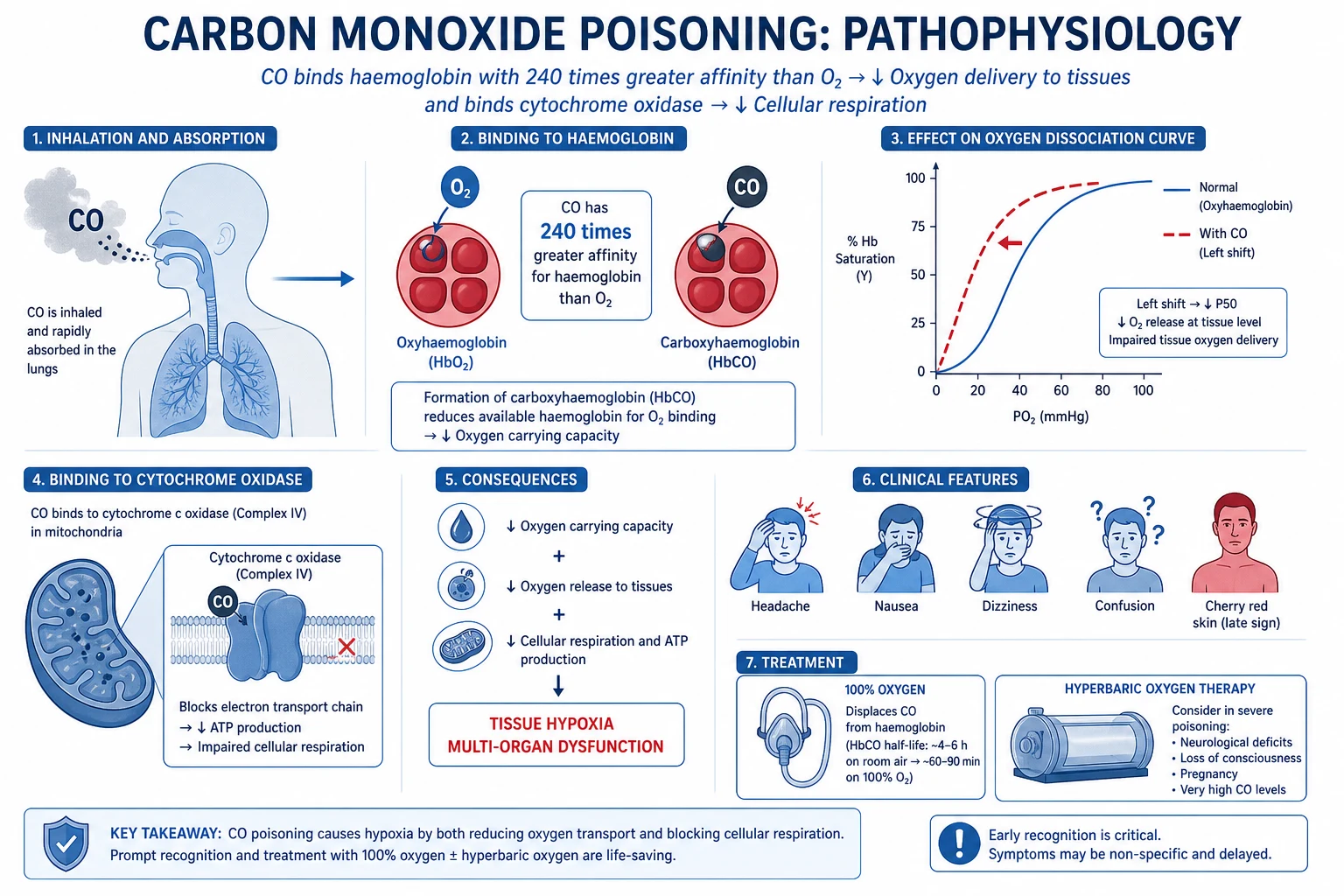
CO produces tissue hypoxia through three synergistic mechanisms, and understanding all three is essential because it explains why a "normal PaO2" and "normal SpO2" do not exclude life-threatening poisoning. [1]
-
Functional anaemia (reduced O2 carrying capacity). CO binds haemoglobin with an affinity roughly 240x that of oxygen, forming carboxyhaemoglobin (COHb). Because the affinity is so much higher, even low ambient CO concentrations progressively displace oxygen from haemoglobin. A COHb of 40% means ~40% of haemoglobin binding sites are occupied by CO and unavailable to carry oxygen — the equivalent of losing 40% of haemoglobin to a functional anaemia, but with the added insult that the remaining sites behave abnormally (point 2).[1]
-
Left shift of the oxyhaemoglobin dissociation curve. This is the second, often-underappreciated mechanism. When one CO molecule occupies one of the four haem sites on a haemoglobin tetramer, the remaining three sites bind oxygen with increased affinity (an allosteric effect analogous to the Bohr effect in reverse). The dissociation curve shifts left, so haemoglobin holds onto its remaining oxygen more tightly and releases far less at tissue PO2. The practical consequence: even the oxygen that IS carried is not delivered. This is why CO poisoning causes more tissue hypoxia than an equivalent haemorrhagic anaemia.[1]
-
Direct cellular (histotoxic) hypoxia. CO diffuses into tissues and binds two key intracellular targets: myoglobin (with an even higher affinity than haemoglobin) and mitochondrial cytochrome c oxidase (cytochrome a3, Complex IV). Inhibition of cytochrome oxidase blocks the electron transport chain → cells cannot utilise delivered oxygen → anaerobic metabolism → lactic acidosis. This "poisoning of the oxygen utilisation machinery" explains the metabolic acidosis and is the mechanism most strongly linked to delayed neurological injury (it triggers neutrophil activation, free-radical lipid peroxidation, and white-matter demyelination).[1][3]
The net effect is a patient who is hypoxic at the tissue level while displaying a deceptively reassuring arterial blood gas: the PaO2 (dissolved oxygen) is normal, the calculated SaO2 is normal, and only the directly measured COHb and the lactate reveal the truth. [1]
Why the routine numbers lie in CO poisoning
PaO2
Dissolved O2
- NORMAL — dissolved plasma oxygen is unaffected by CO
- CO binds haemoglobin, NOT dissolved O2
- A normal PaO2 does NOT exclude CO poisoning
SpO2
Pulse oximetry
- FALSELY NORMAL — standard 2-wavelength pulse oximetry cannot distinguish COHb from O2Hb
- COHb and O2Hb absorb similarly at 660 nm → oximeter reads ~normal
- Multi-wavelength pulse CO-oximetry (e.g. Masimo RAD-57) CAN detect COHb but is less accurate than blood CO-oximetry
SaO2 (calc)
Calculated saturation
- FALSELY NORMAL — derived from PaO2 and assumes all non-oxygenated Hb is deoxy-Hb
- Blood gas CO-oximetry (multi-wavelength, 4+ wavelengths) directly measures COHb, O2Hb, metHb, HHb — THIS is the diagnostic test
Lactate
Tissue hypoxia marker
- ELEVATED — reflects cytochrome inhibition + anaerobic metabolism
- Severe lactic acidosis OUT OF PROPORTION to COHb → suspect concomitant CYANIDE (house fire)
Clinical presentation — the great imitator
CO poisoning is called "the great imitator" because early symptoms overlap with viral illness, migraine, gastroenteritis, and food poisoning. The pattern that unmasks it is multiple symptomatic people sharing an exposure source, OR a patient whose symptoms wax at home and wane elsewhere. The classical seasonal clue is winter, when faulty heaters, gas appliances, and enclosed generator use drive clusters. [1]
COHb level versus symptoms — but treat the patient, not the number
COHb <10%
Usually asymptomatic
- Smokers have a baseline COHb of 3-10% — do not be falsely reassured
- Mild headache possible at 5% in non-smokers
COHb 10-20%
Mild
- Headache, dyspnoea on exertion
- Often mislabelled as "tension headache" or "viral"
COHb 20-30%
Moderate
- Throbbing temporal headache, irritability, impaired judgement, nausea
- May mimic alcohol intoxication
COHb 30-40%
Severe
- Severe headache, vomiting, confusion, visual disturbance, syncope
- ECG changes (ischaemia), tachycardia common
COHb 40-50%
Very severe
- Syncope, seizures, coma
- Myocardial stunning, arrhythmia, hypotension
COHb >50%
Life-threatening
- Deep coma, seizures, cardiorespiratory arrest, death
- Cherry-red skin (classical, RARE, late) — from saturated residual oxyhaemoglobin
IMPORTANT — the COHb level correlates poorly with the clinical picture. Hampson and Hauff showed that symptom severity and COHb are only loosely related: a chronically exposed patient with a "low" level can be profoundly encephalopathic, while an acute high level can be tolerated. Treat the clinical state, the loss of consciousness, and the end-organ injury — not the number in isolation.[5]
Non-neurological organ effects
CO is a systemic poison. Beyond the brain, expect: [1]
- Cardiac: myocardial stunning, ischaemia, arrhythmia (atrial fibrillation, ectopy, conduction block). Demand ischaemia on a background of fixed coronary disease is common. An elevated troponin is a poor prognostic marker and a trigger to consider HBO.
- Skeletal muscle / kidney: rhabdomyolysis (especially after prolonged immobility, seizures, or a house-fire fall) → acute kidney injury. Check CK and treat with IV fluids.
- Pulmonary: chemical pneumonitis and ARDS after smoke inhalation; aspiration risk with reduced consciousness.
- Skin: bullae and pressure-type lesions in severe poisoning (a marker of deep coma), plus the rare cherry-red discolouration.
- Gastrointestinal: nausea, vomiting, rarely mesenteric ischaemia. [1]
Diagnosis
The diagnosis rests on a measured COHb combined with an exposure history. The single most important pitfall is assuming the patient is well-oxygenated because the pulse oximeter looks normal. [1]
[1] [3] [5]Sources and exposure history
Always identify and document the source, because it drives both treatment (co-toxicities) and public health action (evacuate the dwelling, notify gas/fire services, test appliances): [1]
- Faulty or unflued gas heaters, gas water heaters, wood/coal burners, barbecues used indoors
- Blocked flues/chimneys, reverse draughts in tightly sealed homes
- Petrol/diesel generators run indoors or in attached garages (post-disaster clusters)
- Motor vehicle exhaust (accidental — e.g. idling in a closed garage; or deliberate — self-harm)
- House fires and enclosed-space combustion (steel, plastics → also liberate cyanide, hydrogen chloride, phosgene)
- Methylene chloride (dichloromethane) in paint strippers — metabolised IN VIVO to CO, producing delayed, prolonged, and biphasic COHb elevation; treat differently (much longer elimination, recurrent toxicity) [1]
Management — remove, oxygenate, escalate
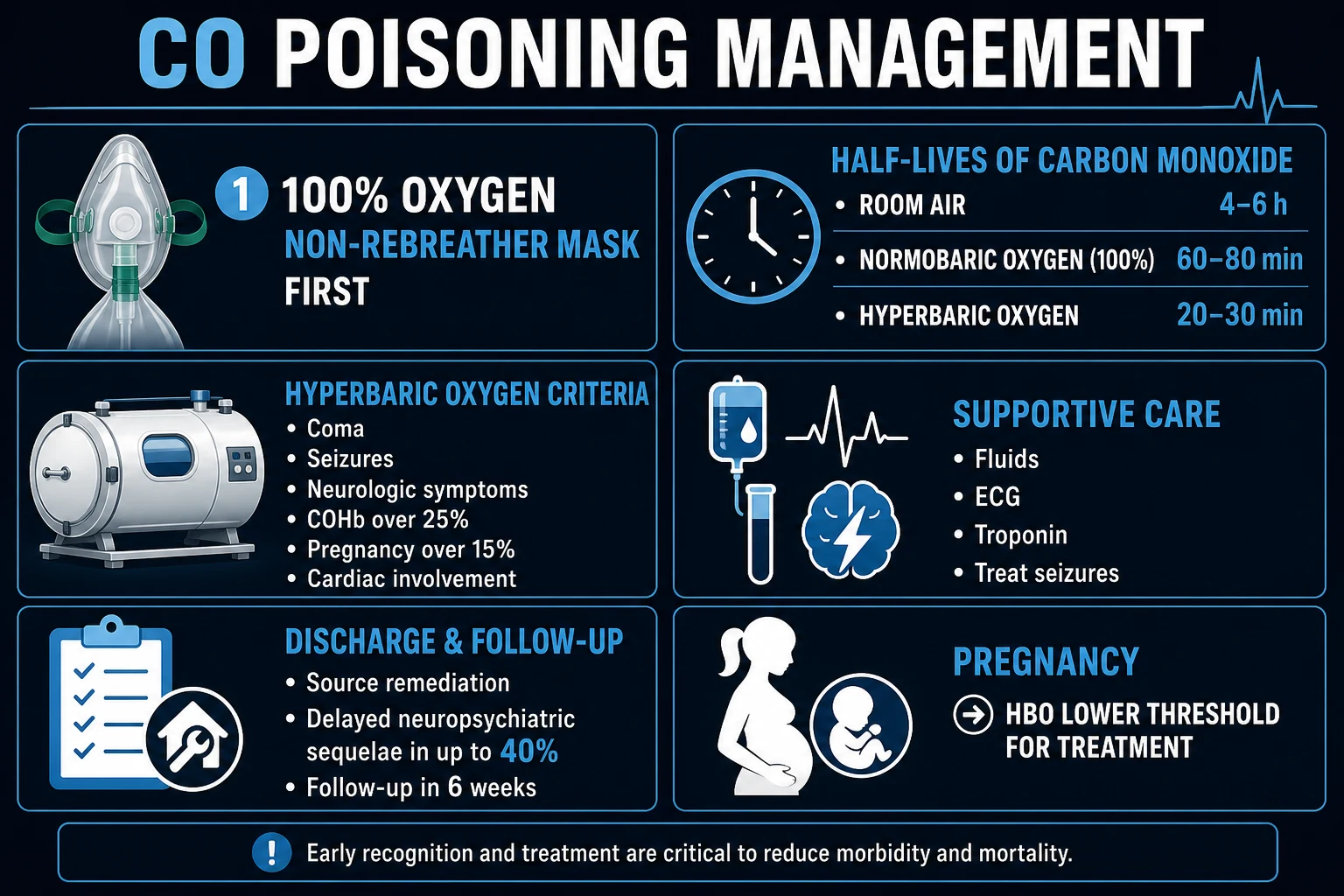
Carbon monoxide poisoning management protocol
1. Remove from source + immediate 100% oxygen
Remove the patient (and all co-occupants) from the CO source immediately. High-flow 100% oxygen via a NON-REBREATHER mask at 15 L/min with a tight face-seal — the reservoir bag must stay >⅔ full. This is the cornerstone of treatment: 100% O2 competes with CO for haemoglobin binding and accelerates dissociation, reducing the CO half-life from ~320 min on room air to ~80 min on 100% O2. Continue 100% O2 until COHb is <5% (target <2% in pregnancy) AND the patient is clinically and biochemically (lactate, acidosis) improved. The COHb must be interpreted WITH the clinical state — a falling level in an obtunded patient still needs 100% O2.
2. ABCDE resuscitation and airway
Assess airway, breathing, circulation, disability, exposure. Intubate and ventilate with 100% oxygen if GCS <8, unable to protect airway, refractory hypoxaemia (from aspiration/ARDS), or recurrent seizures. Use 100% FiO2 (oxygen toxicity is NOT a concern in the acute phase — the priority is CO washout). Secure IV access; treat hypotension with fluids ± vasopressors; continuous ECG monitoring (arrhythmia risk). Seizures: IV benzodiazepines (lorazepam/diazepam). Rhabdomyolysis: IV crystalloid to target urine output.
3. Confirm severity — measure COHb + lactate + troponin
Send COHb (venous or arterial blood gas with CO-oximetry), venous/arterial gas for pH/lactate, ECG, troponin, CK, electrolytes, glucose, beta-hCG. Repeat COHb every 1-2 hours on 100% O2 until <5%. Define severity: COHb >25%, ANY loss of consciousness, neurological signs, pregnancy, or cardiac ischaemia = SEVERE and warrants discussion with a hyperbaric unit.
4. Consider hyperbaric oxygen (HBO) — controversial
HBO at 2.5-3 atmospheres absolute (ATA) dissolves enough oxygen in plasma (~6 vol% at 3 ATA) to meet resting tissue demand independent of haemoglobin, and reduces the CO half-life to ~23 minutes. INDICATIONS (consensus, not absolute): COHb >25% (>20% pregnancy); loss of consciousness; neurological signs (seizure, coma, focal deficit); pregnancy (any symptomatic exposure, COHb >15%); cardiac ischaemia/arrhythmia. The evidence is CONFLICTED: Weaver 2002 (NEJM) showed reduced cognitive sequelae; Scheinkestel 1999 (MJA) showed no benefit; the Cochrane review (Buckley) finds insufficient evidence. Most units still offer HBO for severe cases if a chamber is accessible within a reasonable transfer window. Weigh transfer risk.<Cite id="2" /><Cite id="4" /><Cite id="6" />
5. Pregnancy — treat more aggressively
Fetal haemoglobin has a HIGHER affinity for CO than adult haemoglobin, and fetal COHb is typically 10-15% higher than maternal. The fetus is therefore poisoned at lower maternal levels and clears CO far more slowly (fetal half-life up to 7 hours). Lower the threshold for 100% O2 (continue until maternal COHb <2%) and for HBO. Involve obstetrics; monitor fetal status. ANY symptomatic pregnant patient or COHb >15% warrants hyperbaric discussion.
6. Identify and treat co-toxicities — especially cyanide in house-fire victims
House-fire and enclosed-combustion victims are at risk of concomitant CYANIDE toxicity (combustion of plastics, wool). Suspect cyanide when there is a severe lactic acidosis out of proportion to the COHb, a persistent anion-gap acidosis, cardiovascular instability, or soot in the oropharynx/sputum. Give HYDROXOCOBALAMIN empirically (it is safe, does not impair tissue oxygen utilisation, and works synergistically with 100% O2). Also screen for methaemoglobinaemia (smoke inhalation, nitrates) via CO-oximetry, inhalation injury (bronchoscopy), and thermal airway injury. Consider methylene chloride (paint stripper) exposure if COHb is biphasic/prolonged.
7. Supportive care and disposition
Continue 100% O2 until COHb <5% and the patient is asymptomatic with normal lactate/ECG. Admit severe cases (any LOC, COHb >25%, cardiac/neurological signs, pregnancy) for observation. Treat arrhythmia and ischaemia conventionally. Correct electrolytes; avoid over-sedation. Document a baseline cognitive/neuro examination. Counsel ALL patients (and families) about the risk of delayed neurological sequelae and arrange follow-up at 4-6 weeks. Report the source to public health / gas/fire authorities to prevent re-exposure and further casualties.
8. Monitor for delayed neurological sequelae (DNS)
DNS / delayed encephalopathy occurs in 20-40% of severe cases (especially after loss of consciousness), appearing 2-40 days after apparent recovery. Features: cognitive impairment (memory, executive function), personality change, parkinsonism, gait apraxia, urinary incontinence, mood disturbance. MRI may show globus pallidus injury and diffuse white-matter T2 hyperintensity. DNS often improves over months but may be permanent; there is no proven prevention (HBO may reduce incidence per Weaver 2002, but not reliably per Cochrane). Structured neuro-cognitive follow-up at 4-6 weeks is part of good care.
Elimination half-life of CO — know the three numbers
CO elimination half-life by FiO2 and pressure
| Condition | Approximate CO half-life | Clinical implication |
|---|---|---|
| Room air (FiO2 0.21) | ~320 min (~5 h) | Untreated — tissue injury continues for hours |
| 100% O2 at 1 atm (non-rebreather) | ~80 min | The core treatment; halve COHb roughly every 80 min |
| 100% O2 + HBO at 2.5-3 ATA | ~23 min | Fastest washout + dissolved O2 meets tissue demand |
| Fetus on 100% O2 (maternal) | up to ~7 h | Fetal CO clears slowly — prolonged 100% O2 needed |
Hyperbaric oxygen — the controversy in depth
The HBO question is the single most examined issue in CO poisoning, and the evidence is genuinely conflicting. A fellowship candidate must know both sides. [1]
Mechanistic rationale (why it SHOULD work). HBO (a) accelerates COHb dissociation (half-life ~23 min at 3 ATA), (b) delivers enough dissolved plasma oxygen (~6 vol% at 3 ATA) to sustain tissue metabolism while CO is clearing — independent of haemoglobin, and (c) may reduce the downstream inflammatory cascade (neutrophil β2-integrin clustering, lipid peroxidation, white-matter demyelination) that underlies delayed neurological sequelae.[2]
The positive trial — Weaver 2002 (NEJM). A randomised trial of 152 patients found that three HBO sessions (one at 3.0 ATA, two at 2.0 ATA) over 24 hours, compared with normobaric 100% O2, reduced cognitive sequelae at 6 weeks (25% vs 46%) and the benefit persisted at 12 months. This trial drove much modern enthusiasm for HBO.[2]
The negative trial — Scheinkestel 1999 (MJA). An Australian RCT (179 patients) of normobaric 100% O2 versus HBO (up to 3 sessions at 2.8 ATA) found NO benefit and a non-significant trend towards worse neurological outcomes with HBO. Methodological critiques followed both directions, but the trial stands as a major caution.[6]
The synthesis — Cochrane (Buckley et al.). The pooled analysis concludes the evidence is insufficient to conclude that HBO reduces the incidence of delayed neurological sequelae, citing heterogeneity, risk of bias, and conflicting results. The review does not mandate HBO but does not rule out a benefit in selected patients.[4]
Practical consensus (Hampson 2012 practice recommendations). Most hyperbaric units offer HBO for loss of consciousness, neurological signs, cardiovascular instability/ischaemia, pregnancy with significant exposure, and/or COHb >25%, provided a chamber is accessible and transfer risk is acceptable. The decision is individualised — there is no single correct answer for every patient.[3]
Clinical pearls
Red flags
Prognosis
CO poisoning outcomes and predictors
| Scenario / factor | Outcome | Notes |
|---|---|---|
| Mild poisoning, prompt 100% O2 | Excellent | Full recovery if no LOC and no end-organ injury |
| COHb >25% / any LOC | Guarded | ↑ Risk of delayed neurological sequelae; consider HBO |
| Loss of consciousness at presentation | Poor | Strongest predictor of DNS; cognitive sequelae in ~40% |
| Cardiac ischaemia / arrhythmia | Poor | Elevated troponin predicts mortality; monitor continuously |
| Age >36 / prolonged exposure >24 h | Poor | ↑ Risk of DNS; chronic exposure saturates tissues |
| Acidosis (pH <7.1) / lactate >10 | Poor | Marker of severe histotoxic hypoxia; consider cyanide |
| Pregnancy | Fetal risk high | Fetal loss if maternal LOC or COHb high; lower HBO threshold |
| Delayed neurological sequelae (DNS) | 20-40% of severe | Often improves over months; may be permanent |
| House-fire / smoke inhalation | Worse prognosis | Cyanide co-toxicity, inhalation/thermal airway injury, ARDS |
Long-term cognitive sequelae occur in up to 40% of patients even after apparently "mild" poisoning, and DNS may declare weeks later — so single-point disposition is unreliable. Structured neuro-cognitive follow-up at 4-6 weeks is part of good care, and all patients should be counselled about the possibility of late decline. [1]
Key trials and evidence
Weaver 2002 — Hyperbaric oxygen for acute CO poisoning (NEJM) (PMID 12362006)
Design
RCT: 152 patients with acute CO poisoning, randomised to three HBO sessions (3.0 then 2.0 ATA) vs normobaric 100% O2, within 24 h
Population
Acute CO poisoning (mostly with loss of consciousness)
Primary outcome
Cognitive sequelae at 6 weeks and 12 months
Result
Cognitive sequelae REDUCED with HBO: 25% vs 46% at 6 weeks; benefit persisted at 12 months (18% vs 33%)
Mechanistic point
HBO reduced CO half-life to ~23 min and delivered dissolved O2 independent of haemoglobin
Clinical bottom line
The pivotal POSITIVE trial that drove modern enthusiasm for HBO in severe CO poisoning
Scheinkestel 1999 — Hyperbaric vs normobaric O2 (Med J Aust) (PMID 10092916)
Design
RCT (Australian): 179 patients, up to 3 HBO sessions at 2.8 ATA vs normobaric 100% O2
Population
Acute CO poisoning, mostly unconscious at some point
Primary outcome
Neurological outcome
Result
NO benefit from HBO — non-significant trend towards WORSE neurological outcome in the HBO group
Caveats
Criticised for treatment delays and protocol intensity, but a landmark NEGATIVE trial
Clinical bottom line
The principal counter-evidence; explains why HBO remains controversial
Buckley 2011 — Cochrane: HBO for CO poisoning (PMID 21491385)
Design
Systematic review and meta-analysis of RCTs of HBO vs normobaric O2
Findings
Insufficient evidence to conclude HBO reduces neurological sequelae — heterogeneous results, risk of bias, conflicting trials
Harms
Some studies report adverse effects (e.g. ear barotrauma, anxiety) — generally minor
Certainty of evidence
LOW / very low for most outcomes
Clinical bottom line
HBO not MANDATED; decision individualised based on severity, pregnancy, cardiac involvement, and chamber access
Rose 2017 — CO poisoning: pathogenesis & future therapy (PMID 27753502)
Type
Comprehensive review (Am J Respir Crit Care Med) — the definitive modern mechanistic reference
Key points
Triple mechanism (Hb binding 240x, left shift, cytochrome oxidase inhibition); histotoxic hypoxia drives lactate and DNS
Management
100% O2 is the cornerstone; HBO for severe cases (LOC, neuro signs, COHb >25%, pregnancy, cardiac ischaemia)
Clinical bottom line
Best single source for the pathophysiology and a balanced view of HBO controversy
Hampson 2012 — Practice recommendations (PMID 23087025) & Hampson 2008 — COHb vs symptoms (PMID 18606318)
Hampson 2012 (AJRCCM)
Consensus practice recommendations: diagnosis, management, and prevention of CO poisoning
Hampson 2008 (Am J Emerg Med)
COHb level correlates POORLY with clinical severity — treat the patient, not the number
Clinical bottom line
Use these for the practical management thresholds and the warning that COHb is an imperfect severity marker
SAQ — Carbon monoxide poisoning — comprehensive ICU
10 minutes · 10 marks
A critically ill adult is admitted to ICU with a presentation consistent with carbon monoxide poisoning — comprehensive icu. You are the ICU registrar taking handover.
Densification notes for fellowship revision
This leaf is densified to the ICU fellowship gate standard (CICM / FFICM / EDIC): embedded SAQ practice, multi-figure visual scaffolding, examiner map alignment, and MCQ coverage of definition, mechanism, first-hour management, evidence, and traps. [1]
- Revision checkpoint 1: restate definition, one number examiners expect, and one absolute do-not-miss action.
- Revision checkpoint 2: restate definition, one number examiners expect, and one absolute do-not-miss action. [1]
References
- [1]Rose JJ, Wang L, Xu Q, et al. Carbon Monoxide Poisoning: Pathogenesis, Management, and Future Directions of Therapy Am J Respir Crit Care Med, 2017.PMID 27753502
- [2]Weaver LK, Hopkins RO, Chan KJ, et al. Hyperbaric oxygen for acute carbon monoxide poisoning N Engl J Med, 2002.PMID 12362006
- [3]Hampson NB, Piantadosi CA, Thom SR, Weaver LK. Practice recommendations in the diagnosis, management, and prevention of carbon monoxide poisoning Am J Respir Crit Care Med, 2012.PMID 23087025
- [4]Buckley NA, Juurlink DN, Isbister G, Bennett MH, Lavonas EJ. Hyperbaric oxygen for carbon monoxide poisoning Cochrane Database Syst Rev, 2011.PMID 21491385
- [5]Hampson NB, Hauff NM. Carboxyhemoglobin levels in carbon monoxide poisoning: do they correlate with the clinical picture? Am J Emerg Med, 2008.PMID 18606318
- [6]Scheinkestel CD, Bailey M, Myles PS, et al. Hyperbaric or normobaric oxygen for acute carbon monoxide poisoning: a randomised controlled clinical trial Med J Aust, 1999.PMID 10092916