ICU · toxicology
Acute Digoxin Toxicity — Comprehensive ICU Management
Also known as Digoxin toxicity · Digoxin overdose · Cardiac glycoside toxicity · DigiFab · Digoxin immune fab · Xanthopsia · Bidirectional VT · Stone heart
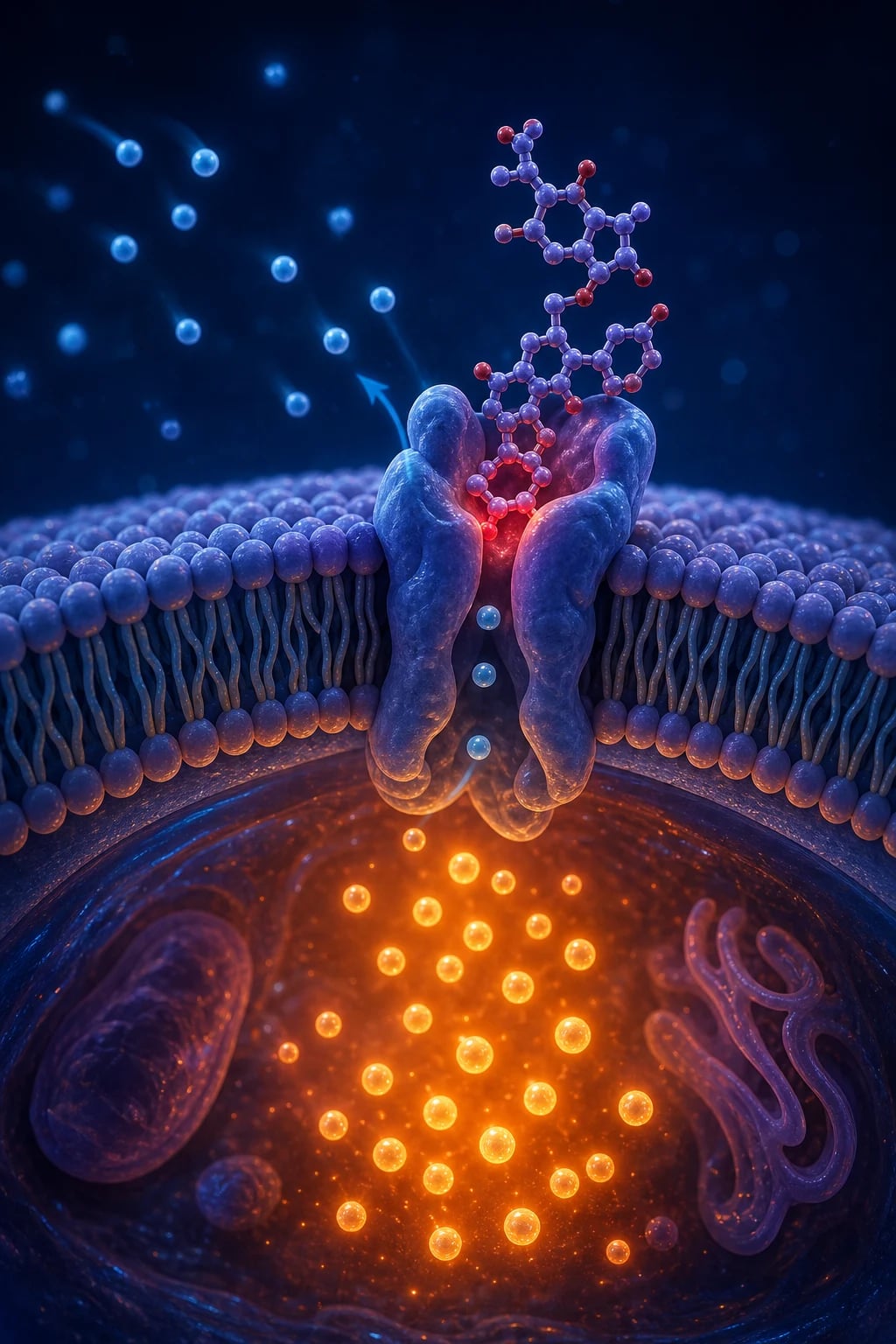
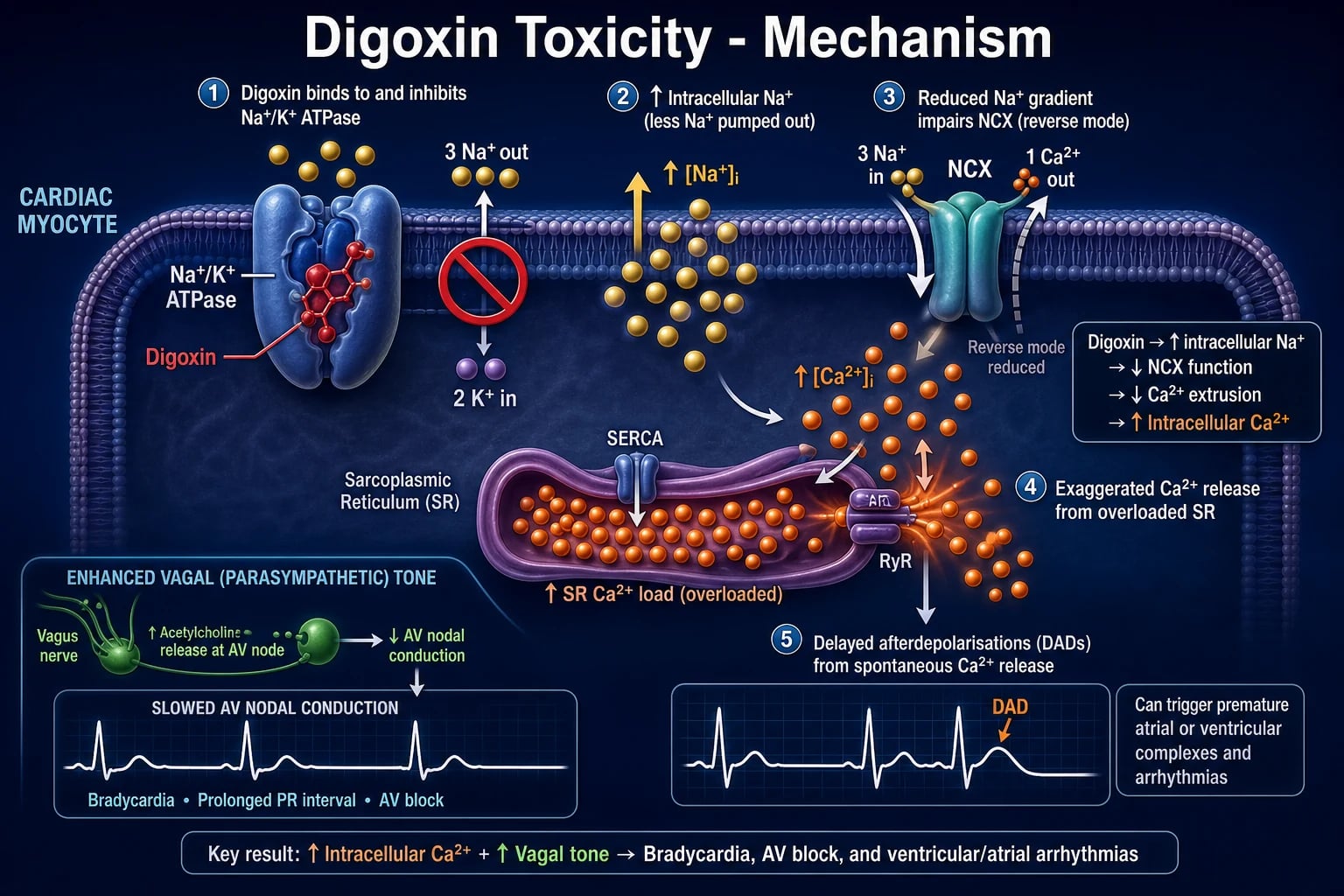
Digoxin toxicity — inhibition of Na-K ATPase by digoxin → intracellular Na+ accumulation + K+ loss → reversal of Na-Ca exchanger → intracellular Ca2+ accumulation → increased contractility BUT also automaticity → ARRHYTHMIA. Chronic toxicity (most common — from accumulation in elderly, renal failure, drug interactions) vs acute overdose (massive ingestion — suicidal). Clinical: GI (nausea/vomiting/anorexia — earliest), visual (yellow-green halos = XANTHOPSIA, blurred vision, photophobia), cardiac (ANY arrhythmia — but classic: ATRIAL TACHYCARDIA WITH AV BLOCK, bidirectional VT, bradycardia), CNS (confusion, weakness, fatigue). ECG: classic signs of digoxin effect (sagging ST depression, T wave inversion, shortened QT, U waves) — BUT toxicity causes ARRHYTHMIAS not just ECG changes. Diagnosis: serum digoxin level (2 ng/mL = toxic — BUT chronic toxicity can occur at 'therapeutic' levels — treat CLINICALLY). Hyperkalaemia (K+ 5.0) in ACUTE overdose = marker of severity (intracellular K+ leaks out from ATPase inhibition). Management: DIGOXIN-SPECIFIC ANTIBODY FRAGMENTS (DigiFab — 40 mg/vial — each vial binds 0.5 mg digoxin — calculate dose from serum level or amount ingested) for life-threatening arrhythmia, K+ 5.0 in acute overdose, severe symptoms. MAGNESIUM sulfate for arrhythmia control. Treat hyperkalaemia (insulin/dextrose — AVOID beta-agonists which may worsen arrhythmia). AVOID calcium gluconate (controversial — 'stone heart' from Ca+digoxin interaction — recent evidence suggests it may be safe, but many still avoid). Activated charcoal if acute ingestion <1h. Mortality: 5-10% (with Fab), 20-40% (without Fab in severe toxicity).
On this page & tools
Your progress
Saved locally on this device.
Target exams
Red flags
Overview
Chronic vs acute toxicity — the two patterns
Chronic vs acute digoxin toxicity
| Feature | Chronic toxicity (most common) | Acute overdose (suicidal) |
|---|---|---|
| Mechanism | Gradual accumulation from decreased clearance (renal failure, elderly, drug interactions) | Massive single ingestion |
| Onset | Days-weeks of progressive symptoms | Hours after ingestion |
| Potassium | Normal or LOW (chronic use + diuretics) | HIGH (K+ >5.0 = severe — from acute ATPase inhibition → intracellular K+ leaks out) |
| Digoxin level | May be 'therapeutic' (1-2 ng/mL) — toxicity occurs at normal levels in chronic setting | Markedly elevated (>10 ng/mL typically) |
| Clinical features | Insidious: fatigue, anorexia, nausea, visual disturbances, confusion, new arrhythmia | Acute: severe nausea/vomiting, bradycardia, hyperkalaemia, any arrhythmia |
| Fab dose | Lower dose (less total body digoxin load) — based on level | Higher dose (large ingestion) — based on amount ingested or level |
| Risk factors | Age >65, renal failure, hypokalaemia (diuretics), hypomagnesaemia, hypothyroidism, amiodarone/verapamil/clarithromycin (increase digoxin levels) | Suicidal intent, access to medication |
Management — DigiFab and supportive care
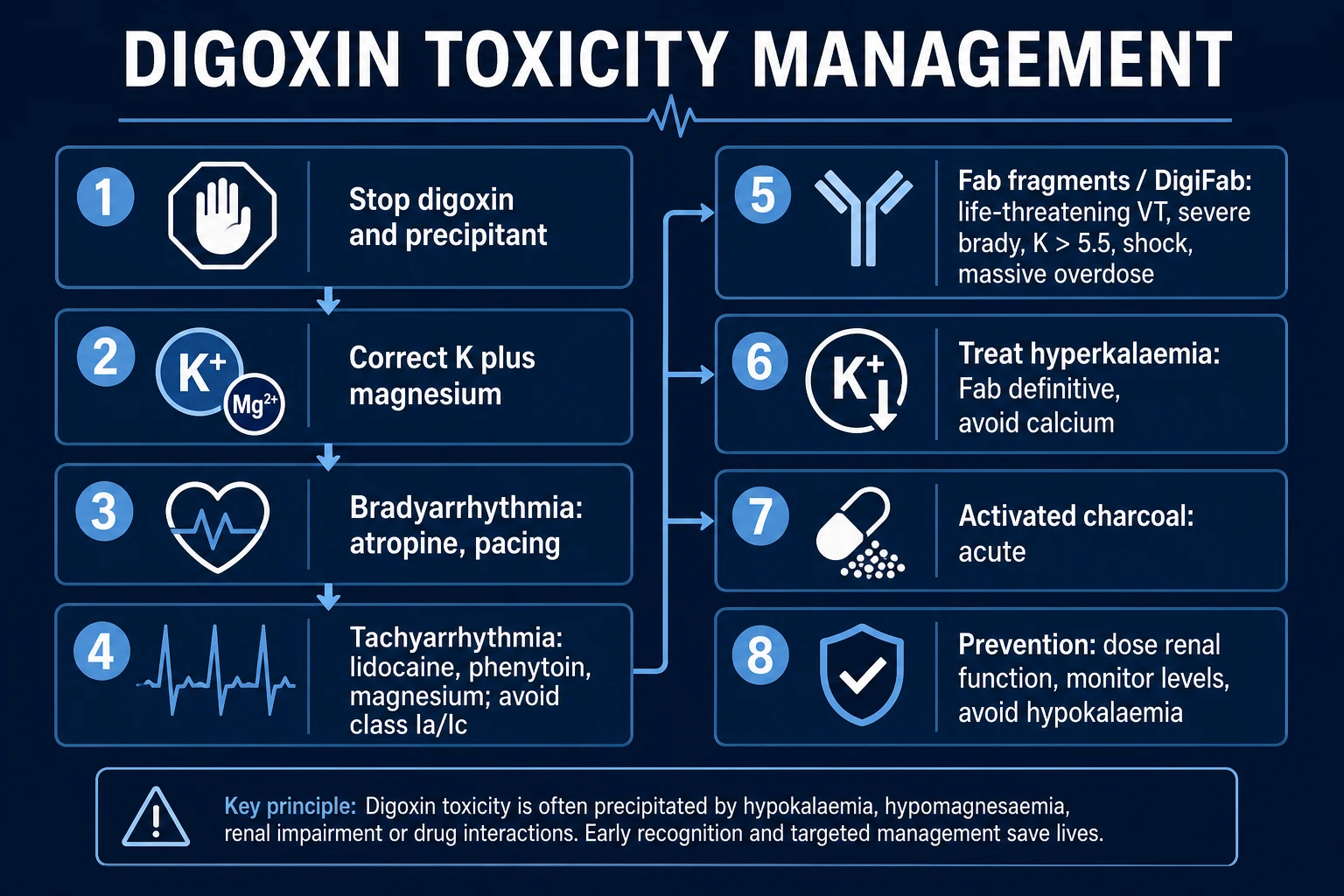
Digoxin toxicity management protocol
- RECOGNISE — any patient on digoxin with new GI symptoms + visual symptoms + arrhythmia = toxicity until proven otherwise. Check digoxin level + K+ + ECG. Chronic toxicity can occur at 'therapeutic' levels — treat CLINICALLY.
- STOP DIGOXIN and any interacting drugs (amiodarone, verapamil, clarithromycin, macrolides — which increase digoxin levels)
- ACTIVATED CHARCOAL (if acute ingestion <1h and airway protected) — 50 g PO/NG
- DigiFab (digoxin-specific antibody fragments) — for ANY of:
- Life-threatening arrhythmia (VT/VF, complete heart block, severe bradycardia unresponsive to atropine)
- K+ >5.0 mmol/L in ACUTE overdose (marker of severe acute toxicity)
- Hyperkalaemia refractory to medical therapy
- Cardiac arrest from digoxin toxicity
- Digoxin level >10 ng/mL (chronic) or >15 ng/mL (acute)
- Dose calculation: (a) Acute: number of vials = (serum digoxin ng/mL × weight kg) / 100. (b) If amount ingested known: vials = amount ingested (mg) × 2 (each vial binds 0.5 mg). (c) If unknown: give 10-20 vials empirically for acute overdose, 3-6 vials for chronic. (d) Each vial = 40 mg DigiFab
- Response: within 30-60 min — arrhythmia resolves, K+ falls (the Fab binds digoxin → the intracellular K+ shifts back → K+ normalises). Monitor: K+ (may DROP rapidly after Fab — give K+ replacement), ECG
- Note: after DigiFab, serum digoxin level RISES dramatically (the Fab-digoxin complex is measured by the assay) — do NOT recheck levels after Fab — the total level is meaningless — clinical improvement is the endpoint
- MAGNESIUM SULFATE 2-4 g IV — antiarrhythmic: Mg2+ reduces digoxin-induced automaticity by inhibiting Ca2+ channels → reduces afterdepolarisations → reduces arrhythmia. Safe, effective, first-line adjunct to Fab
- TREAT HYPERKALAEMIA (if acute overdose):
- Insulin 10 units + 50 mL 50% dextrose IV (shifts K+ intracellularly). May need repeat.
- Salbutamol 10-20 mg nebulised (beta-2 — shifts K+ intracellularly). CAUTION: beta-agonists may worsen digoxin-induced arrhythmia (increase automaticity) — use cautiously.
- AVOID calcium gluconate — controversial: historical concern about 'stone heart' (Ca2+ + digoxin → irreversible contraction → cardiac arrest). Recent evidence (Levine 2009) suggests calcium may be SAFE in digoxin toxicity — but the dogma persists and many intensivists still avoid it. Use insulin/dextrose + Fab as first-line for hyperkalaemia.
- Note: standard hyperkalaemia treatment (insulin/dextrose + salbutamol) will work PARTIALLY — the K+ will fall — but the BEST treatment for digoxin-induced hyperkalaemia is DigiFab (binds digoxin → reverses ATPase inhibition → K+ returns to cells → hyperkalaemia resolves)
- TREAT BRADYARRHYTHMIA:
- Atropine 0.5-1 mg IV for symptomatic bradycardia/AV block (may be ineffective in severe digoxin toxicity — the AV node is profoundly depressed)
- External/transvenous pacing if atropine ineffective
- DigiFab is the definitive treatment (reverses the AV nodal depression)
- TREAT VENTRICULAR ARRHYTHMIA:
- LIDOCAINE (class Ib — preferred — works on Na channels, does NOT affect AV node). 1-1.5 mg/kg IV bolus, then infusion 1-4 mg/min
- MAGNESIUM 2-4 g IV (antiarrhythmic — reduces afterdepolarisations)
- AVOID class Ia (quinidine, procainamide — worsen digoxin toxicity), class Ic (flecainide — proarrhythmic), class III (amiodarone/sotalol — worsen AV block)
- DC cardioversion: LAST RESORT (can trigger refractory VF in digoxin toxicity — use LOW energy if absolutely needed)
- CORRECT ELECTROLYTES:
- Hypokalaemia (K+ <4.0 — worsens digoxin toxicity — lower K+ increases digoxin binding to Na-K ATPase): give KCl IV cautiously (over-correction may cause arrhythmia)
- Hypomagnesaemia (Mg2+ <0.8): give MgSO4 10 mmol IV
- Do NOT give calcium (controversial)
- MONITORING: continuous ECG, K+ (q2-4h initially — K+ drops rapidly after DigiFab), digoxin level (BEFORE Fab — do NOT recheck after Fab), renal function, clinical response
Clinical pearls
Red flags
Prognosis
Digoxin toxicity outcomes
| Factor | Outcome | Notes |
|---|---|---|
| With DigiFab | 5-10% mortality | Fab revolutionised treatment — previously 20-40% mortality |
| Without Fab (severe toxicity) | 20-40% mortality | Arrhythmia is the #1 cause of death |
| Acute overdose (with Fab) | Good — full recovery | Fab binds digoxin → eliminates from body |
| Chronic toxicity | Worse (elderly, comorbid, renal failure) | Underlying conditions determine outcome |
Key trials and evidence
Chan 2018 — DigiFab for digoxin toxicity (PMID 30295715)
Source
Clinical Toxicology — systematic review of DigiFab use
Key finding
DigiFab is SAFE and EFFECTIVE — rapid resolution of arrhythmia + hyperkalaemia within 30-60 min
Key finding
Under-dosing is common — many patients receive fewer vials than calculated
Key finding
No serious adverse effects from DigiFab
Clinical bottom line
DigiFab is the definitive treatment for life-threatening digoxin toxicity — give EARLY and in adequate dose
Digoxin pharmacokinetics — exam-critical details
Digoxin pharmacokinetics — the narrow therapeutic index
| Parameter | Value | Clinical significance |
|---|---|---|
| Therapeutic range | 0.5-0.9 ng/mL (heart failure — modern target). OLD range 0.5-2.0 (no longer recommended — toxicity at upper end) | Modern Heart Failure guidelines (ESC 2021): target 0.5-0.9 for HFrEF rate control. Above 1.0 = risk of toxicity in elderly/renal impairment |
| Bioavailability | 60-80% (tablet). 100% (IV). 80% (elixir) | IV dose = 0.7 x oral dose for equivalent effect |
| Volume of distribution | 5-7 L/kg (LARGE — distributes widely into tissues, especially skeletal and cardiac muscle) | This is WHY serum level is a POOR indicator of total body load. The brain and heart have much higher levels than serum. Also WHY digoxin is NOT dialysable (too large Vd — most drug is in tissues, not blood) |
| Protein binding | 20-30% (LOW protein binding) | Low protein binding means MOST drug is FREE (active) — small changes in binding don't significantly alter free fraction |
| Half-life | 36-48 hours (normal renal function). 4.5-6 DAYS (anuric/ESRD) | LONG half-life → accumulation in renal failure is the #1 cause of chronic toxicity. In ESRD: t1/2 = 5+ days → level falls VERY slowly even with dialysis (dialysis doesn't remove digoxin — Vd too large) |
| Elimination | 70-80% renal (glomerular filtration + tubular secretion) — UNCHANGED by the kidney. 20-30% hepatic (biliary/fecal) | ANY decline in renal function → accumulation → toxicity. Aged 65 with GFR 30 → t1/2 may be 3-4 days → level rises progressively |
| Onset of action | Oral: 2-6h. IV: 5-30 min | IV preferred for rapid rate control in AF with RVR |
| Peak effect | Oral: 6-8h. IV: 1-4h | Level drawn at 6-8h post-oral dose (drawn too early = falsely high) |
DigiFab dose calculation — worked examples
Method 1: Known amount ingested (acute overdose) Each vial of DigiFab (40 mg) binds 0.5 mg digoxin. [1]
Example: Patient ingests 5 mg (50 tablets of 0.1mg). Vials needed = Total ingested (mg) × 2 = 5 × 2 = 10 vials [1]
Example: Patient ingests 25 tablets of 0.25mg = 6.25 mg. Vials = 6.25 × 2 = 12.5 → give 13 vials [1]
Method 2: Known serum concentration (steady state) Vials = (Serum digoxin ng/mL × Weight kg) / 100 [1]
Example: Level 8 ng/mL, weight 70 kg. Vials = (8 × 70) / 100 = 560/100 = 5.6 → give 6 vials [1]
Example: Level 15 ng/mL, weight 60 kg, chronic toxicity. Vials = (15 × 60) / 100 = 900/100 = 9 vials [1]
Method 3: Empiric dosing (unknown amount/level)
- Acute overdose: give 10-20 vials (large ingestion likely)
- Chronic toxicity: give 3-6 vials (lower total body load — therapeutic accumulation)
- Cardiac arrest from digoxin: give 10 vials immediately during CPR [1]
IMPORTANT: After DigiFab, serum TOTAL digoxin level SKYROCKETS (Fab-digoxin complex is measured by standard assays). DO NOT recheck level. Clinical improvement (arrhythmia resolution, K+ falling) is the endpoint. [1]
Specific arrhythmia management in digoxin toxicity
Arrhythmia-specific management in digoxin toxicity
| Arrhythmia | Mechanism | Drug of choice | AVOID |
|---|---|---|---|
| Ventricular tachycardia (monomorphic) | Delayed afterdepolarisations from Ca2+ overload → triggered activity | Lidocaine 1-1.5 mg/kg IV bolus then infusion 1-4 mg/min. OR magnesium 2-4g IV | Class Ia (quinidine, procainamide — worsens toxicity). Amiodarone (controversial — may worsen AV block) |
| Bidirectional VT | Alternating Purkinje foci (pathognomonic for digoxin) | DigiFab + lidocaine + magnesium | Same as above |
| Ventricular fibrillation | Severe myocardial Ca2+ overload | Defibrillate (LOW energy 100-200J biphasic — myocardium is irritable) + DigiFab | Repeated high-energy shocks (may worsen myocardial damage) |
| Bradycardia / AV block | Direct AV nodal suppression + enhanced vagal tone | DigiFab (definitive). Temporary: atropine 0.5-1mg IV (often ineffective — AV node profoundly depressed). External/transvenous pacing | Isoprenaline (may worsen ventricular ectopy) |
| Atrial tachycardia with AV block | Atrial automaticity increased (Ca2+ overload) BUT AV node depressed | DigiFab (definitive). AV block is protective (prevents rapid ventricular response) | Cardioversion (may trigger refractory VF). Verapamil (worsens AV block) |
| Paroxysmal atrial tachycardia (PAT) with block | Classic digoxin-toxic arrhythmia | DigiFab | All AV nodal blockers |
Drug interactions — expanded detail
Drugs that INCREASE digoxin levels — mechanisms
| Drug | Mechanism of interaction | Expected level change | Management |
|---|---|---|---|
| Amiodarone | Inhibits P-glycoprotein (multi-drug resistance transporter) → reduces digoxin efflux from renal tubular cells AND intestinal cells → reduced clearance AND reduced elimination | DOUBLES digoxin level (2x) | Reduce digoxin dose by 50% when starting amiodarone. Recheck level in 5-7 days |
| Verapamil / Diltiazem | Same P-glycoprotein inhibition as amiodarone | Increases by 50-75% | Reduce digoxin by 25-50% |
| Clarithromycin / Erythromycin | P-glycoprotein inhibition + kills gut bacteria that metabolise 10% of digoxin | Increases by 50-100% | Consider azithromycin instead (less P-glycoprotein interaction) or reduce digoxin |
| Cyclosporine / Tacrolimus | P-glycoprotein inhibition | Variable — can double level | Monitor closely in transplant patients on both drugs |
| Itraconazole / Ketoconazole | P-glycoprotein + CYP3A4 inhibition | Increases by 50% | Fluconazole has less interaction |
| Quinidine | Reduces renal clearance of digoxin + displaces from tissue binding sites | Increases by 100%+ | AVOID combination — or reduce digoxin by 50% |
| Spironolactone | Reduces tubular secretion of digoxin + cross-reacts with digoxin assay ( falsely elevates level) | Increases by 25-50% | Be aware of assay cross-reactivity |
| Thiazide / Loop diuretics | Hypokalaemia (K+ and digoxin compete for Na-K ATPase — low K+ → more digoxin binding → more toxicity). ALSO hypomagnesaemia potentiates digoxin | Indirect — potentiates toxicity at ANY level | Correct K+ to >4.0 and Mg2+ to >0.8 in all patients on digoxin + diuretics |
Detailed DigiFab administration — practical ICU protocol
DigiFab administration — the complete ICU protocol
- CONFIRM DIAGNOSIS: (a) Known digoxin ingestion/toxicity. (b) Life-threatening features: ANY arrhythmia (VT, VF, complete heart block, severe bradycardia unresponsive to atropine), K+ >5.0 in ACUTE overdose, cardiac arrest. (c) Severity: digoxin level >10 (acute) or >6 (chronic), OR unknown amount but life-threatening features
- CALCULATE DOSE: Method depends on available information:
- Known ingestion amount: Vials = Amount ingested (mg) x 2. Example: 25 x 0.25mg tabs = 6.25mg → 13 vials
- Known serum level: Vials = (Serum level ng/mL x Body weight kg) / 100. Example: Level 8, weight 70kg → (8 x 70)/100 = 5.6 → 6 vials
- Unknown: Acute overdose → 10-20 vials empirically. Chronic toxicity → 3-6 vials. Cardiac arrest → 10 vials immediately during CPR
- ADMINISTRATION: Each vial = 40 mg DigiFab in 40 mL sterile water (reconstitute by gentle swirling — NOT vigorous shaking — to avoid foaming). Give IV over 30 min (can give faster — over 5 min — in cardiac arrest). No test dose required (unlike equine antitoxins — DigiFab is HUMAN-derived, very low allergic risk)
- RESPONSE TIME: Arrhythmia resolves and K+ falls within 30-60 min of first dose. If NO response after 60 min → give MORE DigiFab (under-dosing is common — total body digoxin load may be higher than estimated)
- POST-FAB MONITORING: (a) ECG continuous — arrhythmia should resolve. (b) K+ every 2h — may DROP RAPIDLY (Fab reverses ATPase inhibition → K+ shifts intracellularly → hypokalaemia → replace KCl if K+ <3.5). (c) Heart rate — may rise from bradycardia to baseline. (d) BP — may normalise from hypotension. (e) DO NOT recheck digoxin level (total level SKYROCKETS — Fab-digoxin complex measured by assay — meaningless). Clinical improvement is the endpoint
- POTASSIUM MANAGEMENT POST-FAB: The MOST COMMON post-Fab problem. K+ shifts intracellularly (Fab reverses ATPase inhibition → Na+/K+ ATPase reactivates → K+ pumped intracellularly). K+ may drop from 5.5 to 2.5 within 2 hours. MANAGEMENT: check K+ q2h for first 6h post-Fab. Replace KCl 10-20 mmol/hour IV if K+ <3.5. Avoid over-correction (K+ >5.5)
- DURATION OF EFFECT: DigiFab binds digoxin irreversibly. The Fab-digoxin complex is cleared renally (glomerular filtration) — in normal renal function, cleared in 24-48h. In renal FAILURE (common in digoxin toxicity), the complex may persist for 5-7+ days. But symptoms do NOT recur (the bound digoxin is inactive). No need for repeated DigiFab doses
Serum digoxin level interpretation — the practical guide
Digoxin level interpretation by clinical context
| Context | Level (ng/mL) | Interpretation | Management |
|---|---|---|---|
| Therapeutic monitoring (AF rate control) | 0.5-0.9 | Therapeutic (modern target) | Continue current dose |
| 1.0-2.0 | Borderline — toxicity possible in elderly/renal failure | Reduce dose by 25% if symptomatic. Check K+/Mg2+/renal function | |
| >2.0 | TOXIC — especially in elderly, renal failure, hypokalaemia | STOP digoxin. Check for toxicity symptoms. Reduce dose when restarting | |
| Acute overdose | >10 | SEVERE — give Fab (calculate from level x weight) | DigiFab immediately |
| 5-10 | MODERATE — give Fab if K+ >5 OR arrhythmia OR cardiac arrest | DigiFab if life-threatening features | |
| 2-5 | MILD — monitor, activated charcoal, treat symptoms | Observe 12-24h, recheck level | |
| Chronic toxicity | >2.0 + symptoms | TOXIC — despite 'therapeutic' range in some patients | DigiFab 3-6 vials. STOP digoxin + interacting drugs |
| Post-Fab | VERY HIGH (50-200+) | MEANINGLESS — Fab-digoxin complex measured by assay | DO NOT recheck. Clinical response is the endpoint |
| End-stage renal disease | 0.5-0.9 | Therapeutic target SAME as normal renal function (but dose is MUCH lower — 0.0625mg alternate days) | Check level monthly. Any decline in residual renal function → reduce dose further |
Calcium in digoxin toxicity — the controversy
The traditional teaching is that calcium is CONTRAINDICATED in digoxin toxicity because of the 'STONE HEART' concern (animal studies in the 1930s showed that calcium + digoxin caused irreversible myocardial contraction → cardiac arrest). However: [1]
- The animal studies used MASSIVE calcium doses (10-20x clinical doses) in NON-toxic animals. Clinical doses of calcium (10 mmol calcium gluconate) in digoxin-toxic patients have NOT been shown to cause stone heart
- Levine 2009 (Clin Toxicol): systematic review — NO cases of stone heart from calcium in digoxin-toxic humans in the modern era. The concern is based on outdated animal data
- CURRENT PRACTICE: Most toxicologists still AVOID calcium for hyperkalaemia in digoxin toxicity (the dogma persists despite lack of evidence). Use INSULIN/DEXTROSE as first-line for hyperkalaemia instead of calcium
- HOWEVER: If the patient has HYPERKALAEMIA-INDUCED ECG CHANGES (peaked T waves, QRS widening) AND the hyperkalaemia is life-threatening AND insulin/dextrose is insufficient — calcium gluconate 10 mmol IV is PROBABLY SAFE (based on Levine 2009 review). Give slowly (over 5 min) with ECG monitoring
- THE EXAM ANSWER: In CICM/FFICM exams — the 'correct' answer is STILL 'avoid calcium in digoxin toxicity — use insulin/dextrose instead.' The evidence may be changing but the exam hasn't caught up yet [1]
Examiner densify anchors
SAQ — Chronic digoxin user with vomiting and slow irregular pulse
12 minutes · 10 marks
An 82-year-old woman on digoxin and amiodarone presents with vomiting, visual changes, K 6.1 mmol/L, creatinine doubled from baseline, and runs of bidirectional VT. Digoxin level is markedly elevated. BP 88/50.
Practical ICU checklist (densify)
Bedside densify checklist
- Confirm diagnosis thresholds with numbers the examiner expects.
- Name the first therapy and the absolute contraindication.
- State monitoring frequency and escalation triggers.
- Cite one landmark paper/guideline and one limitation of the evidence.
- Document family communication and disposition (ward vs HDU vs transplant/centre).
Practical ICU checklist (densify)
Bedside densify checklist
- Confirm diagnosis thresholds with numbers the examiner expects.
- Name the first therapy and the absolute contraindication.
- State monitoring frequency and escalation triggers.
- Cite one landmark paper/guideline and one limitation of the evidence.
- Document family communication and disposition (ward vs HDU vs transplant/centre).
References
- [1]Chan BS, et al. Food impaction: etiology over 35 years and association with eosinophilic esophagitis Dis Esophagus, 2019.PMID 30295715
- [2]Roberts DM, et al. Identification of G-quadruplex structures that possess transcriptional regulating functions in the Dele and Cdc6 CpG islands BMC Mol Biol, 2017.PMID 28655335
- [3]Yang EH, et al. Ultrafast and low temperature synthesis of highly crystalline and patternable few-layers tungsten diselenide by laser irradiation assisted selenization process ACS Nano, 2015.PMID 25768931
- [4]Antman EM, et al. Host-guest chemistry of dendrimer-drug complexes. 4. An in-depth look into the binding/encapsulation of guanosine monophosphate by dendrimers J Phys Chem B, 2010.PMID 20446745
- [5]Kanji S, et al. Associations between conventional cardiovascular risk factors and risk of peripheral artery disease in men JAMA, 2012.PMID 23093164
- [6]Hunter R, et al. COX-2-derived PGE(2) triggers hyperplastic renin expression and hyperreninemia in aldosterone synthase-deficient mice Pflugers Arch, 2018.PMID 29455241