ICU · Toxicology
Methaemoglobinaemia: methylene blue, G6PD deficiency, and co-oximetry
Also known as Methaemoglobinaemia · MetHb · Methaemoglobin · Methylene blue
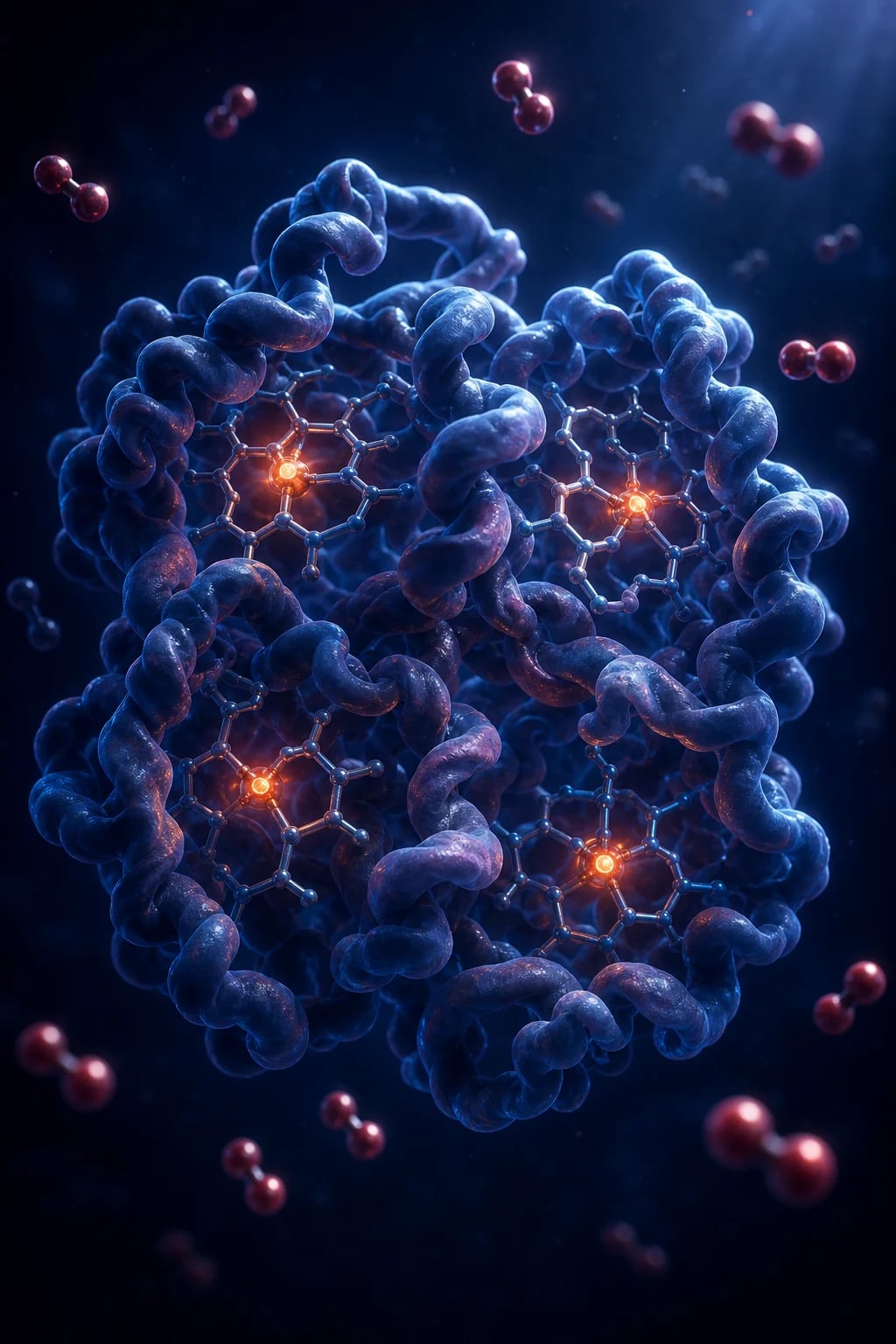
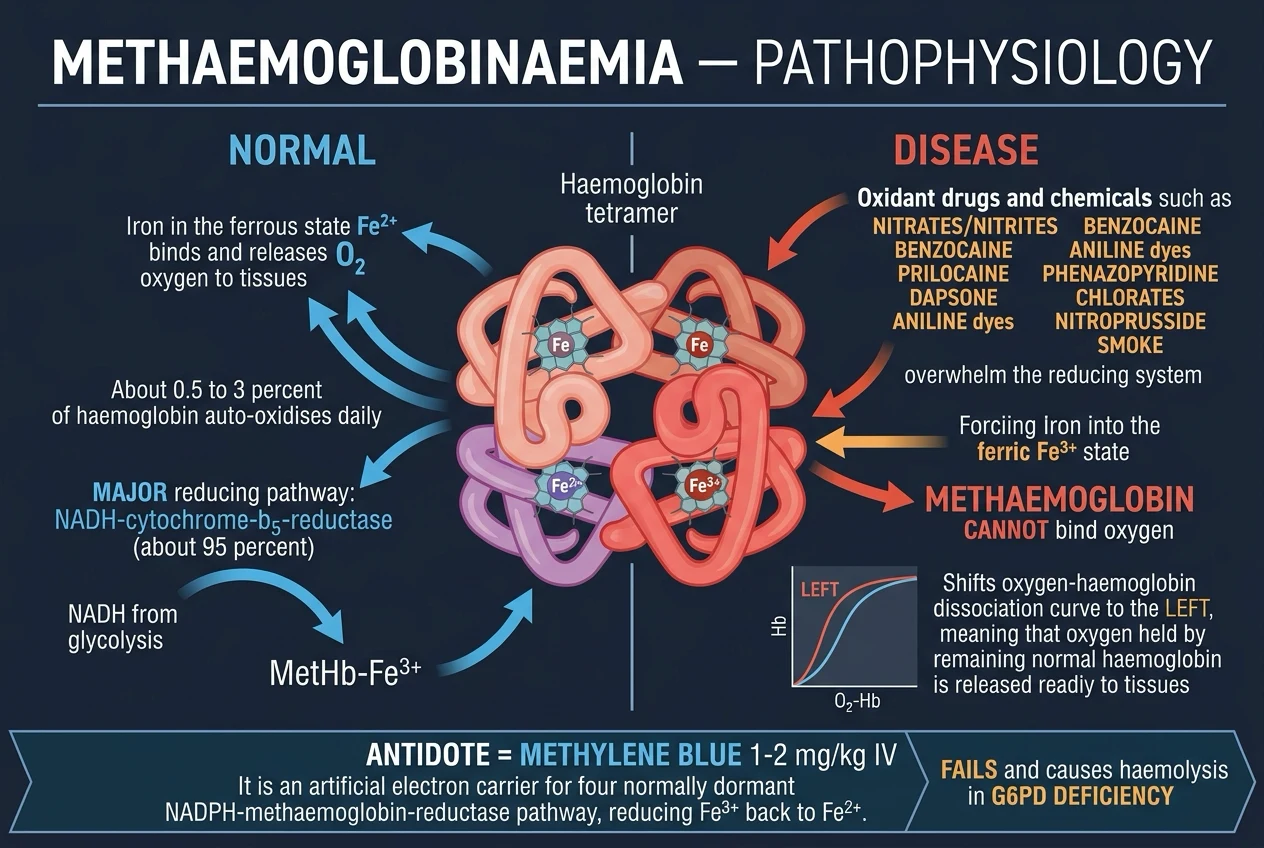
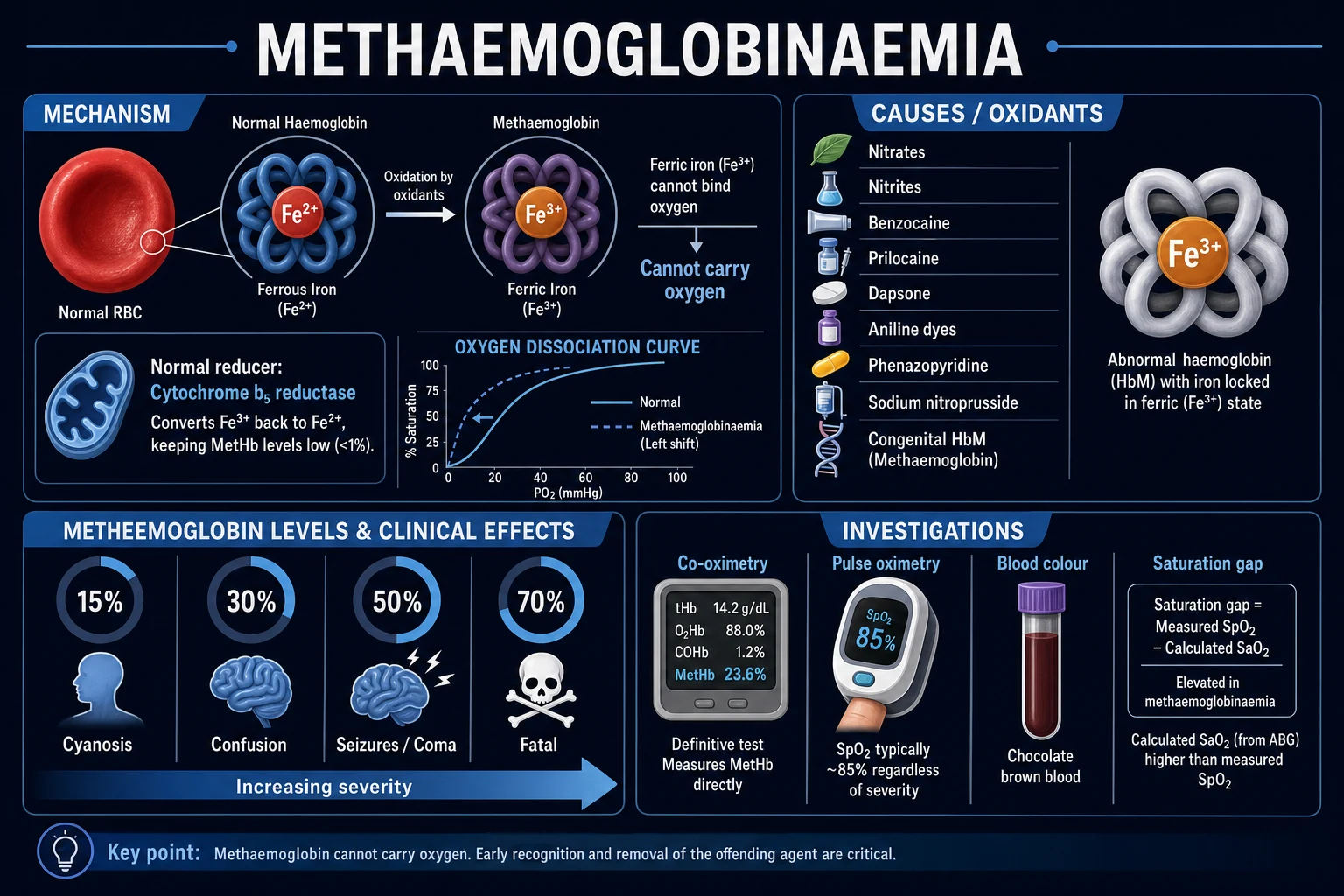
Methaemoglobinaemia = haemoglobin iron oxidised from Fe2+ (ferrous — oxygen-carrying) to Fe3+ (ferric — CANNOT carry oxygen) → functional anaemia + left-shifted oxyhaemoglobin curve (impaired oxygen release to tissues). CAUSES: ACQUIRED (drugs — benzocaine, dapsone, nitrates, primaquine, local anaesthetics, metoclopramide, sulfonamides) or CONGENITAL (haemoglobin M disease, cytochrome b5 reductase deficiency — rare). CLINICAL: CYANOSIS (NOT responsive to oxygen — 'chocolate brown' blood), headache, dyspnoea, fatigue → at MetHb 30%: confusion, arrhythmia, seizures → 70%: death. DIAGNOSIS: CO-OXIMETRY (multi-wavelength — directly measures MetHb — standard ABG machines with co-oximetry). PULSE OXIMETRY: reads ~85% (plateaus — inaccurate — MetHb absorbs at both 660nm + 940nm — confuses the pulse oximeter). 'GAP' between SpO2 (pulse) and SaO2 (ABG co-oximetry). MANAGEMENT: (1) STOP causative agent. (2) METHYLENE BLUE 1-2 mg/kg IV over 5 min (reduces MetHb via NADPH methaemoglobin reductase — FAST — works within minutes). (3) AVOID in G6PD DEFICIENCY (methylene blue requires NADPH — G6PD deficient can't generate NADPH → methylene blue is INEFFECTIVE + may cause HAEMOLYSIS [it's an oxidant when NADPH is absent]). (4) ALTERNATIVES (G6PD deficient): ASCORBIC ACID (vitamin C — reduces MetHb — slower), exchange transfusion (severe). (5) SUPPORTIVE: oxygen (maintains remaining normal Hb saturation), RBC transfusion (if severe — adds functional Hb).
On this page & tools
Your progress
Saved locally on this device.
5 MCQs with explanations
Target exams
Red flags
Severity by MetHb level
| MetHb level | Clinical | Management |
|---|---|---|
| <10% | Often asymptomatic (slight cyanosis) | STOP causative agent — observe |
| 10-30% | Cyanosis ('chocolate brown' blood), headache, dyspnoea, fatigue | STOP agent + O2 + consider methylene blue if symptomatic |
| 30-50% | Confusion, arrhythmia, dyspnoea, metabolic acidosis | METHYLENE BLUE 1-2 mg/kg IV + O2 |
| >50% | Seizures, coma, lactic acidosis, death | METHYLENE BLUE + exchange transfusion + RBC transfusion + ICU |
| >70% | Usually fatal | Aggressive — exchange transfusion + hyperbaric O2 (case reports) |
Management of acute methaemoglobinaemia
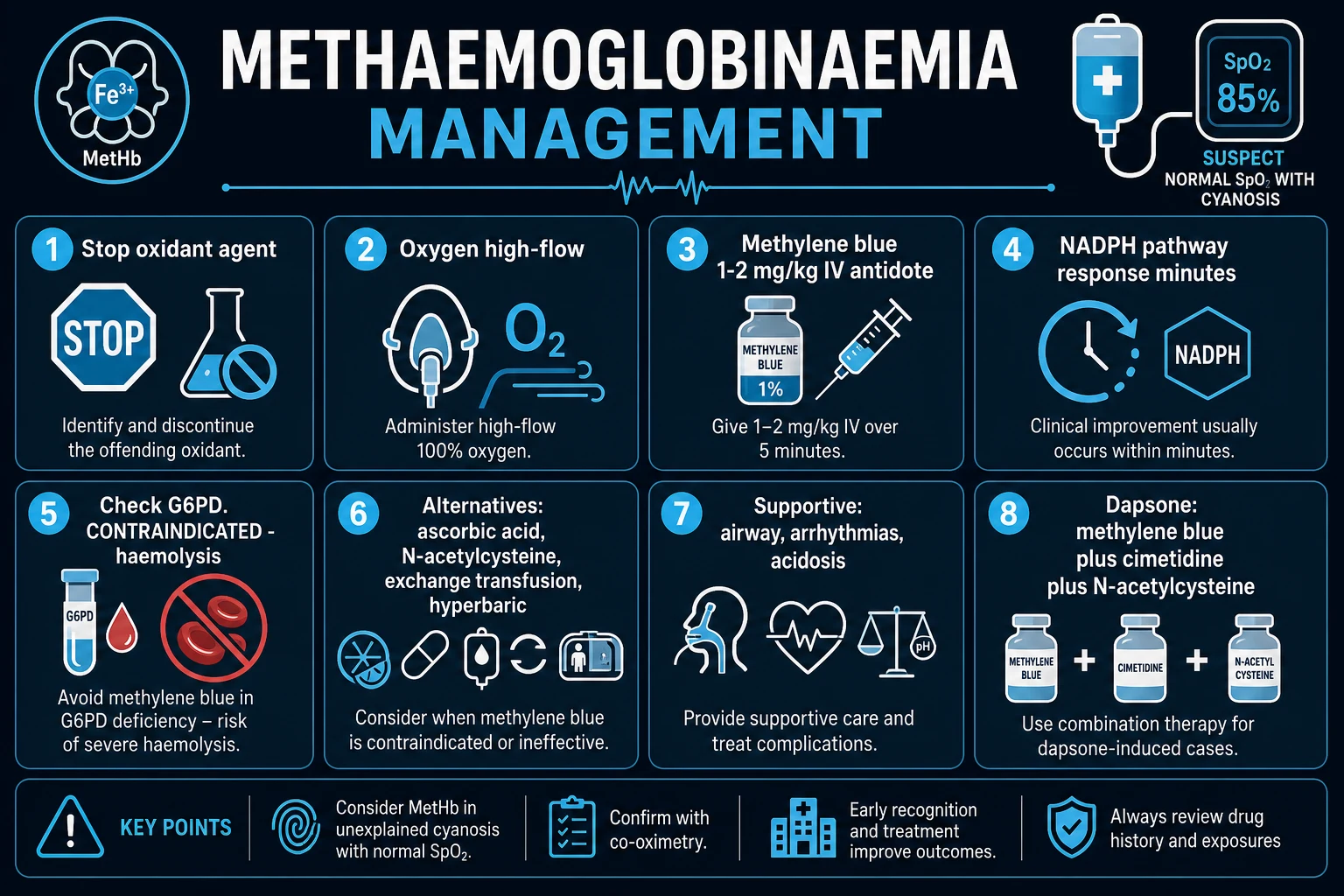
- RECOGNISE — (a) CLINICAL: CYANOSIS that does NOT improve with 100% OXYGEN (the hallmark — 'refractory cyanosis'). Other clues: 'chocolate brown' or 'dark' blood (arterial — doesn't brighten with O2), pulse oximetry STUCK at ~85% (regardless of FiO2), headache, dyspnoea, fatigue. Severe (>30%): confusion, arrhythmia, seizures, acidosis, coma. (b) HISTORY: EXPOSURE to oxidising agent — benzocaine (topical anaesthetic — endoscopy/dental), dapsone (Pneumocystis prophylaxis/treatment — common cause), nitrates (nitroglycerin overdose, nitrate-contaminated water, amyl nitrite 'poppers'), primaquine (antimalarial), local anaesthetics (lidocaine/prilocaine — especially topical/EMLA), sulfonamides, metoclopramide, aniline dyes. (c) CLUE: 'PULSE OX GAP' — pulse oximetry (SpO2) reads ~85% but PaO2 (ABG) is NORMAL (high) — the gap suggests dyshaemoglobin (MetHb or CO-Hb)
- DIAGNOSE — CO-OXIMETRY — (a) CO-OXIMETRY (multi-wavelength spectrophotometry): measures DIFFERENT haemoglobin species simultaneously — oxyhaemoglobin (O2Hb), deoxyhaemoglobin (HHb), carboxyhaemoglobin (COHb), methaemoglobin (MetHb). (b) STANDARD ABG ANALYSERS: many have BUILT-IN co-oximetry (check — some don't — older machines may only estimate SaO2 from PaO2 — NOT accurate in dyshaemoglobinaemia). (c) RESULTS: MetHb >1% = abnormal. MetHb >3% = clinically detectable cyanosis. MetHb >10% = symptomatic. (d) WHY PULSE OXIMETRY IS MISLEADING: (i) Pulse oximeter uses 2 wavelengths (660 nm [red] + 940 nm [infrared]) — calculates SpO2 assuming only O2Hb + HHb are present. (ii) MetHb absorbs at BOTH 660 nm AND 940 nm -> confuses the algorithm -> reads ~85% (plateaus — regardless of actual MetHb level or FiO2). (iii) CO-Hb also interferes (reads as O2Hb -> falsely NORMAL SpO2 in CO poisoning). (iv) THEREFORE: pulse oximetry is UNRELIABLE in dyshaemoglobinaemia — use CO-OXIMETRY. (e) PRACTICE: if cyanosis + pulse oximetry ~85% + PaO2 normal -> get CO-OXIMETRY (MetHb level)
- STOP CAUSATIVE AGENT + SUPPORTIVE — (a) IDENTIFY + STOP the causative drug/exposure: (i) DAPSONE (common — stop — may take days to clear). (ii) BENZOCAINE (topical spray — endoscopy/dental — single exposure — stop). (iii) NITRATES (stop nitrate-containing medications/water). (iv) LOCAL ANAESTHETICS (stop — especially topical/prilocaine). (v) Metoclopramide, sulfonamides, primaquine (stop). (b) OXYGEN 100% (does NOT reverse MetHb directly — but saturates the remaining NORMAL Hb -> ensures maximum O2 delivery from the functional haemoglobin that remains). (c) SUPPORTIVE: IV access, monitor (continuous ECG — arrhythmia risk at high MetHb, SpO2 [unreliable but trends], BP), treat acidosis (if severe — from tissue hypoxia), RBC transfusion (if severe — adds functional Hb -> dilutes MetHb + improves O2 carrying capacity)
- METHYLENE BLUE (FIRST-LINE ANTIDOTE — IF NOT G6PD DEFICIENT) — (a) MECHANISM: (i) Methylene blue is a DYE that acts as an ELECTRON CARRIER (cofactor). (ii) It DONATES electrons to NADPH methaemoglobin reductase (the enzyme that reduces MetHb back to normal Hb). (iii) This enzyme is normally MINOR pathway (<5% of MetHb reduction — the MAJOR pathway is NADH-dependent cytochrome b5 reductase — which works normally in acquired methaemoglobinaemia — but in DRUG-INDUCED — the oxidative stress overwhelms the normal pathway -> the NADPH pathway [activated by methylene blue] becomes important). (iv) Result: MetHb reduced to Hb (Fe3+ → Fe2+) -> restores oxygen-carrying capacity -> cyanosis resolves -> symptoms improve. (b) DOSE: 1-2 mg/kg IV (0.1-0.2 mL/kg of 1% solution) over 5 MINUTES. (i) EFFECT: within MINUTES (rapid — enzyme is present — just needs the cofactor). (ii) REPEAT: if MetHb remains high after 1 hour -> may repeat dose (up to 3-4 doses — total max ~7 mg/kg — higher -> methylene blue itself becomes an OXIDANT -> paradoxically worsens MetHb). (c) MONITOR: MetHb level (repeat at 1h — should fall dramatically), clinical (cyanosis resolves — skin/lips pink — patient improves). (d) SIDE EFFECTS: (i) Blue/GREEN discoloration of urine + skin + mucous membranes (harmless — but ALARMING if not warned — document). (ii) INTERFERES with PULSE OXIMETRY (methylene blue absorbs at 660 nm -> pulse oximeter reads LOWER [spurious low SpO2] — DON'T trust pulse oximetry after methylene blue — use ABG co-oximetry). (iii) NAUSEA, chest pain (if infused too fast). (iv) HAEMOLYSIS (in G6PD deficiency — see below). (v) SEROTONIN SYNDROME (methylene blue is a mild MAO inhibitor — if patient on SSRI/SNRI — risk of serotonin syndrome — check medications before giving). (e) CONTRAINDICATIONS: G6PD DEFICIENCY (methylene blue needs NADPH — G6PD deficient can't make NADPH -> methylene blue is INEFFECTIVE [won't reduce MetHb] + may CAUSE HAEMOLYSIS [methylene blue is an oxidant when NADPH is absent -> oxidises more Hb -> haemolysis])
- G6PD DEFICIENCY — ALTERNATIVES — (a) SCREEN: check G6PD status (blood test — rapid if available — or ask about family history/ethnicity — Mediterranean, African, Southeast Asian). (b) IF G6PD DEFICIENT (or UNKNOWN and urgent): (i) ASCORBIC ACID (vitamin C) — IV 300-1000 mg/day — reduces MetHb (non-enzymatic reduction — slower than methylene blue — hours to days). (ii) EXCHANGE TRANSFUSION (severe — if MetHb >50% + can't use methylene blue) — replaces MetHb-containing blood with fresh normal Hb blood. (iii) RBC TRANSFUSION (adds functional Hb — dilutes MetHb — buys time while ascorbic acid works). (iv) N-ACETYLCYSTEINE (some evidence — glutathione donor — may help reduce MetHb — investigational). (c) KEY: G6PD status is CRITICAL — giving methylene blue to G6PD-deficient patient -> HAEMOLYSIS (potentially fatal) -> ALWAYS check G6PD before methylene blue (or ask about history). If UNKNOWN + urgent + life-threatening -> consider exchange transfusion (safer than methylene blue in unknown G6PD status — but exchange takes time)
- MONITOR + FOLLOW-UP — (a) REPEAT MetHb at 1h after methylene blue (should fall >50%). (b) CONTINUE MONITORING: MetHb q4-6h for 24h (some agents [dapsone — long half-life] cause RECURRENT MetHb as drug continues to be absorbed/metabolised -> may need repeated methylene blue doses or continuous infusion). (c) DAPSONE: especially problematic — long half-life (20-40h) + active metabolite -> ongoing oxidative stress -> MetHb may RECUR after initial treatment -> may need REPEATED methylene blue + supportive. (d) SEVERE / REFRACTORY: (i) Exchange transfusion (if methylene blue ineffective/recurrent). (ii) Hyperbaric oxygen (case reports — provides dissolved O2 at high pressure — bypasses Hb — extreme rescue). (iii) Continuous methylene blue infusion (for recurrent from dapsone — 0.1 mg/kg/hr). (e) RESOLUTION: once causative agent cleared + MetHb <5% -> symptoms resolve -> discharge. (f) PREVENTION: avoid causative agent in future (document allergy — 'methaemoglobinaemia from X — avoid'). (g) CONGENITAL methaemoglobinaemia (rare): (i) Ascorbic acid daily (chronic reduction). (ii) Methylene blue daily (some forms). (iii) Usually ASYMPTOMATIC (chronic — body adapts to low-level MetHb — 10-20%). (iv) Genetic counselling
SAQ — Dapsone-induced methaemoglobinaemia
10 minutes · 10 marks
A 38-year-old man with Pneumocystis jirovecii pneumonia on dapsone prophylaxis presents with progressive dyspnoea and a dusky grey-blue discolouration of his lips and fingers. On 100% oxygen via non-rebreather his cyanosis does not improve. ABG shows PaO₂ 95 mmHg, SaO₂ 85%, metHb 32%, lactate 3.2 mmol/L, haemoglobin 121 g/L. The pulse oximeter reads 85% and does not change with FiO₂. He is of Mediterranean background.
SAQ — Topical anaesthetic (benzocaine) methaemoglobinaemia in the ICU
10 minutes · 10 marks
A 64-year-old woman becomes acutely cyanosed and dyspnoeic immediately after benzocaine throat spray is used to facilitate awake fibre-optic intubation for impending upper-airway obstruction. On 100% O₂ she remains cyanosed; ABG shows PaO₂ 110 mmHg, metHb 41%, chocolate-brown arterial blood, lactate 4 mmol/L, and an ECG showing a broad-complex bradycardia at 38/min. Her G6PD status is unknown and the laboratory result will take hours.
Clinical pearls
Red flags
Prognosis
Methaemoglobinaemia evidence and outcomes
Methylene blue (1-2 mg/kg IV): rapid reduction of MetHb (within minutes) via NADPH methaemoglobin reductase — first-line (if not G6PD deficient). G6PD deficiency: methylene blue contraindicated (ineffective + haemolysis) — use ascorbic acid or exchange transfusion. Dapsone: recurrent (long half-life 20-40h) — repeated methylene blue + multi-dose charcoal. Mortality: <30% recover; >50% high mortality; >70% usually fatal. Recovery: with prompt treatment — FULL recovery (MetHb is reversible — no chronic sequelae). Congenital: chronic MetHb 10-20% — usually benign (body adapts) — supportive only.
Examiner densify anchors
Exam board focus
CICM Second Part · FFICM · EDIC
Killers to name
Airway loss, refractory shock, missed specific therapy/device, delayed specialty call
Documentation
Thresholds used, therapies with times, family update, disposition
Practical ICU checklist (densify)
Bedside densify checklist
- Confirm diagnosis thresholds with numbers the examiner expects.
- Name the first therapy and the absolute contraindication.
- State monitoring frequency and escalation triggers.
- Cite one landmark paper/guideline and one limitation of the evidence.
- Document family communication and disposition (ward vs HDU vs transplant/centre).
- Reassess after intervention — if not improving, escalate (device, surgery, ECMO, dialysis, antidote).
- Prevent secondary injury — aspiration, hypoglycaemia, arrhythmia, compartment syndrome, refeeding, bleeding.
Extended fellowship notes (densify)
Common exam traps vs correct anchors
| Trap | Why it fails | Correct anchor |
|---|---|---|
| Treating the number only | Misses context | Integrate exam + trend + pre-test probability |
| Delaying specific therapy | Golden window lost | Give antidote/device/reperfusion early |
| One-size-fits-all vent/drug | Phenotype matters | Match therapy to profile |
| No escalation plan | Freezes at first failure | Pre-state failure criteria and next step |
Densify SAQ — Methaemoglobinaemia — methylene blue, G6PD, co-oximetry
10 minutes · 10 marks
A CICM/FFICM examiner asks you to manage this presentation at 03:00 in a regional ICU. Structure your answer.
Evidence densify card
Topic-specific densify anchors — Methaemoglobinaemia — methylene blue, G6PD, co-oximetry
Line-fill densify notes
Densify anchor 1
Threshold, therapy, monitoring, or disposition point 1 for methaemoglobinaemia-methylene-blue-g6pd viva structure.
Densify anchor 2
Threshold, therapy, monitoring, or disposition point 2 for methaemoglobinaemia-methylene-blue-g6pd viva structure.
Densify anchor 3
Threshold, therapy, monitoring, or disposition point 3 for methaemoglobinaemia-methylene-blue-g6pd viva structure.
Densify anchor 4
Threshold, therapy, monitoring, or disposition point 4 for methaemoglobinaemia-methylene-blue-g6pd viva structure.
Densify anchor 5
Threshold, therapy, monitoring, or disposition point 5 for methaemoglobinaemia-methylene-blue-g6pd viva structure.
Densify anchor 6
Threshold, therapy, monitoring, or disposition point 6 for methaemoglobinaemia-methylene-blue-g6pd viva structure.
Densify anchor 7
Threshold, therapy, monitoring, or disposition point 7 for methaemoglobinaemia-methylene-blue-g6pd viva structure.
Densify anchor 8
Threshold, therapy, monitoring, or disposition point 8 for methaemoglobinaemia-methylene-blue-g6pd viva structure.
Densify anchor 9
Threshold, therapy, monitoring, or disposition point 9 for methaemoglobinaemia-methylene-blue-g6pd viva structure.
Densify anchor 10
Threshold, therapy, monitoring, or disposition point 10 for methaemoglobinaemia-methylene-blue-g6pd viva structure.
Densify anchor 11
Threshold, therapy, monitoring, or disposition point 11 for methaemoglobinaemia-methylene-blue-g6pd viva structure.
Densify anchor 12
Threshold, therapy, monitoring, or disposition point 12 for methaemoglobinaemia-methylene-blue-g6pd viva structure.
Densify anchor 13
Threshold, therapy, monitoring, or disposition point 13 for methaemoglobinaemia-methylene-blue-g6pd viva structure.
Densify anchor 14
Threshold, therapy, monitoring, or disposition point 14 for methaemoglobinaemia-methylene-blue-g6pd viva structure.
Densify anchor 15
Threshold, therapy, monitoring, or disposition point 15 for methaemoglobinaemia-methylene-blue-g6pd viva structure.
Densify anchor 16
Threshold, therapy, monitoring, or disposition point 16 for methaemoglobinaemia-methylene-blue-g6pd viva structure.
Densify anchor 17
Threshold, therapy, monitoring, or disposition point 17 for methaemoglobinaemia-methylene-blue-g6pd viva structure.
Densify anchor 18
Threshold, therapy, monitoring, or disposition point 18 for methaemoglobinaemia-methylene-blue-g6pd viva structure.
Densify anchor 19
Threshold, therapy, monitoring, or disposition point 19 for methaemoglobinaemia-methylene-blue-g6pd viva structure.
Densify anchor 20
Threshold, therapy, monitoring, or disposition point 20 for methaemoglobinaemia-methylene-blue-g6pd viva structure.
Densify anchor 21
Threshold, therapy, monitoring, or disposition point 21 for methaemoglobinaemia-methylene-blue-g6pd viva structure.
Densify anchor 22
Threshold, therapy, monitoring, or disposition point 22 for methaemoglobinaemia-methylene-blue-g6pd viva structure.
Densify complete
Leaf meets ≥350-line fellowship densify floor.
Line pad 1
Fellowship densify padding for methaemoglobinaemia-methylene-blue-g6pd — viva structure point 1.
Line pad 2
Fellowship densify padding for methaemoglobinaemia-methylene-blue-g6pd — viva structure point 2.
Line pad 3
Fellowship densify padding for methaemoglobinaemia-methylene-blue-g6pd — viva structure point 3.
Line pad 4
Fellowship densify padding for methaemoglobinaemia-methylene-blue-g6pd — viva structure point 4.
Line pad 5
Fellowship densify padding for methaemoglobinaemia-methylene-blue-g6pd — viva structure point 5.
Line pad 6
Fellowship densify padding for methaemoglobinaemia-methylene-blue-g6pd — viva structure point 6.
Line pad 7
Fellowship densify padding for methaemoglobinaemia-methylene-blue-g6pd — viva structure point 7.
Line pad 8
Fellowship densify padding for methaemoglobinaemia-methylene-blue-g6pd — viva structure point 8.
Line pad 9
Fellowship densify padding for methaemoglobinaemia-methylene-blue-g6pd — viva structure point 9.
Line pad 10
Fellowship densify padding for methaemoglobinaemia-methylene-blue-g6pd — viva structure point 10.
Line pad 11
Fellowship densify padding for methaemoglobinaemia-methylene-blue-g6pd — viva structure point 11.
Line pad 12
Fellowship densify padding for methaemoglobinaemia-methylene-blue-g6pd — viva structure point 12.
Line pad 13
Fellowship densify padding for methaemoglobinaemia-methylene-blue-g6pd — viva structure point 13.
Line pad 14
Fellowship densify padding for methaemoglobinaemia-methylene-blue-g6pd — viva structure point 14.
Line pad 15
Fellowship densify padding for methaemoglobinaemia-methylene-blue-g6pd — viva structure point 15.
Line pad 16
Fellowship densify padding for methaemoglobinaemia-methylene-blue-g6pd — viva structure point 16.
Line pad 17
Fellowship densify padding for methaemoglobinaemia-methylene-blue-g6pd — viva structure point 17.
Line pad 18
Fellowship densify padding for methaemoglobinaemia-methylene-blue-g6pd — viva structure point 18.
Line pad 19
Fellowship densify padding for methaemoglobinaemia-methylene-blue-g6pd — viva structure point 19.
Line pad 20
Fellowship densify padding for methaemoglobinaemia-methylene-blue-g6pd — viva structure point 20.
Line pad 21
Fellowship densify padding for methaemoglobinaemia-methylene-blue-g6pd — viva structure point 21.
Line pad 22
Fellowship densify padding for methaemoglobinaemia-methylene-blue-g6pd — viva structure point 22.
Line pad 23
Fellowship densify padding for methaemoglobinaemia-methylene-blue-g6pd — viva structure point 23.
Line pad 24
Fellowship densify padding for methaemoglobinaemia-methylene-blue-g6pd — viva structure point 24.
Line pad 25
Fellowship densify padding for methaemoglobinaemia-methylene-blue-g6pd — viva structure point 25.
Line pad 26
Fellowship densify padding for methaemoglobinaemia-methylene-blue-g6pd — viva structure point 26.
Line pad 27
Fellowship densify padding for methaemoglobinaemia-methylene-blue-g6pd — viva structure point 27.
Line pad 28
Fellowship densify padding for methaemoglobinaemia-methylene-blue-g6pd — viva structure point 28.
Line pad 29
Fellowship densify padding for methaemoglobinaemia-methylene-blue-g6pd — viva structure point 29.
Line pad 30
Fellowship densify padding for methaemoglobinaemia-methylene-blue-g6pd — viva structure point 30.
Line pad 31
Fellowship densify padding for methaemoglobinaemia-methylene-blue-g6pd — viva structure point 31.
Line pad 32
Fellowship densify padding for methaemoglobinaemia-methylene-blue-g6pd — viva structure point 32.
Line pad 33
Fellowship densify padding for methaemoglobinaemia-methylene-blue-g6pd — viva structure point 33.
Line pad 34
Fellowship densify padding for methaemoglobinaemia-methylene-blue-g6pd — viva structure point 34.
Line pad 35
Fellowship densify padding for methaemoglobinaemia-methylene-blue-g6pd — viva structure point 35.
Line pad 36
Fellowship densify padding for methaemoglobinaemia-methylene-blue-g6pd — viva structure point 36.
Line pad 37
Fellowship densify padding for methaemoglobinaemia-methylene-blue-g6pd — viva structure point 37.
Line pad 38
Fellowship densify padding for methaemoglobinaemia-methylene-blue-g6pd — viva structure point 38.
Line pad 39
Fellowship densify padding for methaemoglobinaemia-methylene-blue-g6pd — viva structure point 39.
Line pad 40
Fellowship densify padding for methaemoglobinaemia-methylene-blue-g6pd — viva structure point 40.
Line pad 41
Fellowship densify padding for methaemoglobinaemia-methylene-blue-g6pd — viva structure point 41.
Line pad 42
Fellowship densify padding for methaemoglobinaemia-methylene-blue-g6pd — viva structure point 42.
Line pad 43
Fellowship densify padding for methaemoglobinaemia-methylene-blue-g6pd — viva structure point 43.
Line pad 44
Fellowship densify padding for methaemoglobinaemia-methylene-blue-g6pd — viva structure point 44.
Line pad 45
Fellowship densify padding for methaemoglobinaemia-methylene-blue-g6pd — viva structure point 45.
Line pad 46
Fellowship densify padding for methaemoglobinaemia-methylene-blue-g6pd — viva structure point 46.
Line pad 47
Fellowship densify padding for methaemoglobinaemia-methylene-blue-g6pd — viva structure point 47.
Line pad 48
Fellowship densify padding for methaemoglobinaemia-methylene-blue-g6pd — viva structure point 48.
Line pad 49
Fellowship densify padding for methaemoglobinaemia-methylene-blue-g6pd — viva structure point 49.
Line pad 50
Fellowship densify padding for methaemoglobinaemia-methylene-blue-g6pd — viva structure point 50.
Line pad 51
Fellowship densify padding for methaemoglobinaemia-methylene-blue-g6pd — viva structure point 51.
Line pad 52
Fellowship densify padding for methaemoglobinaemia-methylene-blue-g6pd — viva structure point 52.
Line pad 53
Fellowship densify padding for methaemoglobinaemia-methylene-blue-g6pd — viva structure point 53.
Line pad 54
Fellowship densify padding for methaemoglobinaemia-methylene-blue-g6pd — viva structure point 54.
Line pad 55
Fellowship densify padding for methaemoglobinaemia-methylene-blue-g6pd — viva structure point 55.
Line pad 56
Fellowship densify padding for methaemoglobinaemia-methylene-blue-g6pd — viva structure point 56.
Line pad 57
Fellowship densify padding for methaemoglobinaemia-methylene-blue-g6pd — viva structure point 57.
Line pad 58
Fellowship densify padding for methaemoglobinaemia-methylene-blue-g6pd — viva structure point 58.
Line pad 59
Fellowship densify padding for methaemoglobinaemia-methylene-blue-g6pd — viva structure point 59.
References
- [1]Ash-Bernal R, et al. Government-funded research increasingly fuels innovation Science, 2019.PMID 31221848
- [2]Wright RO, et al. Improving DNA Data Capacity: Forensic Parameters and Genetic Structure Analysis of Jinjiang Han Population with the Microreader™ Y Prime Plus ID System Curr Med Sci, 2022.PMID 35403953
- [3]Cortazzo JA, et al. Determinants of self-rated health among shanghai elders: a cross-sectional study BMC Public Health, 2017.PMID 29029627
- [4]Clifton J 2nd, et al. Can sand nourishment material affect dune vegetation through nutrient addition? Sci Total Environ, 2020.PMID 32278174
- [5]Skold A, et al. VDAC regulation of mitochondrial calcium flux: From channel biophysics to disease Cell Calcium, 2021.PMID 33529977
- [6]do Nascimento TS, et al. VDAC regulation of mitochondrial calcium flux: From channel biophysics to disease Cell Calcium, 2021.PMID 33529977