ICU · toxicology
Acute Organophosphate and Nerve Agent Poisoning
Also known as Organophosphate poisoning · OP poisoning · Nerve agent poisoning · Cholinergic crisis · Sarin poisoning · VX poisoning · Pesticide poisoning · Acetylcholinesterase inhibitor poisoning · SLUDGE syndrome · DUMBELS syndrome
Organophosphate (OP) and nerve agent poisoning — inhibition of acetylcholinesterase (AChE) → acetylcholine accumulation → overstimulation of muscarinic receptors (SLUDGE: salivation, lacrimation, urination, defecation, GI distress, emesis — PLUS miosis, bradycardia, bronchorrhoea, bronchospasm), nicotinic receptors (fasciculations, muscle weakness, paralysis, mydriasis, tachycardia), and CNS (confusion, seizures, coma). OPs: pesticides (chlorpyrifos, dichlorvos, malathion, parathion), nerve agents (sarin, soman, tabun, VX, novichok). Diagnosis: CLINICAL (history of exposure + cholinergic toxidrome) — confirm with RBC AChE activity (reduced) and plasma butyrylcholinesterase (reduced). Management: (1) DECONTAMINATION (remove clothing, wash skin with soap and water — STAFF PPE is critical to prevent secondary contamination), (2) ATROPINE (muscarinic antagonist — titrate to ENDPOINT: dried secretions, HR 80, SBP 80 — NOT to pupil size — give 1.2-6 mg IV, double every 5 min until endpoint — may need massive doses 100-1000+ mg total), (3) PRALIDOXIME (2-PAM — reactivates AChE — 30 mg/kg IV over 15-30 min, then 8 mg/kg/hr infusion — MUST be given BEFORE 'aging' of the enzyme-OP complex — dimethyl OPs age within 3-5 minutes, diethyl within 3-5 hours), (4) BENZODIAZEPINES (diazepam 10 mg IV — for seizures and neuroprotection — given PROPHYLACTICALLY in nerve agent exposure), (5) SUPPORTIVE: intubation (non-depolarising NMB — NOT succinylcholine — which is metabolised by AChE → prolonged paralysis), ventilation, treat arrhythmia. Complications: intermediate syndrome (24-96h post-exposure — proximal muscle weakness + cranial nerve palsies + respiratory failure — from prolonged AChE inhibition), OPIDN (2-3 weeks post-exposure — distal sensorimotor neuropathy — from neurotoxic esterase inhibition — not responsive to atropine/pralidoxime). Mortality 10-40% (higher in resource-limited settings; nerve agents higher mortality).
On this page & tools
Your progress
Saved locally on this device.
Target exams
Red flags
Overview
OP poisoning is one of the MOST COMMON causes of deliberate self-harm death worldwide (especially in rural Asia — pesticide availability) and a recognised terrorist/chemical warfare threat (sarin in Tokyo subway 1995, novichok in Salisbury 2018). The intensivist must recognise the cholinergic toxidrome rapidly — delay in atropine and pralidoxime increases mortality. The unique features of OP poisoning compared to other toxidromes: (a) the REQUIREMENT for staff PPE (secondary contamination is a real hazard), (b) the need for MASSIVE atropine doses (orders of magnitude beyond standard ACLS doses), (c) the time-critical window for pralidoxime (before enzyme 'aging'), (d) the intermediate syndrome and OPIDN as delayed complications.[1][4]
Pathophysiology — the enzyme and the 'aging'
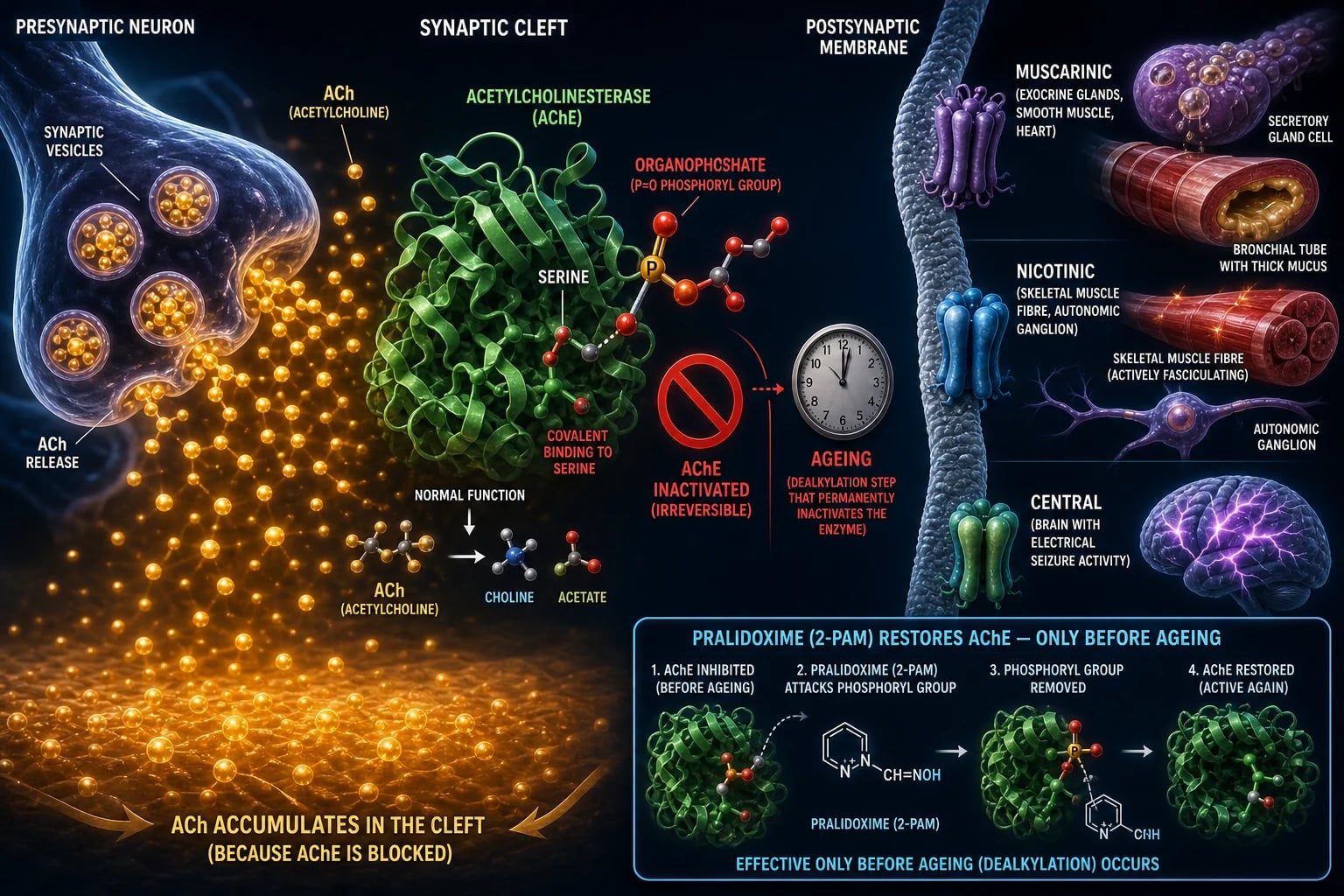
OPs inhibit acetylcholinesterase (AChE) by phosphorylating the serine hydroxyl group at the enzyme's active site → the enzyme cannot hydrolyse acetylcholine → acetylcholine accumulates at all cholinergic synapses (muscarinic, nicotinic, CNS) → continuous stimulation of cholinergic receptors → initial overstimulation (fasciculations, secretions) followed by desensitisation (weakness, paralysis).[1][6]
The 'aging' reaction — the critical concept for pralidoxime timing:
- After the OP binds to AChE, one of the alkyl groups on the phosphorus atom gradually detaches (dealkylation) → the OP-AChE bond becomes IRREVERSIBLE → the enzyme is permanently destroyed
- Dimethyl OPs (dichlorvos, malathion, fenitrothion): aging occurs within 3-5 minutes — pralidoxime has almost NO window to work
- Diethyl OPs (parathion, chlorpyrifos, diazinon): aging occurs within 3-5 hours (or longer) — pralidoxime has a wider window
- Nerve agents: soman ages in 2-6 minutes (fastest — pralidoxime almost useless if delayed); sarin ages in 3-5 hours; tabun ages in 13-14 hours; VX ages very slowly (>48 hours)
- Once aging has occurred → pralidoxime CANNOT reactivate the enzyme → the only source of new AChE is de novo synthesis (takes weeks) → prolonged cholinergic symptoms [1]
Organophosphates vs nerve agents — key differences
| Feature | OP pesticides | Nerve agents |
|---|---|---|
| Examples | Chlorpyrifos, dichlorvos, malathion, parathion, diazinon | Sarin (GB), soman (GD), tabun (GA), VX, novichok |
| Potency | Lower (LD50 in grams) | MUCH higher (LD50 in milligrams) |
| Volatility | Variable | Sarin: volatile (inhalation hazard — disperses quickly). VX: oily, persistent (skin absorption — lasts days on surfaces) |
| Route of exposure | Ingestion (self-harm), dermal (occupational) | Inhalation (sarin — vapour), dermal (VX — liquid) |
| Aging time | 3-5 min (dimethyl) to 3-5 h (diethyl) | Soman: 2-6 min (fastest). Sarin: 3-5 h. VX: >48 h |
| Mass casualty potential | Individual (self-harm) | HIGH — terrorism (Tokyo sarin 1995 — 5,000+ casualties) |
| Mortality | 10-40% | Higher (potency + mass exposure) |
Clinical presentation — the three-receptor triad
Cholinergic toxidrome — muscarinic, nicotinic, and CNS effects
| Receptor | Location | Clinical effects | Mnemonic |
|---|---|---|---|
| MUSCARINIC (parasympathetic postganglionic) | Exocrine glands, smooth muscle, heart | SLUDGE/DUMBELS: Salivation, Lacrimation, Urination, Defecation, GI distress/cramps, Emesis + Miosis (pinpoint pupils), Bradycardia, Bronchorrhoea (copious airway secretions), Bronchospasm, Sweating, Hypotension | DUMBELS: Diarrhoea, Urination, Miosis, Bradycardia, Emesis, Lacrimation, Salivation/Sweating |
| NICOTINIC (sympathetic ganglia + NMJ) | Autonomic ganglia, skeletal muscle NMJ, adrenal medulla | Muscle: initial fasciculations (twitching) → then weakness → flaccid paralysis (desensitisation blockade). Autonomic ganglia: initial tachycardia, mydriasis, hypertension (sympathetic ganglia stimulation) → then variable. Adrenal medulla: catecholamine surge | MTWtHF: Mydriasis, Tachycardia, Weakness, fasciculations, Hypertension, Flaccid paralysis |
| CNS | Brain, spinal cord | Confusion, anxiety, ataxia, tremor, slurred speech, seizures (generalised — from cholinergic CNS overstimulation), coma, respiratory centre depression | — |
Management protocol
OP poisoning management — the first 6 hours
-
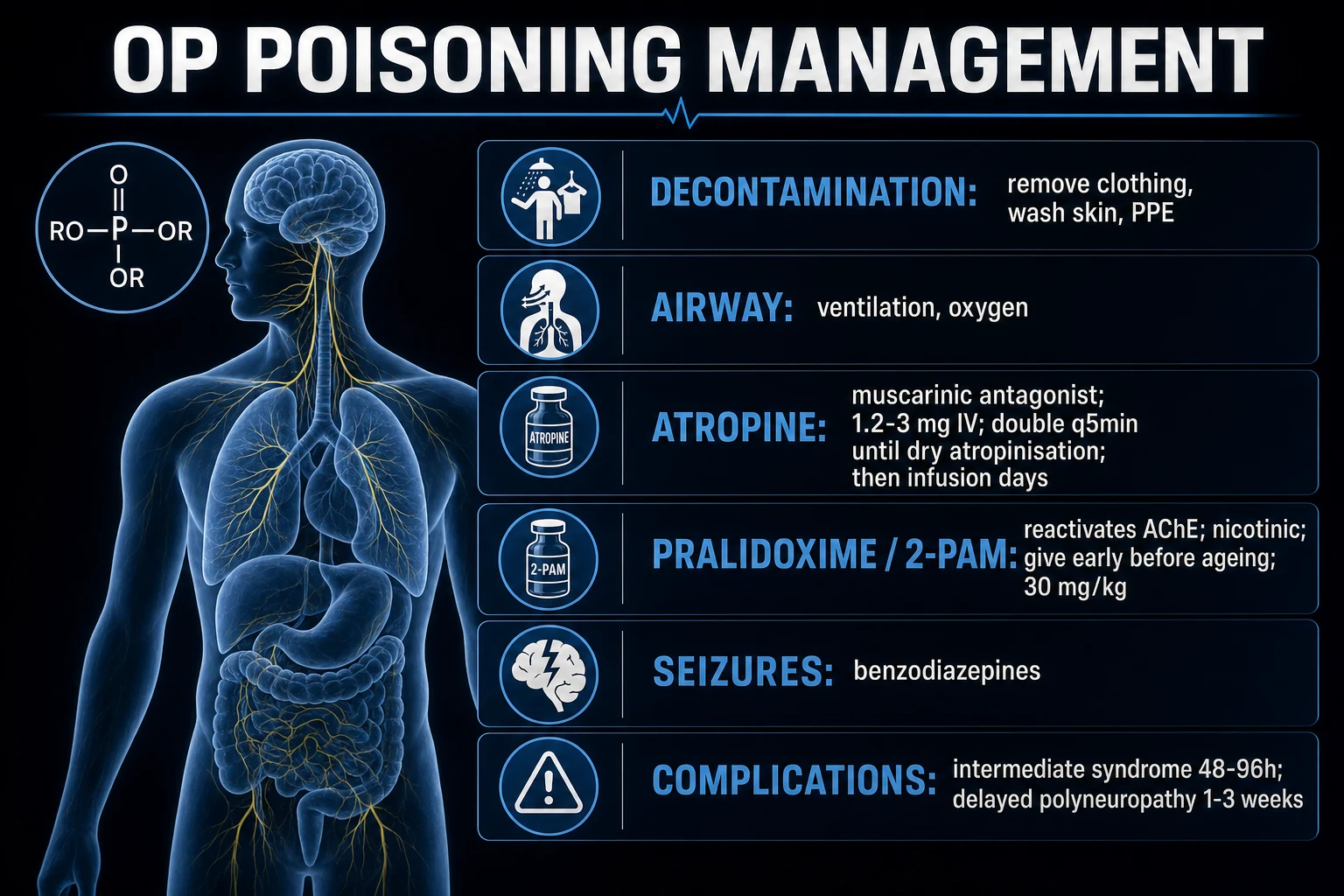
STAFF PROTECTION (FIRST PRIORITY):
- Full PPE (chemical-resistant suit, double gloves, boots, respirator with organic vapour cartridge or SCBA) for ALL staff in contact with patient
- The patient's clothing, bodily fluids (vomit, urine, faeces), and skin are CONTAMINATED — they will poison the staff
- Secondary contamination is a well-documented hazard — healthcare workers have died from OP absorbed through their skin while treating contaminated patients
- Designate a 'contaminated zone' (decontamination area) and 'clean zone' (ICU/ED) [1]
-
DECONTAMINATION:
- Remove ALL clothing (double-bag as hazardous waste — clothing retains 80-90% of contaminant)
- Wash skin and hair with SOAP AND WATER (alkaline soap hydrolyses OP — water alone may spread OP). Wash copiously
- For INGESTION: activated charcoal 50-100 g via NG (IF airway protected — these patients often vomit and aspirate). Gastric lavage if within 1h of ingestion AND airway protected
- For EYE exposure: irrigate with saline for 15-30 minutes
- Continue decontamination throughout treatment — OP continues to absorb from skin/GI for hours [1]
-
AIRWAY + VENTILATION:
- Intubate early (copious secretions + bronchospasm + depressed consciousness + respiratory muscle weakness)
- RSI with ETOMIDATE or KETAMINE + ROCURONIUM (1.2 mg/kg)
- NEVER SUCCINYLCHOLINE — metabolised by plasma cholinesterase (pseudocholinesterase) which is INHIBITED by OP → succinylcholine is not metabolised → prolonged paralysis lasting hours
- Suction frequently (copious secretions — bronchorrhoea)
- Treat bronchospasm with bronchodilators (salbutamol — BUT note: salbutamol is a beta-2 agonist and will cause tachycardia — this is acceptable in OP poisoning — the muscarinic bradycardia is worse) [1]
-
ATROPINE — the first-line antidote (muscarinic antagonist):
- Initial dose: 1.2-3 mg IV (double the dose every 5 minutes until atropinisation endpoint)
- Endpoint (NOT a fixed dose): (a) Dry mouth and skin (secretions resolved). (b) CLEAR chest on auscultation (no crackles/wheeze — bronchorrhoea resolved). (c) HR >80 bpm. (d) SBP >80 mmHg. (e) Pupils may remain miotic — do NOT use pupil size as endpoint
- Massive doses may be needed: severe OP poisoning can require 100-2000+ mg total atropine (hundreds of vials — pharmacy must be alerted EARLY to prepare a large supply)
- Infusion: once atropinised, start atropine infusion (10-20% of total loading dose per hour — titrate to maintain dry secretions + HR >80)
- Monitor: continuous HR, BP, SpO2, chest auscultation (for recurrent bronchorrhoea), skin moisture
- Atropine does NOT reverse: nicotinic effects (muscle weakness, paralysis) — need pralidoxime for that. CNS effects (confusion, seizures) — need benzodiazepines for that [1]
-
PRALIDOXIME (2-PAM) — AChE reactivator:
- Dose: 30 mg/kg IV over 15-30 minutes (max 2 g), then infusion 8 mg/kg/hr for 24-48h (or until symptom-free)
- Mechanism: displaces the OP from the AChE active site → reactivates the enzyme → restores acetylcholine hydrolysis → reverses BOTH nicotinic AND muscarinic effects
- TIMING IS CRITICAL: must be given BEFORE the OP-AChE complex AGES (becomes irreversible). Dimethyl OPs: 3-5 min window. Diethyl OPs: 3-5h window. Nerve agents: 2 min (soman) to >48h (VX)
- GIVE PRALIDOXIME EARLY AND EMPIRICALLY — do not wait for AChE levels or specific OP identification. If OP poisoning is suspected → give pralidoxime immediately alongside atropine
- Newer oximes: obidoxime (Europe), HI-6 (military — for nerve agents — faster reactivation of soman-inhibited AChE)
- Side effects: hypertension, tachycardia, laryngospasm, muscle weakness (paradoxical — from oxime AChE inhibition at high doses) [1]
-
BENZODIAZEPINES:
- Diazepam 10 mg IV (or midazolam 5-10 mg IV) for seizures
- Also given PROPHYLACTICALLY in nerve agent exposure (military autoinjectors contain diazepam alongside atropine + pralidoxime) — diazepam reduces seizure-induced brain injury and improves survival [1]
-
SUPPORTIVE CARE:
- Continuous cardiac monitoring (arrhythmia from OP + electrolyte derangement)
- Electrolytes (OP causes vomiting/diarrhoea → hypokalaemia, hyponatraemia, dehydration)
- Treat hypoglycaemia (OP can cause — from pancreatic cholinergic stimulation → insulin release)
- Temperature control (excess atropine → hyperthermia — "atropine fever")
- DVT prophylaxis (immobility from paralysis)
- ICU admission for ALL symptomatic OP poisoning (minimum 48-72h observation for intermediate syndrome) [1]
-
DIAGNOSTIC CONFIRMATION:
- RBC AChE activity (reduced — reflects TRUE AChE inhibition at synapses — gold standard but slow turnaround)
- Plasma butyrylcholinesterase (pseudocholinesterase — reduced — faster turnaround but less specific — also reduced by liver disease, pregnancy, genetic deficiency)
- These confirm exposure but treatment is CLINICAL — do not wait for results
Delayed complications — intermediate syndrome and OPIDN
Delayed complications of OP poisoning
| Complication | Timing | Mechanism | Clinical features | Management |
|---|---|---|---|---|
| Intermediate syndrome | 24-96h post-exposure (after acute cholinergic crisis resolves) | Prolonged AChE inhibition → prolonged receptor desensitisation → weakness of proximal muscles + cranial nerves + respiratory muscles | Weakness of neck flexors, proximal limbs, cranial nerves (ptosis, diplopia, dysphagia), respiratory muscle weakness → ventilatory failure. NO muscarinic signs (secretions, miosis resolved) — this is NICOTINIC-only (muscle weakness) | Prolonged mechanical ventilation (days-weeks). Continue pralidoxime (may help if some enzyme not yet aged). Atropine usually NOT needed (muscarinic signs resolved). Physiotherapy. Recovery usually complete but slow |
| OPIDN (organophosphate-induced delayed neuropathy) | 2-3 weeks post-exposure | OP inhibits NEUROTOXIC ESTERASE (NTE — a different enzyme from AChE) → axonal degeneration of long peripheral nerves (NOT cholinergic — this is a separate toxic effect) | Distal symmetrical sensorimotor neuropathy (stocking-glove pattern): numbness, paraesthesia, weakness of distal limbs (foot drop, wrist drop). Spasticity may develop. NO cholinergic signs. Occurs with SPECIFIC OPs only (triothocresyl phosphate, mipafox, leptophos — NOT all OPs cause OPIDN) | NO specific treatment. Physiotherapy, orthotics. Recovery variable — may be incomplete or permanent. NOT responsive to atropine or pralidoxime (different mechanism) |
| Recurrent cholinergic symptoms | Hours-days after initial recovery | Continued absorption from GI/skin/fat stores OR redistribution from fat → renewed AChE inhibition | Return of SLUDGE symptoms, miosis, bradycardia, bronchorrhoea — after initial improvement | Increase atropine infusion. Repeat pralidoxime. Search for continued absorption source (clothing, skin, GI — re-decontaminate). ICU monitoring for minimum 48-72h |
| Cognitive/psychiatric sequelae | Weeks-months post-exposure | Chronic cholinergic dysregulation + neurotoxicity | Memory impairment, depression, anxiety, fatigue | Supportive. Neuropsychological rehabilitation. Usually resolves over months |
Nerve agents — chemical warfare and terrorism
Nerve agents are military-grade organophosphates engineered for maximum lethality. They were developed in the 20th century (tabun GA 1936, sarin GB 1938, soman GD 1944, VX 1952) and have been used in war (Iran-Iraq war 1980s — mustard/sarin at Halabja 1988), terrorism (Tokyo subway 1995), and assassination (Salisbury novichok 2018 — Sergei Skripal; Kuala Lumpur 2017 — Kim Jong-nam, VX). The intensivist must know them because: (a) the clinical picture is the SAME cholinergic toxidrome as OP pesticide poisoning, (b) the window for pralidoxime is SHORTER (especially soman — 2-6 min aging), (c) mass casualty logistics dominate the early response, and (d) staff PPE and decontamination are even more critical than for pesticides.[4][8]
Nerve agents — agent-specific properties
| Agent | Code | Class | State / dominant route | Aging time | LD50 (dermal) | Notable features |
|---|---|---|---|---|---|---|
| Tabun | GA | G-series | Vapour/liquid — inhalation + dermal | 13-14 h | ~14 mg/kg | First nerve agent synthesised (Germany, 1936). Cyanide-containing. Slow aging → pralidoxime effective if given within hours |
| Sarin | GB | G-series | Volatile vapour — inhalation dominant | 3-5 h | ~24 mg/kg | Tokyo subway 1995. Highly volatile → disperses quickly but high immediate vapour hazard. Fast onset (minutes) |
| Soman | GD | G-series | Vapour/liquid — inhalation + dermal | 2-6 min (FASTEST) | ~10 mg/kg | Fastest aging → pralidoxime almost USELESS if any delay. Drives military doctrine of immediate autoinjector therapy and pyridostigmine pretreatment |
| Cyclosarin | GF | G-series | Vapour — inhalation | hours | — | Less common; restricted precursor. Fruity odour. Used in Iran-Iraq war |
| VX | — | V-series | Oily liquid — dermal dominant (persistent) | >48 h | ~0.1 mg/kg | MOST persistent nerve agent — lasts days on surfaces. Slow aging → wide pralidoxime window. A single drop on skin is lethal. Skull Valley sheep kill (Utah, 1968); Kim Jong-nam assassination (2017) |
| Novichok | A-230/232/234 | "Fourth generation" | Liquid — dermal + inhalation | Slow (variable) | ~0.1 mg/kg | 5-10× more potent than VX. Salisbury 2018 (Skripals); Navalny 2020. Extremely persistent on surfaces — multiple casualties from contaminated objects |
Tokyo subway sarin attack (1995) — lessons for the ICU
On 20 March 1995, members of the Aum Shinrikyo cult released liquid sarin wrapped in plastic bags on five Tokyo subway trains during the morning rush hour, puncturing them with umbrella tips. The result: 5,510 people sought medical care, 12 died, and ~1,000 were moderately or severely poisoned. St Luke's International Hospital alone received 640 victims in 2.5 hours. The lessons from Okumura's landmark reports remain the foundation of chemical mass-casualty preparedness:[4][7]
-
Miosis is the most sensitive sentinel sign. Of the 640 patients at St Luke's, ~99% had miosis — including asymptomatic staff who later became symptomatic. Pupil size was used as a triage and screening tool. Any staff member developing miosis was removed from the contaminated area and observed. [1]
-
Secondary contamination of healthcare workers was the dominant early problem. Walking patients self-presented and contaminated the ED. ~23% of St Luke's staff developed symptoms (mainly miosis, rhinorrhoea, eye pain) from secondary vapour exposure. KEY LESSON: force all casualties through outdoor decontamination BEFORE hospital entry; protect the ED clean zone; never let walking, contaminated patients into the waiting room. [1]
-
Severity stratification drove resource allocation. Patients were triaged into: MILD (miosis ± eye pain, walking), MODERATE (miosis + respiratory distress + fasciculations, able to walk with assistance), SEVERE (unconscious, seizures, apnoea). Only severe cases received atropine + pralidoxime + ventilation — the sheer volume meant the antidote stockpile had to be reserved for the sickest. [1]
-
Volatile sarin disperses — but liquid residue persists. Sarin's high volatility meant most casualties had vapour inhalation (respiratory/eye symptoms dominant) rather than dermal absorption. Subway cars and stations were decontaminated over weeks. A persistent agent like VX would have produced a very different, protracted casualty pattern with delayed-onset dermal cases arriving over hours-days. [1]
-
Stockpile, drill, and decentralise. Tokyo hospitals ran low on atropine within the first hour. The attack drove worldwide changes: every major ED now holds a minimum OP antidote stockpile, mass-casualty drills include chemical scenarios, and autoinjectors (MARK 1 / DuoDote) are pre-positioned with first responders. [1]
Atropine vs pralidoxime — the two complementary antidotes
Atropine vs pralidoxime — what each antidote does and does NOT do
| Feature | Atropine | Pralidoxime (2-PAM) |
|---|---|---|
| Receptor target | Muscarinic antagonist (blocks ACh at muscarinic receptors) | Reactivates AChE (removes OP from the enzyme → ACh hydrolysis resumes) |
| Effects reversed | Secretions (salivation, bronchorrhoea, sweating), bradycardia, miosis, GI cramps, bronchospasm — the SLUDGE/DUMBELS muscarinic effects | BOTH nicotinic (muscle weakness, fasciculations, paralysis) AND muscarinic effects — by restoring AChE |
| Effects NOT reversed | Nicotinic muscle weakness/paralysis. CNS seizures (only partially). DOES NOT restore AChE | Cannot reactivate AGED enzyme. Markedly less effective once aging is complete |
| Crosses BBB? | YES — treats central muscarinic effects (some sedation, partial seizure control) | POORLY — does not reliably treat CNS effects. This is why benzodiazepines are still required for seizures |
| Time-critical? | No — works immediately at the receptor; titrate to clinical effect | YES — must be given BEFORE aging (minutes for soman/dimethyl OPs; hours for diethyl/VX) |
| Dose | 1.2 mg IV, DOUBLE q5min until dry + HR >80 + SBP >80. Then 10-20% of loading dose/hr as infusion | 30 mg/kg IV over 15-30 min, then 8 mg/kg/hr × 24-48h |
| Endpoint | Clinical: dry secretions, clear chest, HR >80, SBP >80 (NOT pupil size) | Resolution of fasciculations/weakness + falling atropine requirement |
| Danger of underdose | Death from bronchorrhoea/bradycardia/asphyxiation | Permanent AChE destruction (after aging) → prolonged paralysis + intermediate syndrome |
| Danger of overdose | Anticholinergic toxidrome (delirium, hyperthermia) — uncomfortable, rarely fatal | Hypertension, tachycardia, laryngospasm, paradoxical weakness (oxime AChE inhibition at high dose) |
SAQ — Agricultural organophosphate ingestion
10 minutes · 10 marks
A 28-year-old male farmer is brought to the ED 90 minutes after deliberately ingesting an unknown quantity of chlorpyrifos (a diethyl organophosphate) dissolved in alcohol. He is drowsy (GCS 11), profusely salivating, incontinent of urine and faeces, with audible wheeze and bilateral crackles. HR 42, BP 78/45, SpO2 88% on room air, pinpoint pupils, marked fasciculations of the tongue and limb muscles, and he is hypoventilating at 8/min. Two ED nurses have now developed miosis and rhinorrhoea.
SAQ — Soman nerve-agent exposure, mass casualty
10 minutes · 10 marks
You are intensivist on call when emergency services announce a suspected nerve-agent release at a city underground station. Twenty minutes later four casualties arrive by ambulance; all are unconscious, seizing, with copious oral secretions, miosis and flaccid paralysis. Paramedics have already administered intramuscular MARK 1 autoinjectors (atropine 2 mg + pralidoxime 600 mg) and one casualty received a diazepam autoinjector.
Clinical pearls
Red flags
Prognosis
OP poisoning prognosis — factors and outcomes
| Factor | Effect on prognosis | Notes |
|---|---|---|
| Type of OP | Dimethyl (dichlorvos, malathion) = worse (fast aging → pralidoxime ineffective). Diethyl (chlorpyrifos) = better (slow aging → pralidoxime effective) | Specific OP identification is prognostically important |
| Dose ingested | Higher = worse | Large deliberate ingestions have 20-40% mortality |
| Time to treatment | Earlier atropine + pralidoxime = better | Delay >6h = worse outcome |
| Need for ventilation | Ventilated = worse (30-50% mortality) | Reflects severity of poisoning |
| Intermediate syndrome | Occurs in 20-30% | Prolongs ICU stay but usually recovers |
| OPIDN | Occurs in <5% (specific OPs only) | May be permanent disability |
| Overall mortality | 10-40% (variable by region and OP type) | Higher in resource-limited settings |
Key trials and evidence
Eddleston 2008 — OP management (PMID 28678942)
Source
Lancet review — the definitive clinical reference for OP poisoning management
Key principles
(1) Decontamination (staff PPE mandatory). (2) Atropine to clinical endpoint (not fixed dose). (3) Pralidoxime before aging. (4) Benzodiazepines for seizures
Atropine
Titrate to: dry secretions + HR >80 + SBP >80. Massive doses often needed (100-1000+ mg)
Pralidoxime
30 mg/kg loading + 8 mg/kg/hr infusion for 24-48h. More effective for diethyl than dimethyl OPs (aging time)
Clinical bottom line
The authoritative guide to OP poisoning — decontaminate, atropinise to endpoint, pralidoxime early, benzodiazepines for seizures, watch for intermediate syndrome
Eddleston 2009 — ITV pralidoxime trial (PMID 25233747)
Study design
Randomised controlled trial — Sri Lanka (where OP self-harm is common)
Population
235 patients with OP poisoning
Intervention
Pralidoxime (2 g bolus then infusion) vs saline placebo (both groups received atropine)
Key finding
Pralidoxime did NOT reduce mortality overall — BUT this study used a lower pralidoxime dose and included many dimethyl OPs (where aging is fast → pralidoxime ineffective)
Controversy
The trial is controversial — pralidoxime IS effective for diethyl OPs (slow aging) and the World Health Organization still recommends pralidoxime for ALL OP poisoning
Clinical bottom line
Despite the ITV trial, pralidoxime remains standard of care for OP poisoning — give early, especially for diethyl OPs. The controversy is about dose and timing, not whether to give it
References
- [1]Eddleston M, Buckley NA, Eyer P, Dawson AH Management of acute organophosphorus pesticide poisoning Lancet, 2008.PMID 17706760
- [2]Eddleston M, Dawson AH, Karalliedde L, et al. Differences between organophosphorus insecticides in human self-poisoning: a prospective cohort study Lancet, 2005.PMID 16243090
- [3]Buckley NA, Eddleston M, Szinicz LL Oximes for acute organophosphate pesticide poisoning Cochrane Database Syst Rev, 2011.PMID 21328273
- [4]Okumura T, Takasu N, Ishimatsu S, et al. Report on 640 victims of the Tokyo subway sarin attack Ann Emerg Med, 1996.PMID 8759575
- [5]Eddleston M, Eyer P, Worek F, et al. Pralidoxime in acute organophosphorus insecticide poisoning--a randomised controlled trial PLoS Med, 2009.PMID 19564902
- [6]King AM, Aaron CK Organophosphate and carbamate poisoning Emerg Med Clin North Am, 2015.PMID 25455666
- [7]Okumura T, Suzuki K, Fukuda A, et al. The Tokyo subway sarin attack: disaster management, Part 2: Hospital response Acad Emerg Med, 1998.PMID 9660290
- [8]Madsen JM, Milan JJ, Ciottone GT Preparedness for the evaluation and management of mass casualty incidents involving anticholinesterase compounds: a survey of emergency department directors in the 12 largest cities in the United States Am J Disaster Med, 2010.PMID 21319552