ICU · toxicology
Acute Paracetamol (Acetaminophen) Overdose — Comprehensive ICU Management
Also known as Paracetamol overdose · Acetaminophen overdose · Acetaminophen toxicity · NAPQI toxicity · N-acetylcysteine (NAC) protocol · Rumack-Matthew nomogram · King's College criteria for transplant · Paracetamol-induced acute liver failure
Acute paracetamol (acetaminophen) overdose — the MOST COMMON cause of acute liver failure (ALF) in the developed world. Mechanism: 90% metabolised by glucuronidation/sulfation (safe) and ~5% by cytochrome P450 (mainly CYP2E1, also CYP1A2/3A4) to the TOXIC metabolite NAPQI (N-acetyl-p-benzoquinone imine). NAPQI is normally detoxified by conjugation with GLUTATHIONE. In overdose, glutathione is DEPLETED (70% reduction) → free NAPQI binds covalently to hepatocyte macromolecules (cysteine residues of proteins) → mitochondrial dysfunction → oxidative stress → CENTRILOBULAR (zone 3) HEPATIC NECROSIS (zone 3 has the highest CYP2E1 activity and lowest oxygen tension). Risk factors for toxicity at LOWER doses ( glutathione DEPLETION): chronic alcoholism, malnutrition, fasting, chronic malaise, HIV, eating disorders; ENZYME INDUCERS (increase CYP2E1 → more NAPQI): rifampicin, phenytoin, carbamazepine, isoniazid, chronic ethanol. Rumack-Matthew nomogram: plots the paracetamol level (y-axis) against time since ingestion (x-axis) — TREATMENT LINE starts at 150 mg/L (1 mmol/L) at 4h on the standard US line, or 100 mg/L (0.66 mmol/L) at 4h on the UK/paracetamol-antidote line — give NAC if the level is ABOVE the treatment line. CAN ONLY be interpreted for a SINGLE ACUTE ingestion with a KNOWN time of ingestion between 4h and 16-24h, and a NON-sustained-release preparation. CANNOT be used if: ingestion less than 4h ago (level still rising — wait to 4h, or treat empirically if massive), UNKNOWN time of ingestion, STAGGERED overdose (multiple doses over time — nomogram does NOT apply — give NAC), SUSTAINED-RELEASE preparation (levels may rise late and persist), CO-INGESTION of drugs that delay gastric emptying (opioids, anticholinergics — delay absorption → level may rise late — check levels at 4h AND 6-8h). NAC protocol (IV): LOADING dose 150 mg/kg over 1 hour (ONE hour, not 15 min — the traditional 150 mg/kg over 15 min caused high rates of anaphylactoid reactions — now given over 1h to reduce reactions), then 50 mg/kg over 4 hours, then 100 mg/kg over 16 hours — TOTAL 300 mg/kg over 21 hours. Anaphylactoid (NON-IgE) reactions are COMMON in the first hour (incidence 10-50% with the old 15-min protocol, reduced to 5-20% with the 1h loading infusion) — caused by direct histamine release from mast cells by NAC itself (dose-rate dependent) — NOT true allergy — manage by SLOWING or PAUSING the infusion and giving antihistamines (H1 blocker — chlorphenamine/cetirizine) ± H2 blocker — RARELY need adrenaline (only for true hypotension/bronchospasm) — then RESTART at a SLOWER rate and COMPLETE the course. King's College Criteria (KCC) for liver transplant in paracetamol-induced ALF: arterial pH less than 7.25 (after fluid resuscitation) ORIGINALLY less than 7.30 — OR all THREE of: INR greater than 6.5 (PT greater than 100s), serum creatinine greater than 300 micromol/L, grade 3-4 hepatic encephalopathy. Meeting KCC without transplant carries mortality greater than 80% — with transplant, survival improves to 70-90%. STAGGERED overdose (multiple supra-therapeutic doses over more than 1 hour) — WORSE prognosis than single acute overdose — nomogram does NOT apply — give NAC REGARDLESS of the level — these patients have a higher rate of hepatotoxicity and higher rate of meeting KCC. MODIFIED NAC PROTOCOLS for massive ingestion (very high initial levels, e.g. greater than double the treatment line, or sustained high levels): the standard 21h protocol may be insufficient — extend the infusion (continue 100 mg/kg over 16h bag beyond 21h) and recheck paracetamol level + INR — continue NAC until the paracetamol level is UNDETECTABLE AND the INR is less than 1.3 (or falling) AND ALT improving AND clinically well. Fomepizole (CYP2E1 inhibitor) is under investigation as an adjunct to block further NAPQI formation in massive overdose. Activated charcoal 1 g/kg (max 50 g) within 1-2h of ingestion (or later if delayed gastric emptying) — reduces absorption and does NOT interfere with oral NAC. Prognosis: untreated toxic ingestion → hepatotoxicity in 60% at 24h, ALF in 5-20%; NAC within 8h → hepatotoxicity less than 5% and mortality near ZERO; NAC after 24h → hepatotoxicity up to 50% but still improves survival (ALF mortality reduced from ~60% to ~20-30% even when NAC started late).
On this page & tools
Your progress
Saved locally on this device.
Target exams
Red flags
Overview
Pathophysiology — CYP450, NAPQI, and centrilobular necrosis
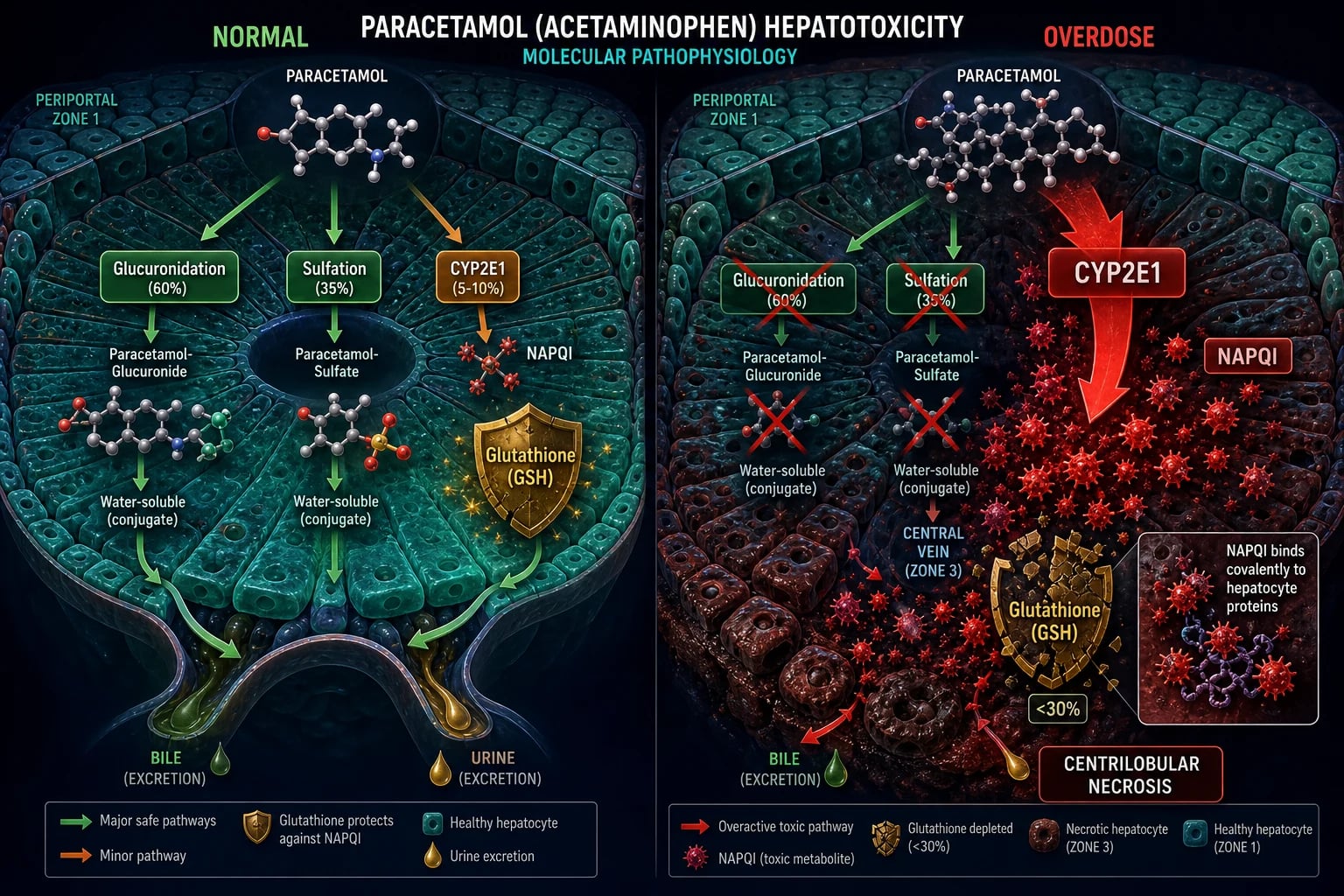
Paracetamol (acetaminophen) is remarkably safe at therapeutic doses (up to 4 g/day, 10-15 mg/kg/dose in adults; 60-75 mg/kg/day max in children) because the vast majority of the drug is detoxified through safe conjugation pathways. The danger of overdose lies entirely in a small secondary metabolic pathway that, once the safe pathways are saturated, generates a directly hepatotoxic electrophile. [1]
Metabolic fate of a therapeutic dose: [1]
- Glucuronidation (~40-67%) — UDP-glucuronosyltransferases (UGT1A1, UGT1A6, UGT2B15) conjugate paracetamol with glucuronic acid → paracetamol glucuronide → renally excreted. This is the dominant adult pathway.
- Sulfation (~20-46%) — sulfotransferases (SULT1A1, SULT1A3, SULT1A4) conjugate with a sulfate group → paracetamol sulfate → renally excreted. This is the dominant pathway in young children (who have reduced glucuronidation capacity).
- Cytochrome P450 oxidation (~5-10%) — mainly CYP2E1 (the major contributor), with minor contributions from CYP1A2 and CYP3A4. These enzymes oxidise paracetamol to NAPQI (N-acetyl-p-benzoquinone imine), a highly reactive electrophilic quinone imine.
- CYP2E1-inducible — chronic ethanol, isoniazid (induces CYP2E1), and fasting up-regulate CYP2E1 → more NAPQI generated per unit of paracetamol. [1]
The glutathione safety net: NAPQI is normally immediately detoxified by conjugation with glutathione (GSH) via glutathione-S-transferases, forming the non-toxic mercapturic acid derivative cysteine and mercapturate conjugates, which are excreted in urine. As long as glutathione stores exceed about 30% of normal, NAPQI is fully neutralised and NO hepatotoxicity occurs. This is the central, load-bearing concept of the entire topic: toxicity requires glutathione depletion beyond a critical threshold. [1]
What happens in overdose: [1]
- In overdose (typically greater than 150-200 mg/kg or greater than 7.5-10 g in an adult), glucuronidation and sulfation become SATURATED — the safe pathways can no longer handle the load.
- An increasing FRACTION of the dose is shunted through CYP2E1 → NAPQI production rises dramatically.
- Glutathione is consumed faster than it can be regenerated → hepatic GSH falls below the critical 30% threshold (i.e. more than 70% depleted).
- Free (unconjugated) NAPQI accumulates → this reactive electrophile covalently binds to cysteine residues on hepatocyte proteins (both cytosolic and, critically, mitochondrial proteins).
- Mitochondrial protein binding → mitochondrial dysfunction → ATP depletion → opening of the mitochondrial permeability transition pore (mPTP) → loss of mitochondrial membrane potential → release of apoptosis-inducing factor and cytochrome c → hepatocellular necrosis and apoptosis.
- Reactive oxygen species (ROS) and oxidative stress amplify the injury. Damage-associated molecular patterns (DAMPs) released from necrotic hepatocytes activate innate immunity (Kupffer cells, neutrophils) → a sterile inflammatory response that ADDS to the injury in the 24-72h window.[5]
Why zone 3 (centrilobular)? The centrilobular hepatocytes (zone 3 of the Rappaport acinus, surrounding the central vein) bear the brunt of injury because: (a) they have the HIGHEST CYP2E1 expression, so they generate the most NAPQI; (b) they are the MOST oxygen-poor hepatocytes (furthest from the portal triad oxygen supply), making them the most vulnerable to mitochondrial oxidative stress; and (c) mitochondrial dysfunction compounds the existing hypoxic vulnerability. This produces the classic centrilobular (zone 3) confluent necrosis seen on histology — the pathological hallmark of paracetamol hepatotoxicity. [1]
N-acetylcysteine (NAC) mechanism of action — multiple, time-dependent: [1]
- Primary (early): NAC is a precursor (pro-drug) of cysteine, the rate-limiting amino acid for glutathione synthesis. It REPLETES hepatic glutathione → restored GSH detoxifies free NAPQI → prevents further covalent binding. This is why NAC is SO effective when given early (within 8h) — it stops NAPQI before it binds.
- Secondary (late): Once NAPQI has already bound and caused injury (greater than 12-24h), NAC still helps through antioxidant and anti-inflammatory effects, haemodynamic support (improves microcirculation and oxygen delivery), and enhanced tissue oxygen extraction. This is why late NAC (even after 24h) STILL improves survival in established ALF — the mechanism shifts from "glutathione repletion" to "antioxidant/haemodynamic/cytoprotective."
- NAC also has emerging roles in modulating the innate immune response in ALF (the Antoniades group's work on anti-inflammatory mediators).[5]
Risk factors — who is at risk of toxicity at LOWER doses
Risk factors for paracetamol toxicity — two distinct mechanisms
| Category | Mechanism | Examples | Clinical implication |
|---|---|---|---|
| LOW glutathione (reduced detoxification capacity) | Less GSH available to conjugate NAPQI → toxicity at lower doses | Chronic alcoholism, malnutrition, fasting, chronic malaise/dehydration, HIV, anorexia/eating disorders, AIDS, cachexia | Some guidelines apply a LOWER treatment threshold (treat at the 100 mg/L "treatment line" rather than waiting for the 150 mg/L line) — the "high-risk" line |
| ENZYME INDUCERS (increased CYP2E1 → more NAPQI) | Up-regulation of CYP2E1 → a larger fraction of each dose is converted to NAPQI → toxicity at lower doses | Rifampicin, phenytoin, carbamazepine, isoniazid, chronic ethanol, St John's wort | Same — treat at the LOWER ("high-risk") treatment line |
| Age extremes | Infants: lower glucuronidation (relative); elderly: reduced hepatic reserve | Neonates/infants; frail elderly | Heightened vigilance; children often tolerate higher mg/kg but still treat by nomogram |
| Pre-existing liver disease | Reduced functional reserve — but paracetamol at therapeutic doses is generally SAFE in stable chronic liver disease | Cirrhosis (compensated) | Controversial — most still use the standard nomogram; therapeutic-dose paracetamol is preferred over NSAIDs in cirrhosis |
The "two lines" concept is exam-critical: the standard (US) treatment line begins at 150 mg/L (1 mmol/L) at 4h; the lower, "high-risk" line (UK "treatment line", and the line used for patients with the risk factors above) begins at 100 mg/L (0.66 mmol/L) at 4h. In Australia/ANZ and the UK, the SINGLE 100 mg/L treatment line is now applied to ALL patients (the 150 mg/L line is historical/US). This is a frequent fellowship exam question.[4]
Clinical course — the four phases (24-72h timeline)
The four phases of untreated paracetamol toxicity
| Phase | Time after ingestion | Clinical features | Biochemistry |
|---|---|---|---|
| 1. Pre-clinical / asymptomatic | 0-24h | Often ASYMPTOMATIC or mild non-specific symptoms (nausea, vomiting, pallor, malaise, diaphoresis). Patient may look entirely well — this is the trap: a well-looking patient at 6h can develop fatal hepatotoxicity at 48h | Paracetamol level high; ALT/INR still NORMAL (hepatotoxicity not yet detectable — LFTs do not rise until 24h+). THIS is why you must treat based on the nomogram LEVEL, not LFTs |
| 2. Hepatic injury | 24-72h | Right upper quadrant pain, hepatic tenderness, jaundice, recurrence of nausea/vomiting. The liver is actively dying | ALT/AST rise (often to the THOUSANDS — paracetamol characteristically produces AST/ALT greater than 1000, often greater than 10,000 U/L), INR rises, bilirubin rises. The ALT can exceed 10,000 U/L — one of the highest ALT levels in medicine |
| 3. Hepatic failure (3-5 days) | 72-120h | Peak hepatotoxicity: fulminant hepatic failure — jaundice, coagulopathy, encephalopathy, renal failure (hepatorenal or ATN), lactic acidosis, hypoglycaemia, multi-organ failure. This is where King's College criteria apply | INR greater than 6.5, pH less than 7.25, creatinine greater than 300, lactate elevated, hypoglycaemia. Transaminitis may paradoxically START to fall as hepatocytes are exhausted/dead (a falling ALT with RISING INR and encephalopathy is an OMINOUS sign — the liver has run out of cells to leak) |
| 4. Recovery OR death/transplant | 4 days - 3 weeks | Either complete hepatic recovery (liver regenerates — no chronic liver disease results) OR progression to death / liver transplant. Survivors have NO long-term liver damage | In survivors: LFTs normalise over weeks. Histology shows complete resolution with regeneration |
The temporal dissociation is the key teaching point: a patient can look completely well in the first 24h while their liver is being destroyed. You cannot rely on symptoms or LFTs in the early phase — the paracetamol LEVEL and the nomogram are the only reliable early guide. This is why NAC is given based on the nomogram, not on LFTs. [1]
Diagnosis — the Rumack-Matthew nomogram and when it CANNOT be used
Diagnosis of paracetamol toxicity — applying the nomogram correctly
- DETERMINE if the nomogram CAN be used. The Rumack-Matthew nomogram is valid ONLY when ALL of the following are true: (a) a SINGLE acute ingestion (one dose taken at one point in time), (b) KNOWN time of ingestion (can plot the level accurately on the time axis), (c) ingestion occurred between 4 hours and 16-24 hours ago (before 4h the level is still rising — wait and recheck at 4h; after 24h the nomogram is less reliable), (d) a STANDARD (immediate-release) preparation. If ANY of these is false — the nomogram CANNOT be used (see step 4)
- MEASURE the serum paracetamol level at 4 hours post-ingestion (or as soon as possible after 4h if presentation is later). Levels drawn BEFORE 4h are uninterpretable (absorption still ongoing, level still rising) — repeat at 4h. For a large ingestion with delayed presentation, draw the level immediately. Send a FULL panel: paracetamol level, ALT, AST, INR, creatinine, venous/arterial blood gas (pH, lactate, bicarbonate), glucose, beta-hCG (women), salicylate level (rule out co-ingestion), lipase (if abdominal pain)
- PLOT the level on the nomogram against the time since ingestion. Use the treatment line appropriate to the region/risk: the STANDARD US 150 mg/L line (and the 200 mg/L "treatment line" historically), OR the UK/ANZ 100 mg/L treatment line (applied to all, or to high-risk patients per local guideline). If the plotted point is ABOVE the treatment line → GIVE NAC. If BELOW → NAC not required (but observe if co-ingestants present). A level of 180 mg/L at 4h is ABOVE both lines → give NAC
- IF the nomogram CANNOT be used — give NAC EMPIRICALLY. Situations where the nomogram is INVALID and NAC is given regardless of the level: (a) STAGGERED overdose (two or more supratherapeutic doses taken over more than 1 hour), (b) UNKNOWN time of ingestion, (c) SUSTAINED-RELEASE preparation (late-rising and persistent levels — check levels at 4h AND at 6-8h and treat if EITHER is above the line), (d) CO-INGESTION of drugs that DELAY GASTRIC EMPTYING (opioids, anticholinergics, tricyclics — delay absorption → level may rise late — check at 4h and 6-8h), (e) massive ingestion with features of toxicity already present, (f) presentation greater than 24h with any detectable paracetamol level OR deranged LFTs
- INTERPRET the level in the clinical context. A level BELOW the treatment line in a patient with RISK FACTORS (low glutathione / enzyme inducers) — use the LOWER 100 mg/L treatment line. A level that is HIGH but the time is uncertain — treat. When in doubt — TREAT. The downside of unnecessary NAC (a few hours of infusion, possible mild anaphylactoid reaction) is trivial compared with the downside of withholding NAC in a patient who develops fatal ALF
- RECHECK if needed. For sustained-release preparations or delayed-gastric-emptying co-ingestants: check levels at 4h and again at 6-8h — if EITHER is above the treatment line, give NAC. For massive ingestion on NAC: recheck the paracetamol level before the end of the 21h infusion — if still detectable, extend the infusion
Management — the N-acetylcysteine (NAC) protocol
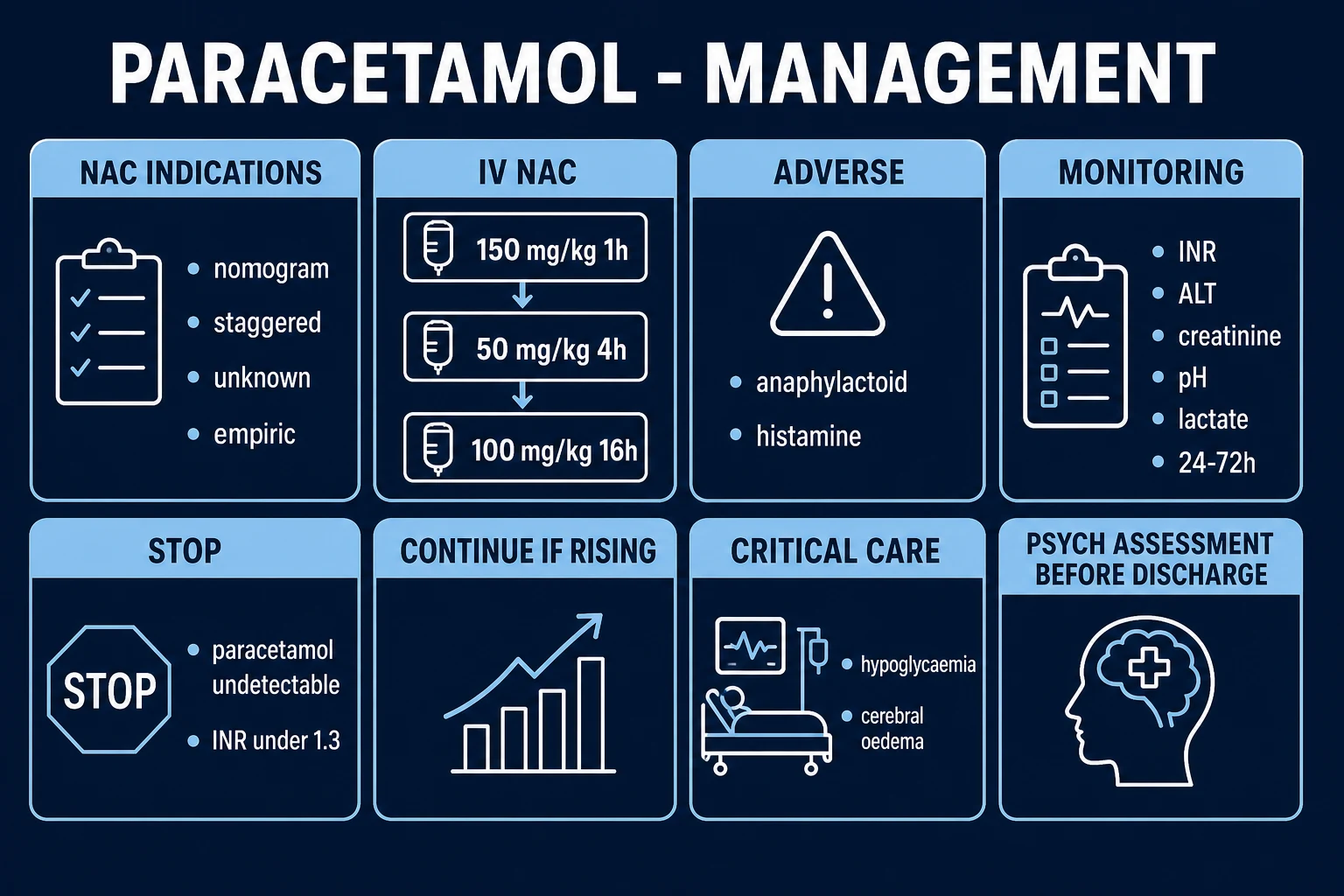
Management of acute paracetamol overdose — the complete protocol
- RESUSCITATE AND ASSESS (ABC). IV access, oxygen, cardiac monitor. Most patients in the early phase are haemodynamically stable. If shock or altered consciousness → consider co-ingestants. Take a focused history: amount ingested (grams and mg/kg), formulation (immediate vs sustained release), time(s) of ingestion (single vs staggered), co-ingestants, regular medications (enzyme inducers?), alcohol history, nutritional/fasting status, pregnancy. Baseline bloods: paracetamol level (at 4h), salicylate level, ALT/AST, INR, creatinine/urea, venous gas (pH, lactate, bicarb), glucose, beta-hCG
- ACTIVATED CHARCOAL (if within 1-2h of ingestion). 1 g/kg (max 50 g) single dose PO/NG within 1-2 hours of ingestion — reduces absorption. Still beneficial up to 4h if delayed gastric emptying. Does NOT meaningfully reduce oral NAC efficacy (charcoal adsorbs paracetamol, not NAC). Give charcoal BEFORE NAC if both indicated; if NAC already started, charcoal can still be given but separate by 1h. Contraindicated if unprotected airway (GCS less than 8 without intubation), bowel obstruction/ileus. Multiple-dose charcoal is NOT recommended for paracetamol (unlike salicylates, paracetamol does not undergo enterohepatic recirculation)
- DECIDE ON NAC using the nomogram (see diagnosis section). If the 4-hour paracetamol level is ABOVE the treatment line → START NAC IMMEDIATELY. If the nomogram cannot be applied (staggered, unknown time, sustained-release, co-ingestion) → START NAC empirically. Do NOT delay NAC waiting for LFTs — LFTs are normal in the first 24h and a normal INR/ALT does NOT exclude evolving toxicity
- IV NAC PROTOCOL (the standard 21-hour course):
- Loading dose: 150 mg/kg in 200 mL 5% dextrose (or saline) IV over ONE HOUR (NOT 15 minutes — the historical 15-minute loading caused high anaphylactoid reaction rates; giving it over 1 hour markedly reduces reactions while remaining effective). Maximum loading dose considerations: some guidelines cap at a weight-based dose for obese patients, but standard practice uses actual body weight up to ~110 kg, then consider capped dosing
- Second bag: 50 mg/kg in 500 mL over 4 HOURS
- Third bag: 100 mg/kg in 1000 mL over 16 HOURS
- TOTAL: 300 mg/kg over 21 hours (standard UK/ANZ "21-hour IV regimen")
- Note on volume: reduce diluent volumes for fluid-restricted patients (e.g. cardiac/renal failure) — give the same NAC dose in less fluid
- MANAGE ANAPHYLACTOID REACTIONS (common in first hour). Incidence ~5-20% with the modern 1-hour loading (was up to 50% with the old 15-minute load). Mechanism: NON-IgE, direct mast-cell histamine release by NAC itself (dose- and rate-dependent) — NOT a true allergy. Features: flushing, urticaria/rash, pruritus, then in more severe cases nausea, angioedema, bronchospasm, hypotension. MANAGEMENT: (a) SLOW or PAUSE the infusion temporarily, (b) give an H1 antihistamine (chlorphenamine 10 mg IV or cetirizine PO) ± an H2 blocker (ranitidine/famotidine), (c) for bronchospasm/hypotension give bronchodilator (salbutamol) and consider small-dose adrenaline ONLY if haemodynamically compromised, (d) once the reaction settles, RESTART the infusion at a SLOWER rate (e.g. halve the rate) and COMPLETE the full course — do NOT abandon NAC. Patients who have a reaction STILL complete the full course; the reaction usually does NOT recur on the slower second and third bags. Pre-treatment with an antihistamine (e.g. cetirizine) can be considered for the loading dose in patients at higher reaction risk (e.g. history of asthma/atopy) but is not routine[6][4]
- MONITOR during NAC. Serial ALT/AST and INR (baseline, then at end of infusion / 12-24h intervals), creatinine, venous gas (pH, lactate), glucose (hypoglycaemia is a feature of severe ALF), paracetamol level (recheck before the end of the 21h course in massive ingestion — if still detectable, extend). Watch urine output. Watch for encephalopathy (grade by West Haven criteria — grade 1: mild confusion/sleep disturbance; grade 2: drowsiness, asterixis; grade 3: marked somnolence/incoherence; grade 4: coma)
- MODIFIED / EXTENDED NAC for massive ingestion or sustained high levels. For very high initial paracetamol levels (e.g. greater than 2x the treatment line), sustained-release overdose, or a level still detectable at the end of the 21h course: CONTINUE the infusion beyond 21h. Typically continue at the 100 mg/kg per 16h rate (i.e. the third-bag rate) until BOTH the paracetamol level is UNDETECTABLE AND the INR is less than 1.3 (or clearly falling) AND ALT is improving AND the patient is clinically well. Higher-dose NAC protocols (e.g. 2-bag or modified regimens) are under study for massive overdose
- SUPPORTIVE / ICU CARE for established ALF. If the patient develops ALF (rising INR, encephalopathy, acidosis, renal failure) — admit to ICU: monitor for cerebral oedema (the major cause of early death in ALF — grade 4 encephalopathy → intubate, ventilate, maintain PaCO2 35-40, head elevated 30 degrees, consider hypertonic saline/mannitol/3% saline with ICP monitoring in some centres), correct coagulopathy judiciously (do NOT correct INR with FFP routinely — the INR is the most sensitive marker of hepatic recovery and of King's College criteria — only give clotting factors if actively bleeding or before procedures), treat hypoglycaemia (10% dextrose infusion — the failing liver cannot gluconeogenesis), manage renal failure (haemofiltration/dialysis), treat infection (broad-spectrum antibiotics at first sign — sepsis is common and fatal in ALF), consider renal replacement therapy
- ASSESS KING'S COLLEGE CRITERIA (KCC) for liver transplant — check at least every 12 hours once ALF develops. (See dedicated section below.) If KCC met → URGENT referral to a liver transplant centre. Time is critical — the window for transplant is narrow
- CONTINUE NAC until recovery or transplant. NAC is continued in established ALF even after the 21h course (extended infusion) because of its antioxidant/haemodynamic/cytoprotective benefits. Stop NAC only when the paracetamol level is undetectable, INR less than 1.3, ALT falling, and the patient clinically improving
King's College Criteria for liver transplantation
King's College Criteria (KCC) for transplant in paracetamol-induced ALF
| Criterion | Threshold | Notes |
|---|---|---|
| Arterial pH | Less than 7.25 AFTER adequate fluid resuscitation (originally less than 7.30; some units still use less than 7.30) | The SINGLE most powerful predictor of mortality — pH alone meeting criteria is an INDEPENDENT indication for transplant. Reflects severe lactic acidosis from failing liver + multi-organ failure. Check on ARTERIAL sample after resuscitation |
| OR all THREE of: | — | The combined triad — all three must be present |
| — INR | Greater than 6.5 (PT greater than 100 seconds) | Reflects severity of hepatic synthetic failure. Note: giving FFP will FALSIFY the INR — do NOT give FFP unless bleeding — the INR must be the uncorrected value |
| — Serum creatinine | Greater than 300 micromol/L (3.4 mg/dL) | Reflects renal failure (hepatorenal or ATN) |
| — Hepatic encephalopathy | Grade 3 or 4 (West Haven) | Grade 3: drowsy/incoherent; Grade 4: comatose. Indicates cerebral involvement |
Important clinical points about KCC: [1]
- Meeting KCC (pH less than 7.25 alone, OR all three of the triad) without transplantation carries a mortality of greater than 80-90% in paracetamol-induced ALF. With transplantation, survival improves to 70-90%.
- The KCC were developed for paracetamol-induced ALF specifically (different criteria exist for non-paracetamol ALF). For non-paracetamol ALF, KCC = INR greater than 6.7 alone OR any three of: age less than 10 or greater than 40, drug-induced (non-paracetamol), duration of jaundice before encephalopathy greater than 7 days, INR greater than 3.5, bilirubin greater than 300.
- The criteria have LIMITED sensitivity (they miss some who would benefit from transplant) but HIGH specificity — patients who MEET the criteria almost certainly need transplant. A lactate greater than 3.5 mmol/L after resuscitation, or greater than 3 mmol/L in the first 12h, has been proposed as an adjunct to improve sensitivity (the "lactate-modified" KCC).
- Because INR is a CRITERION, you MUST NOT routinely correct it with FFP or PCC before checking KCC — correcting the INR will mask the severity. Give clotting factors ONLY for active bleeding or before invasive procedures.
- Referral to a transplant centre should be EARLY — do not wait until all criteria are unequivocally met if the trajectory is worsening. Staggered-overdose patients have a higher rate of meeting KCC.[3]
Special situations
Special overdose situations — when the standard nomogram fails
| Situation | Why it is different | Management |
|---|---|---|
| Staggered overdose (2+ supratherapeutic doses over more than 1 hour) | Nomogram does NOT apply (no single time point to plot). WORSE prognosis — higher hepatotoxicity and higher KCC-meeting rate than single acute overdose. Patients often chronic self-harm / inadvertent | Give NAC REGARDLESS of the level (treat on presentation if any supra-therapeutic dose reported + deranged LFTs, OR a detectable level). Check serial LFTs/INR. Full 21h course, extend if needed |
| Massive single ingestion (very high levels, e.g. greater than 2x treatment line) | Standard 21h course may be insufficient — high NAPQI burden consumes the glutathione NAC generates | Modified/extended NAC — recheck paracetamol level before end of 21h course; continue at 100 mg/kg/16h rate until paracetamol undetectable AND INR less than 1.3. Consider fomepizole (CYP2E1 inhibitor) as adjunct (investigational) |
| Sustained-release preparation | Delayed/prolonged absorption → late-rising and persistent levels; nomogram unreliable | Check levels at 4h AND 6-8h — treat with NAC if EITHER above the treatment line. If uncertain, treat. Extended NAC often needed |
| Unknown time of ingestion | Cannot plot on nomogram | Give NAC empirically if a detectable paracetamol level OR any deranged LFTs OR if the reported dose is potentially toxic |
| Co-ingestion of gastric-emptying-delaying drugs (opioids, anticholinergics, TCAs) | Absorption delayed and prolonged → level rises late | Check levels at 4h and 6-8h; treat if EITHER above line. Consider naloxone for opioid co-ingestion |
| Late presentation (greater than 24h) | Nomogram less reliable; LFTs now the guide | Give NAC if ANY detectable paracetamol level OR deranged LFTs/INR — late NAC still improves survival (antioxidant/haemodynamic benefit). Assess KCC |
| Pregnancy | Paracetamol crosses placenta; NAC safe in pregnancy; foetus at high risk | Treat per nomogram as for non-pregnant. NAC is SAFE in pregnancy. Do NOT withhold. Paracetamol overdose in pregnancy is an independent indication to treat at the standard line |
| Children | Higher mg/kg tolerance but still toxic in overdose | Treat per weight-based nomogram. Pediatric NAC dosing same mg/kg (watch total fluid volume in small children) |
SAQ — Staggered paracetamol overdose meeting King's College Criteria
10 minutes · 10 marks
A 24-year-old woman is brought to the emergency department 28 hours after a staggered ingestion of paracetamol (approximately 25 g taken across the preceding day) with three episodes of vomiting. She is drowsy (GCS 13). Arterial pH 7.20, lactate 6.5 mmol/L, INR 7.8, creatinine 340 micromol/L, ALT 4800 U/L, paracetamol level 90 mg/L. Intravenous N-acetylcysteine has been commenced.
Clinical pearls
Red flags
Prognosis
Paracetamol overdose outcomes by timing and scenario
| Scenario | Hepatotoxicity / Mortality | Notes |
|---|---|---|
| NAC within 8h of ingestion | Hepatotoxicity less than 5%; mortality near ZERO | NAC at this stage is true PROPHYLAXIS — repletes glutathione before NAPQI binds. The single most important determinant of outcome is TIME to NAC |
| NAC at 8-24h | Hepatotoxicity 10-30% | Glutathione already partially depleted; some NAPQI binding has occurred, but NAC still substantially reduces severity |
| NAC after 24h (established ALF) | Hepatotoxicity up to 50%; mortality reduced from ~60% to ~20-30% | Late NAC works by antioxidant/haemodynamic/cytoprotective mechanisms. NEVER withhold NAC in ALF regardless of time |
| No NAC / untreated toxic ingestion | Hepatotoxicity ~60%; ALF 5-20%; mortality up to 30% in those who develop ALF | The natural history — drives the urgency of early treatment |
| Staggered overdose | WORSE than single acute — higher hepatotoxicity and KCC rate | Nomogram invalid; treat on presentation regardless of level |
| Meets King's College criteria, transplanted | Survival 70-90% | vs greater than 80% mortality without transplant — transplant transforms outcome |
| Massive ingestion (very high levels) | Higher hepatotoxicity despite NAC | Standard 21h course may be insufficient — use modified/extended NAC; consider fomepizole adjunct |
| Survivors | COMPLETE hepatic recovery; NO chronic liver disease | The liver regenerates fully. No long-term hepatic sequelae in survivors. This is a key counselling point |
Key trials and evidence
Smilkstein 1988 — Efficacy of oral NAC in acetaminophen overdose (PMID 3059186)
Source
N Engl J Med — the landmark US multicentre study (1976-1985), 11,195 patients
Key finding 1
NAC within 8h of ingestion: hepatotoxicity in less than 5% — near-complete protection
Key finding 2
NAC after 24h: still reduced mortality and hepatotoxicity — late NAC works
Key finding 3
The SINGLE most important determinant of outcome is TIME to NAC
Clinical bottom line
Established NAC as the antidote for paracetamol overdose and the 8-hour window as the critical treatment target — the foundation of modern management
Bateman 2014 — UK revised paracetamol guidelines impact (PMID 24666324)
Source
Br J Clin Pharmacol — large UK cohort study of the effect of the 2012 revised guidelines
Key finding 1
Lowering the treatment threshold (treating at the 100 mg/L line) reduced admissions for hepatotoxicity
Key finding 2
Slower (1-hour) NAC loading reduced anaphylactoid reactions without compromising efficacy
Key finding 3
Established the modern UK/ANZ single-treatment-line approach (100 mg/L at 4h for all patients)
Clinical bottom line
Evidence base for the current 100 mg/L treatment line and the 1-hour loading infusion — directly shapes contemporary ANZ/UK practice
Bernal 2010 — Acute liver failure (Lancet) (PMID 20638564)
Source
Lancet seminar — definitive review of ALF from all causes including paracetamol
Key principle 1
Paracetamol is the leading cause of ALF in the developed world
Key principle 2
King's College Criteria (pH less than 7.25, or INR greater than 6.5 + creatinine greater than 300 + grade 3-4 encephalopathy) guide transplant decisions
Key principle 3
Cerebral oedema is the leading early cause of death; sepsis and multi-organ failure dominate later
Clinical bottom line
The authoritative reference for ALF management, King's College criteria, and the role of emergency liver transplantation
Examiner densify anchors
NAC within 8 h
Hepatotoxicity often <5%; mortality near zero in classic series
KCC untreated mortality
>80% without transplant when criteria met
Practical ICU checklist (densify)
Bedside densify checklist
- Confirm diagnosis thresholds with numbers the examiner expects.
- Name the first therapy and the absolute contraindication.
- State monitoring frequency and escalation triggers.
- Cite one landmark paper/guideline and one limitation of the evidence.
- Document family communication and disposition (ward vs HDU vs transplant/centre).
Practical ICU checklist (densify)
Bedside densify checklist
- Confirm diagnosis thresholds with numbers the examiner expects.
- Name the first therapy and the absolute contraindication.
- State monitoring frequency and escalation triggers.
- Cite one landmark paper/guideline and one limitation of the evidence.
- Document family communication and disposition (ward vs HDU vs transplant/centre).
Practical ICU checklist (densify)
Bedside densify checklist
- Confirm diagnosis thresholds with numbers the examiner expects.
- Name the first therapy and the absolute contraindication.
- State monitoring frequency and escalation triggers.
- Cite one landmark paper/guideline and one limitation of the evidence.
- Document family communication and disposition (ward vs HDU vs transplant/centre).
References
- [1]Rumack BH Acetaminophen hepatotoxicity: the first 35 years J Toxicol Clin Toxicol, 2002.PMID 11990202
- [2]Smilkstein MJ, Knapp GL, Kulig KW, Rumack BH Efficacy of oral N-acetylcysteine in the treatment of acetaminophen overdose. Analysis of the national multicenter study (1976 to 1985) N Engl J Med, 1988.PMID 3059186
- [3]Bernal W, Auzinger G, Dhawan A, Wendon J Acute liver failure Lancet, 2010.PMID 20638564
- [4]Bateman DN, Dear JW, Carroll R, et al. Effect of the UK's revised paracetamol poisoning management guidelines on admissions, adverse reactions and costs of treatment Br J Clin Pharmacol, 2014.PMID 24666324
- [5]Antoniades CG, Lesmana E, Abeles RD, et al. Secretory leukocyte protease inhibitor: a pivotal mediator of anti-inflammatory responses in acetaminophen-induced acute liver failure Hepatology, 2014.PMID 24282114
- [6]Green JL, Heard KJ, Reynolds KM, Dart RC Oral and Intravenous Acetylcysteine for Treatment of Acetaminophen Toxicity: A Systematic Review and Meta-analysis West J Emerg Med, 2013.PMID 23687539