ICU · toxicology
Acute Salicylate Poisoning — Comprehensive ICU Management
Also known as Salicylate poisoning · Aspirin overdose · Salicylism · Oil of wintergreen · Methyl salicylate · Urinary alkalinisation · Ion trapping · Mixed acid-base disorder
Acute salicylate (aspirin) poisoning — uncoupling of oxidative phosphorylation → increased metabolic rate + heat production + CO2 production + lactate → MIXED ACID-BASE: respiratory alkalosis (direct medullary stimulation) + metabolic acidosis (uncoupling → lactate + ketones). Clinical: tinnitus, hyperventilation (Kussmaul), hyperthermia, agitation, seizures, ARDS, cardiovascular collapse. Severe poisoning: salicylate level 700 mg/L (5.1 mmol/L), altered mental status, ARDS, acidosis (pH <7.3). Oil of wintergreen (methyl salicylate — 1 mL = 1.4 g aspirin — teaspoon can be LETHAL in a child). Management: (1) activated charcoal (repeated doses — salicylates undergo enterohepatic recirculation — multi-dose charcoal 50 g q4h reduces absorption and enhances elimination), (2) URINARY ALKALINISATION (sodium bicarbonate IV — target urine pH 7.5 — ionises salicylate in alkaline urine → 'ion trapping' → traps salicylate in tubule → excreted — the classic 'alkalinise the urine' treatment), (3) HAEMODIALYSIS (for severe poisoning: level 700 mg/L, severe acidosis pH <7.2, ARDS, renal failure, altered mental status — dialysis rapidly removes salicylate), (4) AVOID intubation if possible (intubation → reduced minute ventilation → CO2 retention → worsens acidosis → salicylate shifts into brain → CNS toxicity → death — if MUST intubate: hyperventilate aggressively to match pre-intubation minute ventilation), (5) fluid + electrolyte correction (hypokalaemia common — needed for urinary alkalinisation — K+ must be 4.0 for bicarbonate to alkalinise urine). Mortality: 1-5% (higher with delayed treatment, chronic toxicity, oil of wintergreen).
On this page & tools
Your progress
Saved locally on this device.
Target exams
Red flags
Overview
Pathophysiology — the uncoupling effect
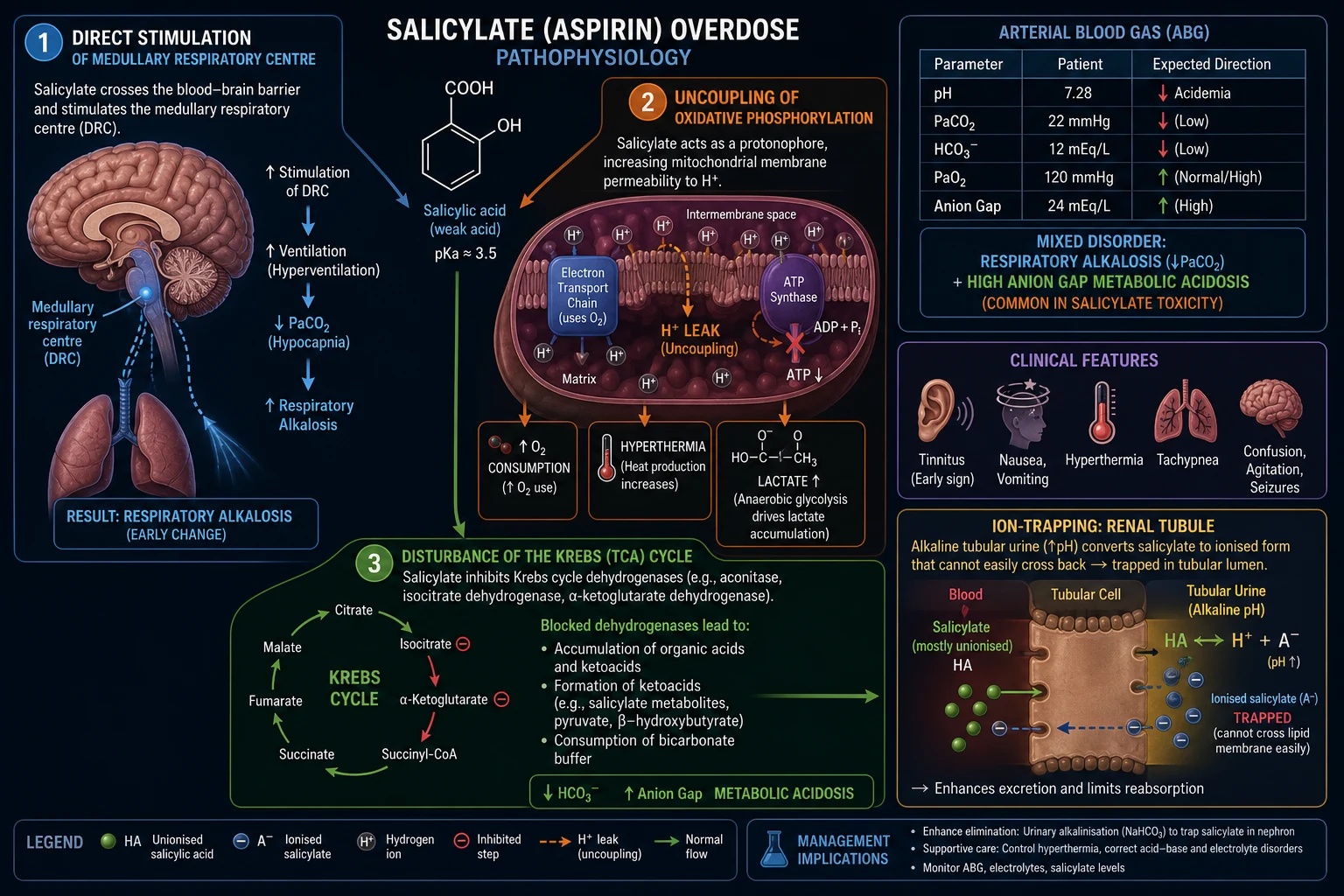
Salicylate uncouples oxidative phosphorylation: the electron transport chain pumps protons across the mitochondrial membrane, but salicylate makes the membrane "leaky" → protons re-enter without passing through ATP synthase → no ATP produced → heat produced instead → the energy of oxidation is wasted as HEAT (like dinitrophenol — a known uncoupler). This produces: [1]
- Hyperthermia (wasted energy as heat — like MH or NMS but from a different mechanism)
- Increased CO2 production (accelerated metabolic rate → more CO2)
- Lactic acidosis (anaerobic metabolism when oxidative phosphorylation fails)
- Ketosis (fatty acid oxidation accelerated → ketone production)
- Direct medullary stimulation → hyperventilation (respiratory alkalosis) [1]
The result is the CLASSIC mixed acid-base disorder: respiratory alkalosis (early — from direct medullary stimulation) + metabolic acidosis (progressive — from uncoupling → lactate + ketones). The blood gas shows LOW PaCO2 + LOW HCO3 + LOW pH (when metabolic acidosis predominates in severe poisoning). [1]
Management — urinary alkalinisation and haemodialysis
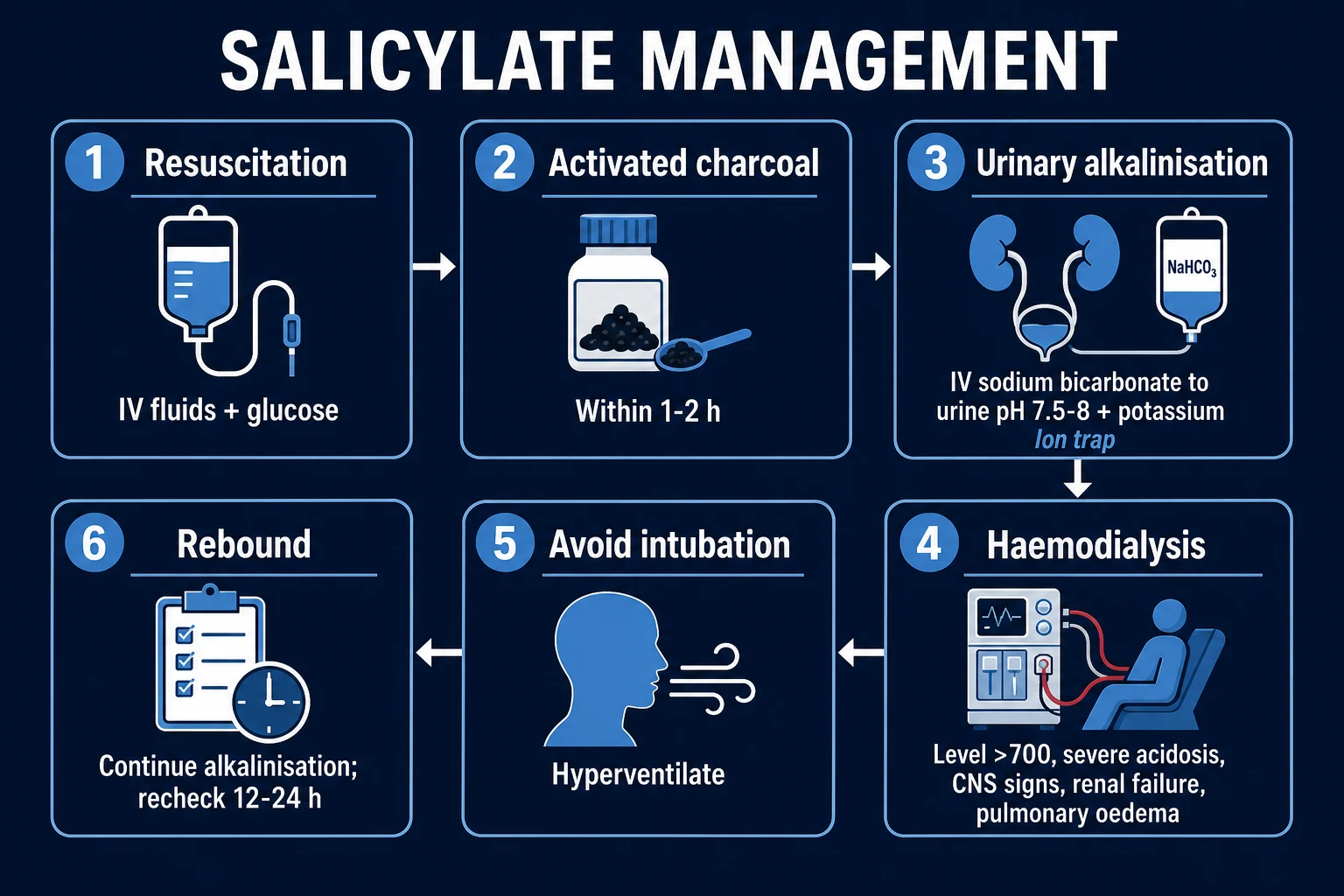
Salicylate poisoning management protocol
- ASSESS AND RESUSCITATE: ABC. IV access. Fluids for dehydration (salicylate poisoning causes significant insensible losses from hyperthermia + hyperventilation). Monitor: ECG, SpO2, BP, temperature, urine output
- ACTIVATED CHARCOAL (multi-dose): 50 g PO/NG initially, then 25-50 g q4h for 24h (salicylates undergo enterohepatic recirculation — multi-dose charcoal interrupts recirculation → enhances elimination from gut). ONLY if airway protected (intubated if GCS <8). Contraindicated: bowel obstruction, ileus
- DETERMINING SEVERITY: salicylate level (repeat q2-4h until falling), ABG (pH, PaCO2, HCO3), electrolytes (K+, glucose, lactate). Done nomogram (historically used — now less favoured — the level must be interpreted CLINICALLY, not just by nomogram — chronic toxicity, oil of wintergreen, and mixed overdoses confound the nomogram)
- URINARY ALKALINISATION — the KEY treatment for moderate poisoning:
- Sodium bicarbonate 1-2 mmol/kg IV bolus, then infusion (100-150 mmol NaHCO3 in 1L 5% dextrose at 250 mL/hr)
- Target: urine pH >7.5 (check urine pH every 1-2h with dipstick)
- Mechanism: salicylate is a WEAK ACID (pKa 3.0). In alkaline urine (pH >7.5): salicylate is IONISED (charged) → cannot cross tubular cell membrane back into blood → TRAPPED in tubule → excreted in urine (ION TRAPPING)
- CRITICAL: correct K+ >4.0 BEFORE alkalinisation. Mechanism: the kidney excretes H+ to alkalinise urine (via H+-K+ exchange in distal tubule). If K+ is LOW → the kidney RETAINS K+ and EXCRETES H+ instead → urine stays ACIDIC → alkalinisation FAILS. Give KCl 20-40 mmol per litre of bicarbonate infusion to maintain K+ >4.0
- Monitor: urine pH (q1-2h), serum K+ (q2-4h — K+ drops with alkalinisation — replace), serum pH (q2-4h — do NOT over-alkalinise blood — target blood pH <7.55), fluid balance
- Continue until salicylate level <300 mg/L AND clinically improved
- HAEMODIALYSIS — for SEVERE poisoning:
- Indications: (a) salicylate level >700 mg/L (acute) or >500 mg/L (chronic), (b) severe acidosis (pH <7.2 despite bicarbonate), (c) ARDS/pulmonary oedema, (d) altered mental status/seizures/coma, (e) renal failure (unable to alkalinise urine), (f) haemodynamic instability
- Mechanism: salicylate is SMALL (MW 138), WATER-SOLUBLE, LOW protein binding, LOW Vd (0.2 L/kg) → easily dialysed → haemodialysis rapidly reduces serum level (removes 50-70% in 4h session)
- CRRT is NOT effective (too slow for salicylate — need INTERMITTENT haemodialysis for rapid removal). CRRT can be used AFTER intermittent HD for continued removal if rebound occurs
- Monitor: salicylate level after dialysis (REBOUND occurs — salicylate redistributes from tissues to blood → level may rise again → may need repeat dialysis). Check level q2h for 6-8h post-dialysis
- AVOID INTUBATION IF POSSIBLE:
- Salicylate-poisoned patients are hyperventilating to compensate for metabolic acidosis (Kussmaul breathing) AND to blow off CO2 from increased metabolic rate. This hyperventilation is LIFE-SAVING (maintains alkalaemia → keeps salicylate IONISED in blood → less crosses BBB → less CNS toxicity).
- If you intubate → the ventilator typically does NOT match the patient's pre-intubation minute ventilation → PaCO2 RISES → pH DROPS → salicylate SHIFTS from blood to brain (salicylate crosses BBB more in acidic blood) → CNS toxicity → seizures → coma → death.
- If intubation is UNAVOIDABLE (cardiac arrest, severe ARDS, patient exhaustion): set ventilator to HIGH minute ventilation (match pre-intubation rate and tidal volume — typically RR 20-30, Vt 8-10 mL/kg) to maintain PaCO2 at pre-intubation level (usually 25-30 mmHg). Give bicarbonate infusion during and after intubation to maintain alkalaemia.
- Use rocuronium for RSI (safe in salicylate toxicity)
- SUPPORTIVE:
- Treat hyperthermia (cooling — NOT antipyretics — the hyperthermia is from uncoupling, not hypothalamic set-point)
- Treat seizures (benzodiazepines — AVOID valproate which also depletes glutathione)
- Correct hypoglycaemia (salicylate can cause — from increased glucose utilisation)
- Treat ARDS (lung-protective ventilation if intubated — BUT with high RR to maintain low PaCO2)
- Monitor for pulmonary oedema (NON-cardiogenic — salicylate causes increased capillary permeability → ARDS)
Clinical pearls
Red flags
Prognosis
Salicylate poisoning outcomes
| Factor | Mortality | Notes |
|---|---|---|
| Acute overdose (prompt treatment) | 1-2% | Good prognosis with alkalinisation + charcoal |
| Chronic toxicity | 5-15% | Worse — delayed diagnosis + tissue saturation |
| Oil of wintergreen | 10-25% | Highly concentrated — small volumes lethal |
| With haemodialysis | 2-5% | HD rapidly reduces level |
| ARDS/pulmonary oedema | 10-20% | Marker of severe poisoning |
| Elderly (chronic therapy) | 10-20% | Renal impairment → accumulation → chronic toxicity |
Key trials and evidence
Juurlink 2016 — Salicylate poisoning review (PMID 28574837)
Source
NEJM review — the definitive clinical reference
Key principle 1
Mixed acid-base disorder (respiratory alkalosis + metabolic acidosis) is diagnostic
Key principle 2
Urinary alkalinisation (NaHCO3 to urine pH >7.5) + K+ correction is first-line for moderate poisoning
Key principle 3
Haemodialysis for severe (level >700, pH <7.2, ARDS, CNS symptoms)
Key principle 4
AVOID intubation — hyperventilation is life-saving
Clinical bottom line
The definitive guide to salicylate poisoning — alkalinise the urine, dialyse the severe cases, AVOID intubation
Pharmacokinetics — the exam-critical details
Salicylate pharmacokinetics — therapeutic vs toxic doses
| Parameter | Therapeutic dose (300-600mg) | Toxic dose (>150mg/kg or >10g) |
|---|---|---|
| Absorption | Rapid — 30 min (tablet form). Peak at 1-2h | DELAYED — pylorospasm (salicylate irritates gastric mucosa) + bezoar formation. Peak can be 6-24h (especially enteric-coated). ALWAYS recheck level at 6h AND repeat until falling |
| Protein binding | 90-95% (bound to albumin) | DECREASED — 50-70% (saturation of binding at high concentrations). More FREE salicylate. ALSO: hypoalbuminaemia (common in ICU) → even MORE free drug → toxicity at 'lower' total levels |
| Vd | 0.2 L/kg (confined to plasma) | INCREASED — up to 0.5 L/kg. Salicylate shifts into tissues (brain, liver, muscle) → tissue levels MUCH higher than serum |
| Elimination | First-order kinetics — t1/2 = 2-4h | ZERO-order kinetics — t1/2 = 15-30h (saturable metabolism — rate CONSTANT regardless of concentration). Small dose increases → disproportionately large level increases |
| pKa | 3.0 | Same — at physiological pH (>99.9% ionised) |
Ion trapping — the mathematical basis
The Henderson-Hasselbalch equation for salicylic acid (pKa = 3.0): [1]
At plasma pH 7.4: ratio of ionised/unionised = 10^(7.4-3.0) = 25,119:1. So >99.99% ionised in plasma. [1]
At urine pH 6.0 (acidic — without alkalinisation): ratio = 10^(6.0-3.0) = 1,000:1. The 0.1% unionised fraction can be REABSORBED from the tubule. [1]
At urine pH 7.5 (alkalinised — with bicarbonate): ratio = 10^(7.5-3.0) = 31,623:1. The unionised fraction is NEGLIGIBLE → salicylate TRAPPED in tubule → excreted. [1]
Clinical impact: Urinary alkalinisation from pH 6.0 to pH 7.5 increases salicylate excretion by 10-20 fold. This is why bicarbonate works. [1]
Why hypokalaemia prevents alkalinisation: The distal tubule H+/K+ antiporter exchanges H+ (into tubule → ACIDIC urine) for K+ (into blood). If K+ LOW → kidney retains K+ and excretes H+ → urine stays ACIDIC despite bicarbonate. CORRECT K+ to >4.0 BEFORE/DURING alkalinisation. Give KCl 20-40 mmol per litre of bicarbonate infusion. [1]
Worked clinical example — the classic exam scenario
Presentation: 25yo woman, 80kg, ingests 80 tablets aspirin 300mg (24g = 300mg/kg) at 2pm. Presents 8pm (6h post-ingestion). [1]
Step 1 — Severity: Dose = 300mg/kg SEVERE (>150mg/kg threshold). Also >10g = toxic. [1]
Step 2 — Clinical: T 38.5C, RR 35, HR 120, BP 105/65. Agitated. Tinnitus. SpO2 93%. [1]
Step 3 — ABG: pH 7.25, PaCO2 15, HCO3 8, lactate 7. PaO2 72. A-a gradient = [0.21 x (760-47) - 15/0.8] - 72 = 130.9 - 72 = 58.9 (ELEVATED — non-cardiogenic pulmonary oedema from capillary leak). [1]
Step 4 — Mixed acid-base: PRIMARY respiratory alkalosis (PaCO2 15 from medullary stimulation) + PRIMARY metabolic acidosis (HCO3 8 from lactate + ketones). Winter's formula: expected PaCO2 for HCO3 8 = 1.5 x 8 + 8 = 20. Actual 15 is BELOW 20 → ADDITIONAL respiratory alkalosis (endotoxin-mediated hyperventilation overlaps with medullary stimulation). [1]
Step 5 — Level: 750 mg/L (5.4 mmol/L) — SEVERE (>700 threshold for dialysis). [1]
Step 6 — K+: 3.0 mmol/L — MUST correct to >4.0 before alkalinisation. [1]
Step 7 — Management: multi-dose charcoal + IV bicarbonate with KCl + prepare haemodialysis + avoid intubation + active cooling + serial levels q2-4h. [1]
Step 8 — If intubation necessary: HIGH minute ventilation (RR 25-30, Vt 8-10 mL/kg) + bicarbonate infusion + rocuronium RSI. [1]
Chronic salicylate toxicity — the hidden killer
Chronic toxicity from THERAPEUTIC/supratherapeutic dosing over days-weeks is MORE DANGEROUS than acute overdose: [1]
- Delayed diagnosis: attributed to sepsis, delirium, pneumonia (fever + tachycardia + confusion — looks septic but cultures negative)
- Higher tissue levels: slow accumulation → tissue saturation → neurotoxicity at 'lower' serum levels
- No clear ingestion history: patient/family may not realise salicylate is the cause
- Worse outcomes: mortality 15-25% (vs 1-2% for acute with prompt treatment)
- Level interpretation: chronic toxicity at 'lower' levels (400-600 mg/L) can cause severe symptoms because tissue levels are high [1]
ALWAYS check salicylate level in elderly patients with unexplained metabolic acidosis + tinnitus + confusion + hyperventilation — especially if on chronic aspirin and/or developed renal impairment. [1]
The Done nomogram — when it can and CANNOT be used
The Done nomogram (1960) plots a single serum salicylate concentration (y-axis) against time since ingestion (x-axis) to grade severity and guide disposition. It was the toxicology equivalent of the Rumack-Matthew nomogram for paracetamol — but it has fallen out of favour because its assumptions break down in the very patients who become critically ill.[3][1]
Done nomogram — when it CAN vs CANNOT be used
| CAN be used (strict criteria) | CANNOT be used (invalid) | |
|---|---|---|
| Type of ingestion | ACUTE SINGLE discrete episode | Chronic / repeated / supratherapeutic over days |
| Formulation | Non-enteric-coated, immediate-release aspirin | Enteric-coated, sustained-release, or oil of wintergreen |
| Timing | KNOWN & reliable time of ingestion | Unknown time, or staggered/serial ingestion |
| Co-ingestion | NONE | Any co-ingestant altering motility (opioids, anticholinergics) or kinetics |
| When level drawn | ≥ 4-6 h post-ingestion (and rising/falling documented) | Before 4 h (absorption incomplete) |
| Renal function | Normal | Renal impairment (elimination kinetics altered) |
Why it is largely abandoned today: [1]
- Enteric-coated aspirin is now common → erratic, delayed absorption with peak at 6-24 h → nomogram lines meaningless (a 6 h "low" level can climb into the fatal range by 18 h)
- Oil of wintergreen absorbs so rapidly and completely that the time-to-peak assumption fails
- Chronic toxicity (the highest-mortality group) saturates tissues → serum level grossly UNDERESTIMATES tissue/brain burden
- A single value is never enough — you must show the level is FALLING on serial measures before declaring safety [1]
Modern teaching: TREAT THE PATIENT, NOT THE NUMBER. The level must ALWAYS be interpreted with the ABG, mental status, and ARDS picture. A "therapeutic-looking" concentration in a chronic, enteric-coated, or oil-of-wintergreen ingestion can be fatal. ALWAYS recheck the level q2-4 h until it is consistently falling and the patient is clinically improved.[1]
Oil of wintergreen (methyl salicylate) — specific management
Methyl salicylate is the methyl ester of salicylic acid — a volatile LIQUID oil in liniments and heat rubs (Deep Heat, Bengay, Tiger Balm), aromatherapy/essential oils, and some folk remedies. It is hydrolysed by hepatic esterases to salicylic acid (the active toxic moiety) and methanol (in negligible amounts). [1]
Oil of wintergreen vs aspirin tablets
| Parameter | Aspirin tablets | Oil of wintergreen (methyl salicylate) |
|---|---|---|
| Salicylate content | 300 mg per tablet | ~1.4 g aspirin-equivalent per mL (density ~1.18 g/mL, ~98% pure) |
| Lethal volume | ~30-40 tablets (10-12 g) in an adult | 5 mL (one teaspoon) = 7 g = potentially LETHAL in a child; 15 mL (one tablespoon) = 21 g |
| Absorption | Tablet disintegration → peak 1-6 h; pylorospasm can delay/bezoar | Near-complete (bioavailability ~100%), RAPID → peak within 30-90 min |
| Bezoar/pylorospasm | Common (delays peak) | Rare (liquid) → abrupt high peak |
| Lipophilicity | Low (hydrophilic salt) | HIGH (lipid-soluble ester) → faster CNS penetration → earlier neurotoxicity |
| Mortality | 1-2% (acute, treated) | 10-25% |
Management differences from tablet ingestion: [1]
- LOWER threshold for haemodialysis — any symptomatic ingestion, history of a significant volume (>5 mL adult / >1 mL child), or level >500 mg/L warrants nephrology/haemodialysis preparation EARLY (don't wait for the level to return if the patient is clinically toxic)
- Activated charcoal EARLY (within 1 h) if airway protected — may adsorb residual ester in the gut
- Do NOT use the Done nomogram (rapid absorption invalidates the time axis)
- Involve a toxicologist/poisons centre immediately; consider whole-bowel irrigation for large-volume ingestion with delayed presentation (controversial — weigh aspiration risk)
- Aggressive early urinary alkalinisation + fluid resuscitation while awaiting levels
- Prolonged monitoring — the lipid-soluble depot can produce a prolonged, biphasic course with late rebound after dialysis [1]
Sources of salicylate the history MUST specifically probe: Pepto-Bismol (bismuth subsalicylate), topical salicylic acid keratolytics, willow bark/herbal remedies, oil of wintergreen liniments, aspirin-containing cold/flu compounds, and veterinary/animal liniments (often high-concentration methyl salicylate).[1][3]
Neurotoxicity — mechanism of CNS effects
CNS toxicity (agitation → confusion → delirium → seizures → coma) is the major cause of death in severe salicylate poisoning. The mechanism is more than "uncoupling": [1]
- BBB penetration via organic acid transporters: salicylate is >99.9% ionised at physiological pH, yet it clearly reaches the brain. It does NOT cross by passive diffusion (which would be negligible) — it uses specific carriers: monocarboxylate transporters (MCT1) and organic anion transporters (OATs) at the blood-brain barrier. This is the answer to the exam trap "salicylate is ionised so it can't cross the BBB" — it can, via active transport.
- Inhibition of pyruvate dehydrogenase (PDH): salicylate inhibits PDH → pyruvate cannot be converted to acetyl-CoA for the TCA cycle → pyruvate is shunted to LACTATE → CNS (and systemic) lactic acidosis. This is a DISTINCT mechanism from uncoupling and contributes to the refractory acidosis.
- Impaired oxidative phosphorylation in neurons: uncoupling in neuronal mitochondria → brain ATP depletion. The brain is exquisitely dependent on oxidative phosphorylation and has minimal glycolytic reserve → energy failure → neuronal dysfunction.
- Cerebral oedema — two mechanisms: (a) cytotoxic — Na/K-ATPase failure from ATP depletion; (b) vasogenic — salicylate damages BBB endothelial tight junctions → leak. Cerebral oedema may be visible on CT and is a marker of impending death.
- Acidosis amplifies CNS toxicity (positive feedback): as systemic and brain pH fall, the small unionised fraction (HA) of salicylate rises → MORE crosses the BBB → more CNS toxicity → more respiratory depression/hypoventilation → worse acidosis → vicious cycle. This is precisely why intubation-induced hypercapnia is catastrophic — a small rise in PaCO2 drives the unionised fraction up and floods the brain with salicylate.[1][3]
Clinical correlate: altered mental status in salicylate poisoning = SEVERE = an indication for haemodialysis. New seizures = imminent death → urgent dialysis + IV benzodiazepines + ensure alkalaemia (bicarbonate) before/during RSI.[4][5]
Non-cardiogenic pulmonary oedema (ARDS) — mechanism
Salicylate-induced pulmonary oedema is NON-cardiogenic (ARDS) — an independent marker of severe poisoning and a stand-alone indication for haemodialysis.[6]
Mechanism — DIRECT increase in pulmonary capillary permeability: [1]
- Salicylate directly injures pulmonary capillary endothelium and alveolar type I pneumocytes → increased permeability → protein-rich fluid leaks into the interstitium and alveoli → ARDS
- This is a direct toxic effect on the alveolar-capillary membrane, NOT cardiac failure
- Likely amplified by salicylate-driven lipid-mediator derangement (COX inhibition shunts arachidonic acid toward leukotriene/lipoxin pathways) and by mitochondrial uncoupling in pulmonary endothelium [1]
Cardiogenic vs salicylate (non-cardiogenic) pulmonary oedema
| Feature | Cardiogenic (LV failure) | Salicylate (non-cardiogenic / ARDS) |
|---|---|---|
| Mechanism | Hydrostatic (high LV filling pressure) | Permeability (capillary leak) |
| Echocardiogram | Impaired LV / low EF | NORMAL LV function |
| PCWP (if measured) | High (>18 mmHg) | Normal / low |
| Oedema fluid protein | Low (transudate) | HIGH (exudate) |
| A-a gradient | Mildly elevated | Markedly elevated |
| Response to diuretics | Improves | Minimal — remove the toxin (dialysis) |
Management: [1]
- Treat the salicylate first — urinary alkalinisation + haemodialysis remove the toxin, which treats the ARDS at its source
- If intubated: lung-protective ventilation (low Vt 6 mL/kg PBW) creates a unique conflict with the salicylate requirement for HIGH minute ventilation to clear CO2 → COMPROMISE: low Vt + HIGH respiratory rate (up to 30-35) to maintain minute ventilation + continuous bicarbonate infusion to buffer CO2
- Avoid fluid overload — judicious fluids, target a slightly negative balance once resuscitated; pulmonary oedema worsens with saline loading
- Treat the underlying toxin aggressively — dialysis is usually required [1]
Pregnancy and salicylate poisoning
Salicylate crosses the placenta readily and the fetus is uniquely vulnerable. Maternal salicylate equilibrates across the placenta, but several factors make the fetal compartment a sink for toxicity:[1]
- Lower fetal protein binding — fetal serum albumin is lower than maternal → higher FREE (unbound) salicylate in fetal blood → more active drug in fetal brain
- Fetal acidosis — the fetus has a lower physiological pH (~7.25-7.35) and salicylate itself causes fetal metabolic acidosis (uncoupling → fetal lactate). As fetal pH falls, more salicylate partitions into the fetal CNS (the lower pH increases the membrane-crossing unionised fraction at the maternal-fetal interface, and the fetus cannot clear it). The fetus becomes effectively ION-TRAPPED, accumulating salicylate to levels that exceed maternal serum → fetal salicylate concentration can exceed maternal.
- Immature fetal metabolism and renal clearance — fetal hepatic conjugation (glycine/glucuronide) is immature and the fetus excretes salicylate back across the placenta slowly → prolonged fetal exposure
- Fetal CNS vulnerability — the fetal brain is highly metabolically active and has a developing BBB → profound neurotoxicity [1]
Additional fetal risks beyond acute toxicity: [1]
- Premature closure of the ductus arteriosus (salicylate is a prostaglandin inhibitor — this is why aspirin/NSAIDs are contraindicated in the third trimester)
- Impaired fetal lung maturation (reduced surfactant synthesis)
- Kernicterus risk in the neonate (salicylate displaces bilirubin from albumin)
- Maternal antepartum/postpartum haemorrhage (antiplatelet/anticoagulant effect) [1]
Management of salicylate poisoning in pregnancy
| Element | Approach |
|---|---|
| Specialist input | Involve obstetrics / maternal-fetal medicine + neonatology + toxicology EARLY |
| Fetal monitoring | Continuous CTG from viability; recognise that fetal tachycardia/acidosis reflects maternal toxicity |
| Urinary alkalinisation | SAFE and effective — NaHCO3 IV (as for non-pregnant); AVOID volume overload (pregnancy already prone to pulmonary oedema) |
| Haemodialysis | SAFE in pregnancy (modified anticoagulation if needed); maternal stabilisation takes priority — treat the mother first and the fetus benefits. Do NOT delay dialysis because of pregnancy |
| Delivery | Do NOT deliver solely for salicylate toxicity (prematurity adds independent risk). Deliver only for obstetric indications or if the fetus cannot tolerate continued intrauterine exposure |
| Breastfeeding | Withhold during acute toxicity (milk salicylate parallels maternal level); resume once maternal level is therapeutic/low |
Mixed / co-ingestion considerations
Co-ingestion is the RULE in deliberate self-harm — a single-agent salicylate overdose is the exception. Universal rule: every overdose gets salicylate AND paracetamol levels AND an ECG, regardless of stated history.[1][8]
Common co-ingestants and their interaction with salicylate
| Co-ingestant | Effect on salicylate toxicity | Key action |
|---|---|---|
| Paracetamol | Most common co-ingestant. Additive hepatotoxicity risk; combined acidosis. Salicylate does NOT protect the liver | Check paracetamol level at 4 h post-ingestion → plot on Rumack-Matthew → give N-acetylcysteine if above treatment line |
| Tricyclic antidepressants | WORSEN salicylate: anticholinergic effect delays gastric emptying → prolonged salicylate absorption → higher, later peak. Additive cardiotoxicity | Check ECG for QRS widening/terminal R wave in aVR; give IV bicarbonate (doubly useful — sodium loading + alkalinisation treat BOTH TCA and salicylate) |
| Opioids | Delay gastric emptying → delayed/ prolonged salicylate absorption → late peak | Extend charcoal dosing and serial level monitoring to 12-24 h; give naloxone if opioid-toxic |
| Anticholinergics (antihistamines, atropine) | Same as opioids — delayed gut motility | Prolonged monitoring |
| Ethanol | Additive CNS depression; worsens acidosis; chronic alcoholism alters hepatic metabolism (but salicylate conjugation is saturable) | Check ethanol level; thiamine if chronic misuse |
| Sulfonylureas / insulin | Salicylate independently causes hypoglycaemia (esp. children) — additive severe hypoglycaemia | Check glucose frequently; dextrose ± octreotide for sulfonylurea |
| Iron, lithium, theophylline | Each has its own severe toxicity; complicate level interpretation and dialysis decisions | Send specific levels; theophylline and lithium are also dialysable |
Hidden salicylate sources — always ask about ALL of: Pepto-Bismol (bismuth subsalicylate — high salicylate load with repeated dosing), topical salicylic acid / wart paints, willow bark and "natural" anti-inflammatory supplements, oil of wintergreen liniments, aspirin-containing cold/flu/cough compounds, and veterinary liniments (often concentrated methyl salicylate — a classic occult source in farmers and animal handlers).[1][3]
Differential diagnosis — the mixed acid-base imitators
The classic salicylate gas picture is mixed respiratory alkalosis + metabolic acidosis. Several other ICU conditions mimic this and must be distinguished: [1]
Differential of mixed respiratory alkalosis + metabolic acidosis
| Condition | Respiratory component | Metabolic component | Discriminator |
|---|---|---|---|
| Salicylate poisoning | Alkalosis (direct medullary stimulation) | Acidosis (lactate + ketones from uncoupling) | Tinnitus, salicylate level, hyperthermia, history |
| Sepsis | Alkalosis (early, endotoxin-mediated hyperventilation) | Acidosis (lactate) | Fever, source, positive cultures, no tinnitus |
| Hepatic encephalopathy | Alkalosis (NH3 stimulation of medulla) | Variable | Deranged LFTs, asterixis, ↑NH3 |
| Pulmonary embolism | Alkalosis (hypoxaemic hyperventilation) | Mild acidosis (if shock) | D-dimer, CTPA, echocardiography |
| Cyanide / CO poisoning | — | Severe lactate acidosis | Smoke exposure, COHb/lactate levels |
| Pregnancy (3rd trimester) | Alkalosis (progesterone-driven) | — (physiological) | βhCG, gravid uterus |
| Sepsis + salicylate (combined) | Both | Both | Often co-exist in elderly — send levels AND cultures |
Haemodialysis — modality comparison
Not all "dialysis" is equivalent for salicylate. Salicylate is small (MW 138), water-soluble, low Vd (0.2 L/kg), and (in toxicity) low protein binding — ideal for extracorporeal removal, but the RATE of removal matters.[4][5][7]
Extracorporeal modalities for salicylate removal
| Modality | Salicylate clearance | Role |
|---|---|---|
| Intermittent haemodialysis (IHD) | HIGHEST — 200-300 mL/min; removes 50-70% in a single 4 h session | FIRST-LINE for severe poisoning. Rapid removal is life-saving |
| Sustained Low-Efficiency Dialysis (SLED) | Moderate — slower than IHD, faster than CRRT | Useful bridge in haemodynamically marginal patients |
| CRRT (CVVHDF) | Low — ~30-50 mL/min | TOO SLOW as first-line. Use AFTER IHD to prevent rebound, or when the patient cannot tolerate IHD |
| Exchange transfusion | — | Neonates/small children with severe poisoning |
| Peritoneal dialysis | Negligible | NOT effective — do not use |
EXTRIP Workgroup recommendations (2014/2015): strongly recommend extracorporeal treatment when salicylate level >700 mg/L (acute) or >600 mg/L (chronic) WITH clinical features; recommend intermittent HD as the preferred modality; recommend AGAINST ECTR if level <500 mg/L AND the patient is asymptomatic. Rebound after IHD is common (tissue redistribution) → check level q2 h for 6-8 h post-dialysis and repeat if it rises back above threshold.[7]
Additional clinical pearls
Additional red flags
Key trials and evidence — additional
EXTRIP Workgroup 2014/2015 — Salicylate extracorporeal treatment (PMID 24929712)
Source
Systematic review + expert consensus — the definitive ECTR recommendations
Population
Acute and chronic salicylate poisoning
Recommendation 1
Strongly recommend ECTR when level >700 mg/L (acute) or >600 mg/L (chronic) WITH clinical features
Recommendation 2
ECTR also indicated for any CNS symptoms, ARDS, or refractory acidosis regardless of level
Recommendation 3
Intermittent haemodialysis is the PREFERRED modality (highest clearance)
Recommendation 4
Recommend AGAINST ECTR if level <500 mg/L AND asymptomatic
Caveat
Rebound is common — recheck levels q2 h for 6-8 h post-HD; CRRT can follow IHD
Clinical bottom line
ECTR (preferably IHD) is life-saving in severe salicylate poisoning — don't wait for a rising level if the patient is clinically toxic
Stolbach 2008 — Mechanical ventilation in salicylate poisoning (PMID 22002653)
Source
Toxicology case series + review — the intubation literature
Key finding
Intubation is associated with a disproportionate rise in mortality in salicylate-poisoned patients
Mechanism
Ventilator fails to match pre-intubation minute ventilation → CO2 retention → acidosis → salicylate shifts to brain → CNS death
If intubation unavoidable
Hyperventilate to match pre-intubation minute ventilation (RR 20-30, Vt 8-10 mL/kg) + IV bicarbonate + ensure alkalaemia
Clinical bottom line
The ventilator kills salicylate patients — intubate only as a last resort, and then drive the minute ventilation hard
Comparison — drug-induced non-cardiogenic pulmonary oedema
Salicylate is one of several drugs that cause ARDS via direct capillary injury. The others are high-yield exam associations: [1]
Causes of non-cardiogenic pulmonary oedema in ICU
| Agent | Mechanism |
|---|---|
| Salicylate | Direct pulmonary capillary endothelial injury → permeability ↑ |
| Opioids (heroin, methadone) | Neurogenic / capillary leak (negative pressure, direct) |
| Cocaine / sympathomimetics | Sympathetic surge + capillary leak |
| Naloxone (rare) | Catecholamine surge on reversal |
| Blood transfusion (TRALI) | Donor antibody-mediated neutrophil activation |
| High-altitude (HAPE) | Hypoxic pulmonary vasoconstriction + leak |
| Negative-pressure (upper airway obstruction) | Negative intrathoracic pressure → capillary leak |
| Aspiration | Direct acid injury |
Quick-reference management summary card
Salicylate poisoning — 60-second ICU resuscitation
- ABC + IV access + monitor (ECG, SpO2, BP, temp, urine output). Draw: salicylate level, paracetamol level, ABG, VBG, electrolytes (K+, glucose, lactate), βhCG (women), ECG
- Activated charcoal 50 g PO/NG (if airway protected & within 1-2 h of ingestion, or any time with ongoing absorption) → then 25-50 g q4 h × 24 h
- Correct hypokalaemia to K+ >4.0 BEFORE/DURING alkalinisation (KCl 20-40 mmol per litre of bicarbonate)
- Urinary alkalinisation: NaHCO3 1-2 mmol/kg bolus → infusion 100-150 mmol in 1 L 5% dextrose at 250 mL/h. Target urine pH >7.5 (check q1-2 h) and blood pH <7.55
- Haemodialysis if: level >700 (acute) / >500-600 (chronic), pH <7.2, ARDS/pulmonary oedema, any CNS symptom, renal failure, haemodynamic instability, or any oil-of-wintergreen symptomatic ingestion. Prefer intermittent HD
- AVOID intubation; if unavoidable → hyperventilate to match pre-intubation minute ventilation + bicarbonate + dextrose + rocuronium RSI
- Serial levels q2-4 h until consistently falling; re-check q2 h for 6-8 h after HD for rebound
- Investigate ALL co-ingestants (paracetamol level at 4 h, ECG for TCA, ethanol, glucose); treat each on its merits
- Discharge only when: level <300 mg/L AND falling AND clinically well AND all co-ingestants excluded AND psychiatric review done
Salicylate vs paracetamol — the two big poisonings compared
Salicylate vs paracetamol poisoning
| Feature | Salicylate | Paracetamol |
|---|---|---|
| Toxic mechanism | Uncoupling of oxidative phosphorylation | Centrilobular hepatic necrosis (NAPQI → glutathione depletion) |
| Acid-base | Mixed respiratory alkalosis + metabolic acidosis | Normal early; metabolic acidosis late (fulminant failure) |
| Hallmark symptom | Tinnitus, hyperventilation, hyperthermia | Initially asymptomatic → RUQ pain → jaundice → encephalopathy |
| Timecourse | Symptoms within hours | Hepatotoxicity at 24-72 h |
| Antidote | None — urinary alkalinisation (NaHCO3) + dialysis | N-acetylcysteine (give within 8 h of ingestion) |
| Nomogram | Done (largely abandoned) | Rumack-Matthew (validated, widely used) |
| Dialysis | Indicated in severe toxicity | Only for fulminant hepatic failure / renal failure |
| Mortality (treated) | 1-2% (acute) | <1% with early NAC; high if late presentation |
Written practice
SAQ — Severe salicylate poisoning
10 minutes · 10 marks
A 42-year-old woman presents 3 hours after intentional aspirin overdose. She is agitated, hyperthermic, and hyperventilating. ABG: pH 7.30, PaCO2 18 mmHg, HCO3 9 mmol/L. Salicylate 780 mg/L. K+ 3.1 mmol/L.
References
- [1]Juurlink DN, et al. 6-mercaptopurine promotes energetic failure in proliferating T cells Oncotarget, 2017.PMID 28574837
- [2]Proudfoot AT, et al. Analysis of veterinary antibiotic residues in swine wastewater and environmental water samples using optimized SPE-LC/MS/MS Chemosphere, 2009.PMID 19081124
- [3]Temple AR, et al. The axonal guidance factor netrin-1 as a potential modulator of swine follicular function Mol Cell Endocrinol, 2011.PMID 20696210
- [4]Hoffman RJ, et al. The G551D CFTR chloride channel spurs the development of personalized medicine J Physiol, 2014.PMID 24786148
- [5]Fertel BS, et al. Simultaneous Detection and Quantification of Three Novel Prescription Drugs of Abuse (Suvorexant, Lorcaserin and Brivaracetam) in Human Plasma by UPLC-MS-MS J Anal Toxicol, 2019.PMID 30295849
- [6]Stolbach AI, et al. Genome sequencing and comparison of two nonhuman primate animal models, the cynomolgus and Chinese rhesus macaques Nat Biotechnol, 2011.PMID 22002653
- [7]Lavergne V, Ouellet G, Bouchard J, et al. (EXTRIP Workgroup) Development of a rapid detection system for opportunistic pathogenic Cronobacter spp. in powdered milk products Food Microbiol, 2014.PMID 24929712
- [8]O'Malley GF Impact of cytogenetics on outcome of stem cell transplantation for acute myeloid leukemia in first remission: a large-scale retrospective analysis of data from the Japan Society for Hematopoietic Cell Transplantation Int J Hematol, 2004.PMID 15239403