ICU · Toxicology
Snake envenomation in the ICU
Also known as Snake bite · Envenomation · Polyvalent antivenom · Venom-induced consumption coagulopathy (VICC)
Snake envenomation is a significant problem in Australia, Asia, Africa, and South America. Australian snakes: brown snake (most deaths), tiger snake, taipan, death adder, mulga/black snake. Clinical syndromes: (1) COAGULOPATHY (VICC — venom-induced consumption coagulopathy — defibrination, INR 10, unrecordable fibrinogen, raised D-dimer). (2) NEUROTOXICITY (presynaptic — taipan, tiger, death adder — progressive flaccid paralysis from terminal axon damage; postsynaptic — death adder — curare-like blockade, REVERSIBLE with antivenom). (3) MYOTOXICITY (rhabdromyolysis — raised CK, myoglobinuria, AKI). (4) RENAL: AKI (direct nephrotoxicity, myoglobinuria, DIC). (5) LOCAL: bite site swelling, bruising, necrosis. Diagnosis: snake venom detection kit (SVDK — bite site swab or urine — identifies snake GROUP). Management: pressure immobilisation bandage (FIRST AID — slows lymphatic spread), IV polyvalent antivenom (or monovalent if species identified — tiger/brown snake antivenom most common in ANZ), supportive ICU (ventilation for neurotoxicity, RRT for AKI, blood products for bleeding from VICC).
On this page & tools
Your progress
Saved locally on this device.
Target exams
Red flags
SAQ — Brown snake bite with venom-induced consumption coagulopathy
10 minutes · 10 marks
A 38-year-old farmer in rural NSW is brought to ED 90 minutes after a bite to his ankle, having had a pressure-immobilisation bandage applied by paramedics. He has gum oozing, two large haematomas at the bite site and is clinically well. INR >10, aPTT >150 s, fibrinogen <0.4 g/L, D-dimer markedly raised, platelets normal. SVDK on bite-site swab returns brown snake (Pseudonaja).
SAQ — Taipan envenomation with presynaptic paralysis
10 minutes · 10 marks
A 26-year-old herpetologist in far north Queensland is bitten on the hand by a coastal taipan. He applies a pressure-immobilisation bandage and arrives at ED asymptomatic. At 3 hours he develops ptosis, diplopia and a hoarse voice; FVC has fallen from 4.2 L to 1.6 L. INR 11, fibrinogen <0.5 g/L, CK 9,800 U/L, urine dark brown.
Clinical pearls
Red flags
Snake families — global taxonomy at the bedside
The three medically important snake families — elapids, vipers and sea snakes
| Feature | Elapids (Elapidae) | Vipers (Viperidae) | Sea snakes (Hydrophiinae) |
|---|---|---|---|
| Dominant venom action | Predominantly neurotoxic (± procoagulant, myotoxic) | Predominantly haemotoxic / cytotoxic (± neurotoxic) | Predominantly myotoxic (± neurotoxic) |
| Fangs | Short, fixed, front-fanged (proteroglyphous) — punctate bite marks | Long, hinged, hollow (solenoglyphous) — deep, painful fang wounds; pit vipers have heat-sensing loreal pits | Short, fixed; small mouth — rarely bite humans out of water |
| Representative genera | Cobra (Naja), mamba (Dendroaspis), taipan (Oxyuranus), brown (Pseudonaja), tiger (Notechis), death adder (Acanthophis), krait (Bungarus), coral snake (Micrurus) | Rattlesnake (Crotalus), puff adder (Bitis arietans), Russell's viper (Daboia russelii), saw-scaled viper (Echis), lancehead (Bothrops), copperhead/cottonmouth | Hydrophis, beaked sea snake (Enhydrina schistosa), Lapemis |
| Geography | Australia, South/South-East Asia, sub-Saharan Africa, Americas (coral snake) | Americas, Africa, Europe, Middle East, Asia | Indo-Pacific coastal waters, coral reefs |
| Hallmark syndrome | Descending flaccid paralysis; VICC in Australasian elapids | Local necrosis + consumption coagulopathy + bleeding; AKI | Rhabdomyolysis, myoglobinuria, hyperkalaemia, AKI |
| Appropriate first aid | Pressure immobilisation bandage — venom travels by lymphatics | Do NOT apply PIB — local tissue injury dominates; immobilisation worsens limb necrosis and compartment syndrome | PIB reasonable — myotoxin also enters via lymph/blood |
| Antivenom | Monovalent (SVDK-guided) or polyvalent; 1–2 vials initial (ANZ) | Region-specific monovalent or polyvalent (e.g. Bothrops, Echis, Daboia); often higher doses | Sea snake antivenom (Haffkine / CSL); tiger snake antivenom cross-reacts |
The Australian elapids — genus, dominant toxin and syndrome at a glance
| Snake (genus) | Dominant venom action | Key clinical syndrome | Antivenom |
|---|---|---|---|
| Brown snake (Pseudonaja) | Prothrombin activator (factor Xa-like) | VICC dominant; little/no local signs; #1 cause of death | Brown snake antivenom |
| Tiger snake (Notechis) | Procoagulant + presynaptic neurotoxin + myotoxin | VICC + neurotoxicity + rhabdomyolysis | Tiger snake antivenom |
| Taipan (Oxyuranus) | Procoagulant + presynaptic neurotoxin | VICC + severe paralysis (often presynaptic) | Taipan antivenom |
| Death adder (Acanthophis) | Postsynaptic α-neurotoxin | Pure neurotoxicity — curare-like, REVERSIBLE by antivenom | Death adder antivenom |
| Mulga / black snake (Pseudechis) | Myotoxin + procoagulant | Myotoxicity (rhabdomyolysis) + VICC; mild neuro | Black snake antivenom |
| Sea snakes (Hydrophiinae) | Myotoxic phospholipase A₂ | Rhabdomyolysis, myoglobinuria, AKI | Sea snake antivenom |
Global burden. Snakebite envenoming is a WHO Category A neglected tropical disease, responsible for an estimated 81 000–138 000 deaths and ~400 000 amputations annually worldwide, concentrated in South and South-East Asia, sub-Saharan Africa, and Latin America. The major killers globally are saw-scaled vipers (Echis), Russell's vipers (Daboia russelii), and the Indian cobra / krait complex; in Australia, the brown snake (Pseudonaja) causes most deaths despite tiny fang marks and minimal local injury.[1][2]
Why taxonomy changes management. Elapid venom is concentrated, lymphatic-spread, neurotoxic — so the pressure immobilisation bandage (which retards lymph flow) buys critical hours. Viper venom is locally destructive — so the same bandage traps venom in the limb and worsens necrosis. Knowing the family tells you whether first aid helps or harms.[7]
Venom components — four toxin classes, four syndromes
Venom component classes — mechanism, source snakes and reversibility by antivenom
| Toxin class | Subtype | Mechanism | Source snakes | Clinical effect | Reversed by antivenom? |
|---|---|---|---|---|---|
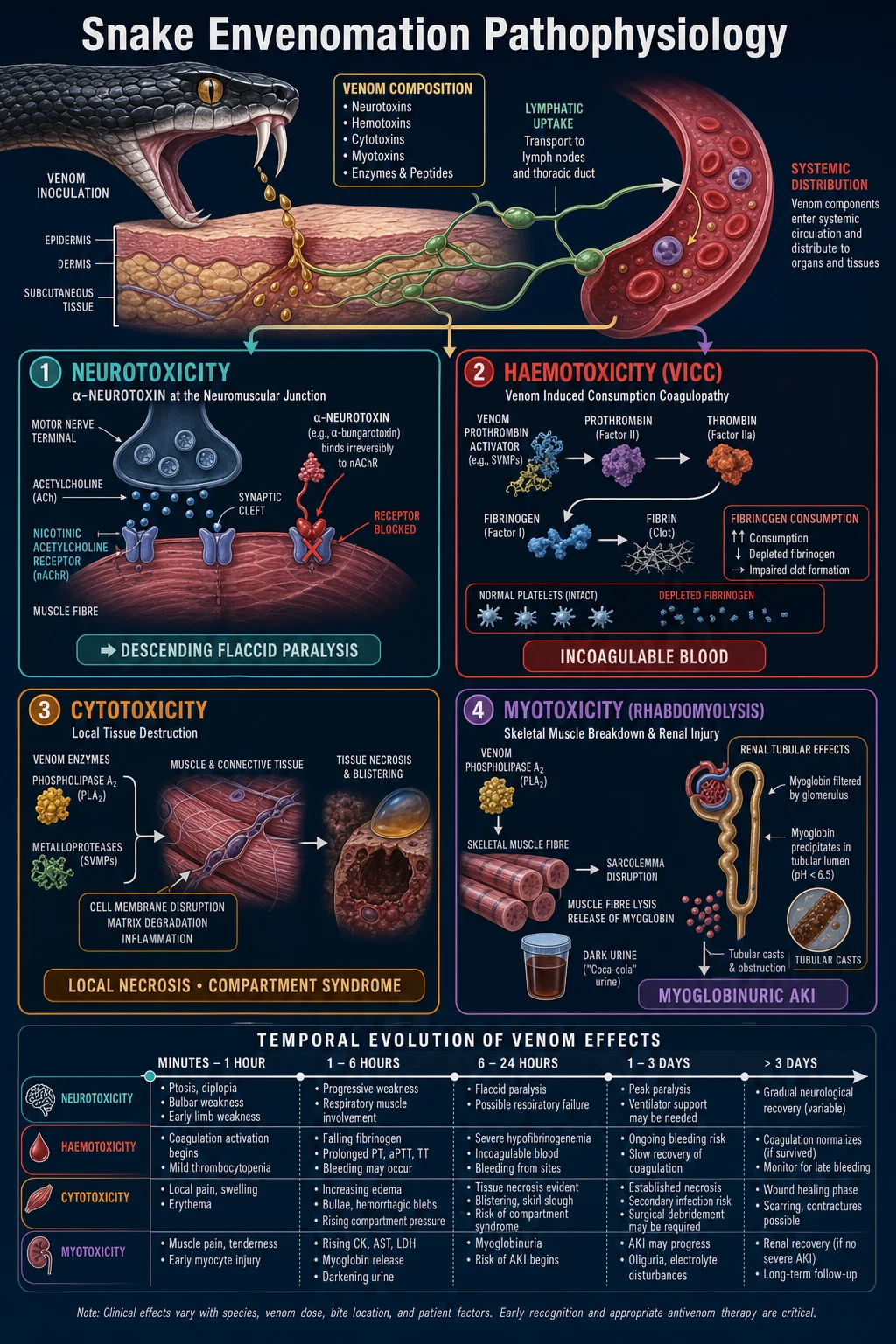
| Neurotoxin | α-neurotoxin (postsynaptic) | Binds the nicotinic ACh receptor at the motor end-plate (curare-like) → blocks ACh binding | Cobra (Naja), death adder (Acanthophis), krait (Bungarus), coral snake (Micrurus) | Descending flaccid paralysis: ptosis → ophthalmoplegia → bulbar palsy → respiratory failure | YES — antivenom displaces toxin from receptor; recovery hours–days |
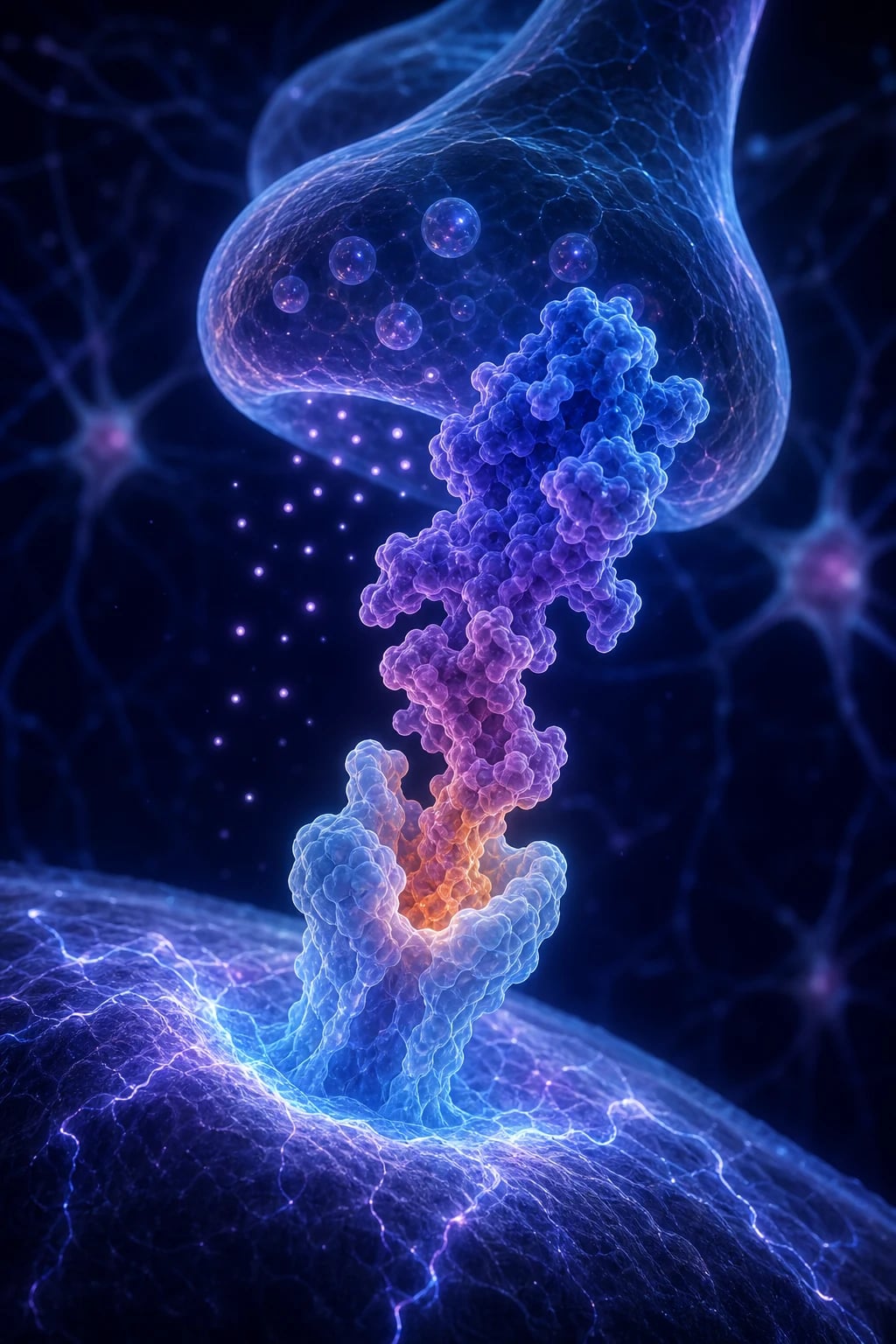
| Neurotoxin | β-neurotoxin (presynaptic phospholipase A₂) | Damages the motor nerve terminal → depletes and blocks acetylcholine release | Taipan (Oxyuranus), tiger (Notechis), some Russell's vipers, mamba (dendrotoxins act differently — potentiate ACh release) | Same descending paralysis, BUT axonal terminal destruction | NO — terminal damage is done; recovery weeks–months |
| Haemotoxin | Procoagulant (prothrombin / factor X activator) | Directly activates prothrombin or factor X → runaway thrombin → massive consumption of fibrinogen + factors → VICC | Brown, tiger, taipan (Australian); Russell's viper, saw-scaled viper (Echis); Bothrops | INR >10, fibrinogen undetectable, D-dimer huge, platelets normal; bleeding catastrophic | Partly — antivenom stops ongoing consumption; liver must resynthesise factors over days |
| Haemotoxin | Anticoagulant / disintegrin / metalloprotease | Cleaves endothelium, von Willebrand factor and fibrinogen; blocks platelet glycoprotein receptors | Bothrops, Echis, Crotalus | Local bleeding, blistering, ecchymosis; coagulopathy variable | Variable |
| Myotoxin | Myotoxic phospholipase A₂ | Lyses skeletal-muscle sarcolemma → myocyte necrosis → rhabdomyolysis | Sea snakes, tiger snake, mulga/black snake, some rattlesnakes | CK >10 000 U/L, myoglobinuria (dark urine), muscle pain, hyperkalaemia, AKI | Partly — early antivenom limits extent; established necrosis is irreversible |
| Nephrotoxin | Direct (phospholipase, metalloprotease) | Tubular injury + interstitial nephritis; microvascular thrombosis; ATN from myoglobin | Russell's viper (Daboia), Bothrops, Echis | AKI (often oliguric) — may need RRT; usually reversible over weeks | Indirect — antivenom limits further damage; supportive care mainstay |
Clinical syndromes — neurotoxic, haemotoxic, myotoxic, nephrotoxic
The four snake-envenoming clinical syndromes — what to watch for, what to measure, what to do
| Syndrome | Hallmark signs | Key investigations | Threshold to act | Specific treatment |
|---|---|---|---|---|
| Neurotoxic | Ptosis, ophthalmoplegia, facial/bulbar weakness, descending flaccid paralysis → respiratory failure | Serial FVC, MIP, MEP (bedside spirometry); ABG | Intubate when FVC <15 mL/kg or MIP <−30 cmH₂O or bulbar signs | Antivenom (reverses postsynaptic only); early intubation/NIV |
| Haemotoxic (VICC) | Bleeding (gums, IV sites, GI, intracranial); grossly abnormal coagulation; often asymptomatic | INR, aPTT, fibrinogen, D-dimer, platelets, 20WBCT every 6 h | Antivenom for confirmed VICC; blood products for active bleeding/procedures | Antivenom + cryoprecipitate/FFP for bleeding |
| Myotoxic | Muscle pain/tenderness, dark urine (myoglobinuria), stiffness, rising CK | Serial CK (every 6 h), urine myoglobin, K⁺, creatinine | Aggressive IV fluids for rhabdomyolysis; treat hyperkalaemia | Early antivenom; fluid resuscitation; renal protection |
| Nephrotoxic | Oliguria, rising creatinine, hyperkalaemia, acidosis | Creatinine, eGFR, urine output, K⁺, ABG, urinalysis | RRT for refractory hyperkalaemia, acidosis, fluid overload, uraemia | Antivenom; supportive; RRT (usually temporary, recovery over weeks) |
Neurotoxic envenoming — the descending paralysis
Paralysis descends in a predictable order and is the syndrome most likely to need ICU support. Cranial nerves fail first: the patient reports blurred or double vision; ptosis and external ophthalmoplegia develop (the eyes feel heavy, the patient cannot look up). Bulbar weakness follows — dysphonia (nasal voice), dysphagia, drooling, poor cough. Limb weakness is then proximal before distal, and finally the respiratory muscles fail: weak cough, paradoxical breathing, then apnoea.[6]
The single most important ICU monitor is bedside spirometry. Measure forced vital capacity (FVC), maximum inspiratory pressure (MIP) and maximum expiratory pressure (MEP) every 1–2 hours. Intubate before respiratory arrest using threshold values — do not wait for desaturation, which is a late, dangerous sign. Accepted triggers for intubation: FVC <15 mL/kg (predicted, or <1 L in an adult); MIP (negative inspiratory force) less negative than −30 cmH₂O; MEP <40 cmH₂O (poor cough and sputum clearance); bulbar weakness with pooled secretions; or a falling trend on serial measurement even while still above threshold.[2]
Haemotoxic envenoming — VICC
VICC may be entirely clinically silent until catastrophic bleeding occurs. Always rely on laboratory testing, not the bedside appearance. The brown snake exemplifies this danger: minimal local signs, the patient looks well, then collapse or intracranial haemorrhage from an INR >10. The 20-minute whole blood clotting test (20WBCT) is the WHO-recommended bedside screen where formal coagulation is unavailable: place a few millilitres of venous blood in a clean glass tube; if it has not clotted after 20 minutes, significant VICC is present and antivenom is indicated.[11]
Myotoxic envenoming — rhabdomyolysis and the kidney
Myotoxins (phospholipase A₂) lyse skeletal muscle. CK rises steeply (often >10 000 U/L), myoglobin spills into the urine (dark, cola-coloured urine, dipstick-positive for blood with few or no red cells), and the patient develops muscle pain and stiffness. The life-threatening consequences are hyperkalaemia (arrhythmia) and pigment nephropathy / AKI. Early aggressive IV fluid resuscitation (to maintain urine output >1 mL/kg/h) is the cornerstone; the standard rhabdomyolysis bundle (no bicarbonate unless acidotic) applies.[3]
Nephrotoxic envenoming — AKI
Snakebite AKI is multifactorial: direct tubular toxicity, pigment (myoglobin) nephropathy, hypovolaemia/hypotension, microvascular thrombosis (TMA/DIC-like), and rarely interstitial nephritis. Russell's viper (Daboia) and Bothrops species are the classic culprits. AKI is typically oliguric and may require renal replacement therapy, but is usually reversible over 2–6 weeks. Indications for RRT are the standard ones — refractory hyperkalaemia, severe metabolic acidosis, fluid overload, and uraemic complications.[3]
Diagnosis — how to confirm and characterise envenoming
The diagnostic workup of a suspected snakebite in the ICU
Decide if envenomation has occurred at all
A bite does not equal envenomation — "dry bites" (no venom injected) are common (up to 20–40% in some species). Look for ANY of: local symptoms (pain, swelling, bleeding from fang marks), systemic symptoms (nausea, vomiting, headache, syncope, abdominal pain), abnormal vital signs, or any laboratory abnormality. Asymptomatic at presentation does NOT exclude delayed envenoming — observe and investigate.
Draw the baseline laboratory panel
Full blood count (platelets), coagulation (INR, aPTT, fibrinogen, D-dimer), CK, creatinine/eUrea, electrolytes (K⁺), lactate, group-and-save, troponin, and a 20WBCT at the bedside. Repeat coagulation and CK every 6 hours for the first 24 hours — VICC and myotoxicity may evolve over hours.
Run a bedside 20-minute whole blood clotting test (20WBCT)
Place 2–3 mL of venous whole blood in a clean, dry glass tube and leave undisturbed for 20 minutes. Invert once: if the blood is still liquid (unclotted), the test is POSITIVE for VICC. This is the WHO-recommended point-of-care coagulopathy screen in resource-limited settings and correlates well with an unrecordable fibrinogen.
Use the Snake Venom Detection Kit (SVDK) to guide antivenom choice
In Australia, the SVDK is a two-step enzyme immunoassay that detects venom GROUP (not species) from a bite-site swab, urine, blood or wound fluid. It tells you which MONOVALENT antivenom to use — it does NOT tell you whether envenomation has occurred (that is a clinical/lab decision). Five groups: brown, tiger, black, death adder, taipan.
Confirm the clinical syndrome and its severity
Map the results to a syndrome: neurotoxic (serial FVC/MIP/MEP), haemotoxic (VICC panel + 20WBCT), myotoxic (CK + urine myoglobin), nephrotoxic (creatinine + urine output). This determines the level of monitoring (ward vs HDU vs ICU) and the timing of antivenom.
Decide: observe, treat, or discharge
Any patient with confirmed envenoming OR an unclear picture requires at least 12–24 hours of observation with serial testing. Discharge only if the patient remains asymptomatic with two normal coagulation panels 6 hours apart AND no evolving neurology. Brown snake bites warrant a minimum 12-hour admission even if initially well.
The three key diagnostic tools — SVDK, 20WBCT and the laboratory coagulation panel
| Tool | What it detects | Sample | Result | Limitation |
|---|---|---|---|---|
| Snake Venom Detection Kit (SVDK) | Which venom GROUP is present (to choose monovalent antivenom) | Bite-site swab, urine, blood | One of 5 groups: brown, tiger, black, death adder, taipan | Does NOT confirm envenomation — only identifies venom type. False negatives if sample taken too early/late or diluted |
| 20-minute whole blood clotting test (20WBCT) | Whether defibrinating VICC is present (bedside) | 2–3 mL venous blood in a glass tube | Unclotted blood at 20 min = POSITIVE (VICC) | Only detects defibrination-type coagulopathy; insensitive to isolated factor deficiencies; affected by heparin, glass quality |
| Laboratory coagulation panel | Full characterisation of coagulopathy | Plasma (citrate) | INR, aPTT, fibrinogen, D-dimer, platelets | Takes longer; requires a lab; in VICC the INR is often reported as ">10" or unrecordable |
VICC vs DIC vs vipers thrombotic microangiopathy — the coagulopathy differentials
| Feature | VICC (snakebite) | DIC (sepsis/trauma/obstetric) | Thrombotic microangiopathy (some vipers) |
|---|---|---|---|
| Platelets | Normal | Low | Low |
| INR / aPTT | Markedly prolonged | Prolonged | Mildly prolonged / normal |
| Fibrinogen | Undetectable | Low | Normal / low |
| D-dimer | Markedly raised | Raised | Mildly raised |
| Schistocytes | Absent | May be present | Present (MAHA) |
| Microvascular thrombosis | Absent | Present | Present |
| AKI dominant? | No (unless myotoxic) | Variable | Yes |
| Treatment anchor | Antivenom + factor replacement for bleeding | Treat the underlying cause + supportive | Plasma exchange ± complement blockade (eculizumab) |
First aid and pre-hospital — the pressure immobilisation bandage
Applying the pressure immobilisation bandage (PIB) — the ANZ first-aid standard for elapid bite
Recognise when PIB is appropriate
PIB is for ELAPID bites (Australian snakes, cobras, mamba, krait, coral snake) where venom spreads via lymphatics and neurotoxicity dominates. It is NOT recommended for viper bites, where local tissue destruction and compartment syndrome dominate — trapping venom in the limb worsens necrosis.
Keep the patient still and calm
Movement — especially of the bitten limb — drives lymphatic and venous return and accelerates venom spread. Lay the patient down and reassure them. Do not let them walk.
Apply a broad crepe bandage over the bite site first
Start directly over the bite (do NOT wash the site — residual venom is used by the SVDK). Bandage firmly — the pressure required is the same as for a sprained-ankle bandage (~55 mmHg), enough to occlude lymphatic flow but not arterial.
Bandage UP the limb from the digits to the trunk
Continue wrapping distal-to-proximal: fingers/toes up to the groin (leg) or armpit (arm). Cover as much of the limb as possible. The aim is to compress the lymphatics along the entire venom-transport path.
Splint and immobilise the limb
Apply a rigid splint to the bandaged limb (the bandage alone is insufficient — muscle pumping from joint movement drives lymph flow). Bind the splint so the limb cannot bend at the joints.
Mark the bite site and note the time
Write the time of the bite and the time of bandaging on the bandage over the bite site. Do NOT remove the bandage to "check" — removal causes sudden venom release.
Transport to hospital — do NOT remove the bandage
The bandage stays in place UNTIL the patient is in a hospital with antivenom available, IV access secured, and staff ready to treat the sudden venom release that occurs when the bandage is removed. Removal is a clinical decision, not a first-aid one.
Pressure immobilisation bandage — elapid vs viper bite
| Elapid bite (ANZ, cobra, mamba, krait) | Viper bite (rattlesnake, Russell viper, Bothrops, Echis) | |
|---|---|---|
| PIB appropriate? | YES — first-aid standard | NO — generally contraindicated |
| Rationale | Elapid venom travels via lymphatics; PIB retards lymph flow and delays neurotoxicity, buying hours for antivenom | Viper venom causes local tissue destruction; trapping venom in the limb worsens necrosis and compartment syndrome |
| What to do instead | — | Immobilise the limb, keep the patient still, remove constrictive items (rings, watches), mark the bite edge, rapid transport |
| Exception | If the species is genuinely unknown in an elapid-endemic region, a PIB is reasonable | A few neurotoxic vipers (e.g. some Crotalus with neurotoxicity) are a grey zone — follow local guidelines |
Antivenom therapy
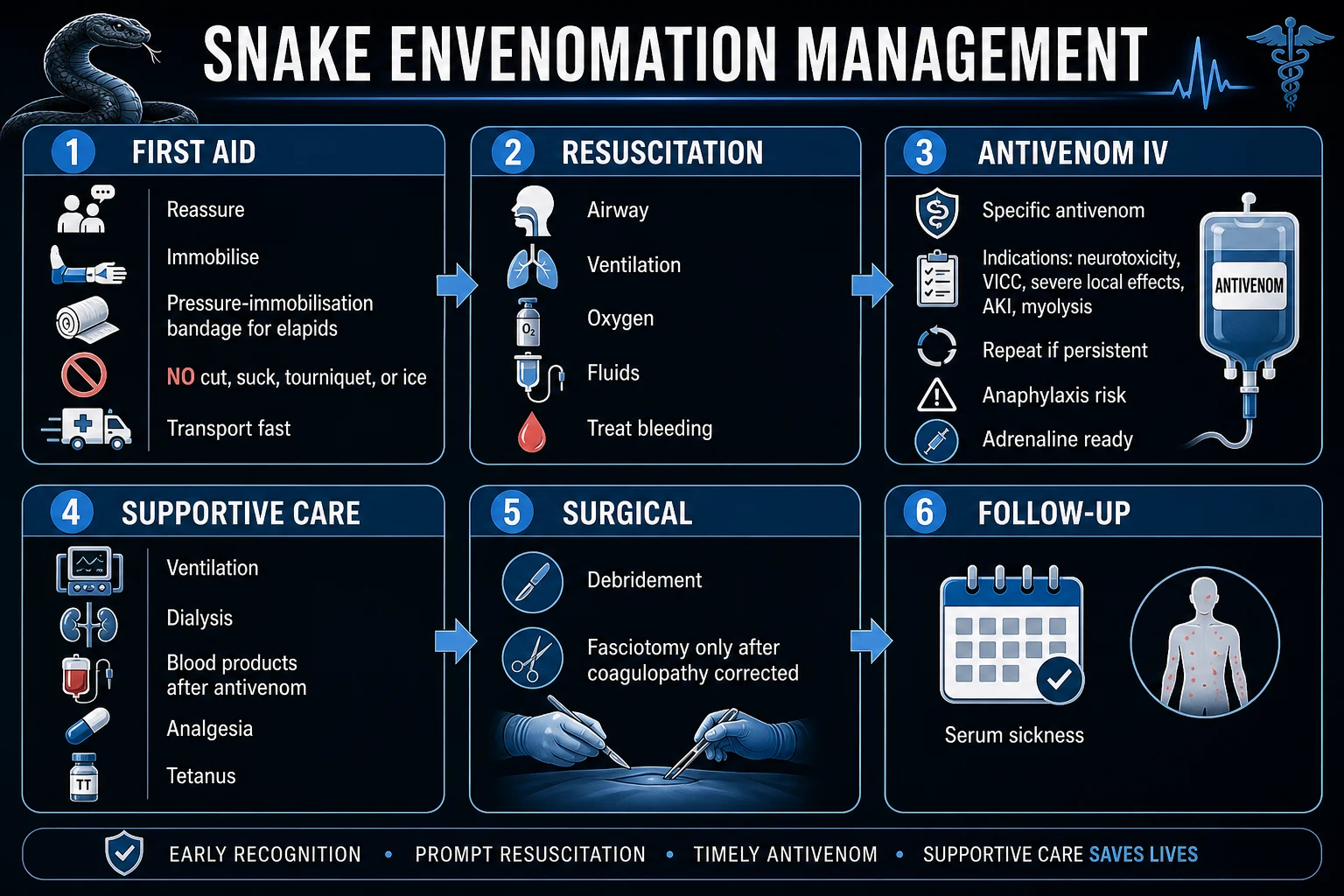
Administering snake antivenom safely in the ICU
Confirm the indication and choose the antivenom
Antivenom is indicated for confirmed systemic envenoming (VICC, neurotoxicity, myotoxicity, renal failure, severe local effects with systemic signs). In Australia use the SVDK to select the MONOVALENT antivenom; if SVDK is unavailable or unclear, use POLYVALENT. Globally, use the region-specific product (e.g. *Bothrops* antivenom, *Echis* antivenom, *Daboia* antivenom).
Prepare for anaphylaxis before drawing up the dose
Antivenom is heterologous equine or ovine immunoglobulin — anaphylaxis occurs in 5–20% (higher with polyvalent, rapid infusion, and prior exposure). Have adrenaline drawn up, IV access secured, oxygen and resuscitation equipment at the bedside. Monitor ECG, BP, SpO₂ throughout.
Decide on premedication — evidence is against routine use
Routine adrenaline premedication is CONTROVERSIAL. A large Sri Lankan RCT showed low-dose subcutaneous adrenaline reduced acute reactions, but it also caused intracerebral haemorrhage in some — so it is not routine in ANZ practice. Antihistamines and steroids do NOT prevent acute (IgE) reactions. Most units give antivenom WITHOUT routine premedication but with everything ready to treat a reaction.
Dilute and infuse slowly
Dilute the antivenom in normal saline (e.g. 1 vial in 100–200 mL for an adult) and infuse over 15–30 minutes — NOT as a rapid bolus. A slower infusion reduces the rate of acute reactions. In children the volume is reduced but the DOSE (number of vials) is the same as for adults.
Monitor the response
Postsynaptic neurotoxicity may begin to reverse within hours. VICC: antivenom halts ongoing consumption within ~6 hours, but the INR stays high for days (hepatic resynthesis). Myotoxicity: CK should stop rising. Repeat the initial dose at 6 hours if there is no improvement or ongoing consumption.
Recognise and treat reactions
Acute (anaphylactic, within 1 hour): STOP the infusion, give IM adrenaline 0.5 mg, IV fluids, oxygen, nebulised salbutamol — once stable, cautiously restart at a slower rate (the antivenom is still needed). Pyrogenic (fever, rigors, within 1–2 hours): slow the rate, paracetamol, meperidine for rigors. Serum sickness (7–14 days): rash, arthralgia, fever — self-limiting; oral prednisolone if severe.
Monovalent vs polyvalent antivenom — the trade-offs
| Feature | Monovalent antivenom | Polyvalent antivenom |
|---|---|---|
| Coverage | One venom group (e.g. brown snake, tiger snake) | All five Australasian groups (brown, tiger, black, death adder, taipan) |
| Selection method | Guided by SVDK result | Given when SVDK unavailable, unclear, or multiple species possible |
| Cost | Lower (1 vial) | Higher (1 vial but more immunoglobulin per vial) |
| Reaction risk | Lower — less foreign protein | Higher — larger protein load |
| When to use | SVDK-positive and single group identified | SVDK negative/unavailable with life-threatening envenoming; do not delay treatment |
| Dose | 1 vial initial (death adder 1 vial; tiger/brown/taipan 1–2; mulga 1) — repeat at 6 h if ongoing consumption | 1 vial initial — repeat as above |
Adrenaline premedication before antivenom — the evidence and the controversy
| Position | Argument | Source / region |
|---|---|---|
| AGAINST routine premedication (ANZ standard) | Antihistamines and steroids do not prevent IgE reactions; reactions are manageable with adrenaline at the bedside; premedication may give false reassurance and delay treatment | Isbister, Johnston — Australian Snakebite Project[1] |
| FOR low-dose adrenaline (Sri Lankan RCT) | Subcutaneous adrenaline 0.25 mg reduced acute reactions to antivenom by ~43% in a large trial of South Asian snakebite | Premawardhena et al. (Sri Lanka); but the trial also reported intracerebral haemorrhage in a few patients |
| Practical compromise | Have adrenaline ready but do NOT routinely premedicate; in high-reaction-rate settings (South Asia, polyvalent, prior exposure) consider low-dose SC adrenaline after weighing bleeding risk (especially VICC) | Rodrigo and Gnanathasan systematic review[9] |
Australian Snakebite Project (ASP) — Johnston et al. 2017 (PMID 28764620)
Study type
Prospective, multicentre registry — the definitive ANZ snakebite dataset, 2005–2015
Population
Over 2 000 patients with snakebite recruited across Australian hospitals, with expert clinical toxinology review and serial laboratory data
Key findings
Brown snakes caused the most envenoming and the most deaths; VICC was the dominant syndrome; presynaptic neurotoxicity (taipan, tiger) was largely irreversible while postsynaptic (death adder) reversed with antivenom; antivenom reactions were common (~25%) but severe anaphylaxis uncommon
Clinical bottom line
Established the modern ANZ approach: SVDK-guided monovalent antivenom, low initial dose (1 vial) with repeat dosing for ongoing VICC, and conservative use of blood products
RCT of antivenom for red-bellied black snake envenomation — Isbister et al. 2024 (PMID 38913734)
Study type
Randomised controlled trial plus prospective cohort — the first properly powered Australian trial of antivenom dose for a specific species
Intervention
Antivenom (tiger snake antivenom, which cross-reacts) vs no antivenom; dose comparison within the antivenom arm — the low-dose vs high-dose antivenom (ASK) question
Key findings
Red-bellied black snake envenoming caused anticoagulant coagulopathy and myotoxicity but was generally self-limiting; antivenom gave only modest benefit and did not clearly prevent myotoxicity — supporting a conservative, low-dose approach for this species
Clinical bottom line
Reinforces the modern low-dose antivenom philosophy: a single initial dose, with repeat dosing only for objective ongoing envenoming, rather than large loading doses
RCT of fresh frozen plasma for VICC — Isbister et al. 2017 (PMID 28106331)
Study type
Randomised controlled trial of FFP vs no FFP in Russell viper envenoming with coagulopathy, Sri Lanka
Intervention
Fresh frozen plasma in addition to antivenom, to accelerate recovery from VICC
Key finding
FFP did NOT significantly speed recovery of coagulopathy over antivenom alone; early FFP was associated with a possible signal of delayed reactions and did not reduce bleeding
Clinical bottom line
Routine FFP does not accelerate VICC recovery — reserve blood products for ACTIVE bleeding or before invasive procedures, not for correcting the numbers
Brown et al. — Clotting factor replacement and recovery from VICC (PMID 19547954)
Study type
Cohort study with serial coagulation sampling, Intensive Care Medicine 2009
Observation
After antivenom, individual clotting factors recovered in order of their half-lives — factor VII (shortest, ~6 h) first, then X, then II (prothrombin, longest)
Key insight
VICC recovery is governed by hepatic resynthesis kinetics, not by the dose of antivenom or blood product given; the INR improves before the fibrinogen fully normalises
Clinical bottom line
Explains why a persistently high INR for 1–3 days after antivenom is EXPECTED and does not indicate treatment failure or a need for more antivenom
Cochrane review — snake antivenom for VICC (PMID 26058967)
Study type
Systematic review (Cochrane), Maduwage and Buckley 2015
Question
Does antivenom improve recovery from snake-venom-induced consumption coagulopathy, and at what dose?
Finding
Antivenom halts ongoing consumption (the rationale for giving it), but the evidence for a dose-response (more vials = faster recovery) was weak and inconsistent; high doses increased the risk of reactions without clearly improving outcome
Clinical bottom line
Supports low-dose initial antivenom (1–2 vials) with repeat dosing only for objective ongoing VICC, rather than empirical high-dose loading
ICU management — syndrome-specific supportive care
ICU management of neurotoxic snake envenoming — the airway-first approach
Establish the trajectory with serial bedside spirometry
Measure FVC, MIP and MEP every 1–2 hours. A falling trend is more important than a single value. Set thresholds for intervention in advance: FVC <15 mL/kg, MIP less negative than −30 cmH₂O, or MEP <40 cmH₂O.
Give antivenom early
Antivenom is most effective within hours of the bite. It reverses postsynaptic (α-)neurotoxicity but cannot reverse presynaptic (β-)terminal damage — so early administration limits the presynaptic injury. Use the SVDK-guided monovalent (or polyvalent if unclear).
Intubate before respiratory arrest
Induce and intubate when thresholds are met or when bulbar weakness (pooled secretions, poor cough) threatens the airway. Use a rapid-sequence technique. Anticipate a difficult airway if jaw/neck muscles are weak — have senior airway support.
Ventilate to normocapnia and protect the lung
Lung-protective ventilation applies. The lungs are structurally normal in neurotoxic envenoming — the failure is pump (muscle) failure. Prolonged ventilation (days to weeks) is expected in presynaptic toxicity; plan early for tracheostomy if weaning is protracted.
Support the patient through the paralytic phase
Analgesia, sedation, DVT prophylaxis (carefully — coagulopathy may contraindicate), pressure-area care, early enteral nutrition, and communication aids (the patient may be fully conscious while paralysed). Avoid depolarising muscle relaxants where possible — they behave unpredictably in denervated muscle.
Wean as the neuromuscular junction recovers
In postsynaptic envenoming this may be within days of antivenom; in presynaptic envenoming it may take weeks. Wean to a T-piece or pressure-support and extubate when FVC >15 mL/kg and bulbar function has returned. Reintubation rates are high — have a low threshold.
Special situations and common exam questions
[1]The five Australian elapid groups and their dominant toxins — Brown Takes Tigers To Death
The descending order of neurotoxic paralysis — POB-RR
Regional variation — why geography dictates the whole algorithm
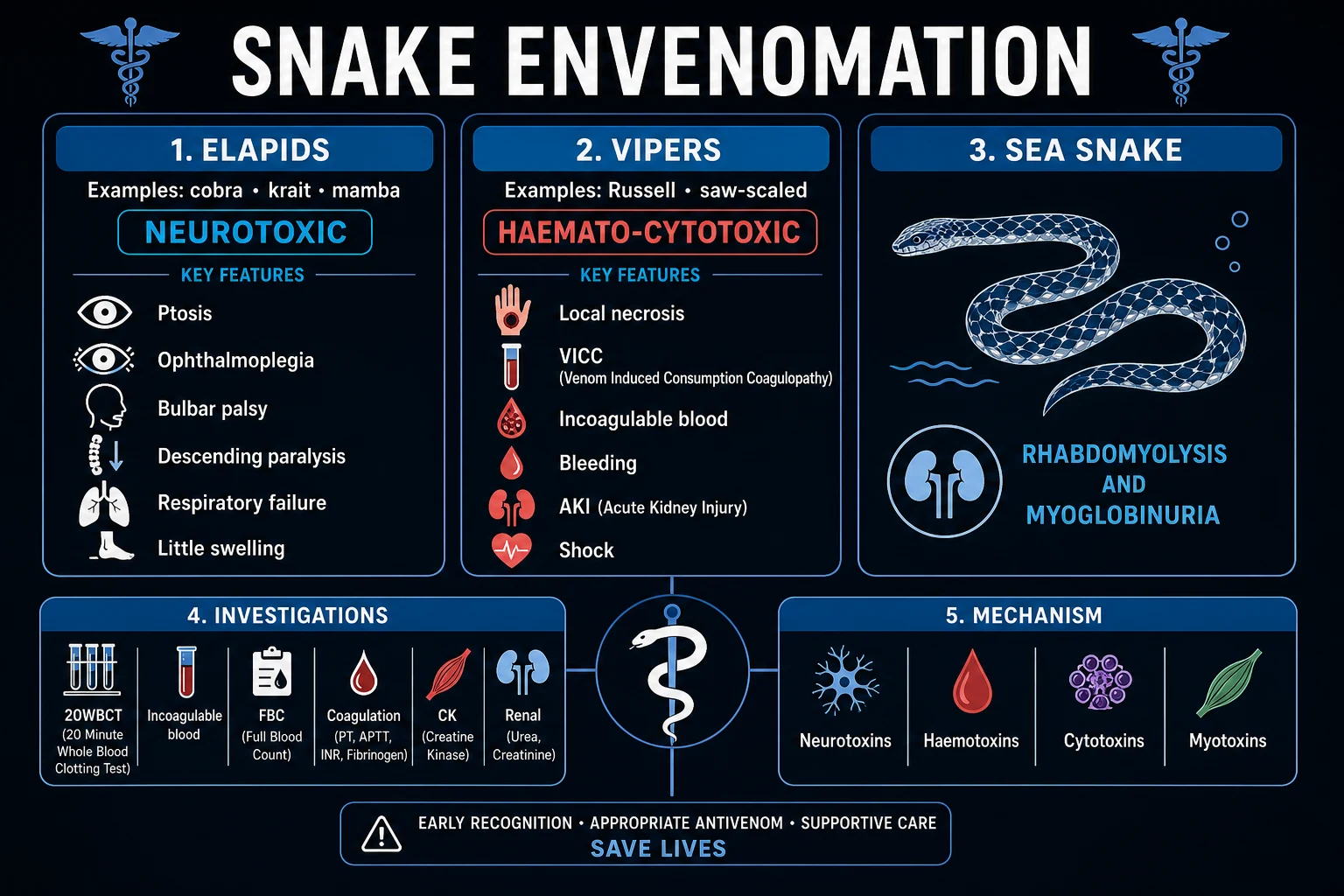
Snake envenoming across regions — the species, the syndrome and the antivenom
| Region | Dominant species | Dominant syndrome | First aid | Antivenom |
|---|---|---|---|---|
| Australia / NZ | Brown, tiger, taipan, death adder, mulga/black | VICC, neurotoxicity, myotoxicity | Pressure immobilisation bandage | Monovalent (SVDK-guided) or polyvalent; low dose |
| South / South-East Asia | Russell viper (Daboia), saw-scaled viper (Echis), cobra (Naja), krait (Bungarus) | VICC, AKI, neurotoxicity, local necrosis | Immobilise; PIB only for neurotoxic elapids (cobra/krait) | Indian polyvalent (cobra, krait, Russell, saw-scaled, Hypnale); higher doses common |
| Sub-Saharan Africa | Puff adder (Bitis arietans), saw-scaled viper (Echis), mamba (Dendroaspis), Naja | Local necrosis, VICC, neurotoxicity (mamba) | Immobilise; PIB for mamba/cobra | Region-specific polyvalent (e.g. EchiTAbG, SAIMR, FAV Afrique) |
| Latin America | Lancehead (Bothrops), rattlesnake (Crotalus), bushmaster (Lachesis) | Local necrosis, VICC, AKI, neurotoxicity (Crotalus) | Immobilise; do NOT use PIB | Bothrops and Crotalus monovalent (Butantan, Instituto Clodomiro Picado) |
| North America | Rattlesnake (Crotalus), copperhead/cottonmouth (Agkistrodon), coral snake (Micrurus) | Local necrosis + cytotoxicity; neurotoxicity (coral snake) | Immobilise; PIB only for coral snake | Crotalidae polyvalent (CroFab); North American coral snake antivenom |
The key principle for the exam: the family (elapid vs viper) determines whether the pressure immobilisation bandage helps or harms, and the species determines which antivenom and which complications to anticipate. A candidate who can map a region to its dominant species and the resulting syndrome has the framework the examiners want.[1][2]
References
- [1]Johnston CI, Ryan NM, Page CB, Buckley NA The Australian Snakebite Project, 2005-2015 (ASP-20) Med J Aust, 2017.PMID 28764620
- [2]Isbister GK, Brown SG, Page CB, McCoubrie DL Snakebite in Australia: a practical approach to diagnosis and treatment Med J Aust, 2013.PMID 24329653
- [3]Maduwage K, Isbister GK Current treatment for venom-induced consumption coagulopathy resulting from snakebite PLoS Negl Trop Dis, 2014.PMID 25340841
- [4]Isbister GK, Jayamanne S, Mohamed F, et al. A randomized controlled trial of fresh frozen plasma for coagulopathy in Russell's viper (Daboia russelii) envenoming J Thromb Haemost, 2017.PMID 28106331
- [5]Brown SG, Caruso N, Isbister GK Clotting factor replacement and recovery from snake venom-induced consumptive coagulopathy Intensive Care Med, 2009.PMID 19547954
- [6]Silva A, Hodgson WC Antivenom for Neuromuscular Paralysis Resulting From Snake Envenoming Toxins (Basel), 2017.PMID 28422078
- [7]Sutherland SK The pressure immobilisation technique Med J Aust, 1994.PMID 7830642
- [8]Maduwage K, Buckley NA Snake antivenom for snake venom induced consumption coagulopathy Cochrane Database Syst Rev, 2015.PMID 26058967
- [9]Rodrigo C, Gnanathasan A Adjunct treatment in snakebite envenoming: a systematic review of randomised controlled trials Trans R Soc Trop Med Hyg, 2020.PMID 32780827
- [10]Isbister GK, Jenkins S, Downes MA, Fakes K, Buckley NA A randomized controlled trial and prospective cohort investigating antivenom for red-bellied black snake envenomation Clin Toxicol (Phila), 2024.PMID 38913734
- [11]Gaus DP, Herrera DF, Troya CJ Management of snakebite and systemic envenomation in rural Ecuador using the 20-minute whole blood clotting test Wilderness Environ Med, 2013.PMID 24119570