ICU · Toxicology
Anticoagulant & Rodenticide (Warfarin & Superwarfarin) Poisoning
Also known as Warfarin overdose · Superwarfarin · Long-acting anticoagulant rodenticide · Brodifacoum · Vitamin K antagonist · VKORC1 · Prothrombin complex concentrate
The vitamin-K-antagonist anticoagulant poisoning — the therapeutic warfarin (the half-life the 40 hours) and the superwarfarin (the long-acting anticoagulant rodenticide — the brodifacoum, the bromadiolone — the half-life the WEEKS to the MONTHS). The inhibition of the vitamin-K-epoxide reductase (the VKORC1) — the impaired the gamma-carboxylation of the factors II, VII, IX, X and the proteins C and S — the coagulopathy. The bleeding. The vitamin K (the phytomenadione), the 4-factor prothrombin-complex concentrate for the active bleeding, and the prolonged (the weeks-to-the-months) vitamin K for the superwarfarin.
On this page & tools
Your progress
Saved locally on this device.
Target exams
Overview & definition
The vitamin-K-antagonist anticoagulants — the therapeutic warfarin and the superwarfarin long-acting anticoagulant rodenticides (the LAARs — the brodifacoum, the bromadiolone, the difenacoum, the difethialone) — produce the coagulopathy by the inhibition of the vitamin-K-epoxide reductase (the VKORC1). The warfarin is the manageable (the half-life the 40 h); the superwarfarin is the prolonged and the dangerous (the half-life the weeks to the months) and the demands the weeks-to-the-months of the vitamin K.[1][1]

The mechanism
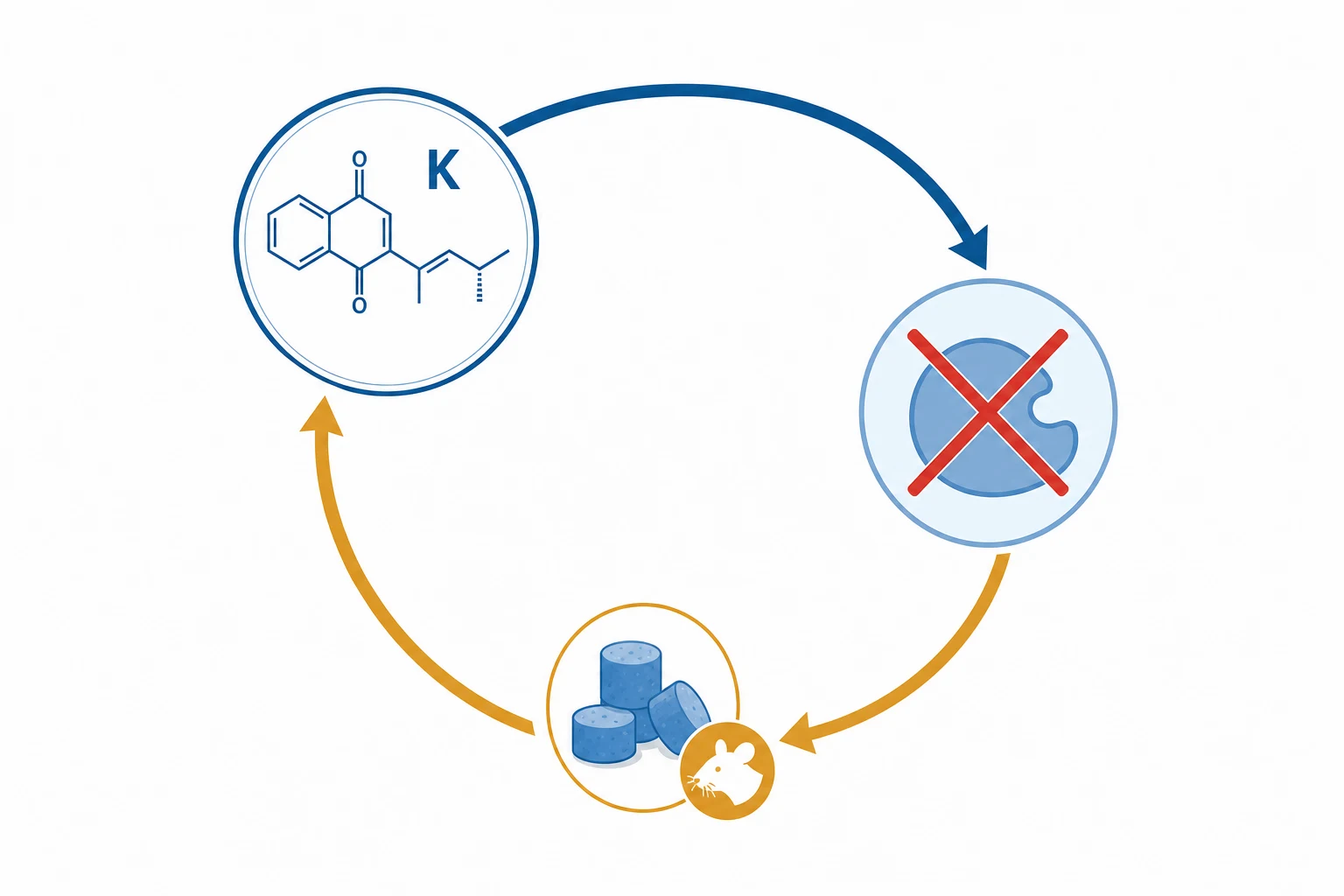
The warfarin and the superwarfarin inhibit the vitamin-K-epoxide reductase (the VKORC1) — the enzyme that the recycles the vitamin K (the epoxide → the active hydroquinone). Without the active vitamin K, the gamma-carboxylation of the vitamin-K-dependent clotting factors (the II / prothrombin, the VII, the IX, the X) and the natural anticoagulants (the proteins C and S) is the impaired — the factors the produced but the non-functional (the no the calcium-binding, the no the activation).[1][1]
The warfarin versus the superwarfarin
- The warfarin — the therapeutic, the half-life the 40 hours. The acute overdose or the supratherapeutic. The coagulopathy the manageable over the days; the vitamin K the several days.[1]
- The superwarfarin (the LAARs — the brodifacoum, the bromadiolone) — the rodenticide. The half-life the weeks to the months (the hepatic accumulation, the high lipid solubility). The prolonged, the severe coagulopathy. The demands the weeks-to-the-months of the high-dose vitamin K (the sometimes the months to the year). The risk of the relapse if the vitamin K the stopped early.[1]
The clinical
- The bleeding — the any site. The mucosal (the epistaxis, the gingival), the GI (the melaena, the haematemesis), the genitourinary (the haematuria), the intracranial (the dangerous), the soft-tissue (the bruising, the haematoma).[1][1]
- The coagulation — the PT/INR the markedly prolonged (the INR often the above 10; the sometimes the unmeasurable). The aPTT the prolonged (the less). The factors the reduced.
- The history — the occupational (the pest-control), the intentional (the self-harm, the Munchausen, the sabotage), the accidental (the child, the pet bait). The "the unexplained coagulopathy" — the suspect the superwarfarin.[1]
The investigation
- The PT/INR — the markedly prolonged; the thrombin time the normal (the distinguishes from the dabigatran / the heparin). The factors (the II, VII, IX, X the reduced).[1]
- The serum warfarin / the brodifacoum level (the qualitative; the not the routine but the confirmatory for the superwarfarin).
- The FBC (the anaemia from the bleeding), the platelet (the normal — the distinguishes from the thrombocytopenia), the cross-match (the transfusion).[1][1]
- The imaging (the CT brain for the intracranial; the imaging for the occult bleeding).[1]
Treatment
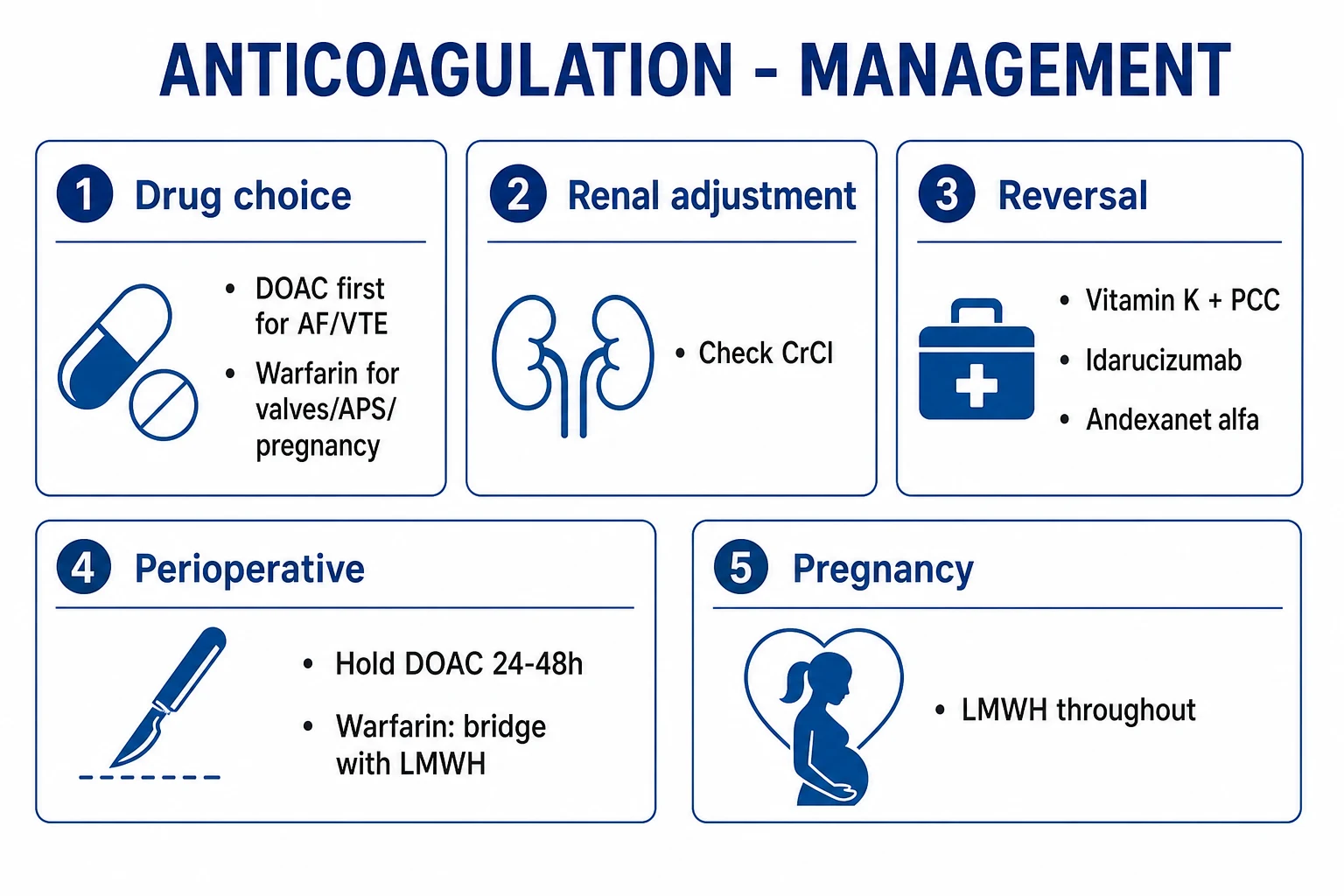
1. The active, the life-threatening bleeding — the immediate reversal.[2][1][1]
- The 4-factor prothrombin-complex concentrate (the PCC) IV (the 25 to 50 units/kg) — the fastest, the most-effective; the reconstitutes the factors immediately. The preferred over the FFP (the faster, the smaller-volume, the more-effective).[2]
- The IV vitamin K1 (the phytomenadione, the 10 mg IV slowly) — the restores the factor SYNTHESIS (the onset the 6 to 12 h; the peak the 24 h). The given WITH the PCC (the PCC the immediate, the vitamin K the sustained).[1]
- The FFP (the 15 mL/kg) if the PCC the unavailable. The larger-volume, the slower.[1]
- The transfusion (the red cells for the anaemia; the platelets if the thrombocytopenia).[1]
2. No the active bleeding, the INR elevated — the vitamin K.[1][1]
- The oral vitamin K1 (the 1 to 5 mg) for the INR the mildly elevated; the IV for the higher. The hold the warfarin.
- The monitor the INR; the titrate.[1]
3. The superwarfarin — the prolonged vitamin K.[1]
- The high-dose vitamin K1 (the oral, the sometimes the IV; the 50 to 100 mg/day) for the weeks to the months — the superwarfarin the half-life the weeks-to-the-months. The relapse if the stopped early. The monitor the INR throughout. The sometimes the year-long course.[1]
- The psychosocial (the intentional — the self-harm, the Munchausen).[1]
The Direct Oral Anticoagulants (the DOACs) — the dabigatran, the apixaban, the rivaroxaban, the edoxaban
The direct oral anticoagulants (the DOACs) — the direct thrombin inhibitor (the dabigatran) and the direct factor-Xa inhibitors (the apixaban, the rivaroxaban, the edoxaban) — the increasingly the supplant the warfarin (the no the routine the monitoring, the predictable the pharmacokinetics, the fewer the interactions). The DOAC overdose (the accidental, the supratherapeutic, the intentional, the renal the failure) the produces the bleeding the indistinguishable from the warfarin — the mucosal, the GI, the intracranial. The reversal the agent-specific: the idarucizumab (the Praxbind) for the dabigatran; the andexanet alfa (the Andexxa / the Ondexxya) for the apixaban / the rivaroxaban; the 4-factor PCC (the 50 IU/kg) for the apixaban / the rivaroxaban if the andexanet the unavailable; the FFP the no the role (the ineffective for the DOAC).[3][4][9]
The DOAC the half-life the 5-17 h (the shorter the warfarin); the renal the dabigatran (the 80 per cent the renal — the dialysis the removes), the mixed the apixaban / the edoxaban (the 25-50 per cent the renal), the hepatic-biliary the rivaroxaban (the 33 per cent the renal, the 66 per cent the hepatic). The renal the failure the prolongs the half-life (the dabigatran the 30 h the dialysis-dependent) — the dialysis the removes the dabigatran (the 50-60 per cent; the NOT the apixaban / the rivaroxaban — the protein-bound the 87-95 per cent).[6][9]
The DOACs — the pharmacology and the reversal
| Agent | The target | The half-life (h) | The renal clearance | The dialysis the removed | The antidote |
|---|---|---|---|---|---|
| The dabigatran (Pradaxa) | The thrombin (the IIa) | 12-17 | The 80% the renal | The YES (the 50-60%) | The idarucizumab (5 g IV) |
| The rivaroxaban (Xarelto) | The factor Xa | 5-13 | The 33% (the 66% the hepatic) | The NO (the protein-bound) | The andexanet / the 4F-PCC |
| The apixaban (Eliquis) | The factor Xa | 8-15 | The 25-30% | The NO (the protein-bound) | The andexanet / the 4F-PCC |
| The edoxaban (Lixiana) | The factor Xa | 10-14 | The 50% | The NO (the protein-bound) | The andexanet / the 4F-PCC |
| The warfarin (the reference) | The VKORC1 | 40 | The metabolised | The NO | The 4F-PCC + the vitamin K |
The DOAC — the laboratory (the drug-specific, the NOT the INR)
The PT/INR and the aPTT the unreliable the DOAC — the apixaban the often the normal the PT; the dabigatran the variably the prolongs the aPTT. The DOAC the NOT the monitored (the predictable the pharmacokinetics — the no the routine the level). The DOAC-specific the assays the required for the confirmatory:[4][6]
- The dabigatran — the dilute thrombin time (the dTT) or the ecarin clotting time (the ECT); the sensitive the quantitative. The standard the thrombin time the too the sensitive (the near-infinite the high the concentration). The anti-IIa the calibrated.
- The apixaban / the rivaroxaban / the edoxaban — the anti-Xa the calibrated (the drug-specific the calibration — the apixaban the anti-Xa ≠ the rivaroxaban the anti-Xa). The NOT the heparin the anti-Xa (the over-estimates the DOAC). The level > 50 ng/mL the bleeding the threshold.
- The "the < 50 ng/mL" the rule — the if the DOAC the level < 50 ng/mL AND the no the life-threatening the bleed, the supportive the management (the no the antidote the required). The drug the below the therapeutic the range. [1]
The DOAC reversal — the agents (the idarucizumab, the andexanet, the PCC)
1. The idarucizumab (the Praxbind) — the dabigatran
The idarucizumab — the humanised the monoclonal-antibody the Fab fragment — the binds the dabigatran with the 350-fold the higher the affinity than the dabigatran the binds the thrombin. The 1:1 the stoichiometric the binding; the immediate the neutralisation (the within the minutes). The 5 g IV (the 2 × 2.5 g the vials, the 5 min the apart; the two the boluses or the rapid the infusion). The peak the reversal the within the 15 min. The dialysis the not the required (the idarucizumab the removes the dabigatran from the circulation; the extravascular the dabigatran the redistributes — the occasionally the second the dose).[3]
The RE-VERSE AD the trial (the Pollack et al. 2017) — the prospective the single-arm the cohort of the 503 the dabigatran-treated the patients with the serious the bleeding or the requiring the urgent the procedure. The idarucizumab 5 g IV the reversed the dabigatran the anticoagulant the activity in the 88-98 per cent the immediately (the dTT the normalised; the ECT the normalised). The thrombotic the events the 4.8 per cent (the 90-day); the 19 per cent the 90-day the mortality (the serious-the-bleed the population).[3]
2. The andexanet alfa (the Andexxa / the Ondexxya) — the apixaban, the rivaroxaban
The andexanet alfa — the recombinant the modified the factor Xa — the catalytically the inactive (the serine-the-protease the domain the mutation) but the retains the Gla-domain the binding. The acts as the decoy — the binds the apixaban / the rivaroxaban (the competitive the sequestration) the AND the releases the tissue-factor-pathway the inhibitor (the TFPI) → the enhanced the thrombin the generation. The 2-min the onset. The low dose (the 400 mg IV bolus at the 30 mg/min then the 4 mg/min × 120 min) for the apixaban the any-dose or the rivaroxaban ≤ 10 mg, the LAST the dose > 8 h; the high dose (the 800 mg bolus then the 8 mg/min × 120 min) for the rivaroxaban > 10 mg or the unknown, the LAST the dose < 8 h. The andexanet the also the reverses the enoxaparin (the LMWH).[4][5]
The ANNEXA-4 the trial (the Connolly et al. 2019) — the single-arm the prospective of the 352 the patients with the apixaban / the rivaroxaban the major the bleeding. The andexanet the reduced the anti-Xa the activity by the 92 per cent; the excellent the haemostasis the 82 per cent at the 12 h. The thrombotic the events the 10 per cent (the 30-day) — the higher the than the idarucizumab. The rebound the anti-Xa the activity after the infusion the ends (the unbound the drug the redistributes) — the re-bleeding the risk.[4]
The ANNEXA-A and the ANNEXA-R (the Siegal et al. 2015) — the randomised the placebo-the-controlled (the healthy the older the volunteers). The andexanet the immediately the reversed the apixaban (the ANNEXA-A) and the rivaroxaban (the ANNEXA-R) the anti-Xa the activity; the no the serious the adverse.[5]
3. The 4-factor PCC — the apixaban, the rivaroxaban, the edoxaban (the if the andexanet the unavailable)
The 4-factor PCC (the 50 IU/kg IV) — the surrogate the reversal for the factor-Xa the inhibitors when the andexanet the unavailable (the expensive, the limited the supply, the not the stocked the all the hospitals). The mechanism: the overwhelming the factor the load (the II, the VII, the IX, the X — the more the factor than the inhibitor the can the bind). The 50 IU/kg the typical (some the 25-50 IU/kg). The improves the thrombin the generation the surrogate (the ETP) the NOT the anti-Xa (the does NOT the neutralise the drug — the overwhelms).[7][9]
The the andexanet versus the PCC the debate — the andexanet the more the effective (the true the neutralisation) but the higher the thrombosis and the expensive; the PCC the cheaper, the stocked, the modest the effect but the widely the used. The 2024 the ACC/AHA the guidance the prefer the andexanet for the apixaban / the rivaroxaban the life-threatening the bleed; the 4-factor PCC the 50 IU/kg the if the andexanet the unavailable.[1]
The warfarin reversal — the detailed protocol (the 4-factor PCC + the vitamin K + the FFP)
The warfarin (and the superwarfarin) the reversal the two-pronged: the immediate the factor the repletion (the 4-factor PCC; the FFP the alternative) PLUS the sustained the factor the synthesis (the IV vitamin K1 10 mg). The PCC the alone the insufficient — the factors the short the half-life (the 6 h for the factor VII) — the INR the rebounds the 12-24 h the without the vitamin K. The vitamin K the alone the too the slow (the onset the 6-12 h) for the active the bleed. The both the together.[2][7]
The 4-factor PCC the dosing — the INR-based (the weight-based):
- The INR 2-4 — the 25 IU/kg (the Beriplex P / the Kcentra; the Octaplex; the Cofact; the max the 2,500 IU).
- The INR 4-6 — the 35 IU/kg (the max the 3,500 IU).
- The INR > 6 — the 50 IU/kg (the max the 5,000 IU). [1]
The 4-factor PCC (the Beriplex P / the Kcentra; the Octaplex; the Cofact) the contains the factors II, the VII, the IX, the X (the 4-factor; the proteins C and S the variable). The reconstitutes the factors the immediately (the within the minutes). The INR the recheck the 30 min the post — the repeat the dose if the INR the still the above the target.[2][8]
The vitamin K1 (the phytomenadione) the 10 mg IV — the SLOWLY (the over the 20-30 min; the NOT the bolus — the anaphylactoid). The restores the factor the synthesis (the gamma-carboxylation). The onset the 6-12 h; the peak the 24 h; the full the effect the 48-72 h. The given the WITH the PCC (the PCC the immediate; the vitamin K the sustained — the prevents the rebound).[1][1]
The FFP (the 15 mL/kg; the 4 units) — the if the PCC the unavailable. The larger the volume (the 1 L the typical), the slower (the thawing, the infusion the time), the less the effective (the factor the concentration the low; the factor VII the labile). The risk the TRALI, the TACO, the pathogen the transmission. The PCC the preferred the whenever the available.[2][1]
The reversal agent — the comparison (the DOAC and the warfarin)
The reversal agent — the DOAC and the warfarin (the full the landscape)
| The agent | The drug the reversed | The mechanism | The dose | The onset | The thrombotic the risk | The notes |
|---|---|---|---|---|---|---|
| The idarucizumab | The dabigatran | The Fab the sequesters the dabigatran (the 1:1; the 350× the affinity) | 5 g IV (the 2 × 2.5 g) | The immediate (the min) | The low (the 4.8% the 90-day) | The dialysis the not the required |
| The andexanet alfa | The apixaban / the rivaroxaban / the edoxaban / the LMWH | The decoy the factor Xa (the sequesters; the releases the TFPI) | The low (400/480 mg) or the high (800/960 mg) | The 2 min | The moderate (the 10% the 30-day) | The expensive; the limited the supply |
| The 4-factor PCC | The warfarin (the 25-50 IU/kg); the DOAC the FXa the surrogate (the 50 IU/kg) | The factor the repletion (the II, VII, IX, X) | 25-50 IU/kg (the INR-based) | The immediate (the min) | The moderate (the 3-7%) | The stocked; the cheaper; the + vitamin K for the warfarin |
| The activated PCC (the FEIBA) | The DOAC the FXa (the if the andexanet / the PCC the unavailable) | The activated the factors (the IIa, the Xa) | 50 IU/kg | The immediate | The higher (the thrombosis) | The second-line |
| The vitamin K1 | The warfarin / the superwarfarin | The restores the gamma-carboxylation | 10 mg IV (the slow); 50-100 mg PO for the superwarfarin | 6-12 h (the peak the 24 h) | The none (the procoagulant) | The sustained; the NOT the alone for the active the bleed |
| The FFP | The warfarin (the if the PCC the unavailable) | The factor the repletion (the dilute) | 15 mL/kg (the 4 units) | The slow (the 30-60 min) | The TRALI / the TACO | The large the volume; the inferior |
The reversal algorithm — by the drug and the bleeding severity
The anticoagulant-reversal algorithm — the by the drug and the bleeding severity
- THE IMMEDIATE — the airway, the breathing, the circulation; the source the control. The resuscitate (the IV access; the fluids; the transfuse for the haemorrhagic the shock). The cross-match. The imaging for the occult (the CT brain for the ICH; the CTA for the active). The identify the specific the drug (the dabigatran, the apixaban, the rivaroxaban, the warfarin, the superwarfarin). The last the dose the time.
- THE DRUG — the identify the specific the agent. The dabigatran → the idarucizumab 5 g IV. The apixaban / the rivaroxaban → the andexanet (the low or the high dose by the drug and the time) OR the 4-factor PCC 50 IU/kg if the andexanet the unavailable. The warfarin → the 4-factor PCC 25-50 IU/kg (the INR-based) + the IV vitamin K 10 mg. The superwarfarin → the 4-factor PCC + the IV vitamin K 10 mg the loading THEN the high-dose the oral the vitamin K 50-100 mg/day for the months.
- THE LIFE-THREATENING the BLEEDING (the ICH, the massive the GI, the haemoperitoneum). The immediate the reversal — the do NOT the wait for the drug the level. The dabigatran → the idarucizumab 5 g IV. The apixaban / the rivaroxaban → the andexanet the high-dose (the if < 8 h the last the dose) or the low-dose (the apixaban the any-dose). The 4-factor PCC 50 IU/kg if the andexanet the unavailable. The warfarin → the 4-factor PCC 25-50 IU/kg + the IV vitamin K 10 mg. The FFP 15 mL/kg if the PCC the unavailable.
- THE NON-LIFE-THREATENING the BLEEDING (the minor the GI, the haematuria, the epistaxis). The assess the drug the level (the DOAC the anti-Xa / the dTT; the warfarin the INR). The DOAC < 50 ng/mL → the supportive (the no the antidote). The DOAC > 50 ng/mL → the local the consensus (the andexanet / the PCC / the conservative). The warfarin → the vitamin K (the oral the 1-5 mg for the INR the mild; the IV the 10 mg for the INR the high).
- THE URGENT the PROCEDURE / the SURGERY (the no the active the bleed). The DOAC → the delay the procedure to the ≥ 2 × the half-life (the 24-48 h the dabigatran; the 24 h the apixaban / the rivaroxaban); the idarucizumab / the andexanet if the urgent (the < 24 h). The warfarin → the 4-factor PCC + the IV vitamin K if the urgent; the vitamin K the alone if the ≥ 24 h.
- THE RE-ANTICOAGULATION the AFTER the REVERSAL (the thrombosis the risk). The idarucizumab the binds the dabigatran only (the not the new); the re-start the dabigatran the when the bleeding the controlled (the 24-72 h). The andexanet the thrombosis the risk the higher (the 10%); the start the heparin / the LMWH when the bleeding the controlled (the 5-7 days). The warfarin the PCC the thrombosis the 3-7%; the bridge the heparin if the high the thrombotic. The do NOT the leave the anticoagulated the patient the unprotected — the assess the thrombotic the risk.
- THE RE-ASSESS the INR / the DRUG the LEVEL the 30 min the POST the PCC. The repeat the PCC if the INR the still the above the target (the 4-factor PCC the factors the short the half-life; the INR the rebounds the 12-24 h the without the vitamin K). The DOAC the anti-Xa the re-check the 4-12 h the post the andexanet (the rebound the unbound the drug the redistributes).
- THE PSYCHOSOCIAL — the intentional (the self-harm, the Munchausen, the sabotage). The superwarfarin the intentional — the psychiatric the assessment; the high-dose the vitamin K the months; the relapse the risk (the hidden the bait, the re-exposure). The safeguarding.
The time-to-offset — the drug still present after the reversal
The DOAC the still the present after the reversal — the idarucizumab the binds the dabigatran in the circulation (the extravascular the dabigatran the redistributes; the occasionally the second the dose the 12-24 h). The andexanet the short the half-life (the 1 h); the infusion the ends → the rebound the anti-Xa (the unbound the drug the redistributes from the extravascular). The PCC the factors the short the half-life (the factor VII the 6 h) — the INR the rebounds the 12-24 h. The the patient the still the anticoagulated — the monitor, the re-assess, the re-dose.[3][4][1]
The special situations
- The intracranial the haemorrhage (the ICH) — the most-feared. The immediate the reversal (the PCC + the vitamin K for the warfarin; the idarucizumab / the andexanet for the DOAC). The PCC the faster than the FFP (the improved the outcome in the ICH — the Steiner the 2016 the INCH). The systolic the BP < 140. The neurosurgery. The thrombotic the risk the managed the post.[8][1]
- The massive the GI the bleed — the source the control (the endoscopy / the colonoscopy / the angioembolisation). The reversal (the PCC for the warfarin; the idarucizumab / the andexanet for the DOAC). The transfusion (the RBC, the platelet if the anti-platelet).
- The peri-operative / the urgent the surgery — the DOAC the delay the 24-48 h (the 2 × the half-life); the reversal if the urgent. The warfarin the PCC + the vitamin K.
- The traumatic the bleed — the massive the transfusion the protocol; the tranexamic the acid (the 1 g IV); the reversal of the anticoagulant. The trauma the team; the damage-control the surgery.
- The pregnancy — the warfarin the teratogenic (the first the trimester); the DOAC the contraindicated. The heparin / the LMWH the preferred. The reversal the heparin the protamine; the LMWH the protamine the partial.
- The renal the failure — the dabigatran the accumulates (the 80% the renal); the dialysis the removes. The apixaban / the rivaroxaban the protein-bound the dialysis the ineffective. The idarucizumab for the dabigatran the dialysis-dependent.
Prognosis
The warfarin overdose is the survivable with the vitamin K and the PCC; the mortality driven by the bleeding (the intracranial). The superwarfarin is the prolonged (the weeks-to-the-months) but the survivable with the prolonged vitamin K. The relapse the risk if the vitamin K the stopped early. The Munchausen / the sabotage the recurring.[1][1][1]
Red flags
SAQ — Warfarin overdose with intracranial haemorrhage
10 minutes · 10 marks
A 74-year-old man on warfarin 5 mg/day for non-valvular AF (CHA₂DS₂-VASc 4) presents with a 2-hour history of headache and progressive left hemiparesis. GCS 12, INR 8.7 (target 2–3), CT brain shows a 35 mL right parietal intracerebral haematoma with midline shift. He has no history of a recent fall.
SAQ — Superwarfarin (brodifacoum) poisoning — chronic coagulopathy
10 minutes · 10 marks
A 41-year-old pest-control worker presents with gross haematuria, epistaxis and a thigh haematoma. INR >15, aPTT 80 s, fibrinogen normal, platelets normal, liver function normal, no warfarin prescription. He admits to chronic occupational brodifacoum exposure. Brodifacoum level is qualitatively positive.
Clinical pearls
Key trials and evidence
Pollack, Reilly, Eikelboom et al. 2017 — RE-VERSE AD: idarucizumab for dabigatran reversal (PMID 27346474)
Source
New England Journal of Medicine — the prospective the single-arm the cohort (the 503 the patients)
Key principle 1
The idarucizumab 5 g IV the reversed the dabigatran the anticoagulant the activity in the 88-98 per cent the immediately (the dTT the normalised)
Key principle 2
The 5 g (the 2 × 2.5 g) the two the boluses or the rapid the infusion; the peak the reversal the within the 15 min
Key principle 3
The thrombotic the events the 4.8 per cent (the 90-day); the 19 per cent the 90-day the mortality (the serious-the-bleed the population)
Clinical bottom line
The idarucizumab 5 g IV the specific the dabigatran the immediate the reversal — the first the specific the DOAC the antidote
Connolly, Milling, Eikelboom et al. 2019 — ANNEXA-4: andexanet alfa for factor-Xa inhibitor reversal (PMID 31157462)
Source
New England Journal of Medicine — the single-arm the prospective (the 352 the patients with the apixaban / the rivaroxaban the major the bleed)
Key principle 1
The andexanet the reduced the anti-Xa the activity the 92 per cent; the excellent the haemostasis the 82 per cent at the 12 h
Key principle 2
The low dose (400 mg bolus then 4 mg/min × 120 min) for the apixaban the any-dose or the rivaroxaban ≤ 10 mg, the last the dose > 8 h
Key principle 3
The high dose (800 mg bolus then 8 mg/min × 120 min) for the rivaroxaban > 10 mg or the unknown, the last the dose < 8 h
Key principle 4
The thrombotic the events the 10 per cent (the 30-day) — the higher the than the idarucizumab; the rebound the anti-Xa the post the infusion
Clinical bottom line
The andexanet the effective the apixaban / the rivaroxaban the reversal but the 10% the thrombosis and the expensive — the balance the risk
Siegal, Curnutte, Connolly et al. 2015 — ANNEXA-A and ANNEXA-R: andexanet for factor-Xa inhibitor reversal (PMID 25730862)
Source
New England Journal of Medicine — the randomised the placebo-the-controlled (the healthy the older the volunteers)
Key principle 1
The andexanet the recombinant the modified the factor Xa (the decoy) — the catalytically the inactive but the Gla-domain the retained
Key principle 2
The immediately the reversed the apixaban (the ANNEXA-A) and the rivaroxaban (the ANNEXA-R) the anti-Xa the activity; the no the serious the adverse
Clinical bottom line
The proof-of-the-concept — the andexanet the sequesters the apixaban / the rivaroxaban (the decoy) — the foundation the ANNEXA-4
Sarode, Milling, Refaai et al. 2013 — 4-factor PCC (Beriplex / Kcentra) vs FFP for warfarin reversal (PMID 23674567)
Source
New England Journal of Medicine — the phase-3 the randomised the open-label (the 202 the patients with the acute the major the bleeding)
Key principle 1
The 4-factor PCC (the Beriplex / the Kcentra) the INR-based the dose (the 25-50 IU/kg) the vs the FFP (the 15 mL/kg)
Key principle 2
The PCC the superior the INR the correction (the 62% the vs the 9% within the 30 min the < 1.5) AND the faster AND the smaller the volume
Key principle 3
The effective the haemostasis the 72 per cent (the PCC) the vs the 67 per cent (the FFP); the thrombotic the events the similar
Clinical bottom line
The 4-factor PCC the preferred the over the FFP for the urgent the warfarin the reversal — the faster, the more the effective, the smaller the volume
Steiner, Poli, Griebe et al. 2016 — INCH trial: PCC vs FFP for warfarin-related ICH (PMID 26759149)
Source
The Lancet Neurology — the randomised the controlled (the 50 the patients with the warfarin-associated the ICH)
Key principle 1
The 4-factor PCC the superior the INR the normalisation the within the 3 h (the 67% the vs the 9% the FFP)
Key principle 2
The haematoma the expansion the less (the PCC the trend)
Key principle 3
The trial the stopped the early (the PCC the clear the benefit)
Clinical bottom line
The PCC the preferred the over the FFP for the warfarin-associated the ICH
Tomaselli, Mahaffey, Cuker et al. 2020 — ACC Expert Consensus Decision Pathway on Management of Bleeding in Patients on Oral Anticoagulants (PMID 31867256)
Source
Journal of the American College of Cardiology — the multidisciplinary the consensus the pathway
Key principle 1
The drug-specific the reversal — the dabigatran the idarucizumab; the apixaban / the rivaroxaban the andexanet (the 4-factor PCC 50 IU/kg if the unavailable); the warfarin the 4-factor PCC + the IV vitamin K
Key principle 2
The DOAC the level < 50 ng/mL — the supportive (the no the antidote); the > 50 ng/mL — the reversal if the major the bleed
Key principle 3
The re-anticoagulation the 7-14 days the assessment (the balance the bleeding the vs the thrombosis); the individualise
Clinical bottom line
The comprehensive the modern the reversal the guidance — the drug-specific, the andexanet the preferred the factor-Xa, the PCC + the vitamin K the warfarin
Frontera, Lewin, Chiu, Moss et al. 2024 — Guideline for Reversal of Antithrombotics in Intracranial Hemorrhage (AHA / ASA / ACC / SCCM)
Source
Stroke — the comprehensive the multidisciplinary the guideline (the 2024)
Key principle 1
The immediate the reversal the all the anticoagulant-related the ICH — the drug-specific
Key principle 2
The dabigatran the idarucizumab 5 g; the apixaban / the rivaroxaban the andexanet (the 4-factor PCC 50 IU/kg the acceptable alternative)
Key principle 3
The warfarin the 4-factor PCC 25-50 IU/kg + the IV vitamin K 10 mg; the FFP only the if the PCC the unavailable
Key principle 4
The re-start the anticoagulation the 7-14 days the high the thrombotic the risk (the mechanical the valve the earliest)
Clinical bottom line
The ICH the reversal the drug-specific and the immediate; the andexanet / the idarucizumab the DOAC; the PCC + the vitamin K the warfarin
Caravati, Weibe, Palmer, Bullard & Brown 2015 — Long-Acting Anticoagulant Rodenticide (Superwarfarin) Poisoning Review (PMID 26239439)
Source
Transfusion Medicine Reviews — the comprehensive the review
Key principle 1
The superwarfarin (the brodifacoum, the bromadiolone) the half-life the 16-200 days — the hepatic the accumulation, the high the lipid the solubility
Key principle 2
The demands the high-dose the oral the vitamin K (the 50-100 mg/day) for the weeks-to-the-months (the sometimes the year); the relapse if the stopped the early
Key principle 3
The intentional (the Munchausen, the self-harm, the sabotage) the common; the psychosocial the assessment the essential
Clinical bottom line
The superwarfarin the months of the vitamin K — the NOT the short course; the screen the unexplained the coagulopathy
References
- [1]Caravati EM, et al. Long-Acting Anticoagulant Rodenticide (Superwarfarin) Poisoning: A Review of Its Historical Development, Epidemiology, and Clinical Management Transfus Med Rev, 2015.PMID 26239439
- [2]Hunt BJ, et al. Prothrombin complex concentrate for vitamin K antagonist reversal in acute bleeding settings: efficacy and safety Expert Rev Hematol, 2019.PMID 31159607
- [3]Pollack CV, Reilly PA, Eikelboom JW, et al. [Prevalence and predisposing factors of methicillin-resistant Staphylococcus aureus in long-term care facilities. An international view] Orv Hetil, 2016.PMID 27346474
- [4]Connolly SJ, Milling TJ Jr, Eikelboom JW, et al. Atomic-Level Customization of 4 in. Transition Metal Dichalcogenide Multilayer Alloys for Industrial Applications Adv Mater, 2019.PMID 31157462
- [5]Siegal DM, Curnutte JT, Connolly SJ, et al. In vivo NAD assay reveals the intracellular NAD contents and redox state in healthy human brain and their age dependences Proc Natl Acad Sci U S A, 2015.PMID 25730862
- [6]Cuker A, Burnett A, Triller D, Crowther M, Ansell J, Van Cott EM, et al. An overview of neural networks for drug discovery and the inputs used Expert Opin Drug Discov, 2018.PMID 30449189
- [7]Sarode R, Milling TJ Jr, Refaai MA, Mangione A, Schneider A, Durn BL, Goldstein JN An indicator of probable semicircular canal dehiscence: ocular vestibular evoked myogenic potentials to high frequencies Otolaryngol Head Neck Surg, 2013.PMID 23674567
- [8]Steiner T, Poli S, Griebe M, Hüsing J, Hajda J, Pabst W, et al. Maternal postpartum high-dose vitamin D3 supplementation (6400 IU/day) or conventional infant vitamin D3 supplementation (400 IU/day) lead to similar vitamin D status of healthy exclusively/fully breastfeeding infants by 7 months of age Evid Based Med, 2016.PMID 26759149
- [9]Tomaselli GF, Mahaffey KW, Cuker A, Dobesh PP, Doherty JU, Eikelboom JW, et al. Intra-auricular modification of facelift incision decreased the risk of Frey syndrome Tzu Chi Med J, 2019.PMID 31867256