ICU · Toxicology
Beta-Blocker & Calcium-Channel-Blocker Overdose
Also known as Calcium channel blocker overdose · Beta blocker overdose · Verapamil poisoning · High-dose insulin therapy · HIET · Hyperinsulinaemic euglycaemia
The cardiovascular drug overdose — the beta-blocker (the bradycardia, the AV block, the negative inotropy, the bronchospasm) and the calcium-channel-blocker (the non-dihydropyridine — the verapamil, the diltiazem — like the beta-blocker; the dihydropyridine — the amlodipine — the vasodilation). The high-dose insulin / euglycaemia therapy (the HIET) is the cornerstone for the severe. The calcium, the glucagon, the vasopressors, the lipid emulsion, the pacing and the ECMO. The CCB the hyperglycaemia (the blocked insulin release) — the distinguishing from the beta-blocker the hypoglycaemia.
On this page & tools
Your progress
Saved locally on this device.
Target exams
Overview & definition
The beta-blocker (the BB) and the calcium-channel-blocker (the CCB) overdose produce the severe cardiovascular toxicity — the bradycardia, the AV block, the hypotension, the negative inotropy — and the high-dose insulin / euglycaemia therapy (the HIET) is the cornerstone for the severe. The sustained-release formulations (the verapamil SR, the diltiazem CD) the carry the high mortality (the prolonged, the continued absorption).[1][1]
The beta-blocker
The BB overdose produces the:[1][1]
- The cardiovascular — the bradycardia, the AV block (the first, the second, the third degree), the hypotension (the negative inotropy and the chronotropy), the asystole (the severe).
- The bronchospasm (the beta-2 blockade — the asthma, the COPD).
- The CNS — the sedation, the confusion, the coma, the seizures (the lipophilic BB — the propranolol, the metoprolol cross the blood-brain barrier).
- The metabolic — the hypoglycaemia (the esp. children — the beta-2 inhibition of the gluconeogenesis; the masked by the no-tachycardia).
The calcium-channel-blocker
The CCB has the two sub-classes with the different overdose profiles:[2][1]
- The non-dihydropyridines (the verapamil, the diltiazem) — the bradycardia, the AV block, the negative inotropy — like the BB. The severe.
- The dihydropyridines (the amlodipine, the nifedipine, the felodipine) — the vasodilation (the reflex tachycardia the early, then the hypotension and the bradycardia the late as the severe).
The CCB hyperglycaemia — the CCB the blocks the pancreatic insulin release (the calcium-dependent) — the hyperglycaemia in the CCB overdose. The distinguishing from the BB (the hypoglycaemia). The glucose the rises; the paradoxic.[2][3]
The investigation and the monitoring
- The ECG (the bradycardia, the AV block, the QRS if the massive), the serial.
- The serum glucose (the hyperglycaemia of the CCB, the hypoglycaemia of the BB), the electrolytes (the potassium), the lactate.
- The echocardiography (the myocardial depression), the cardiac output (the low), the SVR (the low in the DHP).
- The drug level (the not the routine; the clinical).[1][1]
Treatment: the escalation
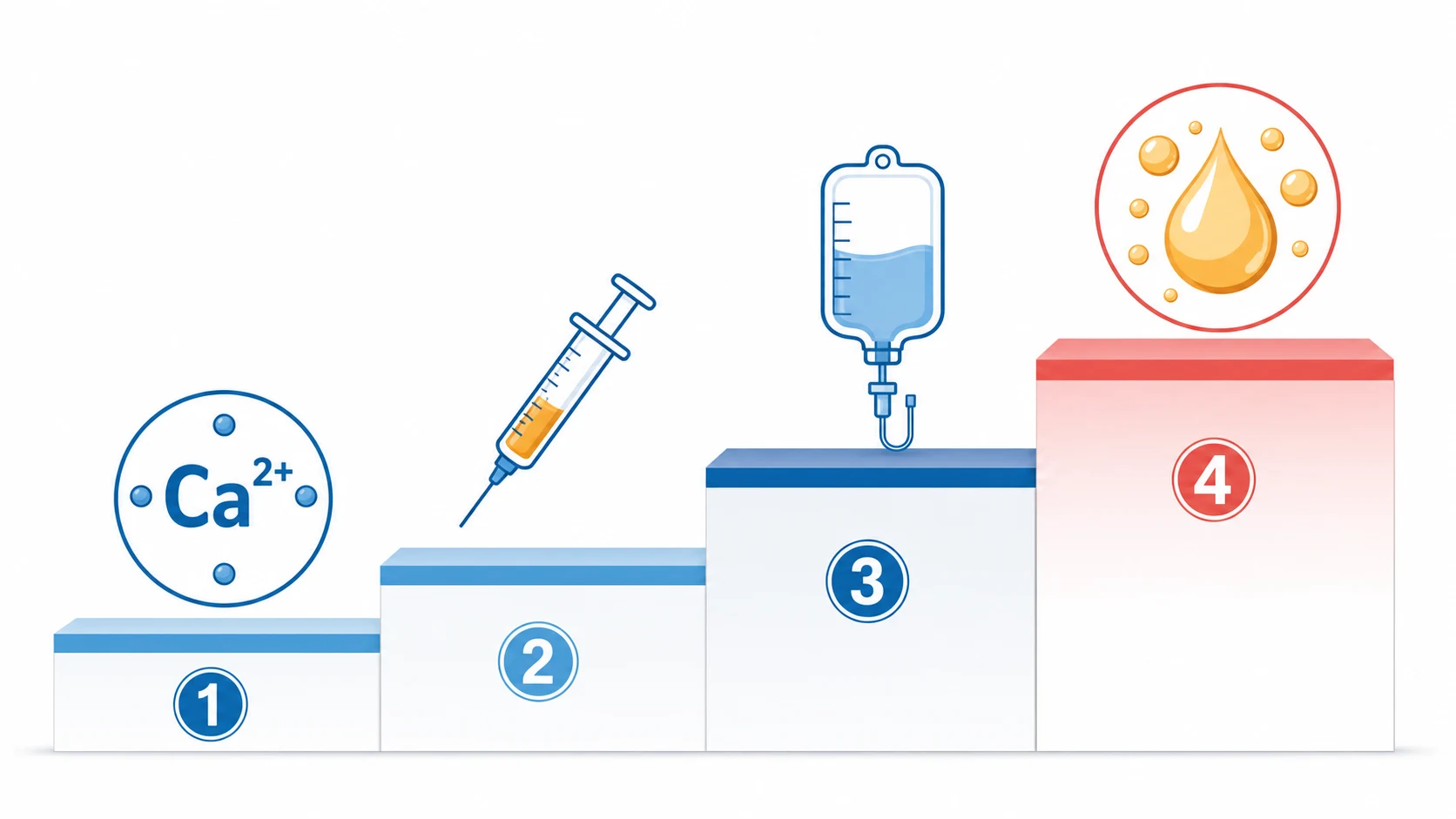
1. The resuscitation + the decontamination. The ABCDE; the activated charcoal if the early AND the airway protected; the whole-bowel irrigation for the sustained-release (the verapamil SR — the continued absorption, the high mortality).[1]
2. The atropine — for the symptomatic bradycardia (the 0.5 to 1 mg IV, the repeat). The often the ineffective in the severe (the drug-dose exceeds the vagal-mimic).[1]
3. The calcium — the calcium chloride (the 1 g IV, the central line — the caustic) or the calcium gluconate (the 3 g IV, the peripheral). The boluses, repeat; the infusion. The overcomes the CCB blockade (the extracellular-calcium load); the modest the effect on the BB. The chloride the preferred (the 3x the calcium).[1][1]
4. The high-dose insulin / the euglycaemia therapy (the HIET) — the cornerstone.[2][3][1]
- The insulin 1 unit/kg IV bolus, then the 0.5 to 1 unit/kg/h infusion (the titrate to the 10); the dextrose to the maintain the euglycaemia (the 25 per cent or the 50 per cent; the variable — the CCB the hyperglycaemic, the BB the hypoglycaemic).
- The mechanism: the positive inotropy (the enhances the myocardial the carbohydrate utilisation — the shift from the fatty-acid to the glucose, the more ATP per oxygen; the improved the contractility), the vasodilation.
- The cornerstone for the severe BB/CCB (the superior to the vasopressors alone). The monitor the potassium, the glucose, the volume (the pulmonary oedema).[2][3]
5. The vasopressors — the norepinephrine and/or the adrenaline (the high doses often required); the vasopressin the adjunct. The titrate to the MAP 65.[1]
6. The glucagon — for the BB (the bypasses the beta-receptor; the glucagon → the cAMP → the inotropy; the 5 to 10 mg IV bolus, the infusion). The limited by the vomiting, the hyperglycaemia, the less-effective than the HIET. The CCB the no-benefit.[1][1]
7. The lipid emulsion — for the refractory (the lipophilic BB/CCB — the "the lipid sink").[1]
8. The cardiac pacing (the transvenous, the transcutaneous) for the refractory bradycardia / the AV block. The may the not the capture / the not the improve the output (the myocardial depression).[1]
9. The ECMO / the circulatory support — for the refractory shock (the bridge to the recovery). The increasingly the used for the severe cardiovascular-drug overdose.[1]
Prognosis
The BB/CCB overdose is the survivable with the aggressive, the escalating care. The poor-prognostic features: the sustained-release, the delayed presentation, the severe bradycardia / the AV block, the refractory shock, the multi-organ failure, the co-ingestant. The sustained-release verapamil the particularly the lethal.[1][1][1]
The beta-blocker in detail
The beta-blocker overdose produces the cardiovascular collapse by the three mechanisms:[1][1]
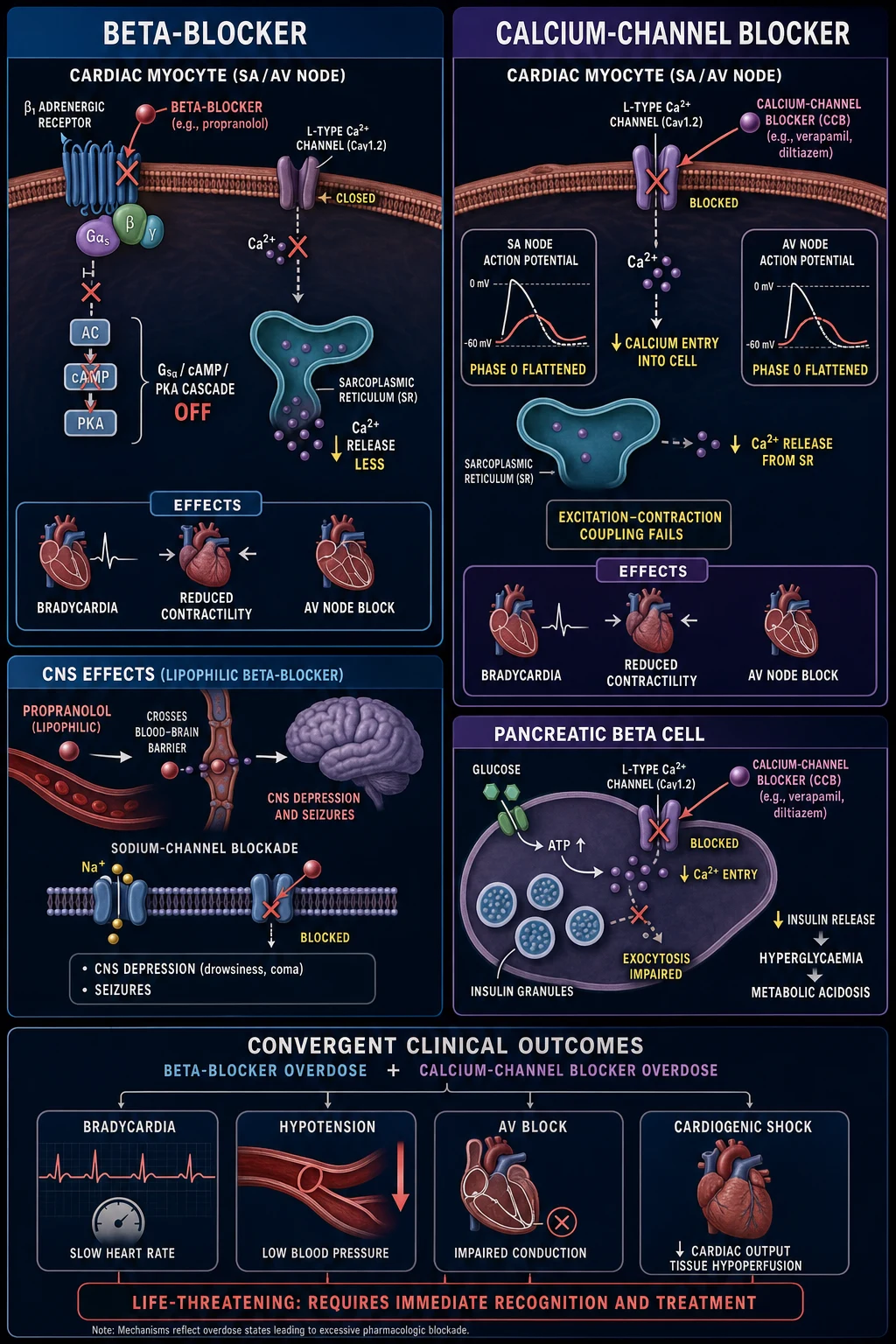
- The beta-1 blockade — the negative inotropy and chronotropy (the reduced the cAMP → the reduced the calcium influx → the reduced the contractility and the heart rate).
- The beta-2 blockade — the bronchospasm (the unopposed the parasympathetic; the smooth-muscle constriction) and the vasodilation-inhibition (the loss of the beta-2 vasodilatory tone — the vasoconstriction; the early hypertension occasionally).
- The sodium-channel blockade (the membrane-stabilising activity) — the fast sodium-channel blockade in the propranolol, the acebutolol, the alprenolol, the carvedilol, the pindolol, the labetalol, the metoprolol, the oxprenolol, the sotalol (some) — the QRS widening, the ventricular arrhythmias, the prolonged the QT (the sotalol). The QRS widening is the marker of the severe and the predictor of the arrhythmic death.
The agents by the lipid-solubility and the membrane-stabilising activity:
- The high lipid-solubility (cross the BBB) — the propranolol, the metoprolol, the carvedilol, the labetalol, the nebivolol, the timolol. The CNS toxicity (the seizures, the coma, the delirium, the hallucinations) — the propranolol the worst (the highest the lipid-solubility AND the sodium-channel activity — the seizures and the QRS widening).
- The low lipid-solubility — the atenolol, the nadolol, the sotalol, the esmolol, the bisoprolol. The less the CNS — the more the cardiovascular (the sotalol the QT prolongation, the torsades).
- The mixed alpha-beta — the labetalol, the carvedilol — the additional the alpha-1 blockade (the vasodilation, the hypotension). [1]
The sotalol — the special case. The sotalol the prolongs the QT (the potassium-channel blockade; the class III antiarrhythmic) → the torsades de pointes → the polymorphic VT. The sotalol overdose the severe — the QT, the torsades, the bradycardia. The treat the torsades with the magnesium (the 2 g IV) and the overdrive pacing (the isoprenaline, the pacing — to the shorten the QT).[1][1]
The hypoglycaemia — the BB the inhibits the hepatic gluconeogenesis and the glycogenolysis AND the inhibits the lipolysis; the beta-2 blockade masks the autonomic response (the no the tremor, the no the tachycardia, the no the sweating) — the patient the unaware of the hypoglycaemia. The esp. the children, the elderly, the renal-failure. The treat with the dextrose (the HIET the increased the insulin requirement). The monitor the glucose hourly.[1]
The calcium-channel-blocker in detail
The calcium-channel-blocker overdose produces the cardiovascular collapse by the L-type calcium-channel blockade: the reduced the calcium influx into the cardiac myocytes (the negative inotropy), the cardiac conduction tissue (the bradycardia, the AV block), and the vascular smooth muscle (the vasodilation).[2][3][1]
The two sub-classes — the different overdose profiles:
- The non-dihydropyridines (the verapamil, the diltiazem) — the AV-node and the myocardium (the negative inotropy, the AV block, the bradycardia) AND the vasodilation (less). The severe — the verapamil the worst (the highest the mortality; the cardiovascular collapse).
- The dihydropyridines (the amlodipine, the nifedipine, the felodipine, the nicardipine, the lercanidipine) — the vasodilation (the peripheral vascular smooth muscle) — the reflex tachycardia the early, then the hypotension and the bradycardia the late as the severe (the myocardial depression). The amlodipine the most-overdosed (the commonest prescribed). [1]
The verapamil — the lethal. The verapamil overdose the highest the mortality of the cardiovascular-drug overdose. The reasons: (1) the potent the negative inotropy AND the AV block; (2) the sustained-release formulation the common — the continued the absorption, the delayed the peak, the prolonged the toxicity (the 24 h); (3) the pancreatic insulin-release blockade → the hyperglycaemia (the worsens the outcome — the hyperglycaemia is the marker of the severe); (4) the co-ingestant the common (the suicide).[2][1]
The CCB hyperglycaemia — the CCB the blocks the calcium-channel of the pancreatic beta-cell → the calcium-dependent the insulin release is the blocked → the hyperglycaemia. The paradoxic — the glucose the rises in the overdose. The distinguishing from the BB (the hypoglycaemia). The severity of the hyperglycaemia the correlates with the severity of the overdose (the verapamil the worst). The treat with the HIET (the insulin) — the dextrose the often not required (the patient the hyperglycaemic).[2][3]
The beta-blocker versus the calcium-channel-blocker overdose
| Feature | The beta-blocker | The calcium-channel-blocker |
|---|---|---|
| The mechanism | The beta-receptor blockade (the cAMP ↓ → the Ca²⁺ influx ↓) | The L-type Ca²⁺-channel blockade (the Ca²⁺ influx ↓) |
| The heart rate | The bradycardia | The bradycardia (the non-DHP) / the tachycardia→bradycardia (the DHP) |
| The AV block | The common (the first, second, third degree) | The common (the non-DHP — the verapamil, the diltiazem) |
| The blood pressure | The hypotension (the negative inotropy) | The hypotension (the vasodilation + the negative inotropy) |
| The bronchospasm | The YES (the beta-2 blockade) | The NO |
| The CNS | The YES (the lipophilic — the seizures, the coma) | The mild (the lethargy, the confusion; the seizures the rare) |
| The glucose | The hypoglycaemia (the inhibited the gluconeogenesis) | The hyperglycaemia (the blocked the insulin release) |
| The QRS widening | The YES (the membrane-stabilising activity — the propranolol) | The NO (the rare) |
| The QT prolongation | The YES (the sotalol) | The NO (the rare) |
| The calcium | The modest the effect | The GOOD (the overcomes the blockade; the extracellular the load) |
| The glucagon | The GOOD (the bypasses the beta-receptor) | The minimal the effect |
| The HIET | The cornerstone | The cornerstone |
| The lipid emulsion | The effective (the lipophilic) | The effective (the lipophilic) |
| The worst agent | The propranolol (the seizures, the QRS); the sotalol (the QT, the torsades) | The verapamil (the worst the mortality); the diltiazem |
| The mortality | The 2-5 per cent | The higher (the verapamil the 10-20 per cent; the SR the worst) |
The calcium-channel-blocker sub-classes
| Feature | The non-dihydropyridines (verapamil, diltiazem) | The dihydropyridines (amlodipine, nifedipine, felodipine) |
|---|---|---|
| The primary target | The AV node, the myocardium (the L-type in the conduction + the muscle) | The vascular smooth muscle (the L-type in the arteriole) |
| The heart rate | The bradycardia | The reflex tachycardia the early → the bradycardia the late |
| The AV block | The common (the high-grade) | The uncommon |
| The blood pressure | The hypotension (the negative inotropy) | The hypotension (the vasodilation) |
| The negative inotropy | The severe | The mild (the reflex) |
| The hyperglycaemia | The marked (the verapamil) | The mild |
| The calcium | The good (the overcomes the cardiac + the AV blockade) | The good (the overcomes the vasodilation) |
| The HIET | The cornerstone | The effective |
| The mortality | The high (the verapamil the worst) | The lower |
The high-dose insulin / euglycaemia therapy (HIET) — the detailed protocol
The HIET (the hyperinsulinaemic euglycaemia therapy) is the cornerstone for the severe BB/CCB overdose. The mechanism: the high-dose insulin the enhances the myocardial the carbohydrate utilisation — the shift from the fatty-acid to the glucose oxidation (the positive inotropy) — the more the ATP per the oxygen, the improved the contractility, the improved the cardiac output and the blood pressure. The additional the vasodilation (the vascular smooth-muscle relaxation). The superior to the vasopressors alone in the severe.[2][3][1]
The HIET the positive inotrope and the vasodilator; the not the antidote. The takes the 15-30 minutes to the work. The start EARLY — the not the wait for the vasopressor failure.[2][3]
The high-dose insulin / euglycaemia therapy (HIET) protocol
- INDICATION — the symptomatic BB/CCB overdose with the myocardial dysfunction (the hypotension, the bradycardia, the AV block, the echocardiographic the depressed contractility). The start EARLY — the not the wait for the vasopressor failure. The more-effective than the vasopressors alone.
- PREPARATION — the regular insulin (the not the analogue; the short-acting); the 50 per cent dextrose (and the 25 per cent, the 10 per cent); the central line preferred (the insulin the irritant). The cardiac monitoring. The two large-bore IV. The trained the nursing — the high-dose insulin the unfamiliar.
- THE INSULIN BOLUS — the 1 unit/kg IV bolus of the regular insulin (over the 5 minutes; the neat or in the 50 mL saline). Some the protocols the higher (the 1.5 unit/kg). The bolus the immediate.
- THE INSULIN INFUSION — the 0.5 to 1 unit/kg/h infusion (the regular insulin 100 unit/mL; the 50 unit in the 50 mL saline = the 1 unit/mL; the rate the mL/kg/h). The titrate by the 0.5 unit/kg/h the every the 15-30 minutes to the 10 unit/kg/h (the maximum). The goal: the MAP > 65, the heart rate > 50, the improved the contractility (the echocardiography), the lactate the falling.
- THE DEXTROSE CO-INFUSION — to the maintain the euglycaemia (the 4-10 mmol/L). The 25 per cent or the 50 per cent dextrose at the 0.25-0.5 g/kg/h (the variable — the CCB the hyperglycaemic the less the dextrose; the BB the hypoglycaemic the more). The start the dextrose with the insulin. The target the glucose > 4 mmol/L.
- THE GLUCOSE MONITORING — the glucose the every the 15 minutes for the first hour, then the every the 30-60 minutes. The hypoglycaemia the most-common the complication (the 20 per cent); the symptomatic and the severe. The keep the glucose > 4 mmol/L. The dextrose the bolus if the < 4 mmol/L.
- THE POTASSIUM MONITORING — the insulin the drives the potassium into the cells → the hypokalaemia. The K⁺ the every the 1-2 h. The replace the K⁺ if the < 3.5 mmol/L (and the magnesium). The target the K⁺ the 3.5-5.0 mmol/L. The NOT the give the potassium with the bolus (the hyperkalaemia the rare — the BB the CCB may the cause; the check the baseline).
- THE VOLUME MONITORING — the insulin-dextrose infusion the large the volume (the 200-500 mL/h); the monitor the volume status, the urine output, the respiratory (the pulmonary oedema). The echocardiography for the volume responsiveness.
- THE DURATION — the continue the HIET for the 12-24 hours AFTER the haemodynamic the stabilisation (the wean the slowly; the 0.5 unit/kg/h decreases the every the 2-4 h). The premature the cessation → the rebound the hypotension (the insulin the short-half-life the 5-15 minutes; the effect the 12-24 h the after the cessation — the myocyte the carbohydrate utilisation).
- THE COMPLICATIONS — the hypoglycaemia (the 20 per cent; the monitor), the hypokalaemia (the replace), the volume overload (the pulmonary oedema; the monitor), the electrolyte (the magnesium, the phosphate). The hepatic (the rare).
The HIET dosing — the quick reference:
- The bolus — 1 unit/kg regular insulin IV.
- The infusion — 0.5-1 unit/kg/h (titrate to 10 unit/kg/h).
- The dextrose — 0.25-0.5 g/kg/h (25% or 50%; variable — the CCB the less, the BB the more).
- The glucose — q15 min × 1 h, then q30-60 min.
- The potassium — q1-2 h; replace if < 3.5.
- The duration — 12-24 h after the stabilisation.[2][3][1]
Calcium: the detailed administration
The calcium is the first-line antidote for the CCB overdose (the overcomes the L-type the channel blockade by the increasing the extracellular the calcium gradient) and the adjunct for the BB overdose (the modest the effect).[1][1]
The two salts:
- The calcium chloride (CaCl₂) — the 10 per cent = the 100 mg/mL = the 1 g/10 mL = the 6.8 mmol the calcium the per the gram (the 3× the calcium of the gluconate). The central line ONLY (the caustic — the extravasation the necrosis). The preferred for the severe (the more the calcium per the volume).
- The calcium gluconate — the 10 per cent = the 100 mg/mL = the 1 g/10 mL = the 2.2 mmol the calcium the per the gram. The peripheral (the safe). The equivalent the 3 g the gluconate = the 1 g the chloride. [1]
The dosing:
- The bolus — the calcium chloride 1 g IV (10 mL of 10%) over the 5-10 minutes (the central) OR the calcium gluconate 3 g IV (30 mL of 10%) over the 5-10 minutes (the peripheral). The repeat the every the 10-20 minutes for the 3 doses (the chloride 3 g; the gluconate 9 g total).
- The infusion — the calcium chloride 0.6-1.2 g/kg/h (or the gluconate the equivalent) for the sustained the effect. The monitor the ionised the calcium (the high — the symptomatic; the ECG the QT the short). [1]
The monitor — the ionised the calcium (the high — the therapeutic), the ECG (the QT the short), the haemodynamics. The calcium the worsens the digoxin the toxicity (the contraindicated if the digoxin the co-ingested).[1]
Glucagon
The glucagon for the BB overdose — the bypasses the beta-receptor (the glucagon → the receptor → the Gs protein → the adenylate cyclase → the cAMP → the PKA → the calcium influx → the inotropy and the chronotropy). The effective the early; the limited the effect for the severe; the no the benefit for the CCB.[1][1]
The dosing:
- The bolus — the 5-10 mg IV over the 1-2 minutes (the high dose — the 50-100× the dose for the hypoglycaemia). The repeat in the 5-10 minutes if the no the response (the up to the 10 mg total).
- The infusion — the 1-5 mg/h (the 5-10 mg the bolus then the infusion). The titrate to the heart rate and the blood pressure. [1]
The limitations — the vomiting (the antiemetic the prophylactic the ondansetron), the hyperglycaemia, the hypokalaemia, the tachyphylaxis, the expensive, the limited the supply. The less-effective than the HIET. The second-line for the BB; the no the role for the CCB.[1][1]
Lipid emulsion therapy
The lipid emulsion (the 20 per cent) for the refractory the BB/CCB overdose — the lipophilic the BB/CCB the partition into the lipid phase (the "the lipid sink") → the reduced the free the drug the concentration → the reduced the toxicity. The mechanism the additional — the fatty-acid the myocardial the substrate (the improved the contractility), the direct the vasodilator.[1][1]
The dosing:
- The bolus — the 20 per cent lipid emulsion 1.5 mL/kg IV over the 1 minute (the lean body weight; the max the 100 mL bolus).
- The infusion — the 0.25 mL/kg/min for the 30-60 minutes (the max the 10 mL/kg over the first 30 minutes). [1]
The complications — the pancreatitis (the hypertriglyceridaemia), the fat the embolus, the ARDS, the haemolysis, the coagulopathy, the allergic. The monitor the triglycerides, the amylase, the lipase, the coagulation.[1]
Pacing and ECMO
The cardiac pacing for the refractory the bradycardia / the AV block:
- The transcutaneous — the immediate (the pads the anterior-posterior). The often the painful (the sedate). The capture the variable.
- The transvenous — the more-reliable the capture. The inserted the early if the bradycardia the severe.
- The epicardial / the temporary — the post-cardiac-surgery. [1]
The pacing the not the improve the output in the severe (the myocardial the depression — the captured the rhythm but the no the blood pressure). The treat the myocardial the depression (the HIET, the vasopressors, the ECMO).[1]
The ECMO (the veno-arterial) for the refractory the shock — the bridge to the recovery. The increasingly the used for the severe the cardiovascular-drug the overdose. The indications: the refractory the shock (the MAP < 65 despite the HIET + the vasopressors + the lipid + the pacing), the cardiac the arrest (the ECPR), the deteriorating despite the optimal the conventional. The outcomes the favourable (the 50-70 per cent the survival in the selected).[1]
The agents — the pharmacology
The beta-blocker agents — the relative toxicity
| Agent | The lipid-solubility | The membrane-stabilising (the Na⁺) | The QT prolongation | The relative the toxicity |
|---|---|---|---|---|
| The propranolol | The high | The YES | The mild | The worst — the seizures, the QRS widening, the coma |
| The sotalol | The low | The no | The YES (the torsades) | The severe — the QT, the torsades, the polymorphic VT |
| The carvedilol | The high | The YES (the alpha-1) | The no | The moderate — the vasodilation, the CNS |
| The labetalol | The moderate | The YES (the alpha-1) | The no | The moderate — the vasodilation |
| The metoprolol | The high | The mild | The no | The moderate — the CNS, the bradycardia |
| The atenolol | The low | The no | The no | The lower — the cardiovascular, the less the CNS |
| The bisoprolol | The moderate | The no | The no | The moderate |
| The esmolol | The low | The no | The no | The lower — the short the half-life (the 9 min); the rapid the recovery |
| The nadolol | The low | The no | The no | The lower — the cardiovascular |
| The nebivolol | The moderate | The no (the NO-mediated the vasodilation) | The no | The moderate — the vasodilation |
| The timolol | The high | The no | The no | The moderate — the eye-drop the overdose (the child) |
The calcium-channel-blocker agents — the relative toxicity
| Agent | The class | The half-life | The relative the toxicity |
|---|---|---|---|
| The verapamil | The non-DHP | The 4-12 h (the SR the longer) | The worst — the highest the mortality; the negative inotropy + the AV block + the hyperglycaemia |
| The diltiazem | The non-DHP | The 3-8 h | The severe — the AV block, the bradycardia |
| The amlodipine | The DHP | The 30-50 h (the long) | The moderate-severe — the vasodilation; the commonest the overdose |
| The nifedipine | The DHP | The 2-5 h (the SR the longer) | The moderate-severe — the vasodilation |
| The felodipine | The DHP | The 11-16 h | The moderate — the vasodilation |
| The nicardipine | The DHP | The 2-4 h | The lower — the short the half-life (the infusion) |
| The lercanidipine | The DHP | The 8-10 h | The lower |
The differential diagnosis
The bradycardia + the hypotension — the differential:[1]
- The BB / the CCB overdose — the history (the empty the bottles, the patient on the cardiovascular the medication), the bradycardia + the AV block, the hyperglycaemia (the CCB) or the hypoglycaemia (the BB).
- The digoxin — the bradycardia, the AV block, the hyperkalaemia, the visual the disturbance (the yellow, the green), the digoxin the level.
- The hyperkalaemia — the bradycardia, the AV block, the peaked the T waves, the wide the QRS.
- The hypothermia — the bradycardia, the Osborn the J waves.
- The hypothyroidism — the bradycardia, the reflexes the delayed.
- The myocardial the infarction (the inferior — the AV node the block).
- The vagal the response — the reversed by the atropine.
- The organophosphate — the bradycardia but the bronchospasm the bronchorrhoea the salivation — the cholinergic.
- The opioid — the bradycardia but the miosis the respiratory the depression — the naloxone the response.
The screening — the paracetamol the level, the salicylate the level, the ethanol the level, the digoxin the level (if the suspected), the ECG (the QRS, the QT), the glucose (the hyper- or the hypo-), the beta-HCG (the pregnancy).[1]
SAQ — Verapamil overdose with refractory shock
10 minutes · 10 marks
A 47-year-old woman (60 kg) is brought to ED 2 hours after a deliberate overdose of 9.6 g of sustained-release verapamil (240 mg × 40 tablets) with alcohol. She is drowsy, HR 36 with second-degree Mobitz I AV block, BP 64/40, lactate 8.2 mmol/L, glucose 12.4 mmol/L. She has been given 2 L crystalloid, 3 mg atropine, 20 mL of 10% calcium gluconate and 5 mg glucagon with no response.
SAQ — Beta-blocker overdose with hypoglycaemia and bronchospasm
10 minutes · 10 marks
A 16-year-old girl (50 kg) with asthma is brought in 90 minutes after ingesting 50 tablets of propranolol 40 mg (2 g total) with ethanol. She is unconscious (GCS 8), HR 38 in sinus bradycardia, BP 70/45, RR 22 with widespread wheeze, SpO2 90%, glucose 2.1 mmol/L, lactate 5.6.
Clinical pearls
Key trials and evidence
Engebretsen, Kaczmarek, Morgan & Holger 2011 — high-dose insulin therapy in BB and CCB poisoning (PMID 21563902)
Source
Clinical Toxicology (Philadelphia) — the landmark review of the HIET
Key principle 1
The HIET (the 1 unit/kg bolus then 0.5-1 unit/kg/h, the dextrose) the cornerstone for the severe BB/CCB
Key principle 2
The mechanism: the enhanced the myocardial the carbohydrate utilisation — the shift from the fatty-acid to the glucose oxidation (the positive inotropy)
Key principle 3
The superior to the vasopressors alone in the severe — the improved the cardiac output, the lactate, the survival
Key principle 4
The complications — the hypoglycaemia (the 20 per cent; the monitor q15 min), the hypokalaemia (the replace), the volume overload
Clinical bottom line
The HIET the EARLY (the not the last-resort) for the severe BB/CCB; the dextrose to the euglycaemia; the monitor the glucose and the potassium
Levine, Boyer, Ruiz-Cabello et al. 2018 — Hyperinsulinemic-Euglycemic Therapy in CCB Overdose (PMID 30141827)
Source
Pharmacotherapy — the modern CCB-HIET overview
Key principle 1
The CCB the blocks the L-type the calcium channel (the cardiac the myocyte, the AV node, the vascular the smooth muscle, the pancreatic the beta-cell)
Key principle 2
The verapamil the worst (the highest the mortality; the SR the common; the hyperglycaemia the marker of the severe)
Key principle 3
The HIET the cornerstone — the 1 unit/kg bolus then 0.5-1 unit/kg/h, the titrate to the 10 unit/kg/h; the dextrose the less for the CCB (the hyperglycaemic)
Key principle 4
The calcium (the chloride 1 g or the gluconate 3 g) the first-line antidote; the repeat the bolus then the infusion
Clinical bottom line
The CCB overdose the escalating the therapy: the calcium + the HIET + the vasopressors + the lipid + the ECMO; the verapamil the most-lethal
Graudins, Roberts & Graudins 2016 (updated 2020) — Treatment for beta-blocker poisoning: a systematic review (PMID 32310006)
Source
Clinical Toxicology (Philadelphia) — the systematic review of the BB antidotes
Key principle 1
The HIET the most-effective antidote for the severe BB — the superior to the vasopressors, the glucagon, the calcium
Key principle 2
The glucagon the effective (the 5-10 mg IV bolus; the 1-5 mg/h infusion) but the limited the effect for the severe; the second-line after the HIET
Key principle 3
The calcium the modest the effect for the BB (the not the CCB-level — the BB the not the calcium-channel the blockade)
Key principle 4
The lipid emulsion and the ECMO for the refractory — the increasingly the used for the severe
Clinical bottom line
The BB overdose the escalating: the HIET the EARLY; the glucagon the second-line; the calcium the adjunct; the lipid and the ECMO the refractory
St-Onge, Dubé & Macpherson 2014 — Calcium channel blocker overdose and the use of high-dose insulin (PMID 24597955)
Source
Annals of Pharmacotherapy
Key principle 1
The CCB overdose the rising the incidence (the amlodipine the commonest; the verapamil the most-lethal)
Key principle 2
The HIET the dose the higher for the CCB than the BB (the 1 unit/kg bolus then up to the 10 unit/kg/h)
Key principle 3
The dextrose the co-infusion the less for the CCB (the hyperglycaemic); the more for the BB (the hypoglycaemic)
Clinical bottom line
The CCB the aggressive the HIET; the dextrose the tailored to the glucose; the monitor the glucose q15 min
Cave, Harvey, Cave & Mason 2020 — The role of VA-ECMO in severe drug toxicity (PMID 31910649)
Source
Heart & Lung — the ECMO for the refractory the cardiovascular-drug the overdose
Key principle 1
The VA-ECMO the bridge to the recovery for the refractory the shock (the HIET + the vasopressors + the lipid + the pacing the failed)
Key principle 2
The survival the 50-70 per cent the selected; the verapamil and the BB the favourable
Key principle 3
The early the referral the centre the expertise (the ECMO, the toxicology, the cardiology)
Key principle 4
The ECPR (the ECMO the CPR) for the cardiac the arrest the cardiovascular-drug the overdose — the bridge to the recovery
Clinical bottom line
The VA-ECMO the not the last-resort — the earlier the better for the refractory the shock / the cardiac the arrest
Woodward & Isbister 2014 — Lipid emulsion in the management of cardiovascular-drug overdose (PMID 24761268)
Source
Journal of Medical Toxicology
Key principle 1
The lipid emulsion (the 20 per cent; the 1.5 mL/kg bolus then the 0.25 mL/kg/min) the effective for the lipophilic the BB/CCB
Key principle 2
The mechanism — the 'lipid sink' (the drug the partitions into the lipid phase) AND the fatty-acid the myocardial the substrate
Key principle 3
The complications — the pancreatitis, the fat the embolus, the ARDS, the coagulopathy
Clinical bottom line
The lipid emulsion the second-line after the HIET + the calcium; the monitor the triglycerides, the amylase, the coagulation
Red flags [1]
References
- [1]Graudins A, et al. Treatment for beta-blocker poisoning: a systematic review Clin Toxicol (Phila), 2020.PMID 32310006
- [2]Engebretsen KM, Kaczmarek KM, Morgan J, Holger JS. High-dose insulin therapy in beta-blocker and calcium channel-blocker poisoning Clin Toxicol (Phila), 2011.PMID 21563902
- [3]Levine M, et al. An Overview of Hyperinsulinemic-Euglycemic Therapy in Calcium Channel Blocker and β-blocker Overdose Pharmacotherapy, 2018.PMID 30141827