ICU · Toxicology
Carbon Monoxide & Cyanide Poisoning
Also known as Carbon monoxide poisoning · CO toxicity · Carboxyhaemoglobin · Cyanide poisoning · Hydroxocobalamin · Smoke inhalation · Delayed neurological sequelae
The two tissue-asphyxiant poisonings — the carbon monoxide (the binds the haemoglobin 240-fold, the shifts the curve left, the binds the cytochrome; the impaired DELIVERY) and the cyanide (the binds the cytochrome a3, the halts the oxidative phosphorylation; the impaired UTILISATION). The pulse oximetry the falsely-normal in the CO. The 100 per cent oxygen (the CO half-life the 320 to 80 min) and the hyperbaric oxygen for the severe CO; the hydroxocobalamin for the cyanide (the preferred in the smoke inhalation). The delayed neurological sequelae.
On this page & tools
Your progress
Saved locally on this device.
Target exams
Overview & definition
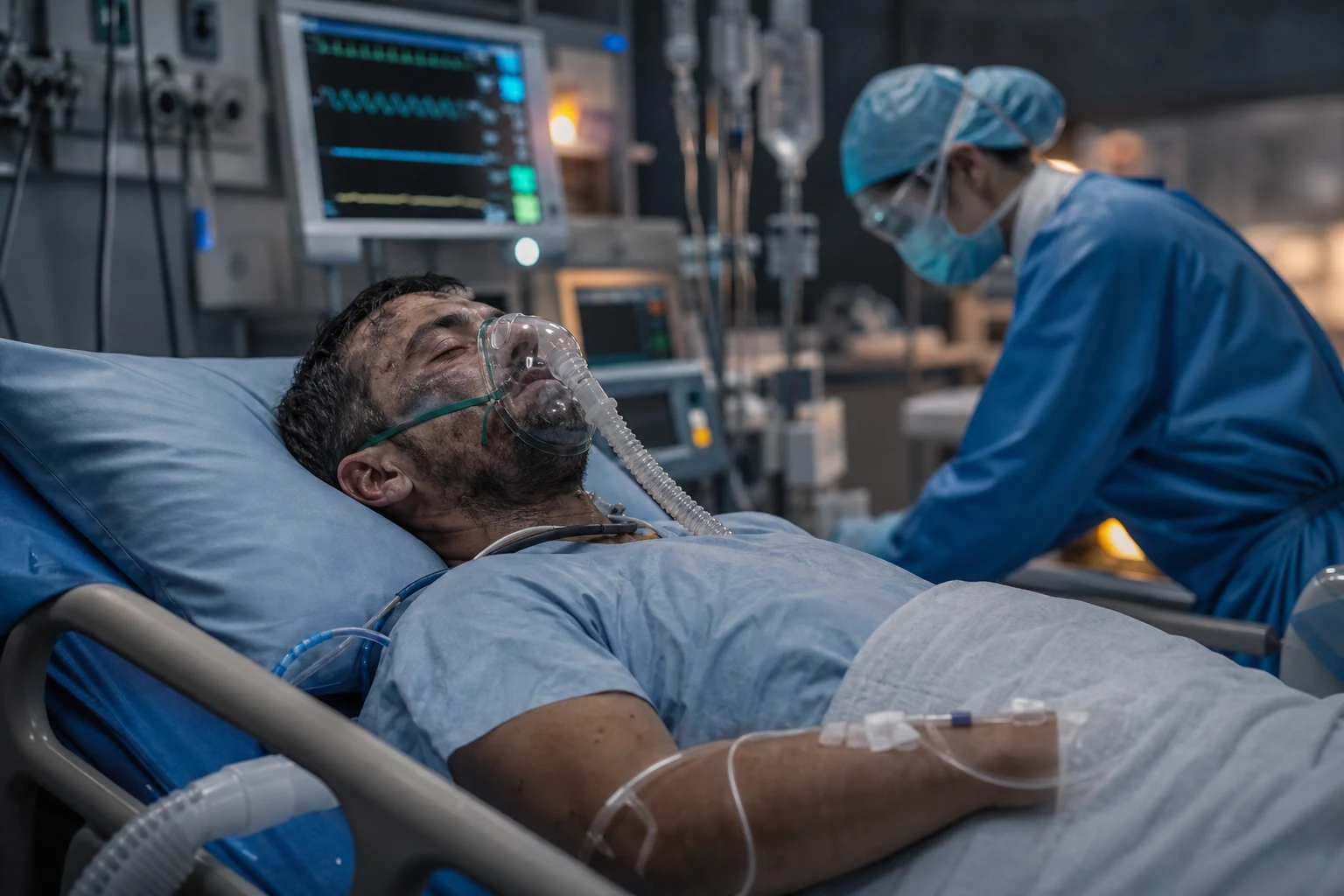
The carbon monoxide (the CO) and the cyanide are the two tissue-asphyxiant poisons — the CO impairs the oxygen DELIVERY (the haemoglobin binding), the cyanide impairs the oxygen UTILISATION (the cytochrome binding). The smoke-inhalation patient (the house fire) often has the BOTH. The 100 per cent oxygen and the specific antidotes (the hyperbaric oxygen for the CO, the hydroxocobalamin for the cyanide) are the life-saving.[1][1]
The carbon monoxide
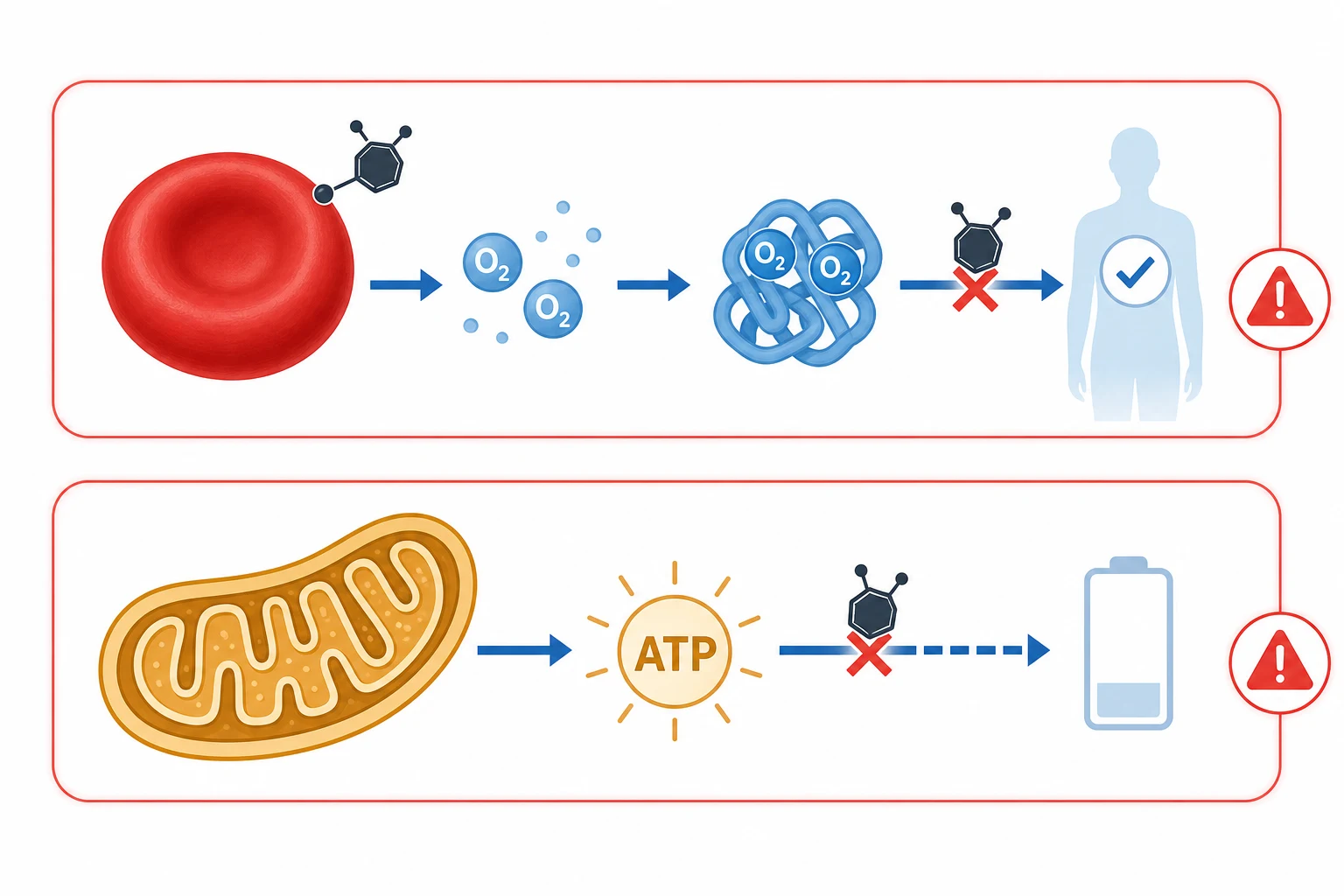
The CO binds the haemoglobin with the affinity the 240-times the oxygen, the shifts the oxygen-dissociation curve the left (the less the release to the tissues), and the binds the myoglobin (the cardiac) and the cytochrome a3 (the mitochondrial — the impaired the oxidative phosphorylation).[1][1]
- The headache (the most common, the "the worst headache"), the nausea, the vomiting, the dizziness, the confusion — the "the flu-like in the winter" (the clue — the multiple people in the one household, the faulty heater).
- The syncope, the seizures, the coma (the severe), the cherry-red skin (the rare, the late — the not the reliable).
- The cardiac — the ischaemia, the arrhythmia (the myocardial the vulnerable).
- The delayed neurological sequelae (the DNS — the parkinsonism, the cognitive impairment, the mood disturbance, the weeks to the months after, the esp. after the loss-of-consciousness).[1][2]
The key trap — the pulse oximetry is the FALS normal. The standard pulse oximeter cannot the distinguish the carboxyhaemoglobin from the oxyhaemoglobin — the SpO2 reads the normal despite the severe tissue hypoxia. The CO-oximeter (the arterial blood, the multi-wavelength) measures the carboxyhaemoglobin directly.[1][1]
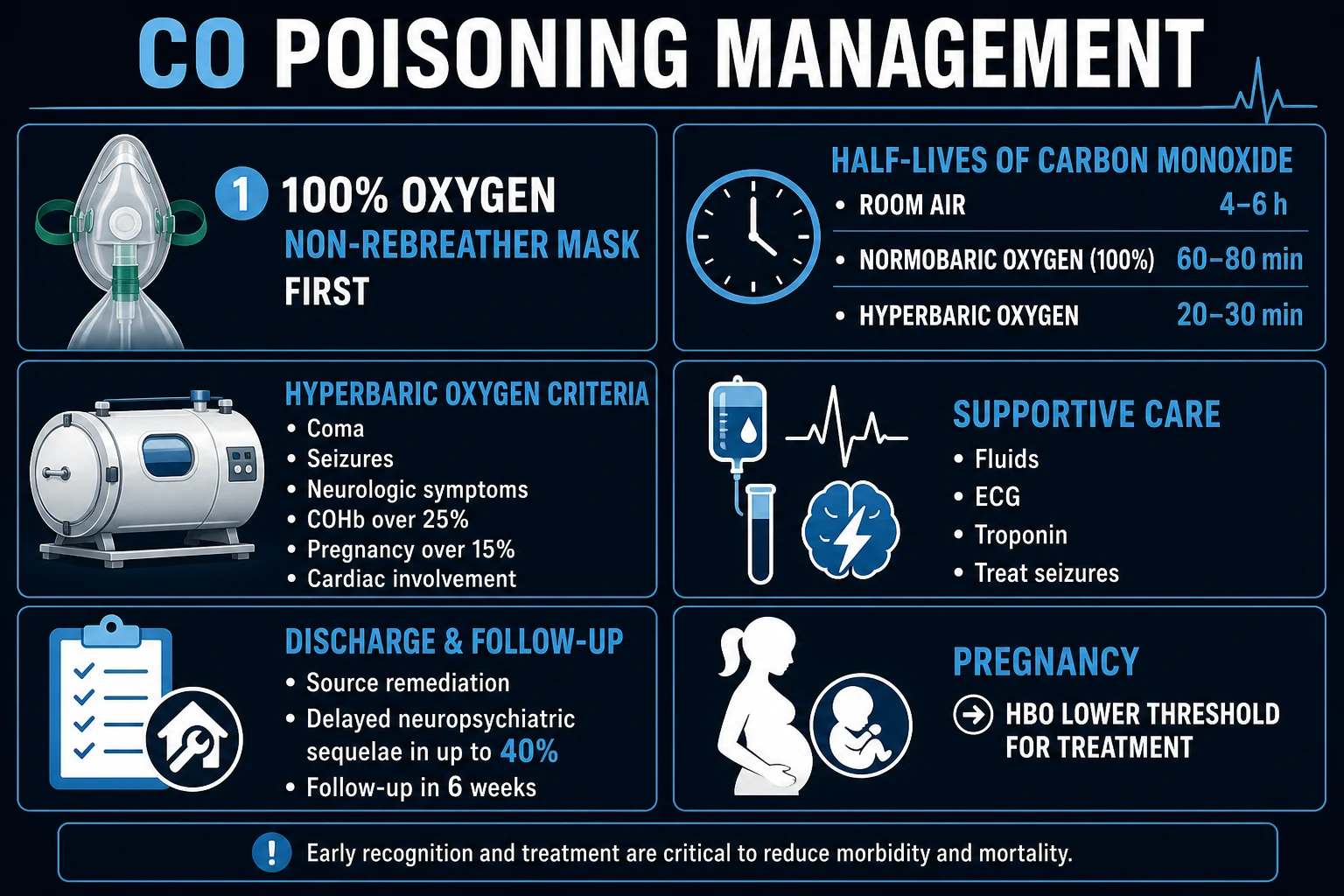
- The 100 per cent oxygen (the non-rebreather, the FiO2 of 1.0) — the reduces the CO half-life from the 320 min (the room air) to the about 80 min (the 100 per cent) to the about 20 min (the hyperbaric). The immediate, the for ALL.[1]
- The hyperbaric oxygen (the HBO) — the controversial, the for the SEVERE: the loss of consciousness, the neurological deficit, the pregnancy (the foetal Hb binds the CO more avidly), the carboxyhaemoglobin above 25 to 30 per cent, the cardiac ischaemia, the severe acidosis. The reduces the half-life AND the may the reduce the DNS (the debated).[1][2]
The CO elimination half-life — the three numbers (the exam favourite)
Room air (FiO₂ 0.21)
~320 min (~5 h)
- Untreated — tissue injury continues for hours
- The COHb falls slowly; the half-life is the longest
100% O₂ at 1 atm (NRB)
~80 min
- The CORE treatment — given to ALL
- Dissolved O₂ competes with CO for haemoglobin; the half-life quartered
- Continue until COHb <5% (target <2% in pregnancy) AND lactate normal
100% O₂ + HBO 2.5–3 ATA
~23 min
- The fastest washout; ~6 vol% O₂ dissolved in plasma — meets tissue demand independent of Hb
- Reserved for the severe; the evidence is conflicted (see trials)
Fetus on maternal 100% O₂
up to ~7 h
- Fetal Hb binds CO more avidly; fetal COHb 10–15% above maternal
- Lower every threshold in pregnancy; the prolonged 100% O₂
The CO triple mechanism — know all three
The CO is not simply "the functional anaemia." The tissue hypoxia arises from the THREE concurrent mechanisms, and the third (the histotoxic) is what drives the lactate and the delayed neurological injury.[1]
- The functional anaemia (the reduced O₂ carriage). The CO binds the Hb with the ~240-fold affinity; the CO-Hb occupies the binding sites and the unavailable to the O₂.
- The LEFT shift of the oxyHb dissociation curve. When the one CO occupies the one of the four haem sites, the remaining three the bind the O₂ with the increased affinity (the allosteric — the reverse Bohr). The Hb the holds the O₂ too tightly; the less the release at the tissue PO₂. The CO poisoning is therefore the WORSE than the equivalent haemorrhagic anaemia.
- The histotoxic hypoxia (the direct cellular). The CO diffuses the into the tissues and the binds the myoglobin (the higher affinity than the Hb — the cardiac) and the mitochondrial cytochrome c oxidase (the cytochrome a3, the complex IV). The halted the oxidative phosphorylation; the anaerobic; the lactate. The third mechanism the triggers the neutrophil activation, the lipid peroxidation, the white-matter demyelination — the substrate of the delayed neurological sequelae.[1][3]
The cyanide
The cyanide binds the cytochrome a3 (the complex IV) of the electron-transport chain — the halts the oxidative phosphorylation, the cell cannot the USE the oxygen (the histotoxic hypoxia). The venous oxygen rises (the arterialized venous blood — the bright red), the arterial-venous oxygen difference the low, the severe lactic acidosis (the anaerobic).[3][1]
The sources. The smoke inhalation (the house fire — the plastics, the wool), the industrial (the electroplating, the mining, the jewellery), the nitroprusside (the prolonged, the high-dose infusion), the amygdalin (the apricot kernels, the bitter almonds).[1]
The clinical. The rapid coma, the seizures, the cardiovascular collapse (the severe); the "the bitter almond" smell (the unreliable — the most cannot the smell); the bright-red venous blood; the high-output cardiac failure initially then the collapse; the tachypnoea (the metabolic acidosis — the compensatory).[3][1]
- The 100 per cent oxygen (the immediately — the increases the cytochrome competition).
- The hydroxocobalamin (the Cyanokit) — the 5 g IV (the 70 mg/kg) — the preferred, the especially in the smoke inhalation. The binds the cyanide to the cyanocobalamin (the vitamin B12) — the excreted in the urine. The NOT the impair the oxygen-carrying (the safe with the CO). The turns the skin and the urine the red (the benign).[3]
- The sodium thiososulfate — the 12.5 g IV — the sulfur donor; the rhodanese enzyme converts the cyanide to the thiocyanate (the less toxic, the excreted). The slower but the synergistic with the hydroxocobalamin.[1]
- The sodium nitrite — the induces the methaemoglobin (the binds the cyanide) — the AVOID in the smoke inhalation / the CO (the methaemoglobin + the carboxyhaemoglobin — the worsened the oxygen-carrying).[1]
The cyanide antidotes — the head-to-head
The three cyanide antidote kits — what, how, and when
Hydroxocobalamin (Cyanokit)
The PREFERRED — esp. smoke
- Dose 5 g IV adult (70 mg/kg child); may repeat 5 g if severe
- Binds cyanide directly → cyanocobalamin (vitamin B12) → renally excreted
- Does NOT impair oxygen carrying — SAFE with concomitant CO (smoke)
- Onset rapid; first-line for smoke inhalation and confirmed cyanide
- Adverse: red skin/urine (benign, ~1 week), transient hypertension, acneiform rash; interferes with colorimetric lab assays (creatinine, bilirubin, Mg, iron, Co-oximetry) — DRAW labs BEFORE the dose
Sodium thiosulfate
The sulfur donor — slower
- Dose 12.5 g IV adult (adult amp); 1.65 mL/kg of 25% solution in children
- Substrate for rhodanese / mitochondrial thiosulfate sulfurtransferase: cyanide → thiocyanate (less toxic, renally excreted)
- Slower onset; ineffective alone in acute severe (rhodanese saturates)
- Often COMBINED with hydroxocobalamin for synergy; adequate in pure, isolated exposure (nitroprusside)
- AVOID in smoke/CO co-poisoning if used WITH sodium nitrite (compounds methaemoglobinaemia risk)
Sodium nitrite
Methaemoglobin former — CAUTION
- Dose 300 mg IV adult (10 mL of 3%); 0.15–0.20 mL/kg of 3% in children
- Induces methaemoglobinaemia → MetHb binds cyanide (cyanomethaemoglobin); then give sodium thiosulfate
- AVOID in SMOKE INHALATION / known CO — methaemoglobin + carboxyhaemoglobin = catastrophic loss of O₂ carriage
- Risk: sudden cardiovascular collapse if infused too rapidly; dilute and infuse over 2–5 min
- Also AVOID in fire victims where CO cannot be excluded
Dicobalt edetate
The chelator — UK / selective
- Dose 300 mg IV (with glucose — the cobalt is emetogenic/cardiotoxic)
- Chelates cyanide directly → renally excreted; rapid onset
- TOXIC in the ABSENCE of cyanide (cobalt toxicity — vomiting, hypotension, arrhythmia) — give ONLY with confirmed severe cyanide
- Largely displaced by hydroxocobalamin in most formularies
- Reserved for the confirmed severe adult when hydroxocobalamin unavailable
The lactate — the silent clue
The cyanide-poisoned patient has the severe lactic acidosis (the often >10 mmol/L) with the NORMAL or the HIGH venous oxygen and the LOW arterial–venous O₂ difference — the cell cannot the USE the oxygen (the histotoxic). The plasma lactate ≥ 10 mmol/L in the smoke-inhalation patient is the 87% sensitive and the 73% specific for the cyanide (Baud 2002). The high anion-gap metabolic acidosis that the PERSISTS despite the 100% oxygen is the cyanide until the proven otherwise.[3][1]
Prognosis
The CO poisoning is the survivable with the 100 per cent oxygen; the DNS occurs in the up to the 40 per cent of the severe (the reduced by the early HBO). The cyanide poisoning is the rapidly-lethal (the minutes) without the antidote; the hydroxocobalamin the reverses. The combined smoke-inhalation (the CO + the cyanide) is the high-mortality.[1][2][1]
Red flags
Smoke inhalation — the combined poisoning
The house-fire patient inhales the combustion products of the plastics, the wool, the synthetic fabrics — liberating BOTH the carbon monoxide AND the hydrogen cyanide. The smoke-inhalation patient therefore has the tissue-asphyxiant DOUBLE hit: the CO impairs the oxygen DELIVERY (the haemoglobin) and the cyanide impairs the oxygen UTILISATION (the cytochrome). The two poisons the potentiate — the mortality is the higher than the either alone.[3][1]
The clues to the combined poisoning
The combined CO + cyanide is the suspected in ANY enclosed-space fire victim with the:
- The soot in the oropharynx / the sputum / the nares (the highly predictive — examine the mouth).
- The altered consciousness out of proportion to the CO-Hb level.
- The severe lactic acidosis (the lactate ≥ 10 mmol/L) that the PERSISTS despite the 100% oxygen.
- The refractory anion-gap metabolic acidosis that the does not the clear with the fluid.
- The cardiovascular instability — the high-output then the collapse, the refractory vasopressor requirement.
- The bright-red venous blood (the arterialized — the cell cannot the extract the oxygen).
- The the bitter-almond breath (the unreliable — the genetic-trait smell, the most cannot the detect).[3][1]
The empirical hydroxocobalamin (the 5 g IV) is the given on the SUSPICION in the smoke-inhalation patient with the severe acidosis or the cardiovascular collapse — the safe, the rapid, the does NOT the impair the oxygen-carrying (the critical advantage over the sodium nitrite). The cyanide laboratory confirmation (the red-cell cyanide concentration) takes the hours to the days and the results return AFTER the decision-point — the treat the CLINICAL, the not the lab.[3]
The CO versus the cyanide — the head-to-head exam comparison
Carbon monoxide (CO)
Impaired DELIVERY
- Binds Hb 240× O₂ affinity; binds myoglobin; binds cytochrome c oxidase (complex IV)
- Functional anaemia + LEFT shift + histotoxic hypoxia (triple)
- Clinical: headache, "flu-like", confusion, coma, cherry-red (rare), DNS
- Pulse oximetry FALSELY NORMAL; PaO₂ normal; CO-Hb on CO-oximetry diagnostic
- Treatment: 100% O₂ for ALL; HBO for the severe (controversial)
Cyanide (CN⁻)
Impaired UTILISATION
- Binds cytochrome a3 (complex IV); halts oxidative phosphorylation
- Histotoxic hypoxia ONLY — venous O₂ rises, AV difference low
- Clinical: rapid coma, seizures, collapse, bright-red venous blood
- Pulse oximetry normal; severe lactic acidosis; plasma lactate ≥10 mmol/L suggestive
- Treatment: 100% O₂; hydroxocobalamin 5 g IV (preferred); sodium thiosulfate; AVOID nitrites in smoke
Both (the smoke)
The double asphyxiant
- The CO + the CN — the impaired delivery AND the impaired utilisation
- The mortality higher than the either alone; the soot the clue
- The empirical hydroxocobalamin + 100% O₂ + the HBO referral
- The NO nitrites (the methaemoglobin + the CO-Hb = catastrophic)
The hyperbaric oxygen — the controversy in depth
The HBO question is the single most-examined issue in the CO poisoning, and the evidence is the GENUINELY conflicted. The fellowship candidate MUST the know the both sides.[2]
The mechanistic rationale (the why it SHOULD the work). The HBO (a) the accelerates the CO-Hb dissociation (the half-life ~23 min at the 3 ATA), (b) the dissolves the ~6 vol% of the oxygen in the plasma at the 3 ATA — the meets the resting tissue demand the INDEPENDENT of the haemoglobin, and (c) the reduces the downstream inflammatory cascade (the neutrophil β2-integrin clustering, the lipid peroxidation, the white-matter demyelination) that the underlies the delayed neurological sequelae.[2]
The indications (the consensus — the NOT the absolute). The HBO is the OFFERED for: the loss of consciousness; the neurological signs (the seizure, the coma, the focal deficit); the pregnancy (the any symptomatic exposure, the CO-Hb >15%); the cardiac ischaemia / the arrhythmia; the CO-Hb >25% (the >20% in the pregnancy); the severe acidosis. The decision is the individualised — the chamber accessibility, the transfer risk, the patient stability.[2][3]
The risk-benefit. The HBO is the generally safe — the barotrauma (the ear, the sinus), the oxygen toxicity seizure (the rare at the 2.5–3 ATA), the anxiety (the claustrophobia in the mono-place chamber). The transfer of the critically-ill patient to the chamber is the NOT the trivial — the ventilation, the monitoring, the vasopressor access. The weigh the risk of the transfer against the potential benefit.[2]
The pregnancy and the paediatric — the special populations
The pregnancy. The fetal haemoglobin binds the CO MORE avidly than the adult; the fetal CO-Hb the 10–15% above the maternal; the fetal half-life the up to the 7 hours. The fetus is therefore the poisoned at the LOWER maternal levels and the clears the CO far more slowly. The LOWER every threshold in the pregnancy: the continue the 100% O₂ until the maternal CO-Hb <2%; the offer the HBO at the CO-Hb >15% or the ANY neurological symptom. The involve the obstetrics; the monitor the fetal status; the counsel the maternal-fetal risk.[2][3]
The paediatric. The children are the more susceptible (the higher metabolic rate, the smaller blood volume, the developing brain). The symptomatic child — the drowsiness, the vomiting, the syncope — warrants the urgent 100% O₂ and the CO-Hb. The paediatric hydroxocobalamin dose is the 70 mg/kg (the maximum 5 g). The lower the threshold for the paediatric concern — the developing neurological injury.[1]
Management protocol — the combined smoke-inhalation pathway
The smoke-inhalation (the CO + the cyanide) ICU management protocol
1. Scene → 100% oxygen immediately + remove from source
Remove the patient (and ALL co-occupants — including pets) from the CO source. Begin 100% oxygen via non-rebreather at 15 L/min with a tight face-seal BEFORE the transfer. Do NOT delay oxygen for the sampling. The CO half-life falls from ~320 min (room air) to ~80 min (100% O₂). Treat the enclosed-space fire victim as having BOTH CO and cyanide until proven otherwise.
2. ABCDE — airway, thermal inhalation injury
Assess the airway for the thermal / the inhalation injury (the soot in the mouth, the singed nasal hairs, the hoarse voice, the stridor, the carbonaceous sputum — the EARLY intubation before the oedema obliterates the airway). Intubate if GCS <8, the airway threatened, the refractory hypoxaemia, the recurrent seizures. Ventilate with 100% O₂ (the FiO₂ 1.0 — the oxygen toxicity is NOT the acute concern). The continuous ECG (the arrhythmia risk); the IV access; the fluid for the hypotension; the vasopressor for the refractory.
3. Diagnose — CO-oximetry + lactate + troponin + β-hCG
Send the CO-oximetry (the CO-Hb, the met-Hb — the venous is sufficient), the venous/arterial gas for the pH / the lactate, the ECG, the troponin, the CK, the electrolytes, the glucose, the β-hCG (the pregnancy). The repeat the CO-Hb every 1–2 h on the 100% O₂ until <5%. The DRAW the baseline labs BEFORE the hydroxocobalamin (it interferes with the colorimetric assays — the creatinine, the bilirubin, the iron, the Mg, the co-oximetry).
4. Empirical hydroxocobalamin for the suspected cyanide
Give the HYDROXOCOBALAMIN 5 g IV over 15 min (the 70 mg/kg in the child; may repeat 5 g if severe) on the SUSPICION of the cyanide: the soot in the oropharynx, the severe lactic acidosis disproportionate to the CO-Hb, the refractory acidosis, the cardiovascular instability, the rapid coma/seizures. The hydroxocobalamin is SAFE with the CO (the does NOT the impair the O₂ carriage); the AVOID the sodium nitrite (the methaemoglobin + the CO-Hb = catastrophic). The expect the red skin/urine (the benign, ~1 week).
5. Consider the hyperbaric oxygen — the severe CO
Discuss the HBO for the severe CO: the loss of consciousness, the neurological signs, the pregnancy with the CO-Hb >15% or any neuro symptom, the CO-Hb >25%, the cardiac ischaemia. The weigh the chamber accessibility, the transfer risk, the patient stability. The HBO is the controversial — the Weaver 2002 (positive), the Scheinkestel 1999 (negative), the Cochrane (insufficient evidence). The decision the individualised.
6. Treat the co-injuries — the inhalation, the burns, the methaemoglobin
The smoke-inhalation patient has the more than the asphyxiant: the thermal / the inhalation airway injury (the bronchoscopy, the nebulised adrenaline, the lung-protective ventilation if the ARDS), the cutaneous burns (the fluid by the Parkland / the Brooke, the escharotomy), the methaemoglobinaemia (the smoke, the nitrates — the methylene blue if the symptomatic with the met-Hb >30%, but AVOID if the concomitant CO-Hb / the G6PD-deficient), the rhabdomyolysis (the IV crystalloid to the target the urine output). The carbonaceous sputum = the airway injury = the intubate EARLY.
7. Supportive + disposition
Continue the 100% O₂ until the CO-Hb <5% (the <2% in the pregnancy) AND the patient is the asymptomatic with the normal lactate/ECG. The ADMIT the severe (the any LOC, the CO-Hb >25%, the cardiac/neuro signs, the pregnancy). The treat the arrhythmia and the ischaemia conventionally. The correct the electrolytes; the avoid the over-sedation. The document the baseline cognitive/neuro exam. The counsel ALL the patients (and the families) on the delayed neurological sequelae; the arrange the 4–6 week follow-up. The NOTIFY the public health / the gas / the fire authorities — the dwelling is unsafe; the prevent the re-exposure.
8. Monitor for the delayed neurological sequelae
The DNS / the delayed encephalopathy in the 20–40% of the severe (the esp. after the LOC), the appearing 2–40 days after the apparent recovery. The features: the cognitive impairment (the memory, the executive), the personality change, the parkinsonism (the globus pallidus — the MRI), the gait apraxia, the urinary incontinence, the mood disturbance. The often the improves over the months but the may the permanent. The no proven prevention (the HBO the may the reduce per the Weaver, the not the reliably per the Cochrane). The structured neuro-cognitive follow-up at the 4–6 weeks is the part of the good care.
The pitfalls in the diagnosis — the traps the examiners set
The deceptive reassurances in the CO / the cyanide poisoning
SpO₂ (the pulse ox)
False reassurance
- The 2-wavelength pulse oximeter cannot the distinguish the CO-Hb from the O₂-Hb (the absorb similarly at the 660 nm)
- The SpO₂ reads the normal despite the lethal CO-Hb
- The CO-oximetry (the multi-wavelength, the 4+ wavelengths) is the diagnostic
PaO₂ (the ABG)
False reassurance
- The PaO₂ (the dissolved O₂) is the NORMAL — the CO binds the Hb, the not the dissolved O₂
- A normal PaO₂ with the metabolic (lactic) acidosis and the altered consciousness = the CO until the proven otherwise
- The lactate is the clue that the tissues are the hypoxic despite the reassuring PaO₂
SaO₂ (the calc)
False reassurance
- The calculated SaO₂ (from the PaO₂) is the falsely normal — the assumes all the non-oxygenated Hb is the deoxy-Hb
- The CO-oximetry measures the CO-Hb, the O₂-Hb, the met-Hb, the HHb directly
Cherry-red skin
False reassurance
- Classical but the RARE and the LATE — the pre-mortem finding of the deep poisoning
- The ABSENCE does NOT the exclude the severe CO
- Most the patients look the pale, the grey, or the simply unwell
CO-Hb level alone
False reassurance
- The CO-Hb correlates the POORLY with the symptoms (the Hampson)
- The chronically-exposed, the encephalopathic patient may have the "low" level
- The treat the PATIENT, the not the number — the LOC, the neuro signs, the acidosis, the end-organ
SAQ — Carbon monoxide poisoning from a faulty heater
10 minutes · 10 marks
A 32-year-old pregnant woman (28 weeks) and her 4-year-old son are brought to ED in mid-winter with headache, nausea and confusion. The household had a faulty gas heater. Both are alert (mother GCS 14, child is drowsy). SpO₂ 99% on room air, HR 110, RR 24, lactate 4.2 mmol/L. CO-oximetry shows carboxyhaemoglobin 32% in the mother and 28% in the child.
SAQ — Smoke inhalation with combined CO and cyanide
10 minutes · 10 marks
A 45-year-old man is pulled unconscious from a house fire. He has soot in the oropharynx, singed nasal hairs, hoarse voice and carbonaceous sputum. HR 124, BP 80/50, RR 32 with stridor, SpO₂ 88% on 15 L O₂, GCS 7. Lactate 12 mmol/L, pH 7.10, CO-Hb 28%. IV access has been obtained.
The expanded clinical pearls
The additional red flags
The prognosis in depth
The CO poisoning outcomes and the predictors
| Scenario / factor | Outcome | Notes |
|---|---|---|
| The mild poisoning, the prompt 100% O₂ | The excellent | The full recovery if no LOC and no end-organ |
| The CO-Hb >25% / the any LOC | The guarded | ↑ The risk of the DNS; the consider the HBO |
| The loss of consciousness at the presentation | The poor | The strongest predictor of the DNS; the cognitive sequelae ~40% |
| The cardiac ischaemia / the arrhythmia | The poor | The elevated troponin the predicts the mortality; the monitor continuously |
| The age >36 / the exposure >24 h | The poor | ↑ The risk of the DNS; the chronic exposure the saturates the tissues |
| The acidosis (pH <7.1) / the lactate >10 | The poor | The marker of the severe histotoxic; the consider the cyanide |
| The pregnancy | The fetal risk high | The fetal loss if the maternal LOC / the CO-Hb high; the lower HBO threshold |
| The delayed neurological sequelae | The 20–40% of the severe | The often the improves over the months; the may the permanent |
| The house-fire / the smoke inhalation | The worse prognosis | The cyanide co-toxicity, the inhalation / thermal airway injury, the ARDS |
The cyanide poisoning outcomes and the predictors
| Scenario / factor | Outcome | Notes |
|---|---|---|
| The prompt hydroxocobalamin + the 100% O₂ | The good if the EARLY | The reversal within the minutes; the lactate the falls |
| The delayed antidote (>1 h) | The poor | The irreversible neurological injury; the mortality high |
| The lactate >10 mmol/L at the presentation | The severe | The marker of the deep histotoxic; the worse prognosis |
| The haemodynamic instability | The poor | The high-output then the collapse; the refractory vasopressor |
| The smoke-inhalation (the CO + the CN) | The worse | The double asphyxiant; the inhalation injury; the high mortality |
The long-term cognitive sequelae occur in the up to the 40% even after the apparently "mild" poisoning, and the DNS may the declare the weeks later — so the single-point disposition is the unreliable. The structured neuro-cognitive follow-up at the 4–6 weeks is the part of the good care, and the ALL the patients the should be the counselled about the possibility of the late decline.[1][2][1]
The key trials and the evidence
Weaver 2002 — Hyperbaric oxygen for the acute CO poisoning (NEJM) (PMID 12362006)
Design
RCT: 152 patients with the acute CO, the randomised to the 3 HBO sessions (the 3.0 then the 2.0 ATA) vs the normobaric 100% O₂, within the 24 h
Population
The acute CO poisoning (the mostly with the loss of consciousness)
Primary outcome
The cognitive sequelae at the 6 weeks and the 12 months
Result
The cognitive sequelae REDUCED with the HBO: 25% vs 46% at the 6 weeks; the benefit the persisted at the 12 months (18% vs 33%)
Mechanistic
The HBO reduced the CO half-life to the ~23 min and the delivered the dissolved O₂ the independent of the Hb
Bottom line
The pivotal POSITIVE trial that the drove the modern enthusiasm for the HBO in the severe CO
Scheinkestel 1999 — Hyperbaric vs normobaric O₂ (Med J Aust) (PMID 10092916)
Design
RCT (the Australian): 179 patients, the up to the 3 HBO sessions at the 2.8 ATA vs the normobaric 100% O₂
Population
The acute CO poisoning, the mostly the unconscious at the some point
Primary outcome
The neurological outcome
Result
The NO benefit from the HBO — the non-significant trend to the WORSE neurological outcome in the HBO group
Caveats
The criticised for the treatment delays and the protocol intensity, but the landmark NEGATIVE trial
Bottom line
The principal counter-evidence; the explains why the HBO the remains the controversial
Buckley 2011 — Cochrane: HBO for the CO poisoning (PMID 21491385)
Design
Systematic review and the meta-analysis of the RCTs of the HBO vs the normobaric O₂
Findings
The insufficient evidence to the conclude the HBO the reduces the neurological sequelae — the heterogeneous results, the risk of the bias, the conflicting trials
Harms
The barotrauma (the ear), the anxiety — generally the minor
Certainty
LOW / the very low for the most outcomes
Bottom line
The HBO NOT the mandated; the decision the individualised on the severity, the pregnancy, the cardiac, the chamber access
Baud 2002 — Plasma lactate for the cyanide diagnosis in the smoke inhalation (PMID 11897944)
Design
Prospective observational, the 11 fire victims with the confirmed cyanide
Finding
The plasma lactate ≥ 10 mmol/L was the 87% sensitive and the 73% specific for the cyanide poisoning
Significance
The bedside lactate is the surrogate when the cyanide concentration is the unavailable (the hours to the days)
Bottom line
The severe lactic acidosis in the smoke-inhalation patient = the empirical hydroxocobalamin — the treat the clinical, the not the lab
Hampson 2012 — Practice recommendations (PMID 23087025) & Hampson 2008 — COHb vs symptoms (PMID 18606318)
Hampson 2012 (AJRCCM)
The consensus practice recommendations: the diagnosis, the management, the prevention of the CO
Hampson 2008 (Am J Emerg Med)
The CO-Hb level correlates the POORLY with the clinical severity — the treat the patient, the not the number
Bottom line
The use for the practical management thresholds and the warning that the CO-Hb is the imperfect severity marker
Borron 2007 — Hydroxocobalamin for the acute cyanide poisoning (PMID 17906805)
Design
Prospective, the open-label, the smoke-inhalation / the suspected cyanide; the hydroxocobalamin 5 g IV
Population
The adult smoke-inhalation patients with the suspected cyanide
Result
The mortality lower than the predicted; the lactate the fell; the minimal adverse (the red skin / urine, the transient hypertension)
Bottom line
The hydroxocobalamin is the effective and the safe — the first-line for the smoke / the suspected cyanide, the does NOT the impair the O₂ carriage
Rose 2017 — CO poisoning: the pathogenesis & the future therapy (PMID 27753502)
Type
Comprehensive review (Am J Respir Crit Care Med) — the definitive modern mechanistic reference
Key points
The triple mechanism (the Hb 240×, the left shift, the cytochrome oxidase inhibition); the histotoxic the drives the lactate and the DNS
Management
The 100% O₂ the cornerstone; the HBO for the severe (the LOC, the neuro signs, the CO-Hb >25%, the pregnancy, the cardiac ischaemia)
Bottom line
The best single source for the pathophysiology and the balanced HBO controversy
The examination vignette
A 32-year-old man is the brought to the ED the unconscious from the house fire. The pulse oximetry 99%, the HR 120, the BP 80/40, the RR 30. The soot in the oropharynx. The venous gas: pH 7.10, lactate 12 mmol/L. The CO-Hb 28%. The wife also symptomatic. [1]
The diagnosis: The combined CO + the cyanide poisoning (the smoke inhalation) + the inhalation airway injury. [1]
The management:
- The 100% O₂ via the NRB (or the intubate — the soot = the early airway, the GCS low).
- The empirical HYDROXOCOBALAMIN 5 g IV (the soot + the severe acidosis + the lactate ≥ 10 = the cyanide the suspected).
- The fluid / the vasopressor for the hypotension; the continuous ECG.
- The DRAW the labs (the troponin, the CK, the renal, the hepatic) BEFORE the hydroxocobalamin.
- The discuss the HBO (the LOC, the CO-Hb >25%, the cardiac ischaemia) — the weigh the transfer.
- The intubate EARLY — the soot the predicts the airway oedema.
- The NO sodium nitrite — the CO-Hb + the methaemoglobin = the catastrophic.
- The notify the public health / the fire service — the wife and the co-occupants the still at the risk. [1]
The pitfalls the examiners probe: The pulse oximetry the falsely normal; the lactate the disproportionate to the CO-Hb = the cyanide; the nitrite the AVOID; the intubate early for the airway; the counsel on the DNS.[1][3][1]
References
- [1]Rose JJ, Nouraie M, Gauthier MC, et al. Carbon Monoxide Poisoning: Pathogenesis, Management, and Future Directions of Therapy Am J Respir Crit Care Med, 2017.PMID 27753502
- [2]Buckley NA, et al. Carbon Monoxide Poisoning: Diagnosis, Prognostic Factors, Treatment Strategies, and Future Perspectives Diagnostics (Basel), 2025.PMID 40075828
- [3]Walker PF, et al. Inhalation Injury in the Burned Patient Ann Plast Surg, 2018.PMID 29461292