ICU · Toxicology
Ethanol Toxicity & Alcohol Withdrawal (Delirium Tremens)
Also known as Alcohol withdrawal · Delirium tremens · DTs · CIWA-Ar · Wernicke encephalopathy · Alcohol withdrawal seizure · Thiamine deficiency
The ethanol — the acute intoxication, the chronic effects (the Wernicke-Korsakoff), and the alcohol withdrawal syndrome. The withdrawal timeline (the minor withdrawal at 6 to 24 h, the seizure at 12 to 48 h, the alcoholic hallucinosis, the delirium tremens at 48 to 96 h). The CIWA-Ar and the symptom-triggered benzodiazepine. The thiamine BEFORE the glucose (the Wernicke encephalopathy). The electrolyte correction (the magnesium, the potassium, the phosphate).
On this page & tools
Your progress
Saved locally on this device.
Target exams
Overview & definition
The ethanol is the commonest intoxicant — the acute intoxication (the CNS depression), the chronic effects (the cirrhosis, the Wernicke-Korsakoff), and the alcohol withdrawal syndrome (the tremor to the delirium tremens). The withdrawal is the dangerous (the seizure, the delirium tremens with the autonomic instability and the mortality) and the benzodiazepine-based, the symptom-triggered management is the core.[1][1]

The acute intoxication
The ethanol enhances the GABA-A and inhibits the NMDA. The clinical effects (the dose-dependent): the disinhibition, the ataxia, the slurred speech, the sedation, the coma, the respiratory depression. The metabolism — the alcohol dehydrogenase → the acetaldehyde → the aldehyde dehydrogenase → the acetate. The lethal in the high dose (the respiratory depression, the aspiration). The supportive (the airway, the observation) — the no specific antidote (the dialysis in the extreme).[1][1]
The chronic effects
The cirrhosis (the portal hypertension, the varices, the ascites), the pancreatitis (the acute and the chronic), the cardiomyopathy, the peripheral neuropathy, the Wernicke-Korsakoff (the thiamine deficiency).[1]
Wernicke encephalopathy
The Wernicke encephalopathy — the acute, the thiamine-deficiency neuropsychiatric syndrome. The classic triad: the ataxia, the ophthalmoplegia (the nystagmus, the lateral-rectus palsy, the conjugate-gaze palsy), and the confusion (the disorientation, the apathy). The Korsakoff syndrome — the irreversible amnestic (the confabulation) — is the late, the untreated consequence.[3][1]
The thiamine BEFORE the glucose. The glucose load in the thiamine-deficient patient precipitates or the worsens the Wernicke (the thiamine is the cofactor — the depleted further by the glycolysis). The give the thiamine (the 100 to 500 mg IV) BEFORE the glucose, in EVERY alcohol-dependent or the malnourished patient. The empirical in the undifferentiated coma.[3][1]
The alcohol withdrawal syndrome
The withdrawal is the result of the rebound excitability (the chronic GABA-enhancing and the NMDA-inhibiting effect of the ethanol is the removed — the unopposed glutamate, the central hyperexcitability). The timeline:[1][2]
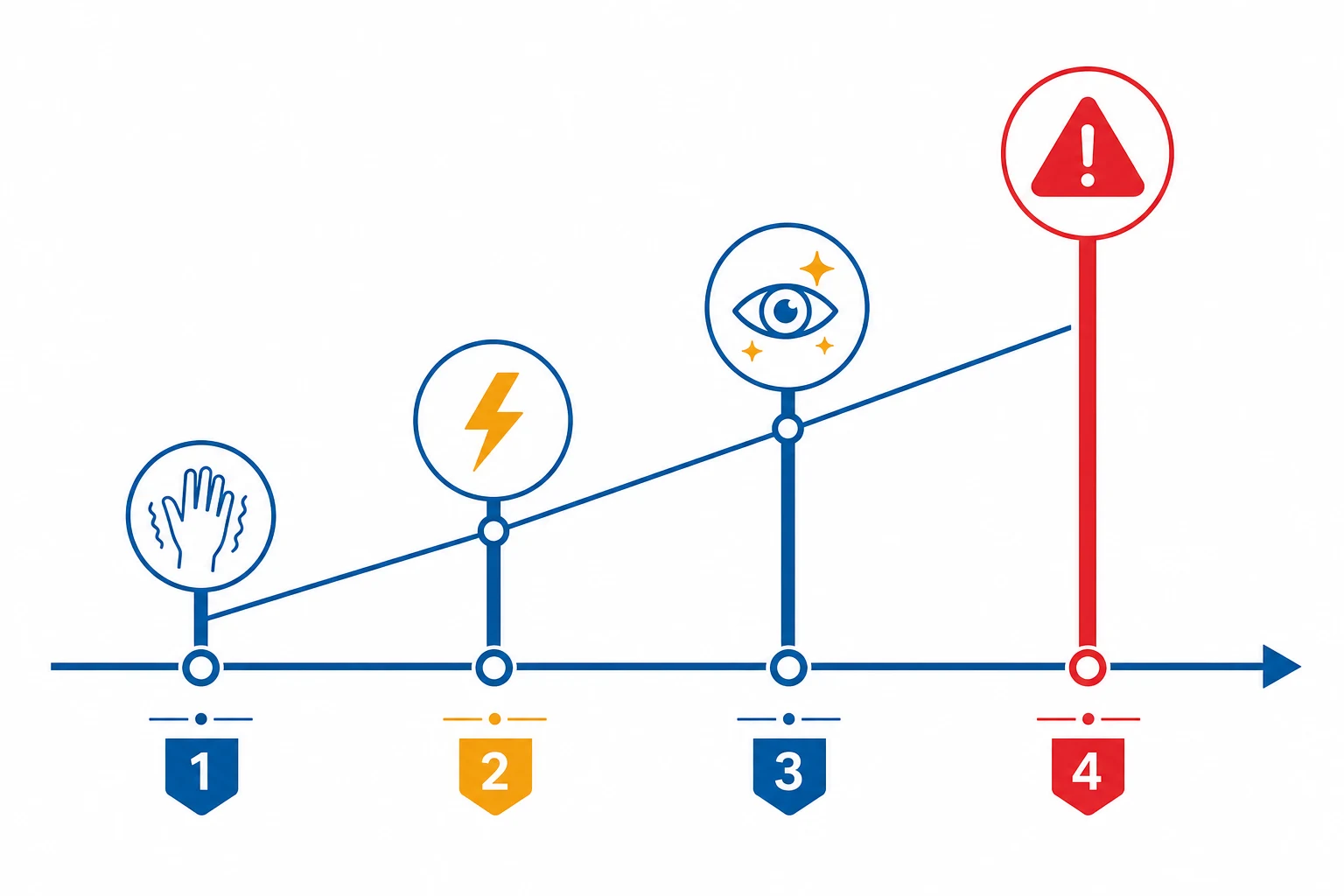
- The minor withdrawal (the 6 to 24 h) — the tremor, the anxiety, the insomnia, the nausea, the vomiting, the palpitations, the diaphoresis, the mild hypertension and the tachycardia. The "the shakes".
- The alcoholic hallucinosis (the 12 to 48 h) — the visual (the auditory) hallucinations with the clear sensorium (the not the confusion of the delirium).
- The withdrawal seizure (the 12 to 48 h) — the generalised tonic-clonic, the often a single or the brief flurry; the status epilepticus the rare. The-not-the focal (the focal → the other cause).
- The delirium tremens (the 48 to 96 h) — the severe: the confusion, the agitation, the hallucinations, the autonomic instability (the tachycardia, the hypertension, the hyperthermia, the diaphoresis), the dehydration, the electrolyte disturbance. The mortality the about 5 per cent (the arrhythmia, the hyperthermia, the cardiovascular collapse).[2][1]
The management
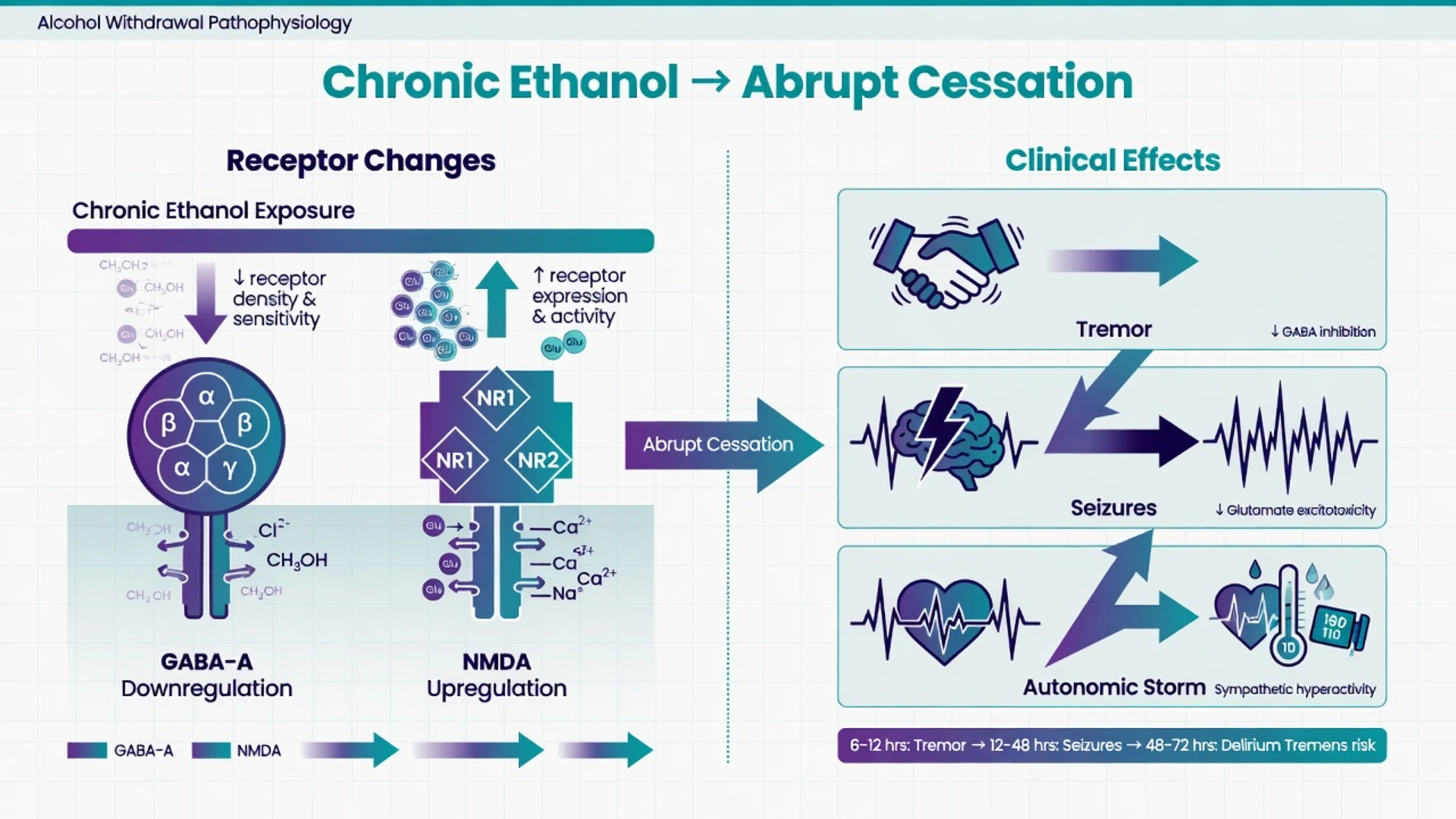
1. The benzodiazepine — the core.[1][1]
- The symptom-triggered regimen (the CIWA-Ar scoring every 1 to 2 h, the diazepam 5 to 20 mg oral/IV per the score) — the less total dose, the shorter the course, the better the outcome than the fixed schedule.
- The diazepam (the long-acting — the self-tapering, the preferred); the lorazepam (the shorter-acting, the hepatic-impaired preferred — the no active metabolites).
- The severe (the DT, the ICU) — the IV diazepam infusion or the phenobarbital, the titrate to the light sedation, the front-loading.
2. The thiamine BEFORE the glucose. The 100 to 500 mg IV, the empirical in the alcohol-dependent, the before any dextrose.[3]
3. The electrolyte correction.[1][1]
- The magnesium (the depleted, the worsens the withdrawal and the seizure threshold — the replete).
- The potassium (the depleted — the replete).
- The phosphate (the refeeding-like — the monitor, the replete for the severe).
- The folate.
4. The supportive. The hydration (the balanced crystalloid), the treat the intercurrent (the infection, the GI bleed, the pancreatitis, the hepatic), the aspiration precaution, the cooling (the hyperthermia of the DT).[1]
5. The ICU for the delirium tremens. The ICU admission, the continuous benzodiazepine infusion, the autonomic control (the beta-blocker cautious; the alpha-2 agonist the dexmedetomidine as the adjunct), the ventilation if the required, the monitoring (the ECG — the arrhythmia, the electrolytes, the temperature).[2]
Prognosis
The minor withdrawal resolves over the 3 to 7 days. The delirium tremens the 3 to 5 days, the mortality the 5 per cent (the arrhythmia, the hyperthermia, the cardiovascular collapse, the aspiration). The Wernicke the reversible if the treated early; the Korsakoff the irreversible.[2][3][1]
Red flags
Pathophysiology — the deep dive
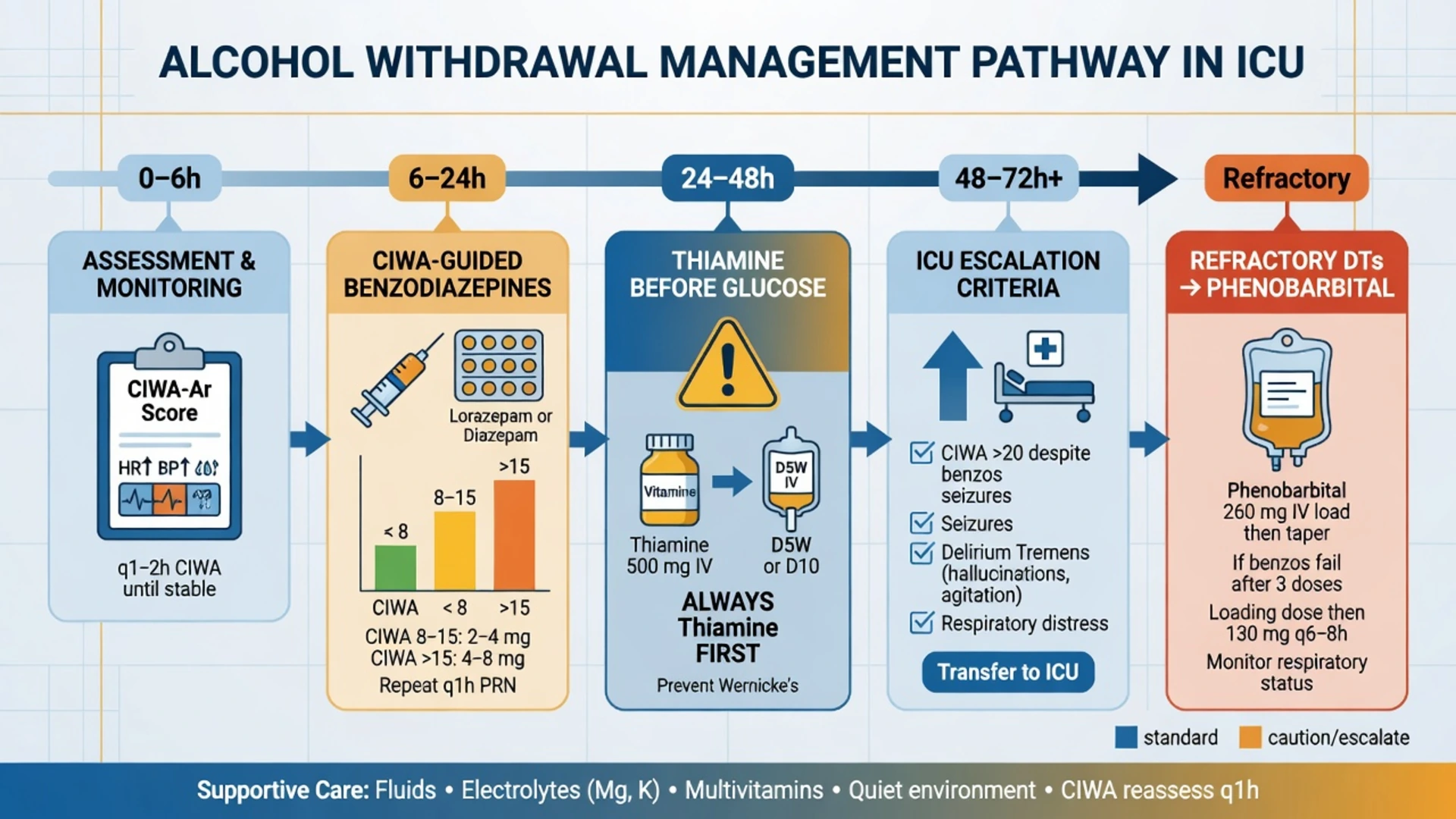
The ethanol is the cross-tolerant with the benzodiazepine (both the enhance the GABA-A) and the barbiturate (both the enhance the GABA-A and the inhibit the NMDA). The chronic ingestion induces the neuroadaptation — the brain the remodels to maintain the homeostasis in the presence of the ethanol.[1][4]
- The GABA-A — the downregulated. The chronic ethanol the potentiates the GABA-A (the increased the chloride influx, the inhibition). The brain the responds the homeostatically the DOWNREGULATE the GABA-A receptor (the reduced the receptor number, the reduced the receptor function, the reduced the endogenous GABA). The net the inhibitory tone the falls.
- The NMDA — the upregulated. The chronic ethanol the inhibits the NMDA receptor (the reduced the calcium influx, the excitation). The brain the responds the homeostatically the UPREGULATE the NMDA receptor (the increased the receptor number, the increased the receptor function) and the UPREGULATE the glutamate release. The net the excitatory tone the rises.
- The other the systems. The chronic ethanol the increases the L-type the voltage-gated the calcium channels (the upregulation — the contributor to the tremor and the autonomic), the decreases the dopamine and the serotonin (the depression, the craving), the activates the HPA axis and the noradrenergic (the autonomic), and the inhibits the NMDA-dependent the NMDA-receptor plasticity. [1]
The abrupt cessation — the excitotoxicity. The ethanol the removed → the GABA the underactive (the downregulated, the no the ethanol to the potentiate) PLUS the glutamate the overactive (the upregulated, the unopposed) → the the unopposed excitatory drive → the hyperexcitability (the tremor, the agitation, the seizure, the DT) and the excitotoxic injury (the calcium influx the excessive, the NMDA-mediated, the neuronal the apoptosis).[4]
The kindling effect — the sensitisation. Each the withdrawal episode the lowers the threshold the for the next (the kindling — the progressive the sensitisation of the NMDA and the limbic the circuitry). The more the episodes, the more the severe, the more the likely the seizure and the DT. The number of the prior the detoxifications the predicts the severity. The rationale the for the early the aggressive the benzodiazepine the prophylaxis (the prevent the cascade).[4][6]
The neurotransmitter the adaptation in the chronic ethanol
| The system | The acute ethanol | The chronic ethanol (the adaptation) | The withdrawal (the ethanol removed) |
|---|---|---|---|
| GABA-A | The enhanced (the inhibition) | The DOWN-regulated (the reduced the number + the function) | The underactive → the loss of the inhibition |
| NMDA (the glutamate) | The inhibited (the less the excitation) | The UP-regulated (the increased the number + the function) | The overactive → the unopposed the excitation |
| L-type the calcium channels | The enhanced | The UP-regulated | The overactive → the tremor, the autonomic |
| The dopamine / the serotonin | The increased (the reward) | The downregulated (the depleted) | The depression, the craving, the dysphoria |
| The noradrenergic / the HPA axis | The activated | The sensitised | The autonomic the surge (the tachycardia, the hypertension, the diaphoresis) |
The CIWA-Ar — the deep scoring
The CIWA-Ar (the Clinical Institute the Withdrawal Assessment — the Alcohol, the revised) is the 10-item the validated the scale (the Sullivan 1989, the derived from the larger the CIWA-A).[1][5]
The 10 items (the each the 0-7, the except the orientation 0-4): the nausea (the 0-7), the tremor (the 0-7), the paroxysmal the sweats (the 0-7), the anxiety (the 0-7), the agitation (the 0-7), the tactile the disturbances (the 0-7), the auditory the disturbances (the 0-7), the visual the disturbances (the 0-7), the headache (the 0-7), the orientation / the clouding (the 0-4). The total the 0 to 67. [1]
The thresholds the for the action (the symptom-triggered the dosing): [1]
| The CIWA-Ar the total | The severity | The action |
|---|---|---|
| The < 8 | The mild | The reassess the q 1-2 h; the no the routine the medication (the PRN the only) |
| The 8-15 | The moderate | The benzodiazepine (the diazepam the 5-20 mg PO/IV) the per the score; the reassess the q 1 h |
| The > 15 | The severe | The benzodiazepine the aggressive (the diazepam the 10-20 mg IV the q 1 h the OR the infusion); the ICU the if > 20 |
| The > 20 | The very severe / the DT | The ICU; the continuous the benzodiazepine the infusion; the phenobarbital the adjunct; the intubation the if required |
The advantages of the symptom-triggered (the CIWA-Ar-driven) over the fixed-schedule (the Saitz 1994, the JAMA): the LESS the total the benzodiazepine (the 100 mg the diazepam the vs the 200+ mg), the SHORTER the treatment (the 2-3 days the vs the 6-8 days), the FEWER the complications, the SAME the efficacy. The fixed the schedule the OVER-treats the mild and the UNDER-treats the severe.[5][6]
The limitations of the CIWA-Ar in the ICU. The CIWA-Ar the requires the patient the communicative and the cooperative. The intubated, the sedated, the deeply the encephalopathic, the post-arrest — the CIWA the INVALID. The alternatives: the SHOTS (the Sedation, the Hallucinations, the Orientation, the Tremor, the Sweating — the simplified), the RASS-driven the benzodiazepine, the BWA (the Brief the Withdrawal Assessment). The ICU the withdrawal — the often the protocolised the nurse-driven the infusion (the diazepam the 10 mg IV the q 5-10 min the until the calm).[7]
The benzodiazepine pharmacology — the agent the comparison
The benzodiazepine the agents for the alcohol withdrawal
| The agent | The half-life (the parent) | The active the metabolites | The onset (the IV) | The duration | The preferred the for | The caution |
|---|---|---|---|---|---|---|
| Diazepam | The 20-100 h | The yes (the nordiazepam, the temazepam, the oxazepam) — the long | The 1-5 min | The long (the self-taper) | The standard the first-line; the hepatic the intact; the outpatient the taper | The hepatic the failure (the accumulation), the elderly |
| Lorazepam | The 10-20 h | The no (the glucuronide — the inactive) | The 5-10 min | The intermediate | The hepatic the failure; the elderly; the ICU the infusion (the predictable) | The less the self-taper → the more the frequent the dosing |
| Chlordiazepoxide | The 5-30 h | The yes (the long) | The N/A (the PO the only) | The long | The outpatient the mild; the historical the standard | The hepatic the failure; the PO the only → the not the ICU |
| Oxazepam | The 4-15 h | The no | The N/A (the PO) | The short | The hepatic the failure; the elderly (the mild the outpatient) | The short → the frequent the dosing |
| Midazolam | The 1-4 h | The yes (the alpha-OH) | The 1-3 min | The ultrashort | The ICU the infusion; the rapid the titration; the DT | The tachyphylaxis; the delirium; the ICU the only |
The principles of the choice. (1) The long-acting the preferred (the diazepam) — the self-tapering, the smooth, the less the rebound, the less the seizure recurrence. (2) The lorazepam the if the hepatic the impaired (the no the active the metabolites, the glucuronide the conjugation the preserved in the cirrhosis). (3) The midazolam the infusion the for the refractory the DT (the rapid the titration, the ICU the only). (4) The chlordiazepoxide the for the mild the outpatient / the ward (the PO, the cheap, the historical the standard).[1][4]
The front-loading. The give the diazepam the 20 mg the IV the q 5-10 min the until the lightly the sedated (the end-point the calm, the drowsy, the rousable) — the often the 60-120 mg the total the in the first the hour. The front-loading the exploits the long the half-life (the self-tapering); the subsequent the doses the only the if the CIWA the rises. The risk: the oversedation, the respiratory the depression (the monitor, the naloxone the ineffective [the not the opioid], the airway the standby).[2][4]
The phenobarbital — the adjunct / the alternative
The phenobarbital is the long-acting the barbiturate. The mechanism: the enhances the GABA-A (the longer the channel the opening, the chloride the influx) AND the inhibits the NMDA (the dual the action — the rationale the for the efficacy the where the benzodiazepine the alone the fails).[9]
The role. (1) The adjunct to the benzodiazepine the for the refractory the withdrawal (the benzodiazepine-resistant the DT). (2) The monotherapy the alternative (the ED the single-dose the 130-260 mg the IM/IV — the Rosenson 2013 the RCT — the reduced the ICU the admission, the reduced the intubation). (3) The ICU the protocolised the phenobarbital the escalating (the boluses the 130-260 mg the q 15-30 min the until the calm — the reduced the intubation the vs the high-dose the benzodiazepine).[9]
The advantages. The long the half-life (the 50-150 h — the self-taper, the less the rebound), the wide the therapeutic the window, the cheap, the no the active the metabolite the accumulation the in the renal the failure. The disadvantages: the slow the onset (the 15-30 min), the long the duration (the risk the oversedation, the prolonged the ventilation), the no the reversal the agent (the flumazenil the not the effective the for the barbiturate).[4]
The dexmedetomidine — the alpha-2 the adjunct
The dexmedetomidine is the selective the alpha-2A the agonist. The mechanism: the central the sympatholysis (the reduced the noradrenaline, the blunted the autonomic the surge) WITHOUT the GABA-A the effect (the not the cross-tolerant, the not the substituting the for the alcohol).[8]
The role. The adjunct the to the benzodiazepine — the reduces the benzodiazepine the requirement, the controls the autonomic (the tachycardia, the hypertension, the diaphoresis, the agitation), the sparing the respiratory the drive (the not the respiratory the depression — the advantage the over the benzodiazepine in the non-intubated).[8]
The Mueller 2014 the RCT (the dexmedetomidine the adjunctive the to the benzodiazepine the in the severe the alcohol the withdrawal): the reduced the benzodiazepine the requirement (the 77 mg the lorazepam the vs the 138 mg), the reduced the agitation, the same the delirium. The no the reduced the ICU the LOS the or the mortality.[8]
The cautions. The bradycardia, the hypotension (the alpha-2 the agonist — the central the sympatholysis), the not the monotherapy (the not the cross-tolerant — the seizure the threshold the unchanged, the monotherapy the INCREASES the seizure the risk), the loading the dose the AVOID (the reflex the hypertension).[7]
The thiamine and the Wernicke — the deep dive
The Wernicke encephalopathy is the acute the thiamine-deficiency the neuropsychiatric the syndrome. The thiamine (the vitamin B1) is the cofactor for the pyruvate the dehydrogenase (the glycolysis → the acetyl-CoA → the Krebs the cycle), the alpha-ketoglutarate the dehydrogenase (the Krebs), the transketolase (the pentose the phosphate). The deficiency → the impaired the energy the metabolism (the brain — the highest the energy the demand), the lactate the accumulation, the oedema, the the mammillary the body, the periaqueductal the grey, the floor the of the fourth the ventricle, the thalamus the haemorrhagic the necrosis.[3]
The classic the triad (the present the in the only ~ 10-30 %!): the ataxia (the wide-based, the cerebellar the vermis), the ophthalmoplegia (the horizontal the nystagmus, the lateral the rectus the palsy, the conjugate the gaze the palsy), the confusion (the disorientation, the apathy, the impaired the attention). The Korsakoff the syndrome — the irreversible the anterograde the amnesia (the confabulation) — the late the untreated the consequence.[3][1]
The thiamine BEFORE the glucose — the rationale. The thiamine the deficiency → the PDH the impaired. The glucose the load → the glycolysis the drives the pyruvate → the PDH the bottleneck → the pyruvate → the lactate (the worsens the acidosis) AND the PDH the demand the depletes the residual the thiamine the acutely → the Wernicke the precipitated or the worsened. The give the thiamine the 100-500 mg the IV the BEFORE the dextrose the in EVERY the alcohol-dependent the or the malnourished the patient.[3][1]
The high-dose the thiamine — the evidence. The conventional the 100 mg the may the under-dose. The high-dose the thiamine (the 500 mg the IV the TID the for the 3 days, the followed the 250 mg the IM/PO the for the 5 days) — the recommended the by the European the guidelines (the better the tissue the saturation, the reduced the Korsakoff). The oral the thiamine the poorly the absorbed (the 5 %) — the IV the for the acute.[3]
The electrolytes — the deep correction
- The magnesium. The depleted (the poor the intake, the renal the loss — the alcohol the inhibits the reabsorption, the diarrhoea, the diuresis). The hypomagnesaemia the worsens the withdrawal, the lowers the seizure the threshold, the perpetuates the hypokalaemia (the renal the K-wasting the persists the until the Mg the repleted — the "the refractory the hypokalaemia the on the ground the of the hypomagnesaemia"). The replete (the MgSO4 the 2-4 g the IV — the empirical the in the every the alcohol the withdrawal).[1][1]
- The potassium. The depleted (the poor the intake, the diarrhoea, the diuresis, the secondary the hyperaldosteronism, the refeeding). The hypokalaemia the arrhythmogenic. The replete (the KCl the IV/PO the guided the by the serum, the re-check the q 4-6 h).
- The phosphate. The depleted (the poor the intake, the refeeding — the respiratory the alkalosis the shifts the phosphate the intracellularly). The hypophosphataemia → the respiratory the muscle the weakness (the failure to the wean), the rhabdomyolysis, the haemolysis, the impaired the 2,3-DPG (the tissue the hypoxia). The replete (the Na/K the phosphate the IV the if < 0.3-0.5). The monitor for the refeeding (the phosphate, the magnesium, the potassium the q 6-12 h).
- The folate. The depleted (the poor the intake, the malabsorption). The megaloblastic the anaemia, the thrombocytopenia. The 1 mg the PO/IV the daily. The replete.
- The sodium. The variable — the hypo (the beer the potomania, the SIADH, the cerebral the salt the wasting — the low the solute the intake the + the free the water the excess) OR the hyper (the dehydration, the diuresis). The correct the slowly (the < 8-10 mmol/L the per day — the osmotic the demyelination the risk the if the rapid the correction the in the chronic the hypo).
- The calcium. The "the functional the hypocalcaemia" — the hypoalbuminaemia the reduces the total the Ca but the ionised the normal; the alkalosis (the hyperventilation) the reduces the ionised. The correct the ionised (the not the total). The magnesium the first (the hypomagnesaemia the causes the functional the hypocalcaemia the via the PTH the suppression).
The flow — the ICU management
The alcohol withdrawal — the ICU the management
- The ABCDE + the recognition. The airway (the aspiration the risk — the lateral, the suction), the breathing (the hypoxia — the O2, the CO2 — the hypoventilation the from the intoxication or the oversedation), the circulation (the tachycardia, the hypertension — the IV the access, the fluid — the euvolaemia), the disability (the GCS, the pupils, the glucose — the the bedside the glucose the FIRST — the hypoglycaemia the common), the exposure (the injuries — the head the trauma the from the fall, the sepsis the source). The confirm the withdrawal (the history — the last the drink, the pattern, the prior the withdrawal, the dependence the markers — the stigmata, the GGT, the MCV, the CDT). The exclude the mimics (the sepsis, the intracranial, the hepatic the encephalopathy, the metabolic, the toxidromes).
- The benzodiazepine — the symptom-triggered the CIWA-Ar. The score the q 1-2 h. The diazepam the 5-20 mg the PO/IV the per the score (the > 8 → the dose; the reassess the q 1 h). The front-load the for the severe (the diazepam the 20 mg the IV the q 5-10 min the until the calm). The infusion the for the DT (the diazepam the 10-20 mg/h the OR the midazolam the 2-10 mg/h, the titrate the to the RASS the -1 to 0). The maximum — the no the fixed the ceiling (the up the to the 1000 mg the diazepam the per day the in the refractory); the if the intubated the monitor; the if the not the intubated the escalate the to the phenobarbital / the intubation the BEFORE the apnoea.
- The thiamine BEFORE the glucose. The 100-500 mg the IV the immediately the in the EVERY the alcohol-dependent. The high-dose the 500 mg the IV the TID the for the 3 days the if the suspected the Wernicke. The empirical the in the undifferentiated the coma. The AFTER the thiamine — the treat the hypoglycaemia (the 50 % the dextrose the 25-50 mL the IV).
- The electrolyte the repletion. The MgSO4 the 2-4 g the IV (the empirical). The KCl the guided the by the serum. The phosphate the if the refeeding the or the severe. The folate the 1 mg. The monitor the q 6-12 h the for the 48-72 h.
- The adjuncts — the phenobarbital the and the dexmedetomidine. The phenobarbital the 130-260 mg the IV the q 15-30 min the for the benzodiazepine-resistant (the end-point the calm). The dexmedetomidine the 0.2-0.7 microg/kg/h (the no the loading — the avoid the reflex the hypertension) the for the autonomic the control (the reduced the benzo, the spared the respiratory the drive). The NOT the monotherapy (the seizure the threshold the unchanged).
- The supportive + the complications. The fluid the euvolaemia (the balanced the crystalloid — the avoid the 5 % dextrose the primary [the thiamine first]), the treat the intercurrent (the sepsis — the cultures, the antibiotics; the GI the bleed — the PPI, the endoscopy; the pancreatitis; the pneumonia — the aspiration), the hyperthermia the cooling (the paracetamol the cautious [the liver], the physical — the ice, the fans; the DT the fever the autonomic — the NOT the infectious — but the ALWAYS the exclude the sepsis), the DVT the prophylaxis, the stress the ulcer the prophylaxis, the aspiration the precaution.
- The disposition + the relapse-prevention. The minor the withdrawal — the ward (the 3-7 days). The DT — the ICU (the 3-5 days). The Wernicke — the high-dose the thiamine, the long-term the PO. The relapse-prevention (the naltrexone, the acamprosate — the NOT the disulfiram the in the ICU), the addiction the liaison, the social the work. The kindling — the counsel the relapse-prevention (the each the episode the worse).
The differential diagnosis
The delirium in the alcoholic — the differential
| The diagnosis | The distinguishing the features | The key the investigation |
|---|---|---|
| Alcohol withdrawal / the DT | The 6-96 h the after the last the drink; the autonomic the surge; the tremor; the CIWA the high; the response the to the benzo | The history; the CIWA-Ar; the response the to the diazepam |
| Wernicke encephalopathy | The ataxia, the ophthalmoplegia, the confusion; the malnutrition; the NO the response the to the benzo | The empirical the thiamine; the MRI (the mammillary the enhancement) |
| Hepatic encephalopathy | The cirrhosis; the asterixis (the NOT the tremor); the elevated the ammonia; the asterixis; the NO the autonomic the surge | The LFT, the ammonia, the response the to the lactulose / the rifaximin |
| Sepsis / the septic the encephalopathy | The source; the fever; the leukocytosis; the hypotension; the hypoperfusion (the lactate) | The cultures, the lactate, the source the imaging |
| Intracranial (the SDH, the SAH, the ICH) | The head the trauma (the fall); the focal the deficit; the headache; the decreased the GCS | The CT the head — the empirical the in the EVERY the withdrawal the patient the with the focal the deficit, the persistent the decreased the GCS, the or the post-ictal |
| The toxidrome (the stimulant, the anticholinergic, the SS) | The history; the toxidrome the features (the mydriasis, the dry, the hyperreflexia, the clonus) | The drug the screen; the temperature (the NMS, the SS — the rigidity, the fever) |
| Hypoglycaemia | The rapid the onset; the diaphoresis; the tremor; the decreased the GCS | The bedside the glucose (the FIRST) |
| The post-ictal (the seizure the mimicking the withdrawal) | The seizure the ictus; the post-ictal the confusion; the slow the resolution | The history; the EEG; the CT |
The refractory the withdrawal — the ICU the escalation
The refractory the withdrawal — the persistent the agitation, the autonomic the instability, the seizure the despite the high-dose the benzodiazepine (the > 200 mg the diazepam the in 4 h, the or > 60 mg the midazolam/h).[7]
The escalation the ladder. (1) The phenobarbital the loading (the 130-260 mg the IV the q 15-30 min the until the RASS the -1 to 0, the maximum the 15-20 mg/kg the loading). (2) The dexmedetomidine the infusion (the 0.2-0.7 microg/kg/h — the autonomic the control, the benzo-sparing). (3) The propofol the infusion (the if the intubated — the 0.5-3 mg/kg/h — the rapid the titration, the ICU the only). (4) The intubation the if the persistent the agitation the + the respiratory the failure, the or the respiratory the acidosis the from the high-dose the benzo. (5) The the propofol the + the fentanyl / the ketamine the for the refractory (the rare — the "the refractory the DT" — the intubated, the paralysed the if required). The the ketamine (the NMDA the antagonist — the rationale the for the pathophysiology — the small the series; the not the standard).[7]
The prognosis + the kindling + the recurrence
The minor the withdrawal the resolves the over the 3-7 days. The DT the 3-5 days, the mortality the 5-15 % (the arrhythmia — the QT the prolongation, the electrolyte, the atrial the fibrillation; the hyperthermia; the cardiovascular the collapse; the aspiration; the rhabdomyolysis; the hepatic). The Wernicke the reversible the if the treated the early; the Korsakoff the irreversible the in the 80 %. The recurrence the high (the 60-70 % the relapse the in the 1 year).[2][3][1]
SAQ — Severe alcohol withdrawal progressing to delirium tremens
10 minutes · 10 marks
A 52-year-old man is admitted 18 hours after his last drink (chronic 100 g/day, recent cessation after a cholecystectomy). He is tremulous, agitated, tachycardic (HR 124), hypertensive (BP 180/110), febrile (38.5°C), hallucinating (visual and tactile — insects crawling) and disoriented to place and time. CIWA-Ar score 26. He has had one witnessed generalised tonic-clonic seizure in the ED.
SAQ — Wernicke encephalopathy in a critically ill alcoholic
10 minutes · 10 marks
A 48-year-old woman with chronic alcoholism is admitted with pancreatitis. She is confused (GCS 13), ataxic and has bilateral sixth-nerve palsy with nystagmus. A medical student has just cannulated her and is about to give 50 mL of 50% dextrose for a glucose of 2.8 mmol/L. She has not received any vitamins.
The clinical pearls
Additional red flags
The trial the evidence
The alcohol the withdrawal — the key the trials
- The Sullivan 1989 (Br J Addict) — the derivation the of the CIWA-Ar (the 10-item, the 0-67) the from the larger the CIWA-A. The validated the scale; the foundation the of the symptom-triggered the dosing.[1]
- The Saitz 1994 (JAMA) — the RCT the of the symptom-triggered (the CIWA-Ar-driven) the vs the fixed-schedule the chlordiazepoxide. The LESS the total the benzo (the 100 mg the vs the 200+ mg), the SHORTER the treatment (the 2-3 days the vs the 6-8 days), the SAME the efficacy. The practice-changing.[5]
- The Mayo-Smith 2004 (Arch Intern Med) — the evidence-based the practice the guideline (the American the Society the of the Addiction the Medicine). The benzodiazepine the FIRST-line the (the A the evidence); the symptom-triggered the preferred (the A); the no the evidence the for the antipsychotic, the beta-blocker, the magnesium the as the monotherapy.[4]
- The Amato 2011 (Cochrane) — the systematic the review the of the 57 the RCTs. The benzodiazepine the more the effective the than the placebo (the reduced the withdrawal the severity, the seizure, the DT, the mortality). The no the clear the difference the between the benzodiazepine the agents. The antipsychotic the no the better; the seizure the risk.[6]
- The Rosenson 2013 (J Emerg Med) — the RCT the of the phenobarbital (the 10 mg/kg the IM) the vs the placebo, the ED, the adjunct the to the lorazepam. The reduced the ICU the admission (the 0 % the vs the 16 %), the reduced the intubation. The phenobarbital the adjunct the effective.[9]
- The Mueller 2014 (Crit Care Med) — the RCT the of the dexmedetomidine the adjunctive the to the benzodiazepine the in the severe the withdrawal. The reduced the benzo (the 77 mg the vs the 138 mg the lorazepam), the reduced the agitation, the same the delirium. The no the reduced the ICU the LOS the or the mortality.[8]
- The Day 2014 (Cochrane) — the thiamine the for the Wernicke-Korsakoff. The limited the evidence the for the efficacy; the empirical the high-dose the recommended (the 500 mg the IV the TID the for the 3 days — the European the guideline).[3]
- The Schuckit 2014 (NEJM) — the review. The DT the 48-96 h, the mortality the 5-15 %. The benzodiazepine the FIRST; the thiamine the before the glucose; the electrolyte the correction; the ICU the for the DT.[2]
The exam the vignettes
Summary
The ethanol the — the acute the intoxication (the CNS the depression, the supportive), the chronic the effects (the cirrhosis, the Wernicke-Korsakoff), the and the alcohol the withdrawal the syndrome. The pathophysiology the — the chronic the ethanol the downregulates the GABA-A the + the upregulates the NMDA the → the abrupt the cessation the → the unopposed the glutamate the excitotoxicity. The timeline the — the minor the (the 6-24 h), the hallucinosis the (the 12-48 h, the clear the sensorium), the seizure the (the 12-48 h, the generalised), the DT the (the 48-96 h, the autonomic the + the mortality the 5-15 %). The management the — the benzodiazepine the (the symptom-triggered the CIWA-Ar; the diazepam the first-line; the lorazepam the if the hepatic), the thiamine the BEFORE the glucose, the electrolyte the (the Mg the + the K the + the phosphate the + the folate), the adjuncts the (the phenobarbital the + the dexmedetomidine), the supportive, the exclude the mimics. The kindling the — the counsel the relapse-prevention.[1][2][1][4]
References
- [1]Soyka M, Lieb M, Koller G, et al. Clinical management of the alcohol withdrawal syndrome Addiction, 2022.PMID 34288186
- [2]Schuckit MA. Recognition and management of withdrawal delirium (delirium tremens) N Engl J Med, 2014.PMID 25427113
- [3]Day E, Bentham PW, Callaghan R, et al. Thiamine in the treatment of Wernicke encephalopathy in patients with alcohol use disorders Intern Med J, 2014.PMID 25201422
- [4]Mayo-Smith MF, Beecher LH, Fischer TL, et al. Paul B Spiegel. Interview Lancet, 2004.PMID 14975639
- [5]Saitz R, Mayo-Smith MF, Roberts MS, et al. Improvement in glucose tolerance and insulin resistance in obese subjects treated with troglitazone N Engl J Med, 1994.PMID 7935656
- [6]Amato L, Minozzi S, Davoli M, Vecchi S. Can difficult intubation be easily and rapidly predicted? Biomed Pap Med Fac Univ Palacky Olomouc Czech Repub, 2011.PMID 21804626
- [7]Sarff M, Gold JA. [Genetic characteristics of mumps virus in China from 2006 to 2008] Zhongguo Yi Miao He Mian Yi, 2009.PMID 20077668
- [8]Mueller SW, Preslaski CR, Kiser TH, et al. Efficacy and safety of oral chelators in treatment of patients with Wilson disease Clin Gastroenterol Hepatol, 2013.PMID 23542331
- [9]Rosenson J, Clements C, Simon B, et al. Anatomical patterns and correlated MRI findings of non-perinatal hypoxic-ischaemic encephalopathy Br J Radiol, 2013.PMID 23255548