ICU · Toxicology
Toxicology — The General Approach to the Poisoned Patient
Also known as Poisoning · Overdose · Toxidromes · Activated charcoal · Decontamination · Enhanced elimination · Antidotes
The structured approach to the poisoned patient in the ICU — the resuscitation and the ABCDE adapted to the toxidrome; the clinical assessment and the toxidromes (the sympathomimetic, the anticholinergic, the cholinergic, the opioid, the sedative-hypnotic, the serotonin, the neuroleptic malignant); the investigation (the drug levels, the ECG, the anion and the osmolar gaps); the decontamination (the activated charcoal, the whole-bowel irrigation, the haemoperfusion); the enhanced elimination (the urinary alkalinisation, the haemodialysis); the antidotes (the naloxone, the N-acetylcysteine, the flumazenil, the digoxin Fab, the atropine and the pralidoxime, the lipid emulsion, the fomepizole); and the supportive care.
On this page & tools
Your progress
Saved locally on this device.
Target exams
Overview & definition
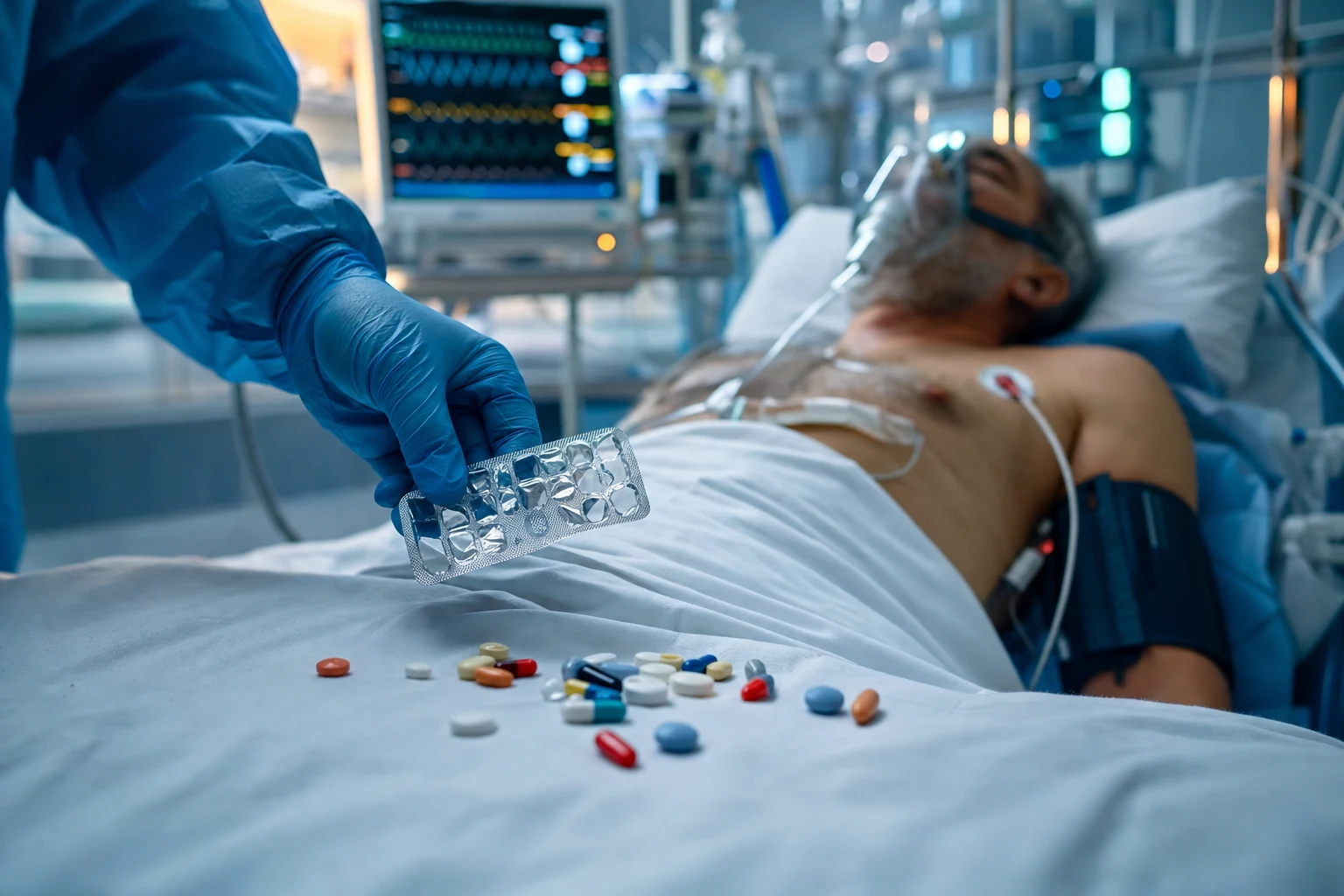
The poisoned patient is a core ICU presentation — the deliberate or the accidental overdose, the environmental exposure, the envenomation. The intensivist's task is the resuscitation, the risk stratification, the decontamination, the antidote, and the supportive care until the toxin is eliminated.[1][1]
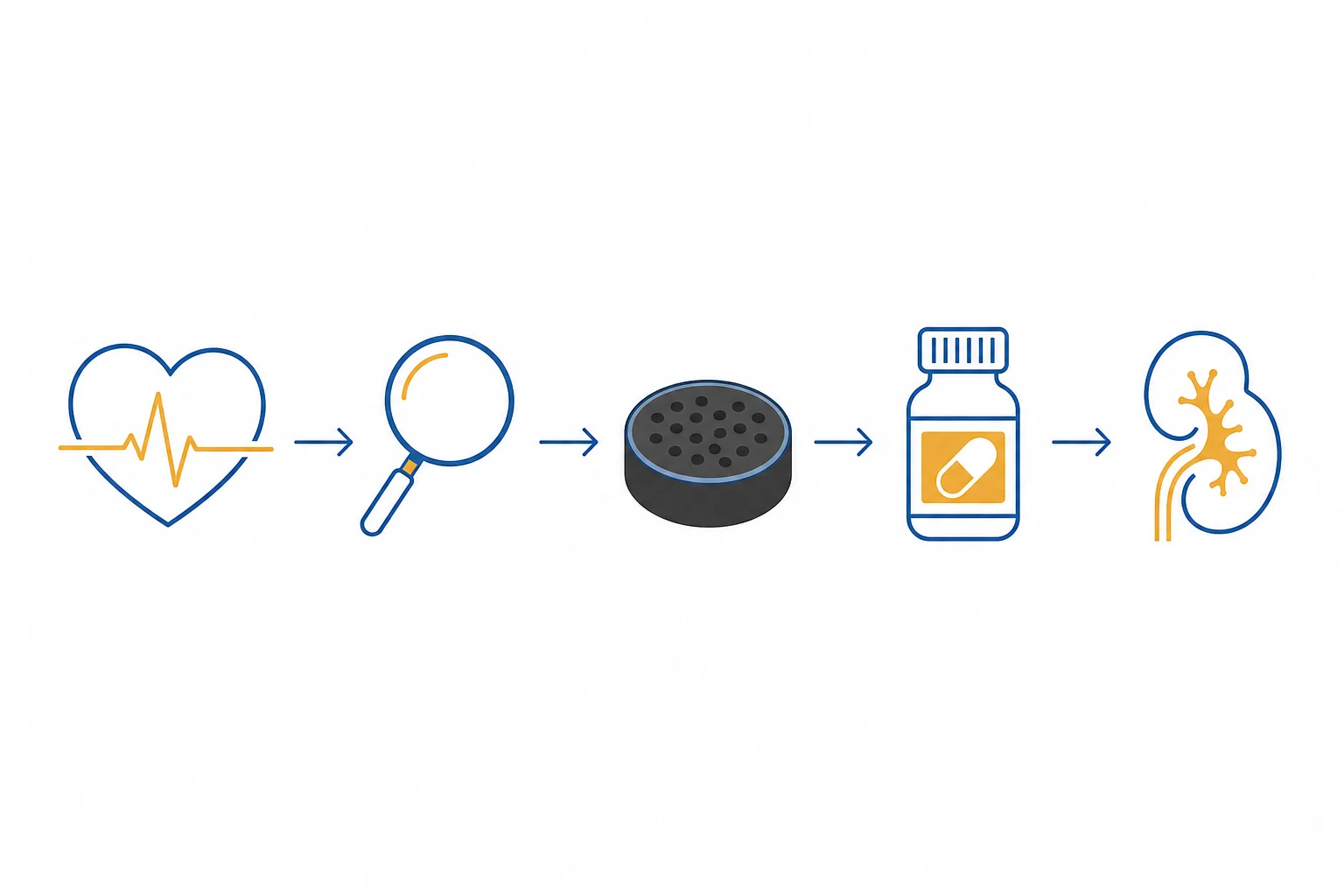
The framework rests on five sequential steps: resuscitate, identify, decontaminate, give the antidote, enhance the elimination — overlaid with the continuous supportive care and the toxidrome recognition.[1]
Resuscitation — the ABCDE adapted to the toxin
The resuscitation precedes everything. The ABCDE, with the toxin-specific nuances:[1][1]
- The airway and the breathing — the coma (the opioid, the sedative) and the aspiration risk. The early intubation for the unprotected airway or the failing ventilation. The high-flow oxygen, but the CAUTION in the chronic-CO2 retainer (the opioid, the benzodiazepine) where the hypoxic drive may be blunted.
- The circulation — the toxin-induced shock (the vasodilation of the calcium-channel-blocker, the negative inotropy of the beta-blocker, the dehydration). The IV fluids, the vasopressors; the specific antidote where relevant.
- The disability — the glucose (the naloxone does NOT replace the glucose check — every unconscious patient gets a finger-prick glucose), the temperature (the hypothermia and the hyperthermia), the pupils (the pinpoint of the opioid, the dilated of the sympathomimetic).
- The early antidotes — the empirical naloxone (the opioid), the glucose (the hypoglycaemia), the thiamine (the alcohol-dependent with the Wernicke).[1][1]
The ABCDE in detail — the toxin-specific adaptations
The poisoned patient's ABCDE departs from the surgical ABCDE in three ways: (1) the airway threat is the aspiration of the gastric contents AND the toxin (the hydrocarbon, the corrosive); (2) the circulation is threatened by the four shock patterns specific to the toxins (the distributive, the cardiogenic, the hypovolaemic, the obstructive); and (3) the empirical antidote is part of the primary survey, not the secondary.[1][1]
- A — Airway — the loss of the protective reflexes (the opioid, the sedative, the anticonvulsant, the TCA), the corrosive injury (the airway oedema from the caustic ingestion), the hypersalivation of the cholinergic. Intubate for the GCS below 8, the loss of the gag, the refractory hypoxaemia, the loss of the airway tone — and before the gastric decontamination. The rapid-sequence intubation: the etomidate or ketamine preferred (avoid the propofol in the shocked); the fentanyl blunts the sympathetic surge; the suxamethonium cautious after the sustained seizure (the hyperkalaemia) and in the chronic cholinergic (the prolonged paralysis).[1]
- B — Breathing — the respiratory depression (the opioid, the sedative) vs the hyperventilation (the salicylate — the early respiratory alkalosis, the compensation for the metabolic acidosis; the methanol and the ethylene glycol — the Kussmaul breathing for the metabolic acidosis). The oxygen for the hypoxaemic; the CAUTION in the chronic-CO2 retainer. The intubation of the salicylate-toxic patient is dangerous — the loss of the compensatory respiratory alkalosis drives the salicylate into the brain; if intubated, hyperventilate to a PaCO2 of 30-35 mmHg and arrange the dialysis.[1][1]
- C — Circulation — the four shock patterns: the distributive (the alpha-blockade of the TCA, the peripheral vasodilation), the cardiogenic (the negative inotropy of the beta-blocker, the calcium-channel-blocker, the TCA-QRS-widening), the hypovolaemic (the vomiting, the diarrhoea, the third-space losses of the iron, the paraquat), the obstructive (the rare — the venous air embolism of the hydrogen-peroxide ingestion). The fluids first; the vasopressor for the refractory; the specific antidote early (the calcium and the high-dose insulin for the CCB and the BB; the bicarbonate for the TCA; the digoxin-Fab).[1][1]
- D — Disability — the glucose (the finger-prick FIRST — the naloxone does NOT replace it; the dextrose for the hypoglycaemia of the sulfonylurea, the insulin, the ethanol, the beta-blocker, the late paracetamol), the temperature (the hyperthermia of the serotonin and the sympathomimetic and the NMS; the hypothermia of the sedative and the opioid), the pupils (the pinpoint of the opioid; the dilated of the sympathomimetic and the anticholinergic; the normal of the sedative), the GCS, the tone (the rigidity of the NMS and the serotonin; the flaccidity of the cholinergic and the botulism).[1]
- E — Exposure — the skin (the corrosive burns of the phenol and the hydrofluoric acid; the diaphoresis of the sympathomimetic; the dry of the anticholinergic), the dermal decontamination (the strip the clothing, the copious water — see below), the temperature (the active cooling for the hyperthermia; the rewarming for the hypothermia), the evidence (the pill bottles, the suicide note, the sertraline or the trazodone wrapper that identifies the toxidrome).[1]
The ABCDE of the poisoned patient — the 90-second resuscitation
A — Protect the airway
GCS <8 or unprotected airway = intubate BEFORE decontamination. Pre-oxygenate; RSI with ketamine or etomidate; fentanyl to blunt the sympathetic surge. Beware the corrosive-airway oedema and the cholinergic hypersalivation.
B — Oxygenate, ventilate, and read the breathing pattern
High-flow O2 for hypoxaemia (CAUTION in the chronic CO2 retainers). Hypoventilation = opioid or sedative (give naloxone). Hyperventilation = salicylate (respiratory alkalosis) or toxic alcohol (Kussmaul). If intubating a salicylate patient, hyperventilate to a PaCO2 of 30-35 mmHg AND arrange dialysis.
C — Identify the shock pattern and resuscitate
Distributive (TCA alpha-blockade), cardiogenic (BB/CCB/TCA — give calcium, high-dose insulin, glucagon, bicarbonate as appropriate), hypovolaemic (iron/paraquat losses — fluids), obstructive (rare). IV access, fluids, vasopressors, and the specific antidote early.
D — Glucose, temperature, pupils, tone, GCS
Finger-prick glucose FIRST (hypoglycaemia mimics opioid coma; sulfonylurea, insulin, ethanol, beta-blocker). Empirical naloxone 0.04-0.4 mg if opioid suspected. Thiamine 100-500 mg IV in the alcohol-dependent or malnourished BEFORE the glucose. Read the temperature, the pupils, and the muscle tone for the toxidrome.
E — Expose, decontaminate, and gather the evidence
Strip and examine the skin (corrosive, diaphoretic, dry). Dermal decontamination: remove clothing, copious water, staff PPE. Active cooling for hyperthermia. Collect pill bottles, blister packs, the suicide note — the wrappers identify the toxidrome.
The "coma cocktail" — the modern revision
The classic trio of the empirical dextrose, naloxone, and thiamine for the undifferentiated coma is the cornerstone — but the modern revision is the targeted, not the blanket: the glucose for the documented hypoglycaemia (the cheap, the safe, the always-indicated); the naloxone for the opioid-toxidrome (the pinpoint pupils, the hypoventilation — NOT the blanket); the thiamine for the alcohol-dependent or the malnourished (the BEFORE the glucose — the Wernicke prophylaxis). The empirical flumazenil is the NEVER (the seizure in the chronic user, the mixed TCA overdose). The empirical oxygen is the reasonable in the hypoxaemic (the CAUTION in the chronic CO2 retainer).[1][1]
The clinical assessment and the toxidromes
The history (the agent, the dose, the time, the route, the co-ingestants) is often unreliable (the self-harm, the altered mental state); the bottle, the witnesses, the poison-centre call. The examination targets the toxidrome — the constellation of signs that identifies the toxin class.[1]
| Toxidrome | Mentation | Pupils | Vital signs | Other |
|---|---|---|---|---|
| Sympathomimetic | Alert, agitated | Dilated | Tachycardia, hypertension, hyperthermia | Sweating, tremor |
| Anticholinergic | Delirium | Dilated | Tachycardia, hyperthermia | Dry, flushed; "mad as a hatter" |
| Cholinergic | Confused | Constricted | Bradycardia or tachycardia | SLUDGE (the salivation, lacrimation, urination, defecation, GI upset, emesis) + the miosis |
| Opioid | Coma | Pinpoint | Bradycardia, hypoventilation, hypotension | The naloxone-responsive |
| Sedative-hypnotic | Coma | Normal | Normo- or hypotension | The normal ventilation (early) |
| Serotonin | Agitation, confusion | Dilated | Hyperthermia, tachycardia | Clonus (the inducible), hyperreflexia |
| Neuroleptic malignant | Stupor | Normal | Hyperthermia, lead-pipe rigidity | The creatine kinase rise |
The seven core toxidromes — in depth
The toxidrome narrows the differential from "an unknown overdose" to "a class of toxin" within seconds at the bedside. The seven core patterns — the sympathomimetic, the anticholinergic, the cholinergic, the opioid, the sedative-hypnotic, the serotonin, the neuroleptic malignant — are read from the vital signs, the pupils, the secretions, the skin, the bowel sounds, and the muscle tone.[1][1]
- The sympathomimetic (the cocaine, the amphetamine, the MDMA, the pseudoephedrine, the caffeine) — the fight-or-flight on a drug: the alert agitation, the dilated pupils, the tachycardia, the hypertension, the hyperthermia, the diaphoresis (the wet — the key differentiator from the anticholinergic), the tremor, the hyperreflexia. The complications: the seizures, the hypertensive emergency, the intracranial haemorrhage, the hyperthermia, the rhabdomyolysis. The management: the benzodiazepine (the first-line) and the cooling; the AVOID the beta-blocker alone for the cocaine (the unopposed alpha-aggravates the hypertension; the labetalol or the carvedilol are the safer if a beta-blocker is essential).[1]
- The anticholinergic (the atropine, the hyoscine, the antihistamines, the TCA, the antipsychotics, the Jimson weed, the belladonna) — the classic "mad as a hatter, blind as a bat, dry as a bone, red as a beet, hot as a hare": the delirium with the mumbling and the picking behaviour, the dilated pupils, the tachycardia, the hyperthermia, the dry skin and the dry mucosae, the urinary retention, the decreased bowel sounds. The management: the benzodiazepine; the physostigmine (the acetylcholinesterase inhibitor that crosses the blood-brain barrier) for the PURE anticholinergic delirium — the NOT for the TCA (the seizure, the asystole).[1][1]
- The cholinergic (the organophosphate, the carbamate, the nerve agent; the rare — the pilocarpine, the neostigmine overdose) — the mnemonic overload: the "SLUDGE" (the Salivation, the Lacrimation, the Urination, the Defecation, the GI distress, the Emesis) AND the "DUMBBBELS" (the Diarrhoea, the Urination, the Miosis, the Bronchospasm, the Bronchorrhoea, the Bradycardia, the Emesis, the Lacrimation, the Salivation, the Seizures) AND the "MTWtHF" (the Miosis, the Tearing, the Weakness, the Hypersalivation, the Fasciculations) — the cholinergic crisis of the nicotinic (the fasciculations, the weakness, the muscle paralysis, the paradoxical tachycardia) and the muscarinic (the SLUDGE) effects. The management: the atropine (titrate to the drying of the secretions, NOT the heart rate — the massive doses, 100-1000+ mg) AND the pralidoxime (the reactivator of the acetylcholinesterase — the EARLY, before the aging).[1]
- The opioid (the morphine, the heroin, the fentanyl, the methadone, the oxycodone, the tramadol) — the classic triad of the coma, the pinpoint pupils, and the respiratory depression (the rate below 12, the shallow). The plus-or-minus the hypotension, the hypothermia, the hyporeflexia. The pitfalls: the meperidine (pethidine), the tramadol and the fentanyl may NOT cause the miosis (the atypical); the propoxyphene and the methadone cause the QRS and the QT prolongation; the non-cardiogenic pulmonary oedema complicates the reversal. The management: the naloxone titrated to the RESPIRATORY RATE (the NOT the full alertness — the over-reversal precipitates the withdrawal and the pulmonary oedema).[1]
- The sedative-hypnotic (the benzodiazepine, the ethanol, the barbiturate, the gamma-hydroxybutyrate, the z-drug) — the central-nervous-system depression with the normal pupils and the normal vital signs (the early). The hypotension and the hypothermia in the severe. The management: the supportive — the airway, the ventilation; the flumazenil ONLY for the isolated, the naive-user benzodiazepine overdose (the CAUTION — the seizure in the chronic user, the mixed TCA overdose, the absolute contraindication in the unknown).[1][1]
- The serotonin syndrome (the SSRI, the SNRI, the MAOI, the tramadol, the linezolid, the methylene blue, the fentanyl, the dextromethorphan, the St John's wort, the combination of any two serotonergic agents) — the clonus (the inducible, the spontaneous, the ocular) is the most specific sign, with the hyperreflexia (the lower-limb-predominant), the agitation, the autonomic instability (the tachycardia, the hypertension, the hyperthermia, the diaphoresis), the dilated pupils, the diarrhoea. The Hunter criteria (the spontaneous clonus, OR the inducible clonus + agitation + diaphoresis, OR the ocular clonus + agitation + diaphoresis, OR the tremor + hyperreflexia, in the presence of a serotonergic agent). The onset in HOURS. The management: the stop the serotonergic agent, the benzodiazepine, the cyproheptadine (the 5-HT2A antagonist — the 12 mg PO/NG, then 2 mg q2h to 32 mg), the active cooling; the NOT the antipyretic (the heat is the muscle-generated).[1]
- The neuroleptic malignant syndrome (the antipsychotic — the haloperidol, the olanzapine, the risperidone; the withdrawal of the dopamine agonist or the levodopa) — the lead-pipe rigidity with the bradyreflexia (the key differentiator from the serotonin), the obtundation, the hyperthermia, the elevated creatine kinase (the rhabdomyolysis), the autonomic instability, the leucocytosis, the low serum iron. The onset over DAYS (the differentiator). The management: the stop the antipsychotic, the cooling, the benzodiazepine, the dantrolene and the bromocriptine or amantadine.[1]
Serotonin
SSRI, MAOI, tramadol, linezolid, methylene blue; onset in HOURS
- Clonus (inducible/spontaneous/ocular) is the most specific sign; hyperreflexia (lower limbs)
- Diaphoresis, mydriasis, diarrhoea, hyperthermia, autonomic instability
- Treatment: STOP the agent + benzodiazepine + cyproheptadine + active cooling; NOT antipyretics
NMS
Antipsychotic or dopamine-agonist withdrawal; onset over DAYS
- Lead-pipe rigidity + BRADYreflexia (the key contrast with serotonin)
- Elevated CK, obtundation, hyperthermia, autonomic instability, low serum iron
- Treatment: STOP the antipsychotic + cooling + benzodiazepine + dantrolene + bromocriptine/amantadine
Malignant hyperthermia
Volatile anaesthetic + suxamethonium; in theatre, onset in MINUTES
- Masseter rigidity, rising end-tidal CO2, hyperthermia, hyperkalaemia
- Ryanodine-receptor-mediated intracellular calcium dysregulation
- Treatment: STOP the trigger + dantrolene 2.5 mg/kg repeat to 10 mg/kg + cooling
Anticholinergic
Antihistamine, TCA, atropine, Jimson weed; onset in HOURS
- "Mad as a hatter, blind as a bat, dry as a bone, red as a beet, hot as a hare"
- Dry skin and mucosae, urinary retention, ileus, mydriasis, tachycardia
- Treatment: benzodiazepine; physostigmine for PURE anticholinergic (NOT for TCA)
Sympathomimetic
Cocaine, amphetamine, MDMA, caffeine; onset in MINUTES-HOURS
- Agitation, mydriasis, tachycardia, hypertension, hyperthermia, DIAPHORESIS (wet vs dry)
- Complications: seizures, intracranial haemorrhage, rhabdomyolysis
- Treatment: benzodiazepine + cooling; AVOID beta-blocker alone in cocaine
The investigation
The targeted investigation confirms and the risk-stratifies.[1][1]
- The ECG — the QT prolongation (the antipsychotics, the methadone, the erythromycin), the QRS widening (the tricyclic, the sodium-channel blockade — the cardiotoxicity), the arrhythmia.
- The arterial blood gas — the acidosis (the high anion gap of the lactic, the toxic alcohols, the salicylate, the metformin).
- The anion gap and the osmolar gap — the high anion gap (the MUDPILES — the methanol, the uremia, the DKA, the propylene glycol, the iron/inborn errors, the lactic, the ethylene glycol, the salicylates); the high osmolar gap (the toxic alcohols).
- The drug levels — the paracetamol (the nomogram), the salicylate, the lithium, the digoxin, the iron, the theophylline, the valproate — the quantitative, the actionable.
- The imaging — the CXR (the aspiration, the pulmonary oedema), the CT brain (the alternative cause of the coma). [1]
Decontamination
The decontamination reduces the absorption — the evidence favours the activated charcoal, given EARLY (within 1 hour of the ingestion) and only if the airway is protected.[1][2][3]
- The activated charcoal (50 to 100 g orally or via the NG tube) adsorbs most toxins (NOT the lithium, the iron, the potassium, the alcohols, the hydrocarbons). The single dose within 1 hour; the multi-dose for the life-threatening theophylline, the phenobarbital, the salicylate ingestion. The aspiration risk in the unprotected airway — the contraindication.[1][2]
- The whole-bowel irrigation (the polyethylene glycol) for the sustained-release, the iron, the packets ("the body-packer"), the lithium — when the charcoal is the ineffective.[3]
- The gastric lavage — the largely abandoned (the aspiration, the oesophageal injury); the only for the life-threatening recent ingestion that cannot be the charcoal.[3]
- The haemoperfusion — the charcoal column for the highly protein-bound, the refractory (the theophylline, the metformin).[1]
The decontamination — by the toxin and the timing
The decontamination reduces the absorption. The modalities target the toxin at three different sites — the stomach, the small bowel, and the skin or eye.[1][2][3]
Activated charcoal — the adsorbent that binds the toxin in the gut lumen by the van-der-Waals forces. The dose: 1 g/kg (the 50-100 g adult), the orally or via the NG tube. The timing: within 1 hour of the ingestion (the EAPCCT and AACT position statement); the longer window (to 4-6 h) for the toxins that delay the gastric emptying (the salicylate, the opioid, the anticholinergic) and the sustained-release formulations. The agents NOT adsorbed — the mnemonic PHAILS: the Pesticides (the paraquat — the charcoal even worsens), the Hydrocarbons (the kerosene, the petrol — the aspiration risk), the Acids and the alkalis (the corrosives — the charcoal obscures the endoscopy), the Ions and the metals (the lithium, the iron, the potassium, the magnesium), the Low-molecular-weight alcohols (the methanol, the ethanol, the ethylene glycol, the isopropanol), and the Solvents. The contraindication: the unprotected airway (the aspiration of the charcoal is the catastrophic — the pneumonitis, the ARDS, the death).[1][2][3]
Whole-bowel irrigation (WBI) — the polyethylene glycol (the PEG — the iso-osmotic, the non-absorbed) at 1-2 L/h via the NG tube (the 0.5 L/h in the child) until the clear effluent (the 4-6 h, the 6-12 L total). The indications: the sustained-release formulations (the calcium-channel-blocker, the theophylline, the verapamil), the iron (the charcoal non-binding), the lithium, the body-packers and body-stuffers (the packets of cocaine or heroin — the risk of the lethal rupture), the potassium. The contraindications: the ileus, the obstruction, the perforation, the haemodynamic instability, the unprotected airway.[3]
Ocular decontamination — the copious irrigation (the saline or the water, the 1-2 L per eye, the 15-30 min, the Morgan lens) for the caustic, the chemical, the irritant. Check the pH (the litmus — the neutral at 7.0-7.4) and recheck at 10 min after the irrigation stops; repeat until the neutral. The alkali (the lye, the ammonia — the deep penetration, the severe) demands the prolonged irrigation (the hours); the acid (the quicker to neutralise). The ophthalmology referral for the slit-lamp and the debridement. [1]
Dermal decontamination — the PPE for the staff first (the organophosphate — the secondary contamination of the ED staff is the documented hazard), the strip the clothing (the 90% of the contamination), the copious water (the 15 min, the lukewarm), the soap for the lipid-soluble (the organophosphate, the phenol). The corrosive — the water dilutes; the NOT the neutralise (the exothermic reaction, the worsens). The hydrofluoric acid — the calcium-gluconate gel (the 2.5%) after the irrigation, the intradermal or the intra-arterial calcium-gluconate for the deep burns. [1]
The gastric lavage and the syrup of ipecac — the largely abandoned
The gastric lavage — the orogastric tube (the 36-40 Fr adult), the 200 mL aliquots, the 5-10 L — the largely abandoned since the EAPCCT 2004 position statement (the aspiration, the oesophageal injury, the no outcome benefit) except for the life-threatening recent ingestion (the within 1 h) that cannot be the charcoal (the iron, the lithium, the potassium) AND the protected airway.[3]
The syrup of ipecac — the abandoned (the delayed onset, the unreliable, the aspiration, the no outcome benefit); the NOT the used in the ICU or the ED.[3]
The multi-dose activated charcoal (MDAC)
The MDAC — the 0.5 g/kg every 4 h (the 25-50 g q4h adult) — for the enterohepatic recirculation (the carbamazepine, the dapsone, the phenobarbital, the phenytoin, the theophylline, the valproate, the quinine) AND the gastrointestinal dialysis (the diffusion of the drug from the blood back into the gut lumen, the trapped by the charcoal — the theophylline, the phenobarbital, the salicylate). The contraindication: the unprotected airway, the ileus, the obstruction. The AVOID the sorbitol (the cathartic — the dehydration, the electrolyte disturbance, the hypernatraemia in the child).[1]
Enhanced elimination and the antidotes
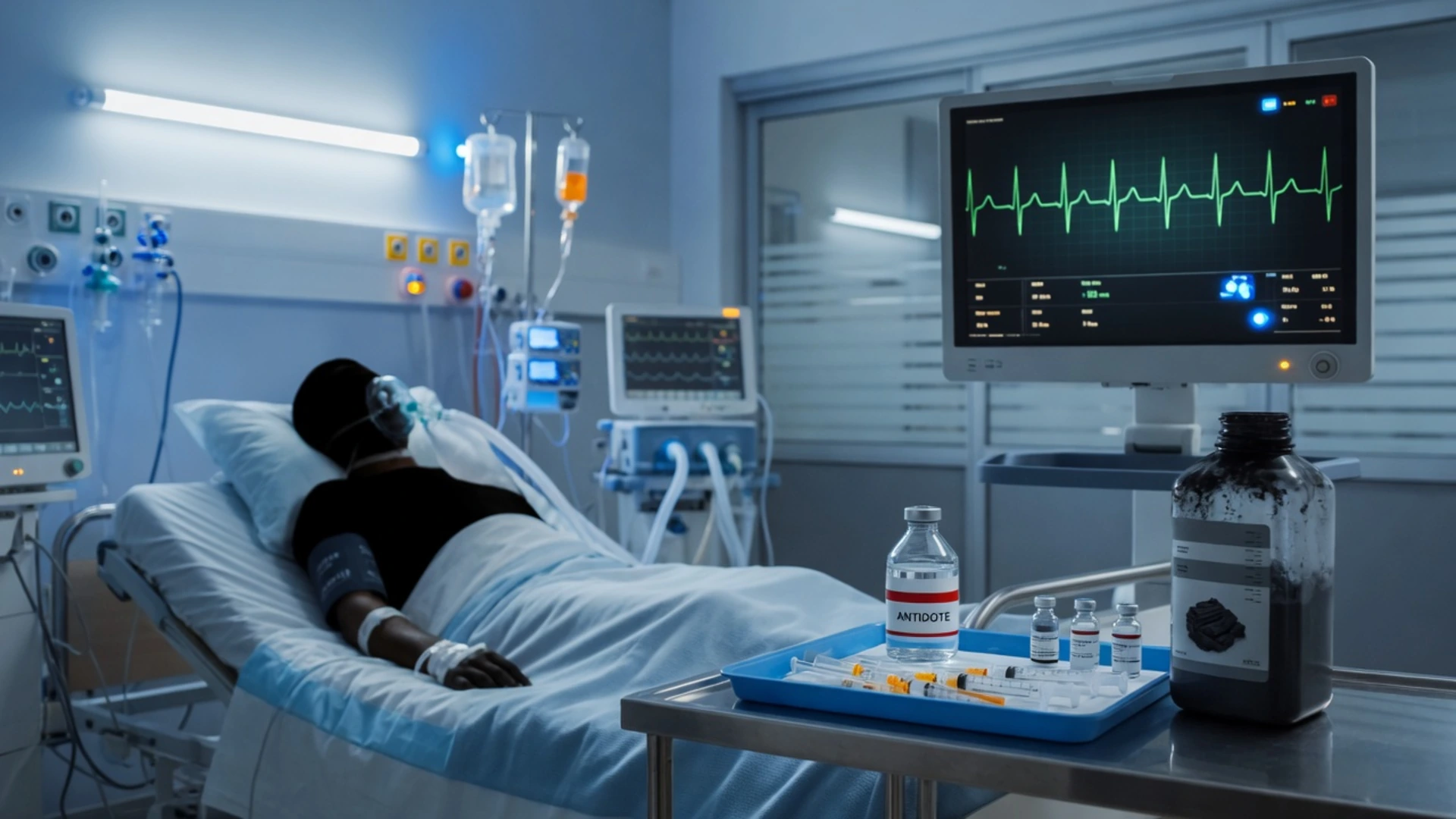
The enhanced elimination accelerates the removal of the already-absorbed toxin.[1][1]
- The urinary alkalinisation (the sodium bicarbonate to a urine pH above 7.5) for the salicylate.
- The haemodialysis for the dialyzable toxins (the SLIME — the salicylate, the lithium, the isopropanol, the methanol, the ethylene glycol) and the severe acidosis, the renal failure, the hepatic failure. [1]
The antidotes (the high-yield):[1]
- The naloxone (the opioid) — 0.04 to 0.4 mg IV, titrate.
- The N-acetylcysteine (the paracetamol).
- The flumazenil (the benzodiazepine — CAUTION: the seizure in the chronic user, the mixed overdose).
- The digoxin-specific Fab (the digoxin).
- The atropine and the pralidoxime (the organophosphate / the cholinergic).
- The lipid emulsion (the local-anaesthetic systemic toxicity, the lipophilic cardiotoxins).[4]
- The fomepizole (or the ethanol) (the methanol, the ethylene glycol).
- The sodium bicarbonate (the sodium-channel-blockade cardiotoxicity — the tricyclic, the QRS widening).
- The calcium, the glucagon, the high-dose insulin (the calcium-channel-blocker and the beta-blocker).
- The octreotide (the sulfonylurea hypoglycaemia).
The enhanced elimination — the three modalities
The enhanced elimination accelerates the removal of the already-absorbed toxin. The three modalities — the urinary alkalinisation, the multi-dose charcoal (above), the haemodialysis (and the haemoperfusion) — are the toxin-specific.[1][1]
The urinary alkalinisation — the sodium bicarbonate (the 1.26% at 100-250 mL/h, OR the boluses of the 8.4% at 1-2 mmol/kg) to a urine pH above 7.5 (the ideal 8.0). The mechanism — the ion trapping: the weak acid (the salicylate, the phenobarbital, the chlorpropamide, the methotrexate) is the uncharged in the acidic tubule and the reabsorbed; the alkalinisation converts it to the charged anion (the trapped, the excreted). The potassium repletion is the prerequisite (the hypokalaemia — the Na+/H+ exchange acidifies the urine — prevents the alkalinisation). The indications: the moderate-to-severe salicylate (the flagship), the phenobarbital, the chlorpropamide, the methotrexate. The target the urine output at 1-2 mL/kg/h.[1]
The haemodialysis — for the dialysable toxins: the small, the water-soluble, the low-volume-of-distribution, the low-protein-binding. The mnemonic — the SLIME: the Salicylate, the Lithium, the Isopropanol, the Methanol, the Ethylene glycol — PLUS the metformin (the lactic acidosis), the valproate (the high level), the theophylline (the high level), the barbiturate (the severe phenobarbital), the formate (the methanol metabolite). The indications — the severe acidosis, the end-organ damage (the CNS, the renal, the hepatic, the cardiac), the high level, the refractory electrolyte, the impaired elimination. The EXTRIP workgroup criteria govern the per-toxin decision. The intermittent haemodialysis clears the fastest; the CRRT for the haemodynamically unstable; the post-dialysis rebound (the lithium, the salicylate — the recheck the level at 2-6 h, the consider the continuous RRT).[1][1]
The haemoperfusion — the charcoal or the resin column for the highly-protein-bound or the high-molecular-weight (the theophylline, the paraquat) — the largely superseded by the high-flux haemodialysis in the modern practice, though retained for the theophylline and the metformin where the protein binding limits the standard dialysis.[1]
Salicylate
Flagship dialysis toxin
- Dialyse when level over 6.5 mmol/L (90 mg/dL), or over 5 with CNS signs, pulmonary oedema, severe acidosis, renal failure
- Intermittent HD preferred (fastest); CRRT acceptable if unstable
- Rebound: YES — recheck at 2-6 h, consider continuous RRT
Lithium
Renally-cleared, non-protein-bound
- Dialyse when over 4 mmol/L acute, or over 2.5 chronic with symptoms, or any level with severe toxicity
- Marked post-dialysis rebound (redistributes from intracellular) — CRRT/CVVHD often preferred
Methanol / ethylene glycol
Give fomepizole FIRST
- Dialyse for severe acidosis (pH below 7.3), visual symptoms (methanol), AKI (ethylene glycol), high level, renal failure
- Fomepizole blocks alcohol dehydrogenase → halts toxic-metabolite formation
- Recheck methanol/ethylene glycol and acidosis post-dialysis
Metformin (MALA)
Lactic acidosis
- Dialyse for pH below 7.25, shock, high level — mortality approaches 50% untreated
- HD removes metformin AND lactate AND corrects the acidosis
Valproate / theophylline
High level
- Valproate: over 1300 mg/L, or coma, hyperammonaemia, hepatotoxicity
- Theophylline: over 90 mg/L, or seizures/arrhythmia
- Haemoperfusion retained for the highly protein-bound in overdose
The antidote reference table
The antidote — the specific therapy that reverses or the blocks the toxin. The intensivist should know the antidote, the dose, the indication, the pitfall for each high-yield agent.[1][1]
| Toxin | Antidote | The dose | The pitfall |
|---|---|---|---|
| Opioid | Naloxone | 0.04-0.4 mg IV titrated to a respiratory rate over 12; infusion at 2/3 the wakeful dose per hour | Over-reversal = withdrawal + non-cardiogenic pulmonary oedema |
| Paracetamol | N-acetylcysteine (NAC) | 150 mg/kg over 1 h, then 50 mg/kg over 4 h, then 100 mg/kg over 16 h | Anaphylactoid reaction (rate-related); give even late (up to 24 h plus) |
| Benzodiazepine | Flumazenil | 0.2 mg IV, repeat to 3 mg | Seizure in chronic user, mixed TCA overdose — avoid if unknown |
| Digoxin | Digoxin-specific Fab (DigiFab) | Empirical 5-10 vials; or calculated from serum level and weight | Total digoxin level rises post-Fab — do not re-treat on the level |
| Organophosphate / nerve agent | Atropine + pralidoxime | Atropine 2-6 mg IV, titrate to dry secretions (may need 100-1000+ mg); pralidoxime 30 mg/kg + 8 mg/kg/h | Pralidoxime ineffective after "aging" (diethyl hours, dimethyl minutes) |
| Methanol / ethylene glycol | Fomepizole (or ethanol) | Fomepizole 15 mg/kg loading, then 10 mg/kg q12h | Fomepizole induces its own metabolism — increase dose after 48 h |
| TCA (Na-channel blockade) | Sodium bicarbonate | 1-2 mmol/kg bolus to a serum pH of 7.45-7.55, then infusion | Avoid class Ia antiarrhythmics, amiodarone — widen the QRS |
| Calcium-channel blocker | Calcium + high-dose insulin + glucagon | CaCl2 1 g or Ca-gluconate 3 g IV; insulin 1 U/kg + 0.5-1 U/kg/h; glucagon 5-10 mg | HIET needs glucose + potassium supplementation |
| Beta-blocker | Calcium + glucagon + high-dose insulin | As above; glucagon the historical first-line | Refractory — lipid emulsion; VA-ECMO for collapse |
| Sulfonylurea | Octreotide | 50 mcg SC q8h | Blocks insulin secretion — superior to dextrose alone (which drives MORE insulin) |
| Iron | Deferoxamine | 15 mg/kg/h IV (max 6 g per 24 h) | Hypotension; ARDS at high doses or long infusions |
| Lead / arsenic / mercury | Succimer (DMSA) / BAL / CaNa2EDTA | Toxin-specific | BAL is oil-based, intramuscular, painful |
| Methaemoglobinaemia | Methylene blue | 1-2 mg/kg IV over 5 min | Avoid in G6PD (haemolysis); serotonin syndrome with SSRIs |
| Heparin | Protamine | 1 mg per 100 U heparin (max 50 mg) | Anaphylaxis; reverse only the last 2 h of heparin |
| Warfarin / anticoagulant rodenticide | Vitamin K1 (phytomenadione) | 5-10 mg IV/PO (slow IV — anaphylaxis) | Days to weeks to reverse the superwarfarin rodenticide |
| Cyanide | Hydroxocobalamin | 5 g IV (or sodium thiossulfate 12.5 g) | Turns skin and urine red — no harm; alert the laboratory |
| Local anaesthetic (LAST) | Lipid emulsion 20% | 1.5 mL/kg bolus, then 0.25 mL/kg/min over 10 min | The "lipid sink" — sequesters the lipophilic cardiotoxin |
| Carbon monoxide | 100% O2 (plus/minus hyperbaric) | 100% via the non-rebreather; HBO at 2.5-3 ATA | SpO2 falsely normal — use the CO-oximetry |
| Anticholinergic (pure) | Physostigmine | 1-2 mg IV slowly | Avoid in TCA — asystole, seizure |
| Serotonin syndrome | Cyproheptadine | 12 mg PO/NG, then 2 mg q2h to 32 mg | Sedating; no IV formulation |
| NMS / malignant hyperthermia | Dantrolene | 1-2.5 mg/kg IV q5min to 10 mg/kg (MH); 1 mg/kg (NMS) | Hepatotoxicity; phlebitis |
Activated charcoal
1 g/kg within 1 h, protected airway
- Binds MOST drugs — not metals, ions, hydrocarbons, alcohols, corrosives (PHAILS)
- Multi-dose for enterohepatic-recirculating: carbamazepine, phenobarbital, theophylline, valproate, quinine, dapsone
- Contraindicated: unprotected airway (aspiration is catastrophic)
Whole-bowel irrigation
PEG 1-2 L/h via NG to clear effluent
- For sustained-release, iron, lithium, potassium, body-packers/stuffers
- Contraindicated: ileus, obstruction, perforation, unprotected airway, instability
- Not for hydrocarbons (aspiration) or corrosives (endoscopy obscuration)
Ocular decontamination
1-2 L saline per eye to pH 7.0-7.4
- Alkali (lye, ammonia) — deep penetration, prolonged irrigation (hours)
- Acid — quicker to neutralise
- Recheck pH at 10 min post-irrigation; ophthalmology for slit-lamp
Dermal decontamination
Strip clothing, copious water, staff PPE
- Organophosphate — staff secondary contamination hazard (PPE FIRST)
- Hydrofluoric acid — calcium-gluconate gel 2.5% after irrigation
- Corrosive — dilute with water; do NOT neutralise (exothermic)
Urinary alkalinisation
NaHCO3 to urine pH over 7.5
- For salicylate (flagship), phenobarbital, chlorpropamide, methotrexate — ion trapping of weak acids
- Potassium repletion is PREREQUISITE (hypokalaemia prevents alkalinisation)
- Target urine output 1-2 mL/kg/h
Haemodialysis
SLIME + metformin + valproate + theophylline
- For small, water-soluble, low-Vd, low-protein-binding toxins
- Indications: severe acidosis, end-organ damage, high level, refractory electrolyte, impaired elimination
- Post-dialysis rebound (lithium, salicylate) — recheck at 2-6 h
Key trials and the evidence
Chyka et al, 1997 — AACT/EAPCCT position statement on single-dose activated charcoal
Journal of Toxicology — Clinical Toxicology
PMID 9482427
Position statement (American Academy of Clinical Toxicology and European Association of Poison Centres consensus)
Population: Adults and children with potentially toxic oral ingestion
Key finding
Charcoal most effective within 1 h of ingestion. No routine recommendation beyond 1 h unless sustained-release formulations or delayed gastric emptying.
Barceloux et al, 1999 — AACT/EAPCCT position statement on multi-dose activated charcoal
Journal of Toxicology — Clinical Toxicology
PMID 10584586
Position statement
Population: Patients with life-threatening ingestion of drugs that undergo enterohepatic recirculation or are amenable to gastrointestinal dialysis
Key finding
MDAC recommended for carbamazepine, dapsone, phenobarbital, phenytoin, theophylline, valproate, quinine. Cathartic (sorbitol) NOT recommended.
Tenenbein et al, 2004 — AACT/EAPCCT position statement on whole-bowel irrigation
Journal of Toxicology — Clinical Toxicology
PMID 9482429
Position statement
Population: Patients with potentially toxic ingestion of substances not bound by charcoal, sustained-release formulations, or body-packers
Key finding
Indicated for sustained-release CCB/theophylline, iron, lithium, potassium, body-packers. Contraindicated in ileus, obstruction, perforation, unprotected airway.
Lavergne et al, 2015 — EXTRIP recommendations for salicylate poisoning
Annals of Emergency Medicine
PMID 25986310
Systematic review and consensus (EXTRIP)
Population: Acute salicylate poisoning
Key finding
Haemodialysis RECOMMENDED for level over 6.5 mmol/L (90 mg/dL), or over 5 mmol/L with CNS signs, pulmonary oedema, severe acidosis, or renal failure. Intermittent HD preferred (fastest clearance); CRRT acceptable if unstable.
Calello et al, 2015 — EXTRIP recommendations for metformin poisoning
Critical Care Medicine
PMID 25860205
Systematic review and consensus (EXTRIP)
Population: Acute metformin poisoning with lactic acidosis
Key finding
ECTR RECOMMENDED for severe metformin toxicity with shock, severe acidosis (pH below 7.25), or high level. Metformin is highly dialysable; HD removes metformin AND lactate AND corrects the acidosis.
Proudfoot et al, 2004 — EAPCCT/AACT position paper on urine alkalinization
Journal of Toxicology — Clinical Toxicology
PMID 15083932
Position statement
Population: Patients poisoned by weak-acid drugs amenable to ion trapping
Key finding
Recommended for moderate-to-severe salicylate poisoning; may be considered for phenobarbital, chlorpropamide, methotrexate. Potassium repletion is the prerequisite.
Saul et al, 2022 — Local anaesthetic systemic toxicity (LAST): a narrative review
American Journal of Emergency Medicine
PMID 35777259
Narrative review
Population: Patients with local-anaesthetic systemic toxicity
Key finding
Lipid emulsion is the specific antidote — the lipid sink sequesters the lipophilic local anaesthetic from the myocardium.
Exam practice
SAQ — Mixed overdose with tricyclic antidepressant cardiotoxicity
10 minutes · 10 marks
A 28-year-old woman is brought to the ED 90 minutes after a deliberate overdose of amitriptyline (an unknown number of tablets), paracetamol and alcohol. She is drowsy (GCS 12, E3V3M6), HR 122, BP 88/52, with dilated pupils and dry mucosae. ECG: sinus tachycardia, QRS 140 ms, QT 480 ms, and right-axis deviation of the terminal R wave in aVR.
SAQ — Gastrointestinal decontamination and activated charcoal timing
10 minutes · 10 marks
Four patients are referred to your toxicology service within the same shift: (A) a 19-year-old man who took paracetamol 20 minutes ago; (B) a 40-year-old woman who took amitriptyline 3 hours ago, GCS 14; (C) a 55-year-old man on sustained-release theophylline who has taken a massive overdose presenting 4 hours after ingestion, GCS 15; (D) a 30-year-old woman who swallowed a caustic drain cleaner.
Clinical pearls — the high-yield facts
Supportive care and the disposition
The supportive care is the mainstay — the airway, the ventilation, the haemodynamics, the seizure control, the temperature (the hyperthermia of the serotonin and the sympathomimetic — the active cooling, the benzodiazepine, the dantrolene for the NMS/malignant hyperthermia), the renal and the hepatic support. The psychiatric assessment once the patient is the recovered (the self-harm).[1][1]
Prognosis
The most of the poisoned patients survive with the supportive care and the timely antidote. The poor prognostic features: the delayed presentation, the severe acidosis, the haemodynamic instability, the multi-organ failure. The specific high-mortality toxins (the paraquat, the colchicine, the massive paracetamol) demand the early, the aggressive management.[1][1]
Red flags
References
- [1]Chyka PA, Seger D, Krenzelok EP, Vale JA; American Academy of Clinical Toxicology; European Association of Poison Centres and Clinical Toxicologists. Position statement: single-dose activated charcoal. American Academy of Clinical Toxicology; European Association of Poisons Centres and Clinical Toxicologists J Toxicol Clin Toxicol, 1997.PMID 9482427
- [2]Villarreal J, et al. Systematic review on the use of activated charcoal for gastrointestinal decontamination following acute oral overdose Clin Toxicol (Phila), 2021.PMID 34424785
- [3]Thanacoody RH, et al. Gut decontamination in the poisoned patient Br J Clin Pharmacol, 2025.PMID 39821212
- [4]Saul C, et al. Local anesthetic systemic toxicity: A narrative review for emergency clinicians Am J Emerg Med, 2022.PMID 35777259
- [5]Barceloux D, McGuigan M, Hartigan-Go K. Position statement and practice guidelines on the use of multi-dose activated charcoal in the treatment of acute poisoning. American Academy of Clinical Toxicology; European Association of Poisons Centres and Clinical Toxicologists J Toxicol Clin Toxicol, 1999.PMID 10584586
- [6]Tenenbein M, Lheureux P; Position Statement and Practice Guidelines. Position statement: whole bowel irrigation. American Academy of Clinical Toxicology; European Association of Poisons Centres and Clinical Toxicologists J Toxicol Clin Toxicol, 1997.PMID 9482429
- [7]Lavergne V, Ouellet G, Bouchard J, et al. (EXTRIP Workgroup). Extracorporeal Treatment for Salicylate Poisoning: Systematic Review and Recommendations From the EXTRIP Workgroup Ann Emerg Med, 2015.PMID 25986310
- [8]Calello DP, Liu KD, Wiegand TJ, et al. (EXTRIP Workgroup). Extracorporeal Treatment for Metformin Poisoning: Systematic Review and Recommendations From the Extracorporeal Treatments in Poisoning Workgroup Crit Care Med, 2015.PMID 25860205
- [9]Proudfoot AT, Krenzelok EP, Vale JA. Position Paper on urine alkalinization J Toxicol Clin Toxicol, 2004.PMID 15083932