ICU · Toxicology
Lithium Toxicity
Also known as Lithium poisoning · Lithium toxicity · SILENT · Nephrogenic diabetes insipidus lithium · Whole bowel irrigation
The lithium toxicity — the narrow therapeutic index (the therapeutic 0.6 to 1.2 mmol/L), the renal clearance (the handled like the sodium), and the no antidote. The acute overdose (the early GI, the delayed neuro) versus the chronic toxicity (the neuro-dominant, the more dangerous — the tremor, the hyperreflexia, the ataxia, the seizures, the coma, the SILENT). The charcoal the not-bind; the whole-bowel irrigation for the sustained-release; the normal saline (the restore the GFR, the NOT the diuretics); the haemodialysis for the severe (with the rebound).
On this page & tools
Your progress
Saved locally on this device.
Target exams
Overview & definition
The lithium (the mood stabiliser for the bipolar) has the narrow therapeutic index (the therapeutic 0.6 to 1.2 mmol/L) and the renal clearance (the handled like the sodium — the reabsorbed in the proximal tubule; the dehydration, the renal failure, the sodium restriction and the drug interactions the precipitate the toxicity). There is the NO antidote. The toxicity is the neuro-dominant and the dialyzable.[1][1]

Pharmacokinetics — the narrow therapeutic index and the renal dependence
The pharmacokinetics the explain EVERYTHING about the lithium toxicity — the narrow therapeutic index, the entirely-renal clearance, the handled like the sodium, and the dialyzability. The lithium is the monovalent cation (the Li⁺) — the handled by the body the virtually the identical to the Na⁺.[1][3]
Lithium pharmacokinetics — the examiner-favourite numbers
| Parameter | Value | Why it matters |
|---|---|---|
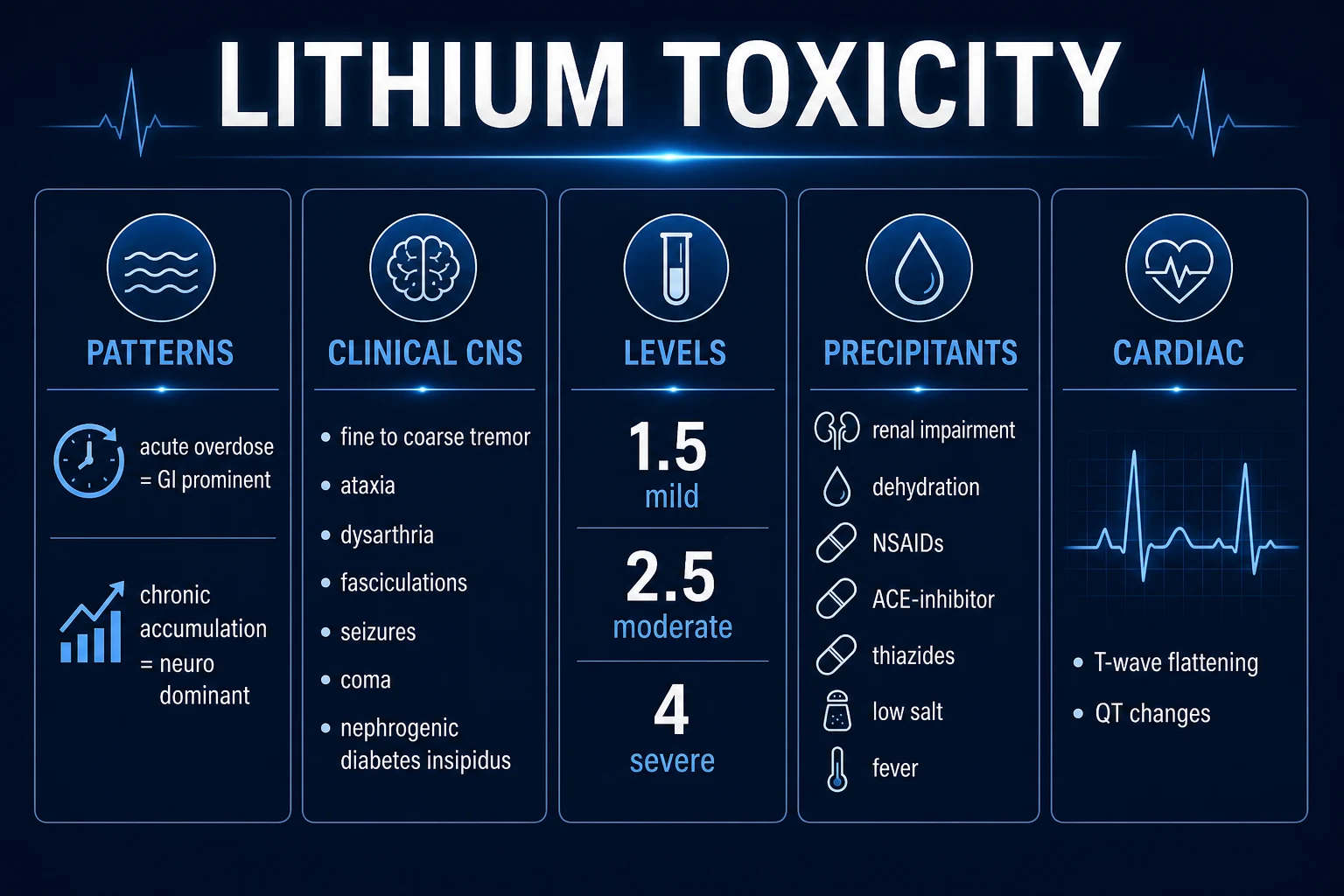
| Therapeutic range | 0.6 to 1.2 mmol/L (acute mania target 0.8 to 1.2; maintenance 0.6 to 0.8) | One of the NARROWEST therapeutic indices in medicine — the toxic dose is only ~2 times the therapeutic |
| Toxic level | above 1.5 mmol/L | Mild–moderate neurotoxicity begins |
| Severe level | above 2.5 mmol/L | Severe neurotoxicity; dialysis threshold (chronic) |
| Volume of distribution (Vd) | 0.6 to 0.9 L/kg (approximates total body water) | NOT large — the lithium the distributes the slowly into the cells/brain. The initial serum level (acute) the misleading LOW |
| Protein binding | 0% (the lithium the NOT the protein-bound) | The entirely the free — the freely filtered and the dialyzable |
| Elimination | entirely renal (the 95% the excreted the unchanged in the urine) | The GFR-dependent — the any decline in the renal function the accumulates the lithium |
| Renal handling | handled like the sodium — the 80% the reabsorbed (the 60% in the proximal tubule, the ~10 to 20% in the proximal straight tubule and the loop) | The sodium balance the governs the lithium clearance — the sodium depletion the RETAINS the lithium |
| Half-life | 18 to 24 hours (the longer in the elderly and the renal failure — the up to 40 to 50 h) | The slow elimination — the toxicity the develops the gradually and the resolves the slowly |
| Time to peak | 1 to 2 hours (immediate-release); 4 to 5 hours (sustained-release) | The acute ingestion — the levels the rise the rapidly then the redistribute |
| Onset of toxicity (acute) | 6 to 12 hours (the delayed — the lithium the distributes into the brain) | The early serum level the misleading; the neuro the delayed |
The renal handling — handled like the sodium (the key to the management)
The lithium the filtered at the glomerulus (the entirely — the 0% the protein-bound) then the 80% the reabsorbed — the the handled like the sodium. The proximal tubule the reabsorbs the 60%; the remainder the reabsorbed the alongside the sodium in the proximal straight tubule and the ascending limb. The CRITICAL corollary: the any process that the increases the sodium reabsorption the ALSO the increases the lithium reabsorption.[1][1]
- The volume depletion (the dehydration, the vomiting, the diarrhoea, the diuretics) → the RAAS the up → the proximal sodium (and the lithium) the reabsorbed → the lithium the RETAINED.
- The sodium restriction → the same.
- The renal failure → the GFR the falls → the filtered load the falls → the lithium the accumulates.
- The AVOID the diuretics (the loop, the thiazide) → the sodium the wasted the distally → the proximal the compensatory reabsorption the up → the lithium the RETAINED. [1]
This is the WHY the isotonic normal saline is the cornerstone (the restore the euvolaemia and the GFR → the filtered lithium the up → the clearance the up) and the WHY the diuretics the worsen.[1][1]
[1]Pathophysiology — why the neuro is dominant and why the chronic is worse
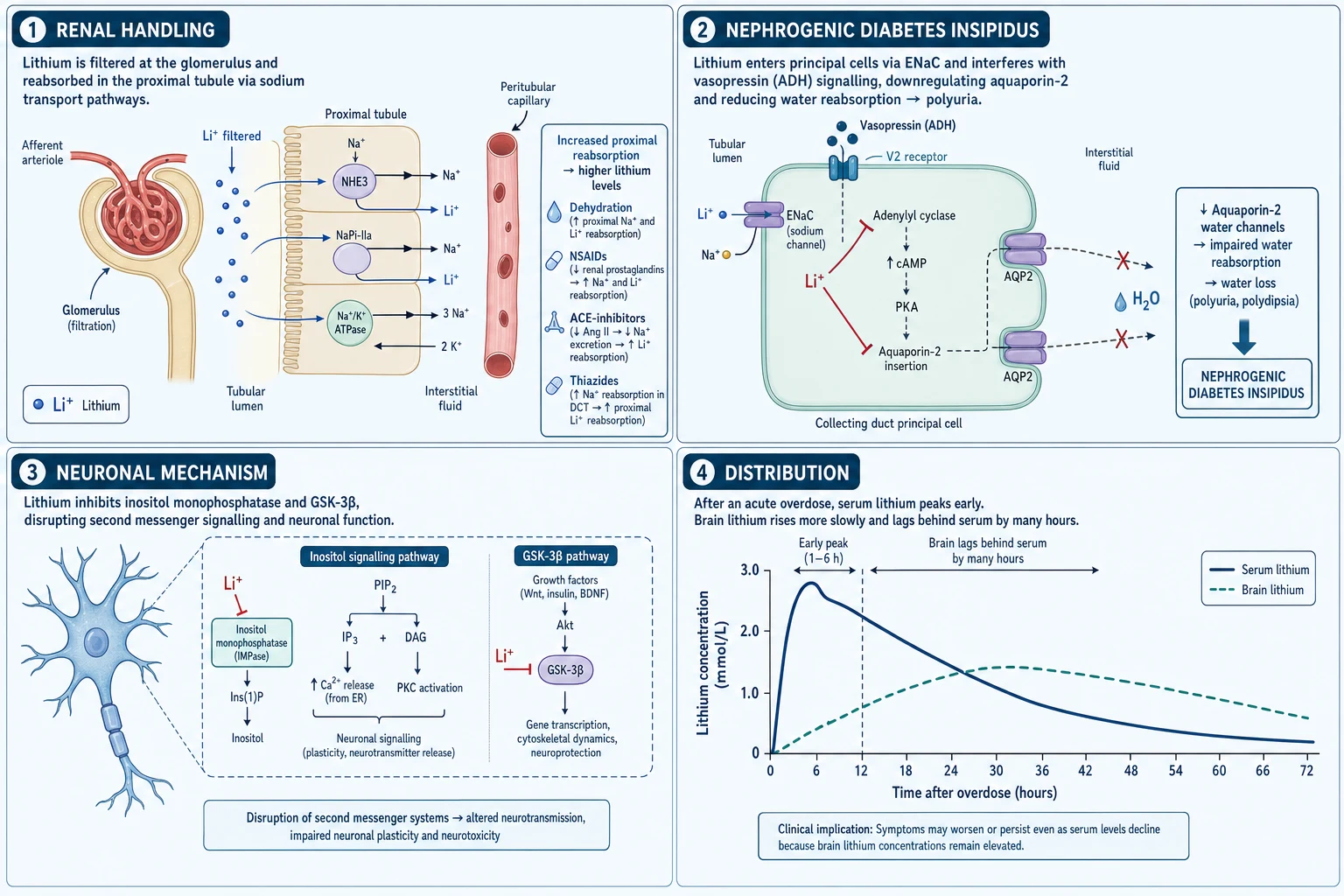
The lithium the neurotoxic through the multiple mechanisms:[1][5]
- The neurotransmitter modulation — the lithium the inhibits the inositol monophosphatase (the PI signalling pathway) and the GSK-3β; the affects the serotonin, the dopamine, the glutamate. The chronic the alters the neuronal function.
- The neurotransmitter the direct — the lithium the competes with the Mg²⁺ and the Ca²⁺ (the similar the ionic radius); the disrupts the cellular signalling.
- The brain the slow the equilibration — the lithium the distributes into the brain the SLOWLY (the BBB the crossed the gradually). The acute ingestion — the serum the high but the brain the protected EARLY; the chronic — the brain the equilibrated and the FULLY the loaded. The THIS the explains the why the chronic is the more dangerous (the brain concentration the higher at the any given serum level).[1]
- The cerebellar and the brainstem the preferentially affected — the ataxia, the nystagmus, the tremor, the dysarthria, the extrapyramidal. The basis of the SILENT.
Acute vs chronic toxicity — the pathophysiology that explains the clinical
| Feature | ACUTE overdose | CHRONIC toxicity |
|---|---|---|
| Mechanism | Single large ingestion; lithium still distributing | Gradual accumulation; brain already equilibrated and fully loaded |
| Serum vs brain | Serum high, brain relatively protected (early) | Brain concentration HIGHER than serum — fully equilibrated |
| Predominant features | EARLY GI (nausea, vomiting, diarrhoea); neuro DELAYED (6 to 12 h) | NEURO-dominant and severe (tremor, ataxia, hyperreflexia, seizures, coma) |
| Level correlates with severity? | Reasonably (early) | POORLY — brain concentration exceeds serum |
| Cardiac | Mild; T-wave changes, QT prolongation | Mild; sinus node dysfunction |
| Risk of SILENT | Lower (if treated early) | HIGHER — prolonged exposure |
| Typical patient | Young, deliberate self-harm | Elderly, renal impairment, "stable dose for years" + new precipitant |
| Mortality | Usually survivable | More dangerous |
Drugs and states that REDUCE lithium clearance — the precipitants
| Precipitant | Mechanism | Clinical scenario |
|---|---|---|
| Dehydration / volume depletion | RAAS up → proximal Na⁺ (and Li⁺) reabsorption up → lithium retained | Gastroenteritis, hot weather, poor intake — the CLASSIC trigger |
| Renal failure (AKI/CKD) | GFR down → filtered lithium load down | Elderly, intercurrent illness, contrast nephropathy |
| Thiazide diuretics | Distal Na⁺ wasting → proximal Na⁺ (and Li⁺) reabsorption up | HCTZ started for hypertension — the MOST COMMON drug precipitant |
| Loop diuretics (less than thiazide) | Same proximal compensatory mechanism; also volume depletion | Furosemide — effect variable, less predictable than thiazide |
| NSAIDs | Inhibit renal prostaglandins → afferent arteriolar constriction → GFR down | Ibuprofen, naproxen, celecoxib — OTC and easily missed |
| ACE inhibitors / ARBs | Efferent arteriolar dilatation → GFR down; also RAAS changes | Lisinopril, valsartan — new prescription in stable patient |
| Sodium restriction / low-salt diet | Sodium depletion → proximal lithium reabsorption up | Dietary advice, heart failure management |
| Fever / sepsis | Volume loss; GFR down; possible direct effect | Intercurrent infection |
| Calcium channel blockers | Probable GFR effect; mechanism uncertain | Diltiazem, verapamil |
| Coxibs / metronidazole (variable) | Variable reports of level rise | Isolated case reports |
Precipitants of chronic lithium toxicity — 'D-TANS'
The acute overdose versus the chronic toxicity
The distinction is the critical — the chronic is the more dangerous.[1][1]
The acute overdose — the single large ingestion. The early GI (the nausea, the vomiting, the diarrhoea), the relatively-mild neuro EARLY (the lithium the still in the serum, the not yet in the brain), the neuro the delayed (the 6 to 12 hours) as the lithium distributes into the CNS. The serum level the rises then the peaks the late.[1]
The chronic toxicity — the gradual accumulation from the reduced clearance (the dehydration, the renal failure, the NSAIDs, the ACE inhibitors, the thiazide diuretics, the fever, the sodium restriction, the drug interactions). The neuro the dominant and the severe: the coarse tremor (the fine → the coarse), the hyperreflexia, the ataxia, the nystagmus, the muscle fasciculations, the confusion, the seizures, the coma. The serum level the correlates the poorly with the severity (the brain concentration the higher).[1][1]
The SILENT — the Syndrome of Irreversible Lithium-Effectuated Neurotoxicity. The irreversible cerebellar and the brainstem dysfunction (the ataxia, the dementia, the extrapyramidal) that the persists or the worsens the despite the normalisation of the serum lithium. The risk with the severe, the prolonged, the chronic toxicity.[1]
The clinical features
- The neuro — the tremor (the fine → the coarse), the hyperreflexia, the ataxia, the nystagmus, the fasciculations, the myoclonus, the confusion, the seizures, the coma. (The dominant.)[1]
- The gastrointestinal — the nausea, the vomiting, the diarrhoea (the acute).
- The cardiac — the mild — the T-wave flattening/inversion, the QT prolongation, the sinus-node dysfunction (the bradycardia, the sinoatrial block). The rarely the severe.
- The endocrine / the renal — the nephrogenic diabetes insipidus (the lithium — the vasopressin-resistant), the hypothyroidism, the hypercalcaemia. The leukocytosis.[1]
The investigation
- The serum lithium level (the acute — the misleading early, the repeat the serial; the chronic — the 6 to 12-hour trough). The therapeutic the 0.6 to 1.2; the toxic the above 1.5; the severe the above 2.5. The level the correlates the poorly with the chronic neurotoxicity.[1]
- The renal function (the AKI the precipitates AND the results from), the electrolytes (the sodium — the hyponatraemia worsens), the TFTs (the hypothyroid), the calcium (the hypercalcaemia), the ECG.[1][1]
Lithium level and severity — the interpretation by clinical context
| Serum lithium (mmol/L) | Acute overdose | Chronic / acute-on-chronic toxicity |
|---|---|---|
| 0.6 to 1.2 | Therapeutic | Therapeutic |
| 1.2 to 1.5 | Mild; usually GI only | Mild neurotoxicity — fine tremor, mild confusion |
| 1.5 to 2.5 | Moderate; delayed neuro (6 to 12 h) — tremor, hyperreflexia, ataxia | Moderate–severe neurotoxicity — coarse tremor, ataxia, fasciculations, confusion |
| above 2.5 | Severe neurotoxicity — seizures, coma; haemodialysis | SEVERE — haemodialysis threshold; high risk of SILENT |
| above 4.0 | SEVERE — haemodialysis indicated (acute threshold) | Critical; high mortality; urgent dialysis |
SILENT — Syndrome of Irreversible Lithium-Effectuated Neurotoxicity
The SILENT is the feared complication — the persistent or worsening cerebellar and brainstem dysfunction (the ataxia, the dysarthria, the dementia, the extrapyramidal, the choreoathetosis) that the persists or the worsens the despite the normalisation of the serum lithium. The mechanism the uncertain (the believed — the irreversible neuronal injury). The risk factors: the severe, the prolonged, the chronic toxicity, the delayed dialysis, the fever (the hyperthermia the potentiates the neurotoxicity), the elderly. The mortality the up to 10 to 20%; the permanent sequelae the common.[1][5]
The SILENT the develops the days to weeks the AFTER the resolution of the serum toxicity — the patient the neurologically the improving then the WORSENS, OR the patient the never the recovers fully. The diagnosis: the persistent neurology the despite the low/normal lithium; the exclude the other causes (the structural, the metabolic, the infective). The management: the supportive; the NO the specific the treatment (the dialysis the ineffective once the SILENT — the lithium the already the cleared; the damage the done).[1]
[1]Treatment
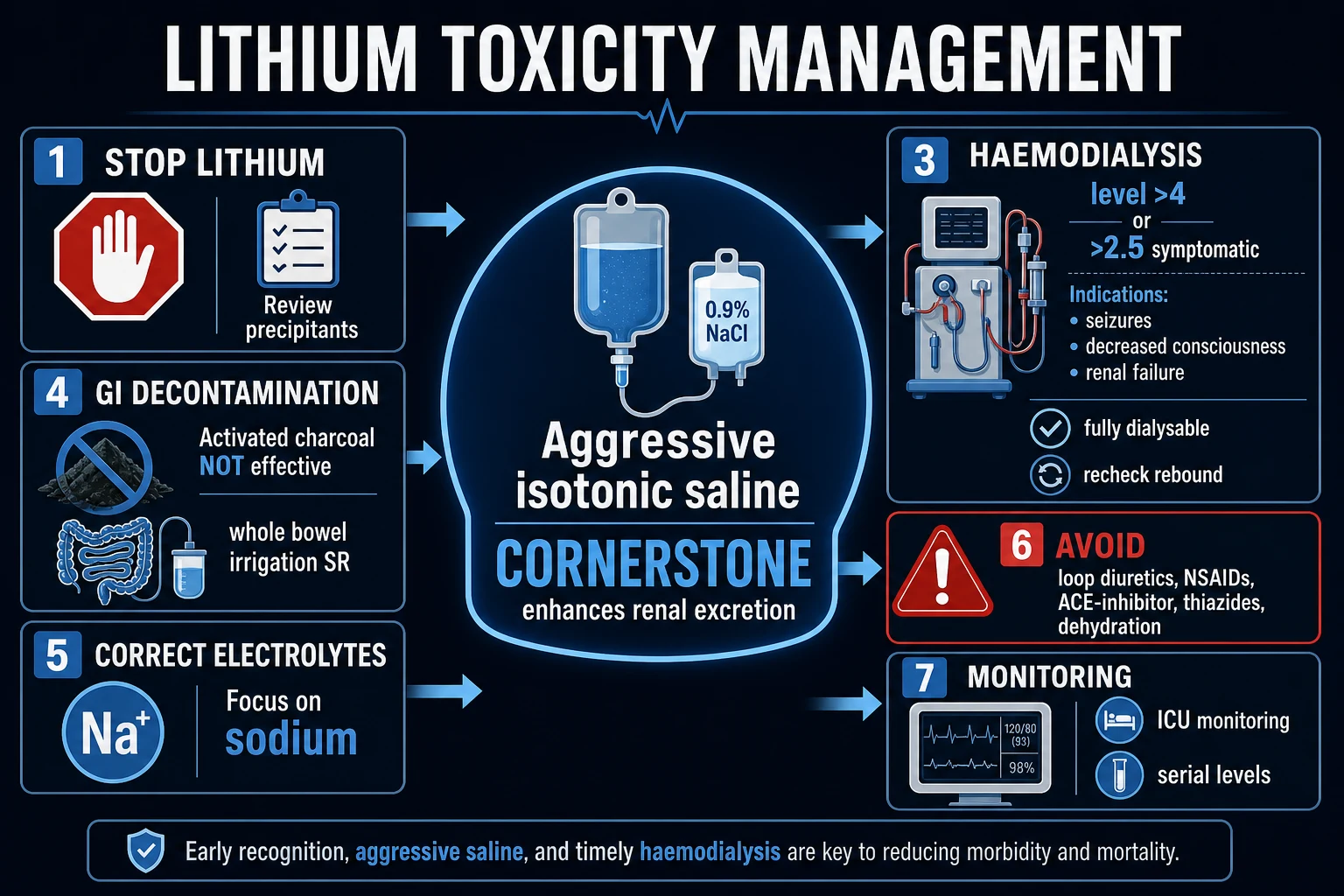
- The activated charcoal the NOT effective (the lithium the not-bind).
- The whole-bowel irrigation (the polyethylene glycol) for the sustained-release acute ingestion (the lithium the sustained-release; the continued absorption).
2. The normal saline — the volume resuscitation.[1][1]
- The isotonic saline IV to the restore the intravascular volume and the GFR — the enhances the lithium clearance (the lithium the cleared like the sodium; the volume-loaded the more).
- The target the euvolaemia (the not the forced diuresis).
- AVOID the loop diuretics and the thiazide diuretics (the increase the lithium reabsorption — the worsen), the AVOID the forced diuresis (the ineffective, the risk the hyponatraemia).[1][1]
3. The haemodialysis — the severe.[1][2][1]
- The indications: the acute level above 4 to 5 mmol/L, the chronic level above 2.5 mmol/L with the symptoms, the severe neurotoxicity (the seizures, the coma, the decreased consciousness), the renal failure, the haemodynamic instability.
- The mechanism: the lithium the small, the water-soluble, the low protein-binding, the small Vd (in the euvolaemic) — the highly dialyzable. The EXTRIP the recommends the haemodialysis for the severe.[2]
- The rebound — the lithium the redistributes from the tissue (the brain, the muscle) the AFTER the dialysis — the serum the rises again. The continuous or the repeat the haemodialysis; the monitor the serial levels.[1][1]
4. The supportive. The airway, the ventilation (the seizures, the coma), the treat the seizures (the benzodiazepine), the correct the electrolytes, the treat the intercurrent (the infection, the dehydration). The psychiatric review for the chronic-overdose (the self-harm, the medication adherence).[1]
Lithium toxicity — the ICU management protocol
- RECOGNISE AND RESUSCITATE. ABC; IV access; continuous cardiac monitoring (the lithium — the rare the arrhythmias). Identify the formulation (the immediate vs the sustained release), the time, the co-ingestants. STOP the lithium AND the precipitants (the thiazides, the NSAIDs, the ACEi). Draw: the serum lithium (the repeat the serial — the every 2 to 4 h), the U&E (the sodium, the creatinine, the eGFR), the TFTs, the calcium, the ECG, the βhCG (the women of the reproductive age).[1]
- DECONTAMINATE (the acute). The activated charcoal the NOT effective (the lithium the not-bind). The whole-bowel irrigation (the polyethylene glycol 1 to 2 L/h via NG for 4 to 6 h, OR until the clear effluent) for the sustained-release acute ingestion within 5 h — the continued absorption. The NOT for the chronic toxicity.[1][1]
- VOLUME RESUSCITATE — the isotonic normal saline. The aggressive but the monitored (the elderly, the cardiac). The boluses the 250 to 500 mL the until the euvolaemic; then the maintenance the 1 to 2 mL/kg/h (the 100 to 150 mL/h) to the target the EUVOLAEMIA and the urine output the 1 to 2 mL/kg/h. The NOT the forced diuresis. The monitor the sodium (the hyponatraemia the worsens the lithium retention), the renal function, the fluid balance.[1][1]
- ASSESS FOR HAEMODIALYSIS — the dialyse the severe. The indications (the below). The dialyse the EARLY; the SLED preferred to the avoid the rebound.[2][3]
- SUPPORTIVE CARE. The airway, the ventilation (the GCS the low, the seizures, the coma); the treat the seizures (the benzodiazepine — the lorazepam 2 to 4 mg IV); the correct the electrolytes (the sodium, the potassium, the calcium); the treat the intercurrent (the infection, the dehydration, the thyroid); the avoid the nephrotoxins (the NSAIDs, the contrast). The ICU monitoring.[1]
- POST-DIALYSIS — the monitor for the rebound. The serial lithium levels the every 2 to 4 h the until the below 1.0 and the clinically improved (the 24 h). The repeat OR the continuous the dialysis if the rebound.[1][2]
- PSYCHIATRIC / DISPOSITION. The psychiatric review for the self-harm (the acute overdose). The renal and the thyroid review before the re-challenge (the reconsider the lithium; the lower dose; the avoid the precipitants). The patient the NOT the re-start the lithium the until the renal and the thyroid the reviewed.[1]
Haemodialysis indications for lithium toxicity — the EXTRIP recommendations
| Indication | Threshold | Rationale |
|---|---|---|
| Acute overdose — level | above 4.0 mmol/L (the EXTRIP; the 5.0 the some sources) | The peak yet to come; the severe neurotoxicity the inevitable |
| Chronic / acute-on-chronic — level | above 2.5 mmol/L with the symptoms (OR above 3.5 the regardless) | The brain the loaded; the severe neurotoxicity |
| Severe neurotoxicity | The seizures, the coma, the decreasing consciousness, the life-threatening | The dialyse the immediately; the level the secondary |
| Renal impairment | The AKI/CKD the impairing the lithium clearance | The saline the alone the insufficient |
| Haemodynamic instability | The shock | The saline the overloaded; the dialyse |
| Inability to tolerate saline | The cardiac failure, the elderly the frail | The dialyse to the remove the lithium |
The rebound — and why SLED is preferred
The lithium the redistributes from the tissue (the brain, the muscle) the AFTER the dialysis — the serum the rises again (the rebound). The single intermittent haemodialysis the clears the serum the rapidly but the lithium the redistributes the back — the level the rises the 30 to 50% the within the 6 to 8 hours. The SLED (the sustained low-efficiency dialysis) the preferred — the slower, the longer (the 6 to 8 h) — the removes the lithium the steadily the AND the keeps the ahead of the redistribution; the less the rebound. The CRRT (the CVVHDF) the also the effective for the rebound the prevention but the slower the clearance.[1][2][3]
Dialysis modalities for lithium — the comparison
| Modality | Lithium clearance | Rebound risk | Role |
|---|---|---|---|
| Intermittent haemodialysis (IHD) | Highest (the 150 to 200 mL/min) — the fastest the removal | HIGH rebound (the 30 to 50% the within the 6 to 8 h) | The first session — the rapid the reduction |
| SLED (sustained low-efficiency dialysis) | Moderate (the 70 to 90 mL/min); the 6 to 8 h | LOW rebound — the steady the clearance the keeps the ahead | PREFERRED — the combines the clearance the AND the rebound the prevention |
| CRRT (CVVHDF) | Lowest (the 25 to 40 mL/min) | LOWEST rebound — the continuous | The post-IHD the rebound the prevention; the haemodynamically the unstable |
Drugs to AVOID in lithium toxicity — and why
| Drug | Reason to AVOID | Safe alternative |
|---|---|---|
| Loop diuretics (furosemide) | Sodium wasting → proximal lithium reabsorption UP → retention | Isotonic saline (the volume expansion) |
| Thiazide diuretics | Same — the #1 drug precipitant; worsens | Isotonic saline |
| Forced diuresis / osmotic diuretics (mannitol) | Ineffective; risk of hypernatraemia / volume overload | Isotonic saline to euvolaemia |
| NSAIDs | GFR down → lithium clearance down | Paracetamol (the analgesia); opioid if needed |
| ACE inhibitors / ARBs | GFR down | Alternative antihypertensive (the calcium channel blocker) |
| Sodium restriction / low-salt | Proximal lithium reabsorption UP | NORMAL sodium intake |
Nephrogenic diabetes insipidus — the lithium long-term renal effect
The lithium the causes the nephrogenic diabetes insipidus (the NDI) — the vasopressin-resistant. The mechanism: the lithium the enters the collecting duct the principal cells (the through the ENaC — the epithelial sodium channel — the same as the sodium); the inhibits the adenyl cyclase → the cAMP the down → the aquaporin-2 the NOT the inserted → the water the NOT the reabsorbed. The polyuria (the 3 to 5 L/day), the polydipsia, the hypernatraemia. The amiloride the blocks the ENaC → the blocks the lithium the entry → the attenuates the NDI (the ONLY the targeted the treatment). The thiazides the NOT (the worsen — the paradoxical; the volume contraction).[1][5]
[1]Prognosis
The acute overdose the usually the survivable with the supportive care and the dialysis. The chronic toxicity the more dangerous (the neuro-dominant, the brain concentration the higher, the SILENT). The poor-prognostic features: the severe neurotoxicity, the delayed dialysis, the renal failure, the elderly, the SILENT.[1][1][1]
Red flags
Special populations
Lithium toxicity in special populations
| Population | Why they are vulnerable | Approach |
|---|---|---|
| The elderly | The reduced GFR; the polypharmacy (the diuretics, the NSAIDs, the ACEi); the decreased total body water → higher serum level at any dose; the comorbidities | The lower the maintenance dose; the monitor the levels the every 3 months; the review the concurrent drugs; the dialyse the lower threshold |
| The renal failure (CKD) | The GFR-dependent clearance — the any decline the accumulates | The dose the adjust; the monitor the frequently; the dialyse the early |
| The pregnancy | The GFR the UP the 50% in the pregnancy → the lithium the clearance the UP → the levels the FALL (the risk the under-treatment); the POSTPARTUM the GFR the normalises → the levels the RISE (the risk the toxicity); the lithium the crosses the placenta → the neonatal the toxicity (the "floppy baby", the Ebstein anomaly — the 1 in 1000) | The monitor the levels the more the frequently; the dose the adjust the peripartum; the caution the postpartum |
| The sodium-restricted / the heart failure | The sodium restriction → the proximal lithium the reabsorption the UP | The caution; the normal the sodium the intake if the possible; the monitor |
| The intercurrent illness (the gastroenteritis, the sepsis) | The volume depletion; the GFR the down | The hold the lithium; the check the level; the rehydrate the aggressively |
Drug interactions and long-term effects
Long-term lithium effects — beyond the acute toxicity
| System | Effect | Mechanism / note |
|---|---|---|
| Renal | Nephrogenic DI (polyuria); chronic tubulointerstitial nephritis; reduced GFR over years | Lithium enters principal cells via ENaC; inhibits aquaporin-2 insertion. Amiloride is the targeted treatment |
| Endocrine | Hypothyroidism (and goitre); hyperparathyroidism (hypercalcaemia) | Direct thyroid inhibition; parathyroid effect uncertain |
| Metabolic | Weight gain; hypercalcaemia; leukocytosis | Common; benign in most cases |
| Neurological | Fine tremor at therapeutic levels (20%); SILENT in severe chronic toxicity | Tremor common at therapeutic; SILENT feared complication |
| Cardiac | T-wave flattening; QT prolongation; sinus node dysfunction | Usually benign; rarely severe |
| Dermatological | Psoriasis worsening; acne; hair thinning | Common cosmetic effects |
Comparison — lithium vs other dialyzable toxins
Lithium vs salicylate vs toxic alcohols — the dialyzable toxins in the ICU
| Feature | Lithium | Salicylate | Toxic alcohols (methanol/ethylene glycol) |
|---|---|---|---|
| Toxin type | Monovalent cation (Li⁺) | Weak acid (salicylate anion) | Alcohol + toxic metabolites |
| Vd | 0.6 to 0.9 L/kg (total body water) | 0.2 to 0.3 L/kg (small) | 0.6 L/kg (methanol); 0.5 L/kg (EG) — parent only |
| Protein binding | 0% | 50 to 80% (saturable) | Negligible (parent) |
| Dialyzability | High | High (when level high — saturates protein) | High (parent) — but metabolites are the problem |
| Antidote | NONE | NONE | Fomepizole (ADH inhibition) |
| Hallmark | Neurotoxicity (tremor, ataxia); SILENT | Mixed respiratory alkalosis + anion gap metabolic acidosis; tinnitus; hyperthermia | Anion gap metabolic acidosis; ocular (methanol); renal (EG) |
| Dialysis threshold | Acute >4; chronic >2.5 with symptoms; severe neuro | >100 mg/dL (6.5 mmol/L) or severe acidosis/end-organ | Acidosis or end-organ damage (any level) |
| Rebound after HD | YES (significant) | Moderate | Low (if fomepizole given) |
| Preferred modality | SLED | Intermittent HD (repeat) | Intermittent HD (with fomepizole cover) |
Lithium vs other ICU neurotoxins — distinguishing features
| Feature | Lithium | Sedative withdrawal (benzo/etOH) | Hepatic encephalopathy |
|---|---|---|---|
| Onset | Gradual (chronic); delayed 6 to 12 h (acute) | Within hours of cessation | Variable |
| Tremor | COARSE (characteristic) | COARSE (agitation) | Asterixis (flapping) |
| Ataxia | Yes (prominent) | Variable | Variable |
| Level correlation | Poor (chronic) | N/A | N/A (ammonia poor correlate) |
| Hallmark | Handled like Na⁺; renal; dialyzable | Autonomic hyperactivity; CIWA | Asterixis; high ammonia; precipitant |
Clinical pearls — high-yield points for the CICM/FFICM exam
Lithium toxicity clinical features — 'TIC-TAC-TOE'
Haemodialysis indications for lithium — 'SHED-Li'
Lithium management — 'STOP-SHED'
Key evidence
EXTRIP — Decker 2015 — Extracorporeal treatment for lithium poisoning (PMID 25635057)
Source
Clinical Journal of the American Society of Nephrology — the EXTRIP workgroup systematic review and recommendations
Design
Systematic review (1966 to 2013) + structured expert consensus. Reviewed 159 cases of lithium poisoning treated with extracorporeal therapy
Key recommendations
Recommend extracorporeal treatment (grade 1D) for: (1) lithium >4.0 mmol/L acute; (2) >2.5 mmol/L chronic with symptoms; (3) severe neurotoxicity (seizures, coma); (4) renal failure impairing clearance
Modality preference
Intermittent haemodialysis first-line (highest clearance); SLED acceptable (reduces rebound); CRRT alone NOT recommended as sole therapy (insufficient clearance) but useful after IHD to prevent rebound
Rebound
Significant rebound after single IHD (30 to 50% rise within 6 to 8 h) — recommends serial monitoring and repeat/continuous therapy
Clinical bottom line
Lithium is one of the few toxins where the EXTRIP workgroup gives a 1D recommendation FOR dialysis — severe lithium toxicity is a definitive dialysis indication. SLED is the pragmatic ANZ-preferred modality.
Ghannoum 2019 — Extracorporeal removal of poisons and toxins (PMID 31439539)
Source
Clinical Journal of the American Society of Nephrology — comprehensive review of dialyzable toxins
Lithium data
Lithium: Vd 0.8 L/kg, 0% protein binding, clearance via IHD 150 to 200 mL/min; dialyser extraction ratio 0.7 to 0.9. Highly dialyzable
Key finding
Confirm lithium among the 'highly dialyzable' toxins. Rebound significant — recommends SLED or post-IHD CRRT to manage redistribution
Clinical bottom line
Lithium is a textbook dialyzable toxin: small, water-soluble, no protein binding, modest Vd. BUT the brain redistribution causes rebound — plan for it.
McKnight 2012 — Lithium toxicity profile: systematic review and meta-analysis (PMID 22265398)
Source
Lancet — the landmark systematic review of lithium adverse effects
Design
Systematic review and meta-analysis of 385 studies of lithium adverse effects
Key findings
Lithium toxicity prevalence: chronic toxicity in 15 to 80% of long-term users depending on definition. Renal: reduced urinary concentrating ability in majority; reduced GFR in subset. Endocrine: hypothyroidism 14%; hyperparathyroidism 10%
Weight gain
Mean 5 to 10 kg over 1 to 2 years — common and distressing adverse effect
Clinical bottom line
Lithium toxicity is COMMON even at therapeutic levels in long-term users — the nephrogenic DI, the hypothyroidism, the hyperparathyroidism, the weight gain. The ICU toxicity the often the end of a long the accumulation.
Gitlin 2016 — Lithium side effects and toxicity: prevalence and management (PMID 26813837)
Source
International Journal of Bipolar Disorders — comprehensive clinical review
Key teaching
The narrow therapeutic index: toxicity at only 1.5 times the upper therapeutic limit. The most common cause of toxicity: IMPAIRED RENAL FUNCTION (dehydration, drug interactions, intercurrent illness)
Chronic vs acute
Chronic toxicity is far more dangerous than acute — brain concentration exceeds serum; SILENT risk. Acute overdose: early GI, delayed neuro, usually survivable
Management summary
Normal saline (NOT diuretics); haemodialysis for severe; SLED to manage rebound. No antidote. No effective role for charcoal, urinary alkalinisation, or forced diuresis
Clinical bottom line
The classic modern review cited in CICM/FFICM exams. Reinforces: saline + dialysis; avoid diuretics; prevent SILENT by early intervention.
Gupta 2017 — Lithium Poisoning review (PMID 27516079)
Source
Journal of Intensive Care Medicine
Key teaching
Comprehensive ICU-focused review of lithium poisoning. Distinguishes acute, chronic, and acute-on-chronic. Emphasises the serum-level correlates POORLY with chronic neurotoxicity
Management algorithm
Stop lithium; whole-bowel irrigation for sustained-release; isotonic saline to euvolaemia; haemodialysis for severe (acute >4, chronic >2.5 with symptoms); serial monitoring for rebound
Clinical bottom line
The most-cited ICU-focused lithium poisoning review. Core exam content for CICM First Part toxicology.
Additional red flags
SAQ — short answer question
Lithium toxicity — SAQ (CICM/FFICM style)
10 minutes · 10 marks
Key facts summary
[1] [1]References
- [1]Gupta M, et al. Lithium Poisoning J Intensive Care Med, 2017.PMID 27516079
- [2]Ghannoum M, et al. Extracorporeal Removal of Poisons and Toxins Clin J Am Soc Nephrol, 2019.PMID 31439539
- [3]Decker BS, Goldfarb DS, Dargan PI, et al. Quantitative analysis of receptor tyrosine kinase-effector coupling at functionally relevant stimulus levels J Biol Chem, 2015.PMID 25635057
- [4]McKnight RF, Adida M, Budge K, Stockton S, Goodwin GM, Geddes JR Connecting threads: epigenetics and metabolism Cell, 2012.PMID 22265398
- [5]Gitlin M [Operation experience of atypical ruptured abdominal aortic aneurysm] Zhonghua Wai Ke Za Zhi, 2015.PMID 26813837